
Predictive Factors for Clinical Improvement Following a Manual Therapy-Based Program in Patients with Neck Pain: A Prescriptive Clinical Prediction Rule Derivation Study
 ,
,  ,
,  ,
, 
Abstract
1. Background
2. Methods
2.1. Study Design
2.2. Participants
2.3. Patient-Reported Baseline Information
2.3.1. International Physical Activity Questionnaire-Short Form (IPAQ-SF)
2.3.2. Hospital Anxiety and Depression Scale (HADS)
2.3.3. Minnesota Satisfaction Questionnaire (MSQ)—Short Form
2.3.4. Baseline Disability
2.3.5. Baseline Pain Intensity
2.4. Subjective and Objective Patient Assessment
Photogrammetry: Forward Head Posture (FHP) in Seated Work Position
2.5. Outcome
Global Perceived Effect Scale (GPES-7)
2.6. Manual Therapy-Based Intervention
- Soft Tissue Techniques: Performed in the prone or seated position, focusing on the cervical region (C1–T2), paraspinal areas, and muscles above the scapulae and clavicles for 5 min.
- Passive and Active Movements: Passive neck movements (flexion, extension, lateral flexion, rotation, combined movements) targeting restricted directions, followed by active movements combined with mobilization techniques for 2 min each, in the supine or seated position.
- Joint Techniques: Manipulations targeting restricted levels followed by mobilization for 2 min and traction at the disk level for 2 min, performed in the supine position.
- Thoracic Spine Techniques: Manipulation techniques in the supine position were applied.
- Rehabilitation Exercises: Isometric and posture retraining exercises in neutral and restricted positions (two contractions of 30 s each) were conducted in the supine and seated positions.
- Stretching: Stretching of the scalene, levator scapulae, and upper trapezius muscles (one repetition for 30 s) was performed in the seated position.
- Activities of Daily Living (ADL): Basic advice on ADL was provided, encouraging patients to maintain their usual activity levels if no symptom exacerbation occurred.
2.7. Procedures
2.8. Sample Size
2.9. Statistical Analysis
2.9.1. Normality Testing
2.9.2. Identifying Predictive Factors for MT-Based Intervention
Univariate Analysis
Receiver Operating Characteristic (ROC) Curve Analysis
Selection of Predictive Factors
3. Results
3.1. ROC Curve Analysis
3.2. Selection of Predictive Factors
4. Discussion
5. Conclusions
Author Contributions
Funding
Institutional Review Board Statement
Informed Consent Statement
Data Availability Statement
Conflicts of Interest
Abbreviations
| NP | Neck Pain |
| CPR | Clinical Prediction Rule |
| PI-NRS | Pain Intensity Numeric Rating Scale |
| NDI | Neck Disability Index |
| BM | Body Mass |
| BMI | Body Mass Index |
| IPAQ-SF | International Physical Activity Questionnaire-Short Form |
| HADS | Hospital Anxiety and Depression Scale |
| MSQ | Minnesota Satisfaction Questionnaire-Short Form |
| CVA | Craniovertebral Angle |
| GPES-7 | Global Perceived Effect Scale |
| PA | Physical Activity |
| MT | Manual Therapy |
| IFOMPT | International Federation of Orthopaedic Manual Therapy |
| FHP | Forward Head Posture |
| ICC | Intraclass Correlation Coefficient |
| CI | Confidence Interval |
| ADL | Activities of Daily Living |
| SPSS | Statistical Package for the Social Sciences |
| ROC | Receiver Operating Characteristic |
| AUC | Area Under the Curve |
| PPV | Positive Predictive Value |
| MET | Metabolic Equivalent |
| UNIWA | University of West Attica |
| B | Unstandardized Regression Coefficient |
| SE | Standard Error |
| OR | Odds Ratio |
References
- Cohen, S.P. Epidemiology, diagnosis, and treatment of neck pain. Mayo Clin. Proc. 2015, 90, 284–299. [Google Scholar] [CrossRef]
- Wu, A.M.; Cross, M.; Elliott, J.M.; Culbreth, G.T.; Haile, L.M.; Steinmetz, J.D.; Hagins, H.; Kopec, J.A.; Brooks, P.M.; Woolf, A.D.; et al. Global, regional, and national burden of neck pain, 1990–2020, and projections to 2050: A systematic analysis of the Global Burden of Disease Study 2021. Lancet Rheumatol. 2024, 6, e142–e155. [Google Scholar] [CrossRef]
- Liu, R.; Kurihara, C.; Tsai, H.; Silvestri, P.J.; Bennett, M.I.; Pasquina, P.F.; Cohen, S.P. Classification and treatment of chronic neck pain: A longitudinal cohort study. Reg. Anesth. Pain Med. 2017, 42, 52–61. [Google Scholar] [CrossRef] [PubMed]
- Binder, A.I. Neck pain. BMJ Clin. Evid. 2008, 2008, 1103. [Google Scholar] [PubMed]
- Kaplan, C.M.; Kelleher, E.; Irani, A.; Schrepf, A.; Clauw, D.J.; Harte, S.E. Deciphering nociplastic pain: Clinical features, risk factors and potential mechanisms. Nat. Rev. Neurol. 2024, 20, 347–363. [Google Scholar] [CrossRef]
- Malanga, G.A. The diagnosis and treatment of cervical radiculopathy. Med. Sci. Sports Exerc. 1997, 29, S236–S245. [Google Scholar] [CrossRef]
- Yarznbowicz, R.; Wlodarski, M.; Dolutan, J. Classification by pain pattern for patients with cervical spine radiculopathy. J. Man. Manip. Ther. 2020, 28, 160–169. [Google Scholar] [CrossRef]
- Guzman, J.; Hurwitz, E.L.; Carroll, L.J.; Haldeman, S.; Côté, P.; Carragee, E.J.; Peloso, P.M.; van der Velde, G.; Holm, L.W.; Hogg-Johnson, S.; et al. A new conceptual model of neck pain: Linking onset, course, and care: The Bone and Joint Decade 2000–2010 Task Force on Neck Pain and Its Associated Disorders. Spine 2008, 33, S14–S23. [Google Scholar] [CrossRef]
- Kazeminasab, S.; Nejadghaderi, S.A.; Amiri, P.; Pourfathi, H.; Araj-Khodaei, M.; Sullman, M.J.M.; Kolahi, A.A.; Safiri, S. Neck pain: Global epidemiology, trends and risk factors. BMC Musculoskelet. Disord. 2022, 23, 26. [Google Scholar] [CrossRef]
- Peters, R.; Mutsaers, B.; Verhagen, A.P.; Koes, B.W.; Pool-Goudzwaard, A.L. Prospective cohort study of patients with neck pain in a manual therapy setting: Design and baseline measures. J. Manip. Physiol. Ther. 2019, 42, 471–479. [Google Scholar] [CrossRef] [PubMed]
- Mazaheri-Tehrani, S.; Arefian, M.; Abhari, A.P.; Riahi, R.; Vahdatpour, B.; Baradaran Mahdavi, S.; Kelishadi, R. Sedentary behavior and neck pain in adults: A systematic review and meta-analysis. Prev. Med. 2023, 175, 107711. [Google Scholar] [CrossRef]
- Chen, X.; O’Leary, S.; Johnston, V. Modifiable individual and work-related factors associated with neck pain in 740 office workers: A cross-sectional study. Braz. J. Phys. Ther. 2018, 22, 318–327. [Google Scholar] [CrossRef] [PubMed]
- Kim, R.; Wiest, C.; Clark, K.; Cook, C.; Horn, M. Identifying risk factors for first-episode neck pain: A systematic review. Musculoskelet. Sci. Pract. 2018, 33, 77–83. [Google Scholar] [CrossRef]
- Van Looveren, E.; Bilterys, T.; Munneke, W.; Cagnie, B.; Ickmans, K.; Mairesse, O.; Malfliet, A.; De Baets, L.; Nijs, J.; Goubert, D.; et al. The association between sleep and chronic spinal pain: A systematic review from the last decade. J. Clin. Med. 2021, 10, 3836. [Google Scholar] [CrossRef]
- Sihawong, R.; Sitthipornvorakul, E.; Paksaichol, A.; Janwantanakul, P. Predictors for chronic neck and low back pain in office workers: A 1-year prospective cohort study. J. Occup. Health 2016, 58, 16–24. [Google Scholar] [CrossRef]
- Vincent, H.K.; Adams, M.C.B.; Vincent, K.R.; Hurley, R.W. Musculoskeletal pain, fear avoidance behaviors, and functional decline in obesity: Potential interventions to manage pain and maintain function. Reg. Anesth. Pain Med. 2013, 38, 481–491. [Google Scholar] [CrossRef]
- Palmer, K.L.; Shivgulam, M.E.; Champod, A.S.; Wilson, B.C.; O’Brien, M.W.; Bray, N.W. Exercise training augments brain function and reduces pain perception in adults with chronic pain: A systematic review of intervention studies. Neurobiol. Pain 2023, 13, 100129. [Google Scholar] [CrossRef]
- Ireland, J.; Window, P.; O’Leary, S.P. The impact of exercise intended for fitness or sport on the prevalence of non-specific neck pain in adults: A systematic review. Musculoskelet. Care 2022, 20, 229–244. [Google Scholar] [CrossRef]
- Cheung, J.; Kajaks, T.; MacDermid, J.C. The relationship between neck pain and physical activity. Open Orthop. J. 2013, 7, 521–529. [Google Scholar] [CrossRef] [PubMed]
- Mansfield, M.; Thacker, M.; Taylor, J.L.; Bannister, K.; Spahr, N.; Jong, S.T.; Smith, T. The association between psychosocial factors and mental health symptoms in cervical spine pain with or without radiculopathy on health outcomes: A systematic review. BMC Musculoskelet. Disord. 2023, 24, 235. [Google Scholar] [CrossRef] [PubMed]
- Moon, K.Y.; Shin, D.C. Correlation between psychosocial stresses, stress coping ability, pain intensity and degree of disability in patients with non-specific neck pain. Physiol. Behav. 2024, 275, 114433. [Google Scholar] [CrossRef]
- Cote, P.; van der Velde, G.; Cassidy, J.D.; Carroll, L.J.; Hogg-Johnson, S.; Holm, L.W.; Carragee, E.J.; Haldeman, S.; Nordin, M.; Hurwitz, E.L.; et al. The burden and determinants of neck pain in workers: Results of the Bone and Joint Decade 2000–2010 Task Force on Neck Pain and Its Associated Disorders. Spine 2008, 33, S60–S74. [Google Scholar] [CrossRef]
- Gerard, T.; Naye, F.; Decary, S.; Langevin, P.; Cook, C.; Hutting, N.; Martel, M.; Tousignant-Laflamme, Y. Prognostic factors of pain, disability, and poor outcomes in persons with neck pain—An umbrella review. Clin. Rehabil. 2024, 38, 1658–1676. [Google Scholar] [CrossRef] [PubMed]
- Coulter, I.D.; Crawford, C.; Vernon, H.; Hurwitz, E.L.; Khorsan, R.; Booth, M.S.; Herman, P.M. Manipulation and mobilization for treating chronic nonspecific neck pain: A systematic review and meta-analysis for an appropriateness panel. Pain Physician 2019, 22, E55–E70. [Google Scholar] [CrossRef]
- Liu, Z.; Shi, J.; Huang, Y.; Zhou, X.; Huang, H.; Wu, H.; Lv, L.; Lv, Z. A systematic review and meta-analysis of randomized controlled trials of manipulative therapy for patients with chronic neck pain. Complement. Ther. Clin. Pract. 2023, 52, 101751. [Google Scholar] [CrossRef] [PubMed]
- Makin, J.; Watson, L.; Pouliopoulou, D.V.; Laframboise, T.; Gangloff, B.; Sidhu, R.; Sadi, J.; Parikh, P.; Gross, A.; Langevin, P.; et al. Effectiveness and safety of manual therapy when compared with oral pain medications in patients with neck pain: A systematic review and meta-analysis. BMC Sports Sci. Med. Rehabil. 2024, 16, 86. [Google Scholar] [CrossRef]
- Hidalgo, B.; Hall, T.; Bossert, J.; Dugeny, A.; Cagnie, B.; Pitance, L. The efficacy of manual therapy and exercise for treating non-specific neck pain: A systematic review. J. Back Musculoskelet. Rehabil. 2017, 30, 1149–1169. [Google Scholar] [CrossRef] [PubMed]
- Gross, A.; Langevin, P.; Burnie, S.J.; Bédard-Brochu, M.S.; Empey, B.; Dugas, E.; Faber-Dobrescu, M.; Andres, C.; Graham, N.; Goldsmith, C.H.; et al. Manipulation and mobilisation for neck pain contrasted against an inactive control or another active treatment. Cochrane Database Syst. Rev. 2015, 2015, CD004249. [Google Scholar] [CrossRef]
- Bier, J.D.; Scholten-Peeters, W.G.M.; Staal, J.B.; Pool, J.; van Tulder, M.W.; Beekman, E.; Knoop, J.; Meerhoff, G.; Verhagen, A.P. Clinical practice guideline for physical therapy assessment and treatment in patients with nonspecific neck pain. Phys. Ther. 2018, 98, 162–171. [Google Scholar] [CrossRef]
- Foster, N.E.; Dziedzic, K.S.; van der Windt, D.A.W.D.; Fritz, J.M.; Hay, E.M. Research priorities for non-pharmacological therapies for common musculoskeletal problems: Nationally and internationally agreed recommendations. BMC Musculoskelet. Disord. 2009, 10, 3. [Google Scholar] [CrossRef]
- McGinn, T.G.; Guyatt, G.H.; Wyer, P.C.; Naylor, C.D.; Stiell, I.G.; Richardson, W.S. Users’ guides to the medical literature XXII: How to use articles about clinical decision rules. JAMA 2000, 284, 79–84. [Google Scholar] [CrossRef]
- Beattie, P.; Nelson, R. Clinical prediction rules: What are they and what do they tell us? Aust. J. Physiother. 2006, 52, 157–163. [Google Scholar] [CrossRef]
- Kelly, J.; Ritchie, C.; Sterling, M. Clinical prediction rules for prognosis and treatment prescription in neck pain: A systematic review. Musculoskelet. Sci. Pract. 2017, 27, 155–164. [Google Scholar] [CrossRef]
- Rushton, A.; Beeton, K.; Jordaan, R.; Langendoen, J.; Levesque, L.; Maffey, L.; Pool, J. IFOMPT Educational Standards in Orthopaedic Manipulative Therapy; IFOMPT: Auckland, New Zealand, 2016. [Google Scholar]
- Puentedura, E.J.; Cleland, J.A.; Landers, M.R.; Mintken, P.; Louw, A.; Fernández-De-Las-Peñas, C. Development of a clinical prediction rule to identify patients with neck pain likely to benefit from thrust joint manipulation to the cervical spine. J. Orthop. Sports Phys. Ther. 2012, 42, 577–592. [Google Scholar] [CrossRef] [PubMed]
- Raney, N.H.; Petersen, E.J.; Smith, T.A.; Cowan, J.E.; Rendeiro, D.G.; Deyle, G.D.; Childs, J.D. Development of a clinical prediction rule to identify patients with neck pain likely to benefit from cervical traction and exercise. Eur. Spine J. 2009, 18, 382–391. [Google Scholar] [CrossRef] [PubMed]
- de Best, R.F.; Coppieters, M.W.; van Trijffel, E.; Compter, A.; Uyttenboogaart, M.; Bot, J.C.; Castien, R.; Pool, J.J.; Cagnie, B.; Scholten-Peeters, G.G. Risk assessment of vascular complications following manual therapy and exercise for the cervical region: Diagnostic accuracy of the International Federation of Orthopaedic Manipulative Physical Therapists framework (The Go4Safe project). J. Physiother. 2023, 69, 260–266. [Google Scholar] [CrossRef] [PubMed]
- Tseng, Y.L.; Wang, W.T.J.; Chen, W.Y.; Hou, T.J.; Chen, T.C.; Lieu, F.K. Predictors for the immediate responders to cervical manipulation in patients with neck pain. Man. Ther. 2006, 11, 306–315. [Google Scholar] [CrossRef]
- Feng, T.; Bu, H.; Wang, X.; Zhu, L.; Wei, X. Interpretation of key points of international framework for examination of the cervical region for potential of vascular pathologies of the neck prior to orthopaedic manual therapy (OMT) intervention: International IFOMPT cervical framework. Chin. J. Tissue Eng. Res. 2024, 28, 1420–1425. [Google Scholar] [CrossRef]
- Lee, M.K.; Oh, J. The relationship between sleep quality, neck pain, shoulder pain and disability, physical activity, and health perception among middle-aged women: A cross-sectional study. BMC Womens Health 2022, 22, 122. [Google Scholar] [CrossRef]
- Papathanasiou, G.; Georgoudis, G.; Papandreou, M.; Spyropoulos, P.; Georgakopoulos, D.; Kalfakakou, V.; Evangelou, A. Reliability measures of the short International Physical Activity Questionnaire (IPAQ) in Greek young adults. Hell. J. Cardiol. 2009, 50, 283–294. [Google Scholar]
- Schmitt, M.A.; Van Meeteren, N.L.; De Wijer, A.; Van Genderen, F.R.; Van Graaf, Y.D.; Helders, P.J. Patients with chronic whiplash-associated disorders: Relationship between clinical and psychological factors and functional health status. Am. J. Phys. Med. Rehabil. 2009, 88, 231–238. [Google Scholar] [CrossRef]
- Michopoulos, I.; Douzenis, A.; Kalkavoura, C.; Christodoulou, C.; Michalopoulou, P.; Kalemi, G.; Fineti, K.; Patapis, P.; Protopapas, K.; Lykouras, L. Hospital Anxiety and Depression Scale (HADS): Validation in a Greek general hospital sample. Ann. Gen. Psychiatry 2008, 7, 4. [Google Scholar] [CrossRef] [PubMed]
- Lakatamitou, I.; Lambrinou, E.; Kyriakou, M.; Paikousis, L.; Middleton, N. The Greek versions of the TeamSTEPPS teamwork perceptions questionnaire and Minnesota satisfaction questionnaire “short form”. BMC Health Serv. Res. 2020, 20, 587. [Google Scholar] [CrossRef]
- Kolovou, A. Comparative study of the professional satisfaction of employees working in welfare institutions using three different questionnaires. Hell. J. Nurs. Sci. 2020, 13, 20–28. [Google Scholar] [CrossRef]
- Beltran-Alacreu, H.; López-de-Uralde-Villanueva, I.; Calvo-Lobo, C.; La Touche, R.; Cano-de-la-cuerda, R.; Gil-Martínez, A.; Fernández-Ayuso, D.; Fernández-Carnero, J. Prediction models of health-related quality of life in different neck pain conditions: A cross-sectional study. Patient Prefer. Adherence 2018, 12, 657–666. [Google Scholar] [CrossRef]
- Trouli, M.N.; Vernon, H.T.; Kakavelakis, K.N.; Antonopoulou, M.D.; Paganas, A.N.; Lionis, C.D. Translation of the Neck Disability Index and validation of the Greek version in a sample of neck pain patients. BMC Musculoskelet. Disord. 2008, 9, 106. [Google Scholar] [CrossRef]
- Modarresi, S.; Lukacs, M.J.; Ghodrati, M.; Salim, S.; MacDermid, J.C.; Walton, D.M. A systematic review and synthesis of psychometric properties of the numeric pain rating scale and the visual analog scale for use in people with neck pain. Clin. J. Pain 2022, 38, 132–148. [Google Scholar] [CrossRef]
- Hjermstad, M.J.; Fayers, P.M.; Haugen, D.F.; Caraceni, A.; Hanks, G.W.; Loge, J.H.; Fainsinger, R.; Aass, N.; Kaasa, S. Studies comparing numerical rating scales, verbal rating scales, and visual analogue scales for assessment of pain intensity in adults: A systematic literature review. J. Pain Symptom Manag. 2011, 41, 1073–1093. [Google Scholar] [CrossRef]
- Boland, D.M.; Neufeld, E.V.; Ruddell, J.; Dolezal, B.A.; Cooper, C.B. Inter- and intra-rater agreement of static posture analysis using a mobile application. J. Phys. Ther. Sci. 2016, 28, 3398–3402. [Google Scholar] [CrossRef]
- Titcomb, D.A.; Melton, B.F.; Bland, H.W.; Miyashita, T. Evaluation of the craniovertebral angle in standing versus sitting positions in young adults with and without severe forward head posture. Int. J. Exerc. Sci. 2024, 17, 73–85. [Google Scholar] [CrossRef]
- Szucs, K.A.; Brown, E.V.D. Rater reliability and construct validity of a mobile application for posture analysis. J. Phys. Ther. Sci. 2018, 30, 31–36. [Google Scholar] [CrossRef] [PubMed]
- Evans, R.; Bronfort, G.; Maiers, M.; Schulz, C.; Hartvigsen, J. “I know it’s changed”: A mixed-methods study of the meaning of global perceived effect in chronic neck pain patients. Eur. Spine J. 2014, 23, 888–897. [Google Scholar] [CrossRef]
- Kontakiotis, N.; Gioftsos, G. Translation into Greek, cross-cultural adaptation and test-retest reliability of the global perceived effect scale for use with patients with sciatica: A quick clinical tool for evaluating progress after treatment. Arch. Hell. Med. 2022, 39, 381–387. [Google Scholar]
- Kamper, S.J.; Ostelo, R.W.J.G.; Knol, D.L.; Maher, C.G.; de Vet, H.C.W.; Hancock, M.J. Global perceived effect scales provided reliable assessments of health transition in people with musculoskeletal disorders, but ratings are strongly influenced by current status. J. Clin. Epidemiol. 2010, 63, 760–766.e1. [Google Scholar] [CrossRef]
- Fernández-Carnero, J.; Beltrán-Alacreu, H.; Arribas-Romano, A.; Cerezo-Téllez, E.; Cuenca-Zaldivar, J.N.; Sánchez-Romero, E.A.; Lerma Lara, S.; Villafañe, J.H. Prediction of patient satisfaction after treatment of chronic neck pain with Mulligan’s mobilization. Life 2023, 13, 48. [Google Scholar] [CrossRef] [PubMed]
- Cleland, J.A.; Childs, J.D.; Fritz, J.M.; Whitman, J.M.; Eberhart, S.L. Development of a clinical prediction rule for guiding treatment of a subgroup of patients with neck pain: Use of thoracic spine manipulation, exercise, and patient education. Phys. Ther. 2007, 87, 9–23. [Google Scholar] [CrossRef]
- Myhrvold, B.L.; Kongsted, A.; Irgens, P.; Robinson, H.S.; Vøllestad, N.K. The association between different outcome measures and prognostic factors in patients with neck pain: A cohort study. BMC Musculoskelet. Disord. 2022, 23, 586. [Google Scholar] [CrossRef]
- Saavedra-Hernández, M.; Castro-Sánchez, A.M.; Fernández-De-Las-Peñas, C.; Cleland, J.A.; Ortega-Santiago, R.; Arroyo-Morales, M. Predictors for identifying patients with mechanical neck pain who are likely to achieve short-term success with manipulative interventions directed at the cervical and thoracic spine. J. Manip. Physiol. Ther. 2011, 34, 144–152. [Google Scholar] [CrossRef]
- Schellingerhout, J.M.; Verhagen, A.P.; Heymans, M.W.; Pool, J.J.M.; Vonk, F.; Koes, B.W.; de Vet, H.C.W. Which subgroups of patients with non-specific neck pain are more likely to benefit from spinal manipulation therapy, physiotherapy, or usual care? Pain 2008, 139, 670–680. [Google Scholar] [CrossRef]
- Walton, D.M. An overview of systematic reviews on prognostic factors in neck pain: Results from the International Collaboration on Neck Pain (ICON) project. Open Orthop. J. 2013, 7, 494–505. [Google Scholar] [CrossRef] [PubMed]
- Austin, P.C.; Steyerberg, E.W. The number of subjects per variable required in linear regression analyses. J. Clin. Epidemiol. 2015, 68, 627–636. [Google Scholar] [CrossRef]
- Childs, J.D.; Cleland, J.A. Development and application of clinical prediction rules to improve decision making in physical therapist practice. Phys. Ther. 2006, 86, 122–131. [Google Scholar] [CrossRef]
- Cai, C.; Ming, G.; Ng, L.Y. Development of a clinical prediction rule to identify patients with neck pain who are likely to benefit from home-based mechanical cervical traction. Eur. Spine J. 2011, 20, 912–922. [Google Scholar] [CrossRef]
- IBM Corp. IBM SPSS Statistics for Mac, version 29.0; IBM Corp.: Armonk, NY, USA, 2022.
- MedCalc Software Ltd. MedCalc’s Diagnostic Test Evaluation Calculator. Available online: https://www.medcalc.org/calc/diagnostic_test.php (accessed on 1 August 2024).
- R Core Team. R: A Language and Environment for Statistical Computing; R Foundation for Statistical Computing: Vienna, Austria, 2025; Available online: https://www.R-project.org/ (accessed on 1 October 2024).
- Harrell, F.E. rms: Regression Modeling Strategies, R package version 6.8; 2024. Available online: https://CRAN.R-project.org/package=rms (accessed on 1 October 2024).
- Ghasemi, A.; Zahediasl, S. Normality tests for statistical analysis: A guide for non-statisticians. Int. J. Endocrinol. Metab. 2012, 10, 486–489. [Google Scholar] [CrossRef]
- Akkarakittichoke, N.; Janwantanakul, P.; Kanlayanaphotporn, R.; Jensen, M.P. Responsiveness of the UW Concerns about Pain Scale and UW Pain-Related Self-Efficacy Scale in individuals with chronic low back pain. Clin. J. Pain 2022, 38, 476–483. [Google Scholar] [CrossRef]
- Heidemann, C.H.; Godballe, C.; Kjeldsen, A.D.; Johansen, E.C.J.; Faber, C.E.; Lauridsen, H.H. Otitis media and caregiver quality of life: Psychometric properties of the modified Danish version of the caregiver impact questionnaire. Otolaryngol. Head Neck Surg. 2014, 151, 142–149. [Google Scholar] [CrossRef]
- Freedman, D.A. A note on screening regression equations. Am. Stat. 1983, 37, 152–155. [Google Scholar] [CrossRef]
- Daher, A.; Carel, R.S.; Dar, G. Neck pain clinical prediction rule to prescribe combined aerobic and neck-specific exercises: Secondary analysis of a randomized controlled trial. Phys. Ther. 2022, 102, pzab269. [Google Scholar] [CrossRef] [PubMed]
- De Pauw, R.; Kregel, J.; De Blaiser, C.; Van Akeleyen, J.; Logghe, T.; Danneels, L.; Cagnie, B. Identifying prognostic factors predicting outcome in patients with chronic neck pain after multimodal treatment: A retrospective study. Man. Ther. 2015, 20, 592–597. [Google Scholar] [CrossRef]
- Deyo, R.A.; Centor, R.M. Assessing the responsiveness of functional scales to clinical change. J. Chronic Dis. 1986, 39, 897–906. [Google Scholar] [CrossRef] [PubMed]
- Nahm, F.S. Receiver operating characteristic curve: Overview and practical use for clinicians. Korean J. Anesthesiol. 2022, 75, 25–36. [Google Scholar] [CrossRef] [PubMed]
- Fluss, R.; Faraggi, D.; Reiser, B. Estimation of the Youden Index and its associated cutoff point. Biom. J. 2005, 47, 458–472. [Google Scholar] [CrossRef]
- Armitage, P.; Berry, G.; Matthews, J.N.S. Statistical Methods in Medical Research, 4th ed.; Blackwell Science: Oxford, UK, 2002. [Google Scholar]
- Hosmer, D.W.; Lemeshow, S.; Sturdivant, R.X. Applied Logistic Regression, 3rd ed.; Wiley: Hoboken, NJ, USA, 2013; ISBN 978-0-470-58247-3. [Google Scholar]
- Nagelkerke, N.J.D. A note on a general definition of the coefficient of determination. Biometrika 1991, 78, 691–692. [Google Scholar] [CrossRef]
- Walsh, M.E.; French, H.P.; Wallace, E.; Madden, S.; King, P.; Fahey, T.; Galvin, R. Existing validated clinical prediction rules for predicting response to physiotherapy interventions for musculoskeletal conditions have limited clinical value: A systematic review. J. Clin. Epidemiol. 2021, 135, 90–102. [Google Scholar] [CrossRef] [PubMed]
- Seidler, A.; Schubert, M.; Freiberg, A.; Drössler, S.; Hussenoeder, F.S.; Conrad, I.; Riedel-Heller, S.; Romero Starke, K. Psychosocial occupational exposures and mental illness—A systematic review with meta-analyses. Dtsch. Arztebl. Int. 2022, 119, 709–715. [Google Scholar] [CrossRef]
- Bigos, S.J.; Battié, M.C.; Spengler, D.M.; Fisher, L.D.; Fordyce, W.E.; Hansson, T.H.; Nachemson, A.L.; Wortley, M.D. A prospective study of work perceptions and psychosocial factors affecting the report of back injury. Spine 1991, 16, 1–6. [Google Scholar] [CrossRef]
- Riegel, G.R.; Martins, G.B.; Schmidt, A.G.; Rodrigues, M.P.; Nunes, G.S.; Correa, V.; Fuchs, S.C.; Fuchs, F.D.; Ribeiro, P.A.; Moreira, L.B. Self-reported adherence to physical activity recommendations compared to the IPAQ interview in patients with hypertension. Patient Prefer. Adherence 2019, 13, 209–214. [Google Scholar] [CrossRef]
- Luo, J.; Lee, R.Y.W. Opposing patterns in self-reported and measured physical activity levels in middle-aged adults. Eur. J. Ageing 2022, 19, 567–573. [Google Scholar] [CrossRef]
- Ludvigsson, M.L.; Peterson, G.; Dedering, Å.; Peolsson, A. One- and two-year follow-up of a randomized trial of neck-specific exercise with or without a behavioural approach compared with prescription of physical activity in chronic whiplash disorder. J. Rehabil. Med. 2016, 48, 56–64. [Google Scholar] [CrossRef]
- Hwang, U.J.; Kwon, O.Y.; Kim, J.H. Unsupervised machine learning for clustering forward head posture, protraction and retraction movement patterns based on craniocervical angle data in individuals with nonspecific neck pain. BMC Musculoskelet. Disord. 2024, 25, 112. [Google Scholar] [CrossRef]
- Wingbermühle, R.W.; Chiarotto, A.; van Trijffel, E.; Koes, B.; Verhagen, A.P.; Heymans, M.W. Development and internal validation of prognostic models for recovery in patients with non-specific neck pain presenting in primary care. Physiotherapy 2021, 113, 61–72. [Google Scholar] [CrossRef] [PubMed]
- Cleland, J.A.; Mintken, P.E.; Carpenter, K.; Fritz, J.M.; Glynn, P.; Whitman, J.; Childs, J.D. Examination of a clinical prediction rule to identify patients with neck pain likely to benefit from thoracic spine thrust manipulation and a general cervical range of motion exercise: Multi-center randomized clinical trial. Phys. Ther. 2010, 90, 1239–1250. [Google Scholar] [CrossRef] [PubMed]
- Wallace, E.; Uijen, M.J.M.; Clyne, B.; Zarabzadeh, A.; Keogh, C.; Galvin, R.; Smith, S.M.; Fahey, T. Impact analysis studies of clinical prediction rules relevant to primary care: A systematic review. BMJ Open 2016, 6, e009957. [Google Scholar] [CrossRef]
- Edgar, T.W.; Manz, D.O. Exploratory study. In Research Methods for Cyber Security; Elsevier: Amsterdam, The Netherlands, 2017; pp. 95–130. [Google Scholar] [CrossRef]
- Chen, S.W.; Keglovits, M.; Devine, M.; Stark, S. Sociodemographic differences in respondent preferences for survey formats: Sampling bias and potential threats to external validity. Arch. Rehabil. Res. Clin. Transl. 2022, 4, 100175. [Google Scholar] [CrossRef]
- Szolnoki, G.; Hoffmann, D. Online, face-to-face and telephone surveys—Comparing different sampling methods in wine consumer research. Wine Econ. Policy 2013, 2, 57–66. [Google Scholar] [CrossRef]


| Patient Perception | n (%) | Dichotomization n (%) | PI-NRS Change | NDI Change |
|---|---|---|---|---|
| Fully recovered Considerable improvement Slight improvement No change | 17 (23.9%) 39 (54.9%) 12 (16.9%) 3 (4.2%) | 56 (78.9%) Improved | 3.73 (3–5) p < 0.001 | 6.58 (3–10) p = 0.007 |
| 15 (21.1%) Not improved |
| Continuous Variables | ||||
|---|---|---|---|---|
| Characteristic | All Participants (n = 71) | Improved Participants n = 56 (78.9%) | Non-Improved Participants n = 15 (21.1%) | GPES-7 Based Univariate Analysis (p-Values) |
| Age (years) | 42.66 (34–51) | 43.14 (35.25–51.75) | 40.87 (31–50) | 0.535 |
| Height (m) | 1.68 (1.62–1.75) | 1.69 (1.63–1.75) | 1.67 (1.60–1.74) | 0.467 |
| BM (kg) | 75.38 (±18.35) | 77.84 (±18.9) | 66.2 (±12.76) | 0.028 |
| BMI (kg/m2) | 26.26 (22.14–28.4) | 27.02 (23.91–29.38) | 23.42 (21.48–26.5) | 0.032 |
| PI-NRS Baseline | 7.11 (6–8) | 6.89 (6–8) | 7.93 (7–9) | 0.081 |
| PI-NRS Final | 3 (2–4) | 6 (5–7) | ||
| PI-NRS Change | 4.16 (3–5) | 2.13 (1–3) | ||
| NDI Baseline | 13.03 (8–17) | 12.93 (8–17) | 13.4 (9–15) | 0.606 |
| NDI Final | 5.48 (3–8) | 10.07 (8–13) | ||
| NDI Change | 7.45 (3–10.75) | 3.33 (−1–6) | ||
| HADS Anxiety | 7.87 (±3.71) | 8.04 (±3.72) | 7.27 (±3.71) | 0.479 |
| HADS Depression | 6.07 (±3.34) | 6.38 (±3.37) | 4.93 (±3.11) | 0.139 |
| HADS Total | 13.94 (±6.12) | 14.41 (±6.06) | 12.2 (±6.22) | 0.216 |
| MSQ | 44.93 (±15) | 43.13 (±14.56) | 51.67 (±15.23) | 0.049 |
| CVA | 42.29 (±9.99) | 42.38 (±9.67) | 41.92 (±11.46) | 0.877 |
| IPAQ-SF MET/week | 2248.23 (675–2860.25) | 2431.47 (720–2916) | 1585.69 (306–2921.5) | 0.247 |
| IPAQ-SF sitting h/day | 7.29 (4–10) | 7.04 (4–10) | 8.31 (3.5–12) | 0.310 |
| Gender Men Women | 19 (26.8%) 52 (73.2%) | 16 (28.6%) 40 (71.4%) | 3 (20%) 12 (80%) | 0.505 |
| Age Category 20 to 30 30 to 40 40 to 50 50 to 60 >60 | 10 (14.1%) 21 (29.6%) 19 (26.8%) 11 (15.5%) 10 (14.1%) | 8 (14.3%) 16 (28.6%) 15 (26.8%) 8 (14.3%) 9 (16.1%) | 2 (13.3%) 5 (33.3%) 4 (26.7%) 3 (20%) 1 (6.7%) | |
| BMI (kg/m2) Categories Underweight Normal Overweight Obese | 3 (4.2%) 27 (38%) 28 (39.4%) 13 (18.3%) | 2 (3.6%) 19 (33.9%) 22 (39.3%) 13 (23.2%) | 1 (6.7%) 8 (53.3%) 6 (40%) - | |
| Chronicity (months) Acute–Subacute Chronic | 4 (2–7) 30 (42.3%) 41 (57.7%) | 6.07 (2–6) 26 (46.4%) 30 (53.6%) | 8.6 (2–12) 4 (26.7%) 11 (73.3%) | 0.182 |
| Office occupation Yes No | 42 (59.2%) 29 (40.8%) | 33 (58.9%) 23 (41.1%) | 9 (60%) 6 (40%) | 0.940 |
| Symptom localization Centralized Non centralized | 44 (62%) 27 (38%) | 36 (64.3%) 20 (35.7%) | 8 (53.3%) 7 (46.7%) | 0.438 |
| IPAQ-SF Low Moderate High | 26 (36.6%) 28 (39.4%) 17 (23.9%) | 19 (33.9%) 24 (42.9%) 13 (23.2%) | 7 (46.7%) 4 (26.7%) 4 (26.7%) | 0.504 |
| NDI Baseline No Mild Moderate Severe Complete | 3 (4.2%) 44 (62%) 17 (23.9%) 6 (8.5%) 1 (1.4%) | 3 (5.4%) 33 (58.9%) 15 (26.8%) 4 (7.1%) 1 (1.8%) | 11 (73.3%) 2 (13.3%) 3 (13.3%) - - | |
| NDI Final No Mild Moderate Severe Complete | 31 (55.4%) 22 (39.3%) 2 (3.6%) 1 (1.8%) - | 2 (13.3%) 11 (73.3%) 2 (13.3%) - - | ||
| HADS Anxiety Normal Mild Moderate Severe | 34 (47.9%) 25 (35.2%) 10 (14.1%) 2 (2.8%) | 25 (44.6%) 21 (37.5%) 8 (14.3%) 2 (3.6%) | 9 (60%) 4 (26.7%) 2 (13.3%) - | |
| HADS Depression Normal Mild Moderate Severe | 49 (69%) 14 (19.7%) 7 (9.9%) 1 (1.4%) | 37 (66.1%) 12 (21.4%) 6 (10.7%) 1 (1.8%) | 12 (80%) 2 (13.3%) 1 (6.7%) - | |
| MSQ Employee Self-employed | 63 (88.7%) 8 (11.3%) | 48 (85.7%) 8 (14.3%) | 15 (100%) - | |
| CVA Normal FHP Severe deviation | 6 (8.5%) 28 (39.4%) 37 (52.1%) | 5 (8.9%) 21 (37.5%) 30 (53.6%) | 1 (6.7%) 7 (46.7%) 7 (46.7%) | |
| Variable | Value | Sensitivity | Specificity | Positive Likelihood Ratio | Negative Likelihood Ratio | AUC | p-Value | 95% CI |
|---|---|---|---|---|---|---|---|---|
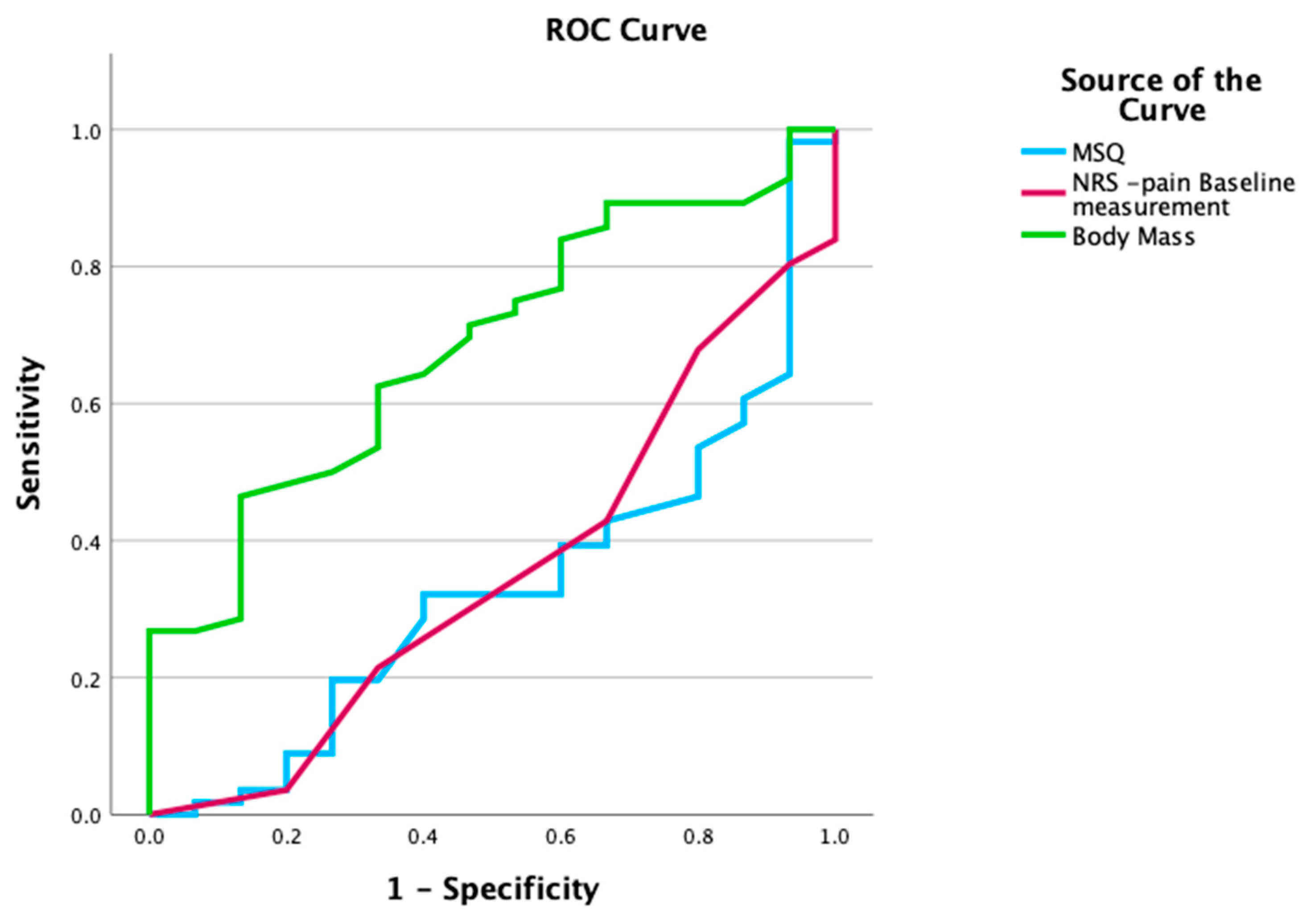
| BM | ≥76.5 | 0.867 (0.595–0.984) | 0.464 (0.323–0.603) | 1.62 (1.18–2.22) | 0.29 (0.08–1.08) | 0.683 | 0.010 | 0.543–0.823 |
| PI-NRS Baseline | ≤7.5 | 0.667 (0.384–0.882) | 0.571 (0.432–0.703) | 1.56 (0.97–2.49) | 0.58 (0.28–1.24) | 0.645 | 0.067 | 0.490–0.800 |
| MSQ | ≤42.5 | 0.800 (0.519–0.957) | 0.536 (0.397–0.670) | 1.72 (1.18–2.52) | 0.37 (0.13–1.06) | 0.667 | 0.029 | 0.517–0.818 |
| Variable | B | SE | Wald | df | p-Value | OR | 95% CI |
|---|---|---|---|---|---|---|---|
| BM ≥ 76.5 kg | −1.855 | 0.829 | 5.004 | 1 | 0.025 | 0.156 | 0.031–0.795 |
| MSQ ≤ 42.5 | −1.653 | 0.725 | 5.203 | 1 | 0.023 | 0.191 | 0.046–0.792 |
| Constant | −0.208 | 0.411 | 0.256 | 1 | 0.613 | 0.812 |
| Number of Predictive Variables | Sensitivity | Specificity | Positive Likelihood Ratio | Overall Proportion Correctly Classified | Probability of Success by Applying MT (PPV) | Improved Patients | Non-Improved Patients |
|---|---|---|---|---|---|---|---|
| 1 variable * | 0.536 (0.397–0.670) | 0.667 (0.384–0.882) | 1.61 (0.75–3.42) | 56.34% (44.05–68.09%) | 85.71% (73.80–92.74%) | 30 | 5 |
| Both variables | 0.237 (0.202–0.273) | 0.969 (0.929–0.99) | 7.58 (3.16–18.19) | 39.73% (36.16–43.38%) ** | 96.43% (91.84–98.48%) | 13 | 0 |
Disclaimer/Publisher’s Note: The statements, opinions and data contained in all publications are solely those of the individual author(s) and contributor(s) and not of MDPI and/or the editor(s). MDPI and/or the editor(s) disclaim responsibility for any injury to people or property resulting from any ideas, methods, instructions or products referred to in the content. |
© 2026 by the authors. Licensee MDPI, Basel, Switzerland. This article is an open access article distributed under the terms and conditions of the Creative Commons Attribution (CC BY) license.
Share and Cite
Kapernaros, E.; Moutzouri, M.; Krekoukias, G.; Chrysagis, N.; Koumantakis, G.A. Predictive Factors for Clinical Improvement Following a Manual Therapy-Based Program in Patients with Neck Pain: A Prescriptive Clinical Prediction Rule Derivation Study. Reports 2026, 9, 98. https://doi.org/10.3390/reports9020098
Kapernaros E, Moutzouri M, Krekoukias G, Chrysagis N, Koumantakis GA. Predictive Factors for Clinical Improvement Following a Manual Therapy-Based Program in Patients with Neck Pain: A Prescriptive Clinical Prediction Rule Derivation Study. Reports. 2026; 9(2):98. https://doi.org/10.3390/reports9020098
Chicago/Turabian StyleKapernaros, Emmanouil, Maria Moutzouri, Georgios Krekoukias, Nikolaos Chrysagis, and George A. Koumantakis. 2026. "Predictive Factors for Clinical Improvement Following a Manual Therapy-Based Program in Patients with Neck Pain: A Prescriptive Clinical Prediction Rule Derivation Study" Reports 9, no. 2: 98. https://doi.org/10.3390/reports9020098
APA StyleKapernaros, E., Moutzouri, M., Krekoukias, G., Chrysagis, N., & Koumantakis, G. A. (2026). Predictive Factors for Clinical Improvement Following a Manual Therapy-Based Program in Patients with Neck Pain: A Prescriptive Clinical Prediction Rule Derivation Study. Reports, 9(2), 98. https://doi.org/10.3390/reports9020098