
Article

Predictive Factors for Clinical Improvement Following a Manual Therapy-Based Program in Patients with Neck Pain: A Prescriptive Clinical Prediction Rule Derivation Study

by
Emmanouil Kapernaros
1,*,
Maria Moutzouri
1,2,
Georgios Krekoukias
1,2,
Nikolaos Chrysagis
1,2 and
George A. Koumantakis
1,2
1
Master’s Degree Program “New Methods in Physiotherapy”, Physiotherapy Department, School of Health & Care Sciences, University of West Attica (UNIWA), 12243 Athens, Greece
2
Laboratory of Advanced Physiotherapy, Physiotherapy Department, School of Health & Care Sciences, University of West Attica (UNIWA), 12243 Athens, Greece
*
Author to whom correspondence should be addressed.
Reports 2026, 9(2), 98; https://doi.org/10.3390/reports9020098
Submission received: 22 February 2026 / Revised: 15 March 2026 / Accepted: 23 March 2026 / Published: 26 March 2026
(This article belongs to the Section Orthopaedics/Rehabilitation/Physical Therapy)

Abstract

Background: The aim of this study was to derive and internally validate a prescriptive clinical prediction rule (CPR) for identifying baseline factors associated with short-term clinical improvement in patients with neck pain (NP) undergoing a manual therapy (MT)-based physiotherapy program. Methods: A prospective cohort study was conducted, including 71 patients with NP (18–65 years). Participants received six MT-based sessions over three weeks. Baseline assessments included Pain Intensity Numeric Rating Scale (PI-NRS), Neck Disability Index (NDI), Body Mass (BM), Body Mass Index (BMI), International Physical Activity Questionnaire-Short Form (IPAQ-SF), Hospital Anxiety and Depression Scale (HADS), Minnesota Satisfaction Questionnaire-Short Form (MSQ), and Craniovertebral Angle (CVA). Clinical improvement was defined using the Global Perceived Effect Scale (GPES-7). Univariate analyses, receiver operating characteristic (ROC) curve analysis, and forward stepwise logistic regression were performed to derive the predictive model. Results: Fifty-six participants (78.9%) reported moderate to complete improvement. BM ≥ 76.5 kg and MSQ score ≤ 42.5 were retained in the final regression model. When both predictors were present, the probability of clinical improvement increased to 96.43% (positive likelihood ratio = 7.58). The model demonstrated adequate fit (Nagelkerke R2 = 0.247; Hosmer–Lemeshow p = 0.804). Internal validation yielded an optimism-corrected AUC of 0.741, suggesting minimal overfitting. Conclusions: Higher BM and lower MSQ score were associated with greater short-term improvement following MT in patients with NP. These findings highlight the relevance of integrating physical and psychosocial factors in prescriptive rehabilitation approaches. External validation of this CPR is required before clinical implementation.

1. Background

Neck pain (NP) ranks as the fourth leading cause of disability worldwide, with a recurrence rate of approximately 50%, one year after its initial onset [1]. It presents with symptoms associated with multiple pathologies, with each patient having a unique presentation [2]. NP is categorized based on the duration of the symptoms (acute < 6 weeks, subacute 6 weeks–3 months, chronic > 3 months) [1], the mechanism of symptom onset (mechanical, nociceptive [1,3], non-specific [4], neuropathic [1], nociplastic [5], traumatic [4]), the location of the symptoms (centralized, non-centralized) [5,6,7], the severity (Grade 1–4) [8], and the recurrence pattern (single episode, recurrent, persistent) [8].
Various physical and demographic factors are associated with the development of NP, being more common in women compared to men [1,9,10], patients aged between 45 and 55 years [9], with a sedentary lifestyle [11,12], prolonged office or computer occupations, technical or healthcare professions [1], working for more than 6 h in a seated position [12,13], with previous neck injuries (traffic or sports trauma) [1], sleep disorders [14], increased BMI [13,15] or increased body mass (BM) [16]. Higher levels of physical activity (PA) provide protection [17] and prevention [13,18,19].
Psychological factors associated with NP include stress and psychological distress [20], anxiety [20], self-reported poor or moderate health perception [13], insufficient coping skills or strategies [9,21], kinesiphobia [21], catastrophizing [9], depression [21] and work-related factors (job stress, part-time employment, low satisfaction, unsupportive work environment) [1,12,15,20,22]. Additionally, socio-demographic factors such as smoking, increased family size, and low income [13] are linked to NP.
The variety of available treatments, combined with the limited and often conflicting evidence regarding their efficacy, presents significant challenges for healthcare professionals during the clinical reasoning process for managing NP [1]. By focusing on multiple factors that are predictive of a positive outcome of specific treatments while simultaneously matching patients’ goals, it not only improves their health outcomes, but it also reduces the socio-economic burden of NP through a patient-centered approach embedded within a biopsychosocial framework [23].
Manual therapy (MT) has been shown to reduce pain and improve functionality in patients with chronic, non-specific NP, compared to other interventions [24]. Manipulation techniques have demonstrated positive outcomes in managing chronic NP and disability [25], outperforming oral pharmaceutical treatments [26]. Moreover, the addition of exercise alongside mobilization techniques results in even better outcomes [27]. MT is believed to have three primary interaction mechanisms with the musculoskeletal system: (a) neurophysiological, (b) mechanical, and (c) psychological effects [28].
During the patient history and clinical evaluation, physiotherapists collect a wealth of information, which will be processed to design the optimal multimodal interventions, tailored to each patient [29]. Identifying subgroups of NP patients and categorizing them for rehabilitation based on their initial characteristics is recognized as a priority for improving management strategies [1,30]. Clinical prediction rules (CPRs) assist in categorizing patients according to their initial symptoms, enabling the selection of optimal clinical interventions based on the data obtained from the initial medical history and clinical evaluation [31,32].
CPRs can be classified as prognostic, identifying baseline factors associated with outcome within a given treatment, or prescriptive, identifying factors associated with the likelihood of successful response to a specific intervention [32,33]. The present study constitutes a prescriptive CPR derivation, identifying baseline characteristics associated with short-term improvement following an MT-based program.
The aim of this study was to develop and test the predictive ability of a prescriptive CPR in patients with NP based on the patients’ initial characteristics, following a six-session MT-based physiotherapy program over three weeks. The analysis was based on characteristics recorded before and after completing a physiotherapy program involving MT. Despite growing interest in prescriptive CPRs for neck pain, existing models have predominantly focused on biomechanical variables and have been derived in specific military or North American clinical settings, limiting their broader applicability. Furthermore, no prescriptive CPR has been developed for a multimodal MT-based program integrating psychosocial factors such as job satisfaction. This study aimed to address these gaps by developing a prescriptive CPR within a Greek clinical setting, contributing to the broader understanding of CPR applicability across different healthcare contexts.

2. Methods

2.1. Study Design

A prospective cohort study was conducted in a physiotherapy clinic located in the center of a major municipality in Attica, Greece. The study received approval from the Ethics Committee of the University of West Attica (UNIWA) (Approval No. 17778/11-03-2024), ensuring its design aligned with the principles of the Declaration of Helsinki.

2.2. Participants

Patients with NP (acute, subacute, or chronic stage) with centralized or non-centralized symptoms, aged 18–65, were included in the study. Patient history was taken according to IFOMPT guidelines [34] and previous studies that had administered MT in the cervical area [35,36]. Participants provided written informed consent before their inclusion. Complete anonymity was ensured, and all research data were encoded for statistical analysis.
The exclusion criteria used in this study are consistent with those applied in previous studies on MT for NP: (1) medical history of severe cervical pathology (osteoarthritis, rheumatoid arthritis, stenosis [10,37]); (2) non-musculoskeletal or non-psychological origin of symptoms; (3) history of cervical surgery or injury [38]; (4) osteoporosis [38]; (5) psychiatric disorders [38]; (6) history of tumors [10]; (7) pregnancy; (8) vascular; or (9) central nervous system pathologies [10,38]; (10) autoimmune diseases related to NP [38]; (11) inability to read and comprehend Greek [36]; (12) vertebrobasilar artery insufficiency or ligamentous instability of the upper cervical spine [10,38,39].

2.3. Patient-Reported Baseline Information

2.3.1. International Physical Activity Questionnaire-Short Form (IPAQ-SF)

To calculate self-reported physical activity levels, the short form of the IPAQ-SF was used. It assesses the frequency and duration (in minutes per day) of activities performed for more than 10 min at vigorous intensity, moderate intensity, walking, and sedentary behavior over the past seven days [40]. The Greek version is a reliable and valid tool for assessing physical activity, with strong correlations to treadmill performance and significant inter-rater and test–retest reliability [41].

2.3.2. Hospital Anxiety and Depression Scale (HADS)

HADS is a self-reported scale consisting of 14 items, with 7 questions each for assessing anxiety (HADS-A) and depression (HADS-D). Each item is scored on a 4-point scale, and the subscales yield scores ranging from 0 to 21, interpreted as: normal (0–7), mild anxiety/depression (8–10), moderate anxiety/depression (11–14), and severe anxiety/depression (15–21) [42]. It is translated and validated in Greek, shows strong internal consistency, test–retest reliability, structural validity, and high convergent validity with related measures [43].

2.3.3. Minnesota Satisfaction Questionnaire (MSQ)—Short Form

The MSQ-short form is a 20-item questionnaire that measures job satisfaction on a 5-point scale, where 1 represents “very dissatisfied,” and 5 represents “very satisfied.” The total score, calculated by summing the item scores, ranges from 20 to 100, with higher scores indicating greater job satisfaction [44]. It is a valid, quick, and easy self-report tool for healthcare professionals [44,45].

2.3.4. Baseline Disability

The Neck Disability Index (NDI) is a self-reported questionnaire comprising 10 items, each scored on a 6-point scale. The total score ranges from 0 to 50, with scores interpreted as follows: <4: no disability, 5–14: mild disability, 15–24: moderate disability, 25–34: severe disability, and >35: complete disability [46,47]. It is culturally adapted to Greek, reliably evaluates neck-related disability, and is sensitive to its severity and changes over time [46].

2.3.5. Baseline Pain Intensity

The pain intensity numeric rating scale (PI-NRS) was used to assess the average intensity of NP over the past week. It consists of 11 options, where “0” represents “no pain” and “10” indicates “the worst possible pain.” A significant change in pain intensity is defined as a reduction of 1.5 to 4.1 points, depending on the intervention and clinical cause of NP [48]. It is a valid and reliable tool for measuring neck pain intensity, with high ease of use, reliability, validity, and responsiveness [48,49].

2.4. Subjective and Objective Patient Assessment

The subjective assessment included mechanisms, location, and nature of symptoms, symptom onset time, provocation and alleviation factors, previous musculoskeletal issues, and patient beliefs regarding potential NP improvement.
The clinical assessment involved neurological screening and evaluation of the mechanical properties of the region (Spurling test, distraction test, upper limb neurodynamic tests). Additional assessments included tests for cruciate and transverse ligament integrity in the upper cervical region and vertebrobasilar artery insufficiency [39].

Photogrammetry: Forward Head Posture (FHP) in Seated Work Position

The craniovertebral angle (CVA), derived from the forward head posture (FHP), was assessed using the PostureScreen Mobile® application, version 13.7 (PostureCo Inc., Trinity, FL, USA) on a smartphone (iPhone, Apple Inc., Cupertino, CA, USA). The “Sit Screen” module was used by following a specific protocol from previous studies [50]. Although some disparity exists in the categorization of the range and severity of FHP, in the current study, CVA measurements were calculated from photographs of participants taken in simulated office work sitting positions, categorized as: normal (>53°), moderate FHP (52–46°), or severe deviation in FHP (<45°) [51]. This measure has previously demonstrated strong inter-rater and test–retest reliability [52].
Smaller CVA values indicate greater forward head displacement, which has been associated with increased mechanical load on the cervical spine, muscle imbalance, and higher risk of neck pain and disability [51,52]. The CVA has also demonstrated adequate criterion validity, with smaller angles correlating with greater forward head displacement as measured by gold-standard methods [52].

2.5. Outcome

Global Perceived Effect Scale (GPES-7)

Post-treatment clinical improvement was established according to the GPES-7. Patients completed the GPES-7 [53,54], a Likert scale frequently utilized in both research and clinical settings for musculoskeletal pathologies (Intraclass Correlation Coefficient (ICC) = 0.97), measuring clinical improvement during or after therapeutic interventions [53,54,55]. The GPES-7 has been cross-culturally adapted and validated in Greek, demonstrating excellent inter-rater reliability (k = 0.919, 95% Confidence Interval (CI): 83.3–92) [54].

2.6. Manual Therapy-Based Intervention

Patients included in the study received MT-based treatment using predefined methods tailored to each participant, based on a prior clinical assessment [35,38].
The intervention combined soft tissue techniques and mobilization (MT2), high velocity low amplitude thrust manipulation to the cervical and thoracic spine (MT1), and specific exercises, corresponding to an MT3 + exercise approach as defined by Hidalgo et al. [27].
The intervention protocol followed these steps [27]:
  • Soft Tissue Techniques: Performed in the prone or seated position, focusing on the cervical region (C1–T2), paraspinal areas, and muscles above the scapulae and clavicles for 5 min.
  • Passive and Active Movements: Passive neck movements (flexion, extension, lateral flexion, rotation, combined movements) targeting restricted directions, followed by active movements combined with mobilization techniques for 2 min each, in the supine or seated position.
  • Joint Techniques: Manipulations targeting restricted levels followed by mobilization for 2 min and traction at the disk level for 2 min, performed in the supine position.
  • Thoracic Spine Techniques: Manipulation techniques in the supine position were applied.
  • Rehabilitation Exercises: Isometric and posture retraining exercises in neutral and restricted positions (two contractions of 30 s each) were conducted in the supine and seated positions.
  • Stretching: Stretching of the scalene, levator scapulae, and upper trapezius muscles (one repetition for 30 s) was performed in the seated position.
  • Activities of Daily Living (ADL): Basic advice on ADL was provided, encouraging patients to maintain their usual activity levels if no symptom exacerbation occurred.
The entire intervention lasted 30–45 min. Although the intervention was standardized in structure, treatment techniques were adapted based on individual clinical findings, reflecting real-world physiotherapy practice.
Specifically, individualization was restricted to the anatomical level and side of dysfunction identified during clinical assessment (e.g., cervical level, direction of restriction), while the overall structure, sequence, and type of techniques remained identical across all participants. Patients were not consistently assigned to a single therapist; rather, treatment sessions were distributed among the four therapists based on appointment availability, which contributed to minimizing potential therapist-dependent effects. No systematic recording of the specific techniques applied per participant per session was performed.
The treatment was administered by the principal investigator with over 17 years of professional experience, and three physiotherapists, each with at least four years of experience in MT. Therapists were trained to apply only the specified treatment methods without being informed of the study’s purpose.

2.7. Procedures

Data were collected through clinical examinations, patient self-reports using validated Greek versions of the questionnaires, and photogrammetry conducted in a setting where only the patient and the examiner were present.
Assessments were conducted at two time points: (1) baseline (pre-treatment), during which all demographic data, patient-reported outcome measures (PI-NRS, NDI, IPAQ-SF, HADS, MSQ), and photogrammetry (CVA) were collected; and (2) post-treatment (following the sixth session, approximately after three weeks from the baseline measurement), during which PI-NRS, NDI, and GPES-7 were re-administered to evaluate changes and determine clinical improvement.
The selection of predictive factors (demographics, assessment data, and self-reported questionnaires) and outcome followed similar cohort studies aimed at developing CPRs for NP [56,57,58,59,60]. Self-reported questionnaire-based measures were predominantly selected, as they are considered valid prognostic tools for investigating improvement outcomes in patients with NP [61]. Sample size restrictions guided the optimal selection of patient characteristics for CPR development [62,63].
After the six treatments, repeat measurements were conducted to evaluate changes in pain intensity (PI-NRS) and disability (NDI), and patient satisfaction (GPES-7) [36,58,64].

2.8. Sample Size

The sample size calculation followed the empirical ratio of 1:10 for the required number of subjects per variable [36,62,63,64]. Although seven baseline variables were initially considered, only three met the univariate screening criterion, and two were retained in the final model.

2.9. Statistical Analysis

Statistical analysis was performed with IBM Statistical Package for the Social Sciences (SPSS), version 29 (IBM Corp., Armonk, NY, USA) [65], MedCalc (MedCalc’s Diagnostic Test Evaluation Calculator) [66], and R statistical software (v.4.5.3; R Core Team, 2025) [67]. Bootstrap validation of regression coefficients was performed in SPSS, and optimism-corrected AUC was estimated using the rms package in R [68].

2.9.1. Normality Testing

The Shapiro–Wilk test was applied to assess the normal distribution of quantitative variables [69]. The GPES-7 was used exclusively for dichotomization into ‘improved’ and ‘not improved’ groups; no parametric operations were applied to its raw scores, and no assumption of equal intervals was required [36,64]. Separate analysis was conducted for IPAQ-SF data due to missing responses (n = 15, 21.1% of the sample) [41]. Missing responses arose from items not meeting scoring criteria (activities <10 min, >180 min/day, or ‘don’t know’ responses) and were handled using complete-case analysis per standard IPAQ scoring guidelines. To assess whether missingness was associated with the primary outcome, a chi-square analysis comparing improvement rates between participants with and without complete IPAQ-SF data yielded no statistically significant association (χ2 = 1.370, df = 2, p = 0.504), supporting the assumption of missing at random.
Continuous numerical variables were presented as means ± standard deviations or medians (interquartile ranges), depending on whether they followed a normal distribution, while categorical variables were expressed as percentages.

2.9.2. Identifying Predictive Factors for MT-Based Intervention

Post-intervention data were dichotomized into two groups based on GPES-7 scores. Patients reporting scores of 1 (“fully recovered”) or 2 (“considerably improved”) were classified as improved. All other responses (scores ≥ 3) were classified as not improved [36,70,71].
The mean change in scores for pain and disability (including interquartile ranges) was calculated for both groups and analyzed using the Mann–Whitney U test to confirm differences between groups, as determined by GPES-7.
Univariate Analysis
Univariate analysis was performed using independent sample t-tests or Mann–Whitney U tests for continuous variables and chi-square tests (χ2) for categorical variables. Continuous variables with a significance level of p ≤ 0.1 were included in subsequent multivariate analysis to minimize the likelihood of excluding potential predictive factors [36,38,72,73,74].
Receiver Operating Characteristic (ROC) Curve Analysis
For continuous variables that showed significant univariate relationships, sensitivity and specificity were calculated for all potential cutoff points, and ROC curves were plotted [36,75,76]. The area under the curve (AUC) was computed to assess accuracy. The Youden Index was used to determine the optimal cutoff point for defining a positive test [77].
Confidence intervals and likelihood ratios were calculated using MedCalc, with continuity correction applied by adding 0.5 to cells with a value of zero [78].
Selection of Predictive Factors
Potential predictive variables identified through univariate analysis were entered into a forward stepwise binary logistic regression model to identify the most accurate and parsimonious set of variables for predicting the success of MT in improving clinical outcomes for NP patients [64]. A p-value < 0.05 was required for inclusion in the model, and variables with p > 0.10 were excluded.
The goodness of fit for the final regression model was assessed using the Hosmer-Lemeshow statistic [79]. The proportion of variance explained by the model was determined using Nagelkerke R2 [80]. The final model retained two predictors, yielding approximately 28 events per variable, which exceeded the commonly recommended threshold of 10, reducing the likelihood of model overfitting.
To further assess model stability, two internal validation procedures were performed: (a) bootstrap validation of regression coefficients using 1000 bootstrap samples with bias-corrected and accelerated (BCa) 95% confidence intervals (SPSS v.29), and (b) optimism-corrected c-statistic (AUC) using 1000 bootstrap samples via the validate() function of the rms package in R.

3. Results

Between February and August 2024, 83 patients were approached for study inclusion. Of these, 12 were excluded due to various reasons (rheumatic disease, refusal to participate, incomplete sessions), leaving a final sample of 71 participants (52 females).
All participants completed the questionnaires and photogrammetry measurements fully, except for some responses in the IPAQ-SF involving activities under 10 min or over 180 min per day, undefined durations, or “don’t know/not sure” selections [41].
Among the 71 patients, 56 (78.9%) reported improvement, while 15 (21.1%) did not. No patients reported worsening symptoms. The Mann–Whitney U tests revealed statistically significant differences in pain and disability improvement scores between the improved and non-improved groups, as defined by the GPES-7 (Table 1).
The descriptive statistics for the 71 participants and the univariate relationships of the 12 variables with the GPES-7 criteria were presented in Table 2. Continuous numerical variables were expressed as means ± standard deviations or medians (interquartile ranges), while categorical variables were expressed as percentages.
Univariate analysis identified BM, BMI, initial pain intensity (PI-NRS), and job satisfaction (MSQ) as predictive variables for improvement. However, BMI was excluded to avoid multicollinearity with BM. Consequently, three variables were retained for the final regression model.

3.1. ROC Curve Analysis

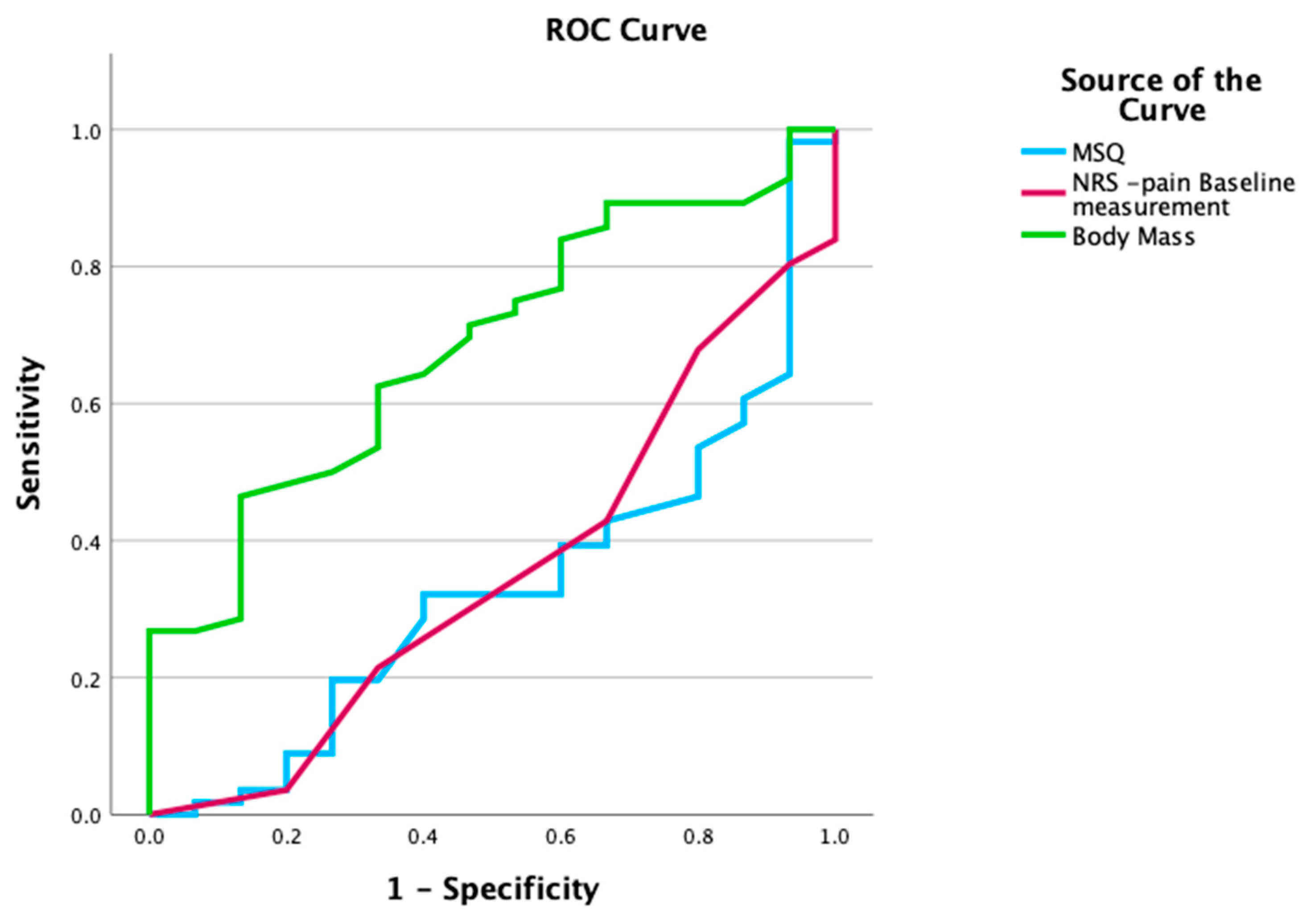
ROC curves were plotted for the three potential predictive factors to determine the cutoff points for defining positive tests as presented in Figure 1. The results of the statistical accuracy analysis for all three variables are summarized in Table 3.

3.2. Selection of Predictive Factors

The final binary logistic regression model, based on forward stepwise inclusion of variables, retained the variables BM ≥ 76.5 kg and MSQ ≤ 42.5. The statistical analysis of the model yielded a χ2 = 12.297 with df = 2 and p = 0.002, indicating that the model is statistically significant. The Nagelkerke R2 value of 0.247 suggests that the model explains approximately 24.7% of the variance in the dependent variable and demonstrated acceptable fit, as shown by the Hosmer–Lemeshow test χ2 = 0.437, p = 0.804, indicating that the model’s predictions align well with the observed data. The regression coefficients and accuracy statistics for the final model are presented in Table 4.
Bootstrap validation of regression coefficients (1000 BCa samples) confirmed the statistical significance of both retained predictors: BM ≥ 76.5 kg (B = 1.855, p = 0.013, BCa 95% CI: 0.078–21.187) and MSQ ≤ 42.5 (B = 1.653, p = 0.011, BCa 95% CI: −0.113–21.286). Optimism-corrected internal validation yielded an apparent AUC of 0.759, with an optimism estimate of 0.035 and an optimism-corrected AUC of 0.741, indicating minimal overfitting.
To further evaluate the association between BM and short-term improvement, baseline NDI and PI-NRS scores were compared between participants with BM ≥ 76.5 kg and those with BM < 76.5 kg using independent samples t-tests. No statistically significant differences were found (NDI: 13.04 ± 9.18 vs. 13.02 ± 6.22, p = 0.995; PI-NRS: 6.93 ± 1.68 vs. 7.23 ± 2.08, p = 0.519), suggesting that baseline symptom severity does not differ between BM groups.
The observed improvement rate (78.9%) was used as the pre-test probability to calculate post-test probabilities. Positive likelihood ratios and post-test probabilities were calculated for each level of the prediction model. The diagnostic performance of the MT success model is presented in Table 5. Diagnostic accuracy indices in Table 5 were calculated based on the logistic regression model classification table rather than the ROC-derived single-variable performance.

4. Discussion

The purpose of this study was to identify a subgroup of patients with neck pain (NP) based on their initial characteristics [29,32,81], who would exhibit short-term improvement following the application of MT, aiming to improve management strategies [1,30]. In physiotherapy, related studies are primarily conducted to develop prescriptive CPRs for musculoskeletal problems, by collecting factors from subjective and objective assessment [81], by studying their predictive value on clinical improvement in patients with a specific pathology and selected rehabilitation interventions [32,33,81].
A prescriptive CPR identifying baseline characteristics associated with clinical improvement may assist in targeted rehabilitation planning.
The identified factors predictive of improvement with MT were BM ≥ 76.5 kg and MSQ ≤ 42.5. The use of stepwise selection may increase the risk of overfitting and should therefore be interpreted cautiously. However, two internal validation procedures were subsequently performed: bootstrap validation of regression coefficients (1000 BCa samples) and optimism-corrected AUC estimation (1000 bootstrap samples). The optimism estimate was small (0.035), with an apparent AUC of 0.759 corrected to 0.741, suggesting minimal overfitting. Nevertheless, the derived model should be considered exploratory and hypothesis-generating, and external validation remains necessary.
When the 1-variable model (MSQ ≤ 42.5) was positive, sensitivity was 53.6%, and the positive likelihood ratio was 1.61, increasing the post-test probability of improvement to 85.71%. When both predictors were present (BM ≥ 76.5 kg and MSQ ≤ 42.5), specificity increased to 96.9%, the positive likelihood ratio increased to 7.58, and the post-test probability of improvement increased to 96.43%.
The GPES-7 was selected to dichotomize the sample because it reflects patients’ overall perception of improvement, rather than solely pain or disability measurements [54]. To avoid overestimating minor improvements, only patients reporting at least “considerable improvement” were classified as “improved” [64].
Increased BM could possibly be associated with neck pain, due to higher systemic inflammation, structural changes, mechanical loads, and reduced muscle strength [16]. Additionally, psychosocial issues and greater disability, including kinesiophobia, are prevalent in overweight and obese individuals [16]. Most patients in the study were overweight or obese (n = 41, 57.7%, with a mean BM of 75.38 kg). Although regression to the mean was considered as a possible explanation, given that individuals with higher BM may present with greater baseline impairment, comparison of baseline NDI and PI-NRS scores between BM groups revealed no statistically significant differences (NDI: p = 0.995; PI-NRS: p = 0.519). These findings do not support baseline severity as the primary explanatory mechanism. An alternative hypothesis is that higher BM may be associated with greater mechanical loading of the cervical spine, potentially rendering these patients more responsive to the biomechanical effects of MT [16]. However, the underlying mechanisms remain speculative, and formal mediation or interaction analysis is recommended in future studies with larger samples.
Workplace conditions may expose employees to various psychological factors that can significantly disrupt their mental and physical health [82]. Work-related stress, part-time employment, and low job satisfaction are recognized as contributors to the development of neck pain [12,20], as well as disability [1,15,22]. It is possible that patients with lower job satisfaction experience greater perceived improvement due to contextual or expectancy-related factors. Furthermore, job satisfaction has been identified as a significant independent predictor of musculoskeletal pain outcomes, beyond the variance explained by baseline pain and disability [83]. The causal pathways underlying this association require further investigation, and formal mediation analysis is recommended in future studies.
A marginal correlation was observed between PA and improvement following the application of MT. PA is expected to positively influence pain and disability and should likely result in statistically significant better outcomes in the rehabilitation of patients with NP [13,17,18,19]. This finding could stem from improper completion of the questionnaire by patients or the questionnaire’s inability to identify those aspects of PA that positively impact the cervical region [19,84,85,86].
Psychological factors (depression, anxiety) and the CVA did not predict improvement in NP patients following MT. These findings align with other studies [38,87]. Similarly, initial pain intensity was not selected, potentially due to a higher mean pain level in the current study [23], but also when compared to related studies [58,59,64,88].
MT encompasses a wide array of methods and approaches for addressing musculoskeletal pathologies. The type of intervention should be clearly defined to investigate the impact of each methodology on a specific population in each study [2,25,27].
Nine studies were identified in the literature investigating MT-based interventions for NP, aimed at developing a prescriptive CPR [35,36,38,56,57,58,59,60,64]. They demonstrate that identifying prognostic factors, including symptom duration, cervical range of motion, and pain intensity, may effectively guide treatment strategies [36,56,57]. Specifically, the use of combined criteria, such as positive responses to specific tests and pain severity, can accurately predict the success of interventions like thoracic and cervical mobilization [35,57] or mechanical cervical traction [64]. However, the heterogeneity in study populations, the absence of control groups, and small sample sizes limit the generalizability of these findings, as noted in related research [36,60]. Despite these limitations, these findings underscore the importance of well-designed predictive models in improving clinical decision-making and the effectiveness of interventions.
Unlike studies that emphasized biomechanical variables such as cervical range of motion [59,64], this study underscores the interplay of psychosocial elements, including job satisfaction, furthering the evidence for integrating a biopsychosocial framework in MT applications. Despite methodological differences, the findings collectively suggest that the potential value of personalized rehabilitation strategies, emphasizing the inclusion of both physical and psychological factors, lies in optimizing clinical outcomes in neck pain management.
Regarding the external validation of prescriptive CPRs for NP with MT-based therapy applications, just one study was found in the literature [89]; CPRs in primary healthcare, particularly for NP, often remain at the derivation stage and lack comprehensive validation and impact analysis, limiting their routine clinical applicability [33]. Medical personnel often exhibit a prevailing fear of missed diagnoses, reliance on personal clinical judgment, and sensitivity to patients’ beliefs, favoring further investigation and management of their condition, ultimately leading to the suboptimal use of CPRs [90].
Although the present prescriptive CPR is not yet validated for widespread clinical use, it provides a valuable framework for identifying potential predictive factors. Future studies should focus on its external validation to confirm its applicability and improve decision-making in physiotherapy practice. Furthermore, clinical trials with control groups are recommended over prospective cohort studies. This would allow a clearer examination of patient improvement due to the intervention being tested in relation to predictive factors [33].
Future CPR development studies should avoid convenience sampling to ensure results are robust and can be validated in subsequent studies. Additionally, these studies should adhere to strict external validity criteria and favor randomized controlled trial designs over prospective cohort studies to confirm that observed outcomes result from the interventions under investigation.
A notable limitation of this study is the reliance on a convenience sampling method, which may introduce response bias [91] and the influence of social desirability effects [92,93]. Additionally, the relatively small sample size restricts the generalizability of the findings. Although internal validation—including bootstrap confidence intervals and optimism-corrected AUC (corrected AUC = 0.741)—suggested minimal overfitting, the wide bootstrap confidence intervals for both predictors indicate estimation imprecision that warrants cautious interpretation. Furthermore, the lack of a control group means that the identified predictors cannot be confirmed as true treatment-effect modifiers specific to MT, as opposed to non-specific prognostic factors for improvement regardless of intervention. This is a recognized methodological limitation of single-arm prescriptive CPR derivation studies [33], and external validation using a randomized controlled design with an active comparator is required to establish the prescriptive validity of this rule.
Additionally, the specific manual therapy techniques applied to each participant were not systematically recorded per session, limiting the ability to examine technique-level effects. However, it should be noted that individualization of treatment was restricted to the anatomical level and side of dysfunction, while the overall structure and type of techniques remained standardized across all participants. Furthermore, potential therapist clustering effects were mitigated by the rotating assignment of patients among the four therapists throughout the study, which also allowed the principal investigator to observe treatment delivery indirectly. Formal clustering analysis was not performed, and future studies should consider multilevel modeling to account for potential therapist-dependent variability.
The emergence of BM and job satisfaction as predictors of short-term improvement following MT highlights the potential relevance of physical and psychosocial baseline characteristics in shaping treatment response. These findings support the clinical value of a biopsychosocial assessment approach, suggesting that factors beyond pain intensity and disability, such as occupational psychosocial burden, may influence patients’ responsiveness to MT-based interventions. While these observations require external validation before informing clinical decision-making, they underscore the importance of integrating both physical and psychosocial domains into the assessment and planning of MT-based rehabilitation for NP.
This study represents the derivation phase of a prescriptive CPR and should not be applied in routine clinical decision-making without external validation.

5. Conclusions

NP is a multifactorial condition, and rehabilitation programs should equally address physical and psychological factors. The reciprocal relationship between neck pain and disability underscores the need for a comprehensive approach.
Internal validation procedures, including bootstrap coefficient estimation and optimism-corrected AUC (0.741), provided preliminary evidence of model stability, supporting the exploratory value of these findings pending external validation.
BM and job satisfaction may play a crucial role in the rehabilitation of NP patients through MT-based interventions. This study adds to the growing evidence supporting the need for tailored rehabilitation approaches in NP patients, emphasizing the role of demographic and psychosocial factors. Future research should explore the integration of these factors in multidisciplinary care models.

Author Contributions

Conceptualization, E.K. and G.A.K.; methodology, E.K. and G.A.K.; investigation, E.K.; data curation, M.M., N.C. and G.K.; formal analysis, M.M., N.C. and G.K.; writing—original draft preparation, E.K.; writing—review and editing, G.A.K., M.M., N.C. and G.K.; supervision, G.A.K. All authors have read and agreed to the published version of the manuscript.

Funding

This research received no external funding.

Institutional Review Board Statement

The study was conducted in accordance with the Declaration of Helsinki and approved by the Ethics Committee of the University of West Attica (protocol code 17778 and date of approval 11 March 2024).

Informed Consent Statement

Informed consent was obtained from all subjects involved in the study.

Data Availability Statement

The data presented in this study are available from the corresponding author upon reasonable request. The data are not publicly available due to privacy and ethical restrictions.

Conflicts of Interest

The authors declare no conflicts of interest.

Abbreviations

The following abbreviations are used in this manuscript:
NPNeck Pain
CPRClinical Prediction Rule
PI-NRSPain Intensity Numeric Rating Scale
NDINeck Disability Index
BMBody Mass
BMIBody Mass Index
IPAQ-SFInternational Physical Activity Questionnaire-Short Form
HADSHospital Anxiety and Depression Scale
MSQMinnesota Satisfaction Questionnaire-Short Form
CVACraniovertebral Angle
GPES-7Global Perceived Effect Scale
PAPhysical Activity
MTManual Therapy
IFOMPTInternational Federation of Orthopaedic Manual Therapy
FHPForward Head Posture
ICCIntraclass Correlation Coefficient
CIConfidence Interval
ADLActivities of Daily Living
SPSSStatistical Package for the Social Sciences
ROCReceiver Operating Characteristic
AUCArea Under the Curve
PPVPositive Predictive Value
METMetabolic Equivalent
UNIWAUniversity of West Attica
BUnstandardized Regression Coefficient
SEStandard Error
OROdds Ratio

References

  1. Cohen, S.P. Epidemiology, diagnosis, and treatment of neck pain. Mayo Clin. Proc. 2015, 90, 284–299. [Google Scholar] [CrossRef]
  2. Wu, A.M.; Cross, M.; Elliott, J.M.; Culbreth, G.T.; Haile, L.M.; Steinmetz, J.D.; Hagins, H.; Kopec, J.A.; Brooks, P.M.; Woolf, A.D.; et al. Global, regional, and national burden of neck pain, 1990–2020, and projections to 2050: A systematic analysis of the Global Burden of Disease Study 2021. Lancet Rheumatol. 2024, 6, e142–e155. [Google Scholar] [CrossRef]
  3. Liu, R.; Kurihara, C.; Tsai, H.; Silvestri, P.J.; Bennett, M.I.; Pasquina, P.F.; Cohen, S.P. Classification and treatment of chronic neck pain: A longitudinal cohort study. Reg. Anesth. Pain Med. 2017, 42, 52–61. [Google Scholar] [CrossRef] [PubMed]
  4. Binder, A.I. Neck pain. BMJ Clin. Evid. 2008, 2008, 1103. [Google Scholar] [PubMed]
  5. Kaplan, C.M.; Kelleher, E.; Irani, A.; Schrepf, A.; Clauw, D.J.; Harte, S.E. Deciphering nociplastic pain: Clinical features, risk factors and potential mechanisms. Nat. Rev. Neurol. 2024, 20, 347–363. [Google Scholar] [CrossRef]
  6. Malanga, G.A. The diagnosis and treatment of cervical radiculopathy. Med. Sci. Sports Exerc. 1997, 29, S236–S245. [Google Scholar] [CrossRef]
  7. Yarznbowicz, R.; Wlodarski, M.; Dolutan, J. Classification by pain pattern for patients with cervical spine radiculopathy. J. Man. Manip. Ther. 2020, 28, 160–169. [Google Scholar] [CrossRef]
  8. Guzman, J.; Hurwitz, E.L.; Carroll, L.J.; Haldeman, S.; Côté, P.; Carragee, E.J.; Peloso, P.M.; van der Velde, G.; Holm, L.W.; Hogg-Johnson, S.; et al. A new conceptual model of neck pain: Linking onset, course, and care: The Bone and Joint Decade 2000–2010 Task Force on Neck Pain and Its Associated Disorders. Spine 2008, 33, S14–S23. [Google Scholar] [CrossRef]
  9. Kazeminasab, S.; Nejadghaderi, S.A.; Amiri, P.; Pourfathi, H.; Araj-Khodaei, M.; Sullman, M.J.M.; Kolahi, A.A.; Safiri, S. Neck pain: Global epidemiology, trends and risk factors. BMC Musculoskelet. Disord. 2022, 23, 26. [Google Scholar] [CrossRef]
  10. Peters, R.; Mutsaers, B.; Verhagen, A.P.; Koes, B.W.; Pool-Goudzwaard, A.L. Prospective cohort study of patients with neck pain in a manual therapy setting: Design and baseline measures. J. Manip. Physiol. Ther. 2019, 42, 471–479. [Google Scholar] [CrossRef] [PubMed]
  11. Mazaheri-Tehrani, S.; Arefian, M.; Abhari, A.P.; Riahi, R.; Vahdatpour, B.; Baradaran Mahdavi, S.; Kelishadi, R. Sedentary behavior and neck pain in adults: A systematic review and meta-analysis. Prev. Med. 2023, 175, 107711. [Google Scholar] [CrossRef]
  12. Chen, X.; O’Leary, S.; Johnston, V. Modifiable individual and work-related factors associated with neck pain in 740 office workers: A cross-sectional study. Braz. J. Phys. Ther. 2018, 22, 318–327. [Google Scholar] [CrossRef] [PubMed]
  13. Kim, R.; Wiest, C.; Clark, K.; Cook, C.; Horn, M. Identifying risk factors for first-episode neck pain: A systematic review. Musculoskelet. Sci. Pract. 2018, 33, 77–83. [Google Scholar] [CrossRef]
  14. Van Looveren, E.; Bilterys, T.; Munneke, W.; Cagnie, B.; Ickmans, K.; Mairesse, O.; Malfliet, A.; De Baets, L.; Nijs, J.; Goubert, D.; et al. The association between sleep and chronic spinal pain: A systematic review from the last decade. J. Clin. Med. 2021, 10, 3836. [Google Scholar] [CrossRef]
  15. Sihawong, R.; Sitthipornvorakul, E.; Paksaichol, A.; Janwantanakul, P. Predictors for chronic neck and low back pain in office workers: A 1-year prospective cohort study. J. Occup. Health 2016, 58, 16–24. [Google Scholar] [CrossRef]
  16. Vincent, H.K.; Adams, M.C.B.; Vincent, K.R.; Hurley, R.W. Musculoskeletal pain, fear avoidance behaviors, and functional decline in obesity: Potential interventions to manage pain and maintain function. Reg. Anesth. Pain Med. 2013, 38, 481–491. [Google Scholar] [CrossRef]
  17. Palmer, K.L.; Shivgulam, M.E.; Champod, A.S.; Wilson, B.C.; O’Brien, M.W.; Bray, N.W. Exercise training augments brain function and reduces pain perception in adults with chronic pain: A systematic review of intervention studies. Neurobiol. Pain 2023, 13, 100129. [Google Scholar] [CrossRef]
  18. Ireland, J.; Window, P.; O’Leary, S.P. The impact of exercise intended for fitness or sport on the prevalence of non-specific neck pain in adults: A systematic review. Musculoskelet. Care 2022, 20, 229–244. [Google Scholar] [CrossRef]
  19. Cheung, J.; Kajaks, T.; MacDermid, J.C. The relationship between neck pain and physical activity. Open Orthop. J. 2013, 7, 521–529. [Google Scholar] [CrossRef] [PubMed]
  20. Mansfield, M.; Thacker, M.; Taylor, J.L.; Bannister, K.; Spahr, N.; Jong, S.T.; Smith, T. The association between psychosocial factors and mental health symptoms in cervical spine pain with or without radiculopathy on health outcomes: A systematic review. BMC Musculoskelet. Disord. 2023, 24, 235. [Google Scholar] [CrossRef] [PubMed]
  21. Moon, K.Y.; Shin, D.C. Correlation between psychosocial stresses, stress coping ability, pain intensity and degree of disability in patients with non-specific neck pain. Physiol. Behav. 2024, 275, 114433. [Google Scholar] [CrossRef]
  22. Cote, P.; van der Velde, G.; Cassidy, J.D.; Carroll, L.J.; Hogg-Johnson, S.; Holm, L.W.; Carragee, E.J.; Haldeman, S.; Nordin, M.; Hurwitz, E.L.; et al. The burden and determinants of neck pain in workers: Results of the Bone and Joint Decade 2000–2010 Task Force on Neck Pain and Its Associated Disorders. Spine 2008, 33, S60–S74. [Google Scholar] [CrossRef]
  23. Gerard, T.; Naye, F.; Decary, S.; Langevin, P.; Cook, C.; Hutting, N.; Martel, M.; Tousignant-Laflamme, Y. Prognostic factors of pain, disability, and poor outcomes in persons with neck pain—An umbrella review. Clin. Rehabil. 2024, 38, 1658–1676. [Google Scholar] [CrossRef] [PubMed]
  24. Coulter, I.D.; Crawford, C.; Vernon, H.; Hurwitz, E.L.; Khorsan, R.; Booth, M.S.; Herman, P.M. Manipulation and mobilization for treating chronic nonspecific neck pain: A systematic review and meta-analysis for an appropriateness panel. Pain Physician 2019, 22, E55–E70. [Google Scholar] [CrossRef]
  25. Liu, Z.; Shi, J.; Huang, Y.; Zhou, X.; Huang, H.; Wu, H.; Lv, L.; Lv, Z. A systematic review and meta-analysis of randomized controlled trials of manipulative therapy for patients with chronic neck pain. Complement. Ther. Clin. Pract. 2023, 52, 101751. [Google Scholar] [CrossRef] [PubMed]
  26. Makin, J.; Watson, L.; Pouliopoulou, D.V.; Laframboise, T.; Gangloff, B.; Sidhu, R.; Sadi, J.; Parikh, P.; Gross, A.; Langevin, P.; et al. Effectiveness and safety of manual therapy when compared with oral pain medications in patients with neck pain: A systematic review and meta-analysis. BMC Sports Sci. Med. Rehabil. 2024, 16, 86. [Google Scholar] [CrossRef]
  27. Hidalgo, B.; Hall, T.; Bossert, J.; Dugeny, A.; Cagnie, B.; Pitance, L. The efficacy of manual therapy and exercise for treating non-specific neck pain: A systematic review. J. Back Musculoskelet. Rehabil. 2017, 30, 1149–1169. [Google Scholar] [CrossRef] [PubMed]
  28. Gross, A.; Langevin, P.; Burnie, S.J.; Bédard-Brochu, M.S.; Empey, B.; Dugas, E.; Faber-Dobrescu, M.; Andres, C.; Graham, N.; Goldsmith, C.H.; et al. Manipulation and mobilisation for neck pain contrasted against an inactive control or another active treatment. Cochrane Database Syst. Rev. 2015, 2015, CD004249. [Google Scholar] [CrossRef]
  29. Bier, J.D.; Scholten-Peeters, W.G.M.; Staal, J.B.; Pool, J.; van Tulder, M.W.; Beekman, E.; Knoop, J.; Meerhoff, G.; Verhagen, A.P. Clinical practice guideline for physical therapy assessment and treatment in patients with nonspecific neck pain. Phys. Ther. 2018, 98, 162–171. [Google Scholar] [CrossRef]
  30. Foster, N.E.; Dziedzic, K.S.; van der Windt, D.A.W.D.; Fritz, J.M.; Hay, E.M. Research priorities for non-pharmacological therapies for common musculoskeletal problems: Nationally and internationally agreed recommendations. BMC Musculoskelet. Disord. 2009, 10, 3. [Google Scholar] [CrossRef]
  31. McGinn, T.G.; Guyatt, G.H.; Wyer, P.C.; Naylor, C.D.; Stiell, I.G.; Richardson, W.S. Users’ guides to the medical literature XXII: How to use articles about clinical decision rules. JAMA 2000, 284, 79–84. [Google Scholar] [CrossRef]
  32. Beattie, P.; Nelson, R. Clinical prediction rules: What are they and what do they tell us? Aust. J. Physiother. 2006, 52, 157–163. [Google Scholar] [CrossRef]
  33. Kelly, J.; Ritchie, C.; Sterling, M. Clinical prediction rules for prognosis and treatment prescription in neck pain: A systematic review. Musculoskelet. Sci. Pract. 2017, 27, 155–164. [Google Scholar] [CrossRef]
  34. Rushton, A.; Beeton, K.; Jordaan, R.; Langendoen, J.; Levesque, L.; Maffey, L.; Pool, J. IFOMPT Educational Standards in Orthopaedic Manipulative Therapy; IFOMPT: Auckland, New Zealand, 2016. [Google Scholar]
  35. Puentedura, E.J.; Cleland, J.A.; Landers, M.R.; Mintken, P.; Louw, A.; Fernández-De-Las-Peñas, C. Development of a clinical prediction rule to identify patients with neck pain likely to benefit from thrust joint manipulation to the cervical spine. J. Orthop. Sports Phys. Ther. 2012, 42, 577–592. [Google Scholar] [CrossRef] [PubMed]
  36. Raney, N.H.; Petersen, E.J.; Smith, T.A.; Cowan, J.E.; Rendeiro, D.G.; Deyle, G.D.; Childs, J.D. Development of a clinical prediction rule to identify patients with neck pain likely to benefit from cervical traction and exercise. Eur. Spine J. 2009, 18, 382–391. [Google Scholar] [CrossRef] [PubMed]
  37. de Best, R.F.; Coppieters, M.W.; van Trijffel, E.; Compter, A.; Uyttenboogaart, M.; Bot, J.C.; Castien, R.; Pool, J.J.; Cagnie, B.; Scholten-Peeters, G.G. Risk assessment of vascular complications following manual therapy and exercise for the cervical region: Diagnostic accuracy of the International Federation of Orthopaedic Manipulative Physical Therapists framework (The Go4Safe project). J. Physiother. 2023, 69, 260–266. [Google Scholar] [CrossRef] [PubMed]
  38. Tseng, Y.L.; Wang, W.T.J.; Chen, W.Y.; Hou, T.J.; Chen, T.C.; Lieu, F.K. Predictors for the immediate responders to cervical manipulation in patients with neck pain. Man. Ther. 2006, 11, 306–315. [Google Scholar] [CrossRef]
  39. Feng, T.; Bu, H.; Wang, X.; Zhu, L.; Wei, X. Interpretation of key points of international framework for examination of the cervical region for potential of vascular pathologies of the neck prior to orthopaedic manual therapy (OMT) intervention: International IFOMPT cervical framework. Chin. J. Tissue Eng. Res. 2024, 28, 1420–1425. [Google Scholar] [CrossRef]
  40. Lee, M.K.; Oh, J. The relationship between sleep quality, neck pain, shoulder pain and disability, physical activity, and health perception among middle-aged women: A cross-sectional study. BMC Womens Health 2022, 22, 122. [Google Scholar] [CrossRef]
  41. Papathanasiou, G.; Georgoudis, G.; Papandreou, M.; Spyropoulos, P.; Georgakopoulos, D.; Kalfakakou, V.; Evangelou, A. Reliability measures of the short International Physical Activity Questionnaire (IPAQ) in Greek young adults. Hell. J. Cardiol. 2009, 50, 283–294. [Google Scholar]
  42. Schmitt, M.A.; Van Meeteren, N.L.; De Wijer, A.; Van Genderen, F.R.; Van Graaf, Y.D.; Helders, P.J. Patients with chronic whiplash-associated disorders: Relationship between clinical and psychological factors and functional health status. Am. J. Phys. Med. Rehabil. 2009, 88, 231–238. [Google Scholar] [CrossRef]
  43. Michopoulos, I.; Douzenis, A.; Kalkavoura, C.; Christodoulou, C.; Michalopoulou, P.; Kalemi, G.; Fineti, K.; Patapis, P.; Protopapas, K.; Lykouras, L. Hospital Anxiety and Depression Scale (HADS): Validation in a Greek general hospital sample. Ann. Gen. Psychiatry 2008, 7, 4. [Google Scholar] [CrossRef] [PubMed]
  44. Lakatamitou, I.; Lambrinou, E.; Kyriakou, M.; Paikousis, L.; Middleton, N. The Greek versions of the TeamSTEPPS teamwork perceptions questionnaire and Minnesota satisfaction questionnaire “short form”. BMC Health Serv. Res. 2020, 20, 587. [Google Scholar] [CrossRef]
  45. Kolovou, A. Comparative study of the professional satisfaction of employees working in welfare institutions using three different questionnaires. Hell. J. Nurs. Sci. 2020, 13, 20–28. [Google Scholar] [CrossRef]
  46. Beltran-Alacreu, H.; López-de-Uralde-Villanueva, I.; Calvo-Lobo, C.; La Touche, R.; Cano-de-la-cuerda, R.; Gil-Martínez, A.; Fernández-Ayuso, D.; Fernández-Carnero, J. Prediction models of health-related quality of life in different neck pain conditions: A cross-sectional study. Patient Prefer. Adherence 2018, 12, 657–666. [Google Scholar] [CrossRef]
  47. Trouli, M.N.; Vernon, H.T.; Kakavelakis, K.N.; Antonopoulou, M.D.; Paganas, A.N.; Lionis, C.D. Translation of the Neck Disability Index and validation of the Greek version in a sample of neck pain patients. BMC Musculoskelet. Disord. 2008, 9, 106. [Google Scholar] [CrossRef]
  48. Modarresi, S.; Lukacs, M.J.; Ghodrati, M.; Salim, S.; MacDermid, J.C.; Walton, D.M. A systematic review and synthesis of psychometric properties of the numeric pain rating scale and the visual analog scale for use in people with neck pain. Clin. J. Pain 2022, 38, 132–148. [Google Scholar] [CrossRef]
  49. Hjermstad, M.J.; Fayers, P.M.; Haugen, D.F.; Caraceni, A.; Hanks, G.W.; Loge, J.H.; Fainsinger, R.; Aass, N.; Kaasa, S. Studies comparing numerical rating scales, verbal rating scales, and visual analogue scales for assessment of pain intensity in adults: A systematic literature review. J. Pain Symptom Manag. 2011, 41, 1073–1093. [Google Scholar] [CrossRef]
  50. Boland, D.M.; Neufeld, E.V.; Ruddell, J.; Dolezal, B.A.; Cooper, C.B. Inter- and intra-rater agreement of static posture analysis using a mobile application. J. Phys. Ther. Sci. 2016, 28, 3398–3402. [Google Scholar] [CrossRef]
  51. Titcomb, D.A.; Melton, B.F.; Bland, H.W.; Miyashita, T. Evaluation of the craniovertebral angle in standing versus sitting positions in young adults with and without severe forward head posture. Int. J. Exerc. Sci. 2024, 17, 73–85. [Google Scholar] [CrossRef]
  52. Szucs, K.A.; Brown, E.V.D. Rater reliability and construct validity of a mobile application for posture analysis. J. Phys. Ther. Sci. 2018, 30, 31–36. [Google Scholar] [CrossRef] [PubMed]
  53. Evans, R.; Bronfort, G.; Maiers, M.; Schulz, C.; Hartvigsen, J. “I know it’s changed”: A mixed-methods study of the meaning of global perceived effect in chronic neck pain patients. Eur. Spine J. 2014, 23, 888–897. [Google Scholar] [CrossRef]
  54. Kontakiotis, N.; Gioftsos, G. Translation into Greek, cross-cultural adaptation and test-retest reliability of the global perceived effect scale for use with patients with sciatica: A quick clinical tool for evaluating progress after treatment. Arch. Hell. Med. 2022, 39, 381–387. [Google Scholar]
  55. Kamper, S.J.; Ostelo, R.W.J.G.; Knol, D.L.; Maher, C.G.; de Vet, H.C.W.; Hancock, M.J. Global perceived effect scales provided reliable assessments of health transition in people with musculoskeletal disorders, but ratings are strongly influenced by current status. J. Clin. Epidemiol. 2010, 63, 760–766.e1. [Google Scholar] [CrossRef]
  56. Fernández-Carnero, J.; Beltrán-Alacreu, H.; Arribas-Romano, A.; Cerezo-Téllez, E.; Cuenca-Zaldivar, J.N.; Sánchez-Romero, E.A.; Lerma Lara, S.; Villafañe, J.H. Prediction of patient satisfaction after treatment of chronic neck pain with Mulligan’s mobilization. Life 2023, 13, 48. [Google Scholar] [CrossRef] [PubMed]
  57. Cleland, J.A.; Childs, J.D.; Fritz, J.M.; Whitman, J.M.; Eberhart, S.L. Development of a clinical prediction rule for guiding treatment of a subgroup of patients with neck pain: Use of thoracic spine manipulation, exercise, and patient education. Phys. Ther. 2007, 87, 9–23. [Google Scholar] [CrossRef]
  58. Myhrvold, B.L.; Kongsted, A.; Irgens, P.; Robinson, H.S.; Vøllestad, N.K. The association between different outcome measures and prognostic factors in patients with neck pain: A cohort study. BMC Musculoskelet. Disord. 2022, 23, 586. [Google Scholar] [CrossRef]
  59. Saavedra-Hernández, M.; Castro-Sánchez, A.M.; Fernández-De-Las-Peñas, C.; Cleland, J.A.; Ortega-Santiago, R.; Arroyo-Morales, M. Predictors for identifying patients with mechanical neck pain who are likely to achieve short-term success with manipulative interventions directed at the cervical and thoracic spine. J. Manip. Physiol. Ther. 2011, 34, 144–152. [Google Scholar] [CrossRef]
  60. Schellingerhout, J.M.; Verhagen, A.P.; Heymans, M.W.; Pool, J.J.M.; Vonk, F.; Koes, B.W.; de Vet, H.C.W. Which subgroups of patients with non-specific neck pain are more likely to benefit from spinal manipulation therapy, physiotherapy, or usual care? Pain 2008, 139, 670–680. [Google Scholar] [CrossRef]
  61. Walton, D.M. An overview of systematic reviews on prognostic factors in neck pain: Results from the International Collaboration on Neck Pain (ICON) project. Open Orthop. J. 2013, 7, 494–505. [Google Scholar] [CrossRef] [PubMed]
  62. Austin, P.C.; Steyerberg, E.W. The number of subjects per variable required in linear regression analyses. J. Clin. Epidemiol. 2015, 68, 627–636. [Google Scholar] [CrossRef]
  63. Childs, J.D.; Cleland, J.A. Development and application of clinical prediction rules to improve decision making in physical therapist practice. Phys. Ther. 2006, 86, 122–131. [Google Scholar] [CrossRef]
  64. Cai, C.; Ming, G.; Ng, L.Y. Development of a clinical prediction rule to identify patients with neck pain who are likely to benefit from home-based mechanical cervical traction. Eur. Spine J. 2011, 20, 912–922. [Google Scholar] [CrossRef]
  65. IBM Corp. IBM SPSS Statistics for Mac, version 29.0; IBM Corp.: Armonk, NY, USA, 2022.
  66. MedCalc Software Ltd. MedCalc’s Diagnostic Test Evaluation Calculator. Available online: https://www.medcalc.org/calc/diagnostic_test.php (accessed on 1 August 2024).
  67. R Core Team. R: A Language and Environment for Statistical Computing; R Foundation for Statistical Computing: Vienna, Austria, 2025; Available online: https://www.R-project.org/ (accessed on 1 October 2024).
  68. Harrell, F.E. rms: Regression Modeling Strategies, R package version 6.8; 2024. Available online: https://CRAN.R-project.org/package=rms (accessed on 1 October 2024).
  69. Ghasemi, A.; Zahediasl, S. Normality tests for statistical analysis: A guide for non-statisticians. Int. J. Endocrinol. Metab. 2012, 10, 486–489. [Google Scholar] [CrossRef]
  70. Akkarakittichoke, N.; Janwantanakul, P.; Kanlayanaphotporn, R.; Jensen, M.P. Responsiveness of the UW Concerns about Pain Scale and UW Pain-Related Self-Efficacy Scale in individuals with chronic low back pain. Clin. J. Pain 2022, 38, 476–483. [Google Scholar] [CrossRef]
  71. Heidemann, C.H.; Godballe, C.; Kjeldsen, A.D.; Johansen, E.C.J.; Faber, C.E.; Lauridsen, H.H. Otitis media and caregiver quality of life: Psychometric properties of the modified Danish version of the caregiver impact questionnaire. Otolaryngol. Head Neck Surg. 2014, 151, 142–149. [Google Scholar] [CrossRef]
  72. Freedman, D.A. A note on screening regression equations. Am. Stat. 1983, 37, 152–155. [Google Scholar] [CrossRef]
  73. Daher, A.; Carel, R.S.; Dar, G. Neck pain clinical prediction rule to prescribe combined aerobic and neck-specific exercises: Secondary analysis of a randomized controlled trial. Phys. Ther. 2022, 102, pzab269. [Google Scholar] [CrossRef] [PubMed]
  74. De Pauw, R.; Kregel, J.; De Blaiser, C.; Van Akeleyen, J.; Logghe, T.; Danneels, L.; Cagnie, B. Identifying prognostic factors predicting outcome in patients with chronic neck pain after multimodal treatment: A retrospective study. Man. Ther. 2015, 20, 592–597. [Google Scholar] [CrossRef]
  75. Deyo, R.A.; Centor, R.M. Assessing the responsiveness of functional scales to clinical change. J. Chronic Dis. 1986, 39, 897–906. [Google Scholar] [CrossRef] [PubMed]
  76. Nahm, F.S. Receiver operating characteristic curve: Overview and practical use for clinicians. Korean J. Anesthesiol. 2022, 75, 25–36. [Google Scholar] [CrossRef] [PubMed]
  77. Fluss, R.; Faraggi, D.; Reiser, B. Estimation of the Youden Index and its associated cutoff point. Biom. J. 2005, 47, 458–472. [Google Scholar] [CrossRef]
  78. Armitage, P.; Berry, G.; Matthews, J.N.S. Statistical Methods in Medical Research, 4th ed.; Blackwell Science: Oxford, UK, 2002. [Google Scholar]
  79. Hosmer, D.W.; Lemeshow, S.; Sturdivant, R.X. Applied Logistic Regression, 3rd ed.; Wiley: Hoboken, NJ, USA, 2013; ISBN 978-0-470-58247-3. [Google Scholar]
  80. Nagelkerke, N.J.D. A note on a general definition of the coefficient of determination. Biometrika 1991, 78, 691–692. [Google Scholar] [CrossRef]
  81. Walsh, M.E.; French, H.P.; Wallace, E.; Madden, S.; King, P.; Fahey, T.; Galvin, R. Existing validated clinical prediction rules for predicting response to physiotherapy interventions for musculoskeletal conditions have limited clinical value: A systematic review. J. Clin. Epidemiol. 2021, 135, 90–102. [Google Scholar] [CrossRef] [PubMed]
  82. Seidler, A.; Schubert, M.; Freiberg, A.; Drössler, S.; Hussenoeder, F.S.; Conrad, I.; Riedel-Heller, S.; Romero Starke, K. Psychosocial occupational exposures and mental illness—A systematic review with meta-analyses. Dtsch. Arztebl. Int. 2022, 119, 709–715. [Google Scholar] [CrossRef]
  83. Bigos, S.J.; Battié, M.C.; Spengler, D.M.; Fisher, L.D.; Fordyce, W.E.; Hansson, T.H.; Nachemson, A.L.; Wortley, M.D. A prospective study of work perceptions and psychosocial factors affecting the report of back injury. Spine 1991, 16, 1–6. [Google Scholar] [CrossRef]
  84. Riegel, G.R.; Martins, G.B.; Schmidt, A.G.; Rodrigues, M.P.; Nunes, G.S.; Correa, V.; Fuchs, S.C.; Fuchs, F.D.; Ribeiro, P.A.; Moreira, L.B. Self-reported adherence to physical activity recommendations compared to the IPAQ interview in patients with hypertension. Patient Prefer. Adherence 2019, 13, 209–214. [Google Scholar] [CrossRef]
  85. Luo, J.; Lee, R.Y.W. Opposing patterns in self-reported and measured physical activity levels in middle-aged adults. Eur. J. Ageing 2022, 19, 567–573. [Google Scholar] [CrossRef]
  86. Ludvigsson, M.L.; Peterson, G.; Dedering, Å.; Peolsson, A. One- and two-year follow-up of a randomized trial of neck-specific exercise with or without a behavioural approach compared with prescription of physical activity in chronic whiplash disorder. J. Rehabil. Med. 2016, 48, 56–64. [Google Scholar] [CrossRef]
  87. Hwang, U.J.; Kwon, O.Y.; Kim, J.H. Unsupervised machine learning for clustering forward head posture, protraction and retraction movement patterns based on craniocervical angle data in individuals with nonspecific neck pain. BMC Musculoskelet. Disord. 2024, 25, 112. [Google Scholar] [CrossRef]
  88. Wingbermühle, R.W.; Chiarotto, A.; van Trijffel, E.; Koes, B.; Verhagen, A.P.; Heymans, M.W. Development and internal validation of prognostic models for recovery in patients with non-specific neck pain presenting in primary care. Physiotherapy 2021, 113, 61–72. [Google Scholar] [CrossRef] [PubMed]
  89. Cleland, J.A.; Mintken, P.E.; Carpenter, K.; Fritz, J.M.; Glynn, P.; Whitman, J.; Childs, J.D. Examination of a clinical prediction rule to identify patients with neck pain likely to benefit from thoracic spine thrust manipulation and a general cervical range of motion exercise: Multi-center randomized clinical trial. Phys. Ther. 2010, 90, 1239–1250. [Google Scholar] [CrossRef] [PubMed]
  90. Wallace, E.; Uijen, M.J.M.; Clyne, B.; Zarabzadeh, A.; Keogh, C.; Galvin, R.; Smith, S.M.; Fahey, T. Impact analysis studies of clinical prediction rules relevant to primary care: A systematic review. BMJ Open 2016, 6, e009957. [Google Scholar] [CrossRef]
  91. Edgar, T.W.; Manz, D.O. Exploratory study. In Research Methods for Cyber Security; Elsevier: Amsterdam, The Netherlands, 2017; pp. 95–130. [Google Scholar] [CrossRef]
  92. Chen, S.W.; Keglovits, M.; Devine, M.; Stark, S. Sociodemographic differences in respondent preferences for survey formats: Sampling bias and potential threats to external validity. Arch. Rehabil. Res. Clin. Transl. 2022, 4, 100175. [Google Scholar] [CrossRef]
  93. Szolnoki, G.; Hoffmann, D. Online, face-to-face and telephone surveys—Comparing different sampling methods in wine consumer research. Wine Econ. Policy 2013, 2, 57–66. [Google Scholar] [CrossRef]
Figure 1. ROC curves for the three variables with statistically significant univariate association with clinical improvement: BM, PI-NRS, and MSQ. The AUC reflects the discriminative ability of each variable, with optimal cut-off points determined using the Youden Index. For PI-NRS and MSQ, 1-AUC was applied due to the reversed direction of prediction.
Reports 09 00098 g001
Table 1. Patient-reported clinical improvement GPES-7 (n = 71).
Patient Perceptionn (%)Dichotomization n (%)PI-NRS ChangeNDI Change
Fully recovered
Considerable improvement
Slight improvement
No change
17 (23.9%)
39 (54.9%)
12 (16.9%)
3 (4.2%)
56 (78.9%)
Improved
3.73 (3–5)
p < 0.001
6.58 (3–10)
p = 0.007
15 (21.1%)
Not improved
Table 2. Univariate analysis comparisons of demographic data, self-report clinical status questionnaires, and photogrammetry between improved and non-improved patients according to the GPES-7 scale change.
Continuous Variables
CharacteristicAll Participants (n = 71)Improved
Participants
n = 56 (78.9%)
Non-Improved
Participants
n = 15 (21.1%)
GPES-7 Based Univariate Analysis
(p-Values)
Age (years)42.66 (34–51)43.14 (35.25–51.75)40.87 (31–50)0.535
Height (m)1.68 (1.62–1.75)1.69 (1.63–1.75)1.67 (1.60–1.74)0.467
BM (kg)75.38 (±18.35)77.84 (±18.9)66.2 (±12.76)0.028
BMI (kg/m2)26.26 (22.14–28.4)27.02 (23.91–29.38)23.42 (21.48–26.5)0.032
PI-NRS Baseline7.11 (6–8)6.89 (6–8)7.93 (7–9)0.081
PI-NRS Final 3 (2–4)6 (5–7)
PI-NRS Change 4.16 (3–5)2.13 (1–3)
NDI Baseline13.03 (8–17)12.93 (8–17)13.4 (9–15)0.606
NDI Final 5.48 (3–8)10.07 (8–13)
NDI Change 7.45 (3–10.75)3.33 (−1–6)
HADS Anxiety7.87 (±3.71)8.04 (±3.72)7.27 (±3.71)0.479
HADS Depression6.07 (±3.34)6.38 (±3.37)4.93 (±3.11)0.139
HADS Total13.94 (±6.12)14.41 (±6.06)12.2 (±6.22)0.216
MSQ44.93 (±15)43.13 (±14.56)51.67 (±15.23)0.049
CVA42.29 (±9.99)42.38 (±9.67)41.92 (±11.46)0.877
IPAQ-SF
MET/week
2248.23
(675–2860.25)
2431.47
(720–2916)
1585.69
(306–2921.5)
0.247
IPAQ-SF
sitting h/day

7.29 (4–10)

7.04 (4–10)

8.31 (3.5–12)
0.310
Gender
Men
Women

19 (26.8%)
52 (73.2%)

16 (28.6%)
40 (71.4%)

3 (20%)
12 (80%)
0.505
Age Category
20 to 30
30 to 40
40 to 50
50 to 60
>60

10 (14.1%)
21 (29.6%)
19 (26.8%)
11 (15.5%)
10 (14.1%)

8 (14.3%)
16 (28.6%)
15 (26.8%)
8 (14.3%)
9 (16.1%)

2 (13.3%)
5 (33.3%)
4 (26.7%)
3 (20%)
1 (6.7%)
BMI (kg/m2)
Categories
Underweight
Normal
Overweight
Obese

3 (4.2%)
27 (38%)
28 (39.4%)
13 (18.3%)

2 (3.6%)
19 (33.9%)
22 (39.3%)
13 (23.2%)

1 (6.7%)
8 (53.3%)
6 (40%)
-
Chronicity (months)
Acute–Subacute
Chronic

4 (2–7)
30 (42.3%)
41 (57.7%)

6.07 (2–6)
26 (46.4%)
30 (53.6%)

8.6 (2–12)
4 (26.7%)
11 (73.3%)
0.182
Office occupation
Yes
No

42 (59.2%)
29 (40.8%)

33 (58.9%)
23 (41.1%)

9 (60%)
6 (40%)
0.940
Symptom
localization
Centralized
Non centralized

44 (62%)
27 (38%)

36 (64.3%)
20 (35.7%)

8 (53.3%)
7 (46.7%)
0.438
IPAQ-SF
Low
Moderate
High

26 (36.6%)
28 (39.4%)
17 (23.9%)

19 (33.9%)
24 (42.9%)
13 (23.2%)

7 (46.7%)
4 (26.7%)
4 (26.7%)
0.504
NDI Baseline
No
Mild
Moderate
Severe
Complete

3 (4.2%)
44 (62%)
17 (23.9%)
6 (8.5%)
1 (1.4%)

3 (5.4%)
33 (58.9%)
15 (26.8%)
4 (7.1%)
1 (1.8%)

11 (73.3%)
2 (13.3%)
3 (13.3%)
-
-
NDI Final
No
Mild
Moderate
Severe
Complete

31 (55.4%)
22 (39.3%)
2 (3.6%)
1 (1.8%)
-

2 (13.3%)
11 (73.3%)
2 (13.3%)
-
-
HADS Anxiety
Normal
Mild
Moderate
Severe

34 (47.9%)
25 (35.2%)
10 (14.1%)
2 (2.8%)

25 (44.6%)
21 (37.5%)
8 (14.3%)
2 (3.6%)

9 (60%)
4 (26.7%)
2 (13.3%)
-
HADS Depression
Normal
Mild
Moderate
Severe

49 (69%)
14 (19.7%)
7 (9.9%)
1 (1.4%)

37 (66.1%)
12 (21.4%)
6 (10.7%)
1 (1.8%)

12 (80%)
2 (13.3%)
1 (6.7%)
-
MSQ
Employee
Self-employed

63 (88.7%)
8 (11.3%)

48 (85.7%)
8 (14.3%)

15 (100%)
-
CVA
Normal
FHP
Severe deviation

6 (8.5%)
28 (39.4%)
37 (52.1%)

5 (8.9%)
21 (37.5%)
30 (53.6%)

1 (6.7%)
7 (46.7%)
7 (46.7%)
Bold values indicate p ≤ 0.1 (threshold for inclusion in multivariate analysis).
Table 3. Sensitivity, specificity, and likelihood ratios for the variables with statistically significant univariate relationships with the improvement from MT interventions. For PI-NRS and MSQ values, 1-AUC was applied due to the reversed prediction model.
VariableValueSensitivitySpecificityPositive Likelihood RatioNegative Likelihood RatioAUCp-Value95% CI
BM≥76.50.867 (0.595–0.984)0.464 (0.323–0.603)1.62 (1.18–2.22)0.29 (0.08–1.08)0.6830.0100.543–0.823
PI-NRS Baseline≤7.50.667 (0.384–0.882)0.571 (0.432–0.703)1.56 (0.97–2.49)0.58 (0.28–1.24)0.6450.0670.490–0.800
MSQ≤42.50.800 (0.519–0.957)0.536 (0.397–0.670)1.72 (1.18–2.52)0.37 (0.13–1.06)0.6670.0290.517–0.818
Table 4. Binary logistic regression model coefficients for the final two-variable prescriptive CPR.
VariableBSEWalddfp-ValueOR95% CI
BM ≥ 76.5 kg−1.8550.8295.00410.0250.1560.031–0.795
MSQ ≤ 42.5−1.6530.7255.20310.0230.1910.046–0.792
Constant−0.2080.4110.25610.6130.812
The outcome variable was clinical improvement as defined by GPES-7 dichotomization. A positive GPES-7 outcome (improvement) was coded as 0, and a non-improvement as 1; therefore, negative B values indicate association with a greater likelihood of improvement.
Table 5. Comparison of sensitivity, specificity, and likelihood ratios for the 1-variable and 2-variable models of the prescriptive CPR developed in this study.
Number of Predictive VariablesSensitivitySpecificityPositive Likelihood RatioOverall Proportion Correctly ClassifiedProbability of Success by Applying MT (PPV)Improved PatientsNon-Improved Patients
1 variable *0.536 (0.397–0.670)0.667 (0.384–0.882)1.61 (0.75–3.42)56.34% (44.05–68.09%)85.71% (73.80–92.74%)305
Both
variables
0.237 (0.202–0.273)0.969 (0.929–0.99)7.58 (3.16–18.19)39.73% (36.16–43.38%) **96.43% (91.84–98.48%)130
In the analysis of both characteristics, 0.5 was added to the initial count of each cell where “0” appeared in the “no improvement and absence of characteristic”. * The 1-variable model corresponds to MSQ ≤ 42.5, as it demonstrated the strongest independent predictive performance in the univariate and ROC analyses. ** The low overall accuracy reflects the low sensitivity of the combined rule, which was designed to maximize specificity and positive likelihood ratio rather than overall classification performance.
Disclaimer/Publisher’s Note: The statements, opinions and data contained in all publications are solely those of the individual author(s) and contributor(s) and not of MDPI and/or the editor(s). MDPI and/or the editor(s) disclaim responsibility for any injury to people or property resulting from any ideas, methods, instructions or products referred to in the content.