
Article

Characterization of Smoke Emissions from Wood and Plastic Combustion Under Controlled Conditions


1
Department of Apparel, Events, and Hospitality Management, Iowa State University, Ames, IA 50011, USA
2
Department of Statistics, Iowa State University, Ames, IA 50011, USA
3
Department of Computer Science, Iowa State University, Ames, IA 50011, USA
4
Interdepartmental Microbiology Graduate Program, Iowa State University, Ames, IA 50011, USA
5
Department of Mechanical Engineering, Iowa State University, Ames, IA 50011, USA
*
Author to whom correspondence should be addressed.
Fire 2026, 9(3), 117; https://doi.org/10.3390/fire9030117
Submission received: 30 January 2026 / Revised: 17 February 2026 / Accepted: 3 March 2026 / Published: 6 March 2026

Abstract

Fire smoke, rich in toxic ultrafine particles and polycyclic aromatic hydrocarbons (PAHs), poses significant health risks to first responders and vulnerable populations. In this study, a reproducible combustion–smoke simulation platform was developed to mechanistically quantify fire behavior, particle emissions, and PAH toxicity under controlled heat flux and oxygen conditions. Consistent combustion and smoke emissions were achieved by measuring heat release rate, particle mass, particle number concentration, and PAH concentration, with an overall average coefficient of variation below 15%. Systematic experiments with representative biomass (pine, oak) and plastics (PVC, polystyrene) demonstrate that fuel composition, heat flux, and oxygen availability jointly govern particle formation and PAH partitioning. Regardless of the combustion factors, ultrafine particles dominated the particle number concentration (55.5–86.2%). Plastic combustion generated 7 to 59 times particle mass, up to 260 times higher PAH emissions, and up to 58,500 times greater PAH toxic equivalent quotient (PAH-TEQ) than wood. Oxygen-deficient and smoldering regimes shifted emissions toward fine and ultrafine particles enriched in high-molecular-weight PAHs, revealing a coupled physical–chemical hazard not captured by bulk PM metrics alone. These results establish a quantitative framework linking combustion regime, particle size, and PAH toxicity, providing critical insight for exposure assessment, PPE design, and mitigation strategies in ventilation-limited and mixed-fuel fire scenarios.

1. Introduction

Fire smoke is a complex mixture of gases, vapors, and particulate matter (PM) produced by the combustion of various materials [1,2]. Its composition depends on factors such as fuel source and combustion environment, with wildfires primarily fueled by natural vegetation and structural fires involving synthetic materials [3]. In the wildland–urban interface (WUI), fires often combine biomass and artificial materials, creating more complex smoke compositions [4]. Smoke emissions typically contain hazardous substances, including PM (coarse [10–2.5 μm], fine [2.5–0.1 μm], and ultrafine particles [<0.1 μm]), toxic gases (e.g., carbon monoxide, hydrogen fluoride), volatile organic compounds (VOCs), and semi-volatile organic compounds (SVOCs) such as polycyclic aromatic hydrocarbons (PAHs) [4,5,6]. PAHs are particularly significant due to their role in combustion emissions and their toxicity and have been extensively studied in material degradation, fire safety, and environmental science [7,8].
The increasing frequency and intensity of wildfires globally have escalated public health challenges and economic losses [9]. Wildfire smoke alone contributes approximately one-third of all harmful air pollutants in the lower atmosphere [10], leading to significant health impacts and hundreds of thousands of premature deaths annually [11]. Vulnerable populations, including children, the elderly, and those with pre-existing health conditions, face heightened risk from smoke exposure during large-scale wildfires and WUI fires [11].
Fire emissions have been characterized using both field measurements and laboratory-based combustion experiments. Field studies capture realistic fire behavior and atmospheric evolution but exhibit significant variability due to uncontrolled factors such as fuel heterogeneity, wind, and ventilation [12,13]. For example, during a 2023 wildfire in the northeastern United States, peak PM2.5 concentrations reached 317 μg/m3—nearly ten times the National Ambient Air Quality Standard [8]. These emissions were dominated by fine and ultrafine particles capable of carrying high-molecular-weight (HMW) PAHs and penetrating deep into respiratory and textile barriers. However, field-derived smoke samples undergo rapid atmospheric aging, chemical partitioning, and dilution, limiting their suitability for reproducible toxicological or materials-exposure studies [14,15].
Laboratory-scale combustion systems enable systematic investigation of emission processes by isolating the effects of fuel composition and combustion parameters [15,16]. Prior studies have shown that combustion temperature and oxygen availability strongly influence particle size and PAH formation; for example, increasing furnace temperature from 500 to 800 °C decreases average particle diameter from ~600 nm to ~100 nm while increasing HMW PAH yields [16], and oxygen-deficient conditions enhance HMW PAH production during pyrolysis and gasification [17]. Distinct emission behaviors have also been observed between biomass fuels (e.g., pine and oak) and synthetic polymers (e.g., polyvinyl chloride and polystyrene) [15,18].
However, most existing laboratory studies prioritize material degradation mechanisms or bulk emission factors and are not optimized to generate stable, exposure-relevant smoke with quantified reproducibility. Conversely, field and large-scale fire experiments emphasize realism but sacrifice experimental control. As a result, a methodological gap remains between mechanistic laboratory studies and exposure-oriented fire research: namely, a system capable of producing chemically and physically consistent smoke while allowing systematic manipulation of combustion parameters.
The present study addresses this gap by developing a controlled combustion and smoke-delivery system that integrates regulated heat flux and oxygen concentration, with validated emission stability. Combustion reproducibility is quantified using coefficients of variation across heat release rate, particle mass, particle number concentration, and PAH emissions. This framework enables mechanistic evaluation of how fuel composition (biomass vs. plastics), combustion intensity, and oxygen availability govern ultrafine particle formation and PAH partitioning across particle size. Unlike degradation-focused reactors or variable-field sampling, this system is specifically designed to support standardized exposure studies, including controlled contamination of personal protective equipment (PPE) and the development of repeatable “live-smoke” exposure protocols.
Accordingly, this study aims to establish a reproducible framework for combustion–smoke generation and to elucidate how fuel composition, combustion intensity, and oxygen availability govern particle and PAH emissions. Specifically, the objectives are to (i) demonstrate the stability and repeatability of the combustion system, (ii) quantify the influence of fuel type, heat flux, and oxygen supply on particle mass, number concentration, and size distribution, and (iii) resolve the size-dependent association of toxic PAHs with ultrafine and fine particles under controlled combustion regimes. By linking combustion conditions to size-resolved toxicant partitioning, this work provides a mechanistic basis for interpreting fire-smoke toxicity. It supports the development of standardized exposure scenarios for occupational and environmental health research.
The manuscript is structured as follows: Section 2 details the experimental configuration, including fuel selection, combustion control, and analytical methods for particle and PAH characterization. Section 3 presents the results, focusing on combustion stability and the influence of fuel type, heat flux, and oxygen availability on particle emissions and PAH profiles. Section 4 discusses the implications of ultrafine particle dominance and PAH toxic equivalence for occupational and environmental exposure. Finally, Section 5 summarizes the key findings and highlights potential applications of the developed system for standardized smoke exposure studies and PPE contamination assessments.

2. Methods and Materials

2.1. Smoke Simulation System

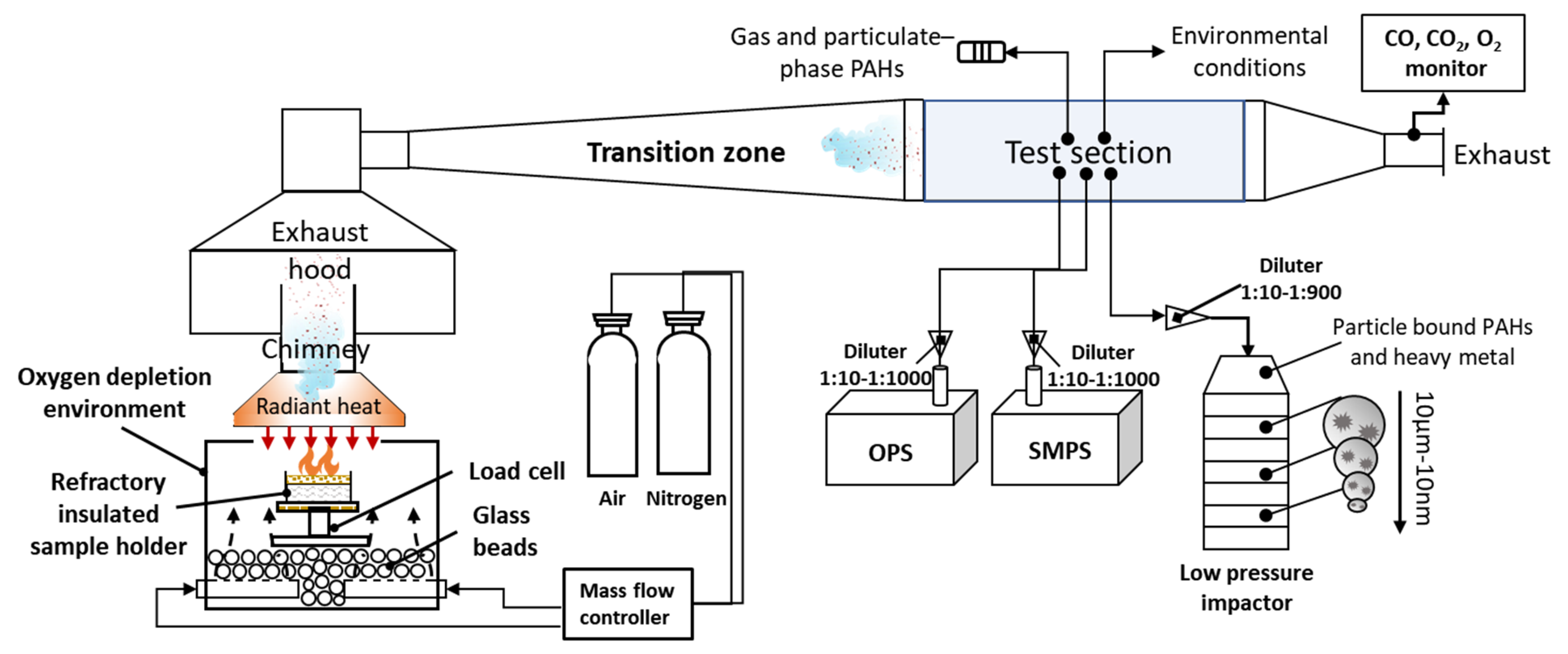
A laboratory-scale smoke simulation system, as shown in Figure 1, was developed to reproduce controlled material combustion and generate reproducible smoke samples for detailed characterization of combustion behavior, particle emissions, and toxicological properties [19,20,21]. The system consists of an atmosphere-controlled combustion chamber, a conical radiative heat source, a fuel sample loading and holder assembly, a smoke-delivery and exhaust tunnel, and an integrated smoke sampling and analysis platform. Additional technical details related to the custom fuel sample holder design are provided in Supplementary Information Section S1.1 (Figure S1).
The atmosphere-controlled combustion chamber was designed in accordance with the requirements of the International Organization for Standardization ISO/TS 5660-5 [21] to enable combustion experiments under both well-ventilated and oxygen-limited conditions. Controlled gas mixing was achieved by blending compressed air with nitrogen before introducing the mixture into the chamber through two lower-side inlets. The chamber floor was covered with glass beads to promote uniform inflow and reduce turbulence near the sample surface. While bulk oxygen concentration is controlled, the local oxygen availability and flow field at the fuel surface are primarily influenced by the material’s combustion rate and convective mixing, which represent design considerations and limitations.
Fuel samples were mounted in a standard holder per ASTM E1354 [22] or in a custom-designed insulated holder to minimize lateral heat loss and promote quasi-one-dimensional heat transfer. The custom holder, illustrated in Supplementary Information Figure S1 and lined with ceramic fiber insulation, was explicitly designed to reduce conductive heat losses to the surroundings and improve repeatability. A restraining wire grid was positioned on the fuel surface to prevent intumescence or delamination during thermal exposure. Samples were placed beneath a conical radiative heater that provided a uniform, controlled external heat flux across the exposed surface. A pilot electronic ignitor was located between the heater and the sample surface to ensure consistent ignition conditions. The applied radiant heat flux is fixed, and the combustion rate is governed primarily by the material’s flammability, which is acknowledged as a limitation for quantifying absolute smoke yields.
Combustion-generated smoke exited the chamber through a 265 cm exhaust and smoke-delivery system comprising five sequential sections: a chimney positioned above the cone heater, a transition zone, a rectangular test section (80 cm × 25 cm × 25 cm), a contraction section, and a final exhaust duct. While the chimney and test section were CFD-optimized to achieve uniform flow and minimize post-oxidation, some residence time and cooling occur during transport, which may influence particle chemistry (e.g., PAH condensation, agglomeration, or phase partitioning shifts). This represents a design limitation inherent to ISO 5660-1 [19] based setups. The nominal exhaust flow rate was maintained at 42 L/s, resulting in an average air velocity of approximately 0.75 m/s and a coefficient of variation below 10.37%.
The test section included real-time environmental and smoke-monitoring instrumentation, as well as multiple isokinetic sampling ports centrally positioned to ensure representative aerosol collection. Four stainless-steel sampling lines (6.35 and 7.78 mm diameter) transported smoke to downstream analytical systems. Two isokinetic lines supplied aerosols to an optical particle sizer and a scanning mobility particle sizer (TSI Inc., Shoreview, MN, USA), enabling particle size measurements from approximately 10 nm to 10 μm. Inline dilution systems (1:10 and 1:100) were incorporated to maintain instrument stability and prevent saturation. Additional sampling lines supported chemical and gravimetric analysis, including a total particle and VOC sampling train equipped with quartz filters and XAD-2 resin cartridges, and a size-segregated cascade impactor system (135-MOUDI™/100NR-MOUDI™, TSI Inc., Shoreview, MN, USA) for detailed particle mass distribution and PAH characterization. While smoke is sampled from the central test section to minimize deposition and achieve uniform collection, particulate cooling and potential deposition in the exhaust represent acknowledged limitations.
Sampling durations were determined according to the dominant combustion phase (flaming or smoldering/pyrolysis), ensuring consistent and representative smoke collection across experimental conditions. The methodology captures reproducible relative yields of particles and PAHs. Still, absolute quantification may be influenced by fixed heat flux, dilution, and transport effects, as explicitly noted in the limitations.

2.2. Fuel Material Property

Polyvinyl chloride (PVC) and polystyrene (PS) were selected to represent common synthetic materials, while pine and oak were chosen to represent biomass fuels prevalent in North America. To enhance uniformity for the controlled experiment, pine boards were ground into 500 µm-size particles and compressed into 100 mm diameter discs with a thickness of 13 mm and a density of 1.0 g/cm3. All fuel materials were conditioned at 21 ± 2 °C and 65 ± 5% relative humidity for at least 24 h before combustion tests. Additional fuel material details are provided in Supplemental Information Section S1.2 and Table S1.

2.3. Sampling and Analysis Methods

Combustion parameters and smoke composition were measured using isokinetic sampling to ensure accuracy and reproducibility. Heat release rate (HRR), total smoke production (TSP), and CO/CO2 concentrations were determined in accordance with ASTM E1354 and ISO 5660-5. Total particulate mass was collected on quartz filters and quantified by gravimetric analysis. Particle number concentration and size distribution were measured using an optical particle sizer (OPS) and a scanning mobility particle sizer (SMPS) (both TSI Inc., USA), together covering a size range from 10 nm to 10 μm. The SMPS operated with a sampling frequency of 1 min.
Gas- and particle-phase polycyclic aromatic hydrocarbons (PAHs) were sampled using an XAD-2 resin tube and a quartz filter, respectively. Size-segregated particle-bound PAHs were collected using an 8-stage MOUDI 100NR cascade impactor with an aerodynamic diameter range of 0.18–10 μm. Sample preparation for the quantification of the 16 United States Environmental Protection Agency (EPA) priority PAHs followed EPA recommendations [23].
To avoid instrument saturation and minimize particle losses, both OPS and SMPS measurements were coupled with dilution systems (model 3332, TSI, Shoreview, MN, USA and eDiluter, Dekati, Tampere, Pirkanmaa, Finland) operating at dilution ratios of 1:10 and 1:100. Detailed descriptions of sampling procedures, PAH analysis, and quality control are provided in the Supplemental Information (Section S1.4 and Tables S2 and S3).

2.4. Experimental Design for Controlled Combustion

Experiments were performed on four board materials (pine, oak, PVC, and PS) and one reconstructed pine disc (Table 1). Combustion conditions varied by heat flux (25 and 50 kW/m2) and oxygen concentration (20.95%, 15%, 7%, and 0%). For clarity, we assigned sample IDs: Samples B1–B4 refer to four board materials tested under heat flux levels of 25 kW/m2 and 50 kW/m2 with open ventilation. Samples D1 and D2 refer to pine discs prepared for enhanced uniformity. D1 was exposed to 50 kW/m2 with open ventilation, while D2 was subjected to 50 kW/m2 under four oxygen levels with a supplied air flow rate of 100 L/min to simulate flaming and smoldering conditions. A naming protocol was used as heat flux_sample ID_oxygen level, for example, 50_D2_15%. Combustion conditions (flaming vs. smoldering) were classified using the CO/CO2 ratio according to ISO 19706:2011 and modified combustion efficiency (MCE) [24,25].
The selected heat fluxes and oxygen levels replicate the range of fire intensities and combustion environments in wildland and structural fires. The 25 kW/m2 and 50 kW/m2 fluxes represent low-intensity ignition and high-intensity flaming, respectively, standard in cone calorimetry for assessing biomass and polymer flammability [22,26,27,28,29,30]. Oxygen levels of 20.95% simulate well-ventilated flaming [16,31], while 15% and 7% model oxygen-deficient smoldering, increasing PAH emissions due to incomplete combustion [32,33]; 0% O2 mimics anoxic pyrolysis, producing volatiles without oxidation [20,34]. Pine discs, with greater uniformity, enable consistent material degradation, aligning with recent biomass combustion research [35]. This design elucidates the transition from flaming to smoldering, a critical step for understanding particle and PAH dynamics in WUI fires.

2.5. Toxic Equivalent Quotient Assessment of Polycyclic Aromatic Hydrocarbons

To evaluate the toxicological and carcinogenic potential of smoke particles, the toxic equivalency (TEQ) of polycyclic aromatic hydrocarbons (PAHs) was calculated using the equation: PAH-TEQ = Σ (PAH EFi × TEFi), where PAH EFi represents the emission factor of each PAH congener, and TEFi is its corresponding toxicity equivalency factor (TEF). This method estimates the overall carcinogenicity of PAH mixtures relative to benzo[a]pyrene (BaP) and is widely used in environmental toxicology [15]. TEF values for the 16 EPA priority PAHs were sourced from established frameworks that reflect their relative carcinogenic potency in mammalian models [36].

3. Results and Discussion

3.1. System Reliability Validation

The reliability of the combustion simulation system was assessed using coefficients of variation (CV) and Jensen–Shannon Divergence (JSD) to evaluate consistency across repeated experiments. The CV for key fire behavior parameters, including HRR, TSP, and CO/CO2 (a measure of combustion completeness), was below 15%, demonstrating high repeatability. Pine disc samples (D1) exhibited even lower CVs (average 12.15%), likely due to their uniform structure compared to board samples. Smoke particle emissions showed a CV of 10.55%. In comparison, total PAH concentrations had a higher CV of 18.17%, potentially due to evaporation of low-molecular-weight (LMW) PAH during sampling.
Jensen–Shannon Divergence [37] measures the similarity between two probability distributions, in our case, the spatial-temporal distribution of smoke particles. JSD was used as a relative indicator to quantify differences in particle number–size distributions across experiments. Low JSD values confirmed the high repeatability of particle size measurements, with pine discs exhibiting a lower JSD of 0.086 than PVC samples (0.168), reflecting their greater uniformity. These results validate the system’s ability to produce consistent combustion conditions. Detailed reliability assessments are provided in Supplemental Information Section S2.1 and Table S4.

3.2. Fuel Material Fire Behaviors

The fire behavior of fuel materials (HRR, TSP, and CO/CO2) was characterized mainly during the flaming phase (from ignition to flameout) and smoldering phase under 7% and 0% oxygen concentration to examine material degradation. A summary of fire behavior and total particle emission has been provided in the Supplemental Information Section S2.2 and Table S5.
Average HRR was highest for PS, reaching approximately 384 kW/m2, followed by oak and pine, with both at 130–140 kW/m2 under a 50 kW/m2 heat flux (Figure S3a). PVC exhibited the lowest HRR of about 91 kW/m2 at a heat flux of 50 kW/m2, consistent with its inherently fire-retardant properties due to chlorine and the formation of a char layer during combustion [38]. These findings align with previous studies under similar configurations, which reported HRRs of 118.2 kW/m2 for PVC and 115.7 kW/m2 for solid wood [39,40]. Oxygen supply ranging from 20.95% to 0% negatively affects HRR from 88.9 to 5.42 kW/m2, especially at zero oxygen; biomass pyrolysis is primarily endothermic [41]. Two distinct HRR peaks are observed for pine and oak wood boards. This phenomenon is commonly observed in the combustion of raw board material under well-ventilated conditions [42]. It follows a two-stage thermal decomposition process of wood (Figure S3b). The pine disc did not exhibit the same HRR distribution due to its different physical structure, density, and component decomposition during combustion. Disc pine is more homogeneous and consists of smaller, more uniform particles (achieved by grinding and compression), allowing pyrolysis and combustion to occur simultaneously [35].
TSP from PS and PVC is about 11–25 times higher than the wood material results (Figure S3). Smoke formation during combustion is highly dependent on fuel properties and heat flux. Pyrolysis of pine discs under 0% oxygen emits approximately 17 times higher TSP than well-ventilated emissions. Under low-oxygen conditions, the VOCs and tars released during pyrolysis do not fully oxidize, leading to increased smoke production [43].
The CO/CO2 is used by ISO 19706-2011 to distinguish between flaming, non-flaming, and well-ventilated flaming conditions, providing insight into combustion completeness [20,31]. Additionally, MCE is widely used to differentiate between flaming and smoldering combustion phases, defined as MCE = [ΔCO2/(ΔCO2 + ΔCO)], where ΔCO2 and ΔCO are the excess concentrations of CO2 and CO [24]. We considered combustion to be flaming when the MCE was >95% and smoldering when the MCE was 65–85%, as suggested by Urbanski [23].
In wood materials, the higher heat flux yielded a lower CO/CO2 ratio of 0.01, indicating more efficient combustion. PVC, due to its inherently flame-retardant properties and high decomposition temperature, exhibited a CO/CO2 ratio of 0.109–10 times higher than that of wood. This indicates incomplete combustion and the occurrence of self-sustained smoldering. This finding is comparable to previous research, which reported CO/CO2 of 0.007 for painted pine at 50 kW/m2 and 0.31 for PVC at 30 kW/m2 [31,44]. Additionally, low oxygen concentrations led to non-flaming conditions in pine discs, resulting in elevated CO concentrations and a higher CO/CO2 ratio [44].
Material fire behavior varied significantly with material composition, heat flux, and oxygen levels, emphasizing the complexity of combustion and the need for precise control of experimental variables. More details on the material fire behavior assessment can be found in the Supplemental Information Section S2.2 and Figures S2–S4.

3.3. Smoke Particle Mass

Emission factors were determined as the total number and mass of particles emitted divided by the fuel mass consumed, and particle concentration was calculated using total mass emission divided by total sample volume. Particle mass emission factors were quantified across combustion experiments involving pine boards, oak boards, PVC boards, PS boards, and pine discs under radiant heat fluxes of 25 and 50 kW/m2, with pine discs additionally tested at oxygen concentrations of 20.95%, 15%, 7%, and 0%. Emission factors (EFs), expressed as grams of emitted particles per kilogram of fuel consumed (g/kg), exhibited significant variation by material and heat flux (p < 0.05).
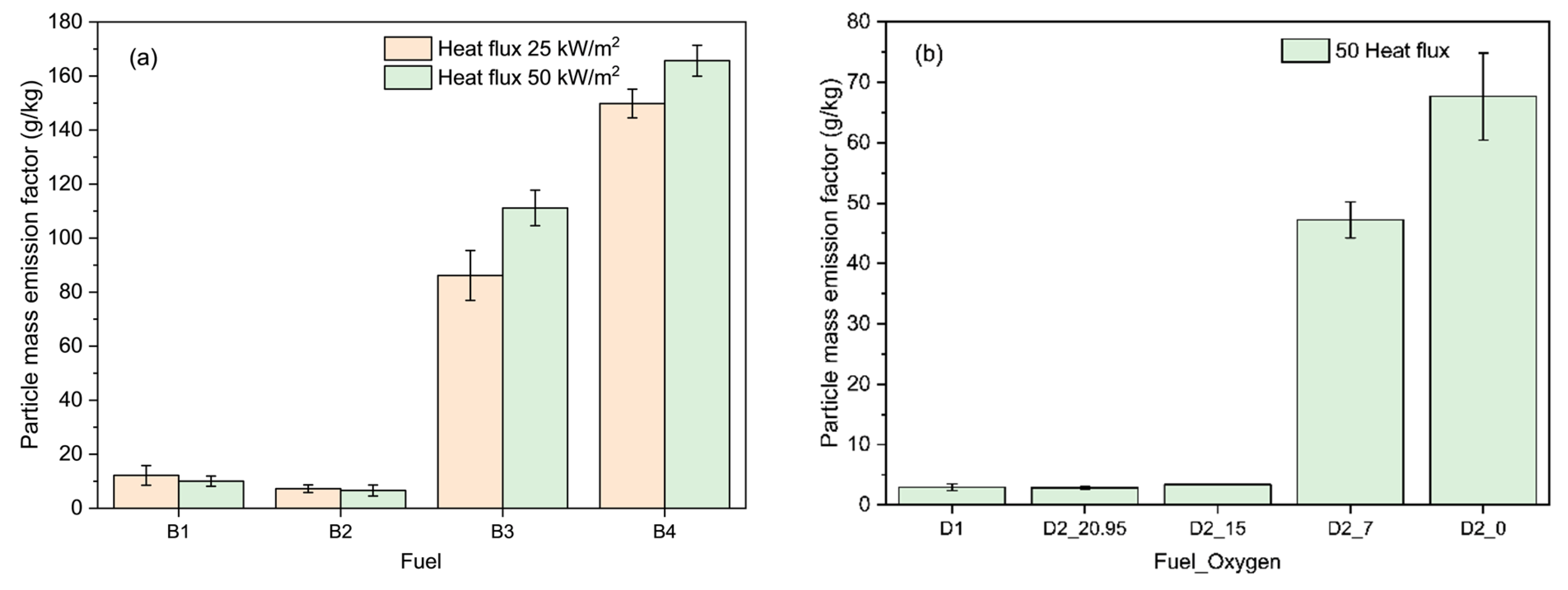
Wood materials (pine and oak) yielded EFs ranging from 4.6 to 9.2 g/kg, with oak emitting higher particle masses than pine, reflecting differences in lignin and cellulose composition [45]. Plastic-based materials produced approximately 7–59 times more particles than wood-based counterparts, irrespective of the heat flux (Figure 2a). The measurements are comparable to the 3.57–12.8 g/kg range observed in previous studies using similar cone-heating configurations [31,46]. The plastic material emission ranged from 61 to 190 g/kg, which is up to 3.72 times higher than previous studies, likely due to differences in material composition and sampling conditions [31].
In contrast, the pine disc yielded lower particle emissions (1.76 g/kg) than the pine board, likely due to its enhanced structural uniformity, which improved combustion efficiency (Figure 2b). Shredding the pine disrupted its structural bonds, creating a loose structure that may facilitate its reaction with oxygen. Additionally, oxygen has a significant effect on particle emissions, especially when the oxygen supply is below 15%, which is typically a critical threshold for igniting biomass like pine wood due to oxygen availability and heat accumulation required to sustain combustion [34]. The sustained smoldering under 7% and 0% oxygen generated particle masses of 44.4 and 85.4 g/kg, respectively (Figure 2b).
An interesting finding is that the particle concentration of biomass and plastic combustion, ranging from 8.1–369.7 mg/m3 obtained in our experiments, is comparable to the PM10 values of 6 mg/m3 (overhaul) and 201 mg/m3 (fire) obtained from simulated field investigations [13,47]. However, understanding the multiple-phase combustion involved in a field natural fire may lead to differences from a controllable lab combustion simulation. This suggests the potential of using lab-scale simulations to replicate field-like smoke particle emissions.

3.4. Particle Size Distribution

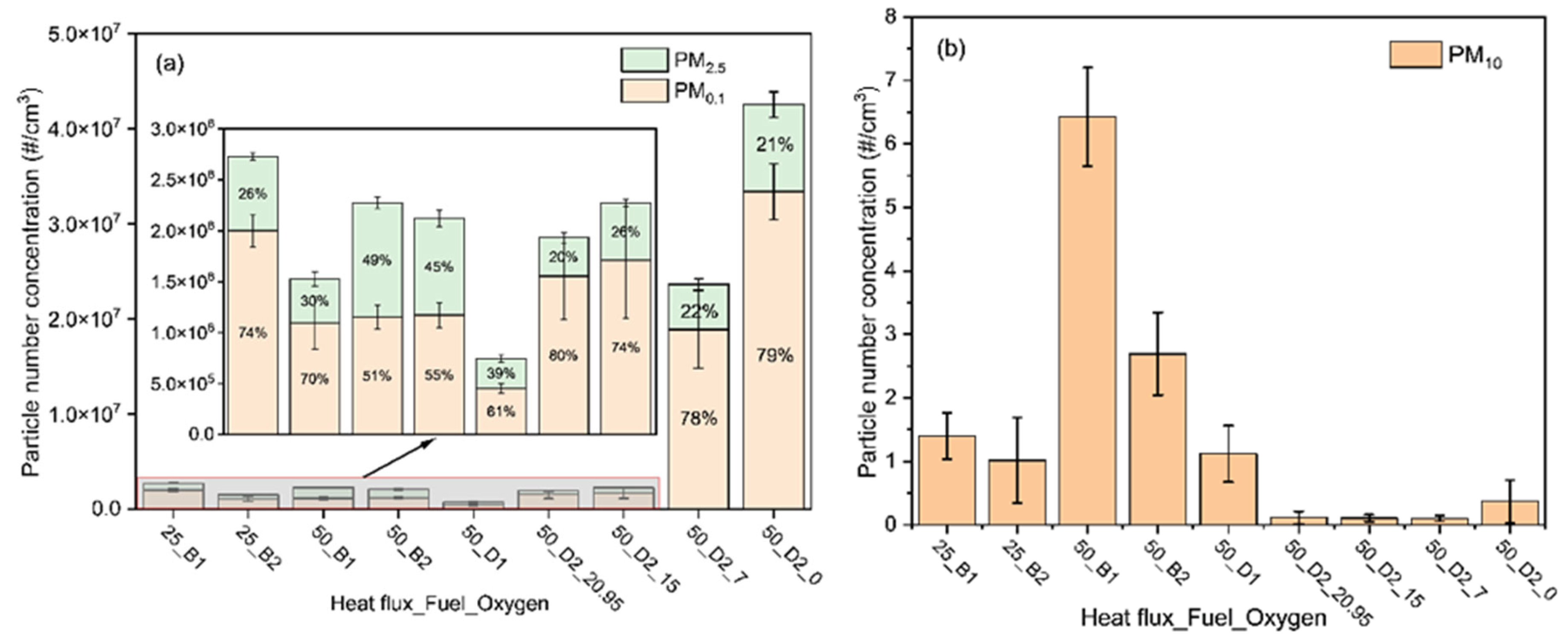
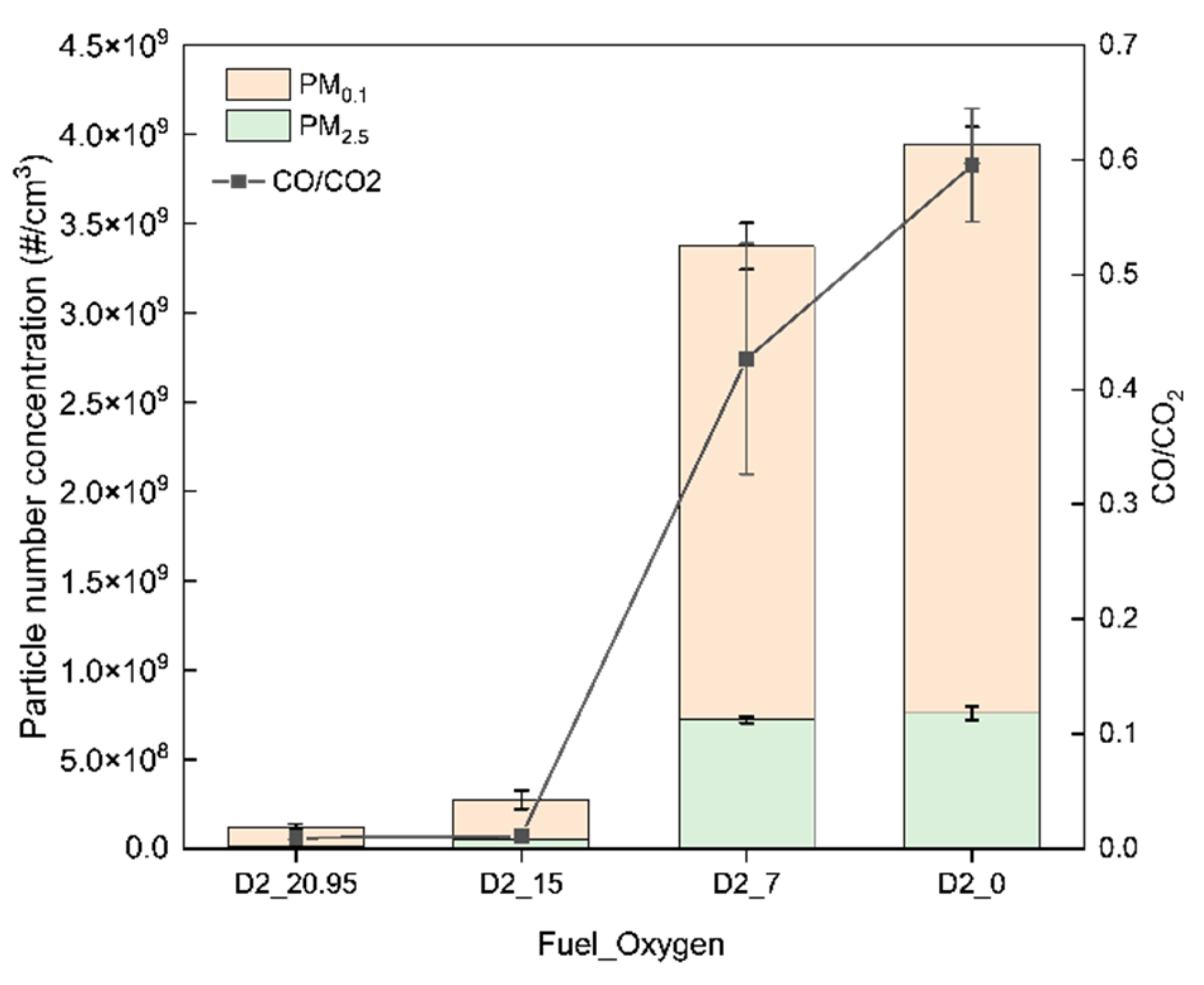
Particle number concentration distribution across three size ranges, namely PM10 (10–2.5 μm), PM2.5 (2.5–0.1 μm), and PM0.1 (<0.1 μm), was measured during the whole combustion period (Figure 3). Material composition, heat flux, fuel form, and oxygen level contributed to the varied particle concentrations (p < 0.05). Ultrafine particles accounted for 55.5% to 86.2% of the total particle number concentration, except in the case of PS emissions, where larger particles dominated at 66.0%. The highest particle number concentrations were observed during combustion of the PVC samples, with both heat flux levels yielding approximately 3 times higher concentrations than for wood materials. As an inherently flame-retardant material, PVC remained in a self-sustaining smoldering state, leading to the highest total smoke production and rate (Figure S3). Compared to wood materials, plastic materials generated a higher proportion of PM10 and PM2.5 particles (Figure 3b). Higher heat flux increases smoke particle concentration by a factor of 0.3–2. The pine discs generated fewer particles than the pine board, consistent with the particle mass emission results (Figure 2). The combustion of a pine disc produces a high proportion of particles, with 13.83% as PM2.5 and 86.17% as PM0.1, probably due to broken internal bonds and loosened structure, which increase combustion efficiency.
Under oxygen-vitiated conditions, the pine disc did not ignite and remained smoldering throughout the sampling period (i.e., 7% and 0% oxygen levels). In such cases, there is a significant increase in fine and ultrafine-size particles, with ultrafine particles dominating the emission (Figure 3a). The particle number concentration is more than 32 times that of well-ventilated combustion conditions. The level of ventilation thus significantly impacts the amount and size distribution of released smoke particles. Our data show that wood material generates more fine and ultrafine particles in well-ventilated (4,033,000 #/cm3) and smoldering conditions (98,500,000 #/cm3), aligning with field-simulated fire data. This corresponds to potential particle exposure levels for firefighters, ranging from 3,479,100 to 8,095,100 #/cm3 during knockdown, and 11,175,700 to 17,100,800 #/cm3 during fire attack assignments [47]. The results indicate that during special firefighting events, such as overhaul, exposure to latent smoke particles may make a respirator even more critical in preventing the inhalation of ultrafine particles.
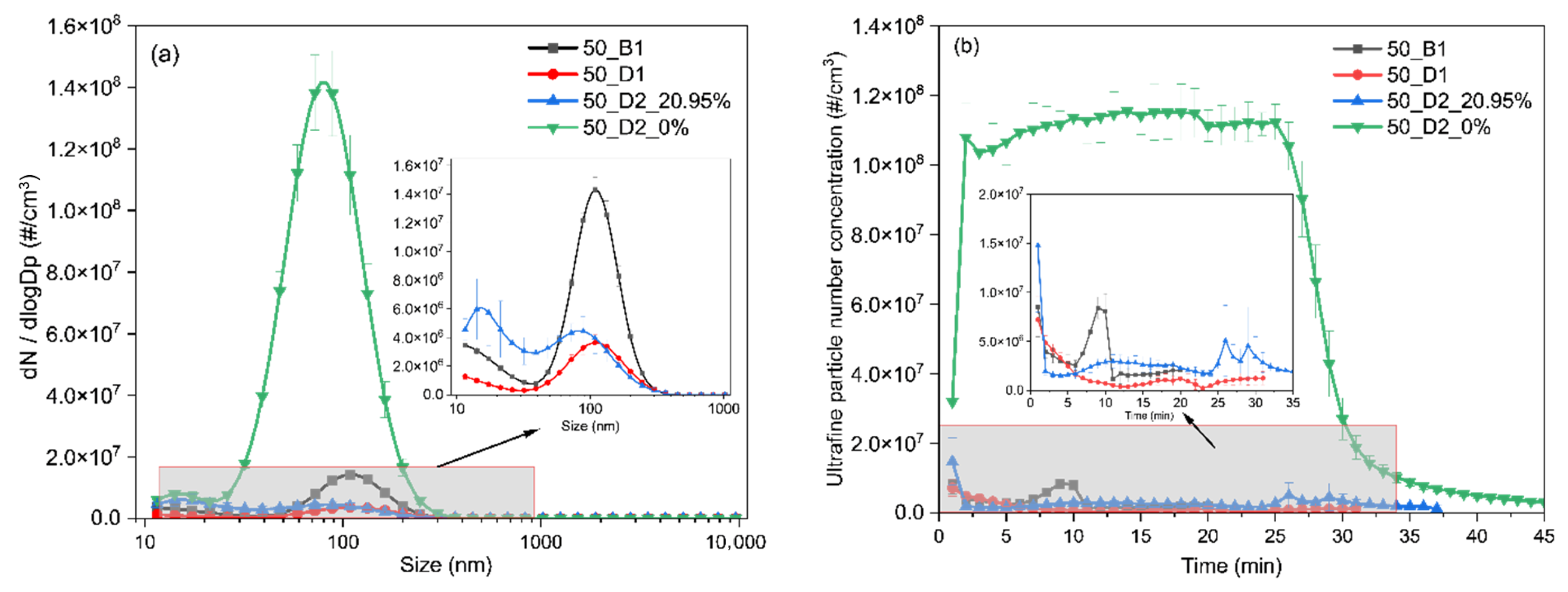
The detailed particle emission curve shows a significant impact of fuel form and oxygen level on combustion emissions (Figure 4). It has been found that the dominant particle number concentration ranged from approximately 10–500 nm regardless of the oxygen supply. With higher oxygen supply and more complete combustion, the fraction of ultrafine particles increases, while concentration increases significantly when oxygen supply is lower, triggering smoldering combustion. It indicates that current validation of protective equipment against PM2.5 may not be adequate to prevent smaller, more specific smoke particles. At a 50 kW/m2 heat flux, the pine board shows a distinct distribution of particle emission peaks, echoing what was seen in fire behavior measurements, such as heat release rate (Figure S2a,b). The second peak of particle emission may be attributed to char oxidation and lowered temperature [48]. The results showed over 10 times more ultrafine particle emission over the first 20 min from pine discs under 0% oxygen than the emission from pine discs under 20.95% oxygen (Figure 4b). Low oxygen impedes complete combustion, promoting pyrolysis and the production of intermediate compounds, such as VOCs, which condense into particles.
A strong relationship exists between particle emissions and CO/CO2 (Figure 5). At 7% and 0% oxygen, there is a notable increase in fine and ultrafine particles, with particle concentrations exceeding tenfold under such low-ventilation conditions. The CO/CO2 of the four pine combustion conditions yields results from 0.009 (flaming) to 0.595 (smoldering). The results are comparable to the recent combustion test using the tube furnace, where the CO/CO2 of flame and smoldering for plywood are (0.044 and 0.306) and cardboard (0.016 and 0.248) [16,49].

3.5. Emission of PAHs

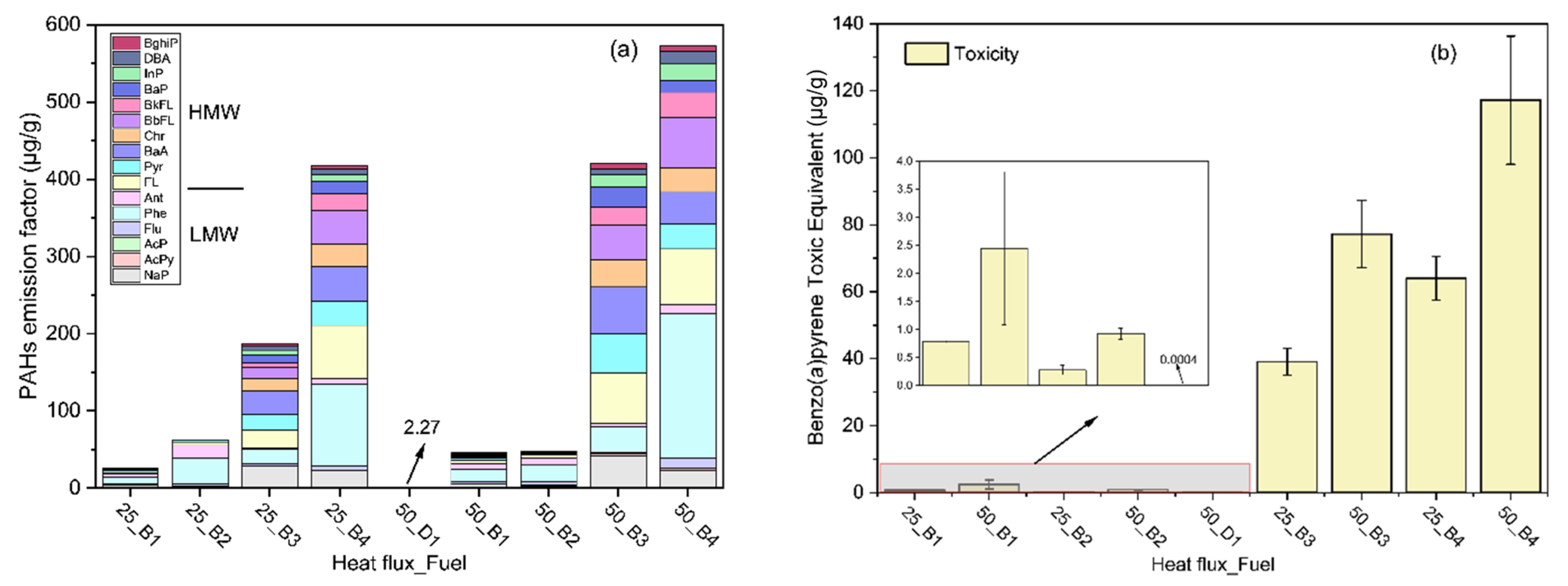
The emission spectra of 16 analyzed PAHs show significant differences between wood and plastic boards (Figure 6, p < 0.05). The emission factor, calculated as the mass of the emitted PAH per unit mass of fuel material. Plastic materials emitted 12–16 times more total PAHs than wood materials. Higher heat flux led to increased PAH formation in all materials, as temperature plays a critical role in material degradation [31]. At a heat flux of 50 kW/m2, PS produced the highest level of PAHs, with an emission factor (EF) of approximately 572 µg/g, followed by PVC with an EF of approximately 470 µg/g, while emissions from wood ranged from 25–62 µg/g.
These estimates for wood materials align with findings by other studies, which reported an EF range of 4–43 µg/g under well-ventilated conditions [50,51]. Our results on PAH emissions from PS and PVC are also consistent with previous studies, which reported EF values ranging from 200 to 1000 µg/g [31,52]. Generally, combustion of wood materials mainly generated LMW PAHs with 0–3 rings, such as phenanthrene and anthracene, while combustion of plastic materials generated higher proportions of HMW PAHs with 4–6 rings, such as fluoranthene, benzo(a)anthracene, benzo(b)fluoranthene, and benzo(k)fluoranthene (Figure 6a). Additionally, the emission from the pine disc under open ventilation consists solely of naphthalene, which has the lowest molecular weight among the 16 PAHs. The results align with the observed particle emissions and the previously discussed CO/CO2 ratio.
The toxic equivalent of PAH emission was assessed using toxic equivalency factors (TEFs). The benzo(a)pyrene (BaP) toxic equivalents (BaP-EQ) are calculated by multiplying the individual PAH emission factors by their corresponding TEF [36], which showed that PAH groups (i.e., gas phase vs. particulate phase) contributed unequally to toxicity. The toxicity of PAH emissions from plastic material combustion was thousands of times greater than that from wood materials. Nonetheless, it is essential to note that these results do not suggest that the toxicity from wood materials would be negligible, especially since PAH concentration alone is not a full indicator of smoke toxicity. Other components, such as toxic gases and VOCs, represent major pollutants but were not investigated in the present study. Also, the total amount of PAH emitted is not necessarily a sufficient indicator of toxicity. Comparing emissions from PVC at 50 kW/m2 and PS at 25 kW/m2 shows that, while PVC produced similar total PAH emissions, its smoke had higher PAH TEQ because it contained more HMW PAHs (Figure 6a).

3.6. Ring Effect on PAH Toxicity

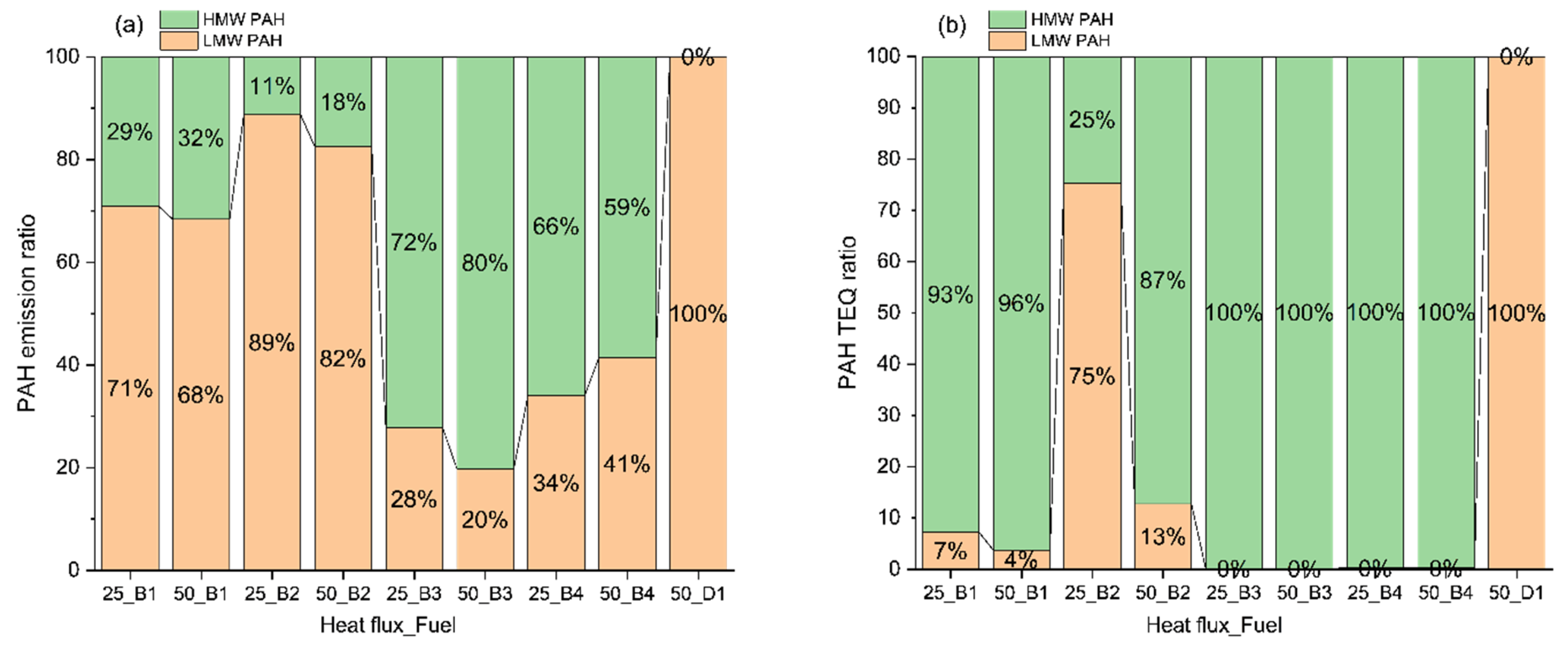
In addition to the total PAH emission factors, PAH emissions with respect to the number of aromatic rings were analyzed. The results show that some LMW PAHs, despite high emission yields, contribute minimally to the overall TEQ (Figure 7). It confirms that the number of rings in PAHs significantly influences their level of toxicity. LMW PAHs exhibit lower TEQs and degrade more readily due to their higher vapor pressures and faster photolysis and biodegradation rates [53]. In contrast, HMW PAHs contribute to smoke particle formation and can either be absorbed or attached to smoke particles. This behavior is well documented, as HMW PAHs exhibit strong affinity toward particles owing to their low vapor pressures and high octanol-air partition coefficients [54]. Wood materials primarily emit gaseous PAHs (>70%), whereas plastic materials generate more particulate PAHs (>60%) (Figure 7a), consistent with prior experimental comparisons of biomass and polymer combustion [31,55,56]. Oak board combustion under 25 kW/m2 heat exposure generated a large portion of phenanthrene and anthracene, which contributed to most of the toxicity of such emissions (75%). In contrast, under 50 kW/m2 conditions, even only marginal HMW PAHs were generated (18%), and they contributed to the majority of the TEQ (87%). While heat flux is considered as a key driver influencing surface temperature and thus the pyrolysis regime, other factors—including pyrolysis temperature gradients, fuel composition, sample structure, and thermal conductivity—also play essential roles in determining PAH formation pathways [55,57]. Our observation that LMW PAHs dominate at 25 kW/m2 and that HMW PAHs decrease at 50 kW/m2 likely reflects a combination of these factors. Additionally, the difference in emission may be due to the high sensitivity of LMW PAHs to evaporation and to the GC-MS limit of detection. The accuracy of the estimate may be improved by designing a specific sampling flow and instrumentation for biomass emission.
Protection of personnel exposed to smoke needs to consider the existence of both forms of PAH. However, a higher contribution of HMW PAHs suggests that preventing contact with particulate-bound PAHs is the key to reducing PAH-TEQ toxic exposure levels for firefighters. PPE decontamination studies have identified HMW PAHs as the most challenging contaminants to remove [58]. Whereas LMW gaseous PAHs dissipate quickly after firefighter evacuation, they pose additional uptake challenges, such as inhalation [59].

3.7. PAH Distribution Across Particle Size by Oxygen Concentration

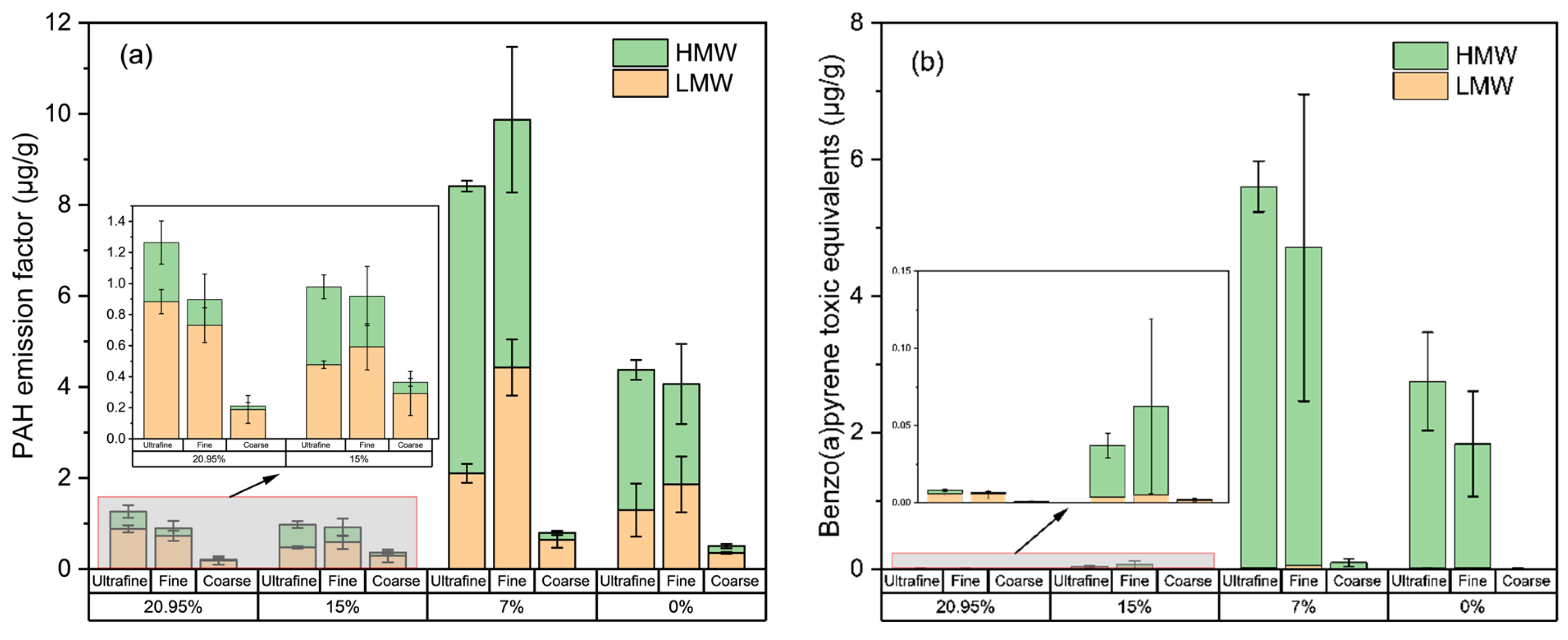
PAH emissions vary significantly with smoke particle size under different oxygen levels—the emission factor calculated as the mass of the emitted PAH per unit mass of consumed fuel. HMW PAHs, such as BaP, are contained mainly in fine and ultrafine particles (Figure 7a). This may be due to the large surface area provided by a substantial increase in particle concentration for a fixed mass in the sub-PM2.5 size range [60]. The presence of HMW PAHs in larger particles is due to low-mass measurements near the analytical balance’s limit of detection. It is also notable that, although the ignited condition (15% oxygen) and the smoldering condition (7% oxygen) of the wood material generated similar amounts of HMW PAHs within particles smaller than 0.18 µm (Figure 8a), they showed significantly different toxicity levels (Figure 8b). This demonstrates that the composition of HMW PAHs changed drastically under different combustion/smoldering conditions, driven by differences in oxygen supply.

4. Conclusions

This study systematically characterized smoke and ultrafine particle emissions from representative biomass (pine and oak) and plastic (PVC and polystyrene) fuels under controlled combustion conditions. Using a combustion control and smoke simulation system, highly reproducible fire behavior, particle emissions, and PAH measurements were achieved, enabling a robust comparison of the effects of fuel composition, heat flux, and oxygen availability on smoke characteristics. Across all conditions, ultrafine particles dominate particle number concentrations, underscoring their critical role in inhalation exposure and potential health risk.
Results demonstrated that plastic combustion produced substantially higher particle mass, PAH emission factors, and PAH toxic equivalency factors than wood combustion, even at comparable heat fluxes. Oxygen-deficient and smoldering conditions further amplified the production of fine and ultrafine particles and shifted PAH profiles toward more toxic high-molecular-weight species. The distribution of PAHs across particle sizes revealed that the most carcinogenic compounds were preferentially associated with fine and ultrafine particles, particularly under low-oxygen conditions, highlighting a combined physical–chemical hazard that is not fully captured by bulk PM metrics alone.
These findings provide critical mechanistic insights into how combustion conditions govern smoke toxicity and particle characteristics, particularly in mixed-fuel and ventilation-limited fire scenarios typical of wildland–urban interface and structural fires. The validated combustion system offers a versatile platform for generating controlled, composition-specific smoke for downstream toxicological testing, PPE contamination and decontamination studies, and evaluation of exposure mitigation strategies.
Based on these findings, we recommend prioritizing PPE capable of filtering ultrafine particles and focusing decontamination efforts on particle-bound high-molecular-weight PAHs, which are persistent and highly toxic. Public health measures should consider elevated emissions from plastic combustion and low-oxygen smoldering, which substantially increase exposure to ultrafine particles and HMW PAHs. Operational strategies that reduce low-oxygen smoldering zones can mitigate these risks, while comprehensive monitoring should include both particle-bound and gaseous PAHs to more accurately assess total smoke toxicity.
Overall, this work advances the quantitative understanding of smoke emissions and toxicity and provides evidence-based guidance to improve risk assessment, PPE design, operational practices, and protective strategies for firefighters and other exposed populations.

5. Limitations and Future Work

This study used a controlled cone-based combustion and smoke-delivery system to achieve high reproducibility and enable mechanistic comparisons across fuels and oxygen levels; however, several limitations warrant consideration. The ISO 5660 configuration necessarily involves smoke dilution and finite residence time before sampling, which may affect aerosol coagulation, gas–particle partitioning of PAHs, and chemical evolution during cooling. Although bulk oxygen concentration was prescribed, local oxygen availability at the fuel surface was primarily determined by material flammability and the imposed heat flux rather than by a controlled airflow field, potentially influencing combustion completeness. Particle losses and chemical transformations within the exhaust and sampling pathway cannot be entirely excluded, and stoichiometric mass-balance validation with reference fuels was not performed. Consequently, the reported emission factors should be interpreted as internally consistent, relative values rather than absolute fire emission factors.
Toxicity was evaluated using PAH-based toxic equivalency factors, which represent only one dimension of smoke hazard and do not account for other key toxicants (e.g., VOCs, carbonyls, acid gases, or metals) or biological responses. Future work will integrate near-source and reduced-residence-time sampling, stoichiometric validation, and mixed-fuel assemblies representative of realistic fire loads. Coupling this platform with cellular and air–liquid interface exposure assays will enable direct assessment of health-relevant outcomes. Extension to transient ventilation, larger fuel packages, and cascading ignition scenarios will further improve applicability to wildland–urban interface and structural fire conditions.

Supplementary Materials

The following supporting information can be downloaded at: https://www.mdpi.com/article/10.3390/fire9030117/s1. Additional instrument method details, fuel material details, sampling and analysis details. Additional results regarding system reliability validation, fuel material fire behavior, and PAH-TEQ analysis.

Author Contributions

Conceptualization, G.S. and R.L.; methodology, Y.W. and M.J.U.R.; formal analysis, J.S. and F.Z.; investigation, Y.W.; data curation, Y.W., M.J.U.R., M.E. and M.J.H.; writing—original draft preparation, Y.W. and M.J.U.R.; writing—review and editing, R.L., M.Z. and M.J.U.R.; supervision, R.L. and G.S.; project administration, R.L.; funding acquisition, G.S. and R.L. All authors have read and agreed to the published version of the manuscript.

Funding

This research was funded by the U.S. Department of Homeland Security (DHS), Federal Emergency Management Agency (FEMA), Fire Prevention and Safety (FP&S) Research and Development (R&D) Grants, grant numbers EMW-2021-FP-00088 and EMW-2023-FP-00242.

Institutional Review Board Statement

Not applicable.

Data Availability Statement

The original contributions presented in this study are included in the article; further inquiries can be directed to the corresponding author.

Conflicts of Interest

The authors declare no conflicts of interest. The funders had no role in the design of the study, in the collection, analysis, or interpretation of data, in the writing of the manuscript, or in the decision to publish the results.

Abbreviations

The following abbreviations are used in this manuscript:
BaPBenzo[a]pyrene
COCarbon monoxide
CO2Carbon dioxide
CVCoefficient of variation
EFEmission factor
GC-MSGas chromatography–mass spectrometry
HMWHigh-molecular-weight
HRRHeat release rate
JSDJensen–Shannon divergence
LMWLow-molecular-weight
MCEModified combustion efficiency
OPSOptical particle sizer
PAHPolycyclic aromatic hydrocarbon
PAH-TEQPolycyclic aromatic hydrocarbon toxic equivalent quotient
PMParticulate matter
PM0.1Ultrafine particles (aerodynamic diameter < 0.1 μm)
PM2.5Fine particulate matter (aerodynamic diameter < 2.5 μm)
PM10Coarse particulate matter (aerodynamic diameter < 10 μm)
PSPolystyrene
PVCPolyvinyl chloride
SMPSScanning mobility particle sizer
TEFToxic equivalency factor
TSPTotal smoke production
VOCVolatile organic compound
WUIWildland–urban interface

References

  1. Watson, J.G.; Cao, J.; Chen, L.W.A.; Wang, Q.; Tian, J.; Wang, X.; Gronstal, S.; Ho, S.S.H.; Watts, A.C.; Chow, J.C. Gaseous, PM2.5 mass, and speciated emission factors from laboratory chamber peat combustion. Atmos. Chem. Phys. 2019, 19, 14173–14193. [Google Scholar] [CrossRef]
  2. Lemieux, P.M.; Lutes, C.C.; Santoianni, D.A. Emissions of organic air toxics from open burning: A comprehensive review. Prog. Energy Combust. Sci. 2004, 30, 1–32. [Google Scholar] [CrossRef]
  3. Hiemstra, H. Influence of Building Structure and Building Content on Residential Fires. Master’s Thesis, Lund University, Lund, Sweden, 2016. [Google Scholar]
  4. Holder, A.L.; Ahmed, A.; Vukovich, J.M.; Rao, V. Hazardous air pollutant emissions estimates from wildfires in the wildland urban interface. PNAS Nexus 2023, 2, pgad186. [Google Scholar] [CrossRef] [PubMed]
  5. Navarro, K.M.; Schweizer, D.; Balmes, J.R.; Cisneros, R. A Review of Community Smoke Exposure from Wildfire Compared to Prescribed Fire in the United States. Atmosphere 2018, 9, 185. [Google Scholar] [CrossRef]
  6. Austin, C.; Wang, D.; Ecobichon, D.J.; Dussault, G. Characterization of volatile organic compounds in smoke at municipal structural fires. J. Toxicol. Environ. Health Part A 2001, 63, 437–458. [Google Scholar] [CrossRef]
  7. Parizek, O.; Zavodna, T.; Milcova, A.; Drabova, L.; Stupak, M.; Gomersall, V.; Schmuczerova, J.; Jirik, V.; Topinka, J.; Pulkrabova, J. Personal exposure monitoring to polycyclic aromatic hydrocarbons bound to size-segregated aerosol. Atmos. Pollut. Res. 2024, 15, 102122. [Google Scholar] [CrossRef]
  8. Cedeño Laurent, J.G.; Parhizkar, H.; Calderon, L.; Lizonova, D.; Tsiodra, I.; Mihalopoulos, N.; Kavouras, I.; Alam, M.; Baalousha, M.; Bazina, L.; et al. Physicochemical Characterization of the Particulate Matter in New Jersey/New York City Area, Resulting from the Canadian Quebec Wildfires in June 2023. Environ. Sci. Technol. 2024, 58, 14753–14763. [Google Scholar] [CrossRef]
  9. Bayham, J.; Yoder, J.K.; Champ, P.A.; Calkin, D.E. The Economics of Wildfire in the United States. Annu. Rev. Resour. Econ. 2022, 14, 379–401. [Google Scholar] [CrossRef]
  10. Hunnicutt, P.; Henderson, G. Particulates Matter: Policy Failures, Air Pollution, and Collective Political Participation in the United States. Ph.D. Thesis, University of California, Berkeley, CA, USA, 2022. [Google Scholar]
  11. Rumi, M.J.U.; Wu, Y.; Zhang, M.; Li, R.; Song, G. Invisible hazards of ultrafine particles (UFPs) from Wildland-Urban Interface (WUI) fire smoke as emerging public health risks: A critical review of transformation dynamics from emission sources, exposure pathways, and vulnerable population to WUI fire toxicants. Sci. Total Environ. 2025, 1003, 180656. [Google Scholar] [CrossRef]
  12. Teixeira, J.; Sousa, G.; Azevedo, R.; Almeida, A.; Delerue-Matos, C.; Wang, X.; Santos-Silva, A.; Rodrigues, F.; Oliveira, M. Characterization of Wildland Firefighters’ Exposure to Coarse, Fine, and Ultrafine Particles; Polycyclic Aromatic Hydrocarbons; and Metal(loid)s, and Estimation of Associated Health Risks. Toxics 2024, 12, 422. [Google Scholar] [CrossRef]
  13. Fent, K.W.; Evans, D.E.; Babik, K.; Striley, C.; Bertke, S.; Kerber, S.; Smith, D.; Horn, G.P. Airborne contaminants during controlled residential fires. J. Occup. Environ. Hyg. 2018, 15, 399–412. [Google Scholar] [CrossRef]
  14. Eden, M.J.; Matz, J.; Garg, P.; Perera-Gonzalez, M.; McElderry, K.; Wang, S.; Gollner, M.J.; Oakes, J.M.; Bellini, C. Prolonged smoldering Douglas fir smoke inhalation augments respiratory resistances, stiffens the aorta, and curbs ejection fraction in hypercholesterolemic mice. Sci. Total Environ. 2023, 861, 160609. [Google Scholar] [CrossRef]
  15. Kim, Y.H.; Sinha, A.; George, I.J.; DeMarini, D.M.; Grieshop, A.P.; Gilmour, M.I. Toxicity of fresh and aged anthropogenic smoke particles emitted from different burning conditions. Sci. Total Environ. 2023, 892, 164778. [Google Scholar] [CrossRef] [PubMed]
  16. Garg, P.; Wang, S.; Oakes, J.M.; Bellini, C.; Gollner, M.J. Variations in gaseous and particulate emissions from flaming and smoldering combustion of Douglas fir and lodgepole pine under different fuel moisture conditions. Combust. Flame 2024, 263, 113386. [Google Scholar] [CrossRef]
  17. Malmborg, V.; Sadiktsis, I.; Madsen, D.; van Hees, P.; Grieshop, A.; Pagels, J. Biomass Burning Emissions and Influence of Combustion Variables in the Cone-Calorimeter. In Proceedings of the International Aerosol Conference 2022, Athens, Greece, 4–9 September 2022; p. 170. [Google Scholar]
  18. Samae, H.; Tekasakul, S.; Tekasakul, P.; Furuuchi, M. Emission factors of ultrafine particulate matter (PM < 0.1 μm) and particle-bound polycyclic aromatic hydrocarbons from biomass combustion for source apportionment. Chemosphere 2021, 262, 127846. [Google Scholar] [CrossRef] [PubMed]
  19. ISO 5660-1; Reaction-to-Fire Tests—Heat Release, Smoke Production and Mass Loss Rate. ISO: Geneva, Switzerland, 2015.
  20. Chatenet, S. An Instrumented Controlled-Atmosphere Cone Calorimeter to Characterize Electrical Cable Behavior in Depleted Fires. Ph.D. Thesis, Université de Lille, Lille, France, 2019. [Google Scholar]
  21. ISO 5660-5; Reaction-to-Fire Tests—Heat Release, Smoke Production and Mass Loss Rate. ISO: Geneva, Switzerland, 2020.
  22. ASTM E1354; Standard Test Method for Heat and Visible Smoke Release Rates for Materials and Products Using an Oxygen Consumption Calorimeter. ASTM: West Conshohocken, PA, USA, 2022.
  23. EPA. Method 8270E: Semivolatile Organic Compounds by Gas Chromatography/Mass Spectrometry (GC/MS) (SW-846 Test Method); U.S. Environmental Protection Agency, Office of Resource Conservation and Recovery: Washington, DC, USA, 2018. [Google Scholar]
  24. Urbanski, S. Wildland fire emissions, carbon, and climate: Emission factors. For. Ecol. Manag. 2014, 317, 51–60. [Google Scholar] [CrossRef]
  25. Ward, D.; Radke, L. Emissions measurements from vegetation fires: A comparative evaluation of methods and results. In Fire in the Environment: The Ecological, Atmospheric and Climatic Importance of Vegetation Fires; John Wiley & Sons: Hoboken, NJ, USA, 1993; Volume 13, pp. 53–76. [Google Scholar]
  26. Párničanová, A.; Zachar, M.; Kačíková, D. The Influence of the Heat Flux of the Infrared Heater on the Charring Rate of Spruce Wood. Polymers 2024, 16, 2657. [Google Scholar] [CrossRef]
  27. NFPA 1971; Standard on Protective Ensembles for Structural Fire Fighting and Proximity Fire Fighting. NFPA: Quincy, MA, USA, 2018.
  28. Massman, W.; Frank, J.; Shepperd, W.; Platten, M. In Situ soil temperature and heat flux measurements during controlled surface burns at a southern Colorado forest site. In Fire, Fuel Treatments, and Ecological Restoration: Conference Proceedings; Proceedings of RMRS-P-29, Fort Collins, CO, USA, 16–18 April 2002; Omi, P.N., Joyce, L.A., Eds.; US Department of Agriculture, Forest Service, Rocky Mountain Research Station: Fort Collins, CO, USA, 2003; Volume 29, pp. 69–88. [Google Scholar]
  29. Frankman, D.; Webb, B.W.; Butler, B.W.; Jimenez, D.; Forthofer, J.M.; Sopko, P.; Shannon, K.S.; Hiers, J.K.; Ottmar, R.D. Measurements of convective and radiative heating in wildland fires. Int. J. Wildland Fire 2013, 22, 157–167. [Google Scholar] [CrossRef]
  30. Filkov, A.I.; Tihay-Felicelli, V.; Masoudvaziri, N.; Rush, D.; Valencia, A.; Wang, Y.; Blunck, D.L.; Valero, M.M.; Kempna, K.; Smolka, J.; et al. A review of thermal exposure and fire spread mechanisms in large outdoor fires and the built environment. Fire Saf. J. 2023, 140, 103871. [Google Scholar] [CrossRef]
  31. Reisen, F.; Bhujel, M.; Leonard, J. Particle and volatile organic emissions from the combustion of a range of building and furnishing materials using a cone calorimeter. Fire Saf. J. 2014, 69, 76–88. [Google Scholar] [CrossRef]
  32. Reisen, F.; Meyer, C.P.; Weston, C.J.; Volkova, L. Ground-Based Field Measurements of PM2.5 Emission Factors from Flaming and Smoldering Combustion in Eucalypt Forests. J. Geophys. Res. Atmos. 2018, 123, 8301–8314. [Google Scholar] [CrossRef]
  33. Marquis, D.; Guillaume, E.; Camillo, A. Effects of oxygen availability on the combustion behaviour of materials in a controlled atmosphere cone calorimeter. In Proceedings of the Eleventh International Symposium on Fire Safety Science, Christchurch, New Zealand, 9–14 February 2014; Volume 11, pp. 138–151. [Google Scholar]
  34. Richter, F.; Jervis, F.X.; Huang, X.; Rein, G. Effect of oxygen on the burning rate of wood. Combust. Flame 2021, 234, 111591. [Google Scholar] [CrossRef]
  35. Wang, S.; Ding, P.; Lin, S.; Gong, J.; Huang, X. Smoldering and Flaming of Disc Wood Particles Under External Radiation: Autoignition and Size Effect. Front. Mech. Eng. 2021, 7, 686638. [Google Scholar] [CrossRef]
  36. Nisbet, I.C.; Lagoy, P.K. Toxic equivalency factors (TEFs) for polycyclic aromatic hydrocarbons (PAHs). Regul. Toxicol. Pharmacol. 1992, 16, 290–300. [Google Scholar] [CrossRef]
  37. Endres, D.M.; Schindelin, J.E. A new metric for probability distributions. IEEE Trans. Inf. Theory 2003, 49, 1858–1860. [Google Scholar] [CrossRef]
  38. Snegirev, A.Y.; Handawy, M.K.; Stepanov, V.V.; Talalov, V.A. Pyrolysis and combustion of polymer mixtures: Exploring additivity of the heat release rate. Polym. Degrad. Stab. 2019, 161, 245–259. [Google Scholar] [CrossRef]
  39. Fang, Y.; Wang, Q.; Bai, X.; Wang, W.; Cooper, P.A. Thermal and burning properties of wood flour-poly(vinyl chloride) composite. J. Therm. Anal. Calorim. 2012, 109, 1577–1585. [Google Scholar] [CrossRef]
  40. Hurley, M.J.; Gottuk, D.T.; Hall, J.R., Jr.; Harada, K.; Kuligowski, E.D.; Puchovsky, M.; Watts, J.M., Jr.; Wieczorek, C.J. SFPE Handbook of Fire Protection Engineering; Springer: Berlin/Heidelberg, Germany, 2015. [Google Scholar]
  41. Demirbas, A.; Arin, G. An Overview of Biomass Pyrolysis. Energy Sources 2002, 24, 471–482. [Google Scholar] [CrossRef]
  42. Mustafa, B.; Mat Kiah, M.; Andrews, G.; Phylaktou, H.; Li, H. Smoke Particle Size Distribution in Pine Wood Fires. In Proceedings of the Ninth International Seminar on Fire and Explosion Hazards; Saint-Petersburg Polytechnic University Press: St. Petersburg, Russia, 2019; Volume 2, pp. 930–939. [Google Scholar] [CrossRef]
  43. Matsuyama, Y. Fire Smoke and Combustion Characterization of Materials in an Enclosed Chamber. Ph.D. Thesis, Case Western Reserve University, Cleveland, OH, USA, 2022. [Google Scholar]
  44. Tsuchiya, Y. CO/CO2 ratios in fire. Fire Saf. Sci. 1994, 4, 515–526. [Google Scholar] [CrossRef]
  45. Wang, J.; Jiang, H.; Chen, Y.; Han, Y.; Cai, J.; Peng, Y.; Feng, Y. Emission characteristics and influencing mechanisms of PAHs and EC from the combustion of three components (cellulose, hemicellulose, lignin) of biomasses. Sci. Total Environ. 2023, 859, 160359. [Google Scholar] [CrossRef]
  46. Blomqvist, P.; Simonson, M.; Stec, A.; Gylenstam, D.; Karlsson, D. Characterisation of Fire Generated Particles; SP Sveriges Tekniska Forskningsinstitut: Gothenburg, Sweden, 2010. [Google Scholar]
  47. Fent, K.W.; Eisenberg, J.; Evans, D.; Sammons, D.; Robertson, S.; Striley, C.; Snawder, J.; Mueller, C.; Kochenderfer, V.; Pleil, J.; et al. Evaluation of Dermal Exposure to Polycyclic Aromatic Hydrocarbons in Fire Fighters; US Department of Health and Human Services, Centers for Disease Control and Prevention, National Institute for Occupational Safety and Health: Washington, DC, USA, 2013. [Google Scholar]
  48. Trojanowski, R.; Fthenakis, V. Nanoparticle emissions from residential wood combustion: A critical literature review, characterization, and recommendations. Renew. Sustain. Energy Rev. 2019, 103, 515–528. [Google Scholar] [CrossRef]
  49. Kim, Y.H.; Warren, S.H.; Kooter, I.; Williams, W.C.; George, I.J.; Vance, S.A.; Hays, M.D.; Higuchi, M.A.; Gavett, S.H.; DeMarini, D.M.; et al. Chemistry, lung toxicity and mutagenicity of burn pit smoke-related particulate matter. Part. Fibre Toxicol. 2021, 18, 45. [Google Scholar] [CrossRef] [PubMed]
  50. Blomqvist, P.; Hertzberg, T.; Tuovinen, H.; Arrhenius, K.; Rosell, L. Detailed determination of smoke gas contents using a small-scale controlled equivalence ratio tube furnace method. Fire Mater. Int. J. 2007, 31, 495–521. [Google Scholar] [CrossRef]
  51. Blomqvist, P.; McNamee, M.S.; Stec, A.A.; Gylestam, D.; Karlsson, D. Detailed study of distribution patterns of polycyclic aromatic hydrocarbons and isocyanates under different fire conditions. Fire Mater. 2014, 38, 125–144. [Google Scholar] [CrossRef]
  52. Valavanidis, A.; Iliopoulos, N.; Gotsis, G.; Fiotakis, K. Persistent free radicals, heavy metals and PAHs generated in particulate soot emissions and residue ash from controlled combustion of common types of plastic. J. Hazard. Mater. 2008, 156, 277–284. [Google Scholar] [CrossRef]
  53. Kim, K.-H.; Jahan, S.A.; Kabir, E.; Brown, R.J. A review of airborne polycyclic aromatic hydrocarbons (PAHs) and their human health effects. Environ. Int. 2013, 60, 71–80. [Google Scholar] [CrossRef]
  54. Ravindra, K.; Sokhi, R.; Van Grieken, R. Atmospheric polycyclic aromatic hydrocarbons: Source attribution, emission factors and regulation. Atmos. Environ. 2008, 42, 2895–2921. [Google Scholar] [CrossRef]
  55. Reizer, E.; Viskolcz, B.; Fiser, B. Formation and growth mechanisms of polycyclic aromatic hydrocarbons: A mini-review. Chemosphere 2022, 291, 132793. [Google Scholar] [CrossRef]
  56. Fine, P.M.; Cass, G.R.; Simoneit, B.R.T. Organic compounds in biomass smoke from residential wood combustion: Emissions characterization at a continental scale. J. Geophys. Res. Atmos. 2002, 107, ICC 11-11–ICC 11-19. [Google Scholar] [CrossRef]
  57. Yang, H.; Yan, R.; Chen, H.; Lee, D.H.; Zheng, C. Characteristics of hemicellulose, cellulose and lignin pyrolysis. Fuel 2007, 86, 1781–1788. [Google Scholar] [CrossRef]
  58. Banks, A.P.; Wang, X.; Engelsman, M.; He, C.; Osorio, A.F.; Mueller, J.F. Assessing decontamination and laundering processes for the removal of polycyclic aromatic hydrocarbons and flame retardants from firefighting uniforms. Environ. Res. 2021, 194, 110616. [Google Scholar] [CrossRef]
  59. Fent, K.W.; Alexander, B.; Roberts, J.; Robertson, S.; Toennis, C.; Sammons, D.; Bertke, S.; Kerber, S.; Smith, D.; Horn, G. Contamination of firefighter personal protective equipment and skin and the effectiveness of decontamination procedures. J. Occup. Environ. Hyg. 2017, 14, 801–814. [Google Scholar] [CrossRef]
  60. Pham, C.T.; Nghiem, T.D.; Le, H.-T.; Chu, H.D.; Tran, V.-T.; Sekiguchi, K.; Tang, N.; Hayakawa, K.; Toriba, A. Size distribution of airborne particle-bound polycyclic aromatic hydrocarbons during rice straw open burning in Hanoi, Vietnam. Atmos. Pollut. Res. 2024, 15, 102115. [Google Scholar] [CrossRef]
Figure 1. Schematic illustration of the smoke simulation system.
Fire 09 00117 g001
Figure 2. (a) Smoke particle mass emission factor of wood and plastic board combustion. (b) Smoke particle mass emission factor of pine disc combustion under four oxygen levels.
Fire 09 00117 g002
Figure 3. (a) Total particle number concentration of PM2.5 and PM0.1 among pine combustion conditions. (b) Total particle number concentration of PM10 among pine combustion conditions.
Fire 09 00117 g003
Figure 4. (a) Particle size distribution among four pine combustion conditions. (b) Concentration time series of ultrafine particles under four pine combustion conditions.
Fire 09 00117 g004
Figure 5. CO/CO2 and particle emission concentration under four oxygen levels for pine discs.
Fire 09 00117 g005
Figure 6. (a) PAH EF and (b) toxic equivalent from wood and plastic materials.
Fire 09 00117 g006
Figure 7. (a) PAH emission factor ratio between LMW PAH and HMW PAH. (b) The toxicity ratio between LMW PAH and HMW PAH.
Fire 09 00117 g007
Figure 8. Size-segregated particle-bound PAH (a) emission factor and (b) toxicity equivalency from pine disc combustion under four oxygen levels.
Fire 09 00117 g008
Table 1. Combustion conditions for the fuel materials. Triplicate experiments for each condition.
Sample IDMaterialHeat Flux (kW/m2)Oxygen Level (%)Supplied Air Flow Rate (L/min)
B1Pine boards25, 5020.95Open ventilation
B2Oak boards25, 5020.95Open ventilation
B3PVC boards25, 5020.95Open ventilation
B4PS boards25, 5020.95Open ventilation
D1Pine discs5020.95Open ventilation
D2Pine discs5020.95, 15, 7, 0100
Disclaimer/Publisher’s Note: The statements, opinions and data contained in all publications are solely those of the individual author(s) and contributor(s) and not of MDPI and/or the editor(s). MDPI and/or the editor(s) disclaim responsibility for any injury to people or property resulting from any ideas, methods, instructions or products referred to in the content.