
Pedestrian Decision-Making Behavior During Stair Evacuation: An Experiment Study on Stair Lane-Selection Preferences

Abstract
1. Introduction
- (1)
- What are the key factors influencing lane-selection preferences, and what is the hierarchy of their relative importance?
- (2)
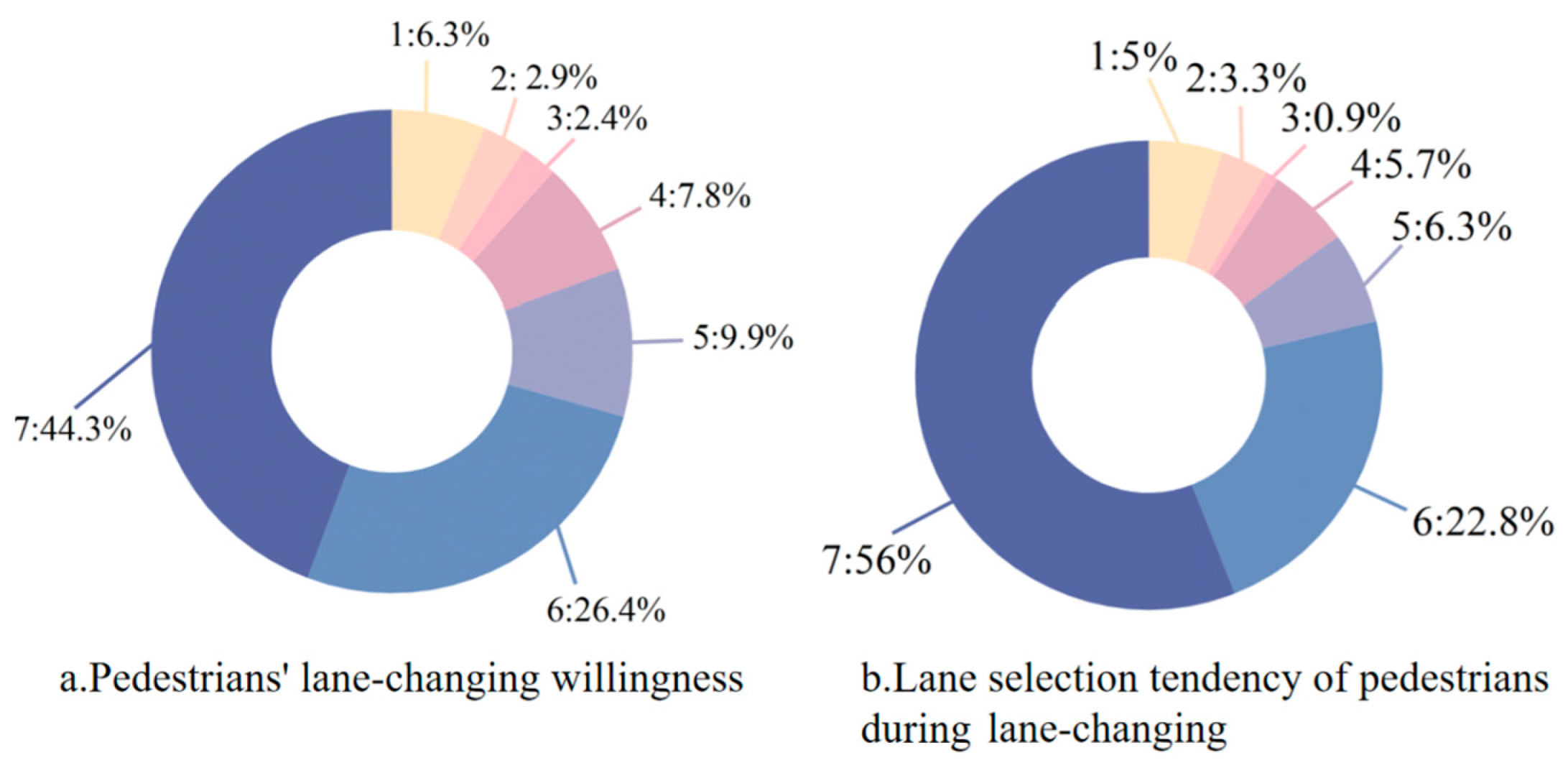
- Do pedestrians in different initial lanes (handrail-side, middle, wall-side) exhibit distinct lane-changing behaviors when space allows? Are pedestrians in the middle lane more inclined to change lanes proactively?
- (3)
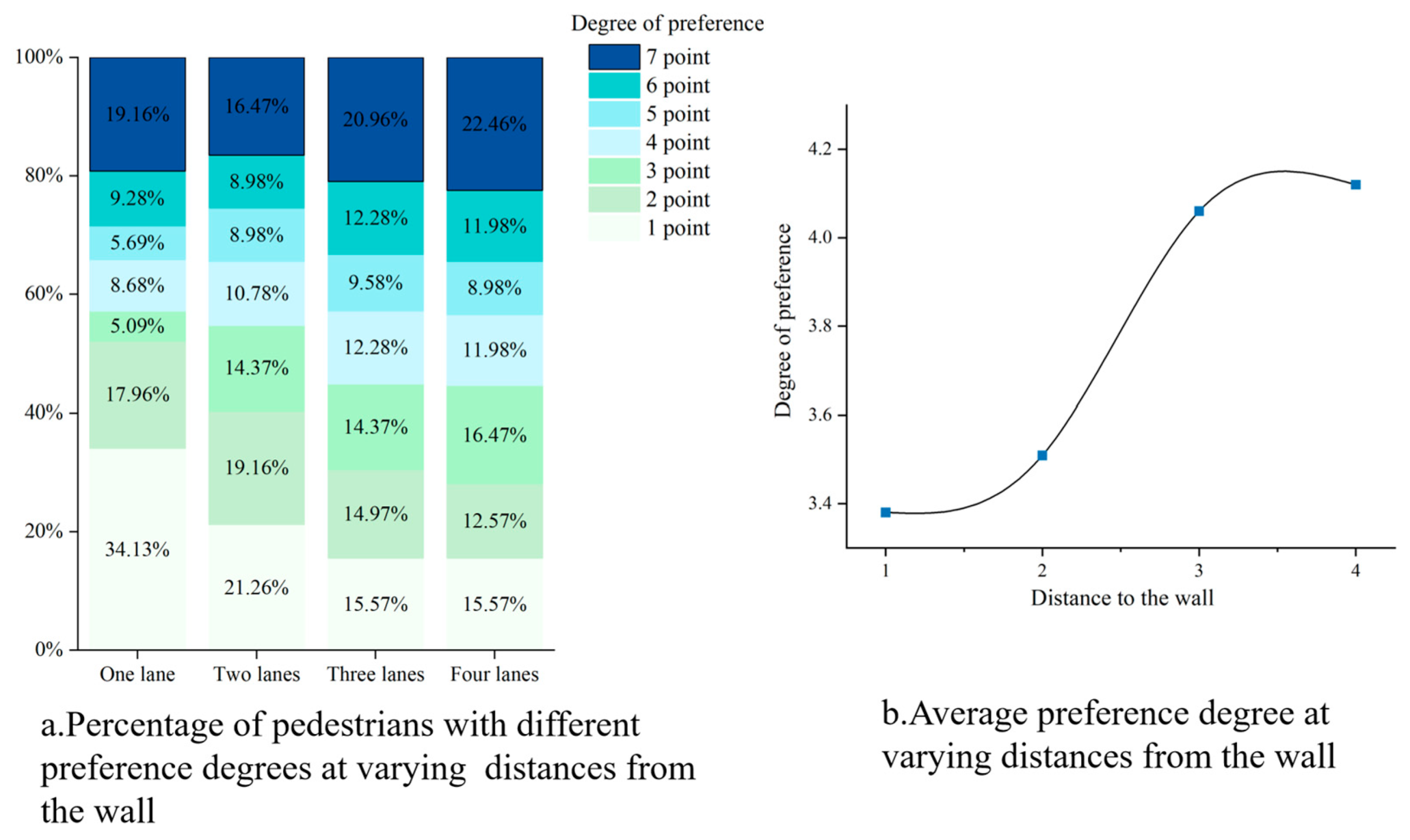
- How does the distance to the wall affect pedestrians’ preference for the wall-side lane, and what is the trend of this influence?
2. Methodology
- (1)
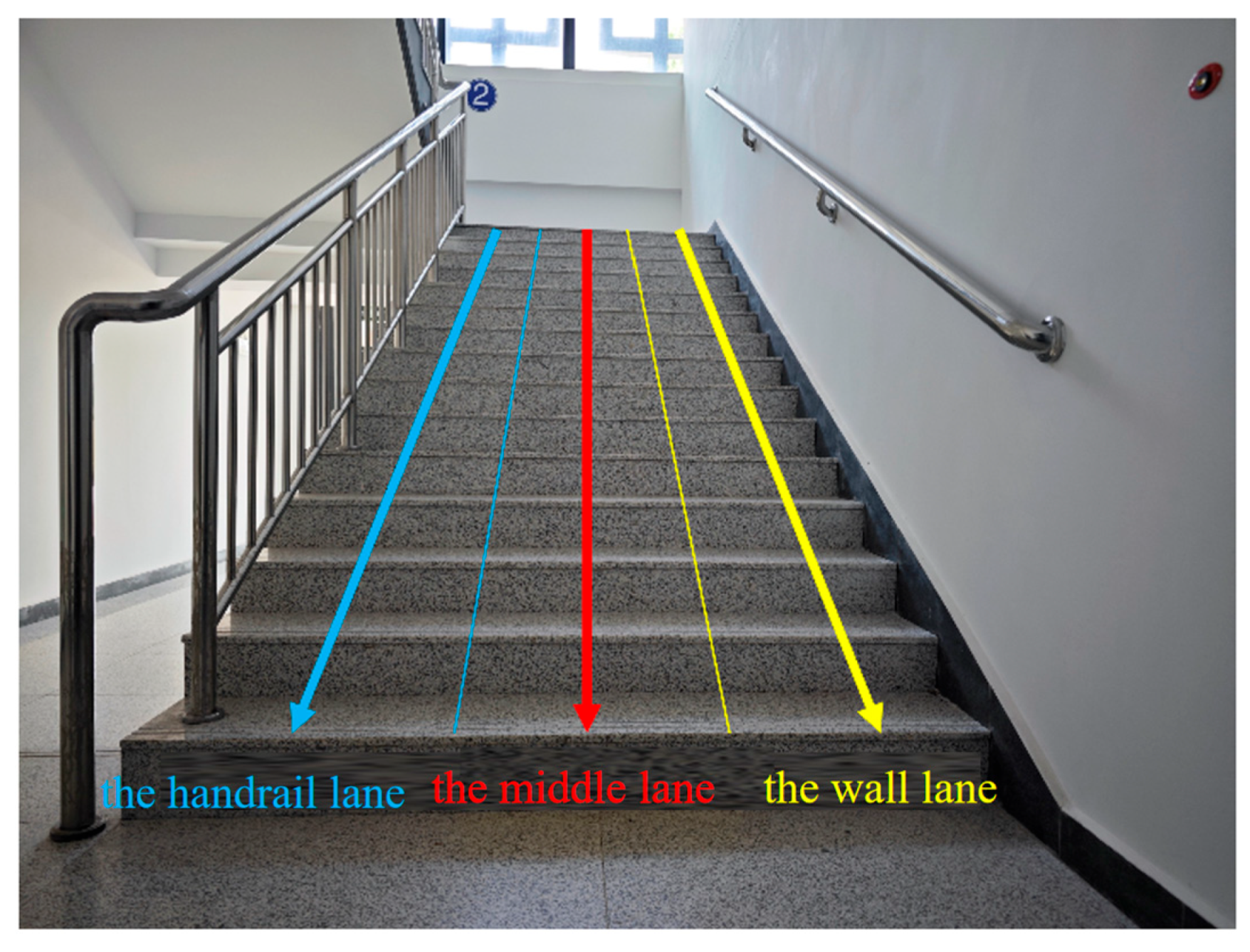
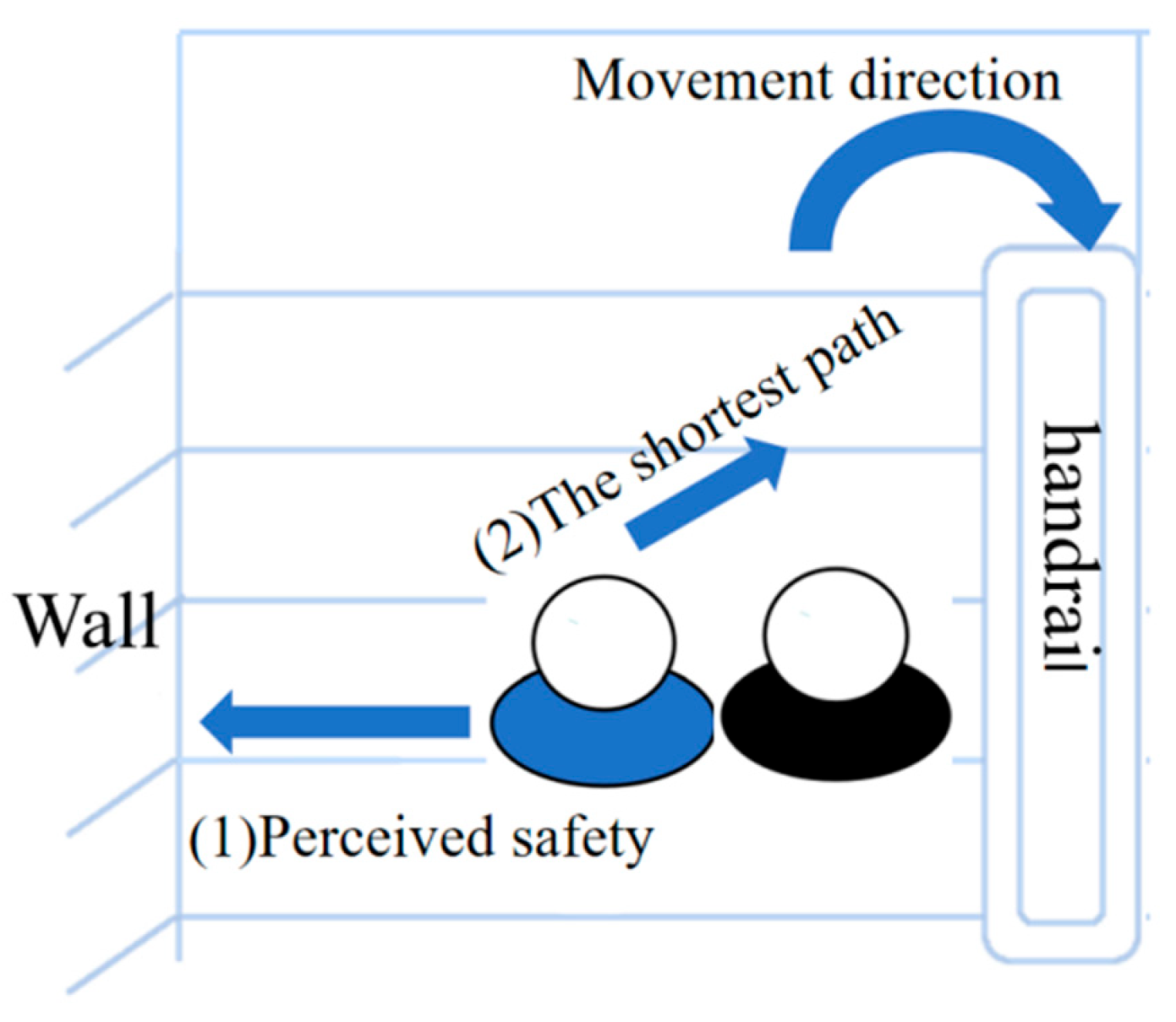
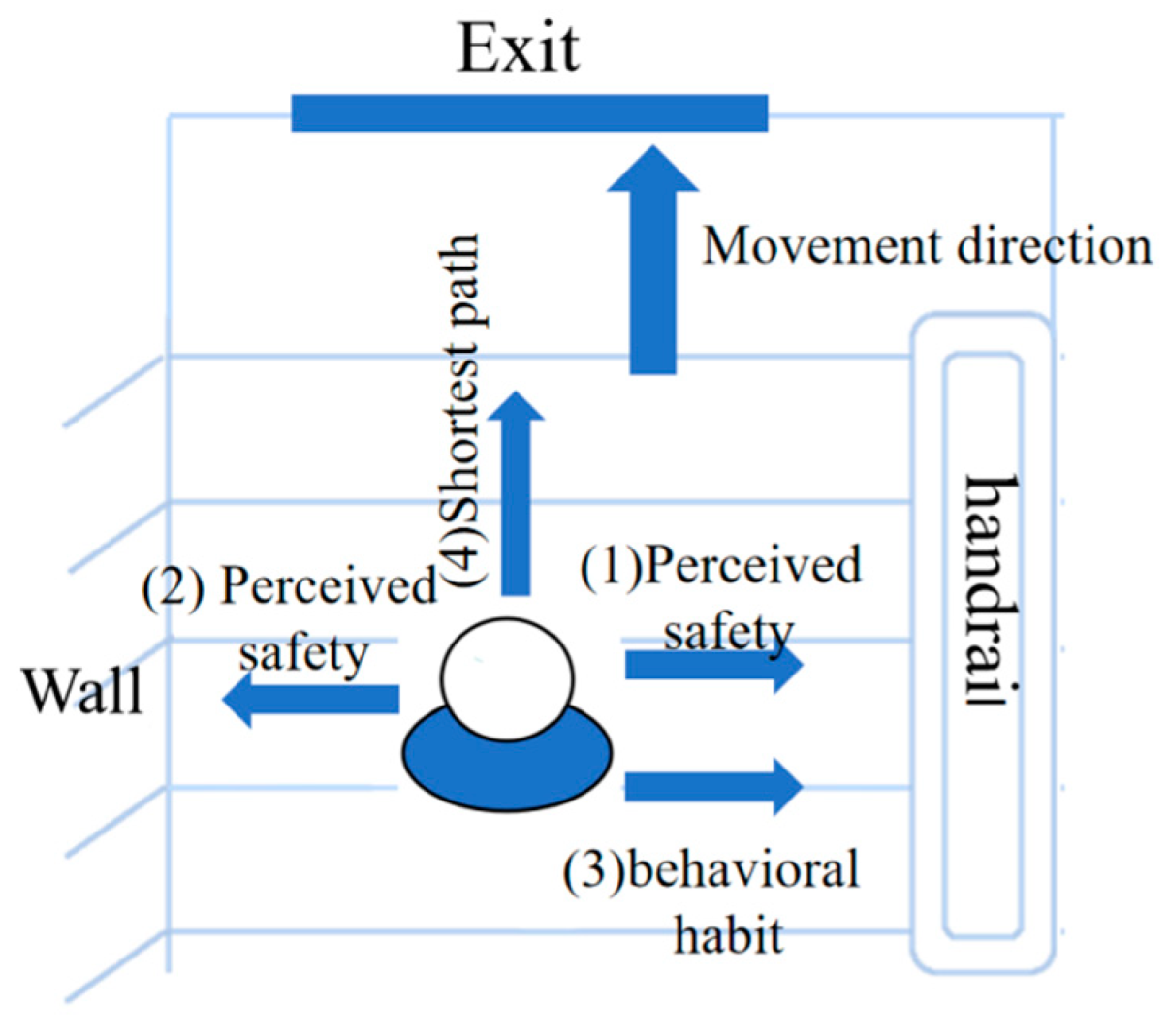
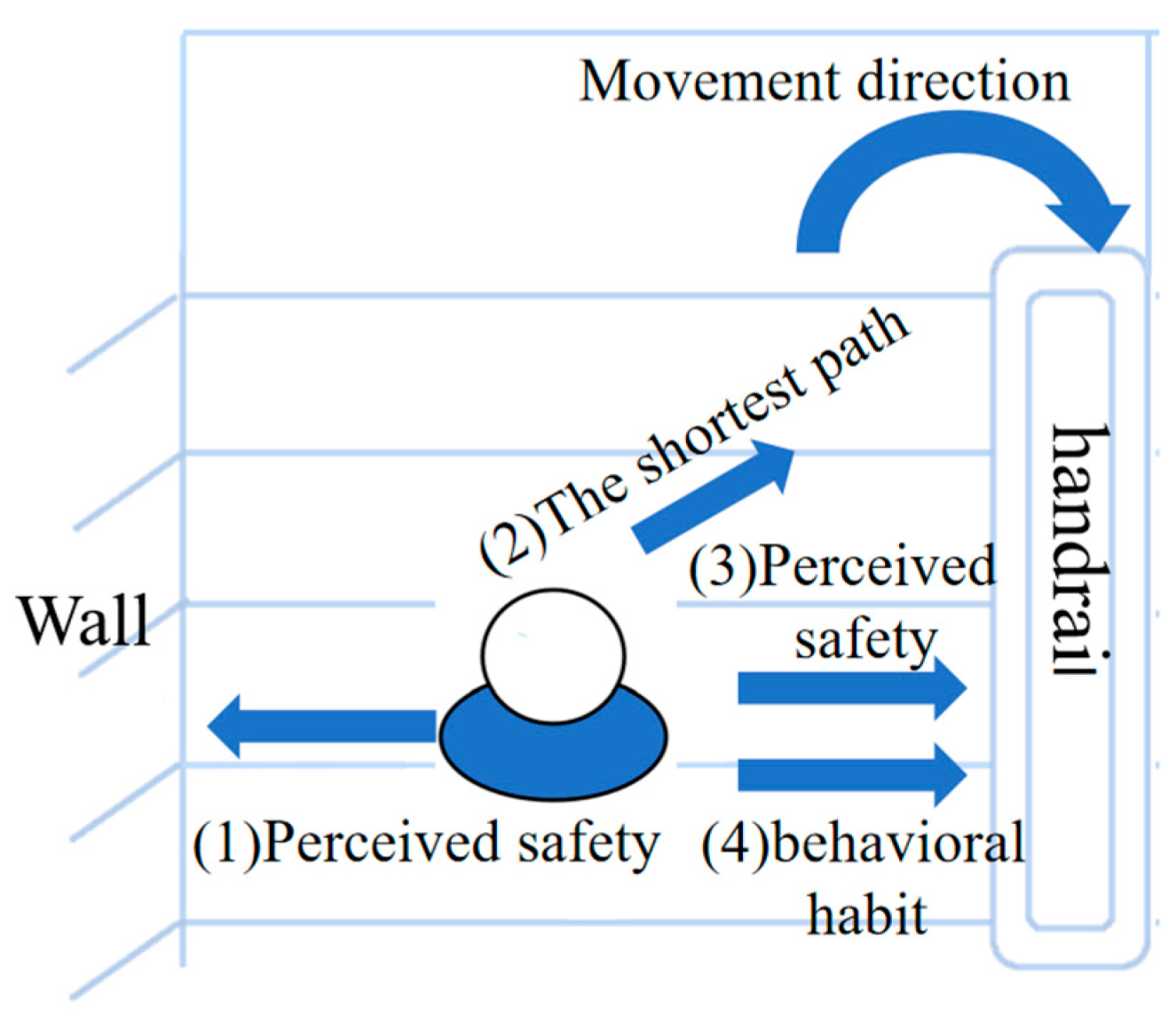
- Pedestrians’ lane-selection preferences are significantly influenced by three factors: perceived safety, shortest path, and behavioral habit.
- (2)
- When sufficient space is available, pedestrians will proactively change lanes based on their own preferences. If pedestrians are already in their preferred lanes, they will continue moving forward along the original lanes.
- (3)
- As the distance to the wall increases, the preference for the wall-side lane gradually decreases.
2.1. Research Methods
2.2. Experiment Objectives
2.3. Experiment Site
2.4. Experimental Procedure
2.4.1. Stair-Evacuation Observation Experiment
2.4.2. Questionnaire Survey
3. Data Analysis and Results
3.1. Stair-Evacuation Observation Experiment Results
3.1.1. Pedestrians’ Lane Selection Data
3.1.2. Pedestrians’ Lane-Changing Behavior Data
3.2. Questionnaire Survey Results
3.2.1. Pedestrians’ Lane-Changing Tendency Data
3.2.2. Data on Pedestrians’ Lane Preference Under Different Distances to the Wall
3.2.3. Data on Influencing Factors of Pedestrians’ Lane Selection Preference
4. Discussion
4.1. Pedestrians’ Lane-Choice Preference
4.2. Pedestrian Lane-Changing Behavior
4.3. Influencing Factors and Their Relative Importance
4.3.1. Perceived Safety
4.3.2. Behavioral Habits
4.3.3. Shortest Path
4.4. The Influence of Stair Width on Pedestrians’ Lane Selection Preference
5. Conclusions
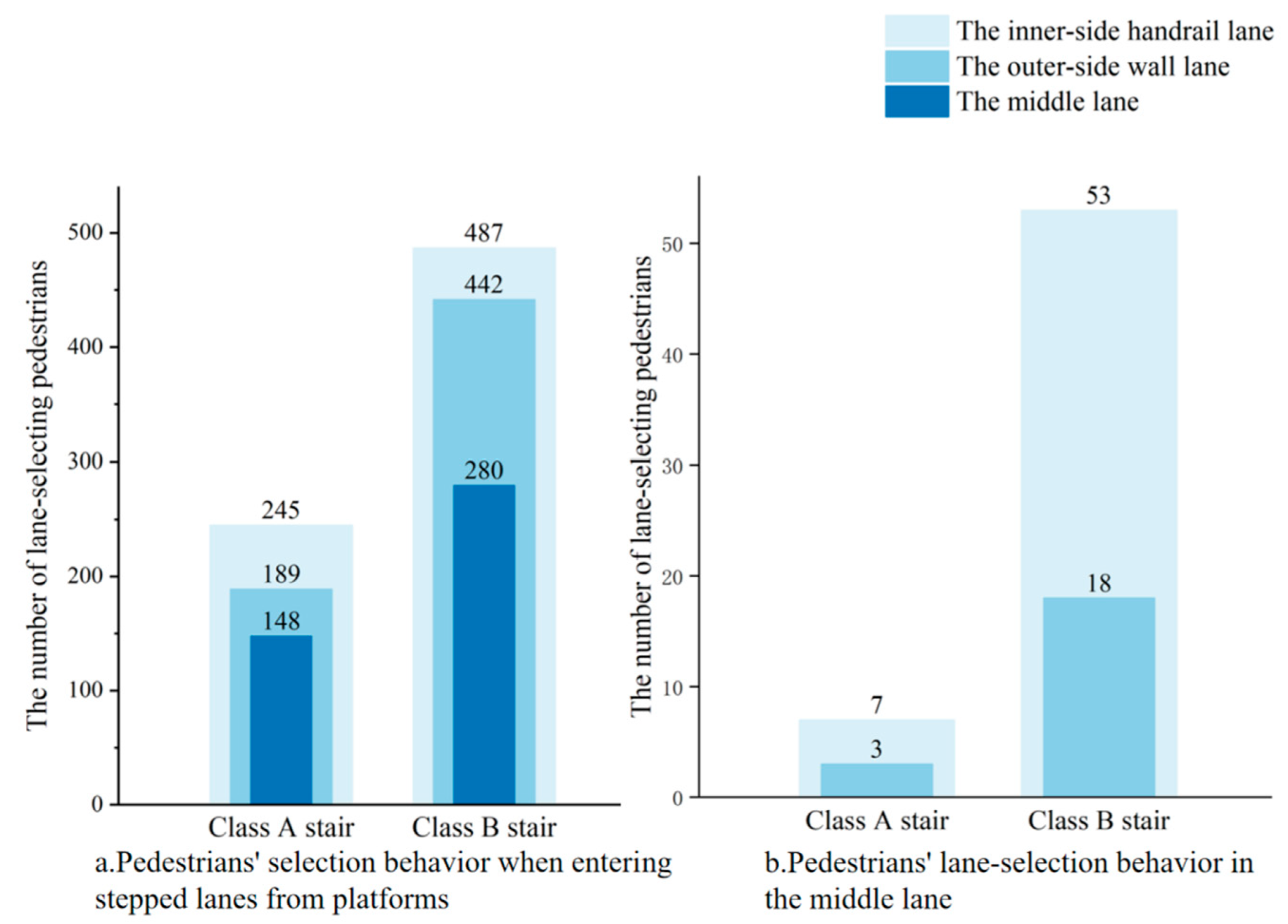
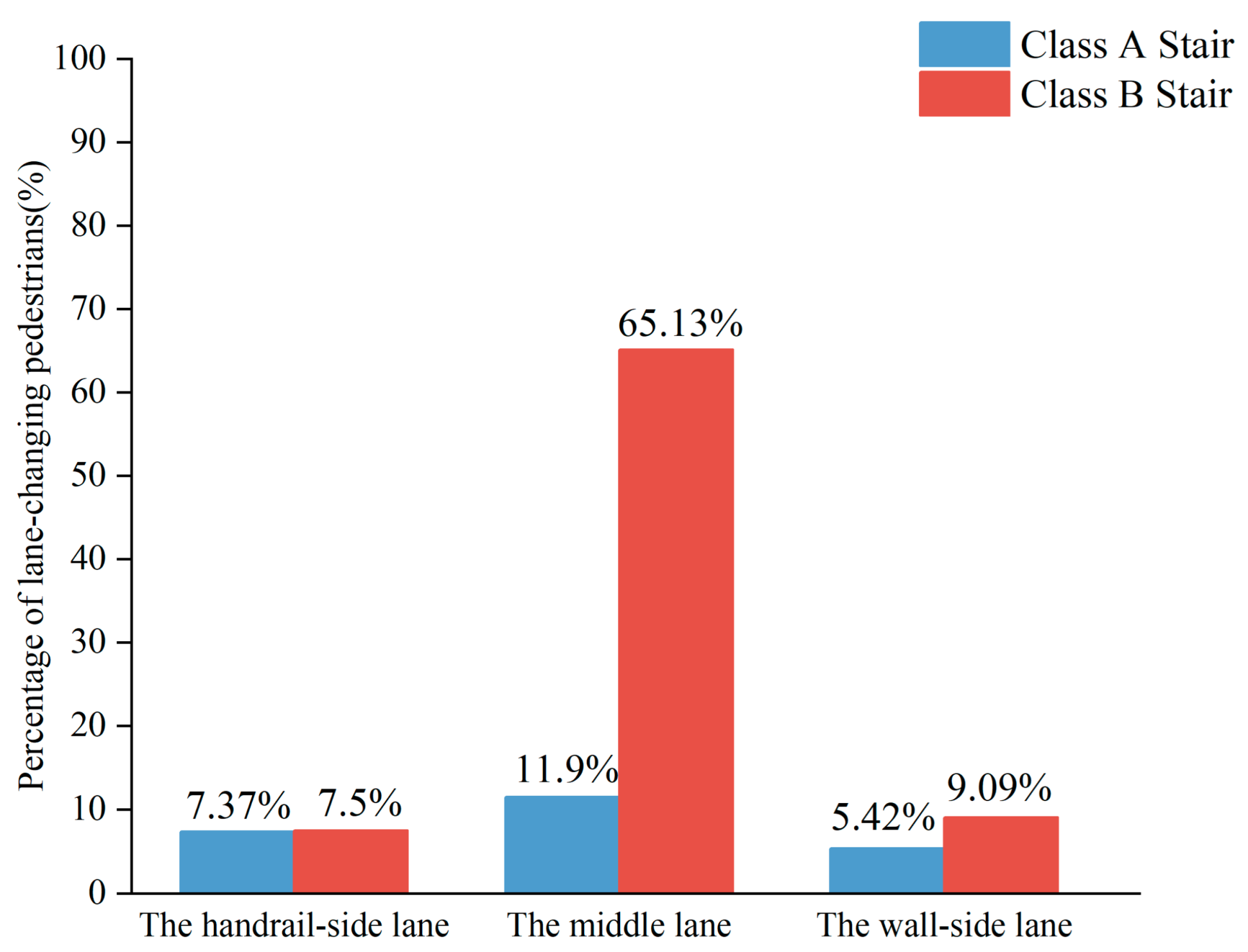
- When sufficient space is available, pedestrians in the middle lane are more inclined to proactively change lanes according to their preferences. In contrast, those occupying the wall-side or handrail-side lane are more likely to stay in their current lane and continue forward.
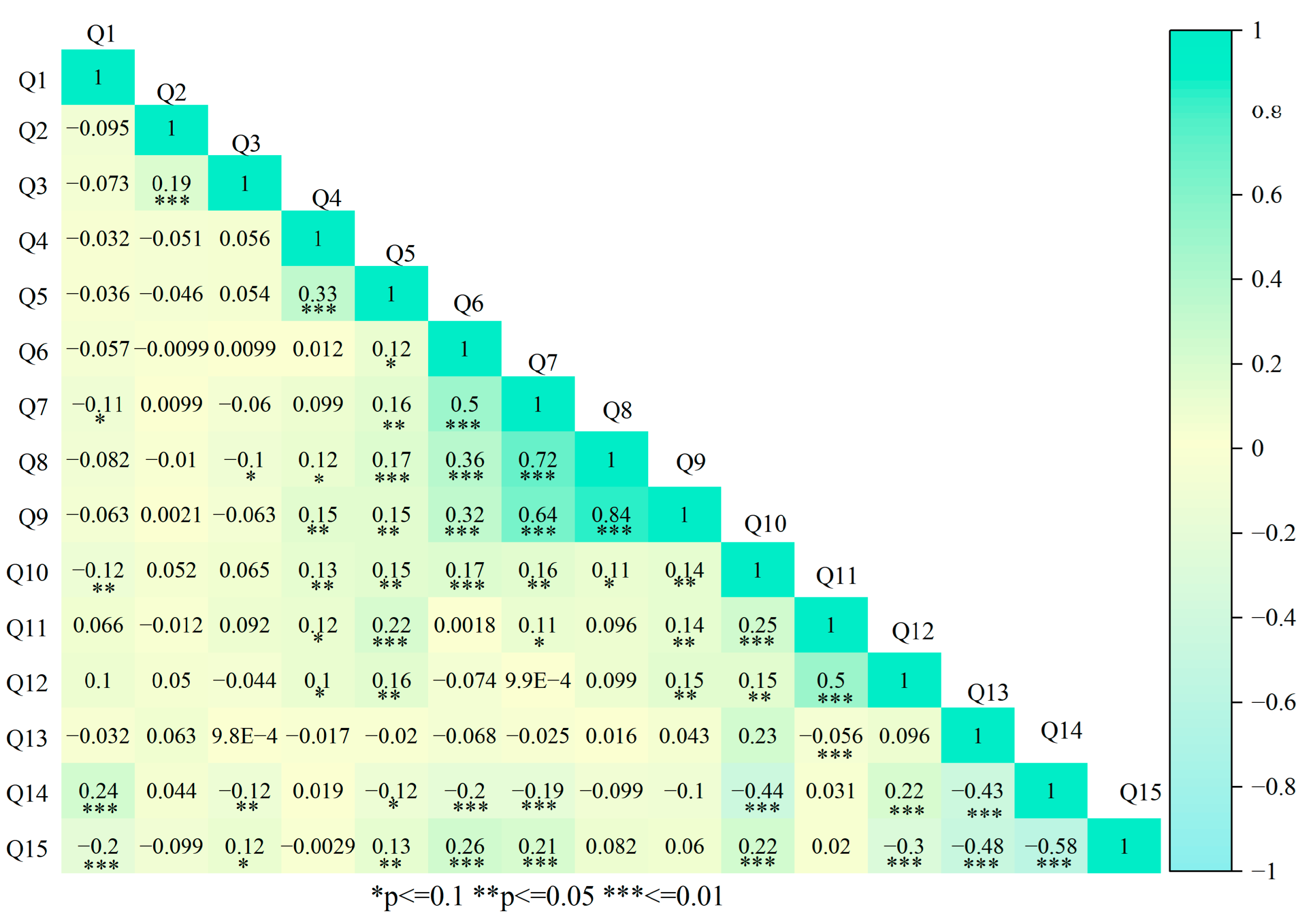
- Pedestrians’ lane-selection preferences during stair evacuation are primarily influenced by perceived safety, the shortest path, and behavioral habits. The relative influence of these factors on pedestrians’ lane-selection preferences from strongest to weakest are as follows: behavioral habits, perceived safety, and the shortest path.
- The effect of the distance to the wall on pedestrians’ lane-selection preference is varied. As the distance to the wall increases, the preference for the wall-side lane gradually decreases. Notably, the rate of decline accelerates at first, then slows down as the wall becomes farther away.
Author Contributions
Funding
Informed Consent Statement
Data Availability Statement
Acknowledgments
Conflicts of Interest
Appendix A. Stair Evacuation Questionnaire
| No. | Item | Option | Answer Statistics (Selection Count/Composite Score) |
| 1 | What is your gender? | Man | 256 |
| Woman | 78 | ||
| 2 | What is your age? | Less than 18 | 3 |
| Ages 18–22 | 319 | ||
| Ages 23–27 | 10 | ||
| 28 years old and above | 2 | ||
| 3 | What is your highest education level? | Associate Degree | 69 |
| Undergraduate Degree | 260 | ||
| Graduate Student | 5 | ||
| The following situational questions assess the degree of preference for different decisions across multiple scenarios, as well as the extent of their influence. Lower or higher values indicate a stronger tendency toward the corresponding behavior/a stronger influence, while the midpoint value of 4 represents no particular tendency or influence. | |||
| 4 | When walking in the middle lane of stairs, do you tend to continue moving in the middle lane, or are you more inclined to change lanes toward the wall or handrail? | 1 | 21 |
| 2 | 10 | ||
| 3 | 8 | ||
| 4 | 26 | ||
| 5 | 33 | ||
| 6 | 88 | ||
| 7 | 148 | ||
| 5 | When you are in the middle lane of stairs, do you tend to move toward the wall side or the handrail lane? | 1 | 17 |
| 2 | 11 | ||
| 3 | 3 | ||
| 4 | 19 | ||
| 5 | 21 | ||
| 6 | 76 | ||
| 7 | 187 | ||
| 6 | When you are in the middle lane of stairs, and the handrail lane is occupied while the wall is only one lane away, do you tend to move toward the wall side or continue in your current lane? | 1 | 114 |
| 2 | 60 | ||
| 3 | 17 | ||
| 4 | 29 | ||
| 5 | 19 | ||
| 6 | 31 | ||
| 7 | 64 | ||
| 7 | When you are in the middle lane of stairs, and the handrail lane is occupied while the wall is two lanes away, do you tend to move toward the wall side or continue in your current lane? | 1 | 71 |
| 2 | 64 | ||
| 3 | 48 | ||
| 4 | 36 | ||
| 5 | 30 | ||
| 6 | 30 | ||
| 7 | 55 | ||
| 8 | When you are in the middle lane of stairs, and the handrail lane is occupied while the wall is three lanes away, do you tend to move toward the wall side or continue in your current lane? | 1 | 52 |
| 2 | 50 | ||
| 3 | 48 | ||
| 4 | 41 | ||
| 5 | 32 | ||
| 6 | 41 | ||
| 7 | 70 | ||
| 9 | When you are in the middle lane of stairs, and the handrail lane is occupied while the wall is four lanes away, do you tend to move toward the wall side or continue in your current lane? | 1 | 52 |
| 2 | 42 | ||
| 3 | 55 | ||
| 4 | 40 | ||
| 5 | 30 | ||
| 6 | 40 | ||
| 7 | 75 | ||
| 10 | The degree to which the choice of the shortest path influences the tendency to move toward the handrail or wall side. | 1 | 22 |
| 2 | 36 | ||
| 3 | 78 | ||
| 4 | 105 | ||
| 5 | 93 | ||
| 11 | The degree to which behavioral habit influences the tendency to move toward the handrail or wall side. | 1 | 10 |
| 2 | 20 | ||
| 3 | 52 | ||
| 4 | 120 | ||
| 5 | 132 | ||
| 12 | The degree to which perceived safety influences the tendency to move toward the handrail or wall side. | 1 | 16 |
| 2 | 29 | ||
| 3 | 58 | ||
| 4 | 92 | ||
| 5 | 139 | ||
| 13 | Among the three factors—sense of safety, shortest path, and habitual behavior—what is the ranking position of habitual behavior? | 1 | 134 |
| 2 | 114 | ||
| 3 | 58 | ||
| 14 | Among the three factors—perceived safety, shortest path, and behavioral habit—what is the ranking position of shortest path? | 1 | 119 |
| 2 | 88 | ||
| 3 | 86 | ||
| 15 | Among the three factors—perceived safety, shortest path, and behavioral habit—what is the ranking position of behavioral habit? | 1 | 81 |
| 2 | 79 | ||
| 3 | 129 | ||
References
- Ma, J.; Song, W.G.; Tian, W.; Lo, S.M.; Liao, G.X. Experimental study on an ultra high-rise building evacuation in China. Saf. Sci. 2012, 50, 1665–1674. [Google Scholar] [CrossRef]
- Andrée, K.; Nilsson, D.; Eriksson, J. Evacuation experiments in a virtual reality high-rise building: Exit choice and waiting time for evacuation elevators. Fire Mater. 2016, 40, 554–567. [Google Scholar] [CrossRef]
- Ronchi, E.; Nilsson, D. Modelling total evacuation strategies for high-rise buildings. In Building Simulation; Springer: Berlin/Heidelberg, Germany, 2014; Volume 7, pp. 73–87. [Google Scholar]
- Chen, J.; Ma, J.; Lo, S.M. Event-driven modeling of elevator assisted evacuation in ultra high-rise buildings. Simul. Model. Pract. Theory 2017, 74, 99–116. [Google Scholar] [CrossRef]
- Koo, J.; Kim, Y.S.; Kim, B.I.; Christensen, K.M. A comparative study of evacuation strategies for people with disabilities in high-rise building evacuation. Expert Syst. Appl. 2013, 40, 408–417. [Google Scholar] [CrossRef]
- Butler, K.; Kuligowski, E.; Furman, S.; Peacock, R. Perspectives of occupants with mobility impairments on evacuation methods for use during fire emergencies. Fire Saf. J. 2017, 91, 955–963. [Google Scholar] [CrossRef]
- Chen, Z.-M.; Zhang, J.; Li, D.-P. Smoke control–Discussion of switching elevator to evacuation elevator in high-rise building. Procedia Eng. 2011, 11, 40–44. [Google Scholar] [CrossRef][Green Version]
- Chien, S.W.; Wen, W.J. A research of the elevator evacuation performance and strategies for Taipei 101 Financial Center. J. Disaster Res. 2011, 6, 581–590. [Google Scholar] [CrossRef]
- Ding, N.; Chen, T.; Zhu, Y.; Lu, Y. State-of-the-art high-rise building emergency evacuation behavior. Phys. A Stat. Mech. Its Appl. 2021, 561, 125168. [Google Scholar] [CrossRef]
- Ronchi, E.; Nilsson, D. Fire evacuation in high-rise buildings: A review of human behaviour and modelling research. Fire Sci. Rev. 2013, 2, 7. [Google Scholar] [CrossRef]
- Lovreglio, R.; Ronchi, E.; Borri, D. The validation of evacuation simulation models through the analysis of behavioural uncertainty. Reliab. Eng. Syst. Saf. 2014, 131, 166–174. [Google Scholar] [CrossRef]
- Lin, J.; Li, N.; Rao, L.L.; Lovreglio, R. Individual wayfinding decisions under stress in indoor emergency situations: A theoretical framework and meta-analysis. Saf. Sci. 2023, 160, 106063. [Google Scholar] [CrossRef]
- Cheng, X.; Zhang, H.; Xie, Q.; Zhou, Y.; Zhang, H.; Zhang, C. Study of announced evacuation drill from a retail store. Build. Environ. 2009, 44, 864–870. [Google Scholar] [CrossRef]
- Rasa, A.R.; Xia, L.; Song, X.; Yu, H.; Karim, R.; Zhang, J.; Song, W. Understanding human-obstacle interaction dynamics on staircases: Implications for emergency evacuation and fire safety in high-rise buildings. J. Build. Eng. 2024, 98, 111082. [Google Scholar] [CrossRef]
- Liu, M.; Lu, G.; Yoshinao, O. Analyzing factors causing deadlock events of bi-directional pedestrian flow when moving on stairs using a personal space model. Sci. Rep. 2024, 14, 10847. [Google Scholar] [CrossRef]
- Wei, X.; Zhao, Y.; Lian, L.; Yao, H.; Song, H.; Qin, H. Study on group movement characteristics in stairwell of high-rise buildings. Buildings 2023, 13, 83. [Google Scholar] [CrossRef]
- Huo, F.; Song, W.; Lv, W.; Liew, K.M. Analyzing pedestrian merging flow on a floor–stair interface using an extended lattice gas model. Simulation 2014, 90, 501–510. [Google Scholar] [CrossRef]
- Zeng, Y.; Song, W.; Huo, F.; Fang, Z.; Cao, S.; Vizzari, G. Effects of initial distribution ratio and illumination on merging behaviors during high-rise stair descent process. Fire Technol. 2018, 54, 1095–1112. [Google Scholar] [CrossRef]
- Crociani, L.; Shimura, K.; Vizzari, G.; Bandini, S. Simulating pedestrian dynamics in corners and bends: A floor field approach. In International Conference on Cellular Automata; Springer International Publishing: Cham, Switzerland, 2018; pp. 460–469. [Google Scholar]
- Liu, Y.; Mao, Z. An experimental study on the critical state of herd behavior in decision-making of the crowd evacuation. Phys. A Stat. Mech. Its Appl. 2022, 595, 127087. [Google Scholar] [CrossRef]
- Dias, C.; Sarvi, M. Exploring the effect of turning manoeuvres on macroscopic properties of pedestrian flow. In Proceedings of the 38th Australasian Transport Research Forum, Melbourne, Australia, 16–18 November 2016. [Google Scholar]
- Zhang, J.; Seyfried, A. Quantification of bottleneck effects for different types of facilities. Transp. Res. Procedia 2014, 2, 51–59. [Google Scholar] [CrossRef]
- Imanishi, M.; Sano, T. Compression of Pedestrian Crowd in Corner Turning Subject experiment-based analysis of walking trajectories. Collect. Dyn. 2020, 5, 53–60. [Google Scholar] [CrossRef]
- Boltes, M.; Seyfried, A. Collecting pedestrian trajectories. Neurocomputing 2013, 100, 127–133. [Google Scholar] [CrossRef]
- Ye, R.; Fang, Z.; Huang, Z.; Lian, L.; Li, X.; Gao, Y.; Liu, J. Trajectory-based analysis on pedestrian turning movement on a stair landing. Saf. Sci. 2022, 147, 105622. [Google Scholar] [CrossRef]
- Dias, C. Crowd Dynamics at Turning Phenomena: Experiments and Modelling. Doctoral Dissertation, Monash University, Melbourne, Australia, 2015. [Google Scholar]
- Johnson, N.R. Panic and the breakdown of social order: Popular myth, social theory, empirical evidence. Sociol. Focus 1987, 20, 171–183. [Google Scholar] [CrossRef]
- Tucker, A.; Marsh, K.L.; Gifford, T.; Lu, X.; Luh, P.B.; Astur, R.S. The effects of information and hazard on evacuee behavior in virtual reality. Fire Saf. J. 2018, 99, 1–11. [Google Scholar] [CrossRef]
- Haghani, M.; Sarvi, M.; Shahhoseini, Z. Evacuation behaviour of crowds under high and low levels of urgency: Experiments of reaction time, exit choice and exit-choice adaptation. Saf. Sci. 2020, 126, 104679. [Google Scholar] [CrossRef]
- Ding, N.; Chen, T.; Zhang, H.; Luh, P.B. Stair evacuation simulation based on cellular automata model considering social forces. In Traffic and Granular Flow’13; Springer International Publishing: Cham, Switzerland, 2014; pp. 145–153. [Google Scholar]
- Zhu, Y.; Chen, T.; Ding, N.; Fan, W.C. Analyzing floor-stair merging flow based on experiments and simulation. Chin. Phys. B 2020, 29, 010401. [Google Scholar] [CrossRef]
- Zeng, Y.; Song, W.; Jin, S.; Ye, R.; Liu, X. Experimental study on walking preference during high-rise stair evacuation under different ground illuminations. Phys. A Stat. Mech. Its Appl. 2017, 479, 26–37. [Google Scholar] [CrossRef]
- Huo, F.Z.; Song, W.G.; Lv, W.; Liew, K.M. Simulation of Pedestrian Flow on Floor-Stair Interface Using an Extended Lattice Gas Model. Appl. Mech. Mater. 2014, 444, 1550–1554. [Google Scholar] [CrossRef]
- Averill, J.D.; Song, W. Accounting for Emergency Response in Building Evacuation: Modeling Differential Egress Capacity Solutions; US Department of Commerce, Technology Administration, National Institute of Standards and Technology, Building and Fire Research Laboratory: Gaithersburg, MD, USA, 2007.
- Boyce, K.E.; Purser, D.A.; Shields, T.J. Experimental studies to investigate merging behaviour in a staircase. Fire Mater. 2012, 36, 383–398. [Google Scholar] [CrossRef]
- Ye, R.; Fang, Z.; Zeng, G.; Wang, Q.; Lian, L.; Cao, S. Characteristics of pedestrians descending on a stairway: A trajectory-based empirical analysis. Saf. Sci. 2023, 160, 106068. [Google Scholar] [CrossRef]
- Jin, H.; Guo, R. Pedestrian movement in stairs based on the cellular automata model. Acta Phys. Sin. 2019, 68, 38–48. [Google Scholar]
- Zhu, R.; Lin, J.; Becerik-Gerber, B.; Li, N. Human-building-emergency interactions and their impact on emergency response performance: A review of the state of the art. Saf. Sci. 2020, 127, 104691. [Google Scholar] [CrossRef]
- Shi, D.; Yang, M.; Chen, J.; Ma, J. Experimental study on unidirectional pedestrian descending and ascending stair with a fixed obstacle. Collect. Dyn. 2021, 6, 1–14. [Google Scholar] [CrossRef]
- Ding, N.; Zhang, H.; Chen, T. Simulation-based optimization of emergency evacuation strategy in ultra-high-rise buildings. Nat. Hazards 2017, 89, 1167–1184. [Google Scholar] [CrossRef]
- Shi, J.; Ding, N.; Wang, H.; Wang, Y. How risk preference affects evacuees’ route choice in buildings: An IVR-based experimental study. Saf. Sci. 2025, 187, 106840. [Google Scholar] [CrossRef]
- Kobes, M.; Helsloot, I.; De Vries, B.; Post, J.G.; Oberijé, N.; Groenewegen, K. Way finding during fire evacuation; an analysis of unannounced fire drills in a hotel at night. Build. Environ. 2010, 45, 537–548. [Google Scholar] [CrossRef]
- Zhu, K.J.; Shi, Q. Experimental study on choice behavior of pedestrians during building evacuation. Procedia Eng. 2016, 135, 207–216. [Google Scholar] [CrossRef]
- Silverman, A.K.; Neptune, R.R.; Sinitski, E.H.; Wilken, J.M. Whole-body angular momentum during stair ascent and descent. Gait Posture 2014, 39, 1109–1114. [Google Scholar] [CrossRef]
- Xu, X.; Song, W. Staircase evacuation modeling and its comparison with an egress drill. Build. Environ. 2009, 44, 1039–1046. [Google Scholar] [CrossRef]
- Fang, Z.M.; Song, W.G.; Li, Z.J.; Tian, W.; Lv, W.; Ma, J.; Xiao, X. Experimental study on evacuation process in a stairwell of a high-rise building. Build. Environ. 2012, 47, 316–321. [Google Scholar] [CrossRef]
- Ding, N.; Luh, P.B.; Zhang, H.; Chen, T. Emergency evacuation simulation in staircases considering evacuees’ physical and psychological status. In Proceedings of the 2013 IEEE International Conference on Automation Science and Engineering (CASE), Madison, WI, USA, 17–20 August 2013; IEEE: Piscataway, NJ, USA, 2013; pp. 741–746. [Google Scholar]
- Huo, F.; Song, W.; Chen, L.; Liu, C.; Liew, K.M. Experimental study on characteristics of pedestrian evacuation on stairs in a high-rise building. Saf. Sci. 2016, 86, 165–173. [Google Scholar] [CrossRef]






| Observational Area | The Wall-Side Lane | The Middle Lane | The Handrail Lane | |||
|---|---|---|---|---|---|---|
| Lane Change | No Lane Change | Lane Change | No Lane Change | Lane Change | No Lane Change | |
| Class A stair | 7 | 122 | 10 | 77 | 7 | 88 |
| Class B stair | 13 | 130 | 71 | 38 | 15 | 185 |
| Factors | Shortest Path | Behavioral Habit | Perceived Safety | |
|---|---|---|---|---|
Score | ||||
| 1 | 6.59% | 2.99% | 4.97% | |
| 2 | 10.78% | 5.99% | 8.68% | |
| 3 | 23.35% | 15.57% | 17.37% | |
| 4 | 31.44% | 35.93% | 27.54% | |
| 5 | 27.84% | 39.52% | 41.62% | |
| Average score | 3.63 | 4.03 | 3.93 | |
| Factor | Composite Score | First Place | Second Place | Third Place |
|---|---|---|---|---|
| Behavioral habit | 2.06 | 134 (43.79%) | 114 (37.25%) | 58 (18.95%) |
| Perceived safety | 1.85 | 119 (40.61%) | 88 (30.03%) | 86 (29.35%) |
| Shortest path | 1.59 | 81 (28.03%) | 79 (27.34%) | 129 (44.64%) |
Disclaimer/Publisher’s Note: The statements, opinions and data contained in all publications are solely those of the individual author(s) and contributor(s) and not of MDPI and/or the editor(s). MDPI and/or the editor(s) disclaim responsibility for any injury to people or property resulting from any ideas, methods, instructions or products referred to in the content. |
© 2026 by the authors. Licensee MDPI, Basel, Switzerland. This article is an open access article distributed under the terms and conditions of the Creative Commons Attribution (CC BY) license.
Share and Cite
Xu, C.; Ding, N.; Zhang, E.; Xu, Q. Pedestrian Decision-Making Behavior During Stair Evacuation: An Experiment Study on Stair Lane-Selection Preferences. Fire 2026, 9, 64. https://doi.org/10.3390/fire9020064
Xu C, Ding N, Zhang E, Xu Q. Pedestrian Decision-Making Behavior During Stair Evacuation: An Experiment Study on Stair Lane-Selection Preferences. Fire. 2026; 9(2):64. https://doi.org/10.3390/fire9020064
Chicago/Turabian StyleXu, Chunhua, Ning Ding, Erhao Zhang, and Qinan Xu. 2026. "Pedestrian Decision-Making Behavior During Stair Evacuation: An Experiment Study on Stair Lane-Selection Preferences" Fire 9, no. 2: 64. https://doi.org/10.3390/fire9020064
APA StyleXu, C., Ding, N., Zhang, E., & Xu, Q. (2026). Pedestrian Decision-Making Behavior During Stair Evacuation: An Experiment Study on Stair Lane-Selection Preferences. Fire, 9(2), 64. https://doi.org/10.3390/fire9020064