
Estimating the Spatio-Temporal Distribution of Smoke Layer Interface Height in Tunnel Fires During Construction

 ,
,  ,
, 
Abstract
1. Introduction
2. Materials and Methods
2.1. Experimental Apparatus
2.2. Numerical Simulation Set-Up
3. Results and Discussion
3.1. Estimating Method for Smoke Layer Interface Height
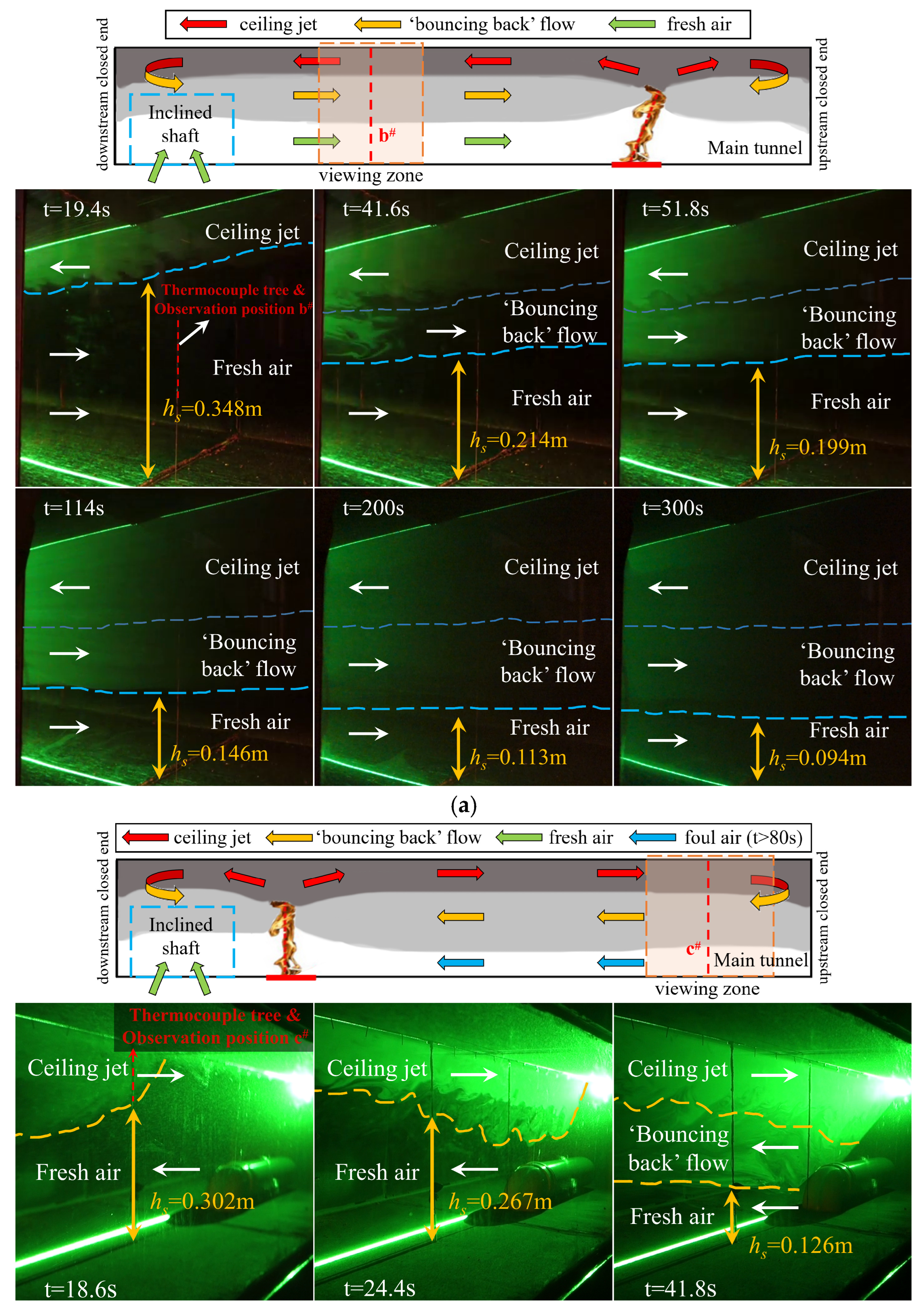
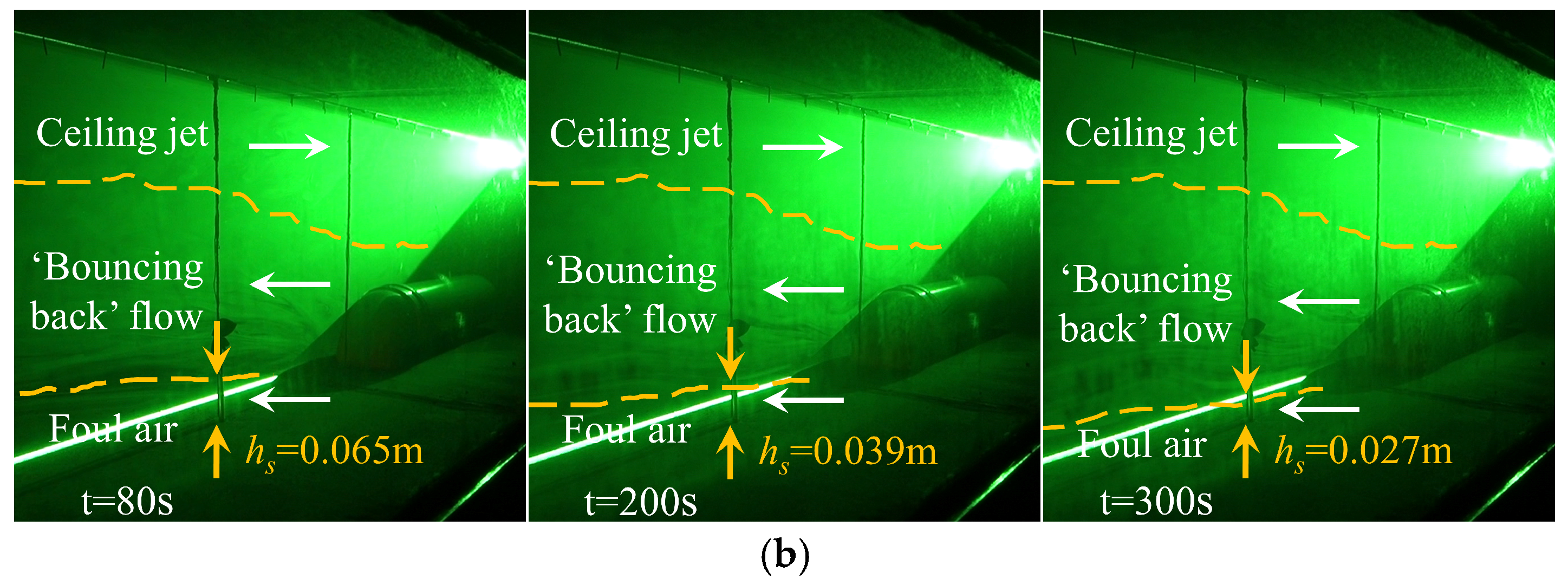
3.1.1. Dynamic Evolution of the Smoke Layer
- Fire scenario 1
- Fire scenario 2
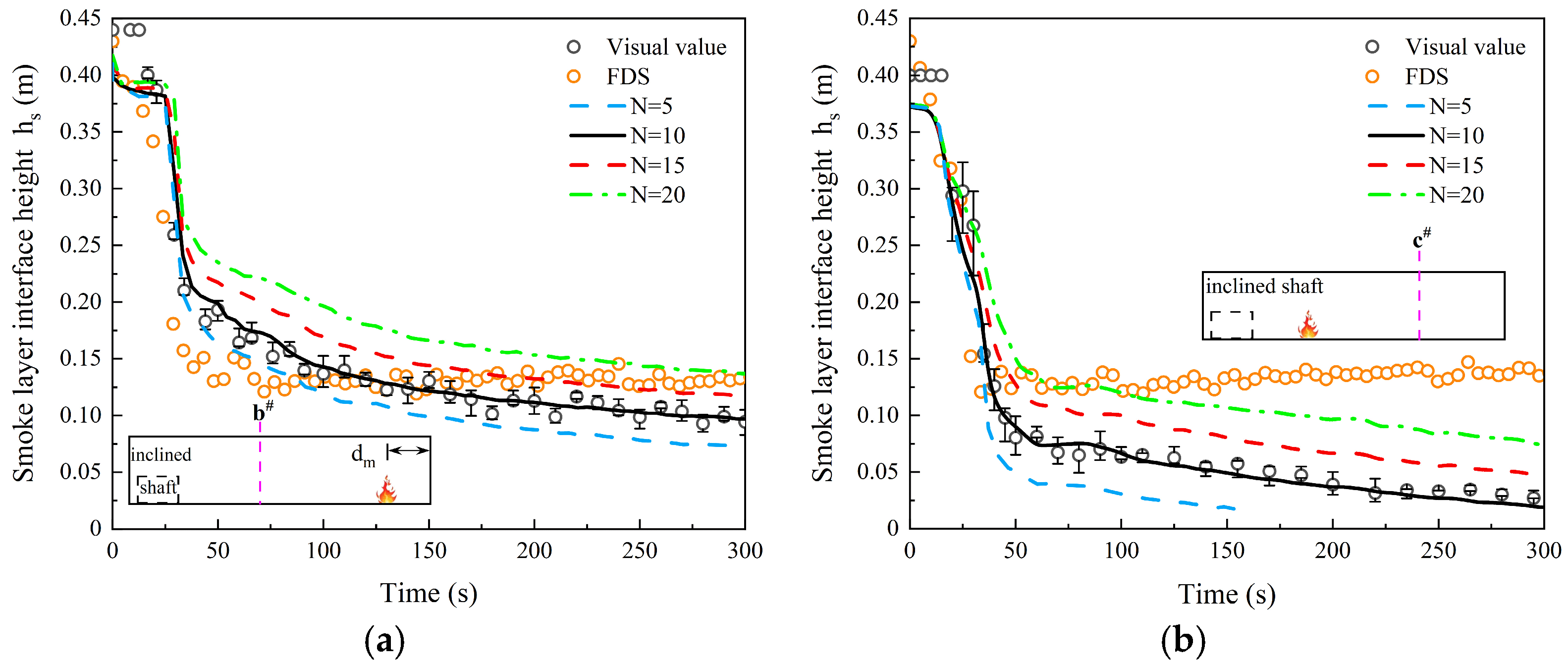
3.1.2. Determination of the Reasonable N Value
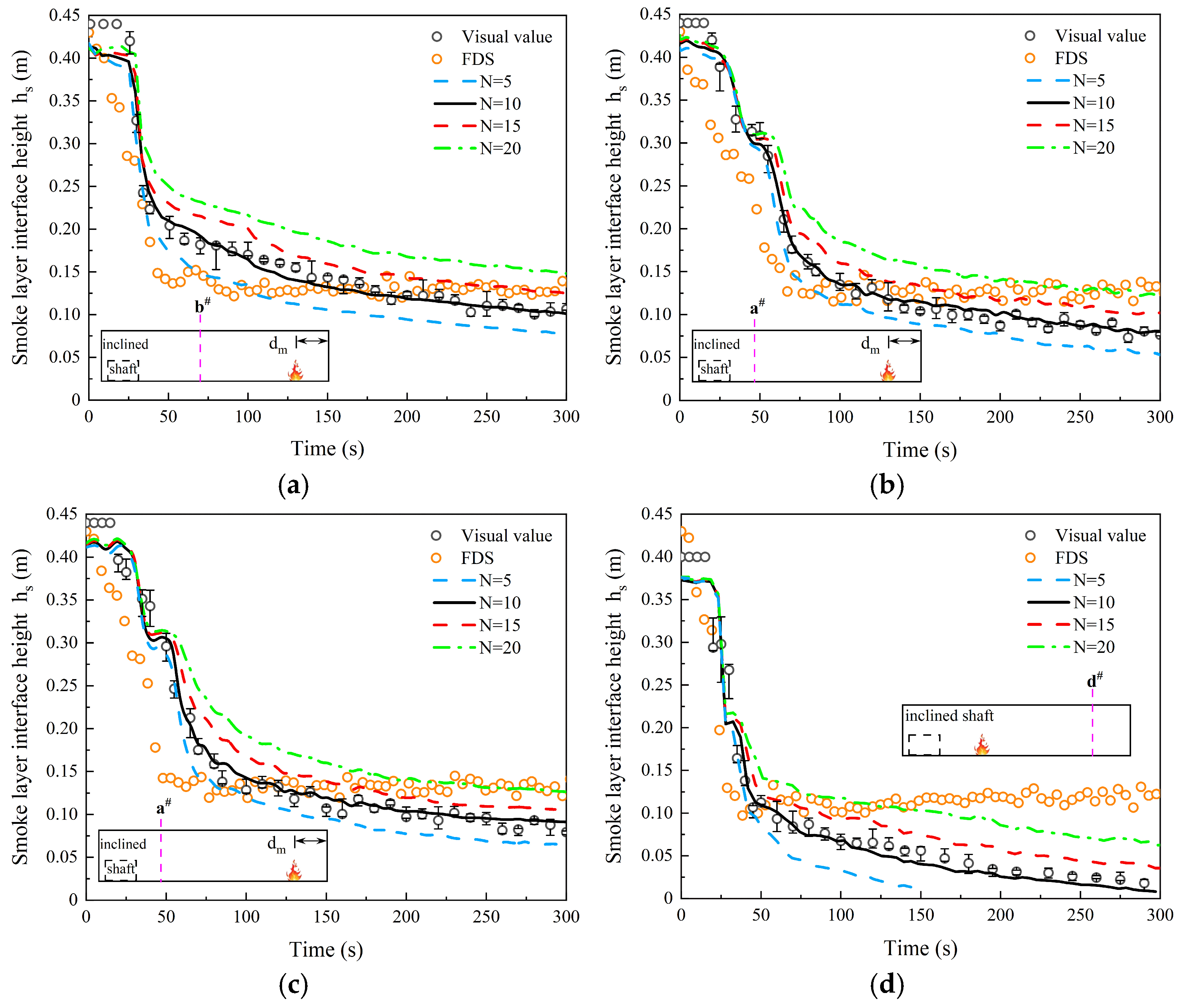
3.1.3. Verification of the Reasonable N Value
3.2. Application in Tunnel Fire Safety Assessment
3.2.1. Spatio-Temporal Distribution of hs
3.2.2. Smoke Arrival Time
3.3. Limitations and Future Work
4. Conclusions
- (1)
- In the two fire scenarios, the structural evolution of the smoke layer inside the main tunnel roughly experiences three stages. For fire scenario 1, a clear flow of three layers is maintained inside the tunnel. Meanwhile, for fire scenario 2, after t > 80 s, the original smoke stratification upstream of the fire is destroyed, and the lower fresh air is replaced by the foul air layer.
- (2)
- For multiple typical test cases and observation positions, the reasonable N value is 10 through the comparison and verification of the visual values with the predicted values of the N-percentage method.
- (3)
- It is found that the FDS simulation method is suitable for situations with good stratification. However, it is not suitable for situations with poor stratification, such as the area between the fire and the closed end. It should be used with caution because its prediction may have significant deviations.
- (4)
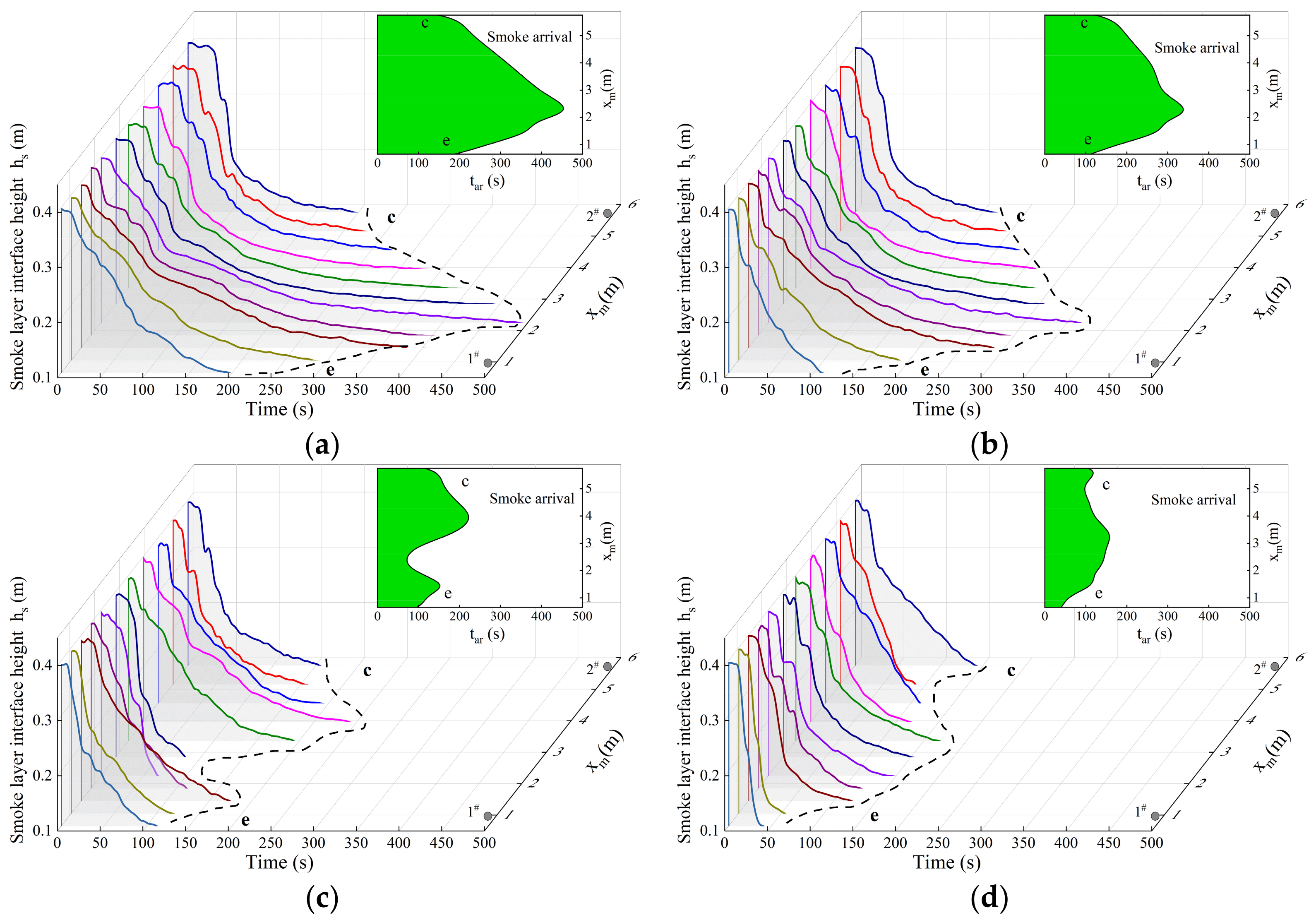
- The spatio-temporal distributions of hs are further predicted based on N = 10. With the increase of Qm, the settlement velocity of the smoke is accelerated. Except near the fire source, the hs value decreases rapidly with distance from the fire source, and reaches 0.1 m above the tunnel floor earlier.
- (5)
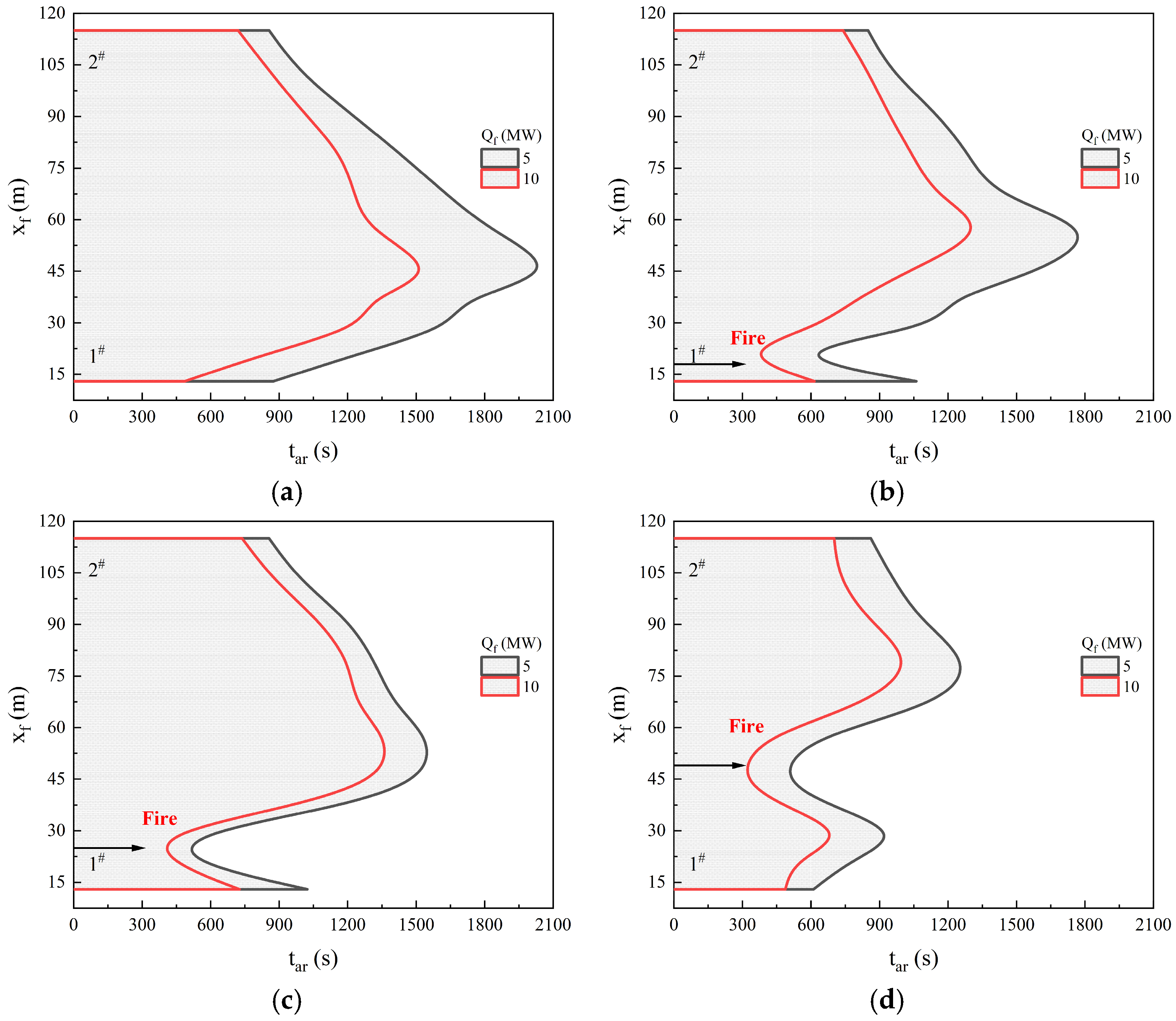
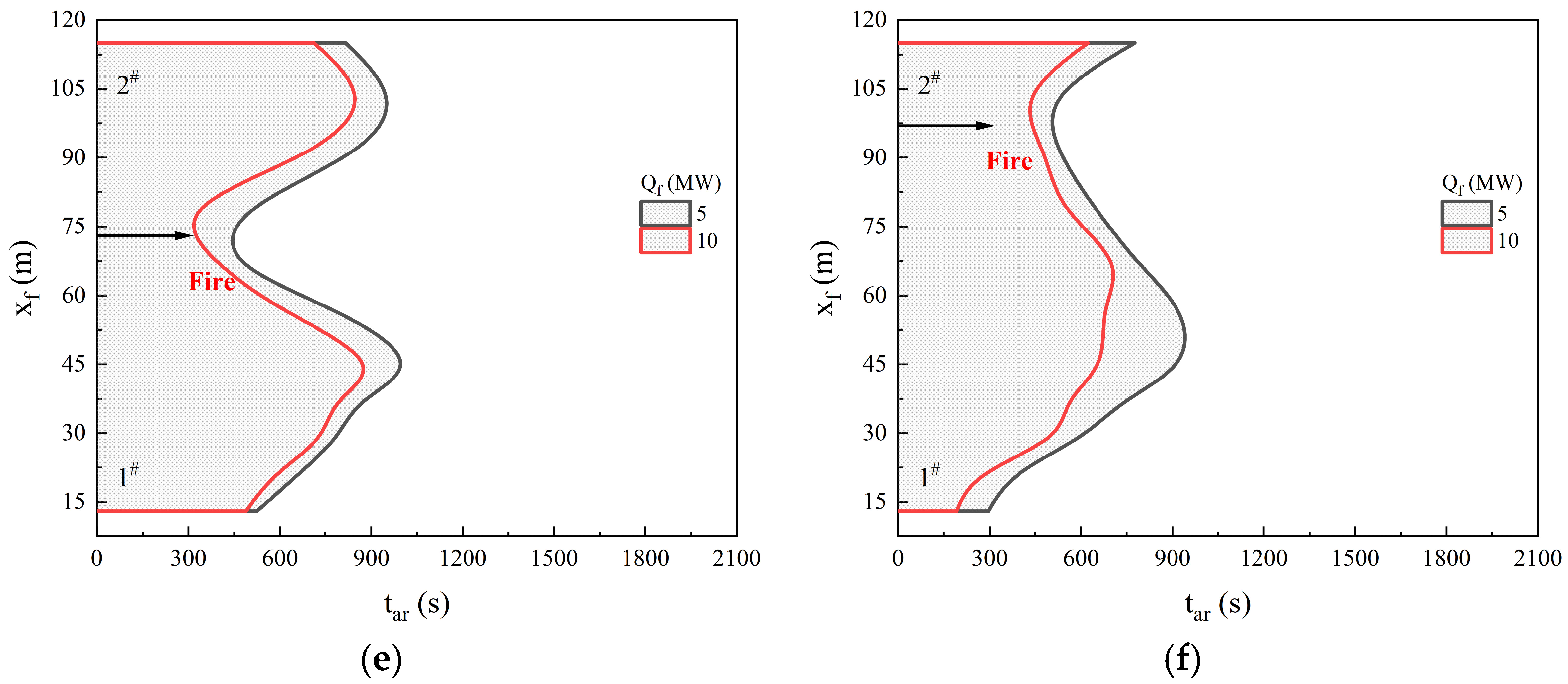
- The heat release rate and the longitudinal fire location evidently influence the value of tar. When df = 49 m, as Qf increases, the tar at 1# and 2# are reduced by 122 s and 160 s, respectively. As the fire source moves to the downstream closed end, the ‘safe region’ becomes smaller. For Qf = 10 MW, when df increases from 9 m to 49 m and then to 97 m, the tar value at 2# decreases from 721 s to 701 s and then to 622 s.
Author Contributions
Funding
Data Availability Statement
Conflicts of Interest
References
- Carvel, R.; Marlair, G. A history of fire incidents in tunnels. In The Handbook of Tunnel Fire Safety; Emerald Publishing Limited: Leeds, UK, 2005. [Google Scholar]
- Tong, W.X.; Ge, F.L.; Ding, L.; Ji, J.; Zhou, Y.L.; Zhou, Y.; Zhou, F. Full-scale experimental and numerical study of smoke spread characteristics in a long-closed channel with one lateral opening. Tunn. Undergr. Space Technol. 2023, 132, 104919. [Google Scholar] [CrossRef]
- Lönnermark, A.; Hugosson, J.; Ingason, H. Fire Incidents During Construction Work of Tunnels–Modelscale Experiments; SP Report 2010; SP Technical Research Institute of Sweden: Borås, Sweden, 2010. [Google Scholar]
- Qiu, M.X.; Xu, L.; Zhao, Y.H.; Ding, C.; Zhao, S.Z.; Yu, W.; Li, L.Y.; Zhou, X.X. Experimental investigation on maximum ceiling temperature and longitudinal attenuation in a closed tunnel with an inclined shaft. Int. J. Therm. Sci. 2025, 208, 109484. [Google Scholar] [CrossRef]
- Xu, L.; Qiu, M.X.; Zhao, Y.H.; Ding, C.; Yu, W.; Zhao, S.Z.; Li, L.Y.; Liu, J. Experimental study on vertical temperature distribution of the two-layer smoke flow in tunnel during construction. Tunn. Undergr. Space Technol. 2023, 136, 105105. [Google Scholar] [CrossRef]
- Yao, Y.Z.; Li, Y.Z.; Lönnermark, A.; Ingason, H.; Cheng, X.D. Study of tunnel fires during construction using a model scale tunnel. Tunn. Undergr. Space Technol. 2019, 89, 50–67. [Google Scholar] [CrossRef]
- Yao, Y.Z.; Wang, R.; Xia, Z.Y.; Ren, F.; Zhao, J.L.; Zhu, H.Q.; Cheng, X.D. Numerical study of the characteristics of smoke spread in tunnel fires during construction and method for improvement of smoke control. Case Stud. Therm. Eng. 2022, 34, 102043. [Google Scholar] [CrossRef]
- Fan, C.G.; Li, A.Y.; Mu, Y.; Guo, F.Y.; Ji, J. Smoke movement characteristics under stack effect in a mine laneway fire. Appl. Therm. Eng. 2017, 110, 70–79. [Google Scholar] [CrossRef]
- He, Y.P.; Fernando, A.; Luo, M.C. Determination of interface height from measured parameter profile in enclosure fire experiment. Fire Saf. J. 1998, 31, 19–38. [Google Scholar] [CrossRef]
- Tang, F.; He, Q.; Shi, Q. Experimental study on thermal smoke layer thickness with various upstream blockage-fire distances in a longitudinal ventilated tunnel. J. Wind Eng. Ind. Aerodyn. 2017, 170, 141–148. [Google Scholar] [CrossRef]
- Gao, Z.H.; Ji, J.; Fan, C.G.; Li, L.J.; Sun, J.H. Determination of smoke layer interface height of medium scale tunnel fire scenarios. Tunn. Undergr. Space Technol. 2016, 56, 118–124. [Google Scholar] [CrossRef]
- Xu, Z.S.; Zhao, J.M.; Liu, Q.L.; Chen, H.G.; Liu, Y.H.; Geng, Z.Y.; He, L. Experimental investigation on smoke spread characteristics and smoke layer height in tunnels. Fire Mater. 2019, 43, 303–309. [Google Scholar] [CrossRef]
- Chow, W.K. Determination of the Smoke Layer Interface Height for Hot Smoke Tests in Big Halls. J. Fire Sci. 2009, 27, 125–142. [Google Scholar] [CrossRef]
- Cooper, L.Y.; Harkleroad, M.; Quintiere, J.; Rinkinen, W. An Experimental Study of Upper Hot Layer Stratification in Full-Scale Multiroom Fire Scenarios. J. Heat Transf. 1982, 104, 741–749. [Google Scholar] [CrossRef]
- Lai, C.M.; Chen, C.J.; Tsai, M.J.; Tsai, M.H.; Lin, T.H. Determinations of the fire smoke layer height in a naturally ventilated room. Fire Saf. J. 2013, 58, 1–14. [Google Scholar] [CrossRef]
- Zhu, S.; Mao, S.; Hu, L.; Wu, L. An improved algorithm for smoke layer identification in building fire condition. In Proceedings of the 2011 Eighth International Conference on Fuzzy Systems and Knowledge Discovery (FSKD), Shanghai, China, 26–28 July 2011; pp. 410–413. [Google Scholar]
- Tanno, A.; Oka, H.; Kamiya, K.; Oka, Y. Determination of smoke layer thickness using vertical temperature distribution in tunnel fires under natural ventilation. Tunn. Undergr. Space Technol. 2022, 119, 104257. [Google Scholar] [CrossRef]
- He, L.; Xu, Z.S.; Markert, F.; Zhao, J.M.; Xie, E.; Liu, Q.L.; Tao, H.W.; Marcial, S.T.S.; Wang, Z.H.; Fan, C.G. Study on the effect of tunnel dimensions on the smoke layer thickness in naturally ventilated short tunnel fires. Tunn. Undergr. Space Technol. 2021, 112, 103941. [Google Scholar] [CrossRef]
- Zhang, J.L.; Zhou, X.D.; Xu, Q.K.; Yang, L.Z. The inclination effect on CO generation and smoke movement in an inclined tunnel fire. Tunn. Undergr. Space Technol. 2012, 29, 78–84. [Google Scholar] [CrossRef]
- Zhao, S.Z.; Li, Y.Z.; Ingason, H.; Liu, F. A theoretical and experimental study on the buoyancy-driven smoke flow in a tunnel with vertical shafts. Int. J. Therm. Sci. 2019, 141, 33–46. [Google Scholar] [CrossRef]
- Lei, W.J.; Zhang, Z.Z.; Li, Y.H.; Zheng, Z.J.; Tai, C.M.; Zhang, L.H. Experimental study on the effect of makeup air inlets height on the fire combustion and smoke diffusion. Case Stud. Therm. Eng. 2024, 61, 104951. [Google Scholar] [CrossRef]
- Tilley, N.; Rauwoens, P.; Merci, B. Verification of the accuracy of CFD simulations in small-scale tunnel and atrium fire configurations. Fire Saf. J. 2011, 46, 186–193. [Google Scholar] [CrossRef]
- Weng, M.C.; Xiong, K.; Liu, F.; Xie, J. Improved temperature-based methods and deep learning-based method for identifying the smoke layer height in tunnel with longitudinal ventilation. J. Wind Eng. Ind. Aerodyn. 2024, 252, 105833. [Google Scholar] [CrossRef]
- Jiang, L.; Guo, X.; Yang, Y.; Yang, D. Inversion of tunnel fires using limited monitored temperature data based on transfer learning approach and full-scale scenario applications. Eng. Appl. Artif. Intell. 2025, 162, 112708. [Google Scholar] [CrossRef]
- Hansen, R.; Ingason, H. Heat release rate measurements of burning mining vehicles in an underground mine. Fire Saf. J. 2013, 61, 12–25. [Google Scholar] [CrossRef]
- Okamoto, K.; Watanabe, N.; Hagimoto, Y.; Chigira, T.; Masano, R.; Miura, H.; Ochiai, S.; Satoh, H.; Tamura, Y.; Hayano, K.; et al. Burning behavior of sedan passenger cars. Fire Saf. J. 2009, 44, 301–310. [Google Scholar] [CrossRef]
- McGrattan, K.; Hostikka, S.; McDermott, R.; Floyd, J.; Weinschenk, C.; Overhold, K. Fire Dynamics Simulator User’s Guide. NIST Spec. Publ. 2013, 1019, 1–339. [Google Scholar] [CrossRef]
- Zhao, S.Z.; Liu, F.; Wang, F.; Weng, M.C.; Zeng, Z. A numerical study on smoke movement in a metro tunnel with a non-axisymmetric cross-section. Tunn. Undergr. Space Technol. 2018, 73, 187–202. [Google Scholar] [CrossRef]
- Janssens, M.; Tran, H.C. Data deduction of room tests for zone model validation. J. Fire Sci. 1992, 10, 528–555. [Google Scholar] [CrossRef]
- Li, X.; Yang, K.M.; Wang, Y.C.; Du, X.M. Simulation study on coupled heat and moisture transfer in grain drying process based on discrete element and finite element method. Dry. Technol. 2023, 41, 2027–2041. [Google Scholar] [CrossRef]
- Long, Z.; Chen, J.F.; Qiu, P.Y.; Zhong, M.H. Study on the smoke layer height in subway platform fire under natural ventilation. J. Build. Eng. 2022, 56, 104758. [Google Scholar] [CrossRef]



| Time | Tunnel | Location | Cause of Fire | Consequence |
|---|---|---|---|---|
| 1994 | Great Belt Tunnel | Denmark | Fire in shield machine | Concrete structure damage, loss of USD 33 million |
| 1999 | Oslofjord Tunnel | Norway | Explosion caused fire | 2 dead |
| 2012 | Bamianshan Tunnel | China | Explosive transport vehicle exploded | 20 dead, 2 injured |
| 2015 | Wuluo Road No. 1 Tunnel | China | Gas explosion caused fire | 1 dead, 20 injured |
| 2017 | Xiamen Metro Line 2 | China | Fire in decompression chamber of shield machine | 3 dead |
| 2022 | Housi Tunnel | China | Welding slag ignited waterproof board | 9 dead, 5 injured, loss of CNY 8 million |
| 2023 | Xingaopo Tunnel | China | Gas explosion caused fire | 5 dead |
| Main Tunnel | Inclined Shaft | ||||
|---|---|---|---|---|---|
| Lmain [m] | Amain [m2] | Lshaft [m] | Ashaft [m2] | α [degree] | θ [degree] |
| 122 | 140.8 | 180 | 42.6 | 90 | 5 |
| Type of Parameter | Scale Model |
|---|---|
| Temperature [K] | Tf = Tm |
| Velocity [m/s] | uf/um = (Lf/Lm)1/2 |
| Time [s] | tf/tm = (Lf/Lm)1/2 |
| Heat release rate [kW] | Qf/Qm = (Lf/Lm)5/2 |
| Model Tunnel | Main Tunnel | Inclined Shaft | ||||
|---|---|---|---|---|---|---|
| Lmain [m] | Wmain [m] | Hmain [m] | Lshaft [m] | Wshaft [m] | Hshaft [m] | |
| A | 6.38 | 0.8 | 0.44 | 9 | 0.38 | 0.28 |
| B | 6.38 | 0.6 | 0.4 | 8 | 0.38 | 0.28 |
| Test Case | Tunnel Model | Fire Source | |
|---|---|---|---|
| dm [m] | Qm [kW] | ||
| A1/A2/A3 | A | 0.45 | 2.8/4.2/5.6 |
| A4/A5/A6 | 0.9 | 2.8/4.2/5.6 | |
| A7/A8/A9 | 1.25 | 2.8/4.2/5.6 | |
| A10/A11/A12 | 2.45 | 2.8/4.2/5.6 | |
| A13/A14/A15 | 3.65 | 2.8/4.2/5.6 | |
| A16/A17/A18 | 4.85 | 2.8/4.2/5.6 | |
| B1/B2/B3 | B | 5.5 | 1.68/3.35/5.03 |
| Model Tunnel | Longitudinal Positions of the Thermocouple Trees 1 [m] | Vertical Positions of the Thermocouples 2 [m] | Observation Positions 3 [m] |
|---|---|---|---|
| A | 0.65, 1.05, 1.45, 1.85, 2.25, 2.85, 3.35, 3.95, 4.55, 5.15, 5.75 | 0.02, 0.07, 0.14, 0.24, 0.34, 0.42 | a# (5.15), b# (3.95) |
| B | 1.1, 1.5, 1.9, 2.3, 2.7, 3.1, 3.5, 3.9, 4.3, 4.7, 5.1, 5.3, 5.5 | 0.02, 0.05, 0.1, 0.2, 0.3, 0.38 | c# (1.9), d# (1.5) |
Disclaimer/Publisher’s Note: The statements, opinions and data contained in all publications are solely those of the individual author(s) and contributor(s) and not of MDPI and/or the editor(s). MDPI and/or the editor(s) disclaim responsibility for any injury to people or property resulting from any ideas, methods, instructions or products referred to in the content. |
© 2026 by the authors. Licensee MDPI, Basel, Switzerland. This article is an open access article distributed under the terms and conditions of the Creative Commons Attribution (CC BY) license.
Share and Cite
Xu, L.; Qiu, M.; Zhao, Y.; Ding, C.; Li, L.; Zhao, S. Estimating the Spatio-Temporal Distribution of Smoke Layer Interface Height in Tunnel Fires During Construction. Fire 2026, 9, 39. https://doi.org/10.3390/fire9010039
Xu L, Qiu M, Zhao Y, Ding C, Li L, Zhao S. Estimating the Spatio-Temporal Distribution of Smoke Layer Interface Height in Tunnel Fires During Construction. Fire. 2026; 9(1):39. https://doi.org/10.3390/fire9010039
Chicago/Turabian StyleXu, Lin, Mingxuan Qiu, Yinghao Zhao, Chao Ding, Longyue Li, and Shengzhong Zhao. 2026. "Estimating the Spatio-Temporal Distribution of Smoke Layer Interface Height in Tunnel Fires During Construction" Fire 9, no. 1: 39. https://doi.org/10.3390/fire9010039
APA StyleXu, L., Qiu, M., Zhao, Y., Ding, C., Li, L., & Zhao, S. (2026). Estimating the Spatio-Temporal Distribution of Smoke Layer Interface Height in Tunnel Fires During Construction. Fire, 9(1), 39. https://doi.org/10.3390/fire9010039