


Abstract
High-rise buildings present substantial challenges for firefighting and rescue operations owing to their considerable height. The stack effect, which becomes more pronounced with increasing building height, accelerates smoke propagation and significantly increases the likelihood of casualties. This study identifies and analyzes the risks associated with fire incidents in high-rise residential buildings. A 49-story building was selected as the reference model, and population density was applied to estimate occupant numbers for the risk assessment. For the damage scenario, one disaster-vulnerable individual per household was assumed. The simulation results revealed that firefighters and vulnerable occupants were exposed to smoke within 541 s. The findings of this study indicate that the stack effect, amplified by building height, exacerbates fire and smoke spread, thereby increasing firefighting risks and potential casualties. These results highlight fire incidents in high-rise structures as a critical category of urban disaster. Furthermore, the study underscores the limitations of existing firefighting facilities in addressing such scenarios and emphasizes the urgent need for new paradigms in firefighting strategies and smoke control technologies to mitigate the risks associated with the stack effect.
1. Introduction
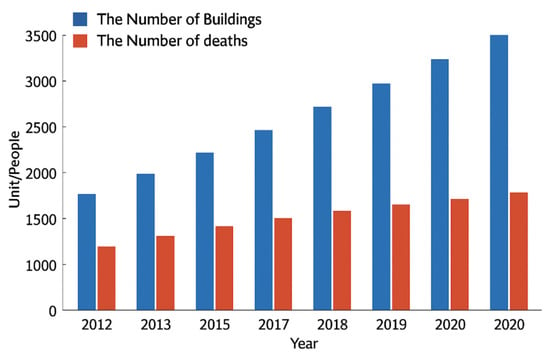
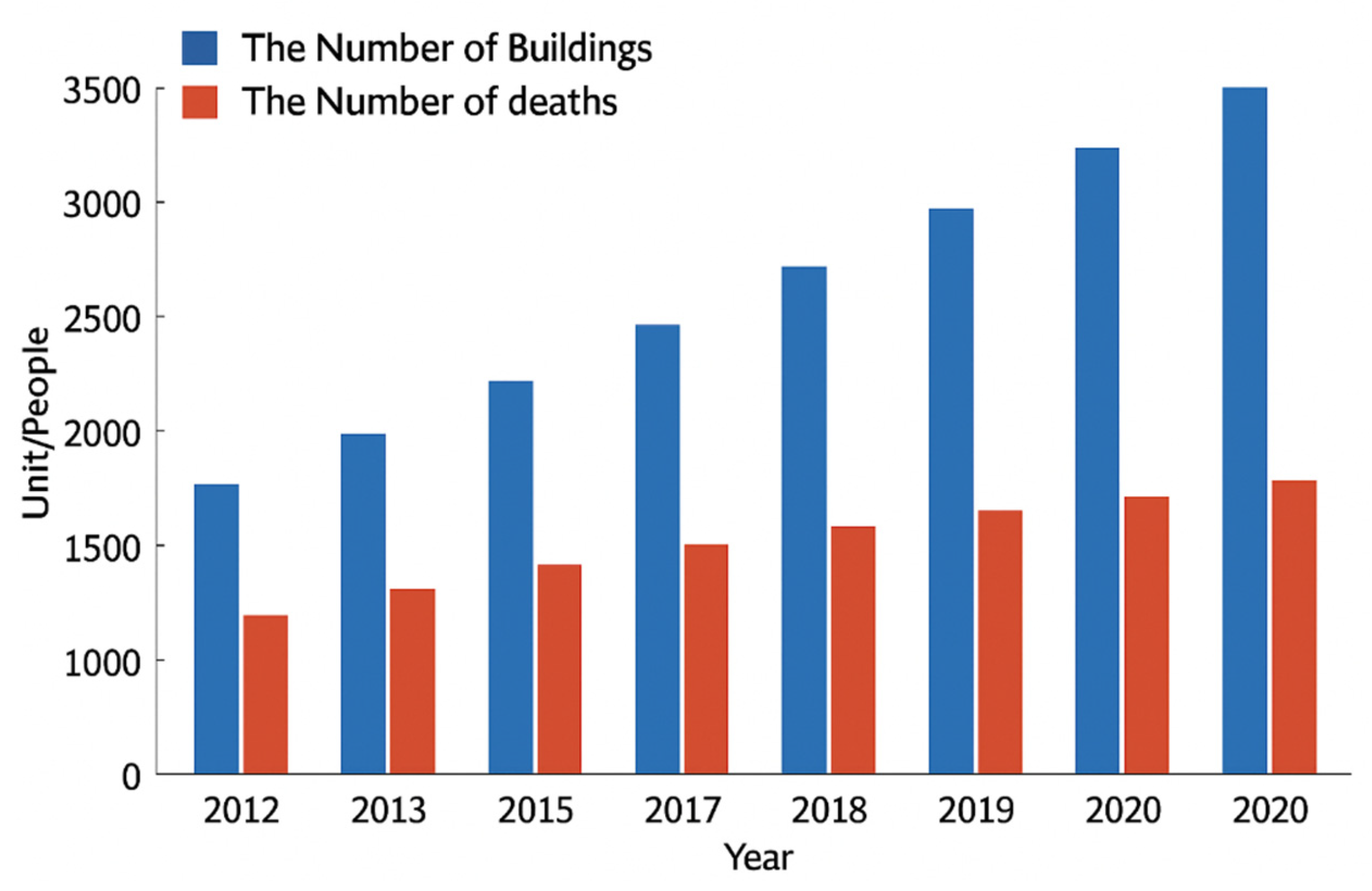
Since the early 2000s, the number of high-rise buildings and skyscrapers with more than 31 floors has increased markedly in Korea, accompanied by a rise in both the frequency and severity of high-rise fires. According to the Ministry of Land, Infrastructure, and Transport, 3165 such buildings were recorded in 2020, representing a 15.5% increase (426 buildings) compared with 2019. The proportion of high-rise structures within the overall building stock continues to grow annually, underscoring the urgency of addressing fire safety in these environments.
Fires in high-rise buildings pose unique risks due to structural characteristics that facilitate the rapid vertical spread of smoke and flames. The stack effect, occurring in vertically connected spaces such as stairwells, elevator shafts, ducts, and utility channels, significantly amplifies the combustion range [1]. Combined with the Coanda effect, whereby heated gases and smoke ascend along vertical surfaces, the stack effect accelerates smoke propagation beyond the speed of firefighting response. Consequently, both occupants and firefighters face elevated risks, as the growth of fire often surpasses the arrival and operational capacity of fire engines.
Among the hazards in high-rise fires, smoke spread is the most critical factor threatening human life. Smoke obscures evacuation routes, reduces visibility, slows egress, and causes fatalities primarily through poisoning. The role of the stack effect in intensifying smoke spread has been widely recognized in recent studies [2]. Historical incidents further highlight this risk; for example, in the 1980 MGM Grand Hotel fire, 85 fatalities were reported, of which 80 were attributed to toxic smoke spreading through vertical shafts and stairwells [3].
The vertical configuration of high-rise buildings not only accelerates smoke movement but also generates extreme internal temperatures, reinforcing buoyancy-driven flows that fuel fire growth. Rising hot air supplies oxygen to the fire source, causing flames and smoke to ascend rapidly through vertical shafts [4,5]. Consequently, the height of these structures, often exceeding the operational reach of ladder trucks, necessitates interior firefighting. However, the transport of heavy equipment into upper floors delays response and increases firefighter vulnerability [6,7]. Moreover, extended evacuation distances pose additional risks for vulnerable occupants, compelling firefighters to conduct rescues under hazardous conditions and further raising casualty rates [8].
In summary, fires in high-rise buildings are characterized by the rapid vertical spread of smoke, intensified by the stack effect and aggravated by building height. These phenomena substantially increase asphyxiation-related fatalities and complicate firefighting operations. A comprehensive understanding of these risks is essential for developing effective strategies to mitigate casualties in high-rise fire scenarios.
Figure 1 illustrates a parallel trend between the increase in high-rise buildings with more than 31 floors and the number of firefighter fatalities over the past five years [9,10]. This correlation suggests that the understanding of risks associated with high-rise development has not advanced at the same pace as the rapid growth of such structures [11]. Consequently, it is imperative to identify and analyze the risks inherent to firefighting operations in high-rise environments and to develop strategies for mitigating the resulting damages.
Figure 1.
Annual distribution of high-rise buildings with over 31 floors and firefighters killed while extinguishing fires.
To reduce the impact of high-rise fires, it is essential to investigate the unique risk factors arising from building characteristics, including the rapid spread of smoke due to the stack effect, extended evacuation times, and operational challenges for firefighters. Previous research has primarily examined smoke propagation and damage escalation associated with the stack effect in high-rise fires.
Su et al. simulated visibility reduction in high-rise fires using FDS [12], while Bilyaz et al. applied fire-STORM modeling to assess the influence of fire location on the stack effect [2]. Although these studies provided valuable engineering insights, including phenomena such as reverse stacking, they did not adequately address the social dimensions of firefighting risks. Kim et al. employed fire simulations to propose improvements in living room extinguishing systems [13]. Although research on special evacuation stairways and annex rooms has been active, investigations into living room fire protection and its direct contribution to occupant safety remain limited. These studies, while advancing engineering solutions, have not sufficiently examined their implications for firefighting effectiveness.
Research on general building fires has also contributed to fire safety strategies. For instance, Al-Hajj et al. conducted a longitudinal evaluation of the Home Safe fire prevention program [14], demonstrating long-term effectiveness but without addressing the specific challenges of high-rise structures. Zheng et al. explored evacuation using building information modeling [15], analyzing human behavior during emergencies; however, their study lacked a focus on risk identification specific to high-rise environments. Similarly, Ma et al. proposed a capability maturity model (CMM) to simulate smart fire response capacities [16]. While effective in establishing indicators and methodologies, their approach did not fully consider the realistic conditions faced by firefighters.
Overall, most prior research has centered on smoke simulation, evacuation modeling, or institutional measures [17], with relatively little attention given to risk factors directly hindering firefighting and evacuation of vulnerable groups in high-rise fires. To address this gap, the present study identifies and evaluates risk factors that complicate firefighting in high-rise environments. A high-rise fire scenario was constructed, and the stack effect was analyzed using computational fluid dynamics (CFD). The results were integrated with system dynamics modeling to simulate the potential consequences, providing a basis for developing measures aimed at minimizing loss of life in high-rise building fires [18].
2. Materials and Methods
2.1. Theoretical Considerations
Prior to establishing the methodology of this study, the stack effect in high-rise buildings and the associated challenges for fire evacuation and rescue of vulnerable occupants were examined from a theoretical perspective. The objective was to analyze the risks encountered by both firefighters and vulnerable individuals during fire incidents in tall structures.
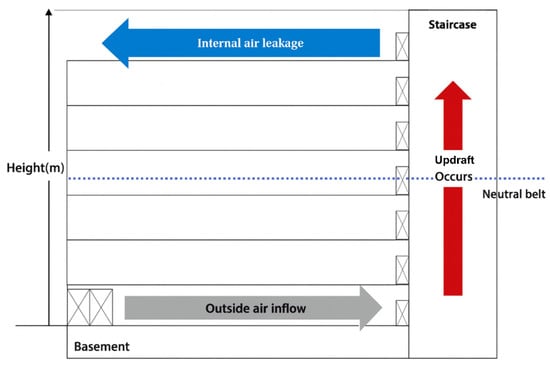
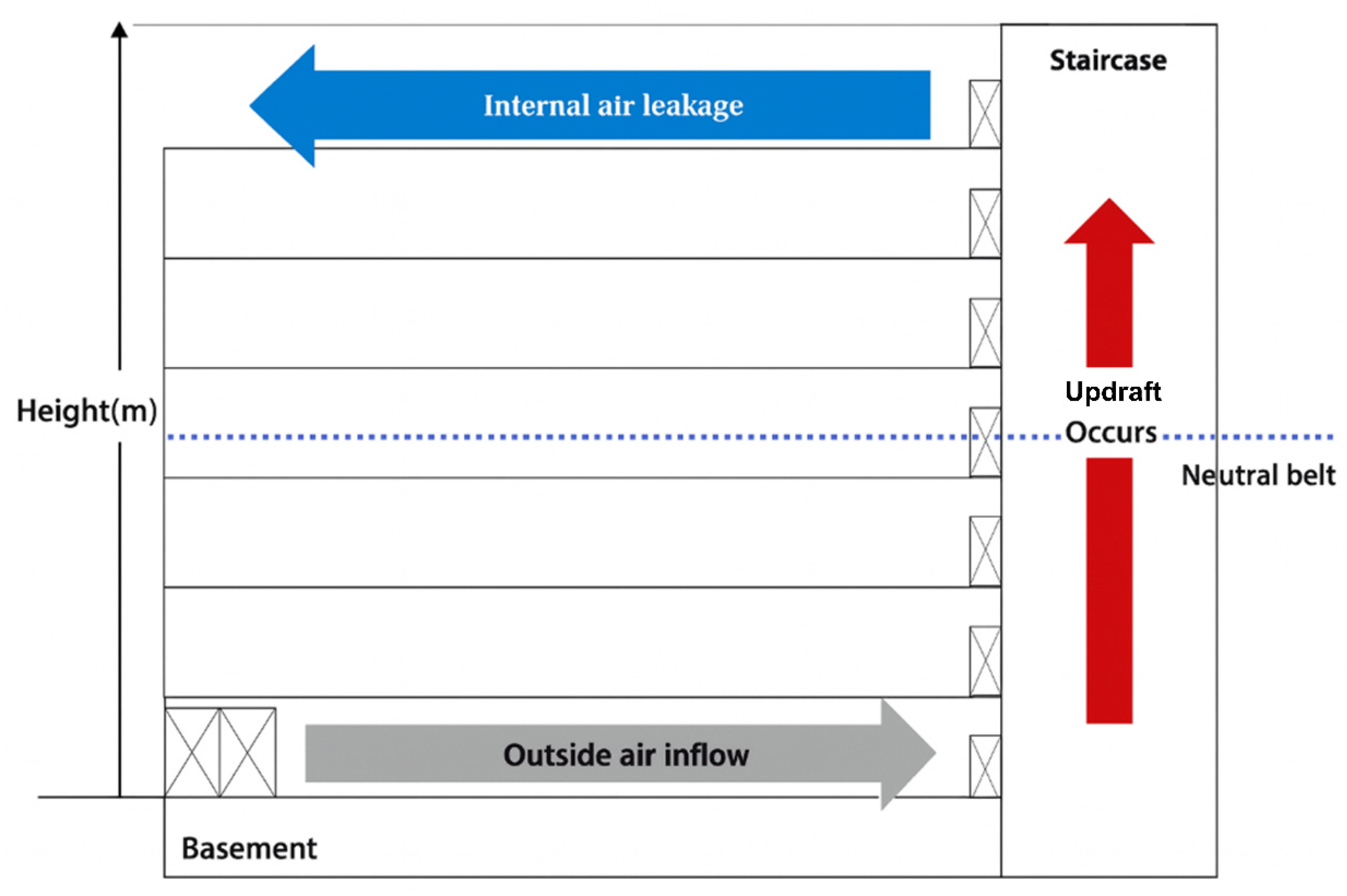
The stack effect arises from pressure differences between indoor and outdoor air, which are primarily driven by variations in temperature, humidity, and air density. These differences generate airflow between the interior and exterior of a building or between upper and lower floors [19]. As building height increases, the gradients of temperature and air density intensify, resulting in greater pressure differentials and enhanced convection rates [20]. Consequently, the stack effect becomes more pronounced in taller buildings, accelerating vertical airflow and smoke movement. An illustration of this phenomenon is provided in Figure 2.
Figure 2.
Stake effect through the vertical staircase of a building.
As illustrated in Figure 2, consolidation induces vertical air movement within connecting spaces such as elevator shafts and stairwells, creating airflow across different floors. In actual buildings, a region known as the neutral zone exists, where indoor and outdoor air pressures are balanced and the pressure difference (P) is zero. Below this zone, outdoor pressure exceeds indoor pressure, causing airflow into the building. Above the neutral zone, indoor pressure becomes greater, resulting in outward airflow [19].
The upward draft generated by consolidation accelerates the spread of fire and smoke to upper floors. Air inside a burning high-rise building becomes hotter, less dense, and more buoyant than the external air, moving rapidly upward. Consequently, flames and smoke spread swiftly through vertical openings such as stairways, elevator shafts, and ducts. The vertical velocity of smoke has been reported to be two to three times faster than horizontal movement [21].
This accelerated spread of smoke significantly complicates the evacuation of vulnerable occupants. Individuals with physical limitations often face difficulties in descending stairs or using emergency exits, placing them at higher risk during a fire. Moreover, vulnerable populations may struggle to recognize or follow evacuation routes due to limited access to or understanding of emergency information. As a result, firefighters are frequently required to enter hazardous high-rise areas directly to conduct rescues and identify safe evacuation routes, taking into account building floor plans, stair locations, elevators, and other safety features.
Despite these efforts, past incidents demonstrate the dangers faced by both occupants and firefighters. The Grenfell Tower fire in London on 14 June 2017 resulted in 72 deaths, including one firefighter. The collapse of the World Trade Center on 11 September 2001 claimed 2753 lives, including 343 firefighters. Similarly, on 10 February 2015, a fire in a five-story building in Taipei, Taiwan, caused six fatalities, including five firefighters.
These cases highlight that fatalities in high-rise fires continue to rise, with consolidation playing a critical role in both fire development and firefighting challenges. Accordingly, this study conducts a comprehensive theoretical and simulation-based analysis to evaluate the risks associated with firefighting and the evacuation of vulnerable occupants in high-rise buildings.
2.2. Research Methods
This study examined the characteristics of high-rise buildings to analyze risks and assess fire damage patterns, with particular emphasis on consolidation, which intensifies with building height. The analysis also considered the operational difficulties encountered during firefighting and evacuation activities. To quantify damage patterns, Computational Fluid Dynamics (CFD) and System Dynamics (SD) were loosely coupled, enabling the integration of flow analysis (e.g., smoke spread) with damage assessments that vary according to time series and environmental variables. A key strength of this approach lies in its ability to combine two modeling frameworks to capture both physical phenomena and systemic impacts.
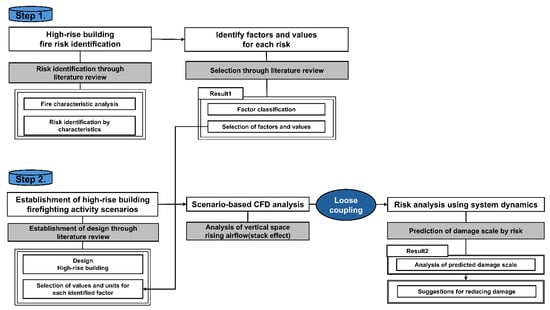
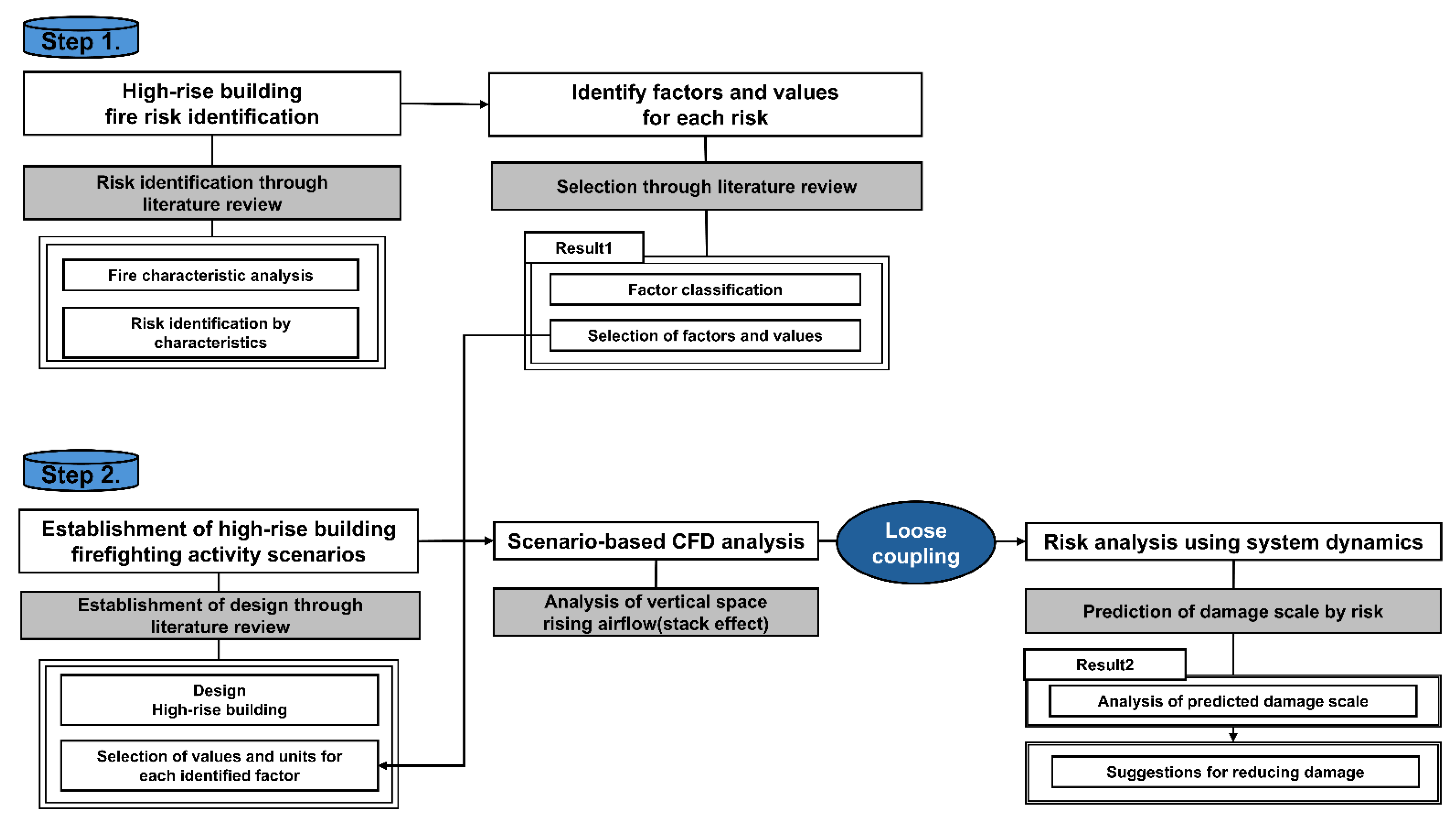
Additional risks associated with high-rise building fires were identified through a comprehensive literature review (Figure 3). For each risk factor, potential damages were assessed using simulation techniques and causal mapping. Design specifications of high-rise buildings were collected from existing studies, and relevant parameters were applied to construct causal models. Among the risks analyzed through CFD simulations, particular attention was given to vertical airflow generated by streamlining and the time required for smoke to ascend to each floor.
Figure 3.
Research flow chart.
By loosely coupling CFD with SD, the temporal dynamics of smoke spread were linked to the timing of firefighting interventions, allowing for a more holistic assessment of damages under different scenarios. Within the SD environment, causal relationships between the onset of smoke spread, evacuation delays, and firefighting operations were modeled to evaluate the extent of risk.
The outcomes of this study include the identification of risks associated with firefighting and rescue in high-rise fires, quantitative damage assessments, and the proposal of a new paradigm for the design and deployment of firefighting equipment. These findings are summarized in the subsequent sections, with detailed recommendations presented in the conclusion.
Result ①: Exploratory research enabled the identification and cataloguing of potential risks, as well as the determination of key risk factors associated with fire and rescue activities.
Result ②: Numerical outcomes were derived by evaluating the damaging effects of the identified risks using system dynamics analysis.
3. Results
3.1. Identification of the Risk Associated with Firefighting Activities in High-Rise Buildings (Result ①)
Firefighting in high-rise buildings involves a series of risks that have become more pronounced with the rapid growth of tall structures. The unique characteristics of high-rise construction amplify existing hazards and introduce new challenges, which can be assessed in terms of probability, uncertainty, and impact [22]. In this section, we examine the principal risks that firefighters encounter during rescue and suppression operations in high-rise environments.
One of the most critical difficulties arises from limited access to fire scenes located above the operational reach of aerial ladder trucks [8]. The effective height of such equipment is approximately 50 m, equivalent to 16 floors or less [23,24]. Fires occurring on higher levels, or those that have already spread, require firefighters to enter directly through emergency stairwells rather than relying on external access. This poses substantial physical demands, as firefighters must climb multiple floors while wearing 12 kg of protective clothing and carrying an additional 6.6 kg of equipment. Visibility is further reduced by dense smoke, and oxygen supplies in breathing apparatuses are often depleted before rescues can be completed. Studies indicate that physical endurance decreases sharply after nine minutes of exertion and may fall to critical levels after fifteen minutes, which significantly undermines operational effectiveness [25]. The combination of physical strain, restricted visibility, and limited oxygen severely impedes safe and timely intervention [26].
Another significant risk is created by streamlining, which accelerates smoke movement within vertical shafts such as stairwells, elevator shafts, and ducts. This phenomenon undermines the performance of fire-suppression systems by allowing smoke to spread rapidly beyond the compartment of origin. Effective smoke control requires maintaining appropriate differential pressures between protected and unprotected areas, yet this is often difficult to achieve in high-rise buildings [27]. Historical fire cases, including the Dupont Plaza fire in the United States, demonstrate how smoke originating on lower floors can quickly rise and cause casualties on upper levels [28,29]. Similarly, Korean building codes require stairways to lead directly to evacuation floors, but in practice, continuous staircase designs can allow smoke to infiltrate evacuation routes below the neutral zone and obstruct exit doors on upper floors, placing evacuees and rescuers at additional risk [30,31].
Finally, the large number of occupants typically present in high-rise buildings further compounds the risks during fire emergencies. High population density increases the likelihood of mass casualties, particularly when evacuation is delayed or obstructed by smoke. Evacuation estimates published by the Japan Architecture Centre highlight the scale of the challenge, indicating the substantial number of people who may require assistance during high-rise fire incidents.
Taken together, these factors illustrate the severe risks that firefighters face when responding to high-rise building fires. Limited access, intensified smoke spread, and high occupant density combine to create conditions that increase the probability of casualties among both evacuees and emergency responders. It presents the population density calculation standards applied to different building uses, including offices, accommodations, and apartments (Table 1).
Table 1.
Population density calculation standards for different building uses.
The calculation of population density for evacuation varies according to building use [32]. In Korea, apartment buildings constitute the largest proportion of high-rise structures [33]. Therefore, this study adopts the residential population density of apartments to estimate evacuation demand. On average, high-rise apartment buildings in Korea contain 544 units [34].
Previous reports, such as those on the 11 September attack in the United States, indicate that approximately five minutes typically elapse before evacuees initiate evacuation, as they seek information, assess the situation, and prepare for movement. In high-rise buildings, however, streamlining accelerates the vertical spread of flames and smoke, substantially increasing the likelihood of casualties. Additional risks arise when a large number of occupants attempt to evacuate simultaneously, creating bottlenecks and delaying movement. Vulnerable populations face even greater challenges, as they often struggle to recognize and follow evacuation routes [35]. When disaster-vulnerable groups represent a significant portion of occupants, evacuation becomes slower and more hazardous. Due to physical limitations, these groups typically move at a slower pace than others, prolonging evacuation time and increasing their susceptibility to smoke exposure [32]. It presents the walking speeds of evacuees based on their characteristics, distinguishing between horizontal movement and stair movement (Table 2).
Table 2.
Walking speed depending on evacuee characteristics.
3.2. Analysing the Risk of Firefighting Activities in High-Rise Buildings (Result ②)
3.2.1. Creating a High-Rise Firefighting Scenario
In this study, the stack effect was simulated using Computational Fluid Dynamics (CFD), and the resulting risks were evaluated through system dynamics analysis. Prior to the CFD simulations, a hypothetical high-rise building was designed in compliance with the Korean building code. The design specifications are presented in Table 3.
Table 3.
Design specifications for skyscrapers.
The average floor area was calculated using recent data from high-rise apartments in Busan, Korea. High-rise apartments are defined as buildings with 30 to 49 floors, and the mean floor area of these buildings was adopted for the scenario. The model building was assumed to have 49 stories above ground and one basement level, with the gross floor area determined accordingly. The floor area ratio (FAR) and building coverage ratio (BCR) were set at 300% and 50% or less, respectively, in accordance with the design standards for Class 3 general residential zones. FAR represents the ratio of the total gross floor area to the site area, while BCR represents the ratio of the building footprint to the site area. Type 3 general residential zones under the Korean building code include high-rise residential apartments; therefore, the scenario building was designed to reflect this classification.
The land area and building height were determined by applying the FAR and BCR. A higher BCR indicates greater land coverage by the building. In this study, the FAR was fixed at 300% based on the regulations for Class 3 residential areas in Busan, and the gross floor area was derived from actual high-rise data. The FAR was then calculated as 6% using the gross floor area. Average floor area values from Busan high-rise apartments (Table 4) were used to estimate the building floor area. Assuming a floor height of 2.85 m, as specified in the Operating Regulations of the Building Commission of Busan, the total height of the building was calculated as 139.65 m above ground with an additional 2.85 m below ground.
Table 4.
Floor area data of actual high-rise buildings in Busan.
Specifications for stairwells and entrance doors were incorporated into the model based on the literature review. For instance, the entrance door height was set at 2 m, slightly above the average height of an adult male, to reflect realistic building design.
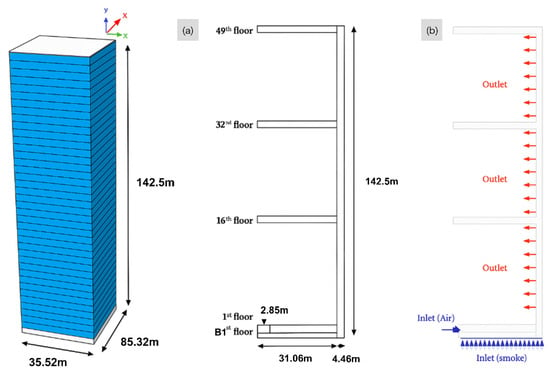
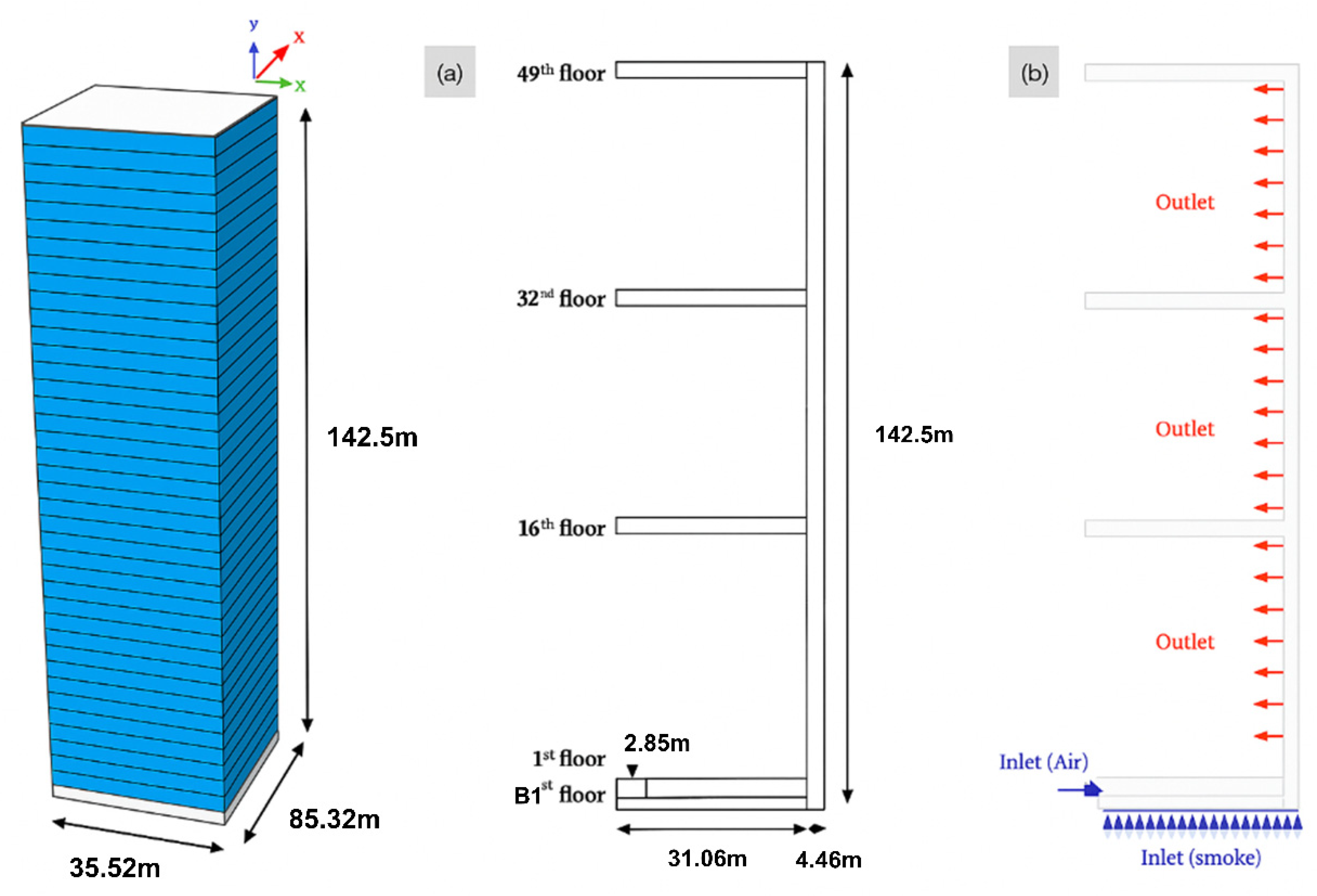
Figure 4 presents the side view of the high-rise building and the boundary conditions applied for fluid flow simulations. According to the specifications in Table 3, the building height, including the basement, was set at 142.5 m. The first floor height was 2.85 m, with a horizontal length of 31.06 m extending to the stairwell, and the stairwell length was 4.46 m. The inlet boundary condition assumed outdoor air entering from the first-floor lobby and smoke entering from the basement fire source. Outlets were placed at the doorways of all floors except the three monitored levels (16th, 32nd, and 49th), which were specifically targeted for detailed analysis.
Figure 4.
Skyscraper geometry and boundary conditions for computational fluid analysis: (a) skyscraper specification from the side and (b) skyscraper boundary conditions from the side.
The selection of outlet placements was designed to optimize computational efficiency by limiting extensive spatial analysis, which would otherwise increase processing time and potentially compromise result quality. Floors not included in the detailed analysis were treated using their doorways as simplified outlet boundaries. This approach enabled a focused and effective investigation of the targeted floors, consistent with the objectives of the study.
The CFD mesh for the high-rise building consisted of 33,001 nodes and 31,662 elements. Mesh quality was evaluated using the skewness metric, yielding a value of 0.045653, which indicates a high-quality grid suitable for accurate numerical simulation. It summarizes the values and units of key parameters used in the system dynamics model, including movement time, personnel allocation, evacuation speed, and initial population (Table 5).
Table 5.
Numbers and units for system dynamics parameters.
To account for household structure and family ties, the horizontal and stair movement speeds of residents were aligned with those of vulnerable groups. Furthermore, it was assumed that each household would include at least one vulnerable person.
3.2.2. High-Rise Firefighting Risk Analysis
To analyse the risks of firefighting in high-rise buildings, CFD and system dynamics were loosely coupled to perform simulations. Loose coupling is a method for predicting a specific phenomenon by indirectly exchanging data between independently operated software. It offers the advantage that a single error does not propagate to the whole. CFD simulates the behaviour of smoke as per the streamlining in vertical space, and system dynamics directly analyses the risk of firefighting activities due to the stack effect.
Vertical Space Updraft Analysis
The vertical space updraft generated by the stack effect was examined through CFD simulations to determine the time and mass of smoke reaching each floor. The analysis was conducted in a two-dimensional environment with a fixed depth of 1 m, corresponding to the entrance door dimensions, as summarized in Table 6. To calculate the accumulated smoke mass per hour, CFD results were multiplied by 2.4, reflecting the stairwell spacing. The air inlet boundary condition was defined at the first-floor entrance, with the external temperature set to −10 °C to emphasize the effect of indoor–outdoor temperature differences on streamlining.
Table 6.
Numerical analysis conditions in Ansys Fluent.
An incompressible gas model was employed, a widely accepted approach in fire simulations, which assumes constant gas density despite pressure fluctuations. This simplification reduces computational complexity while retaining the essential dynamics of smoke and toxic gas movement, allowing feasible modeling of high-rise fire scenarios. The model supports prediction of smoke propagation patterns, aiding in the development of effective firefighting and evacuation strategies. Despite inherent limitations, this approach balances computational efficiency with the need for accurate fire dynamics representation.
In this study, the temperature of the smoke inlet was fixed at 600 °C, representing a constant heat release rate from a basement-level fire (B1). Continuous smoke generation was assumed without explicitly modeling fire spread, thereby focusing on smoke movement and its impacts on occupants. Toxic gases including CO, NO2, and CO2 were modeled as primary components of fire smoke, emitted at a total rate of 40.02 kg/s, with mass fractions of 0.3, 0.1, and 0.6, respectively [40]. These values reflect the typical composition of incomplete combustion products in building fires.
The CFD simulation was governed by the fundamental conservation equations of mass, momentum, and energy, expressed as follows [41,42,43,44]:
Equation (1) represents mass conservation, ensuring that the rate of mass change within a control volume equals the net flux across its boundary. Equation (2) describes momentum conservation, equivalent to the Navier–Stokes formulation for incompressible Newtonian fluids, incorporating pressure, viscosity, and body forces. Equation (3) represents energy conservation based on the first law of thermodynamics, expressed in terms of heat transfer, work, and kinetic energy.
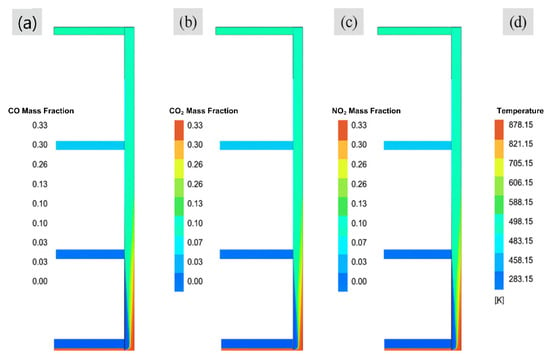
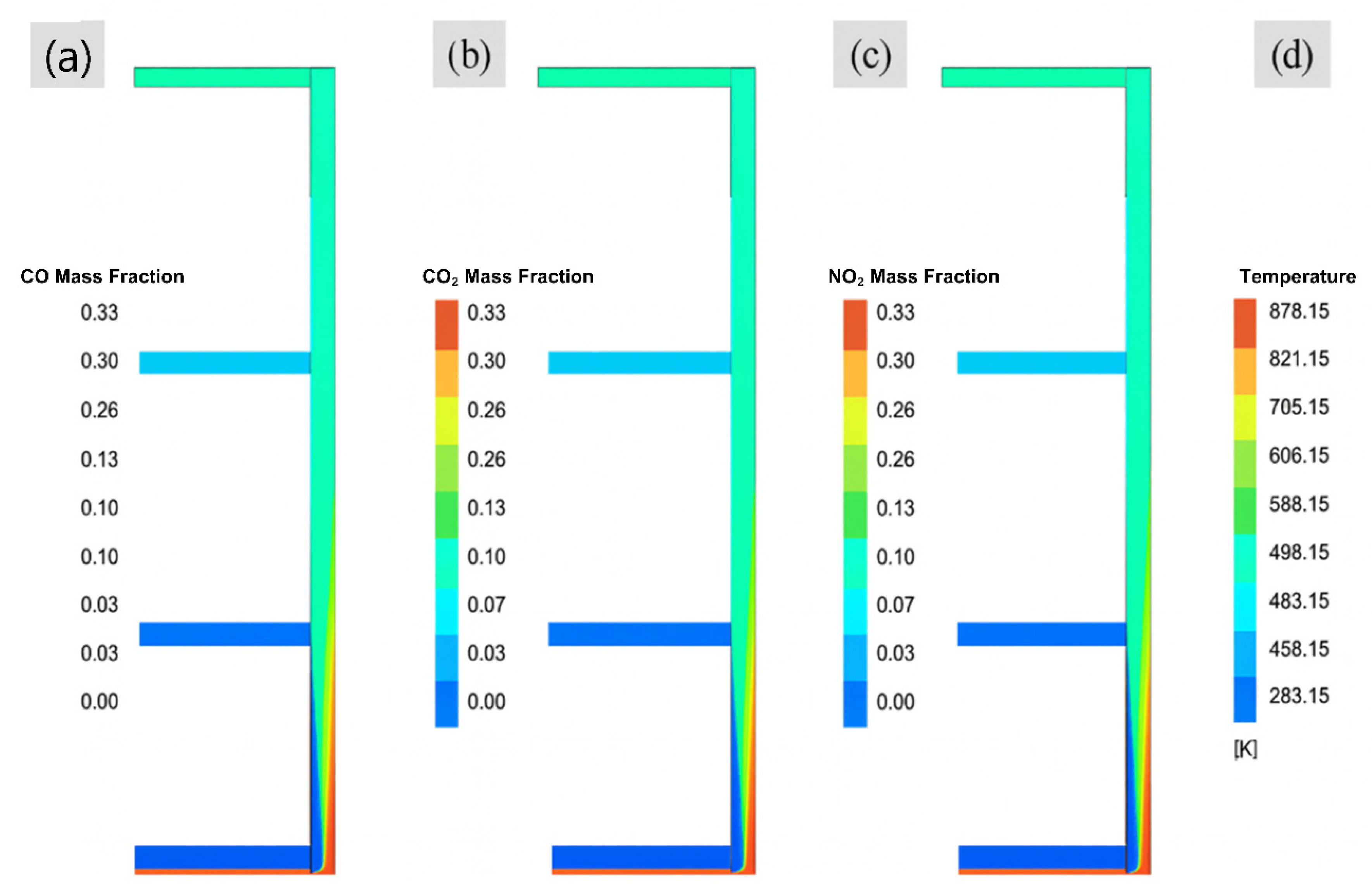
Computational Fluid Dynamics (CFD) numerical analysis was conducted to evaluate the mass fractions of CO2, CO, and NO2 at the 16th, 32nd, and 49th floors. The spatial variation in smoke mass volume at 1000 s is presented in Figure 5. At the basement level, the maximum volume fractions of CO, NO2, and CO2 were 0.3, 0.1, and 0.6, respectively, representing the dominant components of the smoke. The concentrations decreased progressively with increasing floor height. The highest temperature was observed in the basement, with a peak value of 873.15 °C.
Figure 5.
Contour results of CFD-based skyscraper stack effect analysis: (a) mass volume of CO (t = 1000 s), (b) mass volume of CO2 (t = 1000 s), (c) mass volume of NO2 (t = 1000 s), and (d) vertical Temperature Distribution.
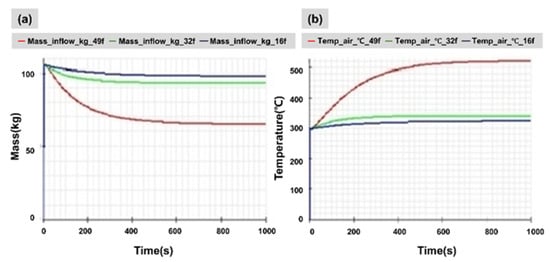
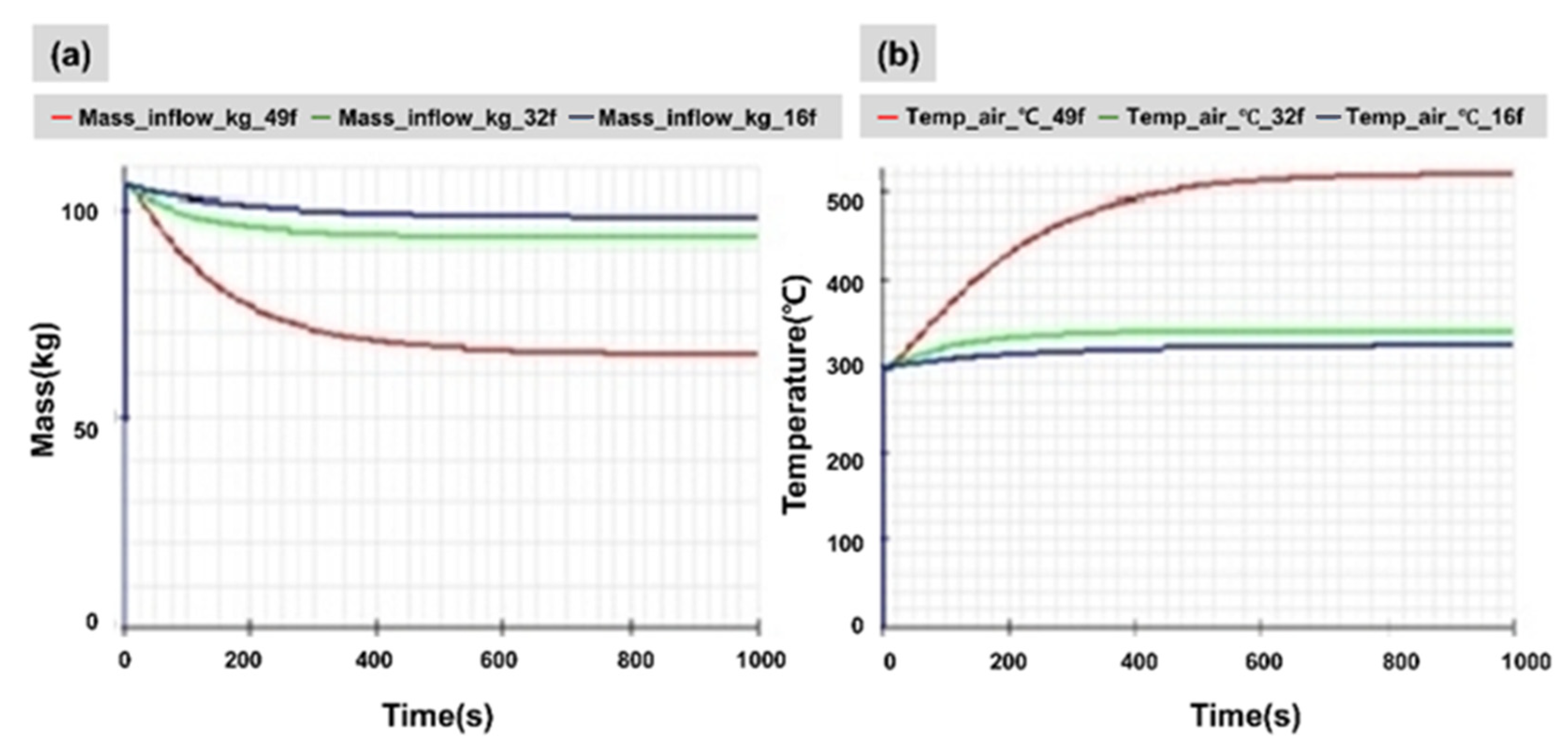
Figure 6 presents the hourly variations in smoke mass (at a depth of 1 m) and temperature in each layer, as derived from the CFD numerical simulation of streamlining. Figure 6a illustrates the results of a two-dimensional simulation showing the hourly smoke mass at each layer, while Figure 6b displays the corresponding hourly temperature distribution across floors. As shown in Figure 6a, the average smoke mass over 1000 s was 71.56, 94.96, and 99.6 kg at the 49th, 32nd, and 16th floors, respectively.
Figure 6.
Graph results of CFD-based skyscraper stack effect analysis: (a) mass change of smoke over time (Depth = 1 m) and (b) temperature change over time.
Risk Analysis
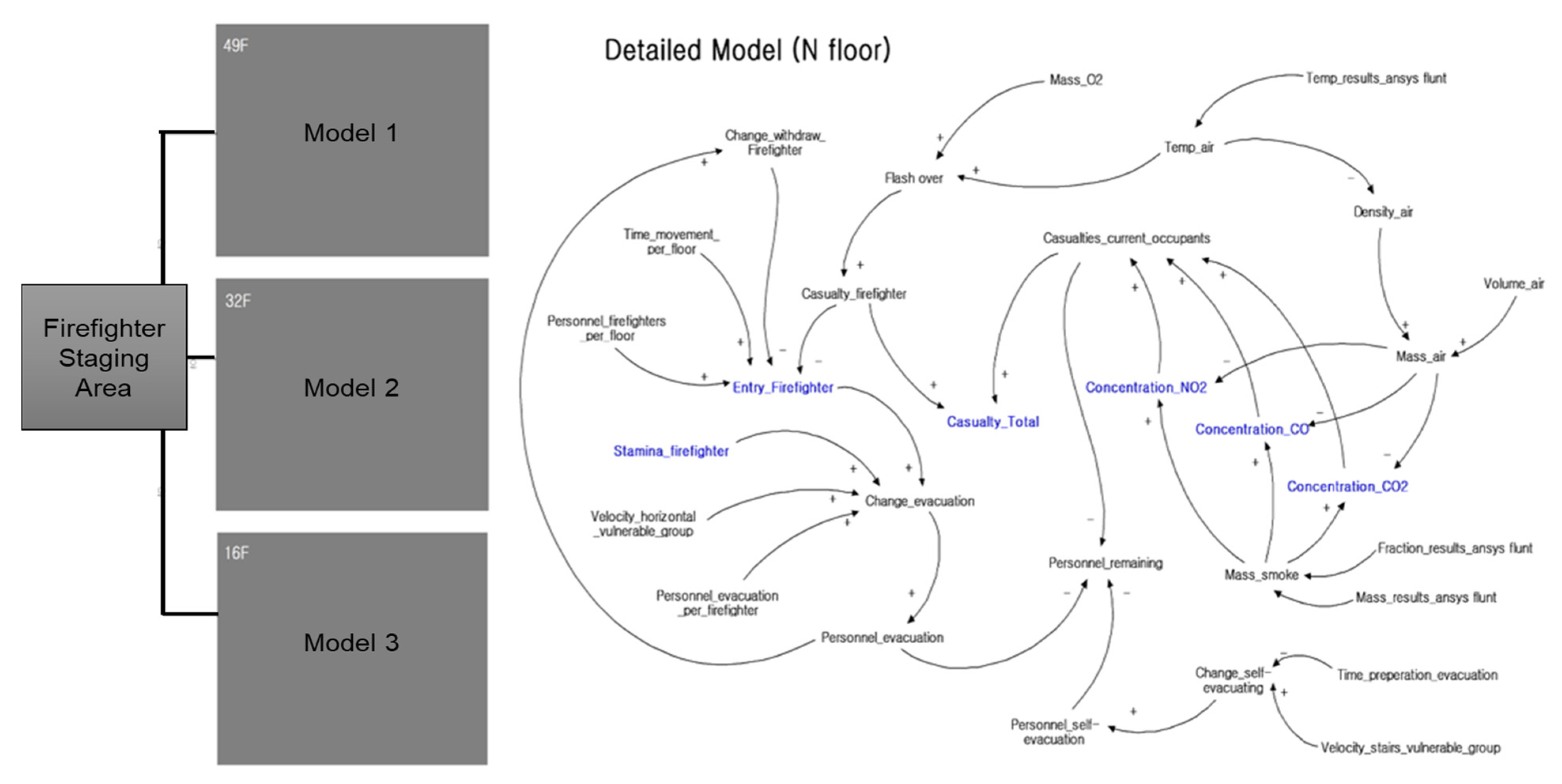
The results of the CFD analysis of smoke mass and temperature on each floor were loosely coupled with system dynamics to evaluate the risk of fire in a high-rise building. The algorithm structure and causal map used in the analysis are illustrated in Figure 7, and the definitions of the main algorithms are provided in Table A1. Detailed models were developed for the 16th, 32nd, and 49th floors, as well as for the remaining floors. In these models, CFD outputs were incorporated into the Mass_results_ansys and Temp_results_ansys factors, while the Casualty_Total factor, representing the casualties of both residents and firefighters, was derived through the operation of the causal map.
Figure 7.
Casual diagram of detailed model (Nth floor).
Table 7 summarizes the symbols, value ranges, and units of the causal mapping factors presented in Figure 7. Input factor ① was obtained from Ansys Fluent results, as previously described, whereas input factor ② was derived from literature sources. Intermediate factors represent transitional results computed within the system dynamics model. Finally, the output factors—including Entry_Firefighter, Stamina_Firefighter, Concentration_(NO2, CO, CO2), and Casualty_Total—were calculated to quantify the overall risk.
Table 7.
List of input and output arguments for the model.
Risks were evaluated in a system dynamics environment by linking the timing of firefighting activities with the onset of smoke spread, in conjunction with CFD numerical analysis results such as vertical space updraft. The identified risks and corresponding analytical targets are summarized in Table 8. The risk of “difficulty in accessing the fire scene” was represented by the factors Entry_Firefighter, denoting the number of firefighters entering, and Stamina_Firefighter, reflecting the decline in firefighter stamina over time. The risk associated with the “streamlining in high-rise buildings” was represented by the factors Concentration_NO2, CO, and CO2, indicating the concentration of each smoke component. Finally, the risk of “occupancy by multiple residents” was represented by the factor Casualty_Total, defined as the total number of casualties. This measure accounts for both firefighters and occupants, with the assumption that the death of a firefighter can exacerbate occupant fatalities.
Table 8.
Identified risks and the corresponding analysis results.
The factors listed in Table 8 represent the outputs of the system dynamics model and were employed to evaluate fire risk. The variable Entry_Firefighter (EF), corresponding to the risk of “difficulty in accessing the fire scene,” is calculated using Equation (4). The initial value of EF is determined by integrating all changes in the factor up to time t. The derivative EF′ represents the rate of change in EF and is obtained using Equation (5). The factor PF, denoting the number of firefighters per floor, was assumed to be five. Accordingly, EF′ is assigned a value of 5 when the elapsed time matches the product of Time_movement_per_floor (TM) and floor_number (FN), which reflects the rate of vertical movement per second. This formulation indicates that the rate of firefighter deployment varies proportionally with the height of the skyscraper.
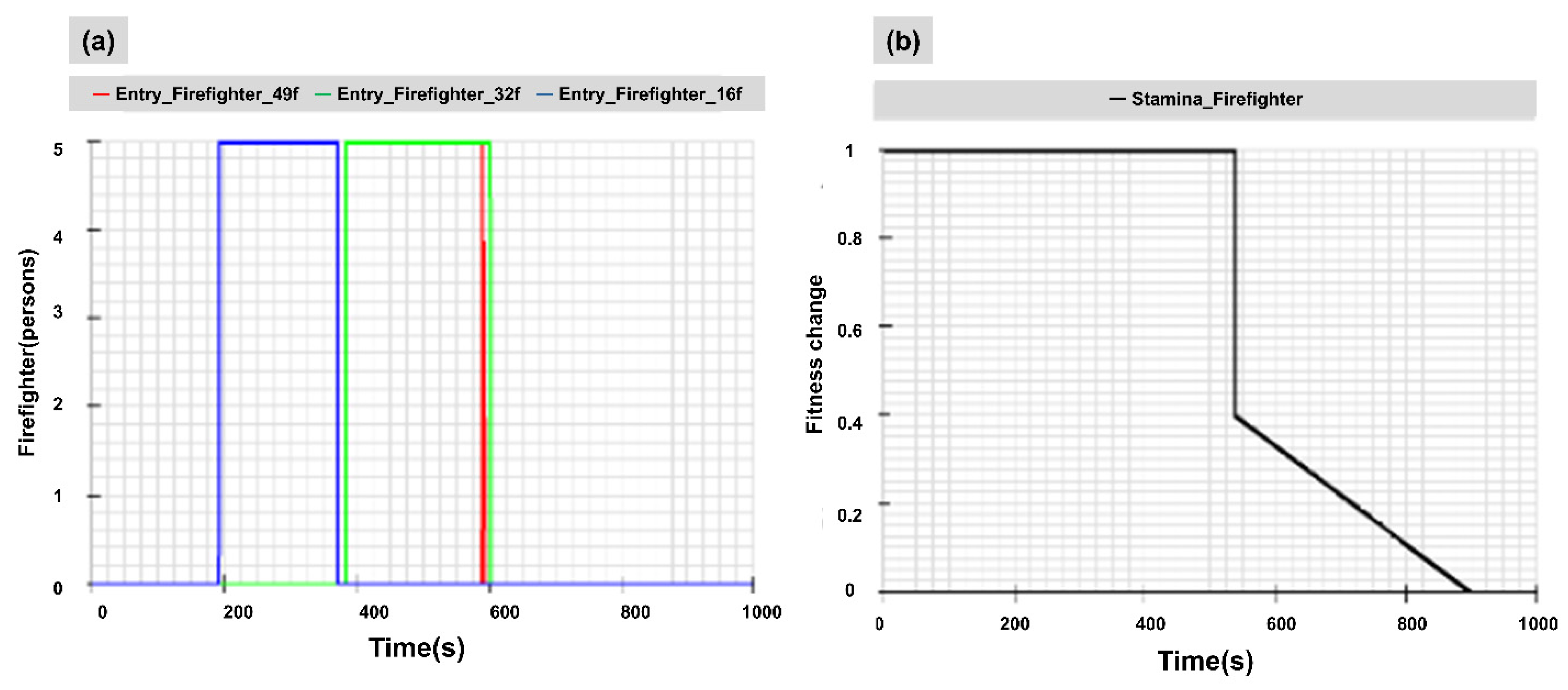
Another consequence of the “difficulty in accessing the fire scene” risk is represented by Stamina_Firefighter (SF), which is calculated using Equation (6). The stamina of firefighters decreases linearly from 1 to 0 as time t increases from 540 s to 900 s. The resulting reduction in evacuation capacity, denoted as Change_Evacuation (CE), is calculated using Equation (7). The parameter Personnel_evacuation_per_firefighter (PEF) represents the number of evacuees that can be rescued by a single firefighter and is assumed to be 2. Here, EF denotes the number of firefighters, while Velocity_horizontal_vulnerable_group (VH) represents the horizontal velocity of the vulnerable group. Travel time was calculated by dividing the horizontal length of the building (35.51 m) by VH. Once SF begins to decline after 540 s, the number of people that firefighters are able to rescue decreases progressively. CE is obtained by dividing the travel time of vulnerable individuals by the number of people that can be evacuated, thereby representing the number of evacuees that can be rescued per unit time.
The risk associated with the “stack effect in high-rise buildings,” represented by Concentration_NO2, CO, and CO2, was calculated using Equation (8). The concentration was defined as the percentage ratio of smoke mass (M_smoke) to air mass (M_air). The parameter M_S is expressed as a function of Fraction_results (FR) obtained from Ansys Fluent, and is calculated using Equation (9). The total smoke mass (M_S_total) was multiplied by the FR value of the mass volume to determine the mass of each smoke component.
The total number of casualties (Casualty_Total, CT) associated with the “occupancy by multiple residents” risk was calculated using Equation (10). CT is defined as the sum of Casualty_Firefighter (CF), derived from Equation (11), and Casualties_Current_Occupants (CC), derived from Equation (12). CF was obtained by adding its initial value to the integral of the duration (in hours) with a flashover (FO) condition, where FO is assigned a value of 1. FO was assumed to occur when the temperature exceeded 500 °C and the oxygen concentration dropped below 10%. Similarly, CC was obtained by adding its initial value to the integral of the change term CC′, where CC′ in Equation (13) was set to 1 when the CO concentration exceeded 1% [45,46]. This formulation assumes that one casualty per second occurs when the average smoke concentration surpasses 1%. The key parameters used in these equations are summarized in Table A2.
- ① Difficulty in accessing the fire scene (analysis)
The first risk, “difficulty in accessing the fire scene,” was quantitatively evaluated using system dynamics simulation. As shown in Figure 8a, the firefighter entry times for the 16th, 32nd, and 49th floors were 193 s, 385 s, and 589 s, respectively. Compared with the 16th floor, the entry times for the 32nd and 49th floors were 1.99 and 3.05 times longer. Figure 8b further illustrates that firefighter stamina declined rapidly after 541 s, resulting in a sharp increase in casualties among both firefighters and occupants. This effect was particularly evident on the 49th floor, where firefighting activities commenced after 589 s.
Figure 8.
Analysis results for ‘difficulty in accessing the fire scene’: (a) firefighter’s entry time graph and (b) firefighter’s fitness change graph.
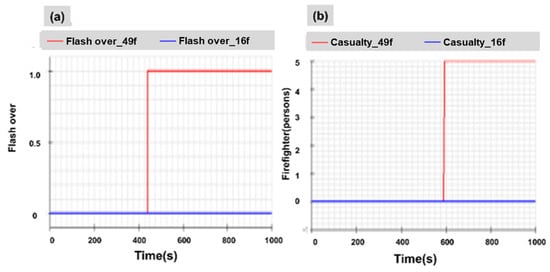
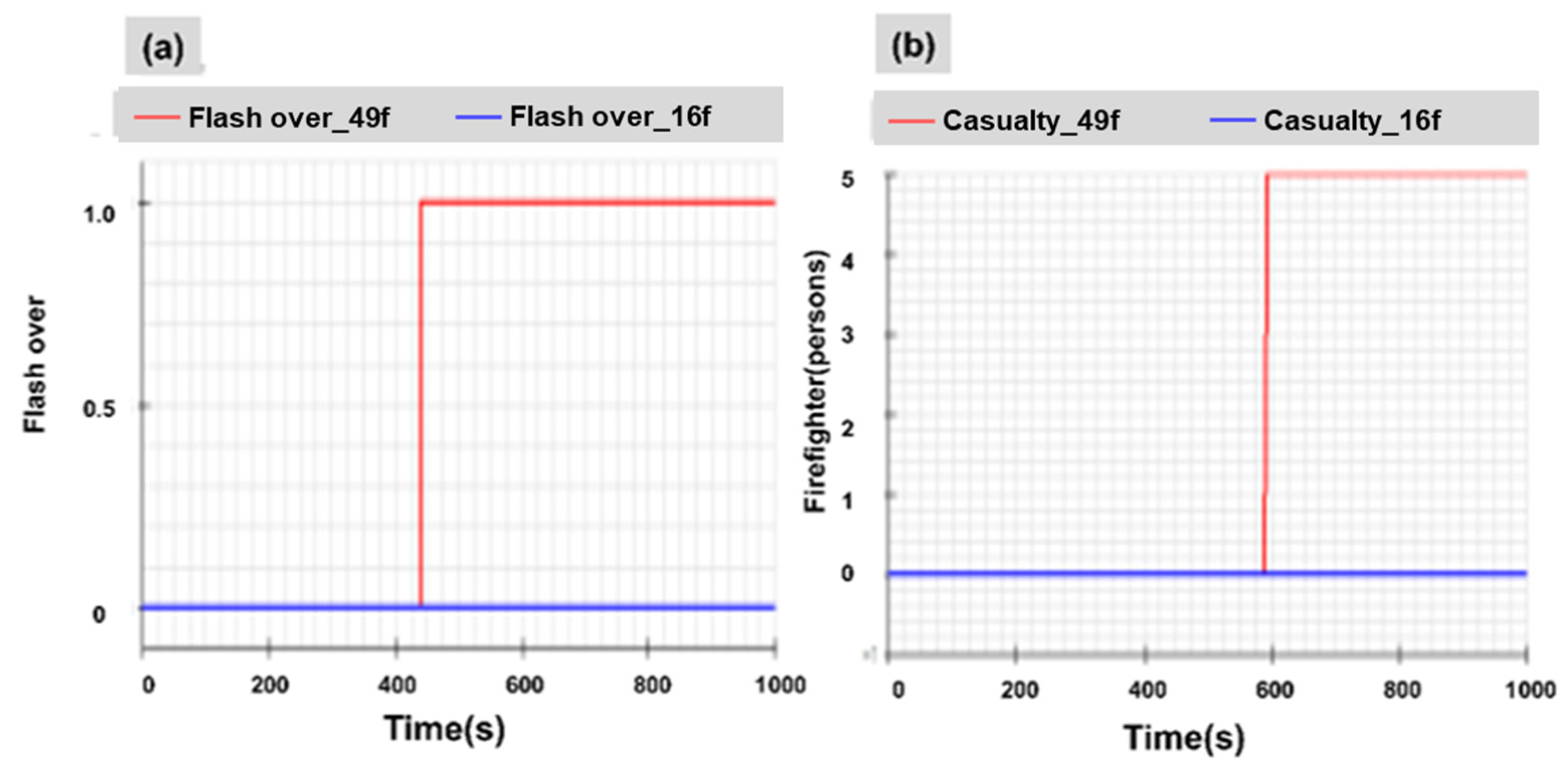
In Figure 9b, firefighter casualties on the 49th floor were estimated to be five after 589 s. As shown in Figure 9a, the high-risk timeframe associated with flashover began at 441 s, and any firefighters entering after this point were classified as casualties. Flashover is represented as a binary variable with values of 0 or 1; when equal to 1, the rapid fire expansion results in a high-risk timeframe [47,48].
Figure 9.
Analysis results for ‘difficulty in accessing the fire scene’: (a) flashover time graph and (b) firefighter casualty graph.
- ② Stack effect due to high-rise buildings (analysis)
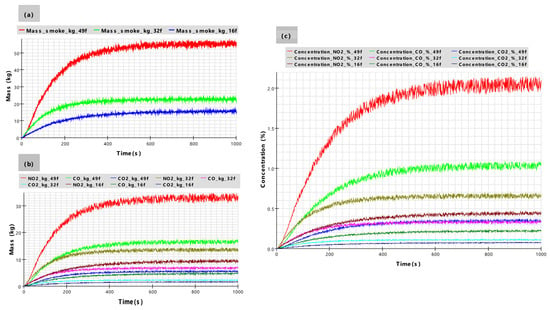
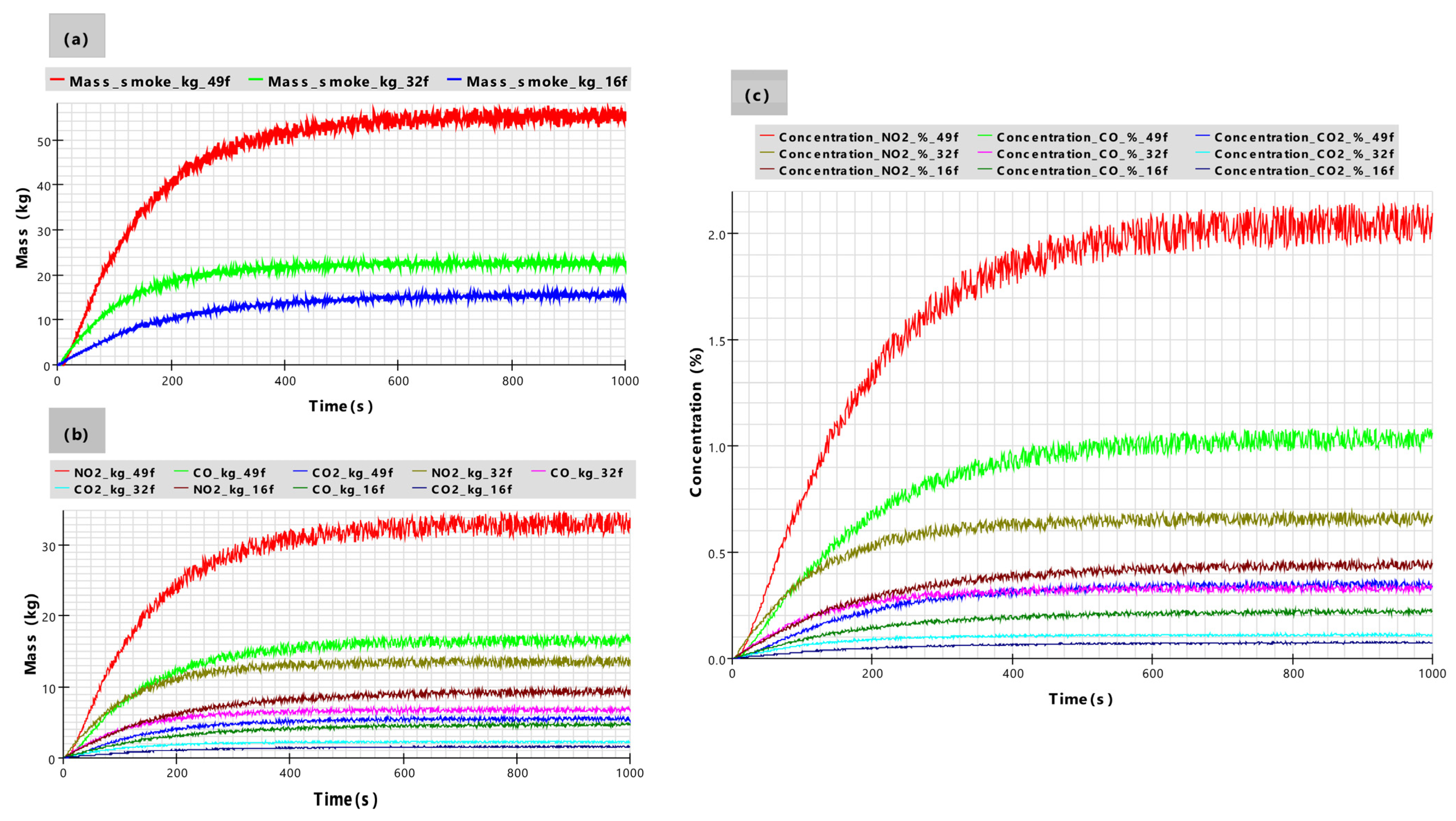
The simulation results indicated that streamlining intensified with building height. On the 49th floor, the smoke mass reached 56.27 kg, with an average concentration of 1.17%. On the 32nd floor, the smoke mass was 23 kg with an average concentration of 0.37%, while on the 16th floor, the maximum smoke mass was 15.87 kg with an average concentration of 0.25%. The results further demonstrated that smoke concentration increased rapidly until approximately 300 s after ignition and exceeded 1% on the 49th floor, surpassing the asphyxiation threshold for CO, CO2, and NO2.
Figure 10 illustrates the temporal progression of smoke reaching each floor. Specifically, Figure 10a shows the cumulative increase in smoke mass, composed of CO, CO2, and NO2, from the onset of the fire. For the 49th floor, smoke influx stabilized at approximately 420 s, while stabilization occurred at 320 s for the 32nd floor and at 400 s for the 16th floor.
Figure 10.
Analysis results for ‘consolidation due to high-rise buildings’: (a) smoke mass graph with respect to time, (b) smoke mass graph by component with respect to time, and (c) smoke concentration graph by component with respect to time.
- ③ Occupancy by multiple residents (analysis)
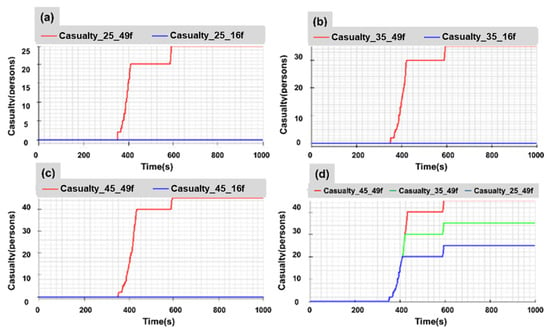
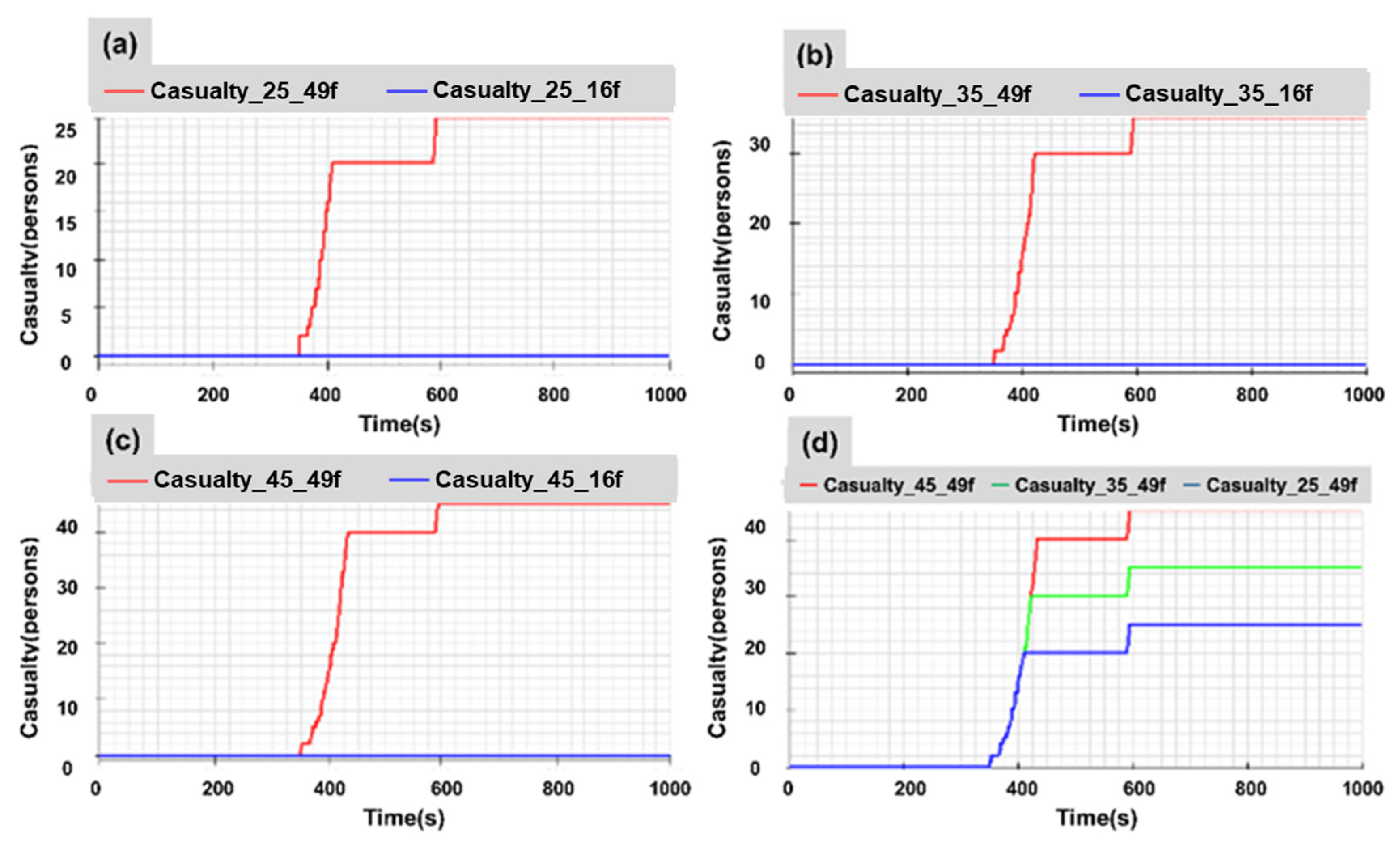
The third identified risk, namely occupancy by multiple residents, was quantitatively analyzed using system dynamics. As shown in Figure 11a–d, the number of casualties increased proportionally with the number of occupants, with casualties concentrated on the 49th floor. The high prevalence of casualties on the 49th floor was primarily attributed to the rapid accumulation of smoke exceeding 3% concentration, as identified in the second risk analysis. The simulation results indicated that 25, 35, and 45 casualties would occur when the number of occupants was 25, 35, and 45, respectively. These findings suggest that, on the top floors of high-rise buildings (represented by the 49th floor in this study), the consolidation becomes more pronounced, thereby increasing the number of casualties as the occupant load rises.
Figure 11.
Analysis of ‘occupancy by multiple residents’: casualties per floor with (a) 25 occupants, (b) 35 occupants, (c) 45 occupants, and (d) comparative results.
The third identified risk, namely occupancy by multiple residents, was quantitatively evaluated using system dynamics. As illustrated in Figure 11a–d, the number of casualties increased in direct proportion to the number of occupants, with casualties concentrated on the 49th floor. The elevated prevalence of casualties on the 49th floor was primarily attributed to the rapid accumulation of smoke exceeding the 3% concentration threshold, as identified in the second risk analysis. Simulation results demonstrated that 25, 35, and 45 casualties would occur when the number of occupants was 25, 35, and 45, respectively. These results indicate that on the uppermost floors of high-rise buildings (represented by the 49th floor in this study), consolidation intensifies, thereby amplifying the number of casualties as occupant density increases. It presents a comprehensive analysis of fire and rescue risks in high-rise buildings, including access difficulty, firefighter physical decline, smoke concentration, and casualty outcomes under varying occupancy conditions (Table 9).
Table 9.
Comprehensive analysis of the risk of fire and rescue activities in high-rise buildings.
Comparative Analysis with the Grenfell Tower Fire
This analysis is consistent with findings from the independent review of building codes and fire safety conducted after the Grenfell Tower fire, which confirmed that the use of exterior materials not compliant with existing codes significantly contributed to the fire’s spread. Collectively, the comparative analysis demonstrates that the model developed in this study effectively predicts risk factors relevant to real-world, large-scale fire events. Furthermore, the case study of the Grenfell Tower fire provides critical insights that enhance our understanding of fire safety in high-rise buildings and support the development of improved prevention and response strategies for future high-risk events [49,50].
Table 10 presents a comparative analysis of the Grenfell Tower fire in West London, England, which serves as a representative case of damage caused by the stack effect. During the Grenfell Tower fire in 2017, the flames spread rapidly through the void between the cladding and insulation, resulting in a large-scale loss of life. The ‘consolidation due to high-rise buildings’ risk analysed in this study closely parallels the phenomenon observed in the Grenfell Tower incident. Specifically, the point at which smoke concentration increased abruptly, hindering firefighter entry and elevating the risk of asphyxiation and flashover, aligns with the predictions of the present model. Moreover, the ‘occupancy by multiple residents’ risk highlighted in this study contrasts with the actual casualty numbers from the Grenfell Tower fire, underscoring the importance of safeguarding occupants in high-rise building fires.
Table 10.
Comparative analysis of aggregate results and the Grenfell Tower fire case.
4. Discussion
This integrated analysis demonstrates that high-rise fires present interconnected risks spanning physical, human, and systemic dimensions. The combined CFD–SD framework revealed three major mechanisms: (1) access limitation, (2) stack-effect-driven smoke propagation, and (3) casualty escalation under high occupancy. Each mechanism interacts dynamically, underscoring the necessity of a systemic, multi-layered approach to urban fire risk management.
Firefighter accessibility emerged as a decisive determinant of survival outcomes. Entry times lengthened dramatically with floor height, while flashover and stamina degradation overlapped within a narrow temporal window. Such conditions make upper-floor firefighting virtually untenable. This finding emphasizes the importance of designing operational systems that explicitly account for human physiological limits in extreme environments. Empirical parallels with the Grenfell Tower case affirm that access constraints, compounded by inadequate vertical transport mechanisms, are pivotal contributors to high-rise fire fatalities [51].
The analysis also confirmed that the stack effect intensifies smoke propagation, producing upward acceleration of toxic gases. Concentrations of CO, CO2, and NO2 exceeded lethal thresholds within 300–420 s after ignition, effectively collapsing the available safe egress time. This “chimney effect,” driven by pressure differentials between floors, transforms stairwells and elevator shafts into vertical conduits for heat and combustion gases. Consequently, architectural countermeasures—such as pressure-regulated stairwells, ventilation zoning, and active exhaust systems—must be institutionalized to counteract this effect.
Population density further exacerbates risk. The simulations demonstrated a direct proportionality between occupant load and fatalities, particularly on upper levels where smoke concentration surpassed 3%. Vulnerable groups (elderly, children, disabled individuals) face disproportionate delays in evacuation, magnifying casualty potential. This highlights the social dimension of high-rise fire vulnerability and the necessity for differentiated evacuation design and rescue prioritization.
Comparative findings with the Grenfell Tower fire validated the model’s predictive capacity. In both cases, smoke accumulation beyond 1% rendered internal entry impossible and precipitated flashover within minutes. The presence of non-compliant cladding materials and insufficient smoke-control infrastructure exacerbated fire spread—conditions mirrored in the simulated vertical intensification. These parallels confirm that the coupled CFD–SD model can reliably reproduce and forecast real-world fire dynamics.
Finally, the integration of CFD and SD modeling offers a dual analytical advantage: CFD delineates physical phenomena with spatial precision, while SD quantifies human and systemic feedback over time. This coupling yields a holistic understanding of fire behavior and operational limitations. The findings support policy and engineering reforms emphasizing (1) expansion of aerial firefighting capabilities, (2) mandatory smoke-control and ventilation standards, (3) incorporation of dynamic simulation into urban building approval processes, and (4) adoption of data-driven evacuation planning that prioritizes human variability and vulnerability.
5. Conclusions
This study quantitatively analyzed high-rise firefighting risk by integrating Computational Fluid Dynamics and System Dynamics, thereby capturing both the physical evolution of smoke and the systemic limitations of human response. Three major findings were derived. First, firefighter access time and stamina proved critical to operational success; when flashover occurred before full entry (441–589 s), the probability of firefighter casualties increased sharply. Second, stack-effect intensification caused rapid vertical smoke propagation, surpassing 1% toxic gas concentration within minutes and drastically reducing the window for suppression or evacuation. Third, higher occupant density directly correlated with casualty escalation, particularly where smoke accumulation exceeded 3%.
These outcomes correspond closely to observations from the Grenfell Tower fire, verifying the model’s predictive validity. The integrated CFD–SD framework thus offers a robust foundation for future urban fire safety policy and high-rise design reform.
From a policy perspective, the study highlights urgent priorities: (1) modernizing firefighting access equipment—including deployable interior lift systems and drone-assisted suppression tools—to overcome vertical limitations; (2) enforcing mandatory smoke-control and ventilation zoning codes; (3) integrating CFD–SD simulation into architectural and fire safety reviews; and (4) implementing human-centered evacuation planning that accounts for vulnerable populations.
Despite its contributions, this research acknowledges that the use of a constant heat release rate simplified the complex variability of real fires. Future studies should incorporate transient fire growth models, variable ventilation conditions, and behavioral evacuation simulations to enhance realism and predictive power.
In conclusion, high-rise fires represent multidimensional crises that exceed conventional firefighting capacity. The coupled CFD–SD methodology developed here establishes a data-driven, predictive framework for building design, policy evaluation, and emergency management. By uniting physical simulation with systemic modeling, this research contributes to the development of a proactive, evidence-based paradigm for safeguarding human life in high-density urban environments.
Author Contributions
Conceptualization, H.Y.; methodology, M.S.; software, M.C.; validation, H.Y.; Formal analysis, J.Y.; Investigation, J.K.; Resources, J.Y.; data curation, J.K.; writing-original draft preparation, M.C.; writing-review and editing, M.C.; visualization, M.C.; supervision, M.S.; project administration, M.S.; funding acquisition, H.Y. All authors have read and agreed to the published version of the manuscript.
Funding
This research was supported by a grant (RS-2021-ND629011) provided through the ‘Policy-linked Technology Development Program on Natural Disaster Prevention and Mitigation’ funded by Ministry of Interior and Safety (MOIS, Korea).
Institutional Review Board Statement
Not applicable.
Informed Consent Statement
Not applicable.
Data Availability Statement
The raw data supporting the conclusions of this article will be made available by the authors on request.
Conflicts of Interest
Author JungGyu Kim was employed by the company SP&E Co., Ltd. The remaining authors declare that the research was conducted in the absence of any commercial or financial relationships that could be construed as a potential conflict of interest.
Appendix A
Table A1.
System dynamics algorithm definitions.
Table A2.
System dynamics parameters and values.
References
- Sun-Hee, K.; Byung-Yeol, M.; CSung-Mo, C. Fire Cause Analysis of High-rise Apartments. Architecture 2015, 59, 23–28. [Google Scholar]
- Bilyaz, S.; Buffington, T.; Ezekoye, O.A. The effect of fire location and the reverse stack on fire smoke transport in high-rise buildings. Fire Saf. J. 2021, 126, 103446. [Google Scholar] [CrossRef] [Scilit]
- Genge, C. Measuring smoke & toxic gas pathways in tall buildings. In Proceedings of the CIB-CTBUH International Conference on Tall Buildings, Kuala Lumpur, Malaysia, 20–23 October 2003. [Google Scholar]
- Mijorski, S.; Cammelli, S. Stack effect in high-rise buildings: A review. Int. J. High-Rise Build. 2016, 5, 327–338. [Google Scholar] [CrossRef] [Scilit]
- Kim, J.-Y. Improvement of Smoke Control System for Reduction of Loss. Architecture 2015, 59, 29–33. [Google Scholar]
- Huang, H.; Lin, C.; Wang, S.; Su, C.; Chen, L. Stack effects in tall building fires: A case study of Taiwan old apartment fire. Sci. Rep. 2022, 12, 8963. [Google Scholar] [CrossRef] [Scilit]
- Shi, W.X.; Ji, J.; Sun, J.H.; Lo, S.; Li, L.J.; Yuan, X.Y. Experimental study on influence of stack effect on fire in the compartment adjacent to stairwell of high rise building. J. Civ. Eng. Manag. 2014, 20, 121–131. [Google Scholar] [CrossRef] [Scilit]
- Choi, K.-C. A Study on the Efficiency of Evacuation Exterior Stairs in High-rise Buildings. Fire Sci. Eng. 2009, 23, 63–69. [Google Scholar]
- Jang, H.S. Competition Intense for Skyscraper Apartments… Increase in Buildings Over 31 Stories. Available online: https://www.fntimes.com/html/view.php?ud=2021032608483529705e6e69892f_18 (accessed on 6 November 2023).
- Shin, H.B. Despite Significantly Increased Personnel and Budget During the Moon Administration… Firefighter Casualties Have Risen. Available online: https://www.hankyung.com/article/2022010955117 (accessed on 1 November 2023).
- Arewa, A.O.; Ahmed, A.; Edwards, D.J.; Nwankwo, C. Fire Safety in High-Rise Buildings: Is the Stay-Put Tactic a Misjudgement or Magnificent Strategy? Buildings 2021, 11, 339. [Google Scholar] [CrossRef] [Scilit]
- Su, C.-H.; Lin, Y.-C.; Shu, C.-M.; Hsu, M.-C. Stack effect of smoke for an old-style apartment in Taiwan. Build. Environ. 2011, 46, 2425–2433. [Google Scholar] [CrossRef] [Scilit]
- Kim, M.-S.; Baek, E.-S. A Study on Improvenment of Livingroom Smoke-control System using the FDS. Fire Sci. Eng. 2017, 31, 26–34. [Google Scholar] [CrossRef] [Scilit]
- Al-Hajj, S.; Thomas, L.; Morris, S.; Clare, J.; Jennings, C.; Biantoro, C.; Garis, L.; Pike, I. Community Fire Risk Reduction: Longitudinal Assessment for HomeSafe Fire Prevention Program in Canada. Int. J. Environ. Res. Public Health 2023, 20, 6369. [Google Scholar] [CrossRef] [Scilit] [PubMed]
- Zheng, H.; Zhang, S.; Zhu, J.; Zhu, Z.; Fang, X. Evacuation in Buildings Based on BIM: Taking a Fire in a University Library as an Example. Int. J. Environ. Res. Public Health 2022, 19, 16254. [Google Scholar] [CrossRef] [Scilit] [PubMed]
- Ma, G.; Tan, S.; Shang, S. The Evaluation of Building Fire Emergency Response Capability Based on the CMM. Int. J. Environ. Res. Public Health 2019, 16, 1962. [Google Scholar] [CrossRef] [Scilit] [PubMed]
- Ingason, H.; Li, Y.Z.; Lönnermark, A. Tunnel Fire Dynamics; Springer: Berlin/Heidelberg, Germany, 2024. [Google Scholar]
- Yin, J.; Tang, T.; Zhang, G.; Zhou, L.; Deng, P. A Probabilistic Model for Fire Temperature Rise in High-Rise Residential Buildings under the Action of Uncertain Factors. Fire 2023, 6, 147. [Google Scholar] [CrossRef] [Scilit]
- Song, D.-S.; Park, D.-R. Overview and Countermeasures for the Stack Effect in High-rise Buildings. Mag. Soc. Air-Cond. Refrig. Eng. Korea 2008, 37, 4–13. [Google Scholar]
- Strege, S.; Ferreira, M. Characterization of stack effect in high-rise buildings under winter conditions, including the impact of stairwell pressurization. Fire Technol. 2017, 53, 211–226. [Google Scholar] [CrossRef] [Scilit]
- Yeo, Y.-J. Smoke Control in Supertall Buildings for Ensuring Safe Evacuation Routes. J. Korean Inst. Fire Sci. Eng. 2008, 4, 31–37. [Google Scholar]
- Lee, G.-H. Fire Protection Design Cases for Supertall Buildings. J. Korean Inst. Fire Sci. Eng. 2008, 4, 1–10. [Google Scholar]
- Min, S.-H.; Bae, Y.-J.; Nam, Y.-H. A Proposal About the Vertical Fire Suppression Methods of High-Rise Buildings; Korean Institute of Fire Science and Engineering: Seoul, Republic of Korea, 2012; pp. 163–166. [Google Scholar]
- Min, S.-H.; Sa, J.-C.; Jang, Y.-J.; Lee, J.-M.; Nam, J.-O. A Study on the Development of Evacuation Equipments for Units in High-Rise Apartment; Korean Institute of Fire Science and Engineering: Seoul, Republic of Korea, 2011; pp. 183–186. [Google Scholar]
- Yoo, D.-H. Physiological Responses of Firefighters During Entry into Virtual Fire Scenarios in High-rise Buildings. Exerc. Sci. 2014, 23, 267–274. [Google Scholar]
- Barbosa, J.V.; Farraia, M.; Branco, P.T.B.S.; Alvim-Ferraz, M.C.M.; Martins, F.G.; Annesi-Maesano, I.; Sousa, S.I.V. The Effect of Fire Smoke Exposure on Firefighters’ Lung Function: A Meta-Analysis. Int. J. Environ. Res. Public Health 2022, 19, 16799. [Google Scholar] [CrossRef] [Scilit]
- Chow, W.K.; Zhao, J. Scale modeling studies on stack effect in tall vertical shafts. J. Fire Sci. 2011, 29, 531–542. [Google Scholar] [CrossRef] [Scilit]
- Choe, J. A Study on Disaster Prevention Measures for Supertall Buildings (Focused on Fire Incidents in Supertall Buildings); Korea Safety Management & Science: Seoul, Republic of Korea, 2008; pp. 53–67. [Google Scholar]
- Ocampos, M.S.; Leite, L.C.S.; de Pádua Melo, E.S.; de Cássia Avellaneda Guimarães, R.; Oliveira, R.J.; de Cássia Freitas, K.; Hiane, P.A.; Karuppusamy, A.; do Nascimento, V.A. Indirect Methods to Determine the Risk of Damage to the Health of Firefighters and Children Due to Exposure to Smoke Emission from Burning Wood/Coal in a Controlled Environment. Int. J. Environ. Res. Public Health 2023, 20, 5607. [Google Scholar] [CrossRef] [Scilit] [PubMed]
- Choi, J.; Choi, J.; Kim, I. Development of BIM-based evacuation regulation checking system for high-rise and complex buildings. Autom. Constr. 2014, 46, 38–49. [Google Scholar] [CrossRef] [Scilit]
- Yun, A. A Study on the Optimal Disaster Prevention Facility Design Guidelines for Supertall Buildings. J. Korean Inst. Fire Sci. Eng. 2007, 3, 8–13. [Google Scholar]
- Park, Y.S.; Lim, D.J. A Study on the Planning for Fire Evacuation of the High-Rise Buildings Using the Fire Evacuation Simulator; The Korean Institute of Electrical Engineers: Seoul, Republic of Korea, 2000; pp. 618–620. [Google Scholar]
- Baek, S.J. The Proportion of Buildings over 31 Floors Is Rapidly Increasing… It’s the Golden Age of High-Rise Apartments. Global Economic. 20 March 2018. Available online: https://www.g-enews.com/view.php?ud=201803191712408697a8b5e7c93c_1 (accessed on 10 December 2024).
- Shim, Y.S.; Kim, D.S. A Study on the Plan composition of the Super High-Rise Apartment (Focused on 20 Cases in Seoul and Kyunggi area). J. Korean Soc. Inter. Des. 2003, 41, 112–120. [Google Scholar]
- Shin, H.J.; Choi, J.H.; Hong, W.H. Guidelines on Performance-based Egress Design Criteria Considering the Risk Factors of a High-rise Building. J. Korean Inst. Archit. 2009, 25, 139–148. [Google Scholar]
- Rescue and Emergency Medical Services Division. Status of Skyscraper Apartments (Busan Area) (General Buildings, Apartments); Rescue and Emergency Medical Services Division: Busan, Republic of Korea, 2023.
- Korea, Ministry of Land, Infrastructure and Transport. Korean Building Act; Ministry of Land, Infrastructure and Transport: Seoul, Republic of Korea, 2023.
- City, B.M. Status of Land Use Zones, Districts, and Areas in Busan City. Available online: https://www.busan.go.kr/depart/agora0704 (accessed on 4 November 2023).
- Busan Metropolitan City. Busan Metropolitan City Architectural Committee Operating Rules. 2018. Available online: https://www.busan.go.kr/depart/bireference/1543406? (accessed on 15 December 2024).
- Dutton, S.J.; Hannigan, M.P.; Miller, S.L. Indoor pollutant levels from the use of unvented natural gas fireplaces in Boulder, Colorado. J. Air Waste Manag. Assoc. 2001, 51, 1654–1661. [Google Scholar] [CrossRef] [Scilit]
- Linke, A. Collision in a cross-shaped domain–A steady 2d Navier–Stokes example demonstrating the importance of mass conservation in CFD. Comput. Methods Appl. Mech. Eng. 2009, 198, 3278–3286. [Google Scholar] [CrossRef] [Scilit]
- Gresho, P.M. Some current CFD issues relevant to the incompressible Navier-Stokes equations. Comput. Methods Appl. Mech. Eng. 1991, 87, 201–252. [Google Scholar] [CrossRef] [Scilit]
- Keshtkar, M.; Eslami, M.; Jafarpur, K. A novel procedure for transient CFD modeling of basin solar stills: Coupling of species and energy equations. Desalination 2020, 481, 114350. [Google Scholar] [CrossRef] [Scilit]
- Muñoz-Blanc, C. Numerical Simulation of Two-Dimensional Turbulent Dilatable Flows in a Fire. Fire 2023, 6, 413. [Google Scholar] [CrossRef] [Scilit]
- EPA. NAAQS Table. Available online: https://www.epa.gov/criteria-air-pollutants/naaqs-table (accessed on 8 November 2023).
- OSHA. Occupational Safety and Health Administration; OSHA: Washington, DC, USA, 2017.
- Daniel, C.; David, G.; Jorge, A.; Florian, V.; Steven, V. A Review of Modelling and Simulation Methods for Flashover Prediction in Confined Space Fires. Appl. Sci. 2020, 10, 5609. [Google Scholar] [CrossRef] [Scilit]
- Ao, X.; Yuanjie, S.; Wei, Z.; Dazhi, J.; Lei, C. Influence of Air Pressure on Surface Flashover. IEEE Trans. Plasma Sci. 2022, 50, 769–774. [Google Scholar] [CrossRef] [Scilit]
- Wikipedia. Grenfell Tower Fire. Available online: https://en.wikipedia.org/wiki/Grenfell_Tower_fire (accessed on 5 November 2023).
- Team, A.I. Grenfell Tower: Public Inquiry Report. Available online: https://www.grenfelltowerinquiry.org.uk/ (accessed on 20 October 2023).
- Ko, B.J. Only 19 Nationwide Aerial Ladders Reach the Height of 23 Floors… Will They Suffice in High-Rise Building Fires? Available online: https://mobile.newsis.com/view.html?ar_id=NISX20221005_0002038067 (accessed on 6 November 2023).

Disclaimer/Publisher’s Note: The statements, opinions and data contained in all publications are solely those of the individual author(s) and contributor(s) and not of MDPI and/or the editor(s). MDPI and/or the editor(s) disclaim responsibility for any injury to people or property resulting from any ideas, methods, instructions or products referred to in the content. |
© 2025 by the authors. Licensee MDPI, Basel, Switzerland. This article is an open access article distributed under the terms and conditions of the Creative Commons Attribution (CC BY) license.