
Article

The Influence of Graphene Oxide Concentration and Sintering Atmosphere on the Density, Microstructure, and Hardness of Al2O3 Ceramics Obtained by the FFF Method

by
Ekaterina Kuznetsova
1,*,
Anton Smirnov
1,
Nestor Washington Solís Pinargote
1,*,
Roman Khmyrov
1,
Daniil Strunevich
1,
Natella Krikheli
2,
Oleg O. Yanushevich
2,
Pavel Peretyagin
1,2 and
Andrey V. Gusarov
1
1
Department of High Efficiency Processing Technologies, Moscow State University of Technology “STANKIN”, Vadkovsky Per. 3a, 127055 Moscow, Russia
2
Scientific Department, Federal State Budgetary Educational Institution of Higher Education Russian University of Medicine of the Ministry of Health of the Russian Federation, Dolgorukovskaya Str. 4, 127006 Moscow, Russia
*
Authors to whom correspondence should be addressed.
Ceramics 2026, 9(1), 2; https://doi.org/10.3390/ceramics9010002 (registering DOI)

Submission received: 18 November 2025 / Revised: 5 December 2025 / Accepted: 17 December 2025 / Published: 26 December 2025
(This article belongs to the Special Issue Advances in Ceramics, 3rd Edition)

Abstract

Highly filled (78 wt.%) alumina filaments with various (0.05, 0.10, 0.25 vol.%) graphene oxide concentration for Fused Filament Fabrication (FFF) were obtained. In order to evaluate the effect of graphene oxide on density, microstructure, and hardness, the fabricated materials were sintered in an argon atmosphere at 1500 °C and 1550 °C. A sample that was sintered under the same conditions in air was used as a control. Raman spectroscopy confirmed the reduction in graphene oxide and the absence of carbon in samples sintered in argon and air, respectively. In addition, in the samples with graphene oxide, the alumina grain size was lower than in air-sintered samples. The composite with the lowest amount (0.05 vol.%) of graphene oxide showed the highest value (1670.73 ± 136.9 HV) hardness.

1. Introduction

One of the promising ceramic materials is aluminum oxide (Al2O3) due to its high availability, biocompatibility, and mechanical stability [1,2,3,4,5,6]. However, forming complex Al2O3 structures with sufficient precision using traditional processing methods remains a challenging task. Modern additive manufacturing technologies, in particular the layered deposition method (Fused Filament Fabrication, FFF), open up new possibilities for creating ceramic parts of complex shape with a specified architecture [7,8,9,10]. However, wide adoption of ceramic 3D printing is hindered by challenges such as defect formation during polymer binder removal and the development of porosity during sintering, which limits achieving maximum density and mechanical properties of the final products compared with materials produced by traditional technology. A solution may be to increase the ceramic content in the starting feedstock, as well as introduce special ceramic-hardening additives. In recent years, carbon nanomaterials such as graphene oxide and its derivatives have been actively studied as reinforcing additives for oxide ceramics [11,12,13,14,15,16]. In our previous study [17], it was shown that adding small amounts (0.10 and 0.25 vol.%) of graphene oxide (GO) allows for a significant reduction in the viscoelastic characteristics of highly filled (74 wt.%) Al2O3 ceramic polymer filaments, making them more flexible and suitable for 3D printing by the FFF method. Moreover, functional groups present on the graphene oxide surface enable good interaction with the Al2O3 surface, leading to better dispersion of both components. It was hypothesized that the obtained results could contribute to creating filaments with increased Al2O3 content, thereby improving the properties of the sintered ceramic. Thanks to the unique combination of high specific surface area and mechanical strength, GO potentially exerts a multilevel influence on the microstructure and properties of ceramic composites: it can modify grain boundaries and, consequently, increase the density and hardness of the sintered material.
Al2O3-graphene (or its derivatives) composites demonstrate a unique set of properties: increased fracture toughness and hardness compared with monolithic oxide, as well as functional characteristics such as enhanced electrical conductivity, thermal stability, wear resistance, and others [18,19,20,21,22,23,24,25]. Despite ongoing interest from researchers in ceramic composites with graphene addition, there are currently relatively few works devoted to adding graphene and its derivatives to Al2O3 ceramics produced by 3D-printing methods. In [26], composites rGO- Al2O3 with a complex architecture were first fabricated by direct ink writing (DIW). It was established that thermal treatment at 1600 °C in N2 is optimal for GO reduction and sintering of the Al2O3 matrix without substantial disruption of the graphene structure. In [27], a new catalytic material based on a graphene oxide- Al2O3 composite, created using 3D printing by DIW without metals, was described. This composite combined the following: graphene oxide catalytic properties; chemical stability and recyclability of the ceramic substrate (Al2O3); and universality and control of size and shape due to 3D printing technology. In [28], a new graphene (G) and Al2O3 composite ceramic with tunable mechanics was obtained using 3D printing by direct ink writing. Researchers found that flexural strength, fracture toughness, and hardness increase with higher graphene content. Flexural strength, fracture toughness, and hardness of the 4.0 wt.% G/Al2O3 composite ceramic increased by 45.0%, 40.6%, and 21.9%, respectively, compared to alumina ceramic.
In [29], scaffolds of γ-Al2O3 with graphene nanoplatelets (GNP) by DIW from concentrated boehmite-based aqueous inks without additional printing additives were successfully created. It was shown that including 12% GNP leads to an increase in compressive strength and Young’s modulus by about 80% compared with pure γ-Al2O3. Thermal conductivity of 3D porous structures increases with graphene content, reaching a maximum four times higher for scaffolds containing 18 vol.% graphene than for 3D-monolithic γ-Al2O3. In [30], a studied PLA/Al2O3/graphene composite produced by selective laser sintering demonstrated high thermal properties. The formation of a hybrid Al2O3-graphene network in a polymer matrix significantly improved the material’s thermal conductivity compared with using individual fillers. In [31], researchers created highly porous 3D-printed Al2O3 substrates by DIW and then coated them with nanocrystalline multilayer graphene by chemical vapor deposition, which endowed these structures with enhanced thermo- and electroconductive properties. Finally, ref. [32] reports a highly loaded (60 vol.%) Al2O3-based suspension with graphene additive for 3D printing by direct light processing (DLP). By adding 0.07% graphene to the suspension, ceramic products with a relative density of 99.7% and microhardness of 18.61 GPa were obtained after air sintering at 1650 °C for 1.5 h. However, in none of the cited 3D printing studies were the influence of adding various graphene oxide concentrations on the microstructure and mechanical properties of Al2O3 ceramics sintered at different temperatures in a protective argon atmosphere or in air examined. The aim of this study was to investigate the relationship between GO content in highly filled aluminum oxide polymer filaments for 3D printing and the evolution of the microstructure, density, and hardness of the sintered ceramics at 1500 and 1550 °C in air and in argon protective atmosphere. In this work, the ceramic–component fraction in the filaments was increased from 74 to 78 wt.% compared with our previous study [17], and the GO contents chosen to study the sintered ceramic properties were 0.05, 0.1, and 0.25 vol.% GO.

2. Materials and Methods

2.1. Raw Materials and Filaments Fabrication

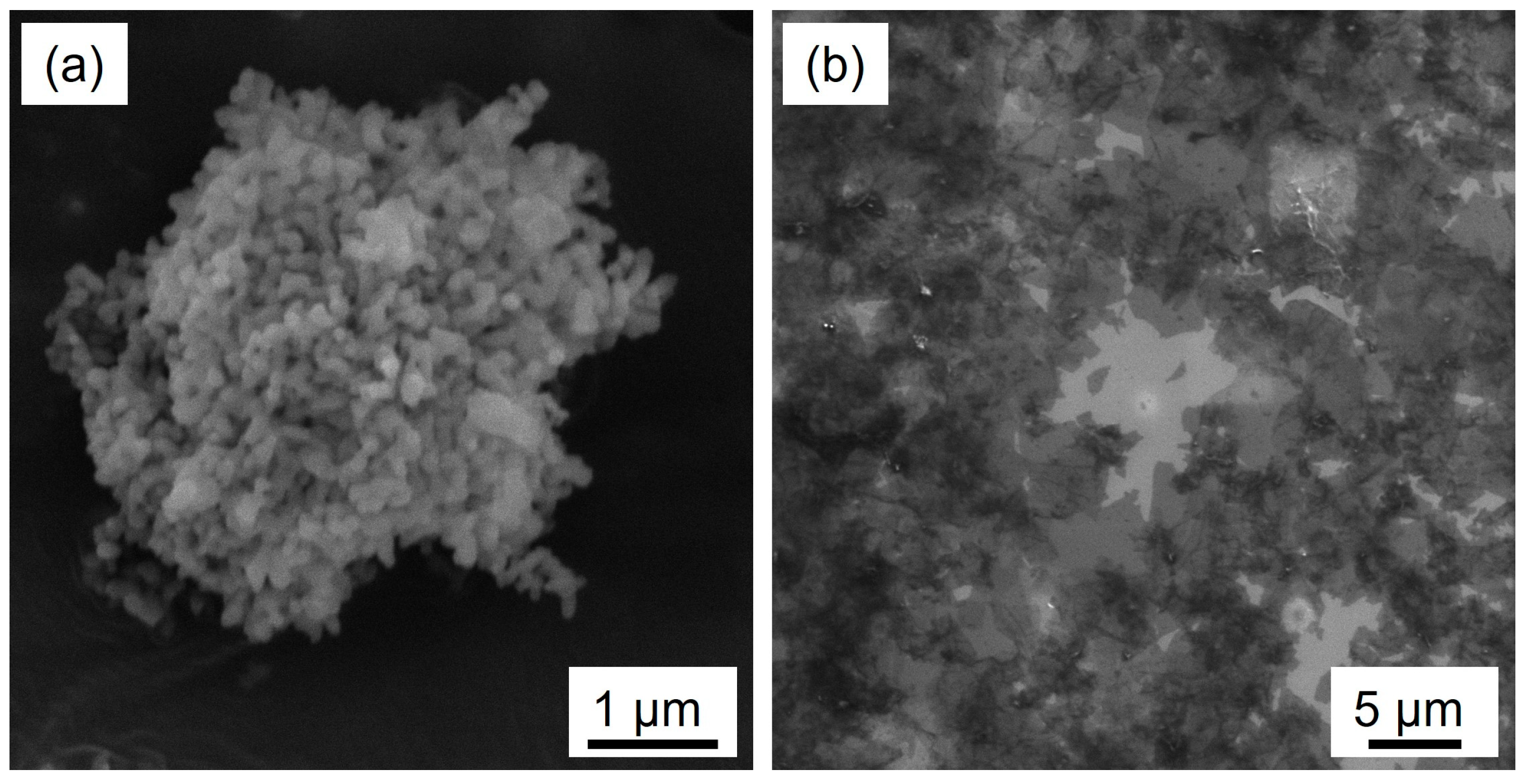
As raw materials for the preparation of a high-filled filament, aluminum oxide powder α-Al2O3 (Plazmotherm Ltd., Moscow, Russia), with a grain size d50 = 200 nm and purity 98.9–99.9%, polyamide powder PA2200 (PA12) (EOS GmbH, Krailling, Germany), paraffin granules (PW) (JSC Yaroslavl paraffin-waxes plant, Rostov, Russia) and stearic acid (SA) (Quox Global Ltd., Taganrog, Russia) were taken. GO paste (50 mg/mL) was purchased from Graphenox (Graphenox Ltd., Moscow, Russia) with the following elemental composition: C—46%, O—49%, H—2.5%, and S < 1.5%. Figure 1 shows the images of the alumina raw powder (Figure 1a) and the GO after ultrasonic dispersion (Figure 1b).
Raw alumina powder consists of soft agglomerates (5–15 μm) formed by irregularly shaped nanoparticles (~200 nm). On the other hand, graphene oxide is characterized by a flaky, multilayered structure.
Alumina mixtures with various GO contents 0.05, 0.1 and 0.25 vol.% were prepared by wet milling. First, the amount of paste required for each GO content was dissolved in distilled water using an IKA T-18 ultrasonic disperser (IKA-Werke GmbH & Co. KG, Staufen im Breisgau, Germany) for 2 h. These GO dispersions were then mixed with the required amount of alumina powder in a ball mill (Promstroymash Ltd., Moscow, Russia). Then, the obtained wet mixtures were dried by freeze-drying in a Labconco freezone 2.5 plus unit (Labconco Corp., Kansas City, MO, USA). Next, the dried Al2O3-GO mixtures were mixed with polyamide, paraffin, stearic acid, and ceramic balls in an organic solvent Nefras S2-80/120. After mixing these compounds, the resulting products were dried in a fume hood until the solvent was removed and then further dried in a VO 400 vacuum oven (Memmert GmbH, Büchenbach, Germany). After that, the obtained mixtures were sieved using a set of sieves with mesh sizes of 1 mm and 100 μm on a sieve analyzer VP-30 (Vibrotekhnik Ltd., Saint Petersburg, Russia). The component content in the prepared mixtures was as follows: 78 wt.% (Al2O3 + GO) + 22 wt.% (PA12 + PW + SA). The ceramic-polymer mixtures differed only in the amount of graphene oxide.
Then, to obtain ceramic polymer filaments, the prepared mixtures were extruded in a Wellzoom desktop extruder (Shenzhen Mistar Technology Co., Ltd., Shenzhen, China) at temperatures of 215–220 °C and maximum screw rotation speed. The diameter of the extruder nozzle was 1.75 mm.
The ceramic-polymer filament manufacturing process used in this study has been described in detail in the article [17].

2.2. Debinding and Sintering

The obtained filaments were subjected to a chemical dissolution procedure in the organic solvent Nefras S2-80/120 for 10 h and then sintered. Sintering was carried out in a tubular furnace GSL-1700x (MTI Corporation, Richmond, CA, USA) in two ways: in a protective argon atmosphere and in air. The sintering regimes were identical in both cases and consisted of a smooth heating at a rate of 1 °C/min to 600 °C, holding for 1 h at this temperature, then heating at a rate of 4 °C/min to the selected sintering temperatures of 1500 and 1550 °C and holding at these temperatures for 1 h. The sintered samples were designated as xGO/y, where x is the percentage content (0.05, 0.1, 0.25) of graphene oxide, and y is the atmosphere (Air) or argon (Ar).

2.3. Samples Characterization

For the analysis of the microstructure and grain size of the sintered filaments, a Vega 3 LMH scanning electron microscope (SEM, Tescan, Brno, Czech Republic) was used. For this, all samples were coated with a layer of gold on the Quorum Q150ES installation (Quorum Technologies, Laughton, UK). For each sample, fifty randomly selected grains were measured and analyzed using the open-source software ImageJ 1.54g on images obtained using a scanning electron microscope. The data were obtained by drawing lines through randomly selected grains and calculating their diameters. For measuring the particle size of each composite, at least 10 measurements were performed, after which the average value and standard deviation were calculated.
Hardness was measured on polished surfaces (along the extrusion direction) by the Vickers method on a microhardness tester (Qness, Salzburg, Austria) with a load of 9.8 N and a dwell time of 10 s. For each sample, 10 indents were measured.
The presence of graphene was confirmed by Raman technique on the DXR TM2 (Thermo Fisher Scientific, Waltham, MA, USA) spectrometer equipped with a laser source with a wavelength of 780 nm at a power of 15 mW.
Apparent density of the samples was measured by the Archimedes method on laboratory scales AND GR-300 (A&D Company Ltd., Tokyo, Japan) with an accuracy of up to 0.0001 g. Distilled water was used as the working fluid.

3. Results and Discussion

3.1. Characterization of Sintered Materials

3.1.1. Raman Spectra of Materials

To confirm the presence of graphene and its derivatives in the samples before and after sintering, Raman spectroscopy was performed as was conducted previously in our work [17]. In this work, we proved that graphene oxide retained its original structure in the obtained mixtures after dispersion, freeze-drying, and mixing with a polymer binder.
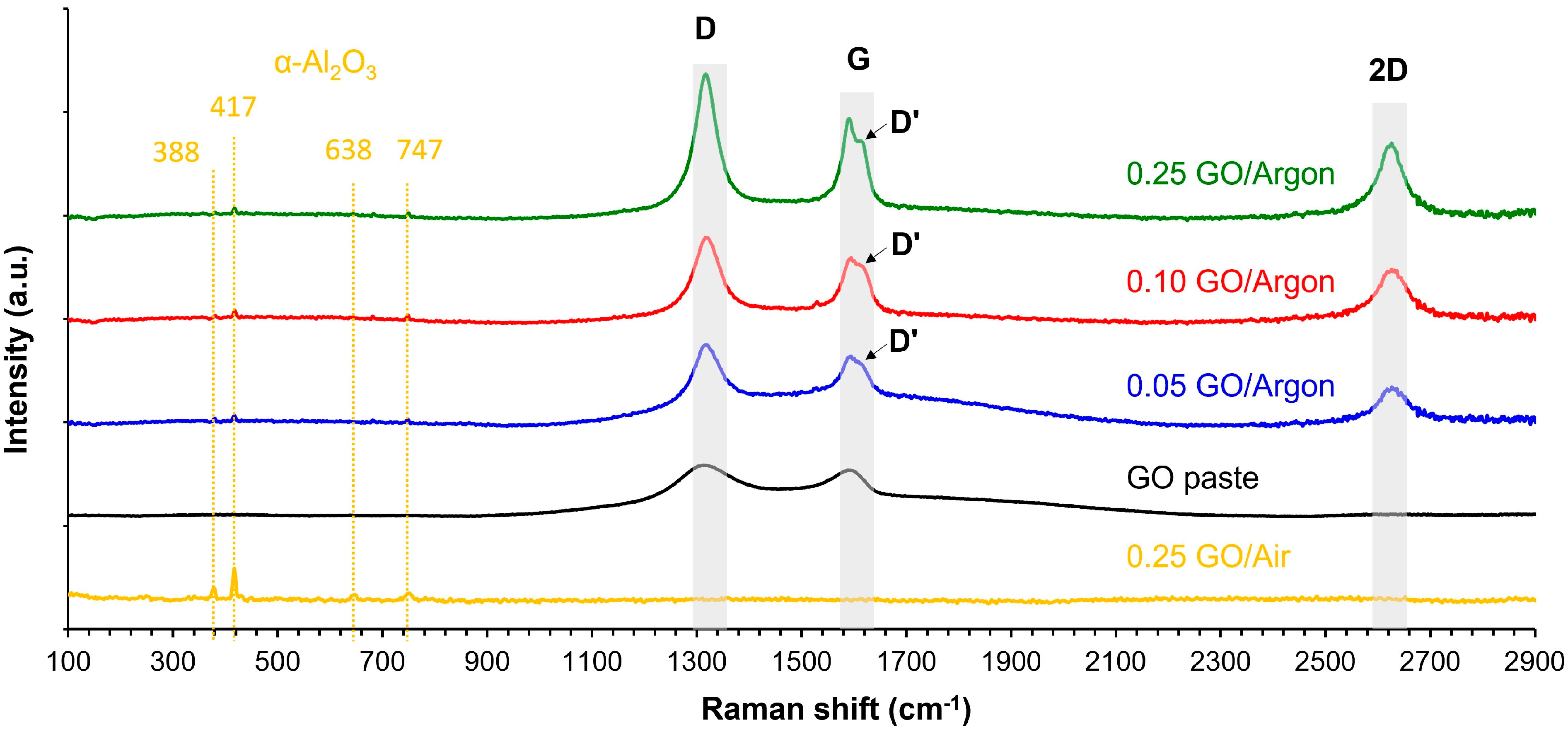
Figure 2 shows the results of the present work. This figure displays the Raman spectra of the filaments sintered at 1500 °C in Argon, the raw GO paste, and the Raman spectrum of a sample sintered in air.
Figure 2 shows that Raman spectra of all samples sintered in Ar have the characteristic peaks for graphene oxide and its derivatives: D (1340 cm−1), G (1590 cm−1) and 2D (2700 cm−1). The G-band corresponds to the ideal graphite structure, the D-band indicates structural defects, and the 2D peak reflects the number of graphene layers [33,34,35,36]. These spectra exhibit a clearly pronounced 2D peak in contrast to the Raman spectrum of the raw GO paste, which shows the absence of the 2D peak. Furthermore, it can be observed that the shape of the 2D band in the sintered samples noticeably differs from the shape of the 2D band of common graphite, as can be seen in the work [35]. The appearance of the 2D peak in the sintered samples indicates the thermal transformation of GO to reduced graphene oxide (rGO) during sintering at 1500 °C in argon [24].
The intensity ratio of D-peak and G-peak (ID/IG) is widely used as a parameter characterizing the degree of structural defectiveness in graphene-based materials. For GO, the intensity ratio is typically close to one (ID/IG ≈ 1), which is due to the presence of numerous functional groups and sp3-hybridized carbon atoms. It was expected that during thermal treatment, the removal of oxygen-containing functional groups from GO would occur, leading to a reduction in defectiveness, restoration of the crystalline structure, and, consequently, a decrease in the intensity of the D-peak and the ID/IG value. However, in our case, the opposite trend was observed: the intensity ratio of sintered samples in Ar increased compared to this parameter of GO-paste (ID/IG = 1.11). Namely, the intensity ratios for the 0.05 GO/Ar, 0.1 GO/Ar, and 0.25 GO/Ar samples were 1.17, 1.32, and 1.45, respectively. Similar results were observed in investigations engaged in the deposition of graphene obtained by chemical vapor deposition onto powder particles [18,20,37], as well as nanocomposite coatings based on aluminum oxide/reduced graphene oxide [25,31,38].
An additional indication of increased defectiveness is the appearance of the D’ band (1620 cm−1) in the spectra of sintered samples.
The increased intensity ratio and the appearance of the D’ band in the Raman spectra of sintered samples in Ar may be related to the formation of chemical bonds between the GO and the Al2O3 matrix, as well as to the degradation of the rGO structure and the formation of defects at elevated temperatures. Therefore, it can be assumed that the number of defects in the composite will increase with the increasing proportion of graphene oxide. Emerging structural defects reduce graphene’s ability to evenly distribute mechanical stress, potentially leading to deterioration of the mechanical properties of sintered compounds.
Figure 2 also shows the Raman spectrum of the sample with 0.25 vol.% of GO (yellow line) and sintered in air. In this spectrum it is clearly visible that the active A1g and the Eg modes, characteristic of α-Al2O3, are located in the region of 415 and 643 cm−1, as well as in 378 and 749 cm−1 [39,40], respectively. The Raman spectra of samples with 0.05 and 0.1 vol.% of GO and sintered at the same conditions are similar to that shown with the yellow line. These spectra do not show the common peaks (D, G, and 2D) for graphene-like materials, indicating that there was complete removal of GO from the ceramic volume during sintering in air.
The spectra of the argon-sintered samples (blue, green, and red lines in Figure 2) also show the α-Al2O3 peaks. However, a notable shift of the 638 cm−1 peak to the right is observed, which could indicate the appearance of residual compressive stresses resulting from the difference in the coefficients of thermal expansion between Al2O3 and rGO.

3.1.2. Microstructure of Sintering Composites

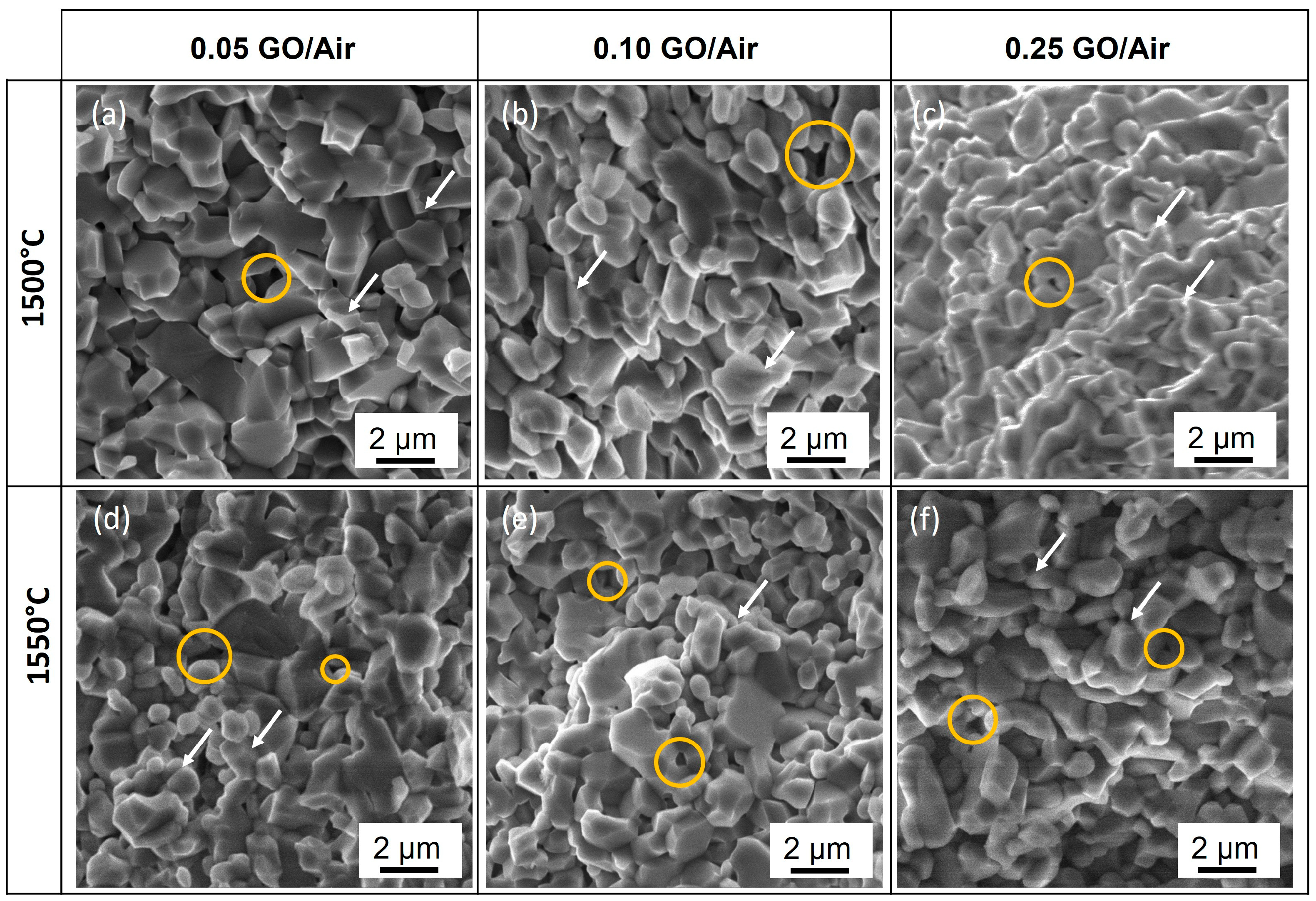
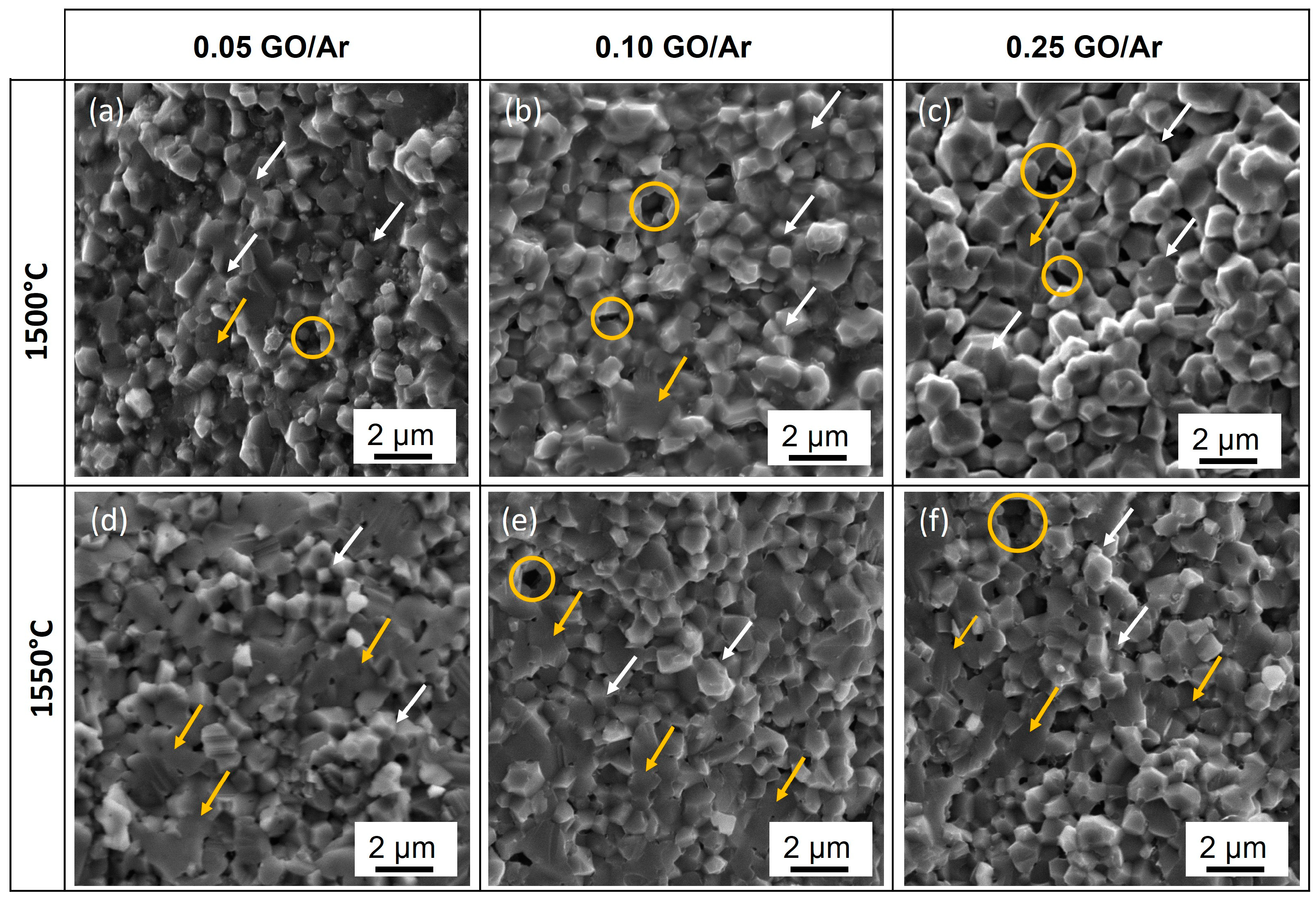
An analysis of the shape and grain size in the sintered filaments was performed on the fracture surface obtained by manually bending the samples. Figure 3 and Figure 4 show the microstructure of the fracture surfaces of filaments sintered at 1500 °C and 1550 °C in air and in argon atmosphere, respectively.
Several researchers [19,20,28,41,42] have already indicated that graphene inhibits alumina grain growth during sintering, and this assertion is also confirmed by the results obtained in the present study. As shown in Figure 3 and Figure 4, the grain size was significantly larger in the samples sintered in air (Figure 3) than in the samples sintered in an argon atmosphere (Figure 4). This is because the graphene envelops the Al2O3 particles, which subsequently hinders the uniform coalescence and grain growth of the ceramic particles. The average grain size of the samples sintered in air increased by more than 20% compared to the samples sintered in argon (Table 1).
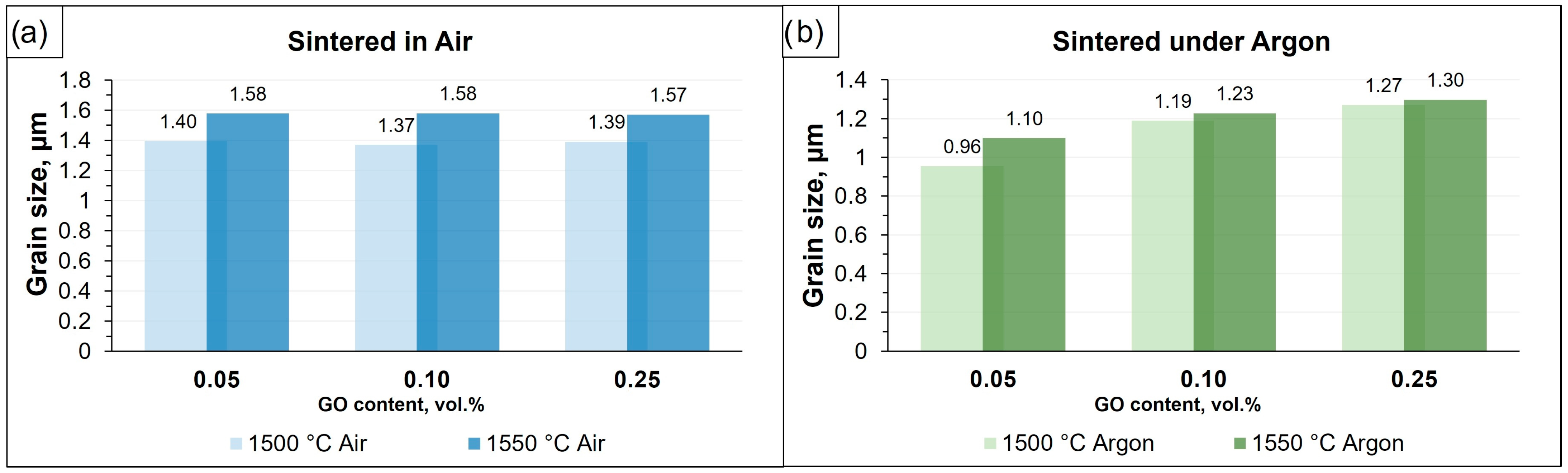
The average grain sizes in samples sintered in air and argon are presented in Figure 5a and Figure 5b, respectively.
From Figure 5 it is observed that by increasing the temperature from 1500 °C to 1550 °C, the grain size increases in all samples. The average grain size of samples 0.05 GO/Air, 0.1 GO/Air, and 0.25 GO/Air sintered at 1500 °C was 1.40 ± 0.70, 1.37 ± 0.61, and 1.39 ± 0.57 µm, respectively; while at 1550 °C, the grain size increased to 1.58 ± 0.77, 1.58 ± 0.71, and1.57 ± 0.80 µm. These results show that the grain size of the samples with different initial GO content and sintered at the same temperature did not differ much between them.
In contrast, the average grain size of 0.05 GO/Ar, 0.1 GO/Ar, and 0.25 GO/Ar sintered at 1500 °C was 0.96 ± 0.65, 1.19 ± 0.52, and 1.27 ± 0.73 µm, respectively; while at 1550 °C, the grain size was 1.10 ± 0.77, 1.23 ± 0.76, and 1.30 ± 0.81 µm. These values were significantly smaller in comparison with the samples sintered in air at the same conditions. The obtained results show that for these samples, the grain size increases with an increase in the GO content. This is likely because as the GO content increases, agglomeration occurs, which leads to the formation of voids and pores between the grains and gives them the opportunity for growth. A lower GO content provides a more uniform distribution of it throughout the ceramic volume, resulting in denser adhesion and greater grain enclosure, and inhibiting diffusion processes, preventing significant grain growth.
From the analyzed images, it can be seen that the grain shape in the sintered samples also differs. Elongated grains with sharp edges, typical of Al2O3 ceramics, are clearly visible in the samples sintered in air (Figure 3). On the other hand, grains with more rounded edges are observed in the samples sintered in argon, which retain graphene in their structure (Figure 4). A similar effect is described in articles [41,43,44,45].
From Figure 3 it is clearly seen that the intergranular fracture mode predominates (white arrows), which is characterized by crack propagation along grain boundaries. In addition, individual grains with polyhedron form are observed on the fracture surface.
Pores are present in all sintered samples (yellow circles in Figure 3 and Figure 4). The presence of pores is due to the burnout of the polymer binder at high temperatures, as well as loose adhesion and uneven distribution of ceramic particles during filament extrusion. Moreover, it was observed that the samples with 0.25 vol.% GO and sintered at 1500 °C in Ar showed the highest number of pores, and with a decrease in the GO amount, the number of pores in the structure decreases also. At the same time, it was noted that the increase in sintering temperature from 1500 °C to 1550 °C also reduces the number of pores in the structure, but increases the proportion of large grains, resulting from the coalescence of neighboring small ones. Simultaneously, the fracture mode of the composites also changes from intergranular (white arrows in Figure 4) that is characteristic of composites obtained at 1500 °C, to a mixed intergranular and partially transgranular (orange arrows in Figure 4) fracture mode that is inherent in samples obtained at 1550 °C. This means that the addition of graphene and an increase in the sintering temperature make the grain boundary stronger, which can subsequently increase the fracture toughness of the composite due to more tortuous fracture paths [18,24,44,46,47].

3.2. Density and Hardness of Sintering Composites

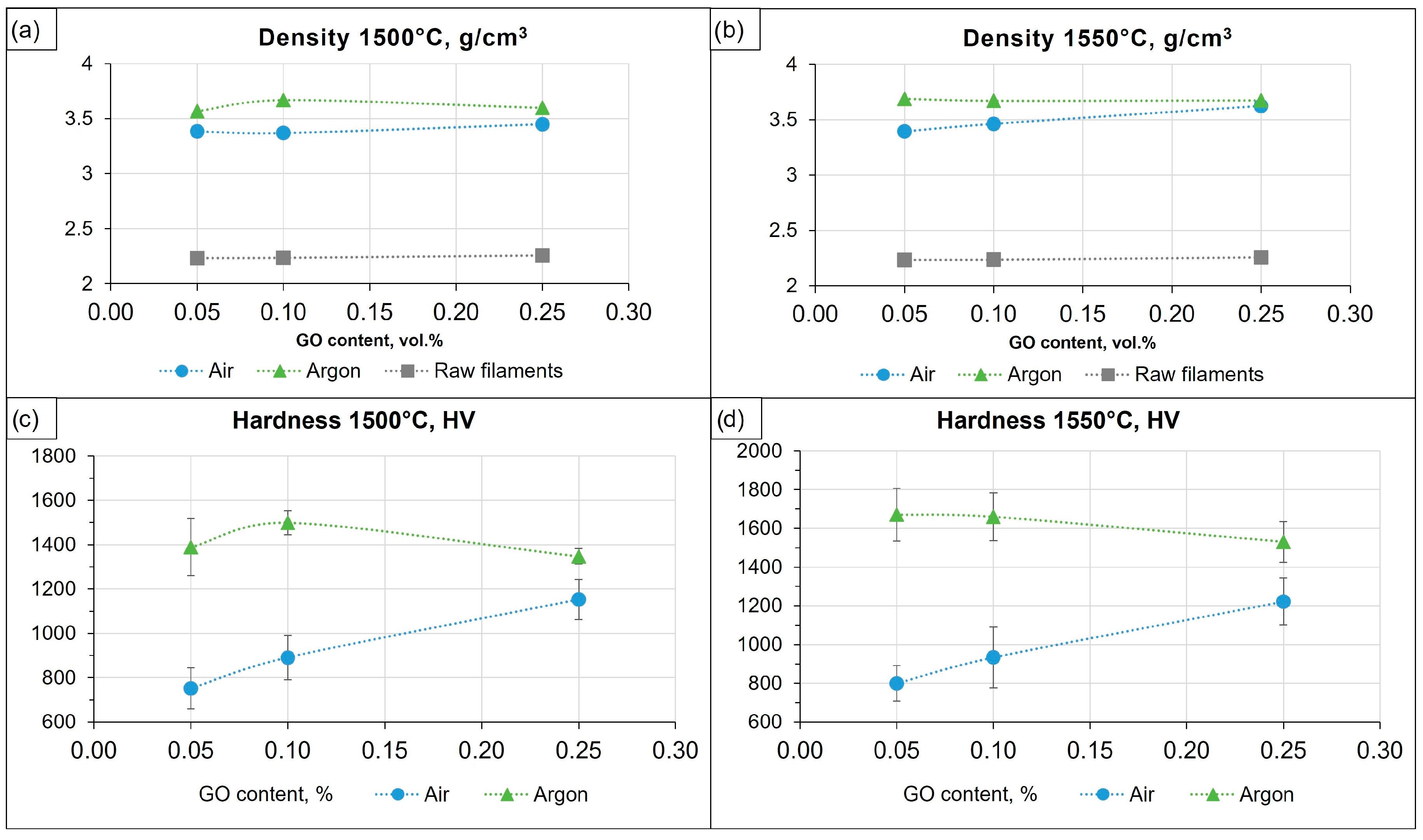
Table 1 and Figure 6 present the density and Vickers hardness results of samples sintered in air and argon at 1500 °C and 1550 °C.
The density of alumina composites with graphene inevitably decreases with an increase in the percentage content of graphene due to the lower density of graphene (2.25 g/cm3) compared to aluminum oxide (3.95 g/cm3). The addition of GO hinders the densification of the Al2O3 matrix during sintering in a protective atmosphere.
In the present work, the density of samples 0.05 GO/Ar, 0.1 GO/Ar, and 0.25 GO/Ar sintered at 1500 °C was 3.57 ± 0.06, 3.67 ± 0.04, and 3.60 ± 0.03 g/cm3, respectively; while at 1550 °C the density of samples was 3.69 ± 0.03, 3.67 ± 0.05, and 3.68 ± 0.04 g/cm3, respectively (Table 1). These results show that with an increase in temperature, the density of the materials increases slightly, which may be related to grain growth in the samples (Figure 6) and to the decrease in the number of pores formed during the burning of the polymer binder. At 1550 °C, the density of the samples differed slightly from each other, while at 1500 °C, a higher value of 3.67 ± 0.04 g/cm3 was achieved for the sample 0.1 GO/Ar.
It is well known that hardness depends on the grain size, density, and residual porosity of the composite, and to obtain a high hardness value, the grain size of the compound must be smaller, and the density must be very high. The hardness of sintered composites showed a more obvious difference in the values obtained at different temperatures compared to density (Table 1).
From Figure 6c,d, it is well-seen that hardness of all composites increases with increasing sintering temperature. Despite the fact that the grain size also increases, along with it, there is an increase in the density of composites and a reduction in porosity, which contributes more to the increase in hardness values. Also, the dependence of the hardness on the GO content of the obtained materials is well-manifested. It is clearly seen that an increase in the proportion of graphene in composites reduces their hardness.
The graph of hardness (Figure 6c) of samples sintered in Ar at 1500 °C coincides in shape with the graph of their density. It is well-seen that the best result was obtained for the composite with 0.1 GO/Ar, for which a higher density was recorded. On the other hand, the hardness of samples sintered at 1550 °C (Figure 6d) decreases with an increase in the proportion of graphene, which correlates well with the data obtained on the growth of grain sizes (Figure 5, and Table 1). Due to the low hardness of rGO, as well as the increase in porosity and grain size, the microhardness of the samples decreases as the rGO content increases.
Hardness values of 1670.73 ± 136.90 and 1659.57 ± 123 HV for 0.05 GO/Ar and 0.1 GO/Ar are related to a more uniform distribution of rGO in the material volume and the presence of fewer defects in its structure, which was noted in the Raman spectroscopy study (Figure 2). Furthermore, the high elastic modulus of graphene can very effectively prevent localized plastic deformation, thus leading to an increase in hardness. When the content of GO increases, the probability of its agglomeration in the structure grows, which leads to the appearance of pores that reduce the density of the material and lead to grain growth, which reduces the hardness of the samples. Also, during sintering in a protective atmosphere, the reduction in GO occurs, in which functional groups on the surface of GO leave in gaseous form, leaving voids in their place, which reduce the contact area of the sheets of reduced graphene oxide with the ceramic, giving rise to defects in the structure that negatively affect the properties of the composite.
From the obtained results, it is seen that samples with different GO content and sintered in argon have similar patterns of properties: with the increase in GO content, the density and mechanical properties of composites decrease, as described earlier by other researchers [20,24,43,48,49,50,51,52].
Unexpected results were shown in samples with different content of GO and sintered in air. It was suspected that with an increase in GO content, more gaps would form in the structure of the samples due to the combustion of GO in air, which would negatively affect the samples mechanical properties. But the exact opposite result was observed. Figure 6 clearly shows that the properties of the material sintered in air improve with increasing graphene proportion.
The density of the initial ceramic-polymer filaments 0.05 GO, 0.1 GO, and 0.25 GO was 2.23 ± 0.01, 2.24 ± 0.03, and 2.26 ± 0.02 g/cm3, respectively. It is seen that initially, the density differed insignificantly by 0.03 g/cm3 between the 0.05 GO and 0.25 GO samples. During sintering at 1500 °C in air, this difference becomes more evident: the densities of the 0.05 GO and 0.25 GO samples were 3.38 ± 0.04 g/cm3, and 3.45 ± 0.04 g/cm3, respectively. The difference in density becomes even greater after sintering at 1550 °C: 3.39 ± 0.05 g/cm3 and 3.63 ± 0.04 g/cm3 for 0.05 GO and 0.25 GO, respectively.
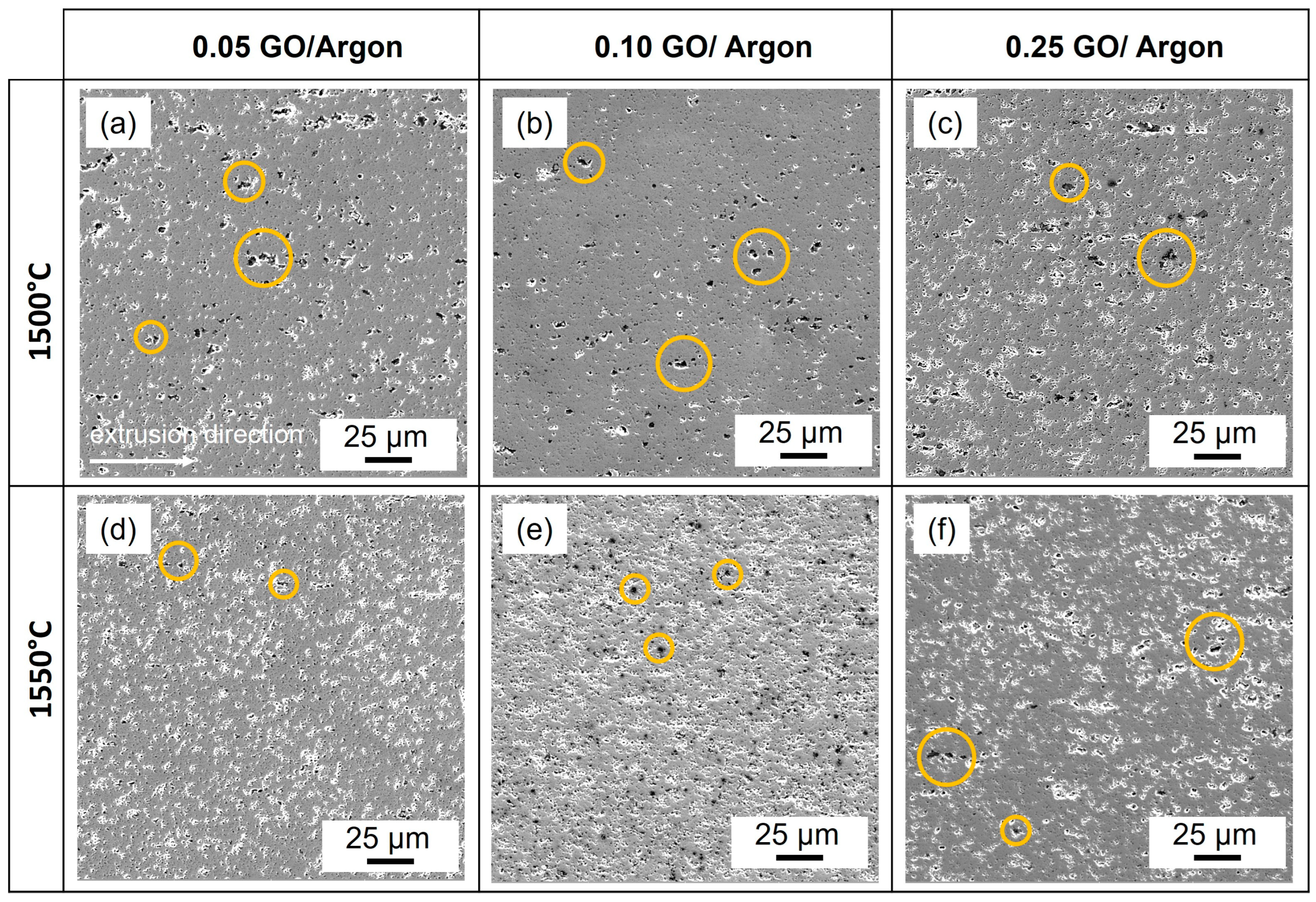
Figure 7 shows the polished surface of filaments sintered in argon at 1500 °C (top row) and 1550 °C (bottom row). The images in Figure 7 confirm the decrease in the number of pores in the samples (yellow circles) and the obtaining of a denser structure with the increase in the sintering temperature. It is also noticeable that an increase in the number of pores occurs with the increase in the GO content in the sample.
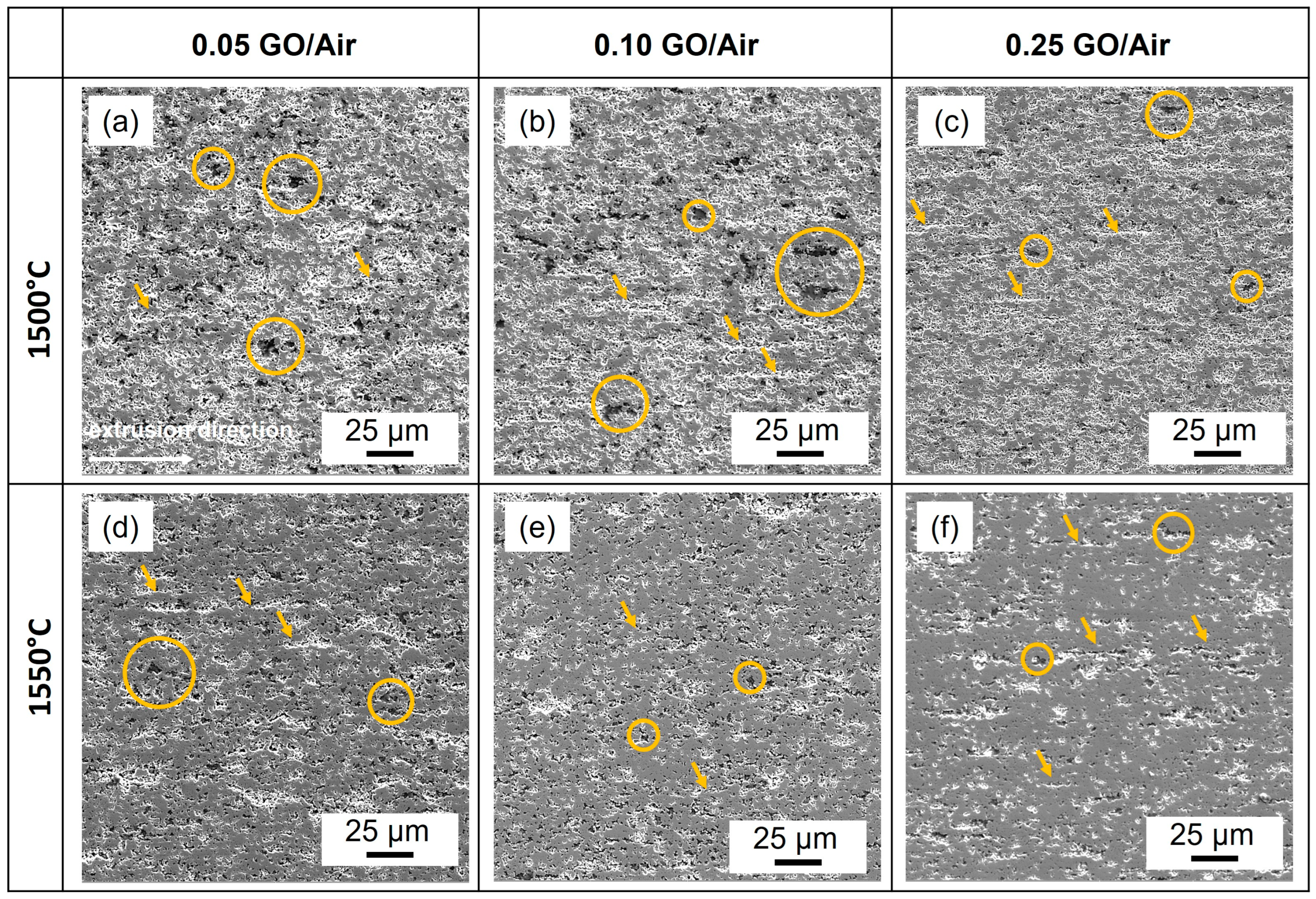
Figure 8 shows a polished surface (along the extrusion direction) of filaments sintered in air at 1500 °C (top row) and 1550 °C (bottom row). As can be seen in the images in Figure 8, the samples sintered in air have a much more porous microstructure compared to the samples sintered in argon under the same conditions (Figure 7). Furthermore, it seems that with the increase in sintering temperature in air from 1500 °C (top row of Figure 8) to 1550 °C (bottom row of Figure 8), the pores in all samples become fewer. Similarly, it can be observed that by jointly increasing the sintering temperature and the graphene oxide content from 0.05 GO (Figure 8a,d) to 0.25 GO (Figure 8c,f), the number of pores also decreases. In addition, on the surfaces are clearly visible pores that formed as a result of the burnout of the polymer binder and the loose adhesion of ceramic particles to each other (yellow circles in Figure 8). But pores with an elongated linear character on the surfaces (yellow arrows in Figure 8) could have been formed by the burning of GO, because these pores have the contour of graphene oxide sheets arranged along the direction of filament extrusion.
These results suggest that during filament extrusion, GO sheets are oriented along the direction of the extrusion flow. Similar results were obtained by researchers [53], who observed the orientation of rGO sheets in the direction of the injection flow when producing cordierite–mullite composites using a ceramic injection molding method. Thus, it can be assumed that GO, which was reduced in samples sintered in argon, is also oriented in the direction of material extrusion. That is, during 3D printing using graphene-containing ceramic filaments, it will be possible to set the orientation of graphene sheets and thus create ceramic products with specified anisotropy of properties in the chosen direction.
The hardness of filaments sintered in air show a more obvious trend with an increase in the content of GO (Figure 6). The hardness of samples 0.05 GO/Air sintered at 1500 °C and 1550 °C was 751.57 ± 92.78 HV and 800.02 ± 91.00 HV, respectively. These values were the lowest observed among the materials studied and sintered at the same temperature. On the other hand, the highest hardness values were observed for the 0.25 GO/Ar samples sintered at 1500 °C and 1550 °C, reaching1152.65 ± 90.20 HV and 1222.31 ± 120.64 HV, respectively. These results obtained in the samples sintered in air are likely due to the fact that the presence of a higher amount of GO (0.25% by volume) in filaments containing a high percentage of ceramic material (78% by weight) allows the ceramics to distribute more uniformly throughout the filament volume during extrusion, due to the lubricating effect of the GO. This enables the ceramic particles to slide effectively against each other, redistribute themselves, and fill any gaps in the structure. Different researcher groups [53,54] noted that GO promotes denser packing of ceramic particles and the formation of a uniform microstructure during sintering. Thus, increasing the graphene oxide content from 0.05 to 0.25 vol.% in extruded filaments provides denser and possibly more uniform adhesion of ceramic particles to each other, which, as a consequence, affects the kinetics of densification and grain growth during sintering.
Based on the obtained research results, an interesting dependence of the influence of GO content on the properties of samples sintered in air and argon emerges. A decrease in the density and hardness of the samples sintered in argon occurs with an increase in GO content from 0.05 vol.% to 0.25 vol.%. On the other hand, an improvement in density and hardness properties of samples sintered in air occurs with an increase in GO content. Moreover, with the increase in sintering temperature from 1500 °C to 1550 °C, the grain size noticeably increases; however, many voids still remain between the grains, which indicates the need to increase the sintering temperature and holding time to achieve a better result. The work [55] indicates that the optimal sintering regimes for aluminum oxide particles in air were a temperature of 1600 °C with a holding time of 4 h.
In another work [56], researchers report the successful sintering of Al2O3 ceramics obtained by the stereolithography method from suspensions with high solid phase content (up to 65 vol.%) at a temperature of 1650 °C and holding time of 4 h in air. Researchers [57] managed to significantly increase the density and hardness of aluminum oxide samples with the addition of carbon nanotubes during pressureless sintering at 1700 °C for 2 h in argon. In this regard, our further research will focus on studying the properties of the developed materials when the sintering temperature rises to 1700 °C.

4. Conclusions

In this study, the influence of the addition of 0.05, 0.1, and 0.25 vol.% graphene oxide and the sintering atmosphere on the microstructure, density, and hardness of Al2O3 ceramics obtained by the FFF method was investigated. The possibility of reducing graphene oxide in composites in a protective argon atmosphere in filaments used for 3D printing by the FFF method is shown. It is noted that with an increase in sintering temperature from 1500 °C to 1550 °C in argon and in air, there is an increase in the properties of the ceramics.
It is shown that graphene oxide inhibits the grain growth of aluminum oxide during sintering in an argon atmosphere, compared to sintering in air. With the addition of 0.05 vol.%, it was possible to reduce the growth by more than 20%; with a further increase in graphene content, the grain growth slightly increases but still remains less than during sintering in air. It is noted that for composites sintered in argon, the fracture mode changes from intergranular to transcrystalline with an increase in sintering temperature. For materials sintered in air, intergranular fracture predominates in both cases. Although with an increase in temperature, the grain size increases, an increase in hardness was recorded for all sintered composites, which is most likely due to the growth in composite density and the reduction in voids that remain during the removal of the polymer binder.
The hardness of composites sintered in an argon atmosphere turned out to be significantly higher. The best (1670.73 ± 136.9 HV) result at a temperature of 1550 °C was obtained with the addition of only 0.05 vol.% graphene oxide. Further increase in its content led to a gradual decrease in hardness values to 1529.99 ± 105.46 HV for the sample with 0.25 vol.% rGO.
An interesting result was obtained during the sintering of composites with different graphene oxide contents in air. A stable increase in density and hardness of the samples was noted with an increase in graphene oxide content. The best hardness result at both sintering temperatures was shown by the 0.25GO/Air sample, whereas it was assumed that with an increase in graphene content during its combustion in air, more voids would form in the samples, which would negatively affect the properties.
The results obtained by us represent a viable solution for the production of highly effective Al2O3 ceramics of complex shape using FFF technology, both for the manufacture of porous structures from oxide ceramics, for example, ceramic cores for the production of gas turbine blades, and for the production of dense ceramic composites reinforced with graphene derivatives with improved thermal and electrical conductivity, and wear resistance.
In the continuation of this work, it is planned to manufacture samples by the FFF method for sintering at higher temperatures and study their properties.

Author Contributions

Conceptualization, E.K.; methodology, E.K.; software, D.S. and R.K.; validation, E.K. and A.V.G.; formal analysis, E.K. and A.S.; investigation, E.K., D.S., N.K., O.O.Y., and R.K.; resources, N.W.S.P., N.K., and O.O.Y.; data curation, A.V.G., A.S., N.K., and O.O.Y.; writing—original draft preparation, E.K. and P.P.; writing—review and editing, A.S. and N.W.S.P.; visualization, E.K. and D.S.; supervision, A.V.G.; project administration, P.P.; funding acquisition, P.P. All authors have read and agreed to the published version of the manuscript.

Funding

This research was funded by the Ministry of Health of the Russian Federation, grant number 056-00041-23-00.

Data Availability Statement

The original contributions presented in this study are included in the article. Further inquiries can be directed to the corresponding author.

Acknowledgments

The study was carried out on the equipment of the Center of Collective Use “State Engineering Center” of the MSUT “STANKIN”.

Conflicts of Interest

The authors declare no conflicts of interest.

References

  1. Abyzov, A.M. Aluminum Oxide and Alumina Ceramics (review). Part 1. Properties of Al2O3 and Commercial Production of Dispersed Al2O3. Refract. Ind. Ceram. 2019, 60, 24–32. [Google Scholar] [CrossRef]
  2. Agac, O.; Gozutok, M.; Turkoglu, H.; Ozturk, A.; Park, J. Mechanical and biological properties of Al2O3 and TiO2 co-doped zirconia ceramics. Ceram. Int. 2017, 43, 10434–10441. [Google Scholar] [CrossRef]
  3. Kaushal, S.; Zeeshan, M.D.; Ansari, M.I.; Sharma, D. Progress in tribological research of Al2O3 ceramics: A review. Mater. Today Proc. 2023, 82, 163–167. [Google Scholar] [CrossRef]
  4. Zhang, L.; Liu, H.; Yao, H.; Zeng, Y.; Chen, J. Preparation, microstructure, and properties of ZrO2 (3Y)/Al2O3 bioceramics for 3D printing of all-ceramic dental implants by vat photopolymerization. Chin. J. Mech. Eng. Addit. Manuf. Front. 2022, 1, 100023. [Google Scholar] [CrossRef]
  5. Wang, X.; Zhong, Y.; Hu, Q. A review of Al2O3-based eutectic ceramics for high-temperature structural materials. J. Mater. Sci. Technol. 2025, 214, 214–232. [Google Scholar] [CrossRef]
  6. Ouyang, Y.; Bai, L.; Tian, H.; Li, X.; Yuan, F. Recent progress of thermal conductive ploymer composites: Al2O3 fillers, properties and applications. Compos. Part A Appl. Sci. Manuf. 2021, 152, 106685. [Google Scholar] [CrossRef]
  7. Spina, R.; Morfini, L. Material Extrusion Additive Manufacturing of Ceramics: A Review on Filament-Based Process. Materials 2024, 17, 2779. [Google Scholar] [CrossRef]
  8. Zaytsev, A.I.; Sotov, A.V.; Abdrahmanova, A.E.; Popovich, A.A. Additive manufacturing of polymer-ceramic materials using fused deposition modeling (FDM) technology: A review. Powd. Metall. Funct. Coat. 2024, 18, 77–88. [Google Scholar]
  9. Patel, A.; Taufik, M. Nanocomposite Materials for Fused Filament Fabrication. Mater. Today Proc. 2021, 47, 5142–5150. [Google Scholar] [CrossRef]
  10. Gonzalez-Gutierrez, J.; Cano, S.; Schuschnigg, S.; Kukla, C.; Sapkota, J.; Holzer, C. Additive Manufacturing of Metallic and Ceramic Components by the Material Extrusion of Highly-Filled Polymers: A Review and Future Perspectives. Materials 2018, 11, 840. [Google Scholar] [CrossRef]
  11. Markandan, K.; Chin, J.K.; Tan, M.T.T. Recent Progress in Graphene Based Ceramic Composites: A Review. J. Mater. Res. 2017, 32, 84–106. [Google Scholar] [CrossRef]
  12. Wakchaure, M.B.; Menezes, P.L. Advances in the Tribological Performance of Graphene Oxide and Its Composites. Materials 2025, 18, 3587. [Google Scholar] [CrossRef] [PubMed]
  13. Ramírez, C.; Belmonte, M.; Miranzo, P.; Osendi, M.I. Applications of Ceramic/Graphene Composites and Hybrids. Materials 2021, 14, 2071. [Google Scholar] [CrossRef]
  14. Jakubczak, M.; Jastrzębska, A.M. A Review on Development of Ceramic-Graphene Based Nanohybrid Composite Systems in Biological Applications. Front. Chem. 2021, 9, 685014. [Google Scholar] [CrossRef]
  15. Morales-Florez, V.; Domínguez-Rodríguez, A. Mechanical properties of ceramics reinforced with allotropic forms of carbon. Prog. Mater. Sci. 2022, 128, 100966. [Google Scholar] [CrossRef]
  16. Kinloch, I.A.; Suhr, J.; Lou, J.; Young, R.J.; Ajayan, P.M. Composites with carbon nanotubes and graphene: An outlook. Science 2018, 362, 547–553. [Google Scholar] [CrossRef]
  17. Kuznetsova, E.; Smirnov, A.; Gusarov, A.V.; Solís Pinargote, N.W.; Tarasova, T.V.; Grigoriev, S.N. Influence of Graphene Oxide on Printability, Rheological and Mechanical Properties of Highly Filled Alumina Filaments and Sintered Parts Produced by FFF. Appl. Sci. 2024, 14, 11986. [Google Scholar] [CrossRef]
  18. Hrubovčáková, M.; Múdra, E.; Bureš, R.; Kovalčíková, A.; Sedlák, R.; Girman, V.; Hvizdoš, P. Microstructure, fracture behaviour and mechanical properties of conductive alumina-based composites manufactured by SPS from graphenated Al2O3 powders. J. Eur. Ceram. Soc. 2020, 40, 4818–4824. [Google Scholar] [CrossRef]
  19. Grigoriev, S.; Peretyagin, P.; Smirnov, A.; Solis, W.; Díaz, L.A.; Fernández, A.; Torrecillas, R. Effect of graphene addition on the mechanical and electrical properties of Al2O3-SiCw ceramics. J. Eur. Ceram. Soc. 2017, 37, 2473–2479. [Google Scholar] [CrossRef]
  20. Drozdova, M.; Hussainova, I.; Pérez-Coll, D.; Aghayan, M.; Ivanov, R.; Rodríguez, M.A. A novel approach to electroconductive ceramics filled by graphene covered nanofibers. Mater. Des. 2016, 90, 291–298. [Google Scholar] [CrossRef]
  21. Grigoriev, S.; Peretyagin, N.; Apelfeld, A.; Smirnov, A.; Rybkina, A.; Kameneva, E.; Zheltukhin, A.; Gerasimov, M.; Volosova, M.; Yanushevich, O.; et al. Investigation of the Characteristics of MAO Coatings Formed on Ti6Al4V Titanium Alloy in Electrolytes with Graphene Oxide Additives. J. Compos. Sci. 2023, 7, 142. [Google Scholar] [CrossRef]
  22. Kurmysheva, A.Y.; Kuznetsova, E.; Vedenyapina, M.D.; Podrabinnik, P.; Pinargote, N.W.S.; Smirnov, A.; Grigoriev, S.N. Removal of 2,4-Dichlorophenoxyacetic Acid from Aqueous Solutions Using Al2O3/Graphene Oxide Granules Prepared by Spray-Drying Method. Resources 2024, 13, 40. [Google Scholar] [CrossRef]
  23. Gutierrez-Gonzalez, C.F.; Smirnov, A.; Centeno, A.; Fernández, A.; Alonso, B.; Rocha, V.G.; Torrecillas, R.; Zurutuza, A.; Bartolome, J.F. Wear behavior of graphene/alumina composite. Ceram. Int. 2015, 41, 7434–7438. [Google Scholar] [CrossRef]
  24. Li, W.; Sim, H.J.; Lu, H.; Cao, H.; Chen, Y.; Xiao, P. Effect of reduced graphene oxide on the mechanical properties of rGO/Al2O3 composites. Ceram. Int. 2022, 48, 24021–24031. [Google Scholar] [CrossRef]
  25. Miszczak, S.; Pietrzyk, B. Morphology and Structure of Al2O3 + Graphene Low-Friction Composite Coatings. Coatings 2022, 12, 1153. [Google Scholar] [CrossRef]
  26. Tubío, C.R.; Rama, A.; Gómez, M.; del Río, F.; Guitián, F.; Gil, A. 3D-printed graphene-Al2O3 composites with complex mesoscale architecture. Ceram. Int. 2018, 44, 5760–5767. [Google Scholar] [CrossRef]
  27. Azuaje, J.; Rama, A.; Mallo-Abreu, A.; Boado, M.G.; Majellaro, M.; Tubío, C.R.; Prieto, R.; García-Mera, X.; Guitián, F.; Sotelo, E.; et al. Catalytic performance of a metal-free graphene oxide-Al2O3 composite assembled by 3D printing. J. Eur. Ceram. Soc. 2021, 41, 1399–1406. [Google Scholar] [CrossRef]
  28. Fan, J.; Guan, R.; Ou, K.; Fu, Q.; Liu, Q.; Li, D.S.; Sun, Y. Direct ink writing 3D printing of graphene/Al2O3 composite ceramics with gradient mechanics. Adv. Eng. Mater. 2023, 25, 2201414. [Google Scholar] [CrossRef]
  29. Moreno-Sanabria, L.; Ramírez, C.; Osendi, M.I.; Belmonte, M.; Miranzo, P. Enhanced thermal and mechanical properties of 3D printed highly porous structures based on γ-Al2O3 by adding graphene nanoplatelets. Adv. Mater. Technol. 2022, 7, 2101455. [Google Scholar] [CrossRef]
  30. Jiang, J.; Yang, S.; Li, L.; Bai, S. High thermal conductivity polylactic acid composite for 3D printing: Synergistic effect of graphene and alumina. Polym. Adv. Technol. 2020, 31, 1291–1299. [Google Scholar] [CrossRef]
  31. Ramírez, C.; Shamshirgar, A.S.; Pérez-Coll, D.; Osendi, M.I.; Miranzo, P.; Tewari, G.C.; Karppinen, M.; Hussainova, I.; Belmonte, M. CVD nanocrystalline multilayer graphene coated 3D-printed alumina lattices. Carbon 2023, 202, 36–46. [Google Scholar] [CrossRef]
  32. Quanchao, G.U.; Lian, S.; Xiaoyu, J.I.; Honglei, W.; Jinshan, Y.U.; Xingui, Z. High-performance and high-precision Al2O3 architectures enabled by high-solid-loading, graphene-containing slurries for top-down DLP 3D printing. J. Eur. Ceram. Soc. 2023, 43, 130–142. [Google Scholar] [CrossRef]
  33. ASTM E3220-20; Standard Guide for Characterization of Graphene Flakes. ASTM International: West Conshohocken, PA, USA, 2025. [CrossRef]
  34. Ferrari, A.C.; Meyer, J.C.; Scardaci, V.; Casiraghi, C.; Lazzeri, M.; Mauri, F.; Piscanec, S.; Jiang, D.; Novoselov, K.S.; Roth, S.; et al. Raman spectrum of graphene and graphene layers. Phys. Rev. Lett. 2006, 97, 187401–187404. [Google Scholar] [CrossRef]
  35. Ferrari, A.C. Raman spectroscopy of graphene and graphite: Disorder, electron–phonon coupling, doping and nonadiabatic effects. Solid State Commun. 2007, 143, 47–57. [Google Scholar] [CrossRef]
  36. López-Díaz, D.; López Holgado, M.; García-Fierro, J.L.; Velázquez, M.M. Evolution of the Raman Spectrum with the Chemical 610 Composition of Graphene Oxide. J. Phys. Chem. C 2017, 121, 20489–20497. [Google Scholar] [CrossRef]
  37. Kim, C.D.; Kim, H.T. Direct formation of graphene shells on Al2O3 nano-particles using simple thermal treatment under C2H2-H2 atmospheric conditions. Mater. Chem. Phys. 2017, 202, 215–219. [Google Scholar] [CrossRef]
  38. Dash, T.; Rout, T.K.; Palei, B.B.; Bajpai, S.; Kundu, S.; Bhagat, A.N.; Satpathy, B.K.; Biswal, S.K.; Rajput, A.; Sahu, A.K.; et al. Synthesis of α-Al2O3–graphene composite: A novel product to provide multi-functionalities on steel strip surface. SN Appl. Sci. 2020, 2, 1147. [Google Scholar] [CrossRef]
  39. Benner, R.E.; Mitchell, J.R.; Grow, R.W. Raman Scattering as a Diagnostic Technique for Cathode Characterization. IEEE Trans. Electron Devices 1987, 34, 1842–1847. [Google Scholar] [CrossRef]
  40. Zhang, F.; You, J.; Canizarès, A.; Tang, X.; Lu, L.; Bessada, C.; Zhang, Q.; Wan, S.; Zhang, Z. Quantitative studies on the microstructure evolution and its impact on the viscosity of a molten Al2O3-Na3AlF6 system by Raman spectroscopy and theoretical simulations. J. Mol. Liq. 2024, 396, 123732. [Google Scholar] [CrossRef]
  41. Fan, Y.; Estili, M.; Igarashi, G.; Kawasakia, A. The effect of homogeneously dispersed few-layer graphene on microstructure and mechanical properties of Al2O3 nanocomposites. J. Eur. Ceram. Soc. 2014, 34, 443–451. [Google Scholar] [CrossRef]
  42. Centeno, A.; Rocha, V.G.; Alonso, B.; Fernández, A.; Gutierrez-Gonzalez, C.F.; Torrecillas, R.; Zurutuza, A. Graphene for tough and electroconductive alumina ceramics. J. Eur. Ceram. Soc. 2013, 33, 3201–3210. [Google Scholar] [CrossRef]
  43. Ahmad, I.; Islam, M.; Abdo, H.S.; Subhani, T.; Khalil, K.A.; Almajid, A.A.; Yazdani, B.; Zhu, Y. Toughening mechanisms and mechanical properties of graphene nanosheet-reinforced alumina. Mater. Des. 2015, 88, 1234–1243. [Google Scholar] [CrossRef]
  44. Shah, W.A.; Luo, X.; Guo, C.; Rabiu, B.I.; Huang, B.; Yang, Y.Q. Preparation and mechanical properties of graphene-reinforced alumina-matrix composites. Chem. Phys. Lett. 2020, 754, 137765. [Google Scholar] [CrossRef]
  45. Porwal, H.; Tatarko, P.; Grasso, S.; Khaliq, J.; Dlouhý, I.; Reece, M.J. Ceramic. Graphene reinforced alumina nano-composites. Carbon 2013, 64, 359–369. [Google Scholar] [CrossRef]
  46. Grigoriev, S.; Yanushevich, O.; Krikheli, N.; Kramar, O.; Pristinskiy, Y.; Solis Pinargote, N.W.; Peretyagin, P.; Smirnov, A. Design and Mechanical Properties of ZTA–Niobium Composites with Reduced Graphene Oxide. Ceramics 2025, 8, 15. [Google Scholar] [CrossRef]
  47. Smirnov, A.; Pristinskiy, Y.; Pinargote, N.W.S.; Meleshkin, Y.; Podrabinnik, P.; Volosova, M.; Grigoriev, S. Mechanical Performance and Tribological Behavior of WC-ZrO2 Composites with Different Content of Graphene Oxide Fabricated by Spark Plasma Sintering. Sci 2024, 6, 82. [Google Scholar] [CrossRef]
  48. Shah, W.A.; Luo, X.; Rabiu, B.I.; Huang, B.; Yang, Y.Q. Toughness enhancement and thermal properties of graphene-CNTs reinforced Al2O3 ceramic hybrid nanocomposites. Chem. Phys. Lett. 2021, 781, 138978. [Google Scholar] [CrossRef]
  49. Kim, H.J.; Lee, S.-M.; Oh, Y.-S.; Yang, Y.-H.; Lim, Y.S.; Yoon, D.H.; Lee, C.; Kim, J.-Y.; Ruoff, R.S. Unoxidized Graphene/Alumina Nanocomposite: Fracture- and Wear-Resistance Effects of Graphene on Alumina Matrix. Sci. Rep. 2014, 4, 5176. [Google Scholar] [CrossRef]
  50. Duntu, S.H.; Hukpati, K.; Ahmad, I.; Islam, M.; Boakye-Yiadom, S. Deformation and fracture behaviour of alumina-zirconia multi-material nanocomposites reinforced with graphene and carbon nanotubes. Mater. Sci. Eng. A 2022, 835, 142655. [Google Scholar] [CrossRef]
  51. Anbazhagan, M.; Michael, A.X. Mechanical and microstructural characterization of graphene reinforced Alumina Ceramic matrix composite. Results Eng. 2025, 25, 103942. [Google Scholar] [CrossRef]
  52. Cui, E.; Zhao, J.; Wang, X. Determination of microstructure and mechanical properties of graphene reinforced Al2O3-Ti (C, N) ceramic composites. Ceram. Int. 2019, 45, 20593–20599. [Google Scholar] [CrossRef]
  53. Hidalgo, J.; Giménez, R.; García-Juarez, A.; Berges, C.; Herranz, G. Ceramic injection moulding adequacy in the fabrication of graphene reinforced cordierite–mullite for high-temperature applications. Boletín Soc. Española Cerámica Y Vidr. 2025, 64, 122–137. [Google Scholar] [CrossRef]
  54. Trusova, E.A.; Ponomarev, I.; Shelekhov, E. Effect of graphene sheets on the physico-chemical properties of nanocrystallite ceria. R. Soc. Open Sci. 2025, 12, 241771. [Google Scholar] [CrossRef]
  55. Sun, L.J.; Dong, P.; Zeng, Y.; Chen, J.M. Fabrication of hollow lattice alumina ceramic with good mechanical properties by digital light processing 3D printing technology. Ceram. Int. 2021, 47, 26519–26527. [Google Scholar] [CrossRef]
  56. Tang, W.; Zhao, T.; Dou, R.; Wang, L. Additive manufacturing of low-shrinkage alumina cores for single-crystal nickel-based superalloy turbine blade casting. Ceram. Int. 2022, 48, 15218–15226. [Google Scholar] [CrossRef]
  57. Sarkar, S.; Das, P.K. Microstructure and physicomechanical properties of pressureless sintered multiwalled carbon nanotube/alumina nanocomposites. Ceram. Int. 2012, 38, 423–432. [Google Scholar] [CrossRef]
Figure 1. Microstructure of alumina raw powder (a) and GO after ultrasonic dispersion (b).
Ceramics 09 00002 g001
Figure 2. Raman spectra of the following: a sample sintered in air 0.25 GO/Air (yellow line); the raw GO paste (black line); and samples sintered in argon—0.05 GO/Ar (blue line), 0.1 GO/Ar (red line), and 0.25 GO/Ar (green line).
Ceramics 09 00002 g002
Figure 3. Microstructure of the fracture surfaces of samples sintered in air at 1500 (top row) and 1550 °C (bottom row): 0.05 GO/Air (a,d); 0.1 GO/Air (b,e); and 0.25 GO/Air (c,f). Yellow circles indicate pores, and white arrows indicate intergranular fracture.
Ceramics 09 00002 g003
Figure 4. Microstructure of the fracture surfaces of samples sintered in argon at 1500 (top row) and 1550 °C (bottom row): 0.05 GO/Ar (a,d); 0.1 GO/Ar (b,e); and 0.25 GO/Ar (c,f). Yellow circles indicate pores, white arrows indicate intergranular fracture, and yellow arrows indicate transgranular fracture.
Ceramics 09 00002 g004
Figure 5. Average grain size of samples sintered in air (a) and argon (b) vs. GO content at 1500 °C and 1550 °C.
Ceramics 09 00002 g005
Figure 6. The influence of GO content on the density (a,b) and hardness (c,d) of samples sintered in air and argon at 1500 °C and 1550 °C.
Ceramics 09 00002 g006
Figure 7. Microstructure of polished surfaces of 0.05 GO/Ar (a,d), 0.1 GO/Ar (b,e), and 0.25 GO/Ar (c,f) filaments sintered in argon at 1500 °C (top row) and 1550 °C (bottom row). Yellow circles indicate pores.
Ceramics 09 00002 g007
Figure 8. Microstructure of the polished surface of filaments sintered in air at 1500 °C (upper row)—0.05 GO/Air (a), 0.1 GO/Air (b), and 0.25 GO/Air (c)—and at 1550 °C (lower row)—0.05 GO/Air (d), 0.1 GO/Air (e), and 0.25 GO/Air (f). Yellow circles indicate common pores, yellow arrows indicate pores formed by the burning of GO sheets.
Ceramics 09 00002 g008
Table 1. The properties and grain size of the sintered samples.
NoSampleSintering Temperature, °CGraphene Oxide Content (vol.%)Average Grain Size (μm)Density (g/cm3)Hardness (HV10)
10.05GO/Air15000.051.40 ± 0.703.38 ± 0.04751.57 ± 92.78
20.1GO/Air0.11.37 ± 0.613.37 ± 0.05890.94 ± 100.67
30.25GO/Air0.251.39 ± 0.573.45 ± 0.041152.65 ± 90.20
40.05GO/Ar0.050.96 ± 0.653.57 ± 0.061388.97 ± 128.52
50.1GO/Ar0.11.19 ± 0.523.67 ± 0.041499.01 ± 53.51
60.25GO/Ar0.251.27 ± 0.733.60 ± 0.031347.81 ± 34.90
70.05GO/Air15500.051.58 ± 0.773.39 ± 0.05800.02 ± 91.00
80.1GO/Air0.11.58 ± 0.713.46 ± 0.07933.93 ± 157.10
90.25GO/Air0.251.57 ± 0.803.63 ± 0.041222.31 ± 120.64
100.05GO/Ar0.051.10 ± 0.773.69 ± 0.031670.73 ± 136.90
110.1GO/Ar0.11.23 ± 0.763.67 ± 0.051659.57 ± 123.76
120.25GO/Ar0.251.30 ± 0.813.68 ± 0.041529.99 ± 105.46
Disclaimer/Publisher’s Note: The statements, opinions and data contained in all publications are solely those of the individual author(s) and contributor(s) and not of MDPI and/or the editor(s). MDPI and/or the editor(s) disclaim responsibility for any injury to people or property resulting from any ideas, methods, instructions or products referred to in the content.