Article

Spatial Risk Assessment: A Case of Multivariate Linear Regression

1
Department of Quality, Faculty of Mechanical Engineering and Naval Architecture, University of Zagreb, 10000 Zagreb, Croatia
2
Department of Production Engineering, Faculty of Technical Sciences, University of Novi Sad, 21000 Novi Sad, Serbia
3
Department of Polytechnics, Dr. Franjo Tuđman Defense and Security University, Ilica 256b, 10000 Zagreb, Croatia
*
Author to whom correspondence should be addressed.
Appl. Syst. Innov. 2026, 9(1), 20; https://doi.org/10.3390/asi9010020
Submission received: 2 November 2025 / Revised: 25 December 2025 / Accepted: 7 January 2026 / Published: 9 January 2026
(This article belongs to the Section Applied Mathematics)

Abstract

The acceptance or rejection of a measurement is determined based on its associated measurement uncertainty. In this procedure, there is a risk of making incorrect decisions, including the potential rejection of compliant measurements or the acceptance of non-conforming ones. This study introduces a mathematical model for the spatial evaluation of the global producer’s and global consumer’s risk, predicated on Bayes’ theorem and a decision rule that includes a guard band. The proposed model is appropriate for risk assessment within the framework of multivariate linear regression. Its applicability is demonstrated through an example involving the flatness of the workbench table surface of a coordinate measuring machine. The least-risk direction on the workbench was identified, and risks were quantified under varying selections of reference planes and differing measurement uncertainties anticipated in future measurement processes. Model evaluation was performed using confusion matrix-based metrics. The spaces of the commonly used metrics, constrained by the dimensions of the coordinate measuring machine workbench, were constructed. Using the evaluated metrics, the optimal guard band width was specified to ensure the minimum values of both the global producer’s and the global consumer’s risk.

1. Introduction and Basic Information

In today’s manufacturing environment, where every product must comply with established standards before reaching consumers, the assessment of product quality plays a critical role. Evaluating product conformity involves measuring one or more characteristic properties relevant to the product in question [1]. Under a simple acceptance decision rule, the measured value (MV) is compared against the permissible limits defined by the tolerance interval ( T I ). It is verified whether the measured value of the quantity of interest lies within or outside the tolerance interval [2]. Decision-making becomes particularly challenging when the measured value lies near the boundaries of the tolerance interval [3,4]. This can lead to incorrect decisions with unintended consequences and significant economic repercussions for both producers and consumers [5]. The risk and associated costs arise from mistakenly rejecting a compliant product whose measured value falls within the tolerance limits. Conversely, a product may be accepted as conforming to specifications even though it is not [6]. These potential mistakes are quantified as specific risks for each characteristic property [7,8]. When multiple characteristic properties are considered, an overall total specific risk is calculated [9,10].
The measurement result and measurement uncertainty are inextricably linked. Measurement uncertainty refers to the range of values that can be assigned to a measurand [11,12]. The measured value, along with its associated uncertainty, is used to establish a guard band around the specification limits, with acceptance and rejection zones [13,14]. Higher measurement uncertainty implies a larger range of possible measured values, making it more difficult to verify compliance with given tolerance interval limits and leading to a significant risk of incorrect decisions [15]. To reduce this risk, a special protocol for the application of a guard band in the conformity assessment procedure based on measurement uncertainty has been defined [16]. This protocol includes the determination of specification limits and definition of acceptance and rejection zones. In this context, in addition to the tolerance interval, risk assessment also includes an acceptance interval ( A I ), which specifies the permissible upper and lower bounds for measured values [17,18]. Introducing an acceptance interval in the conformity assessment process minimizes the impact of measurement uncertainty on making incorrect decisions [19]. This way, the risk of incorrect decisions can be effectively controlled, assessed and reduced [20,21]. In this study, closed tolerance and acceptance intervals were considered. Within the producer’s risk minimization framework, the tolerance interval is enclosed by the acceptance interval. Conversely, under the consumer’s risk minimization framework, the acceptance interval is contained within the tolerance interval [15,22,23]. In both models, the tolerance and the acceptance interval are separated by a guard band of width w. In the so-called shared risk model, the limits of the tolerance interval and the acceptance interval coincide.
By incorporating measurement uncertainty of a future measurement process, a probabilistic model for risk assessment is obtained based on Bayes’ theorem, with the application of decision rules that include a guard band [24,25]. The core concept of “point-based” risk assessment was adopted by the Joint Committee for Guides in Metrology (JCGM) and formalized in Guide 106:2012 [18]. This procedure yields global producer’s risk ( R P ) and global consumer’s risk ( R C ) for a single value within the tolerance interval and acceptance interval. Global producer’s and consumer’s risks are obtained by combining information about possible, assumed values that the quantity being measured can take with data obtained from future measurements.
The true value (TV) of the product characteristic under measurement is unknown and is therefore modeled as a random variable Y with possible values η The allowable values for η are defined by the tolerance interval T I = T L , T U , where T L and T U are the lower and upper limits of the tolerance interval. Information about the random variable Y is represented by a conditional probability density function (PDF) denoted as g Y | T I η | T I . In the Bayesian approach, this PDF is referred to as the prior and denoted as g 0 η for simplicity [18]. Selection of this prior distribution follows the principle of maximum entropy (PME) and is guided by the nature of the measurand and available data sources [26,27]. Out of all those that satisfy the required constraints, this procedure generates the least biased prior distribution given the available information [28,29]. Prior knowledge can be informed by historical measurement data, relevant standards, technical manuals, or expert judgment based on the measurer’s experience [30,31]. Essential inputs to define the prior include the best estimate of the measured quantity, denoted y 0 , and the corresponding measurement uncertainty, u 0 . The parameters of the prior distribution are estimated using techniques such as the method of moments or maximum likelihood estimation, leveraging information from y 0 and u 0 [18,32,33]. Depending on the number of available data (both y 0 and u 0 , only y 0 , or none), the prior can be represented as a two-parameter, one-parameter, or non-parametric distribution [26,33,34].
The future measurement process’s data is also regarded as a random variable, denoted as Y m . The value η m represents the realization of the random variable Y m given the value η of the random variable Y is known. It is assumed that η m takes on values within the interval A I = A L , A U . The symbols A L and A U represent the lower and upper limits of the acceptance interval. Knowing the information about interval A I and given Y = η , the PDF for the random variable Y m is denoted by g Y m | η ,   A I η m | η ,   A I . This PDF is known as the likelihood function, and for simplicity, it is denoted as h η m | η [18]. As an input for modeling a likelihood function, the anticipated measurement uncertainty u m associated with the future measurement process is required.
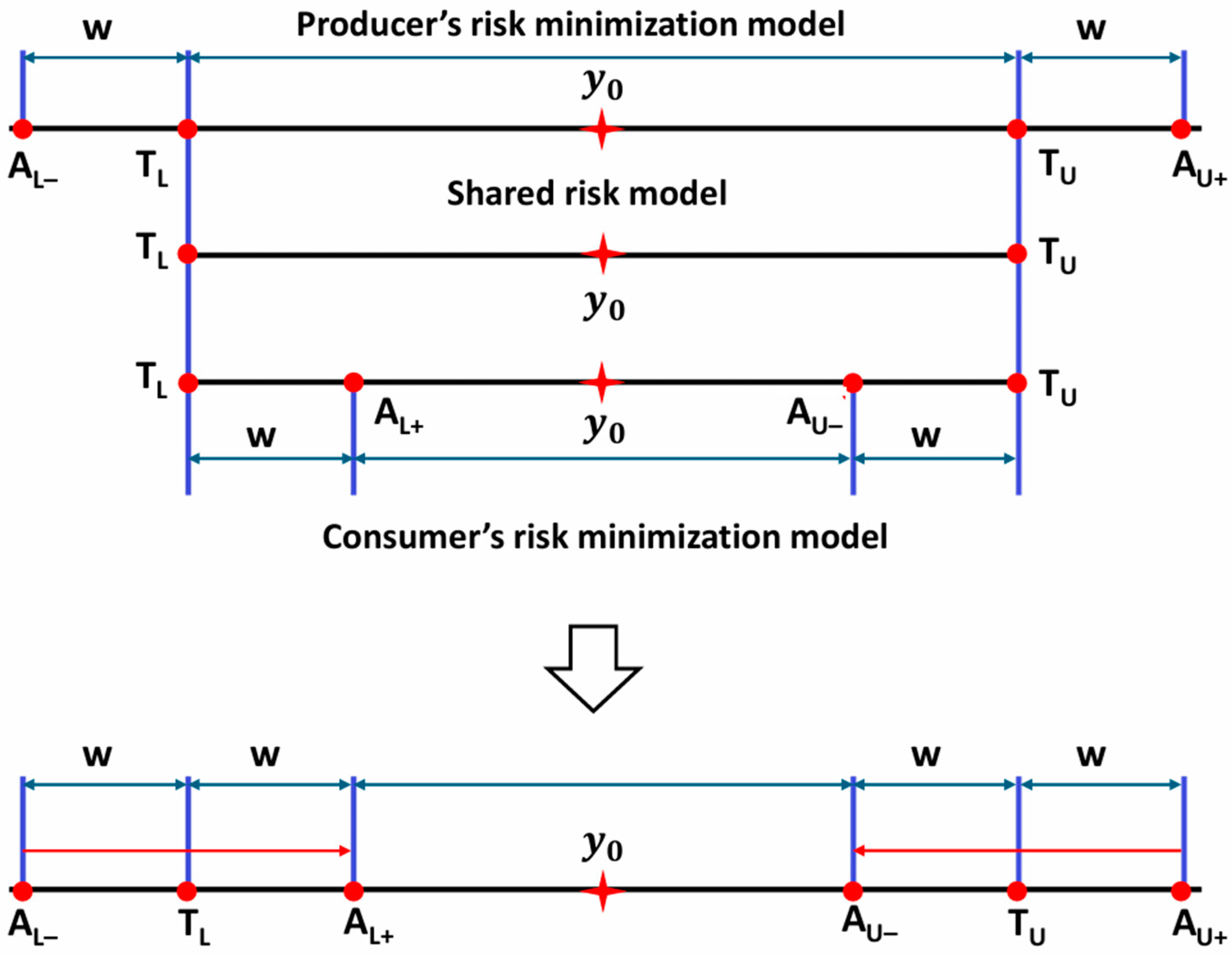
The point-based approach for risk estimation, as delineated in Guide 106:2012, yields a single definitive value for both the global producer’s risk and the global consumer’s risk [18]. This assumes determining the risk for exactly one value of the best estimate y 0 . By discretizing a naturally selected domain and transforming the argument of the prior distribution in Bayes’ theorem, this fundamental point-based method for risk assessment can be two-dimensionally and three-dimensionally extended. Assume the best estimate y 0 is fixed and placed within both the tolerance interval and the acceptance interval. It is not required that the position of the best estimate y 0 be centered within either the tolerance or acceptance intervals [35]. Let A L and A U + denote the lower and upper limits of the acceptance interval of the global producer’s risk minimization model. Additionally, let A L + and A U denote the lower and upper limits of the acceptance interval of the global consumer’s risk minimization model. The following holds: A L + , A U T L , T U A L , A U + (Figure 1).
Figure 1 illustrates an interval representation of the risk assessment domain along the guard band axis. This interpretation enables the construction of risk curves along the interval I w = w ,   w . It holds that w = A L + T L = T L A L = A U + T U = T U A U . The two-dimensional extension of the point-based method for risk assessment given in JCGM 106:2012 is obtained by discretizing the interval w ,   w [33]. Values of global consumer’s and producer’s risk are calculated in each point of subdivision. The limits of the acceptance interval vary with changes in the guard band width w , such that it simultaneously holds that A L   A L + and A U + A U . Throughout this process, the values T L and T U remain fixed. It is shown that the curves of the global producer’s risk along the guard band axis on the interval w ,   w increase, while the curves of the global consumer’s risk at the same time decrease [33,36,37,38].
Point-based risk quantification can be used for the quality assessment of various products, such as food [39], water [40], pharmaceuticals [41], medical treatments [42], natural gas [43], fuels [44], and other industrial goods [45]. Quality assessment can also be performed for multiple characteristics of an item of interest. In the case of multicomponent quality control, the total risk of false decisions is calculated. The total risk rises as additional measured characteristics are observed [46]. In the case of correlated measurement characteristics, there may be either a decrease or an increase in the total risk, depending on the actual test results [47]. A straightforward estimation of total risk is possible using spreadsheets that combine a Bayesian approach with Markov chain Monte Carlo (MCMC) simulations [48]. This requires determining a guard band for each controlled component [49,50].
In addition to the previously discussed extension, the point-based method for risk assessment can be extended two-dimensionally such that the arguments of the prior distribution are functionally related data. This method is applicable in a risk assessment for models where data can be modeled by using linear regression. The method can be applied in risk assessment procedures in scenarios of both linearized and nonlinearized geometries. The linearized geometry assumes that the acceptance and tolerance lines run parallel to the reference line and are equidistant from it. In contrast, in the scenario of the nonlinearized geometry, the acceptance and tolerance curves are placed around the reference line instead of straight lines. These curves are wider at the ends of the moderate scale and narrowest in the middle of the scale [38]. Furthermore, the method can be used in a risk assessment procedure for calibration in both types of geometry [51,52].
Risk assessment in linear regression is carried out naturally, considering the reference line y = x . When the regression line intersects y = x line, the resulting risk curves on the moderated scale take the form of upward-opening parabolas, with their minimum located at the intersection points [38]. If the regression line coincides with or runs parallel to y = x , the risk curves become linear and run parallel to the moderated scale axis [53]. Calibration risk assessment models are derived from these regression-based risk frameworks [51]. The only difference is that the application of the risk assessment method in calibration requires the definition of tolerance and acceptance intervals for the explanatory variable, which corresponds to the given values of the response variable [51,52]. Within the domain enclosed by the interval on the guard band axis and the interval on the moderate scale, surfaces representing the global producer’s and global consumer’s risk can be observed for both regression and calibration settings [38,51,52].
This study takes a step further by advancing the risk assessment method through the introduction of a three-dimensional extension of the point-based approach. The proposed method enables spatial risk assessment and is suitable for application in the case of multiple linear regression, resulting in the construction of a 3D risk space. The extension is demonstrated through a practical example involving the risk assessment for the plane determined during the estimation of flatness error on a coordinate measuring machine (CMM) worktable. This control is essential because deviations in the flatness of the CMM worktable from manufacturer-specified limits can significantly affect measurement results in procedures such as calibration of standards, measuring equipment, and other metrological tasks [54]. The equation of the plane passing through the sampled points was determined using the minimum zone (MZ) method. Several variants of the MZ method are prevalent in practice [55]. In this study, the One Point Plane Bundle Method (OPPBM) was used, which identifies an optimal plane through the sampled points, minimizing the distance between points with the most extreme measured values [56]. This method is recommended by ISO 1101:2017 for verifying form errors within a specified zone [57]. The risk space is defined by the coordinates of sampled points on the CMM worktable used for flatness assessment. Its third axis represents the global producer’s and consumer’s risk values at these points.
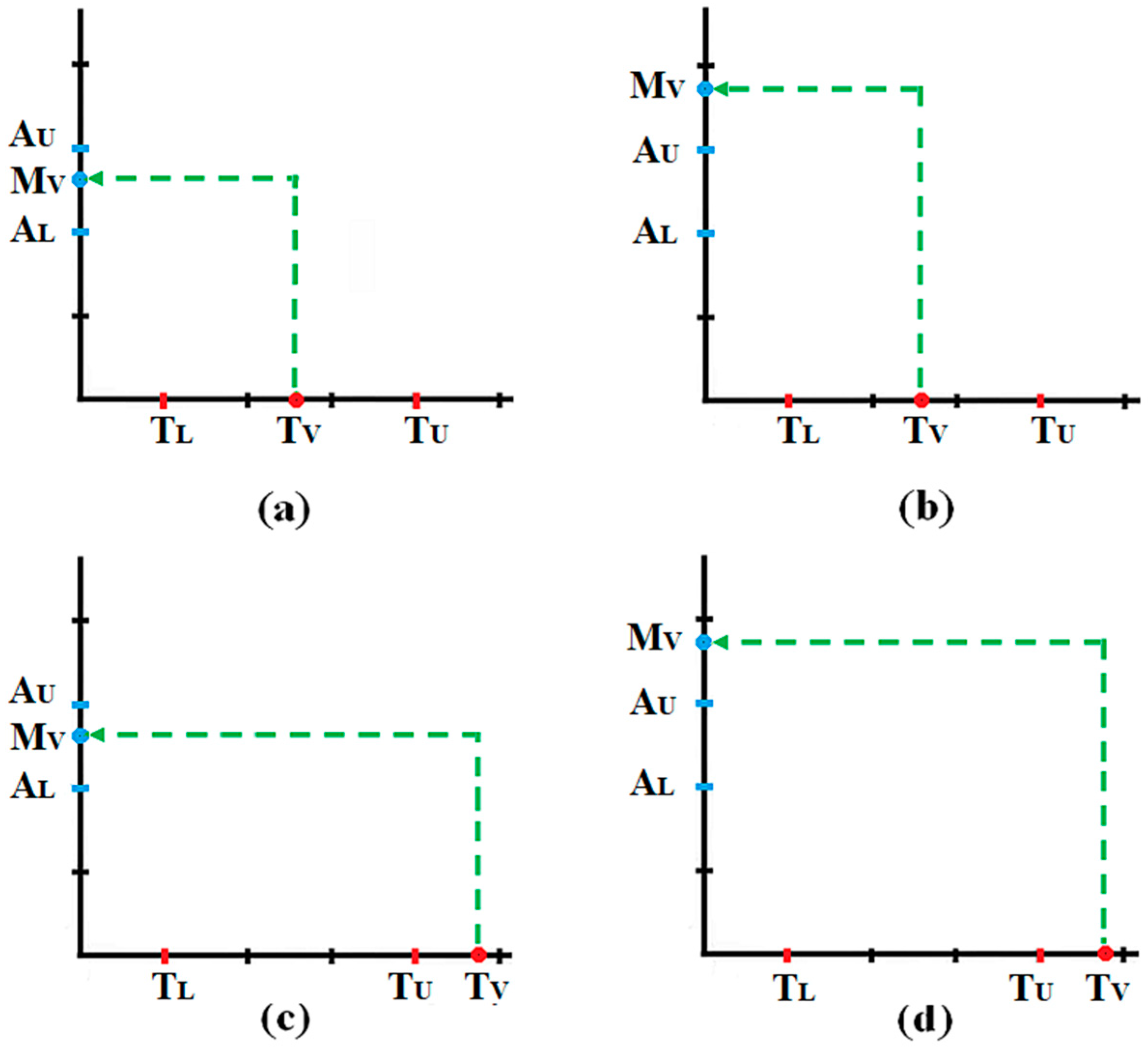
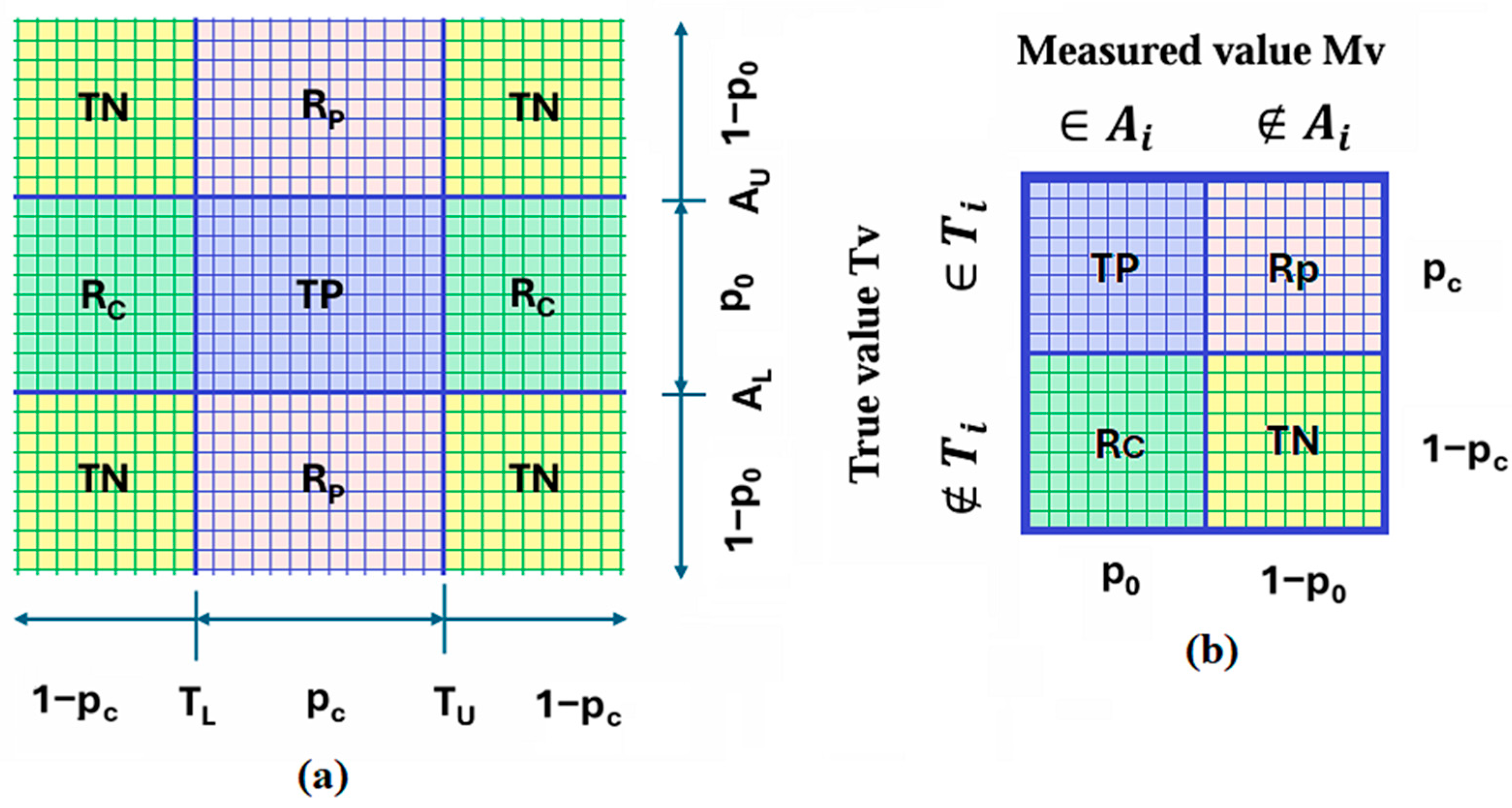
The spatial risk assessment model was evaluated using confusion matrix-based metrics. Four possible outcomes occur in the conformity assessment of a product with the required specifications, as shown in Figure 2.
The true value, TV, of a characteristic property of an item of interest may fall within the tolerance interval T I , while the measured value, MV, may fall within the acceptance interval A I . This corresponds to the valid acceptance of measurements, i.e., the probability of true positives ( T P ) in the conformity assessment process. In a probabilistic way, a true positive value is equal to T P = P Y m = η m A I , Y = η T I . If the measured value MV falls outside the acceptance interval, assuming that the true value TV is outside the tolerance interval, a valid rejection of the measurement occurs, resulting in a true negative probability ( T N ), i.e., T N = P Y m = η m A I , Y = η T I . If the measured value MV of a property of an item of interest is within the acceptance interval, but the true value TV of that property is assumed to fall outside the tolerance interval, this results in a global consumer’s risk ( R C ) or false acceptance probability (FA). Therefore, R C = P Y m = η m A I , Y = η T I . Conversely, a scenario in which measured value MV lies outside the acceptance interval while the true value TV is within the tolerance interval represents the global producer’s risk ( R P ) or the probability of false rejection (FR), i.e., R P = P Y m = η m A I , Y = η T I [33,37]. In all the above cases, T I R and A I R is valid.

2. Materials and Methods

2.1. Measurement Description

The granite surface of a CMM worktable can be mechanically damaged during exploitation. This can significantly affect the accuracy of measurements taken with the given device [54,58,59]. The risk of measurements on the CMM worktable associated with the flatness of its granite surface was assessed in this study. Measurements were conducted at the Department of Production, Faculty of Technical Sciences, University of Novi Sad, by using a CMM device whose worktable surface is the object of interest. A Carl Zeiss Contura G2 CMM equipped with an RDS rotating head and a VAST XXT passive measuring sensor was used. With this CMM, measurements can be performed in the range of 1000 mm × 1200 mm × 600 mm. According to the manufacturer’s specifications, the maximum permissible error is M P E E = 1.9 + L / 330 µm, where value L is given in mm. Measurement was performed with a silicon nitride (SiN) probe with a single tip, 5 mm in diameter and 75 mm in body length [54]. Sample collection was carried out at n = 40 measurement sites, with point-by-point measurements. Three measurements were performed at each of the sample points. The coordinates of the sampled points x i , y i ,   i = 1 , ,   n on the granite table of the CMM, along with the mean values from the three measurements of the surface flatness in the z-direction, are given in [54]. The coordinate values of the sampled points and the surface flatness values are given in millimeters.

2.2. Best Estimate and Measurement Uncertainty

The equation of plane α describing the granite table of the CMM was determined using the measurement given in [54]. The software solution for determining the plane using the MZ method was developed at the Faculty of Technical Sciences in Novi Sad [56]. The plane equation is of the form z = β 0 + β 1 x + β 2 y , and is given by the following equation:
z = 506.29043 + 1.71 · 10 6 x + 1.715 · 10 6 y .
Within this study, this plane is denoted as α . The parameters β 0 ,   β 1 , and β 2 in Equation (1) are given in millimeters. One of the input parameters of the model for estimating the global producer’s risk R P and the global consumer’s risk R C is the best estimate y 0 of an item of interest. In this case, the best estimate is represented as an n-tuple y 0 = z x 1 , y 1 ,   z x 2 , y 2 ,   ,   z x n , y n ,   n = 40 whose components are obtained by substituting the coordinates of the sampled points x i , y i ,   i = 1 , ,   n into Equation (1). For simplicity, the notations z i = z x i , y i ,   i = 1 , , n for the components of the best estimate y 0 were introduced. The global producer’s risk and global consumer’s risk are computed for each value z i ,   i = 1 , 2 , , n . For the calculation, the point-based method for risk assessment is still used, but the functional relationship of the data given by Equation (1) is considered. The measurement uncertainty u 0 associated with the best estimates z i ,   i = 1,2 , , n is identical for all sampled points x i , y i ,   i = 1 , ,   n and equals u 0 = 1.9   μ m . This measurement uncertainty u 0 is determined according to research [60,61].
Each observed point x i , y i ,   i = 1 , ,   n , near regression plane α is assumed to be a single realization drawn from a normal distribution centered on the plane’s predicted value at that location. Thus, the prior has the form g 0 i η = φ η ; z i , u 0 2 ,   i = 1,2 , , n .
The measurement uncertainty u m required for specifying the likelihood function is determined in the future measurement process, independently of the procedure used to derive the plane in Equation (1). The likelihood function of a measured value η m , given η , is also modeled as a normal distribution and has the form h η m | η = φ η m ;   η ,   u m 2 [18]. It is presumed that the measurement uncertainty u m of a future measurement process controlling the quality of the CMM granite worktable, after exposure to exploitation, will be u m = u 0 / 2 . In addition to the stated values, the study also provides a comparison of risks for the scenarios where u m = u 0 and u m = 2 u 0 .

2.3. Selection of the Reference Plane

An assessment of the global producer’s and consumer’s risk for a linear regression model is conducted in relation to the y = x line [38]. This line naturally imposes itself as a reference line for risk assessment in linear regression models because it represents an ideal measurement. This study presupposes that the data are functionally connected through a multiple linear regression model and represented by Equation (1). In this context, no inherent reference plane exists to serve as a benchmark for evaluating risk, and therefore such a plane must be defined. Since the risk assessment concerns the flatness of a surface, the reference plane is assumed to be parallel to the xy-plane. The reference plane is denoted as β and defined as follows:
z r = z m i n + z m a x 2 = 506.29085   m m ,
where is z m i n = 506.2926 mm, z m a x = 506.2891 mm, and z r is the value of a reference plane. The choice of plane β in Equation (2) is based on the process of determining the equation of plane α using the MZ method. The reference plane β passes through the center point of the parallelogram formed by the maximum and minimum values of the measured surface flatness reported by the CMM [56].

2.4. Tolerance Plane and Acceptance Plane

In spatial risk assessment, the roles of tolerance and acceptance intervals are taken over by tolerance and acceptance planes. The tolerance space is bounded by the lower tolerance plane τ L and the upper tolerance plane τ U . These two planes are parallel to the plane β as well as to one another. Since it is a class 0 granite surface plate, the width of the tolerance space is equal to T = 7.5 μm [62]. For each value z i ,   i = 1,2 , , n , the upper tolerance plane τ U has the equation T U = 506.2871 mm, and the lower tolerance plane τ L has the equation T L = 506.2946 mm. The width of the acceptance space in the model aimed at minimizing the global producer’s risk is A = 1.2 T . In the model aimed at minimizing the global consumer’s risk, the width is A = 0.8 T . The discretization of the domain I w = w ,   w along the guard band axis is carried out by introducing the multiplicative factor r k 1,1 of the form r k = 1 + 0.1 k 1 ,   k = 1,2 , , m . Interval subdivision is thus carried out with a step of 0.1, leading to m = 21 subdivision nodes. A finer step would increase the number of nodes. However, it is shown that a subdivision step of 0.1 is sufficient for determining the global producer’s and consumer’s risk, and the obtained risk surfaces are sufficiently smooth. The subdivision nodes of the interval I w are of the following form:
w k = r k w U 2 , k = 1,2 , , m ,
where w U = 0.2 T = 1.5 µm is the total width of the guard band. The acceptance planes for fixed values of T U and T L are calculated from the following equations:
A U i , k = T U i w k ,   i = 1,2 , , n ,   k = 1,2 , ,   m ,
A L i , k = T L i + w k ,   i = 1,2 , , n ,   k = 1,2 , ,   m .
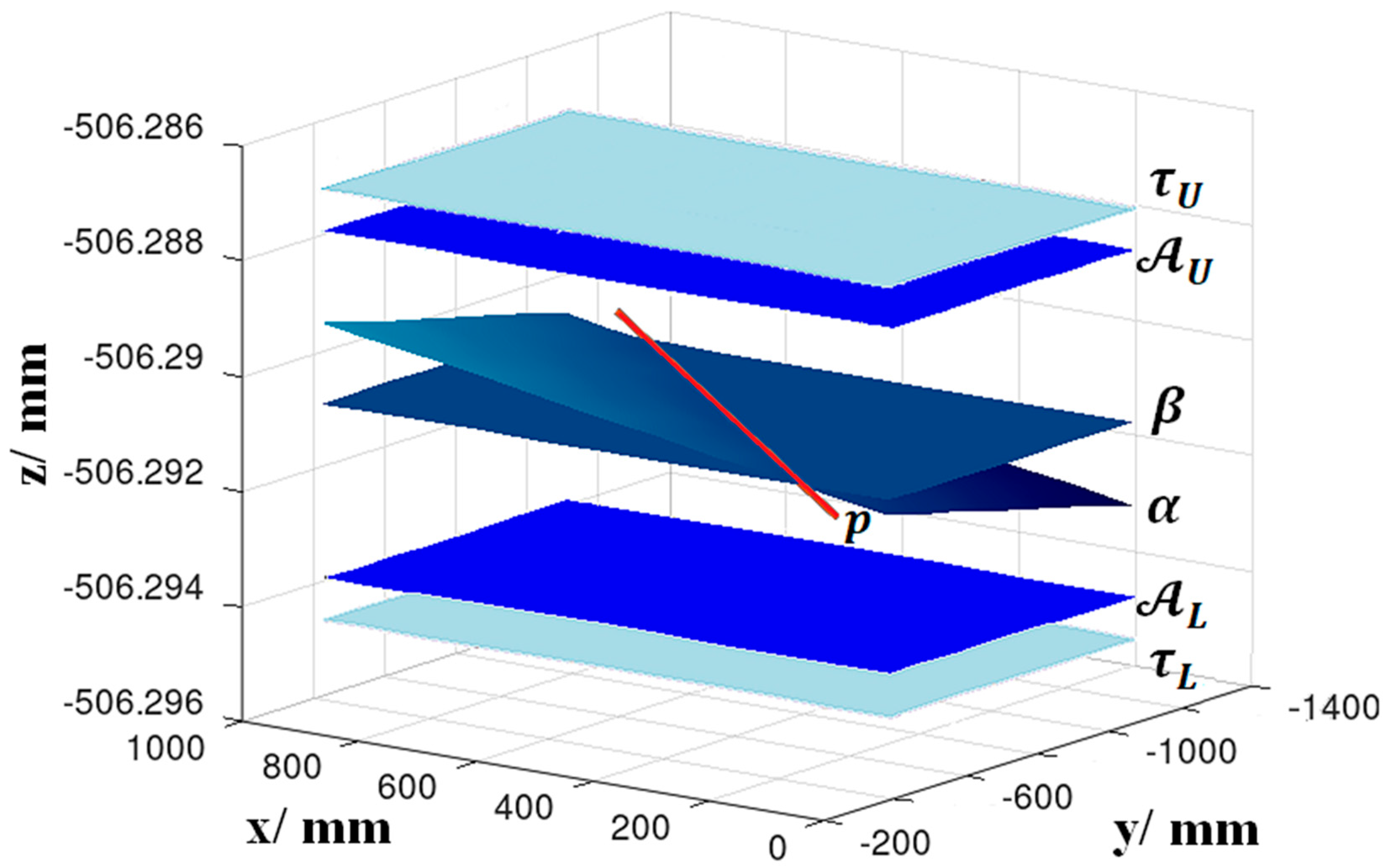
The index i in Equations (4) and (5) for the values of the lower and upper limits of the acceptance interval indicates that the interval refers to the points z i ,   i = 1,2 , , n , and it holds that T L i = T L and T U i = T U for each i = 1,2 , . . , n . For k = 1 , it follows that r 1 = 1 , i.e., A L i , 1 = A L and A U i , 1 = A U + . These are the conditions of the model of minimization of the global producer’s risk. For k = 11 , it is true that r 11 = 0 , i.e., A L i , 11 = T L and A U i , 11 = T U . This therefore represents a shared risk model. For k = 21 , it holds that r 21 = 1 , corresponding to the model of minimization of global consumer’s risk, with A L i , 21 = A L + and A U i , 21 = A U . To maintain simplicity, only the value of the multiplicative factor r will be provided in the subsequent text without referring to the index k . Plane α and the reference plane β , together with the tolerance planes τ L and τ U and the lower and upper acceptance planes A L and A U , are shown in Figure 3. Planes A L and A U depicted in Figure 3 have the following equations: A L i , 21 = 506.29385 mm and A U i , 21 = 506.28785 mm, i = 1,2 , . . , n , respectively.
Figure 3 illustrates the model of minimizing global consumer risk with linearized geometry. A model of minimization of global producer’s risk can be presented analogously. The line denoted as p , highlighted in red, represents the intersection of planes α and β . The equation of line p given in implicit form is
0.9970845 x + y + 244.898 = 0 .    
Points along line p are the only points on plane α that lie exactly midway between the tolerance field and the acceptance field. It should be noted that, on the domain defined by the plane containing the sampled points x i , y i ,   i = 1 , ,   n , plane α does not intersect the tolerance or the acceptance planes. This indicates that the model will not exhibit anomalies that may arise when such a mutual relationship between the tolerance and acceptance planes and the regression plane is present [38].

2.5. Risk Calculation

Considering the previously defined model parameters and assuming normal distributions for both the prior and likelihood functions, the global consumer’s risk R C in the multivariate linear regression case, at each measurement point x i , y i ,   i = 1 , ,   n , for each associated best estimate value z i ,   i = 1,2 , , n , can be calculated from the following equation [18,38]:
R C i , k = T L i z i u 0 φ 0 t F i , k t d t + T U i z i u 0 φ 0 t F i , k t d t ,   i = 1,2 , ,   n ,   k = 1,2 , , m .
The global producer’s risk R P can be calculated from the following equation [18,38]:
R P i , k = T L i z i u 0 T U i z i u 0 φ 0 t 1 F i , k t d t ,   i = 1,2 , , n ,   k = 1,2 , , m .
In Equations (7) and (8), φ 0 denotes the standard normal probability density function. The expression F i , k t is given by the following equation [18,38]:
F i , k t = ϕ A U i , k z i u 0 t u m ϕ A L i , k z i u 0 t u m ,   i = 1,2 , , n ,   k = 1,2 , , m ,
where symbol ϕ denotes the cumulative distribution function (CDF) of the standard normal distribution. Equation (9) and the integrals in Equations (7) and (8) were obtained by transforming the argument of the prior in the point-based risk assessment method and by discretizing the constructed domain [18]. In transforming the prior argument, the functional connection of the data, given by Equation (1), is considered. Since the function from Equation (1) is continuous at the points x i , y i ,   i = 1 , ,   n and ϕ is continuous in the arguments from Equation (9), the data obtained from Equations (7) and (8) must also be functionally connected by a continuous function. The integrals in Equations (7) and (8) do not have closed-form solutions. Consequently, these integrals require numerical evaluation, which may present challenges and limitations in the practical implementation of the method. The numerical solution of the integrals from Equations (7) and (9) was performed using a package from the R programming language, version 4.2.0 [63,64]. The graphs were created using either R or Octave software, version 8.4.0 [65].

2.6. Point-Based Method Extension

Equations (3)–(5) and (7)–(9) constitute the fundamental formulation of the point-based risk assessment method, as well as its two-dimensional and three-dimensional extensions. It should be noted that Equation (8) is valid only when both the prior and the likelihood follow normal distributions. For other distributions, a similar expression can be obtained. If n = 1 and the index k takes on the single value k = 21 , these equations are used to calculate the global risk for producers and consumers within a point-based method. Then r = 1 , and the model represents a minimization of the global producer’s risk outlined in Guide 106:2012 [18]. The best estimate y 0 is a single value with one associated tolerance interval that contains an acceptance interval (Figure 1). The result is exactly one value of the global producer’s risk and one value of the global consumer’s risk. If n = 1 and k = 1 , then r = 1 , and the model is designed to minimize the global producer’s risk [23]. The same applies to the shared risk model when r = 0 . Then n = 1 , and the index k takes on exactly one value k = 11 .
If, in Equations (3)–(5) and (7)–(9), n = 1 and k = 1,2 , , m , a two-dimensional extension of the point-based method is obtained. The subdivision step of the interval 1,1 must be such that r 1 = 1 and r m = 1 . The global producer’s and consumer’s risks are then calculated for exactly one value of the best estimate y 0 . The limits of the tolerance interval associated with the best estimate are fixed, but with a change in value of the index k , the limits of the acceptance interval change so that it simultaneously holds A L   A L + and A U + A U (Figure 1). The risks are evaluated at each subdivision point of the interval w , w . As a result, risk curves are obtained that can be displayed on the I w domain along the guard band axis [33,37,38]. A two-dimensional extension of the point-based method can also be obtained for data related to the function f . It is assumed that i = 1,2 , , n ,   n > 1 , and that the best estimate is n-tuple y 0 = f 1 , f 2 , ,   f i , , f n , where f i = f x i , 1 , x i , 2 , , x i , d ,   i = 1,2 , , n . The symbol d denotes the number of input variables on which the function f depends. The global producer’s and global consumer’s risk are calculated for exactly one, arbitrarily selected value of the index k , and at each point x i , 1 , x i , 2 , , x i , d ,   i = 1,2 , , n along the measurement scale. This yields upward-opening parabolas along the measurement axis [38].
A three-dimensional extension of the point-based method is obtained by applying Equations (3)–(5) and (7)–(9) under the assumptions that the indices take the values i = 1,2 , , n ,   k = 1,2 , , m , n > 1 ,   m > 1 , and that the measurement data are functionally related. The functional relationship of the data in this study is given by Equation (1). The global producer’s and consumer’s risks are calculated for each sampled point x i , y i ,   i = 1 , ,   n . The limits of the tolerance interval remain fixed, whereas the limits of the acceptance interval vary with the index k (Figure 1).

3. Results and Discussion

3.1. Risk Curves

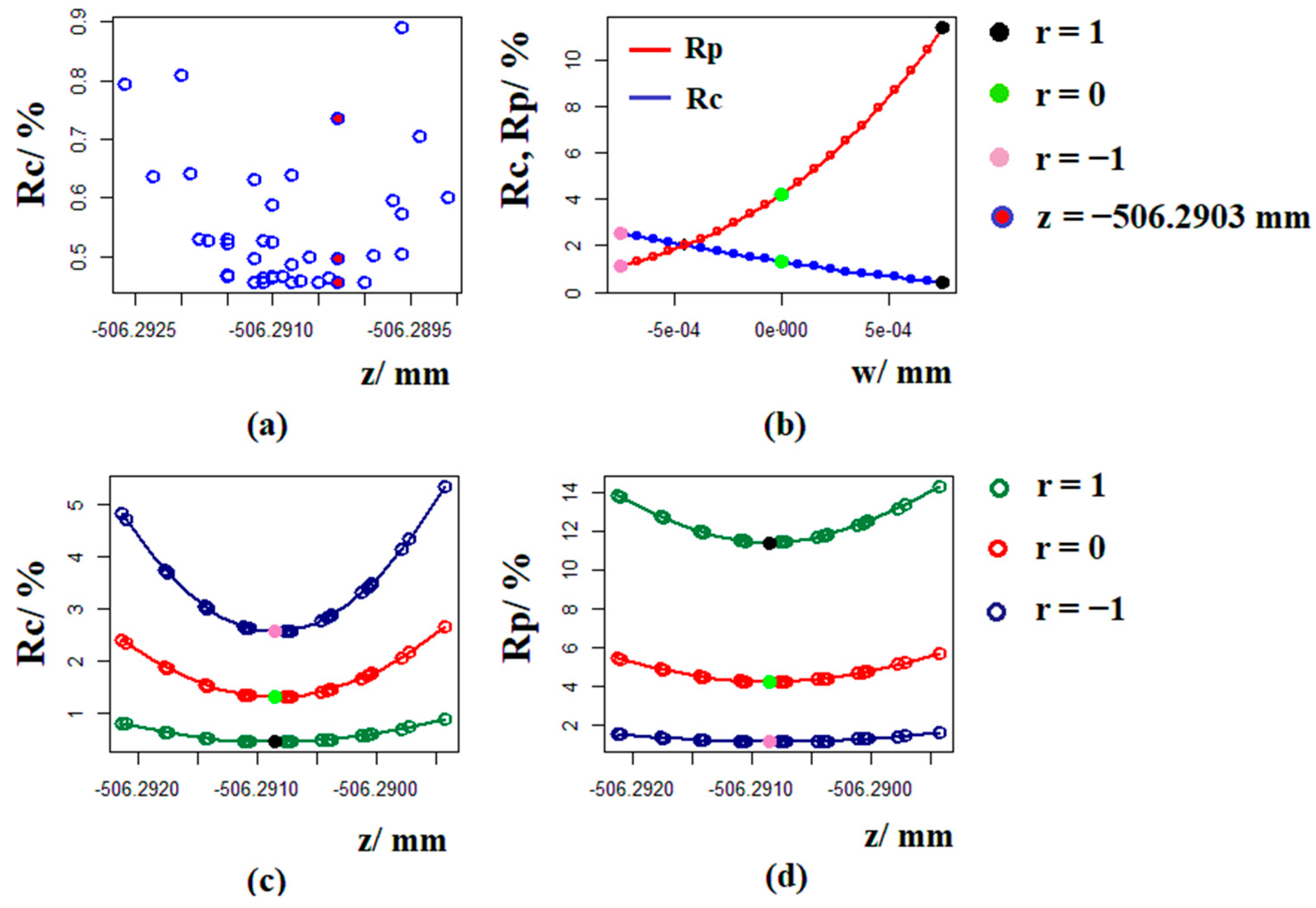
Although the measured flatness values at points x i , y i ,   i = 1 , ,   n may be identical, the resulting risks do not necessarily coincide (Figure 4a).
The values of global consumer’s risk shown in Figure 4a correspond to the measured surface flatness values for r = 1 listed in [54], but before smoothing the data with the regression plane α . A flatness value of z = 506.2903 mm was obtained at three different locations on the CMM worktable, yet the associated risks, highlighted in red, differ. When the risks are presented considering the functional relationship of the data described by the equation of plane α , it becomes evident that it is highly dependent on the positioning of the sample points x i , y i ,   i = 1 , ,   n . This dependence is expressed relative to the line p from Equation (6) and to the plane β containing line p .
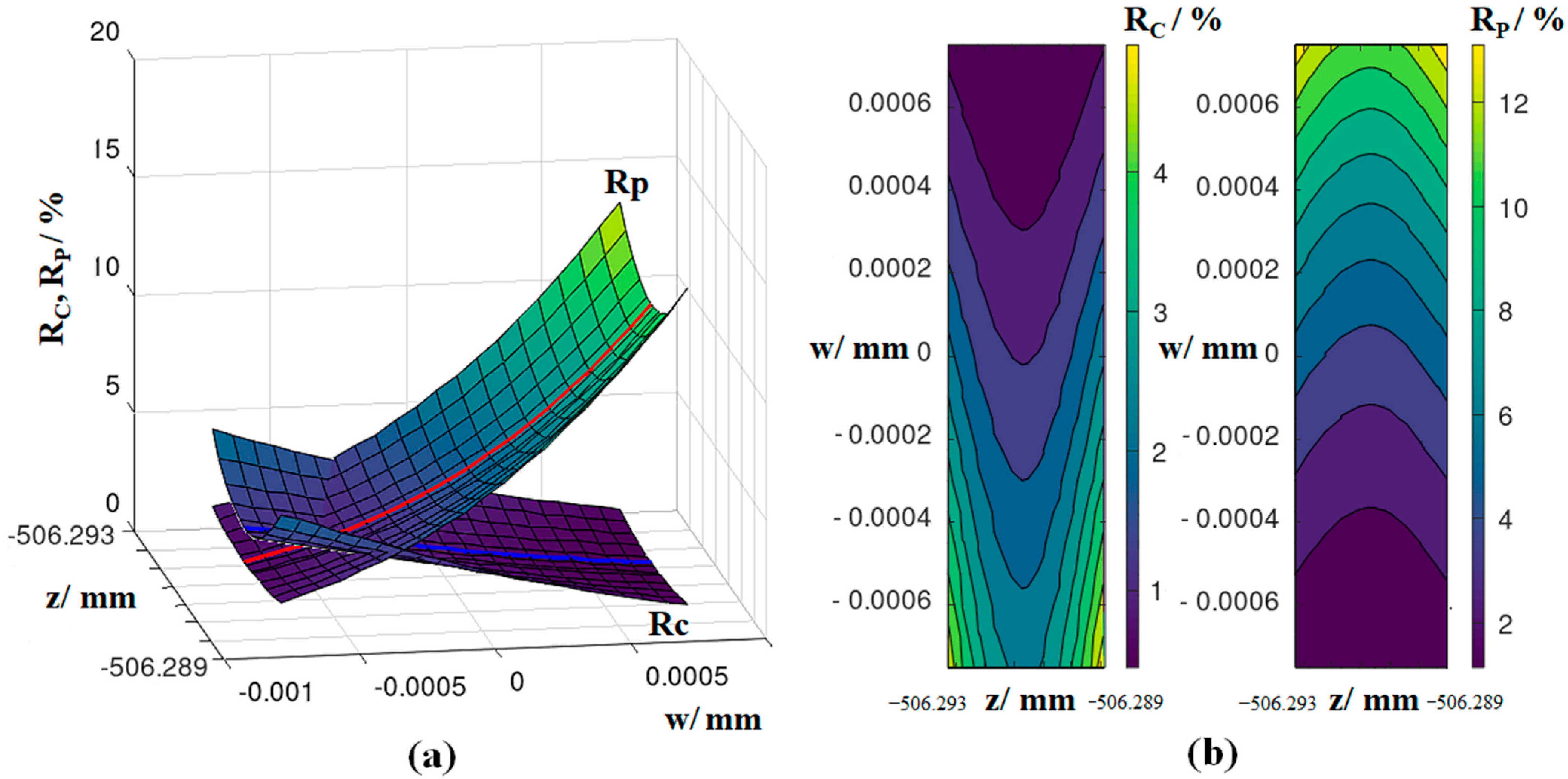
The curve that represents the global producer’s risk increases along the guard band axis, while the curve of the global consumer’s risk decreases along the guard band axis (Figure 4b). These curves are the result of a two-dimensional extension of the point-based method in the case where the global risk of producers and consumers is calculated at each point of the subdivision of the interval w , w , and the best estimate takes exactly one value y 0 = β . For that value, the risks are the lowest, so the curves in Figure 4b are referred to as curves of minimum. They intersect each other at w s = 0.44   µm, where the risks are equal, R C = R P 2.03 % . On these curves, the points corresponding to the risk values when r = 1 , r = 0 , and r = 1 are particularly highlighted. The highlighted points have the same value as the points of minimum of the parabolas shown in Figure 4c,d. Figure 4c,d illustrate the curves of global consumer’s and producer’s risk along the z-directions, calculated at the points x i , y i ,   i = 1 , ,   n . These curves are upward-opening parabolas which have a minimum at a point that matches the value of the reference plane β from Equation (2). They are the result of a two-dimensional extension of the point-based method in the case where the data are related by Equation (1), provided that the selected index values are i = 1 , ,   n and k 1,11,21 . Points that are equidistant from the axis of symmetry of the parabola, i.e., from the value specified in Equation (2), have equal risks.
If it is worth r 1 , 0 , the guard band width w is negative, corresponding to the conditions of a model that minimizes the global producer’s risk. The values r = 0 and w = 0 indicate that it is a shared risk model. For r 0 , 1 , it holds that w > 0 . This represents the conditions for the model of minimization of global consumer’s risk.

3.2. Risk Surfaces

The risk surfaces displayed in Figure 5a are the outcome of the three-dimensional extension of the standard, point-based method for risk assessment.
The risk surfaces presented in Figure 5a are displayed over the domain defined by the interval I w = 0.75 ,   0.75 µm on the guard band axis, and the range of measured values for surface flatness I z = 506.292 ,   506.289 mm. The maximum values of both the global producer’s and global consumer’s risk occur at the boundaries of interval I z . Along the guard band axis, the maximum of the global producer’s risk occurs at w = 0.75 µm, while the global consumer’s risk simultaneously reaches its minimum (Figure 5b). The risk surfaces in Figure 5a include the curves of minimum depicted in Figure 4b. The results of the spatial risk assessment method that have been examined thus far are consistent with the results of previous research [37,38,45]. In Figure 4b, among others, the points for which r = 1 are particularly highlighted. The global producer’s risk along the guard band axis is then the highest and amounts to R P 1 = 11.40 % . Concurrently, the global consumer’s risk along the guard band axis is at its minimum, with a value of R C 1 = 0.45 % .
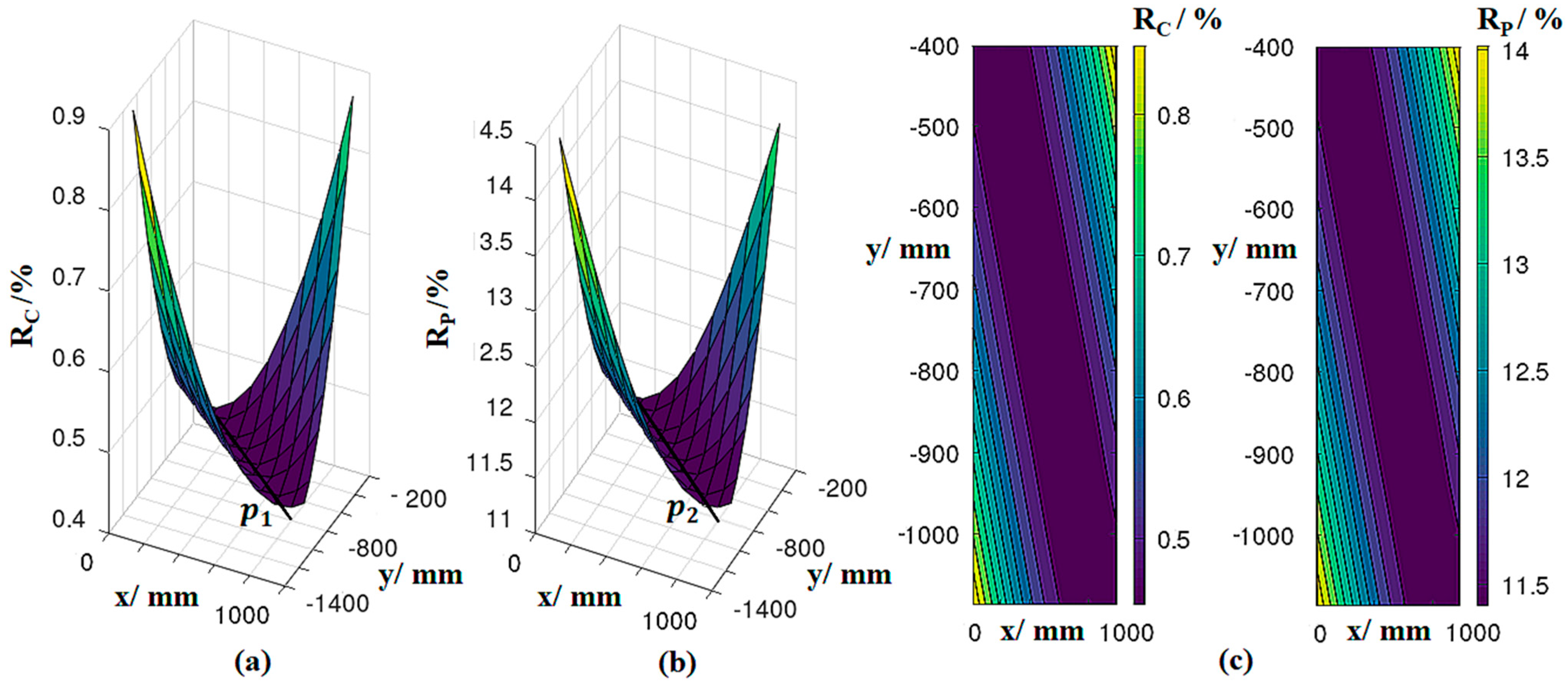
Figure 6a,b illustrate the risk surfaces for r = 1 . In contrast to the risk surfaces shown in Figure 5a, these surfaces are displayed over the I x × I y domain. The interval I x = 11.7003 ,   984.7228 mm lies along the x-axis, while the interval in the range of I y = 1086.1684 , 395.6763   mm lies along the y-axis. Lines p 1 and p 2 highlighted in Figure 6a,b pass through the points x , y , R C 1 and x , y , R p 1 , respectively, where the corresponding value of y for a given x I x is obtained from Equation (6). The orthogonal projections of lines p 1 and p 2 onto the xy-plane have the same direction and position as the projection of line p onto the xy-plane. This orthogonal projection of line p onto the xy-plane is hereinafter denoted by p .
The risk of flatness deviation of the CMM worktable surface from the specified standards is smallest in the direction of line p , as illustrated in Figure 6c. On the I x × I y domain, the largest risks occur at point A 984.6031 , 395.6776 , where the risk values are R C 0.89 % and R p 14.30 % .
The risk surfaces displayed in Figure 5a and Figure 6a,b have different domains. The representation of the risk surface on the domain I w × I z enables the identification of curves of minimum along the guard band axis and the assessment of the surface flatness value that yields the lowest risks. The representation of the risk surfaces on the I x × I y domain has a practical application. It illustrates how to position the measurement object on the workbench surface so that the flatness of the surface and potential mechanical damage to the CMM device’s workbench surface have the least impact on the measurement results.

3.3. Risk Spaces

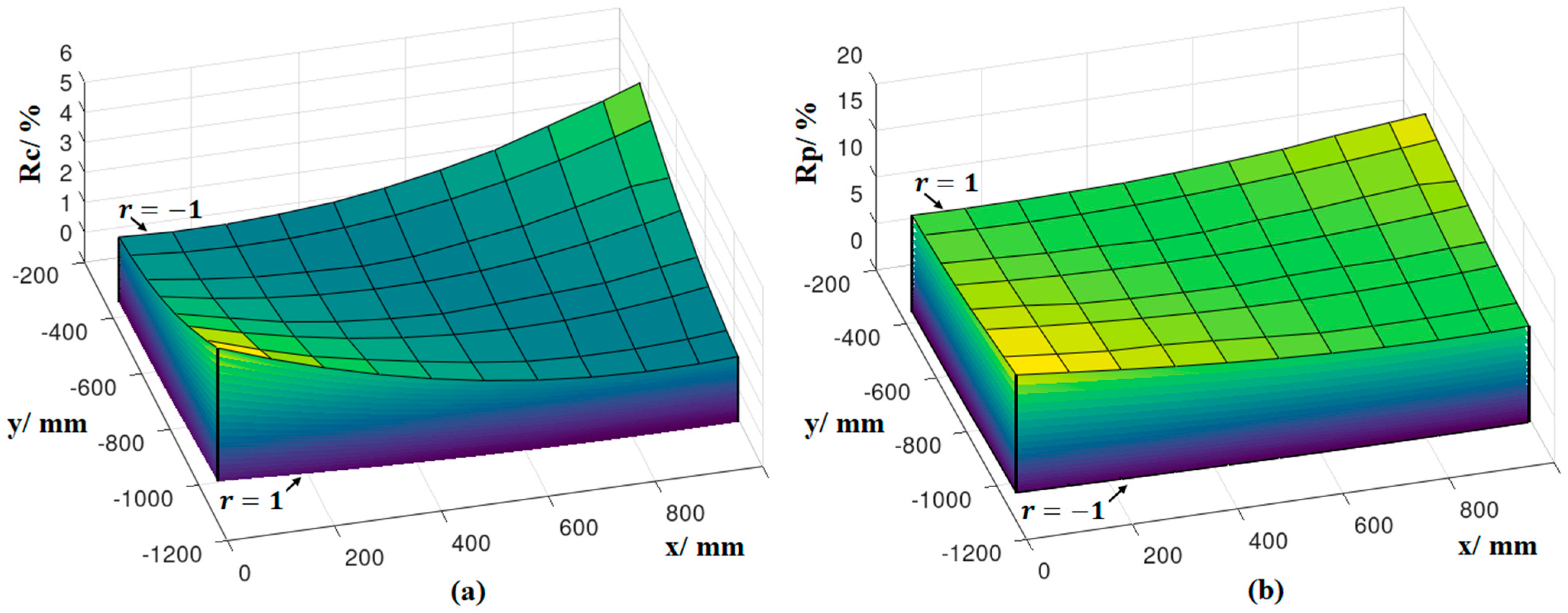
Risk surfaces on the domain I x × I y can be obtained for each r k , k = 1,2 , ,   m . The global producer’s risk space and the global consumer’s risk space are formed by stacking these layers on top of one another, as shown in Figure 7a,b.
The stacking of the global consumer’s risk layers concerning the multiplicative factor r is descending, for r l < r s , l , s 1,2 , , m ,   l s ,   l < s holds R C l > R C s . The construction of the global producer’s risk space is ascending. For r l < r s , l , s 1,2 , , m ,   l s ,   l < s holds R P l < R P s . The minimum of each layer lies along the direction of line p . The global consumer’s risk space reaches its maximum at point A for r = 1 , and it has a value of R C = 5.35 % . As the behaviors of global producer’s and consumer’s risks are reversed, the maximum of the space of global risk of producers is reached at the same point, but for r = 1 and amounts, as already stated, R p = 14.30 % . It is important to note that the spatial risk assessment method enables risk estimation for any guard band width and at locations where surface flatness measurements were not performed.
In this multivariate linear regression model, the output variable z depends on two input variables, x and y . In a model where the number of predictors is equal to d , the response variable has the form z x 1 , x 2 , , x d = β 0 + β 1 x 1 + β 2 x 2 + + β d x d . In this case, the best estimate is represented as an n-tuple y 0 = z 1 , z 2 , ,   z i , , z n , where z i = z x i , 1 , x i , 2 , , x i , d ,   i = 1,2 , , n . To calculate the global risk of producers and consumers in a model with d predictors, it is sufficient to insert the values of z i ,   i = 1,2 , , n into Equations (7)–(9). A multivariate linear regression model with two predictors, x and y , and one response variable, z , is visually represented as a flat plane in 3D. Here, it is plane α shown in Figure 3. A model with d predictors fits a hyperplane in d + 1 dimensional space, including the response variable. In higher dimensions, when the number of predictors is d > 2 , visualization can be carried out by selecting three variables and projecting a hyperplane orthogonally onto a chosen subspace.

3.4. Dependence of the Results on the Choice of the Reference Plane

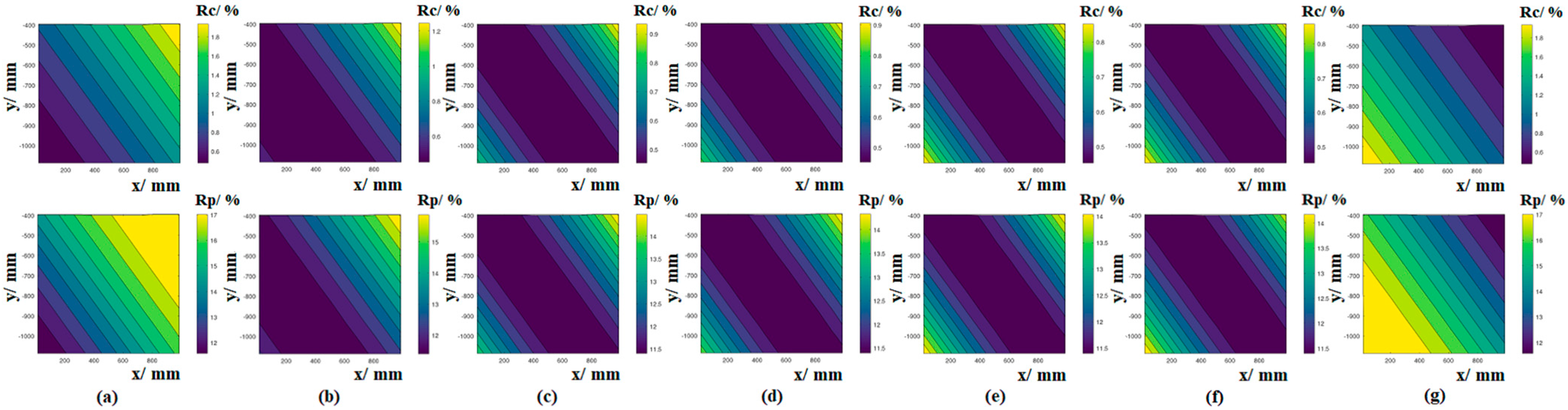
This study presents the spatial risk assessment method for the first time. Therefore, there is currently no established professional consensus regarding the selection of the reference plane β . The choice of reference plane in this context is specific, as it is derived from the MZ method. The reference plane was determined based on the extreme values obtained from the surface flatness sample. In some applications, such extreme values would be discarded as outliers and excluded. Thus, when selecting a reference plane for multiple linear regression models, it is advisable to use the sample mean or another relevant statistic, depending on the specific practical problem being addressed. In the present case, there is no significant difference between the sample mean z ¯ = 506.290835 mm and the value taken by plane β . Consequently, the corresponding differences in risks are minimal, as shown in Figure 8e,f. When this disparity is substantial, there are also discernible differences between the estimated values for the global producer’s and consumer’s risk.
Figure 8 illustrates the variations in values of global consumer’s and producer’s risk for r = 1 and for different choices of reference planes. The values of the reference planes are selected to match the characteristic points of the surface flatness sample. As the reference plane values vary from minimum to maximum, the region indicating the highest global consumer’s or producer’s risk transitions from point A on the workbench surface toward the lower-left corner, (Figure 8a,g). It is essential to highlight the central symmetry between the graphs corresponding to the minimum and maximum values of the reference planes (Figure 8a,g). The least-risk direction and position correspond to the case shown in Figure 8e, where the reference plane is derived from the MZ method. This direction and position also correspond to the direction and position of line p . Considering a line that would be the intersection of plane α and any chosen reference plane, its projection onto the xy-plane would be parallel to line p .

3.5. Dependence of Results on Measurement Uncertainty u m

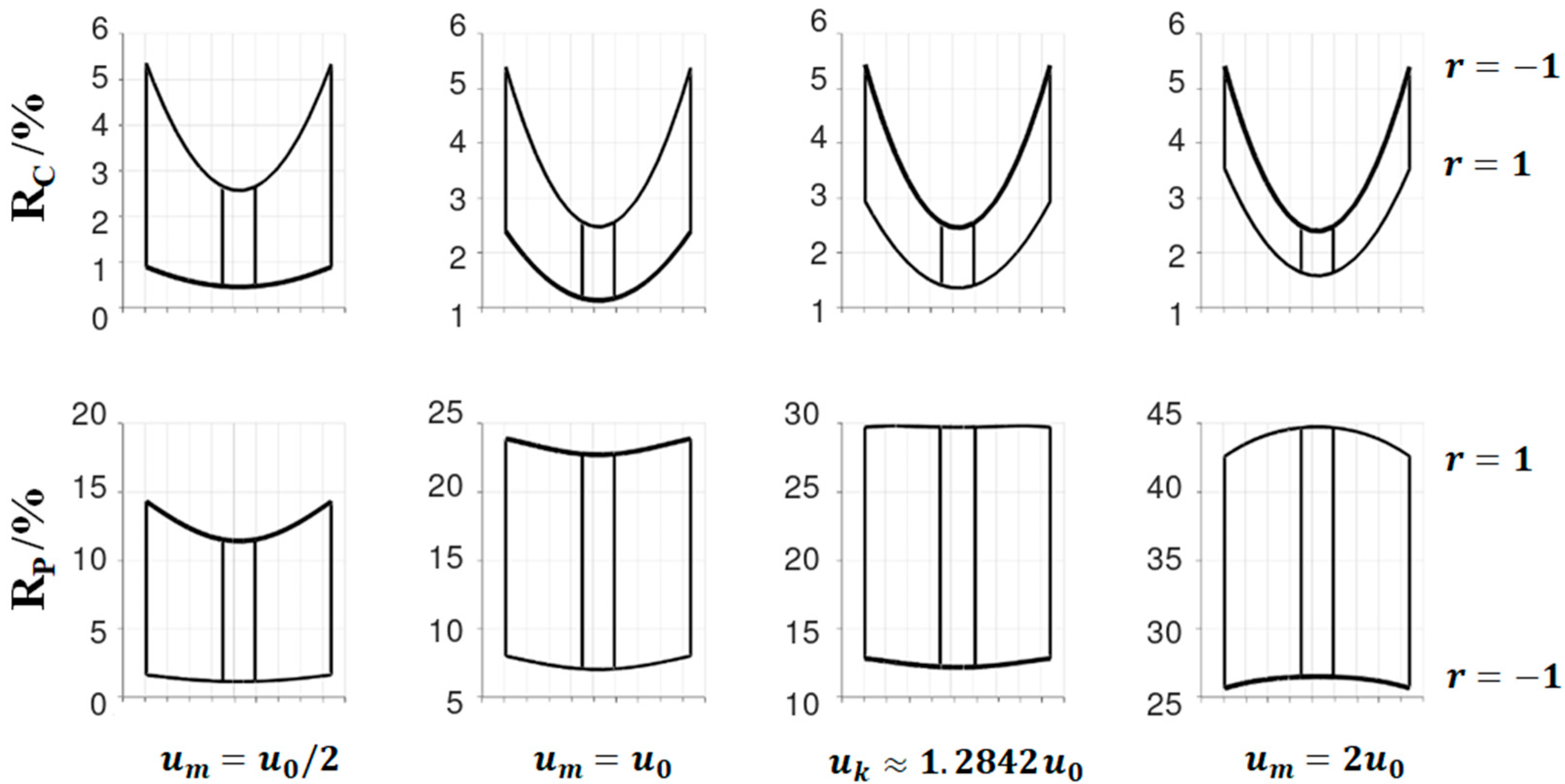
Risk calculation requires information about the prior distribution and the measurement uncertainty u m associated with a future measurement process. The spatial risk assessment method allows for the prediction of the risk value for the desired measurement uncertainty u m , even without performing a measurement. All results so far are calculated for u m = u 0 / 2 . Figure 9 shows a comparison of the risk space from Figure 7 with the spaces obtained for u m = u 0 and u m = 2 u 0 . To facilitate comparison, the risk space is projected onto a plane to which line p is perpendicular. The observed lattice of space is limited by the layers obtained for r = 1 and r = 1 . The vertical lines in the graphs correspond to the lines connecting the layer vertices.
The space of global consumer’s risk contracts as measurement uncertainty u m increases. The values of the global consumer’s risk for the layer of space where r = 1 increase. Simultaneously, the values of global consumer’s risk for the risk layer where r = 1 are declining. As a result of the change in the value of measurement uncertainty u m , the increase in the risk values of the lower layer is significantly more pronounced than the decline in the risk value of the upper layer of space of global consumer’s risk (Figure 9).
The contraction of the space of global consumer’s risk cannot be observed independently of the behavior of the space of global producer’s risk. With the increase in measurement uncertainty u m , there is a translation of the space of global producer’s risk along the risk axis toward higher values (Figure 9). The space of the global producer’s risk expands until the point of alignment of the risk layers; that is, until the point at which the risk layers are almost parallel to the xy-plane. The critical value at which the layer geometry changes is u k 1.2842 u 0 = 2.44 μm. That is approximately 32.53 % T in terms of the tolerance field range. Beyond this critical value, the layers of the space of global producer’s risk change shape in projection, transitioning from an upward-opening parabola to a downward-opening parabola. The space of global consumer’s risk is contracting, while the measurement uncertainty is rising. Although for u m u k the values of the global consumer’s risk are below R C = 5.4 % , the values of the global producer’s risk are extremely high and go above 30%. Due to such unfavorable outcomes for the producer, models that have a measurement uncertainty greater than the critical value should not be considered. In practical terms, if the method was used for quality control in manufacturing a CMM granite workbench, under such conditions, the producer would have numerous non-compliant worktables and extremely high production costs.

4. Model Evaluation

4.1. Conformance Probability

To evaluate the model, the conformance probability p C is used. Evaluation of the model is required because the conformance probability may be small despite the risk values being small. These anomalies arise when a regression line or plane intersects a tolerance or acceptance line or plane [38]. According to the two-dimensional interpretation of the risk assessment procedure depicted in Figure 2, the expression for calculating the conformance probability presented in [18] (p. 27) should be slightly redefined. Instead of the expression
p C i = T L i T U i g 0 η d η , i = 1,2 , , n ,
which may lead to misunderstanding, the following expression should be used:
p C i , k = T L i T U i A L i , k A U i , k g 0 η h η m | η d η d η m , i = 1,2 , , n ,   k = 1,2 , , m .
In this sense, the conformance probability can also be written in a following way p C i , k = P Y m = η m A I i , k , Y = η T I i ,   i = 1,2 , , n ,   k = 1,2 , , m , where T I i = T L i , T U i   ,   i = 1,2 , , n . Applying transformations that are equivalent to those that are implemented in the calculation of the global producer’s and consumer’s risk [18,38], Equation (11) takes the following form:
p C i , k = T L i y 0 u 0 T U i y 0 u 0 φ 0 t F i , k t d t , i = 1,2 , , n , k = 1,2 , , m .
Assuming that A I i , k = A L i , k , A U i , k   = R , i = 1,2 , , n ,   k = 1,2 , , m , and z i ,   u 0 ,   u m < , and using the CDF properties
lim A L i , k ϕ A L i , k z i u 0 t u m = 0 ,
lim A U i , k ϕ A U i , k z i u 0 t u m = 1 ,
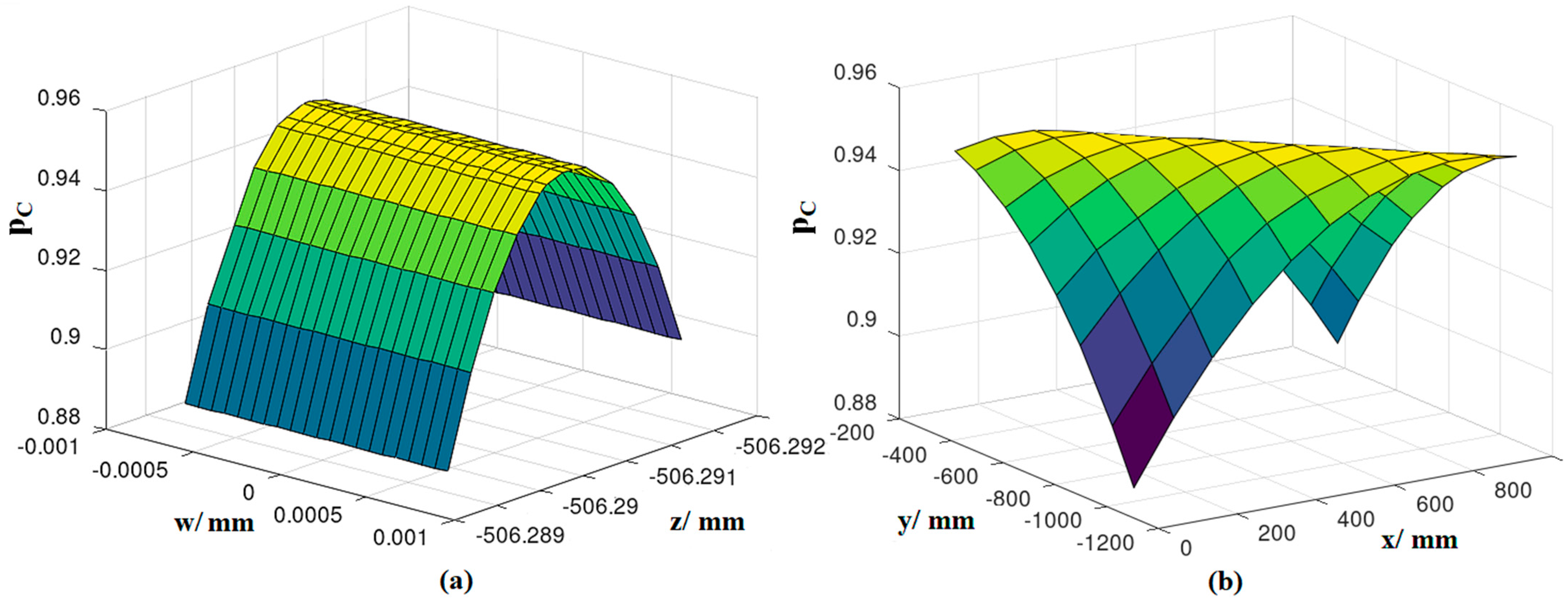
it is determined that Equation (10) is valid i = 1,2 , , n and k = 1,2 , , m . From Equation (10), it is obvious that the value for the conformance probability depends on the best estimate y 0 and its associated measurement uncertainty u 0 . The width of the tolerance space is the same for each component z i ,   i = 1,2 , , n of the best estimate y 0 . Therefore, all layers for the conformance probability over the domains I w × I z and I x × I y are the same for each k = 1,2 , , m , as shown in Figure 10.
The line of maximum values on domain I w × I z passes through the points w k ,   z r ,   p C m a x ,   k = 1,2 , , m , where p C m a x 95.15 % . The line of maximum values on I x × I y domain follows the CMM workbench’s least-risk direction defined by line p and has the same maximum conformance probability p C m a x . The minimum value p C m i n 88.62 % displays the lowest value in the I w × I z domain. On the I x × I y domain, the minimum conformance probability p C A = p C m i n occurs at point A, where the risks are at their highest. In machine learning terms, conformance probability represents prevalence [66].

4.2. Confusion Matrix

Lines T U , T L , A L , and A U partition the area, representing possible values of TV and MV, into nine distinct fields (Figure 11a) [67].
From Figure 11a, the definition areas for the quantities shown in Figure 2 can be reconstructed. Given that, as well as the definitions of R C , R P , T P and T N probabilities, it is simple to demonstrate that p C = T P + R P and 1 p c = R c + T N . It also held that T P + T N + R C + R P = 1 . The probabilities R C , R P , T P and T N represent the classes of the confusion matrix (Figure 11b) [33,37]. By using the mentioned connections between the global producer’s and consumer’s risk, and conformance probability, in addition to the spatial representation of R C and R P classes, as shown in Figure 7, it is possible to construct spaces of classes T P and T N (Figures S1 and S2).

4.3. Probability of Frequent and Rare Events

It is evident from the confusion matrix that another marginal probability can be constructed in addition to the conformance probability. This is the probability of frequent events p 0 = T P + R C . It represents the probability that the measured value is within the acceptance interval. The probability of rare events is defined as 1 p 0 = T N + R P [67]. Assuming T I i = T L i , T U i   = R , i = 1,2 , , n and applying the same reasoning used to establish the equivalence of Equations (10) and (11), the following equation for probability of frequent events is obtained:
p 0 i , k = φ 0 t F i , k t d t ,   i = 1,2 , , n ,   k = 1,2 , , m .
Also, the probability of frequent events can be written in the form p 0 i , k = P Y m = η m A I i , k , Y = η T I i ,   i = 1,2 , , n ,   k = 1,2 , , m , where A I i , k = A L i , k , A U i , k   R , i = 1,2 , , n ,   k = 1,2 , , m .
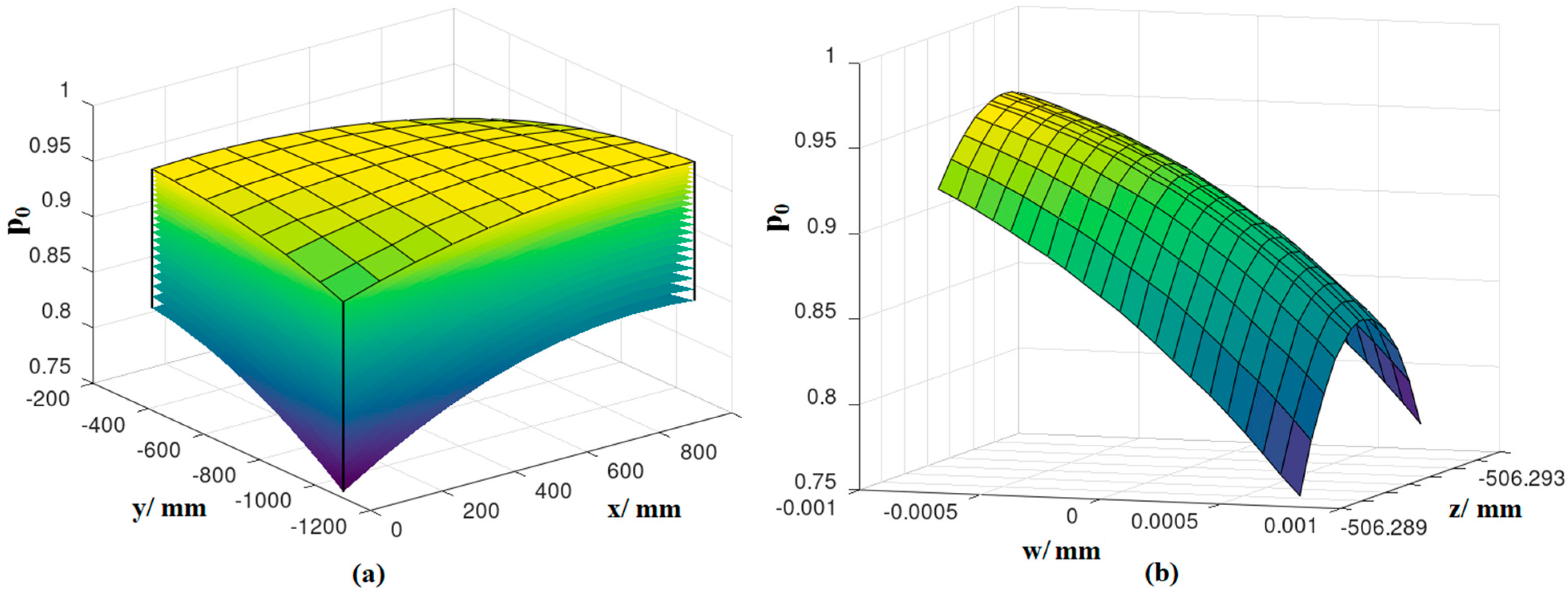
A probability surface of frequent events is generated for each value of the multiplicative factor r k ,   k = 1,2 , , m . By stacking these layers one on top of the other, the overall probability space for frequent events across the domain I x × I y is obtained (Figure 12a). The stacking of the layers is descending. For r l < r s , l , s 1,2 , , m ,   l s ,   l < s it holds that p 0 l > p 0 s . The probability of frequent events can also be represented on the I w × I z domain (Figure 12b). The maximum probability of frequent events in both domains is p 0 m a x = 96.58 % . This value is achieved by the layer of the multiplicative factor r = 1 (Figure 12a), i.e., under the conditions of the model of minimization of global producer’s risk (Figure 12b).
A narrower spacing between the layers depicted in Figure 12a would be achieved by implementing a finer subdivision step of the interval 1,1 . At point A, where the risks are highest, the probability of frequent events is lowest and amounts to p 0 A = 75.22 % on both domains. It should also be noted that, in machine learning terms, the probability of frequent events is also referred to as bias [66].
Given the stated range of values that have conformance probability and probability of frequent events, it can be inferred that the model performs satisfactorily on the provided data and that there are no anomalies in the model.

4.4. Curves, Surfaces, and Spaces of Metrics Associated with the Confusion Matrix

With the integration of all elements used in metrology for conformity assessment, the evaluation of risk assessment models in multiple linear regression becomes possible using metrics associated with confusion matrices [33,37].
Among the many tested metrics are the metrics that illustrate the relationship between the global producer’s and global consumer’s risk in relation to conformance and non-conformance probabilities, as well as the probabilities of frequent and rare events. In relation to the multiplicative factor r , the stacking order of layers for the False Positive Rate (FPR) and False Discovery Rate (FDR) metrics is descending (Figures S3 and S5). These metrics compare global consumer’s risk with non-compliant measurement and probability of frequent events, respectively [68]. Given that the curves of global consumer’s risk along the guard band axis fall, the descending order of layers for these two metrics was expected. This confirms the previously mentioned results. In contrast, the False Negative Rate (FNR) and the False Omission Rate (FOR) are metrics that compare the global producer’s risk with conformance probability, i.e., probability of rare events; thus, the ascending order of layers was obtained (Figures S4 and S6) [68]. There are no intersections of layers for any of the metrics listed. Therefore, their behavior is considered stable for each r 1,1 . The most frequently used evaluation metrics in practice are Accuracy, Precision, Recall and Specificity [69]. In metrology, imbalanced data results from well-performed measurements, and thus the T P class is dominant. For assessing imbalanced datasets, the F1-score is an effective metric, being the harmonic mean of Precision and Recall [70,71]. Among these metrics, Precision, Recall, and Specificity exhibit stable behavior, while Accuracy and F1-score show unstable behavior (Figures S7–S11), where instability refers to the presence of layer intersections. Additional risk spaces were constructed for less commonly used metrics. Negative predictive value (NPV) and Markedness (MK) exhibit stable behavior (Figures S12 and S13). Balanced Accuracy (BA), G-mean, Bookmarked informedness (BM), and Cohen’s kappa coefficient show unstable behavior (Figures S14–S17). Ranges of the multiplicative factor r S for which metric stability is ensured are provided in the Supplementary Material. These ranges are determined by observing all values of r 1,1 and identifying a domain without layer intersection.
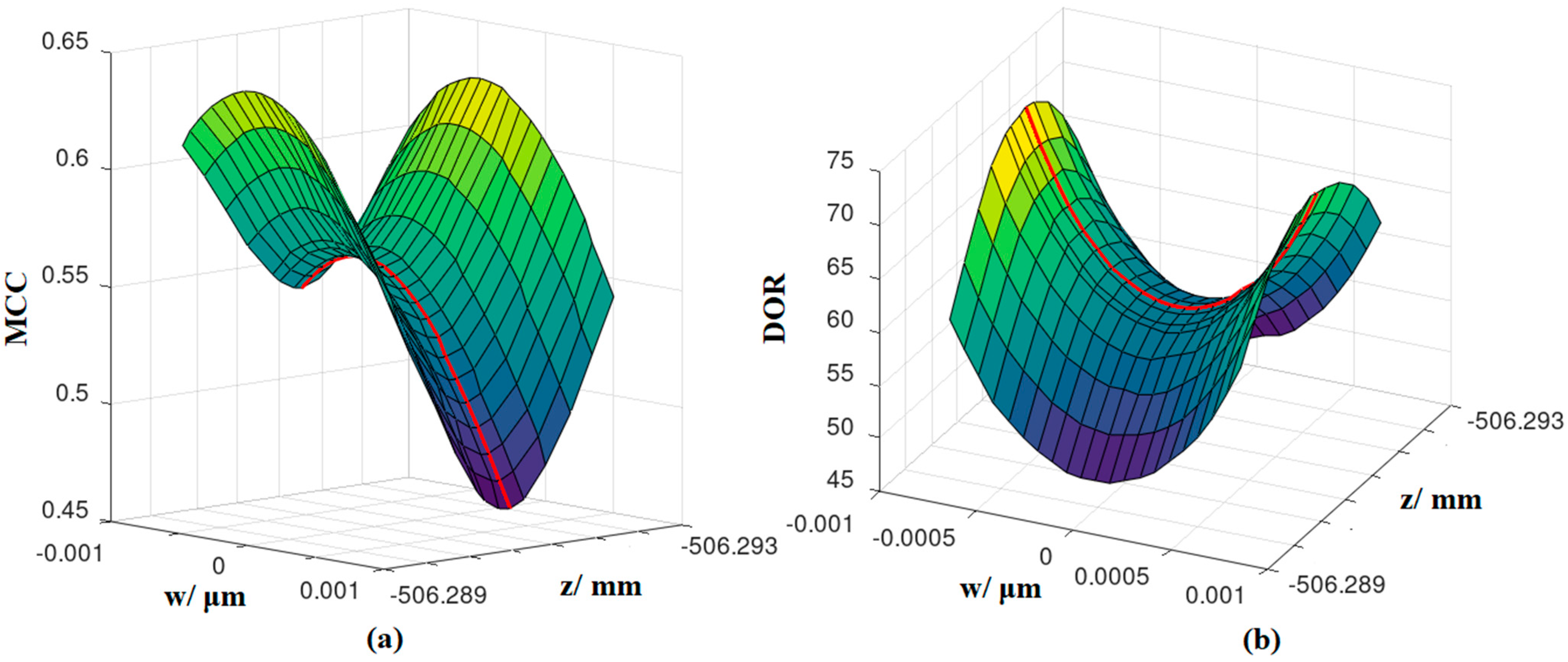
The most pronounced unstable behavior is observed for the MCC and DOR metrics. Their surfaces on the domain I w × I z are hyperbolic paraboloids (Figure 13a,b). A hyperbolic paraboloid is a translation surface formed by sliding one parabola along another. The DOR surface is generated by translating an upward-opening parabola along a downward-opening one, forming a classic saddle shape. The MCC surface is generated by translating a downward-opening parabola along an upward-opening one, with its orientation opposite DOR. In Figure 13a,b, the translation parabolas are highlighted in red. On the MCC surface, this parabola represents a curve of the minimum, with a maximum value of M C C m a x = 0.56 achieved for r M C C = 0.44 and guard band width w M C C = 3.3 · 10 4 mm. Because the TNR and NPV metrics may attain very small values (Figures S11 and S12), the MCC values are relatively low across the I w × I z domain (Figure 13a) [66]. For the DOR metric, the translation parabola corresponds to the maximum curve, with a minimum value of D O R m i n = 57.9 , achieved for r D O R = 0.05 and the guard band width of w D O R = 3.75 · 10 5 mm.
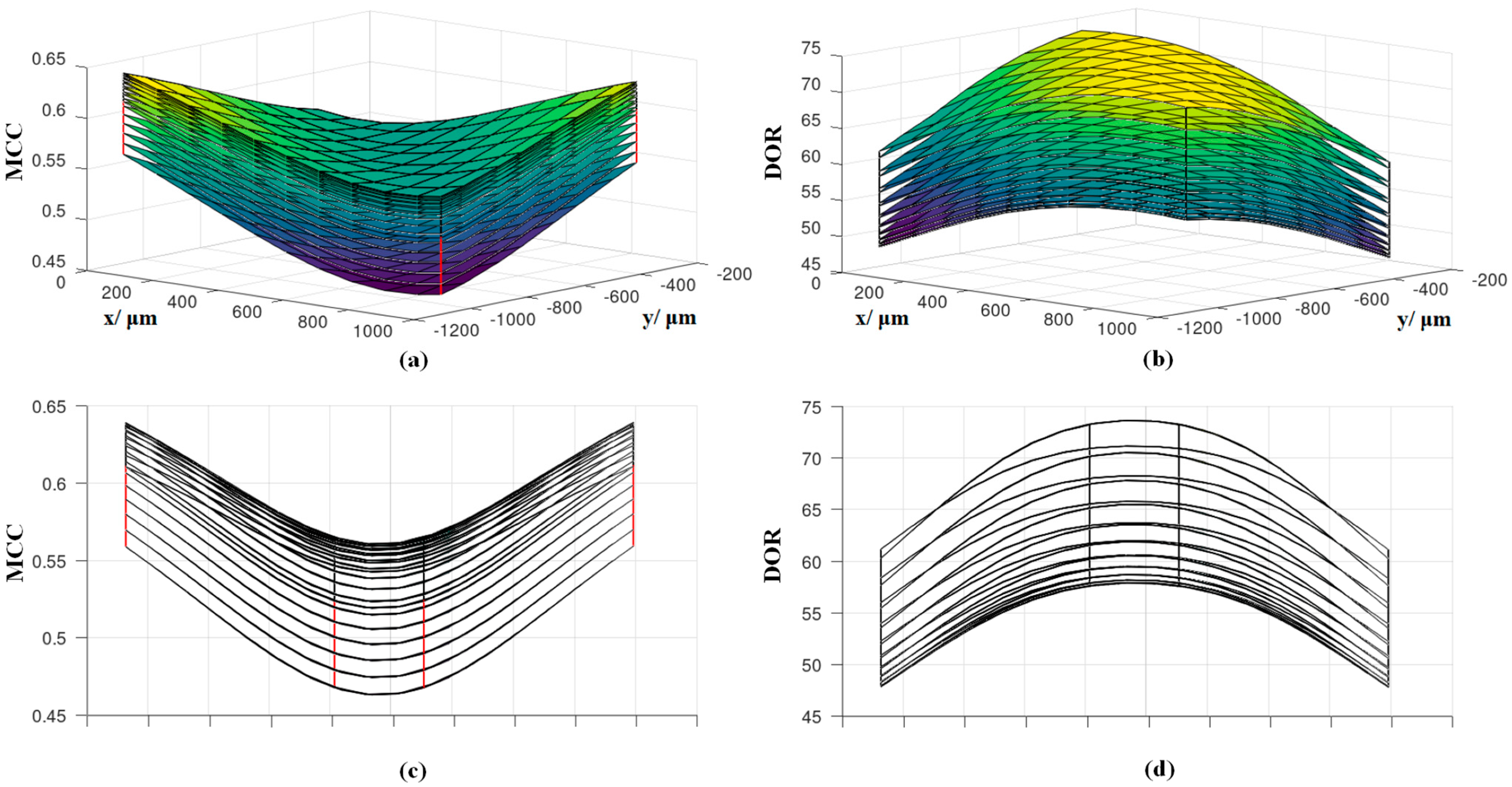
The surfaces of MCC and DOR metrics are generated in a different way, and consequently, the construction of their spaces on the I x × I y domain also differs. For r 1 , 0.44 , the stacking of the MCC layers is ascending, i.e., for r l < r s , l , s 1,2 , , m ,   l s ,   l < s it holds that m i n ( M C C ) l < m i n ( M C C ) s . For r 0.44 , 1 , the values taken by the MCC layers metric decrease with respect to the multiplicative factor r , and it holds that m i n ( M C C ) l > m i n ( M C C ) s . Here, the ascending and descending order of the MCC minima is discussed because the MCC layers intersect at the edges of the I x × I y domain (Figure 14a,c).
The MCC layers’ minima lie on the curve of minimum highlighted red (Figure 13a). The red vertical lines in Figure 14a,c connect the stability area, i.e., the area where there is no intersection of layers. The stability area is achieved for r S 0.45 ,   1 .
For the DOR metric, the situation is reversed. For r 1 ,   0.05 , a descending trend in the maximum values of the DOR layers is observed. For r 0.05 , 1 , the maximums of the DOR layers are ascending. Thus, the DOR layers also intersect (Figure 14b,d). The maximum values of the DOR layers lie on the curve of maximum highlighted in red (Figure 13b). Unlike the MCC metric, when all values of r 1,1 are considered, the DOR metric does not have a stable area on the domain I x × I y (Figure 14d).
The stable behavior of the tested metrics on the I x × I y domain can be ensured by restricting the range of the multiplicative factor r such that the injectivity property is fulfilled, in the sense that r 1 , r 2 1,1 ,   r 1 r 2 M r 1 M r 2 , where M r 1 and M r 2 denote the values of the corresponding tested metrics calculated for given values of the multiplicative factor r . The values r I of the multiplicative factor, which ensure injectivity for each tested metric, are listed in Table 1.
The guard band widths in Table 1 were calculated from the following equations: w = T L A L = A U + T U and w + = A L + T L = T U A U . For Cohen’s kappa coefficient, MCC, and DOR, it is possible to identify two disjoint intervals without layer intersections. These intervals are separated and denoted with L and R in Table 1. Both endpoints of the injectivity intervals, 6L, 7L, and 8L, fall within the domain of the model of minimization for global producer’s risk and represent the value of A L . For this reason, their guard band widths w are within the range given in Table 1, while the width of the guard band w + does not exist. Similarly, both endpoints of the interval 8R are within the domain of the model for minimization of the global consumer’s risk and correspond to the value of A L + . Consequently, the guard band w does not exist, and the guard band w + is defined by the range provided in Table 1.
In addition to the injectivity intervals for individual metrics, it is also possible to determine the common injectivity interval, r C , of all tested metrics, where the layers of metrics do not intersect. Three possible outcomes are summarized in Table 2.
Intervals I 1 and I 2 are situated within the domain of the model for minimizing the global producer’s risk, while interval I 3 is in the domain of the model for minimizing the global consumer’s risk. Since the curves of minimum of global producer’s and consumer’s risk intersect for w S = 0.44 µm, on interval I 2 , it holds that R C < R P (Figure 4b and Figure 5a). The same applies to interval I 3 , whereas on interval I 1 , it holds that R C > R P . Choosing interval I 1 yields the smallest global producer’s risk, while choosing interval I 3 yields the smallest global consumer’s risk. In this manner, optimal guard band widths were obtained. The choice between those two intervals depends on whether the goal is to minimize the damage that the manufacturer may incur by rejecting a compliant measurement or to reduce the risk that the consumer may face by using a non-compliant product.

5. Conclusions

This study introduces a spatial risk assessment method based on a multiple linear regression model and demonstrates its application in the case of CMM workbench flatness. The proposed method enables calculation of global producer’s and consumer’s risks even for locations where no direct measurements are taken and for any chosen value of the guard band width w . Through the case study, the least-risk area of the workbench surface was identified, and a critical measurement uncertainty threshold was established, marking the point at which the global producer’s risk landscape changes significantly. In addition, it is shown that by evaluating the model using metrics associated with confusion matrices, it is possible to determine the optimal width of the guard band.
With an appropriate selection of the reference plane, the method can be extended to risk assessment scenarios involving any input data type that can be represented within a multiple linear regression framework. The method can also be applied in cases where measurement uncertainty and tolerance interval range are not available. The use of risk assessment methods under nonlinearized geometry conditions within multiple linear regression models is a topic for future research. Consequently, this spatial risk assessment framework is applicable beyond metrology, offering potential utility across diverse scientific disciplines.

Supplementary Materials

The following supporting information can be downloaded at: https://www.mdpi.com/article/10.3390/asi9010020/s1. Figure S1: True positive; Figure S2: True negative; Figure S3: False positive rate; Figure S4: False negative rate; Figure S5: False discovery rate; Figure S6: False omission rate; Figure S7: Accuracy; Figure S8: Precision; Figure S9: Recall; Figure S10: F1-score; Figure S11: True Negative Rate; Figure S12: Negative Predictive Value; Figure S13: Markedness; Figure S14: Balanced Accuracy; Figure S15: G-mean; Figure S16: Bookmaker informedness; Figure S17: Cohen’s kappa coefficient.

Author Contributions

Conceptualization, D.B.; methodology, D.B., B.Š., and B.R.; software, D.B., B.Š., and M.R.; validation, D.B., B.Š., B.R., M.R., and A.R.; formal analysis, D.B.; investigation, D.B. and B.Š.; resources, D.B., B.Š., and M.R.; data curation, D.B., B.Š., A.R., and M.R.; writing—original draft preparation, D.B.; writing—review and editing, D.B., A.R., and B.R.; visualization, D.B. and A.R.; supervision, B.R.; project administration, D.B.; funding acquisition, B.R. All authors have read and agreed to the published version of the manuscript.

Funding

This research received no external funding.

Data Availability Statement

The original contributions presented in this study are included in the article. Further inquiries can be directed to the corresponding author.

Conflicts of Interest

The authors declare no conflicts of interest.

Correction Statement

This article has been republished with a minor correction to resolve typographical and grammatical errors. This change does not affect the scientific content of the article.

Nomenclature

The following list of symbols and mathematical notations are used in this manuscript:
MVMeasured value
T I Tolerance interval
A I Acceptance interval
w Guard band width
y 0 Best estimate
u 0 Measurement uncertainty associated with the best estimate
u m Measurement uncertainty of a future measurement process
TVTrue value
A L Lower limit of the acceptance interval in producer’s risk minimization model
A U + Upper limit of the acceptance interval in producer’s risk minimization model
A L + Lower limit of the acceptance interval in consumer’s risk minimization model
A U Upper limit of the acceptance interval in consumer’s risk minimization model
T L Lower limit of the tolerance interval
T U Upper limit of the tolerance interval
TPTrue positive probability
TNTrue negative probability
RcGlobal consumer’s risk
RpGlobal producer’s risk
iIndex, i = 1 , ,   n
x i x coordinates of the sampled points, i = 1 , ,   n
y i y coordinates of the sampled points, i = 1 , ,   n
zSurface flatness
nNumber of the sampled points
α Plane of the granite table of the CMM
z i Values of plane α calculated at the points x i , y i ,   i = 1 , ,   n
g 0 Prior distribution
η Values taken by the prior distribution
h Likelihood function
η m Values taken by the likelihood function, given η
β Reference plane
z r Value of the reference plane β
T Range of the tolerance space
τ U Upper tolerance plane
τ L Lower tolerance plane
A Range of the acceptance space
I w Domain along the guard band axis
rMultiplicative factor
kIndex, k = 1,2 , , m
r k Multiplicative factor for a given index k = 1,2 , , m
m Number of subdivision nodes of interval w ,   w
w k Guard band width for a given index k = 1,2 , , m
w U Total width of the guard band
A U i , k Upper limit of the acceptance interval for i = 1,2 , , n ,   k = 1,2 , ,   m
A L i , k Lower limit of the acceptance interval for i = 1,2 , , n ,   k = 1,2 , ,   m
T U i Upper limit of the tolerance interval for i = 1,2 , , n
T L i Lower limit of the tolerance interval for i = 1,2 , , n
A L Lower acceptance plane
A U Upper acceptance plane
p Line, intersection of planes α and β
R C i , k Global consumer’s risk for i = 1,2 , , n ,   k = 1,2 , ,   m
R P i , k Global producer’s risk for i = 1,2 , , n ,   k = 1,2 , ,   m
φ 0 Standard normal probability density function
ϕCumulative distribution function of standard normal distribution
F i , k Auxiliary function, i = 1,2 , , n ,   k = 1,2 , ,   m
tValue taken by F i , k ,   i = 1,2 , , n ,   k = 1,2 , ,   m
w s Value of the guard band at which the curves of minimum intersect
I z Domain for surface flatness
p Orthogonal projection of the line p onto the xy-plane
l Index, l 1,2 , , m
s Index, s 1,2 , , m
z ¯ Sample mean for surface flatness
z m i n Minimal value of surface flatness
z m a x Maximal value of surface flatness
u k Critical measurement uncertainty
p C Conformance probability
p C i Conformance probability for i = 1,2 , , n
p C i , k Conformance probability for i = 1,2 , , n ,   k = 1,2 , ,   m
p 0 Probability of a frequent event
p 0 i , k Probability of a frequent event for i = 1,2 , , n ,   k = 1,2 , ,   m
p C m i n Minimal conformance probability
p C m a x Maximal conformance probability
p C A Conformance probability in point A
p 0 m a x Maximal probability of a frequent event
p 0 A Probability of a frequent event in point A
M C C m a x Maximal value of Matthews correlation coefficient
r M C C Multiplicative factor for maximal value of Matthews correlation coefficient
w M C C Guard band width for maximal value of Matthews correlation coefficient
D O R m i n Minimal value of diagnostic odds ratio
r D O R Multiplicative factor for minimal value of diagnostic odds ratio
w D O R Guard band width for minimal value of diagnostic odds ratio
r S Multiplicative factor for stability area
w Guard band width for the model of minimization of global producer’s risk
w + Guard band width for the model of minimization of global consumer’s risk
r I Multiplicative factor for injectivity area
r C Multiplicative factor for common area

References

  1. Kuselman, I.; Pennecchi, F.R.; Da Silva, R.J.; Hibbert, D.B. IUPAC/CITAC Guide: Evaluation of risks of false decisions in conformity assessment of a multicomponent material or object due to measurement uncertainty (IUPAC Technical Report). Pure Appl. Chem. 2021, 93, 113–154. [Google Scholar] [CrossRef]
  2. Ortolano, G.; Boucher, P.; Degiovanni, I.P.; Losero, E.; Genovese, M.; Ruo-Berchera, I. Quantum conformance test. Sci. Adv. 2021, 7, eabm3093. [Google Scholar] [CrossRef] [PubMed]
  3. Dias, F.R.S.; Lourenço, F.R. Measurement uncertainty evaluation and risk of false conformity assessment for microbial enumeration tests. J. Microbiol. Meth. 2021, 189, 106312. [Google Scholar] [CrossRef]
  4. ILAC–G8:09/2019; Guidelines on Decision Rules and Statements of Conformity. International Laboratory Accreditation Cooperation: Silverwater, Australia, 2019. Available online: https://ilac.org/publications-and-resources/ilac-guidance-series/ (accessed on 29 August 2025).
  5. Shirono, K.; Tanaka, H.; Koike, M. Economic optimization of acceptance interval in conformity assessment: 1. Process with no systematic effect. Metrologia 2022, 59, 045005. [Google Scholar] [CrossRef]
  6. Sedeek, M.A.; Elerian, F.A.; Abouelatta, O.B.; AbouEleaz, M.A. Decision-making Approach to Reduce the Risk of Measurement Uncertainty for Product Size. Manosura Eng. J. 2024, 49, 2. [Google Scholar] [CrossRef]
  7. Allard, A.; Fischer, N.; Smith, I.; Harris, P.; Pendrill, L. Risk calculations for conformity assessment in practice. In Proceedings of the 19th International Congress of Metrology, Paris, France, 24–26 September 2019. [Google Scholar] [CrossRef]
  8. Koucha, Y.; Forbes, A.; Yang, Q. A Bayesian conformity and risk assessment adapted to a form error model. Meas. Sens. 2021, 18, 100330. [Google Scholar] [CrossRef]
  9. Pennecchi, F.R.; Kuselman, I.; Di Rocco, A.; Hibbert, D.B.; Sobina, A.; Sobina, E. Specific risks of false decisions in conformity assessment of a substance or material with a mass balance constraint—A case study of potassium iodate. Measurement 2021, 173, 108662. [Google Scholar] [CrossRef]
  10. Bettencourt da Silva, R.J.; Lourenço, F.; Hibbert, D.B. Setting multivariate and correlated acceptance limits for assessing the conformity of items. Anal. Lett. 2022, 55, 2011–2032. [Google Scholar] [CrossRef]
  11. BIPM; IEC; IFCC; ILAC; ISO; IUPAC; IUPAP; OIML. Evaluation of Measurement Data—Guide to the Expression of Uncertainty in Measurement; JCGM 100:2008; Joint Committee for Guides in Metrology: Sèvres, France, 2008. [Google Scholar] [CrossRef]
  12. Grégis, F. On the meaning of measurement uncertainty. Measurement 2019, 133, 41–46. [Google Scholar] [CrossRef]
  13. Pendrill, L.R. Using measurement uncertainty in decision-making and conformity assessment. Metrologia 2014, 51, S206. [Google Scholar] [CrossRef]
  14. Williams, A.; Magnusson, B. Eurachem/CITAC Guide: Use of Uncertainty Information in Compliance Assessment. 2021. Available online: https://www.eurachem.org/index.php/publications/guides/uncertcompliance (accessed on 29 August 2025).
  15. Separovic, L.; Lourenco, F.R. Measurement uncertainty and risk of false conformity decision in the performance evaluation of liquid chromatography analytical procedures. J. Pharm. Biomed. Anal. 2019, 171, 73–80. [Google Scholar] [CrossRef] [PubMed]
  16. Xue, Z.; Mou, X.; Sun, H.; Cao, C.; Xu, B. A Protocol for Conformity and Risk Assessment of Pharmaceutical Product by High Performance Liquid Chromatography Based on Measurement Uncertainty. J. Sep. Sci. 2025, 48, e70158. [Google Scholar] [CrossRef]
  17. Volodarsky, E.T.; Kosheva, L.O.; Klevtsova, M.O. Approaches to the Evaluation of Conformity Taking into Account the Uncertainty of the Value of the Monitored Parameter. In Proceedings of the 2019 IEEE 8th International Conference on Advanced Optoelectronics and Lasers (CAOL), Sozopol, Bulgaria, 6–8 September 2019. [Google Scholar] [CrossRef]
  18. BIPM; IEC; IFCC; ILAC; ISO; IUPAC; IUPAP; OIML. Evaluation of Measurement Data—The Role of Measurement Uncertainty in Conformity Assessment; JCGM 106:2012; Joint Committee for Guides in Metrology: Sèvres, France, 2012. [Google Scholar] [CrossRef]
  19. Volodarskyi, Y.; Kosheva, L.; Kozyr, O. Reducing the Impact of Measurement Uncertainty in Conformity Assessment. In Proceedings of the 2023 XXXIII International Scientific Symposium Metrology and Metrology Assurance (MMA), Sozopol, Bulgaria, 7–11 September 2023. [Google Scholar] [CrossRef]
  20. Separovic, L.; Simabukuro, R.S.; Couto, A.R.; Bertanha, M.L.G.; Dias, F.R.; Sano, A.Y.; Caffaro, A.M.; Lourenco, F.R. Measurement uncertainty and conformity assessment applied to drug and medicine analyses—A review. Crit. Rev. Anal. Chem. 2023, 53, 123–138. [Google Scholar] [CrossRef]
  21. Carullo, A.; Manta, F.; Mugno, R.; Paolino, E.; Pedone, P.; Albis, G.; Corbellii, S.; Vallan, A. Fundamentals in Measurement: The Role of Measurement Uncertainty in Conformity Assessment: Some Examples. IEEE Instrum. Meas. Mag. 2024, 27, 5–12. [Google Scholar] [CrossRef]
  22. Runje, B.; Horvatić Novak, A.; Razumić, A.; Piljek, P.; Štrbac, B.; Orošnjak, M. Evaluation of Consumer and Producer Risk in Conformity Assessment Decision. In Proceedings of the 30th DAAAM International Symposium “Intelligent Manufacturing & Automation”, Zadar, Croatia, 23–26 October 2019. [Google Scholar] [CrossRef]
  23. Hibbert, D.B.; Korte, E.H.; Örnemark, U. Metrological and quality concepts in analytical chemistry (IUPAC Recommendations 2021). Pure Appl. Chem. 2021, 93, 997–1048. [Google Scholar] [CrossRef]
  24. Lira, I. A Bayesian approach to the consumer’s and producer’s risks in measurement. Metrologia 1999, 36, 397. [Google Scholar] [CrossRef]
  25. Volodarsky, E.T.; Kosheva, L.O.; Klevtsova, M.O. The Role Uncertainty of Measurements in the Formation of Acceptance Criteria. In Proceedings of the 2019 XXIX International Scientific Symposium “Metrology and Metrology Assurance”(MMA), Sozopol, Bulgaria, 6–9 September 2019. [Google Scholar] [CrossRef]
  26. BIPM; IEC; IFCC; ILAC; ISO; IUPAC; IUPAP; OIML. Evaluation of Measurement Data—Supplement 1 to the “Guide to the Expression of Uncertainty in Measurement”—Propagation of Distributions Using a Monte Carlo Method; JCGM 101:2008; Joint Committee for Guides in Metrology: Sèvres, France, 2008. [Google Scholar] [CrossRef]
  27. Iuculano, G.; Nielsen, L.; Zanobini, A.; Pellegrini, G. The principle of maximum entropy applied in the evaluation of the measurement uncertainty. IEEE Trans. Instrum. Meas. 2007, 56, 717–722. [Google Scholar] [CrossRef]
  28. Consonni, G.; Fouskakis, D.; Liseo, B.; Ntzoufras, I. Prior distributions for objective Bayesian analysis. Bayesian Anal. 2018, 13, 627–679. [Google Scholar] [CrossRef]
  29. Folye, D.K.; Scharfenaker, E. Bayesian Inference and the Principle of Maximum Entropy. Am. Stat. 2025, 79, 467–473. [Google Scholar] [CrossRef]
  30. Neuenschwander, B. From historical data to priors. In Proceedings of the Biopharmaceutical Section, Joint Statistical Meetings, American Statistical Association, Miami Beach, FL, USA, 30 July–4 August 2011. [Google Scholar]
  31. Separovic, L.; de Godoy Bertanha, M.L.; Saviano, A.M.; Lourenço, F.R. Conformity decisions based on measurement uncertainty—A case study applied to agar diffusion microbiological assay. J. Pharm. Innov. 2020, 15, 110–115. [Google Scholar] [CrossRef]
  32. Tian, Q.; Lewis-Beck, C.; Niemi, J.B.; Meeker, W.Q. Specifying prior distributions in reliability applications. Appl. Stoch. Model. Bus. Ind. 2024, 40, 5–62. [Google Scholar] [CrossRef]
  33. Božić, D.; Runje, B. Selection of an Appropriate Prior Distribution in Risk Assessment. In Proceedings of the 33rd International DAAAM Virtual Symposium “Intelligent Manufacturing & Automation”, Vienna, Austria, 27–28 October 2022. [Google Scholar] [CrossRef]
  34. Toczek, W.; Smulko, J. Risk Analysis by a Probabilistic Model of the Measurement Process. Sensors 2021, 21, 2053. [Google Scholar] [CrossRef]
  35. Ramebäck, H.; Tovedal, A.; Norlin, K. On the significance of the measurement evaluation method in decision making: A synthesis of JCGM 101 and JCGM 106 applied to gross alpha and gross beta measurements using LSC. Appl. Radiat. Isot. 2024, 208, 111282. [Google Scholar] [CrossRef]
  36. Puydarrieux, S.; Pou, J.M.; Leblond, L.; Fischer, N.; Allard, A.; Feinberg, M.; El Guennouni, D. Role of measurement uncertainty in conformity assessment. In Proceedings of the 19th International Congress of Metrology (CIM2019), Paris, France, 24–26 September 2019. [Google Scholar] [CrossRef]
  37. Božić, D.; Runje, B.; Lisjak, D.; Kolar, D. Metrics Related to Confusion Matrix as Tools for Conformity Assessment Decisions. Appl. Sci. 2023, 13, 8187. [Google Scholar] [CrossRef]
  38. Božić, D.; Runje, B.; Razumić, A. Risk Assessment for Linear Regression Models in Metrology. Appl. Sci. 2024, 14, 2605. [Google Scholar] [CrossRef]
  39. Pennecchi, F.R.; Kuselman, I.; Di Rocco, A.; Hibbert, D.B.; Semenova, A.A. Risks in a sausage conformity assessment due to measurement uncertainty, correlation and mass balance constraint. Food Control 2021, 125, 107949. [Google Scholar] [CrossRef]
  40. Brandão, L.P.; Silva, V.F.; Bassi, M.; de Oliveira, E.C. Risk assessment in monitoring of water analysis of a Brazilian river. Molecules 2022, 27, 3628. [Google Scholar] [CrossRef]
  41. Separovic, L.; Saviano, A.M.; Lourenço, F.R. Using measurement uncertainty to assess the fitness for purpose of an HPLC analytical method in the pharmaceutical industry. Measurement 2018, 119, 41–45. [Google Scholar] [CrossRef]
  42. do Prado Pereira, W.; Carvalheira, L.; Lopes, J.M.; de Aguiar, P.F.; Moreira, R.M.; e Oliveira, E.C. Data reconciliation connected to guard bands to set specification limits related to risk assessment for radiopharmaceutical activity. Heliyon 2023, 9, e22992. [Google Scholar] [CrossRef]
  43. Leal, F.G.; de Andrade Ferreira, A.; Silva, G.M.; Freire, T.A.; Costa, M.R.; de Morais, E.T.; Guzzo, J.V.P.; de Oliveira, E.C. Measurement Uncertainty and Risk of False Compliance Assessment Applied to Carbon Isotopic Analyses in Natural Gas Exploratory Evaluation. Molecules 2024, 29, 3065. [Google Scholar] [CrossRef] [PubMed]
  44. Reis Medeiros, K.A.; da Costa, L.G.; Bifano Manea, G.K.; de Moraes Maciel, R.; Caliman, E.; da Silva, M.T.; de Sena, R.C.; de Oliveira, E.C. Determination of total sulfur content in fuels: A comprehensive and metrological review focusing on compliance assessment. Crit. Rev. Anal. Chem. 2023, 54, 3398–3408. [Google Scholar] [CrossRef]
  45. Božić, D.; Samardžija, M.; Kurtela, M.; Keran, Z.; Runje, B. Risk Evaluation for Coating Thickness Conformity Assessment. Materials 2023, 16, 758. [Google Scholar] [CrossRef] [PubMed]
  46. Kuselman, I.; Pennecchi, F.; da Silva, R.J.; Hibbert, D.B. Conformity assessment of multicomponent materials or objects: Risk of false decisions due to measurement uncertainty—A case study of denatured alcohols. Talanta 2017, 164, 189–195. [Google Scholar] [CrossRef]
  47. Kuselman, I.; Pennecchi, F.R.; Da Silva, R.J.; Hibbert, D.B. Risk of false decision on conformity of a multicomponent material when test results of the components’ content are correlated. Talanta 2017, 174, 789–796. [Google Scholar] [CrossRef] [PubMed]
  48. da Silva, R.J.; Pennecchi, F.R.; Hibbert, D.B.; Kuselman, I. Tutorial and spreadsheets for Bayesian evaluation of risks of false decisions on conformity of a multicomponent material or object due to measurement uncertainty. Chemom. Intell. Lab. Syst. 2018, 182, 109–116. [Google Scholar] [CrossRef]
  49. Silva, C.M.D.; Lourenço, F.R. Definition of multivariate acceptance limits (guard-bands) applied to pharmaceutical equivalence assessment. J. Pharm. Biomed. Anal. 2023, 222, 115080. [Google Scholar] [CrossRef]
  50. Silva, C.M.D.; Lourenço, F.R. Multivariate guard-bands and total risk assessment on multiparameter evaluations with correlated and uncorrelated measured values. Braz. J. Pharm. Sci. 2024, 60, e23564. [Google Scholar] [CrossRef]
  51. Božić, D.; Runje, B.; Razumić, A. Risk Assessment Procedure for Calibration. Teh. Glas. 2025, 19, 7–12. [Google Scholar] [CrossRef]
  52. Božić, D.; Runje, B.; Razumić, A. Risk assessment for calibration: The non-linearized case. In Proceedings of the 2025 IMEKO Joint Conference TC8–TC11–TC25, Torino, Italy, 14–17 September 2025. [Google Scholar]
  53. Božić, D.; Runje, B.; Razumić, A.; Lisjak, D.; Štrbac, B. Risk assessment for linear regression models in metrology: Hypothetical cases. In Proceedings of the 15th International Scientific Conference MMA-Flexible Technologies, Novi Sad, Serbia, 24–26 September 2024. [Google Scholar] [CrossRef]
  54. Ranisavljev, M.; Razumić, A.; Štrbac, B.; Runje, B.; Horvatić Novak, A.; Hadžistević, M. Ispitivanje ravnosti granitnog stola KMM primenom konvencionalne i koordinatne metrologije. In Proceedings of the 6th International Scientific Conference Conference on Mechanical Engineering Technologies and Applications (COMETa2022), Jahorina, Bosnia and Herzegovina, 17–19 November 2022. [Google Scholar]
  55. Moroni, G.; Petro, S. Geometric tolerance evaluation: A discussion on minimum zone fitting algorithms. Precis. Eng. 2008, 32, 232–237. [Google Scholar] [CrossRef]
  56. Radlovački, V.; Hadžistević, M.; Štrbac, B.; Delić, M.; Kamberović, B. Evaluating minimum zone flatness error using new method—Bundle of plains through one point. Precis. Eng. 2016, 43, 554–562. [Google Scholar] [CrossRef]
  57. ISO 1101:2017; Geometrical Product Specifications (GPS)—Geometrical Tolerancing—Tolerances of Form, Orientation, Location and Run-Out. International Organization for Standardization: Geneva, Switzerland, 2017.
  58. Shen, Y.; Ren, J.; Huang, N.; Zhang, Y.; Zhang, X.; Zhu, L. Surface form inspection with contact coordinate measurement: A review. Int. J. Extreme Manuf. 2023, 5, 022006. [Google Scholar] [CrossRef]
  59. Zahwi, S.Z.; Amer, M.A.; Abdou, M.A.; Elmelegy, A.M. On the calibration of surface plates. Measurement 2013, 46, 1019–1028. [Google Scholar] [CrossRef]
  60. Štrbac, B.; Radlovački, V.; Spasić-Jokić, V.; Delić, M.; Hadžistević, M. The Difference Between GUM and ISO/TC 15530-3 Method to Evaluate the Measurement Uncertainty of Flatness by a CMM. Mapan 2017, 32, 251–257. [Google Scholar] [CrossRef]
  61. Cui, C.; Fu, S.; Huang, F. Research on the uncertainties from different form error evaluation methods by CMM sampling. Int. J. Adv. Manuf. Technol. 2009, 43, 136–145. [Google Scholar] [CrossRef]
  62. British Standard: BS 817:1988; Specification for Surface Plates. British Standard Institution: London, UK, 1988.
  63. R Core Team. R: A Language and Environment for Statistical Computing; The R Foundation for Statistical Computing: Vienna, Austria, 2022; Available online: https://www.R-project.org/ (accessed on 21 September 2025).
  64. Borchers, H.W. Pracma: Practical Numerical Math Functions. R Package Version 2.4.2/r532. Available online: https://R-Forge.R-project.org/projects/optimist/ (accessed on 21 September 2025).
  65. Eaton, J.W.; Bateman, D.; Hauberg, S.; Wehbring, R. GNU Octave Version 8.4.0 Manual: A High-Level Interactive Language for Numerical Computations. Available online: https://www.gnu.org/software/octave/doc/v8.4.0/ (accessed on 21 September 2025).
  66. Chicco, D.; Tötsch, N.; Jurman, G. The Matthews correlation coefficient (MCC) is more reliable than balanced accuracy, bookmaker informedness, and markedness in two-class confusion matrix evaluation. BioData Min. 2021, 14, 13. [Google Scholar] [CrossRef]
  67. Juras, J.; Pasarić, Z. Application of tetrachoric and polychoric correlation coefficients to forecast verification. Geofizika 2006, 23, 59–82. Available online: https://hrcak.srce.hr/4211 (accessed on 22 September 2025).
  68. Shaukat, K.; Luo, S.; Varadharajan, V.; Hameed, I.A.; Xu, M. A survey on machine learning techniques for cyber security in the last decade. IEEE Access 2020, 8, 222310–222354. [Google Scholar] [CrossRef]
  69. Grandini, M.; Bagli, E.; Visani, G. Metrics for multi-class classification: An overview. arXiv 2020. [Google Scholar] [CrossRef]
  70. Riyanto, S.; Imas, S.S.; Djatna, T.; Atikah, T.D. Comparative analysis using various performance metrics in imbalanced data for multi-class text classification. Int. J. Adv. Comput. Sci. Appl. 2023, 14. [Google Scholar] [CrossRef]
  71. Altalhan, M.; Algarni, A.; Alouane, M.T.H. Imbalanced data problem in machine learning: A review. IEEE Access 2025, 13, 13686–13699. [Google Scholar] [CrossRef]
Figure 1. The domain for the point-based risk assessment model along the guard band axis.
Asi 09 00020 g001
Figure 2. Possible outcomes in a quality assessment procedure using a decision rule with a guard band and by including measurement uncertainty of future measurement: (a) true positive; (b) global producer’s risk RP; (c) global consumer’s risk RC; (d) true negative [36].
Asi 09 00020 g002
Figure 3. Model geometry for spatial risk assessment: case of minimization of global consumer’s risk, r = 1 .
Asi 09 00020 g003
Figure 4. (a) Global consumer’s risk for the measured surface flatness values; (b) minimum curves along guard band axis; (c) global consumer’s risk curves; (d) global producer’s risk curves.
Asi 09 00020 g004
Figure 5. (a) Risk surfaces; (b) contour plots.
Asi 09 00020 g005
Figure 6. Risk surfaces on domain I x × I y for r = 1 ; (a) global consumer’s risk; (b) global producer’s risk; (c) contour plots.
Asi 09 00020 g006
Figure 7. Risk spaces: (a) global consumer’s risk; (b) global producer’s risk.
Asi 09 00020 g007
Figure 8. Contour plots for different choices of reference planes, case of r = 1 : (a) minimum value, z m i n = 506.2926 mm; (b) 1st sample mode, z = 506.2915 mm; (c) second sample mode, z = 506.291 mm; (d) median, z = 506.29095 mm; (e) the value taken by the plane β , z = 506.29085 mm; (f) mean, z = 506.290835 mm; and (g) maximum value, z m a x = 506.2891 mm.
Asi 09 00020 g008
Figure 9. Risk space for different values of measurement uncertainty u m .
Asi 09 00020 g009
Figure 10. Conformance probability on domains: (a) I w × I z ; (b) I x × I y .
Asi 09 00020 g010
Figure 11. (a) Plane division; (b) confusion matrix.
Asi 09 00020 g011
Figure 12. (a) Probability space of frequent events; (b) probability surfaces of frequent events.
Asi 09 00020 g012
Figure 13. Surfaces of metrics: (a) Matthews correlation coefficient; (b) diagnostic odds ratio.
Asi 09 00020 g013
Figure 14. Spaces of metrics: (a) MCC; (b) DOR; projections: (c) MCC; (d) DOR.
Asi 09 00020 g014
Table 1. Injectivity intervals and guard band width for tested metrics.
LabelsMetrics r I w / · 10 4 mm w + / · 10 4 mm
1Accuracy 0.85 ,   1 ↘ *6.3757.5
2F1-score 0.9 ,   1 6.757.5
3BA 1 ,   0.9 7.56.75
4G-mean 1 ,   0.84 7.56.3
5BM 1 ,   0.9 7.56.75
6Lkappa 1 ,   0.5 7.5 → 3.75
6Rkappa 0.35 ,   1 2.6257.5
7LMCC 1 ,   0.4 7.5 → 3
7RMCC 0.3 ,   1 2.257.5
8LDOR 1 ,   0 7.5 → 0
8RDOR 0.05 ,   1 0.375 → 7.5
* ↘ Stacking layers in descending order. ↗ Stacking layers in ascending order.
Table 2. Common injectivity intervals and the corresponding width of guard band.
Intersection of IntervalsLabels r C w / · 10 4 mm w + / · 10 4 mm
1–5, 6L, 7L, 8L I 1 0.85 , 0.5 6.375 → 3.75
1–5, 6R, 7R, 8L I 2 0.3 ,   0 2.25 → 0
1–5, 6R, 7R, 8R I 3 0.05 ,   0.84 0.375 → 6
Disclaimer/Publisher’s Note: The statements, opinions and data contained in all publications are solely those of the individual author(s) and contributor(s) and not of MDPI and/or the editor(s). MDPI and/or the editor(s) disclaim responsibility for any injury to people or property resulting from any ideas, methods, instructions or products referred to in the content.