


Abstract
Wastewater management plays a critical role in advancing the circular economy, as wastewater is increasingly considered a recoverable resource rather than a waste product. This paper reviews physical, chemical, biological, and combined treatment methodologies, highlighting a lack of a holistic framework in current research which includes both the operational phases of wastewater treatment and proper risk analysis tools. To address this gap, an innovative methodological framework for wastewater recovery and risk management within an integrated logistic–production process is proposed. The framework is structured in five steps: description of the logistic–production process, hazard identification, risk assessment through the Failure Modes, Effects, and Criticality Analysis (FMECA), prioritization of interventions using the Action Priority (AP) method, and definition of corrective actions. The application of the proposed methodology can optimize the usage of available resources across various sectors while minimizing waste products, thus supporting environmental sustainability. Furthermore, political, economic and social implications of adopting the proposed approach in the field of energy transition are discussed.
1. Introduction
The wastewater treatment sector has assumed an increasingly prominent position in the transition toward an economy based on the principles of circularity. Wastewater, far from being merely a waste product, is composed of numerous raw materials that could be recovered and reintroduced into production cycles [1]. It should be noted that this article mainly refers to wastewater samples primarily contaminated by oils, which include, for instance, bilge water from ships. Biotechnological processes represent an economical and flexible method to concentrate and transform resources derived from waste or wastewater into valuable products, a fundamental element for the technological development of a circular economy based on the bioeconomy [2], in line with Industry 4.0 technologies and sustainability practices [3,4,5,6].
The integration of advanced technologies into wastewater treatment facilities has moved beyond traditional purification processes, enabling the recovery of valuable resources such as stabilized fertilizers, biogas, and bio-oils. Once reintroduced into the market, these by-products can generate substantial economic returns, which may help to offset operational expenses while also fostering renewed investment in sustainable infrastructure [7].
Another promising avenue involves the use of thermophilic microorganisms. These organisms, which thrive in environments with elevated temperatures, facilitate the transformation of both industrial and municipal wastewater into products of considerable value. Among these, thermostable enzymes stand out for their potential application across a wide range of industrial sectors [8].
Therefore, considering recent developments, it is increasingly evident that wastewater treatment plants can become true “bio-factories”, recovering essential nutrients such as nitrogen and phosphorus while also providing a sustainable alternative to freshwater, which is becoming increasingly scarce. Despite the clear potential, regulatory obstacles still exist, as well as challenges regarding public perception and the willingness to adopt these innovative technologies [9].
The United States, Brazil, China, and India have already made significant investments in developing technologies for the treatment and valorization of pollutants contained in wastewater. Government initiatives and international collaborations, such as those promoted by the International Energy Agency (IEA) Bioenergy, have led to the development of standardized analytical methods and specifications for products derived from pyrolysis oil, fostering the technological maturity of the sector [10].
Although largely underestimated, the activity of wastewater treatment plants can be analyzed in terms of environmental impact, considering that every phase of the process requires energy consumption. A key component of the wastewater treatment process is therefore reducing the carbon footprint by lowering energy use. Among possible strategies, wastewater treatment could be integrated with thermal decomposition plants to autonomously generate part of the energy required for operations, while simultaneously reducing residues destined for landfills. However, it is essential that energy savings do not result in an increase in greenhouse gas emissions, thereby undermining the environmental benefits [11].
The path toward implementing wastewater reuse strategies is not without its hurdles. On the technical level, geographical differences influence the effectiveness of treatment technologies, making the customization of solutions essential. From an administrative standpoint, a variety of regulations emerge among European countries, each with specific requirements. Another aspect to consider is social perception. While wastewater is treated through advanced technologies and safety concerns are carefully addressed, public confidence continues to play a crucial role in determining the success of reuse initiatives. In many cases, unfamiliarity with water recovery systems and lingering doubts about their reliability still pose serious obstacles. These concerns are not purely technical; they reflect deeper issues of perception and trust. For this reason, building meaningful engagement requires more than just scientific reassurance. It calls for honest, accessible communication paired with sustained environmental education efforts, aimed not only at informing but also at involving communities in these emerging practices [12].
In this regard, one study demonstrated a significant improvement in public perception when the term “recycled water” was used instead of “treated wastewater,” or when the term “purified water” was employed instead of “effluent” [13].
From a socio-economic perspective, wastewater reuse provides interesting employment opportunities. Projections indicate that this sector could generate up to 20,000 new jobs in Europe, with a modest increase of 0.1% in Gross Domestic Product. This highlights how a sustainable and innovative approach to wastewater management not only reduces environmental impact but also represents an important economic opportunity [14].
Despite the growing attention devoted to wastewater recovery and circular resource management, current research focuses either on technological optimization or environmental issues, often disregarding the systemic integration between treatment processes, logistics, and Risk Management. Existing frameworks rarely provide a unified methodology that connects the operational phases of wastewater treatment with structured risk analysis tools. Life Cycle Assessment (LCA) [15] and Environmental Risk Assessment (ERA) [16], for instance, are well established frameworks for evaluating environmental impacts and ecological risks associated with wastewater treatment technologies. Specifically, LCA evaluates the environmental impact of a product or a process across its entire life cycle and provides a comparative, system-wide view of sustainability performance, while ERA focuses on the likelihood and severity of adverse effects on ecosystems or human health caused by specific substances or emissions. While these approaches provide valuable insights into environmental performance and ecological risk assessment at a system level, they often disregard operational-level guidance for identifying failure modes, prioritizing risks, or defining corrective actions within the internal phases of a logistic-production process.
To address this gap, the study introduces a conceptual framework that brings together process modeling, risk assessment through FMECA methodology, and structured planning of corrective actions. The proposed theoretical solution embeds risk analysis directly into the logistic-production process, allowing the identification of critical points and hazard at the operational level. This integration makes it possible to gain a clearer understanding of the wastewater recovery process, while also highlighting critical stages and guiding the timely implementation of preventive measures. For these reasons, the proposed conceptual framework intends to complement the existing frameworks with an integrated, operational and risk-driven approach that links wastewater recovery and management processes with structured decision-making. The broader objective is to support the development of treatment systems that are safer, more efficient, and environmentally sustainable.
2. Literature Review
In this section, a systematic review of the literature is proposed with the aim of providing a comprehensive overview of academic research conducted in the field of wastewater, with a particular focus on treatment methodologies and their management. Specifically, the identified treatment methodologies include:
- Physical treatments;
- Chemical treatments;
- Biological treatments;
- Combined treatments.
2.1. Physical Treatments
Physical treatment of wastewater refers to the use of mechanical and physical processes to remove or reduce impurities. The most common methods include:
- Gravitational Separation;
- Centrifugal Separation;
- Coagulation Separation;
- Filtration Separation.
Wastewater treatment typically begins with gravitational and centrifugal separation, which serve as primary purification steps. The gravitational method, commonly referred to as an Oil Water Separator (OWS), exploits the immiscibility and density differences between oil and water to remove free oil droplets.
Before undergoing full treatment, wastewater is typically heated to temperatures above 49 °C to improve the separation of oil from water. As the fluid passes through the oil water separator, free and dispersed oil droplets tend to adhere to internal media designed to promote coalescence. Once the droplets combine and increase in size, they detach and rise to the surface, where built-in sensors detect their presence and activate pumps that transfer the collected oil into dedicated storage tanks.
While gravitational OWS systems are effective for floating and dispersed oil, their efficiency decreases in the presence of emulsified or dissolved oil. Emulsified oil refers to a stable suspension of oil droplets uniformly distributed in water, often stabilized by surfactants forming films around droplets that prevent coalescence [17,18,19].
In such cases, centrifugal separators can offer a more efficient alternative. These systems increase separation forces by spinning the mixture at high speed, which enhances processes like coagulation and flocculation. This method is particularly useful for targeting emulsified oils and tends to require smaller equipment footprints compared to conventional gravitational separation systems. That said, the benefits come with trade-offs: centrifugal units often involve high upfront costs and require regular maintenance to ensure consistent operation.
Despite their utility, both gravitational and centrifugal OWS methods are ineffective at removing droplets smaller than 20 µm, as well as colloidal metals and soluble compounds present in wastewater [20]. For this reason, they are generally classified as pretreatment methods and, together with coagulation/flotation separation, fall under conventional approaches. Consequently, systems must integrate additional post-treatment processes, such as filtration technologies, to achieve effluent quality compliant with environmental regulations. According to Bian et al. [21], these conventional physical separation methods are associated with high operational costs and limited efficiency, often failing to ensure compliance with discharge standards.
A physical treatment method that has recently gained attention is membrane separation. Membranes are porous materials that trap oil droplets and other contaminant particles. Depending on pore size, processes can be classified as microfiltration (MF), ultrafiltration (UF), nanofiltration (NF), and reverse osmosis (RO). Ultrafiltration applied to oil–water emulsified wastewater offers the advantage of high oil rejection due to the small pore size of the membranes (generally in the 2–50 nm range) and moderate operating conditions, which translate into relatively low energy consumption. However, membrane fouling caused by oil deposition on the membrane surface or changes in pore structure leads to a reduction in permeate flux.
Wastewater can be treated using either polymeric or ceramic membranes. Prior to membrane filtration, pretreatment is often necessary to remove larger particles and substances that could damage the membranes. Karakulski & Gryta [22] applied coagulation/flotation as a pretreatment step, followed by ultrafiltration with a polymeric membrane (FP100). The resulting permeate exhibited low oil concentrations and turbidity values of 0.9–1.1 ppm and 0.08–0.26 NTU (nephelometric turbidity unit), respectively. Such permeate quality allows for reuse in washing operations, thereby reducing the demand for freshwater in equipment rinsing and contributing to the optimization of water resource utilization.
Polymeric membranes are susceptible to irreversible fouling, making it impossible to fully restore initial conditions. Chemical cleaning with Ultrasil 11 at 56 °C for 1 h increased the permeate flux from 57 to 120 L/m2h; however, this remained lower than the flux obtained with new membranes (177 L/m2h). Gryta [18] applied membrane distillation for the separation of pollutants in wastewater, reporting the formation of CaCO3 deposits on the membranes, which reduced permeate flux. In a subsequent study, Gryta [23] investigated polypropylene membranes and found that they remained unwetted during NaCl solution separation for up to 500 h. The addition of oil (5–100 mg/L) to the feed caused a progressive decline in permeate flux, reaching reductions of up to 30%.
Ceramic membranes are well known for their ability to achieve treatment standards without the need for chemical pretreatment, as well as for their high mechanical, chemical, and thermal stability, tolerance to high oil concentrations and other pollutants, high permeation flux, antifouling properties, and long service life. In particular, tubular ceramic membranes have proven effective in separating oil droplets and suspended solids from wastewater. The resulting permeates are oil-free and exhibit an 80% reduction in organic compound content [24].
However, ceramic membranes are more expensive than polymeric membranes due to the materials used in their fabrication, such as zirconia and alumina (Al2O3). Membrane filtration remains an effective process for wastewater treatment, especially when high water purity standards are required, but it demands careful maintenance to ensure optimal long-term performance. Ultrafiltration can lead to the accumulation of oil particles and other impurities on the membrane surface, reducing efficiency.
To address this limitation, Tan et al. [25] employed BaTiO3/PVDF piezoelectric membranes for wastewater ultrafiltration. These membranes generate vibrations when subjected to an electric field, enhancing filtration performance. The piezoelectric membranes achieved a high total organic carbon (TOC) removal rate (>94%) in wastewater. This approach provides a significant advantage over conventional methods, as piezoelectric membranes help maintain long-term filtration efficiency while reducing the need for frequent cleaning and maintenance. Additionally, this strategy supports compliance with environmental regulations and contributes to the protection of marine ecosystems.
Other innovative solutions have also been explored. Kuligin et al. [26] investigated the use of superhydrophilic materials for oil–water separation, while Mustapha et al. [27] proposed an alternative technique based on the different freezing points of the two components of wastewater, offering a potential solution to some of the limitations associated with conventional methodologies.
2.2. Chemical Treatments
Chemical treatment is one of the principal methods applied to wastewater containing oils, suspended solids (SS), chemical oxygen demand (COD), and other impurities. This approach relies on chemical reactions to effectively remove pollutants from wastewater. Several innovative chemical technologies have been developed and applied, including:
- Adsorption Methods;
- Electrocoagulation/Electroflocculation Methods;
- Advanced Oxidation Processes (AOPs).
Adsorption is a chemical reaction in which molecules or particles of the adsorbate (solute) adhere to the surface of the adsorbent (substrate) due to intermolecular forces. This process typically employs solid porous materials with high specific surface areas to capture small and medium-sized oil molecules, thereby enabling oil–water separation. When applied to oil-containing wastewater, adsorption not only removes recalcitrant hydrocarbons and reduces COD but also improves water clarity and eliminates unpleasant odors. However, conventional adsorbents such as activated carbon present several limitations, including restricted adsorption capacity, long contact times, and high costs of production and regeneration [28].
As an alternative, synthetic resins can be employed for oil removal from wastewater. Compared with activated carbon, resins form weaker bonds with adsorbates, allowing for easier regeneration through solvent extraction or steam heating, thereby enabling recovery of the adsorbed substances. Cataldo et al. [29] proposed biochar derived from Posidonia oceanica through pyrolysis following OWS treatment as an effective adsorbent. The authors classified various adsorbents according to their hydrocarbon adsorption capacity in synthetic wastewater prepared with surfactants and marine gas oil. Biochar derived from Posidonia oceanica demonstrated the highest adsorption performance, attributed to its carbon-rich nature and more open, porous structure compared to other biochars examined.
Electrocoagulation (EC) is a water treatment process that applies electrical current through electrodes immersed in wastewater to promote pollutant removal. Waller et al. [30] applied EC using iron anodes in simulated wastewater, achieving a 98% reduction in turbidity. During the process, sludge containing FeOx nanoparticles were generated, which, due to magnetic attraction, settled at the bottom of the tank when exposed to a permanent magnet, thereby enhancing treatment efficiency.
Vozniuk et al. [31] investigated the effectiveness of electrocoagulation using aluminum and iron anodes for oil removal from oil–water emulsions with varying mineral salt concentrations. Treatment of oil–water solutions containing 100 mg/dm3 of oil in a single-chamber electrolyzer achieved 98–99% oil removal, applying an anodic current density between 0.57 and 2.11 A/dm2 for highly mineralized water and 0.34 A/dm2 for freshwater treatment. Within the first 15 min, the oil concentration decreased from 100 mg/dm3 to values ranging between 1.55 and 2.93 mg/dm3. Extending the treatment time to 45 min showed that aluminum anodes provided higher efficiency in highly mineralized water.
AOPs represent a set of advanced chemical treatments designed to remove persistent and complex organic pollutants from wastewater and environmental contamination sources. These processes are recognized for their ability to degrade or transform complex organic pollutants into simpler and less harmful compounds through advanced oxidation reactions.
Fontana et al. [32] applied AOP techniques using highly oxidizing reagents to remove both organic and inorganic contaminants from wastewater. Specifically, the authors compared two AOP methods—Fenton reaction and TiO2 photocatalysis—for wastewater recovery. Experiments were conducted on both synthetic wastewater samples and real matrices. The reported reductions in total organic carbon (TOC) in wastewater were 67% for the Fenton reaction and 64% for TiO2 photocatalysis. The efficiency of the Fenton reaction increased to 95% when the aqueous phase of wastewater was pretreated via flocculation using polyelectrolytes. This combined approach represents a viable method for treating wastewater, which can subsequently be discharged directly into the sea, fed into a wastewater disposal system, or reused as greywater.
Recent innovations in AOPs have focused on improving process efficiency through the optimization of persulfate activation systems. Zhang et al. [33], for instance, developed a cysteine-controlled Fe2+/persulfate system for the treatment of coking wastewater, enabling the simultaneous recovering of magnetic products and enhanced contaminant degradation attributed to synergistic effects.
2.3. Biological Treatments
Biological treatment employs living organisms, such as bacteria, to remove contaminants and pollutants from wastewater. These organisms degrade and metabolize organic compounds in the water, transforming them into less harmful products. Biological treatments include the following approaches:
- Microbial Metabolism;
- Activated Sludge;
- Biofilm-based Systems.
Microbial metabolism relies on microbial degradation of oil-containing fluids and other organic pollutants present in wastewater. Drakou et al. [34] used two bacterial strains, Pseudomonas aeruginosa LVD-10 and Enterobacter SW, to remove pollutants from wastewater while producing Extracellular Polymeric Substances (EPS) that facilitate microbial cell adhesion to surfaces. The treatment achieved COD reductions of 62% and 51% for LVD-10 and SW, respectively, with EPS exhibiting a high emulsification index.
Nisenbaum et al. [35] applied an aerobic microbial consortium to wastewater, achieving removal efficiencies of 66.65%, 72.33%, and 97.76% for total petroleum hydrocarbons, aromatics, and n-alkanes, respectively. These results indicate that the microbial consortium demonstrated high biodegradation efficiency across a wide range of hydrocarbon compounds present in wastewater.
To overcome the limitations of membrane filtration, microbial fuel cells (MFCs) have emerged as a promising technology capable of converting the chemical energy in wastewater organics into electricity. Hwang et al. [36] employed single-chamber MFCs inoculated with Pseudomonas putida ATCC 49128 for simultaneous biodegradation of wastewater and electricity generation, achieving a 71% COD removal over 20 days. They also investigated the effect of adding the surfactant SDS, which significantly enhanced biodegradation.
Similarly, Hwang et al. [37] utilized single- and dual-chamber algae-based MFCs (SMAFC and DMAFC) with the microalgae strain Chlorella sorokiniana, isolated from oily wastewater, to treat synthetic wastewater. Both SMAFC and DMAFC achieved soluble COD removal ranging from 67.2% to 77.4% from an initial value of 5576.5 ± 166.5 mg/L COD.
Shi et al. [38] employed a sequencing batch reactor (SBR) in combination with Bacillus licheniformis S2. Optimal operational conditions for the SBR were determined as follows: temperature 35.44 °C, pH 8.13, and an inoculum volume of 31.47 mL, achieving a maximum COD removal of 77.81% in wastewater.
The activated sludge process is an aerobic biological treatment that employs suspended microbial flocs to treat wastewater. Uma & Gandhimathi [39] investigated the treatment of synthetic oily wastewater and the subsequent production of polyhydroxyalkanoates (PHA) using a SBR inoculated with bacteria isolated from hydrocarbon-contaminated soil near the Karaikal port in India. Experimental results demonstrated COD removal and PHA yields ranging from 68–81% and 30–81%, respectively, indicating that the proposed system effectively treated oily wastewater while producing biodegradable and biocompatible polymers from the organic matter present.
Mazioti et al. [40] examined wastewater treatment using anaerobic digestion with granular sludge, a specialized type of activated sludge. Their study revealed that the addition of zero-valent iron (ZVI) and activated carbon significantly enhanced methane (CH4) production and COD removal from treated wastewater. These improvements were achieved over a relatively short contact period. Specifically, conventional anaerobic digestion reduced less than 5% of initial COD over 15 days, producing only 2.5 ± 0.1 mL of CH4. In contrast, with the addition of ZVI and activated carbon, over 50% of the initial COD was removed within 15 days, methane production reached 44.3 ± 3.4 mL, and the CH4 content in the biogas reached 76.3 ± 2.5%.
Gatidou et al. [41] demonstrated that isolated bacteria, particularly Citrobacter species, possess the capacity to biodegrade wastewater and remove pollutants. Microorganisms were isolated from petroleum-contaminated sites and indigenous species from raw wastewater to evaluate biodegradability. Exposure to wastewater at high and low concentrations resulted in COD removal of 83% and 53%, respectively.
Ameen & Al-Homaidan [42] isolated five bacterial strains (Acinetobacter baumannii, Klebsiella aerogenes, Pseudomonas fluorescens, Bacillus subtilis, and Brevibacterium linens) from port soil for wastewater treatment. Their crude oil degradation capacities were first confirmed experimentally. Single strains and two-species consortia were subsequently compared under optimized conditions: 40 °C, glucose as the carbon source, ammonium chloride as the nitrogen source, pH 8, and 25% salinity. Each strain and consortium were capable of degrading crude oil, with Klebsiella aerogenes and Pseudomonas fluorescens achieving the highest reductions, lowering oil concentration from 290 mg/L to 23 mg/L and 21 mg/L, respectively. Turbidity decreased from 320 NTU to 29 and 27 NTU, and BOD dropped from 210 mg/L to 18 and 16 mg/L. Post-treatment, water was removed, and the sludge was composted with palm molasses and bovine manure. After 60 days of composting and inoculation with various bacterial consortia, the final product was used as a seedbed for vegetables. Compost produced with the Klebsiella aerogenes and Pseudomonas fluorescens consortium promoted superior vegetable growth, demonstrating its potential application in agriculture.
The biofilm method for wastewater treatment is a biological technique that utilizes the formation of a biofilm—a layer of bacteria and microorganisms adhering to a solid surface—to remove organic pollutants such as oils, fats, and other substances present in wastewater prior to environmental discharge.
Vyrides et al. [19] addressed the challenge of treating undiluted wastewater rich in emulsions and characterized by high pollutant concentrations and salinity. The adopted treatment utilized a moving bed biofilm reactor (MBBR) based on biological processes, with particular focus on microbial consortia and aerobic and anaerobic granules. In the anaerobic process, granular anaerobic sludge reduced COD by 28% over 13 days. Subsequently, the application of an aerobic microbial consortium further reduced the COD of the aerobic effluent by 63%. An anaerobic microbial consortium applied to the anaerobic effluent achieved an additional 35% reduction within 2 days, leading to a total COD reduction of 55%. Finally, exposure to granular anaerobic sludge contributed an additional 5% reduction, resulting in an overall COD removal of 50%.
Due to the limited effectiveness of anaerobic treatment in methane production caused by high salinity, Betaine Glycine (GB) was added to the granular anaerobic sludge, increasing methane production by 11%. Moreover, the MBBR filling fraction affected COD removal, with reactors at 40% filling achieving the highest average reduction (60%) compared to reactors with 45% filling.
Mazioti et al. [43] investigated the treatment of actual high-salinity wastewater using two aerobic moving bed biofilm reactors at pilot scale, each equipped with a different type of bio-carrier (K3 and Mutag BioChip). Both systems achieved up to 86% COD removal. Mazioti & Vyrides [44] evaluated two MBBR filling levels (20% and 40%) and three hydraulic retention times (HRTs) of 48, 30, and 24 h, in addition to a two-stage treatment configuration. Results indicated COD removal of 69% and 75% for HRTs of 48 and 24 h, respectively. The first stage of the bioreactors removed the majority of the organic load (57–65%), while the second stage contributed additional removal (18–31%).
2.4. Combined Treatments
To enhance the performance of wastewater treatment methodologies, combinations of previously described treatment methods are often employed. Common combined treatment approaches include:
- Coagulation/Flotation—Membrane Ultrafiltration;
- Photoelectrochemical Methods;
- Microbial Fuel Cell (MFC)—Electrocoagulation;
- Electrocoagulation—Magnetic Filtration;
- Membrane Ultrafiltration—Wet Air Oxidation (WAO);
- Ozonation—Sequencing Batch Reactor (SBR);
- Fenton Oxidation—Adsorption;
- Coagulation/Flocculation;
- Microbial Electrolysis Cell (MEC)—Anaerobic Granular Sludge (AGS);
- Humidification—Dehumidification.
Coagulation/Flocculation is a combined chemical and physical treatment method for wastewater purification. This technique involves the addition of chemical coagulants to wastewater to promote the aggregation of suspended particles. Subsequently, flocculating agents facilitate the formation of flocs, enhancing particle removal. During the process, fine non-settling particles (colloids) aggregate into larger, settleable particles. Coagulants are primarily categorized into inorganic coagulants, such as aluminum sulfate and polyaluminum chloride, and organic coagulants, such as chitosan. Although synthetic/inorganic coagulants are widely used due to their low cost and availability, they pose potential environmental and aquatic toxicity risks. Natural coagulants, on the other hand, are biodegradable, produce less sludge, and are non-toxic to humans and the environment.
Fard et al. [45] used Alyssum mucilage as a novel, cost-effective natural coagulant for wastewater treatment. The authors conducted mathematical, kinetic, and statistical analyses to quantitatively define the coagulation-flocculation process. Optimal Alyssum mucilage conditions demonstrated significant pollutant removal efficiencies compared to polyaluminum chloride (a water-soluble inorganic polymer). Hamidi et al. [46] explored the use of Orchis tuber starch as a natural coagulant for wastewater containing both salt and oil, achieving a chemical oxygen demand removal efficiency of 92.21 percent, which outperformed the results obtained with Alyssum and Lallemantia mucilages.
Emerging combined approaches have also explored the integration of waste-derived materials with chemical processes for enhanced treatment performance. Yang et al. [47] investigated zirconium-doped magnetic gasification slag for phosphate removal, achieving complete adsorption at 10 mg/L concentrations within 3 h through mesoporous structures with large specific surface areas, illustrating the potential of functionalized waste materials in integrated treatment systems.
Karakulski and Gryta [22] treated wastewater through a combined chemical and physical process, applying coagulation followed by flotation, and subsequently ultrafiltration using FP100 membranes. This method produced a permeate with oil concentrations ranging from 0.9 to 1.1 parts per million. Eskandarloo et al. [17] analyzed wastewater demulsification using a photoelectrochemical approach.
This method employs light energy to initiate chemical reactions for water purification. Hydrogen peroxide (H2O2) is used as an oxidizing agent, typically produced industrially via the Riedl-Pfleiderer process, which is energy-intensive and generates significant waste. To overcome these limitations, in situ generation of H2O2 via an electrochemical method is proposed, avoiding transport and handling of toxic substances. The proposed photoelectrochemical method reduces organic contaminant concentrations by 70% and is energetically advantageous due to the use of light energy.
Mei et al. [48] noted that standalone electrocoagulation is not energy-efficient. Therefore, they proposed an integrated system combining a MFC with EC to treat both industrial and municipal wastewater. This combination enables treatment without external energy input and achieves up to 93% removal of oily organic compounds.
Waller et al. [30] investigated electrocoagulation as a pretreatment for oil-in-water emulsions, simulating typical wastewater conditions. The turbidity of the emulsions was reduced by over 98%, demonstrating the effectiveness of the process. Additionally, during electrocoagulation, iron oxide nanoparticles (FeOx) were produced, accelerating sedimentation and facilitating contaminant removal. Subsequently, the magnetically attracted iron oxide particles were used to enhance separation efficiency during the magnetic separation stage. This resulted in higher water quality, with sludge containing iron oxide particles deposited at the bottom of the tank under the action of a permanent magnet.
Pinchai et al. [49] examined a hybrid process combining membrane filtration with Wet Air Oxidation (WAO) for wastewater treatment. Ultrafiltration demonstrated high hydrocarbon removal, producing permeates of good quality. WAO was applied to treat the concentrates due to its suitability for low-biodegradability effluents. The combination of the two methods showed positive results, achieving over 99% turbidity removal and over 90% hydrocarbon removal from wastewater via ultrafiltration.
Uma & Gandhimathi [50] employed ozonation as a pretreatment technique to enhance the biodegradability of synthetic wastewater. The ozonation pretreatment was applied prior to a SBR for the removal of organic substances and the production of PHA, thermoplastic polyesters. The synthetic wastewater initially exhibited low biodegradability, which significantly improved after ozonation, increasing the biodegradability index from 0.36 to 0.52. Optimal ozonation conditions (ozone dose = 2 g/L, pH = 6, contact time = 75 min) achieved 92% soluble COD (CODₛ) removal and a 4.5-fold increase in PHA production. Comparing a standard SBR with an ozonated SBR, CODₛ removal efficiencies were 68% and 92%, respectively. These results indicate that ozonation substantially enhanced the biological process’s capacity to remove organic compounds from oily wastewater, highlighting a positive impact on overall treatment efficiency.
Öz & Çetin [51] investigated the treatability of wastewater using granular activated carbon adsorption following Fenton oxidation pretreatment, obtaining economically advantageous results. The Fenton oxidation process demonstrated higher removal of organic matter compared to coagulation-flocculation. Several natural coagulants were tested, and ferrous sulfate exhibited the highest efficiency, achieving a maximum COD removal of 40.7 ± 0.7% at an optimal dose of 250 mg/L. For Fenton oxidation, various Fe2+ and H2O2 concentrations, as well as different Fe2+/H2O2 ratios, were examined to determine optimal conditions. COD removal of 59.0 ± 0.2% was achieved with 6 mM Fe2+ ions. Maximum efficiencies were obtained with 30 mM H2O2 and a Fe2+/H2O2 ratio of 1:5. Although Fenton oxidation outperformed coagulation-flocculation in removing organic materials, the residual COD concentration did not meet discharge limits. Therefore, Fenton oxidation under optimal conditions was considered an effective pretreatment method for the removal of organic materials from wastewater.
Gatidou et al. [52] analyzed a combined system consisting of a Microbial Electrolysis Cell (MEC) and Anaerobic Granular Sludge (AGS). The authors evaluated, for the first time, the performance of various carbon-based electrodes (carbon sponge, carbon cloth, and three-dimensional graphene foam) to enhance the biodegradation of real wastewater and increase methane production. Graphene foam exhibited higher methane production at low wastewater concentrations, whereas carbon sponge showed greater stability at higher wastewater concentrations.
Eder et al. [53] demonstrated that bubble column humidifiers (BCHs), devices used in humidification and dehumidification systems, are suitable for treating oil-water emulsions and can reduce oil content in the condensate to acceptable levels, making it suitable for discharge into various water bodies. BCHs are columns in which humidification occurs through the introduction of air bubbles into a liquid, a process known as bubble humidification. The bubble columns are designed to be insensitive to different feed liquids, feature simple construction, and require minimal maintenance.
3. Materials and Methods
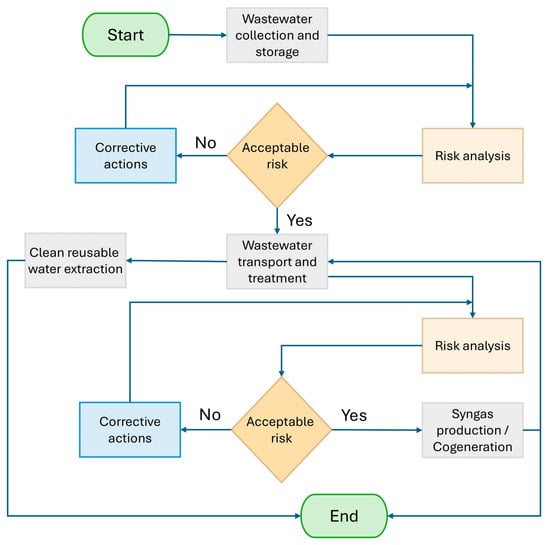
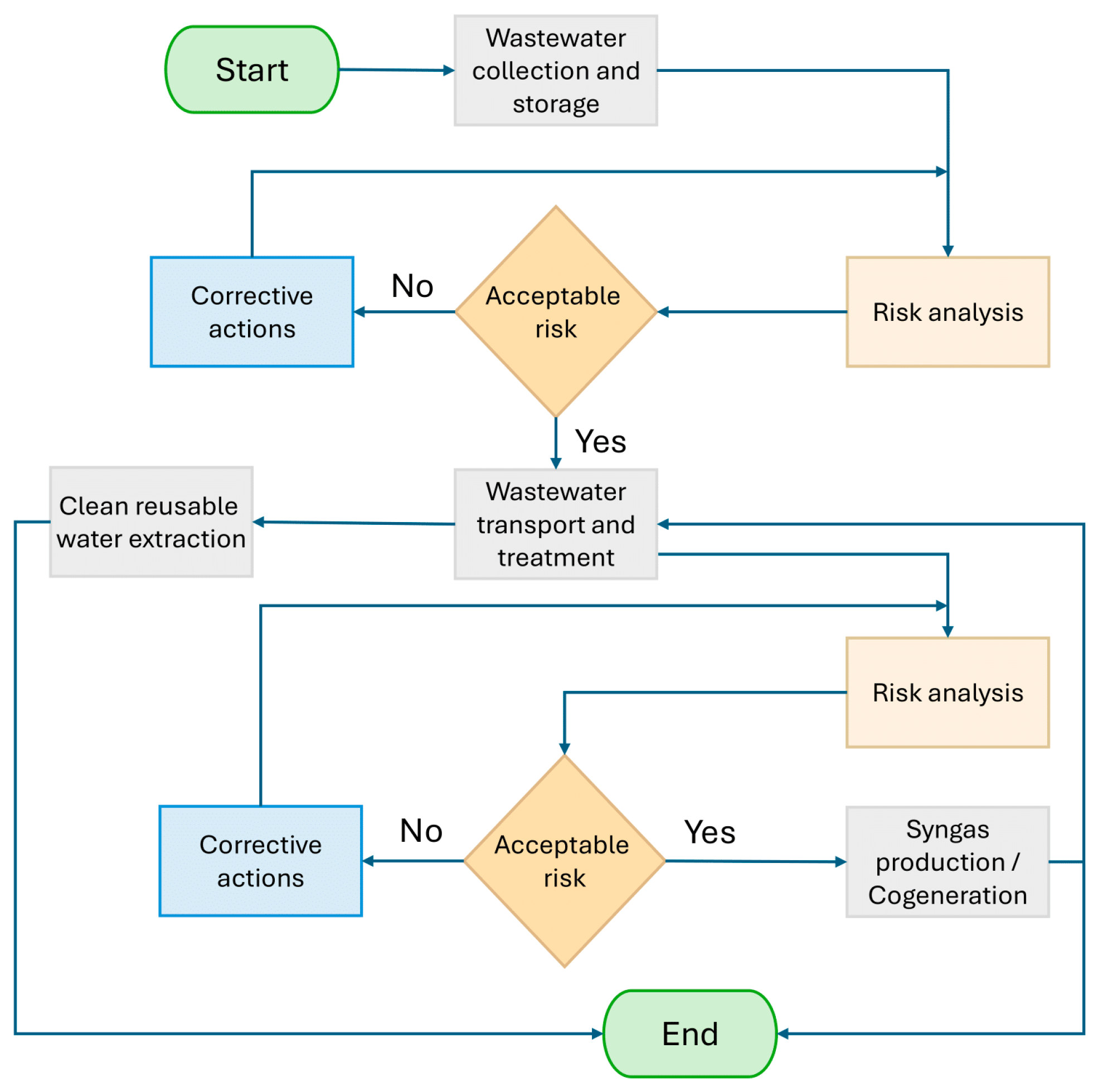
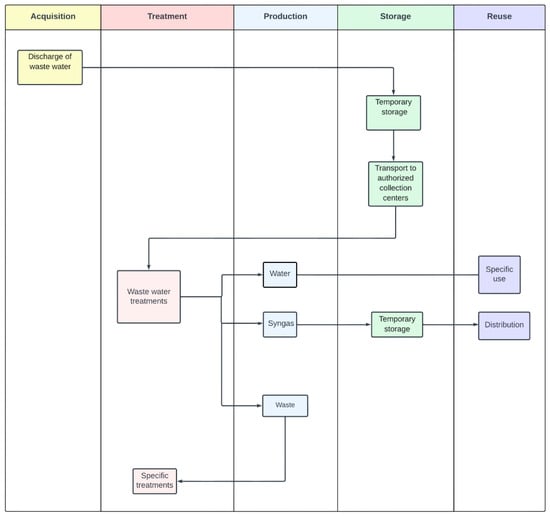
The construction of a model for the logistic-production process for the recovery and management of wastewater is hereby proposed. The management process of such effluents includes the collection and storage of liquids, the application of treatment methodologies to eliminate or minimize impurities, the production of water and syngas, and their subsequent distribution. Figure 1 shows a high-level flowchart of the proposed framework.
Figure 1.
High-level flowchart of the proposed framework.
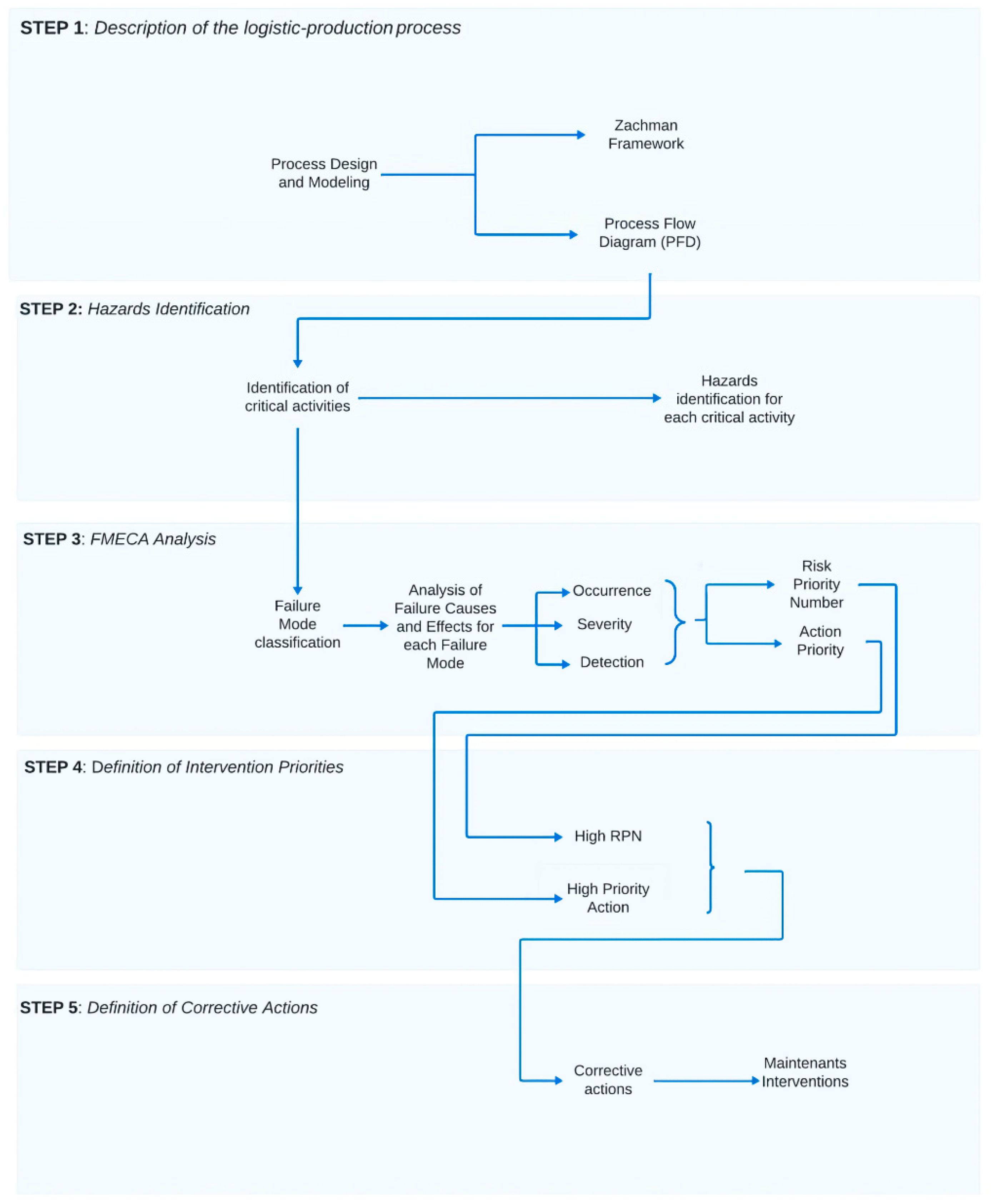
More specifically, the methodology is based on five main steps, as illustrated in Figure 2:
- Description of the logistics-production process;
- Hazard identification;
- Application of the FMECA (Failure Modes, Effects, and Criticality Analysis) technique for risk assessment;
- Definition of intervention priorities;
- Definition of corrective actions.
Figure 2.
Steps of the proposed methodology.
At each stage of the logistic-production process, risks will be assessed to ensure the overall safety and sustainability of activities related to the recovery and management of wastewater. This holistic approach aims to maximize the utilization of available resources while minimizing waste, thereby positively impacting both economic and environmental sustainability.
3.1. STEP 1: Description of the Logistic-Production Process
This first step provides a description of the process under analysis through the definition and modeling of an architecture and the configuration for the integrated logistics of wastewater/by-products supply and product distribution.
3.1.1. Definition of the Logistic-Production Process Architecture
The architecture of a logistic-production process refers to an organizational and conceptual support structure that serves as a “guide” for designing, implementing, and managing a process involving the production of goods (or services) and the associated logistical activities.
The Zachman framework is particularly valuable for its ability to identify and involve stakeholders within the process [54]. In the proposed methodology, inspiration is drawn from the Zachman framework, with both rows and columns adapted to the context of this study. In general, the framework is structured as a matrix, where the columns correspond to the questions “What?”, “How?”, “When?”, “Who?”, “Why?” while the rows have been tailored to the specific analysis.
This adaptation results in a new framework derived from the original Zachman model, in which the rows correspond to the components of the logistic-production process. In this way, a first structured description of the logistic-production process can be established.
3.1.2. Modeling the Logistic-Production Process
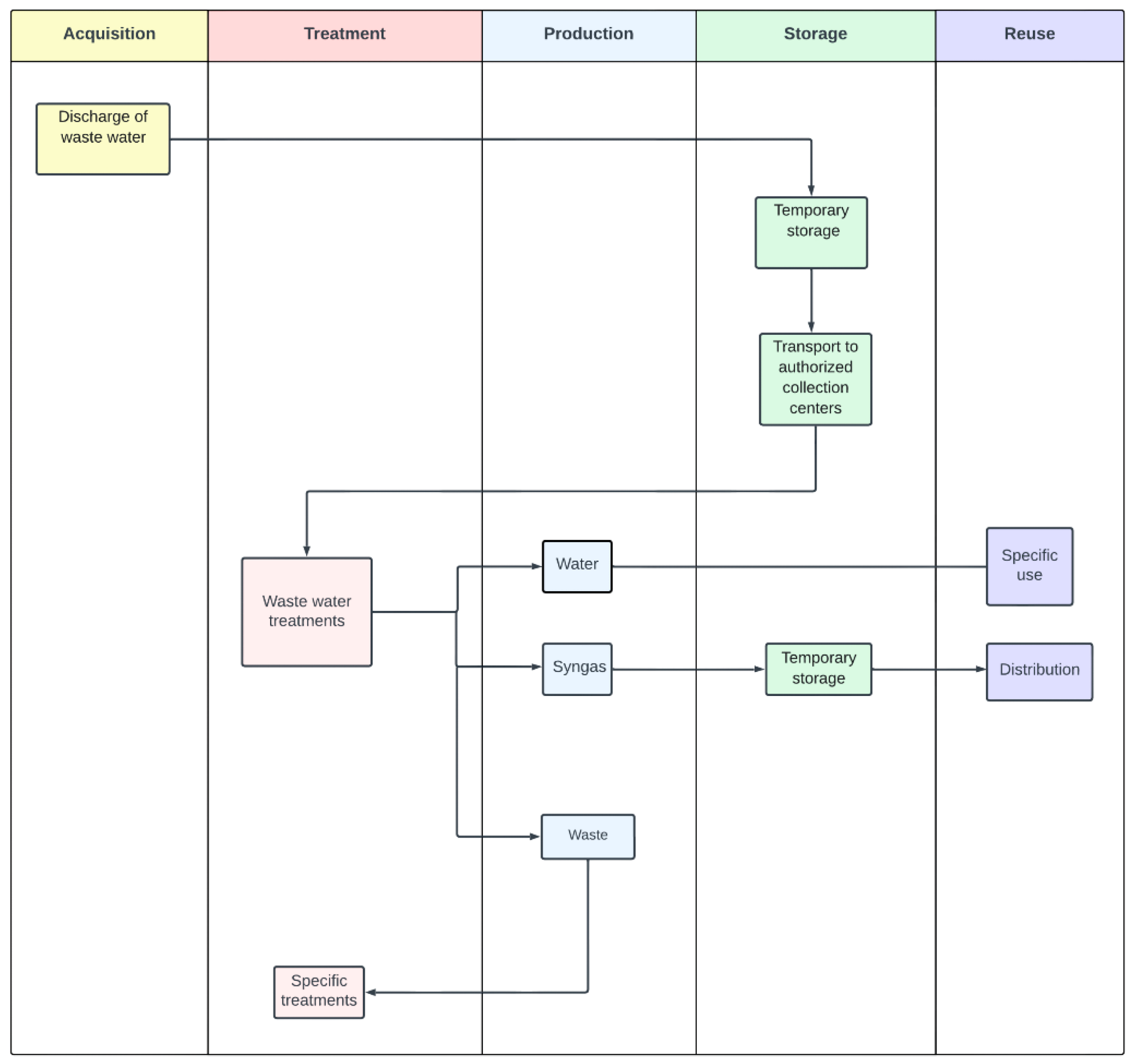
This second step refers to the construction of a Process Flow Diagram (PFD) with the aim of providing a detailed representation of the logistic-production process. The use of flow diagrams allows for a simplification in the understanding of complex processes and highlights the main phases of the process, as well as the sequence of activities identified within each of them. Figure 3 presents the PFD representation of the logistic-production process for the collection and management of wastewater.
Figure 3.
Logistic-Production Process Model.
3.2. STEP 2: Hazard Identification
Once the macro-phases of the process and the activities within each phase have been identified, the next step focuses on the recognition of critical activities, with the objective of identifying potential hazards. This step is structured into two sub-stages, described in the following.
3.2.1. Identification of Critical Activities
Critical activities are defined as those operations within a logistic–production context that may generate significant impacts, particularly in terms of safety and environmental protection. Such activities often involve the handling of hazardous elements or substances.
3.2.2. Identification of Hazards
According to Article 2 of Legislative Decree 81/08, a “hazard” is defined as an intrinsic property or quality of a given factor that has the potential to cause harm. Thus, a hazard is considered an inherent characteristic of an object, substance, or situation, independent of external factors, and represents a potential source of environmental damage. Examples include toxic chemicals, fire, explosions, or human error. In this stage, the analysis also refers to comparable case studies reported in scientific literature.
3.3. STEP 3: FMECA
The third step aims to determine, through the application of Failure Mode, Effects, and Criticality Analysis (FMECA), the Risk Priority Number (RPN) for each critical activity identified within the logistic–production process. This involves classifying the various failure modes, as well as identifying their causes and potential effects, to limit the occurrence of risks during the implementation phase of the process.
FMECA differs from the more traditional FMEA (Failure Mode and Effects Analysis) [55,56] by introducing the calculation of the Risk Priority Number (RPN), a quantitative index that enhances the precision of the methodology [57]. The RPN provides a numerical assessment of the risks associated with different failure modes, enabling a more accurate prioritization of risk mitigation actions.
3.4. STEP 4: Definition of Intervention Priorities
The output of the FMECA is the calculation of the RPN, determined in the previous step for each failure mode as the product of the three factors Occurrence (O), Severity (S), and Detection (D). In order to establish intervention priorities, the calculated RPN values are ranked in descending order.
It is important to note, however, that higher RPN values do not necessarily correspond to a greater need for corrective actions. This depends on the specific combination of the three factors and the relative weights assigned to each of them. To address this limitation, the AIAG & VDA manual [58] introduces the Action Priority (AP) method, which attributes greater importance to severity, followed by occurrence, and finally by detection.
Figure 4 [58] provides a three-level prioritization scale (high–medium–low) for the identification of corrective actions, where
- High Priority (H): maximum urgency for intervention;
- Medium Priority (M): moderate urgency for intervention;
- Low Priority (L): low urgency for intervention.
Figure 4.
Action Priority. Legend: O = Occurrence, S = Severity, D = Detection; H = High Priority, M = Medium Priority, L = Low Priority.
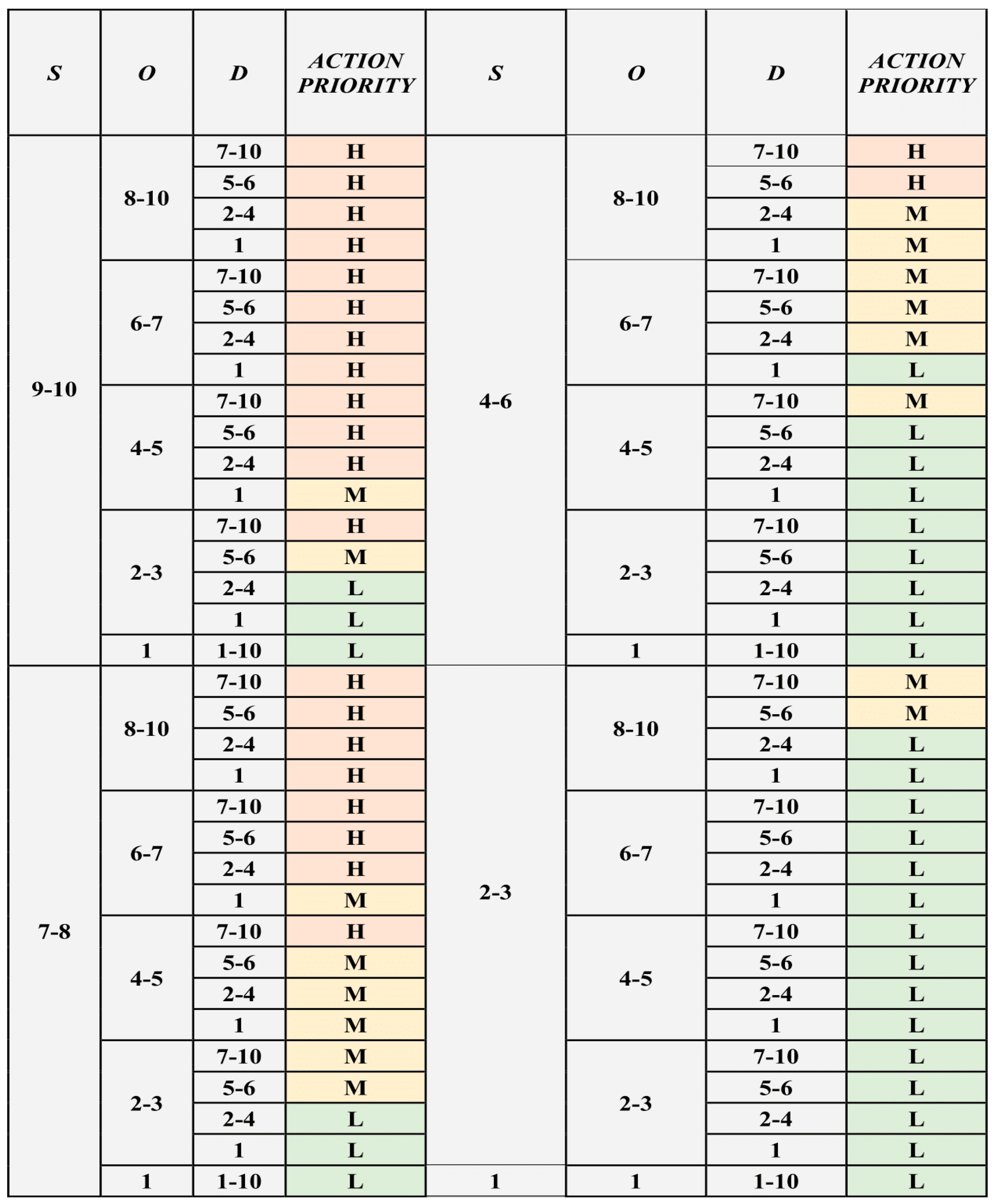
Once the RPN has been calculated and the AP determined for each failure mode, it becomes possible to identify which activities require immediate corrective actions and which can be managed progressively.
3.5. STEP 5: Definition of Corrective Actions
In the final step, corrective actions are defined for those activities exhibiting a high Action Priority, and it is assessed whether failure modes with elevated Risk Priority Numbers require immediate corrective measures.
Subsequently, a Causal Loop Diagram (CLD) is constructed. This diagram serves as a systems analysis tool for understanding the dynamics of the logistic-production process, providing a solid foundation for targeted actions aimed at continuous improvement and risk mitigation.
4. Results and Discussions
The proposed methodological approach for wastewater recovery and management provides a structured conceptual framework to examine the critical activities of the logistic-production process and allows for the definition of targeted preventive measures to mitigate negative impacts and enhance the safety of operations across the entire logistic-production chain.
At the end of the wastewater treatment, water is obtained whose characteristics vary depending on the methodology applied during the process. The treated water can be reused for different purposes, such as:
- cleaning of treatment facilities, thereby minimizing dependence on potable water;
- irrigation, supporting more sustainable agricultural practices and responsible use of water resources;
- transport to irrigation basins to address drought periods.
In parallel, the wastewater treatment process also enables the production of syngas, which, once purified, can be utilized for:
- generation of electrical and thermal energy that can be employed to minimize the energy costs required for wastewater treatment, thus contributing to the sustainability of the industry plant;
- commercialization for different applications, such as hydrogen production from renewable energy sources, thereby promoting the adoption of low-carbon solutions.
We emphasize that the main objective of this study is to propose a conceptual design of a logistic-production framework for wastewater recovery and risk management, developed on the basis of an extensive literature review and supported by an initial qualitative analysis of potential advantages and criticalities. Preliminary qualitative results suggest that the application of the proposed approach could optimize the use of available resources and minimize waste, thereby enhancing both economic and environmental sustainability, as detailed in the following section.
5. Policy and Economic Implications
The impact of sustainable solutions in energy transition can be investigated from different viewpoints, such as economic, social, environmental, and political [59,60,61]. The proposed methodological framework for wastewater recovery and management, indeed, can hold significant implications for both policy development and industrial economics.
From an economic viewpoint, the integration of energy recovery, particularly through syngas production, enables a comprehensive cost–benefit analysis that extends beyond conventional treatment processes. The valorization of by-products, such as biogas and syngas, can offset operational costs associated with wastewater treatment plants, potentially transforming these facilities from cost centers into revenue-generating units. This shift supports the long-term financial sustainability of treatment infrastructures, reducing dependency on external energy sources and minimizing waste disposal costs.
For industrial management, the application of the framework can facilitate informed decision-making by quantifying risks and prioritizing interventions. This structured approach enhances process reliability, operational safety, and resource efficiency. As industries increasingly adopt circular production models, the ability to integrate wastewater treatment with energy recovery and resource reuse becomes a competitive advantage that aligns economic objectives with environmental performance.
From a policy perspective, the methodology contributes to the suggestion of regulatory strategies that promote circular transition pathways. By linking technological innovation with structured risk assessment, it provides empirical support for policies encouraging waste-to-resource initiatives and energy valorization, offering a reference model for aligning industrial practices with sustainability targets.
The combination of technical feasibility, economic viability, and policy coherence positions the proposed framework as a strategic instrument for advancing sustainable and circular wastewater management at both industrial and policy levels.
However, despite the potential benefits, the technology adoption of waste-to-energy solutions is challenged by financial constraints, technical maturity, environmental impacts, supporting policies, and public acceptance [62]. To overcome some of these issues, a deeper understanding of the complex finance-energy transition relationship is necessary to provide useful information for policy decision-making and interdisciplinary research [63]. Furthermore, public perception regarding energy transition and the challenges of environmental protection must be considered to promote the large-scale diffusion of sustainable energy solutions [64].
6. Conclusions
The recovery and management of wastewater is more and more important in recent years; in fact, industrial systems are moving toward circular economy principles and the paradigm of Industry 4.0. Although this growing interest, existing research often lacks an integrated framework capable of effectively connecting the operational stages of wastewater treatment with structured risk assessment tools. Widely adopted methodologies such as Life Cycle Assessment (LCA) and Environmental Risk Assessment (ERA) typically emphasize global environmental performance, emissions, resource use, exposure pathways, and long-term sustainability. Therefore, they offer limited support at the operational level, where identifying failure modes, prioritizing risks, and defining corrective actions within internal logistical and production processes are critical.
To address this gap, this study proposes a conceptual integrated methodology that combines the sequential phases of wastewater recovery with a structured risk analysis technique, FMECA, and the AP approach. This framework enables early detection of critical vulnerabilities, supports clearer prioritization of mitigation measures, and fosters a more proactive, resilient approach to system management.
A preliminary qualitative analysis shows that this methodology may achieve positive economic, social, and political outcomes. By combining technical feasibility, cost optimization, and alignment with international circular-economy principles, the proposed approach emerges as a potentially strategic tool for supporting sustainable, circular wastewater management. Nevertheless, several challenges remain, including financial viability, technological maturity, and limited availability of supportive policy frameworks. In addition, social acceptance and public perception of the energy transition represent key factors that must be addressed to facilitate the large-scale implementation of sustainable solutions.
Future research will focus on the application and validation of the proposed methodology through an experimental case study, aiming to assess its feasibility and effectiveness in complex operational contexts.
Author Contributions
Conceptualization, T.M.; methodology, T.M. and M.d.F.; formal analysis, M.d.F.; investigation, R.M.; resources, R.M.; data curation, R.M.; writing—original draft preparation, M.d.F.; writing—review and editing, T.M.; visualization, R.M.; supervision, T.M.; project administration, T.M. All authors have read and agreed to the published version of the manuscript.
Funding
This research received no external funding.
Data Availability Statement
The data presented in this study are available upon request from the authors.
Conflicts of Interest
The authors declare no conflict of interest.
Abbreviations
The following abbreviations are used in this manuscript:
| AGS | Anaerobic Granular Sludge |
| AOP | Advanced Oxidation Processes |
| AP | Action Priority |
| BCH | Bubble Column Humidifier |
| CLD | Causal Loop Diagram |
| COD | Chemical Oxygen Demand |
| EC | Electrocoagulation |
| EPS | Extracellular Polymeric Substances |
| FMEA | Failure Mode and Effects Analysis |
| FMECA | Failure Modes, Effects, and Criticality Analysis |
| HPA | Polyhydroxyalkanoates |
| HRT | Hydraulic Retention Time |
| IEA | International Energy Agency |
| MBBR | Moving Bed Biofilm Reactor |
| MEC | Microbial Electrolysis Cell |
| MF | Microfiltration |
| MFC | Microbial Fuel Cell |
| NF | Nanofiltration |
| NTU | Nephelometric Turbidity Unit |
| OWS | Oil Water Separator |
| RPN | Risk Priority Number |
| SBR | Sequencing Batch Reactor |
| SS | Suspended Solids |
| TOC | Total Organic Carbon |
| UF | Ultrafiltration |
| WAO | Wet Air Oxidation |
| ZVI | Zero-Valent Iron |
References
- Bellver-Domingo, Á.; Hernández-Sancho, F. Circular economy and payment for ecosystem services: A framework proposal based on water reuse. J. Environ. Manag. 2022, 305, 114416. [Google Scholar] [CrossRef] [Scilit]
- Puyol, D.; Batstone, D.J.; Hülsen, T.; Astals, S.; Peces, M.; Krömer, J.O. Resource recovery from wastewater by biological technologies: Opportunities, challenges, and prospects. Front. Microbiol. 2017, 7, 2106. [Google Scholar] [CrossRef] [Scilit]
- Di Nardo, M.; Gallab, M.; Murino, T.; Wu, J.; Pandey, S. Integrating sustainability and industry 4.0: A framework for sustainable logistics 4.0. Circ. Econ. Sustain. 2025, 1, 2157–2195. [Google Scholar] [CrossRef] [Scilit]
- Castiglione, A.; Cimmino, L.; Di Nardo, M.; Murino, T. Optimising production efficiency: Managing flexibility in Industry 4.0 systems via simulation. Comput. Ind. Eng. 2024, 197, 110540. [Google Scholar] [CrossRef] [Scilit]
- Upadhyay, A.; Balodi, K.C.; Naz, F.; Di Nardo, M.; Jraisat, L. Implementing industry 4.0 in the manufacturing sector: Circular economy as a societal solution. Comput. Ind. Eng. 2023, 177, 109072. [Google Scholar] [CrossRef] [Scilit]
- Caiazzo, B.; Di Nardo, M.; Murino, T.; Petrillo, A.; Piccirillo, G.; Santini, S. Towards Zero Defect Manufacturing paradigm: A review of the state-of-the-art methods and open challenges. Comput. Ind. 2022, 134, 103548. [Google Scholar] [CrossRef] [Scilit]
- Piubello Orsini, L.; Leardini, C.; Danesi, L.; Guerrini, A.; Frison, N. Circular economy in the water and wastewater sector: Tariff impact and financial performance of SMARTechs. Util. Policy 2023, 83, 101593. [Google Scholar] [CrossRef] [Scilit]
- Najar, I.N.; Sharma, P.; Das, R.; Tamang, S.; Mondal, K.; Thakur, N.; Gandhi, S.G.; Kumar, V. From waste management to circular economy: Leveraging thermophiles for sustainable growth and global resource optimization. J. Environ. Manag. 2024, 360, 121136. [Google Scholar] [CrossRef] [Scilit] [PubMed]
- Hernández-Chover, V.; Castellet-Viciano, L.; Fuentes, R.; Hernández-Sancho, F. Circular economy and efficiency to ensure the sustainability in the wastewater treatment plants. J. Clean. Prod. 2023, 384, 135563. [Google Scholar] [CrossRef] [Scilit]
- Li, S. Reviewing Air Pollutants Generated during the Pyrolysis of Solid Waste for Biofuel and Biochar Production: Toward Cleaner Production Practices. Sustainability 2024, 16, 1169. [Google Scholar] [CrossRef] [Scilit]
- Liu, Z.; Xu, Z.; Zhu, X.; Yin, L.; Yin, Z.; Li, X.; Zheng, W. Calculation of carbon emissions in wastewater treatment and its neutralization measures: A review. Sci. Total Environ. 2024, 912, 169356. [Google Scholar] [CrossRef] [Scilit]
- Koseoglu-Imer, D.Y.; Oral, H.V.; Coutinho Calheiros, C.S.; Krzeminski, P.; Güçlü, S.; Pereira, S.A.; Surmacz-Górska, J.; Plaza, E.; Samaras, P.; Binder, P.M.; et al. Current challenges and future perspectives for the full circular economy of water in European countries. J. Environ. Manag. 2023, 345, 118627. [Google Scholar] [CrossRef] [Scilit] [PubMed]
- Moya-Fernández, P.J.; López-Ruiz, S.; Guardiola, J.; González-Gómez, F. Determinants of the acceptance of domestic use of recycled water by use type. Sustain. Prod. Consum. 2021, 27, 575–586. [Google Scholar] [CrossRef] [Scilit]
- Castellet-Viciano, L.; Hernández-Chover, V.; Hernández-Sancho, F. The benefits of circular economy strategies in urban water facilities. Sci. Total Environ. 2022, 844, 157172. [Google Scholar] [CrossRef] [Scilit]
- Corominas, L.; Byrne, D.M.; Guest, J.S.; Hospido, A.; Roux, P.; Shaw, A.; Short, M.D. The application of life cycle assessment (LCA) to wastewater treatment: A best practice guide and critical review. Water Res. 2020, 184, 116058. [Google Scholar] [CrossRef] [Scilit]
- Finckh, S.; Beckers, L.-M.; Busch, W.; Carmona, E.; Dulio, V.; Kramer, L.; Krauss, M.; Posthuma, L.; Schulze, T.; Slootweg, J.; et al. A risk based assessment approach for chemical mixtures from wastewater treatment plant effluents. Environ. Int. 2022, 164, 107234. [Google Scholar] [CrossRef] [Scilit] [PubMed]
- Eskandarloo, H.; Selig, M.J.; Abbaspourrad, A. In situ H2O2 generation for deemulsification of fine stable bilge water emulsions. Chem. Eng. J. 2018, 335, 434–442. [Google Scholar] [CrossRef] [Scilit]
- Gryta, M. The application of submerged modules for membrane distillation. Membranes 2020, 10, 25. [Google Scholar] [CrossRef] [Scilit]
- Vyrides, I.; Andronikou, M.; Kyprianou, A.; Modic, A.; Filippeti, A.; Yiakoumis, C.; Samanides, C.G. CO2 conversion to CH4 using Zero Valent Iron (ZVI) and anaerobic granular sludge: Optimum batch conditions and microbial pathways. J. CO2 Util. 2018, 27, 415–422. [Google Scholar] [CrossRef] [Scilit]
- McLaughlin, C.; Falatko, D.; Danesi, R.; Albert, R. Characterizing shipboard bilgewater effluent before and after treatment. Environ. Sci. Pollut. Res. 2014, 21, 5637–5652. [Google Scholar] [CrossRef] [Scilit]
- Bian, Y.; Ge, Z.; Albano, C.; Lobo, F.L.; Ren, Z.J. Oily bilge water treatment using DC/AC powered electrocoagulation. Environ. Sci. Water Res. Technol. 2019, 5, 1654–1660. [Google Scholar] [CrossRef] [Scilit]
- Karakulski, K.; Gryta, M. The application of ultrafiltration for treatment of ships generated oily wastewater. Chem. Pap. 2017, 71, 1165–1173. [Google Scholar] [CrossRef] [Scilit]
- Gryta, M. Resistance of polypropylene membrane to oil fouling during membrane distillation. Membranes 2021, 11, 552. [Google Scholar] [CrossRef] [Scilit]
- Tomczak, W.; Gryta, M. Application of ultrafiltration ceramic membrane for separation of oily wastewater generated by maritime transportation. Sep. Purif. Technol. 2021, 261, 118259. [Google Scholar] [CrossRef] [Scilit]
- Tan, Z.; Chen, S.; Mao, X.; Lv, H.; Wang, Y.; Ye, X. Antifouling BaTiO3/PVDF piezoelectric membrane for ultrafiltration of oily bilge water. Water Sci. Technol. 2022, 85, 2980–2992. [Google Scholar] [CrossRef] [Scilit]
- Kuligin, S.V.; Kosyakov, A.V.; Belov, P.V.; Lapenko, A.A.; Ishkov, A.D. Water purification from oil and petrol products by means of nano-porous super-hydrophilic materials. Nanotechnol. Constr. 2021, 13, 63–72. [Google Scholar] [CrossRef] [Scilit]
- Mustapha, S.N.A.; Amran, N.A.; Roslan, I.L.; Chandra Segaran, R.; Samsuri, S. Potential efficient separation of oil from bilgewater and kitchen wastewater by fractional freezing process. Crystals 2021, 11, 685. [Google Scholar] [CrossRef] [Scilit]
- Chen, H.; Zheng, Q.-R.; Wu, M.-B.; Chai, R.; Zhuang, D.-X.; Shi, J.-X.; Li, L.-P. Development of carbon based composites for filtering elements used on bilge’s oily water treatment units. Results Eng. 2022, 15, 100511. [Google Scholar] [CrossRef] [Scilit]
- Cataldo, S.; Muratore, N.; Giannici, F.; Bongiorno, D.; Chiodo, V.; Maisano, S.; Pettignano, A. Hydrocarbons removal from synthetic bilge water by adsorption onto biochars of dead Posidonia oceanica. Environ. Sci. Pollut. Res. 2022, 29, 90231–90247. [Google Scholar] [CrossRef] [Scilit]
- Waller, G.H.; Martin, C.A.; Jones, N.J.; Paynter, D.M. Treatment of oil-in-saltwater emulsions by in-situ production of magnetic FeOx nanoparticles. J. Water Process Eng. 2019, 31, 100851. [Google Scholar] [CrossRef] [Scilit]
- Vozniuk, M.; Shabliy, T.; Gomelya, M.; Sirenko, L.; Sidorov, D. Electrochemical Purification of Oil-Containing Shipping Waters. J. Ecol. Eng. 2023, 24, 246–253. [Google Scholar] [CrossRef] [Scilit] [PubMed]
- Fontana, D.; Cardenia, C.; Pietrantonio, M.; Pucciarmati, S.; Forte, F. Applications of advanced oxidative processes for the recovery of water from bilge water. Int. J. Environ. Sci. Technol. 2023, 20, 8561–8570. [Google Scholar] [CrossRef] [Scilit]
- Zhang, Y.; Jiang, F.; Wang, M.; Zhang, C.; Gong, H.; Qiu, Y.; Feng, X.; Han, Q.; Guo, F. Cysteine controlled Fe2+/PS system to efficiently treat coking wastewater and recover magnetic products simultaneously. Sep. Purif. Technol. 2025, 379, 134987. [Google Scholar] [CrossRef] [Scilit]
- Drakou, E.M.; Amorim, C.L.; Castro, P.M.L.; Panagiotou, F.; Vyrides, I. Wastewater Valorization by Pure Bacterial Cultures to Extracellular Polymeric Substances (EPS) with High Emulsifying Potential and Flocculation Activities. Waste Biomass Valorization 2018, 9, 2557–2564. [Google Scholar] [CrossRef] [Scilit]
- Nisenbaum, M.; Corti-Monzón, G.; Villegas-Plazas, M.; Junca, H.; Mangani, A.; Patat, M.L.; González, J.F.; Murialdo, S.E. Enrichment and key features of a robust and consistent indigenous marine-cognate microbial consortium growing on oily bilge wastewaters. Biodegradation 2020, 31, 91–108. [Google Scholar] [CrossRef] [Scilit]
- Hwang, J.H.; Kim, K.Y.; Resurreccion, E.P.; Lee, W.H. Surfactant addition to enhance bioavailability of bilge water in single chamber microbial fuel cells (MFCs). J. Hazard. Mater. 2019, 368, 732–738. [Google Scholar] [CrossRef] [Scilit]
- Hwang, J.H.; Ryu, H.; Rodriguez, K.L.; Fahad, S.; Domingo, J.S.; Kushima, A.; Lee, W.H. A strategy for power generation from bilgewater using a photosynthetic microalgal fuel cell (MAFC). J. Power Sources 2021, 484, 229222. [Google Scholar] [CrossRef] [Scilit] [PubMed]
- Shi, J.; Zhang, G.; Zhang, S.; Lu, R.; Chen, M. Biodegradation and optimization of bilge water in a sequencing batch reactor using response surface methodology. Chemosphere 2022, 307, 135654. [Google Scholar] [CrossRef] [Scilit]
- Uma, V.; Gandhimathi, R. Organic removal and synthesis of biopolymer from synthetic oily bilge water using the novel mixed bacterial consortium. Bioresour. Technol. 2019, 273, 169–176. [Google Scholar] [CrossRef] [Scilit] [PubMed]
- Mazioti, A.A.; Notarides, G.; Symeou, G.; Vyrides, I. Improving Biological Treatment of Real Bilge Wastewater With Zero Valent Iron and Activated Charcoal Addition. Front. Bioeng. Biotechnol. 2020, 8, 614510. [Google Scholar] [CrossRef] [Scilit]
- Gatidou, G.; Drakou, E.M.; Vyrides, I. Assessment of Bilge Water Degradation by Isolated Citrobacter sp. and Two Indigenous Strains and Identification of Organic Content by GC-MS. Water 2022, 14, 1350. [Google Scholar] [CrossRef] [Scilit]
- Ameen, F.; Al-Homaidan, A.A. Oily bilge water treatment using indigenous soil bacteria: Implications for recycling the treated sludge in vegetable farming. Chemosphere 2023, 334, 139040. [Google Scholar] [CrossRef] [Scilit] [PubMed]
- Mazioti, A.A.; Koutsokeras, L.E.; Constantinides, G.; Vyrides, I. Untapped potential of moving bed biofilm reactors with different biocarrier types for bilge water treatment: A laboratory-scale study. Water 2021, 13, 1810. [Google Scholar] [CrossRef] [Scilit]
- Mazioti, A.A.; Vyrides, I. Treatment of high-strength saline bilge wastewater by four pilot-scale aerobic moving bed biofilm reactors and comparison of the microbial communities. Environ. Technol. 2022, 44, 3600–3616. [Google Scholar] [CrossRef] [Scilit]
- Besharati Fard, M.; Hamidi, D.; Alavi, J.; Jamshidian, R.; Pendashteh, A.; Mirbagheri, S.A. Saline oily wastewater treatment using Lallemantia mucilage as a natural coagulant: Kinetic study, process optimization, and modeling. Ind. Crops Prod. 2021, 163, 113326. [Google Scholar] [CrossRef] [Scilit]
- Hamidi, D.; Besharati Fard, M.; Yetilmezsoy, K.; Alavi, J.; Zarei, H. Application of Orchis mascula tuber starch as a natural coagulant for oily-saline wastewater treatment: Modeling and optimization by multivariate adaptive regression splines method and response surface methodology. J. Environ. Chem. Eng. 2021, 9, 104745. [Google Scholar] [CrossRef] [Scilit]
- Yang, B.; Jiang, F.; Zhao, Y.; Li, H.; Zhang, S.; Liu, K. Phosphate removal performance and mechanism of zirconium-doped magnetic gasification slag. Arab. J. Chem. 2025, 18, 106079. [Google Scholar] [CrossRef] [Scilit]
- Mei, X.; Wang, H.; Hou, D.; Lobo, F.L.; Xing, D.; Ren, Z.J. Shipboard bilge water treatment by electrocoagulation powered by microbial fuel cells. Front. Environ. Sci. Eng. 2019, 13, 46. [Google Scholar] [CrossRef] [Scilit]
- Pinchai, C.; Monnot, M.; Lefèvre, S.; Boutin, O.; Moulin, P. Membrane filtration coupled with wet air oxidation for intensified treatment of biorefractory effluents. Water Sci. Technol. 2019, 80, 2338–2343. [Google Scholar] [CrossRef] [Scilit] [PubMed]
- Uma, V.; Gandhimathi, R. Effectiveness of ozone pretreatment on bioconversion of oily bilge water into biopolymer. J. Water Process Eng. 2020, 36, 101275. [Google Scholar] [CrossRef] [Scilit]
- Öz, Ç.; Çetin, E. Treatment of bilge water by fenton oxidation followed by granular activated carbon adsorption. Water 2021, 13, 2792. [Google Scholar] [CrossRef] [Scilit]
- Gatidou, G.; Constantinou, M.; Koutsokeras, L.; Vyrides, I.; Constantinides, G. Efficiency of Carbon-Based Electrodes on a Microbial Electrolysis System for the Treatment of Bilge Water. Front. Environ. Sci. 2022, 10, 894240. [Google Scholar] [CrossRef] [Scilit]
- Eder, E.; Cordin, M.; Pham, T.; Brüggemann, D.; Preißinger, M. An experimental study of oily wastewater treatment in a humidification–dehumidification system with bubble column humidifier. Therm. Sci. Eng. Prog. 2023, 37, 101578. [Google Scholar] [CrossRef] [Scilit]
- Noran, O. An analysis of the Zachman framework for enterprise architecture from the GERAM perspective. Annu. Rev. Control 2003, 27, 163–183. [Google Scholar] [CrossRef] [Scilit]
- Naciri, L.; Merzouk, S.; Gallab, M.; Chourak, M.; Di Nardo, M.; Murino, T.; Galli, G.; Jais, H.K.; Bouterfa, H.; Benkaddour, H. Addressing Uncertainty in Digital Risk Evaluation Using a Fuzzy-FMEA Methodology. Res. Sq. 2025. [Google Scholar] [CrossRef] [Scilit]
- Murino, T.; Di Nardo, M.; Pollastro, D.; Berx, N.; Di Francia, A.; Decré, W.; Pintelon, L. Exploring a cobot risk assessment approach combining FMEA and PRAT. Qual. Reliab. Eng. Int. 2023, 39, 706–731. [Google Scholar] [CrossRef] [Scilit]
- Di Nardo, M.; Murino, T.; Osteria, G.; Santillo, L.C. A new hybrid dynamic FMECA with decision-making methodology: A case study in an agri-food company. Appl. Syst. Innov. 2022, 5, 45. [Google Scholar] [CrossRef] [Scilit]
- AIAG; VDA. FMEA—Failure Mode and Effects Analysis. 2019. Available online: https://pq-fmea.com/?gad_source=1&gad_campaignid=23300053618&gbraid=0AAAABAB9FGYM_gMSbBXBr3JYrJw_yY4X&gclid=Cj0KCQiAx8PKBhD1ARIsAKsmGbfywZb2m7O_-ilqi1cQRaj_4ud8k9jGagQbKHSZlIyyZoKP1c8P4U8aAn2IEALw_wcB (accessed on 24 December 2025).
- Gniadkowska-Szymańska, A.; Keller, J.; Kowalska, M. Renewable Energy, Macroeconomic Stability and the Sustainable Development of the Logistics Sector: Evidence from the Visegrad Countries. Energies 2025, 18, 5557. [Google Scholar] [CrossRef] [Scilit]
- Elhaj, M.; Mabrouk, F.; Alotaibi, L. Financing the Green Transition: How Green Finance and Renewable Energy Drive CO2 Mitigation. Energies 2025, 18, 5563. [Google Scholar] [CrossRef] [Scilit]
- Nwala, K.C.; Kabeyi, M.J.B.; Olanrewaju, O.A. A Visual and Strategic Framework for Integrated Renewable Energy Systems: Bridging Technological, Economic, Environmental, Social, and Regulatory Dimensions. Energies 2025, 18, 5468. [Google Scholar] [CrossRef] [Scilit]
- Agaton, C.B.; Santos, M.J.A. Social Acceptability of Waste-to-Energy: Research Hotspots, Technologies, and Factors. Clean Technol. 2025, 7, 63. [Google Scholar] [CrossRef] [Scilit]
- Fan, S.; Zhao, Y.; Zuo, S. Financial Development and Energy Transition: A Literature Review. Energies 2025, 18, 4166. [Google Scholar] [CrossRef] [Scilit]
- Chomać-Pierzecka, E.; Kowalska, M.; Czyrka, K. The Problem of Transforming the Energy System Towards Renewable Energy Sources as Perceived by Inhabitants of Rural Areas in South-Eastern Poland. Energies 2025, 18, 5548. [Google Scholar] [CrossRef] [Scilit]
Disclaimer/Publisher’s Note: The statements, opinions and data contained in all publications are solely those of the individual author(s) and contributor(s) and not of MDPI and/or the editor(s). MDPI and/or the editor(s) disclaim responsibility for any injury to people or property resulting from any ideas, methods, instructions or products referred to in the content. |
© 2025 by the authors. Published by MDPI on behalf of the International Institute of Knowledge Innovation and Invention. Licensee MDPI, Basel, Switzerland. This article is an open access article distributed under the terms and conditions of the Creative Commons Attribution (CC BY) license.