


Abstract
This article took the case of the adoption of a Machine Learning (ML) solution in a steel manufacturing process through a platform provided by a Canadian startup, Canvass Analytics. The content of the paper includes a study around the state of the art of AI/ML adoption in steel manufacturing industries to optimize processes. The work aimed to highlight the opportunities that bring new business models based on AI/ML to improve processes in traditional industries. Methodologically, bibliographic research in the Scopus database was performed to establish the conceptual framework and the state of the art in the steel industry, then the case was presented and analyzed, to finally evaluate the impact of the new business model on the operation of the steel mill. The results of the case highlighted the way the innovative business model, based on a No-Code/Low-Code solution, achieved results in less time than conventional approaches of analytics solutions, and the way it is possible to democratize artificial intelligence and machine learning in traditional industrial environments. This work was focused on opportunities that arise around new business models linked to AI. In addition, the study looked into the framework of the adoption of AI/ML in a traditional industrial environment toward a smart manufacturing approach. The contribution of this article was the proposal of an innovative methodology to put AI/ML in the hands of process operators. It aimed to show how it was possible to achieve better results in a less complex and time-consuming adoption process. The work also highlighted the need for an important quantity of data from the process to approach this kind of solution.
1. Introduction
This article tackles the opportunities that new business models [1] based on artificial intelligence (AI) can generate to transform traditional factories toward a smarter and more efficient environment, and how people on the shop floor can be empowered by the information these types of solutions produce. To illustrate the subject, the article presents a case of a steel industry that needed to improve the process of its blast furnace, with a focus on energy consumption, quality consistency, and lower silicon usage. The work from [2] highlighted the disruptive potential of AI, and more recently, machine learning (ML), to generate new business models and opportunities for entrepreneurs. The authors support the conceptual development with many cases from practice, and conclude that the innovative potential of the new business models can give rise to radical new operating models that could lead to firms of a kind not seen before.
Another point to address, connected with the subject this article aimed to tackle, was raised by [3] regarding opportunities for the development of smart industries, and their expansion and evolution of production processes. This was a result of the demand for more efficient technologies and procedures, quality standards, and cost reduction, as well as technological improvement. Furthermore, a large variety of issues were discussed regarding Industry 4.0; the main focus of the new production paradigm is to bring into existing industries more intelligent and adaptable processes, with better use of production resources. In the article, the authors provided an interesting approach to industrial process optimization and smart manufacturing.
To complete the idea put forth in the previous paragraphs, [4] highlighted that there is a huge quantity of legacy, enterprise, and operational systems data that is not being used. The article pointed out that manufacturers are sitting on a goldmine of unexplored historical, legacy, and operational data from their manufacturing execution systems (MESs) and enterprise resource planning systems (ERPs), among other software sources, and they cannot afford to miss out on its unexplored potential. However, only 20–30% of the value from such available data-at-rest is currently accrued.
This article considered the ideas in the previous paragraphs regarding opportunities using data models to generate value from them. New business models can be generated to transform traditional factories toward a smarter and efficient environment, and people on the shop floor can be empowered by the information these solutions produce.
The authors aimed to go deeper than previous research on the subject [5], and intended to illustrate the way a new business model based on an AI/ML platform with a No-Code/Low-Code solution approach can transform a traditional production process. The value proposal of the new business model is focused on easing the implementation process in the industrial environment and augmenting industrial operators’ knowledge. The work begins with brief research conducted in the Scopus scientific database. This first section highlights concepts regarding data analysis related to the steel industry, and presents the state of the art in the use of AI/ML in this industrial sector. Then, the startup and its business model are introduced, and finally, we describe the case at the steel mill, the solution adopted, and the results achieved.
2. Related Works in Steelmaking
This section presents a brief study of the state of the art in the adoption of AI/ML in the steel industry. After performing a simple query with “ML” and “steel industry” as keywords in the Scopus scientific database (performed on 27 August 2021, a total of 99 works regarding the subject were found.
Among the most interesting ones to consider that were related to the case studied were the works of [6,7,8,9,10,11].
From the works mentioned in the above paragraph, [6] had a great relevance to the case presented in this paper, due to the fact that it referred to an ML-based computational methodology used for improvement in the productivity of the blast furnace at Jindal Steel and Power Limited (JSPL), India. These improvements took about 18 months, and were made possible by, among other things, the use of ML employed alongside domain knowledge of blast furnace specialists.
The authors highlighted the importance of ML methods in improving productivity and quality in continuous-flow materials processing, such as in a blast furnace, which takes in various earth ore materials and outputs hot metal.
According to [6], a structured business intelligence platform is the basis for the use of a statistical data analytics approach, empowered by emerging technologies of AI and ML for the extraction of hidden knowledge useful for production, cost, and quality optimization. The steelmaking industry is an open field in which to apply these techniques: the high availability of data and the necessity to control complex and multiphysics processes meet the requirements for a successful implementation of a data-driven approach. They showed this at ABS, Acciaierie Bertoli Safau, Italy, which, together with the expertise of industrial partners, began using predictive analytics.
Another interesting work is presented by [8] which presents a methodology to contribute with solutions for facing the challenges of data processing and rendering, and predictive model design, which have been deployed in a factory of ACERINOX Europa S.A.U.
The study in [9] at Gerdau Aços Longos SA, Brazil, presented a solution based on ML to make possible for a billet with a steel grade different than expected to be misplaced and loaded. The methodology identified the steel of the bar being rolled through the rolling stand motors as currently used. Using an outlier detection technique, it was possible to identify patterns in the data for every steel grade, identifying when it did not match the expected in the simulated data. Currently, the model is working offline, and further testing will be realized during production to validate the model’s efficiency.
Ref. [10] presented a case of Falkonry’s Operational AI as a novel solution to approach the challenges of scaling machine learning and AI in manufacturing. This intelligent first step toward creating machine learning applications is based on a consistent, repeatable, time-series classification technique that is robust for incomplete and irregular data, engenders expert knowledge capture, and leads to real-time actions to positively affect production. The paper discussed underlying challenges in the real-time application of Operational AI in production systems, and presented a real-world case study of how Operational AI was applied in steel manufacturing at the production scale to predict equipment failure in order to reduce unexpected downtime.
Finally, [11] addressed the difficulty in applying AI and ML in traditional industries, mainly for two reasons: (a) it is not really big data, although megabytes are being logged by the comprehensive automation system of steel plants from thousands of field sensors every week; and (b) purely data-based model results have a likelihood of some 70 or 80% to deliver the correct result or decision proposal, but this will not deliver an assured best/optimized control mode for production or quality. Until now, such a likelihood percentage did not seem sufficient in the business-to-business (B2B) field.
The last two papers were particularly interesting for this work because both referred to business models using AI/ML to facilitate the adoption of analytics solutions in traditional industries such as steel production.
3. AI/ML and Considerations of the Process in the Blast Furnace
The study in [12] affirmed that process systems in steelmaking are complex entities, involving raw materials, products, energy, processes, automated systems, and people. Their efficient operation involves numerous functions and tasks. A commonly used classification for process systems includes planning, scheduling, real-time optimization, and control.
More specifically, [6] pointed out that modern blast furnace (BF) processes are influenced by many factors, with quite a few of them interacting with each other. It is fair to say that the process is immensely complex. While process complexity in modern state-of-the-art blast furnaces have the positive effect of allowing a higher theoretical limit on both productivity and quality, but this also lends itself to undesirable chronic patterns of behavior that become intractable, leading to lower productivity and quality. It is in this context that machine learning methods become a useful device and a vehicle for discovery.
The complexity of the processes at the blast furnace for steel smelting can be seen in the work of [13]. This paper presented a mathematical model for blast furnaces. A three-dimensional unsteady-state model was developed to express the operation behavior of a blast furnace.
The ML model learned the dynamics of the process to make predictions to anticipate anomalies or incidents that affected the optimization of the process. Ref. [14] showed that ML adapted better to changes in processes and facilitated proactivity. The ML model learned from data to change conditions faster and keep model predictions consistent and stable, while traditional solutions required many adjustments or more rules, and were generally reactive.
ML can develop accurate models for a variety of complex problems [15]. In the case of the blast furnace, very complex chemical and thermodynamic issues arise. ML can model solutions to a wide variety of problems and fit for greater precision with algorithms.
4. The Approach with Canvass Analytics Platform
Ref. [5] referred to the business model of Canvass Analytics (CA) [16]. Gradient Ventures is Google’s AI-focused venture fund [17], which invests in and connects early-stage startups with resources in artificial intelligence. It was interesting to search in the portfolio of startups founded and find Canvass Analytics as one of them. This startup, which aroused interest for this research, developed a business model based on an AI-powered predictive analytics platform for industrial processes. Its customers include leading manufacturing and energy companies globally.
Ref. [5] mentioned the startup CA as a leading provider of AI industrial software. Its patent-pending technology enables industrial companies to accelerate their digitization strategy by putting AI directly in the hands of plant operators—empowering them with data-driven insights to improve production processes and optimize assets.
Unlike other solutions, CA empowers process engineers to quickly apply AI data applications without requiring coding skills. The solution offers prebuilt templates to minimize coding for process engineers, using a Low-Code/No-Code approach [18].
Then, the value proposal of the CA business model focuses on shortening the adoption cycle of AI/ML in industrial environments by using prebuilt templates for manufacturing processes. The platform seven 7 templates: Forecasting, Anomaly Detection, Optimization, Simulation, Failure Prediction, and Defective Part Prediction. The template to use in each case depends on the nature of the process and the opportunity to address.
These preconfigured applications allows users to have a model and evaluate results faster than people in the process. The adoption cycle begins working with the model offline, fed by data from the historian. In this way, the operators evaluate results and gain confidence by iterating through multiple experiments. Finally, the model is deployed into operations, this time ingested with real-time data.
CA provides solution as a service (SaaS) ingesting in its platform, which is cloud-hosted; data in a data series format from MES; or Industrial Internet of Things (IIoT) solutions. The AI/ML platform is integrated with the shop floor solutions, and work with data in real time to provide the predictions to the process operators. A complex issue for the industrial environment, and a weakness reported by the study in [19]; namely, cybersecurity, is tackled by hosting the platform at Azure Microsoft Cloud. This cloud solution also gives the calculation power for the requirement of AI/ML models.
Ref. [4] pointed out that the startup provides a solution that automates the entire data science process, eliminating consulting data science projects. The CA business model has accelerated the time to insights 12 times faster than other solutions and approaches. The solution was developed specifically for the industrial sector.
CA’s platform is being applied across the production process to improve quality, reduce energy consumption, and reduce waste in raw material processing, steelmaking and casting, and hot rolling. This has led to greater stability downstream in rolling processes, leading to more plant throughput, fast sales cycles, and less deterioration of its refractories. In addition, Canvass AI is being used to control cogeneration boilers to optimize fuel sources and consumption, optimize energy supply to plant demand, and reduce energy waste and fuel costs [20].
5. Adoption Case in the Steel Industry
The case examined was the process in the blast furnace of a North American steel company, where there was a need to optimize the production line by improving the quality and quantity of performance of the blast furnace. As mentioned before, these are complex and dynamic processes that generate hundreds of data types with high variability. This leads to management challenges to maintain consistency of production quality, lower energy consumption, and use less silicon.
It should be considered that inconsistencies in quality in the casting process generate excess scrap, rework, and production delays, among other issues. Traditional quality control was done through samples that were analyzed in a laboratory. The problem with this methodology is that if there was an inconsistency, the problem was solved in a reactive way, when it had already occurred.
On the other hand, it must be considered that the process ran in three eight-hour shifts, and the operators were different, each with their own criteria for and experience in the process. Then, its control varied depending on each person. In addition, the smelting process included a large number of chemical and thermodynamic variables that were very difficult to monitor and control.
The firm generated real-time data from the production processes through the world-class MES software, OSI PI from OSIsoft [21]. These data were stored in historian-type databases.
Solution and Results
To address the improvements in the process, the steel company chose the solution proposed by Canvass AI with the following objectives:
- Identify the parameters that influence the maximization of production performance using process data generated by the OSI PI platform.
- Predict product quality and performance at different intervals, and use those predictions to adjust control parameters in real time, thus maximizing product quality and performance.
- Apply a proactive policy for the resolution of problems and anomalies of the process based on having advance information about what happens in the casting process.
- Institutionalize the best practices of the operators and provide those responsible for the information processes that facilitate decision making.
The solution was adopted after identifying the project objectives mentioned above. A forecasting template model from the CA platform was chosen to predict process behavior in advance. This prebuilt configuration was chosen to forecast parameters on currently known data to understand the impact of the current process variables. This way, it materialized the Low-Code/No-Code strategy of the original business model proposed by CA.
Then, the historical data was revised according to quantity and quality for the model to learn from. Then, an exploration and preparation phase was performed to obtain insights from the data and prepare for modeling. The last step with the historical data was to train the model and validate the results.
Then, the in-house historian database from OSI PI was integrated through an application programming interface (API). In this way, the data from the processes was ingested by the Canvass AI platform that was hosted in the Azure cloud, through real-time streaming. The model was productionized, and then real-time predictions began to appear. The results were monitored, and adjustments were performed. Finally, the model results returned predictions to facilitate the decisions on changes in the process to allow for its improvement. Figure 1 shows the seven-step process followed to achieve the results that allowed the optimization of the processes.
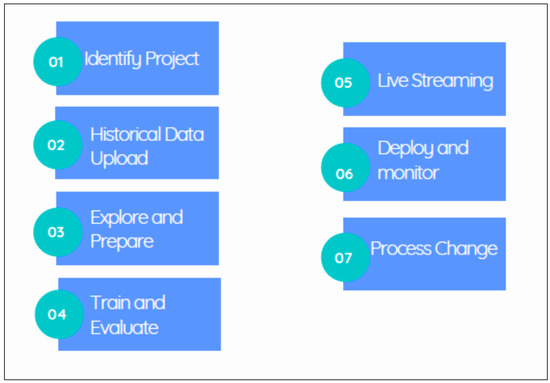
Figure 1.
Seven-step process followed at steel firm to obtain results with the CA platform.
The adoption process took two months until project kick-off in order to have the model on line ingested with real-time data, and generate predictions to suggest better operation conditions to the furnace operators. In this period, the people in the process were taught how to use and understand the information given by the solution, while people from the platform provider adjusted the model. The validation was done together by the software engineers and plant operators.
The CA platform made it easy to define the relationships between variables that significantly affected the production result, such as quantity of silicon added and fuel consumption. The AI models collaborated to determine which of the control variables had a positive or negative impact on production quality. By applying ML-reinforced learning through the forecasting template, the result of the production was predicted in certain duly specified intervals.
Historical data were taken from a period of one year, and parameters such as energy consumption, temperature, and silicon content, among others, were analyzed to generate a model that allowed the prediction of when the alloy with the highest silicon content should be conditioned, and when to increase or decrease the furnace temperature. In this way, it worked proactively, and the furnace operator received information in advance for decision making.
As a result of using data generated by the MES platform through ML methodology, the steel firm obtained a competitive advantage by improving processes and achieving consistency in quality, with silicon content always at a normal range. In addition, by defining set points in real time for fuel consumption, energy savings were facilitated. The firm also reduced the percentage of scrap, thus reducing costs and producing higher-quality steel. There was a triple optimization for the firm: reducing costs, improving customer services, and improving revenue.
The use of ML methods employed alongside domain knowledge of blast furnace specialists facilitated a greater knowledge of the process for the people involved that was augmented continuously. This allowed work on permanent improvements and achieving better key performance indicators (KPIs) and evolution toward more mature management systems.
6. Discussion
The case addressed the adoption of a new business model based on AI/ML in a traditional industrial environment and on the complex steel smelting process in a blast furnace. The solution came from a startup, and had an advantage over new methodologies that shortened times and simplified adoption of analytics in the industry. The distinguishing feature of the approach with respect to other works was the No-Code/Low-Code approach, which eased the use of AI/ML by process operators with little math or statistics knowledge, and shortened adoption times radically.
In line with the above paragraph, change management was simplified toward an agile approach; the new business model generated results faster and with lower complexity than traditional analytics solutions. This was because the model proposed by CA is centered on the end user, the process operator. The No-Code/Low-Code model from the startup eased time-consuming and risky tasks linked with software development and algorithms. In this way, the business model proposed in this paper helped to democratize AI/ML in traditional industries, making the adoption of these types of tools easier for a broad segment of people.
The improved process was based on predictive analytics aimed at exploiting the huge treasure of legacy operational data and overcoming some challenges of real-time data analytics. The potential of the proposed approach is high in traditional industries that have not benefited from the advancements of Industry 4.0, and in most cases have just started investigating the potential of data analytics and machine learning for the optimization of their production processes.
On the other hand, the need for a large amount of operational data is an important limitation for various traditional industries that are still lagging on digitalization. This issue is an important weakness of industries that could use data models to improve the remaining useful life (RUL) of heavy equipment, reduce carbon footprints, and reduce non-value-adding activities, among other wasted opportunities.
Another point to highlight is the opportunities that the smart manufacturing paradigm opens to startups and their innovative business models that offer solutions to ease the adoption of AI/ML in the industry. This case showed how a business model using AI/ML focused on a No-Code/Low-Code strategy could shorten implementation cycles from several months (18 as seen in the case of Jindal Steel and Power Limited), to a couple of months, as shown in the case at the steel firm.
In line with the above paragraph was the solution presented by Falkonry’s Operational AI in Section 2 of this work to improve equipment maintenance. The case of Falkonry could be studied thoroughly to broaden the concepts in this paper, and this is being considered for the next steps in this research.
Future work could also be related to research on cases of business models using AI/ML applied in traditional industrial sectors that need to optimize the use of resources to move toward net-zero emissions targets, such as energy or oil and gas, among others.
Author Contributions
Conceptualization, methodology, formal analysis, investigation, and writing—review and editing, F.W.M. Resources, visualization, supervision, project administration, and funding acquisition, A.R. All authors have read and agreed to the published version of the manuscript.
Funding
The funding information is addressed at the Acknowledgment section.
Institutional Review Board Statement
Not applicable.
Informed Consent Statement
Not applicable.
Data Availability Statement
Not applicable.
Acknowledgments
The authors wish to thank two research projects that made possible the content of this article. The projects are “Metodologías de abordaje al modelo Industria 4.0 en PyMEs, el rol de la Empresas de Base Tecnológica (EBT), los recursos humanos, y el ecosistema de Innovación”, approved by Resolution (R) No. 183-21-UNAJ INVESTIGA Program; and “Mejora de Procesos, Optimización y Data Analytics: Aplicación en Procesos e Industrias de Interés Regional Mediante Estudios de Casos Reales”, approved by a resolution of the UNLZ Engineering Faculty.
Conflicts of Interest
The authors declare no conflict of interest.
References
- Osterwalder, A.; Pigneur YTucci, C.L. Clarifying Business Models: Origins, Present, and Future of the Concept. Commun. Assoc. Inf. Syst. 2005, 16, 1–40. [Google Scholar] [CrossRef] [Green Version]
- Pfau, W.; Rimpp, P. AI-Enhanced Business Models. In Digital Entrepreneurship, Digital Entrepreneurship, Future of Business and Finance; Springer International Publishing: Berlin/Heidelberg, Germany, 2021. [Google Scholar] [CrossRef]
- Da Silva, V.L.; Kovaleski, J.L.; Negri Pagani, R.; De Matos Silva, J.; Corsi, A. Implementation of Industry 4.0 concept in companies: Empirical evidences. Int. J. Comput. Integr. Manuf. 2019, 33, 325–342. [Google Scholar] [CrossRef]
- Lepenioti, K.; Pertselakis, M.; Bousdekis, A.; Fenareti Lampathaki, A.L.; Apostolou, D.; Mentzas, G.; Anastasiou, S. Machine Learning for Predictive and Prescriptive Analytics of Operational Data in Smart Manufacturing. In Advanced Information Systems Engineering Workshops Proceedings of the International Conference on Advanced Information Systems Engineering, Melbourne, CAiSE 2020, VIC, Australia, 8–12 June 2020; Dupuy-Chessa, S., Proper, H., Eds.; Lecture Notes in Business Information Processing; Springer: Cham, Switzerland, 2020; Volume 382. [Google Scholar] [CrossRef]
- Walas Mateo, F.; Redchuk, A. The Emergence of New Business and Operating Models under the Industrial Digital Paradigm. Industrial Internet of Things, Platforms, and Artificial Intelligence/Machine Learning. Mach. Learning. J. Mech. Eng. Autom. (JMEA) 2021, 11, 54–60. [Google Scholar] [CrossRef]
- Mishra, R.; Gandhi, A.; Jaiswal, R.; Mishra, S.; Fadnis, A. Machine Learning to Improve Blast Furnace Productivity at Jindal Steel & Power. In Proceedings of the AISTech 2020, Iron & Steel Technology Conference, Cleveland, OH, USA, 31 August–3 September 2020. [Google Scholar]
- Spadaccini, A.; Di Pierro, M.; Nadalutti, P.; Cestari, L.; Pellegrini, G. Data-driven prediction models at Acciaierie bertoli safau meltshop. In Proceedings of the ICS 2018, 7th International Congress on Science and Technology of Steelmaking: The Challenge of Industry 4.0., Venice, Italy, 13–15 June 2018. [Google Scholar]
- Ruiz-Sarmiento, J.R.; Monroy, J.; Moreno, F.A.; Galindo, C.; Bonelo, J.M.; Gonzalez-Jimenez, J. A predictive model for the maintenance of industrial machinery in the con-text of industry 4.0. Eng. Appl. Artif. Intell. 2020, 87, 103289. [Google Scholar] [CrossRef]
- Gazola, P.E.; dos Santos HS, O.; Daroit, M.; Locatelli, A. A Machine Learning Approach for Steel Grade Detection in Hot Rolling Mills. In Proceedings of the AISTech 2021, Iron & Steel Technology Conference, Nashville, TN, USA, 29 June–1 July 2020. [Google Scholar]
- Waters, C.; Klemme, B.; Talla, R.; Jain, P.; Mehta, N. Transforming Metal Production by Maximizing Revenue Generation With Operational AI. In Proceedings of the AISTech 2021, Iron & Steel Technology Conference, Nashville, TN, USA, 29 June–1 July 2021. [Google Scholar]
- Strasser, S.; Hohenbichler, G.; Sattler, M.; Krahwinkler, P.; Reidetschlaeger, J. Artificial Intelligence Services in Steel Production—On Premises and in the Cloud. In Proceedings of the AISTech 2020, Iron & Steel Technology, Nashville, TN, USA, 29 June–1 July 2020. [Google Scholar]
- Daoutidis, P.; Lee, J.H.; Harjunkoski, I.; Skogestad, S.; Baldea, M.; Georgakis, C. Integrating operations and control: A perspective and roadmap for future research. Comput. Chem. Eng. 2018, 115, 179–184. [Google Scholar] [CrossRef]
- Nishioka, K.; Ujisawa, Y.; Akatani, K. Development of Mathematical Models for Blast Furnaces. Nippon Steel Sumitomo Met. Tech. Rep. 2018, 120, 69–75. [Google Scholar]
- Azeem, M.; Haleem, A.; Javaid, M. Symbiotic Relationship between Machine Learning and Industry 4.0: A Review. J. Ind. Integr. Manag. 2021, 6, 2130002. [Google Scholar] [CrossRef]
- Jamwal, A.; Agrawal, R.; Sharma, M.; Kumar, A.; Kumar, V.; Garza-Reyes, J.A.A. Machine learning applications for sustainable manufacturing: A bibliometric-based review for future research. J. Enterp. Inform. Manag. 2021, ahead-of-print. [CrossRef]
- Canvass Analytics Website. 2021. Available online: http://www.canvass.ai (accessed on 26 July 2021).
- Gradient Ventures Website. 2021. Available online: https://www.gradient.com/ (accessed on 26 July 2021).
- Cabot, J. Positioning of the low-code movement within the field of model-driven engineering. In Proceedings of the MODELS’20: ACM/IEEE 23rd International Conference on Model Driven Engineering Languages and Systems, Virtual Event, Canada, 18–23 October 2020. [Google Scholar]
- Davenport, T.H. Is AI Getting Easier? Forbes Media LLC.: New York, NY, USA, 2020. [Google Scholar]
- Steel Market Magazine, May 2020 Edition. Available online: https://www.amm.com/Issue/101498/May%202020.html (accessed on 26 July 2021).
- OSIsoft Website. 2021. Available online: www.osisoft.com (accessed on 26 July 2021).
Publisher’s Note: MDPI stays neutral with regard to jurisdictional claims in published maps and institutional affiliations. |
© 2021 by the authors. Licensee MDPI, Basel, Switzerland. This article is an open access article distributed under the terms and conditions of the Creative Commons Attribution (CC BY) license (https://creativecommons.org/licenses/by/4.0/).