3. Results
| Galliformes (Temminck, 1820) |
| Phasianidae (Vigors, 1825) |
Coturnix coturnix (Jaume et al., 1993)
Common quail
Surface: two skulls and one sternum (PCCRULL 1984 to 1986). Items from the surface are not included in
Table 2.
Layer CLL 7: one skull, two left humeri, two right humeri, one proximal end and shaft of a right humerus, two right ulnae, one left carpometacarpus, one carpometacarpus right, four synsacra, four right femora, one left femur, three proximal ends of a right femora, one left tibiotarsus, one right tibiotarsus, one proximal end of a left tibiotarsus, one proximal end of a right tibiotarsus, two distal ends of right tibiotarsi, one left tarsometatarsus, one right tarsometatarsus, one distal end of a left tarsometatarsus, and one distal end of a right tarsometatarsus (PCCRULL 1987 to 2025). Juvenile individuals: two right coracoidea, four right humeri, one left humerus, one right ulna, one left ulna, two right femora, one left femur, one proximal end of a right femur, two right tibiotarsi, three left tibiotarsi, one proximal end of a right tibiotarsus, one distal end of a right tibiotarsus, two right tarsometatarsi, two left tarsometatarsi, and one distal end of a left tarsometatarsus (PCCRULL 2026 to 2050).
Layer CLL 8: two left scapula, three cranial ends of a right scapula, one cranial end of a left scapula, one right scapula, one right coracoideum, two furculae, three right humeri, four left humeri, three right ulnae, one left ulna, two right radii, two left radii, three right carpometacarpi, five left carpometacarpi, five synsacra, one pelvis fragment, five right femora, three left femora (
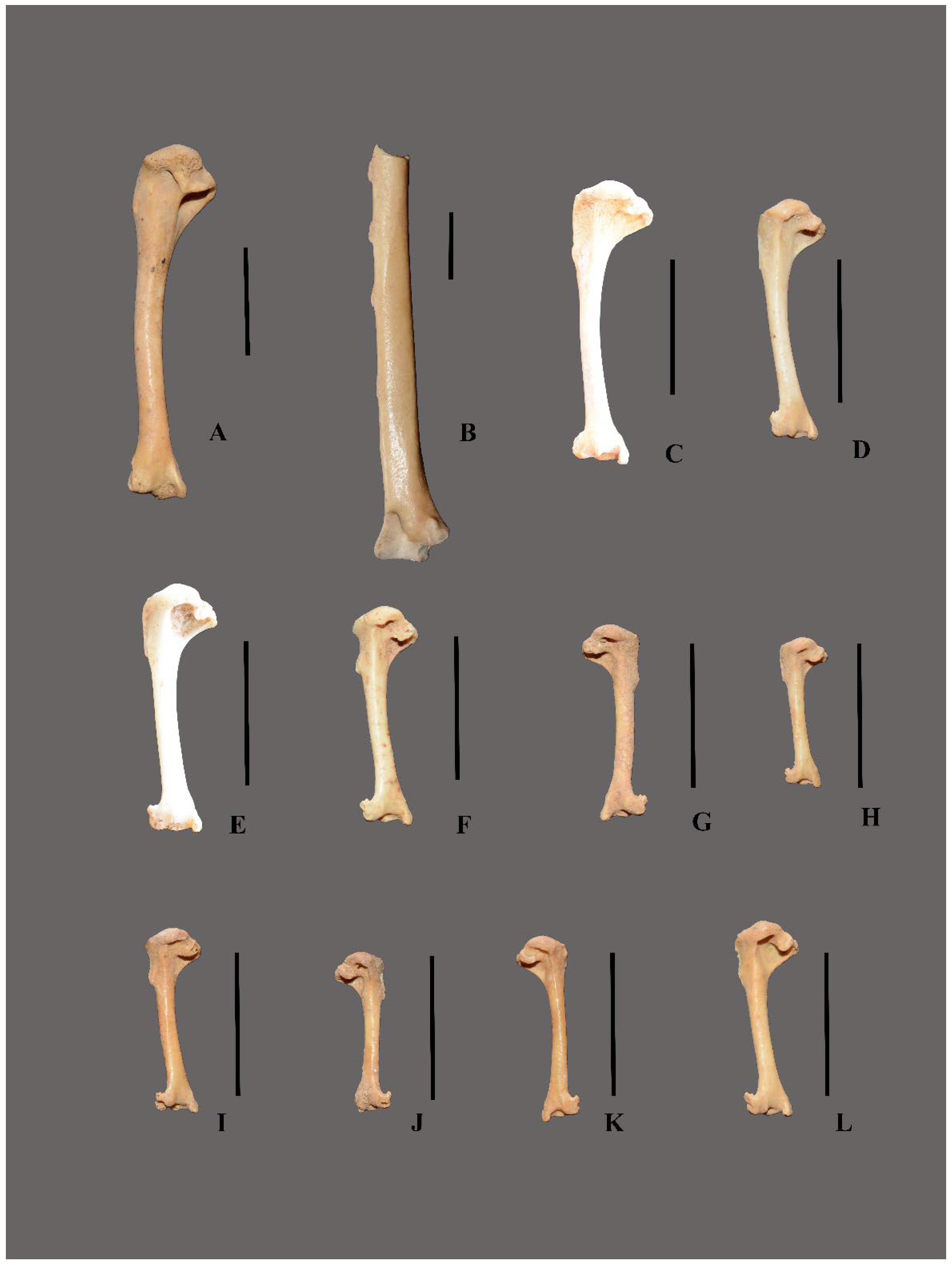
Figure 2A), four proximal ends of left femora, five right tibiotarsi, five left tibiotarsi, one distal end of a right tibiotarsus, five left tarsometatarsi, six right tarsometatarsi, and one distal end of a right tarsometatarsus (PCCRULL 2051 to 2123). Juvenile individuals: one right coracoideum, one right ulna, one right femur, three right tibiotarsi, one left tibiotarsus, three left tarsometatarsi, and one right tarsometatarsus (PCCRULL 2124 to 2134).
Layer CLL 9: one right coracoideum (PCCRULL 2135).
|
| Anseriformes Wagler, 1831 |
Anatidae indet.
Layer CLL 7: one distal left ulna with part of the shaft of a juvenile individual (PCCRULL 2136). The bone is eroded.
|
| Procellariiformes Fürbringer, 1888 |
| Procellariidae Vigors, 1825 |
Calonectris diomedea/borealis (Scopoli, 1769)
Cory’s shearwater.
Layer CLL 7: one left scapula (PCCRULL 2137).
In Puffinus, the cranial area of the scapula has a generally triangular shape and is wider than in Calonectris. In this genus, the cranial end is rounded. In Calonectris diomedea, the tuberculum coracoideum protrudes cranially; while in Puffinus, such a tubercle is absent.
| Gruiformes Bonaparte, 1854 |
| Otididae Rafinesque, 1815 |
Chlamydotis undulata (Jacquin, 1784)
Houbara bustard.
Layer CLL 7: one distal end of one left ulna (PCCRULL 2138) that preserves most of its diaphysis (
Figure 2B).
At the distal end of the ulna, the most distinctive feature in Otididae is that the condylus dorsalis ulnae forms a step in its continuation with the diaphysis. Chlamydotis undulata is intermediate in size between Otis tarda and Tetrax tetrax.
|
| Strigiformes Wagler, 1830 |
| Tytonidae Ridgway, 1914 |
Tyto alba Scopoli, 1769
Barn owl.
Layer CLL 7: one right coracoideum and one cranial end of a right coracoideum (PCCRULL 2139 and 2140).
The area of the facies articularis clavicularis and the processus acrocoracoideus is more developed in Asio otus than in Tyto alba. The foramen n. supracoracoidei is larger in A. otus. The processus procoracoideus ascends cranially in T. alba, and runs more anteriorly in Asio otus, Asio flammeus, and Strix aluco. In Athene noctua, it runs cranially but is much smaller.
|
| Piciformes (Meyer & Wolf 1810) |
| Picidae Leach 1818 |
Jynx torquilla Linnaeus, 1758
Wryneck.
Layer CLL 8: one left humerus juvenile (PCCRULL 2141) (
Figure 2C).
It has a small crista bicipitalis, a developed ventral tuberculum, a triangular crista deltopectoralis, very small ventral and dorsal condyles, a very prominent flexor process, and a very deep insertion area supracondylare ventrale. The humeral head is flat and broad as in the family. The humerus of Picus is much larger. The only Dendrocopus with a humerus the size of the fossil is D. minor. The humerus of Jynx torquilla has a muscle insertion depression above the processus flexorius, which is absent in Picus and Dendrocopus.
|
| Passeriformes Linnaeus, 1758 |
| Alaudidae Vigors, 1825 |
Alaudidae indet.
Lark.
Layer CLL 8: one right humerus and one left humerus juvenile (PCCRULL 2142 and 2143).
Layer CLL 9: two right humeri and three left humeri (PCCRULL 2144 to 2148) (
Figure 2D).
These humeri have been compared with those of Galerida cristata, G. theklae, Lullula arborea, Alauda arvensis, Melanocorypha calandra, Eremophila alpestris, and Calandrella brachydactyla. The humeri found in the Llano Cave are noticeably smaller than in the other species. The dorsal part of the fossa pneumotricipitalis is very shallow in C. brachydactyla, A. arvensis, and L. arborea. In fossils, it is deeper, as seen in E. alpestris. The humeri of Galerida and M. calandra are much larger and the dorsal part of the fossa pneumotricipitalis is deep. These findings could not be compared with those of Calandrella rufescens. Those of Calandrella brachydactyla are clearly different in morphology and size, but it cannot be ruled out that they belong to C. rufescens, or even to another alaudid.
The humeri are the size and morphology of those of E. alpestris. However, E. alpestris generally lives in mountainous areas, above the tree line. These environmental conditions do not appear to have existed in Fuerteventura, not even in the past. Taxonomic identifications must be made taking into account only intrinsic characteristics of the fossils; in this type of study, these are morphological features. However, in this case, as an exception, an extrinsic characteristic—environmental requirements of E. alpestris that are probably impossible in Fuerteventura—suggests that E. alpestris should be ruled out.
|
| Motacillidae Horsfield, 1821 |
Anthus cf. spinoletta (Vieillot, 1820)
Water pipit.
Layer CLL 9: one left humerus (PCCRULL 2149) (
Figure 2E).
The pneumotricipital fossa is wide and deep; is not separated by the ventral tuberculum. The crista bicipitalis is small. The humerus of Anthus pratensis and A. trivialis are larger. The fossil could not be compared with those of other Anthus species. It is similar to that of A. spinoletta.
|
| Muscicapidae Vigors, 1825 |
Phoenicurus phoenicurus (L., 1758)
Redstart.
Layer CLL8: one left humerus left (
Figure 2F) and one right humerus (PCCRULL 2150 and 2151).
The crista deltopectoralis is relatively long, longer than in Luscinia and much longer than in Saxicola. The fossa pneumotricipitalis is wider and deeper in Oenanthe. Erithacus rubecula and Phoenicurus ochruros are quite morphologically similar to Phoenicurus phoenicurus, but they are larger in size.
Luscinia luscinia (L., 1758)/megarhynchos (Brehm, 1831)
Thrush nightingale/Nightingale.
Layer CLL 7: one right humerus (PCCRULL 2152).
The fossa pneumotricipitalis is shallow. It is deeper in Oenanthe, Phoenicurus, Saxicola and Erithacus. The humerus of L. svecica is more robust in its proximal end.
Saxicola dacotiae (Meade-Waldo, 1889)
Canarian Stonechat.
Layer CLL 7: one right and one left humeri (PCCRULL 2153 and 2154).
Layer CLL 8: five right (
Figure 2G) and four left humeri (PCCRULL 2155 to 2163).
The humerus of Saxicola dacotiae is quite similar to that of Certhia, but the latter has a noticeably longer pectoral crest and a larger bicipital crest. Certhia is smaller than S. dacotiae. The bone morphology is like that of Saxicola torquata and Saxicola rubetra, but it is smaller in size.
|
| Turdidae Rafinesque, 1815 |
Turdus merula Linnaeus, 1758
Blackbird.
Layer CLL 7: two left humeri, one right humerus (PCCRULL 2164 to 2166).
Layer CLL 8: three left humeri (PCCRULL 2167 to 2169).
In size and general shape, the humerus of Turdus is similar to that of Sturnus. In Sturnus, the crista deltopectoralis is relatively shorter than in Turdus. The fossa pneumotricipitalis is smaller, rounder, and deeper in Sturnus than in Turdus. Turdus humeri do not always allow identification of the species in question, but in this case it was possible. Those of Turdus viscivorus and T. pilaris are longer and considerably more robust than those of T. merula. Those of T. torquatus and T. philomelos are somewhat longer but considerably more robust. The humeri of T. iliacus are smaller than those of T. merula. The fossils match those of T. merula in size and morphological details.
Sylvia cf. atricapilla (L., 1758)
Blackcap.
Layer CLL 9: one right humerus juvenile (PCCRULL 2170).
All Sylvia species have a very robust, but short, crista deltopectoralis. Sylvia borin and Sylvia atricapilla have a very developed caput humeri, more so than in the other species of the genus. The fossa pneumotricipitalis is deeper in S. atricapilla than in S. borin. S. atricapilla is smaller in size than S. borin and S. communis, and larger than S. undata, S. curruca, and S. melanocephala. It has not been possible to compare it with S. conspicillata or S. nana.
Sylvia cf. melanocephala (Gmelin, 1789)
Sardinian warbler
Layer CLL 8: one right humerus (PCCRULL 2171).
The humeri of Sylvia borin and S. atricapilla are larger and more robust than that of S. melanocephala. That of S. comunis is longer. In S. undata, it is noticeably smaller. That of S. cantillans is smaller, but has a relatively more robust crista deltopectoralis. This crista is longer in S. melanocephala than in S. curruca, but in the latter it is more robust. The humerus found in the cave is indistinguishable from that of S. melanocephala, but it has not been possible to compare it with that of S. conspicillata or S. nana.
Regulus (L., 1758)
Regulus sp.
Goldcrest.
Layer CLL 7: two left humeri (PCCRULL 2172 and 2173) (
Figure 2H).
Layer CLL 8: one left humerus (PCCRULL 2174).
Regulus regulus and R. ignicapillus (the latter today present in Moroccan forests) individuals have the same sizes, and their respective humeri are mutually indistinguishable. The humerus of Regulus is shorter than in Aegithalos caudatus. The crista deltopectoralis is relatively short in that taxon, and the crista bicipitalis is well developed. The humerus of Remiz pendulinus has a distinct shape, with a very short crista deltopectoralis and fused crus dorsale and ventrale fossae, with its crus dorsale notably bigger than the crus ventrale.
The measurements of the fossil humeri from El Llano cave reach higher values than
Regulus regulus and
R. ignicapillus (
Table 3). For this reason, these bones are attributed here to
Regulus sp. The measurements of the fossils could not be compared with those of the Canarian
Regulus regulus.
Regulus regulus is currently the smallest bird in the Canary Islands. There are two non-migratory subspecies, Regulus regulus teneriffae in Tenerife and La Gomera and Regulus regulus ellenthalerae in El Hierro and La Palma. They live in relict forests of the Canarian laurel forest.
Cettia cetti (Temminck, 1820)
Cetti’s warbler.
Layer CLL 8: one left humerus (PCCRULL 2175) (
Figure 2I).
The humeri of Phylloscopus trochilus and Ph. collybita are morphologically similar to that of Cettia, but smaller in size. Regulus is smaller in size, but more robust, and its deltopectoral crest is longer. In Troglodytes, the dorsal pneumotricipital fossa does not exist; it is a convex surface. In Certhia, the humerus is much larger and has a very different morphology. The fossil humerus has been compared with Cettia forticeps, C. diphone and C. cetti. The proximal end of the Cettia cetti’s humerus has an overall rounded shape. The crista bicipitalis is more protruding in Sylvia than in Cettia cetti, Phylloscopus, and Acrocephalus. The crus dorsale of the fossa pneumotricipitalis is narrower in Cettia cetti than in Sylvia, Acrocephalus, and Phylloscopus.
|
| Aegithalidae Reichenbach, 1850 |
Aegithalos caudatus (Linnaeus, 1758)
Long-tailed tit
Layer CLL 7: one right humerus (PCCRULL 2176) (
Figure 2J).
This species shows morphological resemblances with Regulus. However, the crista deltopectoralis is absolutely and relatively larger in Aegithalos caudatus than in Regulus. The crus dorsale and crus ventrale fossae are likewise more separated than in Regulus.
|
| Cisticolidae Sundevall, 1872 |
Cisticola juncidis (Rafinesque, 1810)
Fan-tailed warbler.
Layer CLL 7: one left humerus and one right humerus (PCCRULL 2177 and 2178) (
Figure 2K).
Layer CLL 8: seven right humeri and four left humeri (PCCRULL 2179 to 2189).
Layer CLL 9: one proximal end of right humerus (PCCRULL 2190).
The humerus is more robust in Cisticola than in the genera Phylloscopus, Hippolais and Acrocephalus. The fossa pneumotricipitalis dorsalis is shallower in Cisticola than in Sylvia and Acrocephalus. This fossa does not exist in Locustella and Hippolais. In Regulus and Cettia the humerus is quite small in size. Such a bone is larger and more robust in most of the species within Sylvia. The humerus in Sylvia conspicillata and S. melanocephala is equal in size and robustness to that in Cisticola juncidis. They are very similar in morphology; however, the fossae pneumotricipitalis ventrale and dorsale are wider in Cisticola than in the above Sylvia species.
|
| Fringillidae Vigors, 1825 |
Serinus canaria (Linnaeus, 1758)
Canary.
Layer CLL 7: two left humeri (PCCRULL 2191 and 2192).
Layer CLL 8: three left humeri (PCCRULL 2193 to 2195) (
Figure 2L).
The crista deltopectoralis is short and with little development. The crus dorsale fossae is short. The crista bicipitalis also has little development. The humerus of Serinus canaria bears morphological similarity with those of several species. Petronia petronia, Plectrophenax nivalis, Pyrrhula pyrrhula, Fringilla teydea, F. coelebs, and F. montifringilla are noticeably larger. Carduelis chloris is longer and more robust. Carduelis cannabina is similar in size, but much more robust in build. Serinus cucullata is much smaller. The humerus in Serinus serinus is of the same morphology, although smaller. Carduelis carduelis and Serinus canaria are the same size. The crista deltopectoralis is wider and more prominent in Carduelis carduelis than in Serinus canaria. The ventral tuberculum is also more robust in Carduelis carduelis. In this species, the crista bicipitalis projects ventrally more than in Serinus canaria.
4. Discussion
The Canary Islands are located near the Tropic of Cancer, placing them within the latitude range of subtropical climates. Fuerteventura is one of the western islands, situated just 10 km from Africa. The Azores High pace and the Trade Winds have a decisive influence on the climate of the Canary archipelago. This, combined with its low-lying topography, contributes to very low annual rainfall, resulting in a hot and arid climate according to the Köppen classification. The Greenland ice cover has increased and decreased over the Quaternary as a consequence of climate fluctuations. Recent ice core analysis from northern Greenland reveals that the highest Holocene temperatures would occur between 10 and 7 ka BP, 3 to 7 °C warmer than today [
16]. This suggests that the animals studied here died in warmer conditions than those prevailing today.
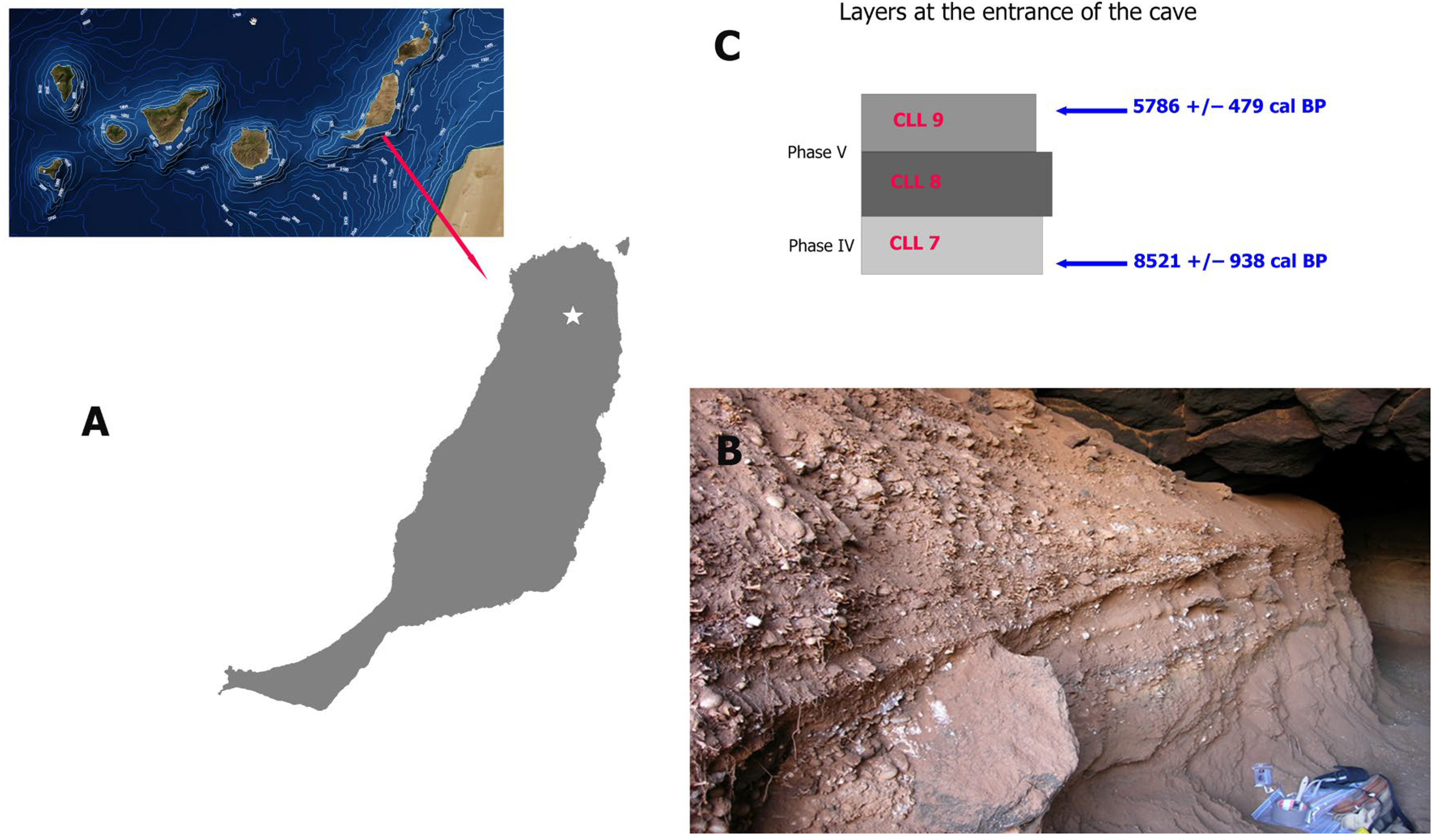
Most of the findings, 149 bone remains out of 209, have been assigned to the common quail. This volcanic tube likely housed the nests of some diurnal raptor for a considerable period of time, or it was a resting place. The discovery of a considerable number of small mammal bones [
8] also implies that nocturnal birds of prey used the cavity. The significant proportion of passerine bones allows for the identification of many bird species. However, it may be convenient to emphasize that the paleontological samples are considerably biased in a stochastic sense, as the only identifiable bones are the humeri, particularly their proximal ends.
Until very recently, fossil and sub-fossil bones of quail found in the Canary Islands were attributed to
Coturnix gomerae, considered an extinct endemic species of the Canaries. Recently, it has been indicated that
C. gomerae is not a valid species and that all quail bones found in the Canary Islands correspond to the extant
C. coturnix [
1]. There may have been variations in the size of Canary Island quails over time, as has happened with other birds in other places [
1] (and bibliography therein), but no differences are seen in the proportions of the front and rear limbs.
No marks of fire or other possible indications of human manipulation have been seen on the bones. Many of the birds found in this volcanic tube are Passerida, and therefore diurnal, small, and fliers. Falcons were probably responsible for hunting and gathering them into the cavity. The presence of quail remains requires a diurnal raptor that hunts on the ground, perhaps a medium-sized accipitrid.
The avian assemblage found in Cueva del Llano is in essence a sample of a past ornithofauna from the surroundings of the cavity, collected by predators that used the cave for shelter. The simplest hypothesis is that such a sample does not contain all or almost all of the species that were present. The record for several species consists of a single bone, which denotes that their discovery in Cueva del Llano was unlikely. This low probability of being recorded probably extends to other taxa, with individuals that were not hunted, brought into the cave, and fossilized. The high proportion of quail bones in the sample could be interpreted as due to an abundance of these animals in the cave’s surroundings because it was close to or surrounded by extensive grasslands. However, it could also be a sample bias determined by the identity of the predators and their hunting habits, i.e., predators that specialize in hunting quail, like kites, buzzards, or goshawks. Peregrine falcon could capture these birds in flight, near the coast. However, this falcon is unlikely to have hunted in an environment with the characteristics indicated by the species found in the volcanic tube.
Table 4 shows the habitats that the identified birds would have required and provides an overview of the hunting grounds of the predators that brought their prey into the cave. The number of species appearing in each habitat does not reflect the approximate size of those habitats in the area surrounding Cueva del Llano.
A considerable proportion of the species identified in Cueva del Llano do not currently live in Fuerteventura, or even in the Canary Islands. Three species that live in forests or prefer vegetation on riverbanks and lagoon shores are not found in the Canary Islands today: Aegithalos caudatus, Cettia cetti and Cisticola juncidis. Some birds are found on other islands, but not in Fuerteventura: Luscinia luscinia, Regulus sp., Turdus merula, and Serinus canaria, which are all typical of wooded areas. Calonectris diomedea/borealis is an oceanic species that comes ashore to excavate a burrow and breed. The soil must be very loose, such as slightly consolidated sand.
It is worth mentioning that no skeletal remains of
Puffinus holeae or
Puffinus olsoni, two extinct shearwaters endemic to Fuerteventura and Lanzarote, have been found. Both shearwaters disappeared due to hunting pressure from native humans in recent times, shortly after the arrival of Europeans in the Canary Islands [
1]. Hole’s shearwater nested in large colonies in sandy areas and paleodunes of Fuerteventura (particularly in Jandía) and Lanzarote, where it dug warrens in large numbers. Their bones are abundant in the Cueva de Villaverde, another volcanic tube located in the same municipality as La Oliva. This cavity was occupied by indigenous humans. It seems clear that the absence of
P. holeae in the Cueva del Llano is due to the different accumulating agents involved in the formation of both sites.
It seems likely that there was a lagoon or pond near the cave, around which large areas of riparian vegetation developed. Likewise, wooded areas with undergrowth, where there were even wrynecks, were probably also in the vicinity of the cave. The ornithological record from Cueva del Llano suggests that in the early stages of the Holocene, the dominant climate in the Canary Islands was much wetter than it is today. In Fuerteventura, there were bodies of water with riparian vegetation and more or less dense forest areas with shrubby undergrowth. Higher global temperatures than the present ones [
16] may have led to changes in the annual displacements of the Azores High and promoted a more intense rainfall regime, which fostered the maintenance of more diverse habitats and, consequently, a significantly more diverse avian fauna than today. The birds linked to these habitats likely disappeared with climate changes, which led to notably more xeric conditions.
The results of this work contribute to increasing the heritage value of the Cueva del Llano paleontological site as a world reference for a stratified volcanic tube fill from the Quaternary. Therefore, its protection is necessary through the application of a Paleontological Heritage Protection Framework.