Systematic Review

Deep Learning Algorithms for Defect Detection on Electronic Assemblies: A Systematic Literature Review


by
Bernardo Montoya Magaña
1,
Óscar Hernández-Uribe
2,*,
Leonor Adriana Cárdenas-Robledo
3 and
Jose Antonio Cantoral-Ceballos
4
1
Posgrado Centro de Tecnologia Avanzada (CIATEQ A.C.), Constituyentes-Fovissste, Av. del Retablo #150, Queretaro 76150, Queretaro, Mexico
2
Centro de Tecnologia Avanzada (CIATEQ A.C.), Parque Industrial Bernardo Quintana, Av. Manantiales #23-A, Queretaro 76246, Queretaro, Mexico
3
Centro de Tecnologia Avanzada (CIATEQ A.C.), Parque Industrial Tabasco Business Center, Cunduacan 86693, Tabasco, Mexico
4
Tecnologico de Monterrey, School of Engineering and Sciences, Av. Eugenio Garza Sada 2501, Monterrey 64700, Nuevo Leon, Mexico
*
Author to whom correspondence should be addressed.
Mach. Learn. Knowl. Extr. 2026, 8(1), 5; https://doi.org/10.3390/make8010005 (registering DOI)
Submission received: 7 October 2025 / Revised: 15 December 2025 / Accepted: 25 December 2025 / Published: 27 December 2025

Abstract

The electronic manufacturing industry is relying on automatic and rapid defect inspection of printed circuit boards (PCBs). Two main challenges hinder the accuracy and real-time defect detection: the growing density of electronic component placement and their size reduction, complicating the identification of tiny defects. This systematic review encompasses 56 relevant articles from the Scopus database between 2015 and the first quarter of 2025. This study examines deep learning (DL) architectures and machine learning (ML) algorithms for defect detection in PCB manufacturing. Findings indicate that 78.6% of the articles used models capable of detecting up to six defect types, and 62.5% relied on custom-made datasets. Convolutional neural networks (CNNs) are commonly utilized architectures due to their flexibility and adaptability to a variety of tasks. Still, real-time defect detection remains a challenge because of the complexity and high throughput in production settings. Likewise, accessible datasets are essential for the electronics industry to achieve broad adoption. Hence, architectures capable of learning and optimizing directly in the production line from unlabeled PCB data, without prior training, are necessary.

1. Introduction

Printed circuit boards (PCBs) and PCB assembly (PCBA) are key elements of today’s electronic manufacturing industry. This industry has been driven by increasing demand for industrial, automotive, healthcare products, and consumer electronics (e.g., smartphones, smart TVs, and biometric devices). The PCB inspection is one of the most relevant quality control processes in electronic manufacturing [1]. The demand for high-technology products drives the electronic manufacturing industry to produce a higher blending of complex products at a faster pace. Therefore, quality inspection of such components has become more critical and challenging due to the evolution toward higher-density layouts and smaller component footprints in shorter timeframes [2].
Over the years, various quality testing and inspection techniques have been developed to detect defects in electronic assemblies (EA) [3]. The most common methods in the industry include manual inspection, automated optical inspection (AOI), automated X-ray inspection (AXI), and in-circuit or functional testing [4,5]. Eventually, these are increasingly falling short as assemblies become more complex and incorporate numerous components (e.g., device miniaturization and multilayer boards) [6].
In addition, potential defects in EA (hereinafter, EA refers to PCB and PCBA) range from a few dozen to several hundred, making real-time detection with traditional techniques complicated [7]. Thus, detecting the wide range of defect types under these challenging conditions requires advanced methods, such as vision systems supported by efficient and reliable detection and classification algorithms [8]. The use of computer vision (CV) and image processing algorithms for defect detection on EAs minimizes human intervention while maximizing accuracy results [9].
Conventional AOI machine defect classification often requires complex setups (e.g., image-acquisition modules and lighting) and a significant space on the production line, incurring high deployment costs [10]. Such machines rely on rule-based algorithms or template matching, which are sensitive to ambient conditions and the board’s physical orientation, lacking generalization capabilities [11]. These factors can compromise AOI accuracy, leading to false positives (correct boards labeled as defective) or false negatives (defective boards passing inspection) [12,13]. AOI machines can achieve 82–92% detection and classification accuracy with high false-detection rates, limited adaptability to new PCBs, and lower effectiveness against complex defects [14,15,16].
In contrast, machine learning (ML) and deep learning (DL) models automatically learn discriminative features from EA images, thereby reducing sensitivity to lighting, viewpoint variations, and noise. Such approaches have achieved notable success in image classification, object detection, target tracking, and semantic segmentation [17,18]. DL approaches primarily rely on convolutional neural network (CNN) architectures, which learn optimal parameters through training and extract hierarchical image features. They address the limitations of traditional image-based defect recognition methods [19]. ML and DL approaches can reach 98–99.8% detection and classification accuracy [14,20].
CNNs’ main advantages include high-speed detection, reduced costs, and improved precision—desirable features in the EA [21]. They represent a promising method to identify EA defects with high accuracy in manufacturing lines [22]. Still, barriers remain for real-time defect detection in EA [23]. For instance, constructing large and balanced datasets is challenging due to low occurrence rates of defects and the rapid introduction of new products, which hinders systematic image acquisition [24,25]. Also, fine-tuning hardware is necessary to support high computing based on graphics processing units (GPUs).
The main contribution of this work is summarized as follows: it presents a comprehensive list of state-of-the-art (SOTA) systems for PCB defect detection, and it compares different architectures and algorithms for real-time defect detection. This study highlights the current challenges and limitations of existing techniques and approaches, identifies areas of future work, and provides guidelines for forthcoming research on defect detection of PCBs and PCBAs. The primary motivation is to answer the research questions below and identify the most used DL algorithms applied to defect detection:
  • RQ1: What are the principal DL architectures to detect defects in EA?
  • RQ2: What is the distribution of research focused on the processes of PCB and PCBA?
  • RQ3: What defect types are detected by DL architectures in PCB and PCBA processes?
  • RQ4: Which programming languages or frameworks are most commonly employed to detect defects using DL architectures?
  • RQ5: What datasets are employed to train DL models for defect detection in EA?
This paper is structured as follows: Section 2 presents background and related works, focusing on their scope and contributions. Section 3 introduces the methodology for this systematic review. Section 4 delivers the results and addresses the stated research questions. Section 5 discusses and examines relevant points reported in the reviewed articles, such as architectures, datasets, hardware, and defect detection. Finally, Section 6 highlights the gaps and challenges of the current electronics manufacturing industry, providing guidelines for future work.

2. Background and Relevant Research

The first part of this section presents AOI systems for defect detection in PCBs and PCBAs, which focus on the algorithms commonly used for defect identification. The second part examines related work that highlights the application of DL architectures and the challenges associated with inspecting increasingly complex electronic assemblies.

2.1. Automatic Optical Inspection Machines

AOI systems play a critical role in modern EA for quality control. They leverage advanced vision technologies to improve the accuracy and efficiency of inspection processes. As EA becomes more sophisticated and components smaller, AOI systems have progressively replaced traditional manual inspection methods. One of the main advantages is its ability to perform non-contact inspection, which is crucial for maintaining the integrity of sensitive electronic components [26].
The value of an AOI system lies in its ability to improve quality to the agreed or desired level in the manufacturing process by reducing the overall number of defects. While cameras, optics, and lighting are essential components in all AOI machines, the most critical factor from an operational perspective is the computational unit that executes tools applied to the captured images [27]. From the manufacturer’s point of view, these rely on an image-based or algorithm-based approach or a combination of both. Image-based AOIs use raw image data to perform pixel-by-pixel comparisons within a defined region of interest.
In contrast, algorithm-based systems utilize pattern recognition techniques to identify components. This approach is effective in detecting parts based solely on their shape, independent of grayscale intensity values [28]. The images captured undergo enhancement techniques, where feature extraction methods are applied to segment the defective regions. Then, the extracted information serves as an input for the classification algorithm to identify defects [29], producing an output of categorized labels, whether binary or multi-class, using either rule-based algorithms or learning-based models like ML and DL.
In relation to the performance metrics, the false acceptance rate (FAR) is a performance metric to evaluate the AOI system’s reliability (false negatives or consumer risk). This metric indicates the number of defective components incorrectly judged as correct by the machine. Then, the operator must identify and flag them as incorrect. Another metric is the false call rate (FCR) that quantifies the number of correct parts mistakenly labeled as defective (false positives or producer risk). This process requires the operator’s intervention to verify and override the decision, a time-consuming and costly task [30].
Excessive false calls impact process flow and operator workload, leading to potential misjudgments and the inadvertent approval of defective products. Notably, a high FCR often results from poor AOI programming, a drawback more commonly associated with image-based systems. For AOI systems using the image-based approach, each time an FAR or FCR event occurs, the database is updated with the image based on the operator’s judgment. It is worth noting that inconsistent operator judgments can lead to overlapping distributions of correct and incorrect conditions for misclassified components.
Over time, the accumulation of such misjudgments can degrade the system’s ability to distinguish accurately between defective and non-defective parts. In addition, cycle time is a critical factor in the surface-mount process, as it integrates most AOI machines in-line to inspect 100% of production. Several AOI settings directly affect cycle time, including deactivating specific tests and using multiple cameras. Finally, a value-added feature constantly sought in the industry is the ability of AOI systems to be integrated into closed-loop process control within the surface-mount technology line, a functionality that algorithm-based AOIs have supported since 2002 [31].

2.2. Related Works

This section presents 15 surveys or literature reviews regarding defect detection applications using DL techniques. The objects of analysis were PCBs (nine works), PCBA (seven works), and semiconductor wafers (two), whereas others were related to different components for electric or electronic applications (five).
Ling et al. [32] examined ML and DL techniques for PCBAs, distinguishing between surface and solder joint defects. Park et al. [33] analyzed PCB models for defect detection using existing datasets and the data attributes required for good algorithm performance. Zheng et al. [34] reviewed the automated vision inspection methods employed for defect detection on industrial products, including PCBs. Jha et al. [35] described traditional defect inspection methods and compared distinct CNN architectures on various industrial products, including wood, fabric, PCB, and aerospace welding. Ma et al. [36] discussed surface defects in software and described DL techniques for their identification and classification, based on application scenarios and task requirements.
He et al. [37] provided an overview of generative adversarial networks (GANs), analyzing GAN variants and their application to defect detection in industry. Likewise, Fang et al. [38] reviewed 2D and 3D AOI techniques for planar metal products and explained image preprocessing methods. Hussain et al. [39] examined SOTA CV techniques applied to electroluminescence-based photovoltaic cell surface imagery, focused on DL approaches. Fonseca et al. [14] explored AI-based methods that are affected by the drift problem, which arises from component variety and rapid update cycles, resulting in information bias that degrades model accuracy. Singh et al. [40] presented SOTA techniques and model accuracy metrics for detecting defects on PCBs, emphasizing the importance of data augmentation, advanced imaging, and sensing technologies.
Villarraga-Gómez et al. [41] discussed workflows that combine 3D X-ray microscopy and nanoscale tomography to visualize interiors of electronic devices for failure analysis and PCB quality inspection. Saberironaghi et al. [42] examined defect detection methods for product surfaces, stressing the use of the DeepPCB (D-PCB) dataset for training. Xia et al. [43] described works based on CNN architectures to identify integrated components and recover critical metals from waste PCBs. Zhou et al. [44] analyzed visual detection methods and research challenges on PCB defect detection. Alam and Kehtarnavaz [45] examined die attachment and wire defect detection methods, reporting the gap between the size of an integrated circuit and the spatial resolution of different sensing modalities.

3. Materials and Methods

This section outlines the methodology followed in this research. The systematic review adheres to the Preferred Reporting Items for Systematic Reviews and Meta-Analyses (PRISMA) guidelines [46] to identify and narrow down relevant published studies as summarized in Section 4.
Eligibility criteria. To identify and select the research articles pertinent to this systematic review, the inclusion and exclusion criteria are described in Table 1.
Information sources. The database employed for this research is Scopus (Elsevier®). A preliminary list of records containing 55 journals was compiled. Once the records were screened and the articles assessed for eligibility, a resulting list of 41 journals was obtained. Figure 1 depicts the journals with the highest frequencies of the reviewed articles across the period included.
Search strategy. The search strategy applied the following filters: (1) Research articles published in journals were considered, excluding books, book chapters, preprint manuscripts, and conference papers. (2) The search is limited from 2011 to 2025, due to the starting boom of DL algorithms and the conceptualization and growth of Industry 4.0, where the AOI systems become more relevant [47,48]. (3) Articles written in the English language are included. The database search was executed on 5 March 2025, delivering 83 records using the query string presented in Table 2. The authors examined each entry row, and they did not find any duplicates.
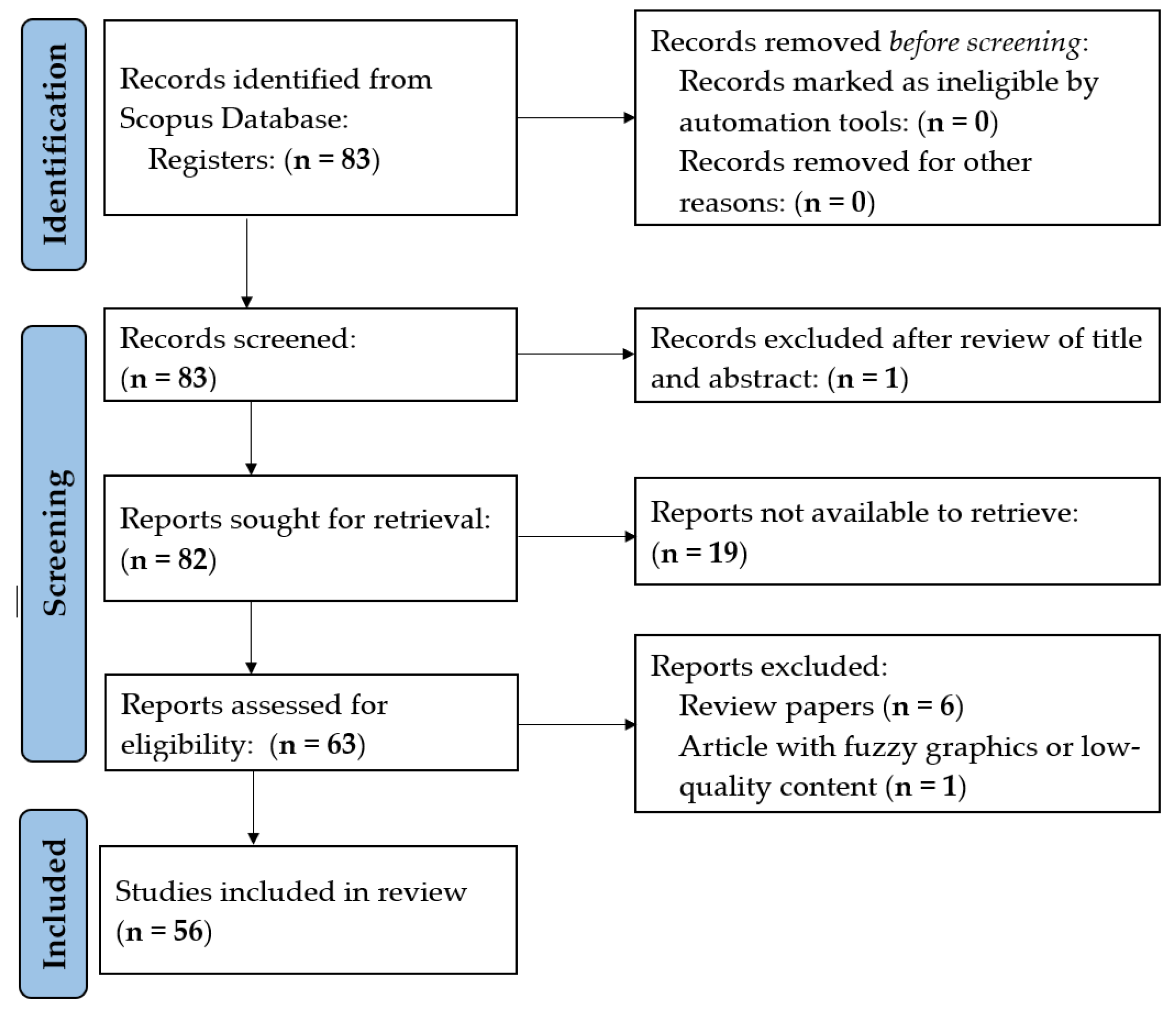
Selection process. The first phase involved the identification and examination of the 83 records recovered, preserving them whole. The four authors (B.M.M, O.H.-U, L.A.C.-R, J.A.C.-C.) participated as reviewers independently during each stage of the review in a rotational manner. In the screening phase, at least two authors reviewed the title, abstract, and keywords of each record; both needed to agree for inclusion. One record not related to the research topic was excluded. Thus, 82 records were candidates, of which 19 articles were not recovered.
Data collection process. As a result, 63 articles were assigned to the four reviewers and independently assessed for eligibility by two authors; in the event of disagreement, a third author cast the final vote. The inclusion criteria were the use of ML or DL algorithms for PCB or PCBA defect detection, including electronic component identification (e.g., resistors, capacitors), as well as the points stated in Table 1.
The exclusion criteria were that the object of study was not related to PCB or PCBA, or the type of work was a literature review, survey, or exploratory study. Consequently, seven works were excluded: six literature review-type articles and one study that presented fuzzy images. Hence, the final count of articles included in this systematic review was 56. Figure 2 shows the flow diagram of the selection process. Zotero software version 7.0.30 was used for data management purposes, primarily to collect, organize, cite, and share information from the retrieved articles [49].
Data items. The reviewers collected data on the article (author, year, journal), the artificial intelligence (AI) approach, the architecture, the development technology, and the dataset employed. They extracted the attributes manually and classified them in a spreadsheet template. The attributes are clearly outlined in summary tables in Section 4.
Risk of bias. In case of any discrepancies in judgments or justifications, these were resolved through discussion to reach consensus among the two reviewers; if necessary, a third author acted as an arbiter.
Synthesis methods. These include a classification of the eligible articles, responses to the research questions by offering relevant information in figures and tables, as well as a descriptive statistical analysis (Section 4). Moreover, this systematic review was registered retrospectively in the Open Science Framework (OSF), https://osf.io/8wuq5/overview?view_only=8097942de1764c839ea314857a16cb37 (accessed on 15 December 2025).
The 56 articles are distributed as follows: 2015 (1), 2017 (2), 2020 (3), 2021 (4), 2022 (10), 2023 (18), 2024 (17), and 2025 (1). The articles published since 2022 account for 82.1% of the total. Likewise, the five journals with the highest frequency of published articles (Figure 1) exhibited a similar trend, starting in 2022, accounting for 84.2%.

4. Results

This section identifies and describes the ten most-cited works, analyzes the 56 selected articles for this study, and extracts and summarizes the relevant features. The last part of the section presents the responses to the research questions by delivering relevant information in figures and tables.

4.1. Ten Most-Cited Works

The articles examined, which have a higher number of citations according to the Scopus database, are as follows. Hu and Wang [25] conducted a PCB automated inspection by modifying a faster region-based CNN (FRCNN) algorithm. They utilized a deeper backbone to extract features, feature pyramid networks (FPNs) to detect defects, a guided anchor region proposal network (GARP) to generate anchors adaptively, and ShuffleNetv2 to speed up the network. Kim et al. [1] presented a PCB inspection system based on a skip-connected convolutional autoencoder (AE) architecture. They altered the images to create artificial defects and highlighted the efficiency for real-time applications.
Tsai and Hsieh [50] used image alignment based on a Canny edge detector, principal component analysis (PCA), and the expectation-maximization (E-M) technique for PCB position and defect inspection. Adibhatla et al. [51] implemented You-Only-Look-Once (YOLO) v5 in small, medium, and large versions; the latter provides the highest accuracy, optimizing skilled workforce and production time. Bhattacharya and Cloutier [4] deployed a DL framework that enables the fabrication units to adjust parameters during manufacturing, reducing process deviation and driving toward zero defects.
Li et al. [8] employed a deep ensemble method in soldering defect detection to reduce the time spent on manual labeling and adapt to the features of each product line unguided. An and Zhang [52] applied a label-robust and patch correlation-enhanced vision transformer (LPViT) that leverages the relationship of regions in images and mask patch prediction to recover lost information. Chen et al. [53] combined two DL models to rejudge defective products and reduce the misjudgment rate detected by the AOI machine.
Jeon et al. [54] utilized thermographic images and a structural similarity index map (SSIM) for object detection in AE and a CNN for real-time and accurate detection of defective PCBAs. Du et al. [55] enhanced a DL algorithm: the backbone network, the channel and spatial attention modules, the depth-wise convolution, employing bidirectional weighted FPN (BiFPN), and Scylla-IoU (SIoU) loss function to detect PCB surface defects.

4.2. Summary of the Analyzed Articles

In this section, a summary of the analyzed works that address the AI approaches, architectures, electronic assemblies, processing units (PUs), programming languages (PLs), frameworks, APIs or libraries (FALs), and datasets utilized is provided. Moreover, Table 3 presents the attributes extracted from the examined articles.
Regarding the AI approach, 42 employed exclusively DL architectures, 9 reported DL architectures using ML or CV algorithms to enhance or compare the DL architecture performance, and 5 considered ML or CV algorithms. That means current research strictly focuses on a ratio of 10.2:1, favoring DL over other ML approaches. Due to the need for faster and more reliable solutions for complex assemblies, this ratio is expected to keep growing. Note that heuristic methods were not considered, such as genetic algorithms, reported in related works [14,32,34,44].

4.3. Principal DL Architectures to Detect Defects in Electronic Assemblies

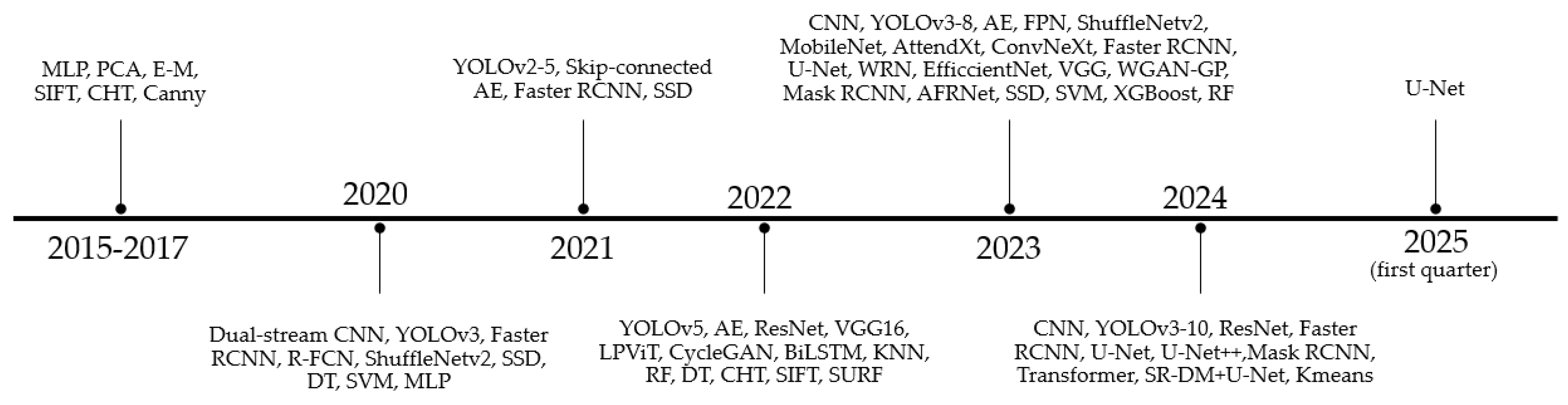
DL architectures are being updated, merged, developed, and evolved at a rapid pace [88,89]. Figure 3 shows the timeline of DL and ML approaches reported in the reviewed papers for defect detection in EA, from 2015 to the first quarter of 2025. Thus, when comparing the timeline for articles, the diversity of architectures employed over time is remarkable; some authors alter the core architecture or propose workflows to achieve better results. Moreover, vision system solutions are developed and optimized for specific types of EA [56], defect detection [57], components [58], or a combination of the above.
Between 2015 and 2017, three papers focused on ML and CV algorithms. These reported the use of MLP networks [57], E-M technique with PCA [50], and circle Hough transform (CHT) and Euclidean distance [83]. In 2020 and 2021, seven articles employed DL architectures: YOLOv2-5, faster RCNN, R-FCN, dual-stream CNN, and skip-connected AE. Moreover, a modified YOLOv3 incorporates a receptive field enhancement (RFE) to increase detection accuracy [18].
In the timeframe of 2022 to 2024, two articles employed ML algorithms, including the support vector machine (SVM) [58] and CV algorithms, such as the CHT algorithm [59]. Whereas six articles reported ML and CV algorithms to enhance DL architectures or to conduct performance comparisons, such as random forests (RFs) or decision trees (DTs) for ML and scale-invariant feature transform (SIFT) for CV, 37 articles included fully DL architectures. Overall, from 2020 to 2024, YOLO appeared in 26 articles, and 20 used DL hybrid architectures such as feature pyramid network (FPN), Mask R-CNN, and U-Net.
Table 4 presents the spectrum of architectures used in the examined works, with the relative frequencies for PCB and PCBA (some reported more than one architecture). It highlights that the main DL models are deeply rooted in CNN architectures, including YOLO, Faster R-CNN, AE, U-Net, and GAN. It is worth noting that a higher proportion of the examined works reported the use of AE, U-Net, and GAN with PCBA.

4.4. Distribution of Research Addressed to the Processes of PCB and PCBA

Defect detection in both PCBs and PCBAs is essential in the industry, as it improves quality, streamlines the manufacturing process, and prevents defective products from reaching the market [78]. The number of studies focused on PCBs and PCBAs is relatively balanced. In the case of PCBs, there is greater consensus regarding the classification of defect types to be identified.
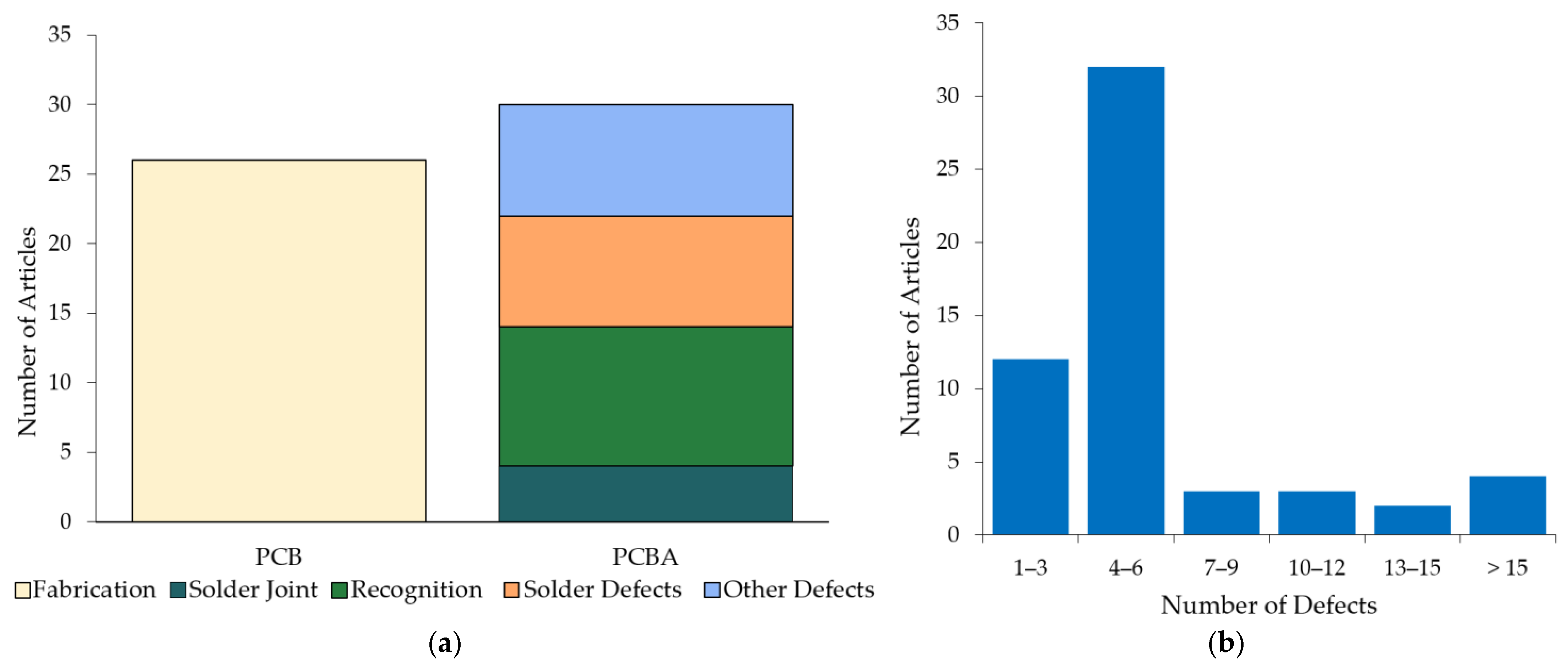
In contrast, the scope of defect detection in PCBAs is broader, which encompasses multiple critical inspection levels, including PCB quality, solder joints, component solderability, structural integrity, component placement and marking, and chemical application, among others. Such variability reflects a larger thematic scope of the reviewed articles. Figure 4a summarizes defects detected in PCBs and PCBAs, with 46.4% and 53.6% distributed across the two.

4.5. Defect Types Detected Using DL Architectures in PCB and PCBA Processes
It is relevant to understand the coverage of the quality inspection method under analysis. For PCBs, the industry recognizes six basic types of defects (missing hole, mouse bite, open circuit, short circuit, spur, spurious copper) [75]. Based on their complexity, the number of defects can increase (pinhole, missing conductor, breakout, wrong-size hole, over etch, under etch, conductor too close, and excessively short) [59].
In PCBA, the situation becomes intricate due to additional elements: flux, soldering, different component types, and coatings. Defects can present on their own or in combination with others, and some are well recognized across the industry (e.g., missing or shifted components, solder splash, tombstone, insufficient, or excess solder). Even if de facto standards for defect types are not widely used, manufacturers usually create their own defect list. Thus, efforts are made to develop standards (e.g., IPC-A-610H and IPC-J-STD) to define defect classifications for PCBAs, including cracks, discoloration, and bent or warped component leads [87].
Figure 4b shows a histogram with the number of defects detected addressed in the examined articles. A total of 78.6% used models capable of detecting six or fewer defects for PCB (24 articles) and PCBA (20 articles). Moreover, Table 5 gives the 11 most common defects in PCBs and PCBAs found in the reviewed articles.
Figure 4. Types of defects detected and number reported in the reviewed articles: (a) defect detection summary; (b) frequencies of the number of defects detected.
Make 08 00005 g004

4.6. Prevalent Programming Languages or Frameworks for Defect Detection Using DL Architectures

The most widely used programming language to implement DL algorithms is Python (28 articles), followed by MATLAB (2 articles). Additional frameworks that support Python are PyTorch (15) and TensorFlow (9). Likewise, 44.6% (25 articles) do not specify the programming language or framework used.

4.7. Datasets Employed to Train DL Models for Defect Detection in Electronic Assemblies

Training on large and balanced datasets is essential for DL algorithms, where the lack of accessible datasets with PCB defects motivates the creation of artificial ones [69]. Table 6 depicts the training strategies used since public datasets for EA are scarce, as follows:
  • Custom, training exclusively on custom-made datasets for bare PCBs defects, such as protrusions, nicks, and scratches [63], or PCBAs defects focused on components [65] and soldering defects [70].
  • Specific, training exclusively on PCB- or PCBA-accessible datasets of images [73,74].
  • General-purpose plus custom, pre-training using a dataset like COCO or ImageNet, followed by a custom-made dataset [82].
  • General-purpose plus specific, similar to the previous, but using an accessible PCB or PCBA dataset [15,60].
  • General-purpose dataset plus a specific dataset enriched by a custom dataset [61].
Table 5. Defects reported for PCB and PCBA by article.
PCB Defect TypesQty.CitationPCBA Defect TypesQty.Citation
Spurious copper21[1,3,4,12,15,25,52,55,59,61,67,68,71,73,74,75,76,78,80,81,86]Component
(detection)
15[5,13,18,21,24,26,53,62,65,72,77,79,84,85,87]
Mouse bite
SpurComponent shifted 6[13,21,24,53,65,84]
Open circuit20[1,3,4,12,15,25,52,55,59,61,67,68,71,73,74,75,76,78,80,81]Insufficient solder5[2,13,53,60,70,85]
ShortTombstone4[13,53,84,85]
Missing holeExcess solder4[8,60,70,85]
Pinhole4[25,50,59,86]Solder bridge4[8,13,60,79]
Scratch4[17,22,50,63]Short3[2,24,54]
Missing conductor1[59]Missing solder3[2,8,13,60]
Breakout1[59]Flux side2[19,57]
Wrong size hole1[59]Poor wetting2[19,53]
Others9[17,22,25,50,51,52,59,63,82]Others18[5,6,8,13,18,19,21,22,24,53,54,56,58,60,64,65,66,69,70,72,77,79,83,84,85]
Table 6. Datasets reported in reviewed articles for defect detection employing DL algorithms.
Datasets Employed to Train DL ModelsPCBPCBATotal
Custom52126
Specific14115
General-purpose + custom 268
General-purpose + specific 426
General-purpose + (specific + custom) 101
It is worth noting that general-purpose (e.g., COCO) and specific (e.g., PKU-Market-PCB) datasets broadly or partially comply with Findable, Accessible, Interoperable, and Reusable (FAIR) principles. Such principles were introduced in response to the growing challenges of managing massive amounts of data across various domains [90]. In this regard, 37.5% of the articles reviewed do not use physical assembly under inspection, opting instead for findable and accessible datasets. This strategy can save time, but deploying it in a real manufacturing process introduces uncertainty regarding the overall accuracy and generalizability of the models.
On the other hand, 62.5% of the reported datasets in the studies rely on custom-made datasets for training DL networks, and most of them are not findable or accessible, which limits model reproducibility and validation of results and diminishes the scientific rigor necessary for fair comparisons. Except for [56,70], which include available links to their datasets, and others explicitly require a request to the authors [2,58,61,63,66,72].
Regarding data augmentation, it involves applying transformations to create new samples, thereby increasing and improving model performance by preventing overfitting and enhancing generalization [4,8,26]. In this review, 34 articles documented the use of such techniques, including geometric transformations (e.g., flipping, rotating, and cropping images) [68,75,82], color space transformations (e.g., adjusting brightness and contrast) [64,71], and kernel filters (e.g., blurring or sharpening) [63,65], while 22 do not mention or use data augmentation.
Table 7 presents a heatmap of the predominant metrics (accuracy, precision, recall, F1_Score) reported in the examined studies. It is worth noting that not all works applied and reported the four metrics. Thus, the value of each metric reflects the average values of the predominant base architecture used in the article (i.e., the example models reported in Table 4), and the datasets used to train DL and ML algorithms, as indicated in Table 6.
While most studies reported performance improvements over benchmark models, others pointed to relatively low metric values for their proposals. It is worth noting that model performance depends heavily on the dataset and the evaluation metrics used. Thereby, it is advisable to use a wide span of metrics and thresholds to assess the model’s robustness and generalizability.

5. Discussion

Since a wide variety of DL architectures are available, users may employ CNN, recurrent neural networks, GANs, AE, or transformer-based models, depending on the task at hand. For instance, CNNs can be configured with different combinations of backbone, neck, and head components to address specific defect detection requirements [68]. Also, diverse training strategies can be adopted depending on the quality and quantity of available data, offering significant advantages that enable customization and fine-tuning models to optimize performance. Such flexibility reflects the growing body of work on these issues, using hybrid or modified architectures that outperform established models, such as YOLO [62,67], ResNets [66], or RNNs [81].
The task of obtaining well-balanced datasets across all defect types is complex [24]. In the real world, it is rare to have such datasets, which affects models’ generalization and prediction abilities [42], impacts model performance and bias, as well as misleading evaluation metrics. Thus, data imbalance poses a significant challenge in the practical application of DL detection methods, leading to training and implementation issues [37]. On the other hand, large annotated datasets are not always available, which can require significant time to develop and a costly operation [91]. Not to mention, the lack of human expertise can challenge the achievement of high-quality annotations [92].
The adoption of DL algorithms in the domain of EA has advanced gradually, mainly due to the scarcity of large, annotated, and balanced datasets. Consequently, publicly accessible PCB and PCBA datasets are used for pre-training when sufficient samples of a particular assembly are unavailable. However, it is well-established that training a DL model on such datasets rather than on actual manufacturing assembly images reduces the model’s ability to accurately detect defects, whether in unseen images or in response to slight design or engineering changes [72].
Analyzing defects at different locations within the circuit board is a complex task. They can occur during both PCB fabrication and component assembly across the board area, where copper tracks, pads, and layers are deposited. For instance, over-soldering and tombstone are typical defects in the soldering process of pads [85], burnt PCBs due to a faulty wave soldering process [87], skewed components, incorrect coating-spraying application (i.e., parts without coating that should be covered or vice versa), as well as defects caused by damage during EA handling. Therefore, the number of possible defects and locations within a PCBA can be substantial.
The examined DL approaches mainly focused on a few priority defects advised by domain experts, well-suited for production with low volume or low complexity. It is worth noting that in manufacturing environments with high volume and high complexity, the feasibility of deploying DL solutions depends on the ratio of network processing capacity and takt time (units per second) [83]. If the system’s frames per second (FPS) is insufficient relative to the required takt time, the usage of DL methods on high-speed EA lines may become impractical. A key challenge is performing in-line inspection within timeframes from a few tenths of a second to a few seconds per unit.
Although inspection applications for EA employ DL models, these do not offer one-size-fits-all solutions. In bulk production, intensive checking and human intervention are required to validate the model’s decisions, primarily in the initial stages [80]. Basically, the operator using the machine begins the inspection process without prior knowledge of the specific assembly errors and builds an understanding incrementally [76,86].
Despite DL models for defect detection initially appearing unsuitable, mainly due to the scarcity or lack of data before the training stage, this limitation occurs in both DL and conventional inspection methods (manual or AOI-based). As a result, PCB or PCBA defect detection combines multiple measurements and AI technologies to reduce the time and costs associated with accurate identification methods [93].
Regardless of significant progress in DL for defect detection, there are notable limitations, for instance, the lack of a direct off-the-shelf solution that fully addresses industry requirements, and the need for technical experts in DL to team with professionals in electronics manufacturing to implement customized developments.
By the same token, the need to adapt and tune the inspection methods to slight changes in the design or layout of the manufacturing product is a shared limitation across all modalities. In consequence, managers often shift to established AOI system providers to obtain adequate inspection coverage, even when customization is required for specific applications (e.g., varying board sizes, component types, or configurations) [79].
Regarding the implications for practitioners and researchers, the electronic assemblies defect detection using DL approaches relies heavily on the availability and quality of datasets. Hence, key standards and practices are worth considering, as outlined below.
Datasets characteristics. Most datasets available lack comprehensive explanations concerning classification standards, descriptions of defect formation location, cause, and morphological characteristics, and the dataset creation process. This gap increases the risk of misclassification, mainly for defects that exhibit strong similarities between classes [94].
Specialized datasets. The structured metadata ensures unbiased and accurate results comparisons [95]. For instance, applying FAIR principles enables knowledge sharing and public availability among the DL community.
Data augmentation and preprocessing. These are essential for addressing the scarcity of large, annotated, and balanced datasets, thereby achieving strong network performance across the training, validation, and testing phases [24,62,77].
DL model training and transfer learning. To enhance PCB defect detection, these approaches address challenges posed by limited datasets and variability in defect types. Transfer learning reduces the need for training on large data volumes, creating a library of patterns to extract features from a small dataset, which makes it an efficient and robust method for quality control processes [22].
Evaluation metrics. Defect coverage and performance metrics are relevant for decision-making. Time is a crucial factor and a notable challenge. Thus, optimizing floating-point operations per second (FLOPS) and FPS metrics (related to hardware capabilities and image resolution) [96,97,98], as well as programming strategies, mitigates the tradeoff.
A research direction suggests developing architectures capable of learning and optimizing directly on the production line using unlabeled PCB data, without prior training. It could yield highly flexible and reliable solutions for quality assessment, reducing the need for domain human experts and accelerating deployment in manufacturing settings. Researchers have turned to AE-based architectures to alleviate the need for balanced datasets to learn features in a self-supervised manner [64,84].
Self-supervised learning (SSL) learns data structure from unlabeled data, which is useful when labeled data is scarce [99]. AE is an SSL approach to extracting features from unlabeled PCB data in object detection [100,101], and vision transformers act as a backbone for contrastive SSL [98], along with denoising diffusion models [102,103]. SSL approaches in the analyzed works include the following: a skip-connected CAE reproduces non-defect image data from defect image data, detecting PCB defects and locations [1]. A diffusion model adds Gaussian noise to defect-free images, trains a U-NET model, and reconstructs images to detect and locate surface defects [71]. A DL model recovers lost image information by chunking the input image into patches and randomly masking [52].
Furthermore, federated learning is an approach that leverages multiple distributed devices to train a shared model, maintaining data locally, thereby preserving privacy and security [104]. For PCB defect detection, it enables knowledge sharing between the server and clients via the client’s dynamic memory bank rather than model parameters [105].
The limitations of this systematic review are the identification of a reduced number of eligible studies, the use of a single database, and the search filters applied (e.g., document type, date range, and language). The above could have left out several relevant studies. As future work, studies should conduct in-depth research into the features for defect detection, expand the number of databases, cover works from other scientific venues (e.g., congresses and conferences), and conduct a bibliometric analysis.

6. Conclusions

DL is a fertile area of research with multiple applications, including defect detection in PCB and PCBA products. It is a task far from trivial due to the diversity of products, materials, surfaces, and characteristics that are relevant to consider for a DL-based inspection system. Even narrowing the scope of defect detections to specific types or attributes, the problem remains complex. The scarcity of reliable, available, and well-annotated datasets poses a significant challenge and a key barrier to adopting DL-based inspection.
Despite the AOIs’ efforts to include tailored algorithms to address specific problems, as assemblies deviate from traditional high-density PCBs, such as defect detection on mechanical parts or chemicals applied, these do not justify the expense of a high-end AOI device [106]. Eventually, AOI systems rely on DL techniques to enhance defect detection [20], while a one-size-fits-all solution remains unfeasible.
The present study reviewed 56 articles that applied DL models for defect detection in electronic assemblies. The timeline emphasizes the rise of DL in this application domain in 2015. The work provides a comprehensive assessment of the SOTA, identifies current trends and challenges, and spotlights potential directions for future research. A key contribution of this work is the contextualization of DL-based developments within real-world manufacturing environments.
Furthermore, the analysis provides a snapshot of current research and a pathway toward broader and more effective deployment of DL models in industrial settings. It highlights the advantages of DL approaches over traditional inspection techniques. Finally, academic and industrial advancements are accelerating, signaling the beginning of a transformative phase in electronic manufacturing that stakeholders across sectors should be ready to embrace.

Author Contributions

Conceptualization, B.M.M. and Ó.H.-U.; methodology, all authors; software, B.M.M.; validation, B.M.M., Ó.H.-U. and L.A.C.-R.; investigation, all authors; writing—original draft preparation, B.M.M. and Ó.H.-U.; writing—review and editing, all authors; visualization, B.M.M. and Ó.H.-U.; supervision, Ó.H.-U., L.A.C.-R. and J.A.C.-C. All authors have read and agreed to the published version of the manuscript.

Funding

This research received no external funding.

Data Availability Statement

The data presented in this study are available on request from the corresponding author.

Acknowledgments

This study was partially supported by the scholarship Secretariat of Science, Humanities, Technology and Innovation (SECIHTI) CIATEQ CVU 1083356 and SECIHTI National Research System of Mexico.

Conflicts of Interest

The authors declare no conflicts of interest.

References

  1. Kim, J.; Ko, J.; Choi, H.; Kim, H. Printed circuit board defect detection using deep learning via a skip-connected convolutional autoencoder. Sensors 2021, 21, 4968. [Google Scholar] [CrossRef]
  2. Jayasekara, H.; Zhang, Q.; Yuen, C.; Zhang, M.; Woo, C.W.; Low, J. Detecting anomalous solder joints in multi-sliced PCB X-ray images: A deep learning based approach. SN Comput. Sci. 2023, 4, 307. [Google Scholar] [CrossRef]
  3. Xiao, G.; Hou, S.; Zhou, H. PCB defect detection algorithm based on CDI-YOLO. Sci. Rep. 2024, 14, 7351. [Google Scholar] [CrossRef]
  4. Bhattacharya, A.; Cloutier, S.G. End-to-end deep learning framework for printed circuit board manufacturing defect classification. Sci. Rep. 2022, 12, 12559. [Google Scholar] [CrossRef] [PubMed]
  5. Zhang, K. Using deep learning to automatic inspection system of printed circuit board in manufacturing industry under the internet of things. Comput. Sci. Inf. Syst. 2023, 20, 723–741. [Google Scholar] [CrossRef]
  6. De Oliveira, J.P.G.; Bastos-Filho, C.J.A.; Oliveira, S.C. Non-invasive embedded system hardware/firmware anomaly detection based on the electric current signature. Adv. Eng. Inf. 2022, 51, 101519. [Google Scholar] [CrossRef]
  7. Chen, X.; Wu, Y.; He, X.; Ming, W. A comprehensive review of deep learning-based PCB defect detection. IEEE Access 2023, 11, 139017–139038. [Google Scholar] [CrossRef]
  8. Li, Y.T.; Kuo, P.; Guo, J.I. Automatic industry PCB board DIP process defect detection system based on deep ensemble self-adaption method. IEEE Trans. Compon. Packag. Manufact. Technol. 2021, 11, 312–323. [Google Scholar] [CrossRef]
  9. Han, X.; Li, R.; Wang, B.; Lin, Z. Defect identification of bare printed circuit boards based on Bayesian fusion of multi-scale features. PeerJ Comput. Sci. 2024, 10, e1900. [Google Scholar] [CrossRef]
  10. Yin, X.; Zhao, Z.; Weng, L. MAS-YOLO: A lightweight detection algorithm for PCB defect detection based on improved YOLOv12. Appl. Sci. 2025, 15, 6238. [Google Scholar] [CrossRef]
  11. Mineo, R.; Sorrenti, A.; Faro, R.; Mineo, G.; Cancelliere, F.; Faro, A. PCB-SAID: A Low-Cost Camera-Based Dataset for Few-Shot SMD Assembly Inspection. In Proceedings of the IEEE/CVF International Conference on Computer Vision, Honolulu, HI, USA, 19 October 2025. [Google Scholar]
  12. Wu, X.; Zhang, Q.; Wang, J.; Yao, J.; Guo, Y. Multiple detection model fusion framework for printed circuit board defect detection. J. Shanghai Jiaotong Univ. (Sci.) 2023, 28, 717–727. [Google Scholar] [CrossRef]
  13. Ye, R.; Pan, C.S.; Hung, P.Y.; Chang, M.; Chen, K.Y. Detection and classification of printed circuit board assembly defects based on deep learning. J. Chin. Soc. Mech. Eng. 2020, 41, 401–407. [Google Scholar]
  14. Fonseca, L.A.L.O.; Iano, Y.; Oliveira, G.G.D.; Vaz, G.C.; Carnielli, G.P.; Pereira, J.C.; Arthur, R. Automatic printed circuit board inspection: A comprehensible survey. Discov. Artif. Intell. 2024, 4, 10. [Google Scholar] [CrossRef]
  15. Lim, J.; Lim, J.; Baskaran, V.M.; Wang, X. A deep context learning based PCB defect detection model with anomalous trend alarming system. Results Eng. 2023, 17, 100968. [Google Scholar] [CrossRef]
  16. Ancha, V.K.; Sibai, F.N.; Gonuguntla, V.; Vaddi, R. Utilizing YOLO models for real-world scenarios: Assessing novel mixed defect detection dataset in PCBs. IEEE Access 2024, 12, 100983–100990. [Google Scholar] [CrossRef]
  17. Huang, C.Y.; Tsai, P.X. Applying machine learning to construct a printed circuit board gold finger defect detection system. Electronics 2024, 13, 1090. [Google Scholar] [CrossRef]
  18. Li, J.; Li, W.; Chen, Y.; Gu, J. A PCB electronic components detection network design based on effective receptive field size and anchor size matching. Comput. Intell. Neurosci. 2021, 2021, 6682710. [Google Scholar] [CrossRef]
  19. Gunraj, H.; Guerrier, P.; Fernandez, S.; Wong, A. SolderNet: Towards trustworthy visual inspection of solder joints in electronics manufacturing using explainable artificial intelligence. AI Mag. 2023, 44, 442–452. [Google Scholar] [CrossRef]
  20. Cantone, C.; Faro, A. An overview of the automated optical inspection edge AI inference system solutions. In Advancing Edge Artificial Intelligence, 1st ed.; River Publishers: New York, NY, USA, 2024; pp. 153–175. [Google Scholar] [CrossRef]
  21. Nguyen, V.T.; Bui, H.A. A real-time defect detection in printed circuit boards applying deep learning. EUREKA Phys. Eng. 2022, 2, 143–153. [Google Scholar] [CrossRef]
  22. Volkau, I.; Mujeeb, A.; Dai, W.; Erdt, M.; Sourin, A. The impact of a number of samples on unsupervised feature extraction, based on deep learning for detection defects in printed circuit boards. Future Internet 2021, 14, 8. [Google Scholar] [CrossRef]
  23. Deng, W. Investigation of visual inspection methodologies for printed circuit board products. J. Opt. 2024, 53, 1462–1470. [Google Scholar] [CrossRef]
  24. Noroozi, M.; Ghadermazi, J.; Shah, A.; Zayas-Castro, J.L. Toward optimal defect detection in assembled printed circuit boards under adverse conditions. IEEE Access 2023, 11, 127119–127131. [Google Scholar] [CrossRef]
  25. Hu, B.; Wang, J. Detection of PCB surface defects with improved faster-RCNN and feature pyramid network. IEEE Access 2020, 8, 108335–108345. [Google Scholar] [CrossRef]
  26. Chi, T.S.; Wahab, M.N.A.; Mohamed, A.S.A.; Noor, M.H.M.; Kang, K.B.; Chuan, L.L.; Brigitte, L.W.J. Enhancing efficientnet-YOLOv4 for integrated circuit detection on printed circuit board (PCB). IEEE Access 2024, 12, 25066–25078. [Google Scholar] [CrossRef]
  27. Ebayyeh, A.A.R.M.A.; Mousavi, A. A review and analysis of automatic optical inspection and quality monitoring methods in electronics industry. IEEE Access 2020, 8, 183192–183271. [Google Scholar] [CrossRef]
  28. Patel, K. AI-Driven defect detection in PCB manufacturing: A computer vision approach using convolutional neural networks. Eur. J. Adv. Eng. Technol. 2025, 12, 10–25. [Google Scholar]
  29. Vaidya, S.R. Automatic Optical Inspection-Based PCB Fault Detection Using Image Processing. Master’s Thesis, Department of Electrical and Computer Engineering, Michigan Technological University, Houghton, MI, USA, 2023. [Google Scholar] [CrossRef]
  30. O’Neill, T.; Towell, G.; Tafoya, C.; Lozoya, A. Comparative Analysis of Automated Optical Inspection (AOI) Performance with Different Solder Alloys. In Proceedings of the SMTA International, Rosemont, IL, USA, 20–24 October 2024. [Google Scholar]
  31. SMTnet. What Is Really Inside Your AOI? Available online: https://smtnet.com/library/index.cfm?fuseaction=view_article&article_id=1771&company_id=46029 (accessed on 28 November 2025).
  32. Ling, Q.; Isa, N.A.M. Printed circuit board defect detection methods based on image processing, machine learning and deep learning: A survey. IEEE Access 2023, 11, 15921–15944. [Google Scholar] [CrossRef]
  33. Park, J.-H.; Kim, Y.-S.; Seo, H.; Cho, Y.-J. Analysis of training deep learning models for PCB defect detection. Sensors 2023, 23, 2766. [Google Scholar] [CrossRef]
  34. Zheng, X.; Zheng, S.; Kong, Y.; Chen, J. Recent advances in surface defect inspection of industrial products using deep learning techniques. Int. J. Adv. Manuf. Technol. 2021, 113, 35–58. [Google Scholar] [CrossRef]
  35. Jha, S.B.; Babiceanu, R.F. Deep CNN-based visual defect detection: Survey of current literature. Comput. Ind. 2023, 148, 103911. [Google Scholar] [CrossRef]
  36. Ma, J.; Zhang, T.; Yang, C.; Cao, Y.; Xie, L.; Tian, H.; Li, X. Review of wafer surface defect detection methods. Electronics 2023, 12, 1787. [Google Scholar] [CrossRef]
  37. He, X.; Chang, Z.; Zhang, L.; Xu, H.; Chen, H.; Luo, Z. A survey of defect detection applications based on generative adversarial networks. IEEE Access 2022, 10, 113493–113512. [Google Scholar] [CrossRef]
  38. Fang, X.; Luo, Q.; Zhou, B.; Li, C.; Tian, L. Research progress of automated visual surface defect detection for industrial metal planar materials. Sensors 2020, 20, 5136. [Google Scholar] [CrossRef]
  39. Hussain, T.; Hussain, M.; Al-Aqrabi, H.; Alsboui, T.; Hill, R. A review on defect detection of electroluminescence-based photovoltaic cell surface images using computer vision. Energies 2023, 16, 4012. [Google Scholar] [CrossRef]
  40. Singh, K.; Kharche, S.; Chauhan, A.; Salvi, P. PCB defect detection methods: A review of existing methods and potential enhancements. J. Eng. Sci. Technol. Rev. 2024, 17, 156–167. [Google Scholar] [CrossRef]
  41. Villarraga-Gómez, H.; Crosby, K.; Terada, M.; Rad, M.N. Assessing electronics with advanced 3D X-ray imaging techniques, nanoscale tomography, and deep learning. J. Fail. Anal. Prev. 2024, 24, 2113–2128. [Google Scholar] [CrossRef]
  42. Saberironaghi, A.; Ren, J.; El-Gindy, M. Defect detection methods for industrial products using deep learning techniques: A review. Algorithms 2023, 16, 95. [Google Scholar] [CrossRef]
  43. Xia, D.; Lee, C.; Charpentier, N.M.; Deng, Y.; Yan, Q.; Gabriel, J.P. Drivers and pathways for the recovery of critical metals from waste-printed circuit boards. Adv. Sci. 2024, 11, 2309635. [Google Scholar] [CrossRef] [PubMed]
  44. Zhou, Y.; Yuan, M.; Zhang, J.; Ding, G.; Qin, S. Review of vision-based defect detection research and its perspectives for printed circuit board. J. Manuf. Syst. 2023, 70, 557–578. [Google Scholar] [CrossRef]
  45. Alam, L.; Kehtarnavaz, N. A survey of detection methods for die attachment and wire bonding defects in integrated circuit manufacturing. IEEE Access 2022, 10, 83826–83840. [Google Scholar] [CrossRef]
  46. Page, M.J.; Moher, D.; Bossuyt, P.M.; Boutron, I.; Hoffmann, T.C.; Mulrow, C.D.; Shamseer, L.; Tetzlaff, J.M.; Akl, E.A.; Brennan, S.E.; et al. PRISMA 2020 explanation and elaboration: Updated guidance and exemplars for reporting systematic reviews. BMJ 2021, 372, n160. [Google Scholar] [CrossRef]
  47. Krizhevsky, A.; Sutskever, I.; Hinton, G.E. ImageNet classification with deep convolutional neural networks. Commun. ACM 2017, 60, 84–90. [Google Scholar] [CrossRef]
  48. Klingenberg, C.O.; Borges, M.A.V.; Antunes, J.A.D.V. Industry 4.0: What makes it a revolution? A historical framework to understand the phenomenon. Technol. Soc. 2022, 70, 102009. [Google Scholar] [CrossRef]
  49. Zotero. Available online: https://www.zotero.org/ (accessed on 28 November 2025).
  50. Tsai, D.M.; Hsieh, Y.C. Machine vision-based positioning and inspection using expectation–maximization technique. IEEE Trans. Instrum. Meas. 2017, 66, 2858–2868. [Google Scholar] [CrossRef]
  51. Adibhatla, V.A.; Chih, H.C.; Hsu, C.C.; Cheng, J.; Abbod, M.F.; Shieh, J.S. Applying deep learning to defect detection in printed circuit boards via a newest model of You-Only-Look-Once. Math. Biosci. Eng. 2021, 18, 4411–4428. [Google Scholar] [CrossRef]
  52. An, K.; Zhang, Y. LPViT: A transformer based model for PCB image classification and defect detection. IEEE Access 2022, 10, 42542–42553. [Google Scholar] [CrossRef]
  53. Chen, I.C.; Hwang, R.C.; Huang, H.C. PCB defect detection based on deep learning algorithm. Processes 2023, 11, 775. [Google Scholar] [CrossRef]
  54. Jeon, M.; Yoo, S.; Kim, S.W. A contactless PCBA defect detection method: Convolutional neural networks with thermographic images. IEEE Trans. Compon. Packag. Manuf. Technol. 2022, 12, 489–501. [Google Scholar] [CrossRef]
  55. Du, B.; Wan, F.; Lei, G.; Xu, L.; Xu, C.; Xiong, Y. YOLO-MBBi: PCB surface defect detection method based on enhanced YOLOv5. Electronics 2023, 12, 2821. [Google Scholar] [CrossRef]
  56. Klco, P.; Koniar, D.; Hargas, L.; Pociskova Dimova, K.; Chnapko, M. Quality inspection of specific electronic boards by deep neural networks. Sci. Rep. 2023, 13, 20657. [Google Scholar] [CrossRef]
  57. Ong, A.T.; Mustapha, A.; Ibrahim, Z.B.; Ramli, S.; Eong, B.C. Real-time automatic inspection system for the classification of PCB flux defects. Am. J. Eng. Appl. Sci. 2015, 8, 504–518. [Google Scholar] [CrossRef]
  58. Jiawang, H.; Lurong, J.; Suoming, Z.; Renwang, L.; Changguo, X.; Xinxia, L.; Yongjian, S. Fast plug-in capacitors polarity detection with morphology and SVM fusion method in automatic optical inspection system. Signal Image Video Process. 2023, 17, 2555–2563. [Google Scholar] [CrossRef]
  59. Onshaunjit, J.; Srinonchat, J. Algorithmic scheme for concurrent detection and classification of printed circuit board defects. Comput. Mater. Contin. 2022, 71, 355–367. [Google Scholar] [CrossRef]
  60. Tsang, S.H.; Suo, Z.; Chan, T.T.L.; Nguyen, H.T.; Lun, D.P.K. PCB soldering defect inspection using multitask learning under low data regimes. Adv. Intell. Syst. 2023, 5, 2300364. [Google Scholar] [CrossRef]
  61. Althubiti, S.A.; Alenezi, F.; Shitharth, S.; K., S.; Reddy, C.V.S. Circuit manufacturing defect detection using vgg16 convolutional neural networks. Wirel. Commun. Mob. Comput. 2022, 2022, 1070405. [Google Scholar] [CrossRef]
  62. Li, Z.; Yan, J.; Zhou, J.; Fan, X.; Tang, J. An efficient SMD-PCBA detection based on YOLOV7 network model. Eng. Appl. Artif. Intell. 2023, 124, 106492. [Google Scholar] [CrossRef]
  63. Pham, T.T.A.; Thoi, D.K.T.; Choi, H.; Park, S. Defect detection in printed circuit boards using semi-supervised learning. Sensors 2023, 23, 3246. [Google Scholar] [CrossRef] [PubMed]
  64. Candido De Oliveira, D.; Nassu, B.T.; Wehrmeister, M.A. Image-based detection of modifications in assembled PCBs with deep convolutional autoencoders. Sensors 2023, 23, 1353. [Google Scholar] [CrossRef]
  65. Ruengrote, S.; Kasetravetin, K.; Srisom, P.; Sukchok, T.; Kaewdook, D. Design of deep learning techniques for PCBs defect detecting system based on YOLOv10. Eng. Technol. Appl. Sci. Res. 2024, 14, 18741–18749. [Google Scholar] [CrossRef]
  66. Ma, H.Y.; Xia, M.; Gao, Z.; Ye, W. Automated void detection in high resolution x-ray printed circuit boards (PCBs) images with deep segmentation neural network. Eng. Appl. Artif. Intell. 2024, 133, 108425. [Google Scholar] [CrossRef]
  67. Chen, W.; Meng, S.; Wang, X. Local and global context-enhanced lightweight CenterNet for PCB surface defect detection. Sensors 2024, 24, 4729. [Google Scholar] [CrossRef]
  68. Yuan, Z.; Tang, X.; Ning, H.; Yang, Z. LW-YOLO: Lightweight deep learning model for fast and precise defect detection in printed circuit boards. Symmetry 2024, 16, 418. [Google Scholar] [CrossRef]
  69. Nguyen, V.T.; Kieu, X.T.; Chu, D.T.; HoangVan, X.; Tan, P.X.; Le, T.N. Deep learning-enhanced defects detection for printed circuit boards. Results Eng. 2025, 25, 104067. [Google Scholar] [CrossRef]
  70. Fontana, G.; Calabrese, M.; Agnusdei, L.; Papadia, G.; Del Prete, A. SolDef_AI: An open source PCB dataset for Mask R-CNN defect detection in soldering processes of electronic components. J. Manuf. Mater. Process. 2024, 8, 117. [Google Scholar] [CrossRef]
  71. Wang, Y.; Yang, Y.; Liu, M.; Tang, X.; Wang, H.; Hao, Z.; Shi, Z.; Wang, G.; Jiang, B.; Liu, C. Industrial product surface defect detection via the fast denoising diffusion implicit model. Int. J. Mach. Learn. Cyber. 2024, 15, 5091–5106. [Google Scholar] [CrossRef]
  72. De Oliveira, G.G.; Caumo Vaz, G.; Antonio Andrade, M.; Iano, Y.; Ronchini Ximenes, L.; Arthur, R. System for PCB defect detection using visual computing and deep learning for production optimization. IET Circuits Devices Syst. 2023, 2023, 6681526. [Google Scholar] [CrossRef]
  73. Guo, H.; Zhao, H.; Zhao, Y.; Liu, W. PCB defect detection algorithm based on deep learning. Optik 2024, 315, 172036. [Google Scholar] [CrossRef]
  74. Pasumponthevar, M.K.; Jeyaraj, P.R. Reliability analysis and terahertz characterization of circuit board defect employing branchy neural network in edge-cloud fusion architecture. Eng. Appl. Artif. Intell. 2024, 138, 109468. [Google Scholar] [CrossRef]
  75. Kong, W.B.; Zhang, Z.F.; Zhang, T.L.; Wang, L.; Cheng, Z.Y.; Zhou, M. SMC-YOLO: Surface defect detection of PCB based on multi-scale features and dual loss functions. IEEE Access 2024, 12, 137667–137682. [Google Scholar] [CrossRef]
  76. Vakili, E.; Karimian, G.; Shoaran, M.; Yadipour, R.; Sobhi, J. Valid-IoU: An improved IoU-based loss function and its application to detection of defects on printed circuit boards. Multimed. Tools Appl. 2024, 84, 13905–13928. [Google Scholar] [CrossRef]
  77. Liu, S.; Chen, J.; Yu, Q.; Zhan, J.; Duan, L. A fast defect detection method for PCBA based on YOLOv7. KSII Trans. Internet Inf. Syst. 2024, 18, 2199–2213. [Google Scholar] [CrossRef]
  78. Wang, X.; Maidin, S.S.; Batumalay, M. PCB defect detection based on pseudo-inverse transformation and YOLOv5. PLoS ONE 2024, 19, e0315424. [Google Scholar] [CrossRef]
  79. Li, Y.; Wang, X.; He, Z.; Wang, Z.; Cheng, K.; Ding, S.; Fan, Y.; Li, X.; Niu, Y.; Xiao, S.; et al. Industry-oriented detection method of PCBA defects using semantic segmentation models. IEEE/CAA J. Autom. Sin. 2024, 11, 1438–1446. [Google Scholar] [CrossRef]
  80. Balizh, K.S.; Eremeev, P.M.; Simakhina, E.A. Proposals for development of the prospective system for optical quality control of the assembly of microelectronic devices. Russ. Microelectron. 2023, 52, S246–S250. [Google Scholar] [CrossRef]
  81. Nayak, J.P.R.; Parameshachari, B.D. Effective PCB defect detection using stacked autoencoder with Bi-LSTM network. Int. J. Intell. Eng. Syst. 2022, 15, 47–56. [Google Scholar] [CrossRef]
  82. Evangelidis, A.; Dimitriou, N.; Leontaris, L.; Ioannidis, D.; Tinker, G.; Tzovaras, D. A deep regression framework toward laboratory accuracy in the shop floor of microelectronics. IEEE Trans. Ind. Inf. 2023, 19, 2652–2661. [Google Scholar] [CrossRef]
  83. Bukhari, S.U.; Bondrea, I.; Brad, R. Automated PCB inspection system. TEM J. 2017, 6, 380–390. [Google Scholar] [CrossRef]
  84. Wu, H.; Lv, Q.; Yang, J.; Yan, X.; Xu, X. Electronic component detection based on image sample generation. Solder. Surf. Mt. Technol. 2022, 34, 1–7. [Google Scholar] [CrossRef]
  85. Kim, Y.-G.; Park, T.-H. SMT assembly inspection using dual-stream convolutional networks and two solder regions. Appl. Sci. 2020, 10, 4598. [Google Scholar] [CrossRef]
  86. Kang, D.; Lai, J.; Zhu, J.; Han, Y. An adaptive feature reconstruction network for the precise segmentation of surface defects on printed circuit boards. J. Intell. Manuf. 2023, 34, 3197–3214. [Google Scholar] [CrossRef]
  87. Weiss, E. Advancements in electronic component assembly: Real-time AI-driven inspection techniques. Electronics 2024, 13, 3707. [Google Scholar] [CrossRef]
  88. Bilal, M.; Podishetti, R.; Grossmann, D.; Bregulla, M. Benchmarking CNN architectures for tool classification: Evaluating cnn performance on a unique dataset generated by novel image acquisition system. IEEE Access 2025, 13, 96400–96422. [Google Scholar] [CrossRef]
  89. Long, C.; Zhao, E.; Zhou, J.; Tan, C.; Shen, K.; Duan, L. Defect recognition of printed circuit board assemblies via enhanced swin-condinst network. Measurement 2025, 253, 117879. [Google Scholar] [CrossRef]
  90. Radha, S.K.; Kuehlkamp, A.; Nabrzyski, J. Advancing transparency and responsibility in machine learning: The critical role of FAIR principles-A comprehensive review. ACM J. Responsible Comput. 2025, 2, 1–38. [Google Scholar] [CrossRef]
  91. Talaei Khoei, T.; Ould Slimane, H.; Kaabouch, N. Deep learning: Systematic review, models, challenges, and research directions. Neural Comput. Appl. 2023, 35, 23103–23124. [Google Scholar] [CrossRef]
  92. Rather, I.H.; Kumar, S.; Gandomi, A.H. Breaking the data barrier: A review of deep learning techniques for democratizing AI with small datasets. Artif. Intell. Rev. 2024, 57, 226. [Google Scholar] [CrossRef]
  93. Stamer, F.; Jachemich, R.; Puttero, S.; Verna, E.; Galetto, M. Integrative inspection methodology for enhanced PCB remanufacturing using artificial intelligence. Procedia CIRP 2024, 132, 227–232. [Google Scholar] [CrossRef]
  94. Lv, S.; Ouyang, B.; Deng, Z.; Liang, T.; Jiang, S.; Zhang, K.; Chen, J.; Li, Z. A dataset for deep learning based detection of printed circuit board surface defect. Sci. Data 2024, 11, 811. [Google Scholar] [CrossRef]
  95. Shaheen, L.; Tubaishat, A.; Shah, B.; Mussiraliyeva, S.; Maqbool, F.; Razzaq, S.; Anwar, S. Deepvoc: A linked open vocabulary for reproducible and reliable deep learning experiments. Int. J. Mach. Learn. Cybern. 2025, 16, 8755–8767. [Google Scholar] [CrossRef]
  96. Zhang, X.; Wang, J.; Jiang, D.; Li, Y.; Wang, X.; Zhang, H. Defects detection in screen-printed circuits based on an enhanced YOLOv8n algorithm. Int. J. Comput. Intell. Syst. 2025, 18, 101. [Google Scholar] [CrossRef]
  97. Kong, X.; Liu, G.; Gao, Y. GESC-YOLO: Improved lightweight printed circuit board defect detection based algorithm. Sensors 2025, 25, 3052. [Google Scholar] [CrossRef]
  98. Geng, R.; Zhao, N.; Wang, Y.; Ouyang, X. EAR-YOLO: An improved model for printed circuit board surface defect detection. Eng. Lett. 2025, 33, 1519–1529. [Google Scholar]
  99. Li, Z.; Yan, Y.; Wang, X.; Ge, Y.; Meng, L. A survey of deep learning for industrial visual anomaly detection. Artif. Intell. Rev. 2025, 58, 279. [Google Scholar] [CrossRef]
  100. Gui, J.; Chen, T.; Zhang, J.; Cao, Q.; Sun, Z.; Luo, H.; Tao, D. A survey on self-supervised learning: Algorithms, applications, and future trends. IEEE Trans. Pattern Anal. Mach. Intell. 2024, 46, 9052–9071. [Google Scholar] [CrossRef]
  101. Silva, L.H.D.S.; Freire, A.; Azevedo, G.O.; Oliveira, S.C.; da Silva, C.M.; Fernandes, B.J. GEN self-labeling object detector for PCB recycling evaluation. IEEE Open J. Comput. Soc. 2025, 6, 1041–1052. [Google Scholar] [CrossRef]
  102. Chen, X.; Liu, Z.; Xie, S.; He, K. Deconstructing denoising diffusion models for self-supervised learning. arXiv 2024, arXiv:2401.14404. [Google Scholar] [CrossRef]
  103. Hosseini, A.; Serag, A. Self-supervised learning powered by synthetic data from diffusion models: Application to X-Ray images. IEEE Access 2025, 13, 59074–59084. [Google Scholar] [CrossRef]
  104. Yurdem, B.; Kuzlu, M.; Gullu, M.K.; Catak, F.O.; Tabassum, M. Federated learning: Overview, strategies, applications, tools and future directions. Heliyon 2024, 10, e38137. [Google Scholar] [CrossRef] [PubMed]
  105. Chen, S.; Di, K.; Xu, Y.; Ye, H.J.; Luo, W.; Zou, N. FedDyMem: Efficient federated learning with dynamic memory and memory-reduce for unsupervised image anomaly detection. arXiv 2025, arXiv:2502.21012. [Google Scholar] [CrossRef]
  106. Zhang, R.; Yan, T.; Zhang, J. Vision-based structural adhesive detection for electronic components on PCBs. Electronics 2025, 14, 2045. [Google Scholar] [CrossRef]
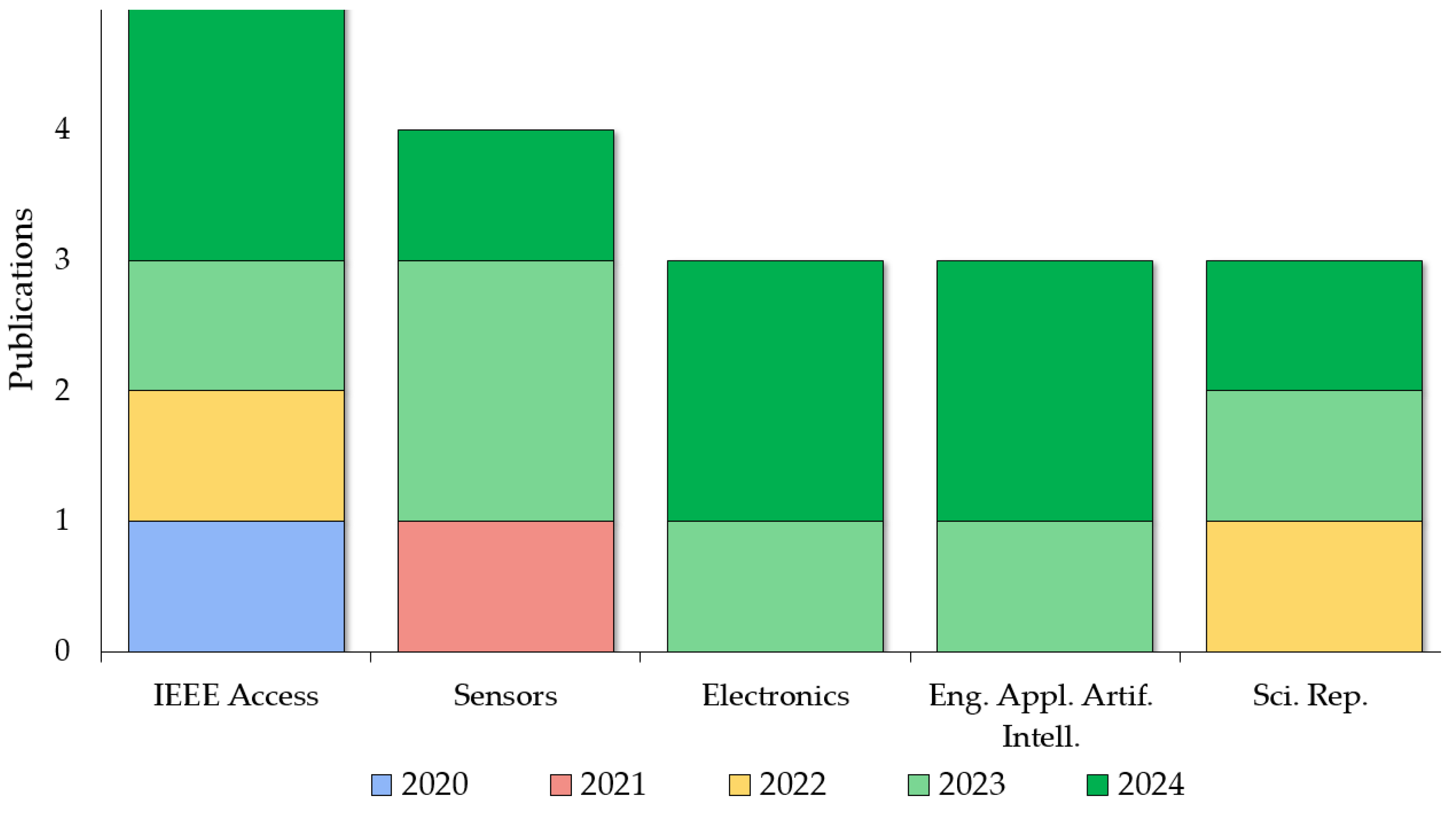
Figure 1. Journals with the highest frequencies of the reviewed articles.
Make 08 00005 g001
Figure 2. Article selection process based on PRISMA.
Make 08 00005 g002
Figure 3. Timeline of algorithms reported for defect detection in electronic assemblies.
Make 08 00005 g003
Table 1. Inclusion and exclusion criteria.
Inclusion CriteriaExclusion Criteria
The article focuses on defect detection on electronic assemblies (PCB or PCBA) using DL, ML, or CV algorithms.The article reports defect detection using DL, ML, or CV not related to EA (PCB or PCBA).
The article reports at least four of the following points: algorithms used, electronic assembly type, hardware, programming language, dataset employed, metrics applied, and classification of the EA as defective or not, or a description of defects detected.The reviews, surveys, or exploratory studies are not considered.
The article presents illegible or fuzzy images.
Table 2. Database search string.
DatabaseSearch String
SCOPUSTITLE-ABS-KEY ((manufactur * OR assembl *) AND (“quality inspection” OR “defect detection” OR “quality assurance” OR “defect inspection” OR “visual inspection”) AND (“machine vision” OR “computer vision” OR “artificial vision” OR “artificial intelligence” OR “machine learning” OR “deep learning” OR “CNN” OR “convolutional neural network”) AND (“electronic assembly” OR “printed circuit board”))
Table 3. Summary of attributes extracted from the examined articles.
RefYearAIArchitecture EAPUPLFALDataset
[1]2021dlSkip-connected AE, CAEp---HRIPCB
[2]2023dlCAE + ResNet101agpnpyCustom A + B (AXI)
[3]2024dlenh. YOLOv7tiny (CA backbone and neck + DSConv + InnerCIoU)pc, gpnpy, cuPKU-Market-PCB
[4]2022dlenh. YOLOv5 (transformer module at the junction neck and backbone + BiFPN+ PANet neck modules)pgpnpyHRIPCB
[5]2023dlYOLOv3, SSD, RCNN, RetinaNeta-pntf, ke, ocCustom
[6]2022dl-mlcvAE, RF, SIFT ac, gpnkeCustom
[8]2021dl(FRCNN + ResNet-101 + FPN)/(YOLOv2 + ResNet-101)ag--Custom A + B + C
[12]2023dl-mlcv(SSD/YOLOv3/FPN) + XGBoost/RF/TPOTp---Public Synth. PCB, D-PCB
[13]2020dl-mlcvKmeans + YOLOv3, R-FCN, SSD, FRCNNag--Custom
[15]2023dlenh. YOLOv5 (new FPN + modified CIoU loss)pgpnpy, cuCOCO + TDD-Net
[17]2024dlYOLOv3, FRCNNp---Custom
[18]2021dlenh. YOLOv3 (RFE and anchor matching), FRCNN, SSDac, gpntf, cuCustom
[19]2023dlShuffleNetv2, MobileNet, AttenNeXt, ConvNeXtac--ImageNet-1k + Custom
[21]2022dl-mlcvORB + RANSAC + ResNet-50ac, g--Custom A, Custom B
[22]2022dlenh. VGG16 (RotNet), ResNet-50a, pc, gpntf, keImagenet + (Custom A, B)
[24]2023dlYOLOv4, YOLOR-P6, FRCNN (ResNeXt-101-FPN 3x)acpn-COCO + Custom
[25]2020dlenh. FRCNN (ResNet50, ResNet101) + GARPN + ShuffleNetV2 pc, gpntfCustom
[26]2024dlenh. YOLOv4 (backbone EfficientNet)agpnpy, tf, keCustom (IC’s)
[50]2017mlcvSpiral Search + Canny + PCA + E-M, SIFTpcc++-Custom
[51]2021dlYOLOv5 (small, medium, large models)pgpnpyCOCO + Custom
[52]2022dlLPViT (ViT + Label Smooth + MPP), ResNet50, Swin Transformerp, ac, gpnpyD-PCB, Micro-PCB
[53]2023dlCustom CNNag--Custom A + Custom B
[54]2022dlYOLOv5, SSIM + AEac, gpnpy, keCustom
[55]2023dlenh. YOLOv5s (MBConv, CBAM attention, BiFPN, SIoU loss) pc, gpnpy, cuPKU-Market-PCB, D-PCB
[56]2023dlYOLOv8n-s, YOLOv5m-n-s, FRCNNac, gpnpyCustom
[57]2015mlcvMLP (scaled conjugate gradient, Levenberg Marquardt, adaptive learning rate)ac--Custom (Flux)
[58]2023mlcvSVM/HOGac, g--Custom (Capacitors)
[59]2022mlcvCHT + MR + CCLpc--Custom
[60]2023dlenh. U-Net (multitask learning)a--pyImageNet + PCBSPDefect
[61]2022dlVGG16, ResNetpc, g-tf, keImageNet + (PKU-Market-PCB enriched with Custom)
[62]2023dlenh. YOLOv7 (CA-based prediction, improved feature function, SEIoU loss)agpncuCOCO 2017 + FICS-PCB, PASCAL VOC 2012, COCO 2017
[63]2023dl-mlcvWRN-28-2, EfficientNet-B5, XGBoostp---Custom
[64]2023dlCAE/VGG19agpntf, ocImageNet + (MPI-PCB, MVTec-AD)
[65]2024dlYOLOv10, YOLOv5, YOLOv8, FRCNNac, gpn-Custom (components)
[66]2024dlResnet34 + UnetPlusPlusag-pyImageNet + Custom (AXI)
[67]2024dlYOLOv8 backbone + transformer modulepg-pyCOCO + HRIPCB
[68]2024dlenh. YOLOv8 (C2f, BiFPN, MPDIoU loss)pc, gpnpyPKU-Market-PCB
[69]2025dl-mlcvORB + RANSAC + U-Netag-pqtPreTrain + Custom (components)
[70]2024dlMask-RCNNa---PreTrain + SolDef_AI
[71]2024dlSR-DM (spectral radius featured guided diffusion model with U-Net)p-pnpyHRIPCB = PKU-Market-PCB
[72]2023dlU-Net + (VGG + CAE + WGAN-GP)a-pntf, ocCustom (components)
[73]2024dl-mlcvKmeans + enh. YOLOv7 (triplet attention mechanism + WIoUv2 loss + RFE)pgpncuPKU-Market-PCB
[74]2024dlEnh. YOLOX (Swin Transformer block) + side branch edge nodespc, g-tfPKU-Market-PCB, Kaggle PCB surface
[75]2024dlenh. YOLOv7tiny (add conv. layers to SPPCSPC, an extra feature channel, EIoU/NWD loss)pgpnpy, cuPreTrain +PKU-Market-PCB
[76]2024dlenh.YOLOv4 (VIoU loss) pg-cu, ocHRIPCB
[77]2024dlenh. YOLOv7 (mish activation f., SEAM attention mechanism, SIoU loss)agpnpyCustom
[78]2024dlenh. YOLOv5 (transformer encoder module replace Bottleneck module)p---PreTrain + PKU-Market-PCB
[79]2024dlU-Net/rule-based defect recognitionagpnpyCustom (obtained by AOI system)
[80]2023dlYOLOv8p---HRIPCB
[81]2022dl-mlcvBRISK + SURF + Stacked AE + (BiLSTM, KNN, RF, DT)pcm-PKU-Market-PCB
[82]2023dlMask-RCNN + FRCNN+ enh. ResNet (class. layer replaced by regression)pg--ImageNet + Custom (Glue)
[83]2017mlcvHistogram + CHT + Euclidean dis.acm-Custom (AXI)
[84]2022dlCycleGAN + CNNagpntf, keCustom
[85]2020dl-mlcvDual-stream CNN, DT, SVM, MLPag-cntkCustom (components)
[86]2023dlAFRNet (Siamese encoder + asymmetrical feature reconstruction modules)pg-py, cuPCB surface-defect
[87]2024dlCustom CNNagpntfCustom
Architecture: (,) architectures used independently, (/) architectures used in parallel, (+) architecture used sequentially, DL: ResNet, VGG, AE, convolutional AE (CAE), YOLO, FRCNN, Mask-RCNN, FPN, EfficientNet, ShuffleNetv2, MobileNet, AttenNeXt, ConvNeXt, U-Net, cycle GAN, wide GAN (WGAN), wide ResNet (WRN), ViT, long-short memory network (LSTM) region fully connected networks (R-FCN), single shot multibox detector (SSD); ML and CV: multilayer perceptron (MLP), SVM, PCA, extreme gradient boosting (XGBoost), Kmeans, KNN, RF, DT, tree-based pipeline optimization tool (TPOT), SIFT, Speeded Up Robust Features (SURF), Oriented FAST and Rotated BRIEF (ORB), Binary Robust Invariant Scalable Keypoints (BRISK), histogram of gradients (HOG), morphological reconstruction (MR), connected component labeling (CCL), circle Hough transform (CHT), Canny; EA: p = PCB, a = PCBA; Processing unit (PU): g = Graphics PU, c = Central PU; Programming language (PL): pn = Python, m = Matlab; FAL: py = Pytorch, cu = Cuda, tf = TensorFlow, ke = Keras, oc = OpenCV, pqt = PyQt, cntk = Microsoft cognitive toolkit; Dataset: (,) dataset individually; (+) pre training in the first data set, and training or testing in a second or next datasets. - = not mentioned.
Table 4. Models employed for defect detection in electronic assembly.
BaseExample of ModelsPCBPCBASUM
YOLOYOLOv2, YOLOv3, YOLOv4, YOLOv5, YOLOv7, YOLOv8, YOLOv10151126
CNNVGG, SSD, ResNet, ShuffleNet, MobileNet, EfficientNet, AttendNeXt, ConvNeXt, AFRNet81725
R-CNNFaster R-CNN, Mask R-CNN, R-FCN369
AE Variational AE (VAE), Denoising AE257
U-Net U-Net, U-Net++, Attention U-Net156
GANCycleGAN, WGAN022
Transformer LPViT112
RNNBiLSTM101
ML-CV MLP, SVM, PCA, XGBoost, Kmeans, KNN, RF, DT, SIFT, CHT, Canny6814
Table 7. Heatmap of the predominant metrics regarding the architecture and datasets employed.
DescriptionMetrics
AccuracyPrecisionRecallF1_Score
ArchitectureYOLO91.5%96.2%92.4%93.2%
CNN93.0%88.3%89.6%85.9%
R-CNN77.9%84.3%79.6%79.6%
AE93.8%91.6%83.0%92.2%
U-Net97.5%83.3%99.8%90.9%
GAN94.6%-94.7%-
Transformer99.1%99.0%99.0%99.0%
RNN100.0%-98.3%99.4%
ML-CV96.8%99.5%99.1%99.8%
DatasetsCustom94.4%93.8%91.3%92.9%
Specific97.7%92.2%94.5%93.1%
General-purpose + custom 84.2%94.4%84.0%79.8%
General-purpose + specific 77.5%97.6%91.8%99.7%
General-purpose + (specific + custom) -74.5%77.2%75.8%
Percentage range: ≤90.0%, 90.1–92.5%, 92.6–95.0%, 95.1–97.5%, ≥97.6%.
Disclaimer/Publisher’s Note: The statements, opinions and data contained in all publications are solely those of the individual author(s) and contributor(s) and not of MDPI and/or the editor(s). MDPI and/or the editor(s) disclaim responsibility for any injury to people or property resulting from any ideas, methods, instructions or products referred to in the content.