
Article

Ni-Co Nanoparticles@Ni3S2/Co9S8 Heterostructure Nanowire Arrays for Efficient Bifunctional Overall Water Splitting

1
School of Chemistry and Environment, Jiaying University, Meizhou 514015, China
2
Laboratory of Guangdong Higher Education Institutions of Northeast Guangdong New Functional Materials, School of Chemistry and Environment, Jiaying University, Meizhou 514015, China
3
School of Materials Science and Engineering, Hunan Institute of Technology, Hengyang 421002, China
4
Office of Assets and Laboratory Management, Jiaying University, Meizhou 514015, China
*
Authors to whom correspondence should be addressed.
J. Compos. Sci. 2025, 9(12), 657; https://doi.org/10.3390/jcs9120657 (registering DOI)
Submission received: 17 October 2025 / Revised: 8 November 2025 / Accepted: 14 November 2025 / Published: 1 December 2025
(This article belongs to the Section Composites Applications)

Abstract

This work develops a novel Ni-Co nanoparticles coupled with Ni3S2 and Co9S8 phases on nickel foam (denoted as Ni-Co NPS@Ni3S2/Co9S8/NF) hybrid structure material as a bifunctional water electrolysis catalyst. The self-assembly Ni-Co alloy phases enhance electrical conductivity, while the synergistic interactions among the three components (Ni-Co, Ni3S2 and Co9S8) optimize the lattice parameters and electronic environment for boosting both the hydrogen evolution reaction (HER) and oxygen evolution reaction (OER). The catalyst achieves low overpotentials of 106 mV for HER and 185 mV for OER at 10 mA·cm−2 in 1M KOH, along with a very low charge-transfer resistance. Density functional theory (DFT) calculations reveal that the multi-component interaction narrows the band gap and optimizes the hydrogen adsorption free energy (ΔGH*) as well as the adsorption free energies of OER intermediates (ΔGOH*). This work identifies the hybrid structure as the key to the enhanced activity and offers a promising strategy for designing efficient nickel–cobalt-based electrocatalysts.

1. Introduction

Renewable energy systems are urgently needed to address the problems associated with traditional fossil fuel depletion and environmental pollution [1,2,3]. Electrochemical water splitting represents a safe and environmentally benign technology for producing hydrogen (H2) [4,5]. Although noble metals and their oxides have considerable potential for the hydrogen and oxygen evolution reaction (HER, OER) in water splitting [6,7], their scarcity renders them impractical for large-scale applications. Consequently, H2 production using earth-abundant electrocatalysts remains a key research focus [8,9].
Earth-abundant transition metal sulfides catalysts have been considered as promising candidates due to their tunable chemical compositions and complex electronic structures [10,11]. Among these, nickel and cobalt sulfides exhibit notable HER and OER activity [12,13]. Unfortunately, their experimentally measured catalytic performance for overall water splitting falls below theoretical predictions owing to intrinsically poor activity [14,15]. Researchers discovered that Ni/Co sites on nickel and cobalt sulfide surfaces exhibit too strong H* and OH* chemisorption for HER and OER, respectively. It is a key factor contributing to their suboptimal activity [16,17,18,19]. Hybridization with active phases or highly conductive materials have been regarded as a common strategy to enhance electronic conductivity and optimize electronic/chemical properties [20,21,22,23,24,25]. For example, Du et al. synthetized the defect-enriched Co9S8/Ni3S2 nanowires for overall water splitting. The interaction between Co9S8 and Ni3S2 regulated the electronic property, lowering H* and OH* adsorption energy. This optimized chemisorption behavior led to enhanced HER and OER activity [26]. In addition, Hegazy et al. demonstrated that incorporating reduced GO or metallic Ni enhances the performance of Ni-based compounds (NiS, Ni3C, NiO, NiCNNi) [27,28,29,30,31,32]. These additives boost electronic conductivity of Ni-based compounds by optimizing their high intrinsic conductivity and electrochemical activity, thereby improving catalytic activity. Inspired by them, our team developed a strategy to synthesize core–shell Ni-Co nanoparticles@Ni0.19Co0.26P nanowires via hydrothermal–calcinations treatment [33]. This structure leverages the high conductivity of the Ni-Co alloy core to accelerate charge transfer of Ni0.19Co0.26P, enhancing pH-universal HER activity. Nevertheless, their electronic and chemical properties influenced by the Ni-Co alloy require further investigation due to prior technical constraints.
Here, we reported on a novel hybrid material featuring metallic Ni-Co alloy nanoparticles coupled to Co9S8 and Ni3S2 phases on nickel foam (denoted Ni-Co NPS@ Ni3S2/Co9S8/NF) as a bifunctional water electrolysis catalyst. The synthesis employs a two-step hydrothermal method: initial growth of the precursor nanowire arrays on NF, followed by spontaneous self-assembly during the second hydrothermal stage. This process yields a hybrid structure where high-conductivity Ni-Co alloy nanoparticles interface with Ni3S2 and Co9S8 active phases. These alloy nanoparticles promote electronic diffusion rate, while DFT calculations reveal that interfacial interactions with Ni-Co NPS, Ni3S2, and Co9S8 reduce H* and OH* adsorption energies for HER and OER, respectively. With optimized charge conduction pathways, electronic and chemical properties, Ni-Co NPS@ Ni3S2/Co9S8/NF demonstrates exceptional HER and OER performance.

2. Results and Discussion

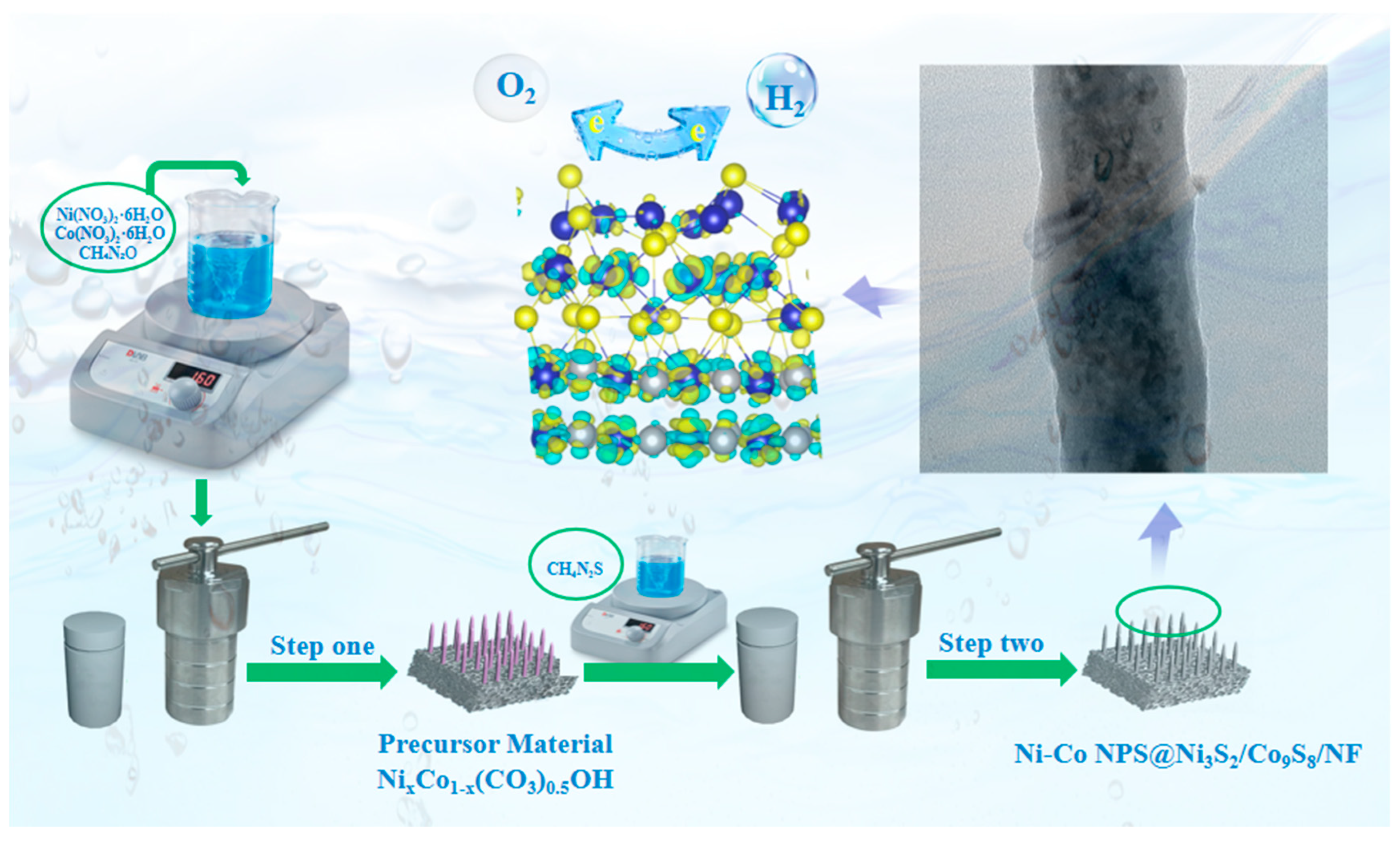
The hybrid structure electrocatalysts was obtained via a two-step method (Figure 1). Firstly, stoichiometric amounts of nickel salt and cobalt salt were dissolved in deionized water and hydrothermally treated at 110 °C for 8 h. This process yielded vertically NixCo1−x(CO3)0.5OH nanowire arrays on nickel foam (denoted as Precursor/NF). Subsequently, thiourea (CH4N2S) was introduced as the sulfur source in the second hydrothermal step at 180 °C for 12 h. Thiourea underwent hydrolysis to generate reducing agents (ammonia NH3 and hydrogen sulfide H2S), which facilitated two concurrent processes: (i) an anion exchange reaction between S2− from H2S and (CO3)0.5OH from NixCo1−x(CO3)0.5OH resulted in the formation of Ni3S2 and Co9S8 phase [34,35]; and (ii) partial Ni2+ and Co2+ were reduced by the reducibility species (NH3 and H2S) to produce Co0 and Ni0 [29,30]. The final architecture comprises a ternary heterostructure, with metallic Ni-Co alloy nanoparticles coupled to Co9S8 and Ni3S2 phases on the nickel foam substrate (abbreviated as Ni-Co NPS@ Ni3S2/Co9S8/NF).
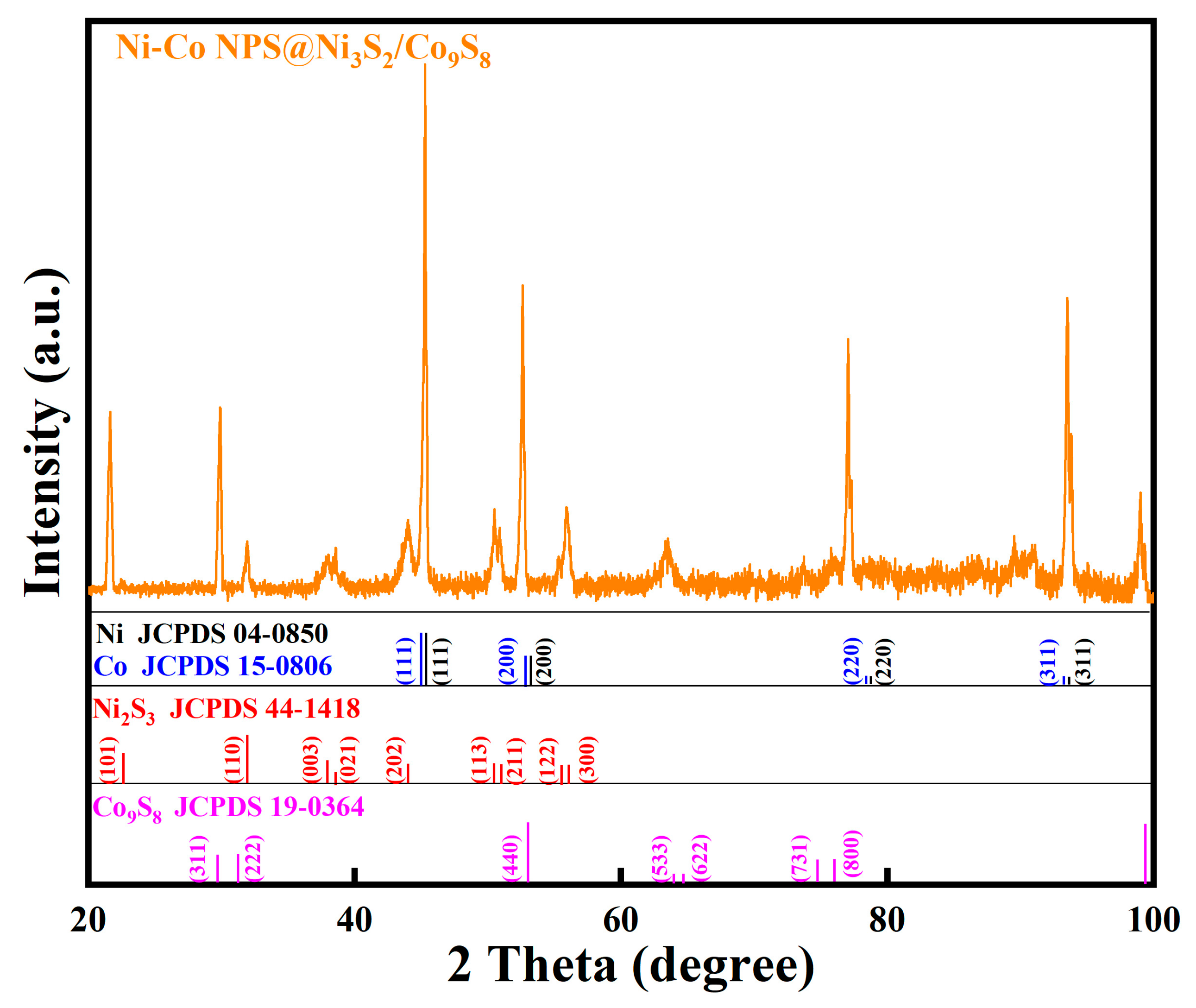
The X-ray diffraction (XRD) was used to analyze the crystalline phases. In this work, The diffraction peaks originating from the Ni foam substrate were exceptionally strong, which obscured the signals from other phases. Therefore, the powder was carefully removed from the substrate prior to XRD characterization. The precursor (Figure S1, brown curve) was identified as the Co(CO3)0.5(OH) phase (JCPDS. 48-0083) and Ni2(CO3)(OH)2 phase (JCPDS. 35-0501) [36,37]. After the second hydrothermal process, the diffraction peaks (Figure 2) at 29.85°, 31.15°, 51.95°, 61.27°, 62.13°, 73.29°, 76.50°, and 99.23° corresponded to the hexagonal phase Co9S8 (JCPDS no. 19-0364) [38], while 2θ = 21.53°, 31.25°, 37.57°, 38.17°, 44.25°, 49.51°, 51.05°, 54.99°, and 55.28° could be assigned to the hexagonal phase Ni3S2 phase (JCPDS. 44-1418) [39]. Significantly, the characteristic peaks at 44.87°, 52.84°, 78.42°, and 93.16° assigned to Ni-cubic phase (JCPDS. 04-0850) was still detected after removing Ni foam, and the above four characteristic peaks presented the shoulder peaks at 45.11°, 53.08°, 78.75°, and 93.54°, which could be indexed to Co-cubic phase (JCPDS. 15-0806). It was a strong indication that not only Ni3S2/Co9S8 but also Ni-Co metal phase had been synthetized during the secondary hydrothermal vulcanization treatment. In addition, the characteristic peaks of Co9S8, Ni3S2, Ni-cubic, and Co-cubic phases slightly shifted compared to those in standard cards, indicating a slight change in the lattice parameters. The change was due to the interaction between the mixture phases.
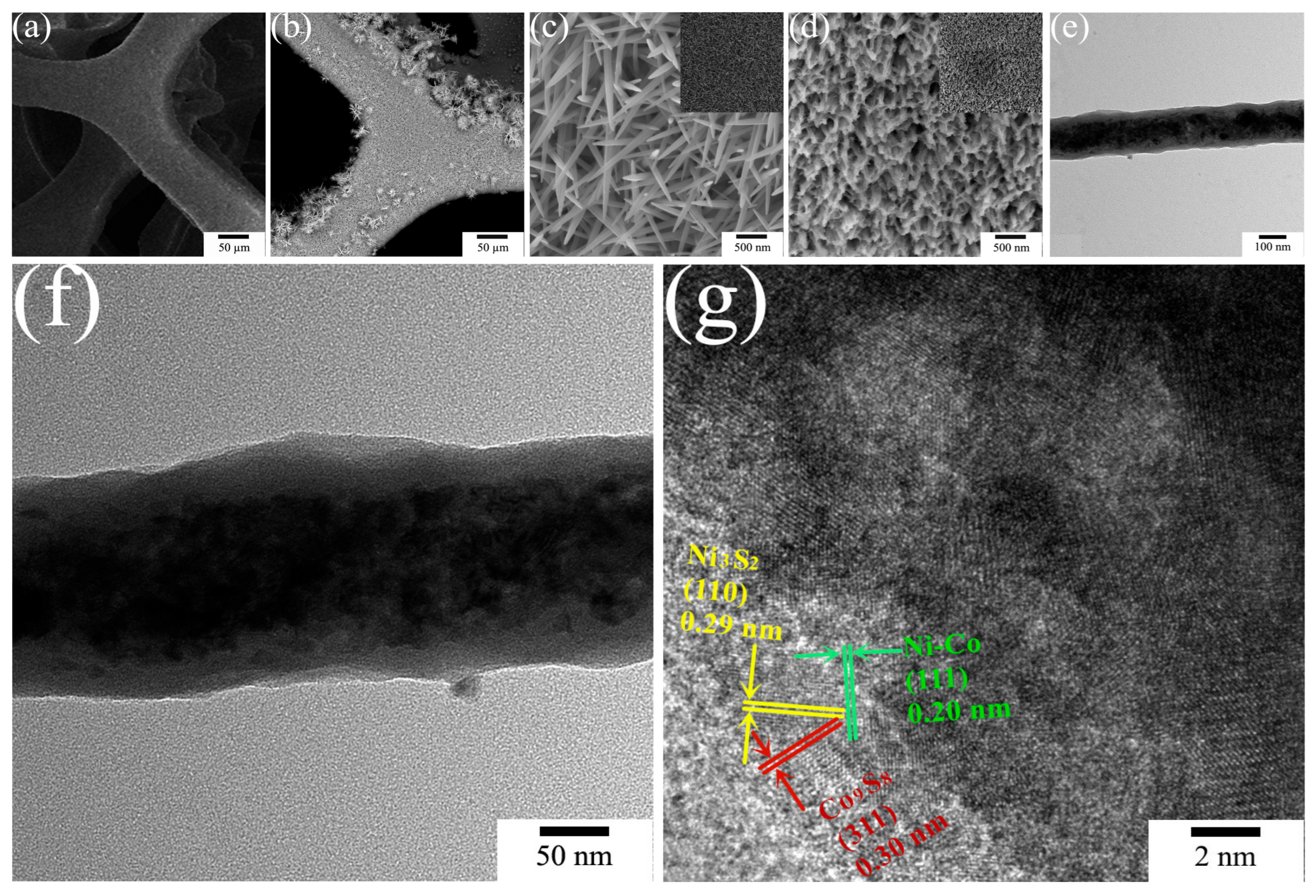
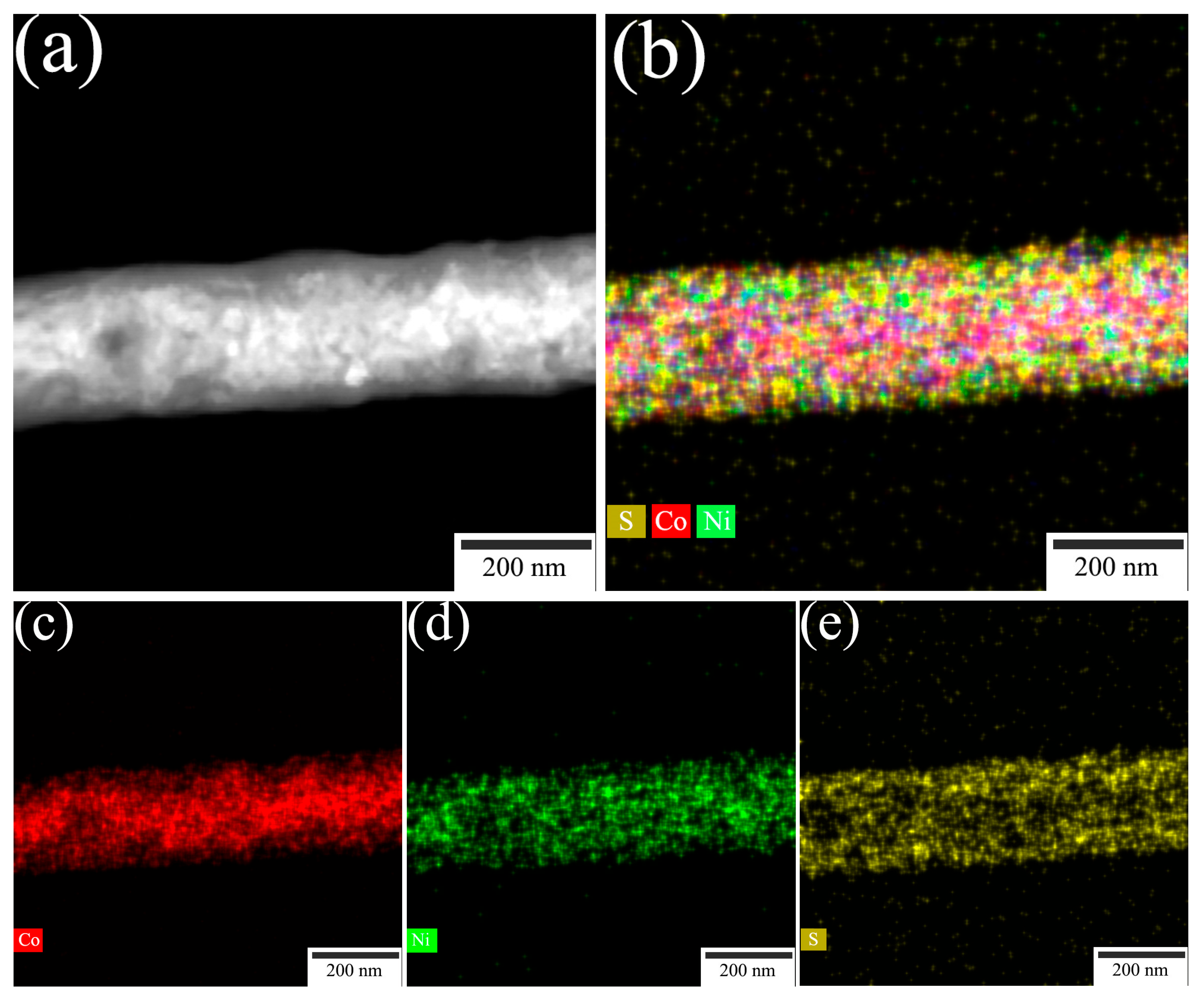
Figure 3 shows the scanning electron microscopy (SEM) images of the bare Ni foam (NF), the NixCo1−x(CO3)0.5OH precursor/Ni Foam (precursor/NF), and the Ni-Co NPS@Ni3S2/Co9S8/Ni Foam (Ni-Co NPS@Ni3S2/Co9S8/NF) electrocatalyst. The bare NF had a smooth surface without any foreign substance (Figure 3a), and the surface of precursor/NF was vertically covered by a large amount of nanowires (Figure 3b,c). After the secondary hydrothermal vulcanization treatment, the sample (Ni-Co NPS@Ni3S2/Co9S8/NF) still presents a nanowire structure (Figure 3d), but had a rougher surface compared to the precursor/NF, which was beneficial to expose more accessible active sites. This roughness could be attributed to the anion exchange reaction. Transmission electron microscopy (TEM) images (Figure 3e,f) reveal that the nanowires had an average diameter of ~200 nm and exhibited a core–shell structure, with ~30 nm in shell thickness and irregular-shaped nanoparticles in core. Meanwhile, the energy dispersive X-ray (EDX) mapping analysis (Figure 4) suggested that the shell region contained a stronger signal of S while showing relatively lower Ni and Co contents, whereas the core exhibited a reversed elemental distribution pattern with enriched Ni and Co elements. This indicated that the core region comprised metallic Ni and Co phases, and the shell region was characterized by the presence of Ni3S2 and Co9S8 phases. Existing evidence from HRTEM image (Figure 3g) revealed the coexistence of Ni3S2, Co9S8, Ni, and Co phases, and the accordingly selected area electron diffraction (SAED) images (Figure S2) also confirmed this conclusion, which was consistent with the XRD analysis. Based on the above analysis, the nanowire was characterized as a composite sulfide with core@shell configuration, where a Ni-Co alloy nanoparticle core was encapsulated by a shell consisting of a mixture of Ni3S2 and Co9S8 phases. This hierarchical architecture ultimately defines the electrocatalysts as Ni-Co alloy nanoparticle core@Ni3S2/Co9S8 shell nanowires on a nickel foam substrate (Ni-Co NPS@Ni3S2/Co9S8/NF).
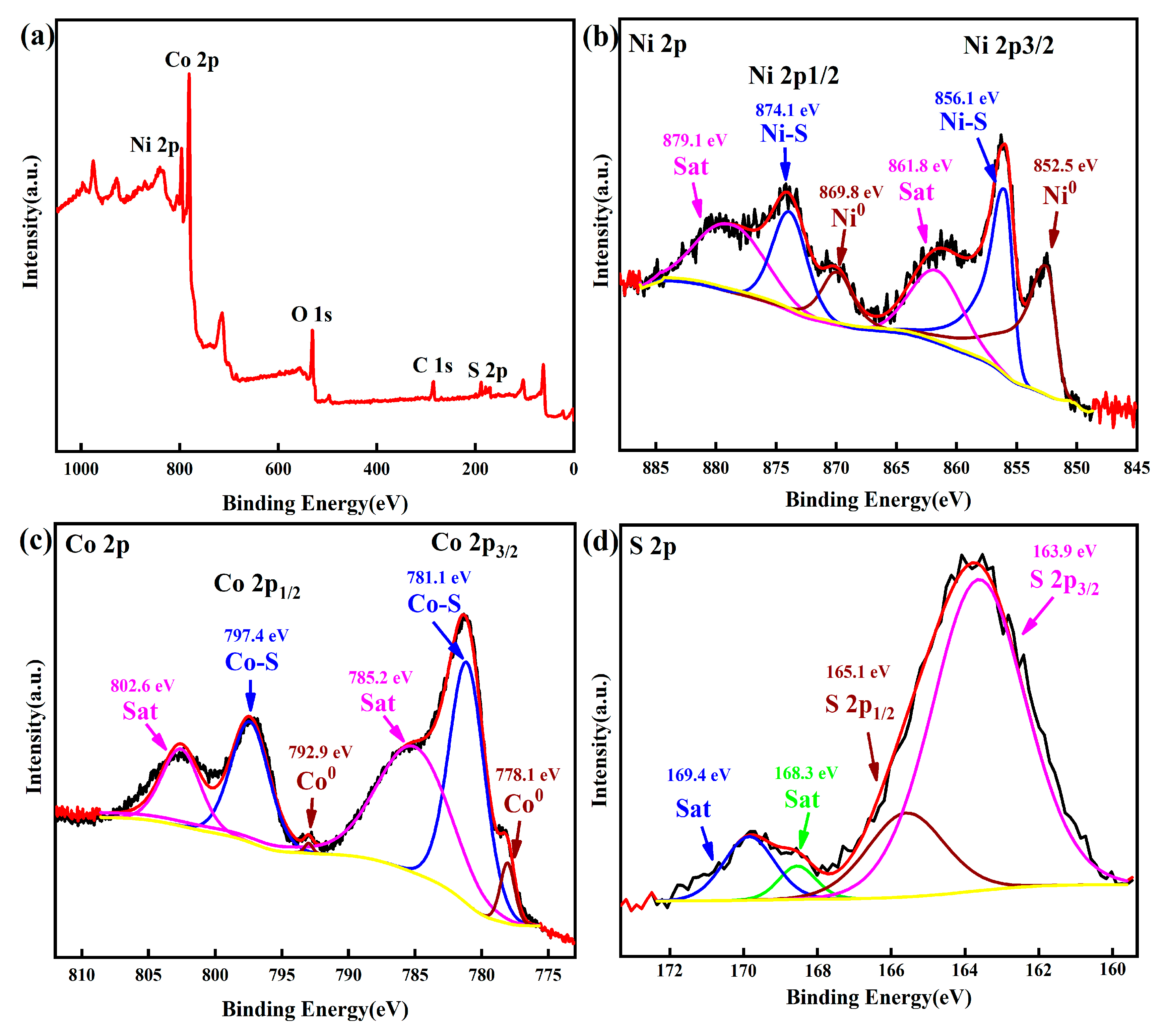
The XPS survey spectrum (Figure 5a) presents characteristic peaks corresponding to Co 2p, Ni 2p, S 2p, and O 1s. In the high-resolution Ni 2p spectrum (Figure 5b), two triplets with a high peak value and a low peak value were caused by the spin–orbit splitting of Ni 2p3/2 and 1/2 belonging to Ni3+ and Ni2+ species in the Ni-S bond, respectively, while the peaks at ~852.5 and 869.8 eV indicated the existence of a lower oxidation state Ni0 [40], which was consistent with previous observations from XRD, HRTEM, and EDX analyses. The Co 2p spectrum (Figure 5c) presents multiple oxidation states (Co3+, Co2+, and Co0) [41]. This confirmed the formation of metallic Co phases in Ni-Co NPS@Ni3S2/Co9S8. Meanwhile, the spin–orbit splitting peaks of S 2p3/2 and 1/2, located at ~163.9 and 165.1 eV, can also be evidence of the Ni-S (Ni3S2) and Co-S (Co9S8) bond (Figure 5d). The overall atomic ratio of Ni-Co NPS@Ni3S2/Co9S8, as quantified by XPS survey, was 13.10: 25.07: 44.91 for Ni:Co:S (Table S2), and the corresponding ratio obtained by EDX was 18.35: 30.26: 43.56 (Table S1). Using the XPS survey as a benchmark, the relative concentrations of Ni0, Co0, Co-S, and Ni-S species were determined to be 4.59, 2.68, 22.39, and 8.51 from the high-resolution Ni 2p and Co 2p spectra, respectively. Based on these values, the phase ratio of Ni-Co: Ni3S2: Co9S8 was calculated to be 7.27: 8.51: 22.39.
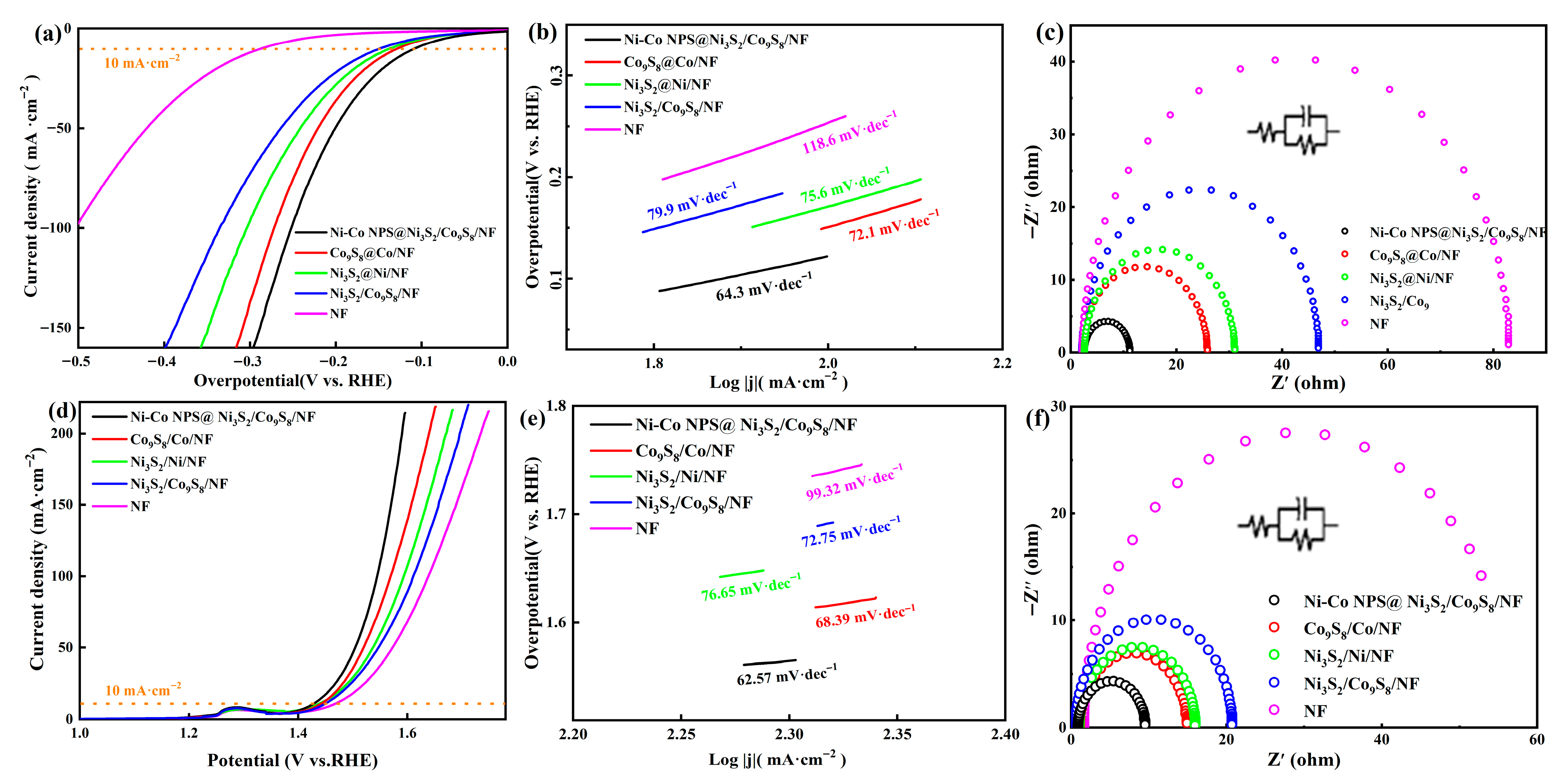
Moreover, HER and OER performance of the electrocatalysts were assessed in alkaline electrolyte (1 M KOH). For comparison, Co9S8@Co/NF, Ni3S2@Ni/NF, Co9S8/Ni3S2/NF (Figures S1, S3 and S4), and bare NF were also prepared. As shown in Figure 6a, Ni-Co NPS@Co9S8/Ni3S2/NF exhibits remarkably HER catalytic activity by the linear sweep voltammetry curves (LSVs), requiring an overpotential of only 106 mV at 10 mA·cm−2. This performance significantly outperforms that of bare NF (290 mV), Co9S8@Co/NF (129 mV), Ni3S2@Ni/NF (141 mV), and Co9S8/Ni3S2/NF (153 mV). This is superior or comparable to recent work (Supporting Information, Table S4). The electrochemical surface area (ECSA) was estimated from the relative double-layer capacitance (Cdl) values (Figure S5, Table S3). Ni-Co NPS@Co9S8/Ni3S2/NF provides the highest ECSA among the electrocatalysts due to its larger Cdl value. This larger ECSA stems from the advantageous nanowire structure with a greater specific surface area, resulting in an easier access to active sites [42]. To explore the intrinsic HER activity per unit area, the linear sweep voltammetry curves (LSVs) were normalized by the ECSA. The normalized LSVs (Figure S6a) reveal that Ni-Co NPS@Co9S8/Ni3S2/NF maintains more favorable HER kinetics compared to the others, which is consistent with the turnover frequency (TOF) conclusion (Table S5). The HER kinetic dynamics were further investigated through Tafel plots (Figure 6b). Ni-Co NPS@Co9S8/Ni3S2/NF exhibits the fastest kinetics due to the smallest Tafel slope of 64.3 mV·dec−1. This outperforms Co9S8@Co/NF (72.1 mV·dec−1), Ni3S2@Ni/NF (75.6 mV·dec−1), Co9S8/Ni3S2/NF (79.9 mV·dec−1), and bare NF (118.6 mV·dec−1). This suggested that the electronic structure, regulated by the interaction among Ni-Co NPS, Co9S8, and Ni3S2 components, is more favorable for H* adsorption and desorption [43]. Electrochemical impedance spectroscopy (EIS) measurements (Figure 6c) confirm Ni-Co NPS@Co9S8/Ni3S2/NF has the smallest Rct among the electrocatalysts [44], attributing to the high electrical conductivity of Ni-Co NPS. Meanwhile, Ni-Co NPS@Co9S8/Ni3S2/NF showed a good durability (Figure S6b). Consequently, the interaction among Ni-Co nanoparticles, Ni3S2, and Co9S8 accelerates HER performance through improved electrical conductivity and kinetic dynamics. Figure 6d shows the LSVs for OER. The overpotentials at 10 mA·cm−2 required 308 mV for bare NF, 259 mV for Co9S8@Co/NF, 234 mV for Ni3S2@Ni/NF, and 285 mV for Co9S8/Ni3S2/NF. In contrast, Ni-Co NPS@Co9S8/Ni3S2/NF required a significantly lower overpotential of only 185 mV, which is superior or comparable to recent works (Supporting Information, Table S6). To evaluate the intrinsic activity per unit area, the LSV curves were normalized by ECSA (Figure S7). As shown in Figure S8a, Ni-Co NPS@Co9S8/Ni3S2/NF still exhibited the lowest overpotential among all samples, suggesting that the OER performance was enhanced by synergistic interactions among the Ni-Co nanoparticles, Ni3S2, and Co9S8. This is consistent with the turnover frequency (TOF) conclusion (Table S5). The electrocatalytic kinetics were further investigated through Tafel analysis (Figure 6e) and EIS (Figure 6f). The Tafel slope of Ni-Co NPS@Co9S8/Ni3S2/NF was 72.5 mV·dec−1, which is lower than those of Co9S8@Co/NF (79.9 mV·dec−1), Ni3S2@Ni/NF (82.3 mV·dec−1), Co9S8/Ni3S2/NF (85.2 mV·dec−1), and bare NF (108.8 mV·dec−1). The lower Tafel slope indicated faster OER kinetics and a more favorable electron transfer process [45]. Additionally, the Nyquist plot derived from EIS measurements revealed that Ni-Co NPS @Co9S8/Ni3S2/NF possessed the smallest charge-transfer resistance, further confirming its superior electrocatalytic activity. Then, Ni-Co NPS@Co9S8/Ni3S2/NF showed a good durability (Figure S8b). Therefore, the interaction among Ni-Co nanoparticles, Ni3S2, and Co9S8 effectively modulates the electronic structure and enhances the electrical conductivity and reaction kinetics, leading to improved OER performance.
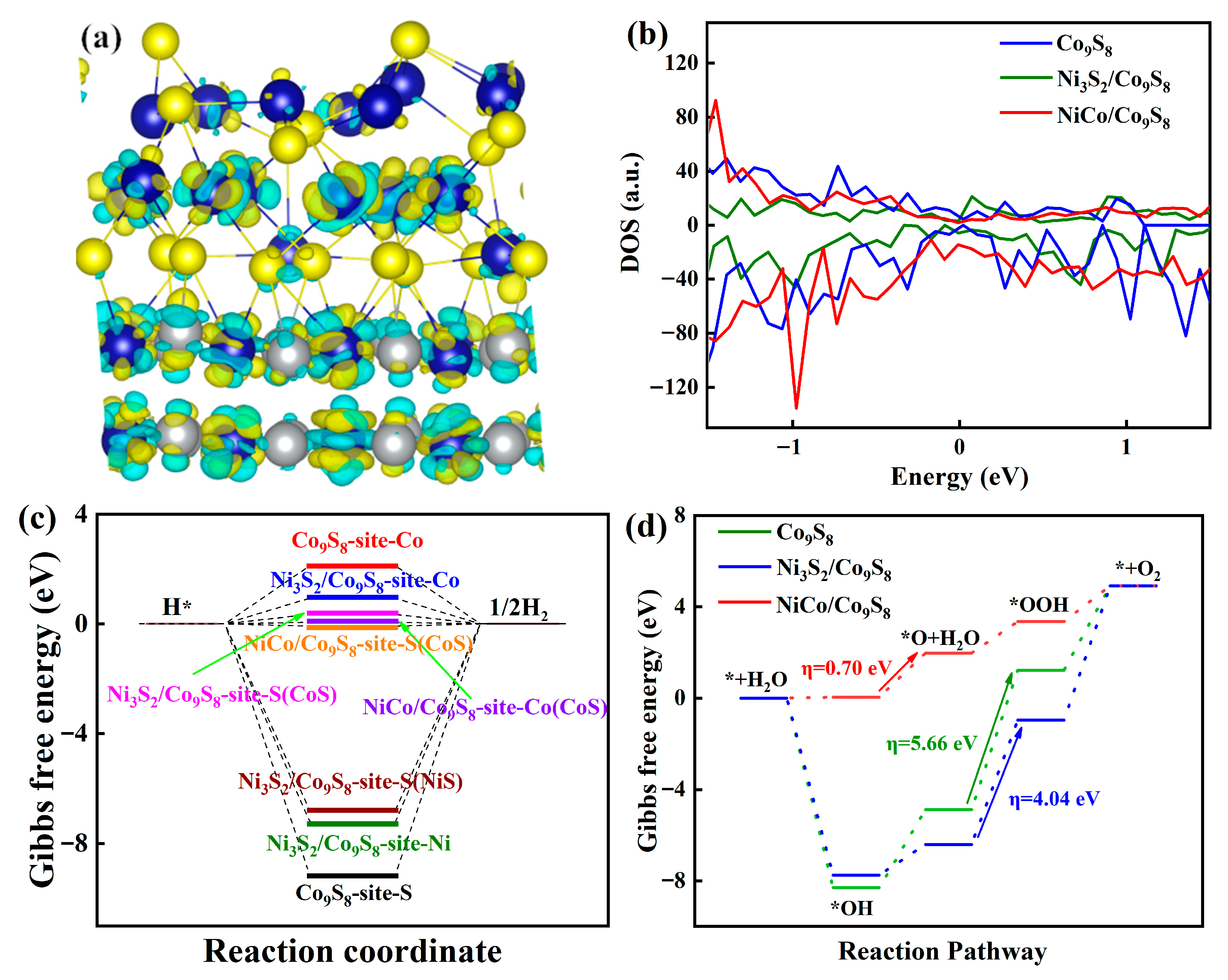
Based on the above, we conclude that the interaction between metallic Ni-Co alloy phases, Co9S8, and Ni3S2 phases significantly enhance HER and OER activity. To elucidate the interfacial contribution to this enhanced activity, DFT calculations were performed to investigate the adsorption free energy of hydrogen (ΔGH*) for the HER [46], as well as those of key OER intermediates (ΔG*OH,*O,*OOH) [47]. Using Ni-Co NPS@Co9S8 structure as a representative system, we probed the influence of the interaction between Ni-Co nanoparticles, Ni3S2, and Co9S8 on these descriptors. According to HRTEM images and XRD analysis, three distinct models were constructed, including Co9S8 (Figure S9a), Ni3S2/Co9S8 (Figure S9b), and Ni-Co NPS@Co9S8 (Figure 7a). For these models, the (110) facet of Ni3S2 and (311) facet of Co9S8 were exposed on the crystal surface, consistent with experimental observations. Figure 7b shows the density of states (DOS) for three models. The calculated band gap was ~1.3 eV for Co9S8 and ~1.0 eV for Ni3S2/Co9S8; both values are characteristic of semiconducting materials [48]. In contrast, Ni-Co NPS@Co9S8 displayed a significantly narrowed band gap of ~0.4 eV, indicating a marked improvement in electrical conductivity [49]. This result aligns well with EIS analysis, and enhanced conductivity can be attributed to the highly conductive nature of the Ni-Co nanoparticles in the composite.
Then, the HER activity of the three studied models was assessed using the hydrogen adsorption free energy (ΔGH*), which governs HER activity [50]. Optimal HER activity is achieved when the ΔGH* is closest to zero. Figure 7c shows the calculated ΔGH* values for the catalytic sites (S, Co, and Ni) on the Co9S8 (311) and Ni3S2 (110) surface across all models. The S and Co sites in pure Co9S8 exhibited ΔGH* values of −9.24 eV and 2.18 eV, higher than the Co site (0.95 eV) and S site (0.46 eV) of Co9S8 and the Ni site (−7.32 eV) and S site (−6.81 eV) of Ni3S2 in Ni3S2/Co9S8. As anticipated, the Ni-Co NPS@Co9S8 has a more favorable ΔGH* of 0.10 eV(Co) and −0.13 eV(S) of Co9S8. These theoretical results are consistent with experimental electrochemical performance, further validating the model’s reliability. Additionally, the Co sites were identified as the primary HER active sites, as their ΔGH* values were lower than those of S sites across all models. Collectively, these findings demonstrate that the ΔGH* of Co9S8 can be modulated via interactions with either Ni3S2 or Ni-Co nanoparticles. Specifically, coupling Ni-Co alloy nanoparticles to Co9S8 optimizes the electronic properties of the catalyst, which explains the enhanced HER performance of the Ni-Co NPS@Co9S8/Ni3S2/NF composite. This improvement originates from the synergistic interactions among Ni-Co nanoparticles, Ni3S2, and Co9S8, which not only tune ΔGH* to near-optimal values but also accelerate electron transfer.
For the OER, the mechanism involves four proton-coupled electron transfer steps, as represented by Equations S1−S4 [51]. We calculated the free energy change (ΔGn, n = 1–4) for each step to derive theoretical overpotentials. As shown in Figure 7d, the rate-determining step for Ni-Co NPS@Co9S8 is the conversion of OH* to O* (ΔG2 = 1.93 eV), corresponding to a theoretical overpotential (η) of 0.7 V. For Co9S8 and Ni3S2/Co9S8, the O* to OOH* conversion is the most energetically demanding, making it rate-limiting, with overpotentials of 5.66 V and 4.04 V, respectively. Compared to three systems, the Ni-Co NPS@Co9S8 composite exhibits a substantially lower theoretical overpotential, which would promote faster electron transfer and improve OER kinetics. These DFT calculations further validate our experimental electrochemical analysis, confirming that coupling Ni-Co alloy nanoparticles with Co9S8 modulates the catalyst’s electronic properties to be optimal for both HER and OER. This synergy between experiment and theory solidifies the conclusion that the interfacial interactions among Ni-Co nanoparticles, Co9S8, and Ni3S2 are the key to the enhanced bifunctional electrocatalytic performance of the Ni-Co NPS@Co9S8/Ni3S2/NF composite.

3. Conclusions

In summary, a novel bifunctional electrocatalyst (Ni-Co NPS@Co9S8/Ni3S2/NF) has been successfully synthesized via a facile two-step hydrothermal method for both HER and OER. Structural characterization revealed the catalyst featured Ni-Co alloy nanoparticles as the core and a mixed phase of Co9S8 and Ni3S2 as the shell, forming a core–shell nanowire structure nanowire arrays with an average diameter of ~200 nm. Comprehensive structural analyses confirmed the coexistence of these phases and their interfacial interactions, which slightly modify the lattice parameters and electronic environments, as evidenced by XRD, HRTEM, and XPS. Electrochemical tests in 1 M KOH electrolyte showed that Ni-Co NPS@Co9S8/Ni3S2/NF required only 106 mV and 185 mV overpotentials at 10 mA·cm−2 for HER and OER, respectively. The catalyst also exhibited smaller Tafel slopes and lower Rct compared to control samples, indicating improved reaction kinetics and enhanced electrical conductivity. DFT calculations revealed that the interfacial interactions between Ni-Co alloy, Co9S8, and Ni3S2 regulated the hydrogen adsorption free energy (ΔGH*) to near-optimal values, reduced the adsorption energy barriers of key OER intermediates (*OH, *O, *OOH), and narrowed the material’s band gap from 1.3 eV (for pure Co9S8) to 0.4 eV, greatly improving electrical conductivity and charge transfer rate. This suggested that the high electrical conductivity of Ni-Co NPS effectively reduced the charge-transfer resistance, and the interfacial interactions between Ni-Co alloy, Co9S8, and Ni3S2 effectively addressed the issues of low catalytic activity. This work provides theoretical and experimental support for the development of low-cost and high-efficiency electrocatalysts for water splitting.

Supplementary Materials

The following supporting information can be downloaded at: https://www.mdpi.com/article/10.3390/jcs9120657/s1. Figure S1. XRD patterns of Co9S8/Co, Ni3S2/Ni, Ni3S2/Co9S8, and NiCo(CO3)(OH)2. Figure S2. SAED patterns of Ni-Co Nanoparticles@Ni3S2/Co9S8. Figure S3. TEM images of (a,b) Co9S8/Co, (c,d) Ni3S2/Ni. Figure S4. The XPS (a) Co 2p spectra of Co9S8/Co, (b) Ni 2p spectra of Ni3S2/Ni. Figure S5. Cyclic voltammogram curves for HER of (a) Ni-Co NPS@Ni3S2/Co9S8/NF, (b) Co9S8@Co/NF, (c) Ni3S2@Ni/NF, (d) Ni3S2/Co9S8/NF, and (e) NF towards HER in 1 M KOH measured in the non-faradaic potential of 1.01-1.06 V at multiple scan rates (2, 4, 6, 8 and 10 mV·s−1). (f) Cdl curves in 1 M KOH evaluated by Δj = ja- jc at 1.05 V versus RHE as a function of the scan rate. Figure S6. (a) the normalized LSVs by ECSA for HER and (b) the durability test (I-T curve). Figure S7. Cyclic voltammogram curves for HER of (a) Ni-Co NPS@Ni3S2/Co9S8/NF, (b) Co9S8@Co/NF, (c) Ni3S2@Ni/NF, (d) Ni3S2/Co9S8/NF, and (e) NF towards HER in 1 M KOH measured in the non-faradaic potential of 1.01-1.06 V at multiple scan rates (2, 4, 6, 8 and 10 mV·s−1). (f) Cdl curves in 1 M KOH evaluated by Δj = ja- jc at 1.05 V versus RHE as a function of the scan rate. Figure S8. (a) the normalized LSVs by ECSA for OER and (b) the durability test (I-T curve). Figure S9. (a) Schematic models of Co9S8 (311) surface. (b) Ni3S2 (110) (top) parallel to Co9S8 (311) (below). Table S1. Atomic Ratio of Ni-Co NPS@Ni3S2/Co9S8 by EDX. Table S2. Atomic Ratio of Ni-Co NPS@Ni3S2/Co9S8 by XPS. Table S3. ECSA values of samples (Cdlref=80*102 µF·cm−2). Table S4. Comparison of the HER performance of Ni-Co NPS@Ni3S2/Co9S8/NF with other well-performed electrocatalysts. Table S5. The TOF of samples at the overpotential of 300 mV. Table S6. Comparison of the OER performance of Ni-Co NPS@Ni3S2/Co9S8/NF with other well-performed electrocatalysts. Table S7. The free energy change for OER (eV).

Author Contributions

Conceptualization, L.Z., W.C., A.Q., F.L., Y.W., H.W., Z.Z., X.X., W.H., M.J., Y.L., F.Z. and H.L.; Methodology, L.Z. and H.L.; Software, L.Z. and H.L.; Validation, L.Z. and H.L.; Formal analysis, L.Z. and H.L.; Investigation, L.Z., W.C., A.Q., F.L., Y.W., H.W., Z.Z., X.X., W.H., M.J., Y.L., F.Z. and H.L.; Resources, L.Z. and H.L.; Data curation, L.Z. and H.L.; Writing—original draft, L.Z. and H.L.; Writing—review & editing, L.Z. and H.L.; Visualization, L.Z. and H.L.; Supervision, L.Z. and H.L.; Project administration, L.Z. and H.L.; Funding acquisition, L.Z. and H.L. All authors have read and agreed to the published version of the manuscript.

Funding

This work is financially supported by a Special Fund (Climbing Plan) for Guangdong Province’s Science and Technology Innovation Strategy in 2024 (No. Pdjh2024b351); the University Key Laboratory of Guangdong (2024KSYS021); the National Natural Science Foundation of China (NSFC) Youth Program (No. 52502095); Hunan Provincial Key Research and Development Program (No. 2025JK2079); Hunan Provincial Natural Science Foundation General Program (No. 2025JJ50310); and the project Exploring the Soil Improvement Effect of Municipal Solid Waste-Derived Biochar Under Different Temperature Conditions (2024KTSCX085).

Data Availability Statement

The raw data supporting the conclusions of this article will be made available by the authors on request.

Conflicts of Interest

The authors declare no conflicts of interest.

References

  1. Rezayeenik, M.; Mousavi-Kamazani, M.; Zinatloo-Ajabshir, S. CeVO4/rGO nanocomposite: Facile hydrothermal synthesis, characterization, and electrochemical hydrogen storage. Appl. Phys. A 2023, 129, 47. [Google Scholar] [CrossRef]
  2. Alnarabijia, M.S.; Tantawib, O.; Ramlic, A.; Zabidic, N.A.M.; Ghanema, O.B.; Abdullah, B. Comprehensive review of structured binary Ni-NiO catalyst: Synthesis, characterization and applications. Renew. Sust. Energy Rev. 2019, 114, 109326. [Google Scholar] [CrossRef]
  3. Geng, S.K.; Zheng, Y.; Li, S.Q.; Su, H.; Zhao, X.; Hu, J.; Shu, H.B.; Jaroniec, M.; Chen, P.; Liu, Q.H. Nickel ferrocyanide as a high-performance urea oxidation electrocatalyst. Nat. Energy 2021, 6, 904–912. [Google Scholar] [CrossRef]
  4. Wang, P.; Bai, X.; Jin, H.; Gao, X.; Davey, K.; Zheng, Y.; Jiao, Y.; Qiao, S.Z. Directed urea-to-nitrite electrooxidation via tuning intermediate adsorption on CoGeCodoped Ni sites. Adv. Funct. Mater. 2023, 33, 2300687. [Google Scholar] [CrossRef]
  5. Yu, F.; Yu, L.; Mishra, I.K.; Yu, Y.; Ren, Z.F.; Zhou, H.Q. Recent developments in earth-abundant and non-noble electrocatalysts for water electrolysis. Mater. Today Phys. 2018, 7, 121–138. [Google Scholar] [CrossRef]
  6. Faber, M.S.; Jin, S. Earth-abundant inorganic electrocatalysts and their nanostructures for energy conversion applications. Energy Environ. Sci. 2014, 7, 3519–3542. [Google Scholar] [CrossRef]
  7. Chen, P.; Zhou, T.; Zhang, M.; Tong, Y.; Zhong, C.; Zhang, N.; Zhang, L.; Wu, C.; Xie, Y. 3D Nitrogen Anion decorated Nickel Sulfides for highly efficient overall water splitting. Adv. Mater. 2017, 29, 1701584. [Google Scholar] [CrossRef] [PubMed]
  8. Liang, K.; Guo, L.; Marcus, K.; Li, Z.; Zhou, L.; Li, Y.; Ye, R.; Orlovskaya, N.; Sohn, Y.H.; Yang, Y. Strained W(SexS1-x)2 nanoporous films for high efficient hydrogen evolution. ACS Energy Lett. 2017, 2, 1315–1320. [Google Scholar] [CrossRef]
  9. Guo, Z.; Cui, Y.; Liu, W. High-performance and durable Pd5P2/PdP2 heterointerface for all-pH hydrogen evolution reactions. ACS Catal. 2024, 14, 9413–9420. [Google Scholar] [CrossRef]
  10. Xing, M.; Zhu, S.; Zeng, X.; Wang, S.; Liu, Z.; Cao, D. Amorphous/crystalline Rh(OH)3/CoP heterostructure with hydrophilicity/aerophobicity feature for all-pH hydrogen evolution reactions. Adv. Energy Mater. 2023, 13, 2302376. [Google Scholar] [CrossRef]
  11. Zhang, R.; Wang, X.X.; Yu, S.J.; Wen, T.; Zhu, X.W.; Yang, F.X.; Sun, X.N.; Wang, X.K.; Hu, W.P. Ternary NiCo2Px nanowires as pH-universal electrocatalysts for highly efficient hydrogen evolution reaction. Adv. Mater. 2017, 29, 1605502. [Google Scholar] [CrossRef] [PubMed]
  12. Mo, Y.; Ni, Y.; Li, X.; Tang, R.; Deng, Y.; Xiao, Y.; Tan, B.; Fang, Y. An efficient pH-universal non-noble hydrogen-evolving electrocatalyst from transition metal phosphides-based heterostructures. Int. J. Hydrogen Energy 2023, 48, 31101–31109. [Google Scholar] [CrossRef]
  13. Cai, C.; Liu, K.; Zhu, Y.; Li, P.; Wang, Q.; Liu, B.; Chen, S.; Li, H.; Zhu, L.; Li, H.; et al. Optimizing hydrogen binding on Ru sites with RuCo alloy nanosheets for efficient alkaline hydrogen evolution. Angew. Chem. Int. Ed. 2022, 61, e202113664. [Google Scholar] [CrossRef] [PubMed]
  14. Wang, Z.; Xiao, B.; Lin, Z.; Xu, Y.; Lin, Y.; Meng, F.; Zhang, Q.; Gu, L.; Fang, B.; Guo, S.; et al. PtSe2/Pt heterointerface with reduced coordination for boosted hydrogen evolution reaction. Angew. Chem. Int. Ed. 2021, 60, 23388. [Google Scholar] [CrossRef]
  15. Dutta, S.; Han, H.; Je, M.; Choi, H.; Kwon, J.; Park, K.; Indra, A.; Kim, K.M.; Paik, U.; Song, T. Chemical and structural engineering of transition metal boride towards excellent and sustainable hydrogen evolution reaction. Nano Energy 2020, 67, 104245. [Google Scholar] [CrossRef]
  16. Zhen, D.; Liu, C.; Deng, Q.; Zhang, S.; Yuan, N.; Li, L.; Liu, Y. A review of covalent organic frameworks for metal ion fluorescence sensing. Chin. Chem. Lett. 2024, 35, 109249. [Google Scholar] [CrossRef]
  17. Zhao, Y.; Luo, M.; Chu, S.; Peng, M.; Liu, B.; Wu, Q.; Liu, P.; Groot, F.M.F.D.; Tan, Y. 3D nanoporous iridium-based alloy microwires for efficient oxygen evolution in acidic media. Nano Energy 2019, 59, 146. [Google Scholar] [CrossRef]
  18. Zhen, D.; Zhang, S.; Yang, A.; Li, L.; Cai, Q.; Grimes, C.A.; Liu, Y. A PEDOT enhanced covalent organic framework (COF) fluorescent probe for in vivo detection and imaging of Fe3+. Int. J. Biol. Macromol. 2024, 259, 129104. [Google Scholar] [CrossRef]
  19. Shen, L.; Yu, L.; Wu, H.B.; Yu, X.-Y.; Zhang, X.; Lou, X.W. Formation of nickel cobalt sulfide ball-in-ball hollow spheres with enhanced electrochemical pseudocapacitive properties. Nat. Commun. 2015, 6, 6694. [Google Scholar] [CrossRef]
  20. Zheng, X.; Yang, J.; Li, P.; Jiang, Z.; Zhu, P.; Wang, Q.; Wu, J.; Zhang, E.; Sun, W.; Dou, S. Dual-atom support boosts Nickel-catalyzed urea electrooxidation. Angew. Chem. Int. Ed. 2023, 135, e202217449. [Google Scholar] [CrossRef]
  21. Jin, J.; Yin, J.; Liu, H.; Huang, B.; Hu, Y.; Zhang, H.; Sun, M.; Peng, Y.; Xi, P.; Yan, C. Atomic sulfur filling oxygen vacancies optimizes H absorption and boosts the hydrogen evolution reaction in alkaline media. Angew. Chem. Int. Ed. 2021, 133, 14236–14242. [Google Scholar] [CrossRef]
  22. Yu, H.; Zhu, S.; Hao, Y.; Chang, Y.; Li, L.; Ma, J.; Chen, H.; Shao, M.; Peng, S. Modulating local interfacial bonding environment of heterostructures for energy-saving hydrogen production at high current densities. Adv. Funct. Mater. 2023, 33, 2212811. [Google Scholar] [CrossRef]
  23. Wang, T.; Cao, X.; Jiao, L. Progress in hydrogen production coupled with electrochemical oxidation of small molecules. Angew. Chem. Int. Ed. 2022, 134, e202213328. [Google Scholar] [CrossRef]
  24. Guo, D.; Luo, Y.; Yu, X.; Li, Q.; Wang, T. High performance NiMoO4 nanowires supported on Carbon cloth as advanced electrodes for symmetric supercapacitors. Nano Energy 2014, 8, 174–182. [Google Scholar] [CrossRef]
  25. Zhu, Z.; Zang, L.; Chu, M.; He, Y.; Ren, D.; Saha, P.; Cheng, Q. Oxygen-vacancy and Phosphorus-doping enriched NiMoO4 nanoarrays for high-energy supercapacitors. J. Energy Storage 2022, 54, 105314. [Google Scholar] [CrossRef]
  26. Dua, F.; Shi, L.; Zhang, Y.; Li, T.; Wang, J.; Wen, G.; Alsaed, A.; Hayat, T.; Zhou, Y.; Zou, Z. Foam-like Co9S8/Ni3S2 heterostructure nanowire arrays for efficient bifunctional overall water-splitting. Appl. Catal. B Environ. 2019, 253, 246–252. [Google Scholar] [CrossRef]
  27. Zakaria, M.B.; Guo, Y.; Na, J.; Tahawy, R.; Chikyow, T.; El-Said, W.A.; El-Hady, D.A.; Alshitari, W.; Yamauchi, Y.; Lin, J. Layer-by-Layer motif heteroarchitecturing of N and S co-doped reduced graphene oxide-wrapped Ni/NiS nanoparticles for the electrochemical oxidation of water. ChemSusChem 2020, 13, 3269–3276. [Google Scholar] [CrossRef]
  28. Zakaria, M.B.; Li, C.; Ji, Q.; Jiang, B.; Tominaka, S.; Ide, Y.; Hill, J.P.; Ariga, K.; Yamauchi, Y. Self-Construction from 2D to 3D: One-pot layer-by-layer assembly of graphene oxide sheets heldtogether by coordination polymers. Angew. Chem. Int. Ed. 2016, 55, 8426–8430. [Google Scholar] [CrossRef]
  29. Zakaria, M.B.; Malgras, V.; Takei, T.; Li, C.; Yamauchi, Y. Layer-by-Layer motif hybridization: Nanoporous nickel oxide flakes wrapped into graphene oxide sheets toward enhanced oxygen reduction reaction. Chem. Commun. 2015, 51, 16409–16412. [Google Scholar] [CrossRef]
  30. Zhang, D.; Shi, J.; Qi, Y.; Wang, X.; Wang, H.; Li, M.; Liu, S.; Li, C. Quasi-Amorphous metallic Nickel nanopowder as an efficient and durable electrocatalyst for alkaline hydrogen evolution. Adv. Sci. 2018, 5, 1801216. [Google Scholar] [CrossRef]
  31. Zakaria, M.B.; Tan, H.; Kim, J.; Badjah, A.Y.; Naushad, M.; Habila, M.; Wabaidur, S.; Alothman, Z.A.; Yamauchi, Y.; Lin, J. Structurally controlled layered Ni3C/graphene hybrids using cyano-bridged coordination polymers. Electrochem. Commun. 2019, 100, 74–80. [Google Scholar] [CrossRef]
  32. Zakaria, M.B.; Ebeid, E.Z.M.; Abdel-Galeil, M.M.; Chikyow, T. Cyanide bridged coordination polymer nanoflakes thermally derived Ni3C and fcc-Ni nanoparticles for electrocatalysts. New J. Chem. 2017, 41, 14890–14897. [Google Scholar] [CrossRef]
  33. Zhang, L.; Chen, K.; Li, L.; Wei, X.; Cai, X.; Yu, Y.; Yang, Y.; Cao, R.; Wei, F.; Lan, B.; et al. One-pot synthesis of Ni-Co nanoparticles@Ni0.19Co0.26P nanowires core/shell arrays on Ni foam for efficient hydrogen evolution reaction at all pH values. Chin. Chem. Lett. 2025, 111002, in press. [Google Scholar] [CrossRef]
  34. Wang, H.; Li, Z.; Li, G.; Peng, F.; Yu, H. Co3S4/NCNTs: A catalyst for oxygen evolution reaction. Catal. Today 2015, 245, 74–78. [Google Scholar] [CrossRef]
  35. Ma, Z.; Zhao, Q.; Li, J.; Tang, B.; Zhang, Z.; Wang, X. Three-dimensional well-mixed/highly-densed NiS-CoS nanorod arrays: An efficient and stable bifunctional electrocatalyst for hydrogen and oxygen evolution reactions. Electrochim. Acta 2018, 260, 82–91. [Google Scholar] [CrossRef]
  36. Chang, C.; Zhang, L.; Hsu, C.W.; Chuan, X.F.; Lu, S.Y. Mixed NiO/NiCo2O4 nanocrystals grown from the skeleton of a 3D porous Nickel network as efficient electrocatalysts for Oxygen Evolution Reactions. ACS Appl. Mater. Inter. 2018, 10, 417–426. [Google Scholar] [CrossRef]
  37. Zhang, L.; Li, Y.; Peng, J.; Peng, K. Bifunctional NiCo2O4 porous nanotubes electrocatalyst for overall water-splitting. Electrochim. Acta 2019, 318, 762–769. [Google Scholar] [CrossRef]
  38. Zhou, Y.; Zhang, J.; Sun, F.; Yu, X.; Kang, W.; Zhang, J. One-step synthesis of Co9S8@Ni3S2 heterostructure for enhanced electrochemical performance as sodium ion battery anode material and hydrogen evolution electrocatalyst. J. Solid State Chem. 2020, 285, 121230. [Google Scholar] [CrossRef]
  39. Dong, J.; Zhang, F.Q.; Yang, Y.; Zhang, Y.B.; He, H.L.; Huang, X.F.; Fan, X.; Zhang, X.M. (003)-Facet -exposed Ni3S2 nanoporous thin films on nickel foil for efficient water splitting. Appl. Catal. B-Environ. 2019, 243, 693–702. [Google Scholar] [CrossRef]
  40. Fan, L.; Liu, P.; Yan, X.; Gu, L.; Yang, Z.; Yang, H.; Qiu, S.; Yao, X. Atomically isolated nickel species anchored on graphitized carbon for efficient hydrogen evolution electrocatalysis. Nat. Commun. 2016, 7, 10667. [Google Scholar] [CrossRef]
  41. Men, Y.; Li, P.; Zhou, J.; Cheng, G.; Chen, S.; Luo, W. Tailoring the electronic structure of Co2P by N do** for boosting hydrogen evolution reaction at all pH values. ACS Catal. 2019, 9, 3744–3752. [Google Scholar] [CrossRef]
  42. Wang, X.; Tong, R.; Wang, Y.; Tao, H.; Zhang, Z.; Wang, H. Surface roughening of Nickel Cobalt Phosphide nanowire arrays/Ni foam for enhanced hydrogen evolution activity. ACS Appl. Mater. Inter. 2016, 8, 34270–34279. [Google Scholar] [CrossRef]
  43. Gong, M.; Li, Y.; Wang, H.; Liang, Y.; Wu, J.Z.; Zhou, J.; Wang, J.; Regier, T.; Wei, F.; Dai, H. An advanced Ni-Fe layered double hydroxide electrocatalyst for water oxidation. J. Am. Chem. Soc. 2013, 135, 8452–8455. [Google Scholar] [CrossRef]
  44. Katsounaros, I.; Cherevko, S.; Zeradjanin, A.R.; Mayrhofer, K.J. Oxygen electrochemistry as a cornerstone for sustainable energy conversion. Angew. Chem. 2014, 53, 102–121. [Google Scholar] [CrossRef]
  45. Fabbri, E.; Habereder, A.; Waltar, K.; Kötz, R.; Schmidt, T.J. Developments and perspectives of oxide-based catalysts for the oxygen evolution reaction. Catal. Sci. Technol. 2014, 4, 3800–3821. [Google Scholar] [CrossRef]
  46. Zheng, Y.; Jiao, Y.; Zhu, Y.; Li, L.; Han, Y.; Chen, Y.; Du, A.; Jaroniec, M.; Qiao, S. Hydrogen evolution by a metal-free electrocatalyst. Nat. Commun. 2014, 5, 3783. [Google Scholar] [CrossRef] [PubMed]
  47. Greeley, J.; Bonde, J.; Chorkendorff, I.; Norskov, J. Computational high-throughput screening of electrocatalytic materials for hydrogen evolution. Nat. Mater. 2006, 5, 909–913. [Google Scholar] [CrossRef] [PubMed]
  48. Man, I.; Su, H.; Calle-Vallejo, F.; Hansen, H.; Martínez, J.; Kitchin, J.; Jaramillo, T.; Nørskov, J.; Rossmeisl, J. Universality in oxygen evolution electrocatalysis on oxide surfaces. ChemCatChem. 2011, 3, 1159–1165. [Google Scholar] [CrossRef]
  49. Xiao, Z.; Wang, Y.; Huang, Y.; Wei, Z.; Dong, C.; Ma, J.; Shen, S.; Li, Y.; Wang, S. Filling the oxygen vacancies in Co3O4 with phosphorus: An ultra-efficient electrocatalyst for overall water splitting. Energy Environ. Sci. 2017, 10, 2563–2569. [Google Scholar] [CrossRef]
  50. Chen, B.; Jiang, Z.; Wang, Y.; Yan, H.; Jiang, Z. In-situ single-phase derived NiCoP/CoP hetero-nanoparticles on aminated-carbon nanotubes as highly efficient pH-universal electrocatalysts for hydrogen evolution. Electrochim. Acta 2022, 416, 140280. [Google Scholar] [CrossRef]
  51. Sun, W.; Song, Y.; Gong, X.; Cao, L.; Yang, J. An efficiently tuned d-orbital occupation of IrO2 by doping with Cu for enhancing the oxygen evolution reaction activity. Chem. Sci. 2015, 6, 4993–4999. [Google Scholar] [CrossRef]
Figure 1. Graphical representation of the synthesis of Ni-Co NPS@ Ni3S2/Co9S8/NF.
Jcs 09 00657 g001
Figure 2. XRD patterns of Ni-Co NPS@Ni3S2/Co9S8.
Jcs 09 00657 g002
Figure 3. Different magnifications of SEM images of (a) bare Ni foam, (b,c) precursors, (d) Ni-Co NPS@Ni3S2/Co9S8, TEM, and HRTEM images of (eg) Ni-Co NPS@Ni3S2/Co9S8.
Jcs 09 00657 g003
Figure 4. (a) HAADF-STEM images, (b) all elements, (c) Co, (d) Ni, and (e) S elements EDX mapping images of Ni-Co NPS@Ni3S2/Co9S8.
Jcs 09 00657 g004
Figure 5. XPS spectra of (a) survey, (b) Ni 2p, (c) Co 2p, and (d) S 2p for Ni-Co NPS@Ni3S2/Co9S8.
Jcs 09 00657 g005
Figure 6. (a) LSVs, (b) Tafel slopes, (c) the fitted Nyquist plots for HER, (d) LSVs, (e) Tafel slopes, and (f) the fitted Nyquist plots for OER.
Jcs 09 00657 g006
Figure 7. (a) DFT-optimized structures: Co9S8 (311) (top) parallel to Ni-doped Co (111) (below), (b) computed density of states for Co9S8, Ni3S2/Co9S8, and NiCo/Co9S8, (c) DFT-calculated free energy diagrams for HER on S, Ni, and Co sites of Co9S8 (311), Ni3S2 (110)/Co9S8 (311), and NiCo (111)/Co9S8 (311), respectively, and (d) DFT-calculated free energy diagrams for OER on Co9S8 (311), Ni3S2 (111)/Co9S8 (311), and NiCo (111)/Co9S8 (311).
Jcs 09 00657 g007
Disclaimer/Publisher’s Note: The statements, opinions and data contained in all publications are solely those of the individual author(s) and contributor(s) and not of MDPI and/or the editor(s). MDPI and/or the editor(s) disclaim responsibility for any injury to people or property resulting from any ideas, methods, instructions or products referred to in the content.