Editorial

Emerging Trends in Otorhinolaryngology, Hearing, and Balance Medicine for 2026


by
Agnieszka J. Szczepek
1,2
1
Department of Otorhinolaryngology, Head and Neck Surgery, Charité—Universitätsmedizin Berlin, Corporate Member of Freie Universität Berlin and Humboldt Universität zu Berlin, 10117 Berlin, Germany
2
Faculty of Medicine and Health Sciences, University of Zielona Góra, 65-046 Zielona Góra, Poland
J. Otorhinolaryngol. Hear. Balance Med. 2026, 7(1), 4; https://doi.org/10.3390/ohbm7010004
Submission received: 30 December 2025 / Accepted: 7 January 2026 / Published: 12 January 2026

1. Introduction

Otorhinolaryngology is at a pivotal moment of change. While it has historically focused on organ-based diagnostics and procedures, it is now being influenced by breakthroughs in molecular biology, digital tools, and regenerative medicine. Conditions such as hearing loss, balance disorders, voice and airway problems, and head and neck cancers are recognized as complex, evolving disorders that involve neural regulation, inflammatory processes, cellular metabolism, and sustained functional adaptation.
The year 2026 marks a significant turning point in this progression. AI and digital health tools are moving from experimental phases to becoming part of the clinical infrastructure. Telemedicine has evolved into organized remote diagnostics and rehabilitation services. Biologic and immunotherapeutic approaches are reshaping treatment objectives. Additionally, new insights into mitochondrial dysfunction and oxidative stress are opening up fresh therapeutic avenues across ENT specialties. These advancements are not just isolated trends but are increasingly integrated into international scientific agendas, such as the XXIII World Congress of Otorhinolaryngology–Head and Neck Surgery (IFOS 2026, https://www.ifosistanbul2026.org/en/, accessed on 28 December 2025), which emphasizes innovation and emerging technologies.
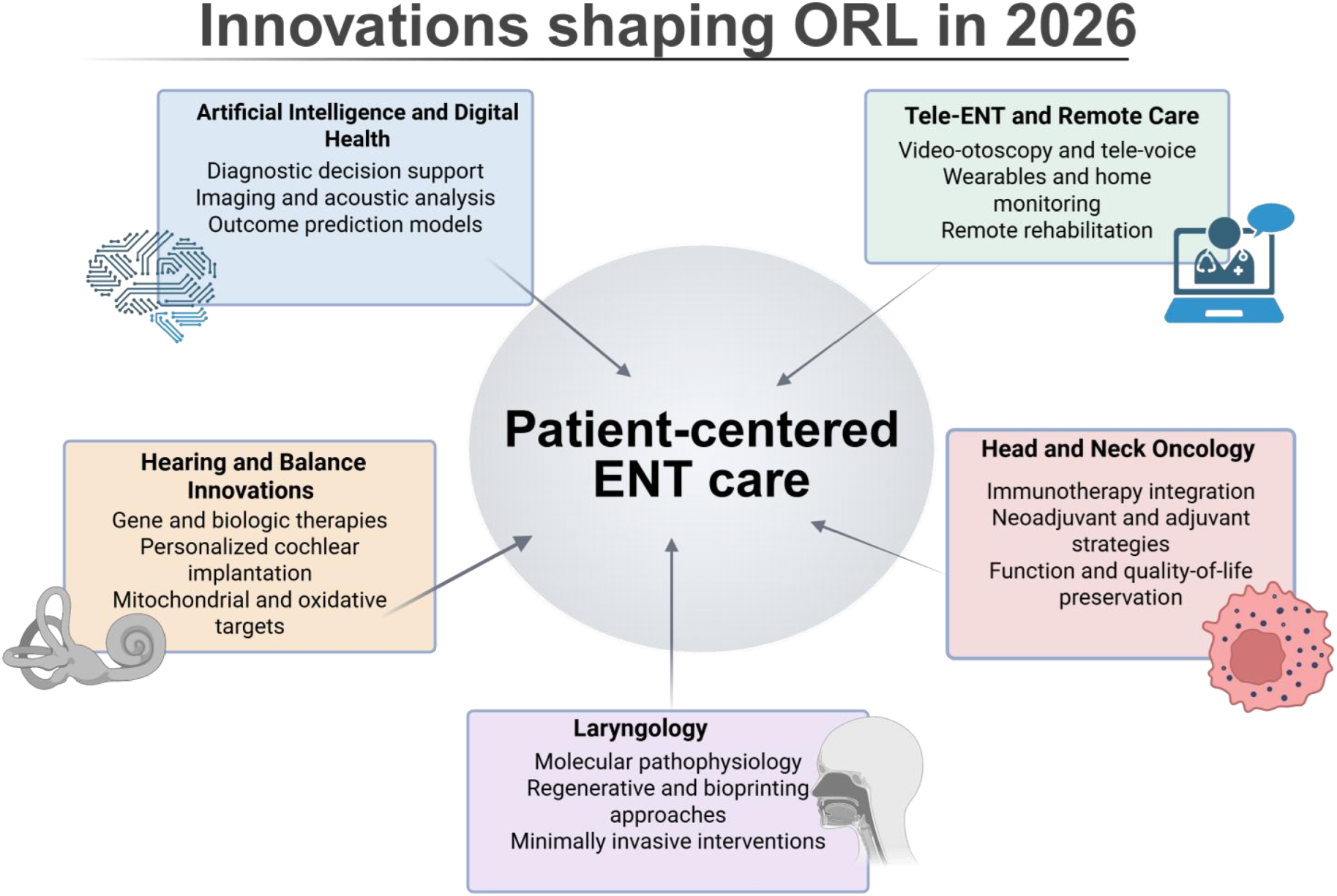
This editorial emphasizes the main areas anticipated to influence otorhinolaryngology, hearing, and balance medicine in 2026, including Artificial Intelligence and Digital Health, Tele-ENT and Remote Care, Innovations in Hearing and Balance, Laryngology, and Progress in Head and Neck Oncology.
This editorial is based on a narrative synthesis of emerging literature from 2025, landmark clinical reports, translational studies, and authoritative reviews published in leading journals in otolaryngology. Topic selection was informed by areas demonstrating rapid clinical uptake, clear translational relevance, and alignment with international congress themes, including IFOS 2026.
Rather than providing an exhaustive review, the aim was to identify major trajectories shaping the field and to contextualize them within contemporary clinical practice. Particular attention was given to developments affecting diagnostic pathways, therapeutic decision-making, and longitudinal patient outcomes in the field of hearing and balance medicine.

2. Artificial Intelligence and Digital Health

AI has moved beyond isolated algorithmic demonstrations toward integration into diagnostic pathways and clinical decision support. Applications span image analysis, acoustic signal processing, predictive outcome modeling, and workflow optimization. Significantly, the focus has shifted toward validation, interpretability, and real-world performance, reflecting a maturation of AI from innovation to infrastructure [1,2]. These tools increasingly support personalized care while raising important questions regarding data governance, bias, and equitable access.

3. Tele-ENT and Remote Care

Tele-ENT has evolved into a hybrid care model combining in-person assessment with remote diagnostics and longitudinal monitoring. Smartphone-based otoscopy [3], voice analysis [4], and wearable vestibular sensors [5] enable the acquisition of clinically meaningful data outside the clinic [6]. In hearing and balance medicine, remote rehabilitation platforms support continuity of care and patient engagement, particularly for chronic conditions [7,8]. By 2026, tele-ENT is expected to become a standard component of care pathways rather than an optional add-on.

4. Hearing and Balance Innovations

Hearing and balance medicine is undergoing a conceptual shift from compensation toward restoration and precision rehabilitation. Advances in gene and biologic therapies for hereditary hearing loss challenge prosthetic-only paradigms [9], while cochlear implant research increasingly focuses on optimizing outcomes and addressing individual variability [10]. At the molecular level, growing evidence implicates mitochondrial dysfunction and oxidative stress in age-related and acquired hearing loss [11,12,13,14], highlighting new potential targets for disease-modifying interventions.

5. Laryngology: Molecular, Regenerative, and Functional Perspectives

Laryngology illustrates the integration of molecular understanding and practical treatment. Oxidative stress and mitochondrial dysfunction have emerged as essential contributors to laryngological pathophysiology [11,15], suggesting that targeted antioxidant and mitochondrial-protective strategies may complement established therapies.
Regenerative and bioengineering approaches, including three-dimensional bioprinting and biomaterial-based scaffolds [16], are advancing toward clinical relevance. At the same time, minimally invasive interventions continue to expand [17], reinforcing a patient-centered, outcome-driven framework for laryngological care.

6. Advances in Head and Neck Oncology

Head and neck oncology is experiencing a paradigm shift with the integration of immunotherapy into curative-intent treatment strategies. Immune checkpoint inhibitors have transformed treatment for recurrent and metastatic disease and are now being more widely investigated in neoadjuvant and adjuvant contexts [18,19]. While response rates remain heterogeneous, these advances emphasize the need for biologically informed patient selection. In otorhinolaryngology, the challenge lies in balancing oncologic control with the preservation of voice, swallowing, and quality of life [20]—an objective that aligns closely with emerging data-driven, multidisciplinary approaches.
Together, these advancements indicate a shift in otorhinolaryngology toward integrated, technology-driven, and biologically based care. AI and digital health innovations improve diagnostic accuracy and ongoing monitoring; tele-ENT broadens access and ensures continuous care; molecular and regenerative research provide opportunities for disease modification; and immuno-oncology transforms treatment objectives.
At the same time, several significant challenges persist. New technologies must undergo rigorous validation, use standardized outcome measures, and be thoughtfully integrated into clinical workflows. Molecular and regenerative therapies also necessitate careful evaluation of their safety, feasibility, and cost-effectiveness. Overcoming these hurdles will depend on collaboration across disciplines.
Future progress is likely to come from integrating technological innovations, molecular insights, and patient feedback. As otorhinolaryngology, hearing, and balance medicine advance, their integration offers a valuable opportunity to improve functional outcomes and quality of life for patients across all ENT conditions (Figure 1). Importantly, emerging evidence from medical humanities research suggests that technological innovation in otorhinolaryngology should be matched by continued investment in communication skills, empathy, and compassion, which remain central to patient care and professional excellence [21].
By 2026, otorhinolaryngology, hearing, and balance medicine are expected to be increasingly defined by the convergence of digital technologies, molecular insights, and regenerative strategies. Advances in artificial intelligence and tele-ENT are reshaping diagnostic and care pathways, while emerging biologic and immunotherapeutic approaches are shifting therapeutic goals toward personalization and functional preservation. At the same time, growing recognition of mitochondrial dysfunction, oxidative stress, and tissue regeneration across ENT subspecialties underscores a deeper move toward mechanistically informed care. Translating these innovations into routine practice will require rigorous validation, multidisciplinary collaboration, and sustained attention to patient-centered outcomes. These combined efforts set otorhinolaryngology on a path to 2026 as a discipline marked not just by technological advancements but also by a more cohesive and future-oriented approach to hearing, balance, voice, airway, and cancer care.

Funding

This research received no external funding.

Institutional Review Board Statement

Not applicable.

Informed Consent Statement

Not applicable.

Conflicts of Interest

The author declares no conflicts of interest.

References

  1. Demir, E.; Uğurlu, B.N.; Uğurlu, G.A.; Aydoğdu, G. Artificial intelligence in otorhinolaryngology: Current trends and application areas. Eur. Arch. Oto-Rhino-Laryngol. 2025, 282, 2697–2707. [Google Scholar] [CrossRef]
  2. Hack, S.; Attal, R.; Farzad, A.; Alon, E.E.; Glikson, E.; Remer, E.; Maria Saibene, A.; Zalzal, H.G. Performance of generative AI across ENT tasks: A systematic review and meta-analysis. Auris Nasus Larynx 2025, 52, 585–596. [Google Scholar] [CrossRef] [PubMed]
  3. Pannonhalmi, Á.; Posta, B.; Perényi, Á.; Rovó, L.; Bende, B.; Katona, G.; Csóka, I.; Kemény, L.; Szakács, L. Clinical Validation of a Video-Otoscopy-Based Medical Device for the Remote Diagnosis of Ear Complaints. Sensors 2025, 25, 758. [Google Scholar] [CrossRef] [PubMed]
  4. Liu, B.; Hao, G.; Cui, Y.; Fang, J.; Ji, M.; Wu, J.; Jiang, J.; Shao, J.; Liu, H. Introduction of Voice Type Component (VTC) as an Effective Acoustic Voice Analysis Method in Tele-evaluation. J. Voice 2025, 39, 1463–1472. [Google Scholar] [CrossRef] [PubMed]
  5. Cho, S.Y.; Dibble, L.E.; Fino, P.C. Continuous Monitoring of Head Turns: Compliance, Kinematics, and Reliability of Wearable Sensing. IEEE Trans. Neural Syst. Rehabil. Eng. 2025, 33, 4374–4385. [Google Scholar] [CrossRef]
  6. Sakazaki, H.; Noda, M.; Dobashi, Y.; Kuroda, T.; Tsunoda, R.; Fushiki, H. Monitoring Nystagmus in a Patient With Vertigo Using a Commercial Mini-Infrared Camera and 3D Printer: Cost-Effectiveness Evaluation and Case Report. JMIR Form. Res. 2025, 9, e70015. [Google Scholar] [CrossRef]
  7. Homans, N.C.; van der Toom, H.F.E.; Goedegebure, A.; Vroegop, J.L. Remote CI Fitting in Early Rehabilitation Phase: Preliminary Results. Otol. Neurotol. 2025, 46, e453–e456. [Google Scholar] [CrossRef]
  8. Nairn, B.; Tsakanikas, V.; Gordon, B.; Karapintzou, E.; Kaski, D.; Fotiadis, D.I.; Bamiou, D.E. Smart Wearable Technologies for Balance Rehabilitation in Older Adults at Risk of Falls: Scoping Review and Comparative Analysis. JMIR Rehabil. Assist. Technol. 2025, 12, e69589. [Google Scholar] [CrossRef]
  9. Valayannopoulos, V.; Bance, M.; Carvalho, D.S.; Greinwald, J.H., Jr.; Harvey, S.A.; Ishiyama, A.; Landry, E.C.; Löwenheim, H.; Lustig, L.R.; Manrique, M.; et al. DB-OTO Gene Therapy for Inherited Deafness. N. Engl. J. Med. 2025. [Google Scholar] [CrossRef]
  10. Bircher, B.; Philipp, A.; Wilhelm, W.; Georgios, M.; Stephan, S.; Marco, C.; Stefan, W. A clinical shift toward personalized cochlear implantation: Using preoperative planning to optimize insertion depth. Am. J. Otolaryngol. 2025, 47, 104777. [Google Scholar] [CrossRef]
  11. Meng, L.; Liu, S.; Luo, J.; Tu, Y.; Li, T.; Li, P.; Yu, J.; Shi, L. Oxidative stress and reactive oxygen species in otorhinolaryngological diseases: Insights from pathophysiology to targeted antioxidant therapies. Redox Rep. 2025, 30, 2458942. [Google Scholar] [CrossRef] [PubMed]
  12. Pan, Y.; Ji, N.; Jiang, L.; Zhou, Y.; Feng, X.; Li, J.; Zeng, X.; Wang, J.; Shen, Y.-Q.; Chen, Q. GPCRs identified on mitochondrial membranes: New therapeutic targets for diseases. J. Pharm. Anal. 2025, 15, 101178. [Google Scholar] [CrossRef] [PubMed]
  13. Li, B.; Li, B.; Qiao, X.; Meng, W.; Xie, Y.; Gong, J.; Fan, Y.; Zhao, Z.; Li, L. Targeting mitochondrial transfer as a promising therapeutic strategy. Trends Mol. Med. 2025, 31, 909–924. [Google Scholar] [CrossRef] [PubMed]
  14. Ma, T.; Zeng, X.; Liu, M.; Xu, S.; Wang, Y.; Wu, Q.; Zhang, T. Analysis and identification of mitochondria-related genes associated with age-related hearing loss. BMC Genom. 2025, 26, 218. [Google Scholar] [CrossRef]
  15. Hou, Y.-J.; Yang, X.-X.; Meng, H.-X. Mitochondrial metabolism in laryngeal cancer: Therapeutic mechanisms and prospects. Biochim. Biophys. Acta—Rev. Cancer 2025, 1880, 189335. [Google Scholar] [CrossRef]
  16. Torrisi, A.; Lentini, M.; Pezzino, S.; Gagliano, C.; Lavalle, S.; Lechien, J.R.; Malaguarnera, R.; Castorina, S.; Torrisi, F.; Maniaci, A. The Promise and Challenges of 3D Bioprinting in Otolaryngology: A Contemporary Perspective Viewpoint. Clin. Otolaryngol. 2025, 50, 795–807. [Google Scholar] [CrossRef]
  17. Zhang, Y.; Qi, N.; Lv, P.; Yu, M.; Wu, Y. Mapping the Evolving Trend and Prospect of Transoral Robotic Surgery: A Bibliometric Analysis. J. Craniofac. Surg. 2025. Epub ahead of print. [Google Scholar] [CrossRef]
  18. Sim, E.S.; Nguyen, H.C.B.; Hanna, G.J.; Uppaluri, R. Current Progress and Future Directions of Immunotherapy in Head and Neck Squamous Cell Carcinoma: A Narrative Review. JAMA Otolaryngol. Head Neck Surg. 2025, 151, 521–528. [Google Scholar] [CrossRef]
  19. Uppaluri, R.; Haddad Robert, I.; Tao, Y.; Le Tourneau, C.; Lee Nancy, Y.; Westra, W.; Chernock, R.; Tahara, M.; Harrington Kevin, J.; Klochikhin Arkadiy, L.; et al. Neoadjuvant and Adjuvant Pembrolizumab in Locally Advanced Head and Neck Cancer. N. Engl. J. Med. 2025, 393, 37–50. [Google Scholar] [CrossRef]
  20. Murariu, M.O.; Boia, E.R.; Sitaru, A.M.; Mot, C.I.; Negru, M.C.; Brici, A.C.; Zahoi, D.E.; Balica, N.C. Psychological Distress and Quality of Life in Patients with Laryngeal Cancer: A Review. Healthcare 2025, 13, 1552. [Google Scholar] [CrossRef]
  21. Leahy, J.; Jo, J.J.; Steidl, W.; Appel, J. Assessing the competitiveness of medical humanities research on psychiatry, otolaryngology, and ophthalmology residency program applications. Med. Educ. Online 2023, 28, 2212929. [Google Scholar] [CrossRef] [PubMed]
Figure 1. Converging innovations shaping otorhinolaryngology, hearing, and balance medicine in 2026. Advances in artificial intelligence and digital health, tele-ENT and remote care, hearing and balance innovations, and laryngology and head and neck oncology increasingly intersect to support personalized, data-driven, and function-preserving ENT care. Created with Biorender.com (accessed on 28 December 2025).
Ohbm 07 00004 g001
Disclaimer/Publisher’s Note: The statements, opinions and data contained in all publications are solely those of the individual author(s) and contributor(s) and not of MDPI and/or the editor(s). MDPI and/or the editor(s) disclaim responsibility for any injury to people or property resulting from any ideas, methods, instructions or products referred to in the content.