
Induction-Heated, Unrestricted-Rotation Rectangular-Slot Hot End for FFF


 , ,
, ,  ,
,  and
and 
Abstract
1. Introduction
2. Unrestricted-Rotation Hot End: Design and Optimization
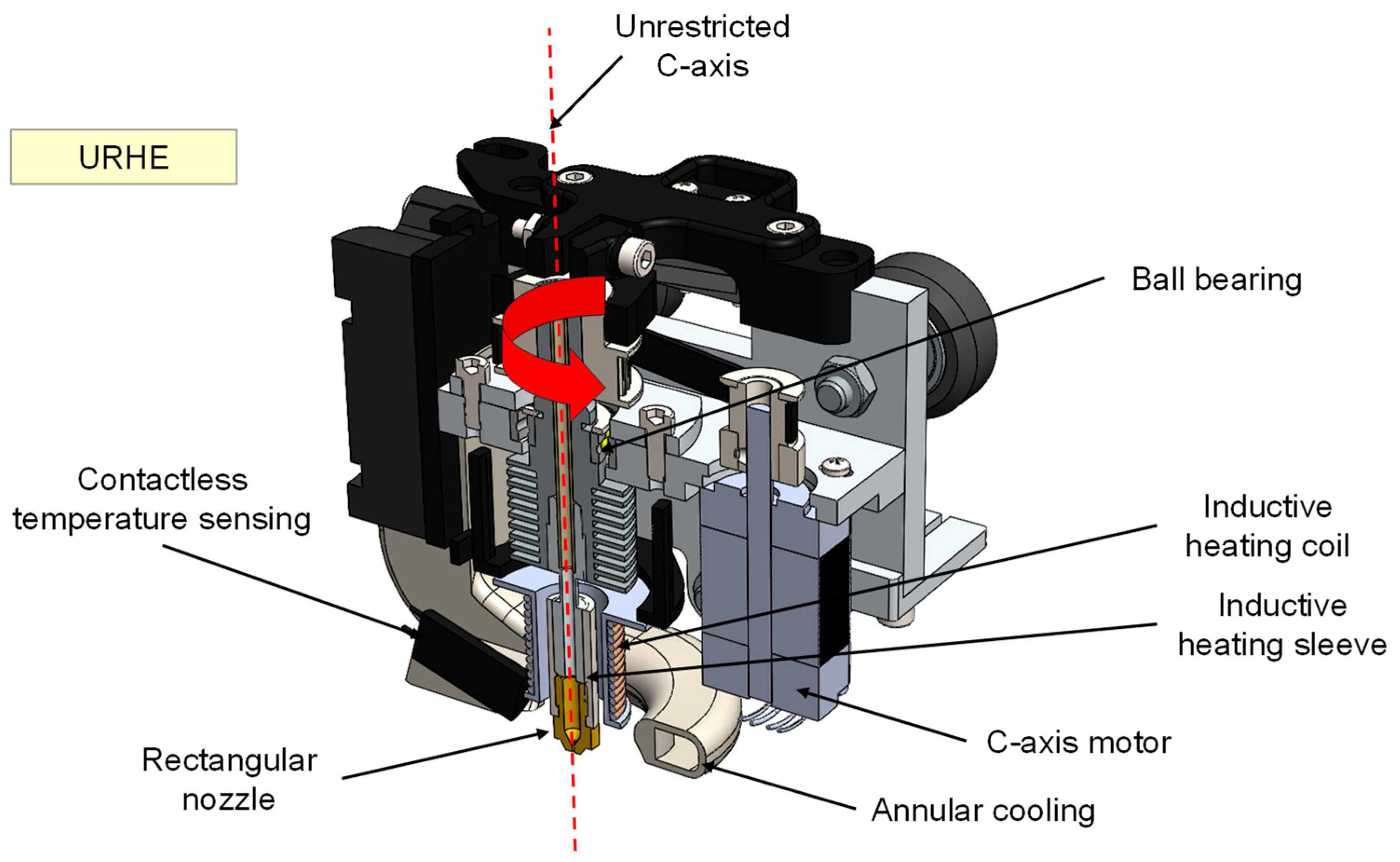
2.1. Hot End System Architecture
2.1.1. Hot-End Stack and Rotation (C-Axis)
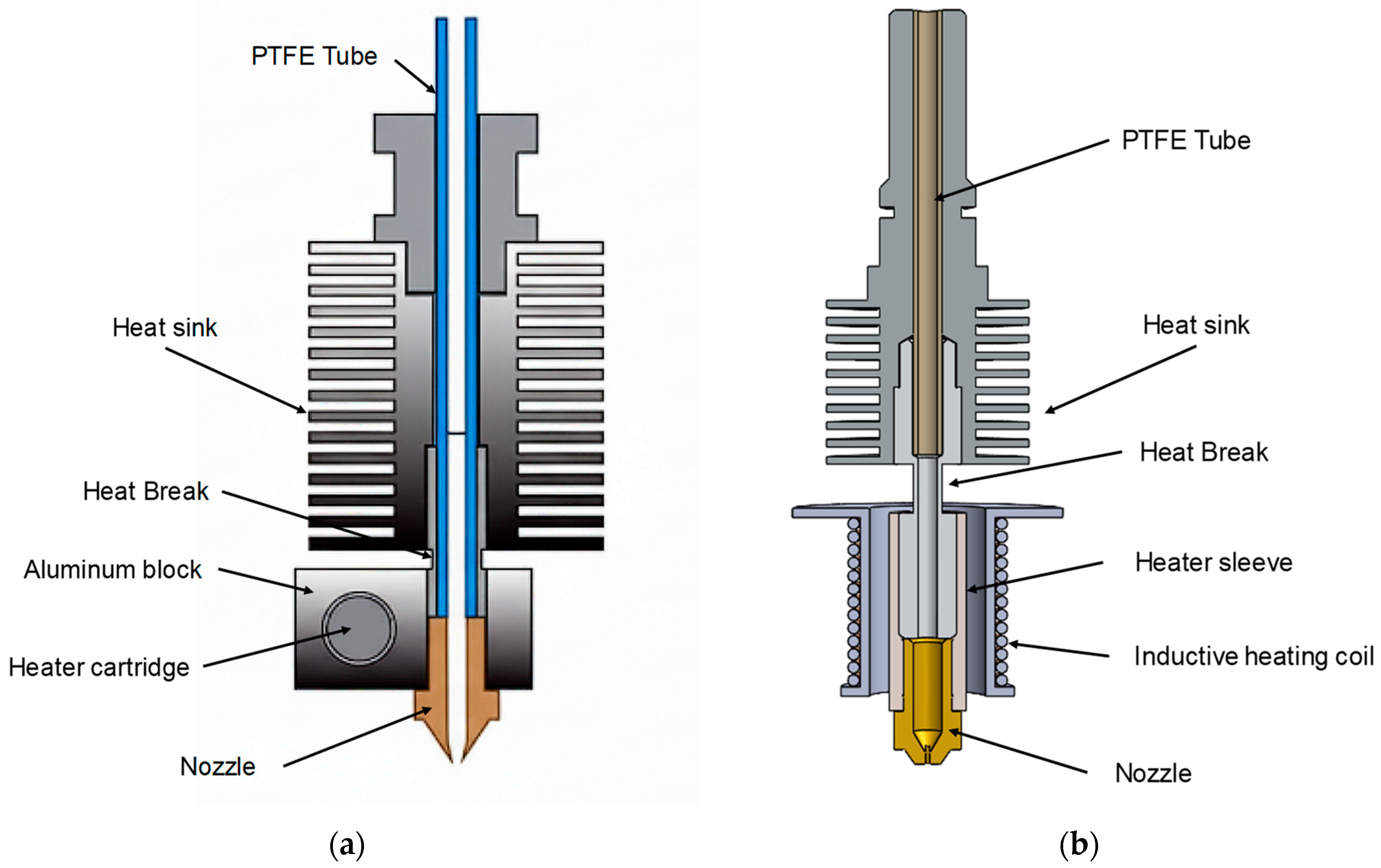
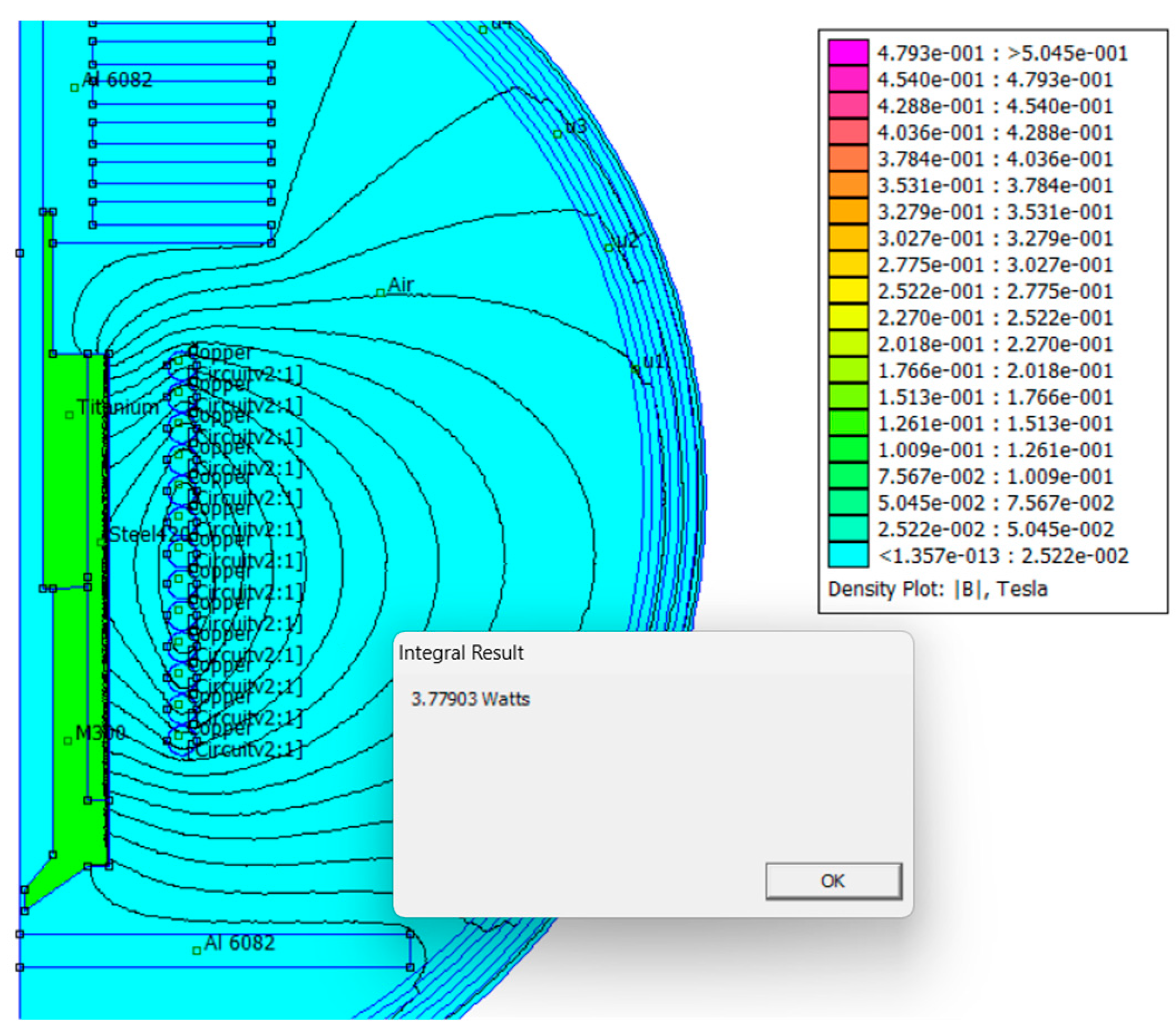
2.1.2. Induction Heating Assembly
2.1.3. Contactless Infrared Thermometry and Frequency-Modulated Control
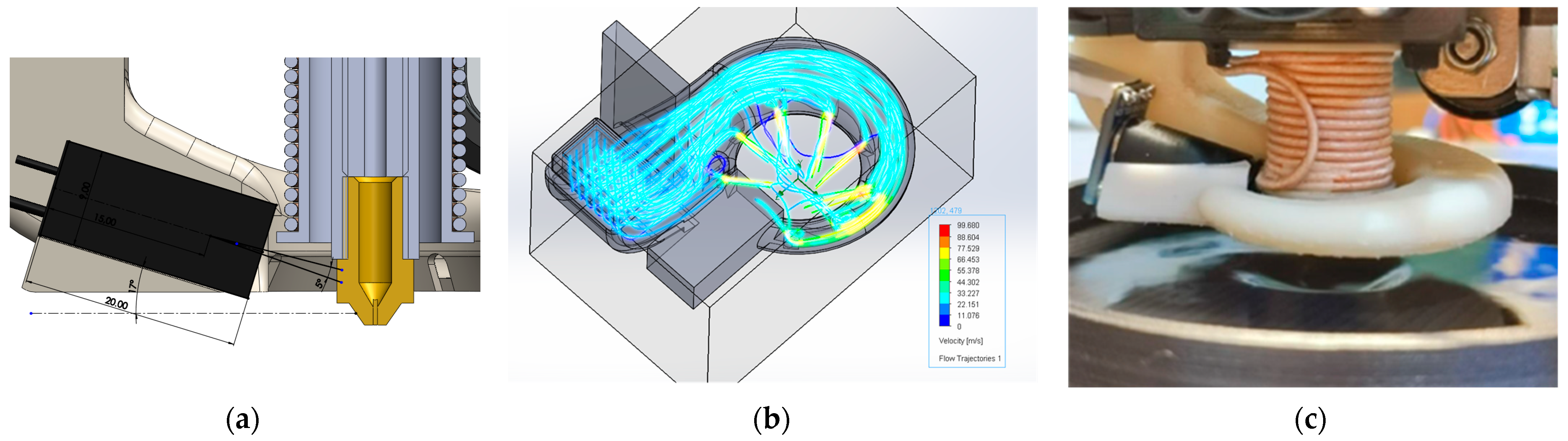
2.1.4. Azimuthally Uniform Layer Cooling
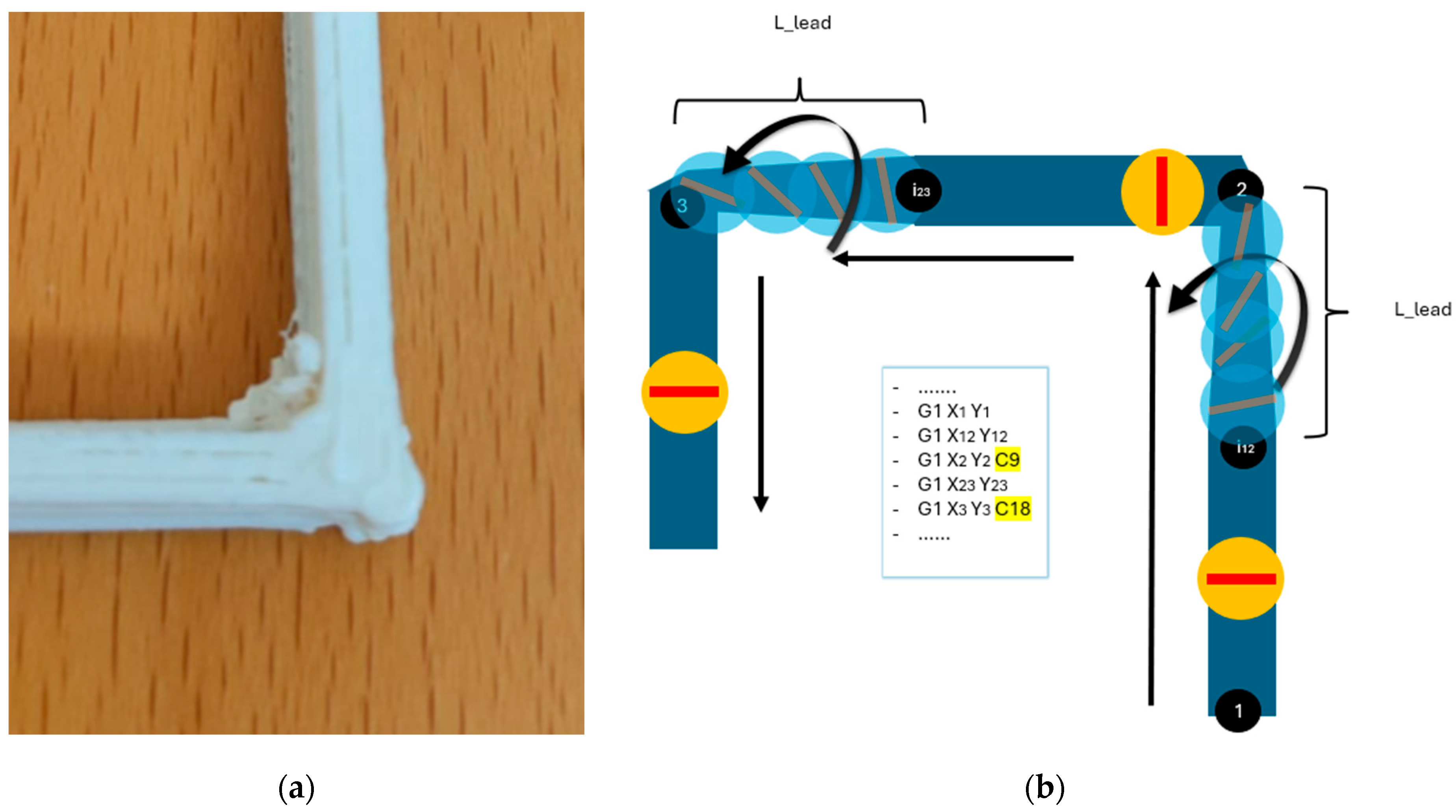
2.2. Synchronized C-Axis Toolpath Control
2.3. Practical Considerations
2.3.1. Stable IR Reading
2.3.2. Runout and Concentricity
2.3.3. Extrusion Temperature
3. Materials and Methods
3.1. Materials
3.2. Methods
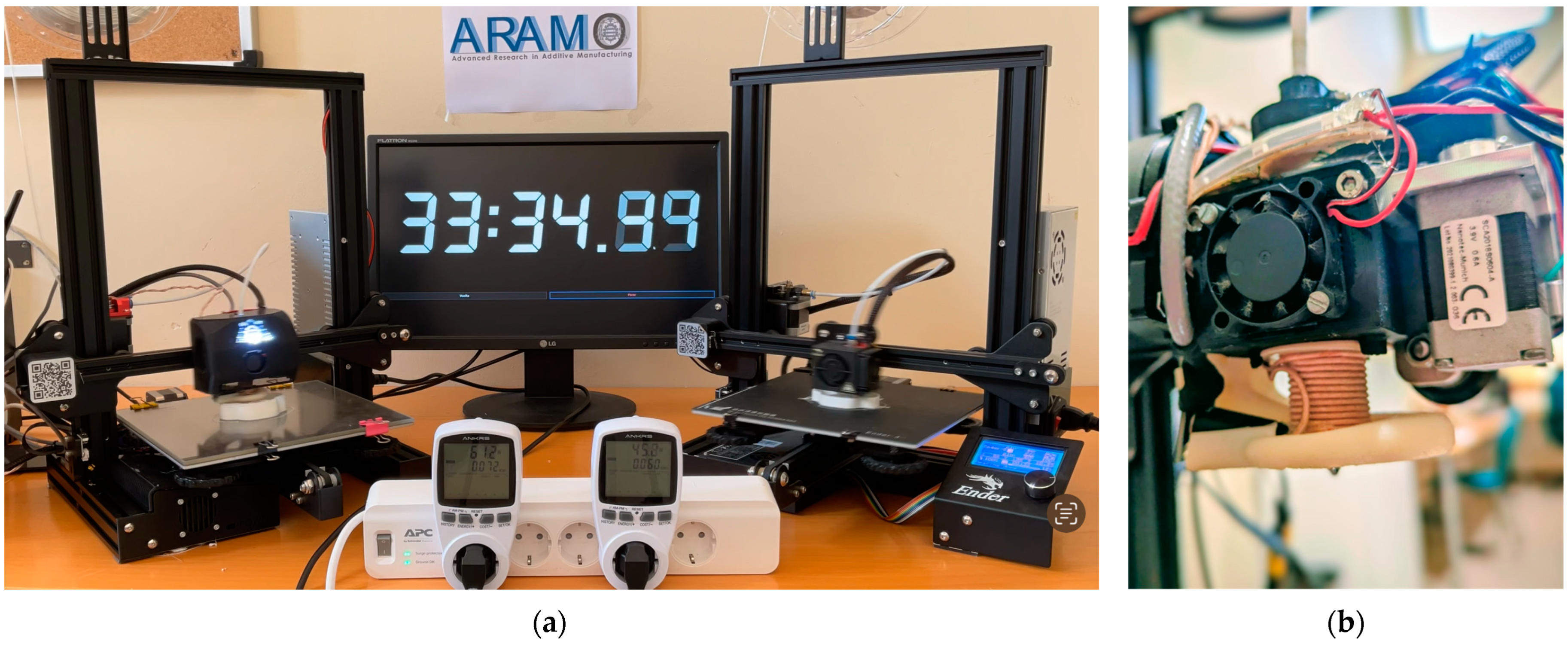
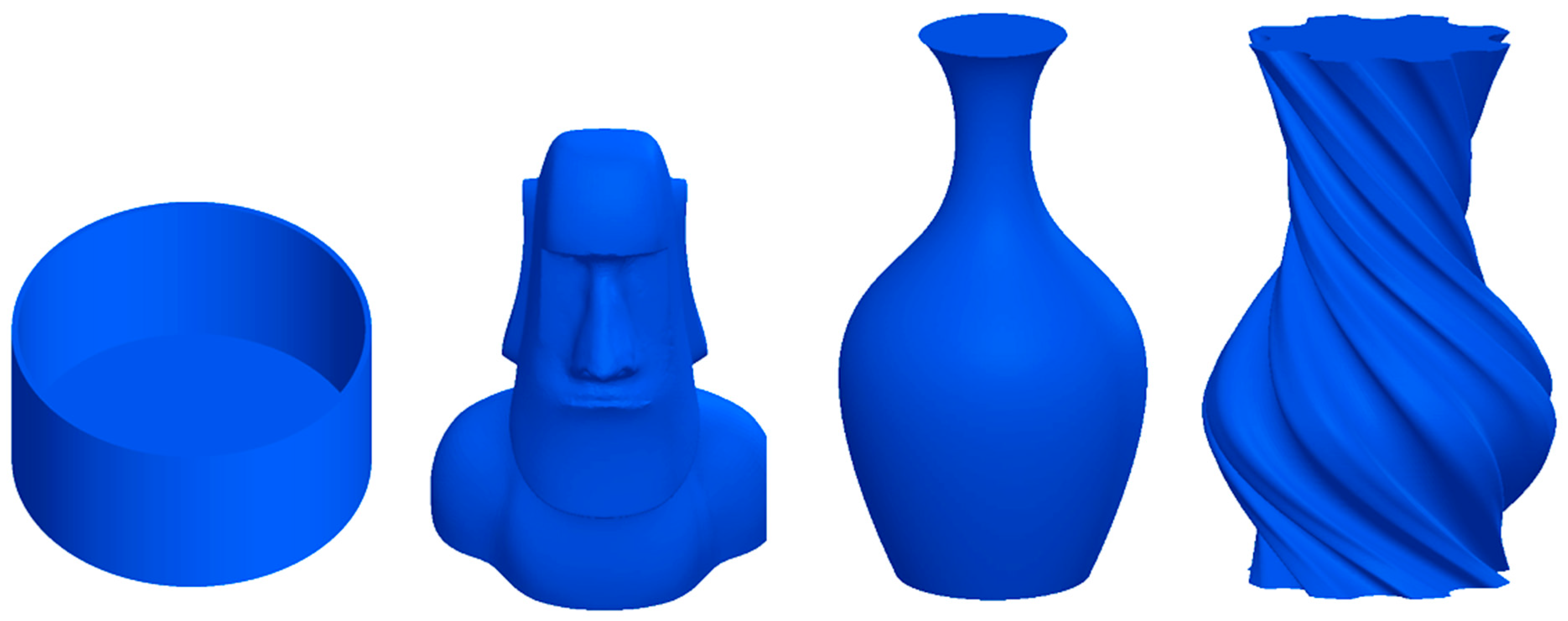
3.2.1. Time and Energy Comparative Test
3.2.2. Steady-State Hot-End Power Measurement
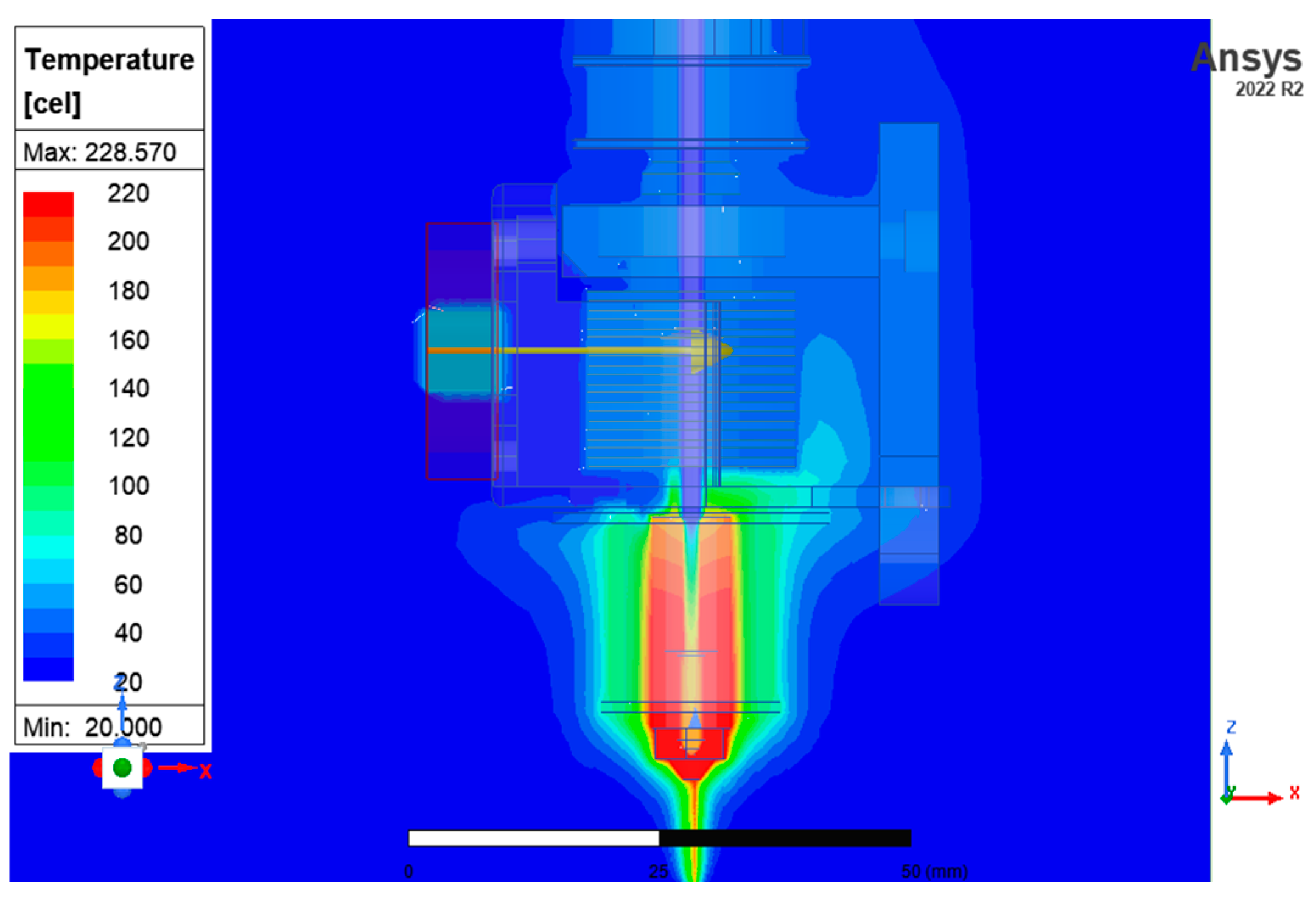
3.2.3. Thermal Transients
3.2.4. Sustained Flow Rate
4. Results and Discussion
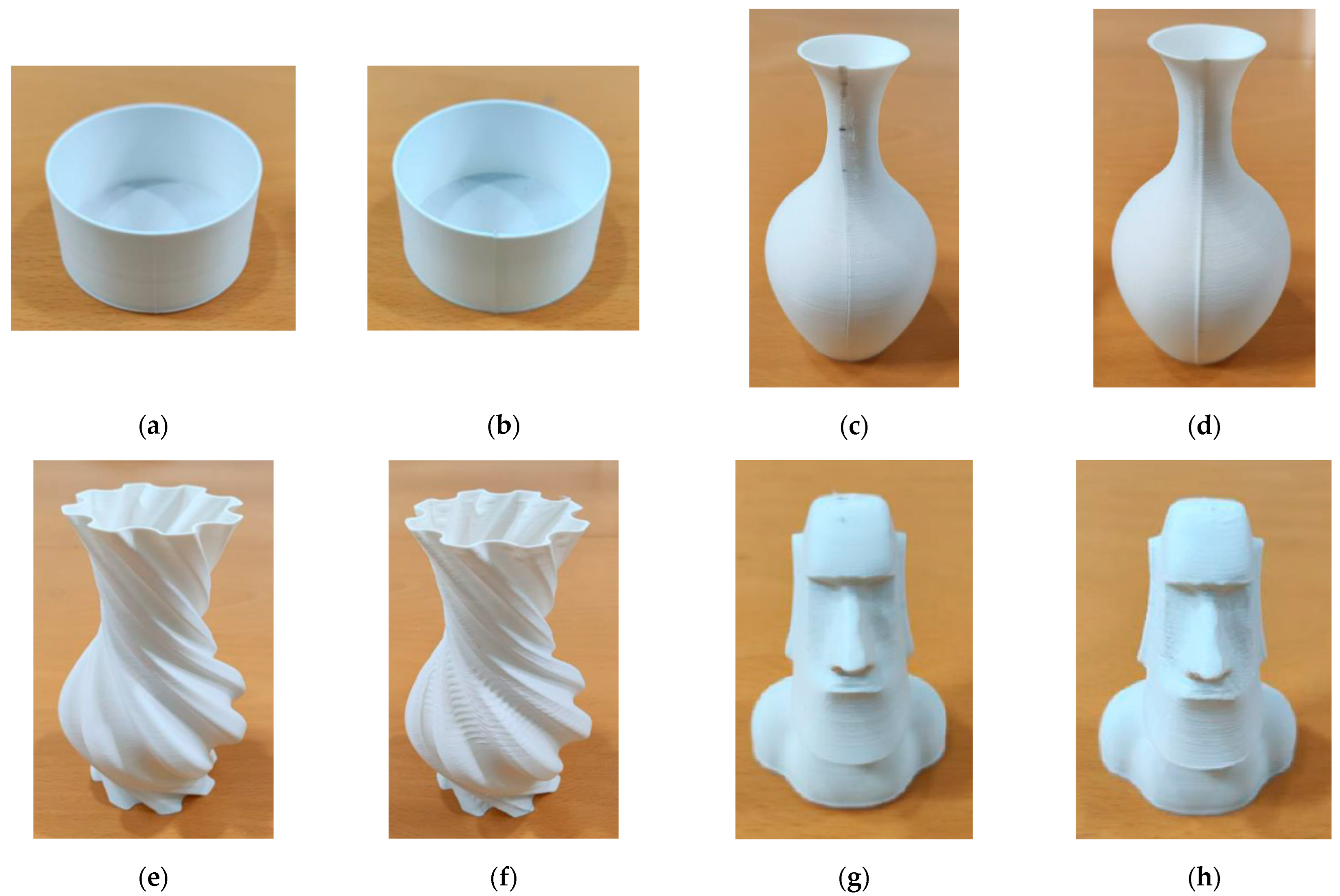
4.1. Manufacturing Time and Energy Comparative Test
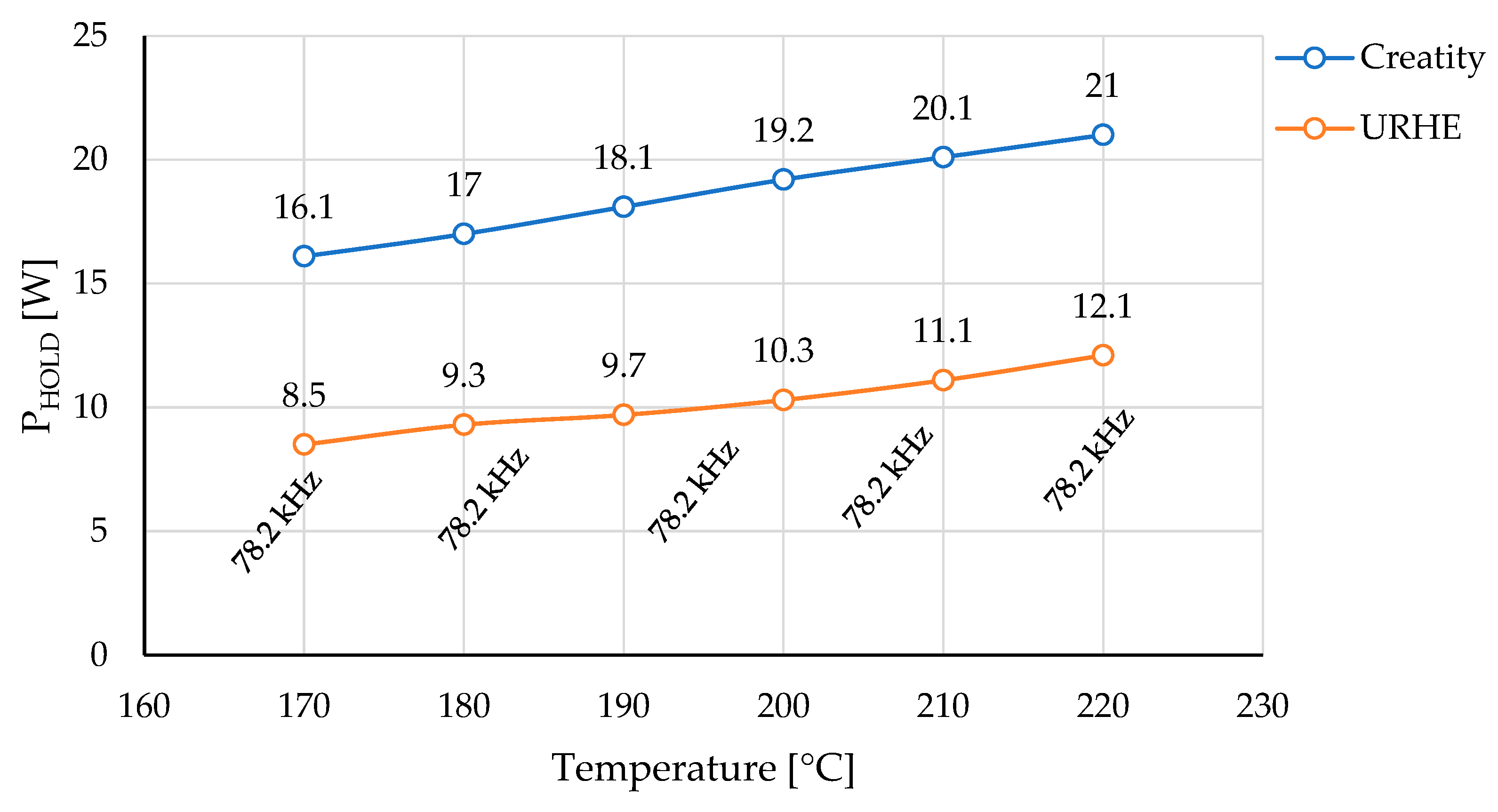
4.2. Steady-State Hot End Power Measurement
4.3. Thermal Transients
4.4. Sustained Flow Rate
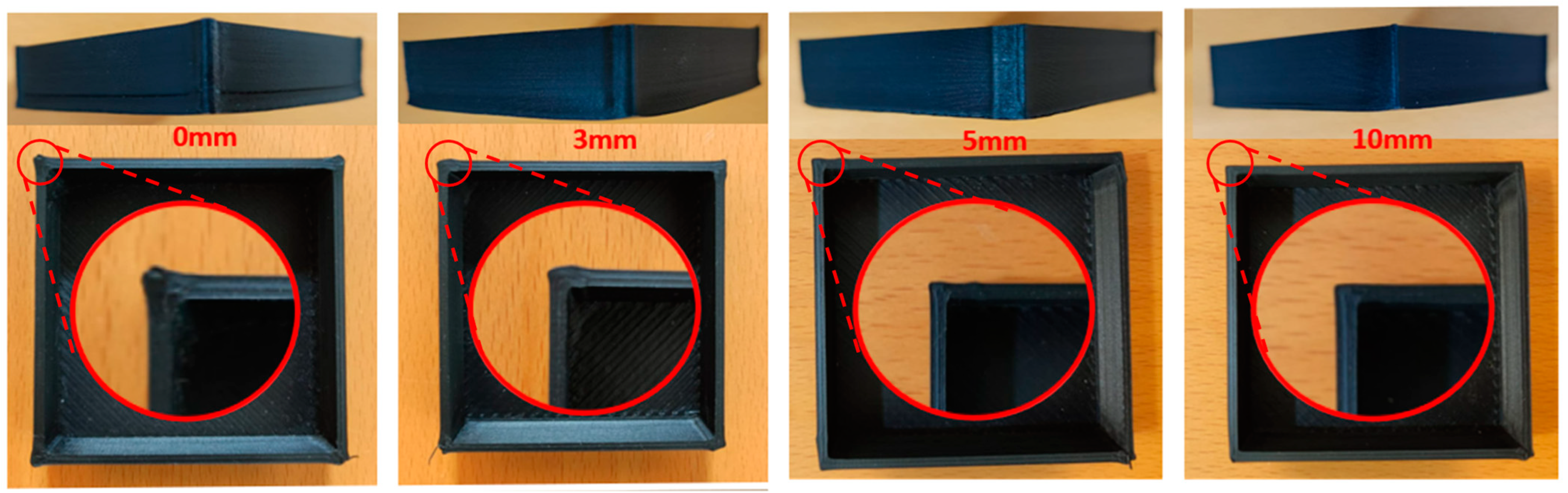
4.5. Runout
4.6. Temperature Measurement
4.7. Limitations of This Work
5. Conclusions
Supplementary Materials
Author Contributions
Funding
Data Availability Statement
Acknowledgments
Conflicts of Interest
Abbreviations
| ASTM | American Society for Testing and Materials |
| AISI | American Iron and Steel Institute |
| cfm | Cubic Feet per Minute |
| IR | Infrared |
| FFF | Fused-Filament Fabrication |
| LPBF | Laser Powder Bed Fusion |
| MEX | Material Extrusion |
| MEX/M | Extrusion of Metal/Polymer |
| μH | Microhenry |
| nF | Nanofarad |
| PEEK | Poly(Ether Ether Ketone) |
| PLA | Polylactic Acid |
| PTFE | Polytetrafluoroethylene |
| RMS | Root Mean Square |
| URHE | Unrestricted-Rotation Hot End |
References
- ISO/ASTM 52900:2021; Additive Manufacturing—General Principles—Fundamentals and Vocabulary. International Organization for Standardization: Geneva, Switzerland, 2021.
- Desktop 3D Printing Market Size & Share Analysis—Growth Trends & Forecasts (2025–2030). Available online: https://www.mordorintelligence.com/industry-reports/desktop-3d-printing-market (accessed on 7 August 2025).
- Fiedler, F.; Ehrenstein, J.; Höltgen, C.; Blondrath, A.; Schäper, L.; Göppert, A.; Schmitt, R. Jigs and Fixtures in Production: A Systematic Literature Review. J. Manuf. Syst. 2024, 72, 373–405. [Google Scholar] [CrossRef]
- Hernandez Korner, M.E.; Lamban, M.P.; Albajez, J.A.; Santolaria, J.; Ng Corrales, L.D.C.; Royo, J. Cost Model Framework for Pieces Additively Manufactured in Fused Deposition Modeling for Low to Medium Batches. 3D Print. Addit. Manuf. 2024, 11, 287–298. [Google Scholar] [CrossRef] [PubMed]
- Jung, S.; Kara, L.B.; Nie, Z.; Simpson, T.W.; Whitefoot, K.S. Is Additive Manufacturing an Environmentally and Economically Preferred Alternative for Mass Production? Environ. Sci. Technol. 2023, 57, 6373–6386. [Google Scholar] [CrossRef] [PubMed]
- May, G.; Psarommatis, F. Maximizing Energy Efficiency in Additive Manufacturing: A Review and Framework for Future Research. Energies 2023, 16, 4179. [Google Scholar] [CrossRef]
- Su, J.; Ng, W.L.; An, J.; Yeong, W.Y.; Chua, C.K.; Sing, S.L. Achieving Sustainability by Additive Manufacturing: A State-of-the-Art Review and Perspectives. Virtual Phys. Prototyp. 2024, 19, e2438899. [Google Scholar] [CrossRef]
- Wichniarek, R.; Osiński, F. Assessing Energy Efficiency in Desktop-Size FFF 3D Printers. Appl. Sci. 2024, 14, 11819. [Google Scholar] [CrossRef]
- Lunetto, V.; Priarone, P.C.; Galati, M.; Minetola, P. On the Correlation between Process Parameters and Specific Energy Consumption in Fused Deposition Modelling. J. Manuf. Process. 2020, 56, 1039–1049. [Google Scholar] [CrossRef]
- Kim, K.; Noh, H.; Park, K.; Jeon, H.W.; Lim, S. Characterization of Power Demand and Energy Consumption for Fused Filament Fabrication Using CFR-PEEK. Rapid Prototyp. J. 2022, 28, 1394–1406. [Google Scholar] [CrossRef]
- Kazmer, D.; Peterson, A.M.; Masato, D.; Colon, A.R.; Krantz, J. Strategic Cost and Sustainability Analyses of Injection Molding and Material Extrusion Additive Manufacturing. Polym. Eng. Sci. 2023, 63, 943–958. [Google Scholar] [CrossRef]
- Wang, Y.; Hu, C.; Wang, Z.; Lin, S.; Zhao, Z.; Zhao, W.; Hu, K.; Huang, Z.; Zhu, Y.; Lu, Z. Optimization-Based Non-Equidistant Toolpath Planning for Robotic Additive Manufacturing with Non-Underfill Orientation. Robot. Comput.-Integr. Manuf. 2023, 84, 102599. [Google Scholar] [CrossRef]
- Yan, Z.; Hui, J.; Lv, J.; Huisingh, D.; Huang, J.; Ding, K.; Zhang, H.; Liu, Q. A Hybrid Mechanism-Based and Data-Driven Approach to Forecast Energy Consumption of Fused Deposition Modelling. J. Clean. Prod. 2023, 413, 137500. [Google Scholar] [CrossRef]
- Manford, D.; Budinoff, H.D.; Callaghan, B.J.; Jeon, Y. Towards a General Model to Predict Energy Consumption for Fused Filament Fabrication. Manuf. Lett. 2023, 35, 1358–1365. [Google Scholar] [CrossRef]
- El Youbi El Idrissi, M.A.; Laaouina, L.; Jeghal, A.; Tairi, H.; Zaki, M. Modeling of Energy Consumption and Print Time for FDM 3D Printing Using Multilayer Perceptron Network. J. Manuf. Mater. Process. 2023, 7, 128. [Google Scholar] [CrossRef]
- Gao, M.; Li, L.; Wang, Q.; Liu, C.; Li, X.; Liu, Z. Feature-Based Energy Consumption Quantitation Strategy for Complex Additive Manufacturing Parts. Energy 2024, 297, 131249. [Google Scholar] [CrossRef]
- Vidakis, N.; Kechagias, J.D.; Petousis, M.; Vakouftsi, F.; Mountakis, N. The Effects of FFF 3D Printing Parameters on Energy Consumption. Mater. Manuf. Process. 2023, 38, 915–932. [Google Scholar] [CrossRef]
- Zakaria, S.; Mativenga, P. A Scientific Base for Optimising Energy Consumption and Performance in 3D Printing. J. Clean. Prod. 2024, 482, 144227. [Google Scholar] [CrossRef]
- Bakrani Balani, S.; Chabert, F.; Nassiet, V.; Cantarel, A. Influence of Printing Parameters on the Stability of Deposited Beads in Fused Filament Fabrication of Poly(Lactic) Acid. Addit. Manuf. 2019, 25, 112–121. [Google Scholar] [CrossRef]
- Cleeman, J.; Bogut, A.; Mangrolia, B.; Ripberger, A.; Kate, K.; Zou, Q.; Malhotra, R. Scalable, Flexible and Resilient Parallelization of Fused Filament Fabrication: Breaking Endemic Tradeoffs in Material Extrusion Additive Manufacturing. Addit. Manuf. 2022, 56, 102926. [Google Scholar] [CrossRef]
- Serdeczny, M.P.; Comminal, R.; Pedersen, D.B.; Spangenberg, J. Experimental and Analytical Study of the Polymer Melt Flow through the Hot-End in Material Extrusion Additive Manufacturing. Addit. Manuf. 2020, 32, 100997. [Google Scholar] [CrossRef]
- Lind, R.F.; Post, B.K.; Love, L.J.; Lloyd, P.D.; Carnal, C.L.; Blue, C.A.; Kunc, V. Variable Width Deposition for Additive Manufacturing with Orientable Nozzle. U.S. Patent US20170320267A1, 9 November 2017. Available online: https://patents.google.com/patent/US20170320267A1 (accessed on 9 September 2025).
- Löffler, R.; Koch, M. Innovative Extruder Concept for Fast and Efficient Additive Manufacturing. IFAC-PapersOnLine 2019, 52, 242–247. [Google Scholar] [CrossRef]
- Gharehpapagh, B.; Dolen, M.; Yaman, U. Investigation of Variable Bead Widths in FFF Process. Procedia Manuf. 2019, 38, 52–59. [Google Scholar] [CrossRef]
- Gharehpapagh, B.; Dilberoğlu, M.U.; Dölen, M.; Yaman, U. Use of a Nozzle with a Rectangular Orifice on a Hybrid FFF System. J. Addit. Manuf. Technol. 2021, 1, 577. [Google Scholar] [CrossRef]
- Gharehpapagh, B.; Dilberoglu, U.M.; Yaman, U.; Dolen, M. Adaptive Toolpath Generation for Material Extrusion Additive Manufacturing Using a Nozzle with Rectangular Orifice. Addit. Manuf. 2023, 78, 103873. [Google Scholar] [CrossRef]
- Gharehpapagh, B.; Dilberoglu, U.M.; Yaman, U.; Dolen, M. A Rotary Extrusion System with a Rectangular-Orifice Nozzle: Toward Adaptive Resolution in Material Extrusion Additive Manufacturing. J. Intell. Manuf. 2025, 36, 1123–1139. [Google Scholar] [CrossRef]
- Go, J.; Schiffres, S.N.; Stevens, A.G.; Hart, A.J. Rate Limits of Additive Manufacturing by Fused Filament Fabrication and Guidelines for High-Throughput System Design. Addit. Manuf. 2017, 16, 1–11. [Google Scholar] [CrossRef]
- Kühn-Kauffeldt, M.; Kühn, M.; Perrin, N.; Saur, W. Fused Filament Fabrication of Thermoplastics in High Vacuum without Convective Heat Transfer. Sci. Rep. 2025, 15, 27497. [Google Scholar] [CrossRef] [PubMed]
- Harding, O.J.; Griffiths, C.A.; Rees, A.; Pletsas, D. Methods to Reduce Energy and Polymer Consumption for Fused Filament Fabrication 3D Printing. Polymers 2023, 15, 1874. [Google Scholar] [CrossRef]
- Nzebuka, G.C.; Ufodike, C.O.; Rahman, A.M.; Gwynn, C.M.; Ahmed, M.F. Numerical Modeling of the Effect of Nozzle Diameter and Heat Flux on the Polymer Flow in Fused Filament Fabrication. J. Manuf. Process. 2022, 82, 585–600. [Google Scholar] [CrossRef]
- Oskolkov, A.A.; Trushnikov, D.N.; Bezukladnikov, I.I. Application of Induction Heating in the FDM/FFF 3D Manufacturing. J. Phys. Conf. Ser. 2021, 1730, 012005. [Google Scholar] [CrossRef]
- Oskolkov, A.; Bezukladnikov, I.; Trushnikov, D. Indirect Temperature Measurement in High Frequency Heating Systems. Sensors 2021, 21, 2561. [Google Scholar] [CrossRef]
- Oskolkov, A.A.; Bezukladnikov, I.I.; Trushnikov, D.N. Rapid Temperature Control in Melt Extrusion Additive Manufacturing Using Induction Heated Lightweight Nozzle. Appl. Sci. 2022, 12, 8064. [Google Scholar] [CrossRef]
- Plasmics GmbH Key Features of the Plasmics INo Trident Induction Nozzle. Available online: https://plasmics.com/inotrident (accessed on 7 August 2025).
- SIJ Metal Ravne. SINOXX 4021 (Mat. No. 1.4021; DIN X20Cr13; AISI 420)—PK3 Data Sheet; SIJ Metal Ravne d.o.o.: Ravne Na Koroškem, Slovenia, 2016; Available online: https://steelselector.sij.si/data/pdf/PK3.pdf (accessed on 5 May 2025).
- Tavares, S.S.M.; Fruchart, D.; Miraglia, S.; Laborie, D. Magnetic Properties of an AISI 420 Martensitic Stainless Steel. J. Alloys Compd. 2000, 312, 307–314. [Google Scholar] [CrossRef]
- Wang, X.; Huang, L.; Li, Y.; Wang, Y.; Lu, X.; Wei, Z.; Mo, Q.; Zhang, S.; Sheng, Y.; Huang, C.; et al. Research Progress in Polylactic Acid Processing for 3D Printing. J. Manuf. Process. 2024, 112, 161–178. [Google Scholar] [CrossRef]
- Pyda, M.; Bopp, R.C.; Wunderlich, B. Heat Capacity of Poly(Lactic Acid). J. Chem. Thermodyn. 2004, 36, 731–742. [Google Scholar] [CrossRef]
- Wang, L.; Qiu, J.; Sakai, E.; Wei, X. The Relationship between Microstructure and Mechanical Properties of Carbon Nanotubes/Polylactic Acid Nanocomposites Prepared by Twin-Screw Extrusion. Compos. Part A Appl. Sci. Manuf. 2016, 89, 18–25. [Google Scholar] [CrossRef]
- Pavon, C.; Aldas, M.; Samper, M.D.; Motoc, D.L.; Ferrandiz, S.; López-Martínez, J. Mechanical, Dynamic-Mechanical, Thermal and Decomposition Behavior of 3D-Printed PLA Reinforced with CaCO3 Fillers from Natural Resources. Polymers 2022, 14, 2646. [Google Scholar] [CrossRef]
- Ankrs. Plug-in Electricity Meter—16A/3680W. Amazon (ASIN B0BGRV4P7V). Available online: https://www.amazon.co.uk/Electric-Consumption-Ankrs-Display-Backlight/dp/B0BGRV4P7V (accessed on 15 September 2025).



| Geometry | Hot End | Layer Height [mm] | Nozzle Shape | Nozzle Size [mm] | Printing Speed [mm∙s−1] | Temperature [°C] | ||
|---|---|---|---|---|---|---|---|---|
| Perimeters | Infill | Hot End | Bed | |||||
| Cylindrical cup | CREALITY | 0.2 | Circular | 0.4 | 50 | 50 | 210 | 60 |
| URHE | 0.2 | Rectangular | 1.20 × 0.40 | 50 | 25 | 170 | 60 | |
| Regular vase | CREALITY | 0.2 | Circular | 0.4 | 50 | 40 | 210 | 60 |
| URHE | 0.2 | Rectangular | 1.20 × 0.40 | 50 | 30 | 170 | 60 | |
| Twisted vase | CREALITY | 0.15 | Circular | 0.4 | 60 | 40 | 210 | 60 |
| URHE | 0.15 | Rectangular | 1.20 × 0.40 | 60 | 30 | 170 | 60 | |
| Moai | CREALITY | 0.15 | Circular | 0.4 | 60 | 60 | 210 | 60 |
| URHE | 0.15 | Rectangular | 1.20 × 0.40 | 60 | 35 | 170 | 60 | |
| Geometry | Extruder Head | Manuf. Time [min] | Time Reduction * | Energy Consumption [Wh] | Energy Savings * | Volume [cm3] | Energy Reduction Per PLA Deposited |
|---|---|---|---|---|---|---|---|
| Cylindrical cup | CREALITY | 47 | 49% | 82 | 39% | 7.3 | 41% |
| URHE | 24 | 50 | 7.5 | ||||
| Regular vase | CREALITY | 88 | 39% | 151 | 27% | 19.7 | 25.7% |
| URHE | 54 | 110 | 19.3 | ||||
| Twisted vase | CREALITY | 271 | 35% | 468 | 18% | 48.7 | 14.3% |
| URHE | 175 | 386 | 46.9 | ||||
| Moai | CREALITY | 54 | 22% | 99 | 9% | 7.3 | 18.6% |
| URHE | 42 | 90 | 8.1 |
Disclaimer/Publisher’s Note: The statements, opinions and data contained in all publications are solely those of the individual author(s) and contributor(s) and not of MDPI and/or the editor(s). MDPI and/or the editor(s) disclaim responsibility for any injury to people or property resulting from any ideas, methods, instructions or products referred to in the content. |
© 2025 by the authors. Licensee MDPI, Basel, Switzerland. This article is an open access article distributed under the terms and conditions of the Creative Commons Attribution (CC BY) license (https://creativecommons.org/licenses/by/4.0/).
Share and Cite
Rodríguez, M.; Blanco, D.; Martín, J.A.; Villegas, P.J.; Fernández, A.; Zapico, P. Induction-Heated, Unrestricted-Rotation Rectangular-Slot Hot End for FFF. J. Manuf. Mater. Process. 2025, 9, 409. https://doi.org/10.3390/jmmp9120409
Rodríguez M, Blanco D, Martín JA, Villegas PJ, Fernández A, Zapico P. Induction-Heated, Unrestricted-Rotation Rectangular-Slot Hot End for FFF. Journal of Manufacturing and Materials Processing. 2025; 9(12):409. https://doi.org/10.3390/jmmp9120409
Chicago/Turabian StyleRodríguez, Miguel, David Blanco, Juan Antonio Martín, Pedro José Villegas, Alejandro Fernández, and Pablo Zapico. 2025. "Induction-Heated, Unrestricted-Rotation Rectangular-Slot Hot End for FFF" Journal of Manufacturing and Materials Processing 9, no. 12: 409. https://doi.org/10.3390/jmmp9120409
APA StyleRodríguez, M., Blanco, D., Martín, J. A., Villegas, P. J., Fernández, A., & Zapico, P. (2025). Induction-Heated, Unrestricted-Rotation Rectangular-Slot Hot End for FFF. Journal of Manufacturing and Materials Processing, 9(12), 409. https://doi.org/10.3390/jmmp9120409