
A Comparative Study of Machine Learning and Deep Learning Models for Real-Time UAV Positioning Error Estimation

 and
and
Highlights
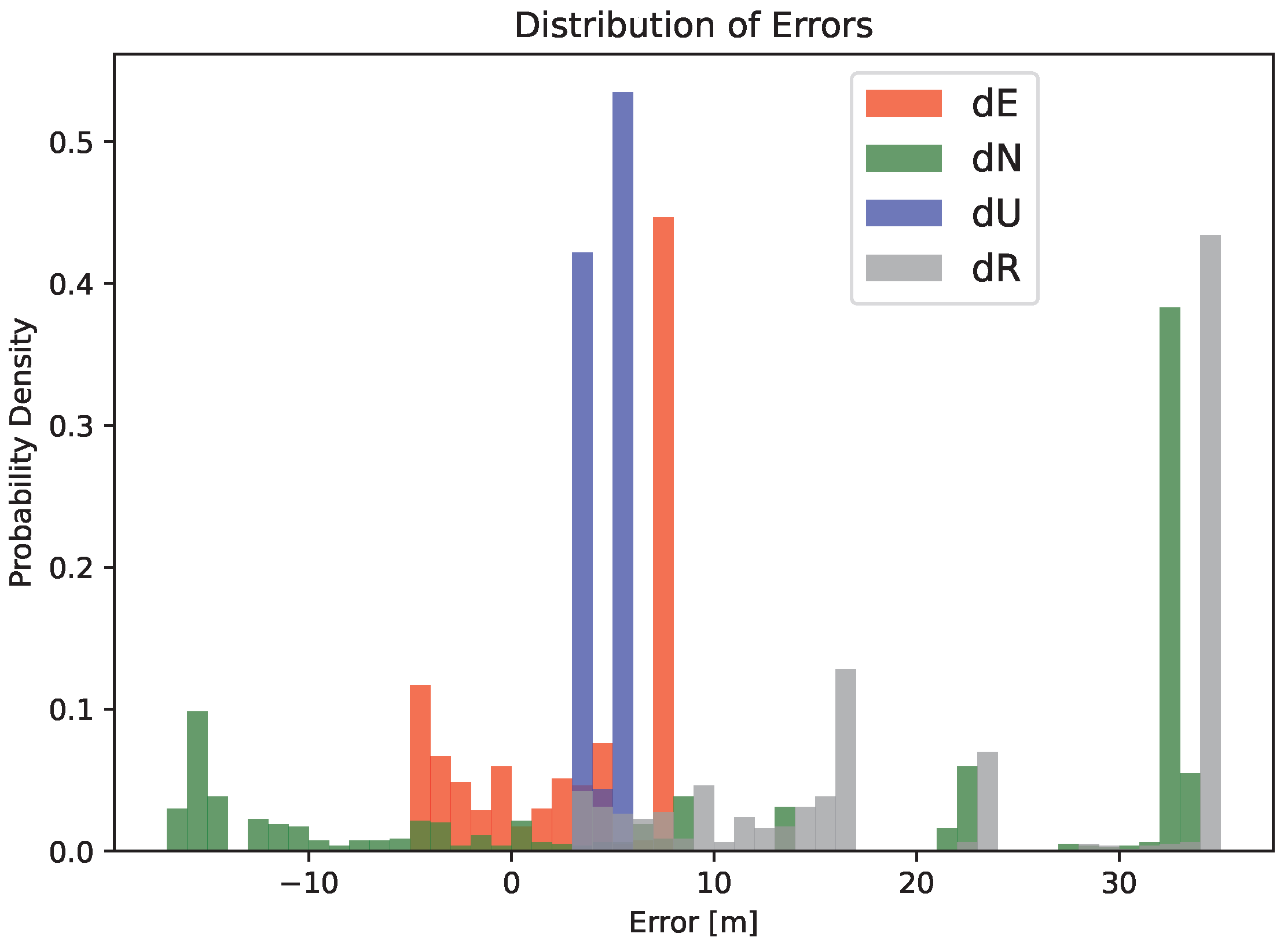
- The horizontal errors are generally larger and more variable than vertical errors.
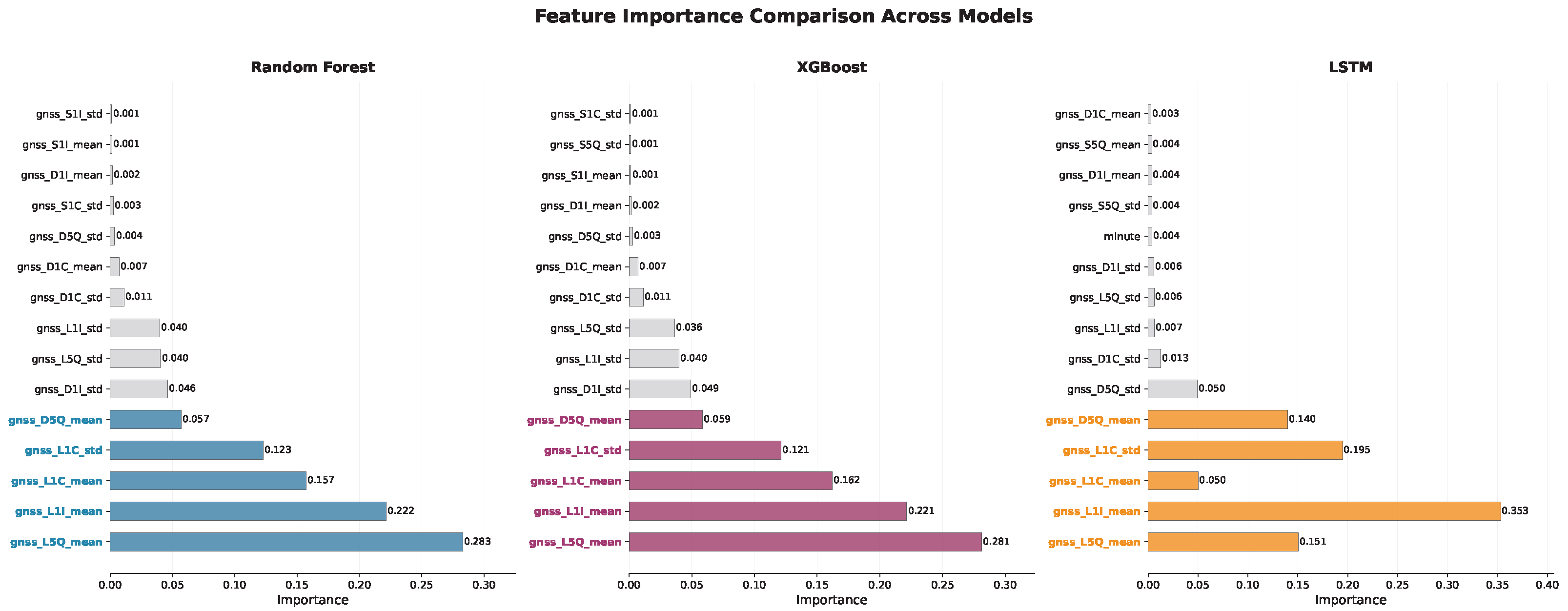
- Some features (‘gnss_L5Q_mean’ and ‘gnss_L1C_std’) dominate the positioning error of the UAV.
- UAV positioning should systematically enhance horizontal accuracy.
- UAV navigation systems should prioritize real-time monitoring of these specific features (‘gnss_L5Q_mean’ and ‘gnss_L1C_std’).
Abstract
1. Introduction
2. Experiment and Data Acquisition
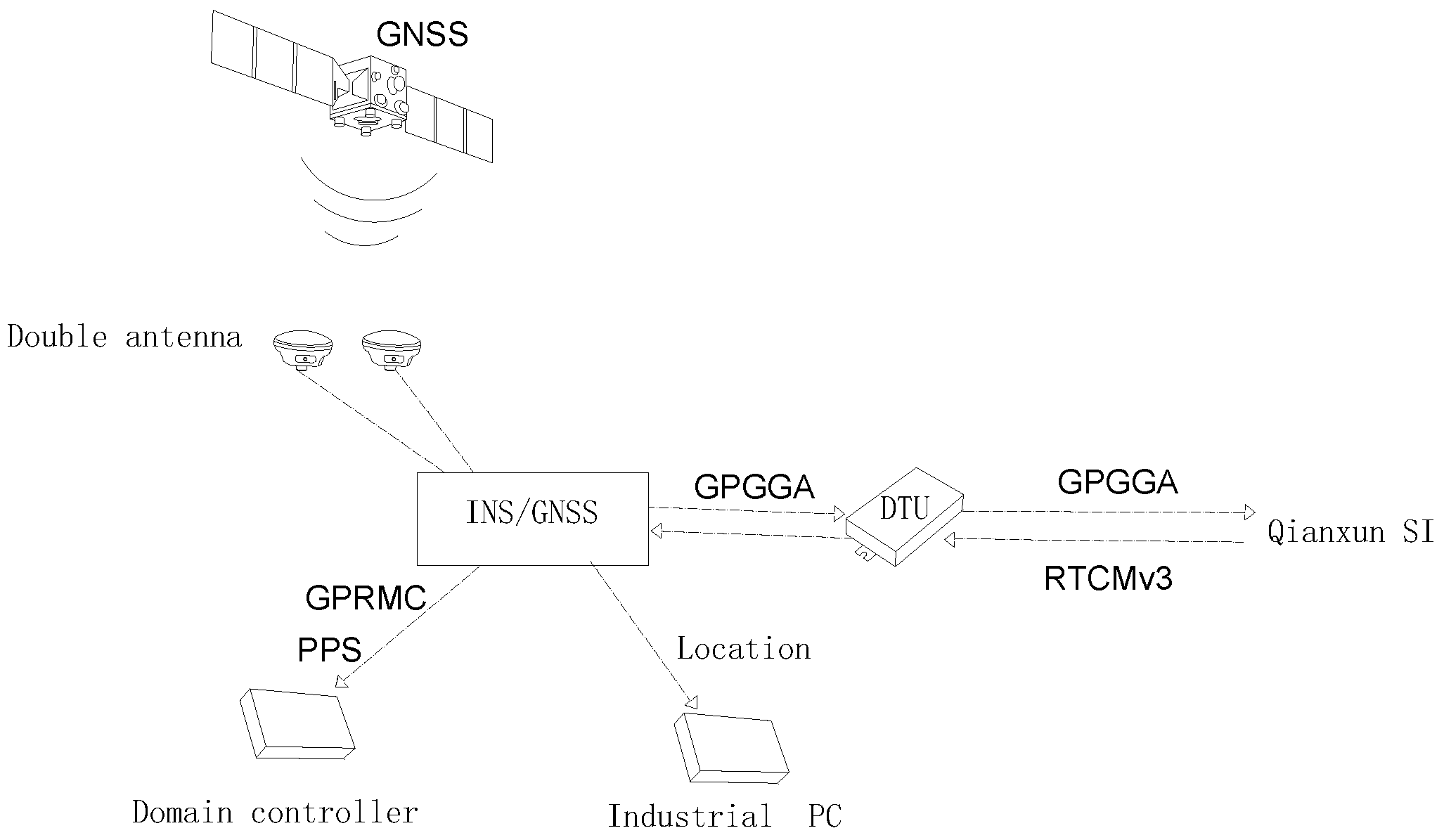
2.1. GNSS/INS Integrated System
2.2. Data Analysis
- GPS (G): L1 C/A (C1C), L1 P-code (C1P and L1P), L2C (C2W and L2W), and L5 (C5Q and C5I);
- GLONASS (R): L1 (C1C) and L2 (C2C) on frequency channel numbers;
- Galileo (E): E1 (C1B, C1C), E5a (C5I), E5b (C7I), and E5 AltBOC (C5Q and C7Q);
- BDS-3 (C): B1I (C1I), B1C (C1Q), B2a (L7), B2b (C7I), and B3I (C6I);
- QZSS (J): L1 C/A (C1C), L2C (C2X), and L5 (C5Q and C5X);
- SBAS (S): L1 (C1C) and L5 (C5I).
- id: It represents a unique identifier for the surveyed point. The dataset includes a fixed reference station (denoted as “Base”) and a series of sequentially numbered rover points.
- N, E, and U: They represent the coordinate components in a local or projected Cartesian system, representing Northing, Easting, and Height (Up), respectively. Coordinates are recorded in meters with a precision of m (0.1 mm).
- time: It represents the precise UTC timestamp for each observation, formatted as MM/DD/YYYY HH:MM:SS.ss. The data exhibit a consistent sampling interval, enabling high-temporal-resolution trajectory analysis.
3. Models
3.1. Benchmark Models
3.2. LSTM
4. Results
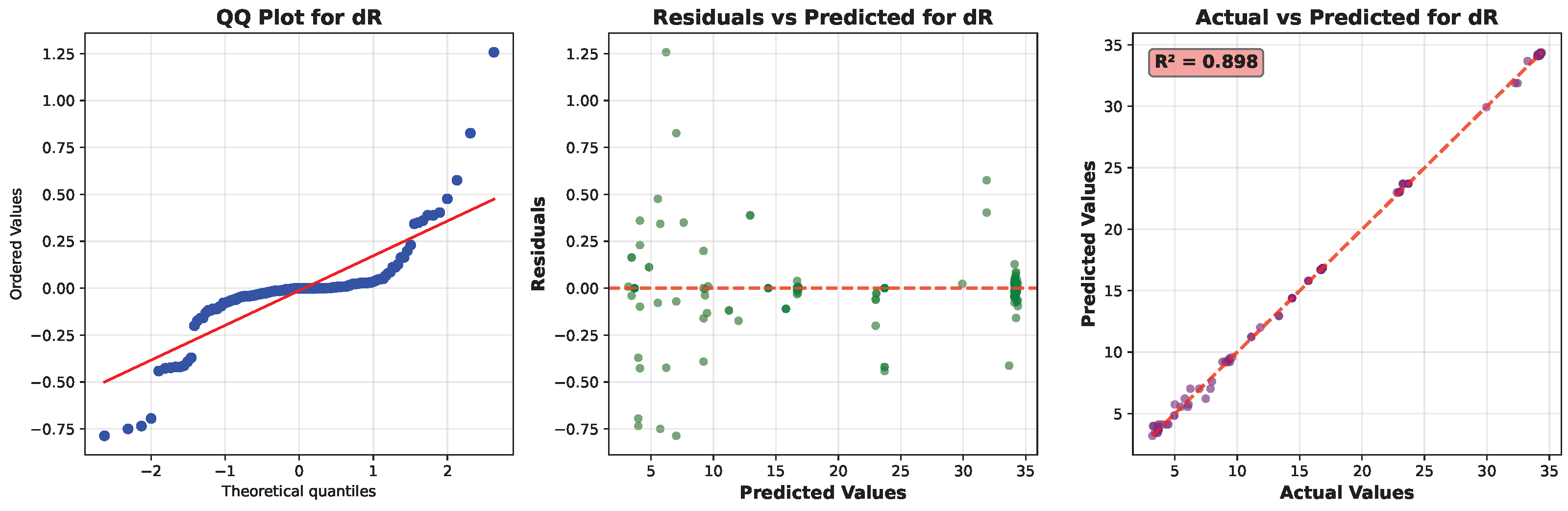
4.1. Model Performance Assessment
4.2. Key Features
- 1.
- gnss_L5Q_mean: The mean signal power of the L5-band quadrature-phase component, which exhibited the strongest overall predictive influence. The L5 band’s high chipping rate and modernized signal structure provide superior noise resistance and multipath mitigation, making its average power a robust indicator of measurement quality.
- 2.
- gnss_L1I_mean: The mean signal power of the L1 in-phase component. As the primary civilian signal, its strength is directly correlated with pseudorange precision and serves as a fundamental indicator of line-of-sight signal availability.
- 3.
- gnss_L1C_mean: The mean power of the modernized L1C signal. Its importance highlights the value of next-generation GNSS signals, which are designed with advanced spreading codes and pilot channels for improved tracking robustness in challenging environments.
- 4.
- gnss_L1C_std: The standard deviation of the L1C signal power. This temporal variability metric captures signal stability, with higher fluctuations often indicative of multipath interference, partial obstructions, or receiver tracking instabilities.
- 5.
- gnss_D5Q_mean: The mean signal power of the D5-band quadrature component (specific to certain satellite systems). Its prominence suggests that leveraging signals across multiple frequencies (L1, L5, and D5) provides complementary information essential for error characterization.
5. Conclusions
Author Contributions
Funding
Data Availability Statement
Acknowledgments
Conflicts of Interest
References
- Laghari, A.A.; Jumani, A.K.; Laghari, R.A.; Nawaz, H. Unmanned aerial vehicles: A review. Cogn. Robot. 2023, 3, 8–22. [Google Scholar] [CrossRef]
- Ahmed, F.; Mohanta, J.; Keshari, A.; Yadav, P.S. Recent advances in unmanned aerial vehicles: A review. Arab. J. Sci. Eng. 2022, 47, 7963–7984. [Google Scholar] [CrossRef]
- Valavanis, K.P.; Vachtsevanos, G.J. Handbook of Unmanned Aerial Vehicles; Springer: Berlin/Heidelberg, Germany, 2014. [Google Scholar]
- Zuo, Z.; Liu, C.; Han, Q.; Song, J. Unmanned aerial vehicles: Control methods and future challenges. IEEE/CAA J. Autom. Sin. 2022, 9, 601–614. [Google Scholar] [CrossRef]
- Newcome, L.R. Unmanned Aviation: A Brief History of Unmanned Aerial Vehicles; Aiaa: Reston, VA, USA, 2004. [Google Scholar]
- Lyu, Z.; Gao, Y.; Chen, J.; Du, H.; Xu, J.; Huang, K.; Kim, D.I. Empowering Intelligent Low-Altitude Economy with Large AI Model Deployment. IEEE Wirel. Commun. 2026, 33, 64–72. [Google Scholar] [CrossRef]
- Javaid, S.; Fahim, H.; He, B.; Saeed, N. Large Language Models for UAVs: Current State and Pathways to the Future. IEEE Open J. Veh. Technol. 2024, 5, 1166–1192. [Google Scholar] [CrossRef]
- Grewal, M.S. Global navigation satellite systems. Wiley Interdiscip. Rev. Comput. Stat. 2011, 3, 383–384. [Google Scholar] [CrossRef]
- Lechner, W.; Baumann, S. Global navigation satellite systems. Comput. Electron. Agric. 2000, 25, 67–85. [Google Scholar] [CrossRef]
- Bonnor, N. A brief history of global navigation satellite systems. J. Navig. 2012, 65, 1–14. [Google Scholar] [CrossRef]
- Yu, J.; Meng, X.; Yan, B.; Xu, B.; Fan, Q.; Xie, Y. Global Navigation Satellite System-based positioning technology for structural health monitoring: A review. Struct. Control Health Monit. 2020, 27, e2467. [Google Scholar] [CrossRef]
- Wang, J.J. Antennas for global navigation satellite system (GNSS). Proc. IEEE 2012, 100, 2349–2355. [Google Scholar] [CrossRef]
- Ekaso, D.; Nex, F.; Kerle, N. Accuracy assessment of real-time kinematics (RTK) measurements on unmanned aerial vehicles (UAV) for direct geo-referencing. Geo-Spat. Inf. Sci. 2020, 23, 165–181. [Google Scholar] [CrossRef]
- Henkel, P.; Sperl, A. Real-time kinematic positioning for unmanned air vehicles. In Proceedings of the 2016 IEEE Aerospace Conference, Big Sky, MT, USA, 5–12 March 2016; pp. 1–7. [Google Scholar]
- Shin, Y.; Lee, C.; Kim, E. Enhancing Real-Time Kinematic Relative Positioning for Unmanned Aerial Vehicles. Machines 2024, 12, 202. [Google Scholar] [CrossRef]
- Tahar, K.N.; Ahmad, A.; Akib, W.A.A.W.M.; Mohd, W.M.N.W. Unmanned aerial vehicle photogrammetric results using different real time kinematic global positioning system approaches. In Developments in Multidimensional Spatial Data Models; Springer: Berlin/Heidelberg, Germany, 2013; pp. 123–134. [Google Scholar]
- Famiglietti, N.A.; Cecere, G.; Grasso, C.; Memmolo, A.; Vicari, A. A test on the potential of a low cost unmanned aerial vehicle RTK/PPK solution for precision positioning. Sensors 2021, 21, 3882. [Google Scholar] [CrossRef]
- Grayson, B.; Penna, N.T.; Mills, J.P.; Grant, D.S. GPS precise point positioning for UAV photogrammetry. Photogramm. Rec. 2018, 33, 427–447. [Google Scholar] [CrossRef]
- Shi, J.; Yuan, X.; Cai, Y.; Wang, G. GPS real-time precise point positioning for aerial triangulation. GPS Solut. 2017, 21, 405–414. [Google Scholar] [CrossRef]
- LeCun, Y.; Bengio, Y.; Hinton, G. Deep learning. Nature 2015, 521, 436–444. [Google Scholar] [CrossRef]
- Mathew, A.; Amudha, P.; Sivakumari, S. Deep learning techniques: An overview. In International Conference on Advanced Machine Learning Technologies and Applications; Springer: Singapore, 2020; pp. 599–608. [Google Scholar]
- Shinde, P.P.; Shah, S. A review of machine learning and deep learning applications. In Proceedings of the 2018 Fourth International Conference on Computing Communication Control and Automation (ICCUBEA), Pune, India, 16–18 August 2018; pp. 1–6. [Google Scholar]
- Deng, L.; Yu, D. Deep learning: Methods and applications. Found. Trends® Signal Process. 2014, 7, 197–387. [Google Scholar] [CrossRef]
- Graves, A. Long short-term memory. In Supervised Sequence Labelling with Recurrent Neural Networks; Springer: Berlin/Heidelberg, Germany, 2012; pp. 37–45. [Google Scholar]
- Huang, R.; Wei, C.; Wang, B.; Yang, J.; Xu, X.; Wu, S.; Huang, S. Well performance prediction based on Long Short-Term Memory (LSTM) neural network. J. Pet. Sci. Eng. 2022, 208, 109686. [Google Scholar] [CrossRef]
- Schmidhuber, J.; Hochreiter, S. Long short-term memory. Neural Comput. 1997, 9, 1735–1780. [Google Scholar] [CrossRef] [PubMed]
- Fujii, K. Extended kalman filter. Ref. Man. 2013, 14, 2. [Google Scholar]
- Ribeiro, M.I. Kalman and extended kalman filters: Concept, derivation and properties. Inst. Syst. Robot. 2004, 43, 3736–3741. [Google Scholar]
- Yang, S.; Baum, M. Extended Kalman filter for extended object tracking. In Proceedings of the 2017 IEEE International Conference on Acoustics, Speech and Signal Processing (ICASSP), New Orleans, LA, USA, 5–9 March 2017; pp. 3736–3741. [Google Scholar]
- Rigatti, S.J. Random forest. J. Insur. Med. 2017, 47, 31–39. [Google Scholar] [CrossRef]
- Breiman, L. Random forests. Mach. Learn. 2001, 45, 5–32. [Google Scholar] [CrossRef]
- Salman, H.A.; Kalakech, A.; Steiti, A. Random forest algorithm overview. Babylon. J. Mach. Learn. 2024, 2024, 69–79. [Google Scholar] [CrossRef] [PubMed]
- Chen, T. XGBoost: A Scalable Tree Boosting System. In Proceedings of the 22nd ACM SIGKDD International Conference on Knowledge Discovery and Data Mining, San Francisco, CA, USA, 13–17 August 2016. [Google Scholar]
- Chen, T.; He, T.; Benesty, M.; Khotilovich, V.; Tang, Y.; Cho, H.; Chen, K.; Mitchell, R.; Cano, I.; Zhou, T.; et al. Xgboost: Extreme Gradient Boosting. R Package Version 0.4-2. 2015. Available online: https://www.rdocumentation.org/packages/xgboost/versions/0.4-2 (accessed on 5 January 2026).
- Taddia, Y.; Stecchi, F.; Pellegrinelli, A. Using DJI Phantom 4 RTK drone for topographic mapping of coastal areas. Int. Arch. Photogramm. Remote Sens. Spat. Inf. Sci. 2019, 42, 625–630. [Google Scholar] [CrossRef]
- Mulakala, J. Measurement Accuracy of the DJI Phantom 4 RTK & Photogrammetry. DroneDeploy, Published in Partnership with DJI 2019. Available online: https://docs.djicdn.com/DJI+Enterprise/measurement-accuracy-dji-phantom-4-rtk-whitepaper-f[1].pdf (accessed on 5 January 2026).
- Testing of drone DJI Phantom 4 RTK accuracy. In Advances and Trends in Geodesy, Cartography and Geoinformatics II; CRC Press: Boca Raton, FL, USA, 2020; pp. 99–105.
- Hu, G.; Wang, W.; Zhong, Y.; Gao, B.; Gu, C. A new direct filtering approach to INS/GNSS integration. Aerosp. Sci. Technol. 2018, 77, 755–764. [Google Scholar] [CrossRef]
- Dai, H.; Bian, H.; Wang, R.; Ma, H. An INS/GNSS integrated navigation in GNSS denied environment using recurrent neural network. Def. Technol. 2020, 16, 334–340. [Google Scholar] [CrossRef]
- Jekeli, C. Inertial Navigation Systems with Geodetic Applications; Walter de Gruyter GmbH & Co KG: Berlin, Germany, 2023. [Google Scholar]
- Cox, D.B. Integration of GPS with inertial navigation systems (Miscellaneous Topics). NAVIGATION J. Inst. Navig. 1978, 25, 236–245. [Google Scholar] [CrossRef]
- Braasch, M.S. Inertial navigation systems. In Aerospace Navigation Systems; Wiley: London, UK, 2016; pp. 1–25. [Google Scholar]
- Hasan, A.M.; Samsudin, K.; Ramli, A.R.; Azmir, R.; Ismaeel, S. A review of navigation systems (integration and algorithms). Aust. J. Basic Appl. Sci. 2009, 3, 943–959. [Google Scholar]
- Hegarty, C.J. GNSS signals—An overview. In Proceedings of the 2012 IEEE International Frequency Control Symposium Proceedings, Baltimore, MD, USA, 21–24 May 2012; pp. 1–7. [Google Scholar]
- Hegarty, C.J. The global positioning system (GPS). In Springer Handbook of Global Navigation Satellite Systems; Springer: Cham, Switzerland, 2017; pp. 197–218. [Google Scholar]
- Kumar, S.; Moore, K.B. The evolution of global positioning system (GPS) technology. J. Sci. Educ. Technol. 2002, 11, 59–80. [Google Scholar] [CrossRef]
- Enge, P.K. The global positioning system: Signals, measurements, and performance. Int. J. Wirel. Inf. Netw. 1994, 1, 83–105. [Google Scholar] [CrossRef]
- Ivanov, N.; Salischev, V. The GLONASS system—An overview. J. Navig. 1992, 45, 175–182. [Google Scholar] [CrossRef]
- Revnivykh, S.; Bolkunov, A.; Serdyukov, A.; Montenbruck, O. Glonass. In Springer Handbook of Global Navigation Satellite Systems; Springer: Cham, Switzerland, 2017; pp. 219–245. [Google Scholar]
- Polischuk, G.; Kozlov, V.; Ilitchov, V.; Kozlov, A.; Bartenev, V.; Kossenko, V.; Anphimov, N.; Revnivykh, S.; Pisarev, S.; Tyulyakov, A. The global navigation satellite system GLONASS: Development and usage in the 21st century. In Proceedings of the 34th Annual Precise Time and Time Interval Systems and Applications Meeting, Reston, VA, USA, 3–5 December 2002; pp. 151–160. [Google Scholar]
- Yang, Y.; Gao, W.; Guo, S.; Mao, Y.; Yang, Y. Introduction to BeiDou-3 navigation satellite system. Navigation 2019, 66, 7–18. [Google Scholar] [CrossRef]
- Han, C.; Yang, Y.; Cai, Z. BeiDou navigation satellite system and its time scales. Metrologia 2011, 48, S213. [Google Scholar] [CrossRef]
- Benedicto, J.; Dinwiddy, S.; Gatti, G.; Lucas, R.; Lugert, M. GALILEO: Satellite system design. In European Space Agency; Int. Business: Tokyo, Japan, 2000. [Google Scholar]
- Falcone, M.; Hahn, J.; Burger, T. Galileo. In Springer Handbook of Global Navigation Satellite Systems; Springer: Cham, Switzerland, 2017; pp. 247–272. [Google Scholar]
- Drake, S. Galileo and satellite prediction. J. Hist. Astron. 1979, 10, 75–95. [Google Scholar] [CrossRef]
- Bartolom’e, J.P.; Maufroid, X.; Hern’andez, I.F.; L’opez Salcedo, J.A.; Granados, G.S. Overview of Galileo system. In GALILEO Positioning Technology; Springer: Dordrecht, The Netherlands, 2014; pp. 9–33. [Google Scholar]
- Snay, R.A.; Soler, T. Continuously Operating Reference Station (CORS): History, Applications, and Future Enhancements. J. Surv. Eng. 2008, 134, 95–104. [Google Scholar] [CrossRef]
- Yang, Y.X. Chinese Geodetic Coordinate System 2000. Chin. Sci. Bull. 2009, 54, 2714–2721. [Google Scholar] [CrossRef]
- Hussain, T. Checking the Integrity of Global Positioning Recommended Minimum (GPRMC) Sentences Using Artificial Neural Network (ANN). 2009. Available online: https://www.diva-portal.org/smash/record.jsf?pid=diva2:233855 (accessed on 5 January 2026).
- Cai, C.; Yan, H.; Chen, H.; Xu, H. Design and Implementation of Traffic Signal Controller with GPS Timing Function. In CICTP 2012: Multimodal Transportation Systems—Convenient, Safe, Cost-Effective, Efficient; American Society of Civil Engineers: Reston, VA, USA, 2012; pp. 1055–1064. [Google Scholar]
- Langley, R. Nmea 0183: A gps receiver. GPS World 1995, 6, 54–57. [Google Scholar]
- Aroon, N. Study of Using MQTT Cloud Platform for Remotely Control Robot and GPS Tracking. In Proceedings of the 2016 13th International Conference on Electrical Engineering/Electronics, Computer, Telecommunications and Information Technology (ECTI-CON), Chiang Mai, Thailand, 28 June–1 July 2016; pp. 1–6. [Google Scholar]
- Brown, N.; Keenan, R.; Richter, B.; Troyer, L. Advances in ambiguity resolution for RTK applications using the new RTCM V3. 0 Master-Auxiliary messages. In Proceedings of the 18th International Technical Meeting of the Satellite Division of The Institute of Navigation (ION GNSS 2005), Long Beach, CA, USA, 13–16 September 2005; pp. 73–80. [Google Scholar]
- Niu, X.; Yan, K.; Zhang, T.; Zhang, Q.; Zhang, H.; Liu, J. Quality evaluation of the pulse per second (PPS) signals from commercial GNSS receivers. GPS Solut. 2015, 19, 141–150. [Google Scholar] [CrossRef]
- IGS RINEX: The Receiver Independent Exchange Format Version 3.04. Available online: http://acc.igs.org/misc/rinex304.pdf (accessed on 5 January 2026).
- Teunissen, P.J.; Montenbruck, O. (Eds.) Springer Handbook of Global Navigation Satellite Systems; Springer: Cham, Switzerland, 2017. [Google Scholar]
- Segal, M.R. Machine Learning Benchmarks and Random Forest Regression. 2004. Available online: https://escholarship.org/uc/item/35x3v9t4 (accessed on 5 January 2026).
- Grömping, U. Variable importance assessment in regression: Linear regression versus random forest. Am. Stat. 2009, 63, 308–319. [Google Scholar] [CrossRef]
- Kingma, D.P.; Ba, J. Adam: A method for stochastic optimization. arXiv 2014, arXiv:1412.6980. [Google Scholar]


| Device Description | Brand/Version | Primary Parameters |
|---|---|---|
| Small multi-rotor, high-precision aerial surveying UAV | DJI Phantom 4 RTK | Hovering Accuracy: With RTK enabled and functioning normally: Vertical: ; Horizontal: . |
| Remote Controller | – | Maximum Operational Range: 7 km |
| High-precision total station | Leica | Accuracy: Single measurement: () Continuous measurement: () |
| High-precision circular prism | Leica | Prism Constant: 0 mm |
| prism | Huilide GRZ101 | Prism Constant: 23.1 mm |
| GNSS receiver | iRTK10 | Positioning Output Rate: 1 Hz–20 Hz |
| Parameter (Description) | Random Forest | XGBoost |
|---|---|---|
| Number of estimators () | 100 | 200 |
| Maximum tree depth () | 10 | 8 |
| Learning rate () | – | 0.1 |
| Minimum samples split | 2 | – |
| Subsample ratio | 1.0 (Bootstrap) | 1.0 |
| Objective/criterion | Squared Error | reg:squarederror |
| Component | Description | Details |
|---|---|---|
| Network Architecture | ||
| Input Shape | Sequence length and features | (samples, timesteps = 10, and features = n) |
| First LSTM Layer | 128 units, return sequences enabled | Dropout (), batch normalization |
| Second LSTM Layer | 64 units, return sequences enabled | Dropout (), batch normalization |
| Third LSTM Layer | 32 units, return sequences disabled | Dropout () |
| First Dense Layer | 64 units, ReLU activation | Dropout () |
| Second Dense Layer | 32 units, ReLU activation | Dropout () |
| Output Layer | Linear dense layer | d units ( for single-value prediction) |
| Training Configuration | ||
| Optimizer | Adam | Learning rate = 0.001 |
| Loss Function | Mean squared error (MSE) | - |
| Batch Size | 32 | - |
| Epochs | 100 | Early stopping with patience = 10 |
| Validation Split | 80% training/20% validation | - |
| Weight Initialization | Glorot uniform | - |
| Random Seed | 42 | For reproducibility |
| Feature Normalization | Z-score normalization | Based on training set statistics |
| Model | MSE (m2) | RMSE (m) | |
|---|---|---|---|
| EKF | 0.0209 ± 0.0013 | 0.144 ± 0.004 | 0.890 ± 0.006 |
| Random Forest | 0.0219 ± 0.0015 | 0.148 ± 0.005 | 0.872 ± 0.012 |
| XGBoost | 0.0174 ± 0.0011 | 0.132 ± 0.004 | 0.898 ± 0.009 |
| LSTM | 0.0198 ± 0.0013 | 0.141 ± 0.005 | 0.884 ± 0.010 |
Disclaimer/Publisher’s Note: The statements, opinions and data contained in all publications are solely those of the individual author(s) and contributor(s) and not of MDPI and/or the editor(s). MDPI and/or the editor(s) disclaim responsibility for any injury to people or property resulting from any ideas, methods, instructions or products referred to in the content. |
© 2026 by the authors. Licensee MDPI, Basel, Switzerland. This article is an open access article distributed under the terms and conditions of the Creative Commons Attribution (CC BY) license.
Share and Cite
Yang, M.; Zhuo, H.; Ma, J.-G.; Niu, G.-H.; Mamtimin, Z.; Tao, M.; Zhu, Y.-Q.; Li, J.; Abdughani, M.; Sidike, A. A Comparative Study of Machine Learning and Deep Learning Models for Real-Time UAV Positioning Error Estimation. Drones 2026, 10, 172. https://doi.org/10.3390/drones10030172
Yang M, Zhuo H, Ma J-G, Niu G-H, Mamtimin Z, Tao M, Zhu Y-Q, Li J, Abdughani M, Sidike A. A Comparative Study of Machine Learning and Deep Learning Models for Real-Time UAV Positioning Error Estimation. Drones. 2026; 10(3):172. https://doi.org/10.3390/drones10030172
Chicago/Turabian StyleYang, Mei, Hua Zhuo, Jun-Gang Ma, Guo-Hui Niu, Zulmira Mamtimin, Mei Tao, Ya-Qiong Zhu, Jun Li, Murat Abdughani, and Aihemaitijiang Sidike. 2026. "A Comparative Study of Machine Learning and Deep Learning Models for Real-Time UAV Positioning Error Estimation" Drones 10, no. 3: 172. https://doi.org/10.3390/drones10030172
APA StyleYang, M., Zhuo, H., Ma, J.-G., Niu, G.-H., Mamtimin, Z., Tao, M., Zhu, Y.-Q., Li, J., Abdughani, M., & Sidike, A. (2026). A Comparative Study of Machine Learning and Deep Learning Models for Real-Time UAV Positioning Error Estimation. Drones, 10(3), 172. https://doi.org/10.3390/drones10030172