
Article

Development and Validation of an Amphibious Drone-Based In-Situ SPE System for Environmental Water Monitoring

1
Faculty of Bioresource Sciences, Akita Prefectural University, Akita 010-0195, Japan
2
Akita Prefectural Center of Analytical Chemistry Ltd., Akita 010-8728, Japan
3
Graduate School of Bioresource Sciences, Akita Prefectural University, Akita 010-0195, Japan
4
Faculty of Software and Information Science, Iwate Prefectural University, Takizawa 020-0693, Japan
*
Author to whom correspondence should be addressed.
Drones 2025, 9(9), 649; https://doi.org/10.3390/drones9090649
Submission received: 6 July 2025 / Revised: 5 September 2025 / Accepted: 9 September 2025 / Published: 15 September 2025
(This article belongs to the Special Issue Drones in Hydrological Research and Management)

Abstract

Highlights

What are the main findings?
  • The SPE system achieved high recovery and precision in laboratory tests.
  • Its insecticide detection ability matched that of boat sampling, showing strong performance in natural waters.
What is the implication of the main finding?
  • The system provides efficient, autonomous monitoring of aquatic pollutants.
  • It reduces manual labor and contamination risks during field monitoring.

Abstract

To improve the efficiency of aquatic environmental monitoring, an in-situ solid-phase extraction (SPE) system using amphibious (waterproof) drones was developed and validated using recovery testing with samples containing known concentrations of systemic insecticides in the laboratory and using real samples from natural water bodies. The system used a water-resistant linear actuator for continuous aspiration at 1–10 mL min−1 through a pre-washed hydrophilic–lipophilic balanced SPE cartridge. The system functioned properly during field sampling using vacuum-mode filtration to avoid overpressure, overcurrent, and contamination through repeated filtration. The recovery tests using 10 ng L−1 of each target analyte in ultra-pure water samples produced satisfactory recovery results of 89–96% (relative standard deviation < 10%). In the real sampling of water bodies, the developed system was able to detect target analytes of 0.9–180 ng L−1. The results are comparable to those obtained using in-situ manual SPE from boat sampling, irrespective of differences in the two aspiration systems. These findings suggest that the application of the developed drone-assisted in situ SPE system can improve the efficiency of real-sample monitoring of natural water bodies.

1. Introduction

Emerging contaminants (ECs) [1,2,3,4,5] are newly identified synthetic or naturally occurring chemicals or biological agents that have been detected in the environment and pose potential hazards to humans and ecosystems. These contaminants, which include pharmaceuticals, personal care products, endocrine disruptors, and industrial chemicals, can enter the environment through various pathways. Thereafter, they persist and accumulate in the food chain, posing risks to ecosystems and human health. Concerns about the adverse effects of ECs stem from insufficient data related to their environmental and health repercussions. This insufficiency stems from a lack of extensive regulatory frameworks for these contaminants [5]. Although natural water dilutes discharged chemicals, some of these chemicals might be ecotoxic to non-target aquatic organisms even below parts-per-trillion (ppt) concentrations [6]. Both temporally and spatially, EC concentrations in the environment can vary considerably, making their detection and analysis complex. This variability necessitates comprehensive sampling regimes to assess the presence and concentrations of these contaminants accurately [5]. Unfortunately, such sampling is usually labor-intensive in water bodies such as lakes and seas. For these reasons, efficient systems must be developed and applied.
Drone-based technologies have been developed to meet the demands for in-situ water quality monitoring [7,8,9,10,11,12]. These technologies, by virtue of their use of vertical takeoff and landing (VTOL) capabilities, reduce the disturbances to monitoring sites [7]. Furthermore, by enhancing accessibility to natural water bodies and providing mobility over water, they can reduce the risks, labor costs, and time constraints associated with conventional manual water sampling. Among the trace chemical sampling technologies compatible with amphibious (air and water) or waterproof drones, the solid-phase micro extraction (SPME) technique supports in-situ measurements of trace chemical concentrations and requires only a lighter drone payload for water sampling [12]. Passive sampling methods such as SPME operate on the principle of adsorption equilibrium. They have garnered attention for their simplicity, portability, and ability to measure the time-weighted average concentrations of target analytes. Despite these benefits, passive methods present several limitations when compared to active sampling techniques. These include constraints on the range of detectable analytes and susceptibility to environmental variables such as the adsorption equilibrium time, water temperature, and water quality conditions [13].
Recent advancements in drone technology have led to the production of off-the-shelf amphibious drones with large payload capacities [14], sufficient for use with large (up to 100 g [15]) SPE cartridges (permeable sorbent columns) and active samplers. These amphibious drones have been combined with various water sampling techniques [7,8,9,10,11], but no SPE active water sampling system has been developed for drones. Macro-scale SPE cartridges with appropriate sorbents allow for rapid and efficient water quality monitoring. They are also suitable for storage because protective measures against light, heat, and biological degradation can be incorporated, thereby ensuring stability until the trace and labile chemicals are quantified [15,16]. Tube extraction using sorbent fibers has already been applied as an SPE technique (ITEX) when using drones and portable air pumps for active sampling of specific air pollutants [17,18,19,20].
Implementing an SPE system requires a precise water filtration mechanism to prevent analyte breakthrough and to protect the system from overpressure or overcurrent. Natural water often contains suspended solids or slime that can clog SPE cartridges [21]. The response to clogging depends on the sample type. Water is applicable to SPE cartridges in either vacuum or positive-pressure mode [15]. Positive-pressure mode maintains a constant infiltration rate through electronic pressure control and the low compressibility of water [22]. However, clogged cartridges require high pressure, which can damage the system. Reusing a water reservoir for sample application might also cause cross-contamination. In contrast, vacuum mode avoids overpressure, overcurrent, and reservoir contamination. Its main shortcoming is an unstable infiltration rate when cartridges clog because vacuum pressure depends on air contraction, even in sealed vessels (e.g., a syringe with a plunger).
Presumed simple approaches for vacuum-mode sample application include (1) setting the lowest probable infiltration rate predicted for each sampling site, (2) fixing the water-landing duration and confirming the infiltrated volume afterward, and (3) applying filtered water to SPE cartridges to remove clogging materials. However, using a prefilter removes some chemicals associated with clogging materials, whereas the other approaches retain insoluble chemicals in the samples. Therefore, we adopted approach (2), which uses a fixed sampling time and does not eliminate clogging materials.
Based on the background presented above, we developed an amphibious drone to assist with an in-situ SPE water sampling system. Together, they provide an efficient tool for comprehensive and extensive sampling and studies. Thereafter, we verified the system using a recovery test with water samples prepared with known concentrations of target analytes (neonicotinoid insecticides and related compounds) and real field sampling. Accordingly, the objective of this study is to elucidate the performance of the newly developed system using metrics of the percentage of recovery of target analytes and the duration necessary for real sampling, as well as to provide any findings obtained through system verification to ensure the reproducibility of this technique.

2. Materials and Methods

2.1. Drone Platform, Flight Configuration, Operational Conditions

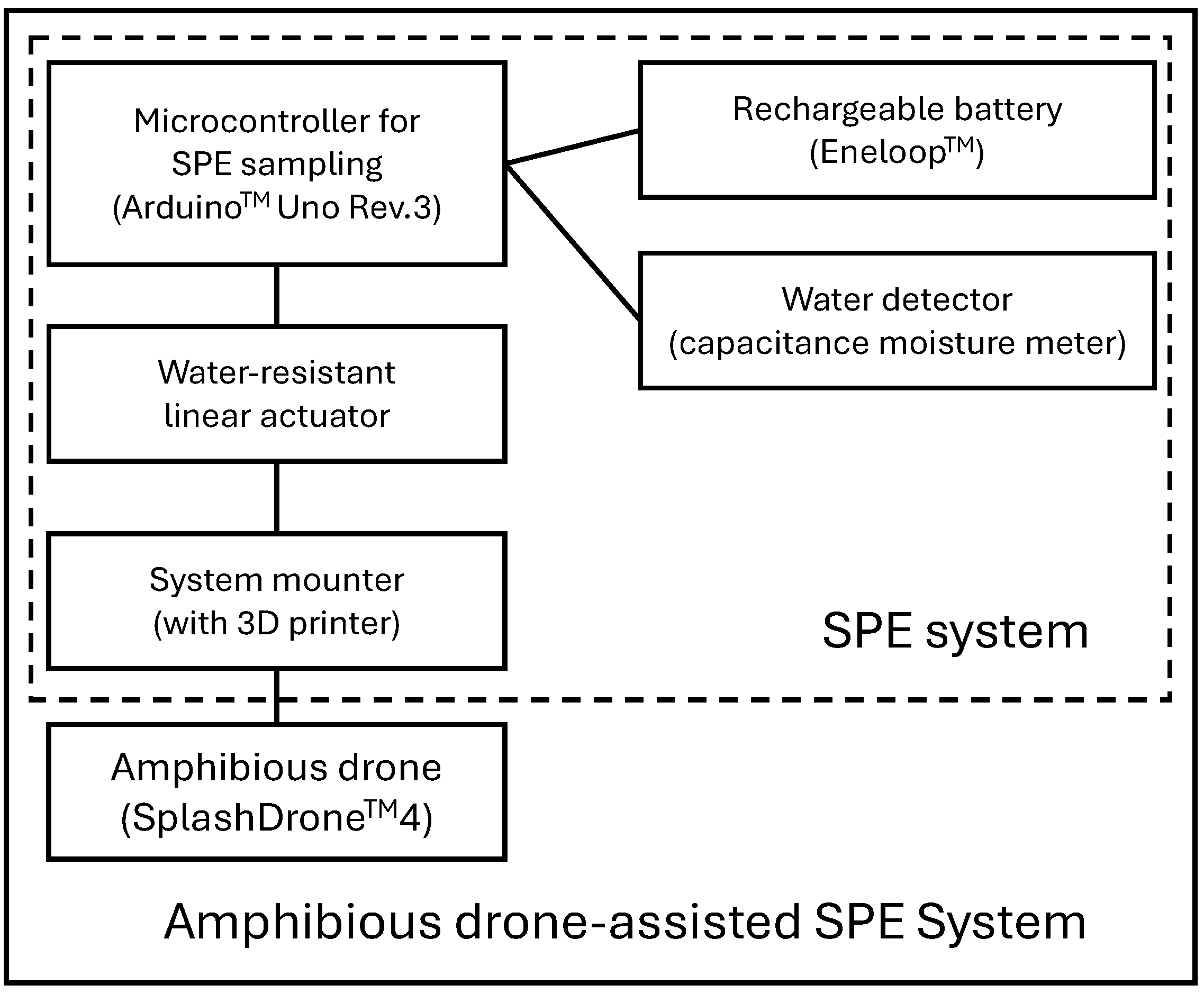
A system schematic is depicted in Figure 1. An amphibious drone was used for developing the SPE water sampling system (SplashDrone™ 4; Swellpro, China, localized and sold by GSM Co., Ltd., Okinawa, Japan). The drone has been rated in China as an Ingress Protection (IP) 67 product (dust-tight and one-meter depth waterproof for 30 min). The maximum payload capacity reported by the manufacturer of this device (SplashDroneTM 4) was 2 kg [14].
To estimate the effects of the external system on the availability of the Global Navigation Satellite System (GNSS)-assisted flight control system, the Global Positioning System (GPS) accuracy indicator [14] of the drone was used. The indicator was associated with restricted flight in GPS mode [14]. For example, for the SplashDroneTM 4, <1 m of location error in the GNSS corresponds to the maximum value (10) of the indicator [14], which allows flight in GPS mode.
The drone was operated in GPS-assisted mode with altitude hold enabled to maintain stable positioning during sampling. The takeoff and landing were performed manually, whereas horizontal navigation was semi-autonomous under GNSS guidance. All flights were conducted under visual line-of-sight (VLOS) in compliance with Japanese aviation regulations. The drone was operated at altitudes of approximately 5 m above the water’s surface and within a horizontal range of 100 m from the operator. Weather conditions differed notably between the two flight sites. At Ogata Marsh Pond, the weather was clear and calm with no wind. The air temperature was approximately 20 °C. In contrast, conditions at Lake Hachiro were cloudy with occasional rain and moderate winds of about 3 m s⁻¹, with an air temperature of approximately 18 °C. Throughout all operations, GNSS signal strength was monitored continuously to ensure the stability of GPS-assisted flight.

2.2. Mechanical Setup and Structural Integration of the SPE System

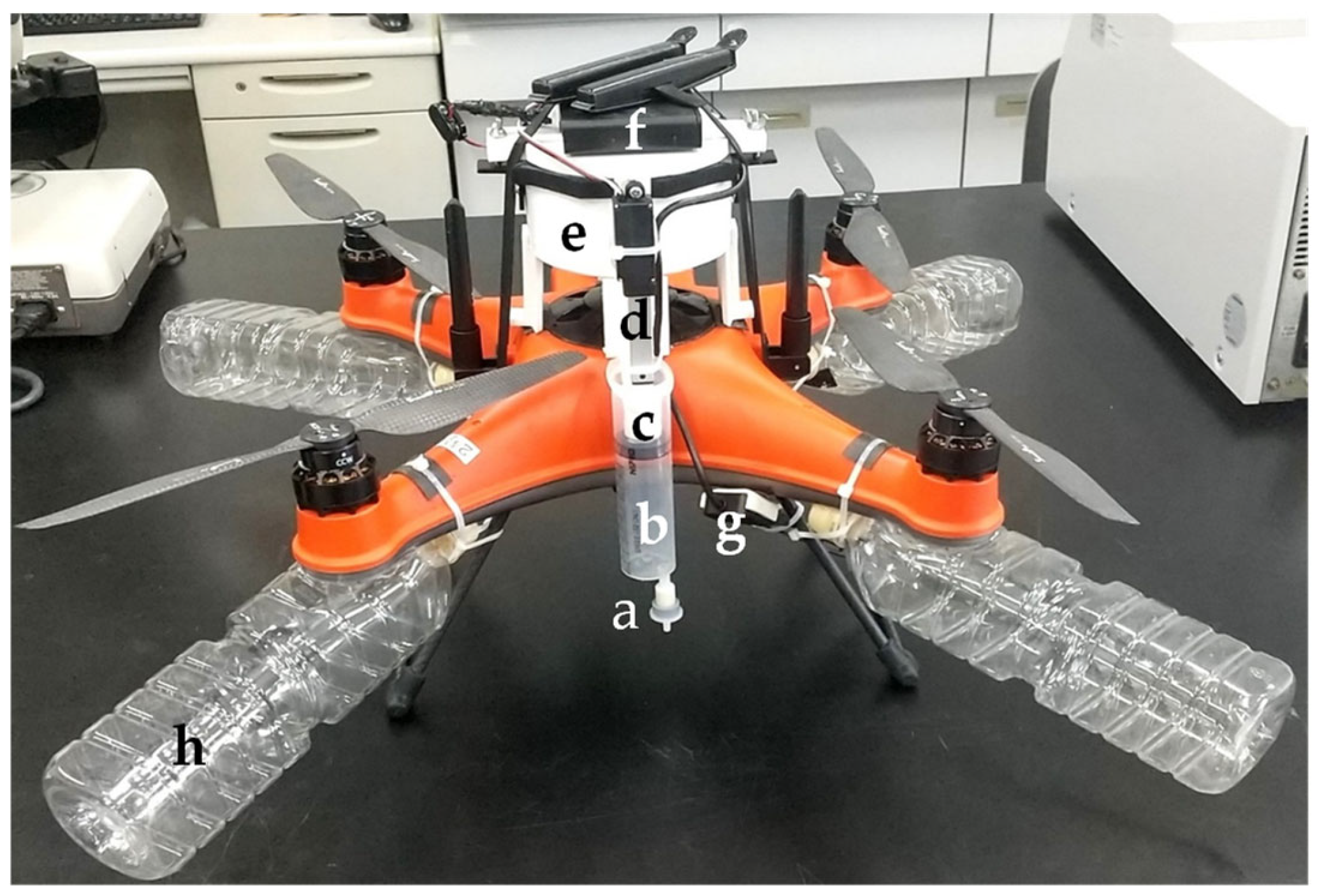
Figure 2 portrays an example of a solid phase extraction (SPE) system with an amphibious drone. A water-resistant (IP54) linear actuator (L16-50-150-6-R, 50-mm stroke, 150:1 gear reduction, 6-V operating voltage, 200-N of maximum lifted force; Actuonix Motion Devices Inc., Saanichton, BC, Canada) [23] was used to apply water samples to SPE cartridges. The actuator was located above the draft line of the amphibious drone to reduce the risk of water intrusion into the actuator. The repeatability of the actuator’s piston tip position was ±0.3 mm [23]. The range of error in position (0.6 mm) corresponds to a volumetric error of 0.4 mL for water sampling with a 50 mL plastic syringe (Terumo Corp., Tokyo, Japan). The void volume of the syringe before starting the plunger retraction was approximately 25 mL, thereby ensuring low current and low vacuuming force sampling (>0.5 atm air pressure in the syringe). The water sampling speed was set as 15 mm min−1 (10 mL min−1 for the case of no cartridge clogging). This value corresponds to 1/32 of the maximum actuator speed [23].
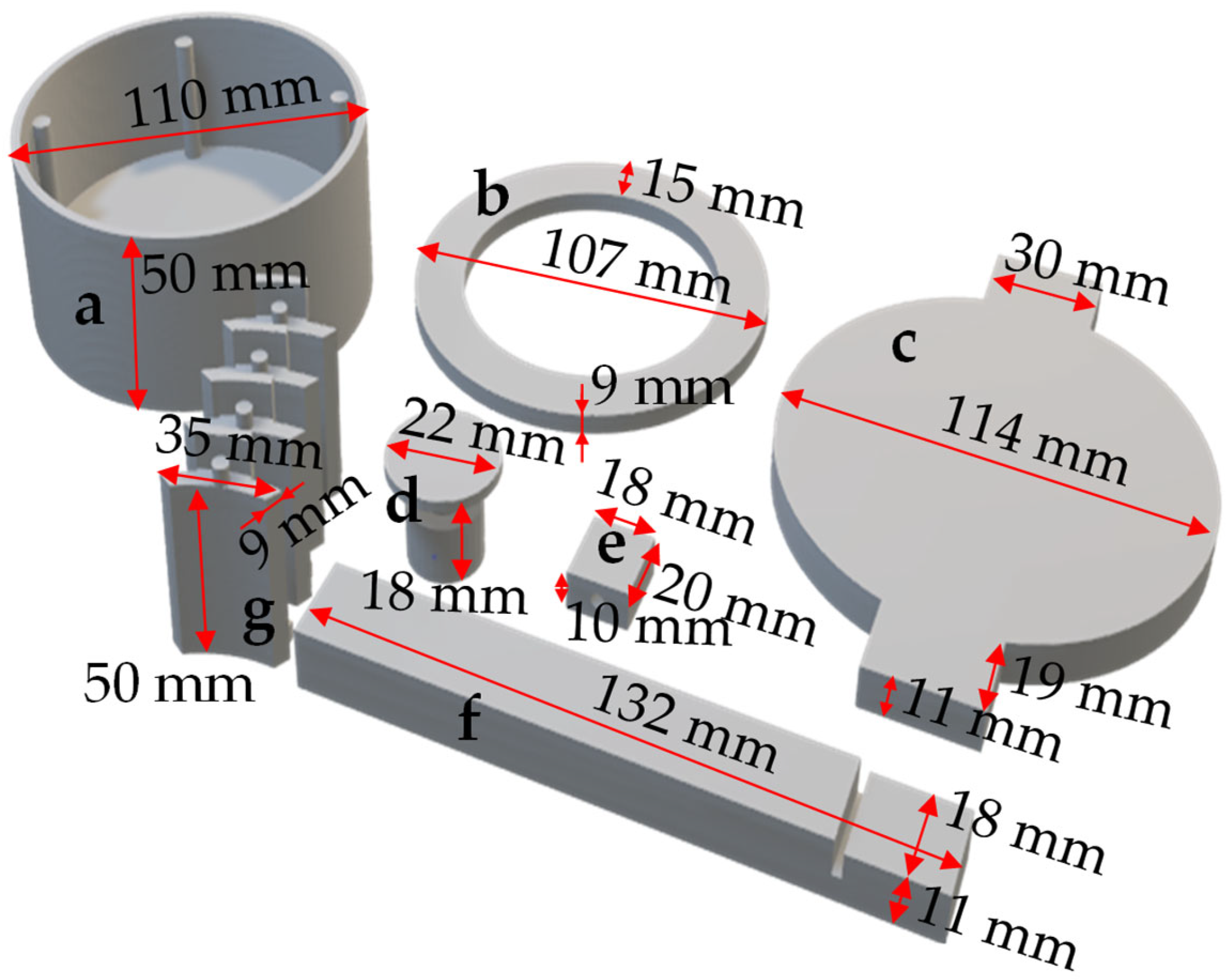
The SPE system mounter for the amphibious drone was developed using a 3D printer (Figure 3). The procedures of the prototype construction were detailed earlier [24].
To ensure the floating stability of the amphibious drone with the SPE system payload, a PET-bottle float (940 mL) was attached below each arm of the drone [24]. The upper mounter was placed on the GNSS antenna of the drone. Further information regarding the upper mount and its influence on GNSS positioning accuracy was reported earlier [24].

2.3. Integration of Power, Electronics, and Control

The actuator was controlled by an open-source one-board microcomputer (Arduino UNO R3; Arduino Holding, Somerville, MA, USA) and an IO expansion shield for Arduino UNO ver. 7.1 (Zhiwei Robotics Corp., Shanghai, China), where ‘shield’ means a stackable electronics board on Arduino series computers [24]. The radio-controlled (RC) servo motor in the actuator was controlled using pulse width modulation (PWM) commands from the Arduino UNO Revision 3. The actuator’s piston tip position was regulated by the writeMsd command in the Arduino Integrated Development Environment (IDE). The spatial resolution was approximately 0.05 mm by 1 ms output from the PWM port. The maximum output current from the 5V-pin of an Arduino Uno Revision 3 board was 800 mA. The stall current of the actuator was 650 mA. Output current from the digital port of the original Arduino UNO Revision 3 board was limited to 40 mA, but the digital port of the IO expansion shield had the ability to draw current from the external power supply on this shield.
The SPE system power source was a fully charged nickel–metal hydride (Ni-MH) battery set (six cells of a serially connected AA-type battery, Eneloop™ BK-3MCC; Panasonic Corp., Tokyo, Japan) [24], which fulfilled the range of input voltage for the IO expansion shield and the Arduino UNO ver. 7.1 (7–12 V). A fully charged lead battery was not compatible with the IO expansion shield because of the exceedingly high voltage. A set of six Ni-MH batteries of another brand may provide insufficient voltage for Arduino UNO Revision 3 boards if the battery’s voltage for Arduino UNO Revision 3 boards and discharging property are not confirmed. The SPE water sampling was triggered by a waterproof capacitance moisture sensor (Gravity SEN0308; Zhiwei Robotics Corp., China) connected to an analog port of the IO expansion shield. The threshold value of the capacitance sensor in issuing the trigger was adjusted to detect a water landing of the amphibious drone.

2.4. Sampling and Filtration Protocol

2.4.1. Aspiration Test of the In-Situ Solid Phase Extraction System in the Laboratory

A laboratory aspiration test was conducted using actual SPE cartridges and real water samples to confirm the capabilities of the vacuum-mode SPE system. For each test, the volume of the collected water sample was measured after 30 s of filtration through an SPE cartridge. Overestimation by excluding the prefiltration time (duration between the start of aspiration by plunger retraction and the filtered water collection in the syringe) was adjusted by testing without the SPE cartridges. Ultrapure water and real water samples from Lake Hachiro (Akita, Japan) were used for testing. The suspended solids (SS) for the Lake Hachiro samples were 21 mg/L. The test was conducted using SPE cartridges with and without pre-conditioning.

2.4.2. Recovery Test of the In-Situ SPE System for Drones

To verify the in-situ SPE system, recovery testing was performed using ultra-pure water samples containing target analytes. Ultra-pure water samples were prepared with concentrations of 10 ng L−1 of each of the target analytes. Pre-conditioned SPE cartridges were used with the in-situ SPE system. Water samples were then applied to the SPE cartridge (n = 4). A sample of approximately 25 mL was applied to a pre-conditioned SPE cartridge using the in-situ SPE system at a flow rate of approximately 10 mL min−1, as described in an earlier report [25]. The loading sample volume to each SPE cartridge was confirmed using a graduated cylinder. The subsequent analytical procedures were the same as those described in Section 2.5.

2.4.3. Field Sampling of the In-Situ SPE System for Drones

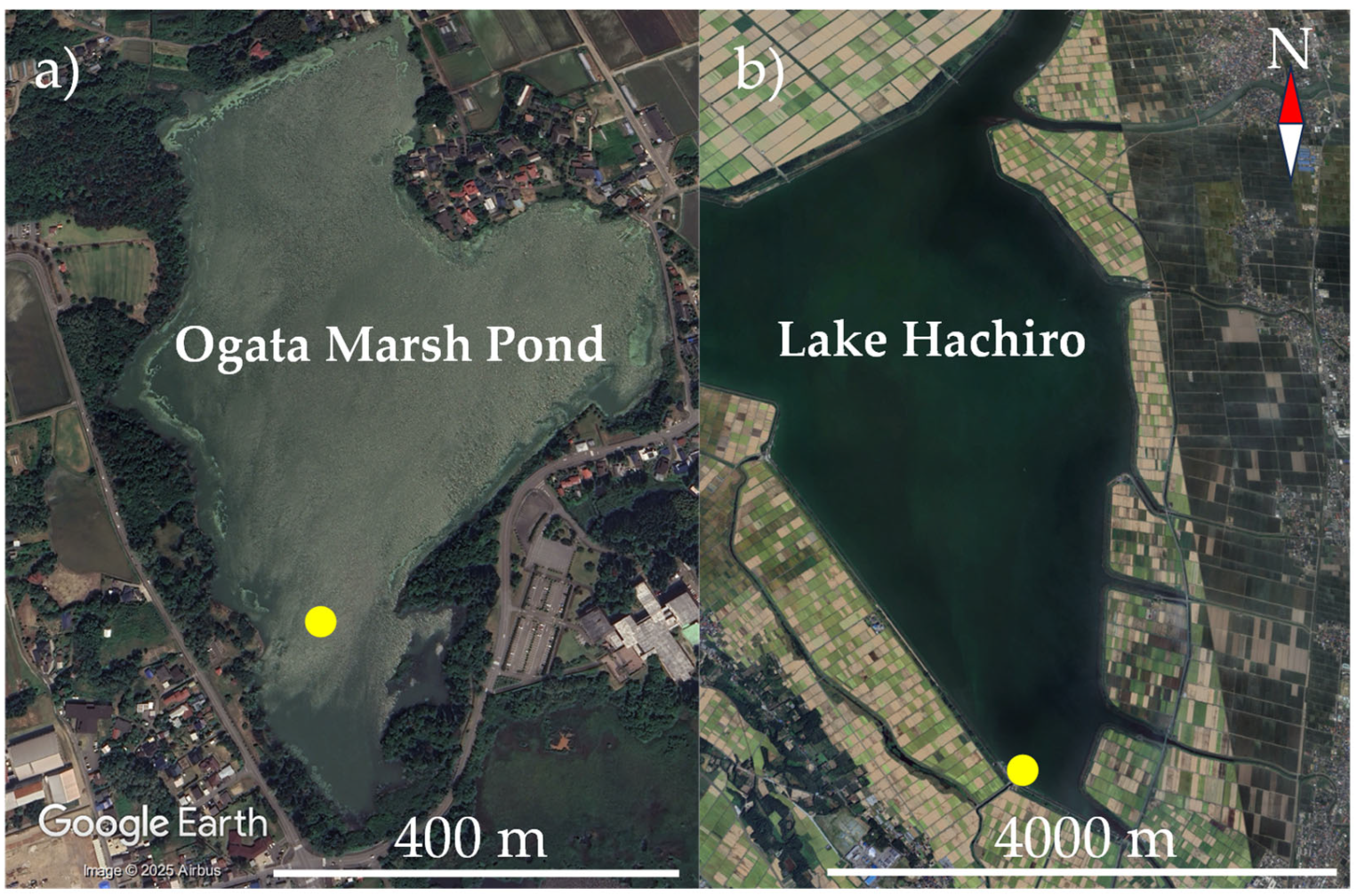
To verify the in-situ SPE system with the amphibious drone for real sampling, field sampling was conducted for Ogata Pond and for Lake Hachiro, Akita, Japan (Figure 4). Most of the lake is impoldered. Agricultural drainage water is discharged into the rest of the lake. Surface streams between the marsh pond and the surrounding farmlands were recognized only slightly on the satellite image, but shallow groundwater from farmlands might exert some effect on the marsh pond water quality. These field samples were conducted on 13 October 2023 and 16 October 2023. Manual in-situ SPE was performed with a sampling syringe using a portable inflatable rowing boat for comparison with the in-situ SPE using the drone-assisted system. The flow rate setting for the vacuum-type SPE system was 10 mL min−1, as in an earlier study [25], but the actual flow rate was confirmed by measuring the volumes of real sample water loaded after each sampling. The loading sample volume to the SPE cartridge was set as approximately 25 mL because that was the maximum volume of the plastic syringe (50 mL) minus the void volume of the syringe before retracting the plunger (25 mL). Two repetitions of sampling with one SPE cartridge were assumed for 50 mL of water sampled with one SPE cartridge. Additionally, composite grab samples (samples stepwisely combined to represent the filtered water sample through an SPE cartridge in each attempt of aspiration) were collected from the boat to analyze the basic water quality indicators (pH, electrical conductivity, suspended solids concentration) of the samples.

2.5. Analytical Chemistry Procedures

2.5.1. Reagents and Standard Solutions

Methanol, acetone, hexane, and acetonitrile used for cartridge pre-washing (pre-conditioning) and for sampling extraction procedures were purchased from Fujifilm Wako Pure Chemical Corp., Osaka, Japan (Residual pesticide and PCB grade, Liquid Chromatography/Mass Spectrometry grade).
We selected neonicotinoid and related insecticides as target analytes (Table 2). The neonicotinoid pesticide standard mixture (20 μg mL−1) and the pesticide neat standards of flonicamid, ethiprole, and fipronil were purchased from Fujifilm Wako Pure Chemical Corp. Deuterium-labeled neonicotinoid pesticide standard mixture (10 μg mL−1, PL Pesticides surrogate mix VII) was purchased from Hayashi Pure Chemical Ind., Ltd., Osaka, Japan. In addition, the deuterium-labeled injection internal neat standards of acephate-d6, theophylline-d6, and 4-CPA-d6 were purchased from Hayashi Pure Chemical Ind., Ltd., Japan.
Native stock solutions from neat standards were diluted with methanol. After native stock and standard mixture solutions were mixed, the mixed native standard solutions were prepared in methanol at appropriate concentrations. Deuterium-internal standard solutions (labeled cleanup and labeled injection internal standards) were diluted with methanol and prepared at appropriate concentrations. Then ultra-pure water was prepared (AriumTM 611UV; Sartorius Japan K.K., Tokyo, Japan).

2.5.2. SPE Cartridges

A hydrophilic–lipophilic balanced (HLB) SPE cartridge (OasisTM HLB plus short; Nihon Waters K.K., Tokyo, Japan) was used for sample extraction [25]. The SPE cartridge was pre-conditioned repeatedly with 5 mL methanol, followed by loading with 5 mL ultra-pure water twice before in-situ SPE extraction. For sample clean-up processing, C18 and PSA cartridges (InertSepTM) were purchased from GL Sciences, Inc., Tokyo, Japan. The SPE cartridges were pre-washed, respectively, with 5 mL of an acetone-hexane mixture (1 + 1) and with 5 mL of acetonitrile before cleanup processing. Cartridge elution was performed using an SPE vacuum manifold system (GL Sciences Inc., Japan).

2.5.3. Analytical Procedures

Sample preparation procedures for target analytes were performed in the following manner, based on an earlier study [25]. After loading the SPE cartridge with sample water, the residual water in the cartridge was removed by centrifugation at 3500 rpm (2330× g) for 10 min. The cartridge was dried further by vacuuming using a vacuum manifold system. After the SPE cartridge was eluted twice with 5 mL of methanol, the eluate was collected in a 10 mL pear-shaped flask. The labeled cleanup internal standard was added to the eluate. Then the solution was concentrated using a rotary evaporator at 35 °C, followed by pure N2-gas blowing. It was allowed to stand at ca. 0.5 mL. A clean-up process was performed with C18 and PSA cartridges connected in series. The elution was performed with 5 mL of acetonitrile; then it was repeated with 5 mL of an acetone–hexane mixture (1 + 1). After the eluates were collected in a 10 mL pear-shaped flask, they were concentrated as described above. The eluate was redissolved with 90 μL of methanol. Then, 10 μL of labeled injection internal standard in 0.5 mg L−1 and 100 μL of ultra-pure water were added to the solution. Additional related information was presented in an earlier report [25].
From each sample solution, 5 μL was injected into a liquid chromatograph-tandem mass spectrometer (LC-MS/MS, 1260 Infinity IITM LC; Agilent Technologies Japan, Ltd., Tokyo, Japan) connected to an UltivoTM triple quadruple LC/MS system. Target analytes were separated using a C18 Column (3-μm average particle size of immobile phase, 2.1-mm internal column diameter, 150-mm column length, InertSustainTM, HP; GL Sciences Inc.) and were subjected to electro-spraying ionization (ESI). The second product ions for the tandem mass spectrometry were detected using multiple reaction monitoring (MRM) for both polarities. The oven temperature for the LC column was set to 40 °C (313 K). Liquid chromatography was conducted in the gradient mode at a 0.3 mL min−1 flow rate with mobile phases of (A) water: methanol (90:10) and (B) methanol: water (90:10). Ammonium acetate was applied to both eluents (5 mM final concentration). The initial volumetric ratio of (A) for the mobile phase was 90%; it was reduced afterward. The mixture ratio of (A) for the mobile phase was reduced from 90% to 40% during the first 3 min of elution. Subsequently, it was reduced to 20% in another 7 min. After the ratio was finally reduced to 5% in another 2 min, it was maintained for an additional 3 min. Finally, the column was re-equilibrated under the initial conditions for another 6 min. The MS source conditions were the following: nebulizer pressure, dry gas, and sheath gas set respectively as 50 psi (345 kPa), 10.0 L min−1 at 250 °C (523 K), and 11.0 L min−1 at 300 °C (573 K); capillary voltage set as 3 kV for the positive mode and −3 kV for the negative mode. The dynamic MRM mode was adopted to monitor product ion transitions, the transitions of native analytes monitored in positive mode were m/z 203 → m/z 129 for dinotefuran, m/z 256 → m/z 209 for imidacloprid, m/z 271 → m/z 126 for nitenpyram, m/z 223 → m/z 126 for acetamiprid, m/z 253 → m/z 126 for thiacloprid, m/z 292 → m/z 211 for thiamethoxam, and m/z 271 → m/z 126 for thiacloprid-amide. Those in negative mode were m/z 248 → m/z 165 for clothianidin, m/z 228 → m/z 228 for flonicamid, m/z 395 → m/z 331 for ethiprole, and m/z 435 → m/z 330 for fipronil. The transitions of labeled analytes monitored in positive mode were m/z 206 → m/z 132 for dinotefuran-d3, m/z 260 → m/z 213 for imidacloprid-d4, m/z 274 → m/z 228 for nitenpyram-d3, m/z 226 → m/z 126 for acetamiprid-d3, m/z 257 → m/z 126 for thiacloprid-d4, m/z 190 → m/z 149 for acephate-d6, and m/z 187 → m/z 127 for theophylline-d6. Those in negative mode were m/z 295 → m/z 214 for thiamethoxam-d3, m/z 251 → m/z 58 for clothianidin-d3, and m/z 191 → m/z 131 for 4-CPA-d6.

2.6. Legal Procedures for Field Tests

Possible legal restrictions and registration procedures for drone flights might be a salient concern for this type of application. We strove to minimize such administrative burdens by optimizing the system design for water-quality monitoring.
Details were provided in our previous report [24].

3. Results

3.1. Aspiration Testing of the in Situ Solid Phase Extraction System in the Laboratory

Table 1 presents the results of laboratory aspiration testing of the in-situ SPE system for drones. The average loaded volumes of ultrapure water without the SPE cartridge and a real sample (Lake Hachiro water) were, respectively, constant at 5.0 and 4.9 mL. The average loaded volume for the ultrapure water was 1.2 mL. For the real sample, the volume was 1.3 mL (Table 1).

3.2. Recovery Testing of the In-Situ Solid Phase Extraction System

Recovery testing with target analytes demonstrated >85% recovery (Table 2). The highest relative standard deviation was less than 10% (Table 2).

3.3. Field Sampling Using the Developed In-Situ SPE System

The developed in-situ SPE system was able to collect real samples during field sampling (Figure 4). The efficiency of water samples loaded onto each SPE cartridge varied among sampling sites (Table 3). The concentration of suspended solids did not correspond to the decrease in the efficiency of sample loading volumes (Table 3, Table 4). To increase the volume of loaded water samples through each SPE cartridge, the sampling procedure was repeated up to two to three times for the same cartridge until a sufficient loading volume had been collected. The sampling duration was extended (Table 3) to collect sufficient volumes for LC-MS/MS detection. Table 4 shows the basic water quality indicators of composite grab samples by boat sampling. The suspended solid concentrations in the samples were 12–28 mg L−1 (Table 4), exceeding the water quality standards in Japan (5 mg L−1) [26]. The pH values of the water samples were approximately neutral (Table 4). The electrical conductivity values of the Lake Hachiro samples were slightly higher than those of samples from Ogata Pond (Table 4).
The target analyte concentrations of the real samples are presented in Table 5. Dinotefuran, imidacloprid, thiamethoxam, clothianidin, and ethiprole were detected in both samples (Table 5). The highest concentration was found for dinotefuran from both samples (Table 5), irrespective of the surface influent from rivers connected to the closed water bodies (Figure 4). For most of the detected compounds, the concentration values from the drone-assisted SPE system and the manual SPE using boat sampling were almost identical, at 10 ng L−1 (Table 5). The results of the relative percent difference (RPD) of detected target analytes were less than 30% [27], except for imidacloprid in HD-2/HB-2 and clothianidin in OD-1/OB-1 (Table 6). Additionally, Welch’s t-test revealed no significant differences between pesticides detected by drone and those detected by boat sampling (p = 0.955, α = 0.05). ND in Table 5 was excluded.

4. Discussion

4.1. Mechanical and Electrical Constraints in Vacuum-Mode SPE Sampling

The developed SPE water sampling system functioned properly in contaminated fields using the vacuum-mode sample application to the SPE cartridge. If the maximum force generated by a completely clogged cartridge can be estimated by the ratio of initial and final enclosed volume in the syringe and the inner cross-sectional area, then (1−25 (mL)/50 (mL)) × 101325 (Pa) × 0.00062 (m2) = 31.4 (N) is given for the system. The maximum force generated during the vacuum-mode operation is below the limit of lifted force at the maximum current for the linear actuator (200 N, 400 mA [23]). The required electrical current for the linear actuator is approximately 120 mA for the 31.4-N of pulling force used for the lifted state [23]. The limit of the direct draw of current from a 5-V pin of the Arduino Uno R3 board is 40 mA, but the IO expansion shield was able to supply the current (up to 800 mA) necessary for SPE extraction. For a more turbid water sample, the initial enclosed volume in the syringe can be reduced within the ranges of maximum force and current allowed for the system. Further extension for severely turbid samples should be conducted in positive-pressure mode using motor drivers, after confirmation of the mechanical strength of the cartridge or syringe and the sealing force of the plunger gaskets.

4.2. Laboratory Validation and Field Performance of the SPE Sampling System

Laboratory confirmation of the aspiration time for the SPE system has demonstrated the necessity of preconditioning the SPE cartridges (Table 1). The concentration of suspended solids for this study suggests that they did not affect the decrease in the efficiency of sample loading volumes (Table 1). Although the sampling duration required for suction-based collection (5–10 min; Table 3) was regarded as a shortcoming of the vacuum mode, this time frame was set conservatively to account for potential delays in field extraction. In practice, even samples with high suspended solid concentration were typically extracted within approximately 3–4 min after water landing. In contrast, grab sampling generally required only about 1–2 min per sample, even when estimated generously. As presented in Table 5, these differences in sampling duration appear to have only a minimal effect on the measured concentrations, except in cases where the values were close to not detected (ND).
Satisfactory recoveries and their %RSD of target analytes in the recovery test for the developed SPE system (Table 2) show no limitation of the present system for in-situ SPE sampling. Based on the target analyte properties, fipronil has distinctive hydrophobicity among the analytes [25]. The octanol–water partition coefficient of fipronil is 4.0 [25]. The extreme hydrophobicity of fipronil might be considered in a clean-up process for concomitant removal with matrix substances. In addition, metabolites of nitenpyram (CPMF, CPMA, and CPF) in an earlier study [25] were excluded from the target analytes. Highly polar properties and pH stability might affect recoveries in water samples [28]. Possible measures to improve recovery include sample pH adjustment with hydrochloric acid before extractions.
The analyte concentration results show water contamination with dinotefuran in both test fields (Table 5). The marsh pond was not connected to influent rivers (Figure 4). Therefore, shallow subsurface drainage from the surrounding agricultural fields might affect the water quality somewhat. The high suspended solid concentrations of these water samples (12–28 mg L1, Table 4) also reflect eutrophication of these closed water bodies.
The RPD results demonstrate the satisfactory accuracy of the SPE system for collecting drone-assisted samples in the field [27]. The analytical values, including preservation, storage, and laboratory procedures, show results equivalent to those obtained from grab sampling (Table 6). However, assuming ND = 0 might engender underestimation of the true variability and potential misinterpretation of RPD values. This assumption should be acknowledged explicitly because it constrains the accuracy and reliability of RPD as a precision metric, particularly at low concentration ranges, by neglecting possible systematic errors and instrument-specific biases.

4.3. Operational Challenges and Risk Mitigation for Drone-Based SPE Sampling

Although our proposed drone-based in-situ SPE system shows great promise, it must address several operational constraints and associated risks for practical implementation.
Battery life limitations and GNSS cold-start delays: the flight duration of drones is inherently limited by battery capacity, posing challenges for long-range monitoring and large-scale surveys. Additionally, the waiting time for the GNSS cold-start after each battery refill was also not negligible for flight tests, which can be expected to affect the efficiency of water quality monitoring with amphibious drones [24]. Implementing multi-drone relay operations can help extend the operational time.
Adverse weather conditions and flight stability: Adverse weather conditions, including strong winds, precipitation, and low temperatures, pose difficult challenges to flight stability and sampling accuracy. The flight controller of the base drone (SplashDroneTM4) was unable to compensate adequately for the additional aerodynamic forces induced by gusts acting on the large floats [24]. To address these limitations, potential enhancements include reducing the float size to improve aerodynamic stability, refining the tuning of the inertial measurement unit and proportional–integral–derivative (PID) controller, and increasing the antenna elevation angle to optimize GNSS signal reception [24]. Implementing these measures is expected to enhance the system’s robustness and operational reliability under real-world water monitoring conditions.
Drone damage risk: Using drones for water quality sampling has many benefits, including increased accessibility, efficiency, and safety. However, the risk of drone damage during sampling remains a major challenge that can compromise data integrity and which can increase operational costs. Flights near water bodies at low altitudes expose drones to obstacles such as trees, power lines, and infrastructure. Additionally, GPS signal degradation and wind gusts increase the risk of collision. Contact with water during sampling poses a severe threat to onboard electronics. Additionally, depending on a single drone and sampling system increases the risk of losing all data in the event of a malfunction. To mitigate these risks, the base drone should incorporate obstacle avoidance systems within payload limits (max. 2 kg) [14] and should implement real-time collision detection. Protective housings with shock-absorbing frames and waterproof cases can safeguard critical components. Additionally, the use of multiple sampling systems [29] reduces the likelihood of losing samples as a result of equipment failure.
Contamination risks from repeated flights: Repeated drone flights can unintentionally disturb or contaminate surface waters, introducing physical and chemical artifacts that compromise sample integrity. Furthermore, SPE cartridges are susceptible to contamination during and after drone operation, especially in field environments with fluctuating humidity and suspended particles. Therefore, optimizing the flight frequency, altitude, and sampling protocols is crucial to minimize environmental disturbances and analytical bias [30].
Drone endurance vs. SPE extraction time: A key concern is the potential conflict between drone flight endurance and the long duration necessary for SPE at low flow rates. This operational constraint limits the feasibility of drone-assisted sampling in remote or hazardous environments considerably. Two main strategies have been proposed to mitigate this limitation: (1) enabling the drone to operate in a floating or stationary mode during sample collection, and (2) optimizing the sample collection protocol to shorten enrichment times without compromising analytical performance. Furthermore, increasing the energy autonomy of drone platforms offers a promising means for extending mission times. Within the payload limits of the SplashDroneTM 4 (max. 2 kg) [14], potential solutions for our proposed system include integrating lightweight solar-powered modules into the sample collection system or employing hybrid power architectures that combine high-capacity batteries with solar-powered charging mechanisms [31]. These approaches aim to improve energy efficiency, operational resilience, and overall system sustainability.

5. Conclusions

For this study, we developed and validated a drone-based in-situ SPE water sampling system for environmental monitoring in hard-to-access aquatic environments. The system operated adequately in vacuum mode, maintaining mechanical and electrical parameters within safe limits. Laboratory tests confirmed the necessity of SPE cartridge pretreatment and showed that suspended solids within the tested range did not significantly affect sample loading efficiency. Field trials demonstrated analyte recovery and accuracy comparable to that of conventional grab sampling, confirming the feasibility of drone-assisted SPE for field applications.
However, several operational limitations were identified, including limited battery life, GNSS cold-start delays, weather sensitivity, and prolonged sampling time in vacuum mode. Future improvements should prioritize positive-pressure operation, weather-resistant platform design, and automation strategies to enhance robustness and scalability. Expanding the analyte range through diverse sorbents will further improve analytical performance. Overall, the proposed system offers a promising solution for rapid, minimally invasive water quality monitoring, enabling efficient sampling in remote and sensitive environments and supporting the integration of UAV-based technologies into routine environmental monitoring.

Author Contributions

Conceptualization, O.K.; methodology, O.K., H.M., T.N., S.W., M.Y., N.K. and H.O.; software, O.K., H.M.; validation, O.K., K.S., M.Y., N.K., H.O., H.M., T.N. and S.W.; formal analysis, O.K., K.S., M.Y.; investigation, O.K., K.S., M.Y., T.K., S.W., H.O., N.K., M.I., T.N. and H.M.; resources, O.K.; data curation, O.K., K.S., M.Y. and T.K.; writing—original draft preparation, O.K.; writing—review and editing, O.K., H.M., T.N. and S.W.; visualization, O.K.; supervision, O.K.; project administration, O.K.; funding acquisition, O.K. All authors have read and agreed to the published version of the manuscript.

Funding

This research was funded by an Akita Prefectural University Grant for Promotion of Academic–Industrial Collaboration (2021–2023 fiscal year).

Data Availability Statement

Data supporting the findings of this study are available from the corresponding author upon reasonable request.

Acknowledgments

We extend special appreciation to Atsushi Suetsugu for his expertise and commitment to system development. We thank Atsushi Suetsugu, Akihiro Kikuchi, and Rin Oshima for their patience and support during field tests. The field test was conducted with the permission of Koizumi Park in Akita City, Akita Prefecture, Japan.

Conflicts of Interest

Authors Kouki Saitoh, Makoto Yoshida, Nobumitsu Kurisawa and Hitoshi Osawa were employed by the company Akita Prefectural Center of Analytical Chemistry Ltd. The remaining authors declare that the research was conducted in the absence of any commercial or financial relationships that could be construed as a potential conflict of interest.

References

  1. Morin-Crini, N.; Lichtfouse, E.; Liu, G.; Balaram, V.; Ribeiro, A.R.L.; Lu, Z.; Stock, F.; Carmona, E.; Teixeira, M.R.; Picos-Corrales, L.A.; et al. Worldwide Cases of Water Pollution by Emerging Contaminants: A Review. Environ. Chem. Lett. 2022, 20, 2311–2338. [Google Scholar] [CrossRef]
  2. Ebele, A.J.; Abdallah, M.A.-E.; Harrad, S. Pharmaceuticals and Personal Care Products (PPCPs) in the Freshwater Aquatic Environment. Emerg. Contam. 2017, 3, 1–16. [Google Scholar] [CrossRef]
  3. Li, F.; Xiong, W.; Zhang, C.; Wang, D.; Zhou, C.; Li, W.; Zeng, G.; Song, B.; Zeng, Z. Neonicotinoid Insecticides in Non-target Organisms: Occurrence, Exposure, Toxicity, and Human Health risks. J. Environ. Manag. 2025, 383, 125432–125448. [Google Scholar] [CrossRef]
  4. Liao, L.; Sun, T.; Gao, Z.; Lin, J.; Gao, M.; Li, A.; Gao, T.; Gao, Z. Neonicotinoids as Emerging Contaminants in China’s Environment: A Review of Current Data. Environ. Sci. Pollut. Res. 2024, 31, 51098–51113. [Google Scholar] [CrossRef]
  5. Li, X.; Shen, X.; Jiang, W.; Xi, Y.; Li, S. Comprehensive Review of Emerging Contaminants: Detection Technologies, Environmental Impact, and Management Strategies. Ecotoxicol. Environ. Saf. 2024, 278, 116420–1006438. [Google Scholar] [CrossRef] [PubMed]
  6. United States Environmental Protection Agency. Aquatic Life Benchmarks and Ecological Risk Assessments for Registered Pesticides; Fipronil Imidacloprid Deltamethrin; United States Environmental Protection Agency: Washington, DC, USA, 2023. Available online: https://www.epa.gov/pesticide-science-and-assessing-pesticide-risks/aquatic-life-benchmarks-and-ecological-risk (accessed on 13 February 2025).
  7. Song, K.; Brewer, A.; Ahmadian, S.; Shankar, A.; Detweiler, C.; Burgin, A.J. Using Unmanned Aerial Vehicles to Sample Aquatic Ecosystems. Limnol. Oceanogr. Methods 2017, 15, 1021–1030. [Google Scholar] [CrossRef]
  8. Koparan, C.; Koc, A.B.; Privette, C.V.; Sawyer, C.B.; Sharp, J.L. Evaluation of a UAV-Assisted Autonomous Water Sampling. Water 2018, 10, 655. [Google Scholar] [CrossRef]
  9. Faraji, A.; Haas-Stapleton, E.; Sorensen, B.; Schol, M.; Goodman, G.; Buettner, J.; Schon, S.; Lefkow, N.; Lewis, C.; Fritz, B.; et al. Toys or Tools? Utilization of Unmanned Aerial Systems in Mosquito and Vector Control Programs. J. Econ. Entomol. 2021, 114, 1896–1909. [Google Scholar] [CrossRef]
  10. Swellpro Technology Co., Ltd. SplashDrone 4 WQMS (Water Quality Monitoring System) User Manual, version 2.3; Swellpro Technology Co., Ltd.: Shenzhen, Guangdong, China, 2022; pp. 6–7. Available online: https://www.manualslib.com/download/2610672/Swellpro-Splashdrone-4.html (accessed on 22 June 2025).
  11. Spreng, J. Expanded Development of Consumer-Level Unmanned Aerial Vehicles for Oceanographic Research. Bachelor’s Thesis, University of Washington, Seattle, WA, USA, 2 June 2019. Available online: https://digital.lib.washington.edu/server/api/core/bitstreams/b1888a8e-230c-4202-abf8-4291cfd847e3/content (accessed on 22 June 2025).
  12. Grandy, J.J.; Galpin, V.; Singh, V.; Pawliszyn, J. Development of a Drone-Based Thin-Film Solid-Phase Microextraction Water Sampler to Facilitate on-Site Screening of Environmental Pollutants. Anal. Chem. 2020, 92, 12917–12924. [Google Scholar] [CrossRef]
  13. Roll, I.B.; Halden, R.U. Critical review of factors governing data quality of integrative samplers employed in environmental water monitoring. Water Res. 2016, 94, 200–207. [Google Scholar] [CrossRef]
  14. Swellpro Technology Co., Ltd. SplashDrone 4 User Manual, version 2.3.5; Swellpro Technology Co., Ltd.: Shenzhen, China, 2022; pp. 55–56. Available online: https://www.swellpro.com/pages/downloadcenter (accessed on 22 June 2025).
  15. Thermo Fisher Scientific Inc. Connected Chromatography Solutions; Thermo Fisher Scientific Inc.: Waltham, MA, USA, 2023; 37p, Available online: https://assets.fishersci.com/TFS-Assets/CMD/Catalogs/BR-21443-Chromatography-Catalog-Sample-Prep-BR21443-EN.pdf (accessed on 22 June 2025).
  16. Turiel, E.; Martín-Esteban, A.; Bordin, G.; Rodríguez, A.R. Stability of Fluoroquinolone Antibiotics in River Water Samples and in Octadecyl Silica Solid-Phase Extraction Cartridges. Anal. Bioanal. Chem. 2004, 380, 123–128. [Google Scholar] [CrossRef]
  17. Carlson, J.C.; Challis, J.K.; Hanson, M.L.; Wong, C.S. Stability of Pharmaceuticals and Other Polar Organic Compounds Stored on Polar Organic Chemical Integrative Samplers and Solid-Phase Extraction Cartridges. Environ. Toxicol. Chem. 2013, 32, 337–344. [Google Scholar] [CrossRef]
  18. Ruiz-Jimenez, J.; Zanca, N.; Lan, H.; Jussila, M.; Hartonen, K.; Riekkola, M.-L. Aerial Drone as a Carrier for Miniaturized Air Sampling Systems. J. Chromatogr. A 2019, 1597, 202–208. [Google Scholar] [CrossRef]
  19. Lan, H.; Ruiz-Jimenez, J.; Leleev, Y.; Demaria, G.; Jussila, M.; Hartonen, K.; Riekkola, M.-L. Quantitative Analysis and Spatial and Temporal Distribution of Volatile Organic Compounds in Atmospheric Air by using Drone with Miniaturized Samplers. Chemosphere 2021, 282, 131024. [Google Scholar] [CrossRef] [PubMed]
  20. Pusfitasari, E.D.; Ruiz-Jimenez, J.; Heiskanen, I.; Jussila, M.; Hartonen, K.; Riekkola, M.-L. Aerial Drone Furnished with Miniaturized Versatile Air Sampling Systems for Selective Collection of Nitrogen Containing Compounds in Boreal Forest. Sci. Total Environ. 2022, 808, 152011. [Google Scholar] [CrossRef] [PubMed]
  21. Wolska, L.; Galer, K.; Górecki, T.; Namieśnik, J. Surface Water Preparation Procedure for Chromatographic Determination of Polycyclic Aromatic Hydrocarbons and Polychlorinated Biphenyls. Talanta 1999, 50, 985–991. [Google Scholar] [CrossRef]
  22. Dzhavadov, L.; Brazhkin, V.; Fomin, Y.D.; Ryzhov, V.; Tsiok, E. Experimental Study of Water Thermodynamics up to 1.2 GPa and 473 K. J. Chem. Phys. 2020, 152, 154501. [Google Scholar] [CrossRef]
  23. Actuonix Motion Devices Inc. Miniature Linear Motion Series · L16; Actuonix Motion Devices Inc.: Saanichton, BC, Canada, 2024; Available online: https://actuonix-com.3dcartstores.com/assets/images/datasheets/ActuonixL16Datasheet.pdf (accessed on 14 February 2024).
  24. Suetsugu, A.; Madokoro, H.; Nagayoshi, T.; Kikuchi, T.; Watanabe, S.; Inoue, M.; Yoshida, M.; Osawa, H.; Kurisawa, N.; Kiguchi, O. Development and Field Testing of a Wireless Data Relay System for Amphibious Drones. Drones 2024, 8, 38. [Google Scholar] [CrossRef]
  25. Yoshida, M.; Konno, R.; Kobayashi, T.; Nishikawa, H.; Kiguchi, O. Distribution of Systemic Insecticides and Their Metabolites in Rural River Water in Akita Prefecture. Bunseki Kagaku 2019, 68, 885–895. [Google Scholar] [CrossRef]
  26. Ministry of the Environment. Environmental Quality Standards for Water Pollution. Government of Japan. Available online: https://www.env.go.jp/content/900454947.pdf (accessed on 15 June 2025).
  27. U.S. Environmental Protection Agency. METHOD 538, Determination of Selected Organic Contaminants in Drinking Water by Direct Aqueous Injection-Liquid Chromatography/Tandem Mass Spectrometry (DAI-LC/MS/MS); ver.1.1; U.S. Environmental Protection Agency: Washington, DC, USA, 2009. [Google Scholar]
  28. Yoshida, T.; Murakawa, H.; Toda, K. Determination of nitenpyram and its metabolites in agricultural products using hydrophilic interaction liquid chromatography-tandem mass spectrometry. J. Pestic. Sci. 2013, 38, 27–32. [Google Scholar] [CrossRef]
  29. Massoum, S.F.; Feng, C.; Liu, H.H.-T. AquaFly Project: Autonomous Multi-Drone Water Sampling with a Payload Deployment and Retraction Mechanism. Unmanned Syst. 2025, 13, 943–955. [Google Scholar] [CrossRef]
  30. Kosior, M.; Przystałka, P.; Panfil, W. Adaptive Path Planning for UAV-Based Pollution Sampling. Appl. Sci. 2024, 14, 12065–12102. [Google Scholar] [CrossRef]
  31. Chu, Y.; Ho, C.; Lee, Y.; Li, B. Development of a Solar-Powered Unmanned Aerial Vehicle for Extended Flight Endurance. Drones 2021, 5, 44–63. [Google Scholar] [CrossRef]
Figure 1. Schematic illustration of the amphibious drone-assisted solid phase extraction (SPE) system for water quality monitoring. The system consists of two functional groups: (1) Sampling components, including a microcontroller (Arduino™ Uno Rev.3), a water-resistant linear actuator, a 3D-printed system mounter, a rechargeable battery (Eneloop™), and a capacitance-based water detector; and (2) the drone component, represented by the amphibious drone (SplashDrone™ 4), which enables autonomous deployment and retrieval of the SPE system.
Drones 09 00649 g001
Figure 2. Configuration of the solid-phase extraction (SPE) system with an amphibious drone (SplashDroneTM 4). The components are categorized into two functional groups. Sampling components: (a) SPE cartridge; (b) commercial syringe barrel; (c) plunger with gasket; (d) water-resistant linear actuator; (e) upper mount bracket for system controller; (f) battery housing with six rechargeable NiMH AA cells; (g) water-level detector (capacitance sensor). Drone component: (h) additional float for stabilizing the drone during waterborne operations with the SPE system payload.
Drones 09 00649 g002
Figure 3. Slicer-generated images of the mounter components for the SPE sampling system. The components are labeled as: (a) water-tight vessel; (b) inner lid; (c) lid of the water-tight vessel; (d) SPE plunger tip; (e) plunger support spacer; (f) plunger support; and (g) legs for the upper mounter.
Drones 09 00649 g003
Figure 4. Locations of solid-phase extraction sampling with an amphibious drone. Each yellow circle represents the location of the drone on the water. (a) Ogata Marsh Pond on 13 October 2023, GPS coordinates: Section No. (SN) OD1—first, N39.81735630, E140.06195310; second, N39.81720295, E140.06204570; third, N39.81736510, E140.06196230; SN OD2—first, N39.81735370, E140.06201430; second, N39.81733450, E140.06208250. (b) Lake Hachiro on 16 October 2023, GPS coordinates: SN HD1—first, N39.87910920, E140.03911990; second, N39.87917050, E140.03861140; SN HD2—first, N39.87904195, E140.03869560; second, N39.87910035, E140.03885050. SNs are the same as those in Table 3. The drone was controlled manually (GPS mode) for safety, with simultaneous grab sampling from a portable inflatable rowing boat. No post-landing adjustment of location against the water flow was conducted in this test using continuous water sampling.
Drones 09 00649 g004
Table 1. Results of laboratory aspiration tests of the in situ SPE system for drones. The volume of water filtered through each SPE cartridge was measured after 30 s from the beginning of filtration to the vacuum syringe. Values of filtered water volume are standardized for correction of pre-aspiration time between the start of plunger retraction and the liquid filtration (3.9 s on average).
SampleAttached
SPE Cartridge
Standardized Loading Volume (mL)Average ± Standard Error (mL)
Ultra-pure water
PW-1none5.0
PW-2none4.95.0 ± 0.1
PW-3none5.0
PW-4conditioned1.4
PW-5conditioned0.81.3 ± 0.4
PW-6conditioned1.6
Lake Hachiro
H-1none4.9
H-2none4.74.9 ± 0.2
H-3none5.0
H-4conditioned1.5
H-5conditioned1.01.5 ± 0.5
H-6conditioned2.0
Table 2. Percent recovery and the relative standard deviation (%RSD) of target analytes using the developed SPE system.
CompoundIonization ModeRecovery (%)RSD (%)
Dinotefuran+911.3
Imidacloprid+932.2
Nitenpyram+947.1
Acetamiprid+963.4
Thiacloprid+942.8
Thiamethoxam+941.7
Clothianidin961.9
Flonicamid992.7
Ethiprole962.5
Fipronil894.5
Thiacloprid amide+911.0
Table 3. Volumes of water samples filtered through solid phase extraction (SPE) cartridges in field tests.
Sampling SiteSample NameSection NumberFiltered Water Volume (mL)Total Filtered Water Volume (mL)Duration of Sampling (min)
Ogata PondOD11st14.5 5
2nd13.0 5
3rd9.036.55
Ogata PondOD21st16.8 8
2nd13.029.810
Lake HachiroHD11st25.8 7
2nd19.945.77
Lake HachiroHD21st25.3 7
2nd22.447.77
Table 4. Basic water quality indicators of the water samples from the field tests: O, Ogata Pond sample from grab sampling; H, Lake Hachiro sample from grab sampling. Sample names correspond to those in Table 3.
Sample NamepHElectrical Conductivity (mS m−1)Suspended Solids
(mg L−1)
OB17.111.514
OB27.111.512
HB17.426.228
HB27.125.823
Table 5. Target analyte concentrations of water samples obtained using the developed in situ SPE system. ND denotes not detectable: HD, Lake Hachiro SPE sample by drone sampling; HB, Lake Hachiro grab sample by boat sampling; OD, Ogata Pond SPE sample by drone sampling; OB, Ogata Pond SPE sample by boat sampling.
CompoundIonization Mode
(+/−)
Method Detection Limit
(ng L−1)
Concentration
(ng L−1)
HD1HD2HB1HB2OD1OD2OB1OB2
Dinotefuran+0.41.1 × 1021.6 × 1021.2 × 1021.8 × 10220181818
Imidacloprid+0.74.77.95.2111.1ND0.9ND
Nitenpyram+7.0NDNDNDNDNDNDNDND
Acetamiprid+1.0NDNDNDNDNDNDNDND
Thiacloprid+0.8NDNDNDNDNDNDNDND
Thiamethoxam+0.54.05.74.26.7NDND0.9ND
Clothianidin0.35.08.35.511ND2.72.62.0
Flonicamid0.7NDNDNDNDNDNDNDND
Ethiprole0.24.77.05.58.07.76.77.76.5
Fipronil0.8NDNDNDNDNDNDNDND
Thiacloprid- amide+0.3NDNDNDNDNDNDNDND
Table 6. Relative percent difference (RPD) of detected target analytes found from drone sampling and boat sampling. The symbol “-“ denotes no data: HD, Lake Hachiro sample by drone; HB, Lake Hachiro sample by boat; OD, drone sampling of Ogata Pond; OB, boat sampling of Ogata Pond. The “ND” is calculated as zero.
CompoundRPD (%)
HD-1/HB-1HD-2/HB-2OD-1/OB-1OD-2/OB-2
Dinotefuran8.718110
Imidacloprid103320-
Thiamethoxam4.916--
Clothianidin9.52820030
Ethiprole161303.0
Disclaimer/Publisher’s Note: The statements, opinions and data contained in all publications are solely those of the individual author(s) and contributor(s) and not of MDPI and/or the editor(s). MDPI and/or the editor(s) disclaim responsibility for any injury to people or property resulting from any ideas, methods, instructions or products referred to in the content.