1. Introduction
In recent years, unmanned aerial vehicles (UAVs) have garnered significant attention across both military and civilian sectors. These versatile devices offer innovative solutions to a variety of applications, including aerial photography, firefighting, search and rescue operations, transportation, even aerial refueling, etc. [
1,
2,
3]. Among the diverse range of UAVs, quadcopter UAVs (QUAVs) have emerged as the most popular choice due to their simplicity and convenience in executing complex tasks. As quadcopters become increasingly integrated into industrial production and daily life, there is a growing demand for enhanced control performance, such as effectively mitigating disturbances and managing actuator failures.
Several classic control strategies have been extensively explored for QUAVs, including proportional–integral–derivative (PID) control [
4] and linear quadratic regulator (LQR) control [
5]. The sliding mode control (SMC) method, known for its ease of implementation, strong robustness, and fast response, has been applied to control UAVs in the presence of external disturbances [
6]. Nonsingular fast terminal SMC has been proposed to achieve finite-time tracking and enhance system robustness [
7,
8], while a cleverly designed finite-time robust controller was introduced for uncertain time-delay systems [
9].
The backstepping algorithm is one of the most popular and effective nonlinear control methods in strict feedback systems and has been successively applied to the QUAVs in [
10,
11]. However, traditional backstepping control suffers from the “complexity explosion” problem because the repeated differentiation of virtual control laws leads to a dramatic increase in the complexity of the controller. To address this issue, command-filtered backstepping [
12] and dynamic surface control (DSC) [
13] have been proposed. To enhance the robustness of UAV control, an adaptive backstepping controller has been adopted to effectively suppress disturbances [
14,
15], and a disturbance observer has been introduced to mitigate external disturbances [
16]. To address actuator errors, Wang et al. [
17] employed an extended state observer, achieving fault-tolerant control and enabling robust trajectory tracking of UAVs within a finite time frame.
Despite these advancements, the aforementioned methods can only ensure the finite-time stability of the filter errors, meaning the convergence time is theoretically dependent on initial conditions. To eliminate this dependency, the concept of fixed-time control was recently introduced [
18]. Unlike finite-time stability, fixed-time control ensures that convergence time is bounded by a constant, regardless of initial conditions, making it an attractive feature for controller design. Studies have developed a modified nonsingular terminal sliding mode surface to achieve fixed-time control for second-order nonlinear systems and multi-agent systems [
19]. Using a similar approach, fixed-time position control for UAVs is accomplished by analyzing each channel in [
20]. To achieve fixed-time disturbance suppression, the design of a fixed-time disturbance observer (FTDO) for linear systems under measurement noise is discussed in [
21]. In [
22], a fixed-time differentiator was developed to ensure the tracking performance of hypersonic vehicles. In [
23], a nonlinear FTDO was studied to estimate target acceleration.
However, research on fixed-time disturbance rejection and motion control of UAV tracking remains insufficient. The introduction of fixed-time controllers can easily lead to severe chattering in the system, which is unacceptable in practical applications. Additionally, in fixed-time backstepping control, the derivative of the virtual control can exhibit singularities, potentially causing controller failure or even system divergence. Furthermore, the aforementioned studies on fixed-time control do not take into account the input saturation characteristics of the system, a common and critical factor in the actual control of UAVs.
To address the aforementioned issues, this paper proposes a novel nonsingular fixed-time backstepping (NFTBS) control framework based on a fixed-time disturbance observer for QUAV trajectory tracking in the presence of input saturation and actuator failure. Compared with the previous works, the designed control algorithm provides the following attractive contributions:
- (1)
Unlike some traditional backstepping controllers proposed in [
14,
15,
16], a fixed-time disturbance-observer-based NFTBS (FTDOB-NFTBS) control framework is developed, which combines the FTDO and the auxiliary variable to eliminate the adverse effects of the external disturbance, actuator failure, and input saturation. The fixed-time stability of the closed-loop system can be guaranteed.
- (2)
In contrast to previous results proposed in [
24,
25], the proposed NFTBS not only stabilizes the system within a fixed time but also guarantees a rapid optimal convergence rate both at a distance from and in close proximity to the reference trajectories.
- (3)
Unlike some earlier proposed fixed-time backstepping controllers shown in [
25,
26], the design of continuous control input signals, along with the implementation of a fixed-time tracking differentiator (TD), effectively addresses the issues of singularity, chattering, and differential explosion that are commonly encountered in fixed-time backstepping control.
The remaining sections of this article are structured as follows:
Section 2 presents preliminaries and problem formation.
Section 3 details the controller design and provides the stability analysis. Simulation results and discussions are arranged in
Section 4. Finally,
Section 5 gives conclusive statements.
Notations: In this article, denotes the diagonal matrix. ∘ represents the Hadamard product operator. , , and correspond to , , and . and indicate the 1-norm and 2-norm of a vector or variable, respectively. is the signum function. .
3. Main Result
Before further derivations, some standard assumptions, definitions, and lemmas are given as follows:
Assumption 1. The equivalent disturbances and are all bounded by some known positive constants, namely and with . The yaw angle is bounded as . To avoid singularities, the roll and pitch angles are bounded as .
Assumption 2 ([
29]).
For system (1) with input saturation, there exists an admissible control policy , with being a compact set and that can stabilize the system (1) in a fixed time. Assumption 3. The parameters m, , g, , and of system (1) are known as constants. What is more, the system states , , , and can be accurately measured without delay or noise.
Assumption 4. The accelerations of the reference trajectory are bounded, i.e.,where and are positive constants. Remark 2. Assumption 3 is a widely accepted and reasonable premise in UAV control [28,30]. The parameters m and J can be directly and easily measured. Additionally, the values for and are readily available on multi-rotor drone design websites. Furthermore, due to the negligible magnitude of and , any inaccuracies in these parameters are unlikely to significantly affect system performance. Given the limitations on the input of UAVs, the system’s acceleration cannot be infinitely large. Consequently, it is reasonable to assume, as stated in Assumption 4, that the acceleration of the reference trajectory is bounded. This assumption ensures the existence of an effective control law for achieving accurate trajectory tracking within the system.
Definition 1 ([
18]).
Consider the systemThe trajectory of system (8) is finite-time stable, if there exists a finite convergence time for all , satisfying . Definition 2 ([
18]).
The trajectory of system (8) is fixed-time stable if the system (8) is finite-time stable and the upper bound of the convergence time does not depend on . Definition 3 ([
18,
24,
31]).
The trajectory of system (8) is practically fixed-time stable if there exists an -independent settling function and a positive constant such that for all , holds. Lemma 1 ([
24,
32]).
The trajectory of the system is practically fixed-time stable for any scalar , if there exists a Lyapunov function such thatwhere α, β, p, q, and , and , the convergence time is bounded bywhere , and the residual set is given by Lemma 2 ([
33]).
For , , , there is Lemma 3 ([
34]).
For , , there is 3.1. Translational Subsystem Stability
The total disturbance including unknown disturbances and actuator failure in the translational subsystem can be defined as
. To estimate
, an FTDO is designed as
where
, and
In Equation (
12),
,
, and
, respectively, represent the estimation of
,
, and
.
,
, are positive vectors.
is a small time constant. By [
35], the following lemma holds.
Lemma 4. The estimation errors of and , respectively, denoted by and , converge to small neighborhoods of the origin and in a fixed-time if and , are chosen from setwhere is the upper bound of , i.e., there exists a time t that for all , is a positive constant. To achieve fixed-time stable tracking of the translational loop, the backstepping control approach is presented as follows:
Step 1: Define the virtual control law
for the tracking error
. Choosing the Lyapunov function candidate for
as
and differentiating
yields
where
is the virtual control law that needs to be designed and
. The virtual control law
can be selected as
where
,
and
are positive constant vectors, and
with
,
,
is a positive rational number.
To avoid the differential explosion problem caused by the derivative of
, the following fixed-time TD is designed to estimate its differentiation [
35,
36]:
where
,
,
are the parameters of the TD. According to [
35,
36], there exists a fixed-time
such that
for all
with
.
Step 2: To design the control law
, the new dynamic error
is defined as
Design the control law as
where
is the auxiliary variable, defined as follows:
where
,
.
and
are positive constant vectors.
, and
, and
,
,
.
Theorem 1. With FTDO (11), fixed-time TD (15), virtual control law (17), and saturation auxiliary variable (18) satisfying , the trajectory of the translational subsystem (5) is guaranteed to be practically fixed-time stable. 3.2. Rotational Subsystem Stability
The disturbance acted on the rotational subsystem can be defined as
. Similarly, the following FTDO is designed to estimate
where
and
In Equation (
20),
,
, and
, respectively, represent the estimation of
,
, and
.
,
, are positive vectors.
is a small time constant. Similarly to Lemma 4, the following lemma holds.
Lemma 5. The estimation errors of and , respectively denoted by and , converge to small neighborhoods of the origin, say, and , in a fixed-time if and are selected from setwhere is the upper bound of , i.e., there exists a time t that for all , with being a known small positive constant. To achieve fixed-time stable tracking of the rotational loop, the backstepping control approach is presented as follows:
Step 1: To design the virtual control law
for the tracking error
, the Lyapunov function candidate
is selected for
. The derivative of
is given by
where
is the virtual control law that needs to be designed and
. The virtual control law
can be selected as
where
,
,
are positive constant vectors, and
are the positive real numbers.
, where
,
, and
is a positive rational number.
To avoid the differential explosion problem caused by the derivative of
, similar to (
15), the TD is designed to estimate its differentiation, which can be given by
where
,
,
are the parameters of the TD. According to [
35,
36], there exists a fixed-time
such that
for all
,
.
Step 2: To design the control law
, the dynamics of
are defined as
Design the control law as
where
is the auxiliary variable, defined as follows:
where
,
.
and
are positive constant vectors.
, with
.
with
,
.
Theorem 2. With FTDO (19), fixed-time TD (23), control law (25), and saturation auxiliary variable (26), by selecting , the rotational subsystem (7) is guaranteed to be practically fixed-time stable. Similarly, choosing the Lyapunov function candidate as
. The following inequality holds for
:
where
. Then, choose another Lyapunov function candidate as
. The derivative of
with respect to time can be given by
According to Lemma 5, if
, there are
and
. Therefore, as analyzed in (
A5) and (
A7), by selecting
, the following inequality holds:
Similarly to Theorem 1, the following inequality holds:
where
,
,
,
, and
is a positive constant. According to Lemma 1, by selecting
,
,
,
, and
, the trajectory of the rotational subsystem is practically fixed-time stable and the settling time is bounded by
where
Remark 3. Note that is continuous and derivative. Compared with , , the utilization of and Lemma 2 can avoid the singularity in the differentiation of virtual controllers and while ensuring the fixed-time stability of the system.
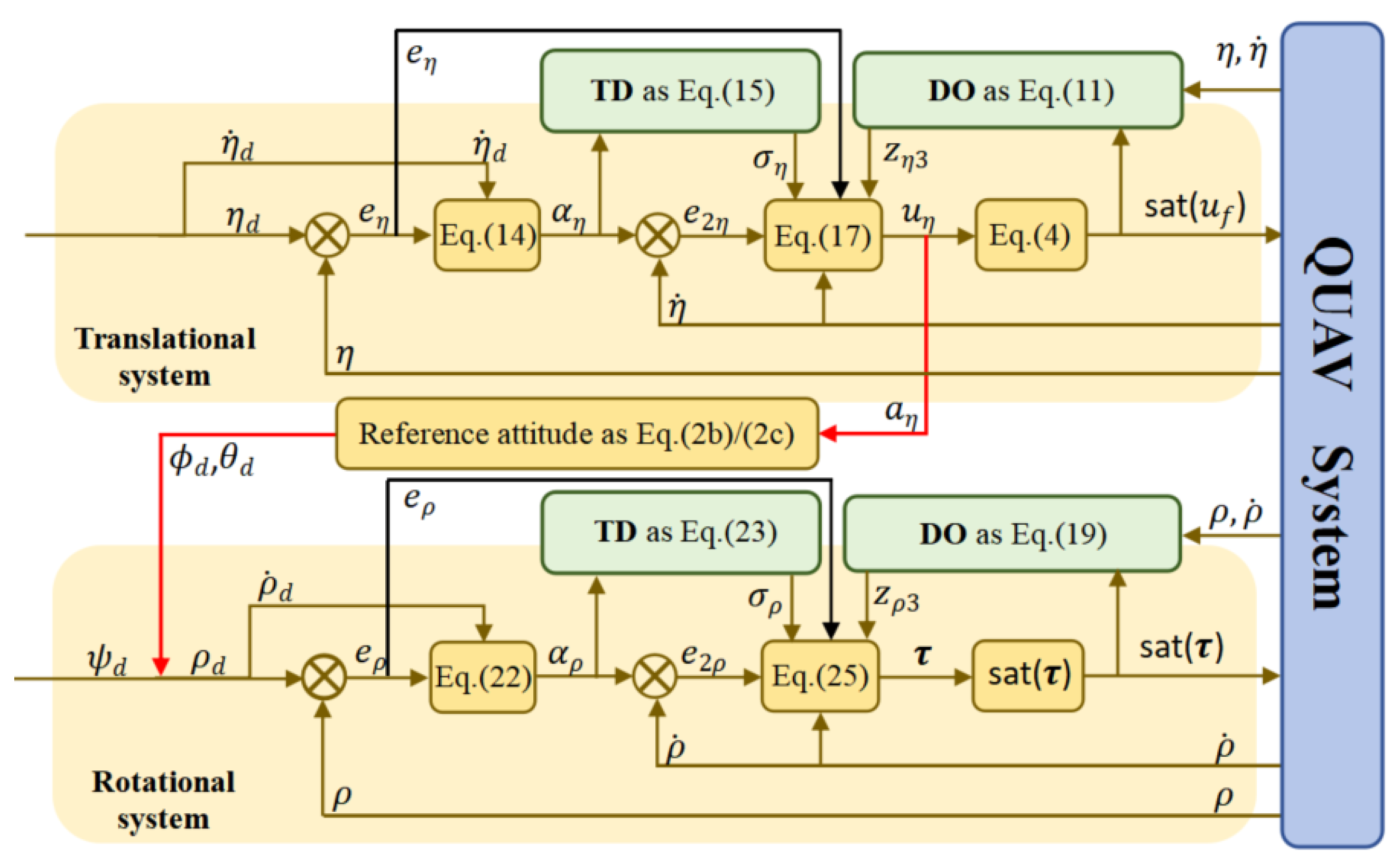
The logic block diagram based on the proposed NFTBS control system is shown in
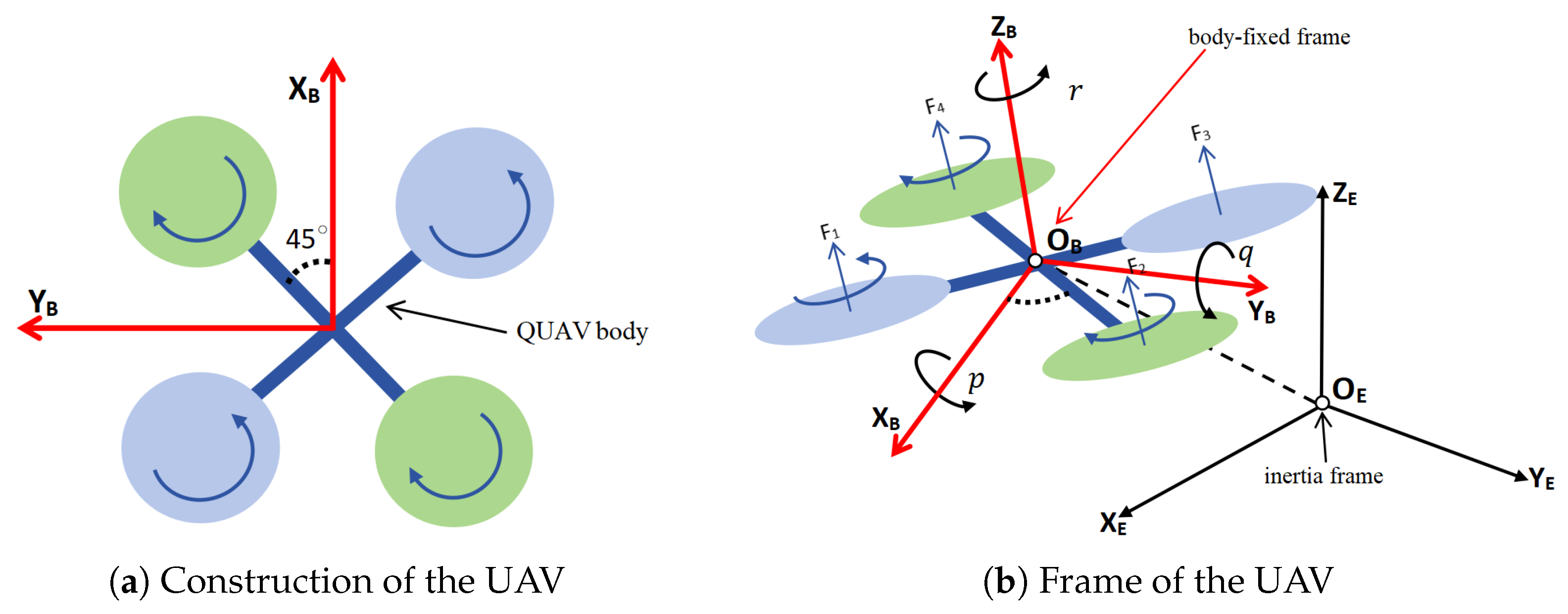
Figure 2.
4. Simulation Results
For the mathematical model of the QUAV, , and , , and and . In the simulation environment described in this article, the system state is updated using the fourth-order Runge–Kutta method to ensure the accuracy of the system model. Updates to trajectory states related to controllers, such as observers, differentiators, and controllers, are performed using the Euler method. The entire system operates with a sampling frequency of 200 Hz.
For the proposed NFTBS in the translational loop, increasing (where and ) enhances the convergence speed of the systematic error trajectories and reduces . Similar to the proportional–derivative (PD) controller, increasing improves the system’s damping and reduces the overshoot of the system trajectory. Consequently, is set to be greater than . Additionally, increasing and can reduce the system’s tracking error; however, excessively large values may cause significant chattering in the system state. The parameter selection principle for the rotational loop is similar to that of the translational loop. Moreover, to ensure the stability of the entire system, the rotational loop must converge more quickly than the translational loop. Therefore, it is crucial to set the gain of the rotational loop higher than that of the translational loop.
4.1. Robustness Verification for Different Parameters
In this subsection, the robustness of NFTBS controllers with different parameters is discussed under multiple disturbances.
According to the theoretical analysis described above, increasing and can improve the robustness of the system. Without the FTDO, four different sets of are chosen as for Case 1, for Case 2, for Case 3, and for Case 4.
As shown in
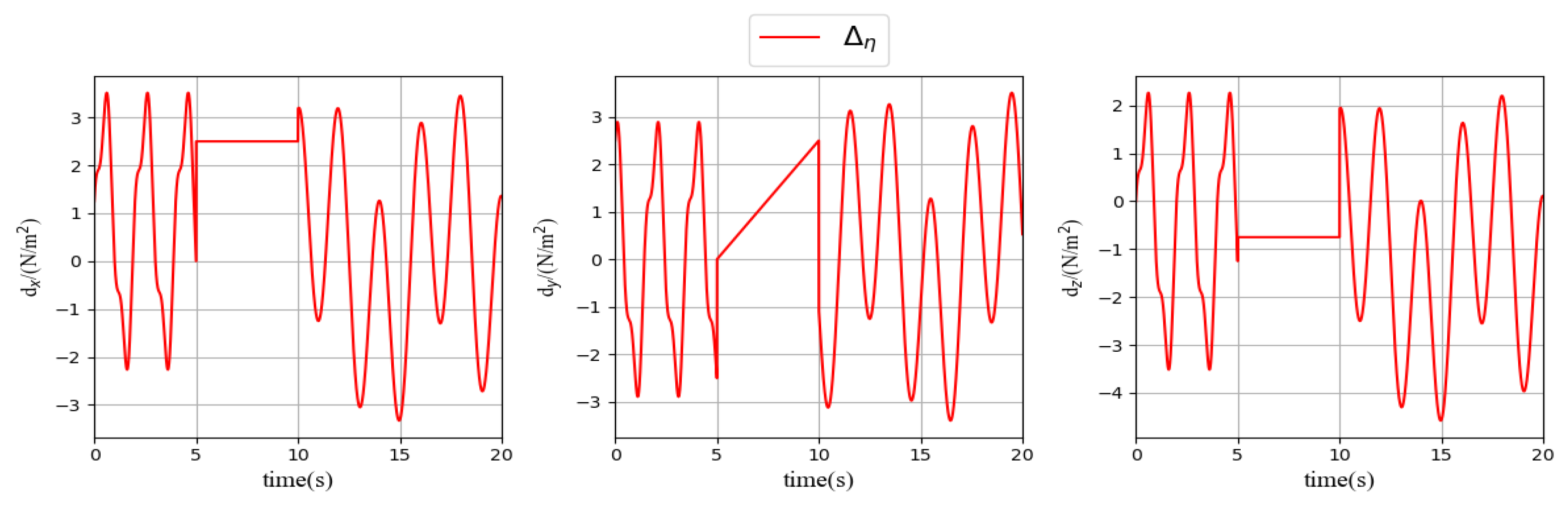
Figure 3, a variety of disturbances, including sinusoidal disturbances, constant disturbances, and linear time-varying disturbances, are added to the system to verify the robustness of the NFTBS. The bounded
and
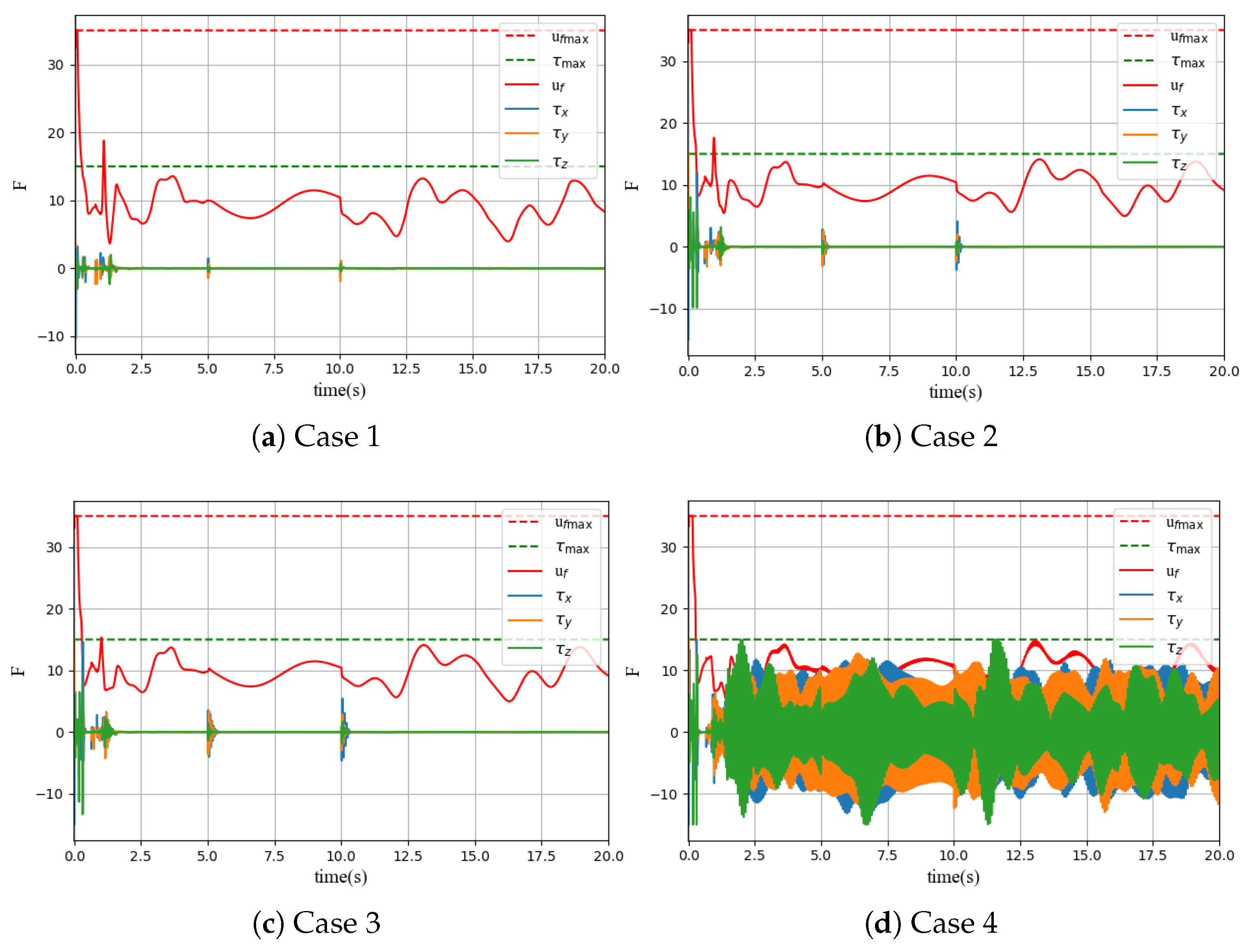
of the QUAVs are depicted in
Figure 4, and the dashed red and green lines, respectively, represent the upper bounds of
and
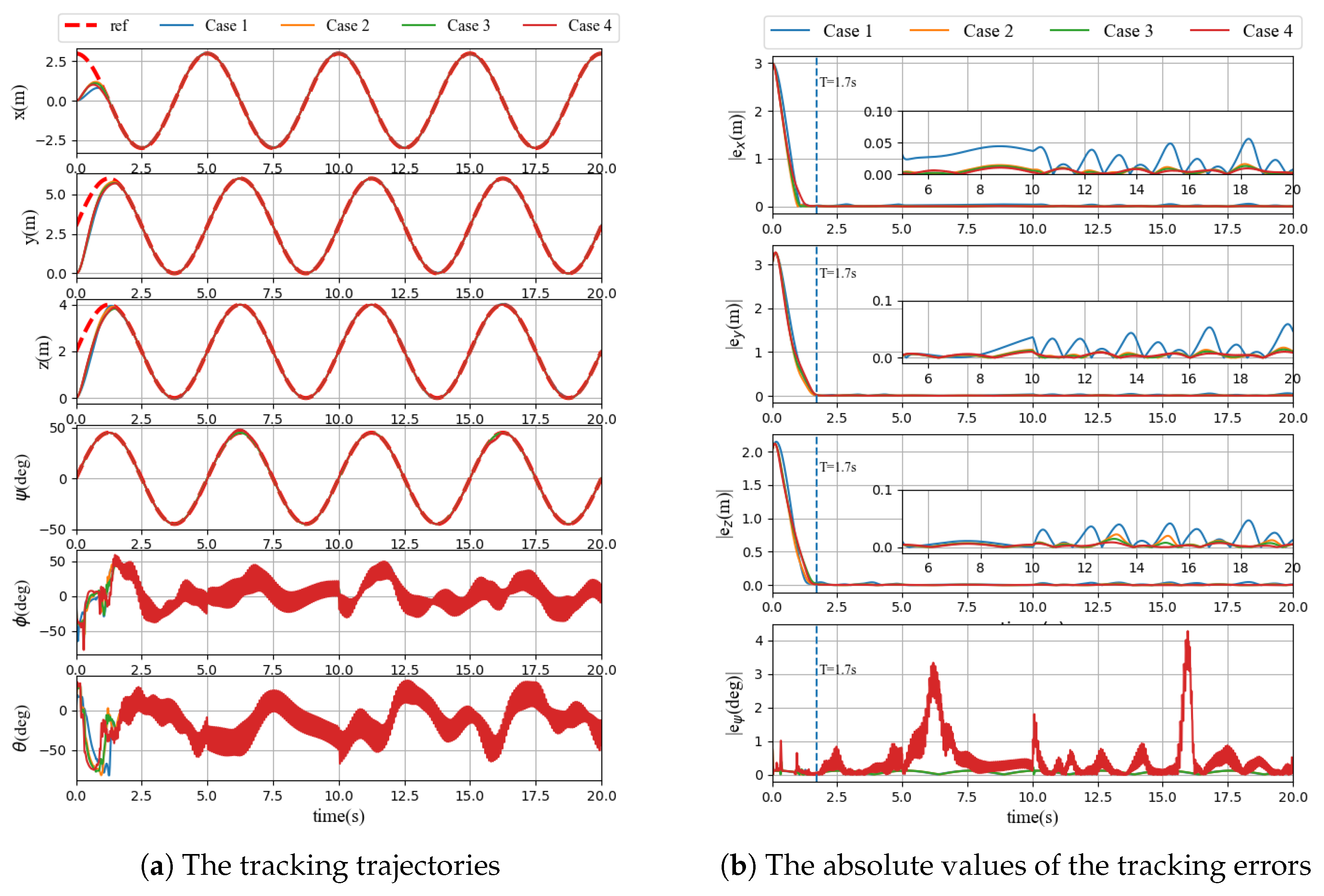
. The response curves of the system are shown in
Figure 5.
To compare the tracking errors of the system trajectories under different parameters, the average absolute errors
and
are defined as follows:
The tracking errors of the system are measured by calculating the absolute values of the system errors after 5 s. The average errors are listed in
Table 1.
Figure 5b and
Table 1 demonstrate that increasing
improves the robustness of the system and reduces position tracking error. However, if
becomes too large, it can cause significant oscillations in the input of the rotational loop, as shown in
Figure 4d, and substantially increase the tracking error of the yaw angle. Taking all factors into consideration, the parameters of the NFTBS in the following simulations are set in
Table 2.
4.2. Fixed-Time Verification for the NFTBS
In this subsection, the fixed-time characteristic of the NFTBS controllers with different initial conditions is shown.
With the same parameters for the nominal system without external disturbances and the actuator failure, set the initial positions as
for Case 1,
for Case 2,
for Case 3, and
for Case 4. The response curves of the system are shown in
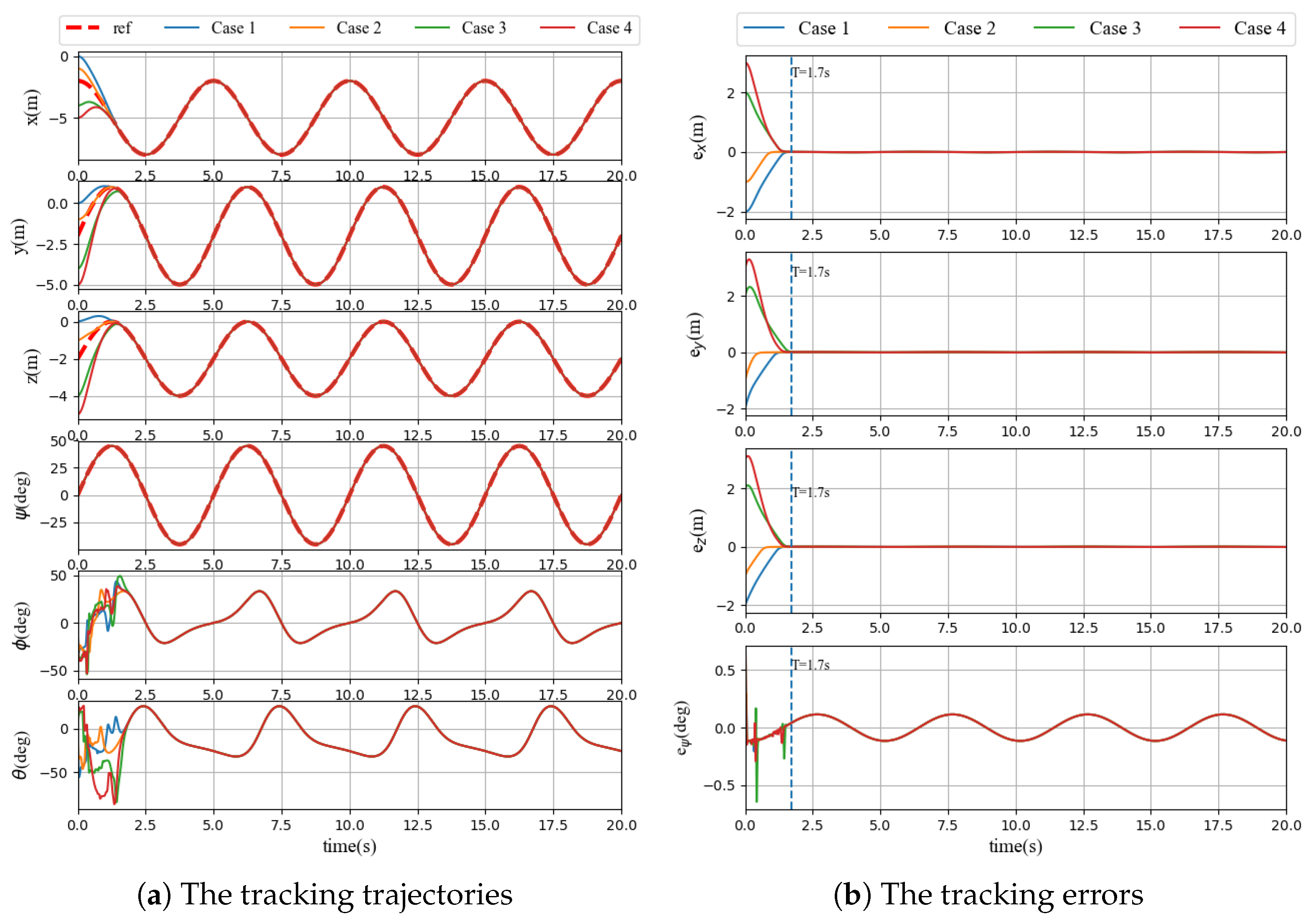
Figure 6.
By
Figure 6b, with different initial conditions, all the tracking trajectories of the system can converge in fixed time (
s). The simulation results verify that the controller proposed in this paper can ensure the fixed-time convergence of the system trajectory, without relying on the initial values.
4.3. Comparison of Different Controllers with Actuator Failure
To further highlight the performance of FTDOB-NFTBS for the QUAV system with the extra disturbance and the actuator failure, it is compared with the traditional proportional–integral–derivative (PID), fixed-time proportional–derivative (FTPD) in [
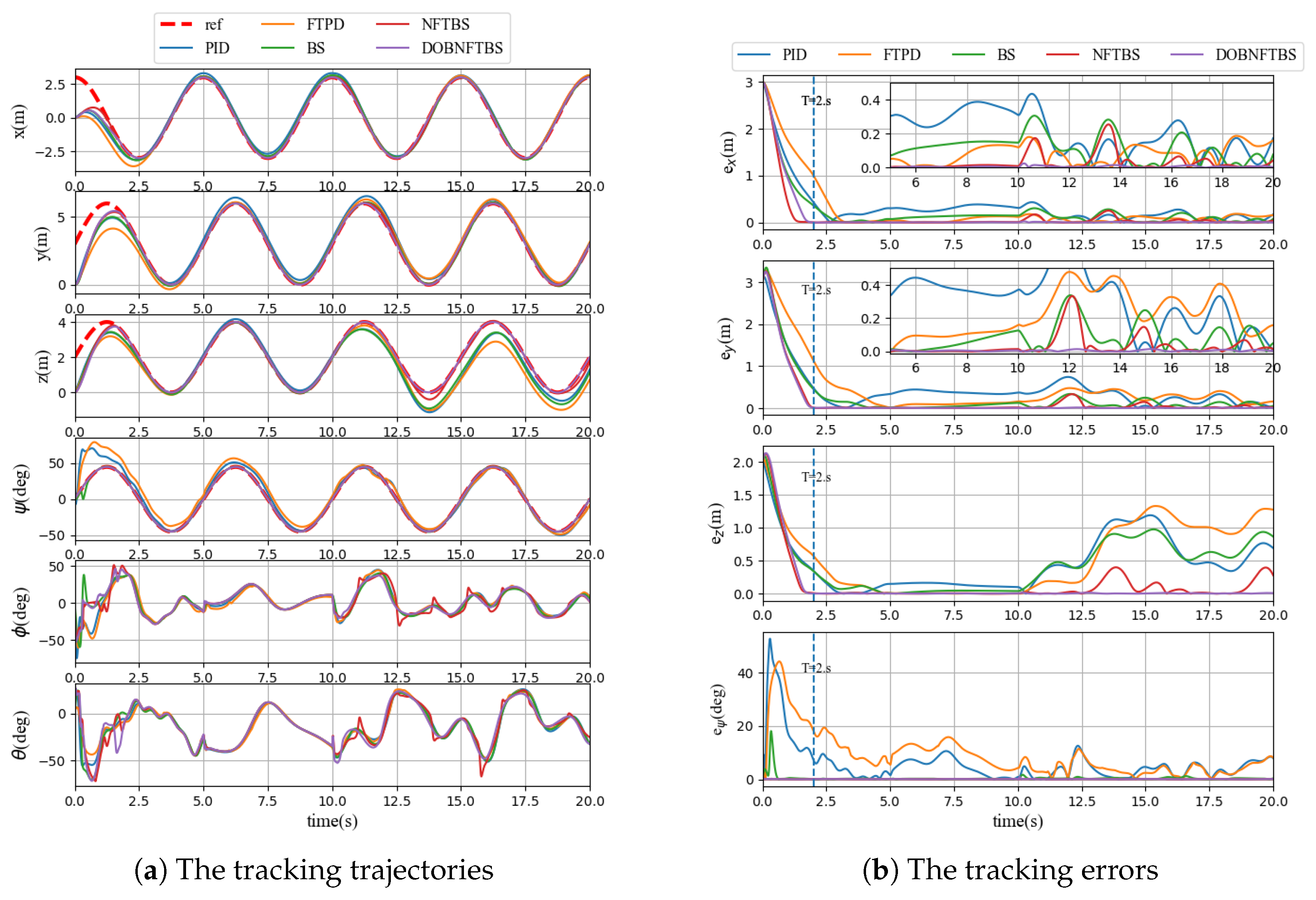
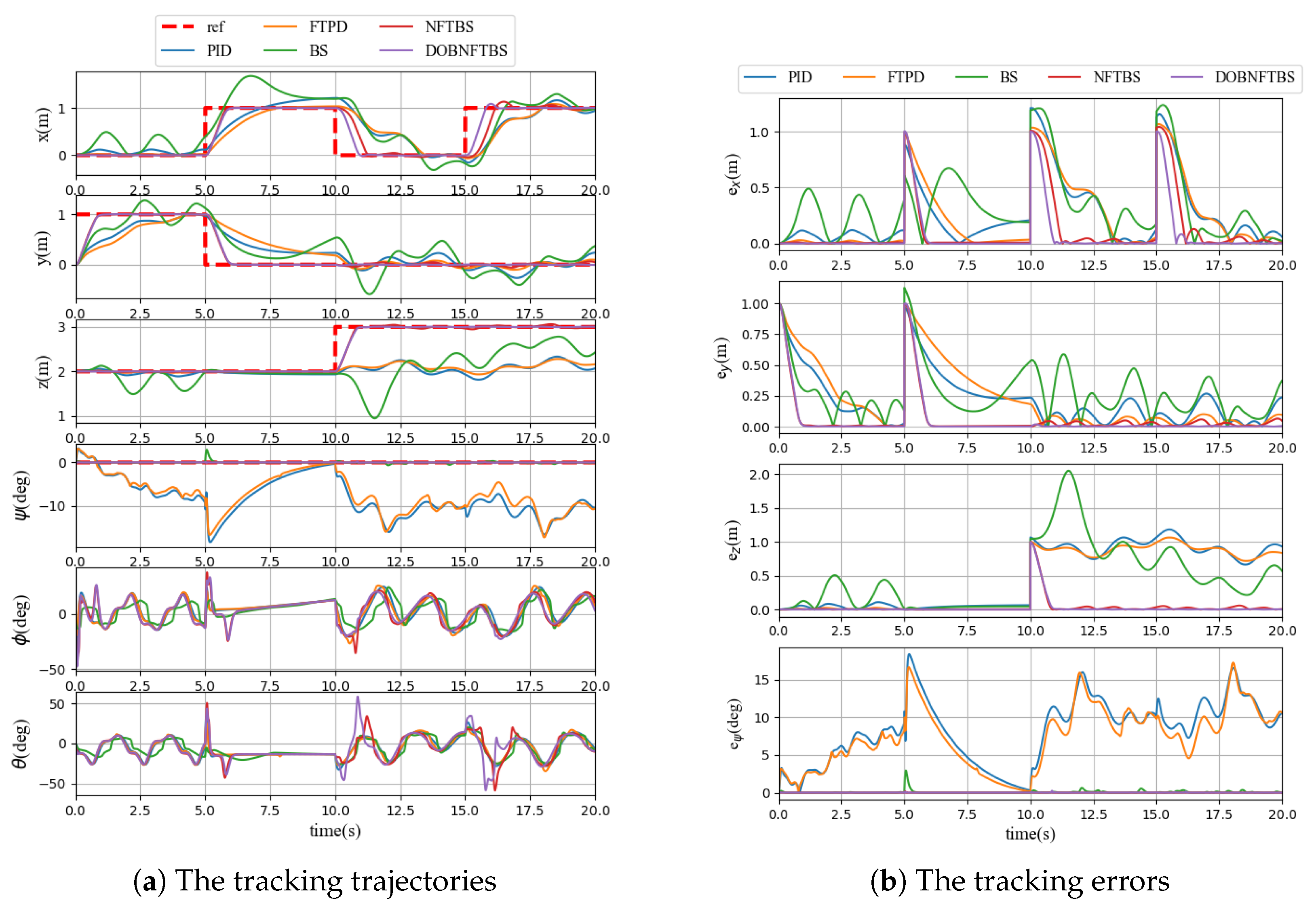
37], traditional backstepping (BS) and NFTBS without the disturbance observer. To ensure fairness, the controller parameters are carefully adjusted to achieve uniform convergence times. To thoroughly validate the effectiveness of the algorithm presented in this paper, the simulation is divided into two parts: continuous trajectory tracking and fixed-point tracking.
Case 1: Continuous Trajectories Tracking
A variety of disturbances, as in
Figure 3, are added to the system.
In the simulation, the actuator failure indicators are set to
and
after 10 s to demonstrate partial actuator failure.
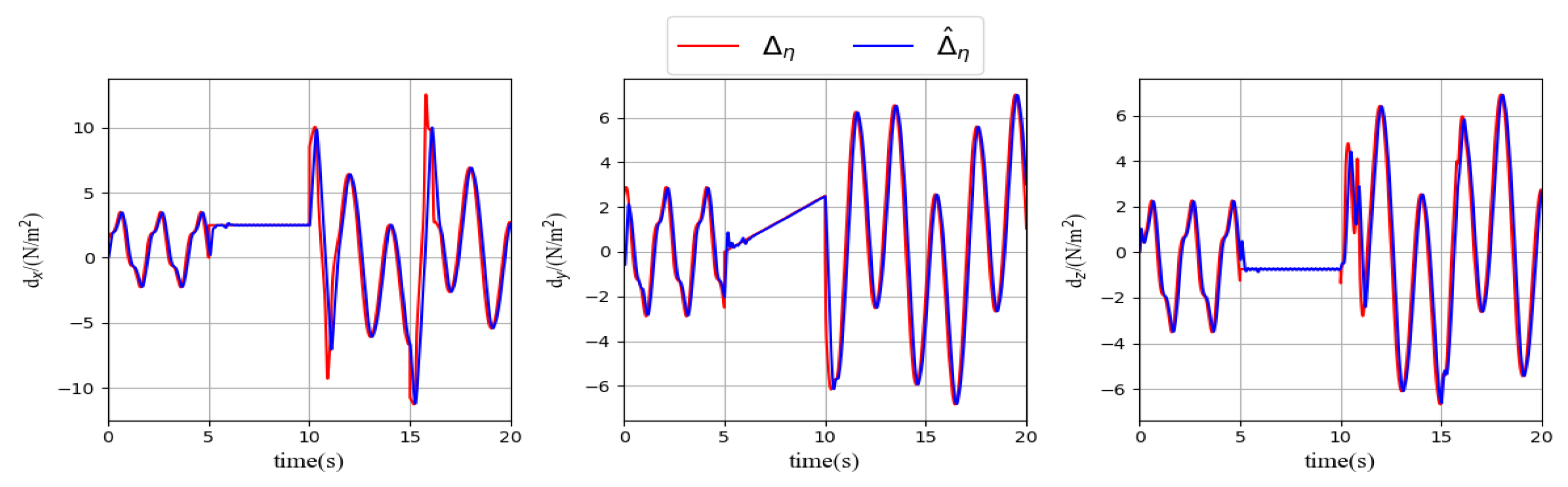
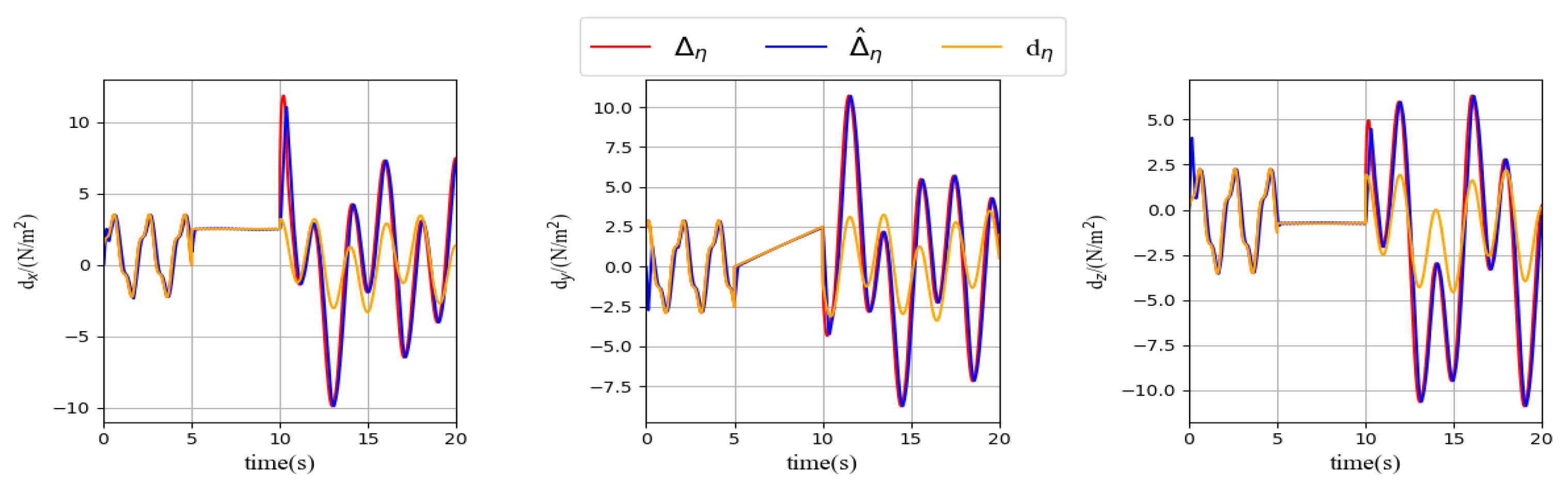
Figure 7 shows the disturbance observer output and the total disturbance, which includes both the extra disturbance and the actuator failure. The red curve represents the true total disturbance, encompassing both the extra disturbance and actuator failure. The blue curve shows the output of the FTDO, while the orange curve represents the true extra disturbance. The noticeable difference between the orange and red curves highlights the impact of the system actuator failure. The results demonstrate that the FTDO used in this paper can quickly and effectively track the total disturbances
.
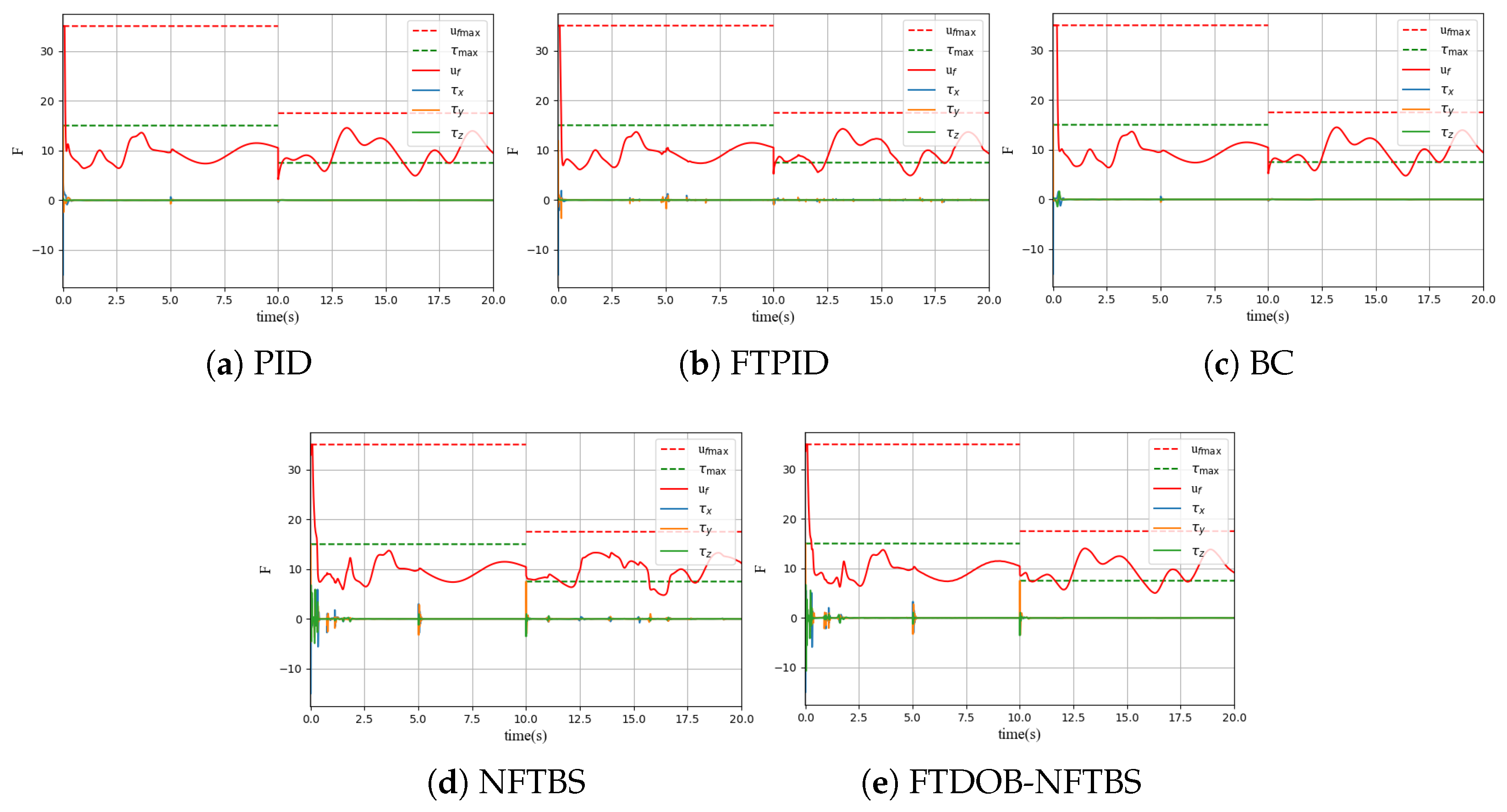
Figure 8 displays the system’s constrained inputs, with the dashed red and green lines representing the upper bounds of
and
, respectively. It is important to note that these upper bounds decrease correspondingly as the actuator experiences partial failure.
The responses and errors of the system tracking trajectories are depicted in
Figure 9. To evaluate the system tracking errors before and after the occurrence of actuator failure, the average absolute errors are defined as
where
and
are defined to evaluate the system tracking errors within 5–10 s without actuator failure.
and
are defined to evaluate the system tracking errors within 10–20 s when the actuator failure occurs. The results are listed in
Table 3.
In summary, all controllers are capable of stabilizing the QUAV in the absence of actuator failure. However, the errors observed with the NFTBS controller and the FTDOB-NFTBS controller are significantly smaller compared with the other three controllers. Furthermore,
Figure 9b shows that the tracking errors with the NFTBS and FTDOB-NFTBS controllers converge to very small regions within 2 s. When actuator failure occurs, the yaw angle tracking errors remain relatively unchanged across all five controllers. However, the position tracking errors with the PID, FTPD, and BC controllers become unacceptably large, with errors along the Z-axis exceeding 1 m. The FTDOB-NFTBS controller exhibits the best performance, with its position tracking error being nearly one-tenth of that of the NFTBS. This highlights the effectiveness of the proposed FTDOB-NFTBS control framework, which demonstrates superior performance in quickly and accurately tracking the reference signal while mitigating the effects of external disturbance and actuator failure.
Case 2: Fixed-Point Tracking
Similar to Case 1, the actuator failure indicators are set to
and
after 10 s to demonstrate partial actuator failure.
Figure 10 shows the disturbance observer output and the total disturbance, which includes both the extra disturbance and the actuator failure. The red curve represents the true total disturbance, encompassing both the extra disturbance and actuator failure. The blue curve shows the output of the FTDO.
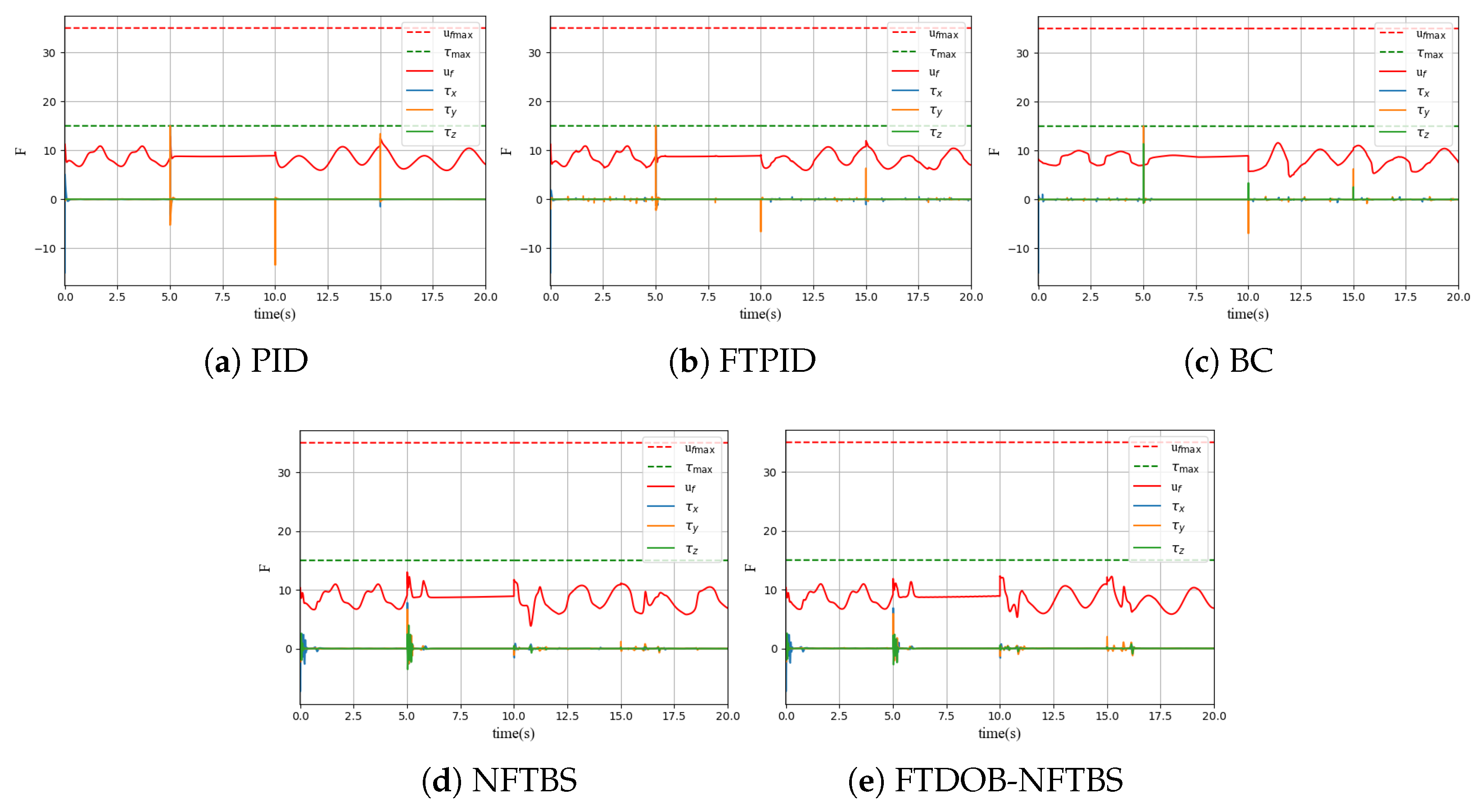
Figure 11 displays the system’s constrained inputs, with the dashed red and green lines representing the upper bounds of
and
, respectively. It is important to note that these upper bounds decrease correspondingly as the actuator experiences partial failure.
The responses and errors of the system tracking trajectories are depicted in
Figure 12. The average absolute errors are defined as (
31), and the results are listed in
Table 4.
In summary, all controllers are capable of stabilizing the QUAV in the absence of actuator failure. However, the errors observed with the NFTBS controller and the FTDOB-NFTBS controller are significantly smaller compared with the other three controllers. The error convergence speed is also significantly faster than other controllers. Furthermore,
Figure 12b shows that the tracking errors with the NFTBS and FTDOB-NFTBS controllers can always converge to very small regions within 2 s for suddenly changed reference points. When actuator failure occurs, the position tracking errors with the PID, FTPD, and BC controllers become unacceptably large, with errors along the Z-axis around 1 m. The FTDOB-NFTBS controller exhibits the best performance, with its position tracking error being less than half of that of the NFTBS. This highlights the effectiveness of the proposed FTDOB-NFTBS control framework, which demonstrates superior performance in quickly and accurately tracking the reference signal while mitigating the effects of external disturbance and actuator failure, even for the suddenly changed reference points.