
Article

Joint Optimization for Energy Efficiency in UAV-Enabled Networks
1
School of Telecommunications Engineering, Xidian University, South Taibai Road, Xi’an 710071, China
2
State Key Laboratory of Blockchain and Data Security, School of Cyber Science and Technology, College of Computer Science and Technology, Zhejiang University, Hangzhou 310007, China
3
Hangzhou High-Tech Zone (Binjiang) Institute of Blockchain and Data Security, Hangzhou 310053, China
4
Department of Computer Engineering, Faculty of Engineering and Architecture, Istanbul Gelisim University, Istanbul 34310, Turkey
5
Department of Computer Science and Information Technology, College of Engineering, Abu Dhabi University, Abu Dhabi 59911, United Arab Emirates
6
Department of Software Engineering, Faculty of Engineering and Architecture, Nisantasi University, Istanbul 34398, Turkey
7
Center for Security, Theory and Algorithmic Research, International Institute of Information Technology, Hyderabad 500 032, India
8
Department of Computer Science and Engineering, College of Informatics, Korea University, 145 Anam-ro, Seongbuk-gu, Seoul 02841, Republic of Korea
*
Authors to whom correspondence should be addressed.
These authors contributed equally to this work.
Drones 2026, 10(4), 262; https://doi.org/10.3390/drones10040262
Submission received: 8 March 2026 / Revised: 31 March 2026 / Accepted: 2 April 2026 / Published: 4 April 2026

Highlights

What are the main findings?
  • The proposed method employs ground user scheduling and UAV trajectory planning to enhance energy efficiency in a UAV-enabled network.
  • The primary goal of these methods is to optimize energy usage while improving the data delivery rate.
What are the implications of the main findings?
  • The key constraints in the UAV-enabled network include communication, trajectory, and scheduling.
  • The problem is formulated as a mixed-integer non-convex optimization problem and is addressed using linear programming, successive convex optimization, and a block coordinate descent algorithm.

Abstract
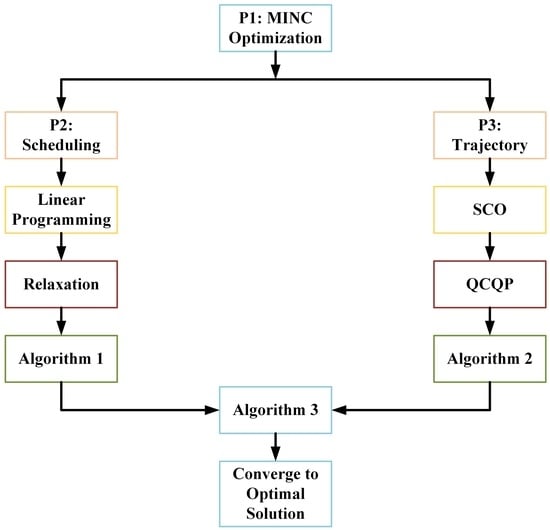
Unmanned Aerial Vehicles (UAVs) were originally designed for military and surveillance applications but are now significant in smart agriculture, wireless communication, and product delivery. In contrast to an Internet Service Provider (ISP), which typically relies on fixed base stations, which can fail in the event of a disaster, UAVs offer more stable alternatives. Because IoT devices, sensors, and ground users have limited processing power and battery life, there is a need for energy-efficient solutions. Meanwhile, users still expect high data rates. UAV-based wireless networks can meet these needs, even in harsh or disaster-hit areas. Current research focuses on improving energy efficiency and data transmission by optimizing UAV flight paths and scheduling. In this work, we tackle these issues by formulating a mixed-integer non-convex optimization problem that jointly considers device scheduling and UAV trajectory. We further decompose it into the following two parts: energy-efficient scheduling among ground users ( P 2 ) and the trajectory optimization of UAVs ( P 3 ). To address these issues, we develop a linear programming relaxation approach, a Quadratically Constrained Quadratic Programming (QCQP)-based Successive Convex Approximation (SCA) scheme, and the Block Coordinate Descent (BCD) algorithm. Experimental results demonstrate that our approach outperforms the state of the art in both power consumption and transmission rate.

Graphical Abstract

1. Introduction

We can use Unmanned Aerial Vehicles (UAVs) to communicate in disasters and remote areas. This significance of this can be highlighted, especially in light of recent cases, such as the Turkey earthquake (2023), where emergency operations struggled during the first 72 h [1]. Also, communication problems were very critical during Hurricane Ian’s impact on Florida in 2022 [2]. These examples demonstrate the limitations of traditional forms of communication media, such as communication towers that are prone to power outages, failures, or overwhelmed situations. UAVs have arisen as a disruptive solution, serving as flying base stations that are able to provide prompt aerial connectivity relief and broadcast data between Internet of Things (IoT) [3] devices and ground users in the absence or unavailability of conventional infrastructure [4].
UAVs typically act as flyable base stations or mobile terminals of cellular networks, able to contain cellular networks and capable of controlling their altitude and position to serve users’ communication needs. Their adaptability means that they play crucial roles in the domains of transportation, disaster relief, surveillance, and healthcare [5]. During an emergency, UAVs can offer communication links not reliant on damaged infrastructure by flying at a high altitude to establish line-of-sight (LoS) with ground users [6]. They can also be quickly deployed as data sinks for IoT devices, supporting essential connectivity [7]. However, integrating UAVs poses challenges due to limited battery life, unreliable communication in disaster scenarios, and resource constraints when serving many users with varying needs [8,9]. Recent studies on UAV communications have mainly focused on optimizing specific aspects, such as coverage [10], throughput [11,12], energy efficiency [13,14,15,16], trajectory planning [17,18,19], and real-time object detection [20]. For instance, some research has used the probabilistic LoS model to improve UAV placement, which can perform much better than static deployment [21].
To make sensing more energy-efficient, we need to jointly optimize the UAV’s 3D trajectory during task execution and its power consumption while respecting limits on movement, coverage, and communication [22]. To address this problem, a two-layer approach was proposed. Each iteration of inner block BCD breaks down the complex problem into three smaller pieces and solves them one by one using an SCA method that handles the tricky nonlinearities. The outer loop, which is the Dinkelbach algorithm, repeatedly reformulates the energy-efficiency ratio into a simpler form, allowing us to zero in on the best balance between performance and energy use.
Nonetheless, these methods usually unrealistically assume that there are no obstacles, when, in reality, they introduce Rec-NLoS effects [23]. Although trajectory optimization has been studied, there remains a significant research gap in optimally designing trajectories in combination with user-centric metrics, namely, minimizing the maximum energy of ground users, such that reliable data delivery is guaranteed under realistic channel conditions, such as outage-constrained Rician fading [24]. Table 1 presents the definitions of abbreviations used in this manuscript.

Motivation and Contributions

Much existing work focuses on UAV trajectory design and communication resource allocation separately to improve energy efficiency [25]. However, most of these studies rely on idealized assumptions, such as static ground users, single-UAV setups, or treating propulsion and transmission power separately. On top of that, conventional optimization methods struggle to adapt in real time as the network becomes dense, simply because they are too computationally intensive. Moreover, while deep reinforcement learning (DRL) has been seen as a promising alternative [26], it often fails to account for the physical constraints of UAV flight, such as velocity and acceleration limits, and the difficult mix of discrete and continuous decisions in multi-UAV systems. Therefore, we proposed a method that combines ground user scheduling with trajectory optimization in a scalable manner: one that can handle three-dimensional trajectories, multi-user interference, dynamic energy optimization, and the probability of LoS, all while converging to a near-optimal solution without significantly increasing computation time.
This paper presents a unified framework for energy-efficient UAV-aided communications in disaster scenarios. We jointly optimize the UAV’s path, user scheduling, and transmission rate control. The problem is formulated as a mixed-integer non-convex optimization (MINCO) to minimize the highest energy use among ground users. To tackle this, we use binary scheduling with linear programming, Successive Convex Approximation (SCA) [27], and the Block Coordinate Descent (BCD) algorithm. The primary contributions of this study are as follows:
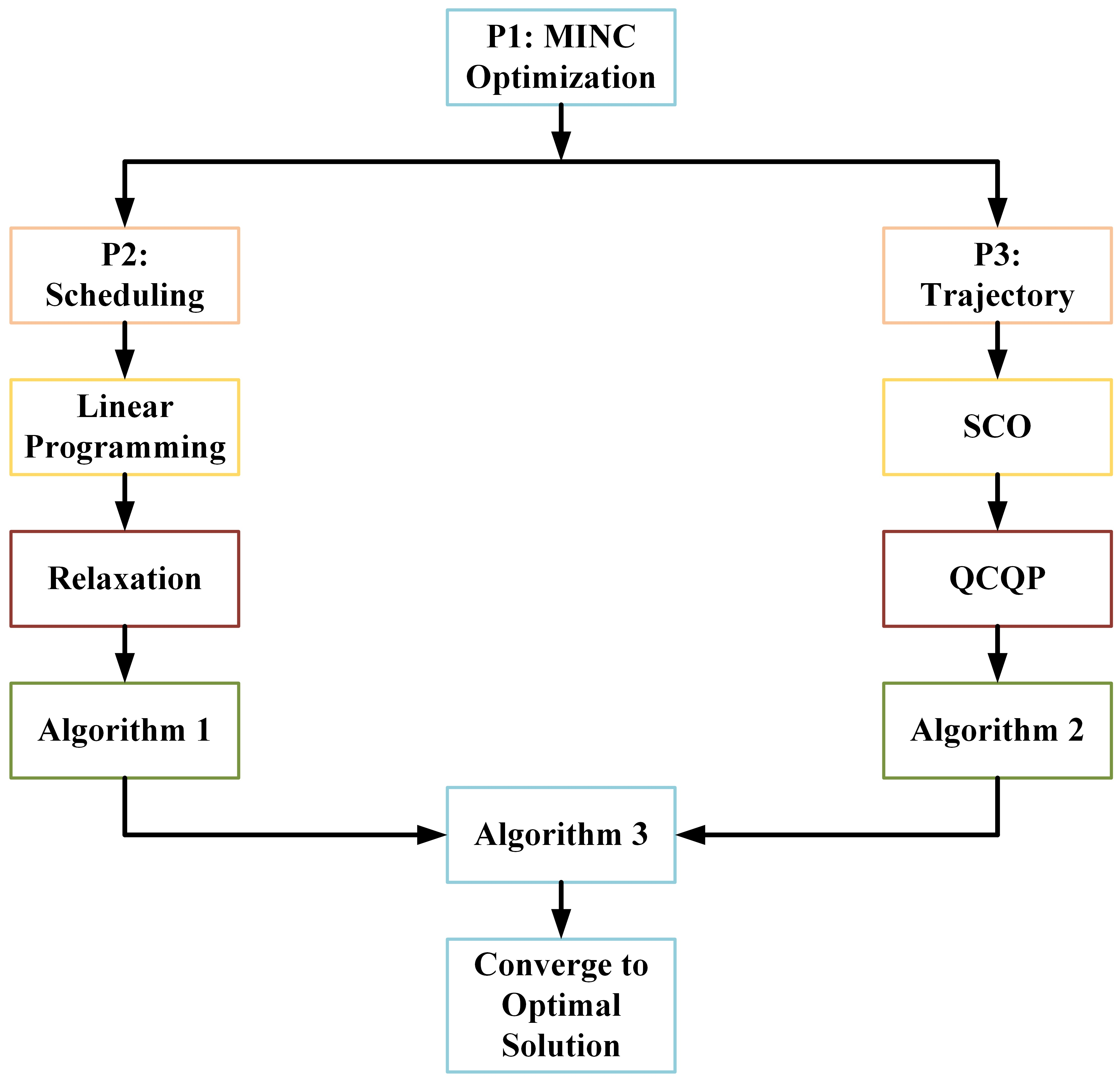
  • To improve energy efficiency, we investigate how to optimize a network of UAVs with many ground users and many UAVs simultaneously. The optimization involves four related factors: channel parameters, trajectory, energy use, and UAV communication scheduling. The MINCO problem ( P 1 ) is the raw problem. We break it down into two subproblems while maintaining coupling constraints: the linear-programming problem of ground user scheduling ( P 2 ) and the non-convex problem of UAV trajectory planning ( P 3 ). We use its structure to solve individual problems in two ways: by SCA based on Taylor expansions with probabilistic channel modeling, and by linear programming with continuous relaxation.
  • Our proposed method accounts for Rician fading and outage probability constraints in the Quadratically Constrained Quadratic Programming (QCQP) formulation. This means that it takes into account how channels actually work, making it more likely that the throughput forecasts will match real-world UAV communication situations compared to earlier SCA methods that assumed that links were always reliable.
  • We save energy by combining trajectory planning and scheduling, which also helps ground users save energy. Our proposed model accounts for factors that earlier studies did not, such as hovering in cities, control signals from above, and increased energy use due to many UAVs in the same area.
  • We used the BCD algorithm, which provides formal convergence guarantees, to perform a thorough convergence analysis. We achieve this by updating variables repeatedly until all improvements are fully realized. We also evaluate the algorithm’s sensitivity to initialization and analyze its convergence characteristics, especially in the context of non-convex trajectory constraints.
  • Simulations validate the proposed joint optimization approach. The results show that the algorithm converges rapidly and achieves higher energy efficiency than benchmark schemes. The effects of the Rician factor, outage probability, and UAV trajectory on energy efficiency are also studied.
This study is organized as follows: Section 2 reviews related work. Section 3 describes the proposed system model for the UAV-enabled system. Section 4 explains how the mixed-integer non-convex optimization problem is formulated. Section 5 introduces a solution to the MINCO problem. Section 6 presents the experimental results for the energy optimization mechanism, and Section 7 concludes this paper.

2. Related Work

UAVs have gained popularity as flexible and rapidly deployable communication tools in disaster response situations. An early key study by Zeng et al. [12] examined how the altitude of rotary-wing UAVs impacts throughput, revealing an optimal height that balances signal path loss with the likelihood of maintaining a LoS connection. Building on this foundation, Sun et al. [21] introduced a more comprehensive model that uses probabilistic LoS to determine the ideal 3D placement of UAV base stations in urban settings, employing a widely recognized elevation-based LoS formula that has since become a standard in UAV channel modeling. Sharma et al. [28] designed a UAV deployment system for post-earthquake scenarios, utilizing actual seismic data to detect and fill coverage gaps caused by destroyed infrastructure. Despite advances in coverage and throughput, many of these works have largely overlooked an important constraint in disaster scenarios: battery-constrained operation in the case of ground terminals. It is an open issue to solve the energy problem of ground users. It is crucial to enhance the UAV’s flight capabilities and the communication system in the network. Li et al. [29] used convex optimization to minimize mission time and guarantee that the user has their required data over fixed-rate links. The objective is to enhance the efficiency of energy consumption in maneuvers that minimize propulsion energy and keep the user connected.
Chen et al. [30] proposed an advanced method based on multi-agent reinforcement learning, where the flight paths of multiple UAVs and associated resource allocations are jointly optimized to maximize network throughput. Yet, these advances are achieved based on oversimplified channel models that almost always take ideal LoS, disregarding the various real-world obstacles encountered, such as shadowing and connected/free topology. Cao et al. [31] minimized the sum energy of all users for data collection by designing a time division multiple access schedule with a convex method. Wang et al. [32] prolonged the total network lifetime by jointly optimizing transmit power and user–UAV associations in IoT systems. Although these studies offer some insight, they focus only on maintaining the UAV or do not consider how the flight behavior affects the scenario or communication reliability in real-world fading conditions. This provides motivation to quantitatively model the channel in order to design robust communication systems for UAVs. Al-Hourani et al. [33] achieved an enormous improvement by establishing a model of how signal loss is governed with elevation in two and four bins labeled as LoS and NLoS, respectively. Subsequently, Sun et al. [34] extended this work by considering air-to-ground communication with Rician fading [35], which is more representative of a real wireless scenario where the signals are affected by strong LoS and scattered paths.
An important parameter for Rician fading is the K-factor (typically denoted by K c ), representing the magnitude of the LoS signal. As Matolak et al. [36] state, a large K c suggests strong and reliable LoS; otherwise, there is significant interference from multipath fading. This enables us to compute the outage probability, i.e., the occurrence of a faded event below an acceptable level, using the Marcum Q-function as in Esmail et al. [37]. In this way, a guide for predicting and controlling communication reliability in practical fading environments is established. As mentioned by Guerra et al. [38], UAV networks are becoming ever more popular for time-critical applications such as target localization, unauthorized UAV detection, search, and rescue. These systems require low tracking errors, continuous connectivity, and precision of mission timelines. Additionally, Hu et al. [39] propose that, due to UAVs, BSs are able to achieve flexible edge computing, so it becomes feasible to save energy through cache refreshing/task offloading/status update policies. Han et al. [40] and Zeng et al. [41] demonstrate that jointly optimizing terrestrial BSs (TBSs) and UAVs in MEC networks mitigates the average task delay while controlling UAV energy consumption.
Sun et al. in [42] point out that UAVs with MEC servers and energy transmitters reduce the response time of Internet of Vehicles (IoV) applications, taking advantage of their mobility to increase resource allocation. Radhakrishnan et al. [43] state that efficient energy management policies for UAV networks should jointly optimize charging and data acquisition. Xie et al. [44] show that the UAVs’ energy consumption during flight is linearly related to the mission time, implying an inherent trade-off between energy and delay in multi-UAV networks. Sun et al. [45] found that rotary-wing UAVs work very well in a relay phase for data gathering between ground users, where direct communication may be difficult to establish. Huang et al. [46] suggest that, by using distributed aerial edge networks, energy efficiency can be improved when performing computational offloading. Guo et al. [47] utilized fixed-wing UAVs to enhance connectivity via coordinated trajectory design, power control, and scheduling.
Novel deployment strategies include the hover-spot and age-of-information (AoI)-aware trajectory optimization in Li et al. [48]. The computation for MINCO problems is not easy. Yang et al. [49] and Danilova et al. [50] used BCD to split these two problems into blocks and update iteratively. Yang et al. [51] jointly scheduled the task over dynamic multi-cell networks. Given power, interference, and user-cluster constraints, the problem of optimizing UAVs is known to be NP-hard, as proposed by Janji et al. [52]. In contrast, Zhou et al. [53] locally approached non-convex constraints with Successive Convex Optimization (SCO). Meanwhile, Chen et al. [30] used the Successive Convex Approximation (SCA) approach to solve the optimization problem of the UAV trajectory but ignored the joint scheduling and outage constraints.
Most prior efforts treat trajectory planning and user scheduling as separate stages, whereas the proposed methods jointly optimize within a unified formulation. These methods took the UAV’s path to be shaped not only by its own energy consumption but also by the timing and location of each user’s service, directly addressing the coupling that previous studies often bypass. In channel modeling, many existing joint optimizations assume simplified path-loss models or static LoS conditions. However, the proposed work combines a probabilistic LoS/NLoS characterization with a more realistic Rician fading model to capture the stochastic nature of air-to-ground links, a crucial aspect for urban deployments that has been ignored in prior joint trajectory and scheduling studies. Furthermore, from an algorithmic perspective, rather than employing pre-made solvers or heuristics, we combine LP relaxation, SCA, and BCD in a novel way tailored to the mixed-integer non-convex structure of our problem. In contrast to other methods, this combination maintains tractability while achieving near-optimal performance. In summary, the main advancements of the proposed work include differences in trajectory and scheduling optimization, realistic fading channel modeling, the inclusion of coupling constraints, and a carefully orchestrated solution framework. Table 2 summarizes related work and highlights the key distinctions between it and our proposed work.

3. The Proposed System Model

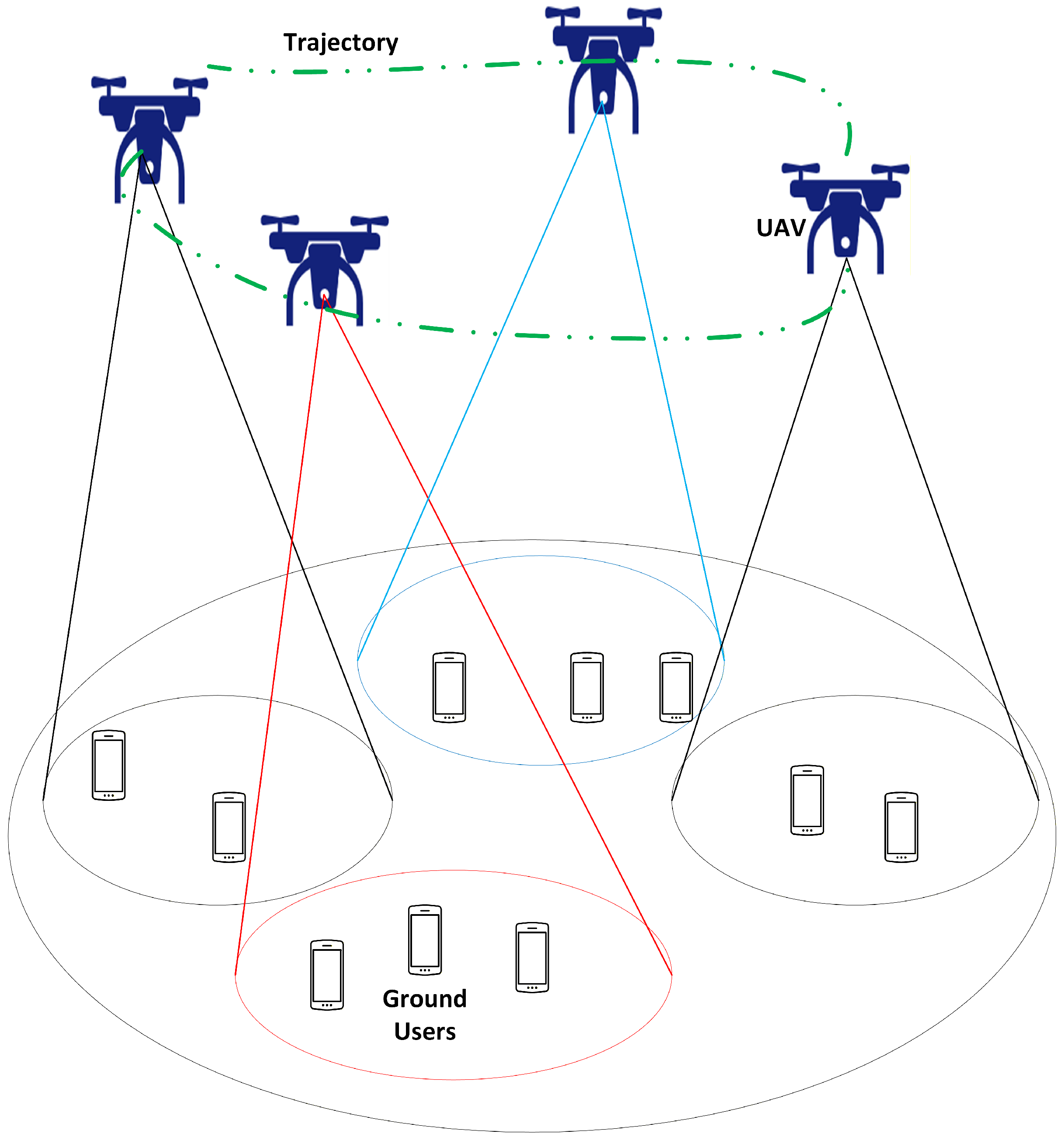
The network comprises several UAVs, represented by U = {1, 2, 3,…, U}, and users, represented by the set M = {1, 2, 3,…, M}, as shown in Figure 1. The UAV-enabled system provides connectivity services and connects IoT devices and ground users to serve data on active users in disaster zones. This study aims to minimize ground users’ energy consumption while obtaining a data transmission rate or throughput from a UAV in an airborne network. This is subject to the system’s constraints of communication, trajectory, and scheduling issues.
Each ground user can communicate with the UAV, allowing for data transmission at a specified rate throughout T = N Δ t . We assume that the UAV maintains a fixed height of H meters while traveling at maximum speed. Additionally, the initial and final locations are predefined, which, in real-world applications, depend on the UAV’s pre- and post-target flight paths [12]. The UAV can move from the initial to the final point within T, as shown in Equation (1). At a discrete time slot N, we assumed that the UAV’s location remained unchanged to provide services to the ground users.
0 N T
Table 3 lists the definitions and key symbols in this study.

3.1. Trajectory and Mobility

The users are distributed randomly and unevenly, with varying service requirements among the ground users. Without loss of generality, we can represent the ground user as a point in a Cartesian coordinate system: w i = ( x i , y i ). Therefore, the three-dimensional coordinates of the j th UAV will be w j ( n ) = ( x j ( n ) , y j ( n ) , H) ∀n= 1 , 2 , 3 , , N . The UAV returns to the start after a period of T = N Δ t seconds, and its trajectory must satisfy periodicity constraints as in Equation (2).
w j [ 0 ] = w j [ N ] , j U
The trajectory is also subject to maximum speed constraints and collision avoidance requirements. Therefore, let v denote the UAV speed and d represent the inter-distance required to prevent UAV collisions. We assume that the vertical speed of the UAV can be controlled independently. The discrete time for the service in each time slot is n, and the constraints are as in Equations (3) and (4), respectively.
w j [ n ] w j [ n 1 ] V max Δ t , j U , n = 1 , , N
w j [ n ] w k [ n ]     d min , j k , n
Therefore, the UAV trajectory w ( n ) can be divided into different sequences based on the discrete time n, which can be represented mathematically as shown in Equation (5):
W = W j [ n ] j , n

3.2. Channel Model

The distance between the i th ground user and the j th UAV in each time slot can be denoted as D i j in Equation (6).
D i j [ n ] = H 2 + w i w j [ n ] 2
The horizontal distance between the i th ground user and the j th UAV is denoted as d i j h o r and can be expressed as shown in Equation (7):
d i j hor = ( x i x j [ n ] ) 2 + ( y i y j [ n ] ) 2
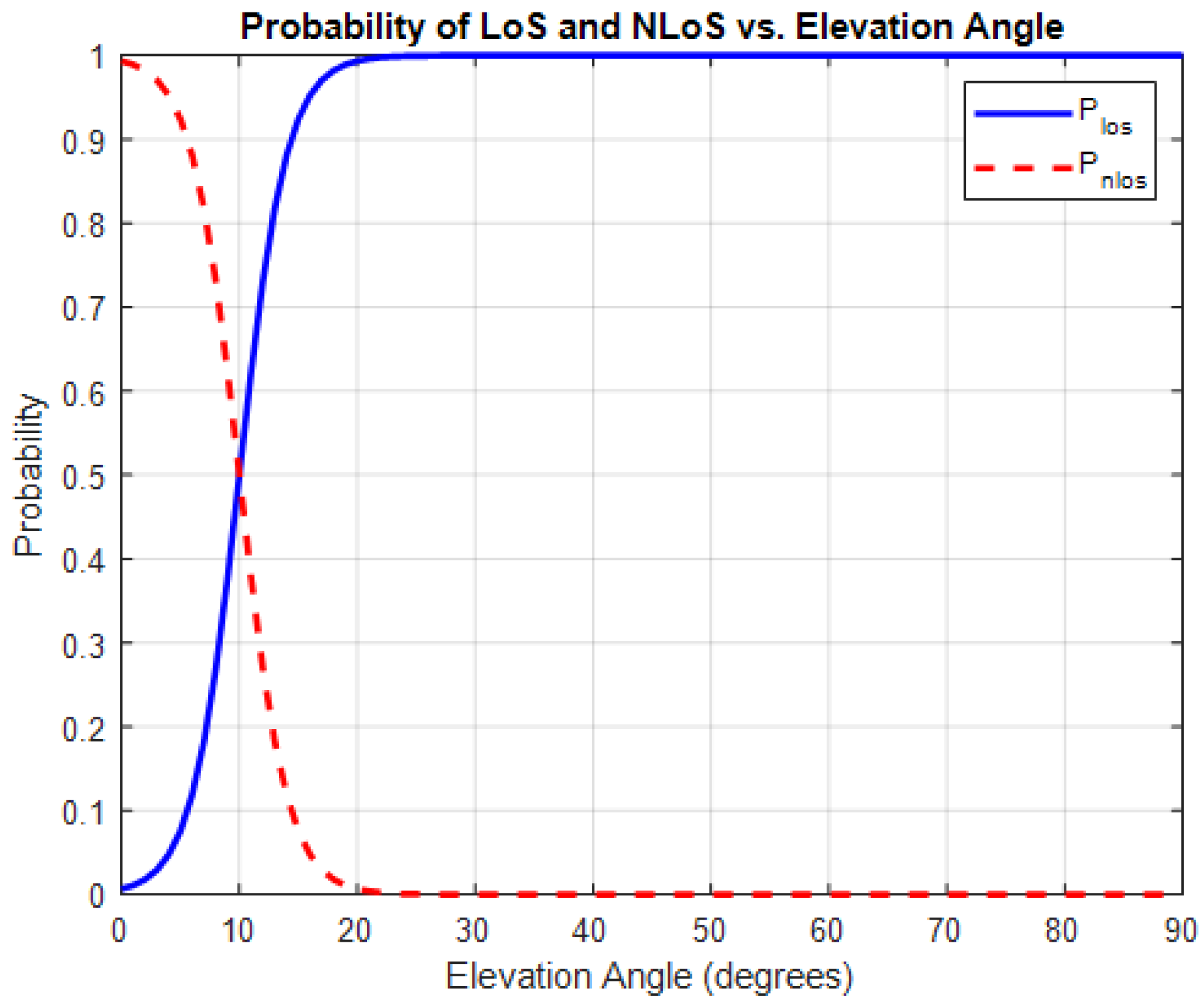
Due to the disaster area, there are a few obstacles to communication between the ground users and UAVs. Therefore, we use the probability of path loss, that is, P i j N L o S [ n ] =1 − P i j L o S [ n ] . In other words, we use Rician fading with a dominant path for the channel model. The LoS link depends on the elevation angle ( θ i j ) of the UAV with the ground users [54]. Therefore, to obtain the elevation angle ( θ i j ) used in Equation (8), the LoS probability is given by Equation (9), and the average path loss is as in Equation (10).
θ i j [ n ] = tan 1 H w i w j [ n ]
P i j LoS [ n ] = a · 180 π θ i j [ n ] Θ 0 b
PL i j [ n ] = P i j LoS [ n ] · η LoS + P i j NLoS [ n ] · η NLoS + 20 log 10 ( D i j [ n ] ) + 20 log 10 4 π f c c
where P i j N L o S and P i j L o S represent the path loss for both LoS and NLoS conditions between the i th user and j th UAV, respectively; P L i j [ n ] represents the average path loss between the i th user and j th UAV’s steps to slot n; a and b are constants of the environmental impact; Θ 0 denotes the reference elevation angle; f c denotes the carrier frequency; D i j denotes the distance between the i th ground user and j th UAV; and η LoS and η NLoS denote the attenuation of the LoS and NLoS, respectively.
We used a probabilistic LoS combined with Rician fading, a widely accepted approach for modeling UAV-to-ground channels in urban and suburban settings. For LoS conditions, we set the Rician K-factor to 10 dB to capture the strong dominant path that typically exists when the UAV flies at a relatively low altitude with a clear view of the ground user. Highlighting the LoS probability’s dependence on UAV altitude and elevation angle underscores the model’s relevance to real-world scenarios and its importance for accurate predictions.
The average channel power gain ( g 0 , i j ) is the inverse of the path loss between the i th ground user and the j th UAV. This relationship can be expressed mathematically as shown in Equation (11) as follows:
g 0 , i j [ n ] = 1 PL i j [ n ]
Hence, the Rician channel coefficient ( h i j ) can be represented as shown in Equation (12), where K c is the Rician factor. The term g 0 , i j [n] represents the deterministic LOS component, and z i j [ n ] C N ( 0 , 1 ) denotes a complex normal distribution for representing scattered multipath components. The corresponding channel power gain g i j [n] is given by Equation (13).
h i j [ n ] = K c K c + 1 , g 0 , i j [ n ] + 1 K c + 1 , z i j [ n ]
g i j [ n ] = | h i j [ n ] | 2

3.3. Communication Model

We implemented a binary ground user association and scheduling mechanism, allowing only one ground user to communicate with the UAV at each time slot. Therefore, the scheduling variable Q i ( n ) = 1 if the i th ground user is associated and begins communication with the j th UAV; otherwise, it is zero. The scheduling constraint in Equation (14) is used to ensure that at most one i th ground user is served across all UAVs in any given time slot.
i = 1 M j = 1 U Q i j [ n ] 1 , n
If the ground user is assigned to Q i (n) = 1 to obtain a service during time slot n, then the achievable data rate for the i th ground user at time slot n is given by Equation (15):
R i j [ n ] = B log 2 1 + g i j [ n ] P i t x σ 2
where g i j denotes the channel power gain of the i th ground user with the j th UAV, P i t x represents the transmit power of the i th ground user, δ denotes the power noise, and > 1 is the SNR gap between the practical and theoretical Gaussian signal. The outage probability indicates the likelihood that the achievable rate R i [n] during time slot n, under Rician fading, will drop below the required data transmission rate threshold R t h [n]. We can use the cumulative distribution function (CDF) g i j to calculate the probability that it falls below a certain threshold. The outage probability between the ground user and the UAV during time slot n, affected by Rician fading, is expressed as follows in Equation (16):
P i out = P R i [ n ] < R th [ n ] = P log 2 1 + g i j P i t x δ 2 < R th [ n ] = P g i j P i t x δ 2 < 2 R th [ n ] 1 = P g i j < δ 2 2 R th [ n ] 1 P i t x = F g i j δ 2 2 R th [ n ] 1 P i t x
F(.) represents the cumulative distribution function (CDF) of P i o u t , which is identical across instances. To reliably achieve the target amount of transmission data for each ground user via the UAV, R i [n] should be selected so that the outage probability can be represented as in Equation (17):
Q i j [ n ] · P i j out [ n ] P max out , i , j , n
Equation (17) enforces the constraint that the outage probability P i j out [ n ] must not exceed the maximum tolerable value P out max . This ensures that the probability that the i th ground user’s data rate falls below the threshold R th [ n ] in slot n is minimized, allowing the system to operate reliably while maintaining a low likelihood of falling below the required transmission rate.
D max T V max , where , T = N Δ t
The maximum travel distance D max is limited by the total time T multiplied by the maximum velocity V max as in Equation (18).
E i = n = 1 N Q i [ n ] P i Δ t
where E i represents the total energy consumed by the i th ground user, calculated by summing the energy over the slots where the user is scheduled and active at Q i [ n ] = 1 , as presented in Equation (19).
r i = S i T B , where , T = N Δ t
The spectral efficiency, r i , measured in bps/Hz, is calculated by dividing the total data S i by the product of the bandwidth B and total time T, as shown in Equation (20) above. The total transmitted data, which is the sum of scheduled data transmission rates R i [ n ] across slots, must satisfy the user demand for total data S i , as shown in Equation (21).
n = 1 N j = 1 U Q i j [ n ] R i j [ n ] Δ t S i , i M
The CDF of the Rician distribution is expressed using the modified Bessel function of the first kind. The Marcum Q-function, denoted as Q i (a, b), describes the cumulative distribution of the Rician random variable [55] in Equation (22).
F ( z ) = 1 Q i 2 K c , 2 K c + 1 2 R th 1 g 0 i j [ n ]

3.4. Energy Model

Ground User Energy: The total energy consumption of the i th ground user for transmission is as in Equation (23):
E i gu = n = 1 N j = 1 U Q i j [ n ] P i tx Δ t
UAV Propulsion Energy: The UAV propulsion power consumption at time slot n is modeled as in Equation (24). The total propulsion energy for the j th UAV is as in Equation (25).
P j prop [ n ] = P 0 1 + 3 v j [ n ] 2 U tip 2 + P i 1 + v j [ n ] 4 4 v 0 4 v j [ n ] 2 2 v 0 2 1 2 + 1 2 d 0 ρ s A v j [ n ] 3
E j prop = n = 1 N P j prop [ n ] Δ t
where P j prop [n] represents the propulsion energy for the j th UAV, v j [ n ] denotes the speed of the j th UAV at time speed n, P 0 denotes the power required to overcome blade drag, P i denotes the induced power, U t i p denotes the maximum speed at the rotor tip, v 0 denotes the mean rotor-induced velocity in hover, d 0 denotes the dimensionless drag coefficient, ρ denotes the air density, s denotes the rotor solidity, and A denotes the rotor disc areas, which are related to the UAV’s aerodynamics.

4. Problem Formulation

The main objective is to minimize the maximum energy consumption among all ground users while employing a scheduling variable defined as Q = q i j [n]  i , n , utilizing the trajectory optimization represented as W = w[n],  n , and accounting for the UAV propulsion energy. Trajectory and communication are also important limitations. The problem can be stated as follows in Equation (26):
( P 1 ) : min Q , W , E E s . t . C 1 : i = 1 M j = 1 U Q i j [ n ] 1 , n C 2 : Q i j [ n ] { 0 , 1 } , i , j , n C 3 : w j [ 0 ] = w j [ N ] , j U C 4 : w j [ n ] w j [ n 1 ] V max Δ t , j , n C 5 : w j [ n ] w k [ n ] d min , j k , n C 6 : E i g u E , i M C 7 : n = 1 N j = 1 U Q i j [ n ] R i j [ n ] Δ t S i , i M C 8 : Q i j [ n ] · P i j out [ n ] P max out , i , j , n C 9 : E j p r o p E max p r o p , j U
The primary objective is to minimize Q, W, and E. Several constraints related to user association and scheduling methods are applied to ground users in these aspects. Constraint C 1 means that there is only one serving ground user in each time frame (truncated to n). Constraint C 2 guarantees binary scheduling, and it behaves as a dummy variable. A second branch of constraints deals with trajectory optimization: C 3 demands that the take-off and landing (TOL) trajectory be periodic, C 4 limits its speed, and C 5 ensures their mutual collision avoidance. The above constraints C 3 to C 5 include the velocity of the UAV and the inter-distance between UAVs in a periodic structure, which are both continuous variables and very important for the optimization problem. The UAV is required to fly from one sojourn location to the other while satisfying the sojourn scheduling and trajectory optimization requirements.
Additionally, the constraint C 6 specifies that the energy consumption of each ground user during data transmission to the UAV must not exceed the maximum energy limit. Constraint C 7 mandates that the data delivery from the ground user must meet or exceed their total data demand. Furthermore, constraint C 8 requires that the outage probability remain below a specified maximum threshold, which is a reliable constraint. Lastly, constraint C 9 limits the propulsion energy for each UAV to a maximum budget.
As a result, the algorithm is compelled to identify a fully coordinated solution in which both components function harmoniously. We decompose the total problem into two smaller parts: P 2 , handling user scheduling and its choices, and P 3 , which involves mapping UAV flight pathways, which is a more challenging task because it is non-convex. Our method differs from earlier research, though, in that we maintain the linkages between these elements by monitoring how modifications to one affect the others. In this manner, we can avoid having a system that works well locally but falls short on a global scale. The complexity that we are dealing with comes from several sources: the binary nature of scheduling choices, the integer constraints in c 1 and C 2 , the non-convex trajectory requirements in C 3 through C 5 , and the continuous variables in the data transmission constraints C 7 that tie everything together.

5. Proposed Solutions

In this study, the problem is formulated as a mixed-integer non-convex program in which scheduling, trajectory, and energy variables are tightly coupled with the rate expression. This problem is inherently hard to solve because it combines discrete and continuous variables. To solve this problem, we used LP relaxation, SCA, and BCD algorithms. Applying LP relaxation to scheduling techniques, which is used to avoid combination explosion while preserving feasibility, the relaxation is deliberately made tight within the constraints. SCA and sequential approximations that guarantee monotonic improvement are used to convexify the non-convex trajectory and energy subproblem. This uses BCD to separate the problem into a scheduling subproblem and a trajectory subproblem, allowing us to alternate updates while keeping the coupling constraints manageable.
Using scheduling and trajectory separately leads to sub-optimal solutions. We guarantee that trajectory adjustments are always aware of scheduling decisions, and vice versa, by coupling directly into the BCD structure and using a novel SCA formulation that accounts for the rate-dependent capacity constraint.
This study utilizes relaxation, which typically indicates that the target value of constraint C 2 serves as an upper bound for problem ( P 1 ). However, due to the non-convex nature of constraints C 7 and C 8 , which involve data rate and outage probability, the problem ( P 1 ) remains non-convex even after relaxation. Generally, there is a lack of established techniques for effectively solving such non-convex optimization problems. Therefore, we propose a robust iterative approach for the relaxed problem ( P 1 ) pertaining to user scheduling, which is solved using Linear Programming (LP) as shown in Algorithm 1. To optimize the trajectory, we adopt a series of convex optimization methods with QCQP (Algorithm 2). To solve the problem, we use BCD to optimize these block-wise optimizations and indeed exploit the structure of each subproblem to achieve efficient optimization [56,57].
Algorithm 1 User Scheduling ( P 2 )
Require: 
Fixed trajectory W, rates R i j [ n ] , outage probabilities P i j out [ n ] , w i
Ensure: 
Scheduling Q, maximum energy E
1:
  Compute R i j [ n ] and P i j out [ n ] for all i , j , n using current W
2:
  Solve linear program P 2
3:
  Rounding to binary:
4:
  for  n  do
5:
       i * arg max i j Q i j [ n ]
6:
      for i do
7:
          if  i = i *  then
8:
                Q i j [ n ] 1 for the assigned UAV j
9:
          else
10:
              Q i j [ n ] 0
11:
        end if
12:
    end for
13:
end for
14:
return Q, E

5.1. User Scheduling

Algorithm 1 addresses the solution for subproblem P 2 and is designed to determine user scheduling and the corresponding maximum energy consumption for a fixed UAV trajectory W. Its main objective is to minimize the peak energy E across all UAVs while adhering to communication constraints and the given trajectory. The algorithm operates in two stages: first, it solves an LP relaxation of the scheduling problem, and then, it rounds the resulting fractional solution to obtain a feasible binary schedule.
Algorithm 2 Trajectory Optimization
Require: 
Fixed scheduling Q, initial trajectory W ( 0 ) , tolerance κ > 0 , max iterations L max , Rician factor K c , outage threshold P max out
Ensure: 
Optimized trajectory W *
1:
   l 0 , ϕ ( 0 )
2:
  repeat
3:
      Step 1: Compute convex approximations at W ( l )
4:
      for  i M , j U , n [ 1 , N ]  do
5:
          Compute u i j ( l ) [ n ] = w j ( l ) [ n ] w i 2
6:
          Compute expected channel gain under Rician fading:
7:
           E [ g i j ( l ) [ n ] ] = g 0 , i j ( l ) [ n ]                  ▹with K-factor scaling
8:
          Compute rate lower bound R ˜ i j ( l ) [ n ] using first-order Taylor expansion:
9:
           R ˜ i j [ n ] = R i j ( l ) [ n ] a i j ( l ) [ n ] u i j [ n ] u i j ( l ) [ n ]
10:
        where a i j ( l ) [ n ] = R i j u i j W ( l )
11:
        Verify outage constraint satisfaction:
12:
         P i j out , ( l ) [ n ] = F g i j ( l ) I σ 2 ( 2 R th [ n ] 1 ) P i tx
13:
        if  Q i j [ n ] · P i j out , ( l ) [ n ] > P max out  then
14:
           Adjust trajectory to improve channel gain
15:
        end if
16:
    end for
17:
    Step 2: Linearize collision constraints
18:
    for  j k , n [ 1 , N ]  do
19:
        Linearize C 5 : w j [ n ] w k [ n ] 2 d min 2
20:
        First-order approximation at W ( l ) :
21:
         w j ( l ) [ n ] w k ( l ) [ n ] 2 + 2 w j ( l ) [ n ] w k ( l ) [ n ] T ×
22:
         w j [ n ] w k [ n ] w j ( l ) [ n ] + w k ( l ) [ n ] d min 2
23:
    end for
24:
    Step 3: Convex propulsion energy approximation with hovering
25:
    for  j U  do
26:
        Compute convex upper bound E ˜ j prop for propulsion energy
27:
        Using velocity v j [ n ] = ( w j [ n ] w j [ n 1 ] ) / Δ t
28:
         E ˜ j prop = n = 1 N c 1 v j [ n ] 3 + c 2 v j [ n ] + P hover [ n ] Δ t
29:
    end for
30:
    Step 4: Solve convex QCQP subproblem with outage constraints
31:
    Solve:
32:
     max w , ϕ ϕ
33:
    s.t.
34:
     1 S i n = 1 N j = 1 U Q i j [ n ] B R ˜ i j ( l ) [ n ] Δ t ϕ , i
35:
     C 3 : w j [ 0 ] = w j [ N ] , j
36:
     C 4 : w j [ n ] w j [ n 1 ] V max Δ t , j , n
37:
    Linearized C 5 constraints
38:
    Outage constraints:
39:
     Q i j [ n ] · F g i j I σ 2 ( 2 R th [ n ] 1 ) P i tx P max out , i , j , n
40:
     E ˜ j prop + E j control E max prop , j
41:
    Altitude constraints:
42:
     H min H j [ n ] H max , j , n
43:
    Step 5: Update and check convergence
44:
     W ( l + 1 ) solution, ϕ ( l + 1 ) optimal value
45:
     l l + 1
46:
until  | ϕ ( l ) ϕ ( l 1 ) |   < κ or l L max
47:
return  W ( l )
We can optimize this by considering the following concerns of Equation (27). Each ground user is served at one time slot n based on constraint C 1 , which only enables the activation of the ground user with the largest fractional value. This requires continuous relaxation of the binary conditions. Simultaneously, the energy limit of the i th ground user must comply with constraint C 6 . Furthermore, the data delivery from the ground user must also satisfy constraint C 7 while adhering to the outage probability specified in constraint C 8 . This is the problem of binary integer programming. Let Q i j [n] represent a variable that indicates the assignment between the i th ground user and j th UAV for a given time slot n and is constrained to the interval [0,1]. Optimization packages such as Gurobi and CPLEX can solve it. For larger graphs, however, the relaxed problem first solves for Q i j [n]. The solution to this linear program can then be rounded toward binary solutions.
( P 2 ) : min E , Q E s . t . C 1 : i = 1 M j = 1 U Q i j [ n ] 1 , n C 2 : Q i j [ n ] { 0 , 1 } , i , j , n C 6 : E i g u E , i M C 7 : n = 1 N j = 1 U Q i j [ n ] R i j [ n ] Δ t S i , i M C 8 : Q i j [ n ] · P i j out [ n ] P max out , i , j , n
Algorithm 1 calculates the rates and outage probabilities for every user, UAV, and time slot based on the fixed trajectory. It then solves a linear program ( P 2 ) to obtain a fractional schedule and the maximum energy value. Because the final schedule must be binary, a rounding step is applied per time slot: for each slot, it finds the user with the highest total fractional assignment across all UAVs, gives that user’s entire slot to the UAV that contributed most to that total (essentially the UAV associated with that user’s fractional values), and leaves all other users unserved in that slot. The result is a binary schedule, Q, and the energy E minimizes the maximum energy consumption while adhering to the fixed trajectory, W.

5.2. Trajectory Optimization

The UAV trajectory optimization problem P 3 aims to maximize the minimum normalized throughput while considering user associations and a fixed scheduling Q. This throughput guarantee is influenced by several constraints: the periodicity constraint C 3 , which specifies fixed starting and ending positions; the speed limitation constraint C 4 for the UAV; and the nonlinearization of the collision avoidance constraint C 5 , particularly as the number of UAVs in the network increases.
( P 3 ) : maximize E , W , ϕ ϕ s . t . n = 1 N j = 1 U Q i j [ n ] B R ˜ i j [ n ] Δ t ϕ , i C 3 : w j [ 0 ] = w j [ N ] , j U C 4 : w j [ n ] w j [ n 1 ] V max Δ t , j , n C 5 : w j [ n ] w k [ n ] d min , j k , n C 7 : n = 1 N j = 1 U Q i j [ n ] R i j [ n ] Δ t S i , i M C 8 : Q i j [ n ] · P i j out [ n ] P max out , i , j , n C 9 : E j prop E max prop , j U
Due to the non-convex constraints in Equation (28), the problem ( P 3 ) is classified as a non-convex optimization problem. To tackle this issue, we utilize an effective approximation method based on the SCA methodology [9,57]. With constraints C 7 and C 8 , the problem is still non-convex. We employ the Successive Convex Approximation (SCA) method to solve this problem. More concretely, the non-convex terms in C7 and C8 are over-approximated through their first-order Taylor expansions around the trajectory solution obtained in the previous iteration to obtain convex lower bounds. As a result, the approximated problem at each iteration is a convex QCQP that can be readily solved by convex optimization solvers, such as CVX. The process is repeated in iterations, updating the trajectory at each step based on the solution to the convex approximation.
Algorithm 2 takes an iterative approach to finding efficient flight paths for UAVs so that, under realistic Rician fading conditions, every user receives a fair share of the total data rate, thereby maximizing the minimum user throughput. It starts from an initial set of paths and then repeatedly refines them. The fading channels are used to directly address outage needs, and a conservative yet convex model that accounts for hovering is used to estimate the energy required for propulsion. After that, the algorithm updates the trajectories by solving this reduced version. This process is repeated until either the performance stops increasing or a predetermined number of rounds is reached, at which point a set of optimized pathways is produced.
Algorithm 3 properly employs the BCD algorithm to reduce and manage multiple decision variables under certain constraints. Under the BCD architecture, global convergence to a sub-optimal solution is guaranteed in terms of user scheduling, trajectory optimization, and energy-efficient management problems in the UAV-enabled system.
Algorithm 3 BCD with Coupling Maintenance
Require: 
Initial trajectory W ( 0 ) , initial scheduling Q ( 0 ) , tolerance κ , max iterations R max
Ensure: 
Optimized Q ( r ) , W ( r ) , E ( r )
1:
   r 0 , E ( 0 )
2:
  repeat
3:
      Block 1: User Scheduling with Coupling Information
4:
      Fix W ( r ) , maintain gradient information W L
5:
       ( Q ( r + 1 ) , E ( r + 1 ) ) Solve P 2 ( W ( r ) )                 ▹Algorithm 1
6:
      Update coupling gradients based on new Q
7:
      Block 2: Trajectory Optimization with Coupling Information
8:
      Fix Q ( r + 1 ) , maintain gradient information Q L
9:
       W ( r + 1 ) Solve P 3 ( Q ( r + 1 ) )                   ▹Algorithm 2
10:
    Update coupling gradients based on new W
11:
    Check joint optimality conditions:
12:
     Q , W L ( Q ( r + 1 ) , W ( r + 1 ) ) < ϵ
13:
     r r + 1
14:
until  | E ( r ) E ( r 1 ) |   < κ and coupling gradients satisfied
15:
return  Q ( r ) , W ( r ) , E ( r )

6. Results and Discussion

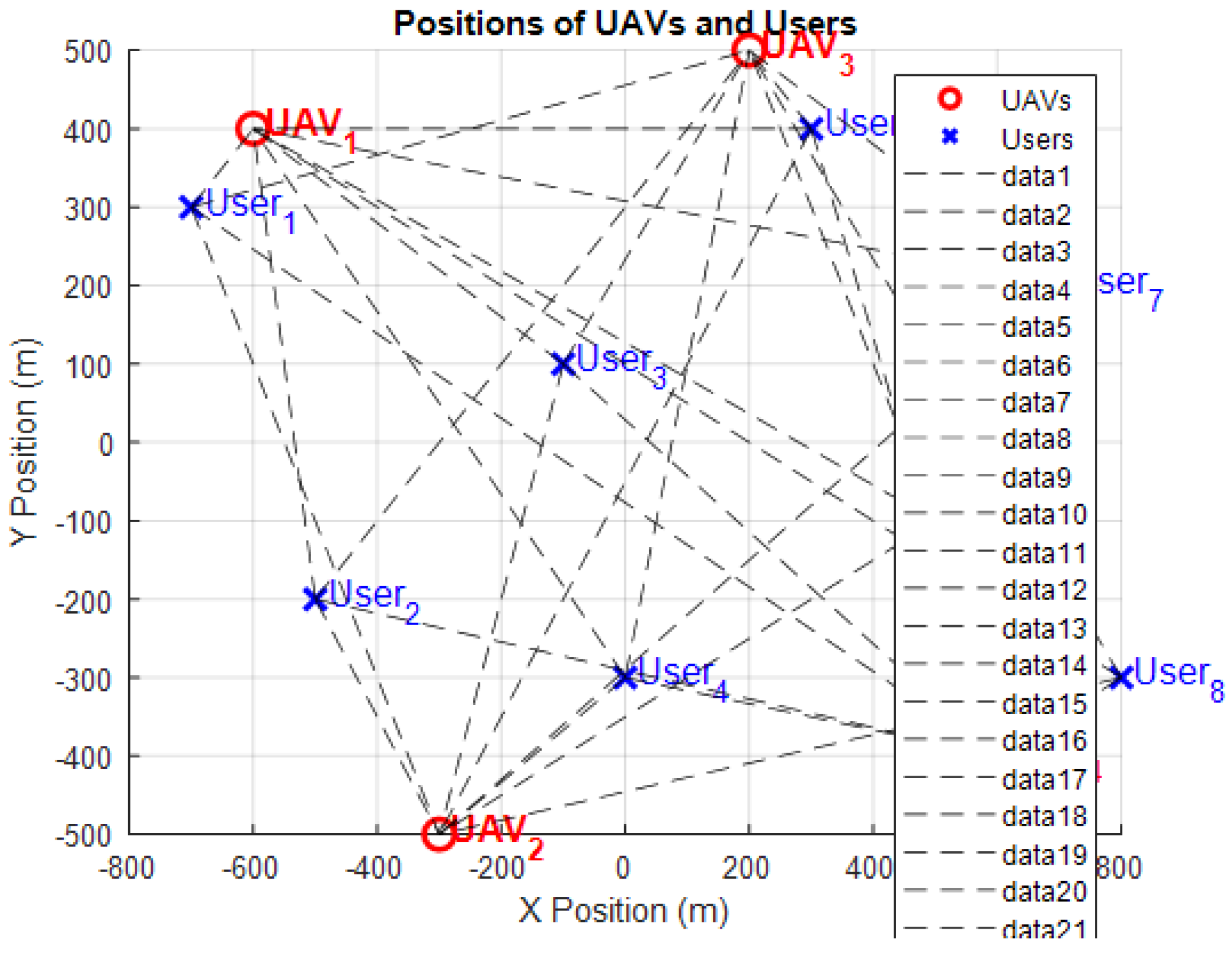
We present our evaluation of our method’s performance in direct comparison with research that focuses on maintaining guaranteed energy consumption for ground users in UAV-assisted networks. Our proposed design was tested in a simulation environment (on an i7-core processor) using MATLAB 2022b, featuring four UAVs and eight ground users randomly placed within a 1000 × 1000 m 2 area. Table 4 lists the evaluation parameters.
We conducted all simulations 50 times independently, using randomly generated user positions and channel realizations for each run. To ensure a fair comparison, we started the UAVs from the same initial positions in every simulation. The figures present the average performance over these 50 runs. We simulated up to 200 outer iterations or continued until the specified condition was met. Additionally, we also verified that increasing the number of simulation runs to 100 did not change the overall trends, indicating that the results are statistically stable.
This simulation provides a clear visual representation of how different benchmarks and fading models affect the distribution of signal intensity. The findings could help design and optimize networks from the air for UAV-enabled communication systems and enhance our understanding of wireless channels under different conditions. Additionally, we connect the probability of LoS and NLoS to the UAVs’ elevation angle in Figure 2 during communication. Hence, we consider practical Rician fading channels with a Rician factor K c . The Marcum-Q function denotes the cumulative distribution function (CDF) of these channels Q 1 (a, b). Figure 3 shows the location of UAVs and ground users in this work. One UAV is able to serve all users, but the joint scheduling and trajectory optimization schemes are proposed to make them communicate with each other.
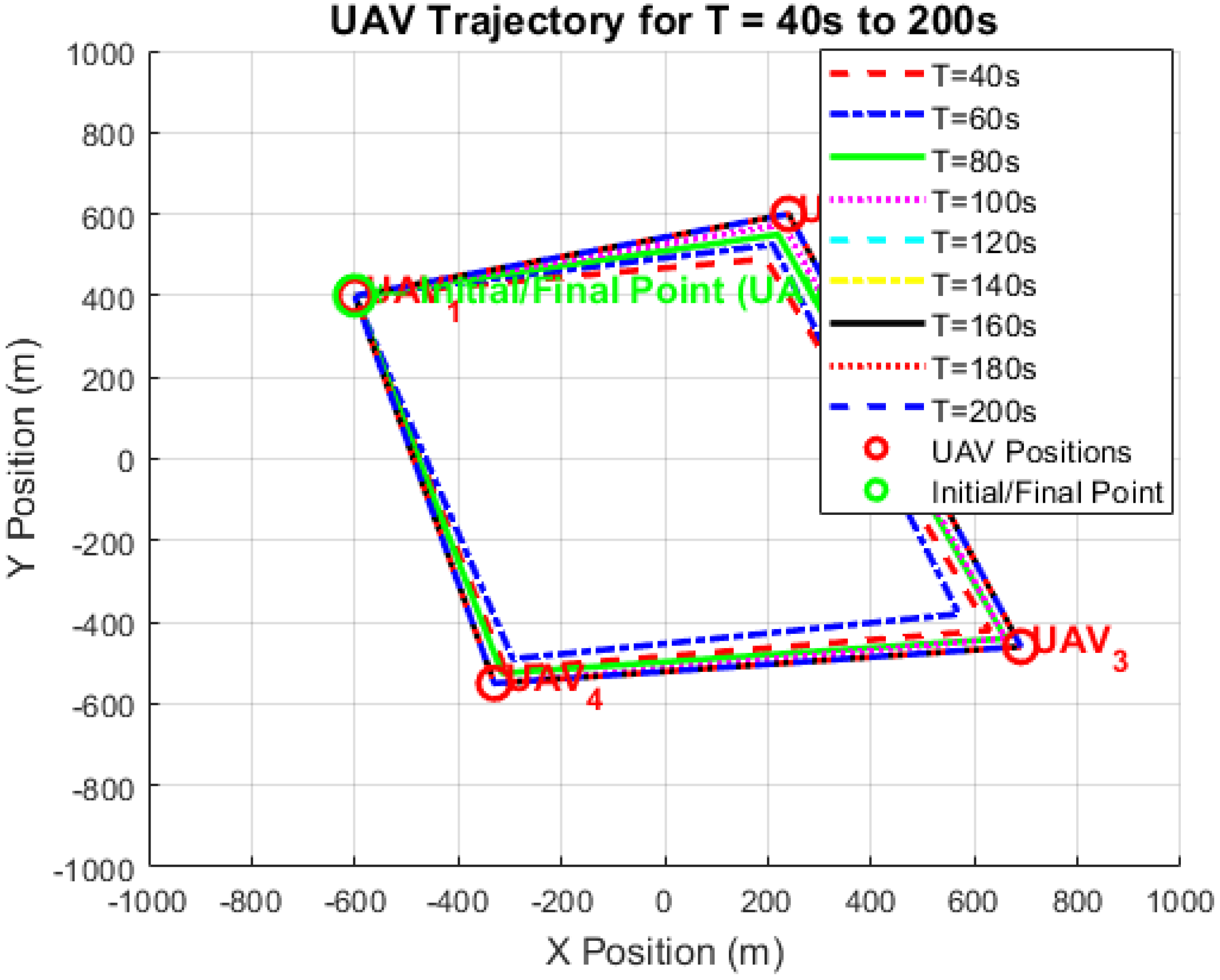
Figure 4 shows the optimized trajectories for different T starting from T = 40 s, which proves that, with the aid of effective scheduling, UAV-optimal trajectory optimization can effectively improve the communication between UAV and ground users, leading to a larger transmission rate as time goes on. One UAV achieves the signal from multiple ground users and only establishes synchronization with one ground user at a time to use high-quality data transmission for channel power gain.
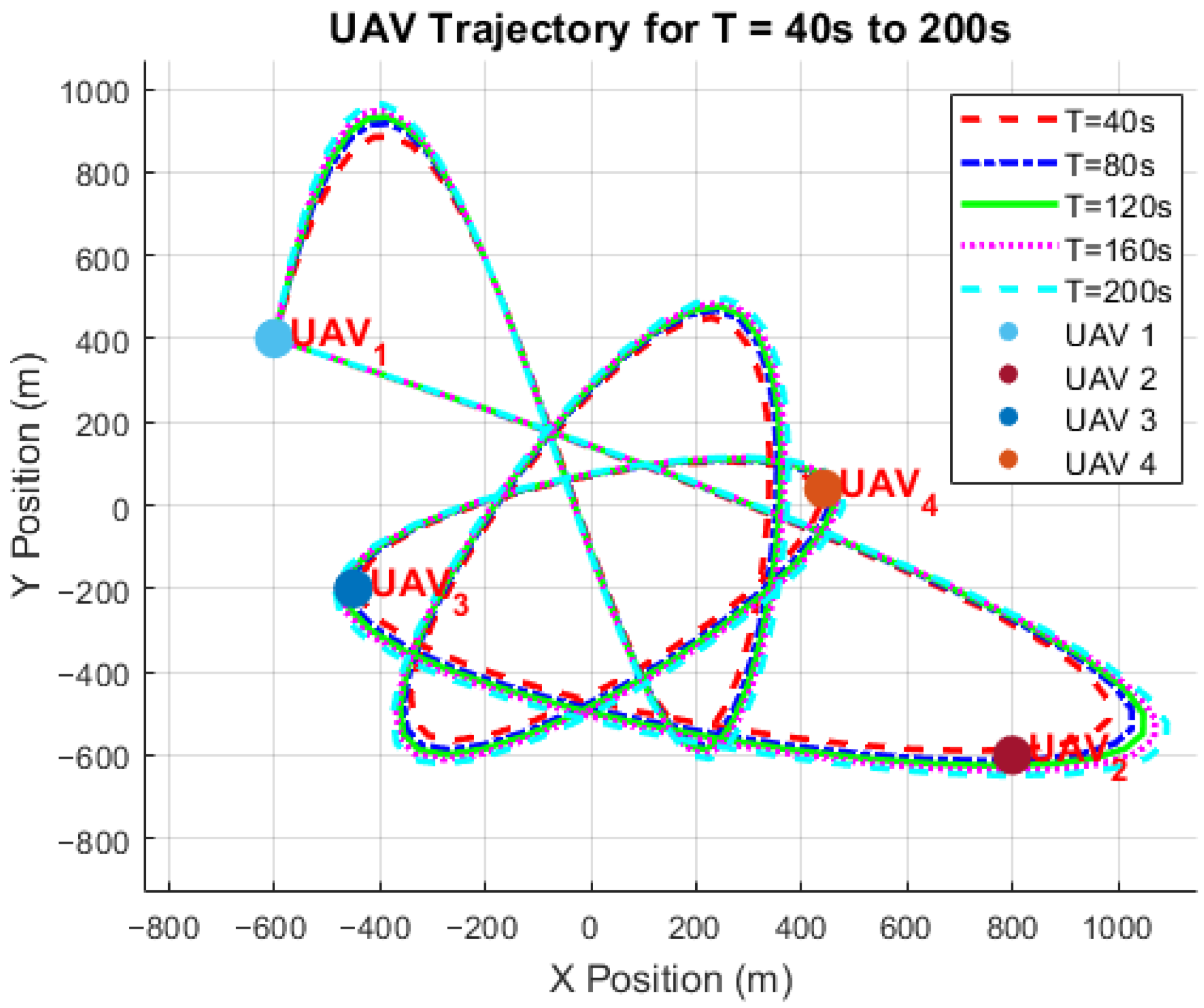
Figure 5 illustrates the UAV trajectory, with continuous flight formulation for several values of T. As T increases, the UAV adjusts its trajectory to boost efficiency, resulting in a higher transmission rate. The continuous formation flight distributes the energy load, necessitating coordinated energy management along with short-range sensing and delivery services.
Figure 4 and Figure 5 illustrate the optimized trajectory used in this study. Instead of flying in a wide loop or hovering at a single static point, the UAV traces a path that brings it closer to each ground user exactly when that user is scheduled for transmission. This is no coincidence: the joint optimization explicitly balances the energy cost of moving the UAV with the energy required for communication to achieve the required data rate. In those zones, the channel gains are high, so the UAV can transmit at lower power while still hitting the rate targets. The algorithm essentially trades propulsion energy for significant savings in transmission power. If the UAV hovered at a central point, it would need much higher transmit power to reach far-away users, wasting communication energy.
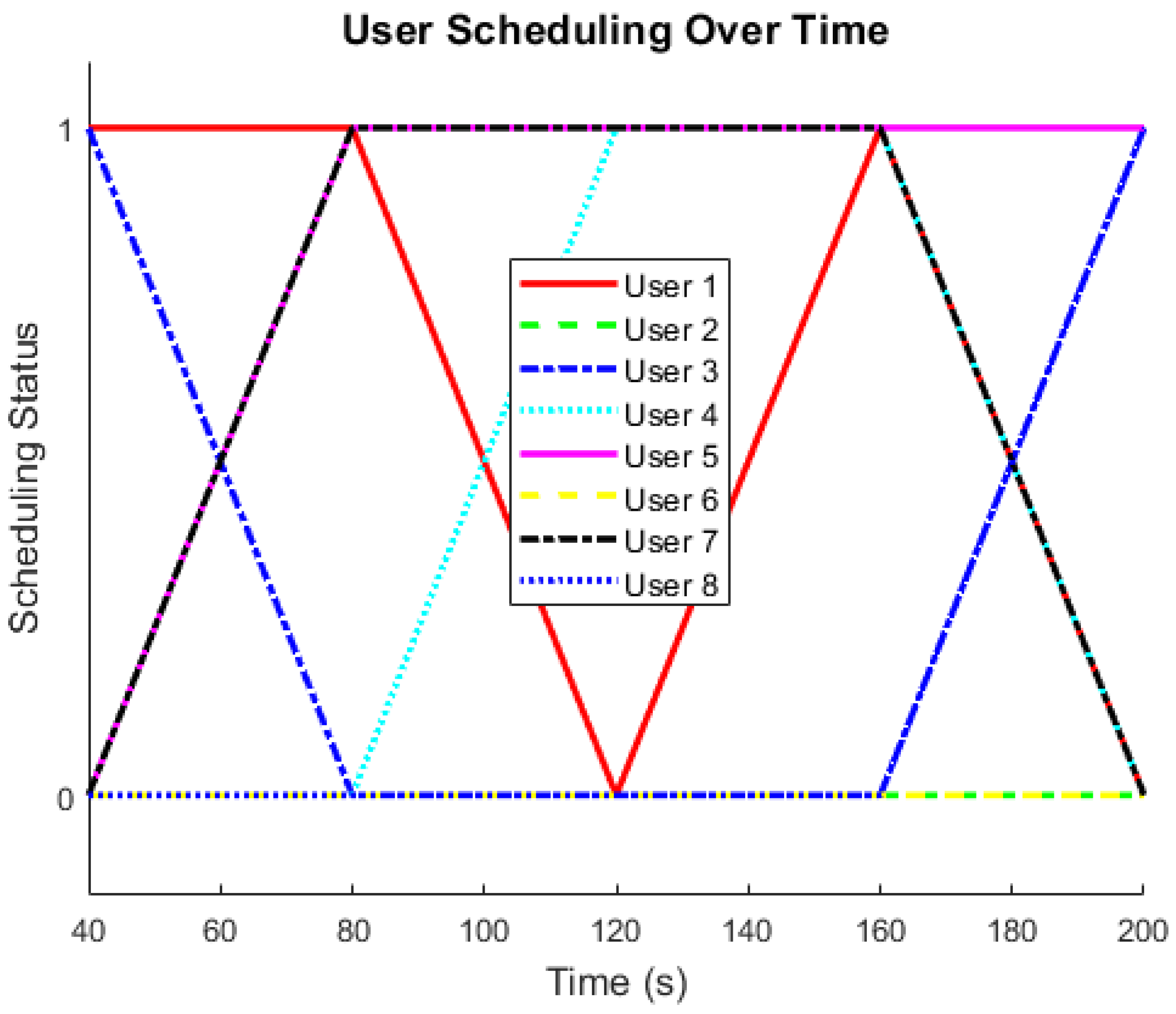
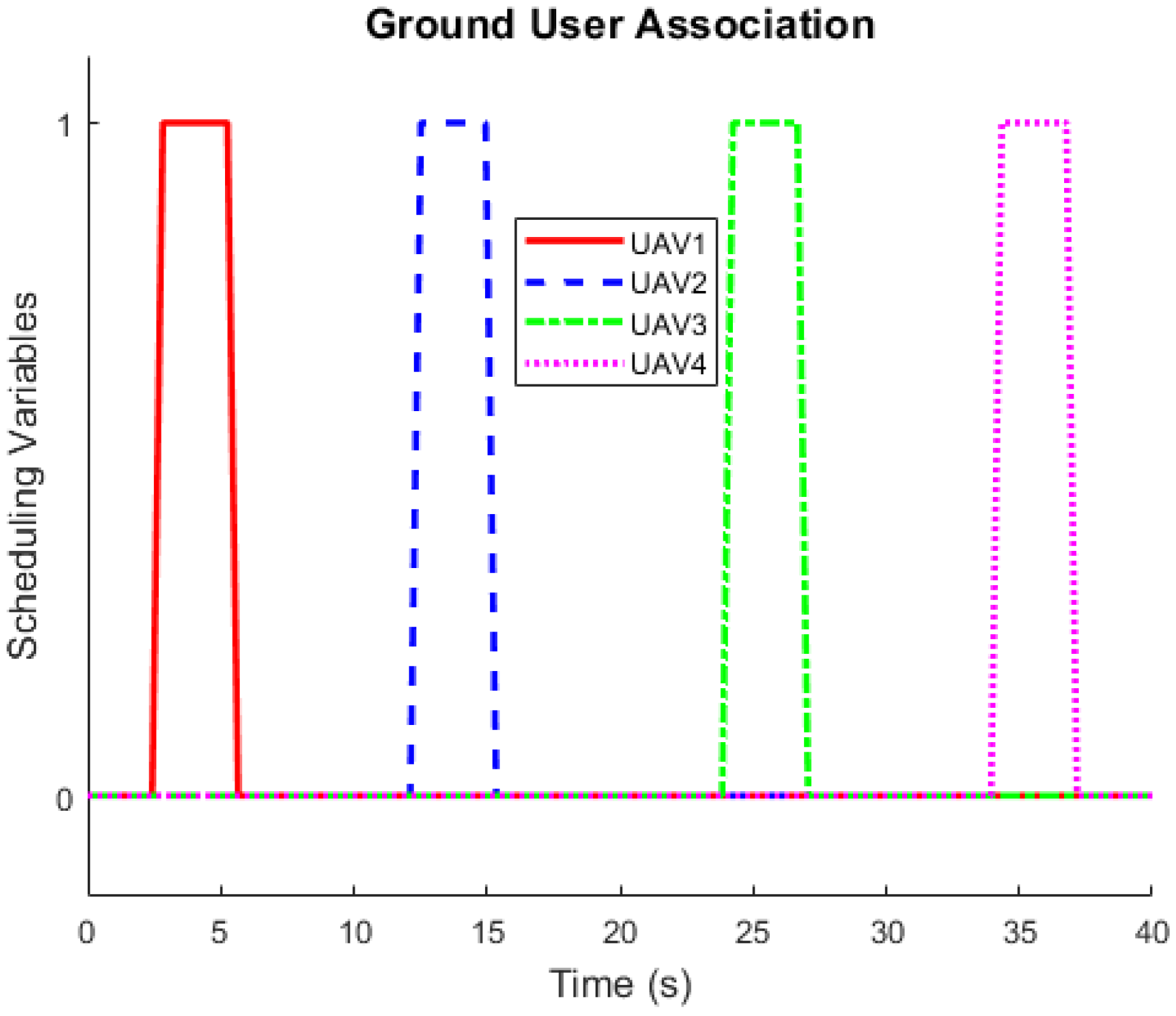
Figure 6 illustrates the scheduling of ground users, and Figure 7 shows the association of UAV trajectories with the delivery service during the specified period. To ensure optimal energy use and maximize data transmission, ground users do not communicate with the UAV until the schedule and trajectory have been optimized. The UAV’s trajectory closely mirrors that generated by the SCA for energy maximization. This similarity arises because the UAV hovers over ground users with smooth turning angles in both trajectories, achieving a balanced compromise between maximizing data rates and minimizing energy consumption.

6.1. Performance Analysis

This subsection compares the performance of our joint optimization methods against baseline schemes: fixed UAV and straight flight. The comparison aims to demonstrate the effectiveness of our method in terms of maximum energy consumption, outage probability target, and data transmission.
Fixed UAV Position: The UAV was positioned at the geometric center of the ground users. Because the ground users transmit data over long distances, higher transmission energy is required to overcome path loss. To reduce energy consumption, a scheduling mechanism should be implemented to optimize data transmission from the ground users. The data transmission rate from the ground users to the UAV remains constant because the UAV is fixed at the center of the geometric area, as shown in Equation (29). Consequently, the UAV’s stationary position results in a constant trajectory, which can be mathematically represented by Equation (30):
W s t a t i c = 1 i i = 1 I W i
W [ n ] = W s t a t i c N
Ground users located far apart experience significant path loss, which results in longer transmission delays in order to achieve the desired data rate. As a result, optimally tuning the energy required for communicating with the UAV becomes challenging. Additionally, the current process energy consumption management has several drawbacks. To address these issues, this work presents a solution that focuses on energy efficiency for ground users in power line communication. This approach aims to achieve a better data rate while also considering the energy needed for UAV propulsion within the network.
Straight Flight: In this condition, the UAV travels in a straight line from the starting point to the endpoint. The UAV’s distance from ground users changes over time. Although the UAV follows this path, it does not prioritize maximizing the energy efficiency of the ground users. Occasionally, ground operator scheduling occurs but is limited by this fixed linear path. Therefore, the UAV maintains a straight trajectory at a constant speed, as shown in Equation (31).
V = W F W 0 T
The UAV powers on and proceeds straight to the destination at constant speed. In forward-straight-flight mode, it flies in a straight line from one endpoint to another, allowing it to cover a larger flying area and approach multiple ground users during its flight. Moreover, this mobility leads to a significant advantage in terms of the user behavior compared to these two static systems: each ground user only sends information when the UAV is closest to it. This creates an optimal moment for communication:
  • Higher speeds result in links that are two to six times shorter, enabling much higher data rates.
  • Reducing the length of transmission windows is more energy-friendly.
Therefore, the straight flight trajectory can be expressed by Equation (32) as follows:
W [ n ] = W 0 + n 1 N 1 ( W F W 0 ) , N
However, there are inherent limitations in this method. The UAV cannot deviate from the flight path in order to stay longer near users or reposition for enhanced signal quality. This approach is superior to the strategy of static deployment, where a fixed UAV flight always creates a long distance over which ground users must send their signals. However, it does not actively minimize the distance between itself and any user on the ground.
Optimization Flight: The optimized flight involves the design of the UAV’s trajectory and the ground user schedule with regard to minimizing the maximum energy consumption of these users. This optimization is performed while ensuring reliable data delivery and considering the UAV’s propulsion energy. The complete mathematical formula of the trajectory, as in Equation (33), along with the velocity of UAVs, is detailed as follows:
w * [ n ] w i w straight [ n ] w i
w * [ n ] w * [ n 1 ] δ t < V max
where w * [ n ] is the optimized position of the UAV in step n, and V max is the maximum speed value for the UAV. Here, w i represents the position of the i th ground user, and Δ t is the time difference between the steps.
Cooperative optimization plays a crucial role in improving the energy efficiency of UAV-enabled networks. It offers a comprehensive view that connects different operational aspects, thereby improving overall performance. These techniques capitalize on resource allocation, trajectory control, and user association to enhance aerial access while minimizing energy consumption. This layered approach is instrumental in ensuring effective and sustainable operational strategies that are resilient towards changing circumstances.
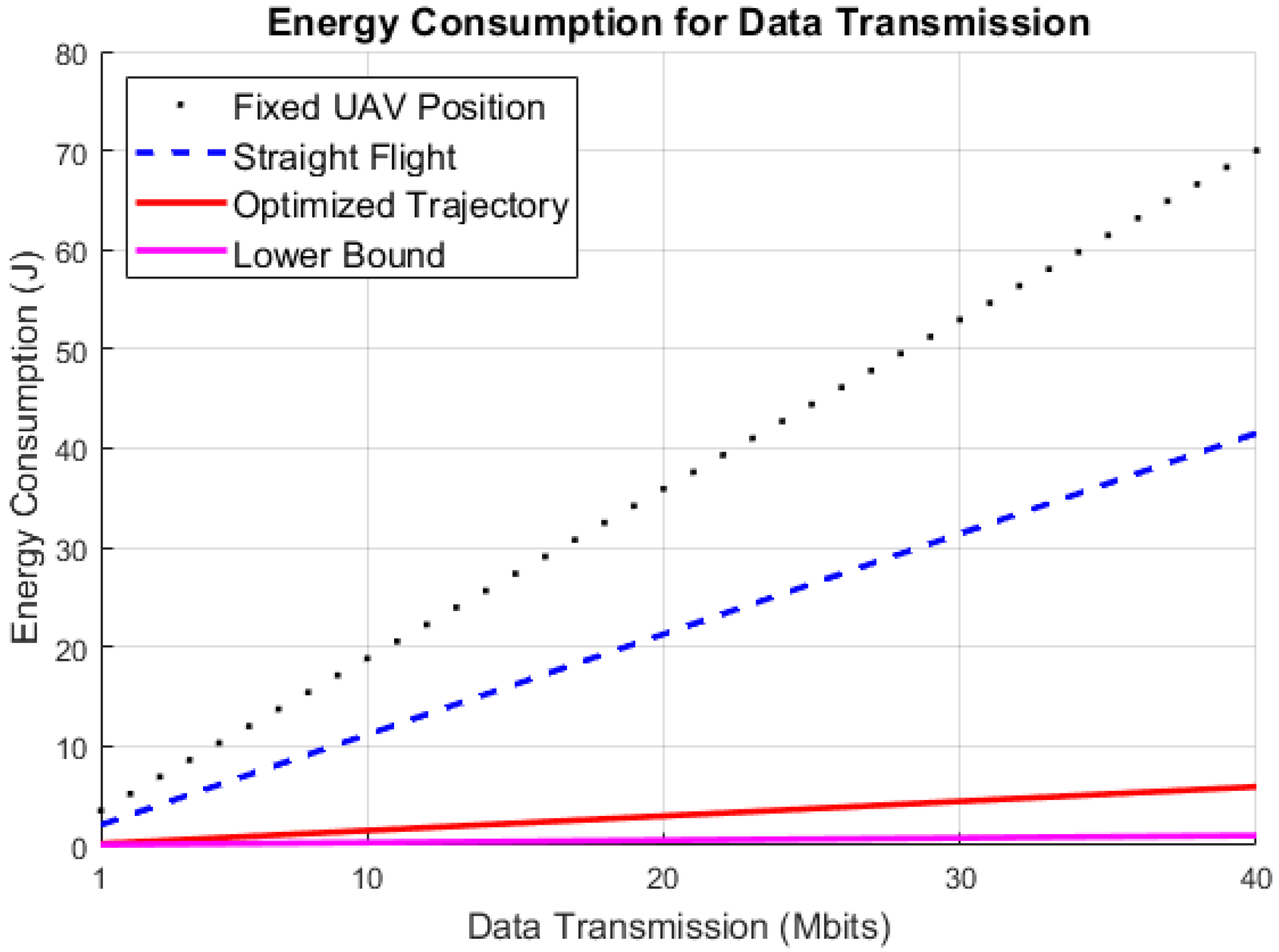
In our study, we evaluate a benchmark case where UAVs maintain constant velocities. One UAV remains stationary at the geometric center and moves straight from the starting point to the destination, while another moves directly from the starting point to the destination. In Figure 8, we compare the energy consumption of our optimized UAV-enabled network trajectory against that of a fixed UAV positioned in straight formation. Our strategy enhances the communication both among UAVs and between them and ground users through joint scheduling and energy-efficient trajectory optimization. This approach maximizes data transmission rates while minimizing power consumption. Our scheme outperforms the baseline schemes, demonstrating greater performance improvements as the volume of transmitted data increases. It is expected because our approach enables the UAV to fly/hover over ground users, leading to better communication links. Consequently, ground users can transmit higher-rate data more reliably, more accurately, and with less power and UAV propulsion energy. We remark that, even when continuous trajectory variables are almost discrete, finding the optimal solution of this problem is still very difficult.
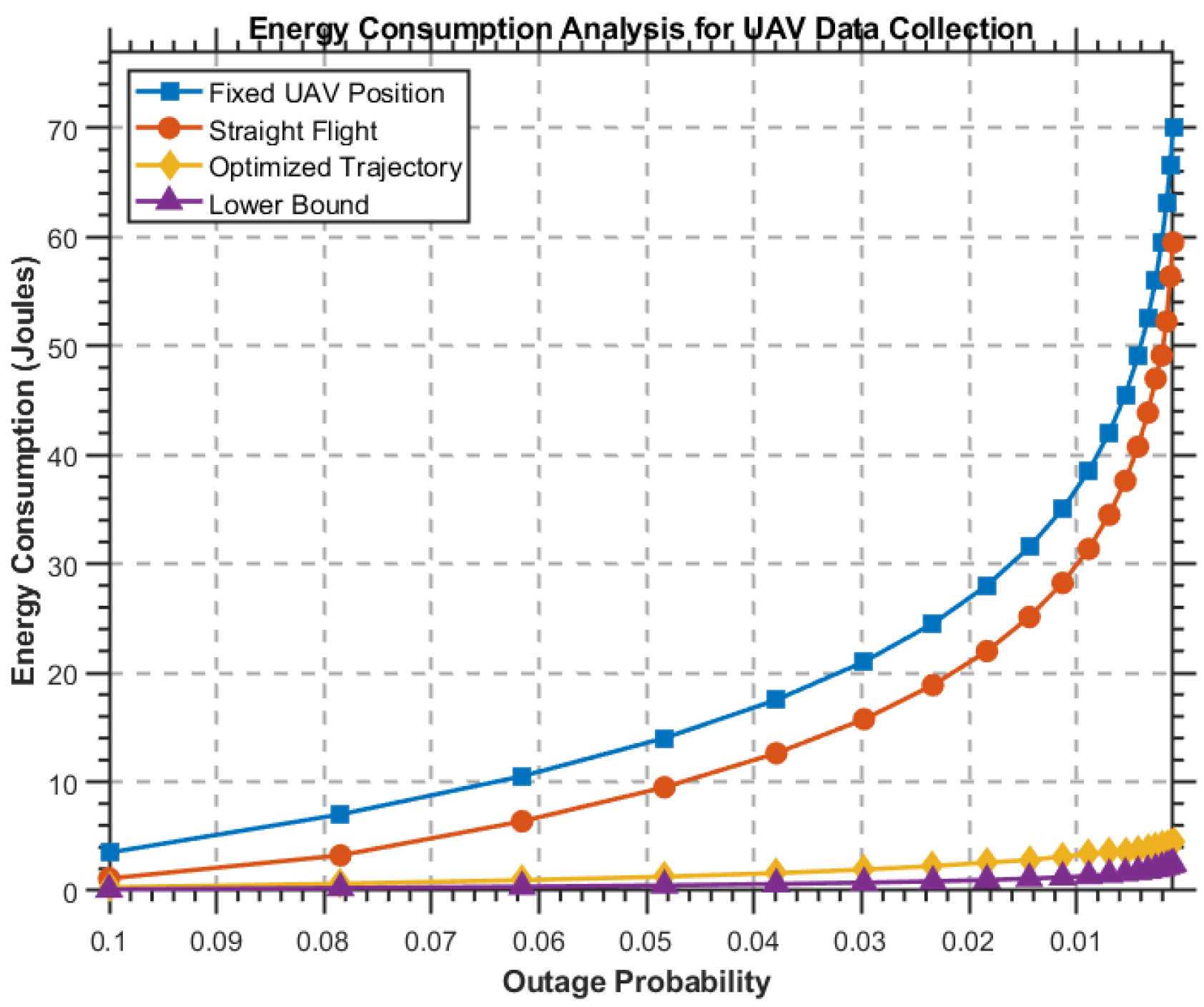
We demonstrate the effectiveness of our proposed design by contrasting it with benchmarks and a lower bound of minimized energy, as illustrated in Figure 8 and Figure 9. This lower bound assumes that the UAV ignores flight time and focuses solely on planning and transmitting data directly to each ground user. The performance of our proposed design shows only a slight difference from this lower bound, indicating that our approach is quite close to the ideal solution for the specified configuration.
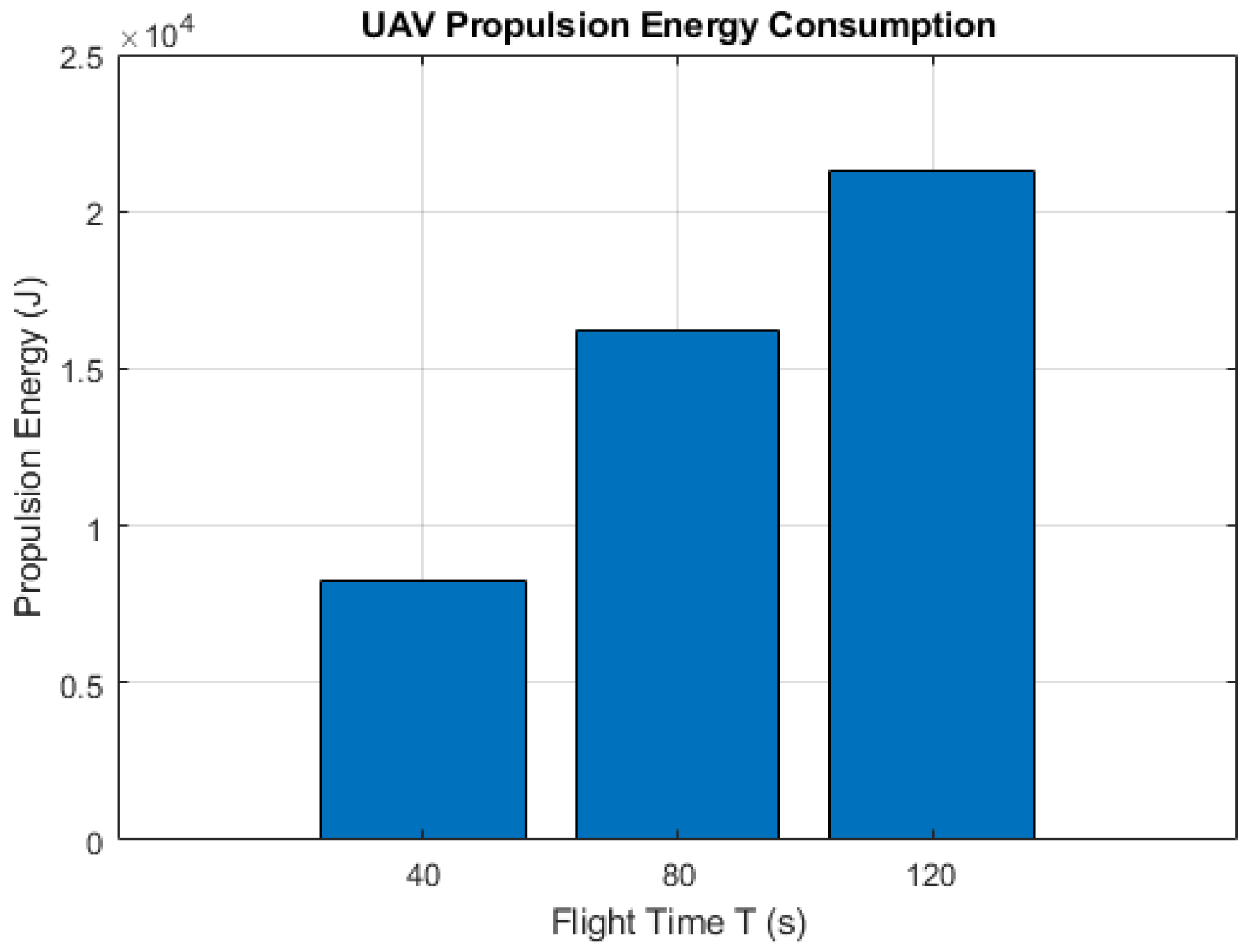
When the flight time T is short, the UAV needs to cover a specific set of areas at a higher average speed. In this scenario, the induced power term becomes relatively small, while the profile power, especially parasite power, dominates. As a result, the total propulsion energy increases sharply with rising speed. Conversely, when the flight time T is long, the UAV operates at a slower speed; the induced power term becomes more significant because the rotor works less efficiently at lower speeds. Consequently, the total energy rises again, though more gradually. The nonlinearity depicted in Figure 10 indicates the existence of an optimal speed at which both ground user scheduling and the UAV trajectory are minimized for a given mission distance. Our joint optimization process naturally identifies this optimal speed while coordinating the schedule. This relationship demonstrates that the propulsion energy scaling is not arbitrary; rather, it is a direct consequence of the rotor-craft physics, as captured in Equation (25). Our findings are consistent with this theoretical expectation.
The propulsion energy results show a generally reasonable trend of increasing energy use with flight time. However, the relationship between energy use and time requires further explanation. For a 40 s flight, 8265.50 J (2.30 Wh) is consumed, giving an average power of 206.6 W, which is plausible for a UAV. If energy consumption were to scale strictly linearly with time, a 120 s flight would consume about three times more energy than the 40 s flight. Instead, energy rises from 8265 J to 21,314 J, an increase of only about 2.6 times. This indicates that the model likely includes higher efficiency during longer, steady-state cruise, so energy does not increase as quickly with time. The concurrent drop in average power from 209 W to 178 W further suggests that the UAV optimizes performance for better efficiency during extended flights, which is in line with real-world UAV behavior.
This work considers the joint optimization of ground user scheduling and UAV trajectory, with an explicit focus on ground users’ and UAV propulsion energy. The problem we address is how to maximize the energy efficiency in a UAV-enabled network. The goal is to effectively manage power consumption while maintaining service quality. To demonstrate the effectiveness of our proposed work, we compare it with related studies by Chen et al. [30], Guo et al. [47], Wu et al. [57], and Tian et al. [58]. We focus on overall energy efficiency for all ground users with respect to UAV propulsion energy. Table 5 presents a comparison of our approach with baseline studies in terms of energy consumption and data transmission rates for ground users and UAVs.
Our proposed approach outperforms current methods by better balancing data transmission speed and energy efficiency. Compared to Chen et al., the propulsion energy of the UAVs has been reduced by 8% while keeping data rates on par. Compared to Guo et al., we hold ground user energy steady at 5 J regardless of mission duration, so at 40 s, we use 54.5% less energy, and at 120 s, 70.6% less, all while delivering a steady 10–20 bps/Hz. Compared to Wu et al., our data rate jumps more than five times higher (10–20 bps/Hz versus 1.8 bps). Moreover, while Tian et al. use less sensor energy (2.5 J vs. our 5 J), our data rate is substantially higher (10–20 bps/Hz vs. 30 bps), proving that we are not just saving power but also moving much more data. Overall, our proposed methods demonstrate flexibility in being able to tune the trade-off and energy savings in some cases without sacrificing strong data performance across different flight times.

6.2. Algorithm Performance

In this section, we compare the algorithms’ performance.

6.2.1. Rician K-Factor

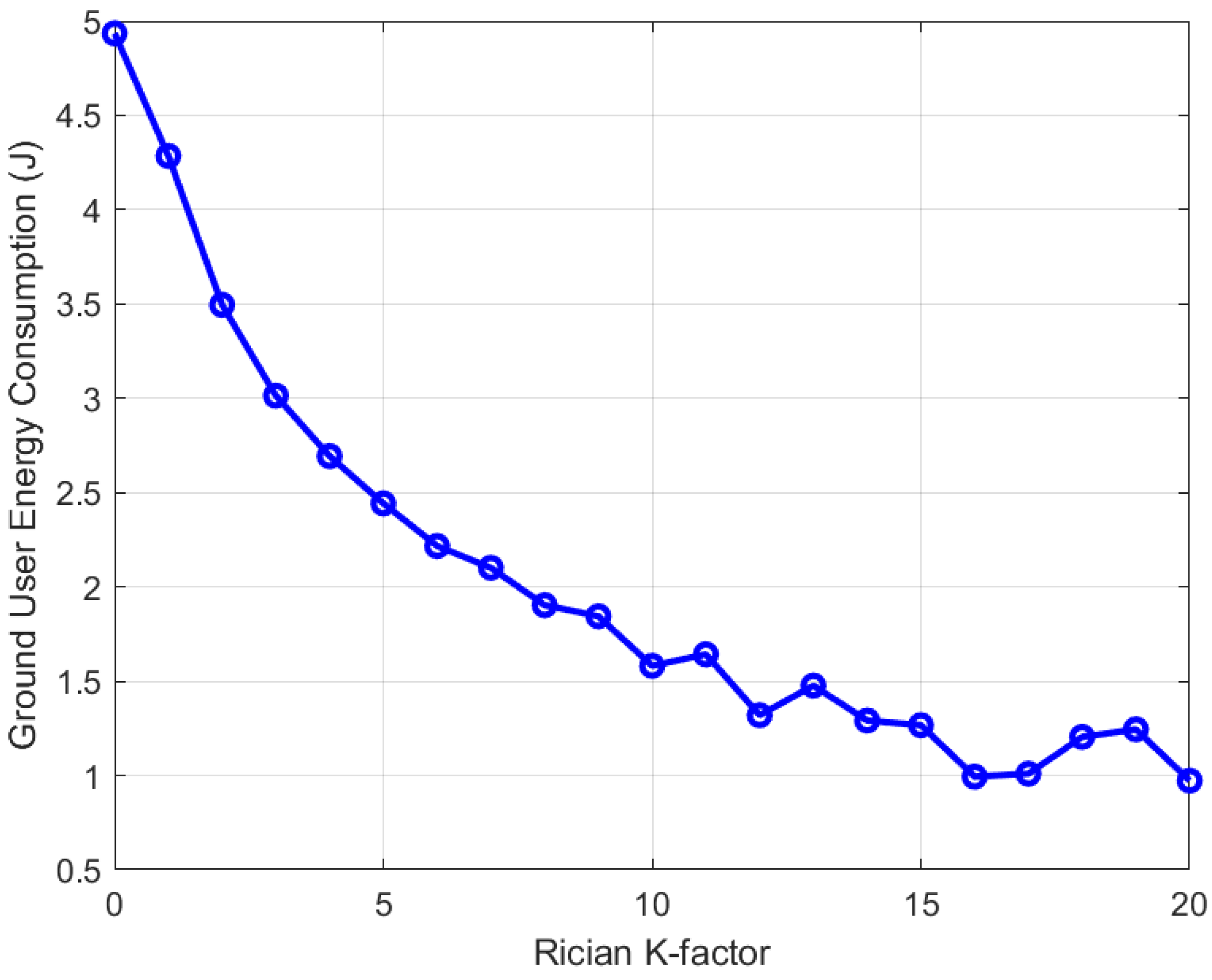
Figure 11 shows how energy consumption changes with the Rician K-factor. The K-factor reflects the clarity of the signal path between the UAV and ground users, with higher values indicating a stronger, more direct LoS connection. In contrast, our proposed model accounts for the variability observed in real-world scenarios. Simple models assume that all connections work in the same manner; however, performance varies depending on how well users can see the UAV and, effectively, how well they can receive signals that are more scattered or reflected.

6.2.2. BCD Convergence

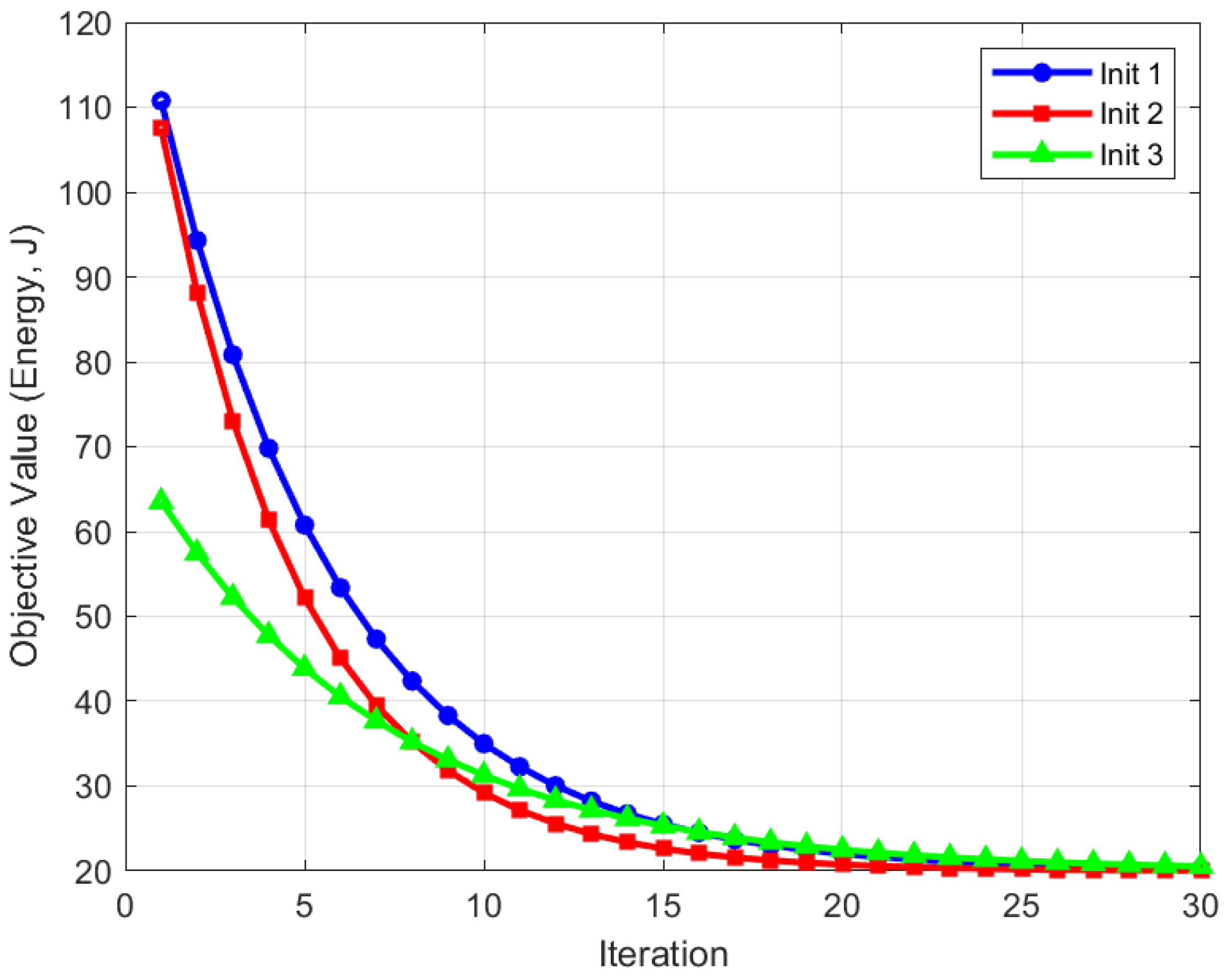
We evaluated the efficacy of our BCD algorithm originating from diverse locations. Figure 12 demonstrates that, regardless of the initial setup, the algorithm consistently produces a favorable result after 15 to 20 attempts. We tested it using three different random initializations. Additionally, our coupling technique keeps scheduling and trajectory decisions synchronized, allowing the solution to improve at each step without making random jumps.

6.2.3. Scalability

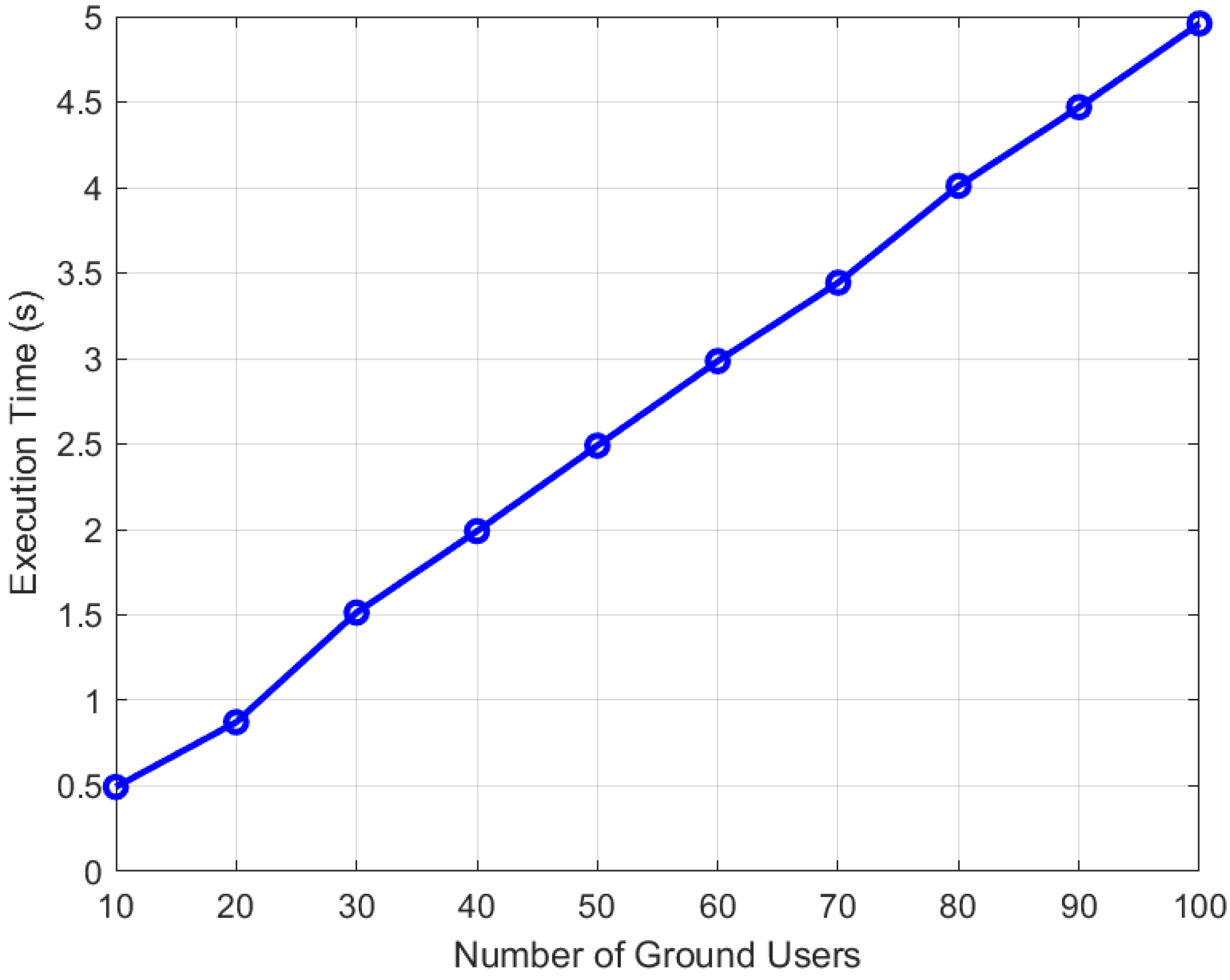
One major concern was whether our method would remain effective as networks grew larger. Figure 13 addresses this. We conducted tests with up to 100 ground users, more than a UAV system would typically require in most crisis situations. While processing the data took longer with increased usage, it was found that the processing time roughly doubled as the number of users doubled, which is acceptable. Even with 100 users, the convergence stayed steady and performed well.

6.2.4. Outage Probability Constraints

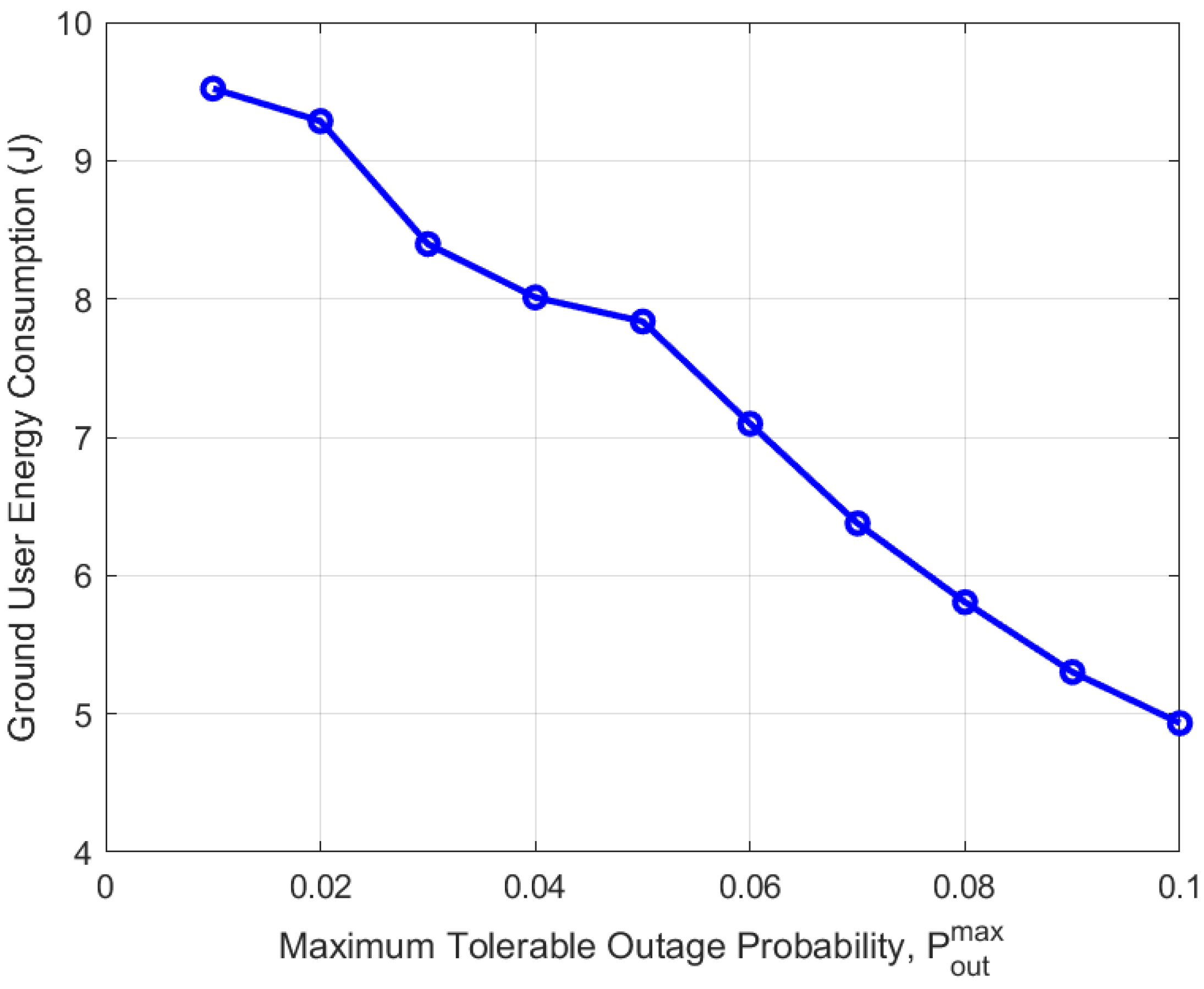
Figure 14 shows a classic trade-off: the model that consumes energy is the one that is willing to make connections more stable. It highlights how often we tolerate connections that do not meet expectations.
When stricter rules are in place (resulting in fewer dropped connections), users must use more power to maintain a reliable connection. Consequently, this leads to increased energy consumption. Our method excels at identifying effective solutions, regardless of how stringent the reliability standard may be.

6.2.5. Multi-UAV Impact

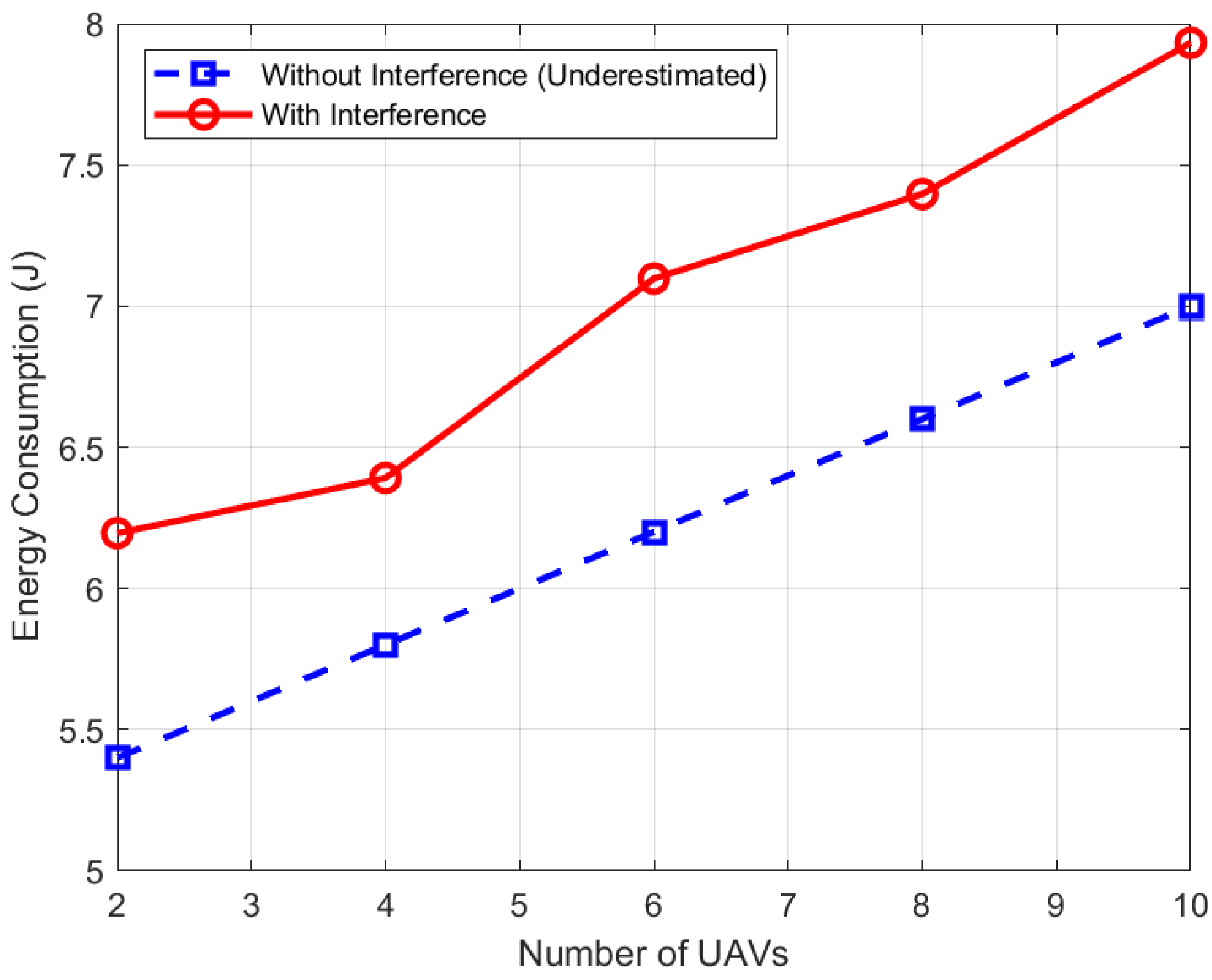
Figure 15 highlights a crucial point regarding how multiple UAVs affect each other’s energy consumption. When we factored in interference, the actual energy usage was found to be 10–18 higher than the best-case estimates that did not account for it. This significant difference emphasizes the importance of our complete energy model. UAVs do not operate in isolation in the real world; they share airspace and communication spectra, which affects everyone’s energy budget.

7. Conclusions

In the event of a loss involving non-line-of-sight links, our study proposes a new design that leverages energy-efficient information transmission and reception in UAV-enabled systems. To ensure reliable data transmission in Rician fading channels while minimizing energy consumption and enhancing data delivery for all ground users, we jointly optimize the UAV’s trajectory (a continuous variable) and the scheduling of ground users (a discrete variable). We cast this problem as a MINCO and break it into subproblems. To address it, we use joint optimization for ground user scheduling via continuous relaxation and linear programming. We also use an iterative SCA-based trajectory optimization algorithm. Furthermore, we use the BCD technique to handle multiple decision variables in the subproblem constraints. The BCD architecture guarantees step-by-step updates that help the system converge on optimal solutions for user scheduling, trajectory optimization, and energy-efficient management of the UAV-enabled system. This design framework can be easily generalized to cope with co-channel interference and data computation at the mobile edge computing server. The trade-off between better direct links and reduced interference is critical in UAV trajectory optimization. This must focus on the computational abilities of ground users and UAVs. Future investigations will focus on this interesting question.

Author Contributions

Conceptualization, C.H.T. and L.Y.; methodology, C.H.T.; software, C.H.T.; validation, C.H.T., L.Y., and J.M.; formal analysis, C.H.T.; investigation, C.H.T.; resources, Z.X.; data curation, S.A.C.; writing—original draft preparation, C.H.T. and J.M.; writing—review and editing, L.Y., Z.X., A.K.D., and S.A.C.; visualization, L.Y., J.M., and S.A.C.; supervision, L.Y. and Z.X.; project administration, L.Y., Z.X., and S.A.C.; funding acquisition, S.A.C. All authors have read and agreed to the published version of the manuscript.

Funding

The work of Shehzad Ashraf Chaudhry was supported by the Abu Dhabi University’s Office of Research and Sponsored Programs under Grant 19300906.

Data Availability Statement

The original contributions presented in this study are included in the article. Further inquiries can be directed to the corresponding authors.

Acknowledgments

The first author acknowledges the Chinese Scholarship Council (CSC) and the State Key Laboratory of Integrated Service Networks of Xidian University for their support, who gave him a golden opportunity to study in China.

Conflicts of Interest

The authors declare that they have no conflicts of interest regarding this manuscript. We confirm that this manuscript is the author’s original work and has not been published or submitted simultaneously elsewhere. All the authors know and approve of the submission and comply with the journal of Drones’ ethical standards regarding plagiarism, authorship, and data integrity.

References

  1. Karaman, B.; Basturk, I.; Taskin, S.; Kara, F.; Zeydan, E.; Yanikomeroglu, H. Enhancing Resiliency of Integrated Space-Air-Ground-Sea Networks with Renewable Energies: A Use Case After the 2023 Türkiye Earthquake. IEEE Commun. Mag. 2024, 62, 104–111. [Google Scholar] [CrossRef]
  2. Kwasinski, A. Effects of Hurricane Ian on Communication Networks and Electric Power Infrastructures. In Proceedings of the 2023 Resilience Week (RWS); IEEE: Piscataway, NJ, USA, 2023; pp. 1–7. [Google Scholar]
  3. Paniagua-Gómez, M.; Fernandez-Carmona, M. Trends and Challenges in Real-Time Stress Detection and Modulation: The Role of the IoT and Artificial Intelligence. Electronics 2025, 14, 2581. [Google Scholar] [CrossRef]
  4. Zeng, Y.; Zhang, R.; Lim, T.J. Wireless communications with unmanned aerial vehicles: Opportunities and challenges. IEEE Commun. Mag. 2016, 54, 36–42. [Google Scholar] [CrossRef]
  5. Yang, S.; Luo, Y.; Miao, W.; Ge, C.; Sun, W.; Luo, C. RF signal-based UAV detection and mode classification: A joint feature engineering generator and multi-channel deep neural network approach. Entropy 2021, 23, 1678. [Google Scholar] [CrossRef]
  6. Bor-Yaliniz, I.; Yanikomeroglu, H. The new frontier in RAN heterogeneity: Multi-tier drone-cells. IEEE Commun. Mag. 2016, 54, 48–55. [Google Scholar] [CrossRef]
  7. Hayat, S.; Yanmaz, E.; Muzaffar, R. Survey on unmanned aerial vehicle networks for civil applications: A communications viewpoint. IEEE Commun. Surv. Tutor. 2016, 18, 2624–2661. [Google Scholar] [CrossRef]
  8. Mohsan, S.A.H.; Khan, M.A.; Noor, F.; Ullah, I.; Alsharif, M.H. Towards the unmanned aerial vehicles (UAVs): A comprehensive review. Drones 2022, 6, 147. [Google Scholar] [CrossRef]
  9. Zhan, C.; Zeng, Y.; Zhang, R. Energy-efficient data collection in UAV enabled wireless sensor network. IEEE Wirel. Commun. Lett. 2017, 7, 328–331. [Google Scholar] [CrossRef]
  10. Alzenad, M.; El-Keyi, A.; Yanikomeroglu, H. 3-D placement of an unmanned aerial vehicle base station for maximum coverage of users with different QoS requirements. IEEE Wirel. Commun. Lett. 2017, 7, 38–41. [Google Scholar] [CrossRef]
  11. Tesfay, C.H.; Xiang, Z.; Yang, L.; Berwo, M.A.; Mahmood, J.; Chaudhry, S.A. An effective and efficient UAV leader selection scheme in swarm of UAVs. Phys. Commun. 2024, 67, 102513. [Google Scholar] [CrossRef]
  12. Zeng, Y.; Zhang, R.; Lim, T.J. Throughput maximization for UAV-enabled mobile relaying systems. IEEE Trans. Commun. 2016, 64, 4983–4996. [Google Scholar] [CrossRef]
  13. Liao, Y.; Chen, X.; Xia, S.; Ai, Q.; Liu, Q. Energy minimization for UAV swarm-enabled wireless inland ship MEC network with time windows. IEEE Trans. Green Commun. Netw. 2022, 7, 594–608. [Google Scholar] [CrossRef]
  14. Qian, L.P.; Zhang, H.; Wang, Q.; Wu, Y.; Lin, B. Joint multi-domain resource allocation and trajectory optimization in UAV-assisted maritime IoT networks. IEEE Internet Things J. 2022, 10, 539–552. [Google Scholar] [CrossRef]
  15. Dai, H.; Yang, Y.; Zhang, K.; Hao, J.; Li, B. Spectrum and Energy Efficiency Optimization for UAV Enabled Integrated Sensing and Communication. In Proceedings of the 2025 IEEE 25th International Conference on Communication Technology (ICCT); IEEE: Piscataway, NJ, USA, 2025; pp. 1064–1068. [Google Scholar]
  16. Tan, X.; Tian, F.; Feng, X.; Wu, W. Energy-Efficient Optimization for UAV-ISAC with Joint Adaptive Task Scheduling, Power Allocation and Trajectory Planning. In Proceedings of the 2025 IEEE 25th International Conference on Communication Technology (ICCT); IEEE: Piscataway, NJ, USA, 2025; pp. 990–996. [Google Scholar]
  17. Liu, B.; Zhu, H. Energy-effective data gathering for UAV-aided wireless sensor networks. Sensors 2019, 19, 2506. [Google Scholar] [CrossRef]
  18. Wu, H.; Wu, M.; Peng, W.; Chen, S.; Feng, Z. ITS: Improved Tabu Search Algorithm for Path Planning in UAV-Assisted Edge Computing Systems. In Proceedings of the 2023 IEEE International Conference on Web Services (ICWS); IEEE: Piscataway, NJ, USA, 2023; pp. 340–349. [Google Scholar]
  19. Nassereddin, K.; Al-Hubaishi, M. Energy-Efficient Multi-UAV Trajectory Planning Using Machine Learning. In Proceedings of the 2025 International Conference on Intelligent Computing, Information and Control Systems (ICOIICS); IEEE: Piscataway, NJ, USA, 2025; pp. 410–416. [Google Scholar]
  20. Bakirci, M. A Novel Swarm Unmanned Aerial Vehicle System: Incorporating Autonomous Flight, Real-Time Object Detection, and Coordinated Intelligence for Enhanced Performance. Trait. Signal 2023, 40, 2063–2078. [Google Scholar] [CrossRef]
  21. Sun, Y.; Xu, D.; Ng, D.W.K.; Dai, L.; Schober, R. Optimal 3D-trajectory design and resource allocation for solar-powered UAV communication systems. IEEE Trans. Commun. 2019, 67, 4281–4298. [Google Scholar] [CrossRef]
  22. Fu, Z.; Liu, J.; Mao, Y.; Qu, L.; Xie, L.; Wang, X. Energy-efficient UAV-assisted federated learning: Trajectory optimization, device scheduling, and resource management. IEEE Trans. Netw. Serv. Manag. 2025, 22, 974–988. [Google Scholar] [CrossRef]
  23. Al-Hourani, A.; Kandeepan, S.; Lardner, S. Optimal LAP altitude for maximum coverage. IEEE Wirel. Commun. Lett. 2014, 3, 569–572. [Google Scholar] [CrossRef]
  24. Matolak, D.W.; Sun, R. Unmanned aircraft systems: Air-ground channel characterization for future applications. IEEE Veh. Technol. Mag. 2015, 10, 79–85. [Google Scholar] [CrossRef]
  25. Gou, H.; Zhao, S.; Rao, Y.; Zhang, G.; Sha, J.; Lu, Z.; Du, P. Energy-Efficient Trajectory Design and Resource Allocation for Multi-UAV-Enabled ISAC in IoT Networks. IEEE Trans. Consum. Electron. 2025, 72, 1672–1684. [Google Scholar] [CrossRef]
  26. Ponniah, J.; Dantsker, O.D. Strategies for scaleable communication and coordination in multi-agent (uav) systems. Aerospace 2022, 9, 488. [Google Scholar] [CrossRef]
  27. Jing, L.; Wang, H.; Qin, Z.; Zhao, Y.; Zhu, Y.; Zhao, W. Energy-Efficient 3D Trajectory Optimization and Resource Allocation for UAV-Enabled ISAC Systems. Entropy 2026, 28, 248. [Google Scholar] [CrossRef]
  28. Ijaz, H.; Ahmad, R.; Ahmed, R.; Ahmed, W.; Kai, Y.; Jun, W. A UAV-assisted edge framework for real-time disaster management. IEEE Trans. Geosci. Remote Sens. 2023, 61, 1001013. [Google Scholar] [CrossRef]
  29. Li, M.; He, S.; Li, H. Minimizing mission completion time of UAVs by jointly optimizing the flight and data collection trajectory in UAV-enabled WSNs. IEEE Internet Things J. 2022, 9, 13498–13510. [Google Scholar] [CrossRef]
  30. Chen, Q. Joint trajectory and resource optimization for UAV-enabled relaying systems. IEEE Access 2020, 8, 24108–24119. [Google Scholar] [CrossRef]
  31. Cao, S.; Zhan, Z.; Dai, C.; Chen, S.; Zhang, W.; Han, Z. Delay-aware and energy-efficient IoT task scheduling algorithm with double blockchain enabled in cloud–fog collaborative networks. IEEE Internet Things J. 2023, 11, 3003–3016. [Google Scholar] [CrossRef]
  32. Wang, X.; Wu, P.; Yuan, X.; Hu, Y.; Zhang, Y. Joint Trajectory and User Scheduling Design for UAV-Assisted Secure Communication. In Proceedings of the 2024 19th International Symposium on Wireless Communication Systems (ISWCS); IEEE: Piscataway, NJ, USA, 2024; pp. 1–6. [Google Scholar]
  33. Al-Hourani, A.; Kandeepan, S.; Jamalipour, A. Modeling air-to-ground path loss for low altitude platforms in urban environments. In Proceedings of the 2014 IEEE Global Communications Conference; IEEE: Piscataway, NJ, USA, 2014; pp. 2898–2904. [Google Scholar]
  34. Sun, R.; Matolak, D.W.; Rayess, W. Air-ground channel characterization for unmanned aircraft systems—Part IV: Airframe shadowing. IEEE Trans. Veh. Technol. 2017, 66, 7643–7652. [Google Scholar] [CrossRef]
  35. Ma, H.; Tao, Y.; Fang, Y.; Chen, P.; Li, Y. Multi-Carrier Initial-Condition-Index-Aided DCSK Scheme: An Efficient Solution for Multipath Fading Channel. IEEE Trans. Veh. Technol. 2025, 74, 15743–15757. [Google Scholar] [CrossRef]
  36. Matolak, D.W.; Sun, R. Air–ground channel characterization for unmanned aircraft systems—Part I: Methods, measurements, and models for over-water settings. IEEE Trans. Veh. Technol. 2016, 66, 26–44. [Google Scholar] [CrossRef]
  37. Esmail, M.A.; Fathallah, H.; Alouini, M.S. Outage probability analysis of FSO links over foggy channel. IEEE Photonics J. 2017, 9, 1–12. [Google Scholar] [CrossRef]
  38. Guerra, A.; Guidi, F.; Dardari, D.; Djurić, P.M. Networks of UAVs of low complexity for time-critical localization. IEEE Aerosp. Electron. Syst. Mag. 2022, 37, 22–38. [Google Scholar] [CrossRef]
  39. Hu, H.; Song, W.; Wang, Q.; Hu, R.Q.; Zhu, H. Energy efficiency and delay tradeoff in an MEC-enabled mobile IoT network. IEEE Internet Things J. 2022, 9, 15942–15956. [Google Scholar] [CrossRef]
  40. Han, Z.; Zhou, T.; Xu, T.; Hu, H. Joint user association and deployment optimization for delay-minimized UAV-aided MEC networks. IEEE Wirel. Commun. Lett. 2023. [Google Scholar] [CrossRef]
  41. Zeng, Y.; Chen, S.; Cui, Y.; Yang, J.; Fu, Y. Joint resource allocation and trajectory optimization in UAV-enabled wirelessly powered MEC for large area. IEEE Internet Things J. 2023, 10, 15705–15722. [Google Scholar] [CrossRef]
  42. Sun, L.; Wan, L.; Wang, J.; Lin, L.; Gen, M. Joint resource scheduling for UAV-enabled mobile edge computing system in Internet of Vehicles. IEEE Trans. Intell. Transp. Syst. 2022, 24, 15624–15632. [Google Scholar] [CrossRef]
  43. Radhakrishnan, V.; Wu, W. Energy Efficient Communication Design in UAV Enabled WPCN Using Dome Packing Method in Water Distribution System. Energies 2022, 15, 3844. [Google Scholar] [CrossRef]
  44. Xie, J.; Fu, Q.; Jia, R.; Lin, F.; Li, M.; Zheng, Z. Optimal Energy and Delay Tradeoff in UAV-Enabled Wireless Sensor Networks. Drones 2023, 7, 368. [Google Scholar] [CrossRef]
  45. Sun, Z.; Yang, D.; Xiao, L.; Cuthbert, L.; Wu, F.; Zhu, Y. Joint energy and trajectory optimization for UAV-enabled relaying network with multi-pair users. IEEE Trans. Cogn. Commun. Netw. 2020, 7, 939–954. [Google Scholar] [CrossRef]
  46. Huang, X.; Wen, Y.; Leng, S.; Zhang, Y. Distributed energy-efficient computation offloading and trajectory planning in aerial edge networks. In Proceedings of the GLOBECOM 2022-2022 IEEE Global Communications Conference; IEEE: Piscataway, NJ, USA, 2022; pp. 1746–1751. [Google Scholar]
  47. Guo, L.; Zhang, S.; Ji, X. Joint optimization for energy efficient full-duplex UAV relaying with multiple user pairs. Comput. Netw. 2024, 253, 110732. [Google Scholar] [CrossRef]
  48. Li, Y.; Ding, H.; Yang, Z.; Li, B.; Liang, Z. Integrated trajectory optimization for UAV-enabled wireless powered MEC system with joint energy consumption and AoI minimization. Comput. Netw. 2024, 254, 110842. [Google Scholar] [CrossRef]
  49. Yang, Y.; Pesavento, M. A unified successive pseudoconvex approximation framework. IEEE Trans. Signal Process. 2017, 65, 3313–3328. [Google Scholar] [CrossRef]
  50. Danilova, M.; Dvurechensky, P.; Gasnikov, A.; Gorbunov, E.; Guminov, S.; Kamzolov, D.; Shibaev, I. Recent theoretical advances in non-convex optimization. In High-Dimensional Optimization and Probability: With a View Towards Data Science; Springer: Berlin/Heidelberg, Germany, 2022; pp. 79–163. [Google Scholar]
  51. Yang, H.; Xie, X. Energy-efficient joint scheduling and resource management for UAV-enabled multicell networks. IEEE Syst. J. 2019, 14, 363–374. [Google Scholar] [CrossRef]
  52. Janji, S.; Kliks, A. Energy-Efficient User Clustering for UAV-Enabled Wireless Networks Using EM Algorithm. In Proceedings of the 2021 International Conference on Software, Telecommunications and Computer Networks (SoftCOM); IEEE: Piscataway, NJ, USA, 2021; pp. 1–6. [Google Scholar]
  53. Zhou, R.; Palomar, D.P. Solving high-order portfolios via successive convex approximation algorithms. IEEE Trans. Signal Process. 2021, 69, 892–904. [Google Scholar] [CrossRef]
  54. Mozaffari, M.; Saad, W.; Bennis, M.; Debbah, M. Mobile unmanned aerial vehicles (UAVs) for energy-efficient Internet of Things communications. IEEE Trans. Wirel. Commun. 2017, 16, 7574–7589. [Google Scholar] [CrossRef]
  55. Ono, F.; Ochiai, H.; Miura, R. A wireless relay network based on unmanned aircraft system with rate optimization. IEEE Trans. Wirel. Commun. 2016, 15, 7699–7708. [Google Scholar] [CrossRef]
  56. Hong, M.; Razaviyayn, M.; Luo, Z.Q.; Pang, J.S. A unified algorithmic framework for block-structured optimization involving big data: With applications in machine learning and signal processing. IEEE Signal Process. Mag. 2015, 33, 57–77. [Google Scholar] [CrossRef]
  57. Wu, Q.; Zeng, Y.; Zhang, R. Joint trajectory and communication design for multi-UAV enabled wireless networks. IEEE Trans. Wirel. Commun. 2018, 17, 2109–2121. [Google Scholar] [CrossRef]
  58. Tian, H.; Jia, X.; Liang, W.; Bao, H. Energy Efficient Tradeoff Scheme for UAV-Assisted Wireless Sensor Network Data Collection. In Proceedings of the 2025 IEEE 25th International Conference on Communication Technology (ICCT); IEEE: Piscataway, NJ, USA, 2025; pp. 985–989. [Google Scholar]
Figure 1. Proposed system model.
Drones 10 00262 g001
Figure 2. Probability of links with θ i j .
Drones 10 00262 g002
Figure 3. UAV and ground user distribution.
Drones 10 00262 g003
Figure 4. UAV trajectory with a varied time.
Drones 10 00262 g004
Figure 5. UAV trajectory with a random distribution of UAVs in continuous formation flight.
Drones 10 00262 g005
Figure 6. UAVs associated with a ground user.
Drones 10 00262 g006
Figure 7. Ground user service time.
Drones 10 00262 g007
Figure 8. Energy consumption.
Drones 10 00262 g008
Figure 9. Energy consumption with the outage probability target.
Drones 10 00262 g009
Figure 10. UAV propulsion energy.
Drones 10 00262 g010
Figure 11. Rician K-factor.
Drones 10 00262 g011
Figure 12. BCD convergence for different initializations.
Drones 10 00262 g012
Figure 13. Scalability analysis.
Drones 10 00262 g013
Figure 14. Impact of outage probability constraints.
Drones 10 00262 g014
Figure 15. Multi-UAV interference impact.
Drones 10 00262 g015
Table 1. List of abbreviations.
AbbreviationMeaning
AoIAge-of-Information
BSBase Station
BCDBlock Coordinate Descent
CDFCumulative Distribution Function
ISPInternet Service Provider
IoTInternet of Things
IoVInternet of Vehicles
KcK-factor
LoSLine-of-Sight
MINCOMixed-Integer Non-Convex Optimization
NLoSNone-Line-of-Sight
QCQPQuadratically Constrained Quadratic Programming
SCASuccessive Convex Approximation
SCOSuccessive Convex Optimization
TBSTerrestrial Base Station
UAVUnmanned Aerial Vehicle
Table 2. Summary of related work.
Study AreaReferenceContributionsLimitations
UAV DeploymentZeng et al. [12]Optimal UAV altitude balancing path loss and LoS probabilityIgnores Ground User (GU) energy constraints; oversimplified channel model
Mozaffari et al. [21]Probabilistic LoS model for 3D placement in urban areasStatic UAVs; no energy-aware scheduling
Sharma et al. [28]Post-earthquake deployment using seismic dataNeglects fading effects and GU battery limitations
Trajectory OptimizationZhan et al. [9]Propulsion energy minimization via velocity controlSimplified LoS model; no fairness mechanism
Li et al. [29]Non-convex optimization for mission time minimizationAssumes fixed-rate links; ignores fading
Chen et al. [30]Multi-UAV trajectory–resource co-optimization using MARLNo joint scheduling; ignores GU energy
Energy-Aware SchedulingChen et al. [30]Joint trajectory-scheduling for UAV energy efficiencyNeglects ground device energy constraints
Cao et al. [31]Sum-user energy minimization with TDMA schedulingStatic UAVs; ignores trajectory dynamics
Wang et al. [32]Network lifetime maximization in UAV-IoT networksOverlooks fading-induced outages
Channel ModelingAl-Hourani et al. [33]Elevation-dependent LoS/NLoS path loss modelsNo small-scale fading characterization
Matolak et al. [34,36]Rician K-factor dependence on altitude/environmentNot integrated with energy optimization
MEC & Energy–Delay Trade-offsHan et al. [40]Task delay minimization in UAV-MEC networksFocuses on UAV energy; ignores GU fairness
Xie et al. [44]Energy–delay trade-off in multi-UAV sensor networksSimplified channel models
Guo et al. [47]Joint trajectory–power-scheduling for fixed-wing UAVsAssumes free-space LoS; no outage analysis
Algorithmic ApproachesLi et al. [48]AoI–energy trajectory optimizationFocuses on UAV energy; ignores GU energy and fading
Yang et al. and Danilova et al. [49,50]Unified BCD-SCA for wireless resource allocationNot applied to MINCO problems with outage constraints
Energy EfficiencyProposed workGround user and UAVs’ energy efficiency using joint optimization (LP, SCA, and BCD).Null
Table 3. List of definitions and key symbols.
Key SymbolsDefinitions
D m a x The maximum travel distance.
D i j The distance between the i th ground user and the j th UAV in each time slot.
d i j h o r The horizontal distance between the i th ground user and the j th UAV.
F ( . ) The cumulative distribution function of the outage probability.
g 0 , i j The average channel power gain.
h i j The Rician channel coefficient.
P i j L o S The path loss for LoS conditions between the i th user and j th UAV.
P i j N L o S The path loss for NLoS conditions between the i th user and j th UAV.
P L i j [ n ] The average path loss between the i th user and j th UAV’s steps to slot n.
Q i [ n ] Scheduling variables.
V m a x The maximum speed of the UAV.
W j [ n ] The UAV trajectory can be divided into different sequences based on the discrete time n.
θ i j The elevation angle of the UAV with the ground users.
Table 4. System parameters.
ParametersDescriptionValues
K c Rician factor10
v m a x Maximum UAV speed50 M/s
P i t x Transmit power0.1 W
δ 2 Noise power spectral density−110 dBm
SNR gap7 dB
BBandwidth1 MHz
HHeight of UAV from the ground100 M
f c Frequency2.4 GHz
cSpeed of light3 × 10 8 m/s
P 0 Reference channel power−60 dBm
M a s s UAV weight2 Kg
ARotor disc area0.2 m
ρ Air density1.225 Kg/ m 3
v 0 Bland velocity40 m/s
Table 5. Comparison of energy consumption.
ReferenceTimeEnergy UsedData Transmission RatesPropulsion Energy
Chen et al. [30]300 s-0.925 bps/Hz2.5 Wh
Guo et al. [47]40 s11 kbits/J--
80 s14.5 kbits/J--
120 s17 kbits/J--
Wu et al. [57]75 s0.5 W1.8434 bps-
Tian et al. [58]-2.5 J30 bps-
Ours40 sGU 5 J10–20 bps/Hz2.3 Wh
80 sGU 5 J10–20 bps/Hz4.52 Wh
120 sGU 5 J10–20 bps/Hz5.92 Wh
Disclaimer/Publisher’s Note: The statements, opinions and data contained in all publications are solely those of the individual author(s) and contributor(s) and not of MDPI and/or the editor(s). MDPI and/or the editor(s) disclaim responsibility for any injury to people or property resulting from any ideas, methods, instructions or products referred to in the content.