
A Discrete-Time Generalized Proportional Integral Controller for a Drone Quadrotor




Highlights
- A robust discrete-time feedback control scheme for a drone quadrotor has been presented.
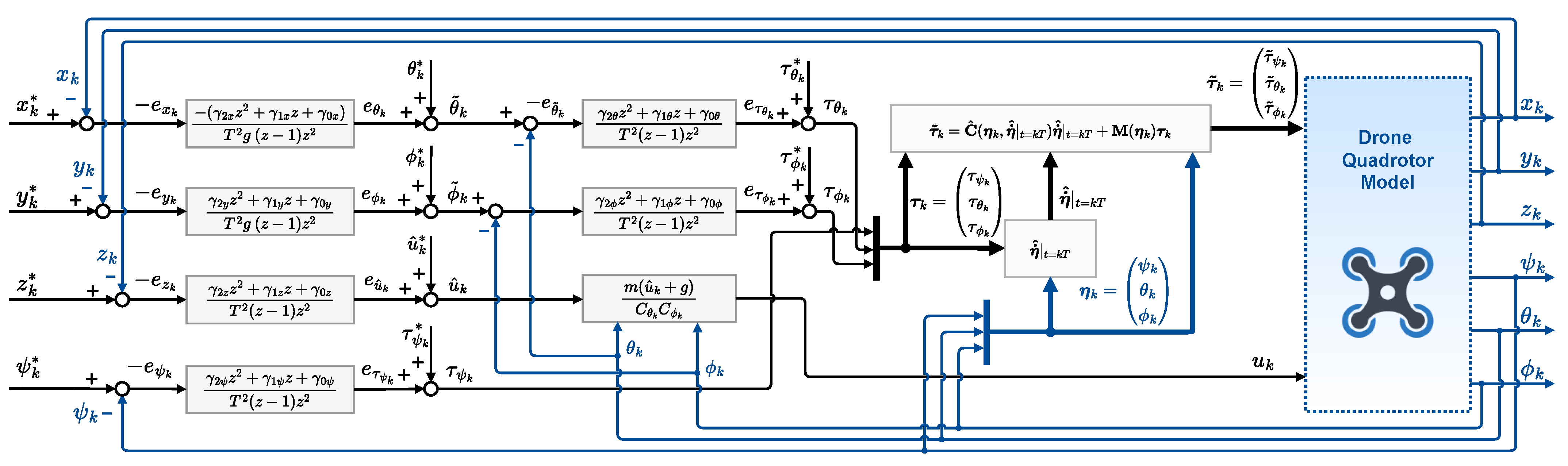
- The controller is operated using only position and orientation measurements.
- The control law aims to reduce errors rapidly, provide a smooth response and minimise control effort.
- The effectiveness of the proposed controller is validated using numerical simulations.
Abstract
1. Introduction
- The discrete-time formulation in relation to its continuous-time counterpart enables faster digital implementation and offers straightforward tuning procedures, particularly through pole placement of the closed-loop tracking error dynamics.
- The controller is carried out using only position and orientation measurements.
- The proposed control scheme is not only simple and practical to implement, but also demonstrates high accuracy in the presence of disturbances of different nature.
- Compared to its continuous-time counterpart, the discrete-time GPI control strategy offers several notable advantages: (i) trajectory planning is simplified because time derivatives are no longer required; (ii) computational load is substantially reduced; (iii) the design of nominal feed-forward input functions becomes less demanding, as they are replaced by the tracking function and its time-shifted versions.
2. Drone Quadrotor Dynamics, Discrete-Time Model and Problem Formulation
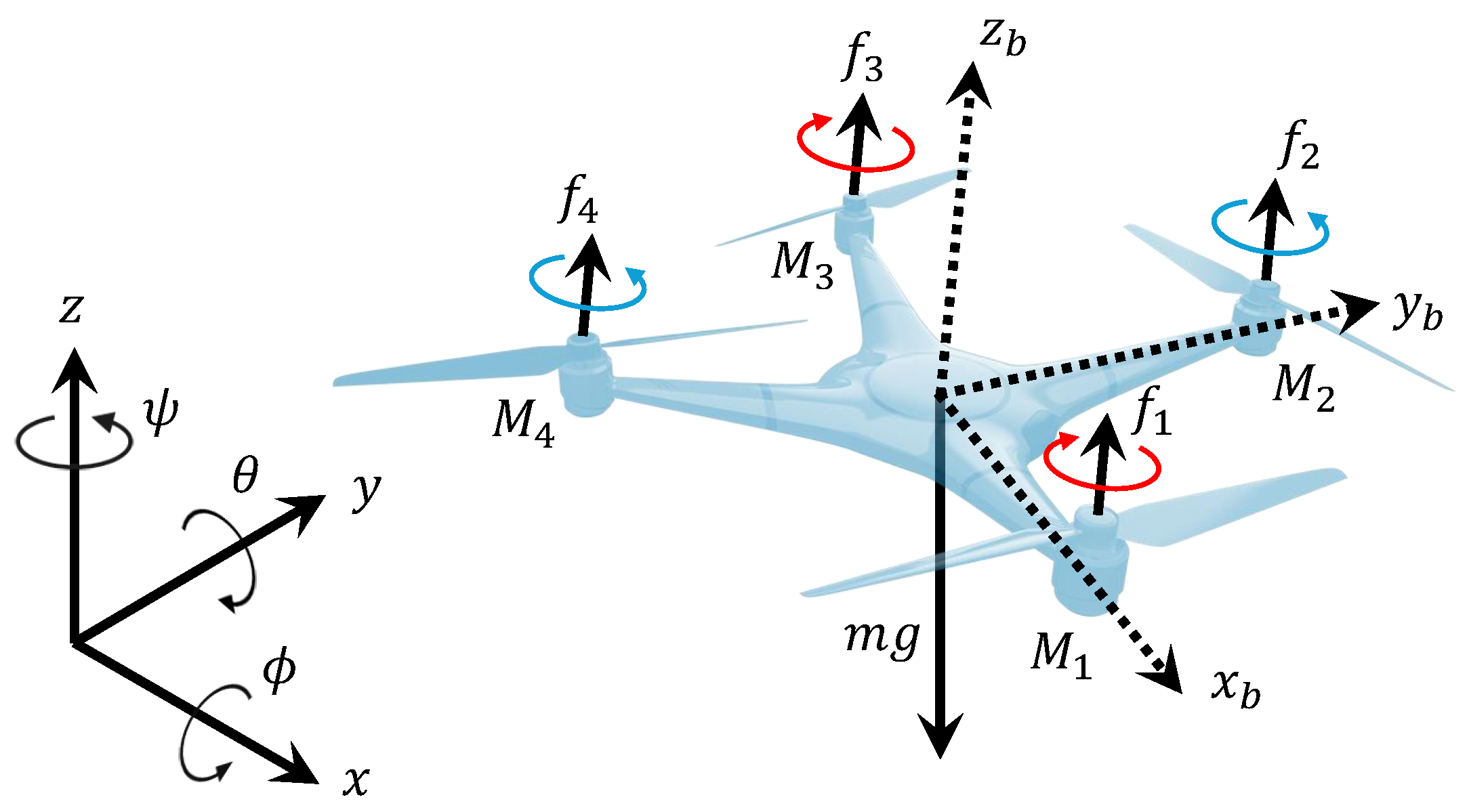
2.1. Drone Quadrotor Dynamics
2.2. Boundaries of the Dynamic Model
- The quadrotor is modeled as a perfectly rigid body, an assumption that holds when structural flexibility is negligible and the rotor arms remain sufficiently stiff to keep vibration effects minimal.
- The simplified model assumes small roll and pitch angles (, , , , , ) which is valid when hovering or during low-angle maneuvers ().
- The model incorporates several aerodynamic simplifications, including lifting proportional to the square of the rotor speed and the neglect of both blade flapping and complex airflow interactions. These assumptions remain valid under hovering conditions, slow translational motion, and overall symmetric low-speed flight.
- Motor and propeller dynamics are approximated as instantaneous, an assumption justified when motor response is significantly faster than the overall system dynamics and neither actuator saturation nor substantial delays are present.
- The model assumes constant mass, inertia matrix, and thrust coefficients, an approximation that holds when the payload remains fixed and any variations in fuel or battery mass are negligible.
- The dynamic model does not include wind forces, turbulence, magnetic disturbances and/or sensor biases, which is valid during indoor flight with no airflow or outdoor flight with small wind gusts and calibrated sensors with low noise.
- The dynamic model neglects wind forces, turbulence, magnetic disturbances, and sensor biases, an approximation that remains valid during indoor flight without airflow or during outdoor operations with mild wind conditions and well-calibrated, low-noise sensors.
- The dynamic model assumes a decoupling between rotational and translational dynamics, whereby thrust is considered to act strictly along the body z-axis and motor torques influence only the rotational motion. This approximation holds for drone quadrotors with symmetric geometry and uniformly performing motors and propellers.
- The dynamic model assumes that the quadrotor operates within its physical actuation limits, including thrust constraints (), and bounded angular rates, noting that gyroscopes and motors saturate beyond specific rotational speeds. This approximation remains valid as long as the commanded maneuvers stay within the actuator capabilities.
2.3. Drone Quadrotor Discrete-Time Model
- Discrete-Time Yaw Model. Using Euler discretization, expression (26) becomeswhere , , and the variable represents a disturbance input to the system, encompassing possible external perturbations and discretization errors. It is assumed to be characterized by a piecewise constant function of time, i.e., .
- Discrete-Time Subsystem Model . Using Euler discretization, expressions (28) and (32) becomewhere , , , , and the variables and represent disturbance inputs to the system, encompassing possible external perturbations and discretization errors. They are assumed to be characterized by piecewise constant functions of time, i.e., and respectively.
- Discrete-Time Subsystem Model . Using Euler discretization, expressions (27) and (34) becomewhere , , , , and the variables and represent disturbance inputs to the system, encompassing possible external perturbations and discretization errors. They are assumed to be characterized by piecewise constant functions of time, i.e., and respectively.
- Discrete-Time Altitude Model. Using Euler discretization, expression (30) becomeswhere , , and the variable represents a disturbance input to the system, encompassing possible external perturbations and discretization errors. It is assumed to be characterized by a piecewise constant function of time, i.e., .
2.4. Problem Formulation
3. Overview of Robust Discrete-Time GPI Control Design
4. GPI Control Design
4.1. Design of the Discrete-Time GPI Yaw Controller
4.1.1. Controller Design: Controller
4.1.2. Design of the Controller Gains
4.2. Design of the Discrete-Time GPI Altitude Controller
4.2.1. Controller Design: Controller
4.2.2. Design of the Controller Gains
4.3. Design of the Discrete-Time GPI Subsystem Controller
4.3.1. Outer Loop Controller
- (A)
- Controller Design: Controller
- (B)
- Design of the Controller Gains
4.3.2. Inner Loop Controller
- (A)
- Controller Design: Controller
- (B)
- Design of the Controller Gains
4.4. Design of the Discrete-Time GPI Subsystem Controller
4.4.1. Outer Loop Controller
- (A)
- Controller Design: Controller
- (B)
- Design of the Controller Gains
4.4.2. Inner Loop Controller
- (A)
- Controller Design: Controller
- (B)
- Design of the Controller Gains
4.5. Obtaining the Input Variable Vector from the Auxiliar Input Variable Vector
5. Numerical Simulations
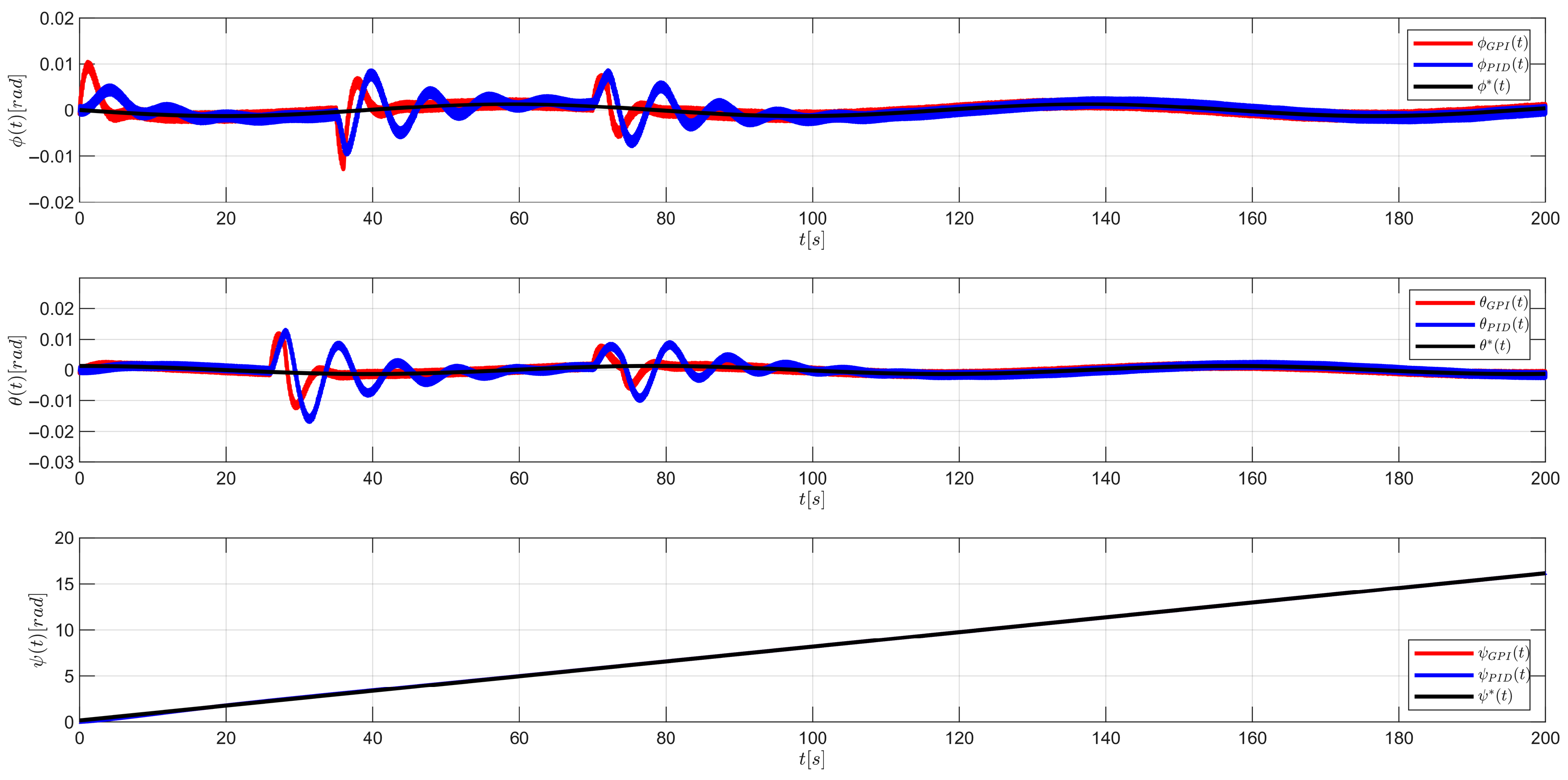
5.1. Stabilisation and Trajectory Tracking of the Drone Quadrotor Under Ideal Conditions
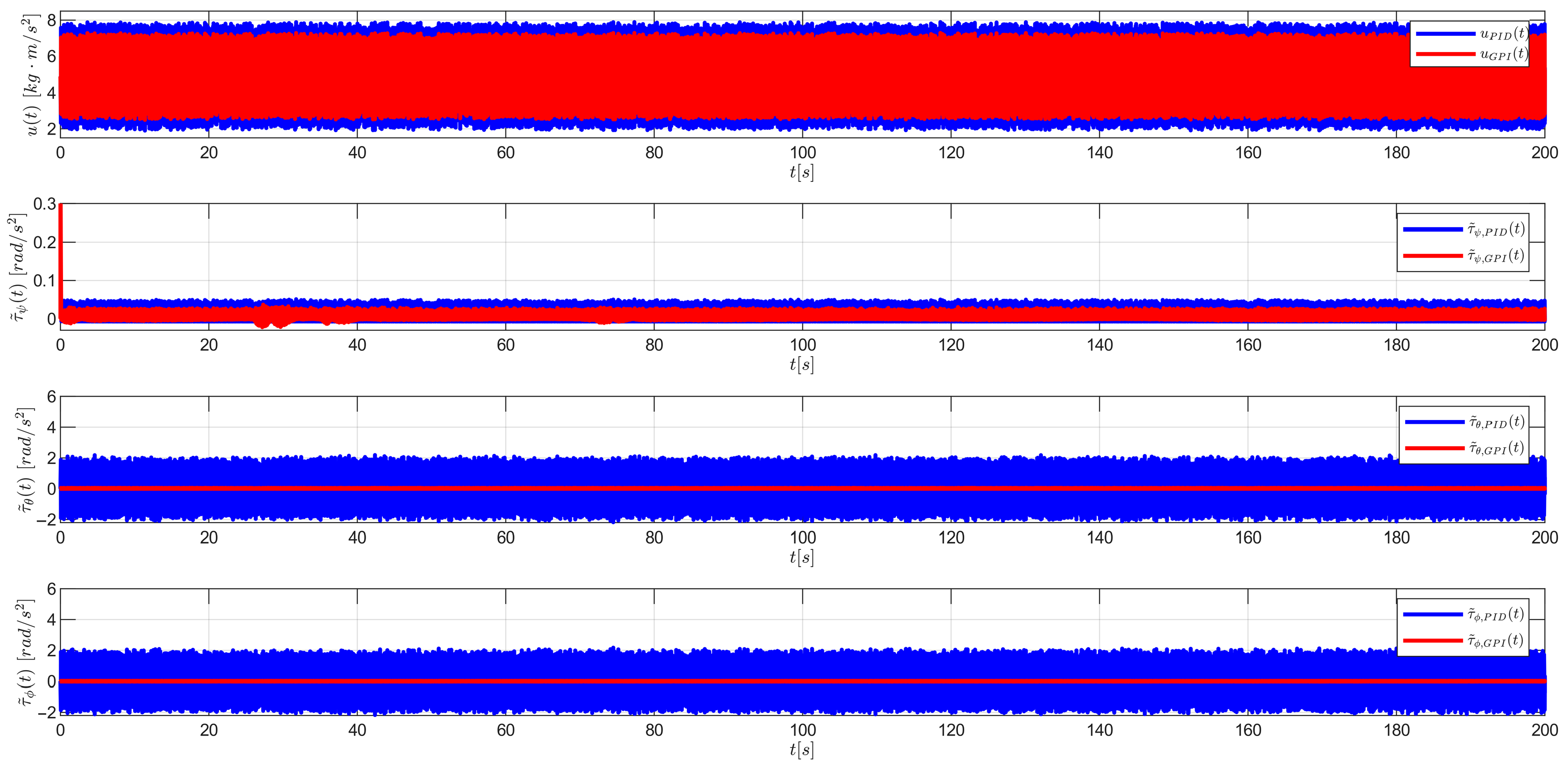
5.2. Stabilisation and Trajectory Tracking of the Drone Quadrotor Under Non-Ideal Conditions
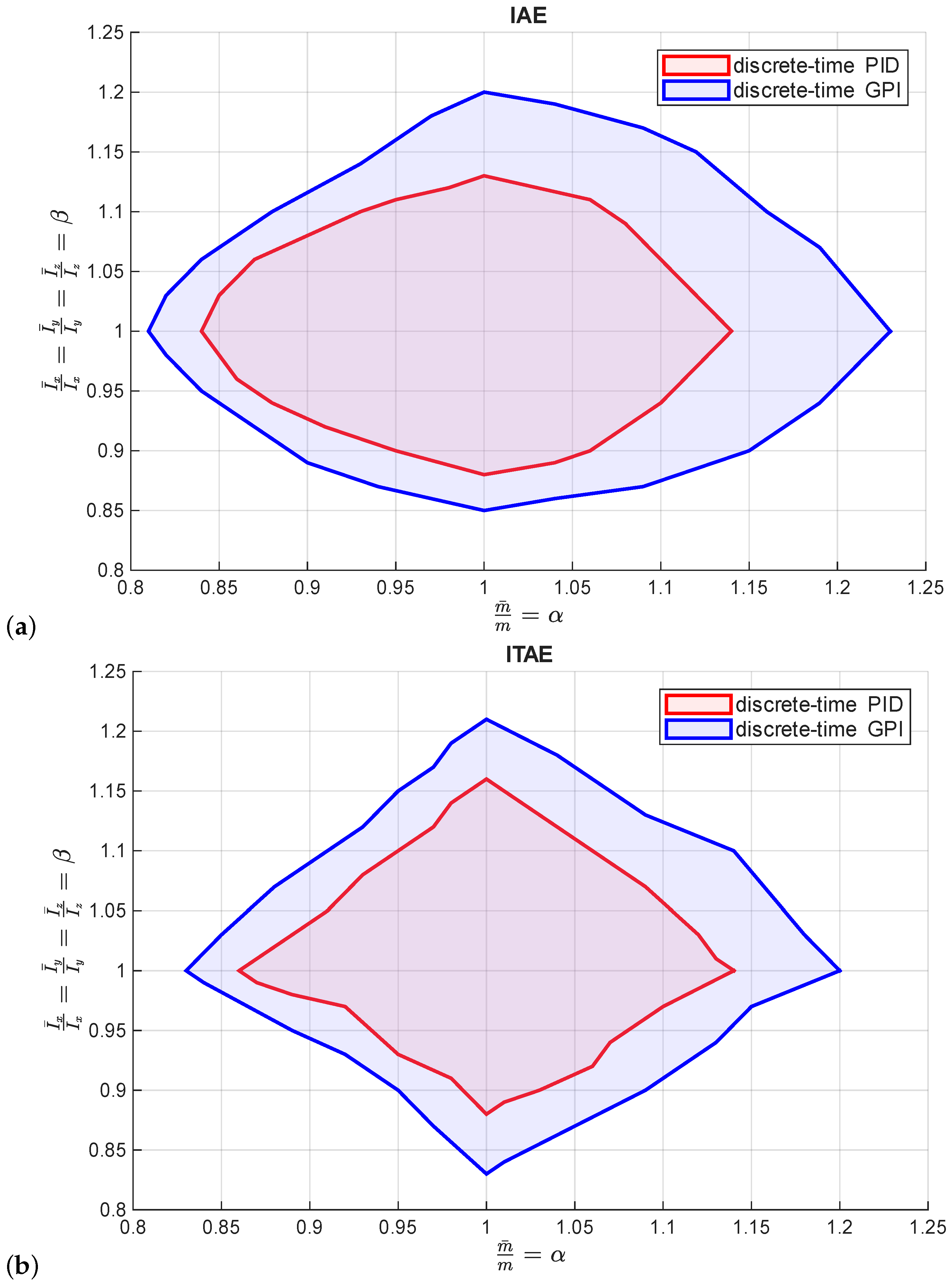
6. Performance of the Proposed Controller
7. Conclusions
Author Contributions
Funding
Data Availability Statement
Conflicts of Interest
References
- Jahani, H.; Khosravi, Y.; Kargar, B.; Ong, K.L.; Arisian, S. Exploring the role of drones and UAVs in logistics and supply chain management: A novel text-based literature review. Int. J. Prod. Res. 2025, 63, 1873–1897. [Google Scholar] [CrossRef]
- Ostermann, L.; Gobachew, A.; Schwung, A.; Lier, S. Planning of Logistic Networks with Automated Transport Drones: A Systematic Review of Application Areas, Planning Approaches, and System Performance. Logistics 2025, 9, 111. [Google Scholar] [CrossRef]
- Pal, O.K.; Shovon, M.S.H.; Mridha, M.F.; Shin, J. In-depth review of AI-enabled unmanned aerial vehicles: Trends, vision, and challenges. Discov. Artif. Intell. 2024, 4, 97. [Google Scholar] [CrossRef]
- Shahi, T.B.; Balasubramaniam, T.; Sabir, K.; Nayak, R. Pasture monitoring using remote sensing and machine learning: A review of methods and applications. Remote Sens. Appl. Soc. Environ. 2025, 37, 101459. [Google Scholar] [CrossRef]
- Hiraguri, T.; Shimizu, H.; Kimura, T.; Matsuda, T.; Maruta, K.; Takemura, Y.; Ohya, T.; Takanashi, T. Autonomous Drone-Based Pollination System Using AI Classifier to Replace Bees for Greenhouse Tomato Cultivation. IEEE Access 2023, 11, 10239389. [Google Scholar] [CrossRef]
- Talaeizadeh, A.; Sharifi, I.; Alasty, A.; Ghatrehsamani, S. Agricultural spraying drones: A comprehensive review. Smart Agric. Technol. 2025, 12, 101519. [Google Scholar] [CrossRef]
- Liu, J.; Luo, K.; Li, P.; Pu, M.; Wang, C. Robust Optimal Consensus Control for Multi-Agent Systems with Disturbances. Drones 2026, 10, 78. [Google Scholar] [CrossRef]
- Yigit, K.A.; Dalkiran, A.; Karakoc, T.H. Applications of Drones in the Health Industry. In Unmanned Aerial Vehicle Design and Technology; Springer: Cham, Switzerland, 2023; pp. 69–93. [Google Scholar] [CrossRef]
- Rahim, F.; Qasim, N.H. A systematic literature review of drones in emergency medicine: Practical applications, legal challenges, and future directions. Drone Syst. Appl. 2025, 13, 1–13. [Google Scholar] [CrossRef]
- Shukla, P.; Shukla, S.; Kumar Singh, A. Trajectory-Prediction Techniques for Unmanned Aerial Vehicles (UAVs): A Comprehensive Survey. IEEE Commun. Surv. Tutor. 2025, 27, 1867–1910. [Google Scholar] [CrossRef]
- Lopez-Sanchez, I.; Moreno-Valenzuela, J. PID control of quadrotor UAVs: A survey. Annu. Rev. Control 2023, 56, 100900. [Google Scholar] [CrossRef]
- Goodarzi, F.; Lee, D.; Lee, T. Geometric nonlinear PID control of a quadrotor UAV on SE(3). In 2013 European Control Conference (ECC); IEEE: Piscataway, NJ, USA, 2013; pp. 3845–3850. [Google Scholar] [CrossRef]
- Singh, A.M.; Lee, D.J.; Hong, D.P.; Chong, K.T. Successive loop closure based controller design for an autonomous quadrotor vehicle. Appl. Mech. Mater. 2014, 483, 361–367. [Google Scholar] [CrossRef]
- He, Z.; Zhao, L. A simple attitude control of quadrotor helicopter based on Ziegler-Nichols rules for tuning PD parameters. Sci. World J. 2014, 2014, 280180. [Google Scholar] [CrossRef] [PubMed]
- Guerrero-Sanchez, M.E.; Abaunza, H.; Castillo, P.; Lozano, R.; Garcia-Beltran, C.; Rodriguez-Palacios, A. Passivity-Based Control for a Micro Air Vehicle Using Unit Quaternions. Appl. Sci. 2017, 7, 13. [Google Scholar] [CrossRef]
- Fan, Y.; Cao, Y.; Zhao, Y. Sliding mode control for nonlinear trajectory tracking of a quadrotor. In 2017 36th Chinese Control Conference (CCC); IEEE: Piscataway, NJ, USA, 2017; pp. 6676–6680. [Google Scholar]
- Cui, Y.; Li, B.; Shi, M. Nonlinear Model Predictive Control for UAV Trajectory Optimization. In Advances in Guidance, Navigation and Control (ICGNC 2024); Springer: Singapore, 2025; pp. 405–412. [Google Scholar] [CrossRef]
- Zheng, L.; Mei, R.; Wei, M.; Zhao, Z.; Zou, B. Bio-Inspired Decentralized Model Predictive Flocking Control for UAV Swarm Trajectory Tracking. J. Bionic Eng. 2025, 22, 2660–2677. [Google Scholar] [CrossRef]
- Xiao, J.; Feroskhan, M. Learning Multipursuit Evasion for Safe Targeted Navigation of Drones. IEEE Trans. Artif. Intell. 2024, 5, 6210–6224. [Google Scholar] [CrossRef]
- Al-Saoudi, A.F.; Al-Aubidy, K.M.; Al-Mahasneh, A.J. Comparison of PID, Fuzzy Logic, ANFIS and Model Predictive Controllers for Cruise Control System. In 2024 21st International Multi-Conference on Systems, Signals & Devices (SSD); IEEE: Piscataway, NJ, USA, 2024; pp. 263–265. [Google Scholar] [CrossRef]
- Morando, A.E.S.; Bozzi, A.; Graffione, S.; Sacile, R.; Zero, E. Optimizing Unmanned Air–Ground Vehicle Maneuvers Using Nonlinear Model Predictive Control and Moving Horizon Estimation. Automation 2024, 5, 324–342. [Google Scholar] [CrossRef]
- Wang, J.; Fang, Z.; Zhao, W. Integral backstepping-based nonlinear flight control strategy for quadrotor aerial robot with unknown mass. In Proceedings of the 3rd International Conference on Robotics, Control and Automation; Association for Computing Machinery: New York, NY, USA, 2018; pp. 88–94. [Google Scholar]
- Najm, A.A.; Ibraheem, I.K. Nonlinear PID controller design for a 6-DOF UAV quadrotor system. Eng. Sci. Technol. Int. J. 2019, 22, 1087–1097. [Google Scholar] [CrossRef]
- Yavuz, H.; İkizoğlu, S. Hyperbolic Tangent Adaptive LQR+ PID Control of a Quadrotor. In 2018 6th International Conference on Control Engineering & Information Technology (CEIT); IEEE: Piscataway, NJ, USA, 2018; pp. 1–6. [Google Scholar]
- Deveerasetty, K.K.; Zhou, Y. PID with derivative filter and integral sliding-mode controller techniques applied to an indoor micro quadrotor. In 2018 18th International Conference on Control, Automation and Systems (ICCAS); IEEE: Piscataway, NJ, USA, 2018; pp. 439–444. [Google Scholar]
- Ortiz, J.P.; Minchala, L.I.; Reinoso, M.J. Nonlinear Robust H-Infinity PID Controller for the Multivariable System Quadrotor. IEEE Lat. Am. Trans. 2016, 14, 1176–1183. [Google Scholar] [CrossRef]
- Bouzid, Y.; Siguerdidjane, H.; Bestaoui, Y. Comparative Results on 3D Navigation of Quadrotor using two Nonlinear Model based Controllers. J. Phys. Conf. Ser. 2017, 783, 012046. [Google Scholar] [CrossRef]
- Bouzid, Y.; Siguerdidjane, H.; Bestaoui, Y. Sliding Modes based Nonlinear PID Controller for Quadrotor—Theory and Experiment. In Proceedings of the 14th International Conference on Informatics in Control, Automation and Robotics, ICINCO 2017, Madrid, Spain, 26–28 July 2017; Gusikhin, O., Madani, K., Eds.; SciTePress: Setúbal, Portugal, 2017; Volume 1, pp. 286–294. [Google Scholar] [CrossRef]
- Benzaid, K.; Mansouri, N.; Labbani-Igbida, O. A generalized dynamical model and control approach applied to multirotor aerial systems. In 2016 8th International Conference on Modelling, Identification and Control (ICMIC); IEEE: Piscataway, NJ, USA, 2016; pp. 225–230. [Google Scholar] [CrossRef]
- Rosales, C.; Tosetti, S.; Soria, C.; Rossomando, F. Neural Adaptive PID Control of a Quadrotor using EFK. IEEE Lat. Am. Trans. 2018, 16, 2722–2730. [Google Scholar] [CrossRef]
- Sierra, J.E.; Santos, M. Wind and Payload Disturbance Rejection Control Based on Adaptive Neural Estimators: Application on Quadrotors. Complexity 2019, 2019, 6460156. [Google Scholar] [CrossRef]
- Yu, W.; Li, J.; Yang, K. Research on Fuzzy Adaptive Stabilization PID Control System. In 2018 IEEE 3rd Advanced Information Technology, Electronic and Automation Control Conference (IAEAC); IEEE: Piscataway, NJ, USA, 2018; pp. 2037–2043. [Google Scholar] [CrossRef]
- Jurado, F.; Hernández, R. Decentralized MRAC with Integral Action for Attitude Control of a Quadrotor UAV. In 2018 IEEE International Autumn Meeting on Power, Electronics and Computing (ROPEC); IEEE: Piscataway, NJ, USA, 2018; pp. 1–6. [Google Scholar] [CrossRef]
- Kourani, A.; Kassem, K.; Daher, N. Coping with Quadcopter Payload Variation via Adaptive Robust Control. In 2018 IEEE International Multidisciplinary Conference on Engineering Technology (IMCET); IEEE: Piscataway, NJ, USA, 2018; pp. 1–6. [Google Scholar] [CrossRef]
- Mofid, O.; Mobayen, S.; Wong, W.K. Adaptive Terminal Sliding Mode Control for Attitude and Position Tracking Control of Quadrotor UAVs in the Existence of External Disturbance. IEEE Access 2021, 9, 3428–3440. [Google Scholar] [CrossRef]
- Montoya-Morales, J.; Guerrero-Sánchez, M.; Valencia-Palomo, G.; Hernández-González, O.; López-Estrada, F.; Hoyo-Montaño, J. Real-time robust tracking control for a quadrotor using monocular vision. Proc. Inst. Mech. Eng. Part G J. Aerosp. Eng. 2023, 237, 2729–2741. [Google Scholar] [CrossRef]
- Fliess, M.; Marquez, R.; Delaleau, E.; Sira–Ramírez, H. Correcteurs proportionnels intégraux généralisés. ESAIM Control. Optim. Calc. Var. 2002, 7, 23–41. [Google Scholar] [CrossRef]
- Åström, K.; Hägglund, T. PID Controllers: Theory, Design, and Tuning; ISA—The Instrumentation, Systems and Automation Society: Research Triangle Park, NC, USA, 1995. [Google Scholar]
- Wu, H.; Su, W.; Liu, Z. PID controllers: Design and tuning methods. In 2014 9th IEEE Conference on Industrial Electronics and Applications; IEEE: Piscataway, NJ, USA, 2014; pp. 808–813. [Google Scholar] [CrossRef]
- Sira-Ramirez, H. On the generalized PI control of some nonlinear mechanical systems. In Proceedings of the 2002 American Control Conference (IEEE Cat. No.CH37301); IEEE: Piscataway, NJ, USA, 2002; Volume 1, pp. 839–844. [Google Scholar] [CrossRef]
- Song, Q.; Song, Y. Generalized PI control design for a class of unknown nonaffine systems with sensor and actuator faults. Syst. Control Lett. 2014, 64, 86–95. [Google Scholar] [CrossRef]
- Belmonte, L.M.; Morales, R.; Fernández-Caballero, A.; Somolinos, J.A. Robust Decentralized Nonlinear Control for a Twin Rotor MIMO System. Sensors 2016, 16, 1160. [Google Scholar] [CrossRef]
- Zurita-Bustamante, E.W.; Linares-Flores, J.; Guzman-Ramirez, E.; Sira-Ramirez, H. A Comparison Between the GPI and PID Controllers for the Stabilization of a DC–DC “Buck” Converter: A Field Programmable Gate Array Implementation. IEEE Trans. Ind. Electron. 2011, 58, 5251–5262. [Google Scholar] [CrossRef]
- Belmonte, L.M.; Segura, E.; Fernández-Caballero, A.; Somolinos, J.A.; Morales, R. Generalised Proportional Integral Control for Magnetic Levitation Systems Using a Tangent Linearisation Approach. Mathematics 2021, 9, 1424. [Google Scholar] [CrossRef]
- Panduro, R.; Segura, E.; Belmonte, L.M.; Fernández-Caballero, A.; Novais, P.; Benet, J.; Morales, R. Intelligent trajectory planner and generalised proportional integral control for two carts equipped with a red-green-blue depth sensor on a circular rail. Integr. Comput.-Aided Eng. 2020, 27, 267–285. [Google Scholar] [CrossRef]
- Trejo-Escamilla, E.G.; Romero, H.; Santos, O.; Salzar, S.; Lozano, R. GPI controller for quadrotor UAV stabilization. In 2017 International Conference on Unmanned Aircraft Systems (ICUAS); IEEE: Piscataway, NJ, USA, 2017; pp. 1833–1839. [Google Scholar] [CrossRef]
- Fernández-Caballero, A.; Belmonte, L.M.; Morales, R.; Somolinos, J.A. Generalized Proportional Integral Control for an Unmanned Quadrotor System. Int. J. Adv. Robot. Syst. 2015, 12, 85. [Google Scholar] [CrossRef]
- Belmonte, L.M.; Morales, R.; Fernández-Caballero, A.; Somolinos, J.A. A Tandem Active Disturbance Rejection Control for a Laboratory Helicopter With Variable-Speed Rotors. IEEE Trans. Ind. Electron. 2016, 63, 6395–6406. [Google Scholar] [CrossRef]
- Fliess, M.; Marquez, R. Une approche intrinsèque de la commande prédictive linéaire discrète. J. Eur. Des Syst. Autom. 2001, 35, 127–147. [Google Scholar]
- Elfadili, A.; Giri, F.; Ouadi, H.; Dugard, L. Discrete-time modelling of induction motors with consideration of magnetic saturation. In IECON 2006—32nd Annual Conference on IEEE Industrial Electronics; IEEE: Piscataway, NJ, USA, 2006; pp. 5119–5124. [Google Scholar] [CrossRef]
- Goodwin, G.; Leal, R.; Mayne, D.; Middleton, R. Rapprochement between continuous and discrete model reference adaptive control. Automatica 1986, 22, 199–207. [Google Scholar] [CrossRef]
- Tesfaye, A.; Tomizuka, H. Zeros of discretized continuous systems expressed in the Euler operator-an asymptotic analysis. IEEE Trans. Autom. Control 1995, 40, 743–747. [Google Scholar] [CrossRef]
- Castillo, P.; Dzul, A.; Lozano, R. Real-time stabilization and tracking of a four-rotor mini rotorcraft. IEEE Trans. Control Syst. Technol. 2004, 12, 510–516. [Google Scholar] [CrossRef]
- Lozano, R. (Ed.) Unmanned Aerial Vehicles; John Wiley & Sons, Ltd.: Hoboken, NJ, USA, 2013. [Google Scholar] [CrossRef]
- Aguilar-Ibáñez, C.; Sira-Ramírez, H.; Suárez-Castañón, M.S.; Martínez-Navarro, E.; Moreno-Armendariz, M.A. The trajectory tracking problem for an unmanned four-rotor system: Flatness-based approach. Int. J. Control 2012, 85, 69–77. [Google Scholar] [CrossRef]
- Haykin, S. A unified treatment of recursive digital filtering. IEEE Trans. Autom. Control 1972, 17, 113–116. [Google Scholar] [CrossRef]
- Butcher, J.C. Numerical Methods for Ordinary Differential Equations; John Wiley & Sons, Ltd.: Hoboken, NJ, USA, 2016. [Google Scholar] [CrossRef]
- Papoulis, A. Signal Analisys; Nalle, P.D., Gardner, M., Eds.; McGraw-Hill: New York, NY, USA, 1977. [Google Scholar]
- Son, Y.I.; Kim, I.H.; Choi, D.S.; Shim, H. Robust Cascade Control of Electric Motor Drives Using Dual Reduced-Order PI Observer. IEEE Trans. Ind. Electron. 2015, 62, 3672–3682. [Google Scholar] [CrossRef]
- Sarwar, S.; Rehman, S. Supervising Control for Unmanned Aerial Vehicles. Math. Probl. Eng. 2013, 2013, 564803. [Google Scholar] [CrossRef]
- Büchi, R. PID Controller Parameter Tables for Time-Delayed Systems Optimized Using Hill-Climbing. Signals 2022, 3, 146–156. [Google Scholar] [CrossRef]
- Mousakazemi, S.M.H. Comparison of the error-integral performance indexes in a GA-tuned PID controlling system of a PWR-type nuclear reactor point-kinetics model. Prog. Nucl. Energy 2021, 132, 103604. [Google Scholar] [CrossRef]
- Sanoj, K.P.; Dhanya Ram, V. Optimal PID Controller Tuning for Multivariable Unstable Systems by Minimizing ITAE Criteria. IFAC-PapersOnLine 2024, 57, 391–396. [Google Scholar] [CrossRef]





| Aspect | PI Control | GPI Control |
|---|---|---|
| Complexity | Simple design and implementation. | More complex; requires system structure knowledge (flatness, relative degree). |
| Tuning | Easy, only two parameters (,). | Harder, multiple gains for higher-order terms. |
| Tracking Ability | Good for constant or slowly varying references. | Excellent for polynomial references (ramps, parabolas, etc.). |
| Robustness | Limited robustness to disturbances and uncertainties. | Higher robustness; can handle nonlinearities better. |
| Applications | Widely used in industrial processes and simple systems. | Suitable for advanced control of nonlinear or higher-order systems. |
| Steady-State Error | Eliminates error for constant signals. | Eliminates error for higher-order signals (up to chosen degree). |
| Design Philosophy | Practical, empirical tuning for linear systems. | Theoretical, model-based design for exact tracking. |
Disclaimer/Publisher’s Note: The statements, opinions and data contained in all publications are solely those of the individual author(s) and contributor(s) and not of MDPI and/or the editor(s). MDPI and/or the editor(s) disclaim responsibility for any injury to people or property resulting from any ideas, methods, instructions or products referred to in the content. |
© 2026 by the authors. Licensee MDPI, Basel, Switzerland. This article is an open access article distributed under the terms and conditions of the Creative Commons Attribution (CC BY) license.
Share and Cite
Segura, E.; Belmonte, L.M.; de las Morenas, J.; Morales, R. A Discrete-Time Generalized Proportional Integral Controller for a Drone Quadrotor. Drones 2026, 10, 245. https://doi.org/10.3390/drones10040245
Segura E, Belmonte LM, de las Morenas J, Morales R. A Discrete-Time Generalized Proportional Integral Controller for a Drone Quadrotor. Drones. 2026; 10(4):245. https://doi.org/10.3390/drones10040245
Chicago/Turabian StyleSegura, Eva, Lidia M. Belmonte, Javier de las Morenas, and Rafael Morales. 2026. "A Discrete-Time Generalized Proportional Integral Controller for a Drone Quadrotor" Drones 10, no. 4: 245. https://doi.org/10.3390/drones10040245
APA StyleSegura, E., Belmonte, L. M., de las Morenas, J., & Morales, R. (2026). A Discrete-Time Generalized Proportional Integral Controller for a Drone Quadrotor. Drones, 10(4), 245. https://doi.org/10.3390/drones10040245