1. Introduction
The pursuit of non-cooperative aerial targets is a critical task for UAVs in various applications, including surveillance, tracking, and some dynamic mission scenarios [
1,
2]. This interception scenario is inherently a two-player pursuer–evader game, where the UAV pursuer aims to minimize the miss distance and satisfy terminal constraints, while the non-cooperative target acts as the evader, maximizing its maneuver uncertainty to evade interception [
3,
4]. As a typical evasive strategy, high-speed aircraft often adopt jump-gliding maneuvering to extend range and enhance survivability, which poses significant challenges to the guidance systems of UAV pursuers [
5,
6]. The trajectories of jump-gliding targets exhibit highly nonlinear, quasi-periodic oscillations with significant aerodynamic uncertainties [
7,
8]. Although some online estimation techniques, such as Kalman filter [
9] and Gaussian process-based method [
10], are employed to observe the states of the targets, they struggle to achieve ideal estimation accuracy in practice due to the low predictability of jump-gliding trajectories. Furthermore, the sheer velocity of these targets drastically compresses the available time window for terminal guidance, demanding not merely asymptotic but finite-time or even prescribed-time convergence of guidance errors [
11]. Different from the common guidance task, it is necessary to pursue jump-gliding targets with a specific terminal angle, which ensures sensor visibility and guidance effectiveness [
12,
13].
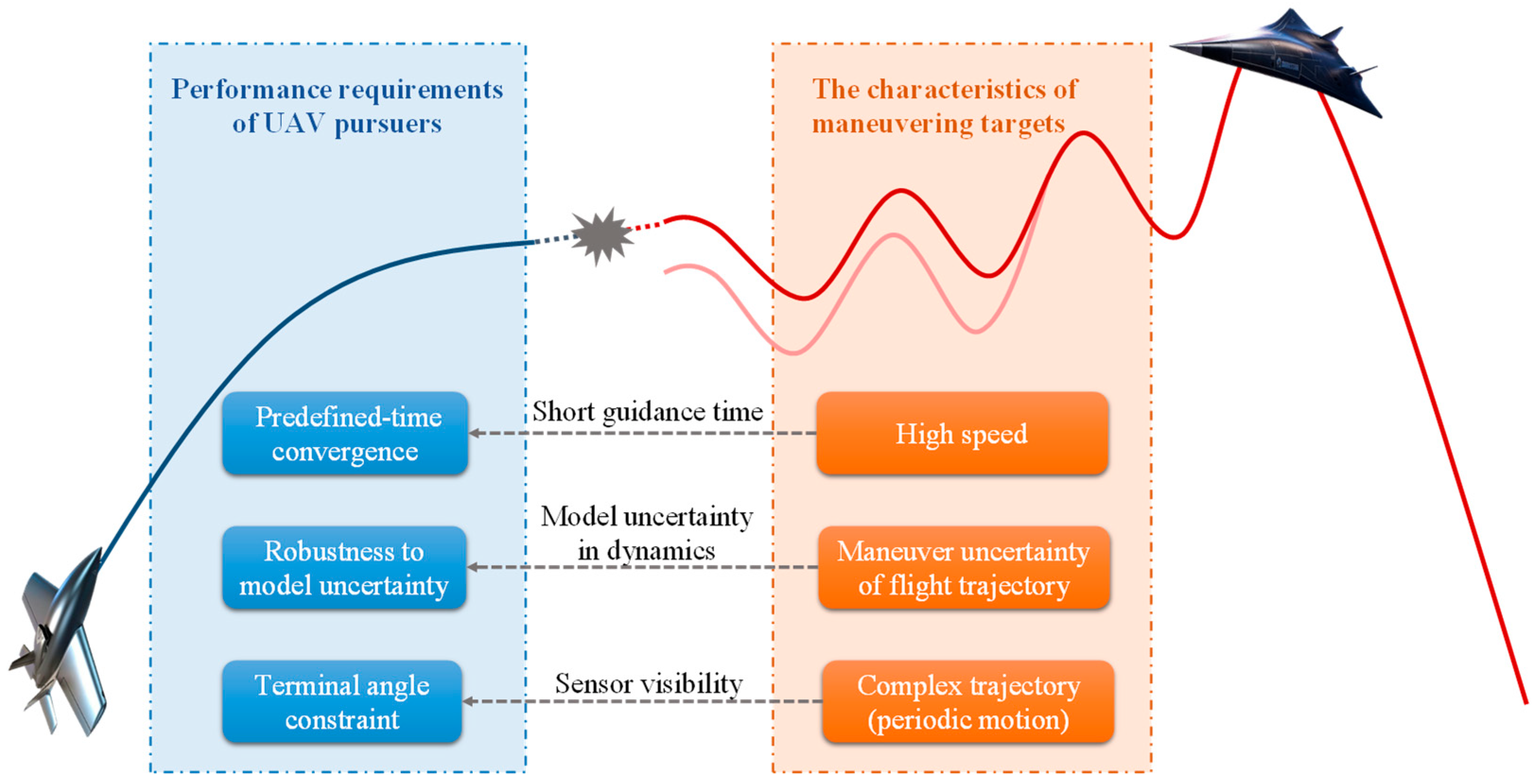
From the perspective of pursuit-evasion games, the jump-gliding maneuver of the evader aims to reduce the guidance accuracy of the pursuer by introducing maneuver uncertainties, while prolonging the engagement duration until the game ends. Therefore, from the pursuer’s standpoint, it must be capable of countering or suppressing the evader’s maneuver uncertainty to ensure guidance accuracy, and furthermore, the guidance errors must converge within a predefined time to achieve successful interception (shown in
Figure 1). This necessitates the development of advanced guidance laws that are inherently robust and adaptive to maneuvering targets, and capable of ensuring prescribed performance.
However, existing methods are hardly capable of accomplishing such a multi-objective guidance task. Classical approaches like proportional navigation are highly sensitive to accurate target maneuver models, leading to large miss distances against high-speed unknown targets [
14,
15]. While modern optimal guidance laws can handle the terminal angle constraints, they typically require extensive information and lack inherent robustness against significant uncertainties [
16,
17]. Sliding mode guidance laws offer robustness to uncertainties by employing discontinuous control actions that force the system state to converge to the predefined sliding surface [
18,
19]. However, traditional sliding surfaces often only ensure asymptotic convergence, failing to meet the critical finite-time pursuit requirements.
The framework of prescribed performance control (PPC) has emerged as a promising solution for regulating transient and steady-state tracking performance [
20]. By confining the error trajectory within a predefined, exponentially decaying bound, PPC-based guidance laws can theoretically manage constraints like impact angles [
21,
22,
23,
24,
25]. Li [
21] developed a terminal guidance law incorporating impact angle, acceleration, and autopilot dynamics constraints. Song [
22] designed a robust PPC guidance and autopilot controller to improve robustness and transient response. Zhang [
23] introduced a cooperative mid-course guidance law for multi-UAVs formation under uncontrollable speed, combining leader–follower strategy with prescribed performance control. Li [
24] proposed a prescribed performance law for three-dimensional (3D) impact-angle control with field-of-view limits, employing a new performance function and a bias term. Ming [
25] presented a terminal guidance law using prescribed performance and nonsingular terminal sliding mode to pursue maneuvering targets with impact angle constraints.
Despite the extensive applications in guidance design, the direct application of the PPC method to pursue highly maneuvering targets remains challenging, primarily due to its lack of strict predefined-time convergence guarantee and the robustness against uncertainties. Standard exponential performance bounds do not allow the designer to explicitly prescribe the exact convergence time, which is crucial for time-sensitive pursuer–evader scenarios. More critically, under large disturbances or highly uncertain maneuvers of targets, the guidance errors may violate the rigid performance bound, triggering control singularity and causing system instability [
26,
27]. This fragility severely limits the practical utility of conventional PPC in such guidance scenarios.
To address the aforementioned limitations, this paper proposes a novel adaptive prescribed-performance guidance law with predefined-time convergence. The main contributions of this paper are summarized as following three aspects:
A kinematics-based velocity model of jump-gliding targets is established by solving the non-homogeneous system of longitudinal maneuver. This model serves as a foundation for the subsequent design of the guidance law and the specification of the guidance performance.
A predefined-time performance function (PPF), which eliminates singularity through robust design, is developed in this paper. A boundness condition for the maneuver uncertainty is obtained from the established velocity model, by which the performance function is modified to be singularity-free.
Building upon the proposed PPF, a comprehensive guidance framework is constructed by integrating a non-singular terminal sliding mode scheme with an adaptive law. This integration enables simultaneous realization of two objectives: a. effective compensation for maneuvering uncertainties of targets; and b. predefined-time convergence of the line-of-sight angle.
Through theoretical analysis, this paper demonstrates the stability of the proposed guidance framework. Simulation results indicate that the proposed guidance law can effectively engage maneuvering targets within an appointed time.
The remainder of this paper is organized as follows:
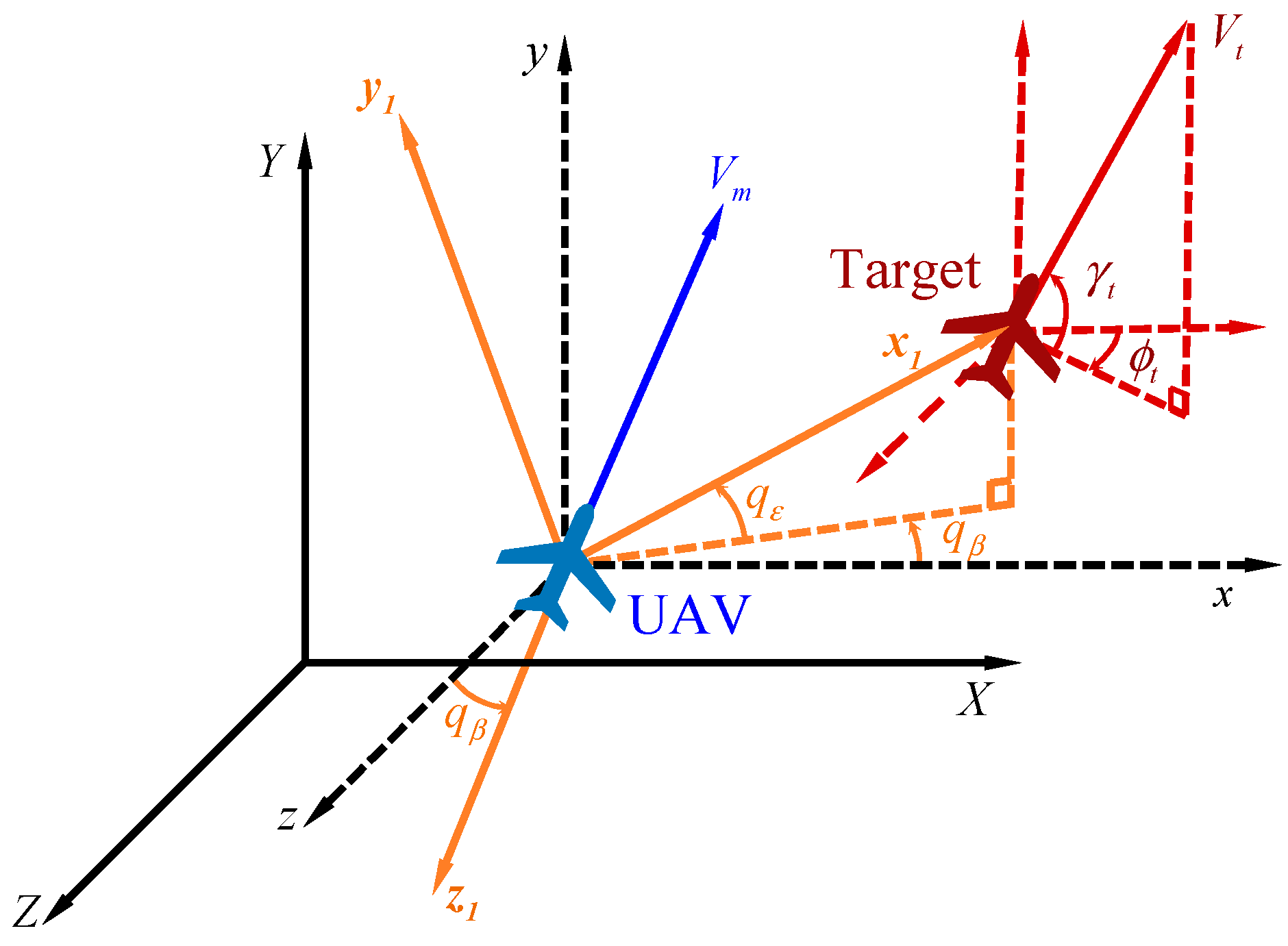
Section 2 formulates the problem, detailing the dynamic model of the target and the engagement geometry.
Section 3 presents the core design, including the PPF and the adaptive guidance law using PPC scheme. Stability is rigorously analyzed in
Section 3.
Section 4 provides numerical simulations validating the effectiveness and superiority of the proposed method. Finally, conclusions are drawn in
Section 5.
3. Adaptive Guidance Law with Predefined-Time Convergence
Based on the established guidance model accounting for the maneuver uncertainty of the target, this Section details the design of a novel adaptive guidance law using the PPC technique. The core objective is to enforce the LOS to converge to the desired angle in finite time, thereby guaranteeing a successful interception. To effectively govern both the transient and steady-state performance, a prescribed performance function with the predefined-time convergence property is constructed. The constrained error dynamics are then transformed into an unconstrained system via the error mapping technique.
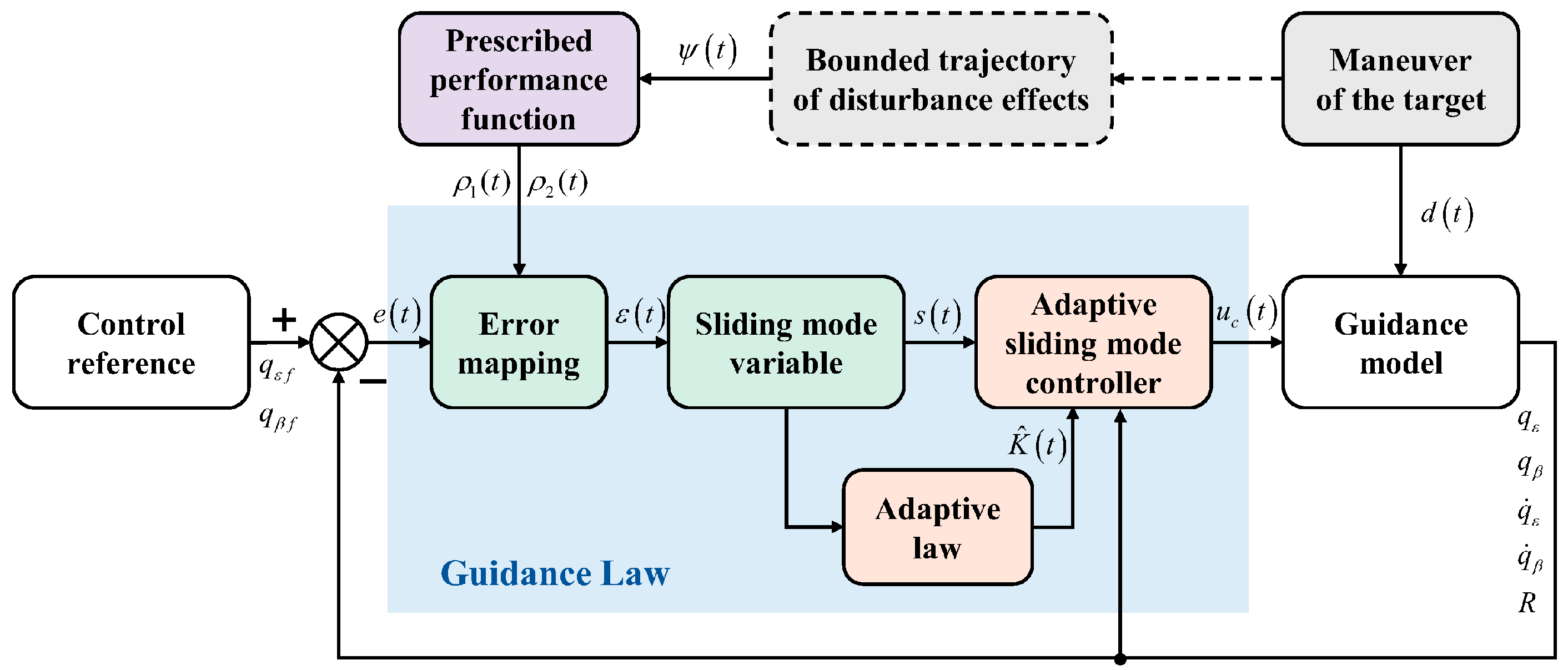
A sliding mode surface is synthesized from the transformed error, and a robust sliding mode controller is developed to fast drive the sliding mode variable to zero under uncertainty of the target. The robustness is achieved by a dedicated adaptive law, which continuously estimates the bound of the uncertainty and provides real-time compensation. The overall architecture, integrating these components, is illustrated in
Figure 3.
3.1. Predefined-Time Performance Function
To specify the transient and steady-state performance of the tracking error, , the performance function is designed in this section. In particular, a performance function should satisfy the following definition.
Definition 1. A continuous function is called a performance function if it satisfies:
- (1)
is positive and strictly decreasing;
- (2)
Based on the design principle of the PPC method, the tracking error should be restricted within the region between two performance functions, which is given by
where
and
are the lower bound and upper bound. Following Definition 1,
and
are realized through cosine-like functions:
where
represents a predefined convergence time. It is easy to check that the both functions will smoothly transfer from initial values
to final values
,
. According to the performance specification, these parameters can be determined by user in the offline stage. The first derivative of the performance function
is obtained as follows:
which indicates the following properties:
- (1)
when holds;
- (2)
when holds;
- (3)
when holds;
Despite the satisfactory dynamic performance delivered by PPC, it has a notable issue: once the states violate the performance bounds, the singularity problem of controller solving is inevitable. Such an issue is especially prominent in the guidance system involving the maneuver uncertainty of targets, as studied in this work. Therefore, it is necessary to modify the performance bounds in response to accommodate the effect of uncertainty, thereby preventing singularity phenomena. First and foremost, it is essential to quantify the effect of uncertainties, which is analyzed by the following lemma:
Lemma 2. Consider the guidance system (9) and its nominal counterpart with initial condition . If the inequality holds, the deviation between the actual and nominal state is bounded by Proof. Considering the boundness of the trigonometric functions, it is easy to find that
satisfies
Define the error
. Its dynamics are:
Taking norms and applying the Lipschitz condition along with the disturbance bound yields:
Applying the Gronwall–Bellman inequality gives:
Since
, the above inequality is bounded by an exponentially decaying function:
which ends the proof. □
Given that
in Lemma 2 is not exactly known, the estimated value
is adopted to replace
. Hence, the performance functions are modified to
where the correction signal
is given by
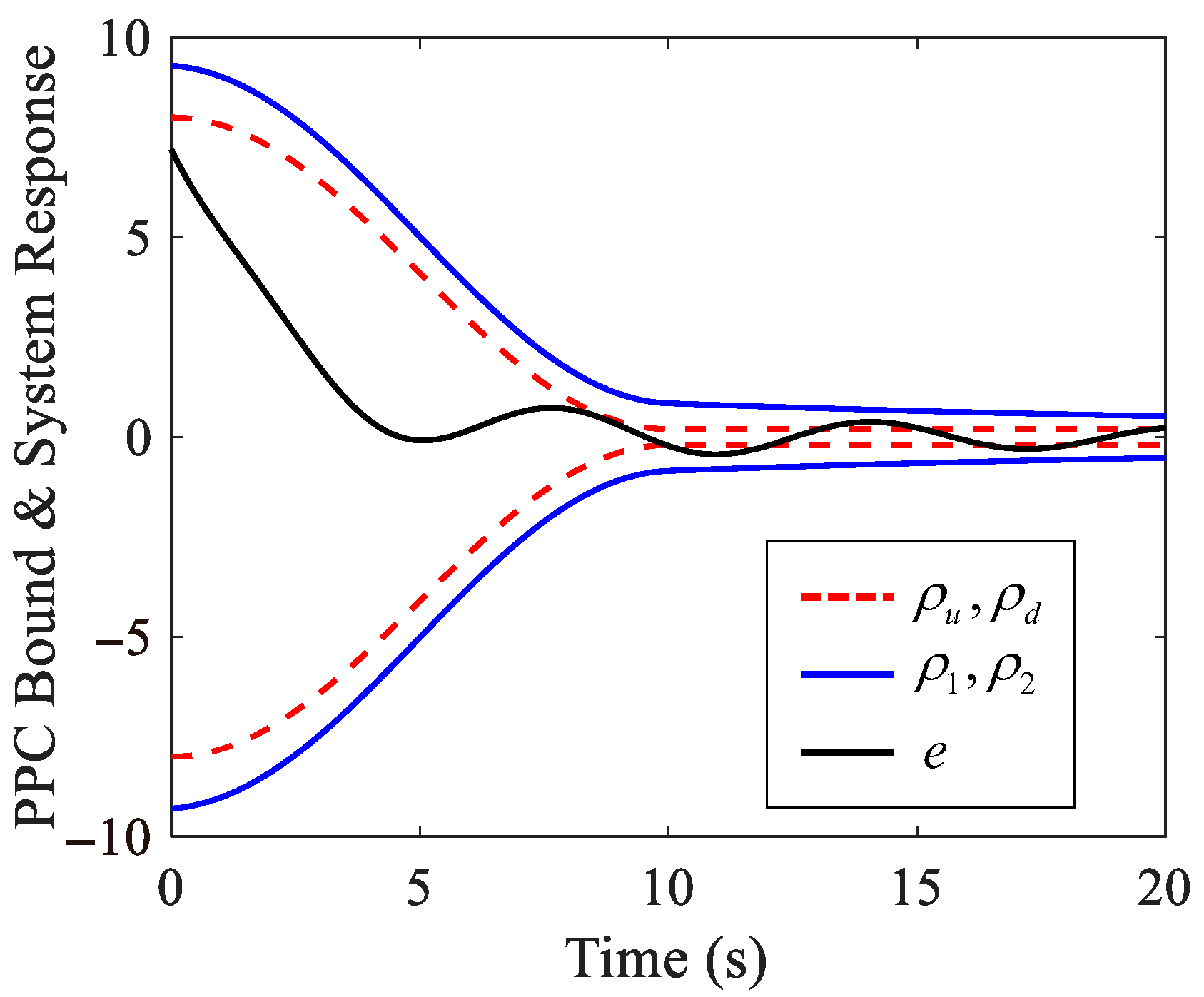
The difference between these two performance functions can be observed in
Figure 4. It can be seen that the tracking error exceeds
and
, triggering the singularity issue. In contrast, the tracking error always maintains within the region between
and
.
A mapping mechanism is introduced here:
where
is a transformed error vector. Taking the first derivative of the transformed error obtains:
where
and
are given by
In this paper, is non-singular due to the modification design of and .
3.2. Adaptive Predefined-Time Controller with Prescribed Performance
In this section, a PPC-based controller is designed to guarantee the predefined-time convergence of guidance error, while an adaptive-law-based compensation control is generated to suppress the effect of the maneuver uncertainty of the target. The overall control framework is illustrated in
Figure 3. In order to ensure the fast convergence of the transformed error
, a finite-time sliding mode surface is formulated as follows:
where
are diagonal gain matrices to be designed, and
are positive odd integers with the constraint
, ensuring the desired convergence properties.
denotes the sign function. To ensure that the system state reaches the sliding surface
within finite time, a fast power-reaching law is applied:
where
are diagonal gain matrices to be designed, and
are positive odd integers with the constraint
. Differentiating the sliding surface
yields:
Taking the derivative of
gives
Rearranging the above equation gives:
where
is provided by
Substituting (20) and (23) into (21) obtains
Hence, an achievable control law can be designed as
where
is a robust action to suppress the effect of uncertainty, and the last term is a PPC-based sliding mode controller.
denotes an adaptive gain, which is an estimate of a positive constant
with
. A well-known issue with such an adaptive scheme is the gain drift issue: even when the disturbance is small or zero, any nonzero tracking error
(e.g., due to measurement noise) will cause
to increase indefinitely. To address this issue, a projection operator is introduced, yielding the following adaptive law:
where
is a positive learning rate, and
is a correction coefficient.
3.3. Stability Analysis
Define the estimation error as
. Since
is a constant satisfying
, the equation of estimation error is obtained as
Substituting (22) and (25) into (21) yields the actual dynamics of the sliding surface:
By analyzing the above error dynamics, we can draw the following stability conclusion.
Theorem 1. Consider the guidance dynamics given by model (8) under Assumptions 1. Suppose that guidance law (25) is implemented with the adaptive law (26), then the resulting closed-loop system is stable, and the errors , , , and are uniformly ultimately bounded. For the sake of readability, the proof is located in Appendix A. Remark 3. The proposed three-dimensional guidance law (25) is inherently applicable to combined maneuvers involving lateral turns. The adaptive law can estimate the composite disturbance containing longitudinal and lateral uncertainties, enabling effective compensation. However, when the target executes simultaneous longitudinal oscillations and lateral maneuvers, obtaining an analytical characterization of the disturbance becomes difficult, which complicates the precise adjustment of the PPFs. In such cases, a more conservative bound based on the target’s maximum maneuver capability can be employed to ensure singularity-free operation. Future work will explore more advanced disturbance observation techniques to address this limitation.
4. Simulation Results
In this section, numerical simulations are carried out to evaluate the performance of the proposed adaptive prescribed-performance guidance law. The target considered is a typical jump-gliding vehicle, whose maneuver profile and kinematic parameters are adopted from [
2]. Four cases are designed to comprehensively assess different aspects of the guidance system:
- (1)
Case 1 compares the proposed method with the conventional PPC guidance law, highlighting the improvement in interception performance and the effective mitigation of the singularity issue.
- (2)
Case 2 investigates the robustness of the proposed guidance law under various initial engagement geometries by varying the initial positions of the UAV and the target.
- (3)
Case 3 examines the guidance performance under strong target maneuver uncertainties.
- (4)
Case 4 presents a sensitivity analysis with respect to key design parameters of the guidance law, illustrating their influence on convergence accuracy and control effort.
The jump-gliding trajectory of the target is generated using the model described in [
2], and the detailed initial conditions for the UAV and target in each case are listed in
Table 1. The parameters of the guidance law (25) are summarized in
Table 2. To quantitatively evaluate the interception performance, three metrics are employed: the miss distance, the interception time, and the root mean square error (RMSE) of the LOS angle. The miss distance is defined as the closest distance between the UAV and the target during the engagement, i.e.,
. The interception time is the time instant when the relative distance between the UAV and the target first reaches its minimum. The LOS angle RMSE is computed over the entire guidance phase as
where
is the number of sampling instants. This metric reflects the overall accuracy of the LOS angle regulation. The statistical results of the four cases are summarized in
Table 3.
4.1. Performance Comparison with Conventional PPC Guidance Law
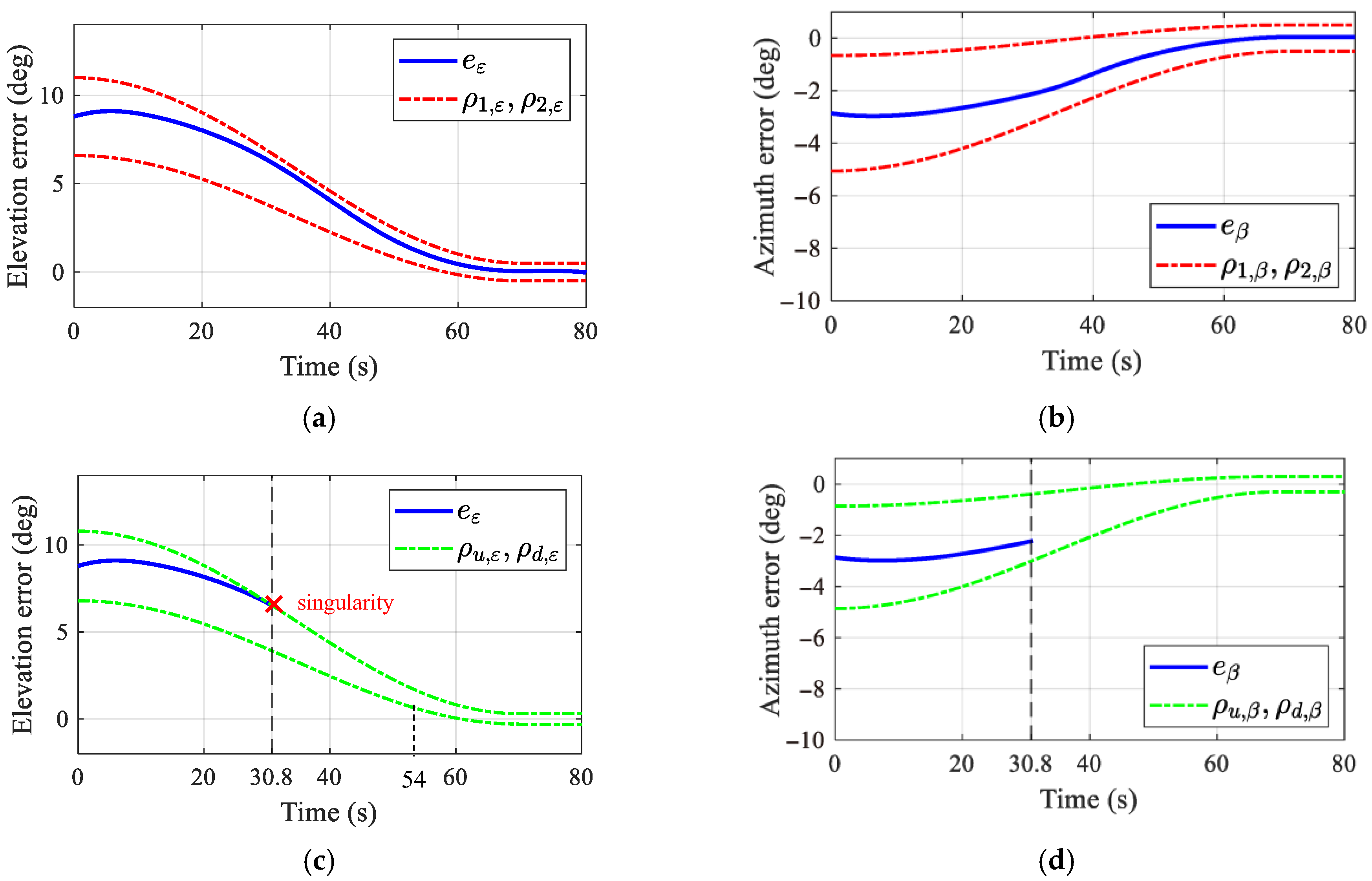
In this subsection, the proposed guidance law is compared with the conventional PPC guidance law. It should be noted that the conventional PPC employs the original performance function without the uncertainty-based boundary modification introduced in Equations (12) and (13), whereas the proposed method adopts the modified performance bounds defined in Equation (15). The simulation results are presented in
Figure 5.
As can be observed, the modified performance boundaries effectively accommodate the error variations induced by target uncertainties, and the tracking errors in both the elevation and azimuth channels converge to within at the terminal time. In contrast, for the conventional PPC without boundary adjustment, the elevation error exceeds the upper bound of the prescribed performance function at approximately , triggering a control singularity and causing the simulation to terminate prematurely. These results clearly demonstrate that the proposed method alleviates the singularity issue inherent in conventional PPC under significant maneuver uncertainties.
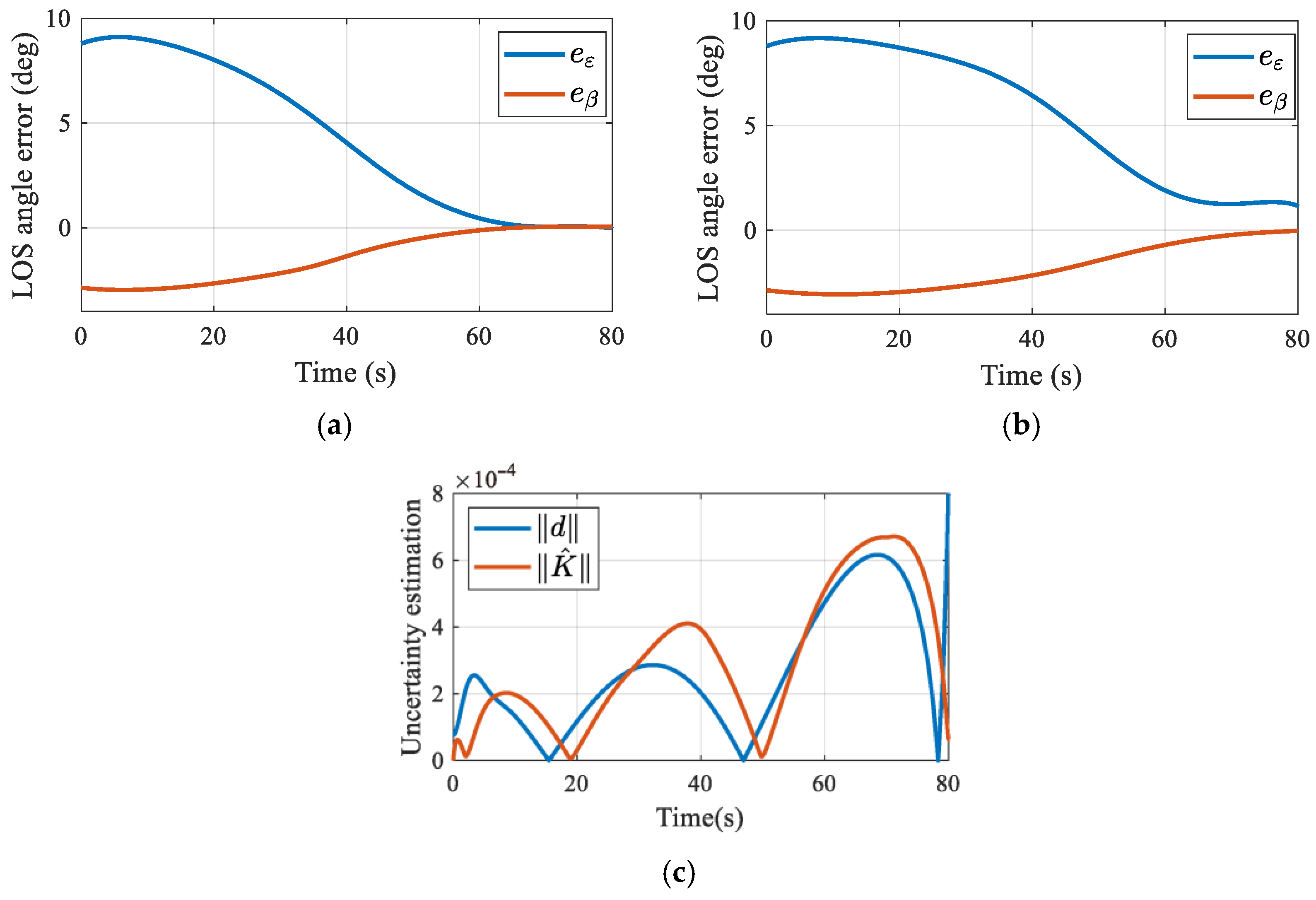
To further validate the effectiveness of the adaptive mechanism in suppressing target-induced uncertainties, the proposed guidance law is compared with a pure PPC version, which is obtained by removing the adaptive term from the control law (i.e., setting ). Since the pure PPC lacks uncertainty compensation, it is more prone to control singularity caused by the tracking error exceeding the prescribed bounds. To ensure a fair comparison and allow the simulation to run to completion, the performance function bounds for the pure PPC are appropriately enlarged to prevent premature termination.
The comparative results are presented in
Figure 6. It can be observed that the LOS errors of the proposed method eventually converge to zero throughout the engagement, whereas the pure PPC exhibits significantly larger deviations.
Table 3 further confirms that the proposed approach achieves a smaller miss distance. Moreover, the evolution of the adaptive gain
, also shown in
Figure 6c demonstrates that
approximately tracks the upper bound of the lumped disturbance
, thereby providing effective compensation and enhancing guidance accuracy. These results clearly highlight the necessity and benefits of the adaptive term in dealing with severe maneuver uncertainties.
4.2. Interception Performance Under Different Initial Conditions
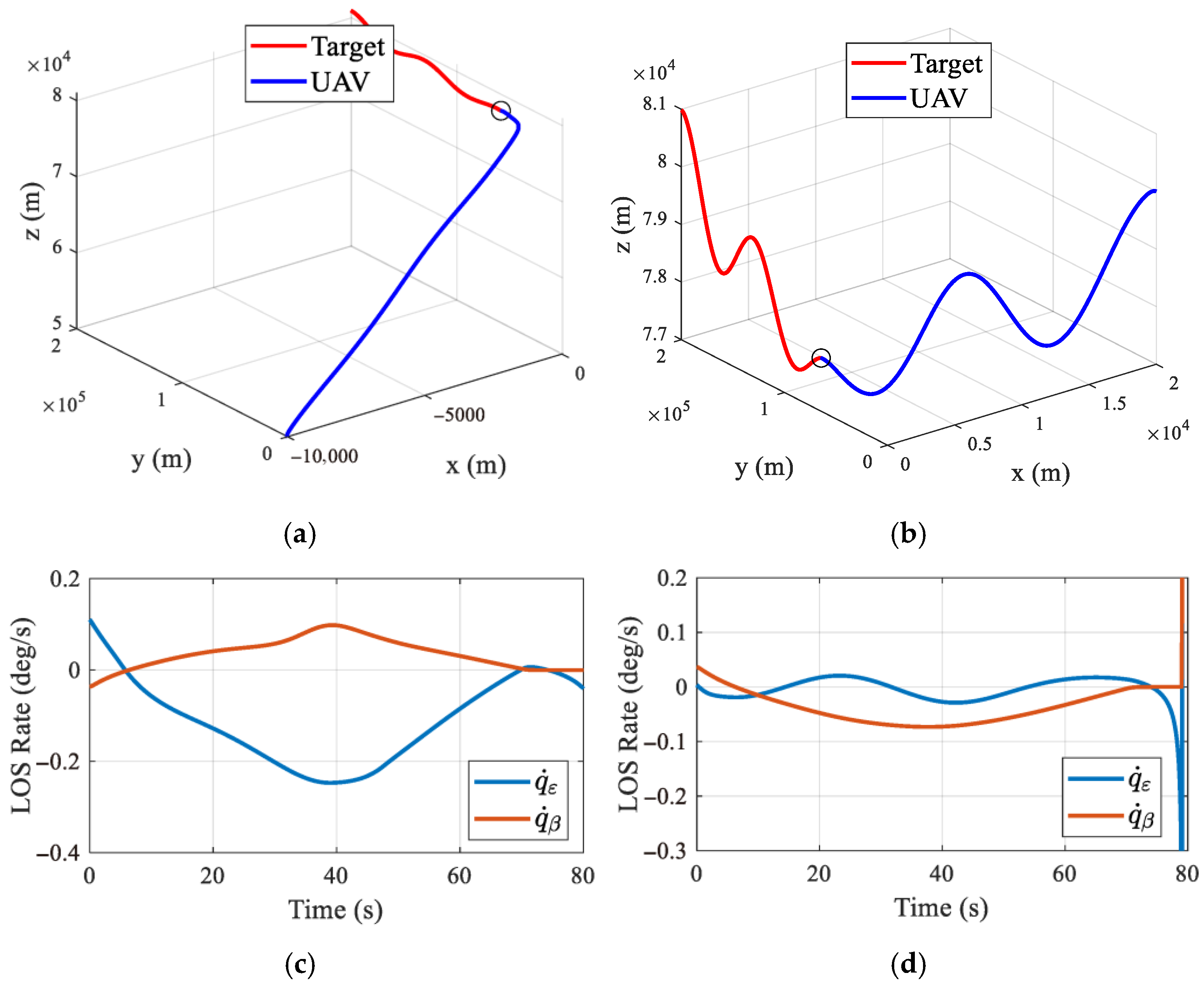
In this subsection, the adaptability of the proposed guidance law to different engagement geometries is evaluated by varying the initial positions of the UAV and the target, as summarized in
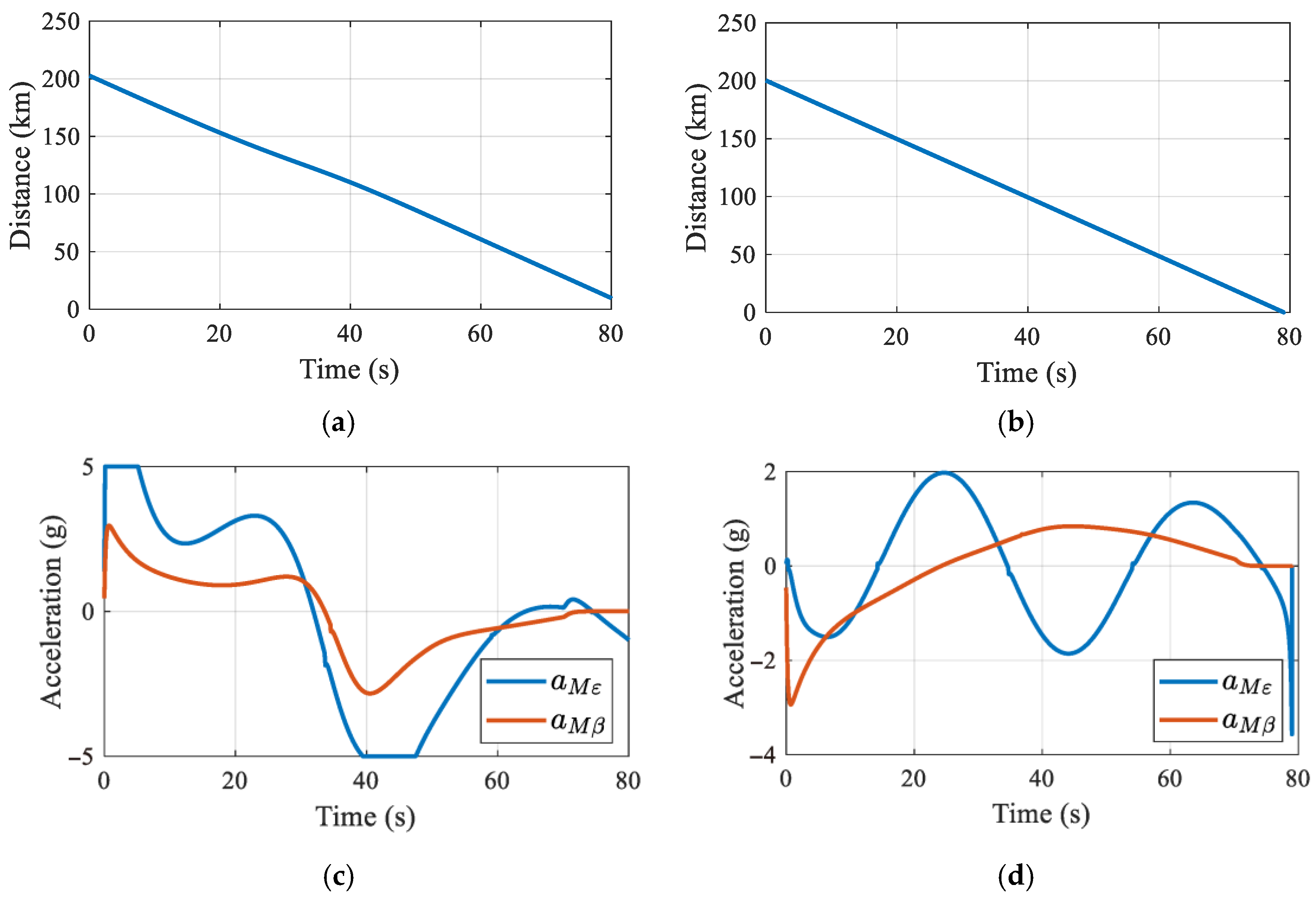
Table 1. The corresponding simulation results, including 3D interception trajectories, LOS angular rates, relative distance, and acceleration commands, are presented in
Figure 7 and
Figure 8.
As shown in
Figure 7a,b, despite the variations in initial geometry, the UAV successfully intercepts the target in all tested scenarios, demonstrating the versatility of the proposed method in three-dimensional pursuit missions. The LOS angular rates in
Figure 7c,d converge to a small value for each case, indicating that the guidance law maintains consistent angular convergence regardless of the initial setup. The relative distance curves in
Figure 8a,b exhibit a smooth and monotonic decrease, confirming that no undesirable oscillations or divergence occur during the engagement.
Figure 8c,d presents the acceleration commands for both the elevation and azimuth channels. It can be observed that the required control efforts remain within reasonable bounds across all initial conditions; although slight saturation occurs in some cases, it does not compromise the convergence of the miss distance. Overall, these results confirm the robustness and adaptability of the proposed method in practical three-dimensional interception scenarios.
4.3. Robustness Verification Under Strong Target Maneuver Uncertainties
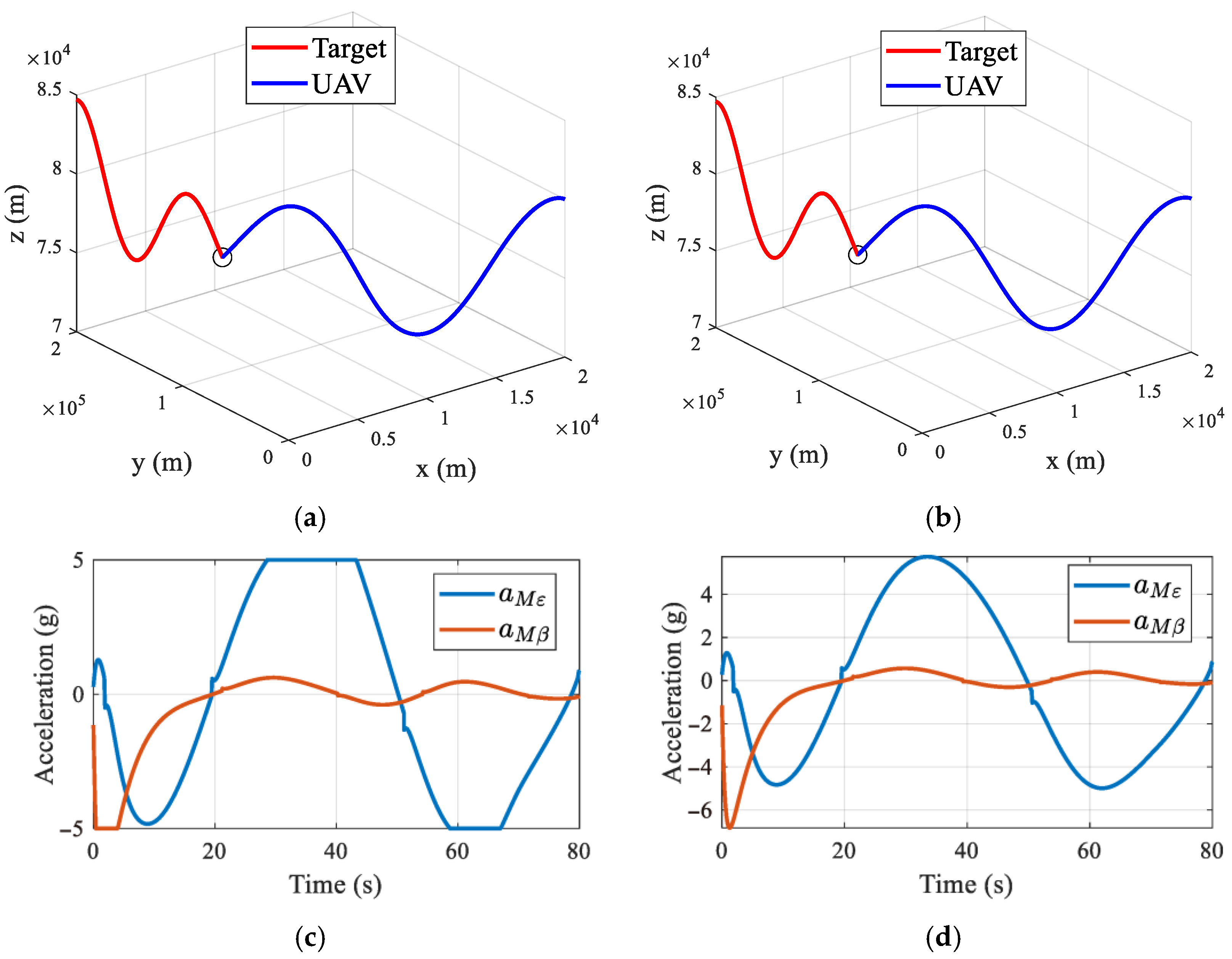
In this subsection, a more challenging scenario with strong target maneuvers is considered. Under such severe maneuver uncertainties, the UAV’s acceleration commands frequently reach saturation limits throughout most of the engagement. To evaluate the impact of actuator saturation on guidance performance, a comparative study is conducted between the proposed method with and without acceleration constraints. The simulation results are presented in
Figure 9.
As can be observed, despite persistent saturation in the control input, the proposed guidance law with acceleration constraints still ensures successful interception, and the miss distance remains within an acceptable range. Compared with the unconstrained case, the saturation leads to slightly degraded transient response and larger LOS angle errors, but the overall convergence trend and terminal accuracy are preserved. This demonstrates that the proposed method possesses a certain degree of tolerance to actuator saturation under extreme maneuver conditions, further confirming its robustness against strong target uncertainties.
4.4. Parametric Sensitivity Analysis of the Proposed Guidance Law
In this subsection, a parametric sensitivity analysis is conducted to evaluate the robustness of the proposed guidance law with respect to variations in its core design parameters. The parameters considered include the sliding mode gains
and
, as well as the adaptation rate
in the adaptive law. For each parameter, perturbations of
,
, and
relative to the nominal values (listed in
Table 2) are introduced, and Monte Carlo simulations with 20 runs per perturbation level are performed to obtain averaged performance metrics. The results, including the miss distance, interception time and RMSE, are summarized in
Table 4.
From
Table 4, it can be observed that within the tested perturbation range, both the miss distance and the LOS angle RMSE remain at relatively low levels, indicating that the guidance law maintains satisfactory interception performance despite moderate parameter variations. Specifically, variations in
and
primarily affect the convergence speed and the smoothness of the control input; however, even with 20% changes, the degradation in terminal accuracy is marginal, with the miss distance increasing by less than 0.6 m compared to the nominal case. The adaptation rate
influences the responsiveness of the uncertainty compensation: smaller
leads to slower adaptation and slightly larger tracking errors, while larger
accelerates compensation but may introduce minor oscillations. Nevertheless, all tested cases still ensure successful interception without triggering control singularity. These results demonstrate that the proposed guidance law exhibits a satisfactory degree of robustness against parameter uncertainties, making it suitable for practical implementation where exact parameter tuning may not be feasible.
5. Conclusions
This paper has proposed an adaptive prescribed-performance guidance law with predefined-time convergence for UAVs pursuing highly maneuverable targets. By establishing a velocity model to characterize target maneuver uncertainties, developing a robustly modified predefined-time performance function to eliminate singularity, and integrating an adaptive compensation mechanism, the proposed framework achieves robust predefined-time convergence of the LOS angle while effectively countering unknown target maneuvers. Theoretical stability analysis and numerical simulations validate its effectiveness and superiority over conventional methods.
Despite these contributions, several limitations should be acknowledged. The target maneuver model assumes predominantly longitudinal oscillatory motion based on [
29]; simultaneous lateral maneuvers may introduce additional uncertainties not fully captured. Furthermore, ideal UAV dynamics are assumed without considering sensor noise, autopilot lag, or communication constraints, which are important for real-world deployment on operational platforms.
Future research will address these limitations by developing coupled target dynamics, investigating robust filters to mitigate noise sensitivity, and extending the framework to multi-UAV cooperative pursuit scenarios. For guidance system design, this work demonstrates that modified prescribed-performance bounds enable singularity-free operation under target uncertainties, while predefined-time convergence ensures engagement success within the terminal guidance window—both critical insights for developing next-generation UAV interception systems capable of reliably engaging high-speed threats.