Article

Robust Extended Object Tracking Based on Variational Bayesian for Unmanned Aerial Vehicles Under Unknown Outliers

1
School of Computer Science, Northwestern Polytechnical University, Xi’an 710072, China
2
The School of Computer Science, Xi’an University of Posts Telecommunications, Xi’an 710061, China
*
Author to whom correspondence should be addressed.
Submission received: 14 November 2025 / Revised: 17 December 2025 / Accepted: 18 December 2025 / Published: 23 December 2025
(This article belongs to the Special Issue Detection, Identification and Tracking of UAVs and Drones)

Highlights

What are the main findings?
  • A dual-extended distortion and hierarchical model is developed within a variational Bayesian framework to facilitate accurate posterior approximation.
  • The proposed robust extended object tracking based on variational Bayesian handles unknown outliers, surpassing recent methods.
What is the implication of the main finding?
  • The proposed adaptive method can effectively handle the challenge of extended object tracking under unknown outliers, which is caused by factors such as UAV interference or partial object occlusion.
  • The experiment results validate the superior effectiveness and robustness of our approach, offering critical implications for UAV perception systems in the accurate estimation of object extension under complex operational environments.

Abstract
The application of extended object tracking (EOT) in unmanned aerial vehicles (UAVs) has increasingly gained attention in recent years. However, EOT is often corrupted by heavy-tailed measurement noise due to outliers, which can be caused by factors such as UAV interference or partial object occlusion. Student’s t distribution (STD) is widely adopted for modeling this type of noise, and the estimation accuracy of EOT is highly dependent on prior knowledge of the noise. Although existing methods typically assume such prior knowledge is available, this assumption often fails in practice. Furthermore, the fact that the posterior of the measurement noise is estimated leads to coupling. This coupling, which cannot be adequately resolved by existing methods, prevents the direct derivation of variational Bayesian (VB) inference. We propose an adaptive EOT approach that employs a decoupling model to address unknown outliers in UAV tracking. Then, a novel dual-extended distortion model from sensor’s FoV is proposed to address the coupling. Subsequently, the measurement likelihood is formulated as a hierarchical structure, where the degrees of freedom (DoF) and measurement noise covariance matrix (MNCM) are modeled by Gamma and inverse Wishart (IW) distributions, respectively. The hierarchical structure allows the model to account for unknown noise characteristics. Based on these models, we derive an approach recursively for estimation. Finally, the performance of the proposed approach is validated with both simulated and real-world datasets. The results demonstrate the superior effectiveness and robustness of our approach.

Graphical Abstract

1. Introduction

Target tracking is a pivotal technology for UAVs. However, the role of UAVs has evolved to encompass more complex missions, such as target size estimation, group object tracking, and recognition. Traditional target tracking methods are facing significant challenges, which primarily estimate kinematic states and represent the target as a point [1,2,3]. Meanwhile, recent advances in sensor technology for UAVs, including LIDAR and millimeter-wave radar [4,5,6], have led to a significant improvement in resolution [7,8]. Consequently, the targets are detected and might occupy more than one resolution cell, and the object extension information contained in the measurements cannot be ignored. This has motivated the development of EOT technology for UAVs [9,10].
The object extension is commonly described by its length and width when object extension is assumed with simple shapes, including rectangles [11] or ellipsoids [12]. Based on this assumption, several novel EOT models were developed. To address the problem of maneuvering EOT, a model based on the expectation–maximization (EM) of the measurement distribution was proposed [13]. This method treats the extension parameters as time-varying. However, it does not explicitly consider the case of a rigid body extension target. Consequently, the length and width of the object extension were generally assumed to be fixed, and a recursive expectation–maximization framework for EOT was proposed [14]. Moreover, a multiplicative error model was introduced, where the extended Kalman filter (EKF) was employed for estimation [15]. To enable online efficiency, a batch update scheme derived from the extended information filter was developed for this multiplicative model [16]. These methods, however, necessitate the computation of a complex Jacobian matrix. In contrast, the random matrix method (RMM) has been established as a simple and effective framework for EOT. It describes the object extension using a symmetric positive definite (SPD) matrix [17] and employs the Bayesian framework for estimation [18]. The RMM was first introduced [19] and then gradually refined [20,21]. Moreover, the length-to-width ratio of rigid objects was assumed to be constant to describe their shapes, and this ratio was incorporated into EOT models [22]. This fixed-aspect-ratio modeling improves EOT performance. Subsequently, a new VB method for EOT was developed, which can estimate the time-varying orientation angle more accurately [23]. To address non-uniform measurement distributions, a Gaussian mixture model was proposed for the EOT [24]. This model characterizes each region of densely distributed measurements by scaling and shifting. The asynchronous measurements are prevalent in multiple sensor scenarios, which significantly degrades the tracking accuracy of extended objects. To address this issue, a distributed framework for asynchronous measurements was derived based on the random matrix, and it was effectively implemented with particle filtering [25].
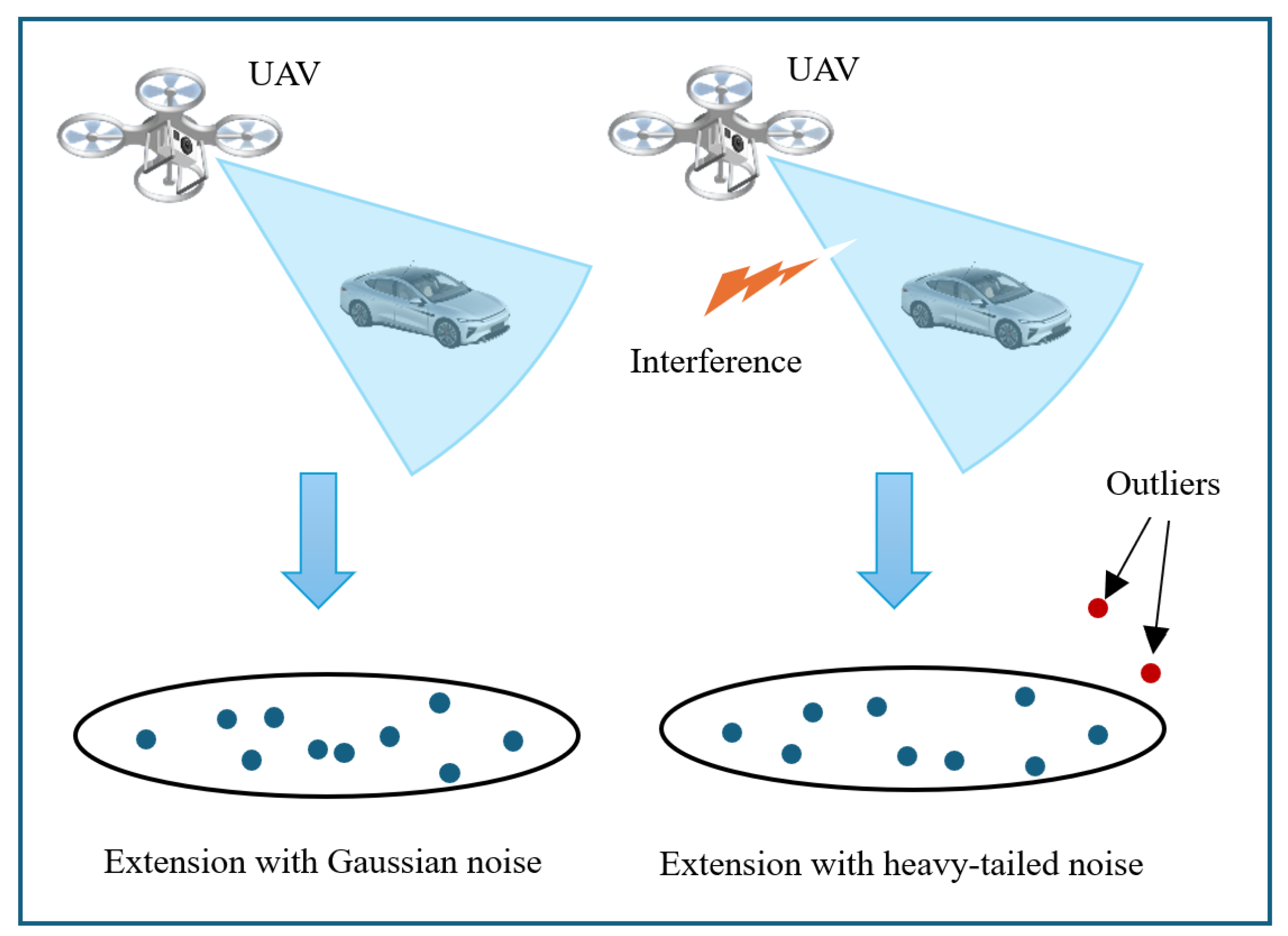
All the aforementioned methods model measurement noise as a Gaussian distribution. In practice, however, measurement outliers often arise from UAV interference or object partial occlusion, resulting in a heavy-tailed probability distribution of measurement noise [26]. Therefore, a heavy-tailed distribution is used to model the uncertainties associated with the frequent occurrence of outliers [27]. Based on this, the EOT method was developed. In this method, the measurement noise was modeled as an STD [28]. To address the heavy-tailed characteristics of both process and measurement noise, EOT methods employing the STD were subsequently proposed [29]. It can be introduced by the smoothing method for EOT. Furthermore, group object tracking has emerged as an established approach that employs the STD to model heavy-tailed noise [30].
The above EOT methods commonly assume that prior knowledge regarding measurement noise is perfectly known. However, this assumption often fails to hold in most UAV exploration missions. Moreover, the performance of these methods is critically influenced by prior noise information, specifically the DoF and MNCM. Specifically, an excessively high DoF degrades the robustness against heavy-tailed noise, while an overly low value slows convergence. Similarly, a mismatch in the MNCM leads to a significant degradation in the measurement gain. Furthermore, estimating the posterior of the noise parameters inherently leads to their coupling with the object extension. Consequently, it is always a challenge to design an effective decoupling model based on STD.
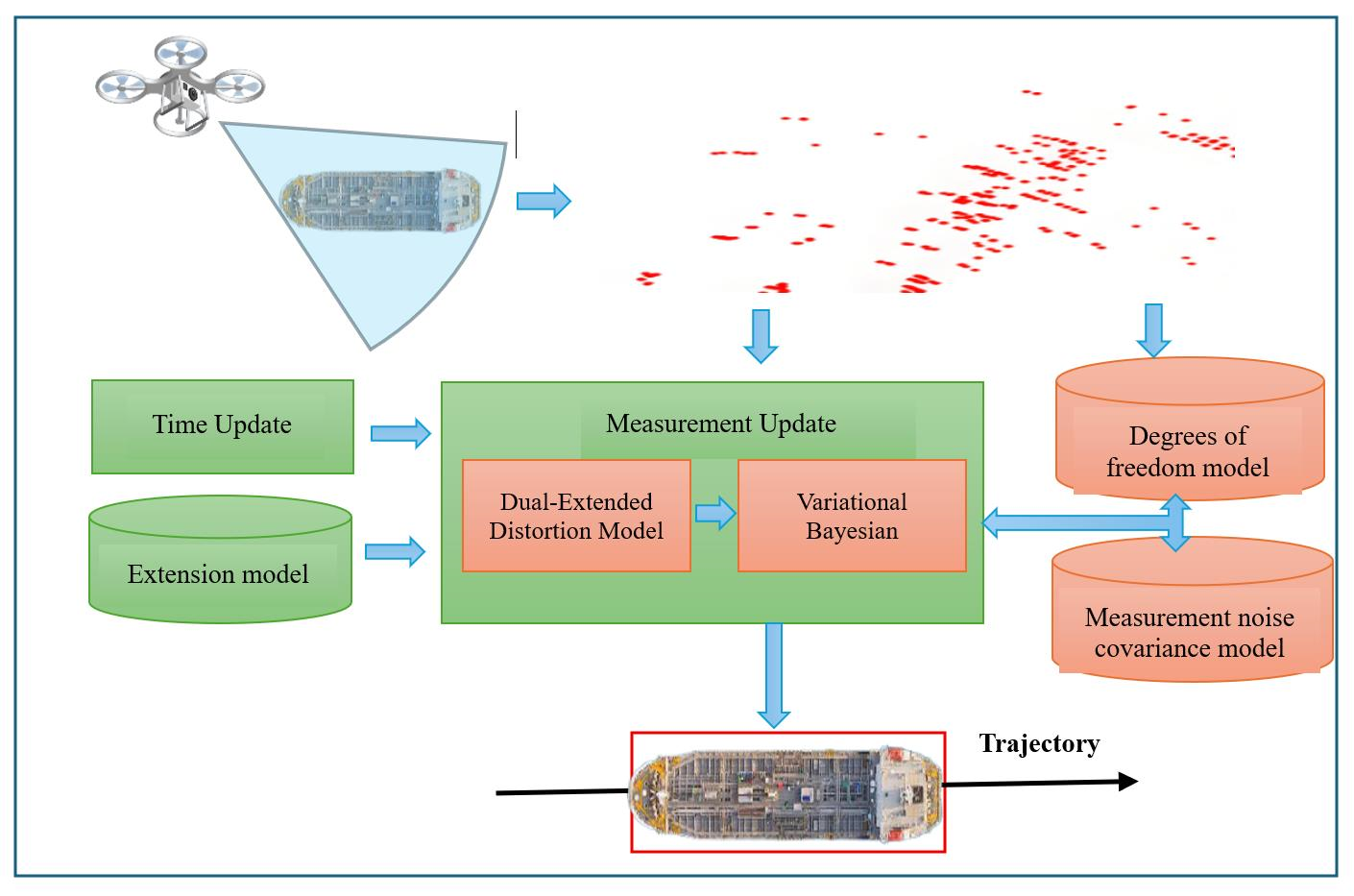
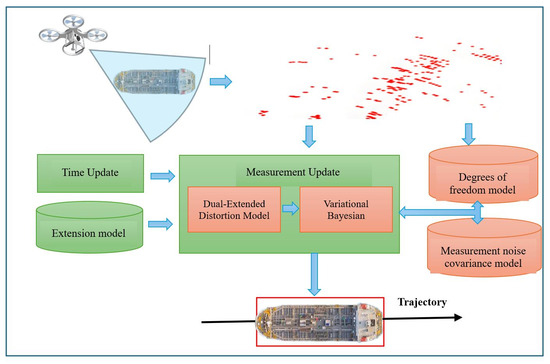
To bridge this gap, we propose an adaptive EOT approach using a random matrix for UAVs, as show in Figure 1. Firstly, a novel dual-extended distortion model is introduced. Moreover, the DoF and MNCM are modeled using the Gamma and IW distributions, respectively, owing to their conjugate prior properties. These properties are well-suited for VB inference, facilitating online recursive updates. Finally, a VB method is derived from these models for recursive estimation. We present the following key contributions in this work:
(1)
To address the coupling among the object extension, DoF, and MNCM, we propose a dual-extended distortion model that can explicitly decouple these parameters.
(2)
We employ the IW distribution to model the MNCM, while the DoF is modeled using the Gamma distribution. Based on these models, a variational Bayesian method is derived to handle the coupling and estimation.
The structure of this paper commences with the formulation of the system models and problem statement in Section 2. It then proceeds to Section 3, which offers a detailed exposition of the proposed adaptive EOT, including step-by-step derivations. The approach is then validated through three experimental scenarios in Section 4. Finally, the paper concludes its findings in Section 5.

2. Models and Problem Formulation

2.1. Noise Model

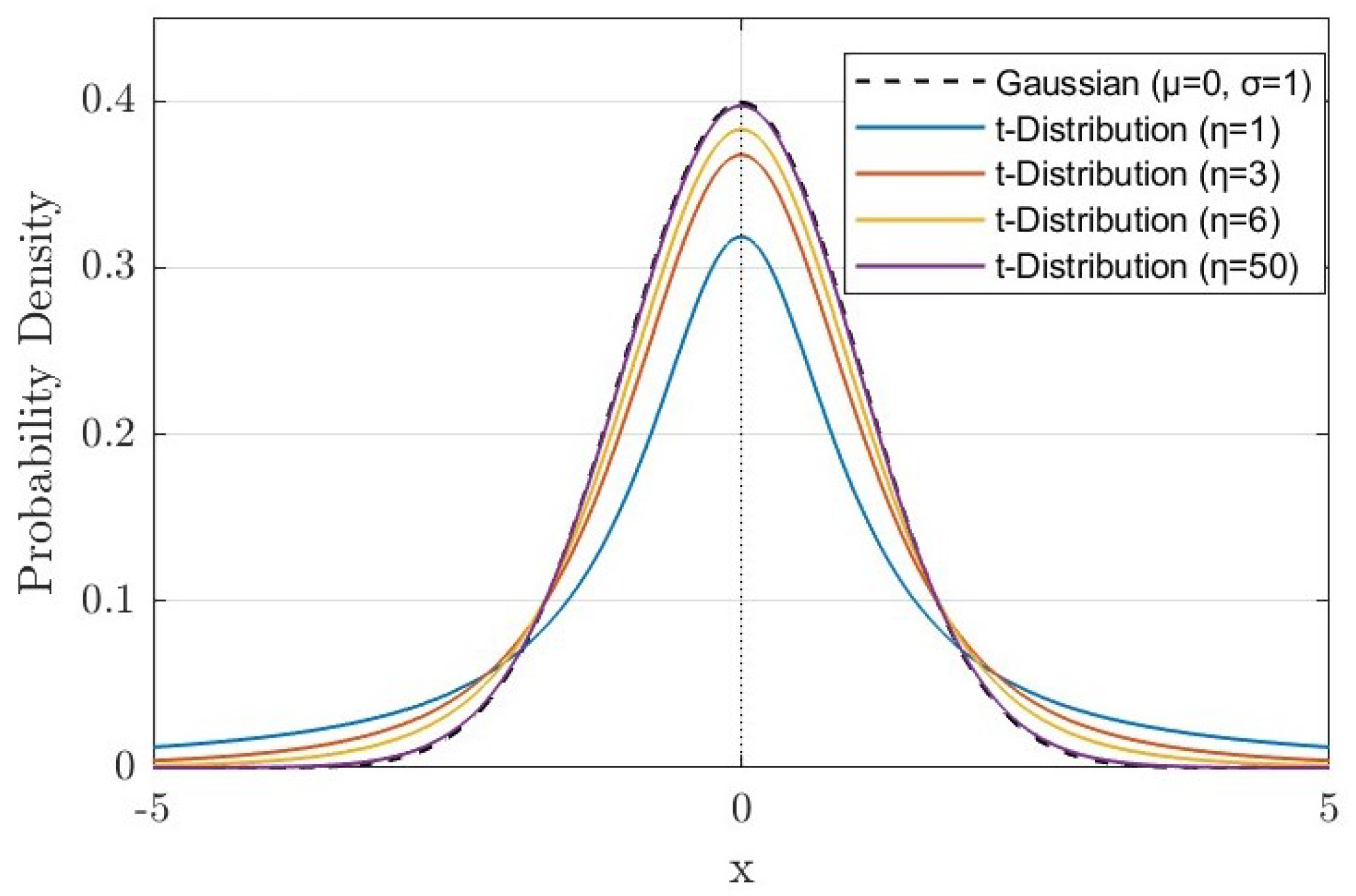
The heavy-tailed noise from outliers is best modeled by the STD, whose PDF has a slower tail decay than the Gaussian distribution. This property allows it to accommodate outliers. Thus, The STD is employed to characterize heavy-tailed measurement noise, thereby improving the adaptive performance for EOT. This can be represented as S T v ; μ , t , η , and its distribution is given by [27]
S T v ; μ , t , η = Γ η + 1 2 η π Γ η 2 1 + t μ 2 η σ 2 η + 1 2
where Γ is the Gamma function, v denotes a random variable, μ denotes the mean, η denotes the DoF, and t denotes the scale matrix.
The STD displays distinct heavy-tailed behavior as the DoF varies, which exhibits power-law tail decay, as depicted in Figure 2. Therefore, the DoF parameter is key for the accurate representation of heavy-tailed measurement noise.

2.2. Dynamic and Measurement Models

At time k, the kinematic state x k R n x includes the position and velocity of the object’s centroid. This model is described by [24] as
x k = F k x k 1 + w k , w k N 0 , Q k
where n x denotes the dimension of the state vector, F k is the transition matrix, and w k is the process noise which is zero-mean white Gaussian noise with a covariance matrix of Q k .
At each time k, a total of m k measurements are generated, which is denoted by y k = z k j i = 1 m k , and the j-th measurement within this set is denoted by z k j R n y . It can be written as follows [24].
z k j = H k x k + u k j , u k j S T 0 , R k , η k
where n y denotes the dimension of measurement, H k is the measurement matrix, and u k j is the noise which follows a zero-mean STD with covariance R k , and j is the index of measurement.
Within the Bayesian framework, the measurement likelihood function p y k m k , χ k , y 0 : k must be defined. In the extended object model, measurement sources are assumed to be statistically independent, and the corresponding measurements are also statistically independent. Thus, the likelihood function takes the form of [31]
p y k m k , x k , X k = j m k S T z k j ; H k x k , s X k + R k , η k
where X k denotes object extension, To ensure a uniform distribution of the measurement source over the object, s is empirically set to 1/4 [32].
The STD is given by a hierarchical form by modeling it as Gaussian. Specifically, this is achieved by introducing latent variables and treating DoF as a hyperparameter, which is then marginalized out to recover the original t-distribution. This representation facilitates analytical tractability within VB; (4) can thus be rewritten as follows
p z k j x k = S T z k j ; H k x k , s X k + R k , η k = p z k j x k , η k p η k d η k
with
p z k j x k , η k = N z k j ; H k x k , s X k + R k η k
Remark 1.
The direct application of (5) results in high computational complexity. To mitigate this issue, the likelihood is reformulated as a Gaussian hierarchical model. According to (6), the degrees of freedom. η k can adaptively control MNCM. The evolution of η k needs to be modeled, which will be introduced in subsequent sections.
In the proposed Bayesian framework for EOT, the measurement likelihood function must be decomposed into an independent measurement mean z ¯ k and a measurement variable Z ¯ k to facilitate easy estimation. Moreover, it is assumed in this work that the measurement sources are uniformly distributed across the object extension. This assumption ensures that the centroid of the measurements in each scan lies inside the object extension. Thus, (4) can be rewritten as follows [21]:
p Y k m k , x k , X k , η k N z ¯ k ; H k x k , s X k m k W Z ¯ k ; m k 1 , s X k + R k η k
with
z ¯ k = 1 m i = 1 m k z k j , Z ¯ k = i = 1 m k z k j z ¯ k z k j z ¯ k T
To facilitate conjugate inference in the Bayesian update step, they can be written as
P η k y k = G η k ; κ k , ζ k
P R k y k = I W R k ; α k , β k
where I W denotes the density of the IW distribution, and α k and β k are the parameters. G is the density of Gamma distribution, and κ k and ζ k are the parameters.
Based on the fact that both the Gaussian and IW distribution belong to the exponential family, the VB inference bypasses the need for complex integration, enabling direct parameter updates. This significantly accelerates the convergence speed of the approximate posterior estimation. Furthermore, the IW distribution inherently guarantees the SPD throughout the update process, thereby effectively preventing numerical failure that could arise from non-positive definite matrices during computation.
Remark 2.
The Gamma and IW are conjugate prior. It ensures that the posteriors remain within the same family, enabling tractable variational inference with closed-form updates. Moreover it has been observed in current research that the MNCM follows an inverse Gamma distribution. Since the DoF and the MNCM are reciprocals of each other, the DoF can consequently be modeled as a Gamma distribution.

2.3. Extension and Distortion Model

The object extension X k is SPD. Refs. [19,21] proposed
p X k X k 1 = W X k ; δ k , X k 1 / δ k
with
P X k y k = I W X k ; v k , V k
where δ k is the scale factor of the Wishart distribution, v k is the scale factor, and V k is an SPD random matrix of the IW distribution. The estimation of extension can be calculated as follows [21].
X ^ k = V k v k 2 d 2
The measurement z k j is generated from its corresponding measurement source H k x k and depends on the object extension X k corrupted by heavy-tailed noise. Consequently, the noise for the object is modeled as
u k j N 0 , s X k + R k η k
From (14), the additive relationship between X k and R k η k creates a coupled structure that prevents the direct inference of their respective posterior distributions using VB methods. Therefore, it is necessary to transform their relationship from additive to multiplicative, enabling the independent estimation of parameters. A novel dual-extended distortion mode that enables decoupling is proposed. It is derived as follows:
s X k + R k η k 1 = s X k + R k η k 1 1 / 2 X k 1 / 2 X k X k T / 2 s X k + R k η k 1 T / 2 = Ψ k X k Ψ k T
s X k + R k η k 1 = s X k + R k η k 1 1 / 2 R k η k 1 1 / 2 R k η k 1 R k η k 1 T / 2 × s X k + R k η k 1 T / 2 = Γ k R k η k 1 Γ k T
where Ψ k = s X k + R k η k 1 1 / 2 X k 1 / 2 and Γ k = s X k + R k η k 1 1 / 2 R k η k 1 1 / 2 are defined as the dual-extended distortion model.
In many real applications, the object extension is generally modeled as time-invariant. Thus, the object extension X k is followed as
X k X k k 1
Equation (17) becomes invalid when the target’s expansion changes rapidly.
Thus, the dual-extended distortion Ψ k and Γ k are approximated as follows:
Ψ k = s X k k 1 + R k η k 1 1 / 2 X k k 1 1 / 2
Γ k = s X k k 1 + R k η k 1 1 / 2 R k η k 1 1 / 2
Remark 3.
The Ψ k in (18) can be interpreted as the extended distortion between the observed extension and the actual one. The Γ k in (19) can be interpreted as the MNCM distortion from the observed FoV. The validity of the dual-extension model is predicated on the premise of a time-invariant target extension. If this condition is not met, the model ceases to be valid and fails to achieve extended target tracking. Furthermore, the dual-extended distortion model introduces a novel decoupling mechanism that enables the separation of previous coupled parameters. This model is scalable and can be extended to a dual-extended deformation model due to its inherent adaptability in future work.

2.4. Problem Formulation

For an extended object χ k = x k , X k , the time update step of the Bayesian framework at time k is expressed as follows [19]:
p k k 1 χ k y 0 : k = f χ k χ k 1 p χ k 1 y 0 : k 1 d χ k 1
and the measurement update is described as follows [19]:
p χ k y 0 : k = p y k m k , χ k , y 0 : k p χ k y 0 : k 1 p y k m k , χ k , y 0 : k p χ k y 0 : k 1 d χ k
where f . denotes the state transition PDF, p y k m k , χ k , y 0 : k 1 is the measurement likelihood function, y 0 : k denotes the measurement sets from time 0 to k and the sequence y 0 , y 1 y k .
Combining (2), (3), and (9)–(12), the adaptive EOT framework is presented as follows:
x k = F k x k 1 + w k , w k N 0 , Q k z k j = H k x k + u k j , u k j S T 0 , R k , η k p X k X k 1 = W X k ; δ k , X k 1 / δ k P X k y k = I W X k ; v k , V k P R k y k = I W R k ; α k , β k P η k y k = G η k ; κ k , ζ k

3. Adaptive EOT with Variational Bayesian

In the adaptive EOT framework, the objective is estimation. To achieve this, the estimation process is divided into two sequential steps: (1) a time update based on a dynamic model, which predicts the time evolution; (2) a measurement update step using VB inference, which integrates measurements to iteratively optimize the posterior distribution.

3.1. Time Update

Based on (22), a VB method for EOT is derived. The independence between x k and X k is assumed. According to the EOT framework, which provides a recursive solution for estimation, the x k k 1 and P k k 1 can be accurately predicted. They are derived as follows:
x k k 1 = F k x k 1 k 1
P k k 1 = F k P k 1 k 1 F k T + Q k
In VB estimation, the IW is frequently employed as a conjugate prior for the object extension model due to its analytical tractability [19]. Thus, the time update for object extension is given by
v k k 1 = v k 1 k 1 e T / τ
V k k 1 = v k k 1 d 1 v k 1 k 1 d 1 V k 1 k 1
where τ is the decay, T is the updating interval, and d is the dimension of X k . The prediction accuracy deteriorates with increasing update interval T. To capture this, τ is introduced as an additional modeling parameter. Furthermore, according to recent studies, the temporal decay constant can be treated as a constant typically constrained to the interval (0, 1].

3.2. Measurement Update

The parameters are independently posterior distribution. Since obtaining the analytical solution for the joint posterior PDF is challenging, we adopt the VB method to approximate [33]. The posterior is given by
p x k , X k , R k , η k , y k y 0 ; k , m q x x k q X X k q R R k q η η k
where q x x k , q X X k , q R R k , and q η η k denote the approximate posterior densities of x k , X k , R k , and η k , respectively.
The VB method approximates the posterior by minimizing the Kullback–Leibler divergence (KLD) between the exact posterior p x and the approximating distribution q x [33], which enables efficiency inference in high-dimensional distributions. The KLD is defined as follows:
K L D q x     p x q x log q x p x d x
Remark 4.
The selecting iterations generally follow two main criteria. The first one is based on the variational evidence lower bound (ELBO), where iterations are terminated once the difference in ELBO values falls below a predefined threshold. This approach is typically used in scenarios demanding high accuracy but with low real-time requirements. The other criterion relies on experimentally tuning a predefined fixed number of iterations until satisfactory accuracy is achieved. Given the high real-time demands of tracking algorithms on UAVs, this paper adopts the approach of using a fixed iteration.
Based on (27) and (28), it can be rewritten as follows:
log q Ω k = E Ω k log p x k , X k , R k , η k , y k y 0 : m ; k + c Ω k
where E is the expectation, Ω k denotes the set of all parameters excluding Ω k , Ω k denotes an arbitrary parameter, and c Ω k is a constant. To ensure real-time performance, the fixed-point iteration method is chosen.
By substituting (8) and (22) into (27), we obtain the following:
p x k , X k , R k , η k , y k y 0 : m , k = N x k ; x k k 1 , P k k 1 N z ¯ k ; H k x k , s X k m k ×   W Z ¯ k ; m k 1 , s X k + R k η k I W X k ; v k k 1 , V k k 1 ×   I W R k ; α 0 , β 0 G η k ; κ 0 , ζ 0
Let Ω k = x k be the approximate posterior distribution of the kinematic state. It can be derived as follows:
log q x i + 1 x k = log N x k ; x k k 1 , P k k 1 + log N z ¯ k ; H k x k , s X k m k = 1 2 t r x k x k k 1 x k x k k 1 T P k k 1 1 1 2 t r z ¯ k H k x k k z ¯ k H k x k k T s X k m k 1 + c x
where c x is a constant, l o g q x i + 1 x k represents the updated values at iteration i + 1.
After exponentiation of both sides of (31), the posterior PDF follows a Gaussian distribution, which is given by [19]
q x i + 1 x k = N x k ; x k k i + 1 , P k k i + 1
where S k , K k , x k k i + 1 , and P k k i + 1 are given by
S k H k P k k 1 H k T + s X k + R k η k 1 m k
K k = P k k 1 H k T S k 1
x k k i + 1 = x k k 1 + K k z ¯ k H k x k k 1
P k k i + 1 = P k k 1 K k S k K k T
and z ¯ k denotes the mean of the measurement set, which is defined by (8). m k is the measurement number.
Let Ω k = X k denote the approximate posterior distribution. It can be derived as follows:
log q X i + 1 X k = log N z ¯ k ; H k x k , s X k m k + log W Z ¯ k ; m k 1 , Ψ k X k k 1 Ψ k T + log I W X k ; v k k 1 , V k k 1 = 1 2 v k k 1 + m k log X k 1 2 t r V k k 1 + z ¯ k H k x k z ¯ k H k x k T 1 2 t r Ψ k 1 Z ¯ k Ψ k T + c X
where t r denotes the matrix race operation, and c X is a constant.
After exponentiation of both sides of (37), the posterior PDF follows IW distribution, which is given by [21]
q X i + 1 X k = I W X k ; v k k i + 1 , V k k i + 1
where v k k i + 1 and V k k i + 1 are given by
N k = E z ¯ k H k x k k 1 + H k x k k 1 H k x k k T = z ¯ k H k x k k 1 T + H k P k k H k T
v k k i + 1 = v k k 1 + m k
V k k i + 1 = V k k 1 + m k N k + Ψ k 1 Z ¯ k Ψ k T
and Z ¯ k denotes the variable of the measurement set, which is defined by (8).
Let Ω k = R k denote the approximate posterior distribution. It can be derived as follows:
log q R i + 1 R k = log W Z ¯ k ; m k 1 , Γ k R k k E i η k Γ k T + log I W R k ; α 0 , β 0 = 1 2 α 0 + m k log R k 1 2 t r β 0 + Γ k 1 Z ¯ k E i η k Γ k T + c R
where c R is a constant.
After exponentiation of both sides of (42), the posterior PDF follows IW distribution, which is given by
q R i + 1 R k = I W R k ; α k i + 1 , β k i + 1
where α k i + 1 , β k i + 1 and E i + 1 R k are given by
α k i + 1 = α 0 + m k
β k i + 1 = β 0 + Γ k 1 Z ¯ k E i η k Γ k T
E i + 1 R k = β k i + 1 α k i + 1
where α 0 d 1 , β 0 is an SPD matrix.
Let Ω k = η k denote the approximate posterior distribution. It can be derived as follows:
log q η i + 1 η k = log W Z ¯ k ; m k 1 , Γ k E i + 1 R k η k 1 Γ k T + log G η k k ; κ 0 , ζ 0 = κ 0 + 1 2 m k log η k = 1 2 β 0 + t r Γ k 1 Z ¯ k E i + 1 R k Γ k T + c η
where c η is a constant.
After exponentiation of both sides of (47), the posterior PDF follows a Gamma distribution, which is given by
q η i + 1 η k = G η k ; κ k i + 1 , ζ k i + 1
where κ k i + 1 , ζ k i + 1 and E i + 1 η k are given by
κ k i + 1 = κ 0 + 1 2 m k
ζ k i + 1 = ζ 0 + t r Γ k 1 Z ¯ k E i + 1 R k Γ k T
E i + 1 η k = κ k i + 1 ζ k i + 1
One step of the VB method for EOT using a random matrix is summarized in Algorithm 1. The VB method converges after fixed-point iteration. Since the VB method is recursive, the derived estimation formulas correspond to one measurement update step.
Algorithm 1: Steps of the Adaptive EOT Approach
Input: x k 1 k 1 , X k 1 k 1 , P k 1 k 1 , F k , Q k , H k , N, T, τ , v k 1 k 1 ,
V k 1 k 1 , α 0 , β 0 , κ 0 , ζ 0 .
For k = 1: steps Time update:
x k k 1 23 , P k k 1 24 , v k k 1 25 , V k k 1 26 .
Measurement update:
Initialization
x k k 0 = x k k 1 , P k k 0 = P k k 1 , X k k 1 = V k k 1 / v k k 1 2 d 2 ,
R k 0 = β 0 α 0 , η k 0 = κ 0 ζ 0 .
While i N do
Ψ k 18 , Γ k 19 .
Calculate q x i + 1
x k k i + 1 35 , P k k i + 1 36 .
Calculate q X i + 1
v k k i + 1 40 , V k k i + 1 41 .
Calculate q R i + 1
α k i + 1 44 , β k i + 1 45 , E i + 1 R k 46 .
Calculate q η i + 1
κ k i + 1 49 , ζ k i + 1 50 , E i + 1 η k 51 .
End
x k k = x k k N , P k k = P k k N , V k k = V k k N , v k k = v k k N , α k k = α k k N , β k k = β k k N ,
κ k k = κ k k N , ζ k k = ζ k k N .
End
Remark 5.
Our approach is inherently flexible. This means it can be adapted as an estimator for either the unknown MNCM or the unknown DoF, based on specific application requirements. Furthermore, it incorporates a real-time parameter adjustment mechanism driven by measurements.

3.3. Complexity Analysis

The complexity of the proposed approach is compared against the classical floating-point EOT algorithm, which operates under known measurement noise. While both methods follow the same EOT framework, the proposed approach incurs additional costs for estimating the unknown noise, whereas the classical method assumes these parameters are given. Taking Equation (24) as an example, the complexity of computing F k P k 1 k 1 is n 2 × n . Subsequently, computing F k P k 1 k 1 F k T is also n 2 × n + n 2 × n . Finally, adding Q k contributes n 2 . Therefore, the total complexity of (24) is O n 3 . The complexity of both the proposed and the classical approaches is summarized as follows:
S p E O T = O n 3 + O N n 2 m + O N d 3 + O N m 3 + O N m 3 = O n 3 + n 2 m + m 3
S t E O T = O n 3 + O N n 2 m + O N m 3 = O n 3 + n 2 m + m 3
where S p E O T is proposed approach, S t E O T is classical approach.
The results show that our method is no more complex than the classical one.

4. Results

This section evaluates the proposed approaches through three distinct scenarios: two simulations and one real-world experiment. We evaluated the proposed method against two established EOT methods tailored for heavy-tailed noise: one based on an STD (ST-EOT [30]) and the other on a Gaussian assumption (Gauss-EOT [21]). For a comprehensive comparison, we include two variants of our approach:
The approach which adaptively estimates both the DoF and MNCM (VB-ST-AEOT).
The approach which presets the DoF to a constant value and adaptively estimates the MNCM (VB-ST-EOT).
All experiments assume that measurement noise exhibited a heavy-tailed characteristic. All approaches compared are implemented in MATLAB (R2021b) and run on a computer with an Intel Core i3-6100 CPU and 4G RAM.
To ensure the reliability of the evaluation, we employ the Gaussian Wasserstein distance (GWD) [34] and the Intersection over Union (IOU) [35] for cross-validation. The former is a comprehensive evaluation metric for EOT, which enables evaluation. The latter can intuitively characterize the degree of spatial overlap between the estimated and true object extension. In addition, Root Mean Square Error (RMSE) is utilized as a metric for state and extension evaluation.
The GWD is defined as
d w 2 = x 1 x 2 2 + t r X 1 + X 2 2 X 1 X 2 X 1
where x 1 and x 2 denote the kinematic state, and X 1 and X 2 denote object extension.
The IOU is defined as
I O U = S t r u e S e s t S t r u e S e s t
where S t r u e is the true object extension and S e s t is the estimated object extension.
RMSE is defined as
R M S E = 1 N k = 1 N p ^ x p x 2 + p ^ y p y 2
where p x , p y denotes the true kinematic state, and p ^ x , p ^ y denotes the estimated kinematic state.

4.1. Simulated Scenario SS1

SS1 is conducted with the aim of evaluating the effectiveness of the proposed methods. In SS1, a cargo ship of 400 m × 150 m is simulated, which dynamically moves following the nearly constant velocity (CV) model with a speed of 9.8 m/s and a fixed orientation of π / 4 in dense fog. This object is tracked by a UAV with a millimeter-wave radar in the Cartesian xy plane over 0–150 s. To verify the robustness of the proposed method against short-term interference and abruptly appearing/disappearing heavy-tailed noise, in experiment SS1, we simulated a scenario where strong interference occurs at 70–80 s. This interference caused the measurements within that period to exhibit a medium-to-heavy-tailed distribution.
The sensor is configured with a sampling period of T = 1 s for the extended object, and the MNCM is R 0 = d i a g ( 100 s 2 , 100 s 2 ) . Measurements obtained from the object’s surface adhere to a Poisson distribution. It has a mean rate of λ = 50 . The proposed VB-ST-EOT uses a preset DoF value of 0.001. The VB iteration count is fixed at 10 for all methods in the comparison. For a fair comparison, all other parameters are kept identical across all approaches.
To simulate the effect of outliers, we inject heavy-tailed noise into the measurements during the time interval 70–80 s, and it is as follows:
R k N 0 , 200 R 0 , 70 s t 80 s . N 0 , R 0 others .
The dynamic evolution model is given by (2), with parameters set as follows:
x 0 = 100 m , 100 m , 5 m / s , 8 m / s , F k = 1 0 T 0 0 1 0 T 0 0 1 0 0 0 0 1 ,
P 0 = d i a g 900 m 2 900 m 2 16 m 2 / s 2 16 m 2 / s 2 ,
Q 0 = d i a g 10 m 2 10 m 2 10 m 2 / s 2 10 m 2 / s 2 .
The object extension evolution model is considered as (12) and (14), with parameters set as follows:
v 0 = 7 , V 0 = d i a g 1 m , 1 m , s = 1 / 4 , d = 2 .
The measurement evolution model is considered as (3), with the parameter set as follows:
H k = 1 0 0 0 0 1 0 0 .
The DoF and MNCM models are considered as (9) and (10), with parameters set as follows:
α 0 = 0.01 , β 0 = d i a g 1 , 1 , κ 0 = 0.001 , ζ 0 = 1 .
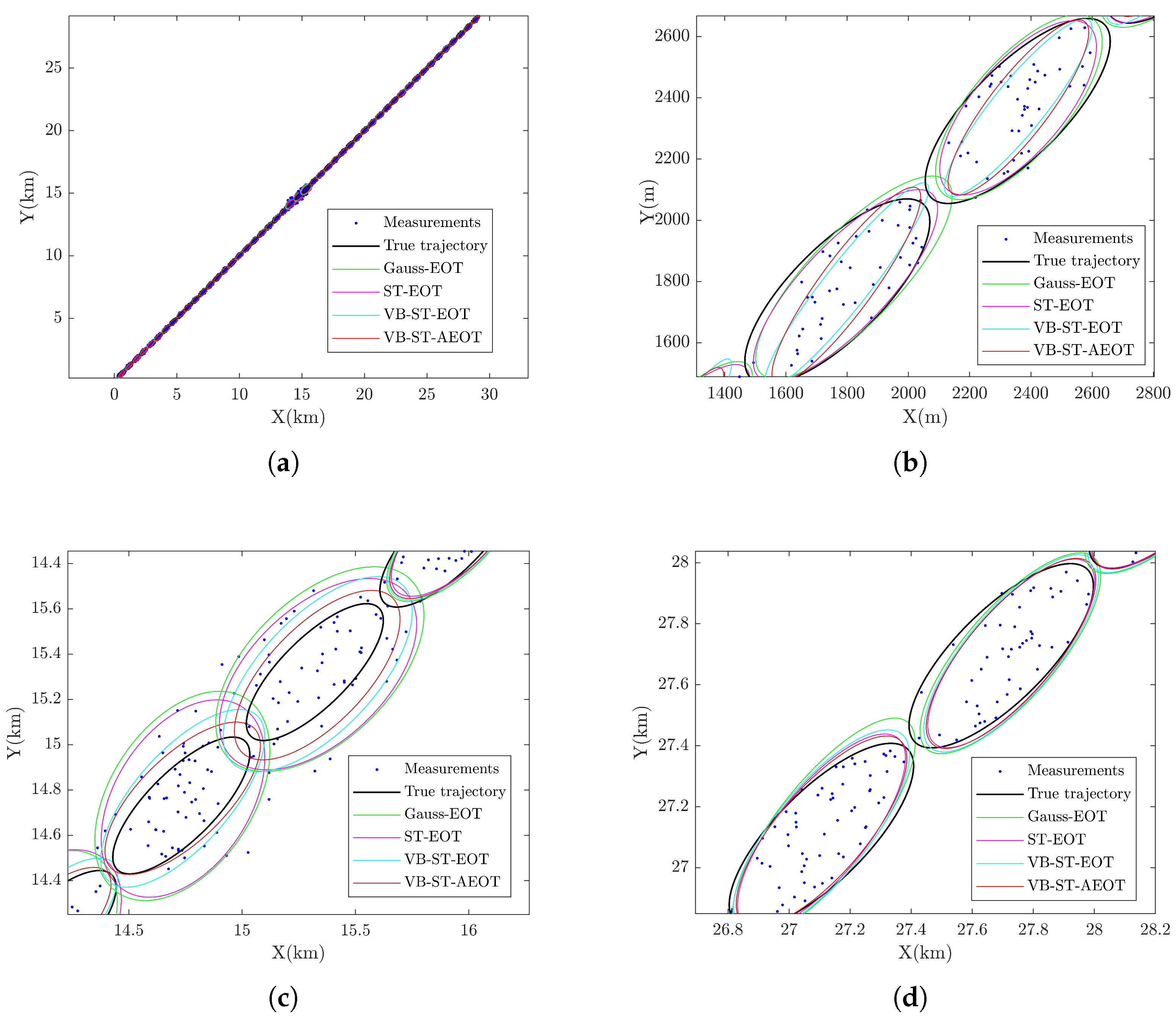
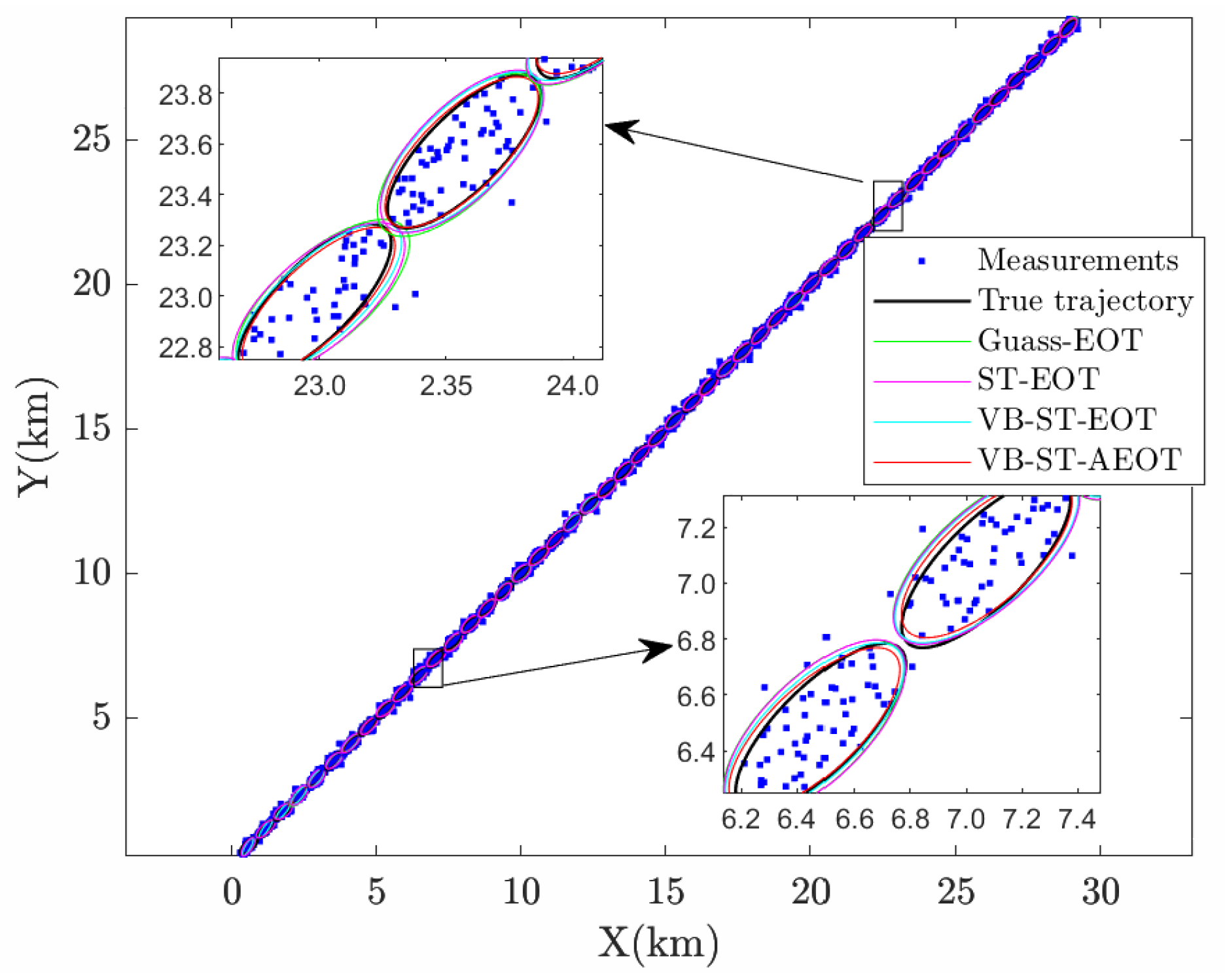
Figure 3a shows the overall tracking trajectories. The result demonstrates that all approaches have a capability for estimation. Moreover, the object is tracked reasonably well by all approaches under nominal conditions. However, the significant performance divergence is observed during the heavy-tailed noise interval (70–80 s).
Figure 3b–d show the detailed typical tracking processes at the initial, middle, and final steps. Figure 3b,d show that all the compared approaches exhibit similar tracking performance under a Gaussian distribution of the measurement noise within 0–70 s and 80–150 s. Figure 3c shows that the proposed VB-ST-AEOT outperforms other approaches in tracking performance, and its variant VB-ST-EOT shows significant improvement to both ST-EOT and Gauss-EOT within 70–80 s. This is primarily because the proposed models can effectively adapt to the uncertain DoF and unknown MNCM, a feature lacking in the other approaches.
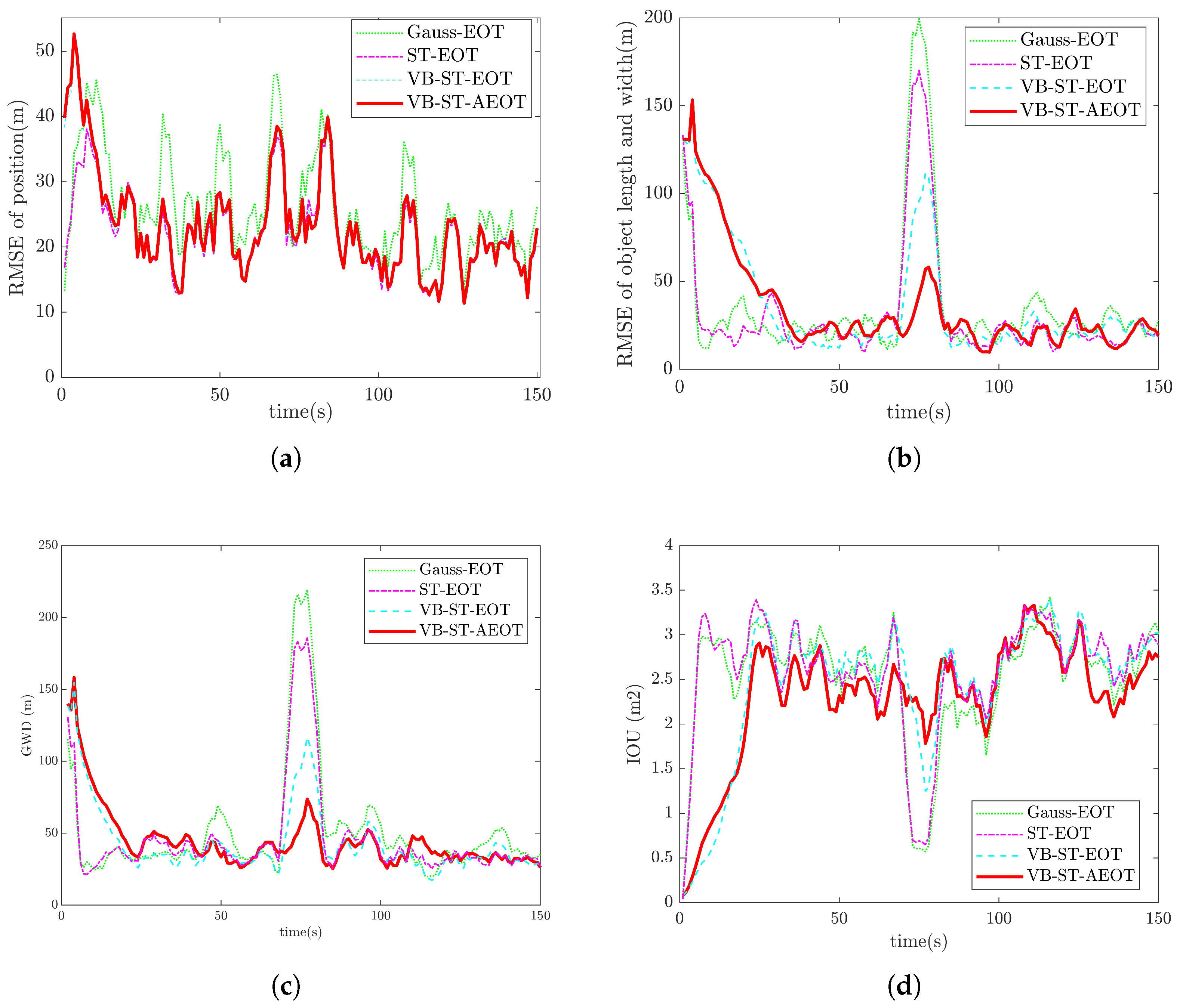
Figure 4a,b show the RMSE for position and extension (length and width) estimates, respectively. For position estimation in Figure 4a, the results demonstrate that the proposed VB-ST-AEOT and VB-ST-EOT have higher estimation accuracy tracks than Gauss-EOT. However, they are nearly indistinguishable from ST-EOT. For extension estimation in Figure 4b, VB-ST-AEOT and VB-ST-EOT yield a marked improvement compared to ST-EOT and Gauss-EOT. And VE-ST-AEOT outperforms VB-ST-EOT. The extension estimation is a core feature of EOT. Thus, the result demonstrates the effectiveness of the proposed approaches.
Figure 4c,d show that the estimation results of compared approaches are exhibited by the GWD and the IOU over 50 Monte Carlo (MC) trials. The two evaluations metrics exhibit consistent results. Compared with other approaches, the proposed VB-ST-AEOT exhibits the lowest GWD and highest IOU. And the proposed VB-ST-EOT outperforms ST-EOT and Gauss-EOT. These results confirm the effectiveness of new approaches under heavy-tailed measurement noise conditions.
Table 1 shows the EOT errors of compared methods at typical time steps in SS1. Consistent with Figure 4, our approaches maintain the lowest errors across all time steps and verify the effectiveness.

4.2. Simulated Scenario SS2

SS2 is designed to validate the robustness of the proposed approaches under conditions of randomly occurring heavy-tailed noise. In this section, we simulate EOT scenarios under varying intensities of the heavy-tailed model, while adopting the same measurement model as in SS1. The heavy-tailed noise model randomly generates outliers in each scan with a probability p. The noise generation method is as follows:
R k N 0 , ρ R 0 , p = 0.2 . N 0 , R 0 p = 0.8 .
where ρ is the noise covariance scaling factor set to 100, 200, and 300, respectively. Except for the MNCM, other parameters are the same as those in SS1.
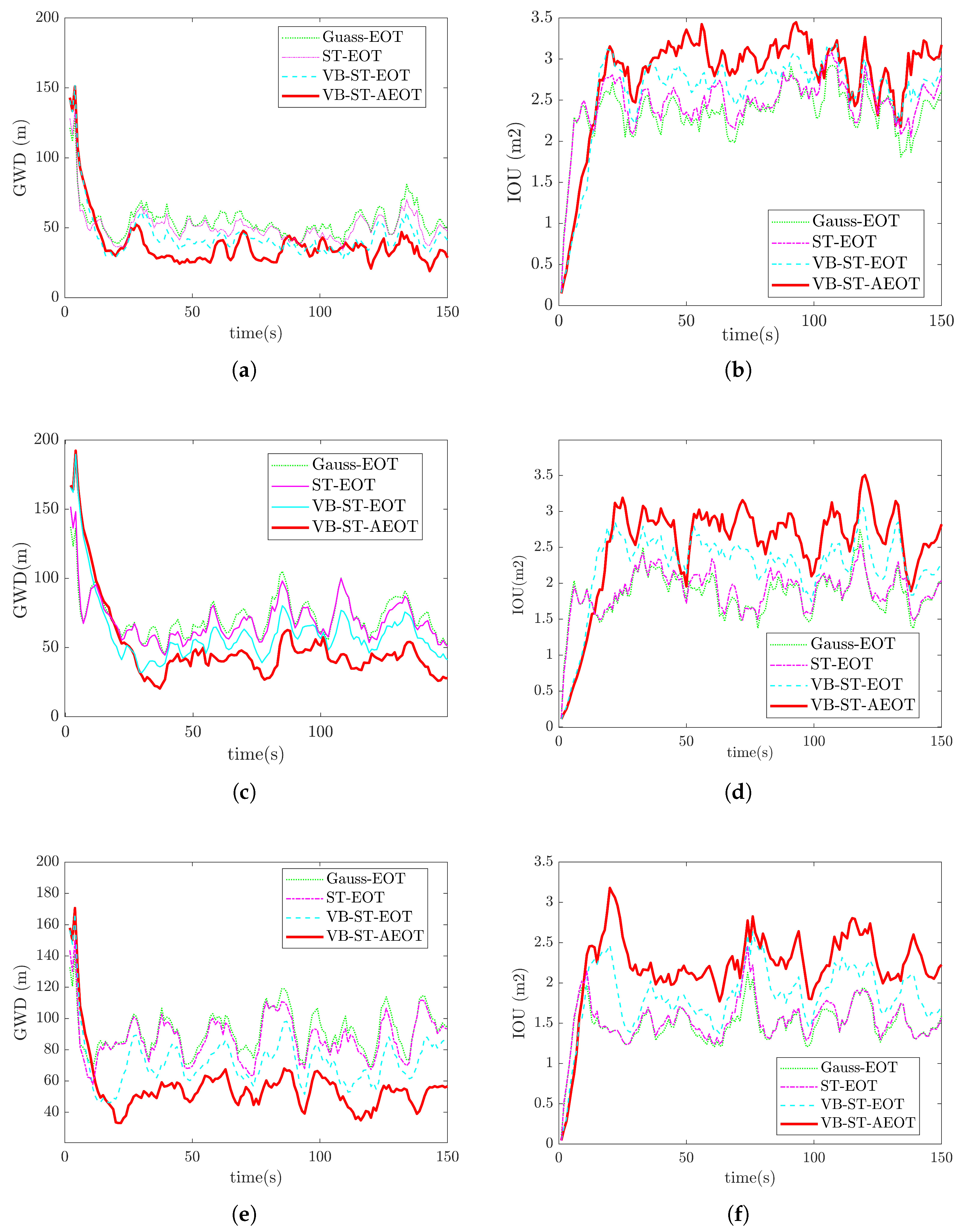
The tracking results of the all approaches are shown in Figure 5, with varying estimation results in Figure 6.
Figure 5 shows that all compared approaches can effectively track to extended objects when the heavy-tailed measurement noise is generated randomly. Figure 6 shows the GWD and IOU results with different heavy-tailed measurement noise intensities over 50 Monte Carlo (MC) trials. The results are consistent with those from SS1, which the VB-ST-EOT exhibiting the best tracking performance and the Gauss-EOT exhibiting the poorest tracking performance. Furthermore, as the intensity of the heavy-tailed noise increases, all compared approaches exhibit varying degrees of tracking accuracy degradation. However, the performance degradation of the proposed approaches is less significant compared to the ST-EOT and Gauss-EOT. Thus, in comparison with the existing methods, the proposed approaches exhibit superior adaptability and robustness.
Table 2 shows the average error of compared approaches in SS2. The results are consistent with those shown in Figure 6 and verify the superior robustness of our approaches to random heavy-tailed noise.
Table 3 summarizes performance improvements of SS1 and SS2. The results demonstrate that the proposed method has excellent performance.

4.3. Real-World Data

This section presents the validation of the proposed method using real-world data from [23], which was collected in an urban parking lot by UAVs equipped with a stationary aerial camera. The tracked object is a commercial vehicle moving with varying maneuvers and occasional partial occlusions (by trees), which naturally induce heavy-tailed measurement noise.
The dynamic and extension models are consistent with SS1. The parameters to match the real-world data are as follows:
x 0 = 410 m , 245 m , 0 m / s , 0 m / s , P 0 = d i a g 1 m 2 1 m 2 1 m 2 / s 2 1 m 2 / s 2 ,
Q 0 = d i a g 5 . 33 m 2 5 . 33 m 2 16 m 2 / s 2 16 m 2 / s 2 , v 0 = 2 , V 0 = d i a g 100 m , 25 m ,
and others are set as SS1. The measurements are generated following a Poisson distribution at time k, where the mean of the Poisson random variable is set to λ = 30 .
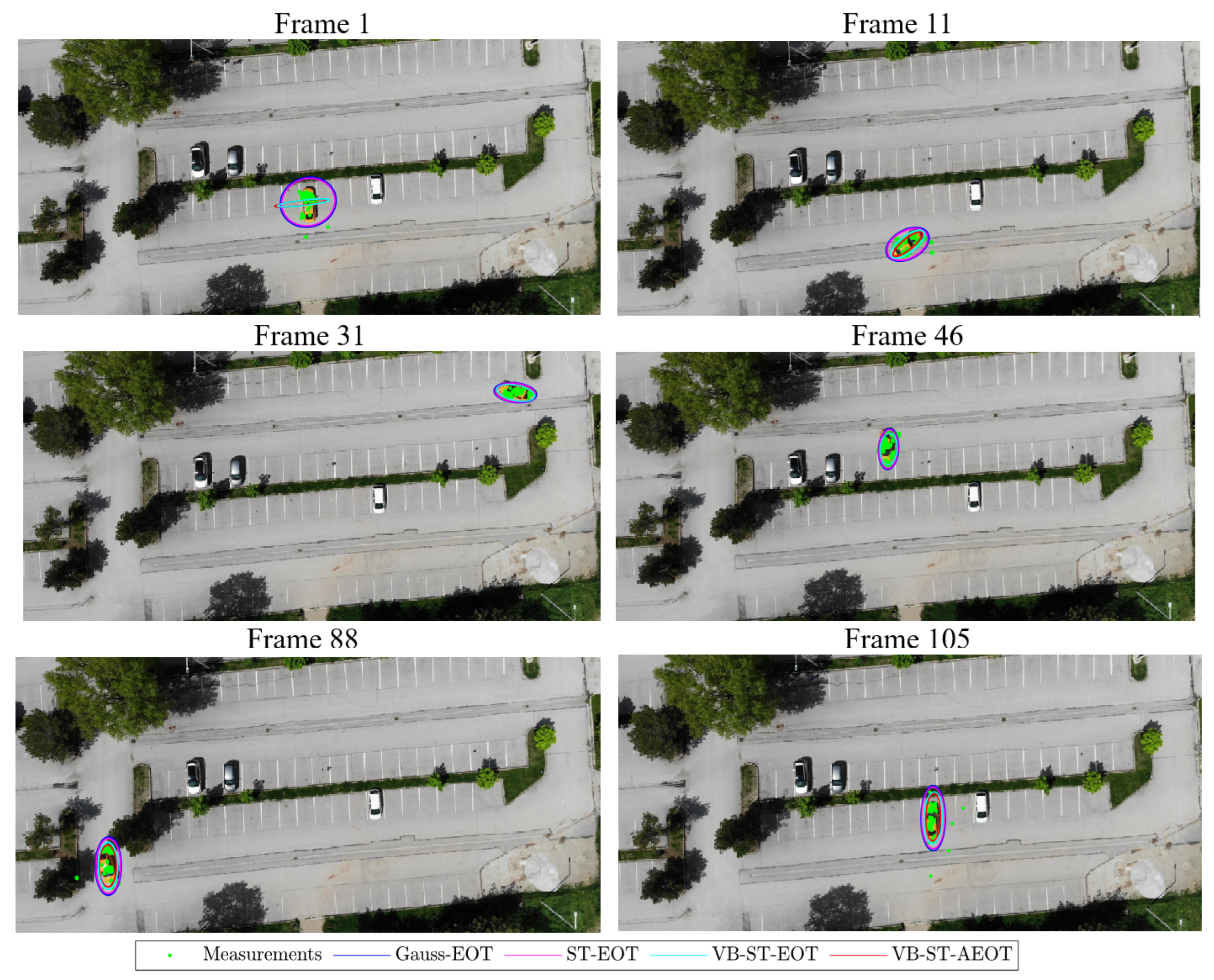
Figure 7 shows estimation results with real-world data. Due to the chosen parameter initialization, all methods initially failed to converge, as seen in Frame 1. All benchmark approaches achieve effective tracking performance during straight-line movement of the vehicle, such as in Frame 31 and Frame 46. Their tracking errors exhibit negligible differences. This result can be attributed to the measurement noise following a Gaussian distribution. Moreover, the proposed VB-ST-AEOT exhibits the best performance, when the vehicle is moving in complex maneuvers in Frame 11 and Frame 105 and traverses occluded areas in Frame 88. This is likely because heavy-tailed noise is present in the measurements during these maneuvers. These results demonstrate the effectiveness and robustness of the proposed approaches.
Table 4 shows the average runtimes of each steps for the compared approaches. The proposed approaches show a slightly higher runtime compared to other methods. This is caused by the joint effects of the calculated DoF and MNCM. Thus, the trade-off between performance enhancement and execution efficiency indicates that the improved accuracy is achieved at the cost of increased runtime. Based on the analysis of collected references [36,37], the onboard processing capabilities for tracking data in current UAV hardware require a processing time of 0.05 s. The proposed method, in the experimental environment of this study, achieves a runtime that falls below this 0.05 s threshold. Furthermore, this performance exceeds the typical frame rate of mainstream millimeter-wave radars (20 Hz). Thus, the proposed method meets the necessary requirements for real-time operation on UAV platforms.

5. Discussion

To address unknown measurement noise and outliers, we propose a novel adaptive EOT approach for UAVs with a decoupling model. Simulation and real-world data experiment results demonstrate that the proposed method effectively mitigates the impact of unknown heavy-tailed noise on tracking performance and enhances the capability to estimation object extensions. This improvement is attributed to the robust adaptation of the heavy-tailed noise model, which leads to a better match between the prior model and reality. Furthermore, a dual-extended distortion and hierarchical model is introduced to facilitate posterior approximation within the variational Bayesian framework.
However, this method primarily investigated the modeling of the 2D object extension and the single extended target tracking scenario. Future work will focus on high-dimensional extension models and multiple extended target tracking under unknown heavy-tailed noise.

6. Conclusions

The proposed approaches demonstrate effectiveness and robustness to heavy-tailed noise in the context of UAVs. The extension is modeled using a random matrix in our approaches. Furthermore, a novel dual-extended distortion model is introduced, which decouples among the object extension, DoF and MNCM. Meanwhile, the measurement noise in this work is modeled following an STD distribution with unknown parameters. The DoF is described by a Gamma distribution, and the MNCM follows an IW distribution. These models enable the adaptive learning of their respective unknown parameters. Based on these models, a VB inference method is derived for estimation. The experimental scenarios are designed and conducted across typical simulated and real-world data. Compared with recent EOT methods, these results demonstrate the superiority of the proposed approaches.
Future work will focus on two primary directions. On one hand, the proposed approaches will be extended to multiple-object tracking tasks for UAVs under heavy-tailed noise conditions. A key challenge in this scenario is the significant computational burden arising from complex data association, which may compromise real-time performance. On the other hand, the framework will be applied to high-dimensional extended object tracking (EOT) problems to meet the demands of complex UAV applications. This introduces strong coupling between the target’s extension and its kinematic model, complicating their independent estimations. These challenges will be the focus of our future research.

Author Contributions

Conceptualization, Y.Z. (Yu Zhu) and Y.Z. (Yanning Zhang); methodology, Y.Z. (Yu Zhu); software, H.Y.; validation, H.Y. and X.C.; formal analysis, X.C.; resources, H.Y.; data curation, H.Y.; writing—original draft preparation, H.Y.; writing—review and editing, X.C. and H.Y.; visualization, H.Y.; supervision, Y.Z. (Yu Zhu); project administration, Y.Z. (Yanning Zhang); All authors have read and agreed to the published version of the manuscript.

Funding

This work was conducted without support from any specific grant or external funding agency.

Data Availability Statement

The data presented in this study include openly available in [Random matrix based extended target tracking with orientation: A new model and inference] at [10.1109/TSP.2021.3065136], reference number [23].

Acknowledgments

The authors are grateful to the Editor and the reviewers for their constructive feedback, which greatly enhanced the quality of this manuscript.

Conflicts of Interest

The author declared no conflicts of interest.

Abbreviations

The following abbreviations are used in this manuscript:
UAVunmanned aerial vehicle
EOTextended object tracking
FoVField of View
VBvariational Bayesian
DoFdegrees of freedom
MNCMmeasurement noise covariance matrix
IWinverse Wishart
LIDARLight Detection and Ranging
EKFextended Kalman filter
EMexpectation–maximization
RMMrandom matrix method
SPDsymmetric positive definite
PDFprobability density function
KLDKullback–Leibler divergence
GWDGaussian Wasserstein distance
IOUIntersection over Union
RMSEroot mean square error
MCMonte Carlo

References

  1. Li, S.; Guo, C. A Novel inverse-Wishart-Student’st mixture distribution based Variational Bayesian Kalman Filter. IEEE Sens. J. 2024, 24, 39325–39333. [Google Scholar] [CrossRef]
  2. Mirsadraei, I.; Dehghan, S.M.-M.; Mofrad, R.F. Poisson multi-bernoulli mixture filter for enhanced tracking of spawning targets. Digit. Signal Process. 2025, 162, 105154. [Google Scholar] [CrossRef]
  3. He, J.; Peng, B.; Wang, G. A non-linear non-Gaussian filtering framework based on the Gaussian noise model jump assumption. Automatica 2025, 178, 112360. [Google Scholar] [CrossRef]
  4. Wen, Z.; Lan, J.; Zheng, L.; Zeng, T. Vehicle Tracking Using Shape-Dependent Mixture Model with Edge-Concentrated Measurements. IEEE Trans. Intell. Transp. Syst. 2025, 26, 8337–8352. [Google Scholar] [CrossRef]
  5. Xia, W.; Song, F.; Peng, Z. Dynamic Obstacle Perception Technology for UAVs Based on LiDAR. Drones 2025, 9, 540. [Google Scholar] [CrossRef]
  6. Kim, D.; Jo, K.; Lee, M.; Sunwoo, M. L-shape model switching-based precise motion tracking of moving vehicles using laser scanners. IEEE Trans. Intell. Transp. Syst. 2017, 19, 598–612. [Google Scholar] [CrossRef]
  7. Huang, S.; Ren, S.; Wu, W.; Liu, Q. Discriminative features enhancement for low-altitude UAV object detection. Pattern Recogn. 2024, 147, 110041. [Google Scholar] [CrossRef]
  8. Wen, Z.; Zheng, L.; Zeng, T. Extended Object Tracking Using an Orientation Vector Based on Constrained Filtering. Remote Sens. 2025, 17, 1419. [Google Scholar] [CrossRef]
  9. Liu, S.; Liang, Y.; Xu, L. Maneuvering extended object tracking based on constrained expectation maximization. Signal Process. 2022, 201, 108729. [Google Scholar] [CrossRef]
  10. Li, M.; Lan, J.; Li, X.R. Tracking of Extended Object Using Random Triangle Model. IEEE Trans. Aerosp. Electron. Syst. 2024, 61, 2926–2940. [Google Scholar] [CrossRef]
  11. Dahlén, K.-M.; Lindberg, C.; Yoneda, M.; Ogawa, T. An improved b-spline extended object tracking model using the iterative closest point method. In Proceedings of the IEEE 25th International Conference on Information Fusion, Linköping, Sweden, 4–7 August 2022; pp. 1–8. [Google Scholar]
  12. Yang, S.; Baum, M. Second-order extended Kalman filter for extended object and group tracking. In Proceedings of the IEEE 19th International Conference on Information Fusion, Heidelberg, Germany, 5–8 August 2016; pp. 1178–1184. [Google Scholar]
  13. Liu, S.; Liang, Y.; Xu, L.; Li, T.; Hao, X. EM-based extended object tracking without a priori extension evolution model. Signal Process. 2021, 188, 108181. [Google Scholar] [CrossRef]
  14. Li, M.; Lan, J.; Li, M.; Lan, J.; Li, X.R. Tracking of elliptical object with unknown but fixed lengths of axes. IEEE Trans. Aerosp. Electron. Syst. 2023, 59, 6518–6533. [Google Scholar] [CrossRef]
  15. Yang, S.; Baum, M. Tracking the orientation and axes lengths of an elliptical extended object. IEEE Trans. Signal Process. 2019, 67, 4720–4729. [Google Scholar] [CrossRef]
  16. Gramsch, C.; Yang, S.; Alqaderi, H. A batch update using multiplicative noise modelling for extended object tracking. In Proceedings of the IEEE 27th International Conference on Information Fusion, Venice, Italy, 8–11 July 2024; pp. 1–8. [Google Scholar]
  17. Zhang, X.; Lan, J. Measurement combination estimator for multisensor extended object tracking using random matrix. IEEE Trans. Aerosp. Electron. Syst. 2023, 60, 698–715. [Google Scholar] [CrossRef]
  18. Zhang, X.; Lan, J. Extended-object or group-target tracking using random matrix with nonlinear measurements. IEEE Trans. Signal Process. Syst. 2019, 67, 5130–5142. [Google Scholar]
  19. Koch, J.W. Bayesian approach to extended object and cluster tracking using random matrices. IEEE Trans. Aerosp. Electron. Syst. 2008, 44, 1042–1059. [Google Scholar] [CrossRef]
  20. Feldmann, M.; Fränken, D.; Koch, W. Tracking of extended objects and group targets using random matrices. IEEE Trans. Signal Process. 2010, 59, 1409–1420. [Google Scholar] [CrossRef]
  21. Jian, L.; Li, X. Tracking of extended object or target group using random matrix: New model and approach. IEEE Trans. Aerosp. Electron. Syst. 2016, 52, 2973–2989. [Google Scholar] [CrossRef]
  22. Zhang, L.; Lan, J. Extended object tracking using aspect ratio. IEEE Trans. Signal Process. 2024, 72, 2157–2170. [Google Scholar] [CrossRef]
  23. Tuncer, B.; Özkan, E. Random matrix based extended target tracking with orientation: A new model and inference. IEEE Trans. Signal Process. 2021, 69, 1910–1923. [Google Scholar] [CrossRef]
  24. Zhang, L.; Lan, J. Tracking of extended object using random matrix with non-uniformly distributed measurements. IEEE Trans. Signal Process. 2021, 69, 3812–3825. [Google Scholar] [CrossRef]
  25. Sun, S.; Peng, F.; Lin, H. Distributed asynchronous fusion estimator for stochastic uncertain systems with multiple sensors of different fading measurement rates. IEEE Trans. Signal Process. 2018, 66, 641–653. [Google Scholar] [CrossRef]
  26. Zhu, H.; Zhang, G.; Li, Y.; Leung, H. A novel robust Kalman filter with unknown non-stationary heavy-tailed noise. Automatica 2021, 127, 109511. [Google Scholar] [CrossRef]
  27. Wang, K.; Wu, P.; Zhao, B.; Kong, L.; He, S. Reconstructed variational Bayesian Kalman filter under heavy-tailed and skewed noises. IEEE Signal Process. Lett. 2024, 31, 2405–2409. [Google Scholar] [CrossRef]
  28. Li, S.; Nie, J.; Xie, X.; Mao, W. A robust kalman filter via gamma student’s t-mixture distribution under heavy-tailed measurement noise. IEEE Sens. J. 2023, 23, 26215–26225. [Google Scholar] [CrossRef]
  29. Chen, H.; Zhang, D.; Lian, F.; Chambers, C.H. Student’s t inverse Wishart smoothing algorithm for extended target tracking. J. Electron. Inf. Technol. 2024, 46, 3353–3362. [Google Scholar]
  30. Xue, X.; Huang, S.; Wei, D. MMF-GSTIW-PMBM adaptive filter for multiple group target tracking with heavy-tailed noise. IEEE Sens. J. 2024, 23, 19959–19973. [Google Scholar] [CrossRef]
  31. Yu, Y.; Li, J.; Wu, T. A Group Target Tracking Method for Unmanned Ground Vehicles Based on Multi-Ellipse Shape Modeling. Drones 2025, 9, 620. [Google Scholar] [CrossRef]
  32. Yang, X.; Jiao, Q. Variational approximation for adaptive extended target tracking in clutter with random matrix. IEEE Trans. Signal Process. 2021, 69, 1910–1923. [Google Scholar] [CrossRef]
  33. Lyu, R.; Cai, Y.; Yao, L. An Event-Triggered Hybrid Consensus Filter for Distributed Extended Object Tracking. IEEE Signal Process. Lett. 2025, 32, 2070–2074. [Google Scholar] [CrossRef]
  34. Wang, S.; Men, C.; Li, R.; Yeo, T.-S. A maneuvering extended target tracking IMM algorithm based on second-order EKF, IEEE Transactions on Instrumentation and Measurement. IEEE Trans. Instrum. Meas. 2024, 73, 1–11. [Google Scholar]
  35. Yang, Z.; Li, X.; Yao, X.; Sun, J.; Shan, T. Gaussian Process Gaussian Mixture PHD filter for 3D multiple extended target Tracking. Remote Sens. 2023, 15, 3224. [Google Scholar] [CrossRef]
  36. Yang, X.; Huang, A.; Lou, J.; Gou, J.; Fu, W.; Yan, J. An Efficient 3D Multi-Object Tracking Algorithm for Low-Cost UGV Using Multi-Level Data Association. Drones 2025, 9, 747. [Google Scholar] [CrossRef]
  37. Fu, C.; Jin, J.; Ding, F.; Li, Y.; Lu, G. Spatial reliability enhanced correlation filter: An efficient approach for real-time UAV tracking. IEEE Trans. Multimed. 2021, 26, 4123–4137. [Google Scholar] [CrossRef]
Figure 1. Extension with different noise distributions.
Drones 10 00004 g001
Figure 2. Probability density function of different distributions.
Drones 10 00004 g002
Figure 3. Extended object tracking for SS1. (a) Overall tracking results. (b) Tracking results at initial time. (c) Tracking results at middle time. (d) Tracking results at last time.
Drones 10 00004 g003
Figure 4. Error for SS1. (a) Error in position estimations. (b) Error in extension estimations. (c) GWD of estimations. (d) IOU of estimations.
Drones 10 00004 g004
Figure 5. Extended object tracking for SS2.
Drones 10 00004 g005
Figure 6. Errors for SS2. (a) GWD with ρ = 100 . (b) IOU with ρ = 100 . (c) GWD with ρ = 200 . (d) IOU with ρ = 200 . (e) GWD with ρ = 300 . (f) IOU with ρ = 400 .
Drones 10 00004 g006
Figure 7. Estimation results with real-world data.
Drones 10 00004 g007
Table 1. The comparison of estimation errors at typical time steps in SS1.
ApproachesTime (s)GWD (m)IOU (m2)Pos. (m)Len. (m)
Gauss-EOT5062.51742.596238.714426.0353
75212.29470.608625.3820199.5003
10044.31872.441018.830017.8623
ST-EOT5039.68132.581128.349017.0332
75179.22770.689422.2775170.0422
10031.06732.729218.362125.2322
VB-ST-EOT5042.43342.722128.267212.1820
75103.96751.782722.624295.7854
10035.77272.646718.000113.2599
VB-ST-AEOT5037.19102.318027.648319.8621
7561.76362.182222.418542.3818
10029.51352.778517.094822.2208
Table 2. The comparison result of average errors in SS2.
Approaches ρ Gauss-EOTST-EOTVB-ST-EOTVB-ST-AEOT
GWD (m)10055.148251.225044.395238.5187
20074.031770.514357.054346.5030
30091.735587.603572.936856.2004
IOU (m2)1002.34382.45932.59222.7988
2001.81841.87782.17192.5066
3001.48481.53231.83352.2100
Table 3. Comparative table for SS1 and SS2.
ApproachesGWD (m)IOU (m2)Pos. (m)Len. (m)
VB-ST-EOT
VB-ST-AEOT
Note: ↑ and → is improvement and no.
Table 4. Comparison runtime for real-world data.
ApproachesRuntime (s)
Gauss-EOT0.0020
ST-EOT0.0039
VB-ST-EOT0.0041
VB-ST-AEOT0.0053
Disclaimer/Publisher’s Note: The statements, opinions and data contained in all publications are solely those of the individual author(s) and contributor(s) and not of MDPI and/or the editor(s). MDPI and/or the editor(s) disclaim responsibility for any injury to people or property resulting from any ideas, methods, instructions or products referred to in the content.