

Cooperative Navigation Framework for UAV Formations Using LSTM and Dynamic Model Fusion


Highlights
- The proposed cooperative navigation framework based on LSTM and dynamic model information fusion integrates airflow-angle prediction with the - scheme to suppress inertial drift and enhance navigation robustness under GNSS-denied.
- A consistency-based node optimization strategy identifies high-precision UAV nodes via altitude and wind-speed consistency evaluations together with geometric constraints.
- This work demonstrates that the framework achieves the navigation objective of short-term stability and long-term drift suppression of the leader layer in GNSS-denied.
- The designed node selection strategies improve the cooperative navigation reliability and robustness, confirming the feasibility and effectiveness of the framework.
Abstract
1. Introduction
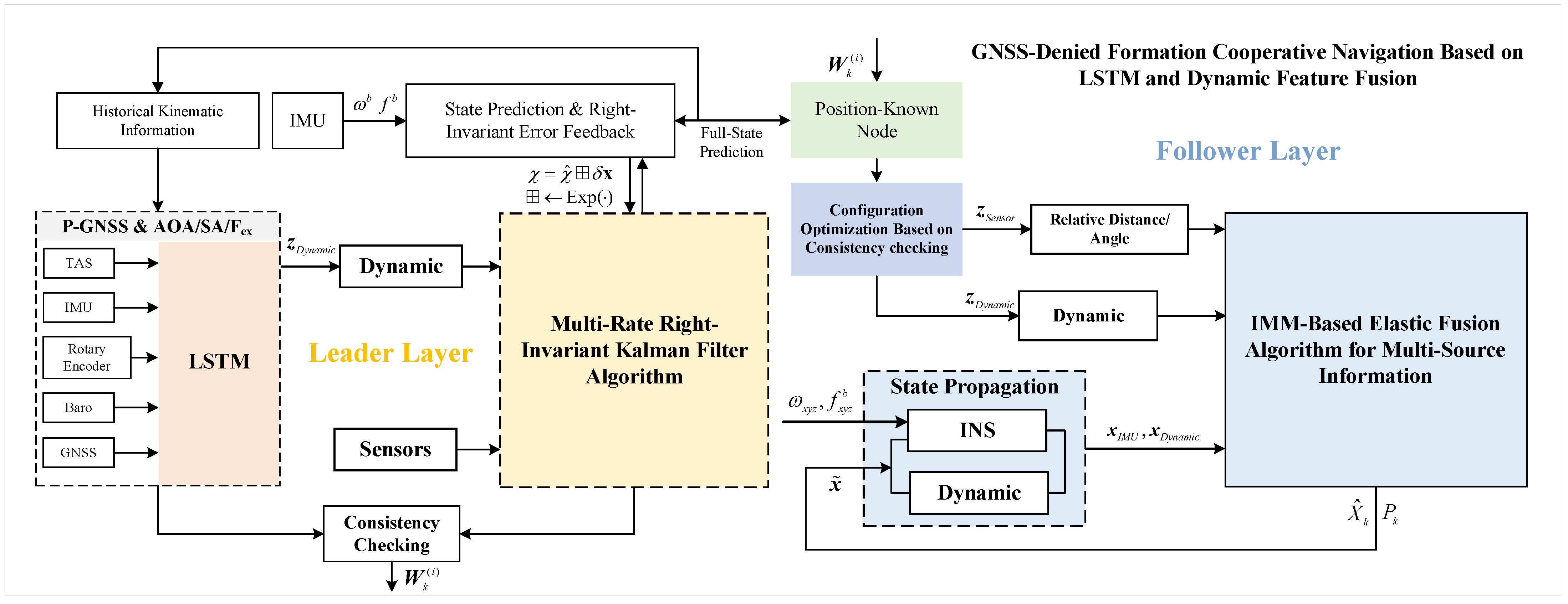
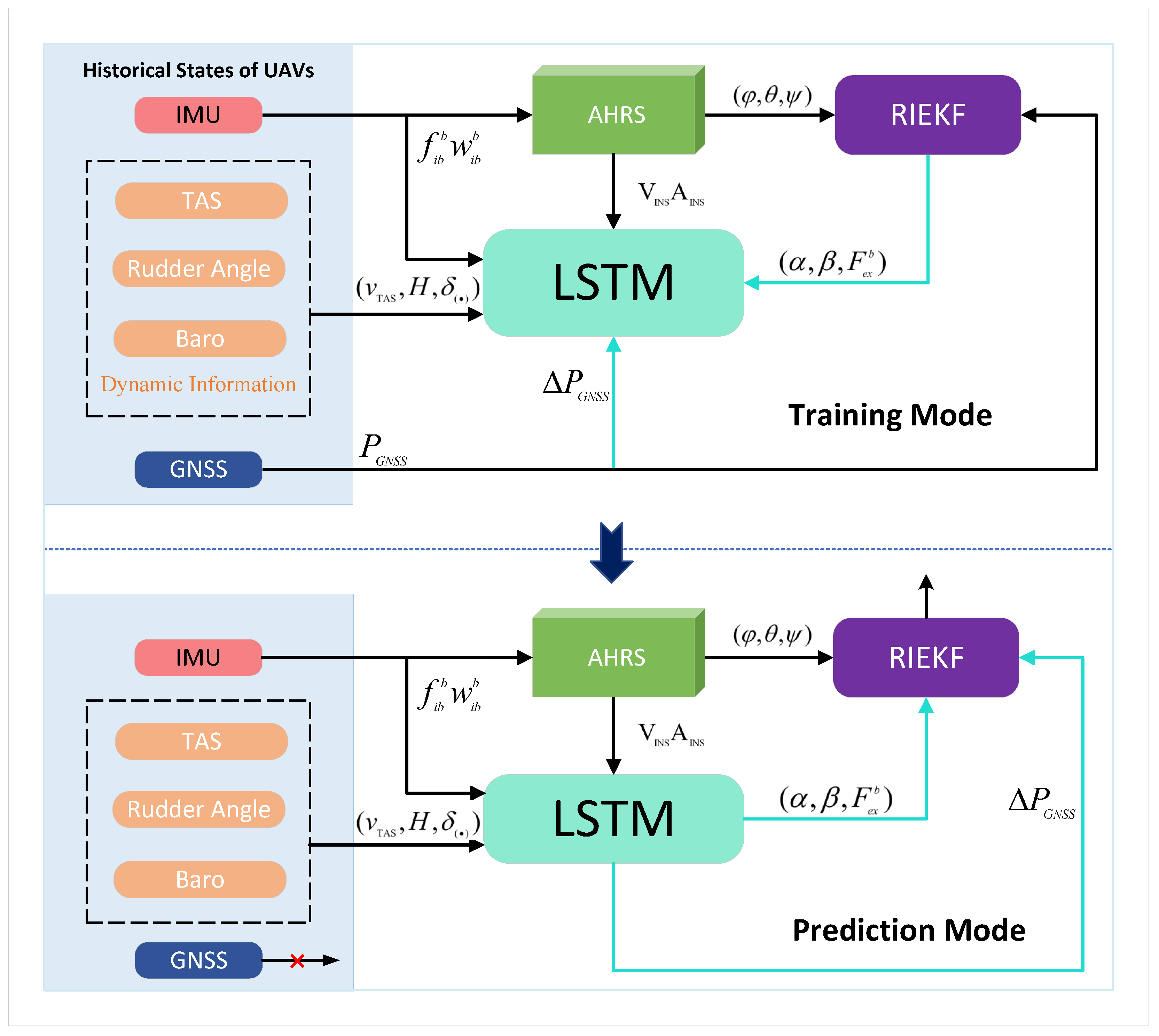
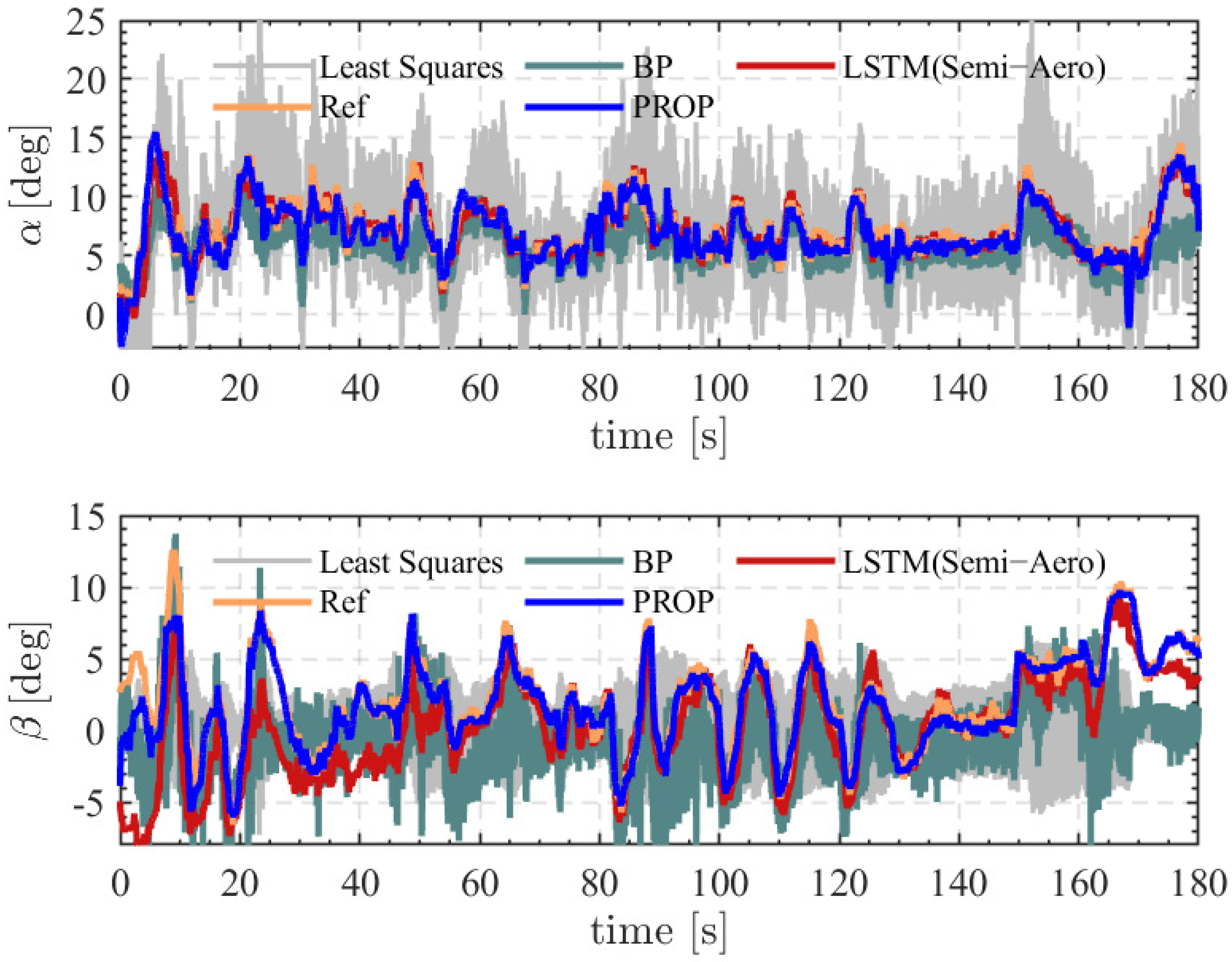
- This paper proposes an LSTM-based complementary cooperative prediction framework integrating airflow-angle prediction with the - scheme under GNSS-denied. The predicted airflow-angle correction facilitates mitigating drift accumulation and improving the stability of state estimation, while the concurrent use of P-GNSS observations imposes closed-loop constraints on inertial position errors. This dual mechanism effectively suppresses inertial drift, enhances overall navigation accuracy and robustness, and provides a basis for subsequent hierarchical fusion and node selection optimization.
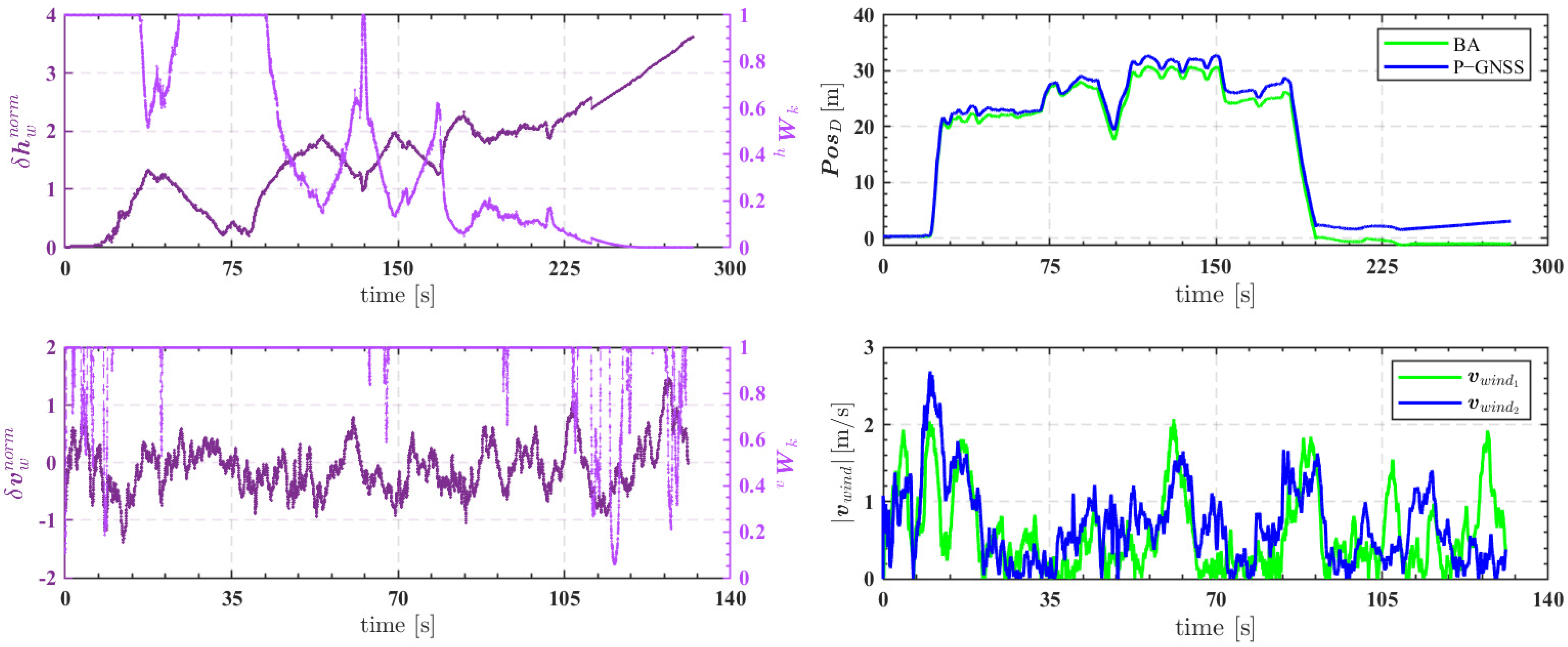
- A consistency-based node optimization strategy is developed for hierarchical architecture and node selection. This strategy introduces a high-level consistency evaluation by constructing statistics of altitude differences of BA/P-GNSS measurement, enabling real-time detection of severe P-GNSS drifts and selecting out high-precision layers. Moreover, through joint wind-speed consistency evaluation and geometric optimization, high-precision nodes with superior prediction reliability are identified as leader nodes for follower-layer navigation.
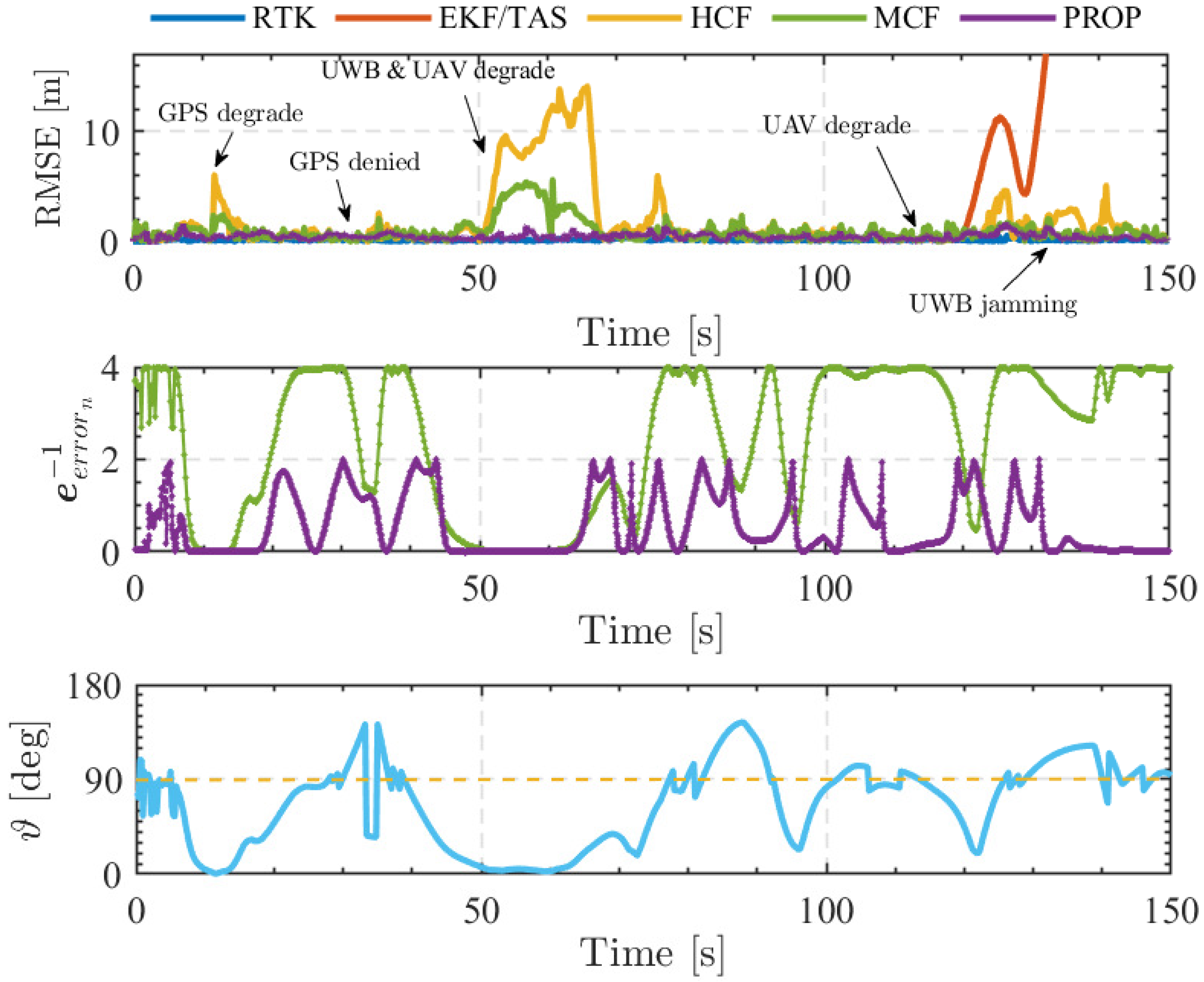
- Building on the consistency-evaluated hierarchical layers, a modified geometric configuration-based IMM filtering algorithm is proposed to flexibly fuse multi-source node information, integrating leader-node multi-sensor data and dynamic model-assisted information such as UWB, wind speed , or external force estimates . This algorithm enhances system robustness under GNSS-denied conditions when facing various contingencies, including UWB outages and leader-node accuracy degradation, and significantly improves navigation accuracy at the follower node layer.
2. Proposed Framework
3. LSTM-Aided Navigation Method
3.1. Aerodynamic Estimation Model
3.2. Airflow-Angle and Position Prediction Model
- Input: Specific forces and angular rates from inertial sensors, together with measurements and states from auxiliary sensors (e.g., airspeed, servos, ESCs);
- Output: GNSS position increments and aerodynamic states, including angle of attack , sideslip angle , and external forces .
4. RIEKF-Based Leader Layer’s Positioning with AHRS
4.1. System State
4.2. Measurement Submodel
4.2.1. Relative Measurement Update
4.2.2. Barometer Update
4.2.3. Airspeed Tube
5. Improved IMM-RIEKF-Based Positioning Method for the Follower Layer
5.1. Dynamic Feature and Consistency Assessment
5.1.1. Maximum Likelihood Estimation Theory
5.1.2. Consistency Assessment
5.2. Improved Geometric Configuration Optimization Strategy
5.3. IMM Framework for Multi-Source Fusion
5.3.1. Resilient Interactive
5.3.2. Model Transition Probability
- (1)
- Computation of Submodel Weights: The cooperative navigation system consists of n leader nodes, each forming a submodel with m sensors. Since the study focuses on optimizing relative-information/dynamics cooperative subfilter configurations, sensor setups are assumed identical across UAV platforms. Specifically, the fusion credibility weight of each submodel can be represented by the leader node consistency. The credibility weight of the j-th leader node in the i-th submodel is obtained by averaging as follows:where denotes the credibility index of the sensor combination in the j-th leader node layer of the i-th submodel. denotes the predictive consistency weight of the leader node layer corresponding to the i-th submodel.This weight not only reflects the performance stability of the leader node but also provides critical support for subsequent IMM model probability updates and state fusion.After the weights of all submodels are obtained, normalization is carried out:
- (2)
- Calculate the self-transition probability :where b represents the baseline probability, which encapsulates the inherent tendency of each model to maintain its current state without external observational influences.
- (3)
- The transition probability between submodels, , is computed as , with the remaining probability uniformly distributed among the other models. This uniform allocation ensures a balanced “competitive” environment among the submodels, especially when precise evaluation of each transition probability is difficult.
6. Experimental Analysis
6.1. Experimental Setup
6.2. Navigation Performance Analysis of the Leader Node Layer
6.2.1. Prediction Results of the LSTM Network
6.2.2. Analysis of RIEKF Filtering Results Based on AHRS
6.3. Follower Node Layer Navigation Performance Analysis
6.3.1. Consistency Evaluation
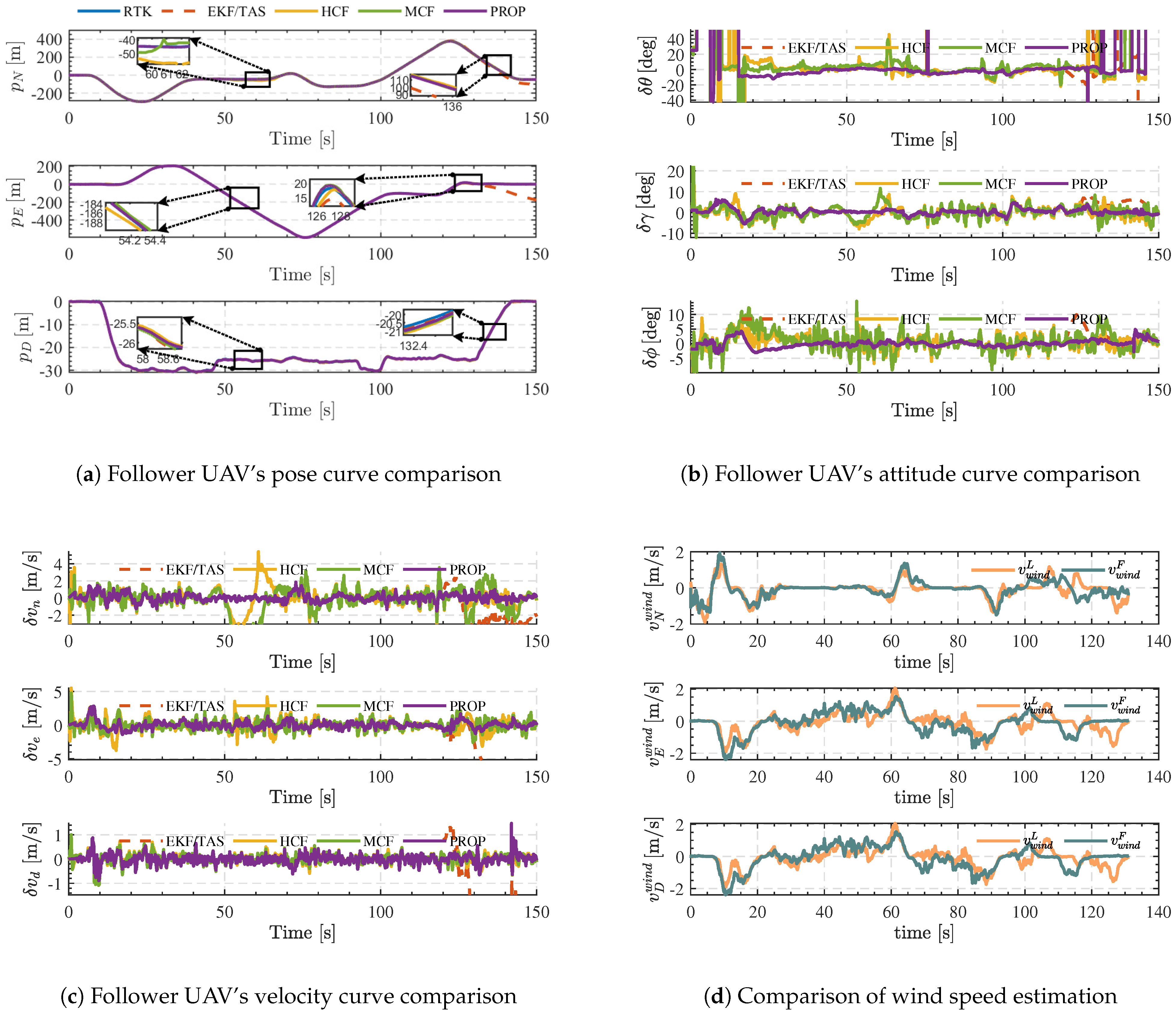
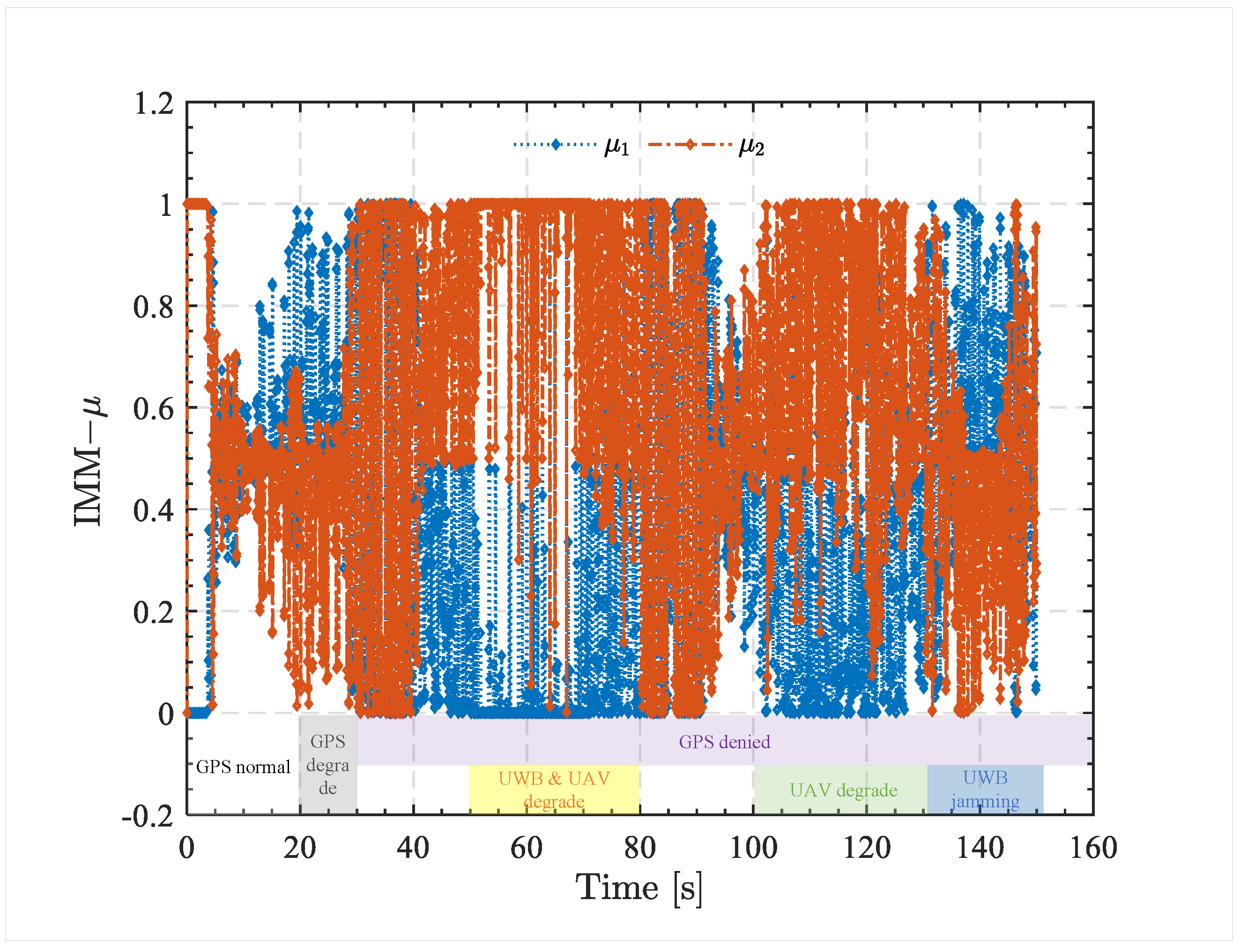
6.3.2. Elastic Analysis of IMM Subfilter with Geometry Configuration Optimization
7. Conclusions
Author Contributions
Funding
Data Availability Statement
Conflicts of Interest
Nomenclature
| P-GNSS | Pseudo-GNSS |
| IMM | Interacting Multiple Model |
| AOA | Angle of Attack |
| TAS | Airspeedometer |
| SINS | Strapdown Inertial Navigation System |
| BP | Back Propagation |
| RIEKF | Right Invariant EKF |
| SA | Sideslip Angle |
| Estimate value | |
| Average value |
References
- Gamagedara, K.; Lee, T.; Snyder, M. Quadrotor state estimation with IMU and delayed real-time kinematic GPS. IEEE Trans. Aerosp. Electron. Syst. 2021, 57, 2661–2673. [Google Scholar] [CrossRef]
- Deng, H.; Fu, Q.; Quan, Q.; Yang, K.; Cai, K.Y. Indoor multi-camera-based testbed for 3-D tracking and control of UAVs. IEEE Trans. Instrum. Meas. 2019, 69, 3139–3156. [Google Scholar] [CrossRef]
- Nie, W.; Han, Z.C.; Li, Y.; He, W.; Xie, L.B.; Yang, X.L.; Zhou, M. UAV detection and localization based on multi-dimensional signal features. IEEE Sens. J. 2021, 22, 5150–5162. [Google Scholar] [CrossRef]
- Lu, Q.; Zhang, Y.; Lin, J.; Wu, M. Dynamic electromagnetic positioning system for accurate close-range navigation of multirotor UAVs. IEEE Sens. J. 2019, 20, 4459–4468. [Google Scholar] [CrossRef]
- You, W.; Li, F.; Liao, L.; Huang, M. Data fusion of UWB and IMU based on unscented Kalman filter for indoor localization of quadrotor UAV. IEEE Access 2020, 8, 64971–64981. [Google Scholar] [CrossRef]
- Haljakov, P.; Novk, A.; Ka, J. Monitoring GNSS signal quality at Zilina Airport. In New Trends in Civil Aviation; CRC Press: Boca Raton, FL, USA, 2018; pp. 289–293. [Google Scholar]
- Novák, A.; Jůn, F.; Škultéty, F.; Novák Sedláčková, A. Experiment demonstrating the possible impact of GNSS interference on instrument approach on RWY 06 LZZI. Transp. Res. Procedia 2019, 43, 74–83. [Google Scholar] [CrossRef]
- Wahlström, J.; Skog, I. Fifteen years of progress at zero velocity: A review. IEEE Sens. J. 2020, 21, 1139–1151. [Google Scholar] [CrossRef]
- Suh, Y.S. A smoother for attitude and position estimation using inertial sensors with zero velocity intervals. IEEE Sens. J. 2011, 12, 1255–1262. [Google Scholar] [CrossRef]
- Deng, Z.; Cao, Y.; Wang, P.; Wang, B. An improved heuristic drift elimination method for indoor pedestrian positioning. Sensors 2018, 18, 1874. [Google Scholar] [CrossRef]
- Nobahari, H.; Mohammadkarimi, H. Application of model aided inertial navigation for precise altimetry of Unmanned Aerial Vehicles in ground proximity. Aerosp. Sci. Technol. 2017, 69, 650–658. [Google Scholar] [CrossRef]
- Crocoll, P.; Trommer, G.F. Quadrotor inertial navigation aided by a vehicle dynamics model with in-flight parameter estimation. In Proceedings of the 27th International Technical Meeting of the Satellite Division of The Institute of Navigation (ION GNSS+ 2014), Tampa, FL, USA, 8–12 September 2014; pp. 1784–1795. [Google Scholar]
- Ko, N.Y.; Choi, I.H.; Song, G.; Youn, W. Three-dimensional dynamic-model-aided navigation of multirotor unmanned aerial vehicles. IEEE Access 2019, 7, 170715–170732. [Google Scholar] [CrossRef]
- Khaghani, M.; Skaloud, J. VDM-based UAV attitude determination in absence of IMU data. In Proceedings of the 2018 European Navigation Conference (ENC), Gothenburg, Sweden, 14–17 May 2018; IEEE: New York, NY, USA, 2018; pp. 84–90. [Google Scholar]
- Koifman, M.; Bar-Itzhack, I.Y. Inertial navigation system aided by aircraft dynamics. IEEE Trans. Control Syst. Technol. 2002, 7, 487–493. [Google Scholar] [CrossRef]
- Mohammadkarimi, H.; Nobahari, H. A model aided inertial navigation system for automatic landing of unmanned aerial vehicles. Navig. J. Inst. Navig. 2018, 65, 183–204. [Google Scholar] [CrossRef]
- Ye, X.; Song, F.; Tang, M.; Guo, Y.; Zeng, Q. GNSS-INS-dynamic fusion with robustness to outliers based on external force state estimation. Meas. Sci. Technol. 2023, 35, 015113. [Google Scholar] [CrossRef]
- Hamandi, M.; Tognon, M.; Franchi, A. Direct acceleration feedback control of quadrotor aerial vehicles. In Proceedings of the 2020 IEEE International Conference on Robotics and Automation (ICRA), Paris, France, 31 May–31 August 2020; IEEE: New York, NY, USA, 2020; pp. 5335–5341. [Google Scholar]
- Ryan, A.; Zennaro, M.; Howell, A.; Sengupta, R.; Hedrick, J.K. An overview of emerging results in cooperative UAV control. In Proceedings of the 2004 43rd IEEE Conference on Decision and Control (CDC) (IEEE Cat. No. 04CH37601), Nassau, Bahamas, 14–17 December 2004; IEEE: New York, NY, USA, 2004; Volume 1, pp. 602–607. [Google Scholar]
- Yang, C.; Strader, J.; Gu, Y.; Hypes, A.; Canciani, A.; Brink, K. Cooperative UAV navigation using inter-vehicle ranging and magnetic anomaly measurements. In Proceedings of the 2018 AIAA Guidance, Navigation, and Control Conference, Kissimmee, FL, USA, 8–12 January 2018; p. 1595. [Google Scholar]
- Zhu, X.; Lai, J.; Chen, S. Cooperative Location Method for Leader-Follower UAV Formation Based on Follower UAV’s Moving Vector. Sensors 2022, 22, 7125. [Google Scholar] [CrossRef] [PubMed]
- Zhou, Y.; Zhao, J.; Shi, Q.; El Kamel, A. Multi-Agent Navigation Based on PHD and CPHD Filters. IEEE Sens. J. 2024, 24, 34999–35007. [Google Scholar] [CrossRef]
- Karmozdi, A.; Hashemi, M.; Salarieh, H.; Alasty, A. Implementation of translational motion dynamics for INS data fusion in DVL outage in underwater navigation. IEEE Sens. J. 2020, 21, 6652–6659. [Google Scholar] [CrossRef]
- Taimuri, G.; Matusiak, J.; Mikkola, T.; Kujala, P.; Hirdaris, S. A 6-DoF maneuvering model for the rapid estimation of hydrodynamic actions in deep and shallow waters. Ocean Eng. 2020, 218, 108103. [Google Scholar] [CrossRef]
- Bijjahalli, S.; Sabatini, R. A high-integrity and low-cost navigation system for autonomous vehicles. IEEE Trans. Intell. Transp. Syst. 2019, 22, 356–369. [Google Scholar] [CrossRef]
- Bancroft, J.B. Multiple IMU integration for vehicular navigation. In Proceedings of the 22nd International Technical Meeting of the Satellite Division of the Institute of Navigation (ION GNSS 2009), Savannah, GA, USA, 22–25 September 2009; pp. 1828–1840. [Google Scholar]
- Lyu, P.; Lai, J.; Liu, J.; Liu, H.H.; Zhang, Q. A thrust model aided fault diagnosis method for the altitude estimation of a quadrotor. IEEE Trans. Aerosp. Electron. Syst. 2017, 54, 1008–1019. [Google Scholar] [CrossRef]
- Ye, X.; Song, F.; Zhang, Z.; Zeng, Q. A review of small UAV navigation system based on multisource sensor fusion. IEEE Sens. J. 2023, 23, 18926–18948. [Google Scholar] [CrossRef]
- Ye, X.; Song, F.; Zhang, Z.; Zhang, R.; Zeng, Q. Semi-aerodynamic model-aided invariant Kalman filtering for UAV full-state estimation. IEEE Sens. J. 2024, 24, 25920–25939. [Google Scholar]
- Zhou, Y.; Dong, Y.; Hou, F.; Wu, J. Review on millimeter-wave radar and camera fusion technology. Sustainability 2022, 14, 5114. [Google Scholar] [CrossRef]
- Jiang, B.; Chen, S.; Wang, B.; Luo, B. MGLNN: Semi-supervised learning via multiple graph cooperative learning neural networks. Neural Netw. 2022, 153, 204–214. [Google Scholar] [CrossRef] [PubMed]
- Lin, J.T.; Dai, D.; Van Gool, L. Depth estimation from monocular images and sparse radar data. In Proceedings of the 2020 IEEE/RSJ International Conference on Intelligent Robots and Systems (IROS), Las Vegas, NV, USA, 24 October 2020–24 January 2021; IEEE: New York, NY, USA, 2020; pp. 10233–10240. [Google Scholar]
- Salameh, N.; Challita, G.; Mousset, S.; Bensrhair, A.; Ramaswamy, S. Collaborative positioning and embedded multi-sensors fusion cooperation in advanced driver assistance system. Transp. Res. Part C Emerg. Technol. 2013, 29, 197–213. [Google Scholar] [CrossRef]
- Mu, M.; Zhao, L. Distributed Elastic Fusion Navigation Method for Vehicle-Borne GNSS/SINS/Odometer. Acta Geod. Cartogr. Sin. 2024, 53, 425–434. [Google Scholar]
- Liu, Y.; Chang, S.; Wei, Z.; Zhang, K.; Feng, Z. Fusing mmWave radar with camera for 3-D detection in autonomous driving. IEEE Internet Things J. 2022, 9, 20408–20421. [Google Scholar] [CrossRef]
- Yang, Y.; Gao, W. An optimal adaptive Kalman filter. J. Geod. 2006, 80, 177–183. [Google Scholar] [CrossRef]
- Wang, W.; Meng, F.; Xu, X.; Chu, W.; Wu, Z. Intelligent Multi-Source Autonomous Navigation Method Based on Vehicle Dynamics Features. J. Astronaut. 2024, 45, 550–559. [Google Scholar]
- Wang, W.; Wu, Z.; Meng, F.; Xu, X.; Wu, S. Research on dependability of multi-source autonomous navigation system. Navigat. Control 2023, 10, 1–9. [Google Scholar]
- Ciuonzo, D.; Buonanno, A.; D’Urso, M.; Palmieri, F.A. Distributed classification of multiple moving targets with binary wireless sensor networks. In Proceedings of the 14th International Conference on Information Fusion, Chicago, IL, USA, 5–8 July 2011; IEEE: New York, NY, USA, 2011; pp. 1–8. [Google Scholar]
- Zhang, P.; Li, T.; Wang, G.; Luo, C.; Chen, H.; Zhang, J.; Wang, D.; Yu, Z. Multi-source information fusion based on rough set theory: A review. Inf. Fusion 2021, 68, 85–117. [Google Scholar] [CrossRef]
- Euston, M.; Coote, P.; Mahony, R.; Kim, J.; Hamel, T. A complementary filter for attitude estimation of a fixed-wing UAV. In Proceedings of the 2008 IEEE/RSJ International Conference on Intelligent Robots and Systems, Nice, France, 22–26 September 2008; IEEE: New York, NY, USA, 2008; pp. 340–345. [Google Scholar]
- Nebula, F.; Morani, G. Failure-proof algorithm for angle of attack estimation. J. Aerosp. Eng. 2023, 36, 04022118. [Google Scholar] [CrossRef]
- Zhi, Z.; Liu, D.; Liu, L. A performance compensation method for GPS/INS integrated navigation system based on CNN–LSTM during GPS outages. Measurement 2022, 188, 110516. [Google Scholar] [CrossRef]
- Ye, X.; Song, F.; Zhang, Z.; Zhang, R.; Zeng, Q. Semi-Aerodynamic Model Aided Invariant Kalman Filtering for UAV Full-State Estimation. arXiv 2023, arXiv:2310.01844. [Google Scholar]
- Song, F.; Zeng, Q.; Zhang, R.; Zhu, X.; Zhou, H.; Ye, X. Double-Stage Filtering Fusion Navigation Algorithm Based on Multisource Optimal Selection. IEEE Sens. J. 2025, 25, 24675–24692. [Google Scholar] [CrossRef]
- Song, F.; Zeng, Q.; Zhang, R.; Zhu, X.; Zhou, H.; Ye, X. RIEKF-based resilient interactive fusion algorithm for cooperative navigation. Meas. Sci. Technol. 2025, 36, 076301. [Google Scholar] [CrossRef]
- Meng, Q.; Hsu, L.T. Resilient Interactive Sensor-Independent-Update Fusion Navigation Method. IEEE Trans. Intell. Transp. Syst. 2022, 23, 16433–16447. [Google Scholar] [CrossRef]
- Ye, X.; Zhu, X.; Song, F.; Huang, D.; He, Z. Multisource Interactive Resilient Fusion Algorithm Based on RIEKF. IEEE Sens. J. 2025, 25, 24634–24648. [Google Scholar] [CrossRef]






| Source | Frequency | Parameters | Typical Value |
|---|---|---|---|
| IMU | 100 Hz | In-Run Bias Stability of Gyroscope Angular Random Walk | |
| Angular Random Walk | |||
| In Run Bias Stability of Accelerometer | |||
| Velocity Random Walk | |||
| UWB | 10 Hz | Position Noise | 2 m |
| GNSS | 5 Hz | Position Noise | m |
| Velocity Noise | |||
| RTK | 5 Hz | Position Noise | m |
| Velocity Noise | |||
| Baro | 100 Hz | Output Noise | |
| Pitot Tube | 100 Hz | Output Noise |
| Channel | Pos MAE (m) | Pos RMSE (m) | ||||
|---|---|---|---|---|---|---|
| P-GNSS | Semi-Aero | PROP | P-GNSS | Semi-Aero | PROP | |
| North | 15.354 | 7.905 | 5.402 | 18.242 | 11.271 | 7.367 |
| East | 18.051 | 17.298 | 12.057 | 21.993 | 20.864 | 16.258 |
| Down | 1.825 | 1.800 | 1.806 | 1.965 | 1.945 | 1.948 |
| Channel | Pos MAE (m) | Pos MAE (m) | Att MAE (deg) | Att MAE (deg) | Vel MAE (m/s) | Vel MAE (m/s) | ||||||
|---|---|---|---|---|---|---|---|---|---|---|---|---|
| MCF | PROP | MCF | PROP | MCF | PROP | MCF | PROP | MCF | PROP | MCF | PROP | |
| North/ | 0.742 | 0.246 | 1.293 | 0.314 | 2.271 | 0.858 | 3.273 | 1.554 | 0.762 | 0.348 | 1.097 | 0.491 |
| East/ | 0.455 | 0.331 | 0.612 | 0.432 | 2.065 | 6.686 | 2.962 | 0.884 | 0.594 | 0.357 | 0.788 | 0.509 |
| Down/ | 0.082 | 0.057 | 0.105 | 0.076 | 4.424 | 2.348 | 13.36 | 7.539 | 0.153 | 0.188 | 0.210 | 0.282 |
Disclaimer/Publisher’s Note: The statements, opinions and data contained in all publications are solely those of the individual author(s) and contributor(s) and not of MDPI and/or the editor(s). MDPI and/or the editor(s) disclaim responsibility for any injury to people or property resulting from any ideas, methods, instructions or products referred to in the content. |
© 2026 by the authors. Licensee MDPI, Basel, Switzerland. This article is an open access article distributed under the terms and conditions of the Creative Commons Attribution (CC BY) license.
Share and Cite
Song, F.; Zeng, Q.; Zhu, X.; Zhang, R.; Ye, X.; Zhou, H. Cooperative Navigation Framework for UAV Formations Using LSTM and Dynamic Model Fusion. Drones 2026, 10, 28. https://doi.org/10.3390/drones10010028
Song F, Zeng Q, Zhu X, Zhang R, Ye X, Zhou H. Cooperative Navigation Framework for UAV Formations Using LSTM and Dynamic Model Fusion. Drones. 2026; 10(1):28. https://doi.org/10.3390/drones10010028
Chicago/Turabian StyleSong, Fujun, Qinghua Zeng, Xiaohu Zhu, Rui Zhang, Xiaoyu Ye, and Huan Zhou. 2026. "Cooperative Navigation Framework for UAV Formations Using LSTM and Dynamic Model Fusion" Drones 10, no. 1: 28. https://doi.org/10.3390/drones10010028
APA StyleSong, F., Zeng, Q., Zhu, X., Zhang, R., Ye, X., & Zhou, H. (2026). Cooperative Navigation Framework for UAV Formations Using LSTM and Dynamic Model Fusion. Drones, 10(1), 28. https://doi.org/10.3390/drones10010028