


Abstract
This paper presents first characterization results of a novel, battery-less sensor for integration into glass fiber-reinforced plastic (FRP) materials. The sensor targets combined usage in both production and structural health monitoring applications. It is shown that wireless measurement of biaxial mechanical strain inside FRP is possible with the presented approach. The results promise feasibility of industrial application by implementing a sticker-based ‘sensor tag’ approach for easy application and additional advantages in context of ‘smart’ structures.
1. Introduction
For monitoring parts made of fiber-reinforced plastic (FRP), a multitude of principles for strain measurement have been investigated [1,2]. Material-integrated systems are gaining relevance due to frequent outside invisibility of internal defects in FRP (e.g., delamination, broken fibers [3,4]) and the higher sensitivity of in situ measurements compared to surface-based measurements [1]. Most established systems (e.g., using Fiber Bragg Gratings [4]), though precise, are usually complex, costly, and mechanically sensitive, thereby complicating integration and automated industrial application [2,4,5]. Most importantly, nearly all established techniques employ wired sensors, fundamentally complicating vacuum setup and part handling. Also, sensor failure due to wire breakage is a problem.
2. Materials and Methods
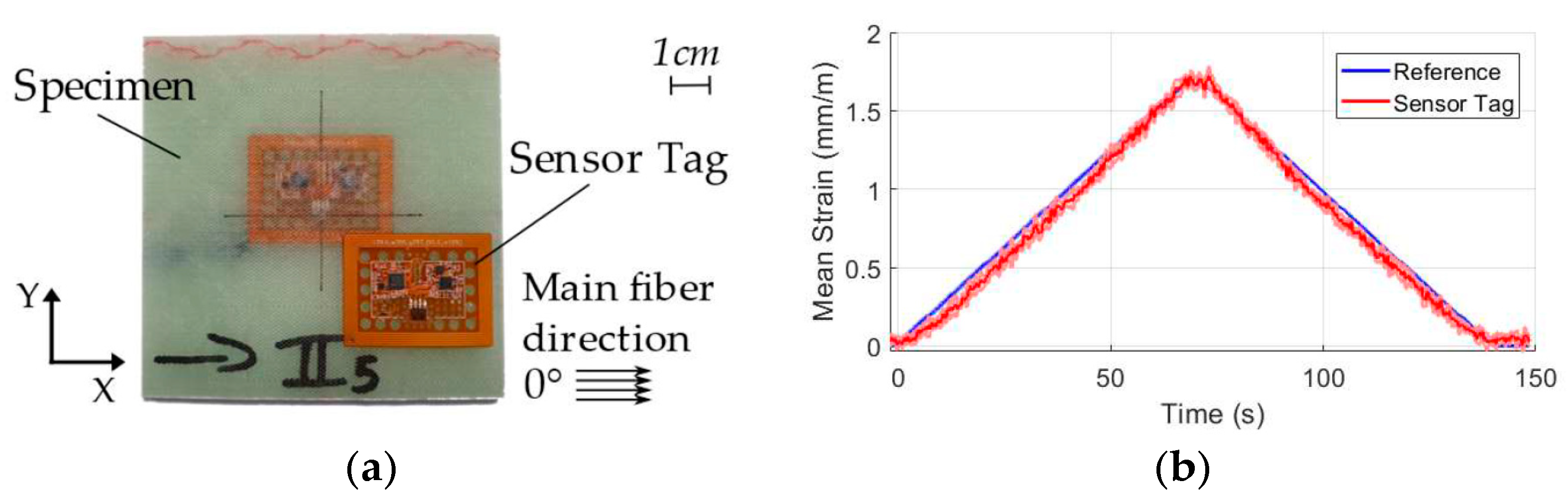
The sensor characterized in this paper circumvents the above problems by utilizing a different approach while also allowing for FRP production monitoring. For the first time, biaxial strain and temperature measurements have been implemented in a completely wireless system that can be directly embedded into FRP materials. The electronics used are based on the results presented in [6], and process monitoring capabilities of the tag have been investigated [7]. It is implemented as a flexible, ‘sticker’-concept-based ‘sensor tag’ (Figure 1a), enabling simple, automated placement during FRP fabrication. Standardized radio frequency identification techniques (RFIDs) are used for energy and data transfer, eliminating the need for a battery while enabling easy readout. A digital temperature sensor is used for temperature measurement, while strain is measured via a temperature-compensated full-bridge strain gauge. The integrated microcontroller can additionally be used for further ‘smart-structure’ functionalities (e.g., part-related identification or maintenance data).
Figure 1.
(a) Specimen with integrated tag and unintegrated tag for reference. Tag coordinate system indicated. (b) Averaged strain readings of a single specimen; n = 5; Fmax = 1 kN. Shaded areas: Std. dev.
To characterize the sensor tags, six tags were integrated into FRP using a vacuum-assisted resin infusion process and cut into specimens (Figure 1a). These were repeatedly loaded in a bending test setup and continuously read out. The longitudinal and transversal strains were measured independently.
3. Discussion
All sensor tags remained functional throughout FRP fabrication, bending tests, and temperature exposure. During fabrication, resin temperature and flow front could be monitored, as in [7]. The overall maximum strain measurement errors, i.e., the difference between the tag readings and the reference readings, are given in Table 1, while an example of the tag response and that of the reference is given in Figure 1b. A comparison of the bending test results showed variance between the specimens in both the actual strain (as measured by the reference system) and sensor tag errors. Possible reasons for this include material effects (e.g., temporary plastic deformation) and variations in the coupling strength between tag and FRP. In conclusion, it could be shown that wireless, material-integrated strain measurements in FRP are possible. Along with production monitoring functionality and easy tag application, the results promise usage in an industrial context for full FRP part life cycle.
Table 1.
Strain measurement errors for bending tests of six integrated sensor tags.
Author Contributions
Conceptualization, methodology, L.B. and M.B.; writing—original draft preparation, L.B.; writing—review and editing, L.B., M.B. and W.L.; supervision, W.L. All authors have read and agreed to the published version of the manuscript.
Funding
This work was supported by the German Federal Ministry for Economic Affairs and Climate Action based on a resolution of the German Bundestag, (Nr. 20941 N).
Institutional Review Board Statement
Not applicable.
Informed Consent Statement
Not applicable.
Data Availability Statement
Data are contained within the article.
Conflicts of Interest
The authors declare a conflict of interest with Committee Member M.J. Vellekoop.
References
- Tuloup, C.; Harizi, W.; Aboura, Z.; Meyer, Y.; Khellil, K.; Lachat, R. On the use of in-situ piezoelectric sensors for the manufacturing and structural health monitoring of polymer-matrix composites: A literature review. Compos. Struct. 2019, 215, 127–149. [Google Scholar] [CrossRef]
- Rocha, H.; Semprimoschnig, C.; Nunes, J.P. Sensors for process and structural health monitoring of aerospace composites: A review. Eng. Struct. 2021, 237, 112231. [Google Scholar] [CrossRef]
- Dimassi, M.A.; John, M.; Herrmann, A.S. Investigation of the temperature dependent impact behaviour of pin reinforced foam core sandwich structures. Compos. Struct. 2018, 202, 774–782. [Google Scholar] [CrossRef]
- Kinet, D.; Mégret, P.; Goossen, K.; Qiu, L.; Heider, D.; Caucheteur, C. Fiber Bragg Grating Sensors toward Structural Health Monitoring in Composite Materials: Challenges and Solutions. Sensors 2014, 14, 7394–7419. [Google Scholar] [CrossRef] [PubMed]
- Zhou, G.; Sim, L.M. Damage detection and assessment in fibre-reinforced composite structures with embedded fibre optic sensors-review. Smart Mater. Struct. 2002, 11, 925–939. [Google Scholar] [CrossRef]
- Bertram, L.; Brink, M.; Thoben, K.-D.; Lang, W. A Passive, Wireless Sensor Node for Material-Integrated Strain and Temperature Measurements in Glass Fiber Reinforced Composites. In International Conference on System-Integrated Intelligence; Springer International Publishing: Cham, Switzerland, 2022; pp. 182–193. [Google Scholar] [CrossRef]
- Bertram, L.; Brink, M.; Lang, W. Material-integrated Temperature Sensors for Wireless Monitoring of Infusion and Curing in Composite Production. In Proceedings of the Sensor and Measurement Science International, Nuremberg, Germany, 8–11 May 2023. [Google Scholar]
Disclaimer/Publisher’s Note: The statements, opinions and data contained in all publications are solely those of the individual author(s) and contributor(s) and not of MDPI and/or the editor(s). MDPI and/or the editor(s) disclaim responsibility for any injury to people or property resulting from any ideas, methods, instructions or products referred to in the content. |
© 2024 by the authors. Licensee MDPI, Basel, Switzerland. This article is an open access article distributed under the terms and conditions of the Creative Commons Attribution (CC BY) license (https://creativecommons.org/licenses/by/4.0/).

