


Abstract
Ammonia detection at ambient with low-cost sensors is a challenge for various applications like breath analysis and agriculture. Such a challenge can be reached with functionalized SnO2 based gas sensors using silanization by 3-aminopropyltriethoxysilane (APTES) as an intermediate step before grafting with functional end group providing selectivity for the target gas. Moreover, operation at room temperature gives the opportunity to develop a sensor on a plastic substrate entirely manufactured by inkjet technology, by developing suitable inks, in particular to obtain SnO2 sensing element.
1. Introduction
Molecularly modified metal oxide gas sensors have shown to be promising devices for selective gas sensor related to disease diagnosis [1]. Moreover, in recent years, a significant advance in the development and implementation of flexible sensors has demonstrated the increasing utility of these special type of sensing platforms [2]. In particular, flexible gas sensors based on metal oxide belong to this category, and have an important role in environmental applications. Although tin oxide (SnO2) is considered as one of the most useful materials in gas sensing applications, the main drawbacks are its lack of selectivity and high operating temperature (350–500 °C). The need of selective sensors with high sensitivity in presence of humidity at low gases concentration and low temperature pushed us to modify chemically SnO2 material in order to change its interactions with gas and to modify the elaboration process to be compatible with plastic foils. Hence, our motivations were to combine both challenges, i.e., to develop a functionalized SnO2 selective sensor on a flexible substrate, working at an ambient temperature.
2. Method and Results
Previous work on conventional SnO2 sensor elaborated by screen printing on alumina substrate have shown that the modification of sensing material by organic functional groups with different polarities can change the sensor response to specific gases depending on their polarity [3]. A functionalization based on 3-aminopropyltriethoxysilane (APTES) combined with methyl adipoyl chloride (ester), hexanoyl chloride (alkyl), and 1,4-butanedicarbonyl chloride (acid) was investigated. Figure 1a shows the response of pure and modified SnO2 by APTES, APTES-alkyl, APTES-acid and APTES-ester to 100 ppm of ammonia gas at 25 °C. It clearly points out the beneficial effect of functionalization to achieve a significant response to NH3 from ambient temperature. In addition, the ester group provides good sensitivity and selectivity to NH3 at variable humidity (Figure 1b).
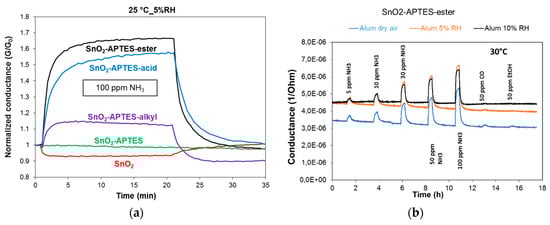
Figure 1.
Functionalized SnO2 sensor developed by screen-printing on alumina substrate: (a) Influence of end functional group on 100 ppm NH3 normalized response (G/G0 ratio conductance under gaz/air), at 25 °C, 5% relative humidity (RH); (b) Selective responses of SnO2-APTES-Ester to NH3 and influence of humidity at 30 °C.
In parallel, SnO2 sensors have been developed on flexible substrates via a sol-gel method applied to synthesize a stable sol based on tin oxide, then transformed into ink to be printed using a drop-on-demand piezoelectric inkjet printer [4]. Ester functionalization was applied to such sensors (Figure 2a). Results under gas (Figure 2b) show results similar to those obtained on ceramic support, validating the transfer on flexible support and the feasibility of low cost NH3 sensor operating at ambient temperature.
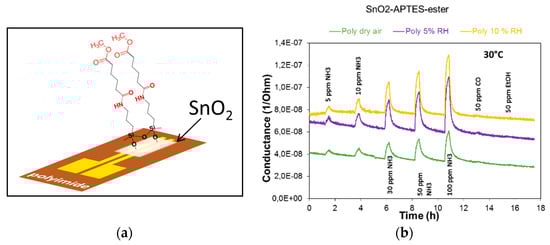
Figure 2.
Functionalized SnO2 sensor developed by inkjet on polyimide substrate: (a) schematic view of flexible sensor on polyimide with ester functionalized layer (b) Selective responses to NH3 and influence of humidity at 30 °C.
References
- Shehada, N.; Brönstrup, G.; Funka, K.; Christiansen, S.; Leja, M.; Haick, H. Ultrasensitive Silicon Nanowire for Real-World Gas Sensing: Noninvasive Diagnosis of Cancer from Breath Volatolome. Nano Lett. 2015, 15, 1288–1295. [Google Scholar] [CrossRef] [PubMed]
- Kenry; Yeo, J.C.; Lim, C.T. Emerging flexible and wearable physical sensing platforms for healthcare and biomedical applications. Microsyst. Nanoeng. 2016, 2, 16043. [Google Scholar] [CrossRef] [PubMed]
- Hijazi, M.; Rieu, M.; Stambouli, V.; Tournier, G.; Viricelle, J.-P.; Pijolat, C. Ambient temperature selective ammonia gas sensor based on SnO2-APTES modifications. Sens. Actuators B 2018, 256, 440–447. [Google Scholar] [CrossRef]
- Kassem, O.; Saadaoui, M.; Rieu, M.; Viricelle, J.-P. A novel approach of fully inkjet printed flexible gas sensor based on tin oxide. J. Mater. Chem. C 2019, 7, 12343–12353. [Google Scholar] [CrossRef]
Publisher’s Note: MDPI stays neutral with regard to jurisdictional claims in published maps and institutional affiliations. |
© 2020 by the authors. Licensee MDPI, Basel, Switzerland. This article is an open access article distributed under the terms and conditions of the Creative Commons Attribution (CC BY) license (https://creativecommons.org/licenses/by/4.0/).