1. Introduction
Fractional calculus plays a vital role in various fields, extending the concept of differentiation to non-integer orders. This generalization enables a deeper exploration of complex phenomena in science, engineering, and mathematics. This study presents a numerical analysis of the nonlinear diffusion equation described by the one-dimensional time-fractional Burgers equation
where
,
, and
are given function. Here, the Caputo fractional derivative of order
is expressed as
where
is the gamma function. The Burgers equation, originally formulated by Bateman [
1], serves as a fundamental model that encapsulates essential concepts in fluid dynamics [
2,
3]. It has significant applications in various scientific and industrial fields [
4,
5,
6]. The fractional version of the Burgers equation has been utilized to describe the unidirectional propagation of weakly nonlinear acoustic waves in gas-filled pipes [
7,
8].
Several analytical and semi-analytical attempts for the time-fractional Burgers equation have been reported (e.g., [
9,
10]). However, as noted in [
11], the classical Hopf–Cole transformation cannot be applied in the fractional setting, making closed-form solutions inaccessible. This limitation has motivated the development of numerous numerical approaches. The widely used
discretization [
12], based on piecewise linear interpolation, provides
-order accuracy for the Caputo derivative and has inspired many subsequent methods. Yaseen and Abbas [
13] introduced an efficient cubic trigonometric B-spline scheme with a linearization strategy to reduce computational cost while preserving unconditional stability and high accuracy. Zhang and Yang [
14] developed a fully discrete finite volume element method for the generalized fractional Burgers equation. Building on the
framework, several enhanced finite difference schemes have been proposed for their simplicity and efficiency. Li et al. [
15] proposed an unconditionally stable linear implicit finite difference scheme with first-order temporal and second-order spatial accuracy. In [
16], a nonlinear difference scheme attained second-order spatial and
-order temporal accuracy, and a nonlinear scheme on nonuniform meshes was introduced in [
17], achieving
temporal accuracy. Furthermore, Zhang et al. [
18] proposed a compact high-order spatial scheme, while Peng et al. [
19] developed a compact method for mixed-type fractional Burgers equations. For nonlocal fourth-order Burgers models, Tian et al. [
20] constructed an
-based implicit scheme on graded meshes with
-robust stability and optimal convergence, and Wang et al. [
21] later introduced a nonlinear compact scheme using an
discretization with a double-reduction strategy, establishing its stability and convergence.
Since the introduction of the
scheme, it has been widely applied to a broad class of nonlinear fractional differential equations. To improve temporal accuracy, several
L-type formulas have been developed, including the
method [
22], the
method [
23], the
method [
24], and related variants [
25,
26]. For example, Wang et al. [
27] employed the
formula on graded meshes to construct a compact scheme for the time-fractional Burgers equation. Peng et al. [
28] proposed a second-order fast finite difference method for a generalized version of the time-fractional Burgers equation, utilizing the nonuniform
formula with a sum-of-exponentials approach. Guan et al. [
29] a numerical scheme combining the
formula with a radial basis function finite difference method was proposed for the generalized time-fractional Burgers equation, achieving
with numerical results confirming the method’s efficiency and accuracy. Recently, Dwivedi and Rajeev [
30] introduced a fast high-order linearized exponential method that combines the
scheme with a tailored finite point formula based on exponential basis functions for the two-dimensional time-fractional Burgers equation, enhancing computational efficiency while preserving accuracy.
While several time discretizations are available, applying
-type schemes on nonuniform meshes often leads to nonlinear and computationally expensive methods, and linearization typically reduces the temporal accuracy to first order [
15]. Phumichot et al. [
31] obtained
-order temporal and fourth-order spatial accuracy through linearization. Wang and Sun [
32] also introduced linear schemes using exponential basis functions, though with only first-order spatial accuracy. These observations illustrate the difficulty of constructing a linear scheme with both second-order temporal and high-order spatial accuracy. To address this challenge, we develop an efficient linear difference scheme based on the
formula, a higher-order extension of the classical
method. In contrast to the
schemes, which require nonlinear treatments, the proposed approach attains second-order temporal and high-order spatial accuracy within a fully linear and stable framework.
Accordingly, this study outlines its key contributions in a comprehensive manner.
A new linear finite difference scheme for the fractional Burgers equation is developed based on the
method. The scheme incorporates a modified fourth-order linearized formulation for the convection term [
33], achieving second-order temporal accuracy together with high-order spatial accuracy.
Existence, uniqueness, and
-stability of the scheme are established using the standard Gronwall inequality, overcoming the difficulty posed by the negative convolution weights of the
formula [
34].
Under weak-regularity conditions, the proposed scheme is shown numerically to achieve the temporal accuracy , representing a clear improvement over the classical method. Numerical experiments further indicate that the scheme remains accurate in long-time simulations, where uniform meshes offer a practical and efficient alternative to graded meshes.
The remainder of the paper is organized as follows.
Section 2 presents the necessary preliminaries, introduces the
discretization, and describes the new linearized fourth-order treatment of the nonlinear convection term.
Section 3 establishes existence, uniqueness,
-stability, and pointwise error estimates for the proposed scheme.
Section 4 provides numerical results that confirm the theory and illustrate the method’s performance for both smooth and non-smooth solutions. Concluding remarks are given in
Section 5.
4. Numerical Experiments
We provide numerical results in this section to demonstrate the accuracy and efficiency of the proposed method. The performance is measured using the maximum error norm, defined as follows
The rate of convergence is determined using
where
and
represent the norm errors associated with grid sizes
h and
, respectively. The corresponding errors for the time grid sizes
and
are denoted as
and
, respectively. To validate the capability of the proposed scheme, we provide numerical examples in two cases: one with a smooth solution and another with a non-smooth solution, demonstrating its reliability and accuracy. To implement the proposed difference scheme, the complete computational procedure is summarized in Algorithm 1, which outlines the main initialization, iteration, and update steps of the method.
| Algorithm 1 The algorithm framework of the fourth-order scheme |
- Require:
Parameters ; - 1:
Preparation: Divide the mesh in time and space; obtain the initial condition and the source term (omit if not applicable); - 2:
Construct the matrices , , and ; - 3:
Calculate and ; - Ensure:
Numerical solution - 4:
Maximum iteration steps: maxstep = 1000; - 5:
iterative error limit: tor =; - 6:
initial iteration value ; - 7:
Calculate ; - 8:
; - 9:
while 1 do - 10:
- 11:
; - 12:
; ; ; - 13:
if or then - 14:
return - 15:
end if - 16:
end while - Ensure:
Numerical solution () - 17:
for do - 18:
Calculate ; - 19:
- 20:
; - 21:
Calculate ; - 22:
end for
|
Example 1. (Smooth solution) In this example, we report on computational experiments for the problem (1a)–(1c), considering a smooth solution [18]. The exact solution is given by with the initial condition and the corresponding source term To verify the accuracy of the numerical solutions, the schemes were tested over the computational domain
with
. We also presented a comparative analysis of our numerical results against those obtained using the compact difference schemes proposed in [
18,
31]. For simplicity, we denote both schemes as Scheme I and Scheme II, respectively. Since Scheme I is nonlinear, we use the standard Newton iteration to solve the resulting algebraic system, terminating the process after a maximum of 1000 iterations.
To assess precision in both spatial and temporal dimensions, sufficiently small step sizes were chosen to ensure that errors were dominated by a single factor. For the spatial test, the time discretization was fixed at
, and spatial accuracy was examined for
. The results in
Table 1, reported for
and
, show fourth-order spatial convergence for all schemes, with the proposed linear method producing noticeably smaller errors, especially for larger
. For the temporal test, we set
and used
. As detailed in
Table 2, our scheme maintains superior accuracy as
increases, achieving the expected second-order temporal convergence, whereas Scheme I and Scheme II attain only
-order accuracy.
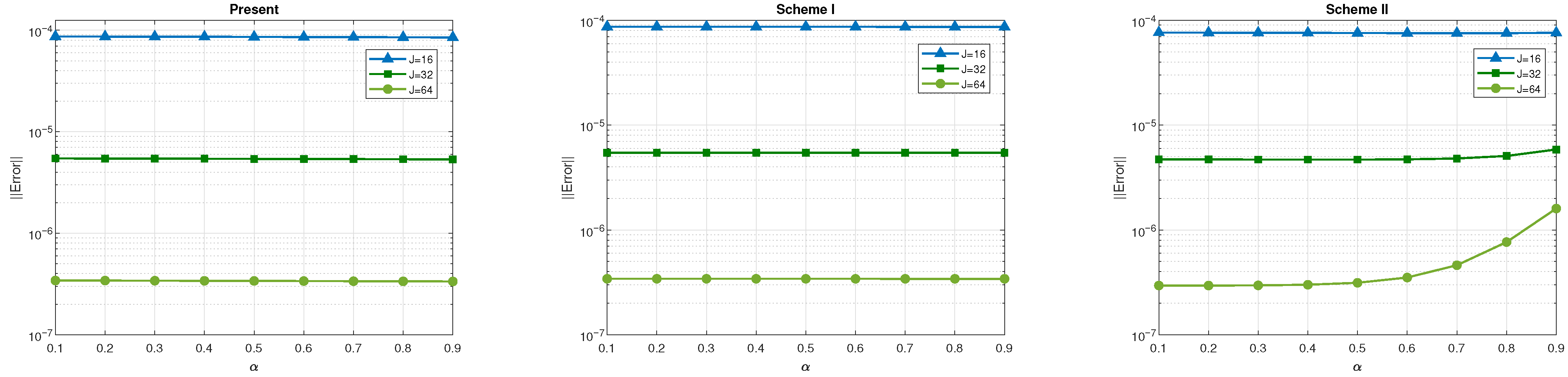
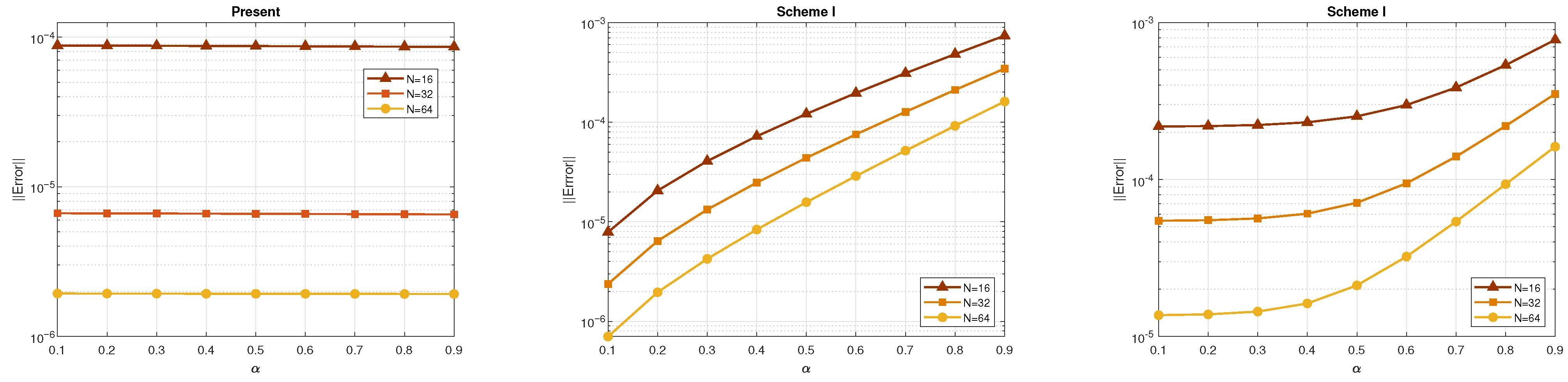
To evaluate the performance of our scheme on uniform temporal meshes, we repeated the simulations with the same settings but allowed
to vary from 0 to 1. The graphical results are presented in
Figure 1 and
Figure 2. Our observations indicate that, in the case of a smooth solution, the scheme demonstrates
robust, implying that the numerical solution remains stable and does not blow-up as
. However, as shown in
Figure 2, the errors associated with Scheme I and Scheme II tend to increase with larger values of
increases.
Example 2.(Non-smooth solution) In this example, we set the exact solutionwith the initial condition and the source term It can be observed that the solution satisfies the weak singularity assumption (
26), with
behaving like
near
, so that the first derivative becomes unbounded at the initial time. To assess the performance of the scheme under such conditions, we carried out simulations using the same setup as in Example 1, and the numerical results are reported in
Table 3 and
Table 4. These results confirm that the proposed scheme preserves fourth-order spatial accuracy. Furthermore, as shown in
Table 3, the temporal convergence rate decreases as
becomes smaller, approaching
-order accuracy, in agreement with Remark 3. Nevertheless, in terms of errors, our proposed method demonstrates a superior resolution highlighting its robustness and effectiveness, even with uniform meshes.
Next, we compared our scheme with Scheme I [
18], which uses nonuniform meshes with the optimal grading
. For
and
, the results in
Table 5 show that our method consistently yields smaller errors, with the advantage most pronounced for small
. The proposed method continues to exhibit a steady decrease in error as
N increases, with an observed rate close to
, as expected. In contrast, Scheme I achieves its theoretical
order only for
and
; for
and
, the convergence deteriorates, and the reported orders fluctuate or even become negative. This loss of accuracy is due to the grading parameter
, which becomes very large for small
, creating a strongly clustered mesh near
and extreme step-size ratios at later times, thereby undermining the expected
accuracy. Finally, the CPU times in
Table 5 indicate that the proposed method significantly outperforms the nonlinear Scheme I, offering a notable reduction in computational cost.
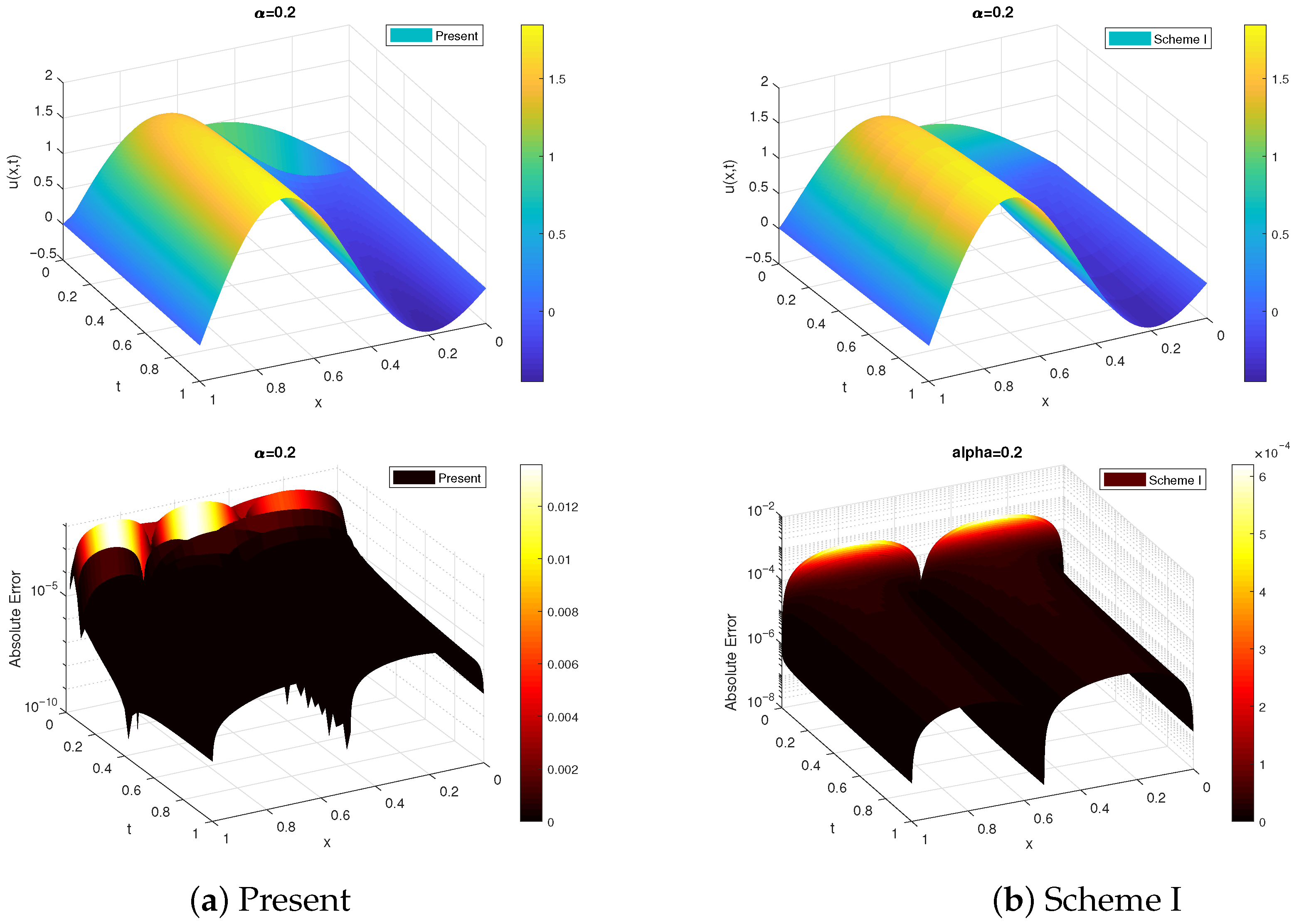
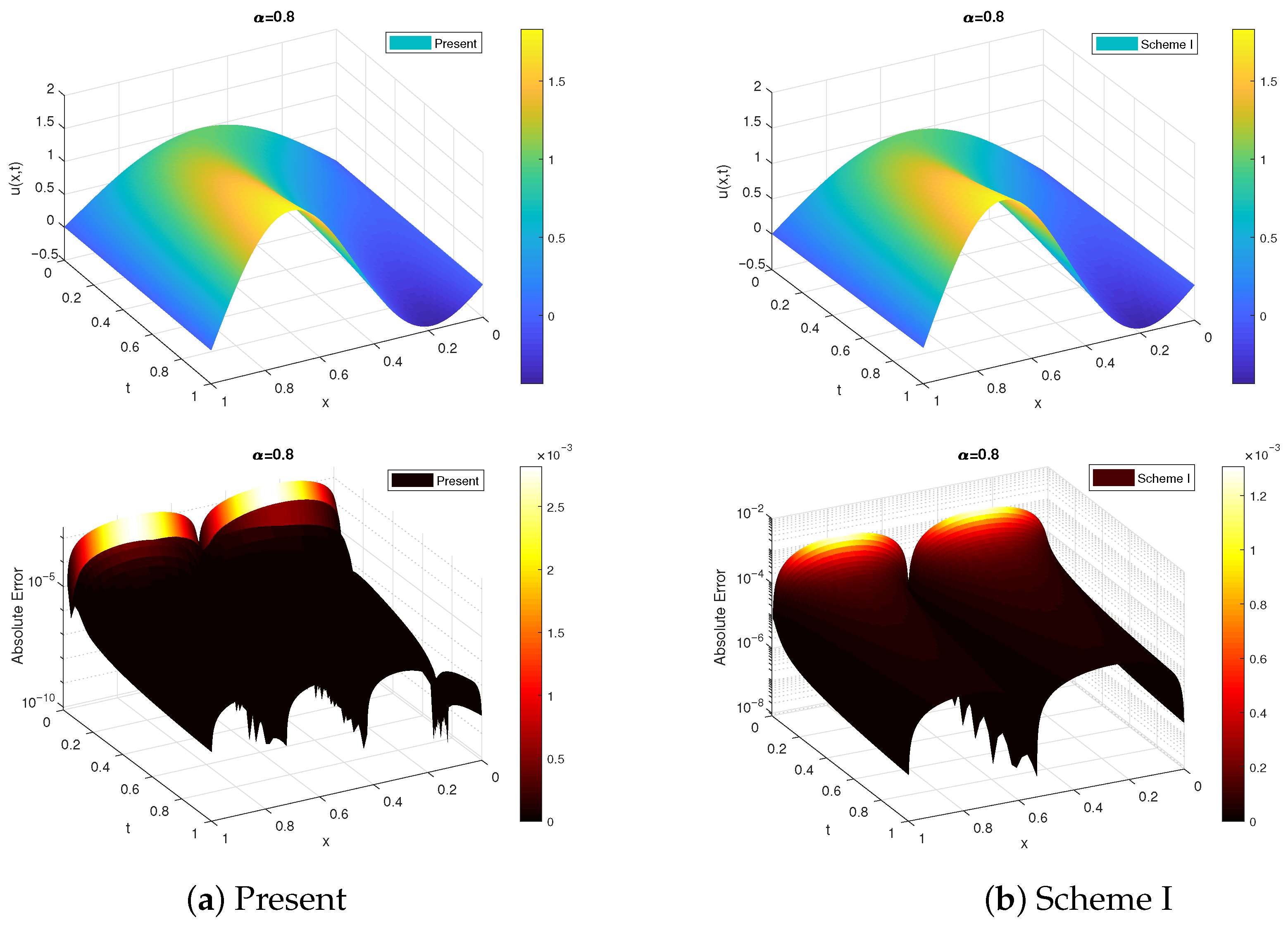
The cases
and
are presented in
Figure 3 and
Figure 4 as representative examples where both schemes exhibit stable temporal accuracy, allowing a meaningful visual comparison of the error structures produced by the two methods. It can be observed that the distribution errors from Scheme I are smoother compared to those of the present scheme in both cases. This behavior corresponds to the nature of Scheme I, which utilizes non-uniform temporal meshes. Although our scheme is implemented on uniform meshes, it effectively captures the numerical solution at the final time, even though the errors are relatively higher around
. This demonstrates the capability of our method to compensate for the lower temporal convergence order through superior numerical resolution.
To further evaluate the performance of the proposed scheme in long-time simulations, we extend the simulation to a final time of
by using
and
. The fractional order is also set to be
and
to examine the numerical behavior over an extended period, particularly in terms of stability, accuracy, and error propagation. The numerical results are presented in
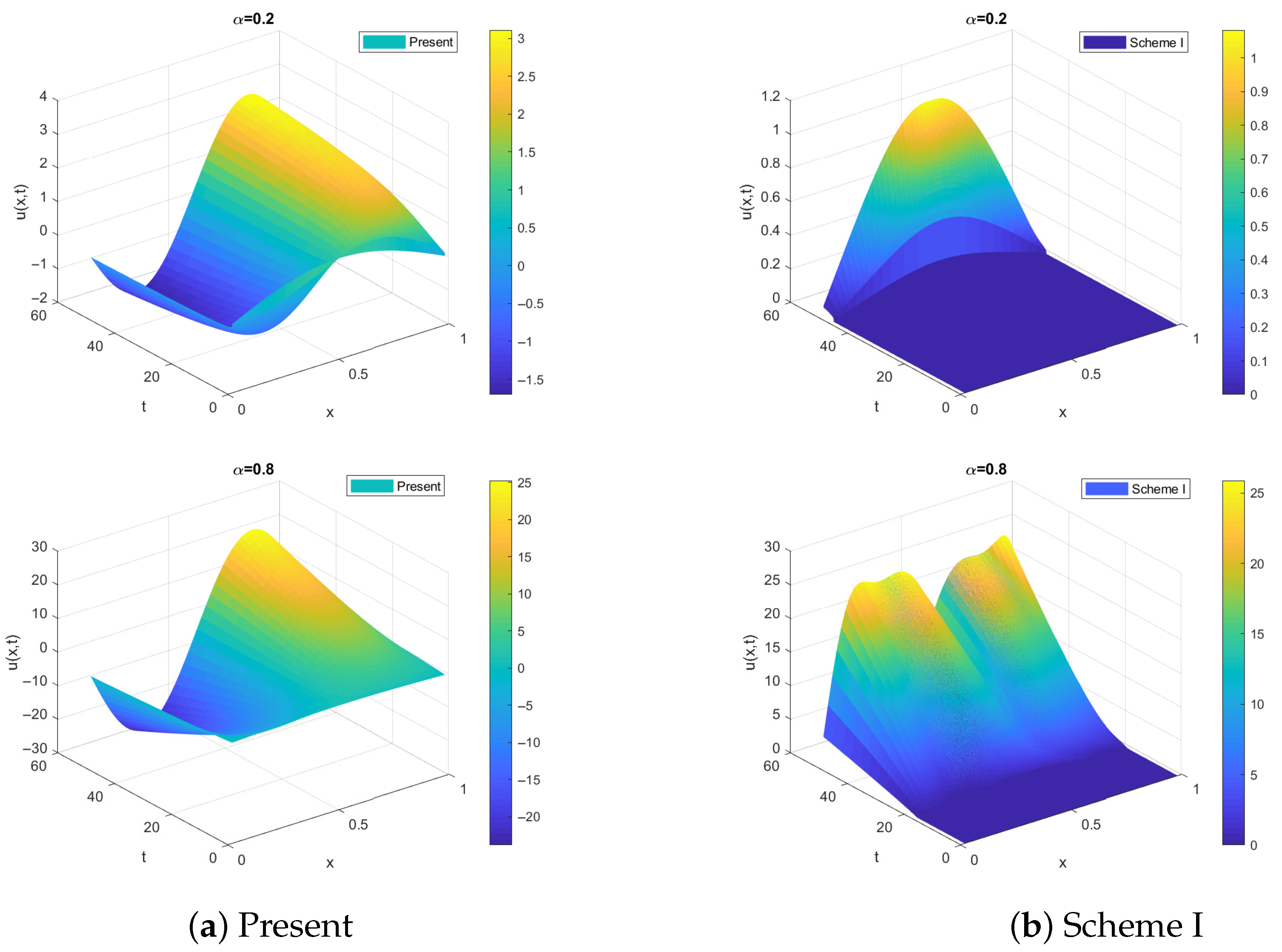
Figure 5. For
, both schemes produced smooth solutions; however, the numerical solution obtained by Scheme I exhibits unstable when
. Additionally, when
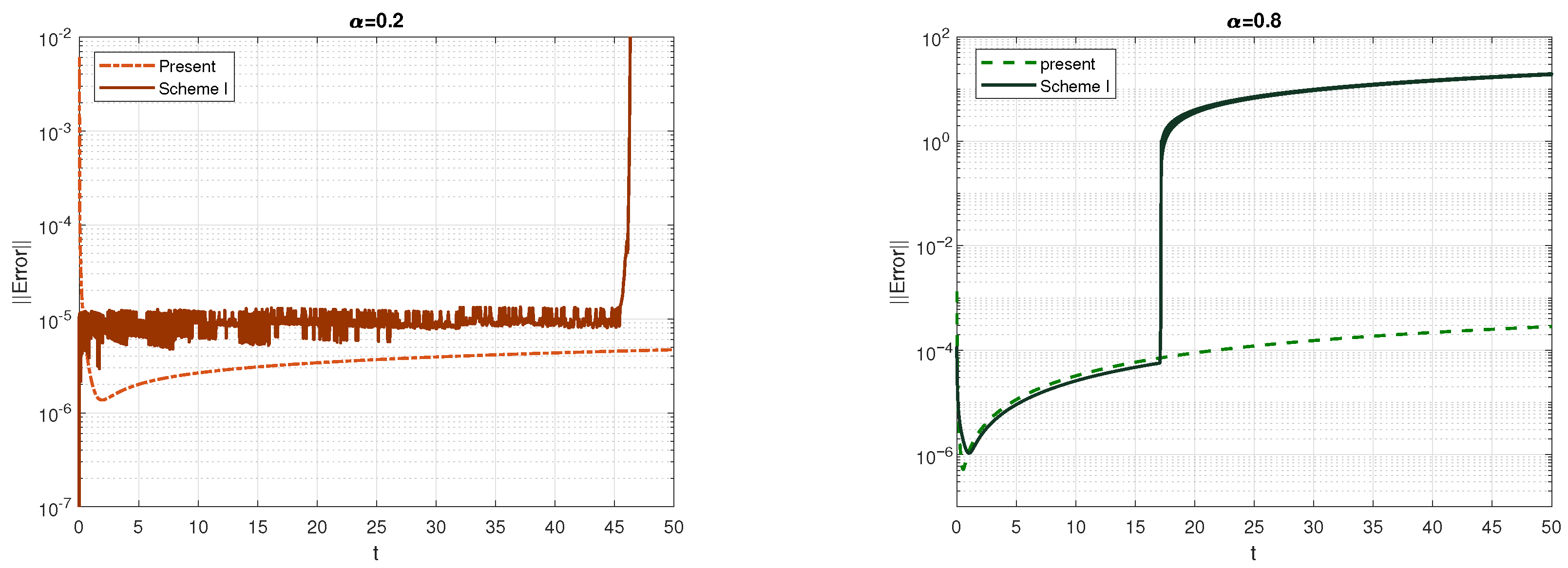
, the
-norm errors at each time step for both schemes were plotted in
Figure 6. Although the singularity of the solution still reduces numerical accuracy within the initial layer near
(see Remark 3), the proposed scheme achieves significantly improved resolution once
is sufficiently far from zero. This finding supports the preference for the
fourth-order difference scheme on uniform meshes over graded meshes in long-time simulations.
Finally, we consider the homogeneous time-fractional Burgers equation with
and initial data
. Simulations are carried out for
on a fixed spatial grid
, testing
and
. Since no exact solution is available, the result with
serves as the reference.
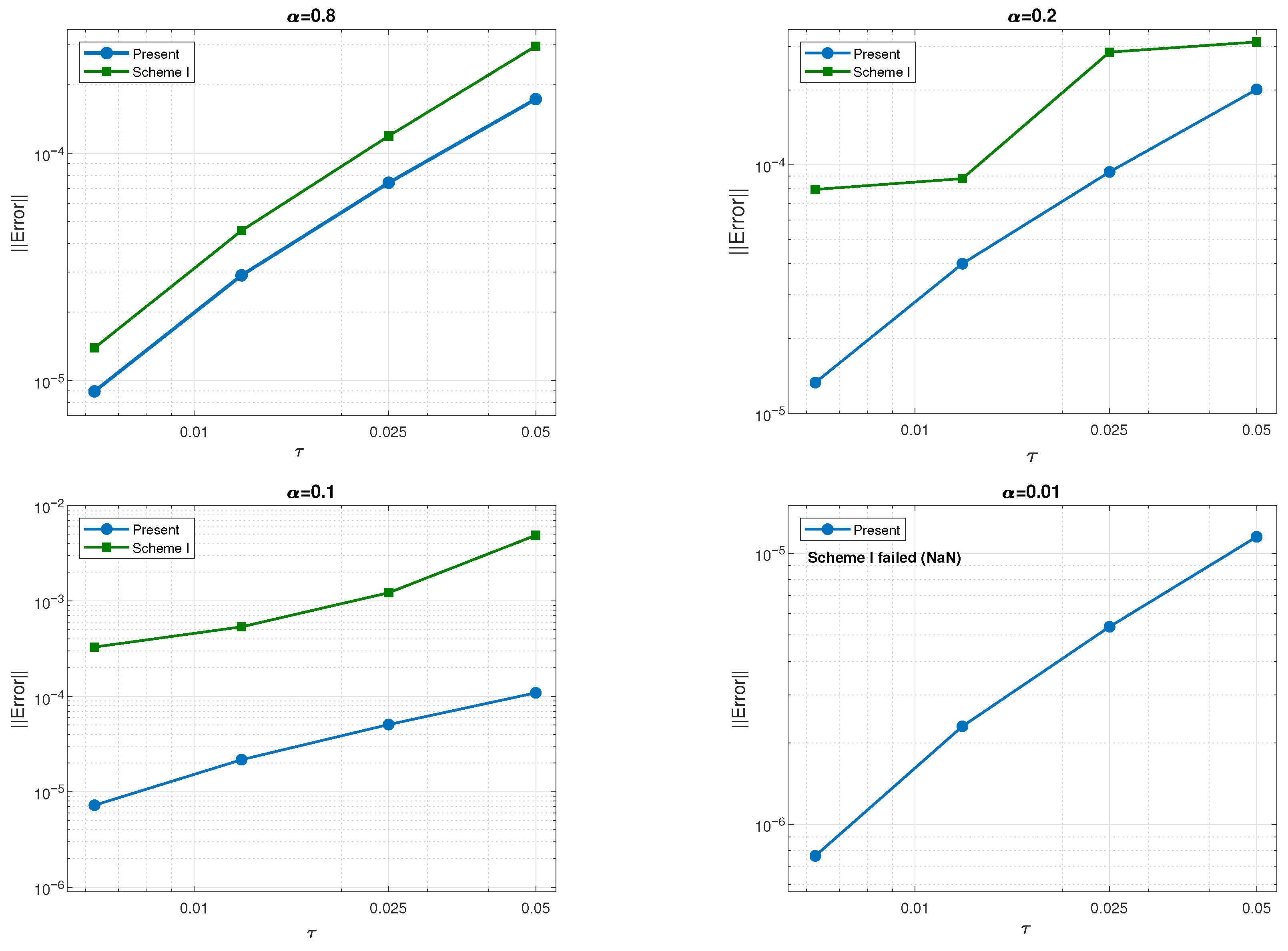
Figure 7 compares the
-errors of our method and Scheme I. The proposed scheme consistently produces much smaller errors for all
. When the grading parameter
becomes large (small
), Scheme I suffers a clear loss of accuracy, while the present uniform-grid method remains stable and convergent. These results demonstrate that the proposed uniform discretization is a reliable alternative to graded meshes.
5. Concluding Remarks
In this paper, we developed an
fourth-order difference scheme for solving the time-fractional Burgers equation. The proposed scheme combines a novel linearized difference formulation for the nonlinear convection term with the
method on uniform temporal meshes. For sufficiently smooth solutions, the method attains second-order accuracy in time, whereas for solutions with weak singularities the temporal accuracy is reduced. In this case, numerical experiments indicate that the scheme achieves a convergence rate of
. The scheme achieves fourth-order spatial accuracy, provided that the time step is sufficiently small to prevent temporal errors from dominating. While graded meshes adaptively refine time steps near
to mitigate singularities, their efficiency diminishes in long-time simulations due to excessive early-stage refinement, which leads to higher computational costs. In contrast, the proposed uniform-mesh approach ensures balanced time stepping across the entire interval, maintaining accuracy throughout the simulation. Numerical results further indicate that the absolute error for uniform meshes remain comparable to those obtained with graded meshes. Moreover, long-time simulations highlight the robustness of uniform meshes in maintaining stability and accuracy over extended periods. This suggests that incorporating a preconditioning technique [
46] or adopting a hybrid graded–uniform mesh strategy could enhance early-time accuracy while maintaining global computational efficiency.
However, the current analysis primarily addresses regular solutions, and extending the theoretical framework to nonregular cases remains a challenging yet important task, as it would provide a more complete understanding of the scheme’s stability and convergence in practical scenarios. We anticipate that the analytical techniques developed in the recent work [
47] could be adapted to this setting, but a comprehensive study is still required, particularly for the
formula. Building upon this foundation, future research will aim to extend the proposed method to higher-dimensional fractional models and to accelerate computations through fast iterative solvers. In addition, sum-of-exponentials-based strategies [
48,
49,
50] and parallel implementation [
51,
52] will be explored to enhance the efficiency of the time-fractional derivative approximation. These developments will also support the analysis and simulation of more general nonlinear time-fractional equations.