1. Introduction
The aviation sector plays a central role in transportation systems, contributing approximately 5% to the overall effective radiative forcing [
1]. This impact primarily arises from aero engine combustion products such as CO
2 and non-CO
2 effects (e.g., H
2O, NO
x, UHC, soot particles, and condensation trails (contrails)). With regard to climate change, the European Union has set the goal of reducing CO
2 emissions by 55% by 2030 and achieving net-zero CO
2 emissions by 2050. In order to achieve these targets and drastically reduce emissions, intensive research and development work on various technologies is required.
To assess these technologies regarding their climatic impact, pollutant emissions and their effects must be well understood. While the release of CO
2 and its effects are subject to only minor uncertainties, the computing of non-CO
2 emissions from aircraft engines and their impact on the climate are significantly less accurate [
1]. This knowledge gap has been acknowledged by the industry, which has identified the need for more accurate modeling of non-CO
2 effects as a critical challenge in the Joint Statement from Chief Technology Officers Advocating for Advancing Science on Aviation’s non-CO
2 impacts on Climate Change [
2]. In order to achieve a holistic evaluation of the climatic impact of an aircraft in operation, realistic information on the ambient conditions along the flight trajectory, as well as the engine operating points, are required. Furthermore, based on these boundary conditions, engine performance evaluation and the prediction of emission products, as well as contrail formation, need to be carried out.
Meteorological conditions, atmospheric composition, and land surface characteristics are of relevance in aero engine operation [
3,
4]. Data on such aspects is required to determine the operating point of an aero engine, to monitor and forecast the aero engine performance and condition degradation, or to estimate emissions. Ambient temperatures influence the choices of derates and subsequent thermal stress. Fine aerosols adhere to surfaces in the compressor and turbine [
5]. Larger, short-lived aerosols, sucked into the engine during ground operations, can erode compressor blades [
6]. Such exemplary deterioration phenomena result in higher fuel flow, operating temperatures, and subsequent emissions. Further, in combustion and exhaust evaluation, aerosol models are of interest since they provide data on the presence and characteristics of potential condensation nuclei required for precise contrail formation prediction. To model any of the exemplary processes named above, it is necessary to obtain data on the ambient conditions acting as process drivers. The data of interest represents the state of the earth’s surface or atmosphere and can be subsumed under the term ambient conditions. In order to represent complex real-world atmospheric behavior, ambient condition data needs to be resolved in temporal and spatial dimensions.
In addition to extensive knowledge of the ambient conditions, a realistic assessment of the flight trajectory as well as the aero engine operating points along the trajectory is required. Aircraft operating models are able to generate these datasets. These models use a parametric approach for generating kinematic aircraft trajectories. The aircraft mission profile is divided into characteristic segments that are described by specific parameter sets, e.g., speeds, transition altitudes, or vertical rates. The parameters are extracted from a broad analysis of Automatic Dependent Surveillance-Broadcast (ADS-B) data and analyzed to assemble a representative aircraft specific default trajectory. Examples of existing tools using this approach are OpenAP [
7] and BADA [
8]. These models are not able to represent single missions under specific ambient conditions. However, accurate information on the aero engine operating points along a specific flight trajectory is important to model the aero engine performance in a realistic scenario. Moreover, a detailed performance model of the aero engine is required to generate the data needed for further emission assessment.
In addition to disruptive technologies such as highly efficient aircraft designs, hydrogen combustion, and fuel cell stacks, alternative hydrocarbon-based jet fuels, which can be used in existing aero engines, are also being researched. This ’drop-in’ capability is particularly important as aircraft engines can have a lifespan of up to 40 years and retrofitting can lead to lower emissions. Sustainable aviation fuels (SAFs) are defined as jet fuels that emit at minimum 10% less CO
2e over their lifecycle compared to fossil fuels (89 gCO
2e/MJ) [
9]. Currently, such hydrocarbon-based jet fuels are approved (ASTM D1655) and can be categorized into biofuels as well as synthetic fuels. Since the properties of these alternative fuels are comparable to conventional jet fuels, similar gaseous emissions are released upon combustion. However, these jet fuels contain fewer or no aromatics and sulfate [
10], resulting in reduced soot particle formation, which affects contrail formation. This effect has been investigated and confirmed in laboratory and field studies [
11,
12,
13]. However, this knowledge is difficult to transfer into existing emission prediction tools. In both academia and industry, various tools exist to quantify aircraft emissions. Notable examples include Cascade from Boeing and AeroMAPS from ISAE-SUPAERO [
14]. These tools primarily use approximations for existing aero engines operating with conventional jet fuel, which means other technologies and SAF-powered aero engines are not taken into account.
To address the issue of determining fuel-specific emissions, various approaches can be applied. In addition to high-fidelity simulations, there are also correlation-based, fuel flow, and simplified physical models available for representing emissions [
15]. These simplified physical models streamline the chemical and physical processes within a combustion chamber (CC), making them particularly useful for rapid calculations. They partition the CC into zones represented by one or more chemical reactors, which are interconnected to form a chemical reactor network (CRN). Within these networks, kinetic mechanisms are applied to simulate the reactions. The number and type of reactors utilized can vary depending on the modeling approach [
16,
17,
18]. Furthermore, CRN models can be combined with soot models to predict soot particle formation, enabling a detailed representation of the chemical processes that account for both low and high temperature ranges, as well as the formation of NO
x and soot.
Contrails, the visible plumes generated by aero engine exhausts, are composed of water vapor that can freeze into ice particles by nucleation under specific atmospheric conditions. For predicting contrail formation, the DLR’s CoCIP tool [
19] utilizes Earth observation data to assess atmospheric conditions along a flight path and evaluate the likelihood of contrail formation based on the Schmidt-Appleman Criterion (SAC), incorporating the Schumann extension [
20]. In these tools, condensation nuclei (e.g., soot particles) are either neglected or only considered with fleet-averaged data, leading to the underestimation of contrail and cirrus formation and influencing the prediction accuracy for various engine architectures and jet fuels [
21,
22].
These fundamental limitations of existing tools, such as the evaluation of mission- and engine-specific non-CO
2 emissions under realistic conditions, remain a driving force for the development of advanced models. This paper pushes the boundaries with an innovative simulation platform called ’Modeling and System Analysis of Aero Engines’ (MSAE). MSAE combines airplane movement and ambient condition data with engine performance simulations and CRN models. This method-based and data-driven approach aims to simulate all important information (e.g., atmospheric and exhaust gas-specific boundary conditions, emission products, and condensation nuclei) along the entire flight mission. As such, aero engine performance is connected with detailed emission prediction in the context of realistic atmospheric boundary conditions in an effort to close the identified knowledge gaps. In this work, we focus on an Airbus A320 powered by the International Aero Engines (IAE) V2500-A1 turbofan engine both with conventional jet fuel (Jet-A) and an alternative hydrocarbon-based jet fuel (such as Fischer–Tropsch synthetic paraffinic kerosene, FT-SPK). However, MSAE is designed to adapt to different aircraft, engines, and fuel types. This manuscript corresponds to our publication for the 16th European Turbomachinery Conference [
23].
2. Methodology
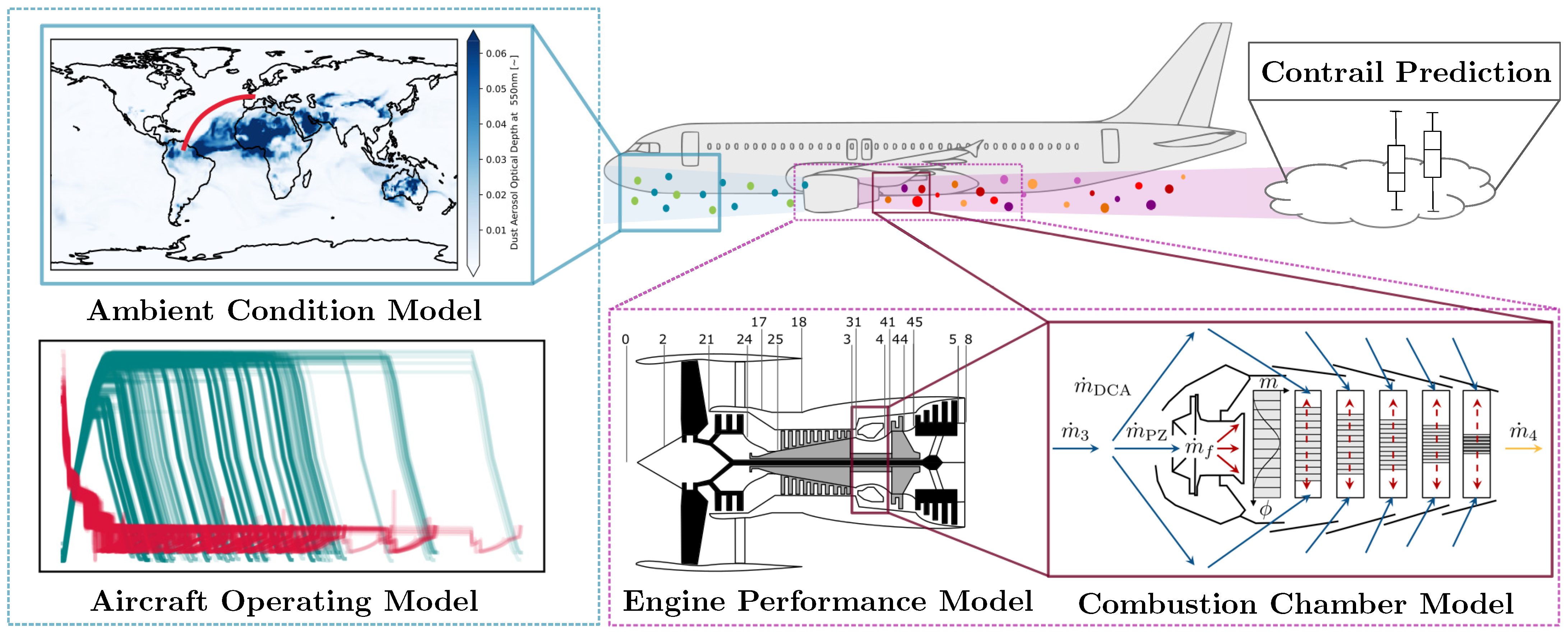
The MSAE platform consists of five main models, enabling a holistic representation of an aircraft flight scenario within realistic ambient conditions, which are passed down from the aircraft level to the aero engine and subsequently to the emission prediction.
Figure 1 shows an overview of the different models. The ambient condition model is used to determine the atmospheric conditions at a selected point in temporal and spatial dimensions, including meteorological parameters as well as information on aerosol species and characteristics. In this model, the database needed to accurately represent realistic ambient conditions within the MSAE platform is generated. An Aircraft Operating Model is used to determine the engine operating points along the flight trajectory. These can be mapped to the ambient conditions, resulting in a set of realistic boundary conditions to be used as input for the performance analysis as well as emission and contrail prediction.
The aero engine performance analysis is conducted using a thermodynamic cycle analysis algorithm for the V2500-A1 turbofan engine. Subsequently, the secondary airflow and fuel flow as well as the compressor outlet pressure and temperature calculated within the performance model are used as input for the CC model. Within the CC model, the combustion processes are simulated in a simplified physics model approach using a CRN [
16]. Here, the formation of various emission species, including CO
2, CO, NO
x, UHC, and soot particles can be calculated. The time dependent combustion processes within the CC are calculated using the open-source software CANTERA [
24], enabling the simulation of different fuel types, such as conventional and alternative hydrocarbon-based jet fuels. In the final step, based on the meteorological conditions and the aero engine exhaust gas properties, a preliminary prediction of contrail formation is conducted using the SAC.
In summary, the dataset generated by the MSAE platform is composed of the ambient conditions at a specific time and location, the engine operating point on the flight trajectory associated with the corresponding performance analysis data, as well as the emission products formed within the engine’s combustion chamber and a preliminary evaluation of contrail formation. This combined dataset can be generated for a single operating point as well as along an entire flight trajectory. In the following sections, the individual models used within the MSAE platform are explained in more detail.
2.1. Ambient Condition Model
For determining the aero engine performance, simulating the combustion processes and subsequently predicting contrail formation, the ambient operating conditions are of interest. Specifically, to model the interactions between engine exhaust and ambient conditions, potentially resulting in the formation of contrails, an ambient condition model provides inputs on boundary conditions. This model contains, among other data, the outputs from atmospheric composition and meteorological models representing the composition and state of the operating environment of an aircraft [
25,
26]. The atmospheric composition can be characterized by the present aerosol species such as mineral dust, sea salt, sulfur, or black carbon, their concentrations, size distributions, and the aerosol mass. The state can be characterized by basic physical properties such as humidity, pressure, or temperature. In the scope of this work, the state variables temperature and specific humidity [
25] are used for contrail prediction by informing the Schmidt-Appleman Criterion.
The aforementioned, here not yet utilized, atmospheric composition information serves two purposes. Firstly, atmospheric composition and state information are used in modeling the deterioration of the aircraft engine. This is achieved by estimating the engine and turbo component specific (cumulative) contaminant mass flows along a given flight path and using them to explain the deterioration of the turbo components [
4,
27]. Such deterioration modeling can then be integrated into combustion chamber models by providing a set of realistic turbo component boundary conditions the combustion chamber interacts with. By representing the actual state of a deteriorated engine, the altered exhaust composition and a potentially altered interaction behavior of the emissions with the ambient conditions can be ensured. Secondly, the composition information can be utilized for providing information on the presence of condensation nuclei, which should be considered when predicting the formation of contrails.
Data on the state and composition of the atmosphere currently stems from reanalysis models with a time resolution of 3 h and spatial resolutions of at most horizontally on up to 72 model levels vertically. The results presented here are based on a lower spatial resolution dataset (European Centre for Medium-Range Weather Forecasts Atmospheric Composition Reanalysis 4) with horizontal resolution and 60 model levels. The datasets used in the ambient condition model are validated against atmospheric measurements and competing models by NASA and the European Centre for Medium-Range Weather Forecasts, among others.
The evidence showing the variations in aerosol concentrations and meteorological parameters makes it necessary to integrate data sources describing both the composition and state of the atmosphere in higher spatial and temporal resolution [
28]. Resolving sub-grid scale processes in more detail is an ongoing effort benefiting from advances in Earth observation and atmospheric modeling. It provides a promising basis to improve contrail prediction following the here presented approach.
2.2. Aircraft Operating Model Using the Example of an Airbus A320
An operational model serves as a link between aircraft operation and the operating point of the aero engines. These operating points are influenced by multiple factors originating from the aircraft’s mission. These are the following: thrust setting, thrust reduction, ambient conditions, flown trajectory (altitude, velocity), and forces (weight, drag).
Firstly, the aero engine operating point is dictated by the thrust setting. In modern aircraft, thrust is controlled by the aircraft’s avionic system within thrust ratings depending on the mission phase: Take Off (TO) and Go-Around, Maximum Continuous, Climb, Idle [
29]. Here, the operating point of the engine is controlled to assure safe and stable operation and to follow a specific flight profile. Because engine thrust itself is not directly measurable within aircraft operation, substitute parameters such as
spool speed or engine pressure ratio are used.
Secondly, the operating point for air breathing engines is influenced by the ambient conditions. Modern high-bypass turbofan engines for civil transport aviation provide a flat rated thrust, where full rated engine thrust is assured with varying outer air temperature by adjusting the operating point of the aero engine. Typically, higher outer air temperatures at constant thrust lead to increased spool speeds, higher fuel burn, and higher exhaust gas temperatures. This is possible up to a defined kink point temperature
above which thrust is reduced in order to limit thermal loads in the engine’s hot section. Ambient pressure further influences air density, thus influencing the thrust provided by the engine. Low air pressure leads to lower generated thrust of the engine. This is why hot and high conditions are demanding for the engines, especially when airport field length is limited and the aircraft is loaded up to maximum TO weight. Another influencing parameter is the flight Mach number, as engine operation and net thrust change with the speed of the ingested air mass flow [
30].
In order to simulate aero engine mission profiles, an operational model is developed. The model consists of three components:
TO and climb are of importance as these flight phases require high thrust settings and have high significance for engine design and operational degradation. At the same time, the characteristics of these flight phases are fairly individual based on mission aspects. In contrast, cruise is a rather steady operating point and descent is performed at low thrust settings close to the lower stability limit of the engine. The model is set up to represent the average behavior of an Airbus A320 aircraft. In contrast to using real kinematic trajectories of existing aircraft from ADS-B data, the model is anticipated to guarantee a high level of flexibility for future investigations considering new aero engine concepts, changes in airframes, and optimized flight profiles by simulation of synthetic trajectories.
2.2.1. Climb Trajectory Model and Trajectory Generation
As a basis, the model uses OpenAP, an open aircraft performance model from Delft University of Technology [
7]. The model is adapted for generating more specific climb trajectories under the assumption that the variance in transition altitudes and vertical rates during climb is caused by variations in flight distance and ambient conditions. To do so, a random forest machine learning algorithm is set up and trained with ADS-B data from an Airbus A320 aircraft operated in North America [
31].
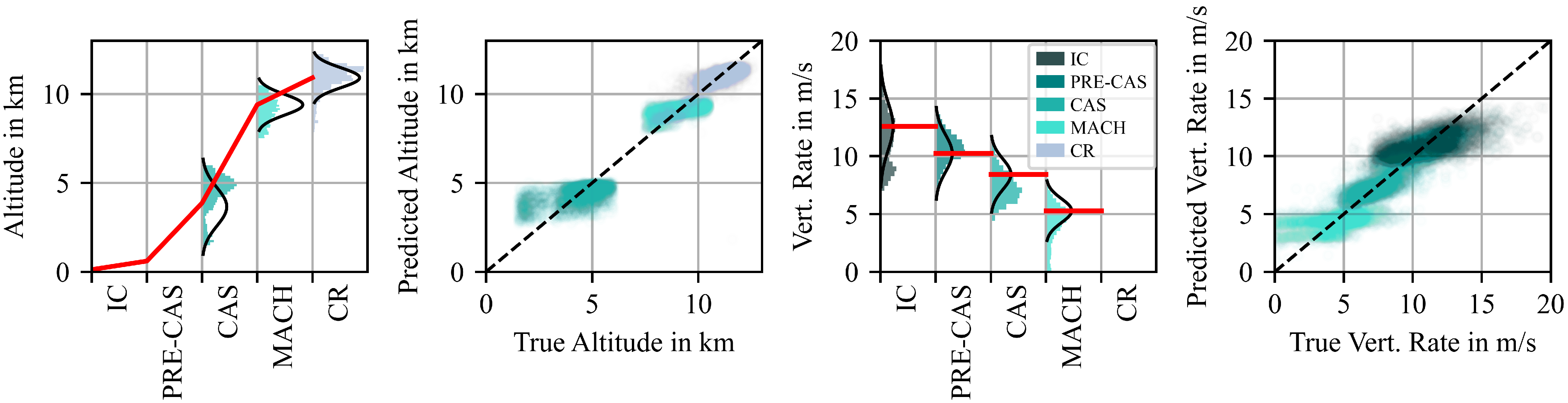
Figure 2 (left, right from centre) shows the variation in climb parameters for each segment during the climb, which are initial climb (IC), acceleration towards constant calibrated airspeed (PRE-CAS), climb at constant CAS (CAS), climb at constant Mach number (MACH), and cruise (CR). Mean values are shown in red, the statistical distributions are represented using black lines and coloured dots. The left graph shows the transition altitudes between climb segments. The right graph shows the average vertical rates for each segment. In Addition, the OpenAP default trajectory (red line) and the statistical distribution (black line) are displayed, showing agreement with the analyzed data.
Figure 2 (left from centre, right) shows the corresponding true versus predicted plots of the random forest models. It can be seen that deviations are high at lower altitudes (IC, PRE-CAS), where the parameter distributions are the widest. This is most likely due to ungeneralizable local influences close to the airport, e.g., air traffic management, obstacles, curved flight trajectory, etc. Another uncertainty arises from the unknown true TO weight of the aircraft in ADS-B data. In the presented procedure, weight is correlated with the great circle flight distance. The true value is likely to deviate for individual flights and might be the cause of residual variance seen in the data. Once the climb trajectory is simulated, a cruise phase of constant altitude and Mach number is attached, followed by a default descent and landing profile from the OpenAP base model.
2.2.2. Take off Thrust Model
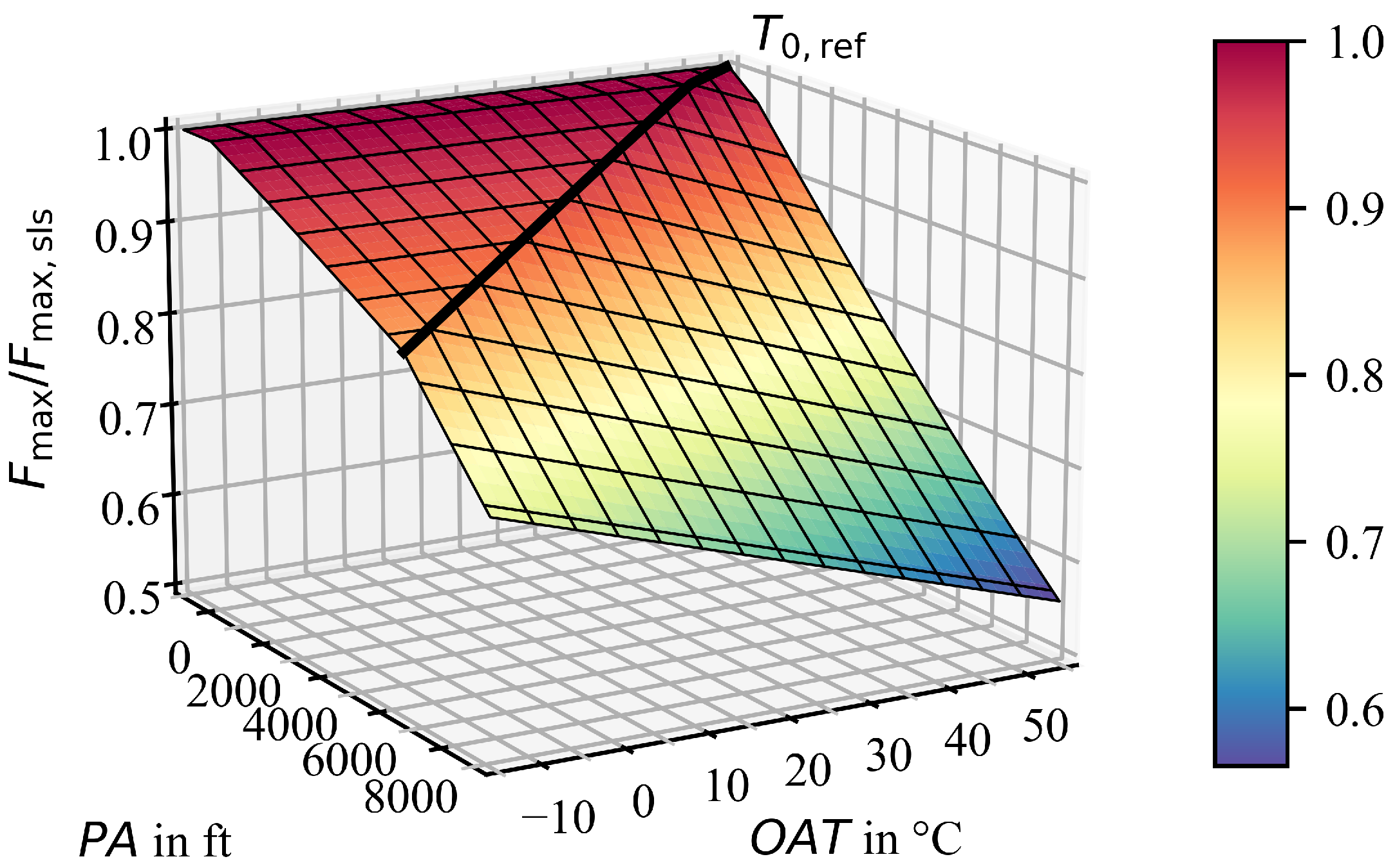
TO thrust is estimated by calculating the available engine thrust and required TO thrust from operational parameters. Maximum available engine thrust is modeled in two steps. Firstly, sea-level static thrust
, the value typically given in engine product cards, is corrected based on the pressure altitude (PA). The value obtained is the flat rated engine thrust at a given atmospheric pressure. Next, available thrust is corrected for the ambient temperature. If the ambient temperature
is above the kink point temperature
, the maximum available thrust is further reduced. These data, specific to an aircraft and an engine model, can be read from data tables in the Flight Crew Operating Manual [
32].
Figure 3 shows the maximum thrust calculated by the model for different PAs and outside air temperatures (OAT). The values are normalized using the maximum thrust at sea level.
Required thrust yields the thrust demand for reduced thrust TO procedure and is modeled depending on aircraft weight, ambient conditions, as well as the runway length at the departure airport. Here, the methodology from OpenAP during TO is also used and physical relations are introduced to model variations in lift-off speed
and average acceleration
. Lift-off speed
is calculated based on Equation (
1), where the aircraft’s roll velocity has to be sufficiently high, such that the generated lift equals the aircraft’s weight. The aircraft lift coefficient at lift-off
is derived from the OpenAP A320 drag model [
7] and is assumed to be constant due to constant flap setting and roll angle at lift-off.
S is the aircraft wing area,
the aircraft’s TO mass, and
g the earth’s gravitational acceleration. Ambient air density
is retrieved from atmospheric data at the airport location and based on the timestamp of the flight. The aircraft average acceleration is calculated according to Equation (
2), where
is the net thrust of the engine and
is the runway surface friction coefficient, which is assumed to be a standard value of 0.02 for a dry concrete and leveled runway [
33]. Lift and drag coefficients are assumed to be constant average values for the rolling phase and are also modeled by the OpenAP drag model.
Eventually, modeled TO performance is compared to the runway length
of the departure airport (see Equation (
3)), such that the required engine thrust can be evaluated. A denominator of
is set to limit the rolling distance on the runway [
29].
Figure 4 (left) shows a comparison of modeled TO thrust with snapshot data at TO, where the thrust is modeled from engine
spool speed. While the data are not fully congruent, it is notable that the slope and range of the data coincide, demonstrating a generalized representation of TO performance.
2.2.3. En-Route Thrust Extraction
From the kinematic trajectory,
and drag
D, thrust can be derived along the flight profile by Equation (
4), where
is the path angle and
is the change in velocity [
34].
Figure 4 (right) shows an adequate fit of modeled en-route thrust with engine snapshot data at cruise. The offset towards higher thrust seen in the snapshot data might be a result of individual engine conditions.
Figure 5 (left) illustrates an example of simulated aircraft trajectories, while
Figure 5 (right) shows the resulting thrust during climb. As can be seen, the model is capable of simulating continuous thrust profiles. The mission profiles are, to a certain extent, representative of specific mission parameters and provide more realistic boundary conditions for engine performance simulation compared to standardized flight missions.
2.3. Aero Engine Performance Analysis
The aero engine examined in the scope of this work is the IAE V2500-A1. The V2500-A1 is a turbofan engine with two spools, a bypass ratio of approximately 5.4 and an overall pressure ratio of up to 35.8. The maximum TO thrust that can be achieved is 111 kN. Detailed information are shown in [
35,
36,
37]. A thermodynamic performance model of this turbofan engine is implemented to analyze the on- and off-design performance during each point of the flight missions. Further details on the used performance model and the structure of the underlying algorithm can be found in the literature [
38,
39,
40]. The off-design is an iterative simulation process that requires various input data, such as the mission profile, thrust requirement, and ambient conditions. Furthermore, the engine’s cycle on-design operating point is necessary [
38]. It represents the framework of the aero engine and defines the interaction between the miscellaneous turbo components, secondary air system, and geometry (e.g., nozzle area) to establish the conservation of mass and energy. The entire steady-state performance maps of the turbo components are required to operate in the full mission. Quantities related to the compressor and turbines are denoted with indices
and
, respectively. These performance maps describe the corrected mass flow
, pressure ratio
, and efficiency
of the turbo components at different corrected rotational speeds. Additionally, auxiliary coordinates, the so-called GL–lines, are deployed along each throttle line. They are necessary for the iteration of the algorithm.
Based on the mission profile (see
Figure 5), the thermodynamic mission analysis is conducted. A distinction is made between the outer loop, in which the rotational speed
is varied until the required net thrust
is reached, and the inner loop, in which the conservative equations of the thermodynamic cycle, based on the input parameters, are solved in an iterative process. The conservative equations are solved by iterating within the performance maps until the following occurs: (1) the turbine power
output matches the compressor power
, (2) the conservation of mass is maintained, and (3) the nozzle pressure
is equal to the pressure
downstream of the LPT (including friction). The convergence limits are
.
The initial values of all necessary parameters are provided based on the on–design input parameters for the first iteration. The iteration variables for the inner loop are the turbine inlet temperature , bypass ratio (BPR), the LP spool rotational speed , and the auxiliary coordinates and . Based on these, a thermodynamic cycle is defined and a global cycle process calculation can be carried out iteratively using the Newton–Raphson method until an operating point is found. Subsequently, the derived cycle is evaluated in terms of achieving the thrust requirement. If not, is varied using the Newton–Raphson method. Here, the termination criterion is . The algorithm is implemented in MATLAB 2019b, making use of its extensive vectorization capabilities; thus, the calculation of all mission points is executed in parallel.
2.4. Combustion Chamber Model
The structure of the CC model presented in this work is primarily based on the CRN model developed by Moniruzzaman and Yu [
16]. The chemical processes are modeled using the open-source tool CANTERA [
24] in combination with the kinetic mechanism developed by CRECK Modeling at Politecnico di Milano for jet fuel [
41,
42].
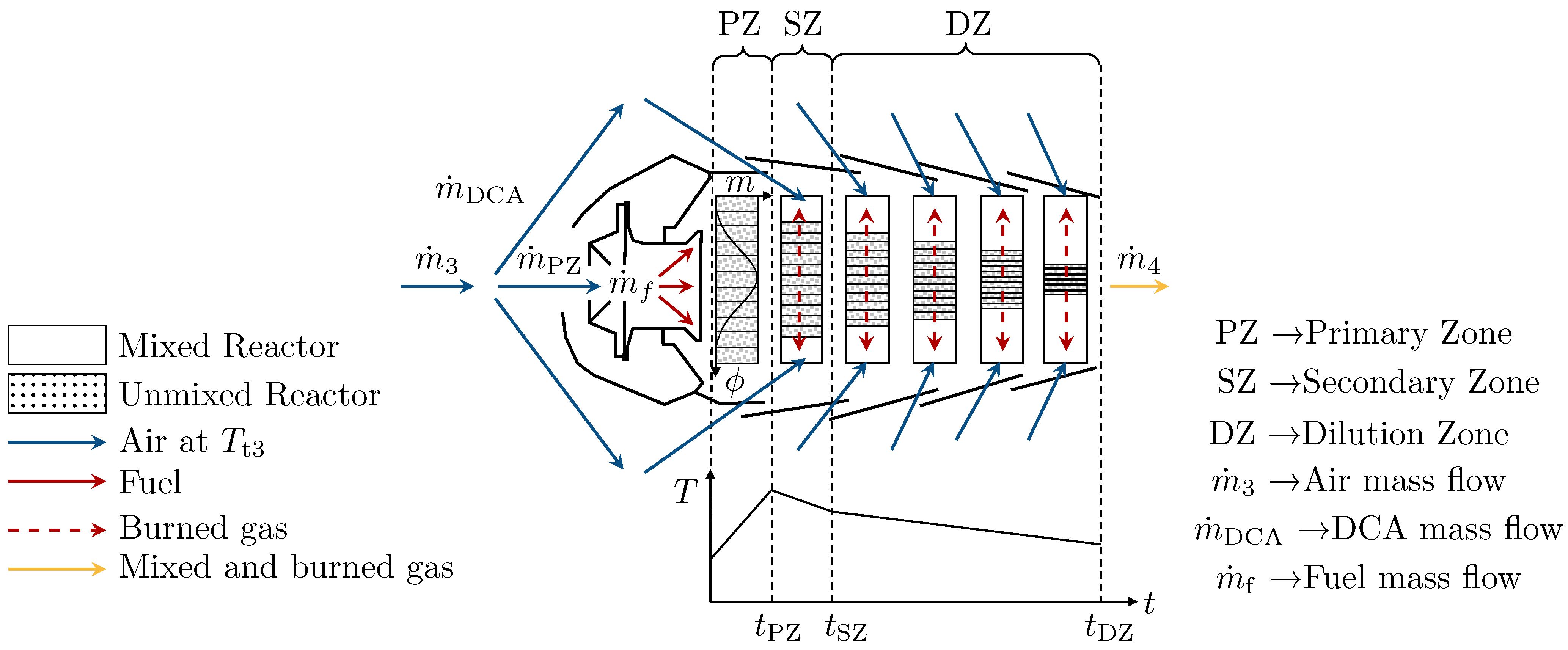
Figure 6 shows the structure of the CC model presented in this work. In the following subsections, the model setup, the calculation methods, and the assumptions made are described in detail.
2.4.1. Model Structure and Set up
In the CC model, the characteristic behavior of a rich burn–quick quench–lean burn (RQL) combustion chamber is simulated by using a set of chemical reactors. The combustor is divided into the primary zone (PZ), the secondary zone (SZ), as well as the dilution zone (DZ). These different zones are defined by their start and end timestamps along the entire residence time
within the CC.
marks the end time of the PZ,
is the end time in the SZ, and
is the end time within the DZ. In the PZ, the fuel mass
and a part
of the air mass from the compressor outlet mass flow
(at temperature
) mixes with the hot gas in the CC within turbulent recirculation regions and ignites. Initially, a rich fuel–air mixture is burnt, yielding incomplete combustion. Within the SZ, a high mass flow consisting of dilution and cooling air (DCA)
is then added to the burnt gas. This leads to a rapid reduction in the equivalence ratio
, resulting in the combustion of the previously unburnt fuel. In the DZ, the remaining DCA enters the flame tube, which results in a temperature reduction. As a result, further reactions take place due to the added oxygen molecules [
43]. The mixture at the combustor outlet contains the sum of the fuel mass
and the total amount of DCA with the overall fuel-to-air ratio
. The pressure along the simulation time is assumed to be constant at
.
Each of the zones is represented by a set of perfectly stirred reactors (PSRs), therefore neglecting the direct incorporation of flow phenomena in the CC model. Reactions take place within the reactors along the residence time of the fluid within the combustor. Since there is no information on the positions of the reactors within the CC model and each PSR is in physical equilibrium at each point in time, the model is considered zero-dimensional. Two types of PSRs are introduced in the CRN, which consists of unmixed reactors and one mixed reactor. The set of unmixed reactors is used to model the main combustion in the complex heterogeneous flow field located in the PZ, representing the rich burn phase. Here, the fuel–air mixture is distributed over the unmixed reactors via a normal distribution, while the mixed reactor contains no mass. The normal distribution is defined by the mean equivalence ratio , which is a measure of the mixture’s overall richness and the standard deviation , which represents the level of unmixedness within the PZ. The mass of the ith unmixed reactor at the beginning of the PZ is then determined by the normal distribution. All unmixed reactors are set up with an initial temperature that is sufficiently high to ensure ignition takes place within the PZ. This initial temperature also influences the time delay between the fuel–air mixture entering the CC and the ignition, hence influencing the combustion behavior as well as the formation of emission products. To ensure energy conservation, a heat transfer is introduced in the PZ, whereby the energy added by the initialization of the unmixed reactors is again subtracted.
Subsequently, in the SZ and DZ, the mixing of the burnt gas with DCA (quick quench, lean burn) is modeled within the mixed reactor. In the SZ, a fraction of the mass stored within the unmixed reactors flows into the mixed reactor and is mixed with a fraction of DCA
, forming an air–fuel mixture with a mean equivalence ratio
. At the end of the SZ, the fraction
of the initial mass is left in the unmixed reactor
i. The mass flow rate between the unmixed reactor
i and the mixed reactor
within the SZ is calculated by Equation (
5).
The mass flow rate of DCA
that is added to the mixed reactor within the SZ is determined by Equation (
6).
Within the DZ, the mass flows between the unmixed reactors and the mixed reactor, as well as the DCA mass flow, are calculated analogous to the SZ. denotes the fraction of mass at the end of the DZ in the ith unmixed reactor and is the fraction of DCA added to the mixed reactor within the DZ.
Based on the work of [
16], a number
of the unmixed reactors are considered soot reactors, which contain the highest equivalence ratios within the normal distribution to model the mass of soot particles formed in the combustor. Analogous to the definitions of
and
, the mass fractions of the soot reactors at end of SZ and DZ are given by
and
. Since the values for
and
can be defined independently, the soot formation process can be calibrated more explicitly.
2.4.2. Kinetic Reaction Mechanism
The development of chemical reaction mechanisms has been an active research area within the last decades, with a trend towards more complex mechanisms containing hundreds of species and thousands of reactions [
44]. In the scope of this work, a detailed kinetic mechanism developed by CRECK Modeling at Politecnico di Milano [
41,
42] is used, which contains 621 chemical species with 27829 chemical reactions. The kinetic mechanism includes low temperature, high temperature chemistry as well as NO
x and soot formation submodules. Here, a sectional model is integrated using lumped pseudo-species (bins) representing soot particles of different sizes and compositions. Overall, 21 soot bins are considered, with particle sizes ranging from 2.02 nm up to 202.12 nm. A detailed description of the soot model is given in [
45].
2.4.3. Surrogate Fuel Models
Real jet fuels consist of various chemical species, causing an unfeasible high effort to model all components. Therefore, surrogate formulations are developed to mimic the chemical and physical behavior of a real fuel while using only a few different chemical species. In the scope of this work, two surrogate formulations are considered that are developed by [
46] to represent the sooting behavior of conventional jet fuel (Jet-A) and an alternative hydrocarbon-based jet fuel (FT-SPK). The molar compositions of the used surrogate formulations are shown in
Table 1.
2.4.4. Calibration of the Model Parameters
In order to represent the properties of a real combustion chamber, the model parameters of the CRN need to be calibrated. The V2500 engine is selected as a reference for which emission data are available in the ICAO certification database [
47]. For the assessment of particulate matter emissions from aero engines, different certification standards were developed in the past. In the currently available ICAO certification data, particle emission evaluations, according to the smoke number (SN) standard introduced in Annex 16 [
48], as well as to the nvPM standard [
49], are included. Based on the SN measurements, the mass emission indices for soot emission are calculated using a correlation method [
50,
51]. Depending on the certification standard, differences in the overall mass emission indices can be observed in the reference database. Additionally, the SN and nvPM measurements themselves show uncertainties.
Since the CRN network is a zero-dimensional model, all information on the combustor geometry is given by the equivalence ratios, the residence time fractions as well as the DCA mass flow ratios in each zone. In addition, the level of unmixedness within the PZ and the mass fractions of the unmixed reactors at the end of SZ and DZ as well as the number of soot reactors represent the characteristics of the combustion chamber. Emission data is available in the ICAO database for four different operating points, comprising TO, Climb-Out, Approach, and Idle. In general, the model parameters can vary with the operating point. Hence, multiple calibration points are selected in order to simulate the combustion processes along the mission. To identify a set of model parameters that reproduce the reference data, a latin hypercube sampling method is used to perform a DoE study with varying model parameters. From the DoE study, the best fitting model parameters are selected. The calibration studies are all performed using the Jet-A fuel surrogate formulation. It is found to be difficult to minimize the relative deviations in the CC model’s results to the ICAO reference for CO, UHC, and soot coherently, as a result of similar factors contributing to the formation of these products mainly being the unmixed reactors containing a rich fuel–air mixture causing incomplete combustion. However, for the Take Off, Climb Out, and Approach reference points, sets of model parameters are identified that represent the overall trend of the emission products reasonably. The emission indices (EIs) calculated by the CC model as well as the ICAO reference values are shown in
Table 2. In this context, UHC comprises all hydrocarbon species at the end of the combustion chamber, excluding soot particles and polycyclic aromatic hydrocarbons. The dominant UHC species are C
2H
2, CH
4 and C
5H
2. The modeling of soot particle formation is associated with large uncertainties, even when considering simple flames in laboratory conditions. For this reason, the soot EI was considered less weighted within the parameter calibration compared to the NO
x, CO and UHC EIs. Following that, the predicted soot EIs, using the calibrated model, show a maximum relative deviation of 57% compared to the ICAO reference data. However, the soot EI trend between the different operating points is captured by the CC model.
2.5. Preliminary Contrail Prediction
Contrails are linear clouds composed of small ice particles resulting from the condensation and subsequent freezing of water vapor emitted by aircraft engines. The formation process involves the mixing of hot exhaust gases with cold ambient air, leading to a locally supersaturated state with respect to liquid water, triggering the condensation of water droplets on aerosols or condensation nuclei. These droplets subsequently freeze, and the growth of contrails can be intensified by the uptake of additional water from the surrounding air beyond the amount emitted [
20,
52]. There are three principal types of contrails: Short-lived contrails lasting less than 10 min. Long-lived (or persistent) contrails lasting more than 10 min. Contrail cirrus lasting several hours to days, which is often indistinguishable from naturally occurring cirrus clouds [
22,
52,
53]. The classification hinges on their lifespan and extent.
According to the World Meteorological Organization (WMO), contrails are referred to as Cirrus homogenitus once they persist for more than 10 min. Long-lived contrails depend on ice-supersaturated regions where the relative humidity with respect to ice exceeds 100%, sometimes reaching up to 150–200% [
52].
The SAC determines the maximum threshold temperature for contrail formation, considering humid air. No further effects of the air composition or the presence of condensation nuclei are considered using the SAC. The maximum threshold temperature represents the warmest ambient condition at which contrails can form. The criterion involves the intersection of the mixing line slope and the saturation curve for liquid water vapor pressure [
20,
52]. Using the SAC a, preliminary evaluation of both non-persistent and persistent contrail formation can be conducted based on the meteorological data of the surrounding atmosphere as well as the exhaust gas temperature determined by the engine performance analysis model. Contrail formation is contingent not only on water vapor emissions but also on the released thermal energy and the efficiency of the aircraft engines.
Persistent contrails have a complex impact on the Earth’s radiation balance. They can block both incoming solar radiation and outgoing terrestrial radiation, affecting the Earth’s energy budget [
1]. At night, persistent contrails often have a warming effect (positive radiative forcing, RF), whereas during the day, their impact can be either warming or cooling depending on specific conditions [
54]. The uncertainty in the emission effects of contrails is influenced by variables such as season, time of day, latitude, and ambient humidity. To mitigate contrail impacts, strategies such as altering flight routes to avoid contrail-prone regions and adjusting aircraft operational parameters to produce thinner and shorter-lived contrails are being investigated [
22]. Finally, a better understanding and accurate representation of contrail formation processes in climate models are vital for predicting their long-term effects on global climate. Contrail impacts are especially significant for persistent contrails and contrail cirrus due to their prolonged existence in the atmosphere and their ability to influence the Earth’s radiation budget over extended periods.
3. Results
The combination of the models described in the preceding section enables the MSAE platform to provide a comprehensive database. It represents the aircraft’s performance in a realistic operational scenario and at given ambient conditions. The effects of the ambient conditions are considered both time resolved and annually averaged. In this section, the MSAE tool is applied to analyze an exemplary point in the cruise phase of an Airbus A320 aircraft on the flight route from Tenerife (TFS) to Amsterdam (AMS). The objective of this demonstration is to illustrate the functionality as well as the interconnections of the individual models that MSAE comprises. The flight trajectory as well as the engine operating points are determined by the operating model described in this work. Subsequently, the performance model of the V2500-A1 turbofan engine is used to determine the thermodynamic properties at each station within the engine. The combustion processes are then analyzed using the CC model.
Below, the results of the CC model are discussed in detail, focusing on the non-CO2 emission products. Additionally, a preliminary contrail prediction is conducted by applying the SAC. Here, both time-averaged meteorological data as well as intraday meteorological information in a resolution of 3 h are considered.
3.1. Engine Operating Point and Boundary Conditions
From the entire mission profile, an exemplary point in the cruise phase is selected for further analysis. The point on the trajectory is defined by an altitude of 11,411 m and a flight Mach number of 0.77.
Table 3 shows the aero engine net thrust
, the compressor outlet pressure
and temperature
, the turbine inlet temperature
, as well as the overall FAR. These data are subsequently used as input for the CC simulation.
3.2. Emission Prediction
The CC simulation is carried out using the Jet-A surrogate as well as the FT-SPK fuel surrogate.
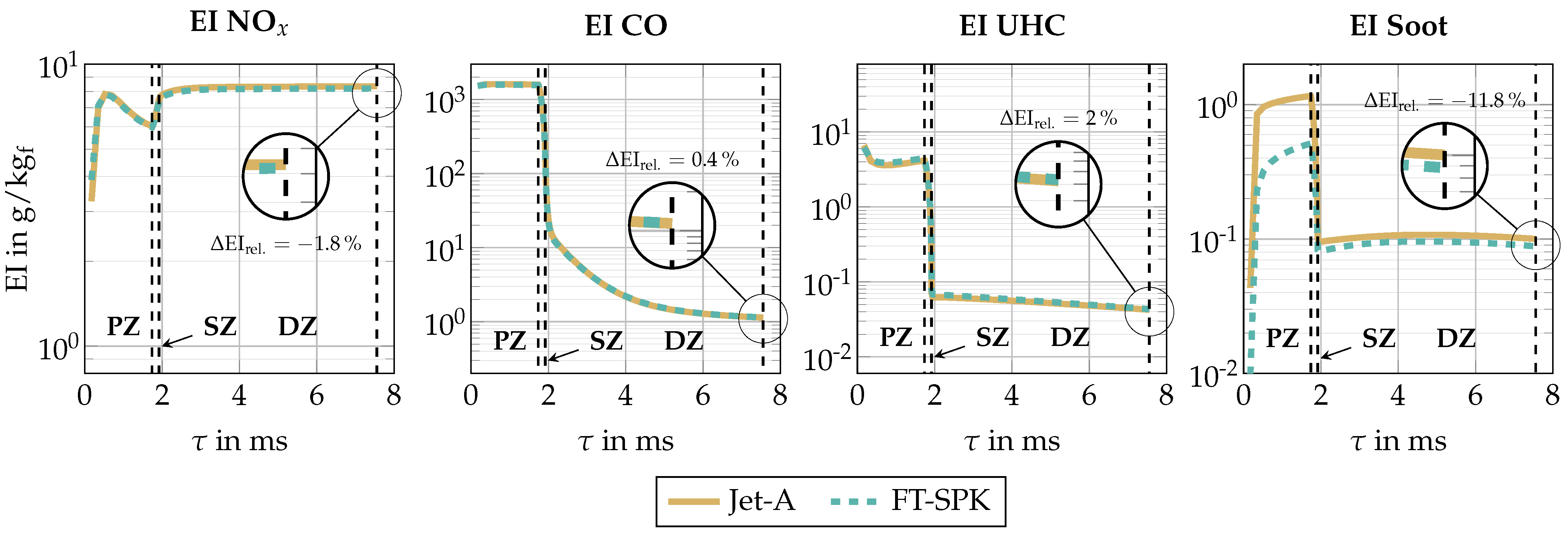
Figure 7 shows the evolution of NO
x, CO, UHC, and soot EIs along the residence time
within the CC for both fuel surrogates. The largest deviations can be observed in the UHC and soot production, whereby the FT-SPK shows a 2% increase in UHC and an 11.8% decrease in soot emissions compared to Jet-A. In general, the qualitative progressions of the emission products reflect the behavior of an RQL combustion chamber. The fuel–air mixture ignites within the PZ in a low-oxygen environment at an equivalence ratio of
, resulting in incomplete combustion, which can be observed in the progressions of CO, UHC, and soot. Due to the temperature increase invoked by the first combustion phase in the PZ, NO
x formation can also be observed. Note that the decrease in NO
x in the PZ is caused by the heat transfer in the CC model. Only small deviations between the emission formation using the Jet-A and FT-SPK surrogate can be observed in the PZ. However, soot particle formation occurs faster when using the FT-SPK surrogate.
Within the SZ, a fraction of DCA is added to the gas mixture, resulting in further oxidation of the CO, UHC, and soot, which can be observed by a rapid decrease in their EIs within the SZ. Moreover, the temperature increases due to the described oxidation reactions and causes an accelerated NO
x formation within the SZ. Again, minor deviations between the two surrogate formulations are observed. In the DZ, the remaining mass of DCA is added to the combustion gases, however, with a lower mass flow rate compared to the SZ. Thereby, the oxidation of CO molecules and soot particles is promoted, resulting in a further decrease in EIs. Along the residence time in the DZ, a deviation in UHC and soot formation between the two surrogate formulations is observed. The use of low-aromatic jet fuels such as FT-SPK is reported to result in a decrease in soot emissions. However, it has also been observed that this effect is reduced at high engine power settings [
55]. Besides the need for further sensitivity investigations on the factors that influence soot formation in the presented CC model, the authors attribute the small soot emission deviations to the relatively high engine power setting at the ambient conditions at the selected mission point. Additionally, in future expansions of the proposed CC model, a representation of the turbine and nozzle will be included.
As described, the in-homogeneity of the fuel–air mixture within the CC is modeled using several PSRs with differing
values. To further analyze the influence of the
distribution on emission formation,
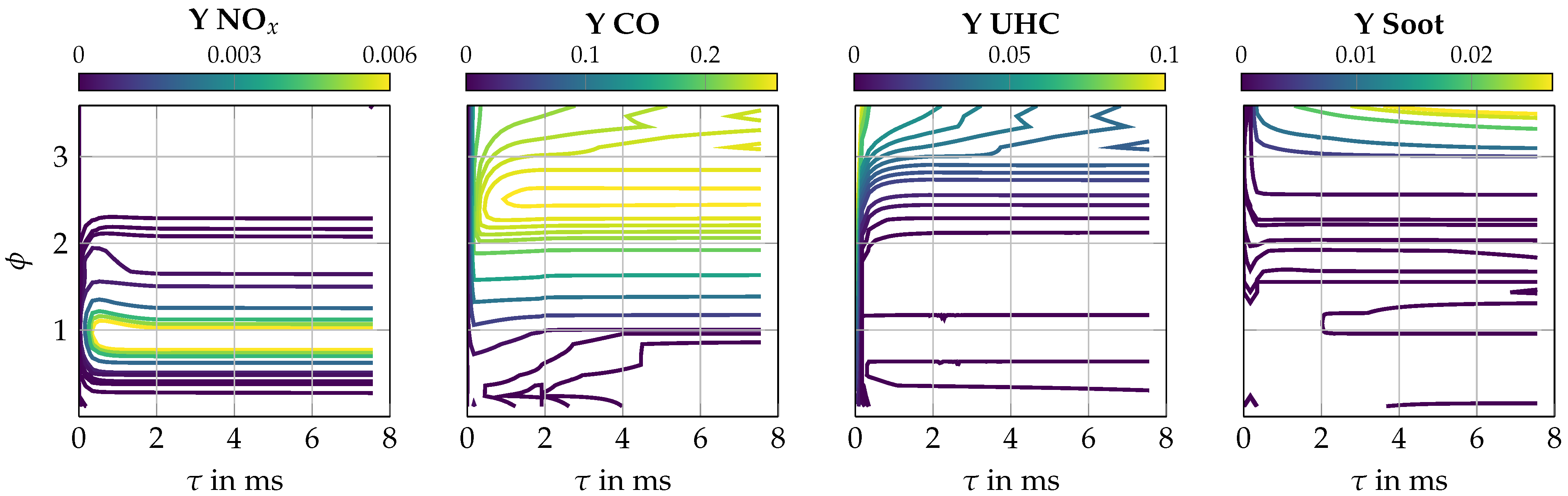
Figure 8 shows the contour lines of NO
x, CO, UHC, and soot mass fractions within the unmixed reactors along the residence time on the x-axis and the initial equivalence ratio
of the unmixed reactors on the y-axis. Note that this is only a representation of the unmixed reactors, not the entire gas mixture in the CC.
In this figure, only the results for the Jet-A surrogate model are considered. NO
x formation mainly occurs in reactors with equivalence ratio
slightly below one, which can be explained by the maximum temperatures reached in this region, resulting in the oxidization of N
2 molecules. CO is formed primarily in the rich mixture regimes with a maximum CO mass fraction at an initial
. The UHC mass fractions rapidly decrease after ignition occurs in all unmixed reactors, as already observed in
Figure 7. The remaining UHC mass at the CC outlet is contained in the unmixed reactors with the highest
values. Soot particles are also primarily formed in the rich mixture zones, showing the highest mass fractions at
. These observations underline the strong correlation between the formation of UHC and soot particles under rich combustion conditions.
3.3. Contrail Prediction
In the following section, the engine exhaust gas properties at the selected cruise point and the ambient atmospheric conditions are used for a preliminary contrail prediction applying the SAC. Here, both time-averaged meteorological data that were used to determine the flight trajectory as well as intraday information in a resolution of 3 h from GEOS-5, are used for contrail evaluation.
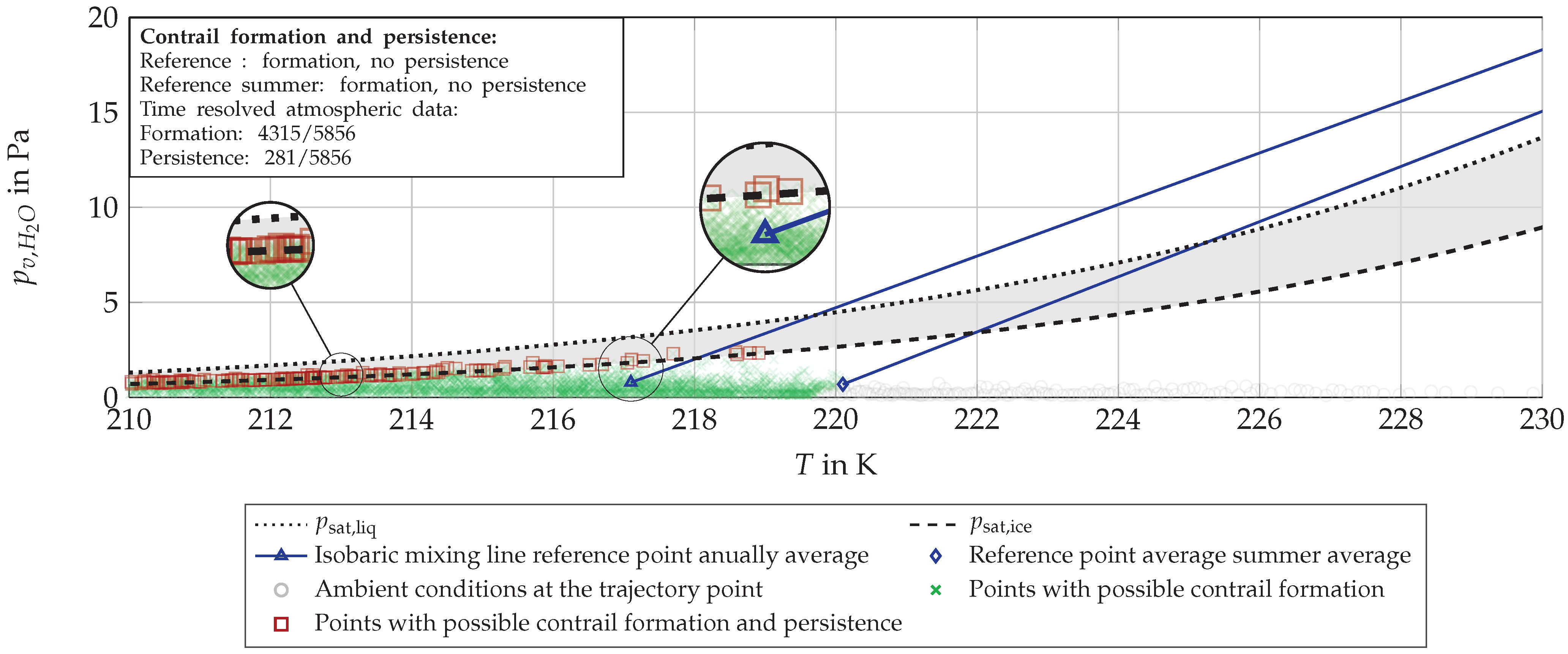
Figure 9 shows the ice and liquid saturation pressure curves as well as the water partial pressure of the ambient air plotted over the ambient temperature.
The figure contains ambient conditions from time-averaged and intraday datasets. Here, the intraday ambient conditions over one year are considered. For each set of ambient conditions, the SAC is evaluated, whereby the engine exhaust conditions are assumed to be constant. The SAC can be visualized by connecting the engine exhaust condition and the ambient condition in the partial pressure temperature diagram. When the connecting line tangents the liquid saturation line, contrail formation is possible according to the SAC. If the ambient condition point lies between the ice and liquid saturation lines, the formation of a persistent contrail is possible. Note that the engine exhaust condition is located outside the display area of the figure. For reasons of clarity, only mixing lines for the time-averaged data are shown (blue). Here, the annually averaged ambient condition is marked with a triangle and the summer-averaged ambient condition is marked with a diamond. Note that, in general, mixing lines form between all intraday ambient condition points and the exhaust gas point. The time resolved ambient condition data points are colored and shaped depending on their associated contrail formation predicted by the SAC. The meteorological ambient conditions resulting in contrail formation are shown with green crosses, those resulting in persistent contrail formation are marked using red squares, all other ambient conditions are marked with gray dots. It is observed that both summer averaged and annually averaged ambient conditions result in non-persistent contrail formation according to the SAC. When taking into account the intraday meteorological information with a resolution of 3 h, contrail formation occurs in 74% of the included cases and persistent contrail formation occurs in 5% of the considered cases. This observation underlines the importance of incorporating time resolved atmospheric ambient conditions to represent realistic boundary conditions.
4. Conclusions and Outlook
This paper presents the novel ‘Modeling and System analysis of Aero Engines’ (MSAE) platform, which uses physics-based and data-driven models to connect the complex modeling of aero engine performance and emission prediction to evaluate engine, mission, and fuel-specific CO2 and non-CO2 effects. The developed platform is able to replicate the atmospheric conditions during flight, determine the engine operating points along the flight trajectory, simulate aero engine performance, and evaluate the formation of emission products and contrails. For this purpose, MSAE comprises the ambient condition model, the aircraft operation model, the engine performance model, the combustion chamber (CC) model, as well as the contrail prediction model.
Both the functionality of the individual models as well as their interconnections are demonstrated using the example of an Airbus A320 powered by an International Aero Engine V2500-A1 turbofan engine. An exemplary point during the cruise phase on a flight route from Teneriffa (TFS) to Amsterdam (AMS) is selected and the engine operating point is determined by the aircraft operation model. Subsequently, the engine performance model is used to calculate the thermodynamic cycle properties at each station within the engine. The emission products are determined using the presented CC model that is based on a simplified physics chemical reactor network (CRN) model and calibrated to match reference emission values from the ICAO certification data for the V2500 turbofan engine. Subsequently, CC simulations are carried out for the selected mission point during the cruise phase, considering a Jet-A as well as a Fischer–Tropsch synthetic paraffinic kerosene (FT-SPK) fuel surrogate formulation. The ability to predict CO, NOx, UHC, and soot emission indices (EIs) for the different fuel types has been demonstrated. It is observed that the FT-SPK surrogate formulation exhibits an 11.8% reduction in soot emissions compared to the Jet-A surrogate formulation. This trend is consistent with experimental data and can be attributed to the lower aromatic content in the FT-SPK fuel surrogate. Moreover, the CC model is able to represent the rich burn–quick quench–lean burn behavior of an aero engine combustion chamber and take into account the in-homogeneity of the gas mixture within the CC. In the final step, a preliminary contrail prediction has been carried out using the Schmidt-Appelmann criterion (SAC). Here, both annually averaged and intraday meteorological data are considered to represent the atmospheric conditions. It is observed that the usage of intraday meteorological data enables a comprehensive evaluation of contrail formation, underlining the importance of incorporating realistic boundary conditions in the performance and emission analysis of aircraft engines. Furthermore, the presented simulation platform makes it possible to pass these realistic atmospheric conditions from the aircraft level to the aero engine and finally to the combustion chamber. This results in more realistic boundary conditions compared to stand-alone models where input conditions have to be assumed.
Future work will involve simulations of entire flight missions using the MSAE platform, where contrails were observed via satellite images. Additionally, information on the composition of the air entering the CC can be included using the atmospheric conditions at the given point on the flight trajectory. Following that, correlations between the modeled emissions, atmospheric conditions, and satellite-observed contrails will be established based on variance sensitivity studies. Finally, back-to-back tests with various jet fuels and at operating points outside the LTO cycle are needed to validate the predicted performance and emissions. Here, a focus will be set on the determination of the soot particle size distribution (PSD). This will add to the understanding of how well the combustion chamber model can represent the intermediate power settings. By evaluating the soot PSD at the different operating points along the mission profile, further enhancements of contrail prediction will be incorporated into the MSAE platform, including the assessment of condensation nuclei, optical thickness, and life duration using more sophisticated contrail prediction methods.



 ,
,