


Abstract
We report on a conceptual framework for describing interactive sound installations from three complementary perspectives: artistic intention, interaction and system design. Its elaboration was informed by a systematic review of 181 peer-reviewed publications retrieved from the Scopus database, which describe 195 interactive sound installations. The resulting taxonomy is based on the comparison of the different facets of the installations reported in the literature and on existing frameworks, and it was used to characterize all publications. A visualization tool was developed to explore the different facets and identify trends and gaps in the literature. The main findings are presented in terms of bibliometric analysis, and from the three perspectives considered. Various trends were derived from the database, among which we found that interactive sound installations are of prominent interest in the field of computer science. Furthermore, most installations described in the corpus consist of prototypes or belong to exhibitions, output two sensory modalities and include three or more sound sources. Beyond the trends, this review highlights a wide range of practices and a great variety of approaches to the design of interactive sound installations.
1. Introduction
In the past two decades, new interfaces for musical expression garnered increased interest, along with the democratization of sensor and micro-controller technologies [1]. This rise in popularity has been accompanied by increased research attention to musical interfaces, as illustrated by the emergence of dedicated conferences, such as the New Interfaces for Musical Expression (NIME) conference (https://www.nime.org/ (accessed on 9 April 2021)) created in 2002. In this review, we focus on a specific type of musical interfaces: interactive sound installations. Such installations, which can be traced back to the 1950s [2], have benefited from this recent democratization, leading to an unprecedented variety of practices and creative contexts that have not been systematically documented yet [3]. It is difficult to situate or compare sound installations given their variety within existing frameworks and reviews. The present comprehensive review proposes a conceptual framework to systematically describe and analyze interactive sound installations documented in research publications, and to identify similarities and differences in design and implementation, along with trends and possible gaps in the literature. Additionally, a visualization tool is provided as an interactive web application (https://idmil.github.io/ISI-Database (accessed on 24 August 2026)), to allow sound artists, designers and researchers to explore the corpus from three perspectives using the proposed framework.
A few conceptual frameworks and reviews have been proposed to position and categorize new interfaces for musical expression. Wanderley and colleagues analyzed interactive sound generating systems (e.g., musical interfaces and installations) from system design and semantic perspectives; the former discussed topics such as sensors and feedback, sensor signal analysis, mapping and sound synthesis, while the latter looked at questions such as the goals of interaction and the expertise of users, the role of sound display and the physical approach to the system [4,5]. Birnbaum et al. established a dimensional space to characterize musical devices with properties derived from human–computer interaction studies [6]. Similarly, Hattwick proposed a dimensional space to investigate collaborative musical devices [7], and Paine classified real-time interfaces for musical expression through a taxonomy derived from a survey of performers [8]. Morreale et al. proposed a framework for describing the design process of musical interfaces [9]. Sanfilippo defined an analytical framework to situate feedback musical systems [10]. Johnston et al. identified modes of interactions of virtual musical instruments [11], while Wallis et al. proposed design heuristics for musical instruments based on criteria for long-term engagement from amateur musicians [12]. Landy established a thorough framework and an associated resource website (http://ears.huma-num.fr/index.html (accessed on 9 April 2021)) that provides theoretical support for understanding various aspects of sound art and electroacoustic composition [13]. Concerning sound installations uniquely, Lacey proposed three approaches and ten attributes for enduring sound installations in public spaces [14]; and Bandt reviewed various sound installations in Australia and proposed a guideline for sound installation design in the public realm [15]. Although useful for positioning and situating new musical interfaces and sound installations, those frameworks and reviews are not specific for interactive sound installations.
Interactive sound installations are limited here to interactive environments in which sound is one of the main mediums of expression or communication. In other words, we consider all multimedia installations where sound is one of the input or output modality. They can be, but are not limited to, artistic installations. These installations rely on real-time interactions with people or consist in adaptive systems, namely, systems that respond to external conditions, such as systems that react to the state of the surrounding environment (for conciseness, the term “interactive sound installation” will include both interactive and adaptive installations). Interaction is defined here as “a reciprocal action between several actors of the same system [...] resulting in a modification of the state of the implied actors” [2]. It can consist in an exchange of information, energy and/or affect [2,16]. Environment adaptive systems are defined as systems that are able to change state as a function of the external environment. They are able to adapt to changing environmental conditions [10]. There have been few attempts to define a conceptual framework dedicated to interactive sound installations. Blaine and Fels identified several contextual elements and design parameters to describe collaborative musical interfaces, including interactive sound installations [17]. Le Prado proposed to characterize the design process of interactive sound installations across their main protagonists: the designer, the system and the interactor [18]. More recently, Goudarzi proposed a taxonomy of interaction in participatory sound art and interactive sonification systems [19,20]. Though these and previous frameworks are useful for characterizing interactive sound installations, they were not based on any systematic literature review.
The present work is an attempt to reconcile those frameworks and studies in the form of a taxonomy for characterizing interactive sound installations within a wider scope, and an associated systematic review of trends and practices concerning their design as presented in academic publications in the Scopus database. This taxonomy was informed both deductively from existing frameworks and reviews, and inductively, through a systematic review of scientific literature with a corpus of 181 documents describing a total of 195 interactive sound installations. In other words, the taxonomy brings together frameworks from the literature and features emerging within the review that were not included in existing frameworks. The corpus consists of scholarly publications and does not include other sources outside of the academic realm, such as artists’ statements, program notes, museum archives, auto-documentation (artists documenting their own practices) or alternative media. The present paper is focused on the elaboration of the conceptual framework and a literature review. The visualization of the framework has been described in detail in another paper [21] and is available on the website associated with this review (https://idmil.github.io/ISI-Database (accessed on 24 August 2026)).
2. Method
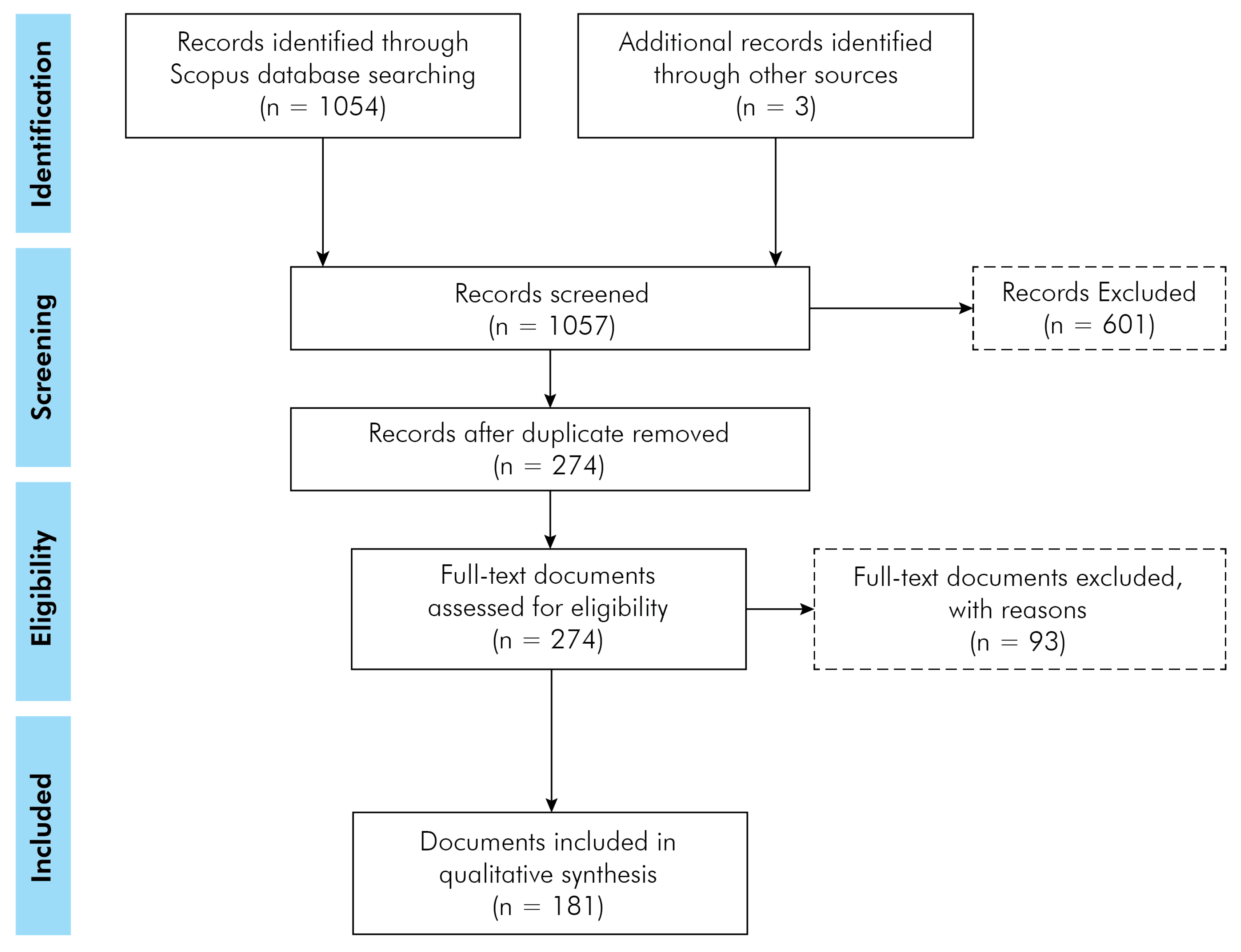
We reviewed 181 full-text journal articles, proceedings papers and book chapters to determine design trends and habits regarding the conception of interactive sound installations. The present review method was derived from the Preferred Reporting Items of Systematic Review and Meta-Analysis Protocol (PRISMA-P, [22]) and is summarized in Figure 1. The corpus describes interactive sound installations, which can be described as interventions. However, the review does not evaluate those interventions, but only provides a qualitative synthesis of the documents.
Figure 1.
A flow diagram of the literature search. Derived from a PRISMA flow diagram [22].
2.1. Search Strategy, Inclusion and Exclusion Criteria
The publications were retrieved from Elsevier’s Scopus database, which covers published, peer-reviewed publications from more than 5000 publishers worldwide (https://www.elsevier.com/solutions/scopus/how-scopus-works/content/content-policy-and-selection (accessed on 9 April 2021)). The database search was conducted between October and November 2020. Table 1 includes the boolean search terms and number of entries associated with each query. The search was carried out within article title, abstract and keywords sections, and led to the identification of 1054 records. Three additional records were identified through cross-referencing.
Table 1.
Scopus boolean search strings. Note that the asterisk indicates the truncation operator and phrases encoded within double quotes return results that contains the phrases as they are typed.
To be included in the review, documents had to be peer-reviewed and published in English or in French, and had to describe one or several interactive sound installations as defined above. In addition, installations that require real-time participation from anyone who is not part of an audience were considered to be beyond the scope of this review and were therefore excluded. Two-hundred and seventy-four full-text documents were assessed for eligibility after a screening of titles and abstracts. A total of 181 documents were selected after full-text review for inclusion in the qualitative synthesis.
2.2. Data Extraction
Each selected full-text document describes one or more interactive sound installation. The description of each installation was manually coded into a database using a binary entry for each of the perspectives and taxa of the developed taxonomy (Section 3). Information missing from the documents was indicated as being non available (N.A.). For the bibliometric analysis, subject areas and fields were retrieved from the proceedings, book or journal in which the work was published using Scopus’ “All Science Journal Classification” list (https://service.elsevier.com/app/answers/detail/a_id/15181/supporthub/scopus/ (accessed on 9 April 2021)). The taxonomy relies on a combination of existing frameworks and new themes emerging from the analysis. It evolved to accommodate new emerging topics through an iterative process: additional taxa were created when observing features on sound installations that could not be represented by the framework. For instance, “Type of Input Device” (see Section 3) was often incremented with new features that were not in the initial framework. The resulting database is available on the repository from which the review’s web application is deployed, in the form of a comma-separated-values file (https://github.com/valerianF/ISI-Database/blob/main/data/installationsList.csv (accessed on 9 April 2021)). The complete list of installations is available in Appendix B and on the website (https://idmil.github.io/ISI-Database/list (accessed on 24 August 2026)). Trends from the review were extracted both from this website and using the programming language R [23].
3. Definition of a Conceptual Framework
A taxonomy, in the sense of Bailey’s definition, was elaborated, both deductively from existing frameworks for musical interfaces and interactive sound installations, and inductively from observation from the corpus [24].
The taxonomy is organized hierarchically, from general to specific. The top layers or roots—the perspectives—of the taxonomy represent three global points of view for enduring interactive sound installations: artistic intention, interaction and system design. The bottom layers or leaves—the taxa—represent specific features or contextual aspects of the installations at a concrete level, such as the kind of input device, the required number of inter-actors or the type of sound materials (c.f. Table 2). Most of the taxa are not mutually exclusive. The inductive analysis first identified taxa when existing conceptual frameworks failed to cover specific features of the installations, which were later grouped, a posteriori, into more abstract themes and perspectives. However, for the sake of argument, we will instead discuss the taxonomy from the more generic to the more specific. While the three perspectives are identified separately, note that the themes and taxa that belong to each perspective are mutually inter-related and depend of each other (see Section 5.3). A short description of the taxonomy is provided below, across the three perspectives’ main themes. This description is identical to what was provided in [21]. Descriptions of the main taxa used are additionally provided in Appendix A. For a full description of the taxonomy, see the web application’s glossary (https://idmil.github.io/ISI-Database/glossary (accessed on 24 August 2026)).
Table 2.
Descriptions of the hierarchical layers from the taxonomy.
- Artistic intention: It relates to all the considerations and contextual aspects that are taken prior to the design process. It is the most conceptual perspective and concerns top-level reflections about of the early part of the creative process before implementation. In a protagonist metaphor, this aspect would relate to the designer [18].
- Context: It provides information about the type of location or situation in which the installation was created.
- Lifespan: The duration in which the installation was or is planned to remain active. It is determinant for the design process [15].
- Role of sound: Derived from Pressing’s categories for sound roles in electronic media [25]. Further roles are induced from the corpus.
- Visitor’s position: visitor’s position and potential motion around or inside the installation.
- Intervention visibility: Details about what can or can’t be seen from the installation.
- Lighting design: Specific lighting involved in the installation.
- Sound design approach: The materials and processes used for sound design and sound generation. Most of it is inspired from Landy’s framework [13].
- Interaction: It concerns all the parameters that characterize the mutual relation between the inter-actor and the installation [6]. This perspective is associated with the reflections between the foremost intentions and the ultimate technical implementation and would relate to the inter-actor [18].
- Inter-actor: The number of people involved simultaneously in the musical interaction [6].
- Interaction type: Type of control is another name for it. It refers to the specific nature of the relation between the inter-actor and the installation [19].
- Feedback type: It refers to the output modalities, also called feedback modalities [6].
- Input and output degrees of freedom: It refers to the number of input and output modalities available to the user or visitor (two actual themes). It does not represent the number of input and output controls as in Birnbaum et al.’s dimension space [6].
- Musical control: It refers to the level of control available to the user [6,26].
- System design: It is about the practical realization of the installation [5], from its components to its diffusion parameters. It emphasizes the practical realization of initial intentions and of interaction design, and relates to the system [18].
- Spatialization: It refers to the number of sound sources used, their spatial disposition and their diffusion and control parameters that are used to create (or not) a spatialized musical experience for visitors [13,27].
- Sound generation: It concerns the nature of the installation’s sound-emitting device(s) [14].
- Type of input device: It describes the kind of device(s) that provides to the installation the data and control signals that are processed as part of the interaction [4,5]. This theme reflects the technical details extracted from the documentation. As such, some taxa consist in types of sensors (using the classification presented in [28]), while others correspond to devices containing multiple sensors.
4. Visualization of the Framework
A web application (https://idmil.github.io/ISI-Database (accessed on 24 August 2026)) was developed as part of the present review, in order to provide an efficient visualization tool to navigate within the corpus’ installation across the taxonomy. The application was developed in Python (source code: https://github.com/valerianF/ISI-Database (accessed on 9 April 2021)), and is powered by Dash, an open-source library developed by Plotly (https://dash.plotly.com/introduction (accessed on 9 April 2021)) and designed for web analytics. The application was built upon a database that was elaborated from the taxonomy in an iterative process where taxa were both deduced from literature and induced when reviewing the corpus. Within the database, installations from the corpus are indicated as either belonging or not to each taxon with a binary entry when the information is available. A complete description of the web application is presented in [21].
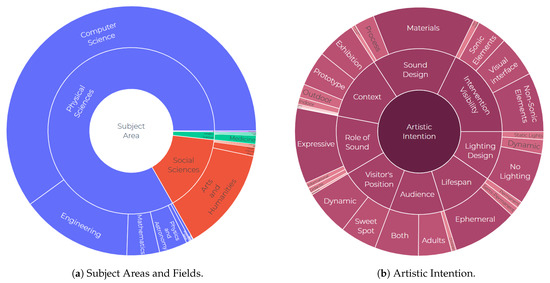
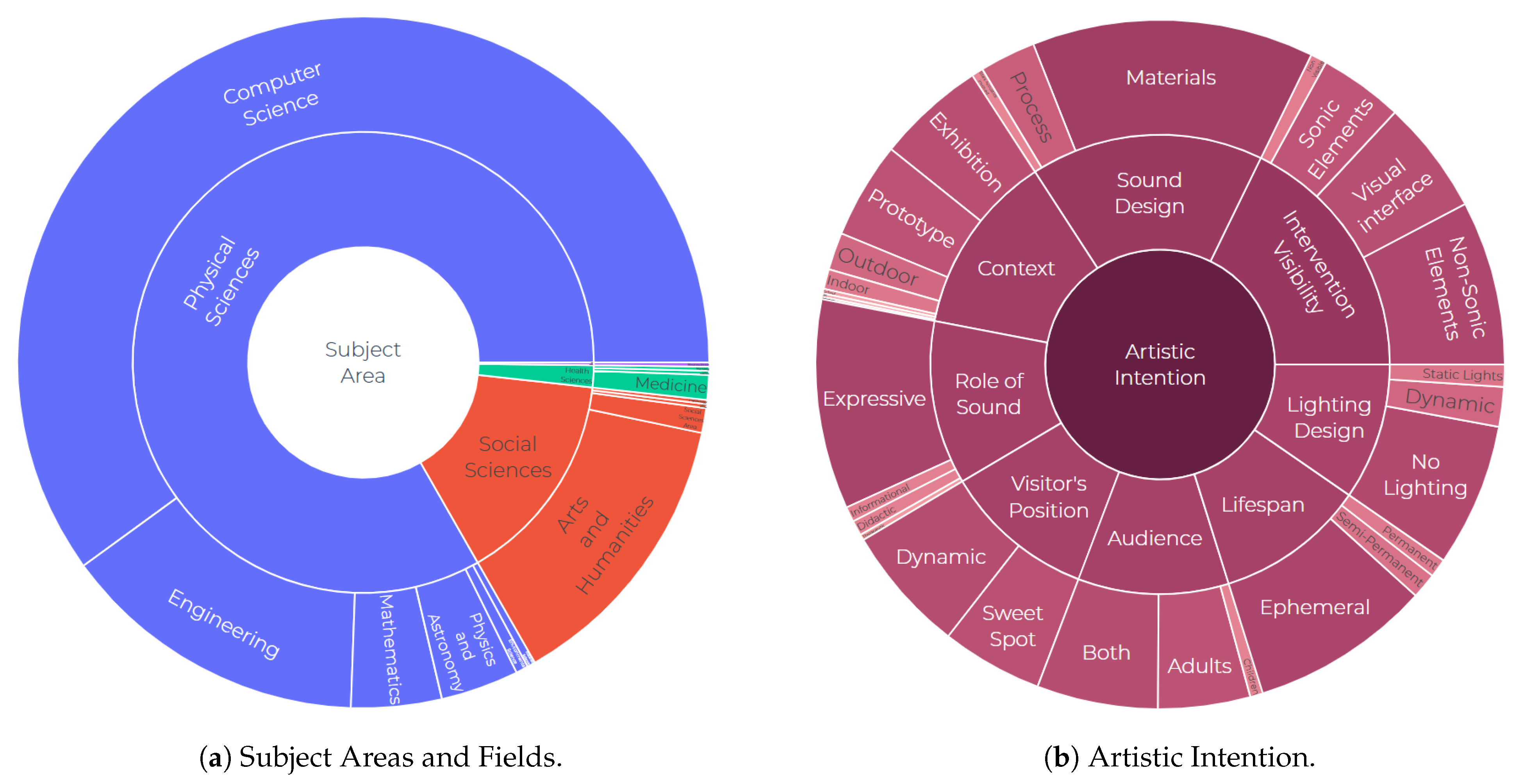
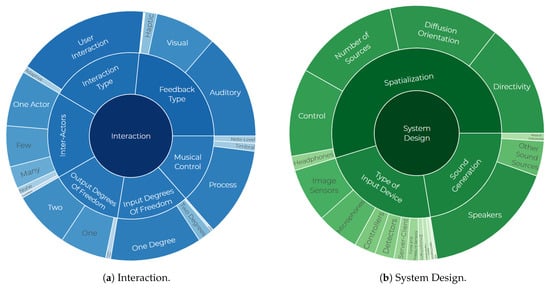
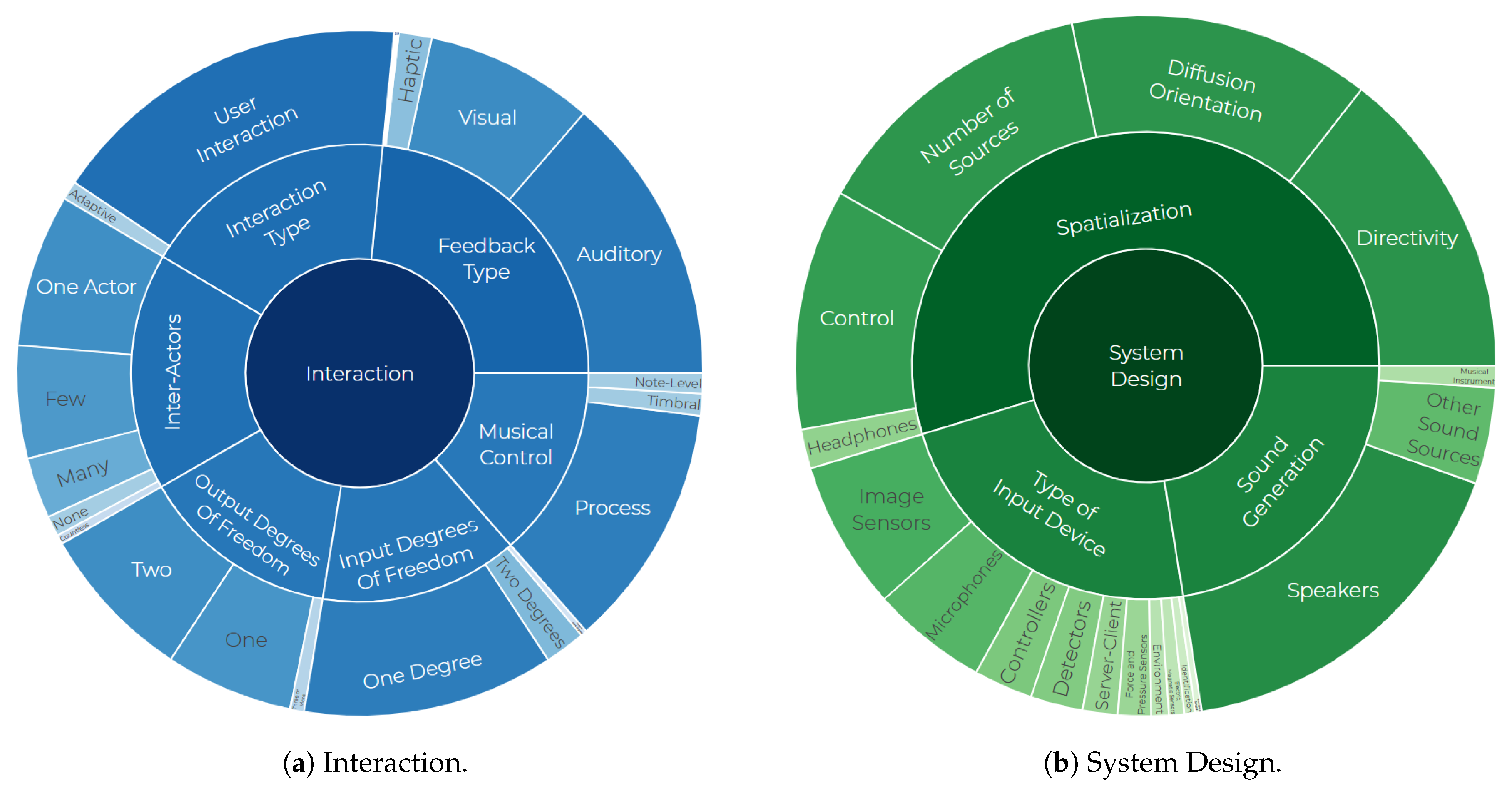
The application includes four interactive sunburst charts, representing the subject areas and fields from the corpus and each of the three perspectives (Figure 2 and Figure 3). They allow for dynamic navigation through the taxonomy from global themes to specific taxa by reproducing the taxonomy’s hierarchy. The size and shade of each portion of the charts represent the number of corresponding installations for a taxon, and the number of times the particular code was used for a theme of perspective. Since one installation may give rise to multiple codes among a given theme, only the last layer provides the number of installations corresponding to a taxon. When clicking on a taxon, a table containing information about the corresponding sound installations and their associated documentation automatically appears below the chart. Additional features include a drop-down list of all taxa that allows one to filter the database via multiple categories.
Figure 2.
Sunburst chart snapshots showing (a) subject areas and (b) artistic intention across the corpus.
Figure 3.
Sunburst chart snapshots showing (a) interaction and (b) system design across the corpus.
5. Results
This section focuses on the results in terms of bibliometrics and global design trends identified throughout the corpus, first for each of the three perspectives and then across perspectives. Each taxon presented in the results is defined in Appendix A. For further evaluation, we invite the reader to try the interactive web application to navigate the database (https://idmil.github.io/ISI-Database (accessed on 24 August 2026)).
5.1. Bibliometrics
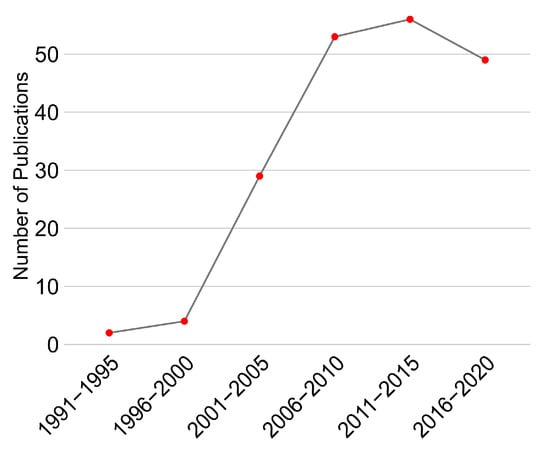
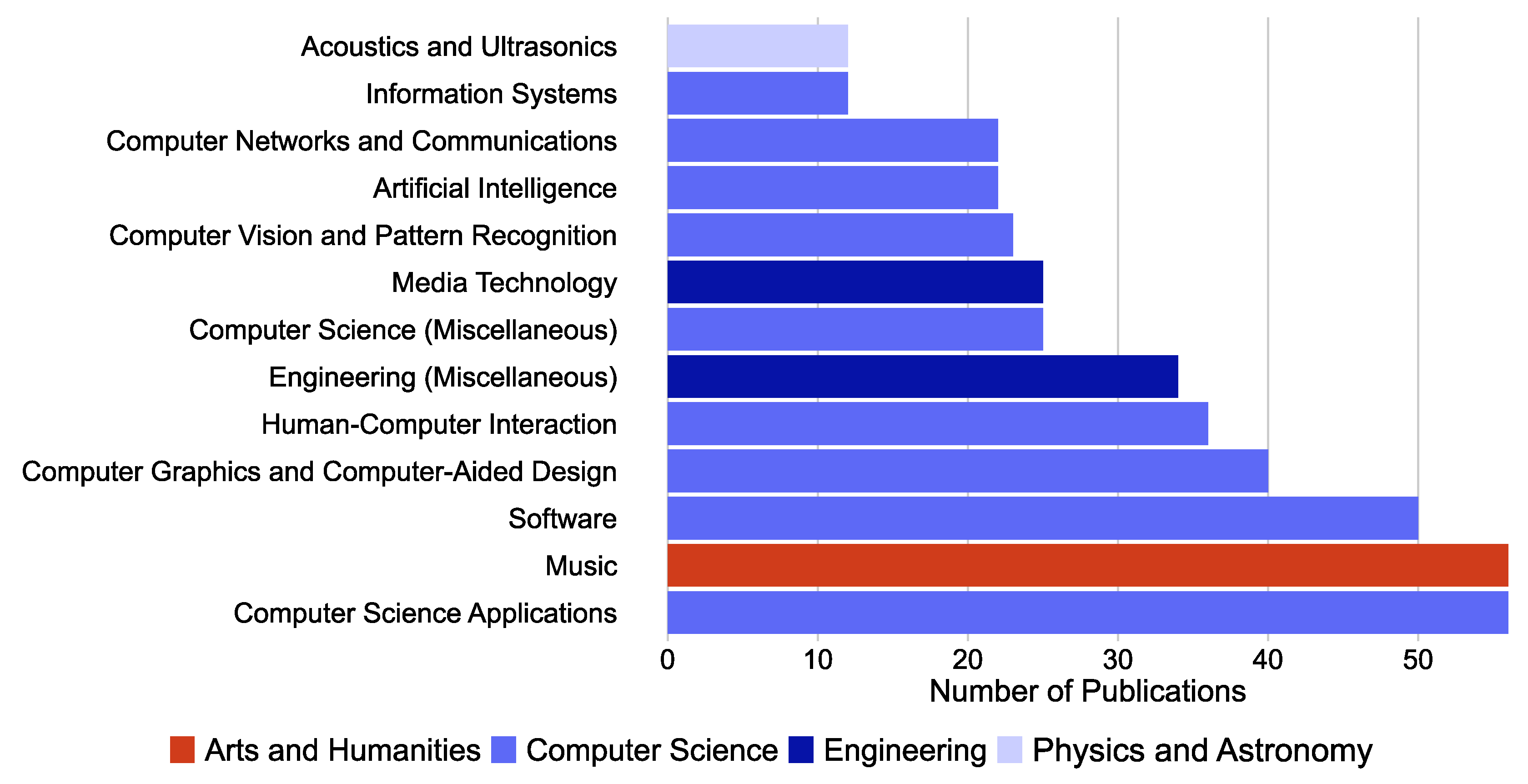
The 181 documents in the review were published in 78 different publications. They predominantly consist of proceedings papers (137 articles in 58 proceedings series), but also in journal articles (42 articles in 18 journals) and two book chapters (from two books). According to the present corpus, when considering 5-year increments, academic, peer-reviewed documentation of interactive sound installations likely gained in popularity in the early 2000s until stabilizing at around 50 publications in 2006 (cf. Figure 4).
Figure 4.
Numbers of publications in five-year periods. Additional documents may be published for the year 2020.
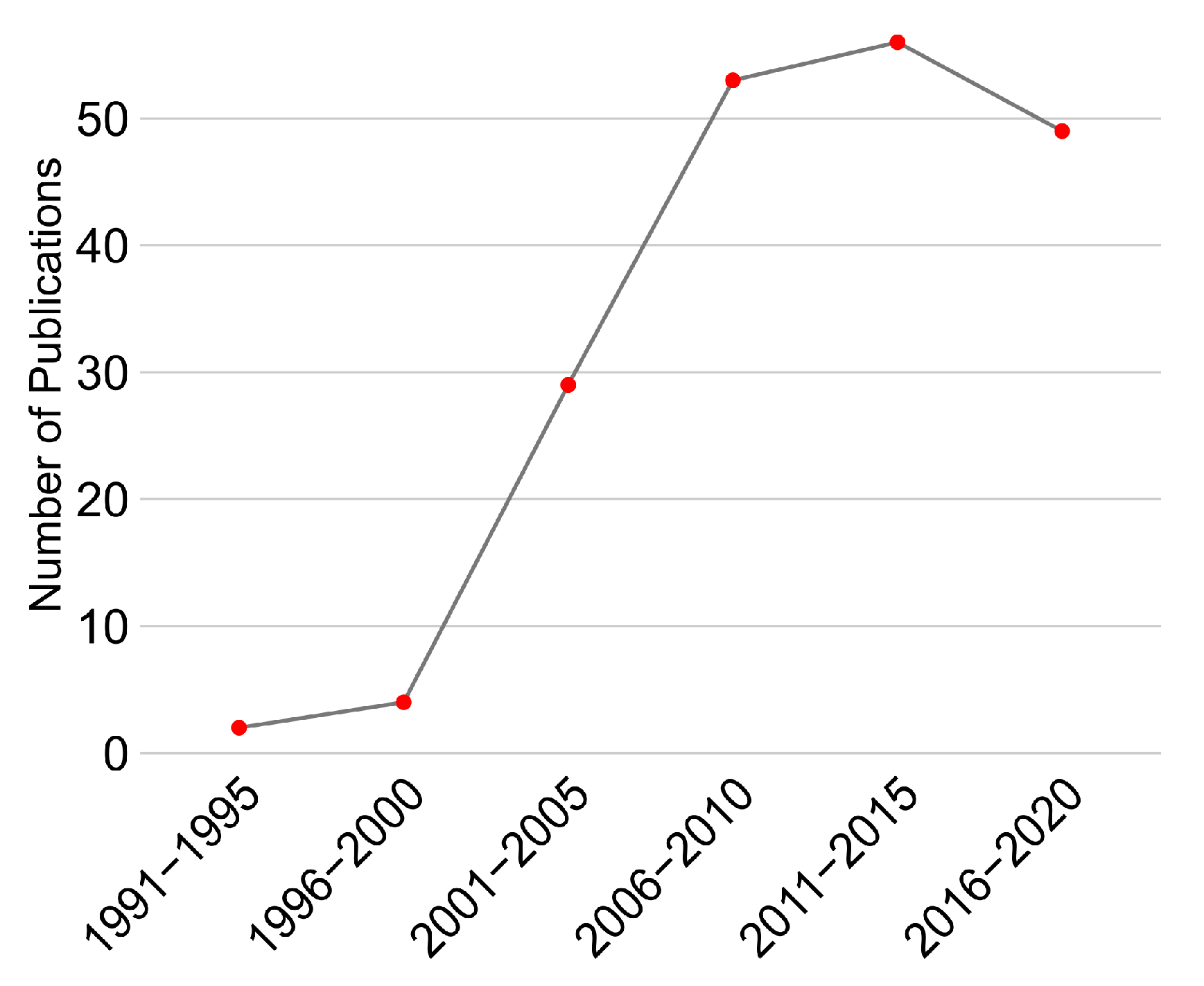
A total of 60 research fields are represented, belonging to fourteen subject areas. They highlight the interest for interactive sound installations in various subject areas across disciplinary fields, from computer science to arts and humanities. Despite this variety, most publications fell under the broad umbrella of computer science (roughly 85% of the total number of documents; c.f. Figure 2a). In fact, thirteen scientific fields cover more than ten documents each (c.f. Figure 5), nine of which are related to computer science, while 27 fields are represented by a single document.
Figure 5.
Numbers of publications for the fields including ten or more publications.
5.2. Salient Trends within Perspectives
5.2.1. Artistic Intention
We focus here on context and lifespan, sound design materials and processes, the role of sound and the type of targeted audience.
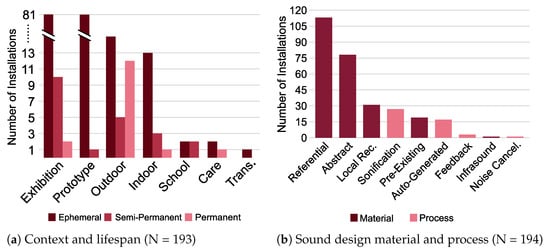
A majority of the corpus’s installations were either presented in the context of an exhibition (N = 93), consisted in prototypes (N = 83) or both (N = 21), yet an important proportion of installations were presented in either outdoor (N = 32) or indoor (N = 17) public spaces. Other contexts are also represented marginally (school: N = 4; care center: N = 3; transportation: N = 2). Most installations were ephemeral, regardless of the context (N = 155, c.f. Figure 6a (overlaps between taxa are not displayed in Figure 6a)). More specifically, out of 93 exhibition totals, 81 were ephemeral, 10 were semi-permanent and 2 were permanent. Considering the 83 prototypes, again 81 were ephemeral; 1 was semi-permanent; and it was not possible to retrieve information about lifespan for one installation. However, more than half of the installations situated in outdoor public spaces had a long-term lifespan (ephemeral: N = 15; semi-permanent: N = 5; permanent: N = 12).
Figure 6.
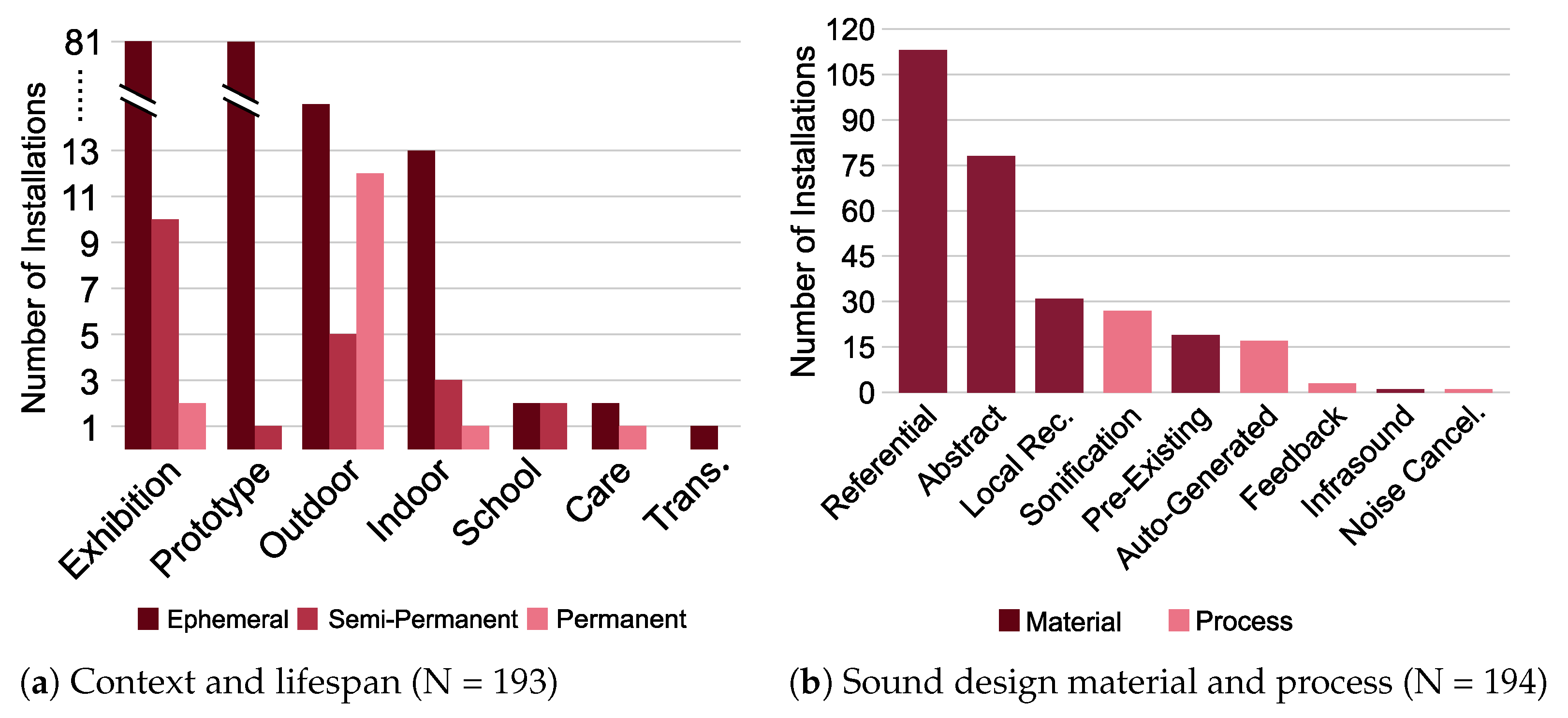
Distribution bar graphs representing (a) the context according to lifespan and (b) the sound design materials.
Regarding sound design, a plurality of materials and processes can be observed across all installations. As can be seen in Figure 6b, referential materials (N = 113) are used more often than abstract ones (N = 78). Other common materials include the use of local recordings (N = 31) and pre-existing materials (N = 19), but one installation used infrasound material. Processes involved in sound design include sonification (N = 27), the use of auto-generative content (N = 17), feedback generation (N = 3) and noise cancellation (N = 1).
Concerning the role of sound, the majority of installations that generates sound with expressive or environmental purposes (N = 180, c.f. Figure 2b), yet the sound in a few installations plays an informational role (N = 13), a didactic role (N = 13), or a therapeutic role (N = 5). Most installations are designed for all audiences (N = 104) or are intended for an adult audience (N = 79), while a few are specifically designed for children (N = 11).
5.2.2. Interaction
Concerning interaction, we focus on the interaction type, the input and output modalities, the number of inter-actors and the musical control.
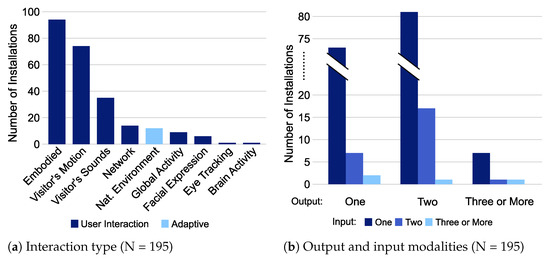
There is a wide variety of interaction types, yet only three were shared by more than 15 installations (c.f. Figure 7a): embodied interaction is the most common (N = 94), followed by visitors’ motion (N = 74) and visitors’ sounds (N = 35). Among all installations, eleven are purely adaptive—i.e., they do not interact with users but rather react to external parameters such as meteorological information.
Figure 7.
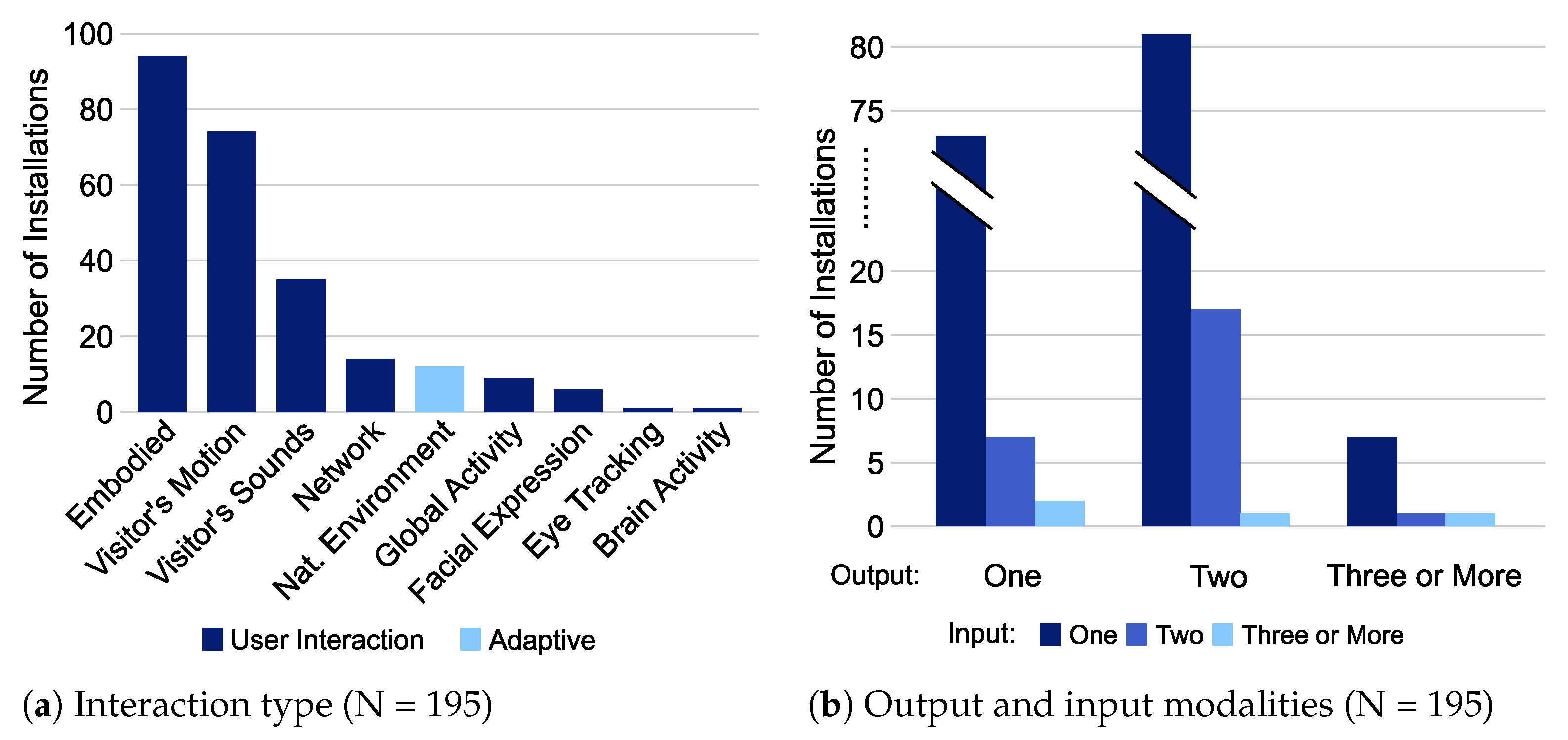
Distribution bar graphs representing (a) the interaction type and (b) the number of output modalities according to the number of input modalities.
Concerning the input and output modalities, the feedback types were mostly auditory (N = 186; c.f. Figure 3a) or visual (N = 108). A few installations also included haptic feedback (N = 21), and three installations featured heat, taste and smell feedback. The majority of installations required a single modality as input, typically through the use of devices and/or a visitor’s motion (one: N = 161; two: N = 26; three or more: N = 4); most installations output one or two sensory modalities, typically auditory feedback for the former, and audio-visual feedback from the latter (one: N = 82; two: N = 101; three or more: N = 9). The most common combinations consisted of one input/two outputs (N = 81) and one input/one output (N = 73), as shown in Figure 7b.
Most interactive installations were designed for one or a few inter-actors (one: N = 98; two to ten: N = 72), but some were designed for more than 10 (N = 39) or did not specify a number (countless: N = 6). Finally, the majority of installations provided musical control in the form of a process (N = 157), typically by triggering sound playback through interaction. Overall, most of the installations provided relatively complex musical information from a few parameters (mostly from a single input modality; c.f. Figure 7b). However, some installations provided timbral (N = 14) and note-level (N = 13) musical control (c.f. Figure 3a).
5.2.3. System Design
Regarding system design, we emphasize the types of input devices; the number of sound sources and the spatialization control; and the sound generation.
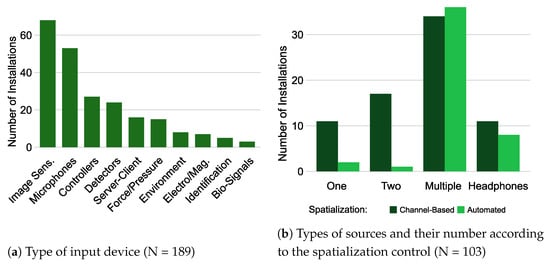
There is a great diversity of input device types used across the corpus’ installations: 30 different kinds of input device were identified, among which 11 were used in only one installation. The most common types of input devices were image sensors (N = 68; 40 cameras and 28 motion sensing devices), microphones (N = 53), controllers (N = 27, including 15 touch-sensitive devices) and detectors (N = 24, including 18 proximity sensors), as shown in Figure 8a.
Figure 8.
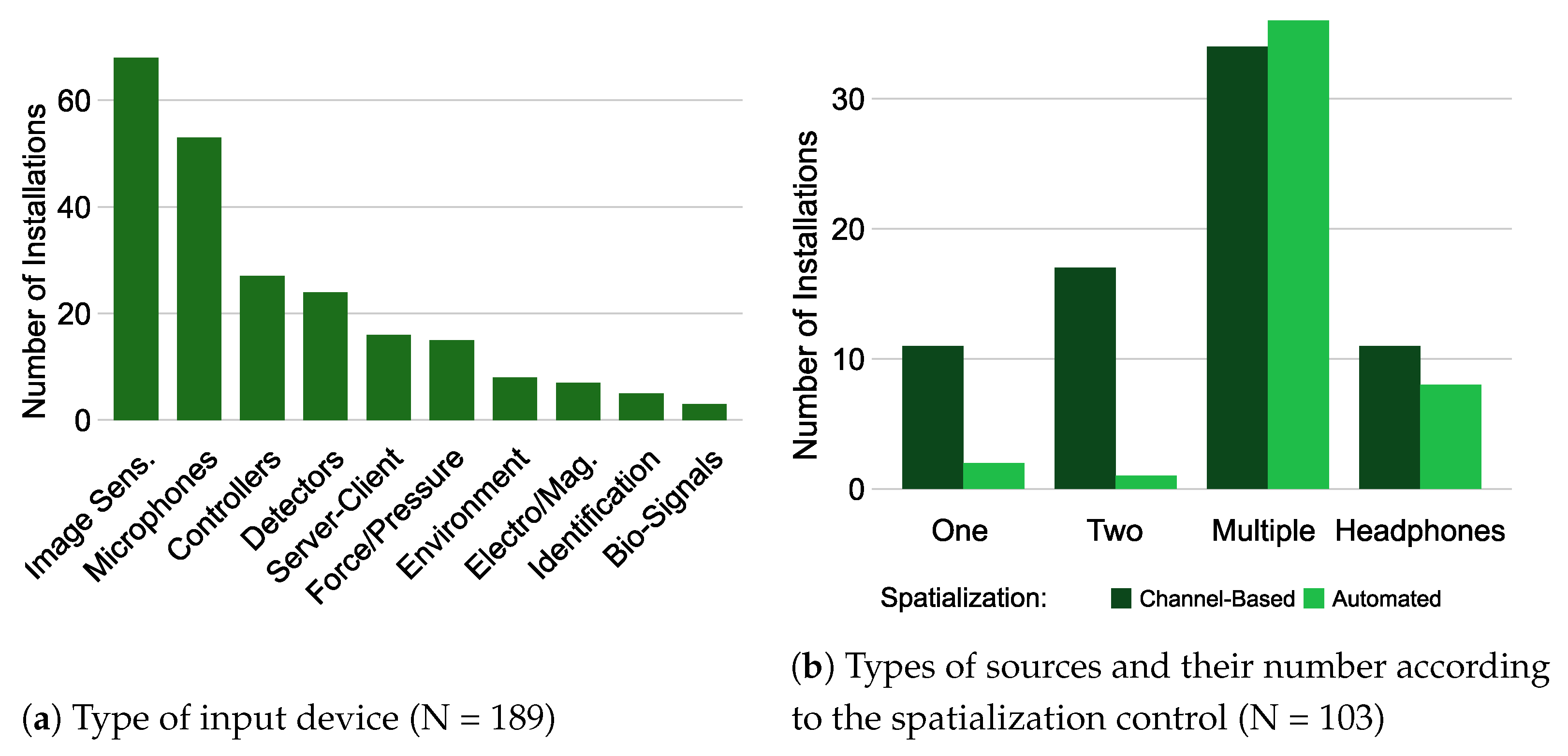
Distribution bar graphs representing (a) the types of input devices and (b) types of sources and their number according to the spatialization control.
Documentation from the corpus notably lacked detail about sound spatialization, and it was not possible to retrieve information about the number of sound sources for 47 installations. Still, we can observe from the remaining installations that the use of more than three sound sources is the most common approach (N = 80, Figure 3b and Figure 8b), be it in channel-wise playback settings (N = 34), or with automated spatialization (N = 36). Installations with two (N = 28) or a single sound source (N = 25) are mostly channel-based.
Regarding sound generation, most installations used loudspeakers (N = 168), and a few installations used resonant (N = 18), electronic (N = 17) or mechanical sound sources (N = 9) or musical instruments (N = 10).
5.3. Salient Trends across Perspectives
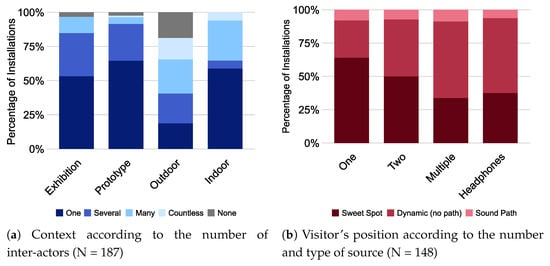
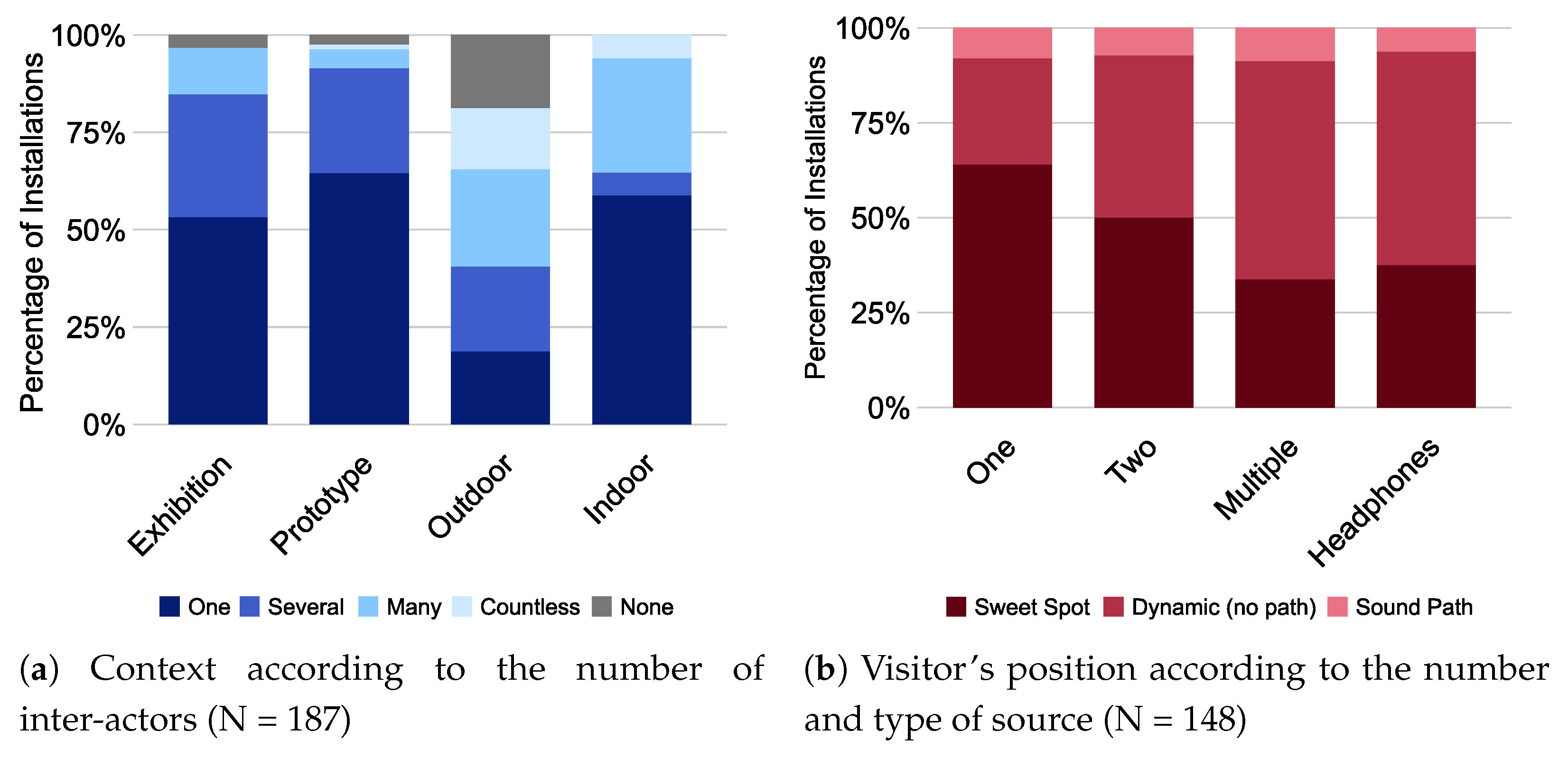
Multiple relations can be found across perspectives. The results presented highlight notable relationships. Figure 9a shows the relationship between context and the number of inter-actors. Installations from the corpus most often require a single actor (N = 98) in the contexts of exhibition, prototypes and indoor public spaces. However, the majority of outdoor sound installations require more than one actor, and most of the installations that are purely adaptive (c.f. Figure 7a) are located outdoors. Otherwise, as shown in Figure 9b, static positioning of the visitors is most often required for installations with one or two sound sources, while the installations with multiple sources or that use headphones more often require the visitor(s) to move freely within the installation.
Figure 9.
Stacked bar graphs representing (a) the context and number of inter-actors and (b) the visitor’s position according to number and types of sources.
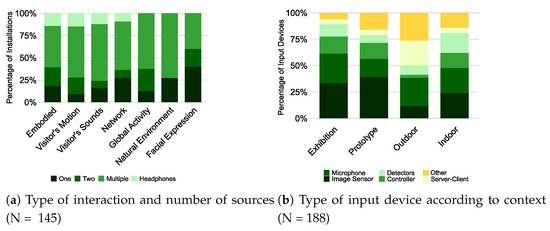
Altogether, spatialization control consists more often of channel-based (CB; N = 63) than of an automated spatialization (AS; N = 47, c.f. Figure 8b). However, the type of spatialization tends to be related to the type of interaction, as installations that react to visitors’ motion use AS more often (N = 24) than CB diffusion (N = 19). Conversely, CB diffusion is favored upon AS for almost all other interaction types (for instance: embodied—CB: N = 32, AS: N = 18; visitor’s sounds—CB: N = 15; AS: N = 10). Given that automated spatialization is frequently used with multiple sound sources (c.f. Figure 8b)—this result is consistent with the fact that sound installations that react to visitors’ motion more often use multiple sources compared to sound installations that rely on other interaction types (especially embodied interaction type), which more frequently use one or two sound sources or headphones, and are usually more limited in space (c.f. Figure 10a).
Figure 10.
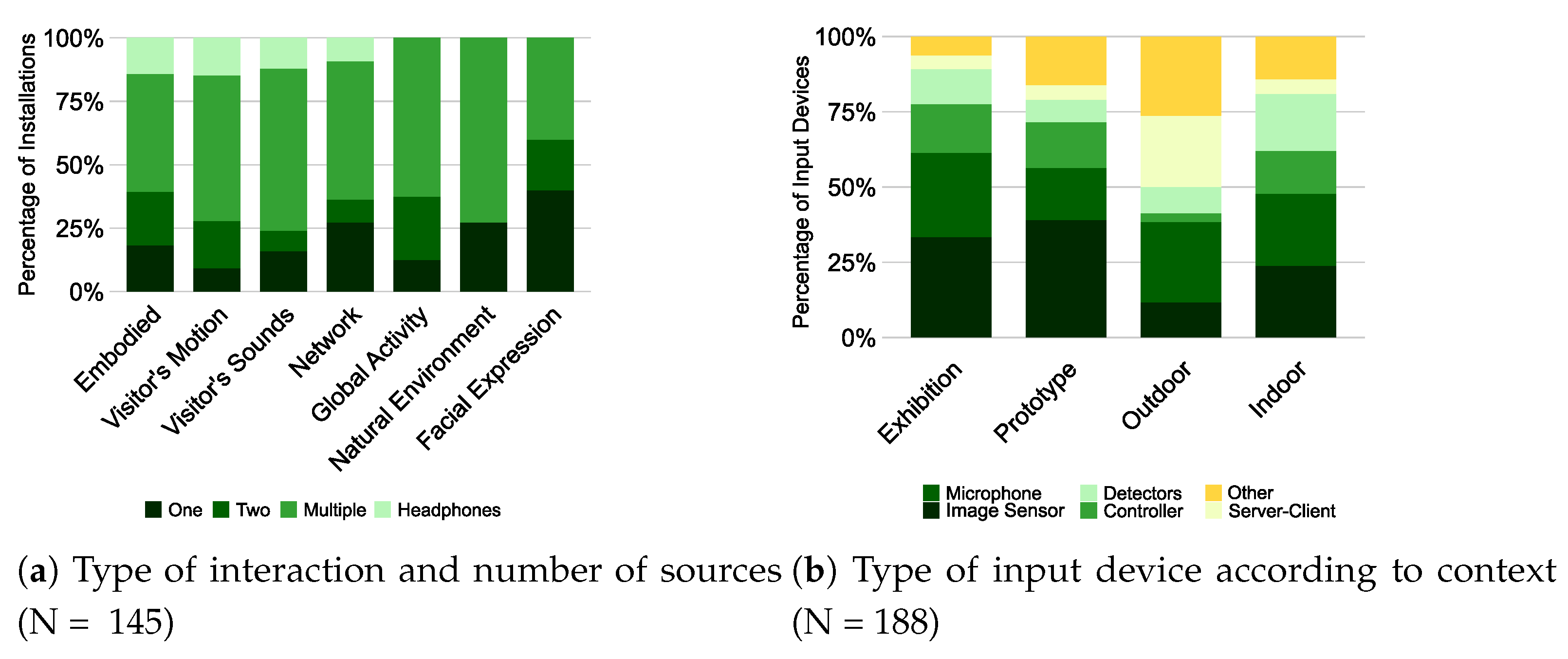
Stacked bar graphs representing (a) the numbers and types of sources according to the type of interaction and (b) the type of input device according to context.
Finally, the relationship between context and type of input device is worth highlighting (c.f. Figure 10b): installations designed for exhibitions, as prototypes or for indoor public spaces, share similar trends concerning the type of input device used for interaction, namely, image sensors, microphones and controllers. On the other hand, installations designed for outdoor public spaces seem to favor other types of input devices apart from microphones, such as server-clients and various miscellaneous input devices, such as environmental sensors.
6. Discussion
In this section, we first discuss the main outcomes from the review, then highlight the main contributions and the limitations and future directions of this work.
6.1. Review Outcomes
This systematic review provided new insights on the academic documentation of interactive sound installations. First and foremost, the majority of the reviewed publications fall under the area of physical sciences, and especially under the subject area of computer science. As such, academic documentation regarding the design of interactive sound installations seems to be more abundant in the area of physical sciences than in the arts and humanities. This trend could partially explain the high number of prototypes in the corpus (https://www.lemonde.fr/blog/binaire/tag/marcelo-m-wanderley/ (accessed on 9 April 2021)). Furthermore, this review encountered a wide variety of publications (78 for 181 documents), covering various fields (60 total), showing that the design of interactive sound installations is of interest to various actors in the scientific scene. This variety also reflects differing documentation processes. For instance, the extent to which technical details are provided greatly varies across publications. While some may be dedicated to accurately describing system design details in order to promote technological development [29], others may focus on social sciences [30], society [31] or even participatory processes [32]. This diversity may sometimes lead to literature gaps concerning the documentation of sound installations. For instance, 47 documents did not provide any information on the number of sound sources used or on their position in space. Since the proposed taxonomy is grounded in the analysis of this corpus, it also reflects these divergences regarding documentation. As an illustration, input devices are either categorized under generic systems (e.g., motion sensing devices) or as individual sensors (e.g., capacitance sensors). Several papers (N = 28) provide additional follow-up studies, evaluating the corresponding installations in terms of the experience of the visitor (e.g., [33,34]), which is beyond the scope of this paper. Ultimately, most of the installations reviewed were conceived between 2006 and 2020 (c.f. Figure 4). This is in line with the increasing diversification of new interfaces for musical expression over the last decades [1].
Overall, the interactive sound installations reviewed are mainly designed for exhibitions and/or as prototypes (c.f. Figure 6a). The sparsity of sound installations designed for indoor and outdoor public spaces could be partially explained by logistic constraints inherent to their design and deployment—for instance, adding sound to existing public spaces requires installations to be non-disruptive and coherent with their surrounding environments [14,35]. Outdoor sound installations are also likely to be encountered by the most diverse audience, implying the need for inclusive content [36]. Additionally, installations in outdoor public spaces are often designed for long-term deployment (c.f. Figure 6a), which brings in additional constraints in terms of durability and resistance to meteorological conditions (rain, heat, humidity, etc.). Designing installations for exhibitions or as prototypes is less restrictive regarding any of those aspects.
Regarding interaction, most of the installations reviewed provide one or two sensory modalities as output, typically through auditory and visual feedback (c.f. Figure 7b), while requiring a single modality as input, typically through embedded tools, motion or sound (c.f. Figure 7a). Such trends could be compared to traditional and digital musical instruments [6], and put in relation to the high number of publications related to the field of computer graphics (c.f. Figure 5). Overall, the most common musical controls for interactive sound installations consist of processes such as sound playback triggering and installations often provide complex sensory information from a few input parameters. This trend could be explained by the fact that the overall user experience may be predominant over the generation of music itself in collaborative musical interfaces [17].
Concerning system design, the majority of installations use multiple sound sources, while image sensors and microphones are the most frequent input devices. The design of interactive sound installations is often an iterative process going back-and-forth between sound design, interaction design and technical implementation [9,20]. This is supported by the present review, in which system design parameters seem intrinsically related to interaction and artistic intention (e.g., see Figure 9b and Figure 10a,b).
Beyond those trends, we observe a diversity of approaches within and across each of the three perspectives in the taxonomy. See, for instance, the multitude of sound design approaches (c.f. Figure 6b), interaction types (c.f. Figure 7a) and types of input devices (c.f. Figure 8a). This diversity is well illustrated by the ways in which outdoor installations are designed, which are often quite different from the trends found in other contexts. Hence, outdoor sound installations tend to last longer (c.f. Figure 6a), to have more inter-actors (c.f. Figure 9a) and to make use of a greater variety of input devices (c.f. Figure 10b) than the other installations.
6.2. Contributions
The proposed taxonomy provides a comprehensive conceptual framework for evaluating interactive sound installations across various design features. This framework is intended to help sound artists, designers and researchers and stimulate reflections around interactive sound installations. Despite lacking in detail compared to existing taxonomies concerning input devices [37], gestural control [38] and sensor characterization [28], it has a broader scope as it combines perspectives from sound art, human–computer interactions and engineering. While this taxonomy would be impossible to navigate in the form of a table (up to four hierarchical layers across 111 taxa), the dynamic data visualization developed within the review (https://idmil.github.io/ISI-Database (accessed on 24 August 2026)) provides an efficient and intuitive visualization to navigate through the corpus’ various sound installations across the taxonomy, allowing users to easily identify trends and retrieve corresponding documentation. Thus, the proposed taxonomy should prove useful for sound artists, designers and researchers interested in interactive sound installations.
The present systematic review allowed the identification of major trends regarding the design of interactive sound installations, leading to two key observations: the majority of interactive sound installations share similar design and documentation features, and there are a great variety of practices regarding the installations that do not fall within those trends. In addition, the review highlighted literature gaps, such as the frequent lack of documentation regarding spatialization.
6.3. Limitations
Multiple aspects that could be important to characterize installations are not included in the taxonomy, such as mapping and software parameters, technical details about sound production and user experience assessments [5,9,13,26,39]. Additionally, the dynamic visualization does not reflect the various inter-relations between perspectives, making difficult the identification of trends such as those presented in Section 5.3. Despite being systematic, the present review also has several limitations. The queries used and shown in Table 1 and the Scopus database may not cover all academic publications. Furthermore, given the majority of engineering-oriented publications (see Figure 2a and Figure 5), humanistic epistemologies may be underrepresented in the taxonomy. Beyond that, creators who present their work in the form of a peer-reviewed publications that would be integrated in the review are typically academics or are directly tied to them. Hence, the present work may not represent practices outside of the academic realm, where artistic works might be represented in artists’ statements for gallery installations, program notes for performances, thorough auto-documentation or through alternative media. Extending the review to these other types of documentation would likely provide more engagement with elements such as aesthetics, musical identity and relations with technology.
6.4. Further Directions
Further works include the improvement of the taxonomy’s coverage, by integrating other technical details such as mapping parameters [5,39]. The corpus itself could gain in coverage by integrating installations from other types of documentation, such as websites, museum databases and press. Such integration would allow the comparison of observed trends with features of corpora obtained from differing forms of documentation.
The dynamic visualization could be further improved by adding additional features. Potential directions for its improvement include a way to visualize installations across the taxonomy (for instance, within a dimensional space [6]), or their geographic spread. Additional media such as video or audio excerpts could also be provided. Ultimately, the application could be transformed into a collaborative database by allowing users to add their own installations. Such modifications could allow the identification of additional creations, and consequently help to better document the design and creation processes of interactive sound installations, while providing more visibility to the field as a collaborative project.
In the near future, we plan to to extend the visualization of the framework on the associated web application using a network visualization displaying installations as nodes (see, for instance, https://www.data-to-viz.com/graph/network.html (accessed on 24 August 2026)). While the present application (https://idmil.github.io/ISI-Database (accessed on 9 April 2021)) allows the identification of trends across the framework, a network visualization could be used to explore relationships between installations, and to browse through similar installations in the database based on a given set of features.
7. Conclusions
The goal of this systematic review was to better understand creation features and design trends of interactive sound installations, first by elaborating a conceptual framework and an associated dynamic visualization tool; then by analyzing trends with that framework.
The present work provided a database for interactive sound installations, a conceptual framework and an associated visualization tool that ultimately led to an insightful overview of trends and practices regarding the design of interactive sound installations. While several notable trends were observed, the documentation, context and design of interactive sound installations are multifaceted and testify to a vast repertory of practices and purposes.
The taxonomy provided in this work provides a conceptual framework to situate interactive sound installations over a wider scope than existing frameworks. Combining perspectives from sound art, human–computer interaction and engineering allows one to better understand the multidisciplinary nature of interactive sound installations. The associated web application (https://idmil.github.io/ISI-Database (accessed on 24 August 2026)) should allow a wide audience to access and navigate along the database within this framework, including sound artists, designers and researchers.
This systematic review provided an overview of trends regarding design features and academic documentation of interactive sound installations, and a glimpse of the great diversity that lies behind the conception and designers of such installations. While similar documentation and design features have been observed over the present corpus, combining a total of 195 interactive sound installations, a multiplicity of approaches, areas and purposes were observed behind notable trends that account for the interest in interactive sound installations in various fields, scenes and contexts.
Author Contributions
Conceptualization, all authors; methodology, all authors; formal analysis, V.F.; data curation, V.F.; writing—original draft preparation, V.F.; writing—review and editing, all authors; supervision, C.G. and M.M.W.; project administration, all authors; funding acquisition, C.G. and M.M.W. All authors have read and agreed to the published version of the manuscript.
Funding
This research is supported by grants from the Natural Sciences and Engineering Research Council of Canada (NSERC) to the second author and the Social Sciences and Humanities Research Council of Canada (SSHRC) to the third author.
Institutional Review Board Statement
Not applicable.
Informed Consent Statement
Not applicable.
Data Availability Statement
The data set is available on the web application’s associated GitHub repository: https://github.com/valerianF/ISI-Database/blob/main/data/installationsList.csv (accessed on 9 April 2021).
Acknowledgments
We would like to thank Nicola Giannini and Julien Champagne for their input on the elaboration of the taxonomy, through discussions in the context of the Sound Art Documentation: Spatial Audio and Significant Knowledge research project led by Guillaume Boutard. We would also like to thank Christian Frisson for his help with the web application’s development.
Conflicts of Interest
The authors declare no conflict of interest. The funders had no role in the design of the study; in the collection, analyses, or interpretation of data; in the writing of the manuscript, or in the decision to publish the results.
Correction Statement
This article has been republished with a minor correction to update the link to the database associated with this research. This change does not affect the scientific content of the article.
Appendix A. Taxonomy
A glossary presenting all taxa from the taxonomy is introduced below. Most of them are presented in the results (Section 5). An installation from the review’s corpus is provided as an example for each taxon at the end of its definition, through its ID indicated in the list of installations (Appendix B). A glossary is also available on the web application’s dedicated page (https://idmil.github.io/ISI-Database/glossary (accessed on 24 August 2026)).
| ARTISTIC INTENTION |
| Context |
| – Outdoor Public Space—Outdoor spaces accessible to all peoples such as plazas, squares or parks. 147 |
| – Indoor Public Space—Indoor spaces accessible to all peoples such as libraries. 34 |
| – Exhibition—The corresponding installation is or was exhibited, for instance at a gallery or in a conference. 9 |
| – School—School from kindergarten to secondary school. 38 |
| – Prototype—The corresponding installation has a temporary design that is subject to improvements. 95 |
| – Care Center—Space dedicated to health care such as hospitals or nursing homes. 80 |
| – Transportation—The corresponding installation is situated in a transportation means such as a car or a boat. 151 |
| Lifespan |
| – Ephemeral—No more than several months, for example, in a temporary exhibition. 31 |
| – Semi-Permanent—Can last several years while not being permanently integrated to urban infrastructures. 130 |
| – Permanent—Permanent integration to urban infrastructures. 147 |
| Audience |
| –Adults—Though children may or may not be able to access it, they are not the primary target of the concerned installation. 4 |
| –Children—The concerned installation is specifically made for a young audience. 28 |
| –Both—The concerned installation can be equally approached by all audiences. 14 |
| Role of Sound |
| –Expressive—Expressive or artistic purposes. Can also consist in Pressing’s environmental category [25]. 24 |
| –Informational—Sound emphasizes information transfer such as speech. From [25]. 30 |
| –Didactic—The sound implies not only an information transfer but aims in bringing knowledge or skills to the user. 71 |
| –Therapeutic—For reeducation or musical therapy purposes. 143 |
| Visitor’s Position |
| –Sweet Spot—The visitor is required to have a static position. 2 |
–Dynamic
|
| Intervention Visibility |
| –Sonic Elements—Sound-emitting devices can be clearly seen by the visitor. 50 |
| –Non-sonic Elements—Parts of the installation that do not emit sounds can be clearly seen by the visitor. 14 |
| –Exhibition—The corresponding installation is or was exhibited, for instance at a gallery or in a conference. 9 |
| –Visual Interface—A visible component of the installation from which visual properties can be altered through interaction. Typically consists of a screen but is not limited to it. 130 |
| –Non visible—The installation remains completely hidden from the visitor’s view. 100 |
| Lighting Design |
| –Static Lights—Spotlights or similar devices are used to emit static rays of light. 12 |
| –Dynamic—The lighting involved by the installation is dynamic and typically reacts to the user. 78 |
| –No Lighting—There is no specific lighting involved by the installation. 9 |
Sound Design Approach
–Material—Relate to the nature of the sound contents and their origin, and is mostly inspired from Landy’s framework [13].
- Abstract—Sounds that can’t be ascribed to any real or imaginary provenance, from [13]. 13
- Referential—Sounds that suggest or at least don’t hide the source to which they belong or that they evoke from [13]. 29
- Pre-existing Material - Named samples in Landy’s Framework [13]. Sound Materials that existed before the creation of the installation and where created in a different context. 107
- Local Recordings—Sound recordings taken in proximity of the installation, or recordings from local residents [40]. 33
- Infrasound—Sound material from which frequency content is below the auditory threshold. 169
–Process—Specific process involved to generate sound content. It is also inspired from Landy’s framework [13].
- Sonification—Refers to a mapping process for representation of non-sonic data through sound, from [13]. 170
- Feedback Generated—Artificial generation of acoustic feedback through a combination of microphones and loudspeakers, from [41]. 195
- Auto-generated—Sound materials are emitted in the absence of interaction. In other words, the installation can generate sounds autonomously. 77
- Noise Cancellation—Specific use of noise cancellation technology. 92
–Site’s Acoustics Involved—Acoustic properties of the space surrounding the installation are explicitly exploited. 9
| INTERACTION |
| Inter-Actors |
| –One—One user is required for the interaction. 22 |
| –Few—Between two and ten people can simultaneously interact with the installation. 17 |
| –Many—More than ten people can simultaneously interact with the installation. 100 |
| –Countless—Installations in which the number of people that can interact with the installation is countless: it is very difficult if not impossible to determine the exact number of inter-actors. 147 |
| –None—The installation does not require a user but rather adapts its content with inputs from other kinds of systems. Typically, the installation is adaptive and reacts to its surrounding environment. 82 |
| Interaction Type |
–User Interaction—The installation interacts with visitor(s).
|
–Adaptive—The installation does not interact with users but reacts to its surrounding environment.
|
| Feedback Type |
| –Auditory—Emission of sound. 9 |
| –Visual—Emission of visual information. 16 |
| –Haptic—Emission of vibrations and/or force stimuli. Related to the sense of touch. Can consist for instance in tactile feedback or force feedback. 63 |
| –Heat—Temperature is artificially regulated as a result of interaction. Related to thermoception. 140 |
| –Smell—Emission of odorant fragrance as a result of interaction. 68 |
| –Taste—Regulated alteration of taste, for example, by delivering vibrations through the lips, tongue and teeth. 146 |
| Musical Control |
| –Timbral—The visitor controls continuous timbral parameters such as the amount of noise or spectral properties, from [6]. 31 |
| –Note-Level—The visitor controls discrete musical events such as musical notes or rythmic patterns, from [6]. 67 |
| –Process—The visitor controls musical processes such as loops or complex patterns playback, from [6]. 14 |
| Input/Output Degrees of Freedom |
| –One Input— 16 |
| –Two Inputs— 187 |
| –Three or More Inputs— 162 |
| –One Output— 9 |
| –Two Outputs— 24 |
| –Three or More Outputs— 125 |
| SYSTEM DESIGN |
| Spatialization |
–Number of Sources—Number of sound-emitting sources belonging to the installation, regardless of their associated sound generation technique. Multiple sources is accounted when the installation takes use of three or more sources.
|
–Diffusion Orientation—Concerns the number of direction(s) to which the sound is diffused by the installation, and their evolution through time.
|
–Directivity—Relates to the directional nature of the sound source(s).
|
–Headphones—The visitor(s) use stereo headphones as a sonic interface with the installation. 20 –Control—Refers to the nature of the playback algorithm or diffusion method across sound sources [13].
|
| Sound Generation |
| –Speakers—Speakers are here defined as systems containing both an electro-acoustic transducer and the enclosure to which they are embedded into, if there is one. 9 |
| –Musical Instrument—Various definitions are provided in the literature for what is, or is not, a musical instrument. It is proposed here to define musical instruments as standalone tools that can be used alone and by a single user to generate sound. They can consist in traditional acoustic instruments but also of digital musical instruments [26,43]. 77 |
–Other Sound Sources—Sources that are neither speakers nor musical instruments. They are segmented along three generations techniques inspired from Lacey’s three approaches for transforming sound environments [14].
|
Type of Input Device
–Image Sensors—Detects electromagnetic radiations such as visible light or infrared.
- Camera - Detects visible light. 38
- Motion Sensing Device—Detects complex motion through infrared sensors. Typically consists of a built-in device such as a Kinect. 16
–Microphones—Sensors that converts acoustic waves in any fluid or solid into electrical signal, regardless of the technology used.
- Microphone—Sensors that converts acoustic waves in the air into electrical signal, regardless of the technology used (for instance MEMS, dynamic, condenser microphones...). 124
- Piezoelectric Sensor—Contact microphone that detects vibrations from a solid material through a piezoelectricity. 103
–Controller—Remote built-in input devices that conveys information through various sensors and protocols, and that were mostly designed for video games or office work.
- Touch-Sensitive Device—Flat device that responds to touch by transmitting the coordinates of the touched point to a computer. May have a screen. 65
- Remote motion tracker—Remote device - typically wireless—containing accelerometers and/or gyroscopes to track variations in its position or angular velocity. Typically consists of Weemotes or in cellphones. 59
- Mouse and/or Keyboard—Devices initially designed as computer input devices. A mouse is a handheld pointing device that detects two-dimensional motion relative to a surface. A keyboard uses an arrangement of buttons that act as mechanical levers or electronic switches and is used to enter symbols and typewriting. 4
- Game Controller—Remote controller initially designed for video games that does not track its relative motion. Typically includes several joysticks and buttons. 48
- Novint Falcon—Specific kind of remote controller that tracks 3D position of a handle. Additionally, provides haptic feedback. 61
–Detectors—Actuators that are triggered by a discrete event.
- Pressure Pad—Pad that is triggered when pressed (typically by a foot or a hand) thanks to a mechanical lever or electronic switch. 14
- Proximity Sensor—Switch that is triggered by any proximity (contactless) motion, such as the motion of a visitor. Typically consists of an infrared actuator. 9
–Server-Client—Client computer system that receives information from a distant server through various protocols such as GPS or Internet. Can also consist of a personal or local area network, for example, by using Bluetooth technology. 20
–Identification—Devices designed to detect specific objects to which is embedded an identification pattern, regardless of the measurand, such as a radio-frequency identificator.
- Radio-Frequency Identificator—Device that uses radio waves to passively detect a tagged object. 57
- Coin Detector—Detects insertion of a coin. May be able to identify the type of coin inserted. 193
- Barcode Scanner—Additionally, called barcode reader. Optical scanner that can read and decode printed barcodes. 160.
–Bio-Signals Sensors—Devices that detect physiological or biometric information from the visitor(s).
- Electromyograph—Evaluates the electrical activity from skeletal muscles. 143
- Electroencephalograph—Records electrical activity from the brain. 141
- Fingerprint Sensor—Identifies fingerprint from a finger when dragged or lied over a scanning area. 41
–Environment—Input device that receives information from the installation’s surrounding environment rather than to the Visitor(s)’s.
- Light Sensor—Measures illuminance by converting light energy into electrical signal. 79
- Temperature sensor—Senses the amount of heat energy and its evolution around the sensor. 110
- Wind Sensor—Measures wind speed and direction. 110
- Seismometer—Sensor that responds to ground motion such as motion caused by earthquakes. 170
–Other Force and Pressure Sensors—Measures mechanical forces such as pressure or acceleration and are not represented by the above taxa.
- Accelerometer, Gyroscope—Measures proper acceleration or angular velocity, relative to the sensor’s position. 140
- Torque Transducer—Converts torque into an electrical signal. 49
- Pressure Sensor—Device that measures pressure inside a fluid (gases or liquids). 146
- Bend Sensor—Additionally, called Flex Sensor, it is a sensor that measures the amount of deflection or bending. 148
–Other Electric, Magnetic Sensors—Measures either electric or magnetic information and are not represented by the above taxa.
- Capacitance Sensor—Measures and detect anything that is conductive via direct or non-direct contact. 45
- Cartridge, Tape Reader—Magnetic tape cartridge reader. 106
- Voltage Sensor—Determinates the amount of voltage in an object (either AC or DC). 194
- Potentiometer—Measures variation of electric potential through sliders, thumbwheels or spinning knobs. 188
Appendix B. List of Installations
Below is a complete list of the sound installations reviewed in this paper. For complete references and hyperlinks, see the website (https://idmil.github.io/ISI-Database/list (accessed on 24 August 2026)).
Table A1.
List of reviewed interactive sound installations.
References
- Medeiros, C.B.; Wanderley, M.M. A Comprehensive Review of Sensors and Instrumentation Methods in Devices for Musical Expression. Sensors 2014, 14, 13556–13591. [Google Scholar] [CrossRef] [Scilit] [PubMed]
- Mugnier, P.; Ho, K.Y. Design Interactif, Eyrolles ed.; EYROLLES: Paris, France, 2012. [Google Scholar]
- LaBelle, B. Background Noise: Perspectives on Sound Art; Continuum International Publishing Group: New York, NY, USA, 2006. [Google Scholar]
- Wanderley, M.M. Performer-Instrument Interaction: Applications to Gestural Control of Music. Ph.D. Thesis, Université Pierre et Marie Curie—Paris 6, Paris, France, 2001. [Google Scholar]
- Wanderley, M.; Orio, N.; Schnell, N. Towards an Analysis of Interaction in Sound Generating Systems. In Proceedings of the International Symposium on Electronic Arts, Paris, France, 7–10 December 2000. [Google Scholar]
- Birnbaum, D.; Fiebrink, R.; Malloch, J.; Wanderley, M.M. Towards a Dimension Space for Musical Devices. In Proceedings of the International Conference on New Interfaces for Musical Expression (NIME05), Vancouver, BC, Canada, 26–28 May 2005; pp. 192–195. [Google Scholar]
- Hattwick, I.; Wanderley, M. A Dimension Space for Evaluating Collaborative Musical Performance Systems. In Proceedings of the International Conference on New Interfaces for Musical Expression, Ann Arbor, MI, USA, 21–23 May 2012. [Google Scholar]
- Paine, G. Towards a Taxonomy of Realtime Interfaces for Electronic Music Performance. In Proceedings of the International Conference on New Interfaces for Musical Expression, Sydney, Australia, 15–18 June 2010. [Google Scholar]
- Morreale, F.; De Angeli, A.; Modhrain, S. Musical Interface Design: An Experience-oriented Framework. In Proceedings of the International Conference on New Interfaces for Musical Expression, London, UK, 30 June–4 July 2014. [Google Scholar]
- Sanfilippo, D.; Valle, A. Feedback Systems: An Analytical Framework. Comput. Music J. 2013, 37, 12–27. [Google Scholar] [CrossRef] [Scilit]
- Johnston, A.; Candy, L.; Edmonds, E. Designing and evaluating virtual musical instruments: Facilitating conversational user interaction. Des. Stud. 2008, 29, 556–571. [Google Scholar] [CrossRef] [Scilit]
- Wallis, I.; Ingalls, T.; Campana, E.; Vuong, C. Amateur Musicians, Long-Term Engagement, and HCI. In Music and Human-Computer Interaction; Holland, S., Wilkie, K., Mulholland, P., Seago, A., Eds.; Springer: Berlin/Heidelberg, Germany, 2013; pp. 49–66. [Google Scholar]
- Landy, L. Understanding the Art of Sound Organization; The MIT Press: Cambridge, MA, USA, 2007. [Google Scholar]
- Lacey, J. Sonic Placemaking: Three approaches and ten attributes for the creation of enduring urban sound art installations. Organised Sound 2016, 21, 147–159. [Google Scholar] [CrossRef] [Scilit]
- Bandt, R. Designing Sound in Public Space in Australia: A comparative study based on the Australian Sound Design Project’s online gallery and database. Organised Sound 2005, 10, 129–140. [Google Scholar] [CrossRef] [Scilit]
- Lee, H.; Kim, J.; Lee, W. Interactive digital art based on user’s physical effort with sensor technology. Int. J. Softw. Eng. Appl. 2014, 8, 211–216. [Google Scholar] [CrossRef]
- Blaine, T.; Fels, S. Collaborative Musical Experiences for Novices. J. New Music Res. 2003, 32, 411–428. [Google Scholar] [CrossRef] [Scilit]
- le Prado, C.; Natkin, S. Design process for interactive sound installations: The designer, the interactor and the system. In Proceedings of the Joint Sound & Music Computing Conference and International Computer Music Conference, Athens, Greece, 14–20 September 2014. [Google Scholar]
- Goudarzi, V.; Gioti, A.M. Engagement and interaction in participatory sound art. In Proceedings of the SMC 2016—13th Sound and Music Computing Conference, Hamburg, Germany, 31 August–3 September 2019; pp. 179–184. [Google Scholar]
- Goudarzi, V. Exploring a taxonomy of interaction in interactive sonification systems. Adv. Intell. Syst. Comput. 2021, 1253, 140–145. [Google Scholar] [CrossRef] [Scilit]
- Fraisse, V.; Guastavino, C.; Wanderley, M. A Visualization Tool to Explore Interactive Sound Installations (forthcoming). In Proceedings of the International Conference on New Interfaces for Musical Expression, Shanghai, China, 15–18 June 2021. [Google Scholar]
- Moher, D.; Shamseer, L.; Clarke, M.; Ghersi, D.; Liberati, A.; Petticrew, M.; Shekelle, P.; Stewart, L.A.; PRISMA-P Group. Preferred reporting items for systematic review and meta-analysis protocols (PRISMA-P) 2015 statement. Syst. Rev. 2015, 4, 1. [Google Scholar] [CrossRef] [PubMed]
- R Core Team. R: A Language and Environment for Statistical Computing; R Foundation for Statistical Computing: Vienna, Austria, 2020. [Google Scholar]
- Bailey, K.D. Typologies and Taxonomies: An Introduction to Classification Techniques; SAGE: Thousand Oaks, CA, USA, 1994. [Google Scholar]
- Pressing, J. Some Perspectives on Performed Sound and Music in Virtual Environments. Presence Teleoperators Virtual Environ. 1997, 6, 482–503. [Google Scholar] [CrossRef] [Scilit]
- Malloch, J.; Wanderley, M. Embodied Cognition and Digital Musical Instruments: Design and Performance. In The Routledge Companion to Embodied Music Interaction; Lesaffre, M., Leman, M., Maes, P.J., Eds.; Routledge: London, UK, 2017; pp. 440–449. [Google Scholar]
- Bandt, R. Sound installation: Blurring the boundaries of the eye, the ear, space and time. Contemp. Music Rev. 2006, 25, 353–365. [Google Scholar] [CrossRef] [Scilit]
- White, R.M. A Sensor Classification Scheme. IEEE Trans. Ultrason. Ferroelectr. Freq. Control 1987, 34, 124–126. [Google Scholar] [CrossRef] [Scilit] [PubMed]
- Schwarz, D.; Lorieux, G.; Lizère, E.; Tarrès, A.A.; Bevilacqua, F. A Topo-Phonic Table for Tangible Sonic Interaction. In Proceedings of the International Computer Music Conference (ICMC), Shanghai, China, 16–20 October 2017. [Google Scholar]
- Fayard, A.; Wilson, A. Building_space_with_words: An interactive multimedia installation exploring the relationship between physical and virtual space. Leonardo 2010, 43, 257–262. [Google Scholar] [CrossRef] [Scilit]
- Girgas, J.; de France, E.; Lalou, M.; Malisianou, E.; Velázquez, F. Oracle. Leonardo 2010, 43, 482–483. [Google Scholar] [CrossRef] [Scilit]
- Patelli, P. A field is to play. Enacting mental images of the soundscape. Emot. Space Soc. 2017, 25, 44–53. [Google Scholar] [CrossRef] [Scilit]
- Le, H.; Loureiro, R.; Dussopt, F.; Phillips, N.; Zivanovic, A.; Loomes, M. A haptically enhanced painting as a tool for neurorehabilitation. In Proceedings of the IEEE International Conference on Rehabilitation Robotics, Seattle, WA, USA, 24–26 June 2013. [Google Scholar] [CrossRef] [Scilit]
- Fehr, J.; Erkut, C. LichtGestalt: Interaction with Sound Through Swarms of Light Rays. In Proceedings of the 12th International Conference Sound and Music Computing Conference (SMC-15), Maynooth, Ireland, 25–29 July 2015; pp. 527–532. [Google Scholar]
- Torehammar, C.; Hellström, B. Nine sound-art installations in public space. In Proceedings of the 41st International Congress and Exposition on Noise Control Engineering 2012, New York, NY, USA, 19–22 August 2012; Volume 3, pp. 2132–2140. [Google Scholar]
- Klein, G. Site-sounds: On strategies of sound art in public space. Organised Sound 2009, 14, 101–108. [Google Scholar] [CrossRef] [Scilit]
- Card, S.K.; Mackinlay, J.D.; Robertson, G.G. A morphological analysis of the design space of input devices. ACM Trans. Inf. Syst. 1991, 9, 99–122. [Google Scholar] [CrossRef] [Scilit]
- Karam, M.; Schraefel, M. A Taxonomy of Gestures in Human Computer Interactions; Monograph; University of Southampton: Southampton, UK, 2005; ISBN 9780854328338. [Google Scholar]
- Hunt, A.; Wanderley, M.M.; Paradis, M. The Importance of Parameter Mapping in Electronic Instrument Design. J. New Music Res. 2003, 32, 429–440. [Google Scholar] [CrossRef] [Scilit]
- Tittel, C. Sound art as sonification, and the artistic treatment of features in our surroundings. Organised Sound 2009, 14, 57–64. [Google Scholar] [CrossRef] [Scilit]
- Eck, C.V. Between Air and Electricity: Microphones and Loudspeakers as Musical Instruments. Ph.D. Thesis, Leiden University, Leiden, The Netherlands, 2013. [Google Scholar]
- Franinovic, K.; Visell, Y. New musical interfaces in context: Sonic interaction design in the urban setting. In Proceedings of the 7th International Conference on New Interfaces for Musical Expression, New York, NY, USA, 6–10 June 2007; pp. 191–196. [Google Scholar] [CrossRef] [Scilit]
- Bengler, B.; Bryan-Kinns, N. Designing collaborative musical experiences for broad audiences. In Proceedings of the 9th ACM Conference on Creativity & Cognition, Sydney, Australia, 17–20 June 2013; pp. 234–242. [Google Scholar] [CrossRef] [Scilit]



Publisher’s Note: MDPI stays neutral with regard to jurisdictional claims in published maps and institutional affiliations. |
© 2021 by the authors. Licensee MDPI, Basel, Switzerland. This article is an open access article distributed under the terms and conditions of the Creative Commons Attribution (CC BY) license (https://creativecommons.org/licenses/by/4.0/).