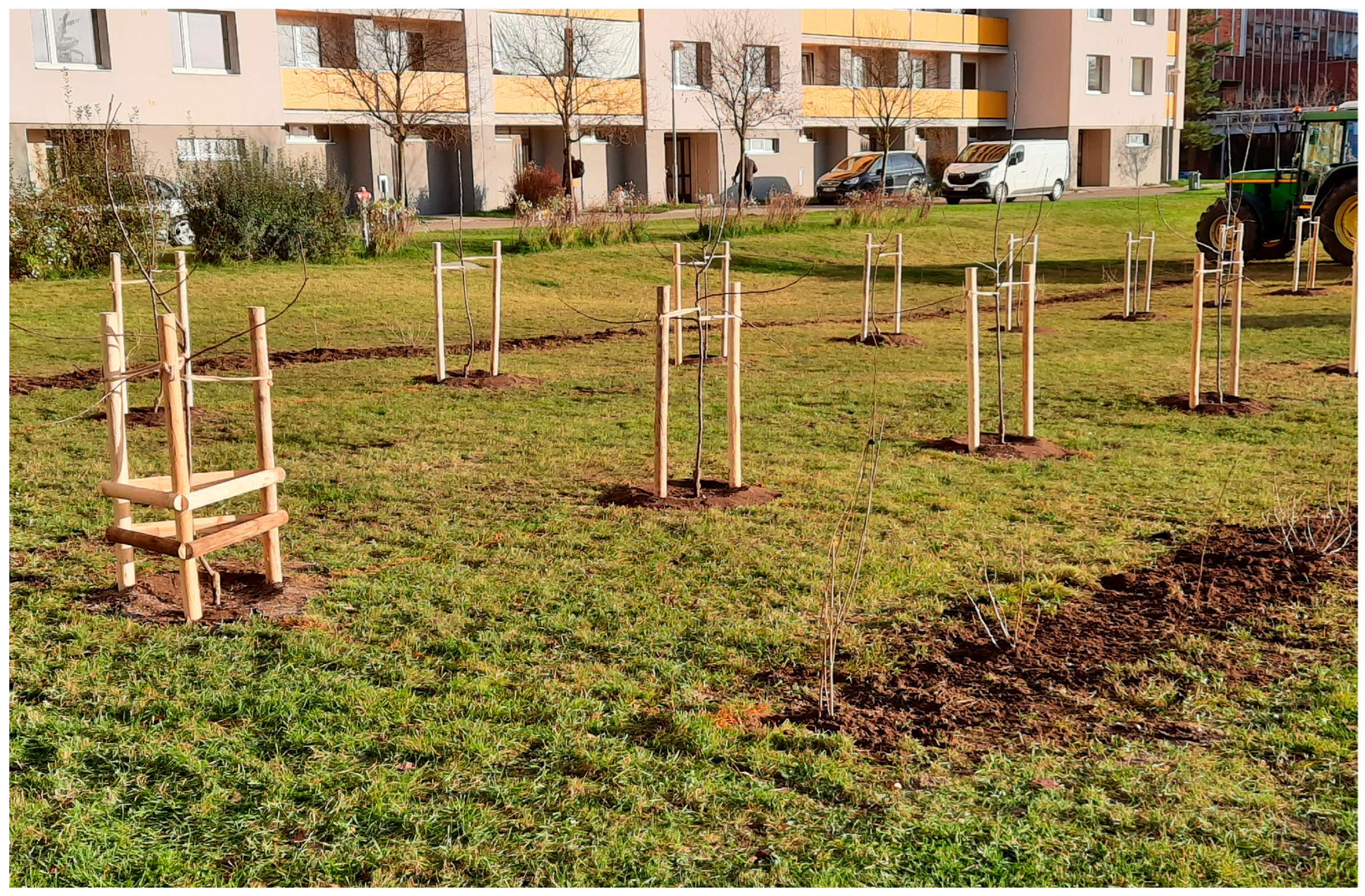
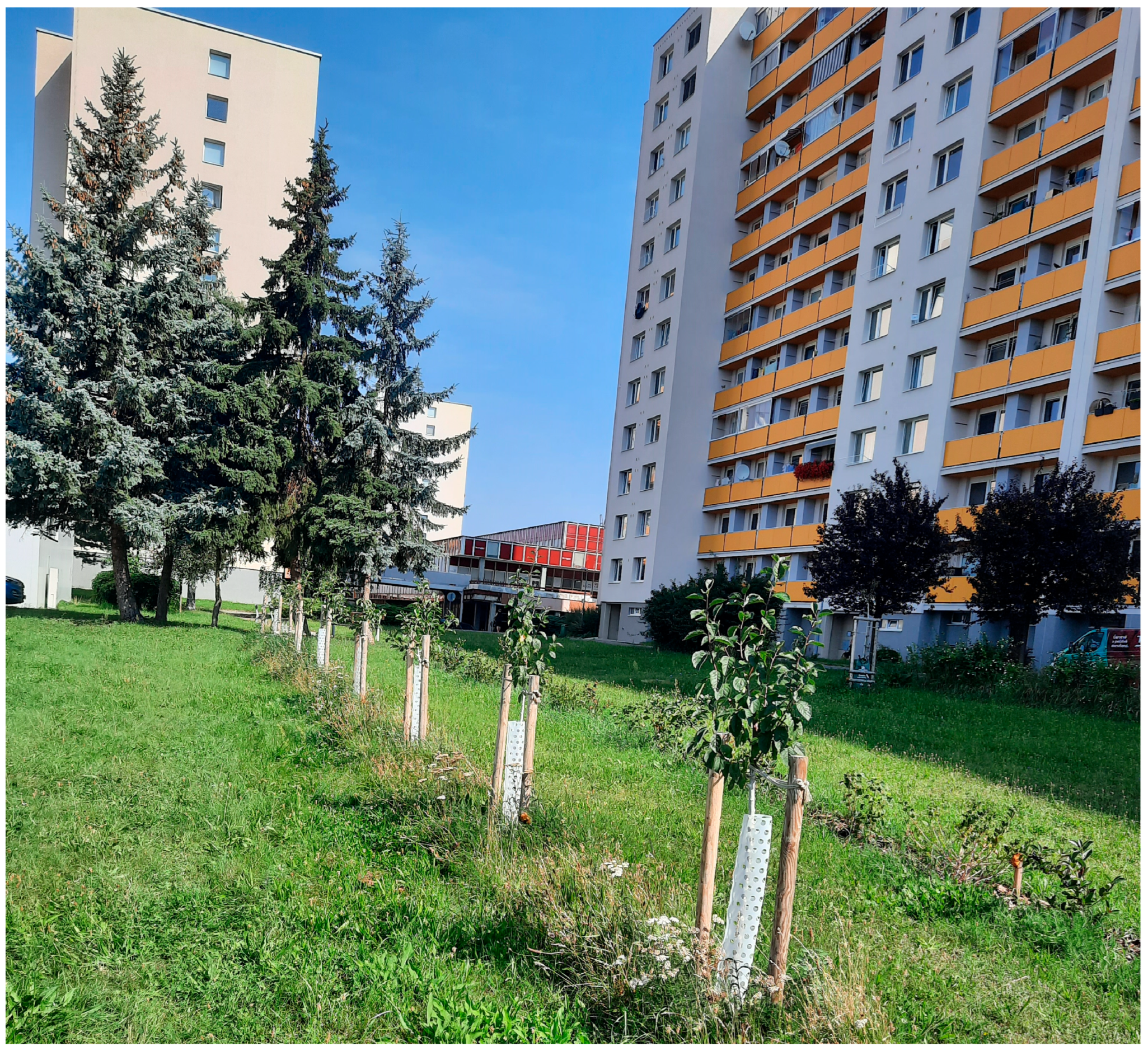
1. Introduction
Cities across the world are experimenting with edible greening, especially urban orchards, community fruit gardens, and mixed productive plantings to integrate ecological performance with everyday social life [
1]. This practice builds on a decade of advances that have mapped typologies of edible landscapes, identified enabling governance arrangements, and documented system-level benefits, including microclimate moderation, shade provision, biodiversity support, and air-quality co-benefits [
2]. These achievements reflect a broader shift from purely ornamental urban greenery to multi-functional plantings that embed food species in the ordinary spaces of housing estates, courtyards, and neighborhood streets [
3,
4].
Alongside these environmental and governance advances, previous research has clarified how social sustainability depends on the legibility of landscape design and the meanings people ascribe to new plantings in their daily routines. In this respect, environmental psychology has connected esthetic judgment, preference, and use [
5], while urban health and landscape studies show that everyday visibility, such as window views of greenery, supports well-being and can shape attitudes and behaviors [
6,
7]. In parallel, urban forestry has moved beyond benefits-only narratives to include ecosystem disservices, calling for evaluation tools that register perceived burdens alongside benefits [
8,
9,
10]. These strands point to the importance of early interpretation: how residents perceive a planting’s order, purpose, and likely trajectory in its first seasons.
Within this broader turn to productive landscapes, edible plantings present distinctive visual and symbolic cues compared with ornamental plantings. Staking, guards, seasonal variability, and the prospect of fruit harvest signal future utility yet can also introduce ambiguity about order, care, and intent [
11,
12]. These attributes heighten the stakes for early community acceptance, and residential settings offer a particularly revealing context for examining these dynamics. In dense housing estates, apartment windows overlook shared grounds, movement patterns are local and routine, and small design decisions, for instance, spacing, edge conditions, or the presence of protective guards, carry outsized interpretive consequences.
Despite the rapid growth of research on edible urban greening [
1,
8,
9,
12], important gaps remain. Early-phase social acceptance is under-examined as a design problem; we know less about how residents interpret the appearance of newly planted edible landscapes and how esthetic legibility shapes legitimacy during establishment [
13]. Insights from environmental psychology are rarely applied directly to edible plantings, leaving open questions about whether having a window view of an edible planting predicts attachment to it [
7,
14,
15,
16,
17]. While calls to account for disservices have grown [
18,
19], design-sensitive instruments that capture both perceived benefits and burdens are still scarce [
20]. Moreover, much of the literature addresses governance at the system level, with fewer studies on residential-scale orchards in dense estates where design choices are most visible and stewardship demands most immediate [
4,
7,
14].
Against this backdrop, this study pursues three aims. Firstly, to assess residents’ early-phase appraisals of design legibility and situational suitability based on our operationalization of esthetic fit over time [
5,
6,
7,
8]. Secondly, to test whether everyday visibility (i.e., window views) and place satisfaction are associated with attachment to urban green [
7,
14,
15,
16,
17]. Thirdly, to examine whether attachment aligns with stewardship-relevant orientations (especially, willingness to help maintain, willingness to pay higher tax, and willingness to participate) [
21,
22]. By focusing on a highly visible residential orchard and employing design-sensitive, benefit-and-burden measures linked to attachment, the study contributes practice-proximate evidence on how esthetic judgments during establishment can lay the groundwork for co-stewardship and the long-term legitimacy of edible urban greening [
18,
19,
20].
3. Results
3.1. Sample Characteristics
The socio-demographic profile of the sample is summarized in
Table 1. Women represented 60% of respondents, while 40% were men. Age distribution was broad, with 24% under 30 years, 20% aged 30–39, 16% aged 40–49, 14% aged 50–59, and 26% aged 60 or older. Educational attainment was concentrated at the secondary level (51.3%), with vocational education at 22.7%, university education at 21.3%, and elementary education at 4.7%.
Two contextual variables were of particular importance. Firstly, 64.7% of respondents reported having a direct view of the orchard from their windows, providing them with everyday visual exposure to the intervention. Secondly, the length of residence differed between long-term residents (≥15 years, 46.7%) and newcomers (<15 years, 53.3%), allowing the exploration of how place memory shapes perceptions of the orchard.
3.2. Expected Burdens and Risks
The anticipated burdens associated with the newly established orchard are both practical and clearly expressed by respondents.
Table 2 shows that concerns related to maintenance score are the highest; the necessity of clearing fallen leaves (M = 3.44, SD = 0.585) and the general perception that “Someone will have to take care of the planted trees and shrubs” (M = 3.84, SD = 0.368) were the strongest concerns. Regular watering (M = 3.61, SD = 0.541) and the potential for leaf litter to create a mess (M = 3.44, SD = 0.585) also rank highly. Ecological concerns are reflected in the expectation that the fruit will attract insects (M = 3.41, SD = 0.615).
Beyond operations, respondents also register social concerns. The expectation that “Fruit will attract homeless people.” (M = 3.57, SD = 0.536) is as salient as the need for regular watering and exceeds many ecological or visual issues. By contrast, visual impacts are evaluated as relatively minor (“Planted trees will cast shadows and obstruct the view.” M = 2.47, SD = 0.662), and potential allergy aggravation is moderate (M = 2.93, SD = 0.435).
3.3. Perceived Current Benefits
Whereas the previous section focused on expected problems,
Table 3 demonstrates that several benefits are already recognized in situ. Using a 1–4 Likert-type scale where 1 = definitely disagree and 4 = definitely agree, respondents reported the strongest perceptions of environmental functions, particularly air cleaning (M = 3.47, SD = 0.642). Esthetic benefits were also highly valued, including the perception that the planting is well designed (M = 3.34, SD = 0.600) and that the selection of trees and shrubs is suitable for the location (M = 3.23, SD = 0.523). The orchard is also perceived to enhance social ambience, making it more pleasant to meet other people (M = 3.15, SD = 0.679).
An important finding is the relatively high agreement with the statement that the orchard reduces the risk of future construction at the site (M = 3.17, SD = 0.528). This suggests that residents view the orchard as a form of “defensive urbanism” where greenery functions not only as an amenity but also as a barrier against development pressures.
By contrast, noise reduction (M = 2.30, SD = 0.502) and stimulation of interest in gardening (M = 2.22, SD = 0.633) received the lowest mean scores. Notably, the fear that the orchard blocks views from windows was strongly rejected (M = 1.25, SD = 0.558).
3.4. Expected Future Benefits
The results presented in
Table 4 show that residents hold consistently high expectations regarding the orchard’s future contributions. On a four-point agreement scale, the strongest endorsements concern the orchard’s role in microclimate regulation and esthetic enhancement. Anticipated cooling during summer (M = 3.63, SD = 0.485) and provision of shade (M = 3.63, SD = 0.497) both approach the scale’s upper limit, underscoring the salience of thermal comfort in residents’ perceptions. Closely following are expectations that the planting will improve the area’s appearance (M = 3.58, SD = 0.495), make breathing easier (M = 3.47, SD = 0.501), and contribute to biodiversity (M = 3.42, SD = 0.522). These evaluations suggest that residents are projecting a wide service envelope onto the orchard, attributing to it both regulating functions (shade, air, biodiversity) and cultural services (esthetics, quality of life).
Other benefits were evaluated positively but at slightly lower levels, notably access to fresh fruit (M = 3.37, SD = 0.755) and wind-speed reduction (M = 2.89, SD = 0.545). The relatively modest expectation of fruit access may reflect uncertainties about rules of use and equitable distribution, issues commonly noted in edible landscape governance. Similarly, the less emphatic rating for wind reduction reflects lay intuitions about the physical limitations of young plantings in providing shelter. Taken together, the pattern indicates that while residents anchor their expectations in tangible, easily legible services such as shade, cooling, and esthetics, they also anticipate broader ecological and social benefits. Importantly, the uniformly high scores confirm that optimism around the orchard’s future performance is strong, providing a fertile basis for cultivating long-term attachment and stewardship—provided that expectations are carefully managed in line with the orchard’s growth trajectory.
3.5. Attitudinal Background Measured by UGAS
UGAS was employed to contextualize the perceptions of local residents.
Table 5 shows that the mean score was 15.67 (SD = 2.401) across five items, with negligible floor effects (0.0%) and modest ceiling effects (5.3%) [
43]. Internal consistency was very good (Cronbach’s α = 0.882, McDonald’s ω = 0.890) [
44,
45,
46,
47]. Skewness was –0.475 and kurtosis −0.366 [
48,
49].
Item means clustered toward agreement for positive evaluations: beauty (M = 3.31, SD = 0.590), contribution to well-being (M = 3.27, SD = 0.609), perceived importance (M = 3.12, SD = 0.634), and willingness to protect trees from removal (M = 3.07, SD = 0.545).
3.6. Predictors of Attachment
A logistic regression model was estimated to identify predictors of higher attachment (
Table 6). The model exhibited good fit χ
2 (df = 5) = 45.381,
p < 0.001; Hosmer–Lemeshow χ
2 (df = 6) = 6.765,
p = 0.343 and satisfactory explanatory power (Nagelkerke R
2 = 0.350), with a classification accuracy of 75.3%. Outcome balance is adequate (84 higher vs. 66 lower), and with 5 model df, the events-per-variable are 84/5 = 16.8, i.e., above common rules of thumb (≥10). Education group sizes (41/77/32) are modest but not sparse; the wider CI for the secondary education category reflects sampling variability rather than model failure.
Four predictors emerged as significant. First, satisfaction with living at the place was strongly associated with higher attachment (OR = 3.548, p < 0.05). Second, having a direct view of the orchard from the window increased the odds of higher attachment (OR = 2.870, p < 0.01), suggesting that everyday visual exposure reinforces the sense of connection. Third, gender differences were evident; male respondents had lower odds of high attachment compared to female respondents (OR = 0.248, p < 0.01). Fourth, education differences were evident; respondents with elementary/vocational education had lower odds of high attachment compared to respondents with university education (OR = 0.274, p < 0.05). Compared with university education (reference), elementary/vocational respondents had significantly lower odds of high attachment (OR = 0.274, p = 0.024), whereas secondary education did not differ from university (OR = 1.060, p = 0.907), indicating a threshold rather than a monotonic, linear stepwise gradient.
3.7. Attachment and Pro-Stewardship Orientations
Bivariate analyses in
Table 7 confirm that higher levels of attachment are strongly associated with pro-stewardship intentions and broader civic dispositions. Respondents with higher UGAS scores were significantly more likely to wish that the orchard remain in the future (M = 16.20 vs. 12.92,
p < 0.001) and to express interest in tasting the fruit (M = 16.17 vs. 13.84,
p < 0.001).
Similarly, willingness to engage in maintenance followed a clear gradient; respondents who were willing to help reported higher attachment (M = 16.89), while those unwilling to participate reported significantly lower attachment (M = 15.01). Willingness to pay higher property taxes to preserve green spaces and willingness to participate if more information was available were also associated with higher attachment.
4. Discussion
The results indicate that esthetic legibility is a critical driver of residents’ acceptance in the establishment phase. Although the orchard is visually “young,” respondents already attribute beauty, well-being, and design suitability to it. These positive evaluations are not yet grounded in deep place identity; rather, they arise from the planting’s capacity to signal order, purpose, and promise. Consistent with theories of environmental legibility, residents appear able to understand intentionality in spatial arrangement, species choice, and edge conditions, even before biophysical functions mature.
The orchard has not yet entered the estate’s entrenched mental map, which is unsurprising when canopy, understory, and seasonal dramaturgy are only beginning. In this early window, attachment reflects surface-level appraisal rather than fully sedimented place meanings, which underscores the importance of design cues and temporal communication.
Multivariate results show that everyday visibility (a direct window view) substantially increases the odds of higher attachment, translating the orchard from abstract amenity to a familiar element of daily life [
50]. General satisfaction with the residential setting further strengthens this pathway, suggesting a reinforcing loop in which positive baseline evaluations color interpretations of new interventions [
51]. Together, these mechanisms support a theory of change in which esthetic legibility, visibility, and place satisfaction jointly foster early attachment [
52,
53].
Gender differences (higher attachment among women) invite targeted engagement strategies. Equally important is the finding that respondents with elementary/vocational education show lower odds of high attachment than their university-educated peers, which can indicate a green attachment divide. Two mechanisms are plausible in this respect: (i) technical language or low-salience cues are harder for individuals with lower levels of education to decode and (ii) edible plantings align differently with habits and perceived obligations. Design and programming should therefore pair legible form with customized information delivery and diverse participation modes, co-produced with local schools, vocational centers, and resident associations.
The benefit profile shows strong endorsement of symbolic ecological services (cleaner air, improved appearance, conviviality) despite limited early biophysical capacity; expectations for noise abatement, wind attenuation, or gardening stimulation are modest. These symbolic attributions are not trivial; they constitute the symbolic value that bridges the time gap between installation and delayed physical performance, sustaining attachment during the period when measurable impacts are nascent.
Residents’ expectations for future benefits, especially shade, biodiversity, quality of life, and fruit, are high. Without coordination, the gap between current reality and projected benefits risks disappointment [
54,
55]. Temporal communication in the form of growth charts, phenology boards, first-blossom and first-harvest events, and participatory pruning days can render maturation timelines visible and align expectations with growth rates, reinforcing the symbolic bridge.
Predictable concerns focused on leaf litter, watering, and routine care are amenable to pre-emptive organization. Turning these tasks into visible, scheduled, participatory routines reframes burdens as rituals, strengthening stewardship. Clear, fair, and widely communicated harvest norms, e.g., “take-what-you-need” guidance, ripeness windows, or shared tasting days, can legitimize use while minimizing perceived disorder.
The concern that “Fruit will attract homeless people” should be understood as a perceived social disservice implicating safety, occupancy, and governance of shared goods beyond simple fruit access. In early stages, such anxieties can erode the symbolic value that sustains attachment before performance is visible. Responses should combine initial legibility with inclusive communication about use, harvest, and care; co-produced norms; communal harvest events; gleaning/donation partnerships with shelters/food banks; routine visible maintenance; and situational design cues (such as clear sightlines, lighting, tidy edges, or wayfinding) [
50]. Collaboration with local social service organizations can pre-empt conflict while preserving an inclusive ethos. By stabilizing symbolic value, these measures can protect the attachment that underwrites co-maintenance.
Bivariate patterns show that residents with higher attachment (i.e., higher UGAS score) are more willing to defend the orchard, taste fruit, contribute to maintenance, and even support preservation through higher taxes [
56]. Attachment thus functions as a practical orientation toward co-stewardship, not merely an affective state.
Several limitations must be acknowledged. First, the study is cross-sectional and captures perceptions at a single point in time shortly after the orchard’s establishment. Longitudinal research is necessary to examine how attachment evolves as the orchard matures and as ecological functions become more tangible. Second, the study focused on a single housing estate in a mid-sized Czech municipality; while socio-demographically varied, the findings cannot be generalized without caution to other urban contexts with different cultural, ecological, or governance settings. Third, reliance on self-reported perceptions introduces potential biases, including social desirability and projection effects. Fourth, results may be affected by common-method variance and unmeasured confounding (e.g., prior pro-environmental attitudes). Finally, single-site design limits external validity; multi-site longitudinal replication is warranted.
Future studies should employ longitudinal and comparative designs, integrating both perceptual data and ecological monitoring to assess how symbolic attributions interact with actual biophysical performance. Further attention to social segmentation (e.g., by gender, age, or length of residence) could also refine engagement strategies tailored to different resident groups.
In spite of those limitations, the study makes four contributions. Firstly, it proposes a way to measure an early-phase design legibility. We adapted and extended the esthetic–legibility tradition to edible plantings, capturing perceptions of order, suitability, and fit in the establishment stage. Secondly, it demonstrates the use of indicators quantifying the everyday visibility. We tested whether having a window view of the orchard significantly predicts attachment, thereby moving from generic studies of “views of nature” to a situated mechanism of social assimilation. Thirdly, it validates attachment and links it to stewardship. Using the UGAS, we assess attachment as a robust psychometric construct and examine its association with orientations toward co-stewardship, neighborhood participation, and willingness to underwrite care. Fourthly, it is balancing services and disservices. We elicited both perceived benefits (e.g., cooling, biodiversity, quality of life) and anticipated burdens (e.g., maintenance load, insects, social frictions), treating them as part of the governance locus where design, perception, and equity intersect. For planners and designers, visibility and communication of seasonal change should be treated as universal design elements, not optional outreach. Careful spacing, grouping, and species selection can accelerate assimilation; communicative devices and participatory routines convert novelty into belonging. From a governance perspective, co-produced care routines and transparent harvest norms can transform predictable frictions into shared rituals. Ultimately, the orchard’s legitimacy will depend not only on ecological performance but also on its capacity to enter residents’ mental maps and daily narratives.
5. Conclusions
Urban edible greening is intrinsically temporal; in the first seasons, trees are small, protections are conspicuous, and ecological performance is nascent. Under these conditions, symbolic value operates as a bridge carrying resident attachment across the gap between installation and delayed benefits. Our results indicate that this bridge forms when early design legibility is paired with communication that makes the future intelligible, and when plantings are visibly present in residents’ daily routines.
Empirically, the logistic model showed that place satisfaction and everyday visibility significantly increased the likelihood of higher attachment, while gender differences suggested the need for tailored engagement. Residents anticipated cooling, shade, air quality, biodiversity, and quality-of-life benefits; their concerns were pragmatic and seasonal (e.g., leaf litter, watering, insects, fair fruit access). These concerns can be addressed through visible care routines and clear norms. Temporal communication tools such as growth charts, phenology boards, and first-harvest events convert abstract promise into concrete milestones, reinforcing the symbolic bridge that sustains attachment before performance fully materializes.
Conceptually, we argue that early-phase esthetic fit mediates between installation and stewardship by aligning form (legibility, proportion, edges), narrative (credible signals of canopy and fruiting), and salience (window and pathway visibility). Practically, this implies siting for benign visibility, detailing that reads as intentional rather than temporary, and communication that invites residents into the orchard’s unfolding story. Because attachment coheres with willingness to participate and underwrite care, investments in early-phase legibility and communication yield downstream governance capacity.
Limitations include the cross-sectional design and early-phase focus; causal pathways require longitudinal follow-up. Nonetheless, the alignment across design appraisals, visibility, attachment, and stewardship orientations provides a coherent account of how edible greening gains legitimacy in dense residential estates. If cities want orchards that endure, the first seasons must be curated as much for meaning as for biology; making the future legible is not cosmetic, but foundational.