Article

Sociodemographic Factors Associated with EU Citizens’ Attitudes Toward Animal Welfare Standards in External Trade


by
Fernando Mata
1,2,*,
Rosário Marques
1,
João M. Almeida
1,3,4,
José Araújo
2,5,
Nuno Baptista
6,
Gustavo Paixão
2,7 and
Joaquim Cerqueira
2,7
1
Estação Zootécnica Nacional, Instituto Nacional de Investigação Agrária e Veterinária, Quinta da Fonte Boa, 2005-424 Vale de Santarém, Portugal
2
Centre for Research and Development in Agrifood Systems and Sustainability, Instituto Politécnico de Viana do Castelo, Rua da Escola Industrial e Comercial Nun’Alvares 34, 4900-347 Viana do Castelo, Portugal
3
CIISA—Centro de Investigação Interdisciplinar em Sanidade Animal, Faculdade de Medicina Veterinária, Universidade de Lisboa, 1300-477 Lisboa, Portugal
4
AL4AnimalS—Associate Laboratory for Animal and Veterinary Sciences, Av. Universidade Técnica, 1300-477 Lisboa, Portugal
5
Mountain Research Centre, Instituto Politécnico de Viana do Castelo, 4900-347 Viana do Castelo, Portugal
6
Escola Superior de Tecnologia e Gestão de Leiria, Instituto Politécnico de Leiria, R. do Alto Vieiro Apartado 4163, 2411-901 Leiria, Portugal
7
Veterinary and Animal Research Centre, Universidade de Trás-os-Montes e Alto Douro, 5000-801 Vila Real, Portugal
*
Author to whom correspondence should be addressed.
Sci 2026, 8(1), 3; https://doi.org/10.3390/sci8010003 (registering DOI)
Submission received: 13 October 2025 / Revised: 10 December 2025 / Accepted: 25 December 2025 / Published: 30 December 2025

Abstract

This study examines the impact of sociodemographic factors on the attitudes of EU citizens towards animal welfare and their implications for trade policy. Variations in animal welfare legislation across major commercial blocks create ethical and economic challenges, with the EU implementing stringent standards compared with other countries. Data were drawn from the Special Eurobarometer 533 survey, conducted between the 3rd and 26th March 2023, which employed a multistage, clustered sampling method across all 27 EU Member States, yielding a representative sample of 26,368 respondents. The survey collected detailed information on attitudes toward animal welfare alongside sociodemographic characteristics. The results revealed substantial public support for stricter regulations and informative labelling, with attitudes differing with age (p < 0.001), education (p < 0.001), income (p < 0.001), and political orientation (p < 0.001), according to the multinomial regression applied to each of the independent variables. These results emphasise the importance of these factors in shaping consumer expectations. The findings highlight the need for policymakers to integrate ethical and societal values into trade negotiations, ensuring that policies reflect public concerns, promote fair competition, and encourage higher animal welfare standards internationally. Additionally, understanding the perspectives and motivations of livestock industry stakeholders remains critical for implementing effective welfare strategies. By aligning EU trade policy with citizen values and stakeholder practices, it is possible to advance animal welfare globally while balancing economic and ethical considerations and promoting a fair trade.

1. Introduction

The landscape of animal welfare legislation varies significantly across major commercial blocks, creating discrepancies that impact international trade [1,2,3]. The European Union (EU) has some of the most stringent animal welfare standards in the world, encompassing various aspects of animal rearing, transport, and slaughter [3,4].
These differences can lead to trade disputes and concerns about the ethical implications of importing animal products from countries with lower welfare standards. The implementation of stricter animal welfare regulations and the belief in animal ethical production often vary among consumers and farmers based on their individual definitions of animal welfare [5,6,7], which are influenced by national contexts [8]. These variations highlight the challenges in harmonising animal welfare standards globally and the potential for trade conflicts arising from differing ethical and regulatory frameworks [9]. The EU’s stance on animal welfare also intersects with the rules and principles of the World Trade Organisation (WTO), particularly concerning protectionism and the defence of internal legislation [10].
The concept of protectionism arises when a country imposes trade barriers, such as tariffs or quotas, to shield its domestic industries from foreign competition. However, when such measures are implemented to uphold higher animal welfare standards, they can be viewed as a defence of internal legislation aimed at protecting ethical values and consumer preferences [3,11]. The WTO generally prohibits discriminatory trade practices but allows for exceptions related to public morals, which creates a grey area where the EU’s efforts to restrict imports of animal products based on welfare concerns may be challenged as disguised protectionism [3,11]. The intersection of animal welfare, trade, and ethical considerations reflects the complexity of formulating and implementing commercial policies that balance economic interests with societal values [12]. It becomes crucial to consider public perception and the extent to which citizens are willing to support trade restrictions to promote animal welfare [8]. Consumers’ concerns about farm animal welfare (FAW) can influence their purchasing decisions, affecting the sustainability of intensive farming systems [8,12]. Citizens participate in public opinion formation, influencing legislation and political decisions related to animal welfare, further highlighting the importance of understanding public attitudes in this context [3,11].
Examining sociodemographic determinants is essential for understanding the nuances of public opinion on this issue. Factors such as age, gender, education, income, and political orientation may significantly shape individuals’ attitudes toward animal welfare and their support for trade policies that align with these values. Understanding these determinants can help policymakers craft more effective and socially acceptable trade policies that reflect the preferences and ethical considerations of EU citizens.
This paper aims to analyse the sociodemographic characteristics of EU citizens and examine how these factors influence their attitudes toward EU trade standards applied to third countries exporting to the EU.

2. Materials and Methods

2.1. Data

Data were sourced from the Special Eurobarometer 533 survey, “Attitudes of Europeans towards Animal Welfare”. This survey was commissioned by the European Commission and is part of the wider Eurobarometer 99.1 series [13].
The survey employed a cross-sectional design and was conducted over the period of 3–26 March 2023. A multistage, clustered sampling approach was applied, covering all 27 EU Member States. Data collection combined face-to-face interviews, computer-assisted interviews, and online video interviews to ensure broad accessibility. To accommodate linguistic and cultural diversity, the questionnaire was translated into the official language(s) of each participating country, allowing respondents to participate in their native or national language.
The study targeted all EU residents aged 15 years and over, irrespective of nationality, who were residing in one of the 27 Member States at the time of data collection. The survey gathered information on attitudes toward animal welfare, alongside detailed sociodemographic variables. Each participant constituted an independent unit of analysis, resulting in a total sample of 26,368 individuals.
The Eurobarometer adheres to strict ethical guidelines. Informed consent was obtained from all respondents. For participants under the age of 18, interviews were conducted only with the consent and supervision of a parent or legal guardian. Additional technical details regarding sampling procedures and the application of regional weighting can be found in the GESIS Survey Data Catalogue [14].

2.2. Variables Used in This Study

To perform this study, the analysis centres on responses to Question C8 of the survey, which serves as the dependent variable (DV) within the present investigation. The wording of the question is as follows: “Today, EU rules on the welfare of animals at the farm level do not apply for food imported from non-EU countries. With this in mind, which of the following items comes closest to your view?”
1—"This should change. EU animal welfare rules should apply to imported food.”
2—"EU animal welfare rules do not need to apply to imported food, but all food products of any origin should bear labels informing EU consumers on the welfare rules applied.”
3—"EU animal welfare rules do not need to apply to imported food, and there is no need to change the current situation”
The option “Don’t know” was also available.
As in Mata et al. [15], the following socio-demographic variables were employed as independent variables (IV) in the analysis:
  • ‘Age’: Provided in full years. This question was answered by all participants, and thus, no data were excluded on this basis.
  • ‘Gender’: Respondents could choose from ‘male’, ‘female’, or ‘none of the above/non-binary/do not recognise yourself in the above categories’. For this study, only those who identified as ‘male’ or ‘female’ were included in the analysis. A total of 31 individuals selected the third option; due to the small number, their responses were excluded on statistical grounds. This decision is in no way intended to disregard or devalue individuals with diverse gender identities.
  • ‘Highest Level of Education Completed’: Responses ranged from ‘1—no formal schooling/did not complete primary education’ to ‘9—doctorate/PhD’. All participants responded, and no exclusions were necessary.
  • ‘Household Income’: Categorised into deciles (from the lowest 10% to the highest 10%) within the sample. A total of 3655 individuals either chose not to respond or indicated they did not know, and these cases were therefore omitted from the analysis.
  • ‘Political Positioning’: Measured on a scale from ‘1 (far left)’ to ‘10 (far right)’. Here, 3386 respondents either refused to answer or selected “Don’t know” and were consequently excluded from the analysis.
  • ‘Type of Community’: Categorised as ‘rural area or village’, ‘small town’, or ‘large town’. All participants responded to this question, and no data were excluded.
  • For all the questions, respondents were given the option to answer ‘don’t know’. Additionally, the choices ‘refuse to answer’ were explicitly available for both the ‘Household Income’ and ‘Political Positioning’.

2.3. Statistical Analysis

The dependent variable was initially examined through a multivariable multinomial logistic regression, adjusted using a backwards stepwise procedure. However, as many interactions were found to be significant, it became impossible to make a correct interpretation of the model. As an alternative, several univariate multinomial logistic regression models were adjusted, in which each socio-demographic variable was entered solely as an independent variable. Model adequacy was assessed via the −2 log-likelihood chi-square test, providing a measure of overall goodness-of-fit. Additionally, the Cox and Snell pseudo-R-squared statistic was reported to offer supplementary insight into the explanatory power of the model. The significance of individual predictors was evaluated using the Wald chi-square test. All statistical analyses were executed using the NOMREG procedure in IBM® SPSS® Statistics, version 29.0.2.0 (20) (IBM Corp., Armonk, NY, USA).
Accompanying tables for each model display the logistic regression coefficients (β) corresponding to each predictor variable across the various response categories. These coefficients represent the expected change in the log-odds (logit) of selecting a particular outcome category for every one-unit increase in the associated predictor. The logit quantifies the probability of an individual being assigned to a specific response category. A β coefficient approaching zero indicates a negligible effect of the predictor on the logit. The exponential of the coefficient, eβ, is interpreted as the odds ratio: values greater than one (eβ > 1) suggest that the predictor increases the likelihood of the outcome, a value equal to one (eβ = 1) indicates no effect, and values less than one (eβ < 1) denote a reduction in the likelihood of the given response. These correspond respectively to positive, null, and negative β values.

3. Results

3.1. Descriptive Statistics

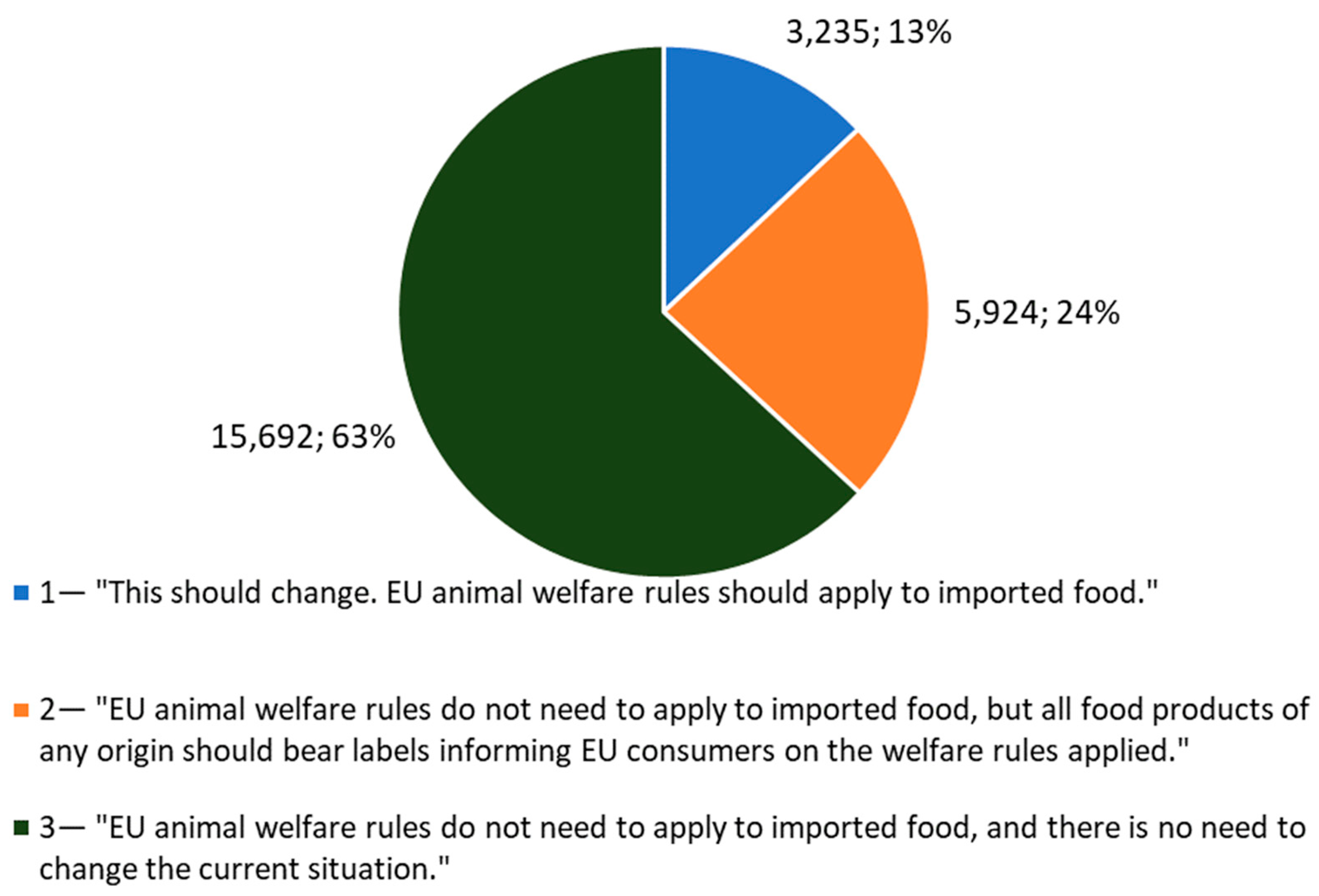
A total of 24,851 respondents provided answers to Question C8. The distribution of responses across the three available options is illustrated in Figure 1. The other 1517 individuals answered ‘Don’t Know’ and were excluded from analysis.
Overall, the findings revealed a strong preference among EU citizens for stricter regulations or informative labelling regarding animal product imports into the EU. Specifically, 63.1% of citizens believed that EU rules needed to change, and 23.8% supported labelling requirements. Only 13% of respondents felt that EU rules should not apply to imported products. These results reflect the significant public concern for animal welfare and/or unfair trade practices, as well as the desire for greater transparency and accountability in the trade of animal products originating from third countries outside the EU.
The variables ‘Gender’ and ‘Community type’ displayed the following distributions: male respondents numbered 9260 (47.7%), while female respondents totalled 10,157 (52.3%). Regarding community type, 6168 respondents (31.8%) resided in rural areas, 7126 (36.7%) in small towns, and 6123 (31.5%) in large towns. Descriptive statistics of the covariate independent variables are presented in Table 1.

3.2. The Models

The multivariable multinomial logistic regression model initially adjusted with the many significant interactions is impossible to interpret. Table A1 in Appendix A indicates its parameter estimates.
In relation to the univariate models, the variables gender and community type were found not to be significant (p > 0.05), and, therefore, were not analysed. All the other independent variables were successfully incorporated into the regression models. The summary statistics with the overall models’ performances are presented in Table 2. Further details concerning the model parameters, including the corresponding odds ratios, are provided in Table 3.
The results indicate that higher-income individuals were more likely to support the view that EU rules should change so that EU rules apply to imported products or at least imported products should be labelled to inform consumers. Similarly, individuals with a political placement on the left were more inclined to favour changing EU rules or implementing labelling requirements. A higher level of education was also associated with a preference for changing EU rules or requiring labelling, suggesting that more educated individuals may be more aware of animal welfare issues and more supportive of measures to address them, or even more aware of unfair trade competition faced by the EU farmers. Older respondents were more likely to opt for labelling requirements but less likely to support changing EU rules altogether.

4. Discussion

The observed relations between sociodemographic factors and attitudes toward animal welfare in trade highlight the influence of these (economic status, political ideology, education, and age) in shaping public opinion related to the trade of products of animal origin in the EU. The tendency of higher-income individuals to support stricter regulations or labelling requirements may reflect the greater wealth and willingness to pay for products that meet higher welfare standards. In other parts of the world, such as China, despite the growing concerns in providing better welfare conditions for farm animals, the willingness to pay for the support of such practices is still modest [16]. In Brazil, willingness to pay for animal welfare-friendly products also follows the household income tendency [17]; however, as the Brazilian society shows huge discrepancies in levels of income, with the majority of citizens in low-income levels, the practical result can be anticipated as modest. In Argentina, adherence to certifications that ensure production processes does not translate into increased consumer demand, nor does it result in a preference for beef product brands that could serve as indicators of the quality provided [18]. These authors report a general sense of consumer empathy towards farmers among Argentinians, alongside a widespread lack of awareness regarding the living conditions of farm animals and a prevailing tendency to rely on retailers as a primary source of information concerning animal welfare.
There are not many studies dedicated to the topic in the USA. A study from 2014 [19] shows that 56% of the interviewees didn’t have a primary public source of information, and those providing primary sources report animal welfare NGOs as their source. Social responsibility towards animal welfare of products was identified as a concern. In a more recent study [20] looking into willingness to pay for pet food originating from animal welfare-friendly systems, in the USA, respondents demonstrated limited knowledge regarding FAW yet tended to overestimate their own level of understanding. In the USA, FAW legislation is challenging to enforce uniformly due to state-level autonomy, with some states exempting farm animals from anti-cruelty laws [21,22]. Advocacy groups have influenced change through public pressure, leading to retailer agreements that promote animal-friendly practices among producers [22,23]. Unlike Europe, where regulations are legislator-driven, progress in the USA is largely society-led and slower [3]. In regions beyond Western Europe and the USA, limited political and public engagement means economic priorities often outweigh animal welfare concerns [24]. The USA, Brazil, and Argentina are major exporters of animal products to the EU, leveraging their large-scale agricultural operations and competitive production costs [25].
Income is positively associated with consumer willingness to pay (WTP) for higher farm-animal welfare standards, and this relationship plausibly extends to attitudes towards imposing welfare-based requirements on imported meat. Meta-analytic evidence shows that, on average, consumers state a positive WTP for improvements in FAW, and that socio-economic covariates such as income and education account for part of the heterogeneity in WTP estimates [26,27]. Within the EU context, cross-country and survey studies report that consumers from higher-income Member States and higher-income households tend to express stronger concern for farm-animal welfare and a greater readiness to pay premiums for FAW-labelled meat. These studies also document that attributes such as country of origin and production labelling are important determinants of choice, suggesting that preferences for welfare-friendly domestic production can affect attitudes towards imported meat [28,29]. Empirical research indicates that WTP is conditional on the ability to pay; price sensitivity is greater among lower-income consumers, who therefore are less likely to accept price premiums associated with higher FAW standards. Consequently, proposals to tighten import rules on the grounds of FAW are likely to generate distributional effects across income groups and Member States; wealthier constituencies are more able to absorb higher retail prices and thereby more likely to support stringent import standards [27,29].
Policy-relevant implications from the literature show that using welfare-conditional import requirements without compensatory measures risks regressive outcomes and political resistance in lower-income regions. In addition,. complementary instruments (e.g., targeted subsidies, phased implementation, or information and certification schemes) are recommended to mitigate affordability concerns and to improve uptake of higher FAW products across socio-economic groups. These recommendations follow both the observed pattern of heterogeneous WTP and the literature emphasising the role of information, trust, and labelling in converting ethical concern into market demand [30,31].
The political ideology influences public attitudes towards animal-welfare standards in trade. In our analysis, left-leaning respondents were more likely to favour extending EU welfare rules to imports or, at a minimum, mandatory labelling. This is a pattern that accords with broader evidence linking progressive political identities to stronger support for environmental and animal-protection policies. Left-of-centre voters typically endorse collective-oriented values and regulatory solutions, which predispose them to favour prescriptive measures that protect animals and curb perceived unfair competition from low-welfare imports [32]. Conversely, right-leaning orientations are often associated with market-liberal values, regulatory scepticism, and prioritisation of property and business freedoms; such values can render welfare-based import restrictions politically contentious and prone to being framed as protectionist. This ideological cleavage in attitudes toward agriculture, diet, and related policy instruments has been observed in Eurobarometer analyses and cross-national studies of EU publics [32,33].
Political positioning also interacts with informational and socio-economic factors. Higher education and exposure to welfare or sustainability arguments can attenuate, but do not eliminate, ideological differences. Education frequently strengthens support for welfare measures among the left and can modestly increase receptivity among centrists, while conservative publics remain comparatively resilient to persuasion absent targeted framing [32,34]. Recognising ideology as both an independent predictor and a framing lens is essential for interpreting public preferences and for designing trade measures (e.g., labelling, conditional cooperation, phased compliance) that are legally defensible and politically viable across the ideological spectrum [35].
Higher educational attainment is consistently associated with stronger support for more stringent animal-welfare regulations and related consumer measures. Empirical studies of EU populations and student samples report that university-educated respondents are more likely to favour restrictive welfare rules or compulsory labelling and are willing to pay premiums for higher-welfare products [36,37]. These findings accord with consumer research showing that respondents with higher education report greater concern for animal welfare and higher willingness to pay for welfare-friendly produce [38].
Possible mechanisms explaining this association include the following: Education enhances factual knowledge and cognitive engagement with ethical and scientific arguments about animal sentience and husbandry, which can influence preferences towards precautionary or rights-based regulation. Higher education shapes value orientations (e.g., post-materialist, cosmopolitan) that predispose individuals to support collective interventions and non-market public goods. Empirical research on pro-environmental attitudes shows a causal (or at least strong) positive effect of education on environmentally protective beliefs and behaviours, suggesting a transferable pathway to welfare preferences. Universities increasingly incorporate animal-welfare science and ethics into curricula, strengthening knowledge and normative commitment among graduates [39].
The preference of older respondents for labelling rather than sweeping regulatory reform plausibly reflects a pragmatic, information-seeking approach; older consumers may prefer clearer signals at the point of purchase that enable informed choices without supporting disruptive policy change. This pattern aligns with empirical research indicating that concern for FAW varies by age (younger respondents often show stronger welfare concerns and a greater desire for systemic change), while older cohorts tend to focus on practical information and incremental solutions [40,41]. Labelling, therefore, acts as a lower-cost, less intrusive policy that maintains consumer choice while increasing transparency qualities that may make it especially appealing to older voters who are wary of regulatory overreach. Additionally, older consumers have specific information and legibility needs. They pay attention to on-pack information but can be sensitive to label complexity and legibility, which influences how effective labelling is in practice. Furthermore, consumer segments differ in their perceived knowledge and contact with farming; those with less direct contact (often urban or older purchasers) may rely more heavily on labels to reduce information asymmetry [42].
These findings have significant implications for policymakers seeking to develop trade policies that align with public values and ethical considerations. Given the strong public support for stricter regulations or informative labelling, policymakers should consider implementing measures to ensure that imported animal products meet comparable welfare standards or are clearly labelled to inform consumers about the conditions under which they were produced. However, such measures must be carefully designed to avoid protectionism and comply with WTO rules. It is also crucial for policymakers to engage in open and transparent dialogue with stakeholders, including consumers, producers, and animal welfare organisations, to ensure that trade policies are informed by a wide range of perspectives and ethical considerations [43]. Raising public awareness about animal welfare concerns can translate these concerns into market drivers, thereby improving the welfare of billions of animals [41].
One potential limitation of this study is the reliance on self-reported data from Eurobarometer surveys. While Eurobarometer provides a valuable source of information on public attitudes, it is subject to the biases and limitations inherent in survey research. Additionally, the study focuses on a limited set of sociodemographic variables, and other factors, such as cultural background, personal experiences, and exposure to information about animal welfare, may also play a significant role in shaping attitudes. Further research is needed to explore these factors and their interactions to provide a more comprehensive understanding of the determinants of public attitudes toward animal welfare in trade. In addition, interactions between variables, were not discussed as a multivariate model as this was impossible to interpret due to the large number of significant terms. Despite these limitations, the study provides valuable insights into the sociodemographic factors that influence EU citizens’ attitudes toward animal welfare in trade. This deeper understanding of how farmers regard and value animal welfare can bring more effective development of collaborative knowledge transfer, policies, and also management initiatives directed at maintaining healthy animals [44].

5. Conclusions

The findings of this study emphasise the importance of addressing animal welfare concerns in EU trade policy. The significant public support for stricter regulations or informative labelling highlights the need for policymakers to consider ethical and social values in trade negotiations and policy decisions. The perceptions and attitudes of livestock industry leaders regarding animal welfare issues are largely unknown. Understanding the motivations of these stakeholders is critical for developing effective strategies to improve animal welfare practices. By implementing appropriate measures, policymakers can ensure that trade policies align with public values, promote fair competition, and contribute to improved animal welfare standards worldwide.

Author Contributions

Conceptualization, F.M.; methodology, F.M.; formal analysis, F.M. and G.P.; investigation, F.M., R.M., J.M.A., J.A., N.B., G.P. and J.C.; writing—original draft preparation, F.M., R.M., J.M.A., J.A., N.B., G.P. and J.C.; writing—review and editing, F.M., R.M., J.M.A., J.A., N.B., G.P. and J.C. All authors have read and agreed to the published version of the manuscript.

Funding

This research received no external funding.

Institutional Review Board Statement

This is a third-party data study. Data was collected originally by Eurobarometer for the European Commission. Both Eurobarometer and the European Commission adhere to the strictest ethical procedures.

Informed Consent Statement

Informed consent was obtained from all subjects involved in the study.

Data Availability Statement

The original dataset used in this study is available open access in the Eurobarometer repository, GESIS from The Leibniz Institute for the Social Sciences at https://doi.org/10.4232/1.14142, accessed on 10 October 2025.

Acknowledgments

To the Foundation for Science and Technology (FCT, Portugal) for financial support to CISAS UIDB/05937/2020 and UIDP/05937/2020.

Conflicts of Interest

The authors declare no conflicts of interest.

Appendix A

Table A1. Parameters of the of multivariable multinomial logistic regression model adjusted and found significant. Most of the variables are interactions.
VariableβSEWald χ2dfp-Value
Intercept S10.1790.049213.1951<0.001
Intercept S21.3190.0499697.6781<0.001
Intercept S32.6070.05432307.5561<0.001
Household income −0.0020.000345.7061<0.001
Gender Male × Education level−0.0010.000312.1371<0.001
Gender Female × Education Level−0.0010.000320.0411<0.001
Community Town × Household income−0.0020.000512.1751<0.001
Community City × Household incomereference
Age × Education Level1.213−52.4617−624.2851<0.001
Household income × Political Positioning0.0004.0868−547.2611<0.001
Political Positioning × Education Level0.0003.9446−510.34210.001
Community Rural × Political Positioning0.0005.6070−57.26710.007
Community City × Political Positioningreference
Community Town × Household income × Education Level3.359−68.6009−715.2521<0.001
Community City × Household income × Education Levelreference
Community Town × Political Positioning × Education Level−6.998−52.5263−57.67410.006
Community City × Political Positioning × Education Levelreference
Notes: S1—Statement 1—“This should change. EU animal welfare rules should apply to imported food”. S2—“Statement 2—EU animal welfare rules do not need to apply to imported food, but all food products of any origin should bear labels informing EU consumers on the welfare rules applied”. S3—Statement 3—“EU animal welfare rules do not need to apply to imported food, and there is no need to change the current situation”.

References

  1. McCulloch, S.P. Brexit and Animal Protection: Legal and Political Context and a Framework to Assess Impacts on Animal Welfare. Animals 2018, 8, 213. [Google Scholar] [CrossRef] [PubMed]
  2. Bessei, W. Impact of Animal Welfare on Worldwide Poultry Production. World’s Poult. Sci. J. 2018, 74, 211–224. [Google Scholar] [CrossRef]
  3. Mata, F.; Araujo, J.; Soares, L.; Cerqueira, J.L. Local People Standings on Existing Farm Animal Welfare Legislation in the BRIC Countries and the USA. Comparison with Western European Legislation. J. Appl. Anim. Welf. Sci. 2024, 27, 652–665. [Google Scholar] [CrossRef] [PubMed]
  4. Molitorisová, A.; Burke, C. Farm to Fork Strategy: Animal Welfare, EU Trade Policy, and Public Participation. Appl. Econ. Perspect. Policy 2023, 45, 881–910. [Google Scholar] [CrossRef]
  5. Mata, F.; Jaeger, B.; Domingues, I. Perceptions of Farm Animal Sentience and Suffering: Evidence from the BRIC Countries and the United States. Animals 2022, 12, 3416. [Google Scholar] [CrossRef]
  6. Garcia, A.; McGlone, J.J. Animal Welfare and the Acknowledgment of Cultural Differences. Animals 2022, 12, 474. [Google Scholar] [CrossRef]
  7. Rollin, B. Animal Welfare across the World. J. Appl. Anim. Ethics Res. 2019, 1, 146–170. [Google Scholar] [CrossRef]
  8. Mata, F.; Dos-Santos, M.; Cocksedge, J. Attitudinal and Behavioural Differences towards Farm Animal Welfare among Consumers in the BRIC Countries and the USA. Sustainability 2023, 15, 3619. [Google Scholar] [CrossRef]
  9. Bayne, K.; Turner, P.V. Animal Welfare Standards and International Collaborations. ILAR J. 2019, 60, 86–94. [Google Scholar] [CrossRef]
  10. Broom, D.M. Animal Welfare and International Trade. In The Key Role of Animal Welfare Science in the Development of Green Agriculture; Jilin Publishing Group: Changchun, China, 2018. [Google Scholar]
  11. Buller, H.; Blokhuis, H.; Jensen, P.; Keeling, L. Towards Farm Animal Welfare and Sustainability. Animals 2018, 8, 81. [Google Scholar] [CrossRef]
  12. Alonso, M.E.; González-Montaña, J.R.; Lomillos, J.M. Consumers’ Concerns and Perceptions of Farm Animal Welfare. Animals 2020, 10, 385. [Google Scholar] [CrossRef] [PubMed]
  13. European Commission. Eurobarometer 97.1 (2022); GESIS: Cologne, Germany, 2023. [Google Scholar]
  14. European Commission; European Parliament. Eurobarometer 99.1; GESIS Study Number ZA7954; GESIS: Cologne, Germany, 2025. [Google Scholar]
  15. Mata, F.; Baptista, N.; Jesus, M.; Santos, J. Fur Farming: EU Citizens’ Stance. Science 2025, 7, 177. [Google Scholar] [CrossRef]
  16. Jiang, B.; Tang, W.; Cui, L.; Wei, Y. Factors Influencing Chinese Public Attitudes toward Farm Animal Welfare. Front. Psychol. 2023, 14, 1049530. [Google Scholar] [CrossRef] [PubMed]
  17. Gonçalves, G.O.; Lima, R.C. Consumer Willingness To Pay For Animals Welfare Products. Bol. Tempo Presente 2023, 12, 54–61. [Google Scholar]
  18. Giacomazzi, C.M.; Talamini, E.; Kindlein, L. Relevance of Brands and Beef Quality Differentials for the Consumer at the Time of Purchase. Rev. Bras. Zootec. 2017, 46, 354–365. [Google Scholar] [CrossRef]
  19. McKendree, M.G.S.; Croney, C.C.; Widmar, N.J.O. Effects of Demographic Factors and Information Sources on United States Consumer Perceptions of Animal Welfare. J. Anim. Sci. 2014, 92, 3161–3173. [Google Scholar] [CrossRef]
  20. Pearce, H.; Neill, C.L.; Royal, K.; Pairis-Garcia, M. Can Dogs Help Chickens? Pet Owners’ Willingness to Pay for Animal Welfare-Friendly Pet Food in the United States. Anim. Welf. 2023, 32, e11. [Google Scholar] [CrossRef]
  21. Von Keyserlingk, M.A.G.; Hötzel, M.J. The Ticking Clock: Addressing Farm Animal Welfare in Emerging Countries. J. Agric. Environ. Ethics 2015, 28, 179–195. [Google Scholar] [CrossRef]
  22. Bryant, T.L.; Sullivan, M. Why American Animal-Protective Legislation Does Not Always “Stick” and the Path Forward. In Animal Welfare: From Science to Law; La Fondation Droit Animal Ethique & Sciences: Paris, France, 2019; pp. 77–87. [Google Scholar]
  23. Centner, T.J. Limitations on the Confinement of Food Animals in the United States. J. Agric. Environ. Ethics 2010, 23, 469–486. [Google Scholar] [CrossRef]
  24. Schweitzer, L. Conclusion to the Symposium: Animal Welfare, Law and Ethics. In Proceedings of the Animal Welfare: From Science to Law, Paris, France, 10–11 December 2015; Hilda, S., Schweitzer, L., Eds.; La Fondation Droit Animal, Éthique et Sciences: Paris, France, 2015; pp. 191–194. [Google Scholar]
  25. Chatellier, V. Review: International Trade in Animal Products and the Place of the European Union: Main Trends over the Last 20 Years. Animal 2021, 15, 100289. [Google Scholar] [CrossRef]
  26. Clark, B.; Stewart, G.B.; Panzone, L.A.; Kyriazakis, I.; Frewer, L.J. Citizens, Consumers and Farm Animal Welfare: A Meta-Analysis of Willingness-to-Pay Studies. Food Policy 2017, 68, 112–127. [Google Scholar] [CrossRef]
  27. Clark, B.; Frewer, L.J.; Panzone, L.A.; Stewart, G.B. The Need for Formal Evidence Synthesis in Food Policy: A Case Study of Willingness-to-Pay. Animals 2017, 7, 23. [Google Scholar] [CrossRef] [PubMed]
  28. Cubero Dudinskaya, E.; Naspetti, S.; Arsenos, G.; Caramelle-Holtz, E.; Latvala, T.; Martin-Collado, D.; Orsini, S.; Ozturk, E.; Zanoli, R. European Consumers’ Willingness to Pay for Red Meat Labelling Attributes. Animals 2021, 11, 556. [Google Scholar] [CrossRef] [PubMed]
  29. Tomasevic, I.; Bahelka, I.; Čítek, J.; Čandek-Potokar, M.; Djekić, I.; Getya, A.; Guerrero, L.; Ivanova, S.; Kušec, G.; Nakov, D. Attitudes and Beliefs of Eastern European Consumers towards Animal Welfare. Animals 2020, 10, 1220. [Google Scholar] [CrossRef] [PubMed]
  30. Heinola, K.; Latvala, T.; Niemi, J.K. Consumer Trust and Willingness to Pay for Establishing a Market-Based Animal Welfare Assurance Scheme for Broiler Chickens. Poult. Sci. 2023, 102, 102765. [Google Scholar] [CrossRef]
  31. van Riemsdijk, L.; Ingenbleek, P.T.M.; van Trijp, H.C.M.; van der Veen, G. Can Marketing Increase Willingness to Pay for Welfare-Enhanced Chicken Meat? Evidence from Experimental Auctions. Animals 2023, 13, 3367. [Google Scholar] [CrossRef]
  32. de Boer, J.; Aiking, H. EU Citizen Support for Climate-Friendly Agriculture (Farm) and Dietary Options (Fork) across the Left-Right Political Spectrum. Clim. Policy 2023, 23, 509–521. [Google Scholar] [CrossRef]
  33. Coleman, G.J.; Hemsworth, P.H.; Hemsworth, L.M.; Munoz, C.A.; Rice, M. Differences in Public and Producer Attitudes toward Animal Welfare in the Red Meat Industries. Front. Psychol. 2022, 13, 875221. [Google Scholar] [CrossRef]
  34. Vecchio, Y.; Pauselli, G.; Adinolfi, F. Exploring Attitudes toward Animal Welfare through the Lens of Subjectivity—An Application of Q-Methodology. Animals 2020, 10, 1364. [Google Scholar] [CrossRef]
  35. Hårstad, R.M.B. The Politics of Animal Welfare: A Scoping Review of Farm Animal Welfare Governance. Rev. Policy Res. 2024, 41, 679–702. [Google Scholar] [CrossRef]
  36. Pejman, N.; Kallas, Z.; Reig, L.; Velarde, A.; Moreno, M.; Magnani, D.; Protopapadaki, V.; Ribikauskas, V.; Ribikauskienė, D.; Dalmau, A. Should Animal Welfare Be Included in Educational Programs? Attitudes of Secondary and University Students from Eight EU Countries. J. Appl. Anim. Welf. Sci. 2023, 26, 341–360. [Google Scholar] [CrossRef]
  37. Pejman, N.; Kallas, Z.; Dalmau, A.; Velarde, A. Should Animal Welfare Regulations Be More Restrictive? A Case Study in Eight European Union Countries. Animals 2019, 9, 195. [Google Scholar] [CrossRef] [PubMed]
  38. Bozzo, G.; Barrasso, R.; Grimaldi, C.A.; Tantillo, G.; Roma, R. Consumer Attitudes towards Animal Welfare and Their Willingness to Pay. Vet. Ital. 2019, 55, 289–297. [Google Scholar] [PubMed]
  39. De Briyne, N.; Vidović, J.; Morton, D.B.; Magalhães-Sant’Ana, M. Evolution of the Teaching of Animal Welfare Science, Ethics and Law in European Veterinary Schools (2012–2019). Animals 2020, 10, 1238. [Google Scholar] [CrossRef] [PubMed]
  40. Clark, B.; Stewart, G.B.; Panzone, L.A.; Kyriazakis, I.; Frewer, L.J. A Systematic Review of Public Attitudes, Perceptions and Behaviours towards Production Diseases Associated with Farm Animal Welfare. J. Agric. Environ. Ethics 2016, 29, 455–478. [Google Scholar] [CrossRef]
  41. Cornish, A.; Raubenheimer, D.; McGreevy, P. What We Know about the Public’s Level of Concern for Farm Animal Welfare in Food Production in Developed Countries. Animals 2016, 6, 74. [Google Scholar] [CrossRef]
  42. Hempel, C.; Waldrop, M.; Roosen, J. Consumers’ Perceptions of Animal Husbandry Practices and Their Heterogeneous Needs for Information—Insights from a Cross-Country Cluster Analysis. Int. Food Agribus. Manag. Rev. 2023, 26, 821–836. [Google Scholar] [CrossRef]
  43. Liang, Y.; Meng, C.; Chen, R.; Yang, Y.; Zeng, Y. Pet Ownership and Its Influence on Animal Welfare Attitudes and Consumption Intentions Among Chinese University Students. Animals 2024, 14, 3242. [Google Scholar] [CrossRef]
  44. Balzani, A.; Hanlon, A. Factors That Influence Farmers’ Views on Farm Animal Welfare: A Semi-Systematic Review and Thematic Analysis. Animals 2020, 10, 1524. [Google Scholar] [CrossRef]
Figure 1. Distribution of responses to question eight across the three available options (n = 24,851).
Sci 08 00003 g001
Table 1. Descriptive statistics of the covariates used in the present study.
VariableNMinMaxMeanSD
Age26,363159851.4618.30
Household income22,7131105.632.76
Education level26,368194.861.86
Political positioning22,9821105.352.18
Table 2. Statistics of the univariate multinomial logistic models found to be significant.
Model−2 LLχ2dfp-Value
Age32,38750.592<0.001
Education level32,328109.652<0.001
Household income32,41226.372<0.001
Political positioning32,36474.332<0.001
Note: LL—log likelihood, df—degrees of freedom.
Table 3. Parameters of the of univariate multinomial logistic regression models adjusted and found significant. Each model models one of the socio-demographic variables and is named after that variable. The variables ‘Gender’ and ‘Community type’ were found not significant.
MStatementIVβSEWald χ2dfp-Valueeβeβ 95% CI
LowerUpper
Age1Intercept1.4680.067479.091<0.001
Age NS
2Intercept0.8670.075134.421<0.001
Age−0.0050.00112.311<0.0010.9950.9920.998
Education1Intercept0.9630.062241.721<0.001
Education level0.1260.012104.301<0.0011.1341.1071.162
2Intercept0.1690.0705.8810.015
Education level0.0940.01446.711<0.0011.0991.0701.129
Income1Intercept1.3840.049796.531<0.001
Household income0.0330.00817.861<0.0011.0341.0181.050
2Intercept0.3630.05641.941<0.001
Household income0.0450.00925.811<0.0011.0461.0281.065
Politics1Intercept1.9640.0591090.321<0.001
Political positioning−0.0720.01052.331<0.0010.9300.9120.949
2Intercept0.7520.067125.521<0.001
Political positioning−0.0240.0114.4710.0350.9770.9550.998
Note: M—model, IV—independent variable, SE—standard error, df—degrees of freedom, CI—confidence interval, and NS—non-significant. Statements: 1—“This should change. EU animal welfare rules should apply to imported food”; 2—“EU animal welfare rules do not need to apply to imported food, but all food products of any origin should bear labels informing EU consumers on the welfare rules applied”; and 3—“EU animal welfare rules do not need to apply to imported food, and there is no need to change the current situation”. Statements 1 and 2 are being modelled while statement 3 is being used as reference.
Disclaimer/Publisher’s Note: The statements, opinions and data contained in all publications are solely those of the individual author(s) and contributor(s) and not of MDPI and/or the editor(s). MDPI and/or the editor(s) disclaim responsibility for any injury to people or property resulting from any ideas, methods, instructions or products referred to in the content.