Review

Digital Twins in Development of Medical Products—The State of the Art

by
Zhuming Bi
*,
Ruaa Jamal Rabi Salem Alfakawi
,
Hosni Abu-Mulaweh
and
Donald Mueller
Department of Civil and Mechanical Engineering, Purdue University Fort Wayne, Fort Wayne, IN 46805, USA
*
Author to whom correspondence should be addressed.
Designs 2025, 9(6), 140; https://doi.org/10.3390/designs9060140
Submission received: 21 October 2025 / Revised: 18 November 2025 / Accepted: 3 December 2025 / Published: 4 December 2025

Abstract

This article provides a Structured Literature Review (SLR) on the uses of Digital Twins (DT-Is) in the development of medical products. The purposes of our SLR are to find out (1) whether existing DT-I technologies are mature enough to be adopted for new medical product development, and (2) if the answer to item (1) is no, what existing works can be utilized in developing DT-Is for designs of bone fixations? It is our finding that numerous works are reported on using DT-Is in healthcare applications such as remote surgeries, remote diagnoses, personalized medicines, and assistive technologies. These applications involve one-to-one correspondence of physical and digital entities but exhibit several limitations in (1) inheriting and transferring knowledge from legacy products to new products and (2) a lack of a systematic approach in creating innovations for new product development. We suggest adopting Digital Triad (DT-II) for medical product development. A background study on using DT-II for the design of bone staples is conducted to illustrate the feasibility of the proposed idea.

1. Introduction

In the digital era, more human activities are automated by machines, while it becomes crucial to represent physical entities in the digital world [1]. Digital Twin (DT-I) technologies were introduced to create digital models for corresponding physical entities, so that these physical entities can be simulated, analyzed, and monitored to predict their performance under given circumstances [2]. DT-I technologies allow designers to model, test, and implement various physical solutions to specified problems with minimized delay and cost [3]. While it is ideal to use DT-Is at all the phases of a product lifecycle, most existing DT-Is are applied at deployment phases when physical systems are in use. For example, the aim of the DT-I by Classens et al. [4] was to diagnose malfunctions of a precision machine for preventive maintenance. Bi [3] argued that DT-Is should be elevated to incorporate a life model in conventional DT-Is to facilitate knowledge inheritance and transfer for sustainable product development [5,6].
This work aims to examine the current development of DT-I technologies and the need to use sustainable materials in medical products, and thus to verify whether DT-I technologies can be a part of vital solutions in developing new medical products. If they are, what critical challenges may arise in inheriting and transferring knowledge in sustainable product development? To this end, our investigation begins with a Structured Literature Review (SLR) to answer the following three Research Questions (RQs).
RQ-1: 
What are the main applications of DT-Is in the healthcare industry? Are there successful stories of using DT-Is to develop new medical products other than their applications in remote surgeries, remote diagnoses, personalized medicines, and assistive technologies?
RQ-2: 
What are the most relevant technologies of DT-Is? Is there any methodological hurdle to creating innovations in sustainable product development?
RQ-3: 
Is there new technology that can elevate the conventional DT-I concept for sustainable medical product development?

2. Structured Literature Review (SLR)

Figure 1 shows the flowchart of our SLR. It consists of (1) a preliminary survey on the applications of DT-Is in the healthcare industry and (2) a refined survey on the applications of DI-Is for the development of sustainable bone fixations. This section introduces our work on the preliminary survey. The need for a refined survey depends on the outcomes of the preliminary survey, as well as the answers to the three aforementioned questions. The outcomes of our refined survey will be discussed in Section 3, Section 4, Section 5, Section 6 and Section 7.

2.1. Introduction of SLR

It was desirable to follow PRISMA guidelines [7] in conducting a Structured Literature Review (SLR). However, the literature review here was not the focus but the means to find out whether existing DT-I technologies were mature enough to solve a specific problem relevant to the design of medical bone staples. The authors were not positioned to classify and criticize the mainstream DT-I applications in the healthcare industry. The SLR was conducted by following the procedure recommended by Piccialli et al. [8] and Carrera-Rivera et al. [9], and the SLR was updated on 19 September 2025 to make our literature survey as structured as possible. The essential components (e.g., methods, results, discussion, and conclusions) of the SLR are discussed below.

2.2. Methods

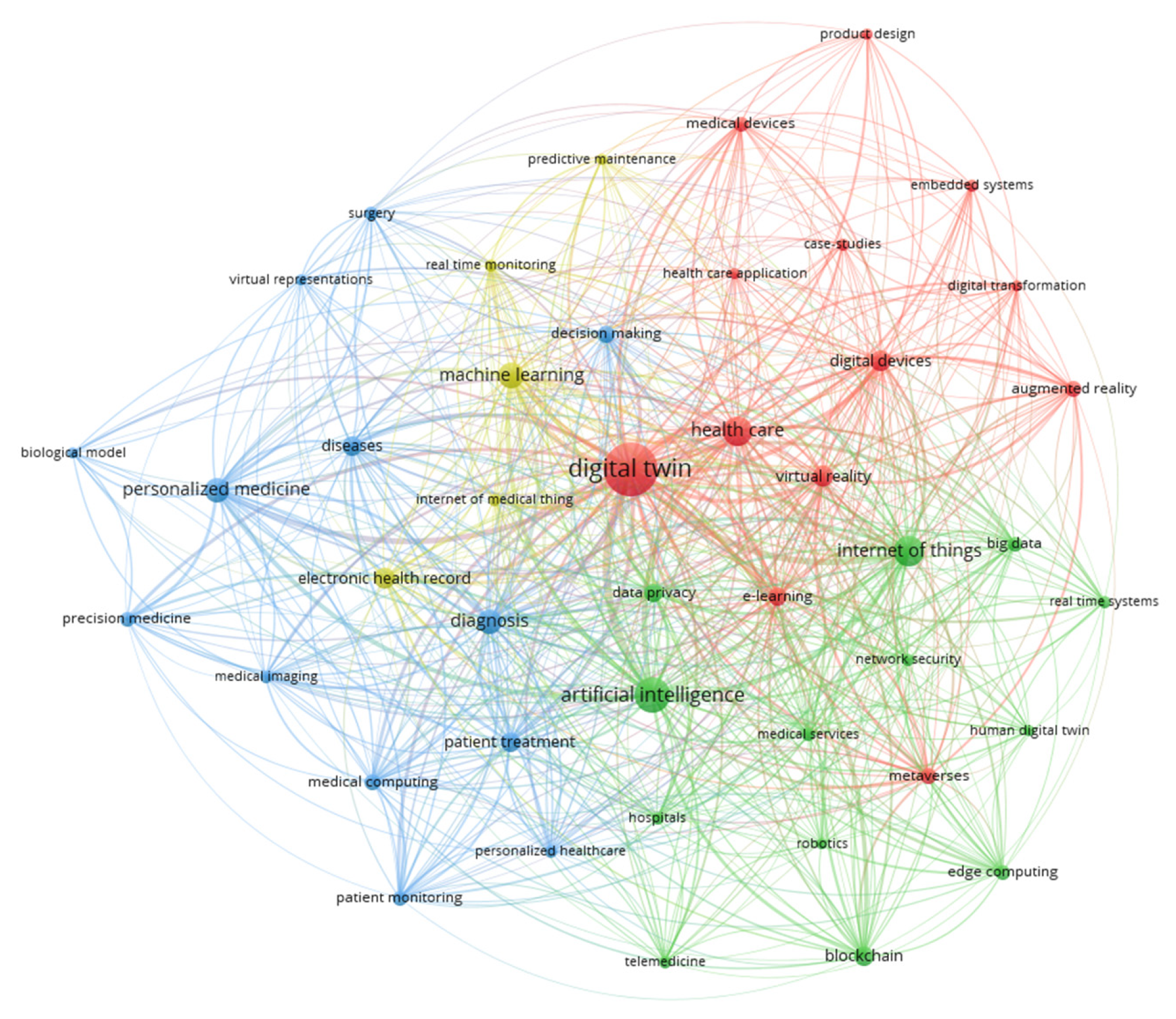
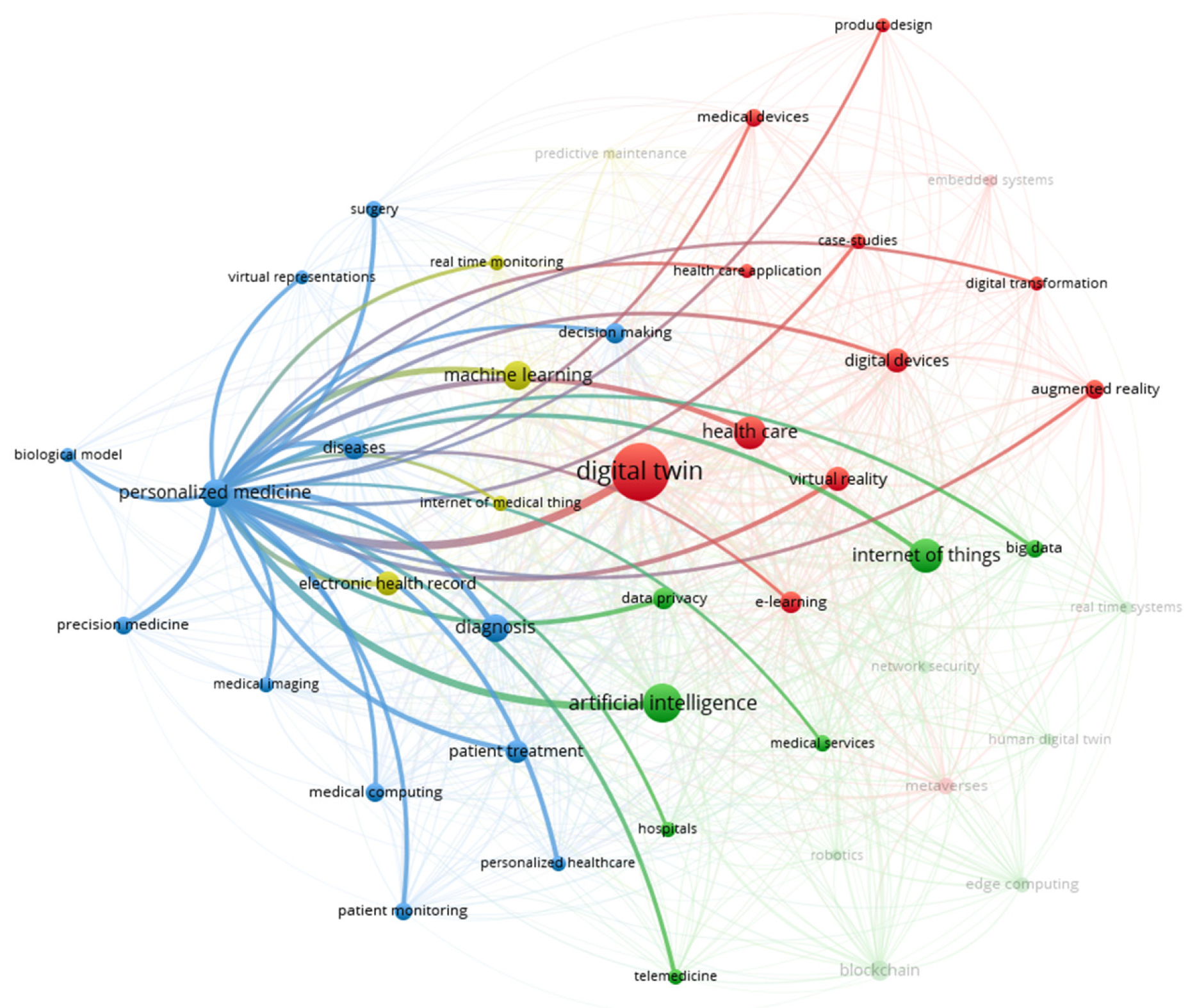
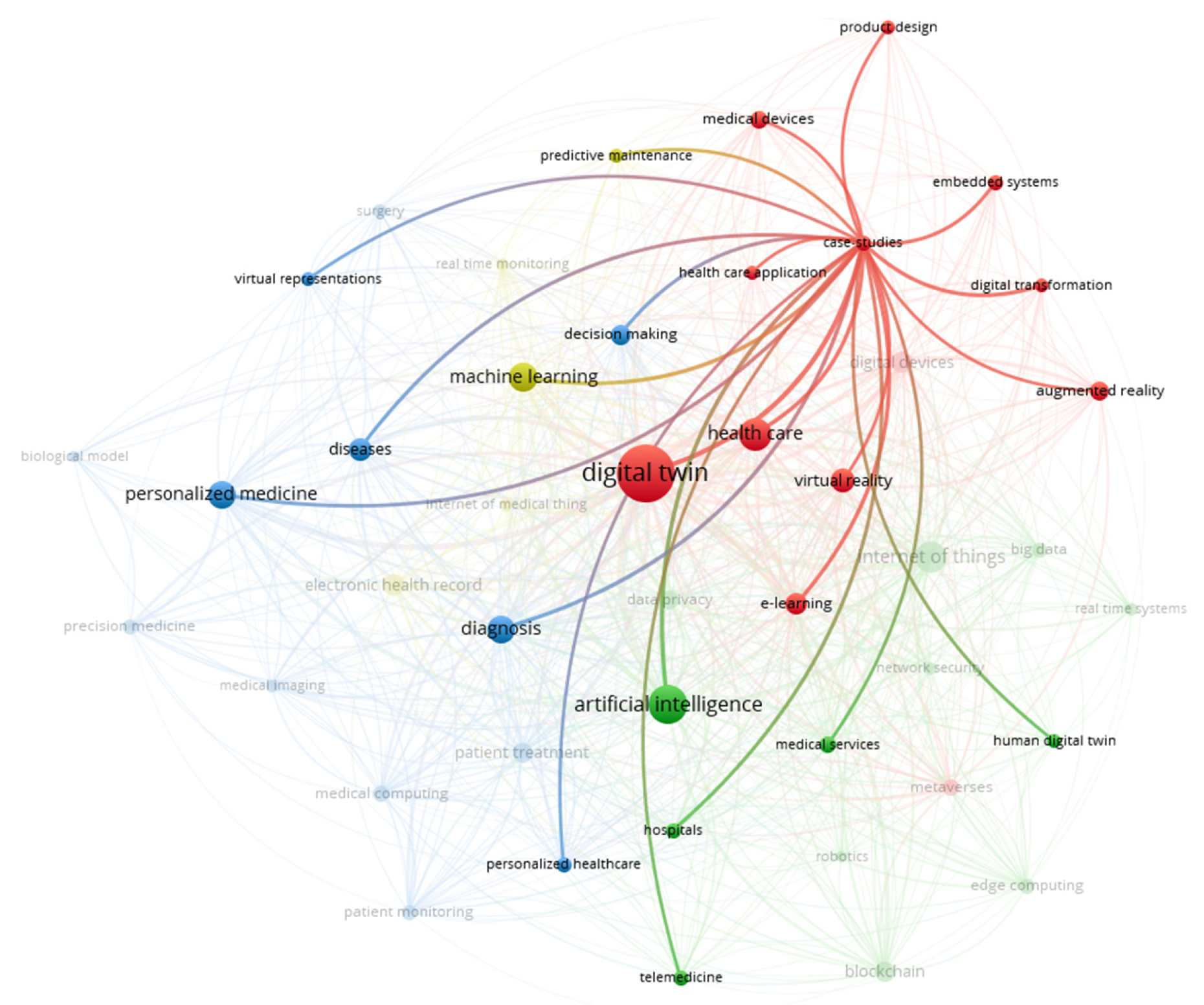
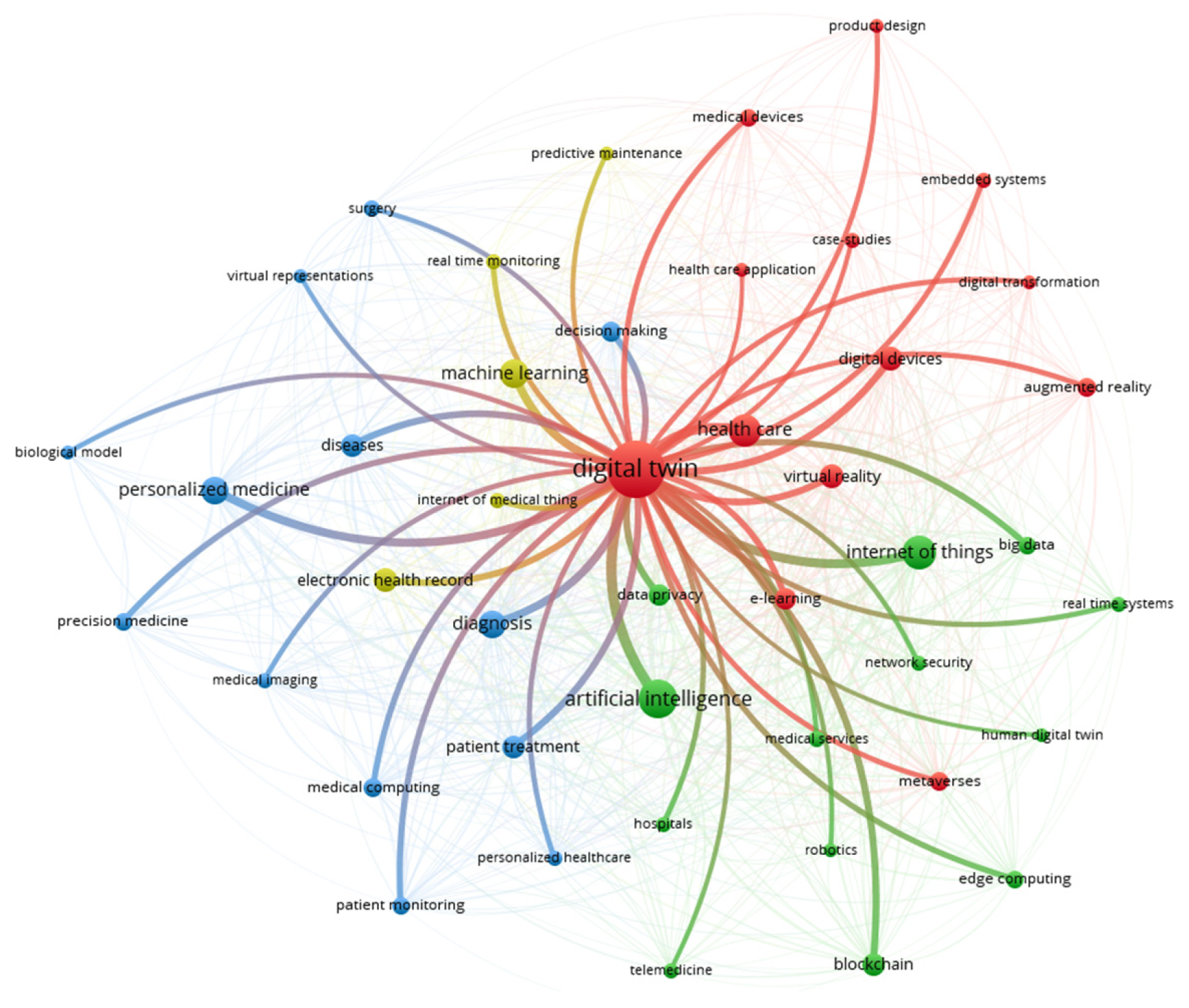
The search criteria were (Article Title, Abstract, Keyword (digital twins) AND (ALL Field) (medical device) AND (ALL Field) (case study)) OR (Article Title, Abstract, Keyword) (medical product design) OR (Article Title, Abstract, Keyword) (remote diagnosis) OR (Article Title, Abstract, Keyword) (healthcare) AND PUB YEAR > 2015). A total of 635 articles were identified. The identified articles were exported as a ‘.ris’ file and loaded into ‘VOSviewer 1.6.20’ to analyze bibliographic data among these articles. The type of analysis was ‘co-occurrence’, and the counting method was set as ‘full counting’. The literature was analyzed on its full records, and it was found to have a total of 5253 keywords. When the threshold was set as ‘15’ times, 82 keywords were identified, and 38 similar and less relevant keywords were eliminated. Figure 2 gives an overview of the bibliographic coupling of these 44 keywords among 635 articles. Figure 3 shows that DT-I technologies have been applied in almost all businesses in the healthcare industry. Figure 4 shows that the most attractive areas of using DT-I technologies were personalized medicines and treatments, while case studies of using DT-Is for medical product development were very scarce, as shown in Figure 5.

2.3. Results

A total of 635 articles were screened, and many other articles were searched in ScienceDirect and IEEE Xplore databases. The most relevant answers to three defined equations were analyzed in depth. DT-Is have been mostly explored to expand diagnostic capabilities and improve drug effectiveness and treatments [10]. Our SLR led to the answers to three defined problems as follows:
AS-1: 
DT-Is have been widely explored in the healthcare industry for predictive healthcare monitoring and analyses, personalized medical treatments, surgical planning, optimization of caregiving workflows, drug delivery, and drug discovery. However, a very limited number of case studies have been found on using DT-Is to develop new medical products. In particular, only one case study was found to adopt the digital triad (DT-II) to support the sustainable development of medical products. Methodologically, the potential of DT-Is was confined by one-to-one correspondence of digital and physical entities, and the benefits of using DT-Is to maximize knowledge transfer from existing products to new products have yet to be thoroughly explored to accelerate innovation and reduce digital waste.
AS-2: 
DT-Is are not stand-alone technologies. Most DT-I applications were developed by integrating with numerous newly developed technologies such as AI, IoT, Cyber-Physical Systems (CPSs), Cloud Computing (CC), Edge Computing (EC), Human Robot Interaction (HRI), Blockchain Technologies, Big Data Analytics (BDA), and data-driven techniques for real-time decision-making support.
AS-3: 
It has been found that DT-II has great potential to elevate existing DT-Is in the sense that a life model is incorporated to maintain all models, methods, and information on legacy products or systems in their evolution, and new products can be conceived, analyzed, prototyped, and virtually verified for personalized medical treatments in the most cost-effective ways.

2.4. Discussion

It was found that the applications of digital twins in the healthcare industry were highly diversified; the conventional functions of monitoring and diagnosing patients and planning and scheduling medical resources were mostly explored. Most digital twins’ applications assumed the corresponding physical twins exist. A limited number of digital twins were developed and used for the design phases of medical products.

2.4.1. DT-I Concepts and Variants

DT-Is are the virtual representations of physical medical devices, and DT-I technologies were used to simulate their physical responses to environments and operational commands [11]. DT-Is were created by using multi-physical modeling of a complex system, considering real-time monitoring of real physical entities [12]. DT-Is in personalized healthcare allow for predicting individuals’ health trajectories and disease progression. DT-Is provided quantitative assessments on the progress of lives and thus refined disease treatments or rehabilitation practices [13].
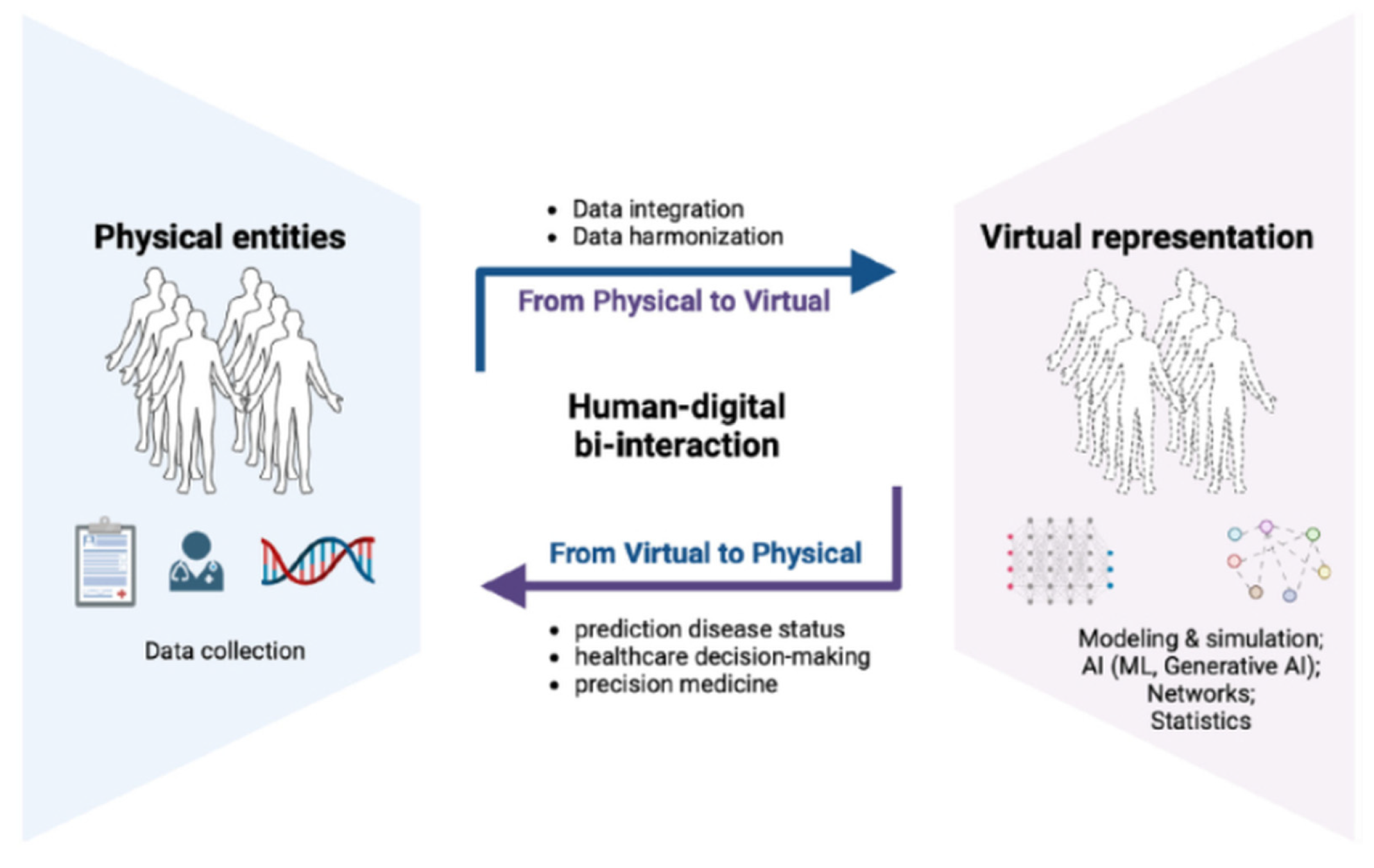
With the rapid development of Information Technology (IT), digital transformation has had a great influence on virtually all industry sectors, including the healthcare industry. DT-Is have been widely explored to expand diagnostic capabilities and improve drug effectiveness and treatments [10]. The main functions of conventional DT-Is are to provide bidirectional data exchange between a virtual model and the corresponding physical counterpart [14]. The implicated technologies of DT-Is in allergy applications were surveyed by Fuse et al. [15], and it was found that physicians must take a role in developing and implementing machine learning (ML) tools to satisfactorily address ethical concerns, such as privacy, fairness, and patient autonomy.

2.4.2. Enabling Technologies

Rowan [16] discussed the potential of digital technologies in developing medical devices from a holistic life-cycle perspective. Digital technologies added value by creating new innovations and opportunities in disposing of and reusing medical devices across industrial sectors. Digital twins were equipped with AI and mechanistic modeling to represent the nonlinear and context-specific behaviors of a complex biological system. AI helped to integrate multi-omics data in a predictive model, and mechanistic modeling helped to improve the interpretability of the predictive model [17]. In developing a context-aware framework to monitor physical activities, blockchains and IoT were integrated into DT-Is to preserve confidential and private information in eldercare [18,19]. Maleki et al. [20] emphasized automation in creating and upgrading a DT-I. It was equipped with AI and a software service to support ML to automate the definitions of functional requirements (FRs) and modeling of a product system.
Mathematical methods for modeling drug delivery systems were discussed by Kashkooli et al. [21]. They further proposed a multi-physical approach in developing clinical digital twins; they were used to model the intricate interactions of physicochemical and physiological processes in personalizing cancer nanomedicines. This alleviated the heavy economic burden of an experimental method in developing a feasible drug delivery system.
The success of a DT-I relies on the sufficiency and reliability of raw data. Vidal et al. [22] proposed to generate raw data for medical DT-Is by X-ray simulations (i.e., gVirtualXray); it was used to filter noise, assess image quality, and produce realistic images for ML. Zhang et al. [23] adopted a highly sensitive triboelectric scanner to acquire raw data and reconstruct digital models from physical entities.
Medical DT-Is facilitated precision medicine by modeling the interactions of patients, machines, and twin synchronization through interfaces [24]. To address the concern of adversarial attacks on medical DT-Is, Shamshiri et al. [25] adopted image processing techniques and ANN in a cancer diagnosis DT-I, and they incorporated a defense method to strengthen the resilience of DT-Is to adversarial attacks. Wu et al. [26] developed a consensus-oriented assessment framework to identify the barriers, and they found the primary and secondary barriers in applying medical DT-Is were a lack of talent and practical technologies and prognosis predictions, respectively.
The threats to DT-Is in an open and distributed environment are still a primary concern, and DT applications benefited by integrating federated learning to detect cyberthreats in IoT [27]. Metaverse was incorporated with DT-Is to analyze and characterize micro-organisms in drug discovery, and DT-Is were developed to represent fungi, viruses, bacteria, archaea, protozoa, and parasites. Digital twin libraries (DTLs), including MobileNetV2 and Resnet-50, were adopted to model bacteria species [28]. Similarly, Sai et al. [29] integrated Metaverse with DT-Is to gamify healthy activities and personalize monitoring, training, and intervening healthy activities.
While the applications of DT-Is in the healthcare industry were widely explored, a number of challenges occur in privacy assurance, access controls, and ineffective interactions with patients. Islayem et al. [30] proposed to integrate blockchain technologies and Metaverse with large-language models and non-fungible tokens (NFTs) to elevate the capabilities of medical DT-Is. To deal with big data, a model-based approach was proposed to fuse sensed data for ventilated patients. It was integrated with new monitoring modalities, including surface electromyography and electrical impedance tomography [31]. The features and services of DT-Is in healthcare were discussed, and Haleem et al. [32] found that the uses of DT-I rely on big data collected from smart things in IoT. Taking the example of medical applications, relevant data included patients’ lifestyles, hobbies and habits, and blood testing data. DT-I technologies began to affect the healthcare industry in 2013 with the integration of Internet of Things (IoT), Edge Computing (EC), Cloud Computing (CC), Artificial Intelligence (AI), and Big Data Analytics (BDA) [10,33]. Ahmed et al. [11] integrated Deep Learning (DL) in DT-Is to collect and analyze medical images to enhance the patient’s experience, reduce operation cost, and improve the quality of medical treatment. The system was able to achieve satisfactory accuracy in detecting virus infections in COVID-19. Similarly, DL and Reinforcement Learning (RL) were incorporated in a DT-I architecture for medical prediction and personalized treatments by Alpysbay et al. [34]. Privacy and security were the prioritized concerns in medical treatments since numerous challenges were raised to manage distributed data flow and protect intellectual properties and privacy [35,36]. Blockchains and Web 3 networking technologies were integrated in DT-Is to assure trust, security, and privacy in distributed environments [37].

2.4.3. Representative Applications

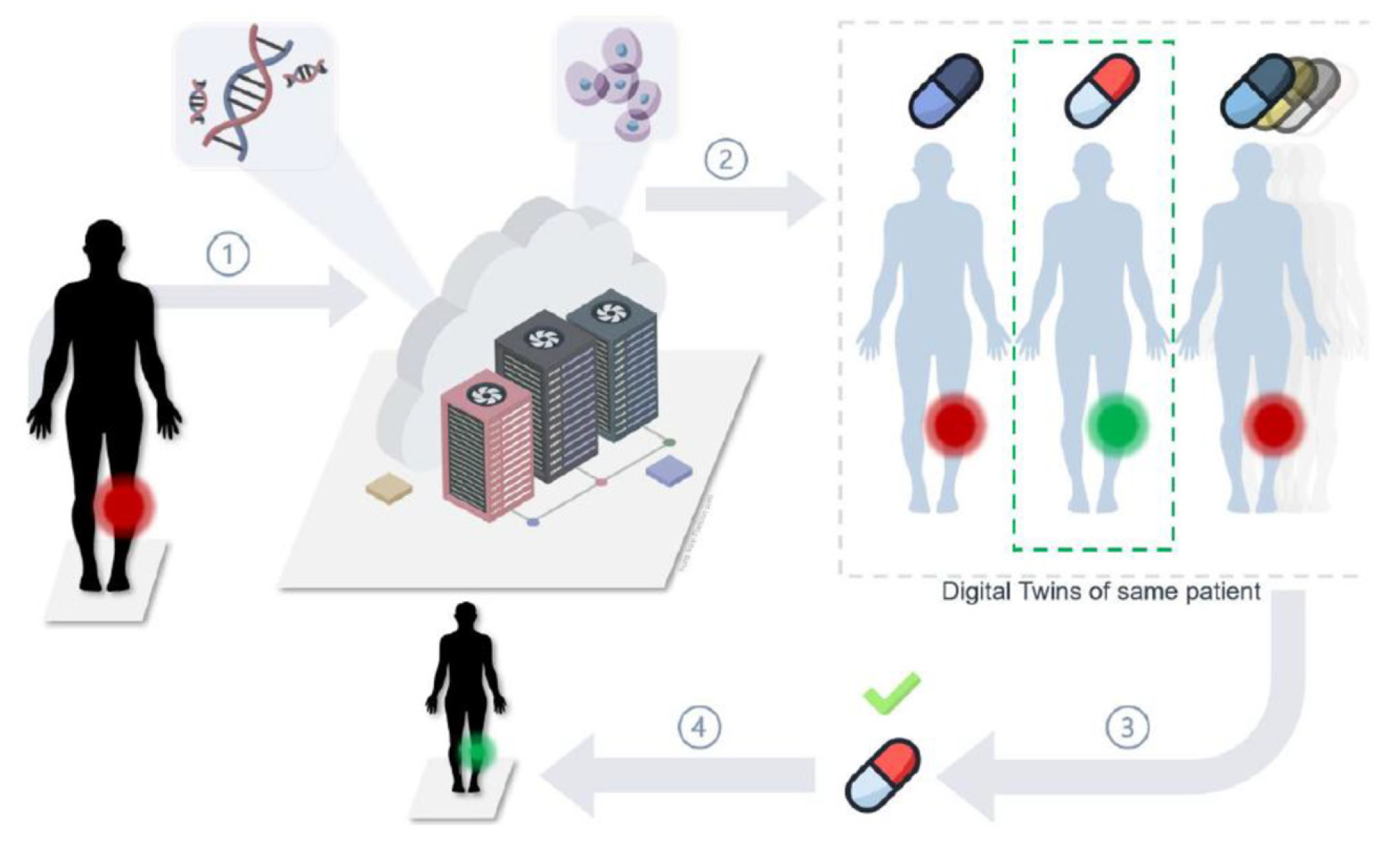
A DT-I was developed as an expert system to customize therapeutic interventions for a patient with an implantable medical device. The DT-I was equipped with an RL agent and a number of sophisticated algorithms to support periodical and informed therapy customizations based on the patient’s health conditions. DT-Is were developed as multi-scale models of organs or patients to track and assess patients’ state changes over time and thus improve clinical decision-making in drug discovery (see Figure 6) [38].
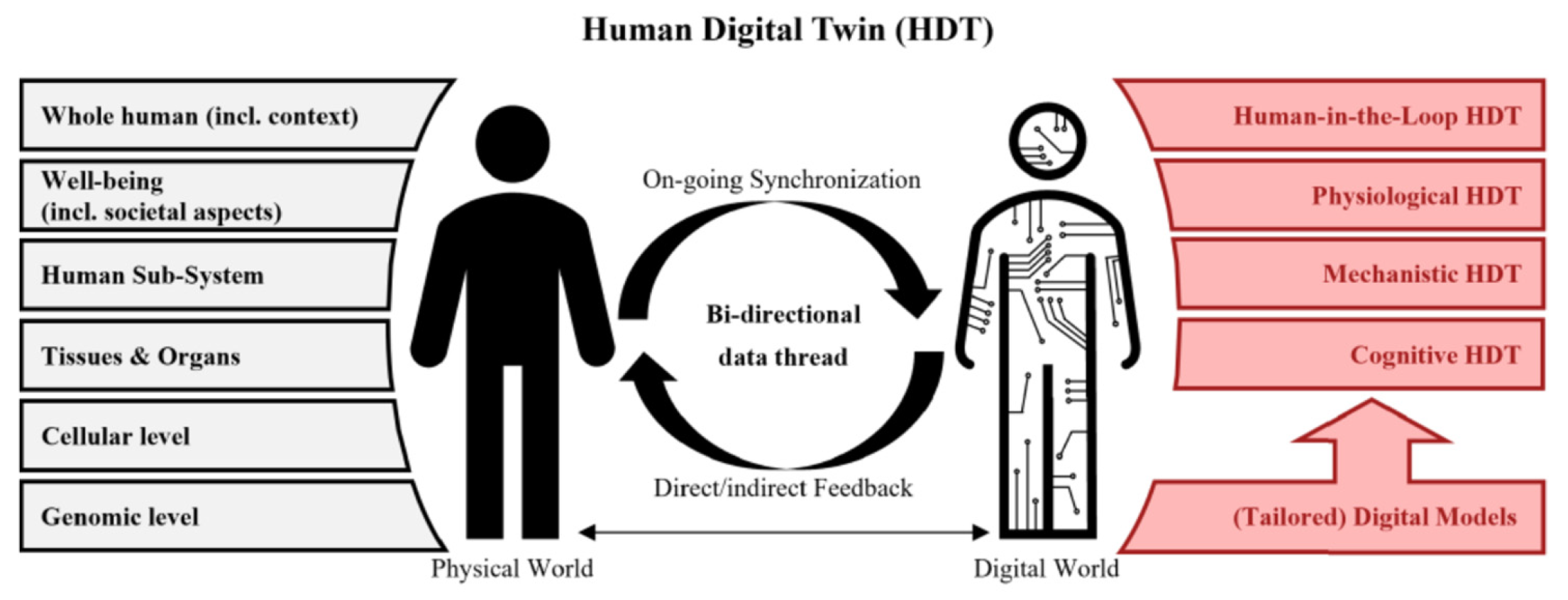
DT-Is were developed to calibrate, control, and validate a robotic biological system for enhanced robustness. Piersanti et al. [39] developed digital twins to model myocardial fibers in tissue characterization. It overcame the difficulty in reconstructing atrial fibers based on inaccurate medical images. Moreover, Lapce-Dirichlet’s rule-based method was adopted to provide robust annotations in bi-atrial morphologies in a physics-based digital twin. DT-Is were developed for medical staff to plan and schedule the use of operating and recovery rooms in a highly dynamic environment. They were data-driven, and raw data was used to track records of patients at entrances, exits, and operating and recovery rooms [40]. DT-Is were developed to virtually model patients and causal disease implications. DT-Is were used to evaluate the safety and efficacy of drug designs and medical devices, and the raw data was the interactomes of genes or proteins, which were used to infer the causality in pathophysiology [41]. Human DT-Is were used to monitor patient conditions and personalize upper-limb stroke rehabilitation using exoskeletons. DT-Is provided the data visualization and decision-support mechanisms for personalized feedback and the collaboration of patients with caregivers (see Figure 7) [42].
Kabir et al. [43] discussed the applications of DT-Is in the Internet of Medical Things (IoMT). DT-Is were developed to model patients, plan surgeries, manage medical resources, and personalize medical treatments. The applications were classified into patient avatars, smart hospitals, surgical planning, medical devices, pharmaceuticals, security, and privacy assurances. John et al. [44,45] provided a systematic review of using AI and DT-Is in prostate cancer care (see Figure 8). By integrating AI, including ML and DL, in DT-Is, medical treatments were improved in terms of accuracy, ease of diagnosis, and treatment individualization. Moreover, multi-model data with large language models (LLMs) and Vision-Language Models (VLS) was deployed to enable AI-driven DT-Is.
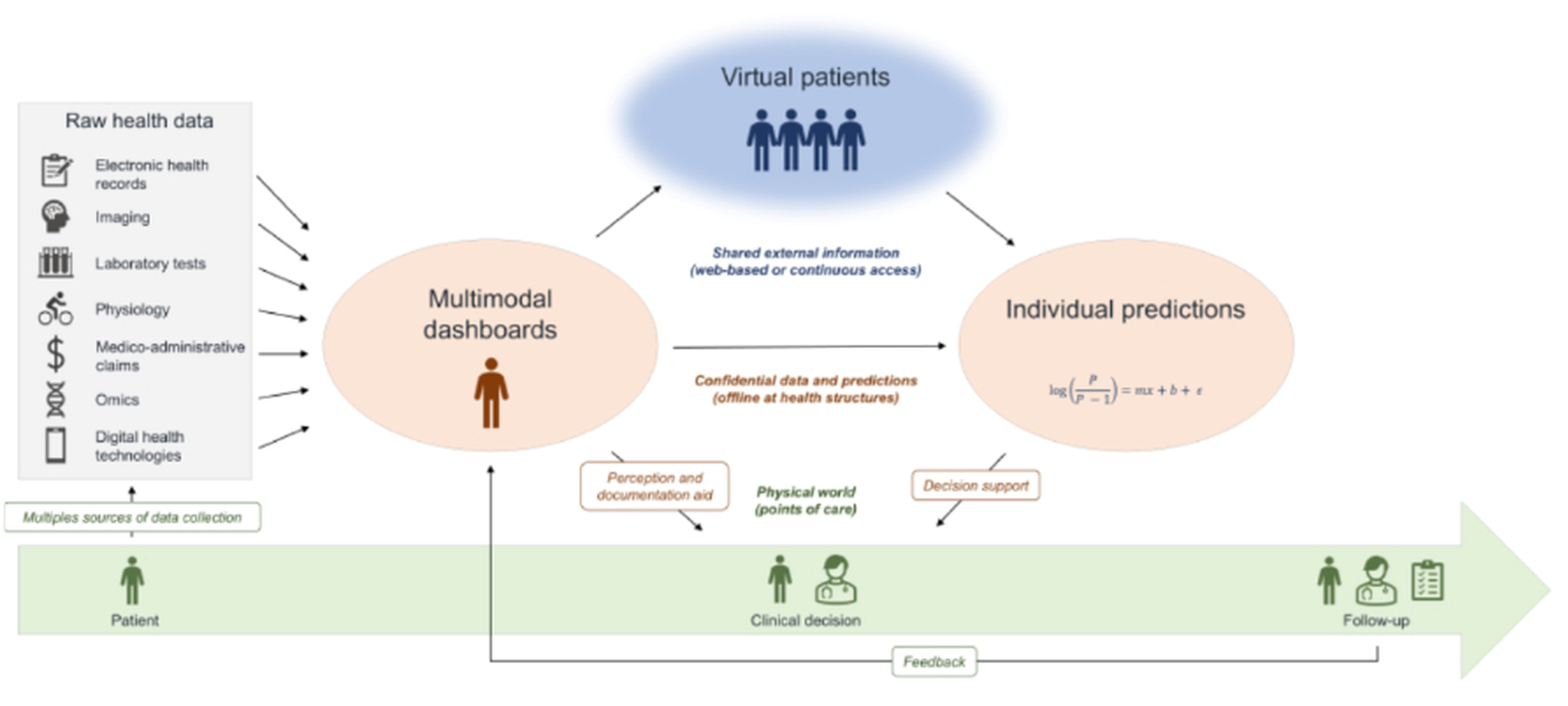
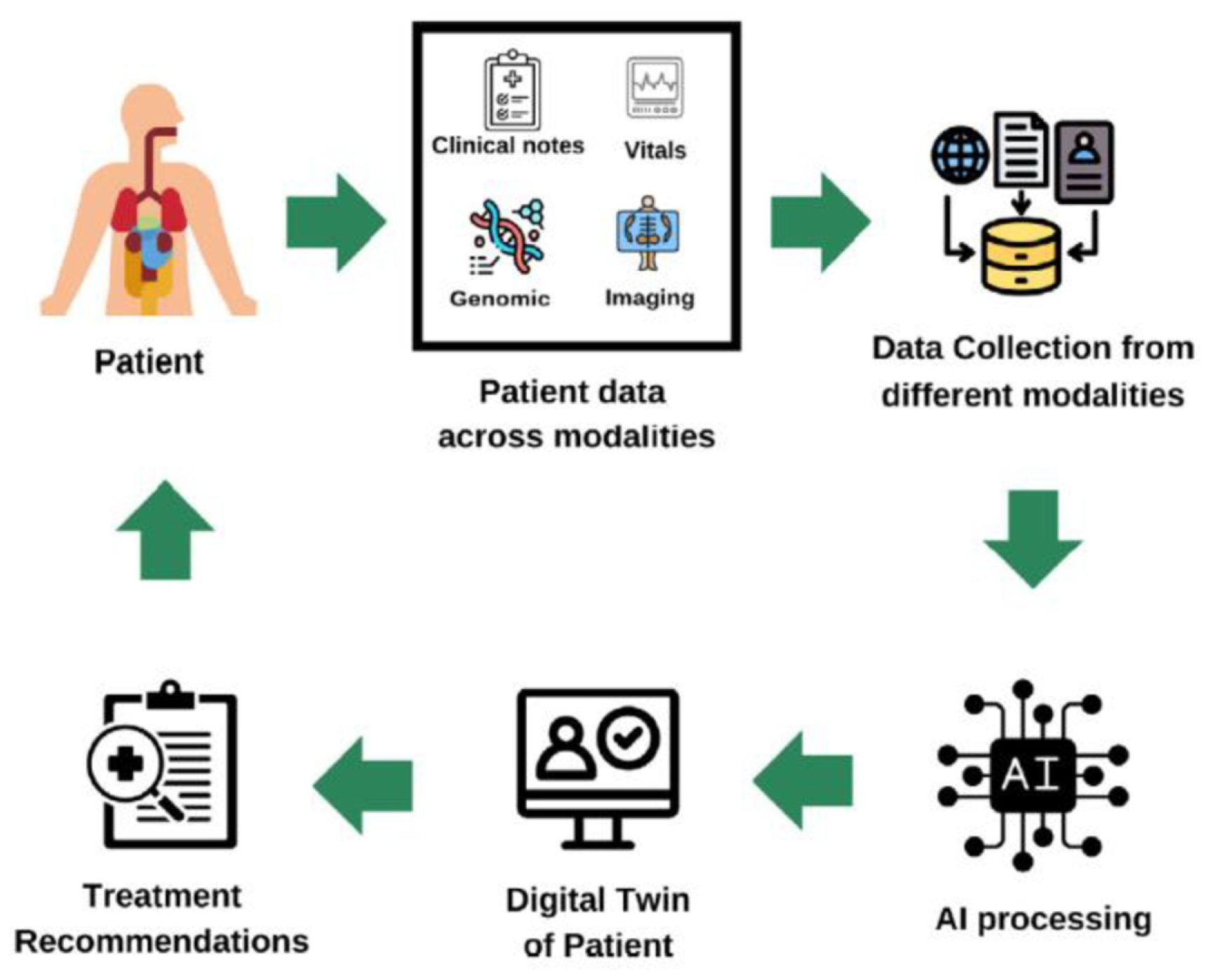
Patients were modeled as DT-Is through the collected data from physical examinations to assist with proper diagnoses and therapies in medical care, and available technologies for the creation and use of DT-Is were discussed to identify the challenges in practical applications [45]. Golse et al. [46] developed a DT-I to model blood circulation mathematically, subject to preoperative conditions. Hepatic flows were obtained from preoperative MRI and intraoperative flowmetry and estimated from cardiac outputs, and they were used to predict postoperative hemodynamic states. Precision medicine brought a paradigm shift in which DT-Is were utilized to support data-driven clinical decisions. Demuth et al. [47] proposed a data-centric framework to integrate multimodal health records for personalized clinical decisions for patients (see Figure 9).
DT-Is allowed for personalized treatment plans, modeling a surgery process, and predicting an individual’s response to certain therapies. Fazio et al. [48] used a Bayesian network model to search hepatic cancers, and their objective was to eliminate diagnosis errors caused by uncertain factors related to gender, age, and historical treatments. DT-I technologies were adopted in the COVID-19 pandemic to aid virus containment by running healthcare businesses with social distancing. A CanTwin framework was proposed to provide social distancing monitoring, queue inspection, headcounting, and tracking and surveillance of table occupancies to 1100 workers (see Figure 10) [10]. DT-Is were used in a medical waste transport system to promote the circularity of medical waste and mitigate the spread of the novel coronavirus [49].
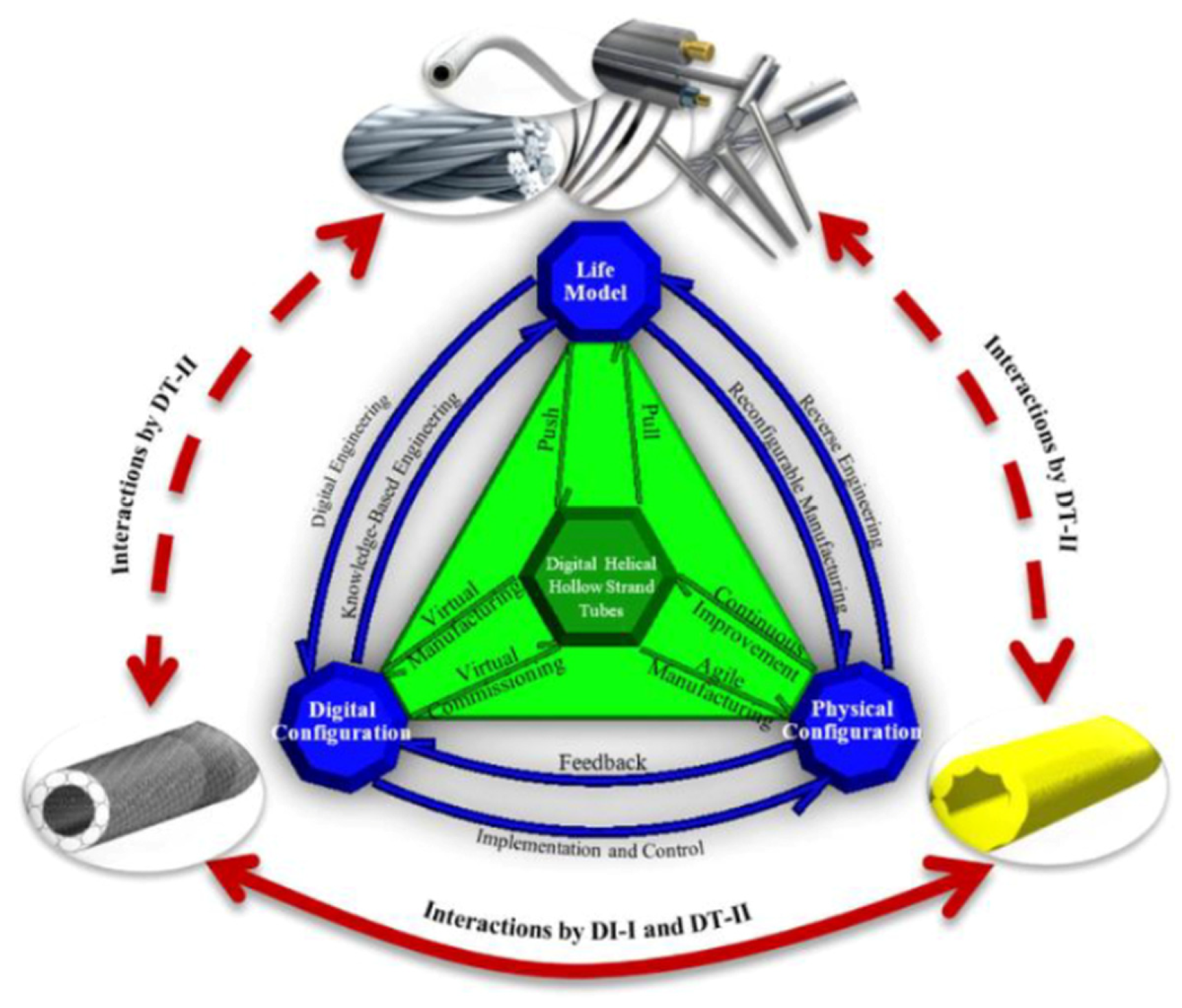
D’Amico et al. [50] developed a DT-based platform to integrate and process real-world clinical and genomic data for personalized medicine in hematology. DT-Is were integrated with AI for processing multimodal information to improve prognosis, diagnosis, and clinical decision-making. Bi et al. [5] developed a case study of using Digital Triad (DT-II) to develop new medical products (see Figure 11).

2.5. Conclusion of SLR and Organization of Paper

Orthopedic implants are vital for fixing broken bones; in particular, bone staples act as an effective option for cortical fixations. Most implants use Nitinol (NiTi) as a base material. However, nickel in Nitinol is an identified allergen that impacts around 18% of the population. Individuals who are sensitive to nickel may encounter some issues, such as contact dermatitis and various allergic responses. There is an emerging need to replace Nitinol-based materials in medical devices to (1) eliminate allergic reactions while preserving the mechanical properties of the product and (2) satisfy the functional requirements of a medical product and explore substitute materials. The main aim of this study is to explore the feasibility of substituting conventional Nitinol staples with Ni-free β-Ti alloy. The feasibility is explored in the aspects of material replacement, design customization, and virtual verification and validation (VVV).

3. Overview of Bone Fixations

A bone fixation is used to reestablish structural integrity and functional stability in a fracture caused by trauma, stress, or preexisting conditions such as osteoporosis and bone disorders. Countless fractures happen globally; around 6.3 million fractures are reported each year in the United States alone. The main objective of a bone fixation is to stabilize the broken bone pieces, alleviate pain, restore alignment, and promote effective biological healing.

3.1. Principles of Bone Healing and Fixation

The biological procedure of bone healing consists of three main phases: inflammation, bone formation, and remodeling. In the inflammatory phase, blood clots develop on site, and inflammatory cells invade to start tissue repair [51]. In the bone formation phase, soft calluses are developed to form hard calluses, ultimately by mineralization. In the remodeling phase, the bone is strengthened by substituting irregular microstructures with lamellar microstructures.
The effectiveness of a bone healing process is measured by the required stability and compression. Stability must be ensured at a fracture to allow for healing of the biological structure without dislocation. Compression must be sustained at a fracture to fill the gap at the fracture and accelerate the healing process. A solution to bone fixation must meet both the requirements of stability and compression.

3.2. Bone Fixation Techniques

Bone fixation techniques have progressed throughout history, transitioning from basic external splints to advanced internal fixation systems. Existing techniques are classified into two groups: (1) External Fixations, such as using splints and casts to support fractured bones externally. Contemporary external fixators are pins, rods, and clamps to stabilize fractures while preserving soft tissue. (2) Internal Fixations, such as using plates, screws, nails, and staples to support fractured bones internally. Techniques of internal fixation enable prompt mobilization and weight-bearing to enhance recovery results. Bone staples are most popular among internal fixation devices. Bone staples are widely applied in minor bone fractures, osteotomies, and joint fusions. Bone staples are usually U-shaped to apply a clamping force to two broken halves.

3.3. Applicable Materials

Early used materials, stainless steel and cobalt-chrome, offered high strength but induced stress shielding due to a high elastic modulus of 190–200 GPa compared to a low elastic modulus of 10–30 GPa of a bone structure [52]. In contrast, Titanium alloys such as Ti–6Al–4V improved biocompatibility, with a reduced modulus of ~110 GPa [53]. Titanium alloys could be stabilized by the elements Nb, Ta, and Zr to further reduce the modulus to 55–85 GPa, but this raised concerns about aluminum and vanadium toxicity [54].
NiTi (Nitinol) introduced shape memory and superelastic behavior, allowing bone staples to deliver compressive forces across osteotomy or fracture sites [55]. These properties enhance primary bone healing and simplify surgical fixation. However, a high percentage of ~50% of nickel in NiTi might cause allergic reactions and ion release [56,57]. It was promising if NiTi could be substituted by equilibrant materials such as Ni-free β-titanium alloys (e.g., Ti–Nb–Sn, Ti–Nb–Zr–Ta) [58,59]. Table 1 below shows a comparison summary of the different materials used for bone fixation methods.
Materials used in medical devices must meet strict requirements, and six well-respected standards and regulations associated with bone fixations are as follows: (1) ISO 10993 for Biocompatibility standards. All implantable medical devices must undergo biocompatibility evaluation per ISO 10993-1 [60]. This involves tests for cytotoxicity, sensitization, irritation, systemic toxicity, etc., unless sufficient prior evidence and rationales can waive certain tests. (2) Material and chemical composition standards. Regulatory bodies prefer materials with established track records. There are ASTM/ISO standards defining acceptable compositions and properties for common implant metals. For instance, ASTM F138 and ISO 5832-1 cover 316 L stainless steel for surgical implants; ASTM F136 and ISO 5832-3 cover Ti-6Al-4V ELI alloy. (3) ASTM F564 for Mechanical performance standards. For bone staples, ASTM F564 [61] Standard Specification and Test Methods for Metallic Bone Staples are directly applicable. These standards describe how to characterize a bone staple’s bending strength, tension/compression behavior, and especially its fatigue life under cyclic loading. Regulatory submissions for a new bone staple device must include mechanical testing per these methods. (4) Sterilization and material processing standards. Orthopedic implants must be provided sterile. ISO 11137 (radiation sterilization) or ISO 17665 are commonly followed. The material must tolerate the chosen sterilization method without degradation. (5) Regulatory approval process. In the United States, orthopedic bone staples are generally Class II medical devices. A manufacturer would typically pursue a 510(k) premarket notification, demonstrating that the new device is “substantially equivalent” to an existing legally marketed staple in intended use, materials, and performance. (6) Regulatory considerations for coatings and manufacturing. If the staple incorporates surface coatings, additional standards and tests come into play. For HA coatings, ASTM F1185 outlines requirements for composition and crystallinity; the FDA typically expects coating adhesion testing and dissolution testing if applicable. Coatings should also be assessed for potential delamination after fatigue. All manufacturing processes must occur under a certified Quality Management System [62].
The regulatory landscape ensures that an orthopedic implant material like a Ni-free β-Ti alloy bone staple meets all necessary requirements, i.e., biocompatibility, mechanical safety, corrosion/durability, and clinical effectiveness. The Ni-free alloy offers a compelling benefit of eliminating nickel-induced allergy risk, but it must clear the same bars set for legacy materials. By adhering to international standards and demonstrating through testing that the staple is safe and effective, developers can obtain approval for this new generation of implant. The interplay of advanced material science with regulatory compliance forms the foundation of bringing such innovative orthopedic solutions from the lab to the clinic.

3.4. Limitations of Existing Bone Staples

Despite their popularity and effectiveness, bone staples show limitations in four main aspects: (1) Nickel Allergy. Roughly 18% of people are allergic to nickel; using nitinol staples may cause contact dermatitis and other allergic reactions. (2) Stress Shielding. High-strength materials such as stainless steel and titanium produce insufficient elastic displacement to sustain a compression force at the expected level, and this slows the healing process. (3) Surgical Complications. An installed bone staple may be removed by surgery, which causes discomfort and a risk of infection.

4. Digital Twins in Biomedical Engineering

In healthcare, DT-Is are being applied to create high-fidelity “digital patients” or digital human twins (DHTs) that replicate an individual’s anatomy, physiology, and medical device implants in silico. These biomedical DTs integrate data from diverse sources. The goal is to enable precision medicine through in silico simulations of disease progression, treatment responses, and device performance unique to each patient. Early examples include cardiac DT-Is to test therapies on a virtual heart, oncology DT-Is to simulate tumor response to treatment, and orthopedic DT-Is for surgical planning. In all cases, the DT-I acts as a bridge between the physical and digital domains, allowing real-time feedback and predictive analytics based on the patient-specific model. However, there are notable challenges in applying DT-Is to medicine. Data integration and quality remain a major hurdle since aggregating multimodal data such as images and bio-signals into a coherent model is complex. DT-Is also lack standardization and interoperability. Privacy and security of patients’ data is another concern; a clinical DT-I must safeguard sensitive data and be resilient against cyber-attacks [63,64].

4.1. Modeling Bone Healing

Finite Element Analysis (FEA) and biomechanical modeling techniques allow the construction of patient-specific bone models to evaluate the distributions of stress, strain, and displacement of a bone staple subjected to given loads. For example, Aubert et al. [65] created a patient-specific FE model of a tibial plateau fracture with different fixation strategies and simulated 12 healing scenarios. Additionally, researchers have introduced computational healing biomarkers to correlate with joining strengths of bone staples.

4.2. Real-Time Monitoring of Bone Healing

A DT is able to update itself with real-world patient data over time. In the healing process of a fractured bone, the data should be acquired from the implant. Advances in “smart implants” are enabling staples, plates, or rods to collect data directly. For example, Lin et al. [66] instrumented a bone plate with electrical impedance spectroscopy to monitor a fracture in vivo. Barri et al. [67] developed a 3D-printed spinal fusion cage with a strain sensor to detect the load on the cage.

4.3. Predictive Maintenance

A bone staple applies compression while the fracture heals. If the staple is at risk of mechanical failure or if it is no longer needed once the bone has sufficiently healed, knowing this in advance is crucial. A digital bone staple model can be used to assess the structural health of an implant over time. If the model predicts that stress exceeds the yield strength, it yields an early warning of possible fracture. Another application of a digital model is to schedule a removal time when the staple is placed as a temporary resolution. By simulating a scenario where the staple is virtually removed, DT-Is can be used to evaluate whether the bone alone can handle physiological forces. Hernigou et al. [68] integrated DT-Is and AI to personalize joint axes and guide a surgical robot.
The data aggregated from many patients’ digital twins can be utilized for product improvement. Digital twin-driven prognostics was coupled with big data analytics to improve maintenance scheduling of medical resources [69,70]. Orthopedic implants will not be seen as static devices but as part of a connected cyber-physical system where continuous monitoring and predictive analytics work hand-in-hand to ensure optimal performance and patient safety [71].

5. Simulation of Bone Staples

Simulation tools are widely used to model and analyze bone staples. By modeling a bone staple and its interaction with bone, engineers can predict performance, optimize geometry, and address potential issues before clinical use [52,69,72,73,74].

5.1. Finite Element Analysis (FEA)

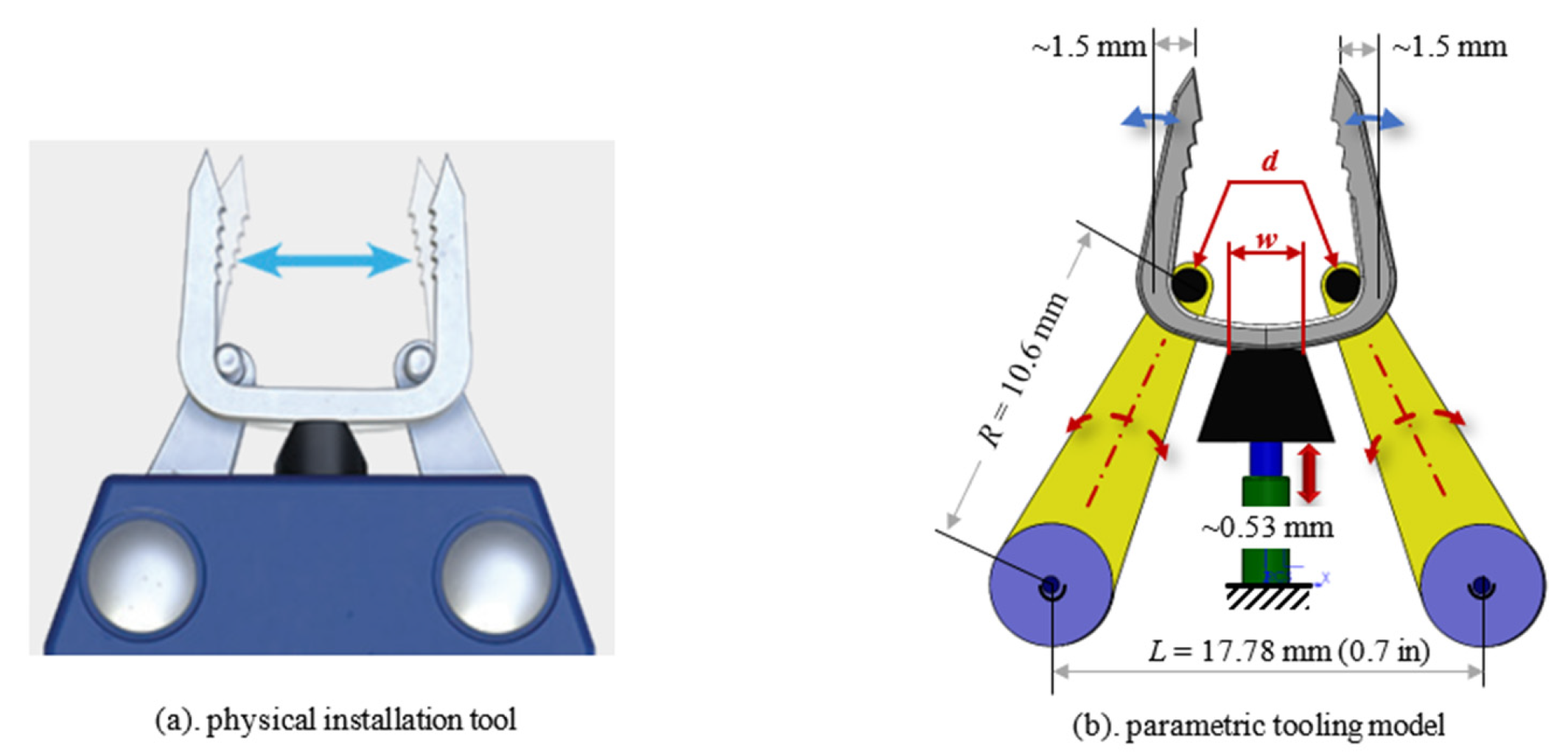
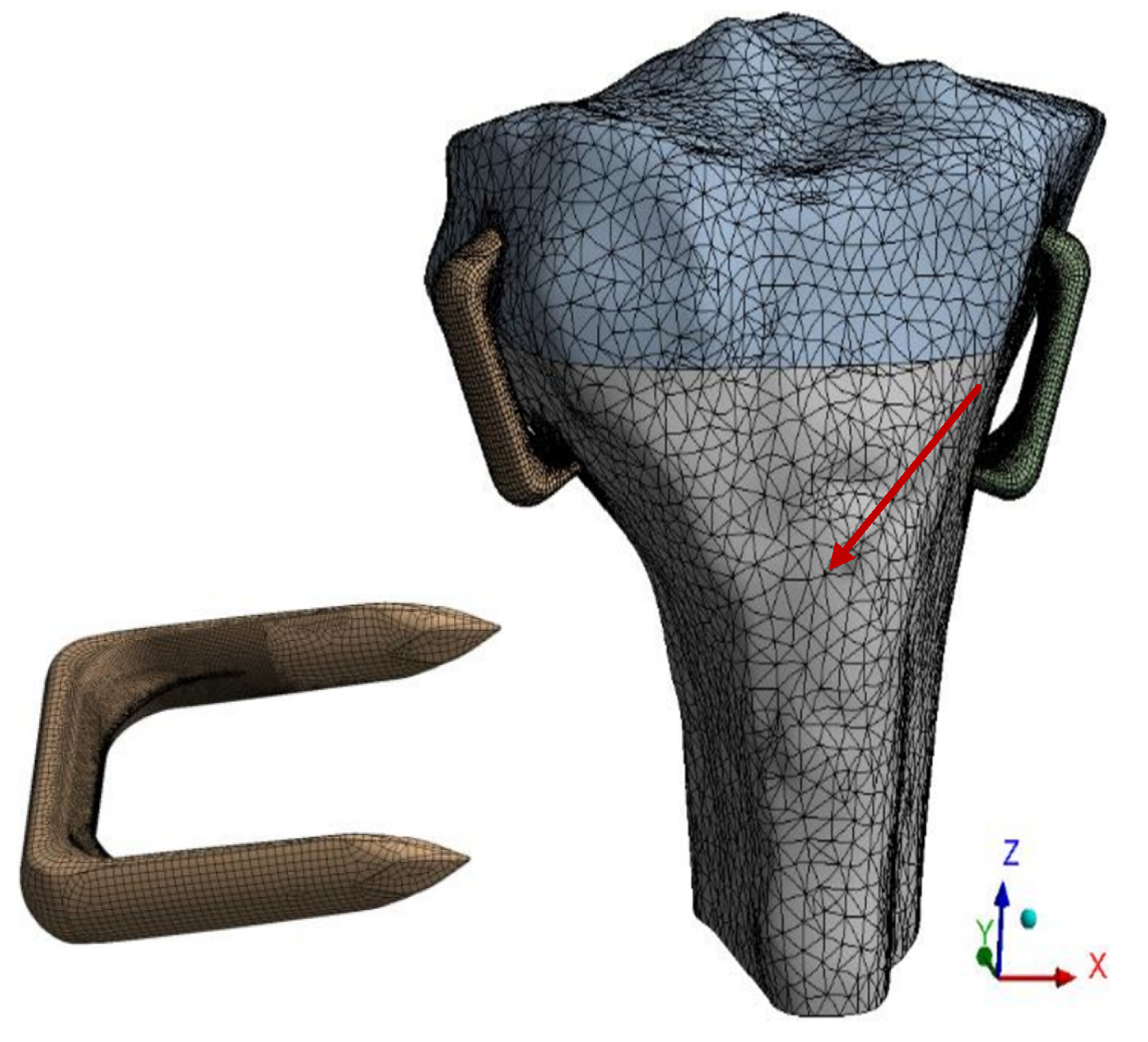
Finite Element Analysis (FEA) is a computational method for managing complexity by subdividing a structure into small elements. Figure 12 shows a finite element model of a tibia with two Blount’s staples [75]. The bone was modeled with separate cortical (blue) and cancellous (gray) regions. Fine mesh refinement was applied around the staple legs to evaluate stress concentrations in critical regions.
FEA studies have provided key insights into bone staple design. For example, Curenton et al. [73] performed FEA on shape-memory and superelastic Nitinol (NiTi) staples with different bridge widths in healthy vs. osteoporotic bone. They found that increasing the length of a staple increased the compression force at the bone interface while lowering peak stress. Notably, shape-memory NiTi staples were predicted to exert greater contact force than superelastic NiTi. These FEA results informed surgeons that using a longer, shape-memory staple could be beneficial in poor-quality bone, as it would maintain alignment with less risk of stress-induced bone damage.

5.2. Multi-Scale Modeling

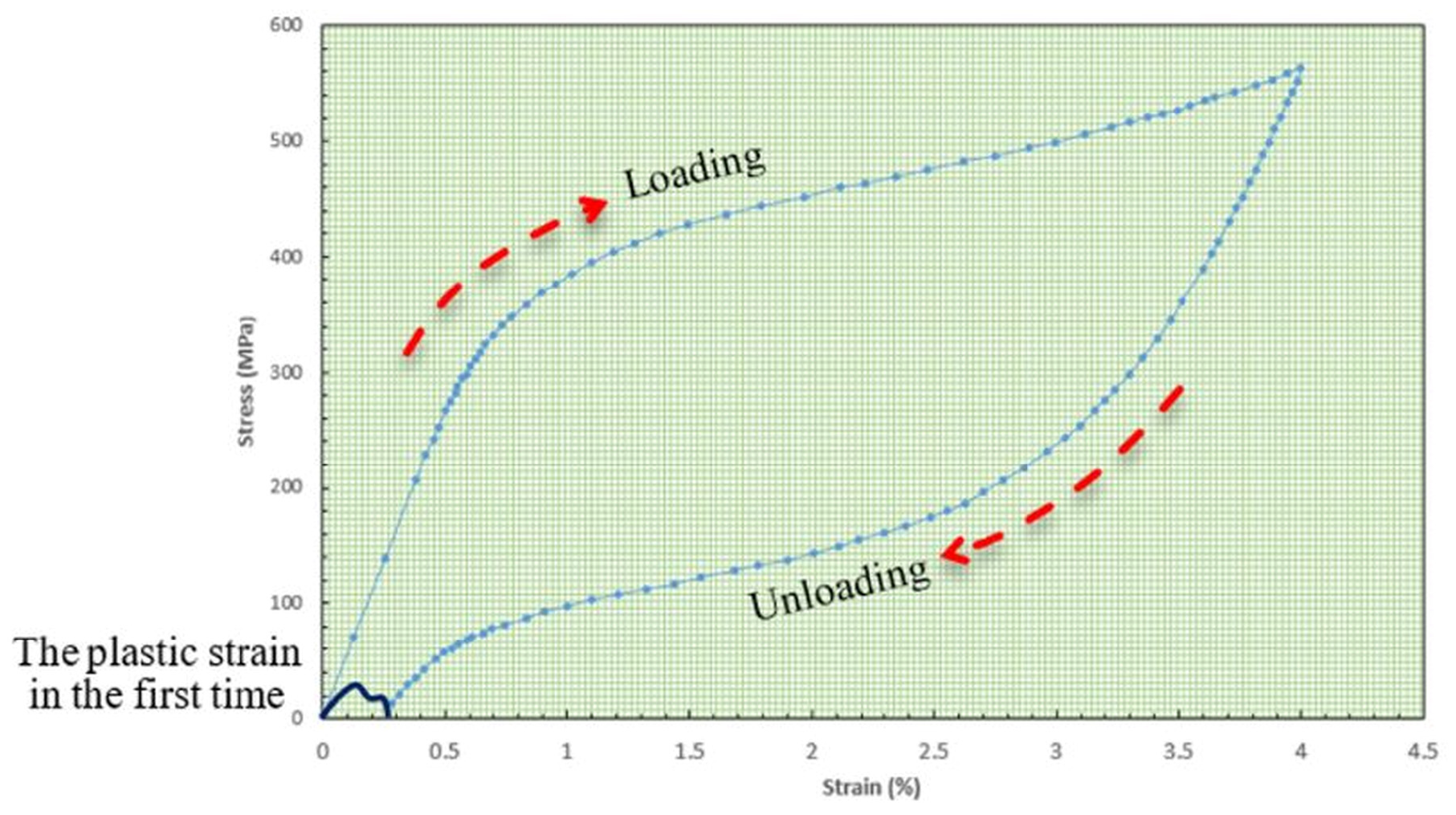
While standard FEA typically focuses on the implant and adjacent bone at a local scale, multi-scale modeling extends simulations to consider interactions across biological length scales. In orthopedic staples, multi-scale approaches can link the musculoskeletal mechanics of a limb. For example, Shu et al. [76] developed a concurrent musculoskeletal model of the knee that could simulate full gait cycles while computing local tissue stresses. The model was used to evaluate mechanics at both the body and tissue levels. Jia et al. [59] developed a specialized superelastic model for Ni-free β-Ti, and the model was calibrated by using experimental data; the simulation on the proposed model produced outcomes that were realistic in a loading and unloading cycle.

5.3. Verification and Validation

No matter how sophisticated a simulation is, verification and validation is essential to ensure the simulation results can be utilized appropriately. In the context of orthopedic staples, this often means mechanical testing of staple prototypes and cadaver or synthetic bone models to measure outcomes like clamp force, displacement, and failure modes, which can then be directly compared to FEA results. Such tests might include four-point bending of the staple, cyclical loading to simulate gait or healing, and pull-out or push-in tests to assess fixation strength. For example, Frydrýšek et al. [75] combined FEA with an in vitro experiment for a stainless steel epiphyseal staple used in guided growth (see Figure 13). Their FEA predicted the maximum stress in the staple and the total displacement under a simulated growth plate load; these predictions were then verified by a physical loading experiment using a bone analog model. Notably, the experiments in that study determined the staple could withstand a force well above physiological levels, confirming that the FEA had not overlooked any weak point in the staple design. This agreement between the FEA and bench tests gave confidence that the staple would be safe and effective under actual clinical forces.
Designers of Ni-free β-Ti staples have also emphasized validation. In the β-Ti vs. NiTi staple study [77], after conducting FEA and initial design tweaks, researchers performed cyclic three-point bending tests on actual prototypes to verify the staple’s superelastic performance. The empirical force–displacement curves closely mirrored the FEA predictions—for the heat-treated β-Ti, the unloading curve and permanent set were nearly identical to the NiTi staple’s behavior, as the simulation had suggested. Both materials exceeded the minimum required clamping force of ~50 N in these tests, confirming the FEA result that the Ni-free staple could achieve adequate compression. In another validation effort, Jia et al. [75] compared FEA outputs of stent expansion with actual measurements, finding good agreement when the correct material model was used. This kind of close correspondence between computational and experimental results is crucial—it demonstrates that the simulation techniques are capturing reality. When discrepancies arise, engineers revisit the models to refine material properties or contact conditions until the FEA aligns with experimental data. Through iterative calibration, the simulations become reliably predictive.
Ultimately, validated simulation tools can substantially accelerate development while ensuring safety. They allow researchers to explore a wide design space efficiently, then confirm the most promising solutions via targeted experiments. Improved validation coupled with advanced modeling enabled FEA to optimize implant designs and inform surgical practice effectively [78]. In the case of β-Ti bone staples, this means engineers can confidently refine the staple’s shape or heat treatment to harness the alloy’s benefits without compromising mechanical stability. The simulation–experiment feedback loop thus ensures that Ni-free β-Ti staples are not only designed with state-of-the-art computational insight, but are also empirically proven to meet the demanding conditions of orthopedic fixation.

6. Clinical Experiments

Titanium-based orthopedic staples have demonstrated high success rates in clinical settings for small bone fixation and arthrodesis. In foot and ankle surgery, NiTi compression staples are increasingly favored due to their ease of use and ability to provide continuous compression across fusion sites. A 2024 systematic review by Reddy et al. [79] reported that patients treated with NiTi staples for forefoot and midfoot fusions had significantly improved postoperative pain and function scores and an overall fusion rate of ~94–99% in the reviewed series. These union rates are comparable to or better than traditional plate-and-screw constructs. For example, in first metatarsophalangeal joint fusions, NiTi memory staples achieved ~96–99% union in some reports, similar to the ~95% union achieved with dorsal plating plus screws. Notably, NiTi staple fixation has allowed immediate postoperative weight-bearing in certain cases without compromising healing: Ravenell and Doh [80] achieved 94% union with immediate weight-bearing after hallux fusion using NiTi staples.
Human case studies highlight additional advantages of titanium-based staples. Because staples are a single low-profile device spanning the bone interface, they result in less bulky hardware than plates, improving radiographic visualization of the fusion site. This can facilitate monitoring of bone healing on X-rays. Staples also avoid prominent screw heads or hardware on the dorsal foot, reducing soft-tissue irritation. In a representative series of tarsometatarsal fracture-dislocations, Dombrowsky et al. [81] found that fusion with NiTi staples had a significantly lower non-union rate than conventional plate and screw fixation. The NiTi staple group also showed shorter operative and tourniquet times due to the simpler implant technique.
Another common application is in small joint fusions of the forefoot. NiTi staples used for procedures like Akin osteotomy or interphalangeal joint arthrodesis have shown solid fixation and high patient acceptance. Surgeons report that the constant compressive force of NiTi staples promotes bone apposition and may accelerate fusion biology. In finite-element and lab simulations, NiTi staples generate dynamic compression that can increase slightly over time, potentially enhancing bone healing at the interface. Clinical outcomes reflect these biomechanical benefits: pain scores and functional outcomes improved significantly in patients treated with NiTi staples in multiple studies. Complications like hardware breakage or non-union are relatively rare.

6.1. NiTi and Nickel-Free Alloys

While NiTi staples are widely used, the presence of ~50% nickel in NiTi raises concerns about metal allergy and potential Ni ion release. This has motivated the development of nickel-free β-titanium alloys for staples that can offer similar mechanical performance without Ni-related risks. Nickel-free β-Ti alloys have inherently good biocompatibility and can be engineered to exhibit shape-memory or superelastic behavior. A prominent example is a Ti–Nb-based β-titanium alloy, which shows large and stable superelasticity at room and body temperature. This Ni-free alloy can be mass-produced and heat-treated to tune its plateau stress, achieving mechanical properties on par with NiTi. Figure 14 illustrates the superelastic stress–strain response of a Ni-free β-Ti staple material compared to a conventional NiTi alloy [58]. The Ni-free β-Ti displays a hysteresis loop and plateau stresses similar to NiTi’s, indicating comparable ability to maintain compression and recover shape after deformation.
Head-to-head mechanical comparisons have been reported between NiTi and Ni-free titanium staples. In a recent laboratory evaluation [77], an experimental Ni-free β-Ti staple was tested against a commercial NiTi staple of the same dimensions. Initially, the β-Ti staple produced slightly lower clamping force and exhibited more permanent set upon deformation. However, after a brief aging heat treatment, the Ni-free β-Ti staple’s performance improved markedly—its closing force increased to ~210 N with negligible residual deformation, essentially matching the NiTi staple’s behavior. Both staple types were able to deliver well above the minimum ~50 N compression needed for bone healing. This study concluded that with optimized processing, Ni-free β-Ti staples can achieve dynamic compression equivalent to NiTi, making them viable alternatives for patients with nickel sensitivity.

6.2. Experiments on Other Materials

Azham Shah et al. [82] compared the bending strength of staples made from stainless steel, cp-Ti, and a Ni-free β-Ti. In four-point bending, the Ni-free Ti–40Nb staple showed lower flexural strength and actually fractured at about 6.8 N/mm deflection, whereas the cp-Ti and steel staples bent plastically but did not break. The authors noted that the as-sintered β-Ti microstructure and stress concentration at the staple corners likely caused brittleness. Modern β-Ti alloys like Ti–Nb–Zr–Sn, however, can be optimized to avoid such issues. Importantly, Ni-free alloys eliminate the risks of Ni-induced cytotoxicity and allergic response. Nitinol implants can release trace Ni ions or particles over time, which, in Ni-sensitive patients, may trigger inflammation or fibrous encapsulation. By using only non-toxic elements, Ni-free β-Ti staples improve biocompatibility while still leveraging the low Young’s modulus and elasticity of β-phase titanium. In summary, nickel-free titanium staples have shown comparable mechanical fixation to NiTi staples in experimental settings, provided their composition and processing are carefully controlled. They represent a promising solution to achieve the benefits of shape-memory compression staples without the drawbacks of nickel.

6.3. Biodegradable Bone Staples

Biodegradable bone staples have been proposed for fracture fixation and arthrodesis in scenarios where load demands are relatively low. The primary appeal of biodegradable staples is that they gradually resorb after the bone heals, obviating the need for implant removal surgery and minimizing long-term artifacts on imaging. Materials under investigation for such staples include bioresorbable polymers and, more prominently, biodegradable metals like magnesium alloys. Magnesium-based implants possess mechanical properties closer to natural bone, which can reduce stress shielding and even stimulate osteogenesis as they corrode.
Several experimental studies in the last few years have evaluated Mg alloy staples for orthopedic use. Deichsel et al. [83] conducted a controlled laboratory study comparing a prototype Mg staple to standard metallic staples for ligament fixation in a porcine knee model. After cyclic loading and pull-out tests, the Mg staples showed no significant difference in primary stability compared to stainless steel staples. Specifically, after 1000 cycles subject to a 100 N load, all groups had similar displacement with no mechanical loosening difference. The magnesium staples even had a slightly higher average failure load than the steel staples, though this was not statistically significant. The conclusion was that Mg staples can provide comparable initial fixation strength to metallic staples in cortical bone applications. These results align with the notion that magnesium’s mechanical integrity can hold through the critical healing period in low-load scenarios.
In clinical contexts, fully degradable staples are not yet widely used, but analogous devices have shown encouraging outcomes in non-weight-bearing or semi-weight-bearing bones. For example, a randomized trial in hallux valgus surgery found that an MgYREZr alloy screw produced equivalent radiographic union and clinical scores to a titanium screw at 6-month follow-up. There were no foreign-body reactions or osteolysis observed as the Mg implant slowly dissolved. This suggests that a well-designed Mg implant can maintain stability long enough for the bone to heal, and then gradually be replaced by natural bone without causing adverse tissue responses. In the context of staples, this concept has been applied to small joint fusions and ligament reattachments. Since staples usually bridge relatively short bone interfaces, they are ideal candidates for biodegradable materials. The key limitation is that the staple must retain sufficient strength during the entire healing phase. Magnesium’s corrosion can be rapid, but modern Mg alloys have improved corrosion control, so that significant strength is retained for 4–6 weeks before gradually declining. Biodegradable staples have demonstrated safety in preliminary animal and lab studies. Amano et al. [84] tested an Mg alloy surgical staple in a porcine intestine model and found complete healing with no device-related complications or inflammation as the staple resorbed.

7. DT-Is in Advancing Bone-Fixing Solutions

Modern bone-fixation devices are essential for stabilizing fractures and osteotomies, yet they face well-documented limitations. These challenges span biomechanical issues, biological responses, clinical complications, and broader patient impacts. We review the key limitations of current bone-fixing materials with supporting evidence from recent studies below.

7.1. Stress Shielding and Biomechanical Imbalance

When a rigid implant is fixed to bone, it often carries a disproportionate share of the load, shielding the surrounding bone from normal stresses. This stress shielding arises from the biomechanical imbalance between the implant’s stiffness and that of bone. Common metals like stainless steel or Ti-6Al-4V titanium alloy have elastic moduli on the order of 100–200 GPa, vastly higher than cortical bone (~3–30 GPa). As a result, under physiological load, the stiff implant bears most of the force, and the bone experiences reduced stress. According to Wolff’s law, bone that is under-loaded will resorb over time. Indeed, the leading cause of implant loosening and periprosthetic fracture in orthopedics is this loss of bone density due to stress shielding. In other words, the mismatch in material properties causes the implant to outwork the bone, preventing normal load transfer and prompting bone remodeling in the wrong direction. Due to stress shielding, the bone–implant system can become biomechanically imbalanced. The surrounding bone may become osteopenic and weaker, which jeopardizes long-term fixation. Clinically, this is evidenced by cortical thinning or even late fractures after implant removal (since the shielded bone is more fragile). Research has quantified this effect: for example, a Ti-6Al-4V plate or stem can reduce local bone stress by ~50%, consistent with experimental measurements. The consequence is often implant loosening or failure at the bone–implant interface over time as the bone support deteriorates.
Engineers and clinicians recognize that achieving a closer stiffness match between implant and bone is crucial to mitigate stress shielding. Flexible or low-modulus materials allow more load-sharing. Studies have shown that when materials with a modulus closer to bone are used for fixation, the stress shielding phenomenon is markedly reduced. For instance, in a simulation comparing plate materials, a stiff titanium plate absorbed most stress, whereas a more bone-like material distributed loads more evenly, leaving higher stress in the bone. This underscores the design principle that balanced load-sharing is needed for healthy healing. If the implant is too stiff, the bone’s natural mechanical stimulus is removed; conversely, if an implant is too flexible, it may allow excessive motion. Thus, an optimal biomechanical balance must be struck.
In summary, stress shielding is a fundamental limitation of metallic bone-fixation devices. The high rigidity of metals protects the bone from stress and can lead to a cascade of issues: diminished bone mass, weaker fixation, and increased risk of failure. The challenge moving forward is developing implants with mechanical properties tailored to maintain bone stimulation so that healing bone shares the load. Lower modulus beta-titanium alloys have been proposed as a solution, as they inhibit bone resorption by reducing stress shielding. This will be explored in later sections of the thesis. First, we examine other major limitations of current implants, beginning with the release of metal ions and associated biological reactions.

7.2. Metal Ion Release and Allergic Reactions

Most orthopedic alloys contain elements that can leach into the body, raising concerns about metal ion release and subsequent biological reactions. Over time, corrosion or wear of implants may release ions such as nickel, chromium, cobalt, aluminum, or vanadium into surrounding tissues or circulation. While generally resistant to corrosion, even stainless steel and Ti alloys can shed minute particles or ions under physiological conditions. These metal ions can trigger local inflammation, adverse tissue responses, or systemic effects, including allergic reactions in susceptible patients.
Nickel is a major concern due to its prevalence in alloys and its well-known allergenicity. Stainless steel typically contains ~12–14% Ni, and Nitinol is ~50% nickel. Ni can be released from these implants in small amounts, especially if the protective oxide layer is disrupted. It is estimated that roughly 8–10% of the general population is allergic to nickel [85]. Patients with a history of nickel allergy can develop localized dermatitis, eczema, or implant-site inflammation if exposed to Ni-containing implants. There have been case reports of cutaneous rashes directly overlying orthopedic hardware in highly nickel-sensitive individuals, as well as systemic reactions attributed to Ni from implants.
Allergic or hypersensitivity reactions to metallic implants, though relatively rare, are increasingly recognized. Among patients with failed implants, a high proportion tested positive for metal hypersensitivity, compared to about 20% in patients without implants [86]. There is a trend that patients with orthopedic implants show higher rates of positive metal allergy tests than those with no implant. In a cohort study, ~20% of people with no implant had sensitivity to common metals. In contrast, nearly half of patients with a stable implant showed some metal allergy, and almost 60% of patients with a failed implant did so. This suggests that implants may induce or promote sensitization in some individuals, or that hypersensitivity may contribute to implant failure.
To address these issues, research is actively exploring Ni-free, allergy-free alloys [87]. β-type Ti alloys not only eliminate Ni but also often have a lower modulus. Similarly, stainless steel variants with negligible Ni content and new Co-Cr formulations are being tested to reduce ion release. Coating technologies can also act as barriers to metal ion release. The overall goal is to maintain the mechanical performance of metal implants while minimizing any biological “leakage” that could harm tissues or provoke immune reactions.

7.3. Complications and Revision Surgeries

Even with ideal biomechanical integration and biocompatibility, complications can arise from bone-fixation devices. These complications include mechanical failures, biological issues, and other adverse outcomes. Such complications often necessitate revision surgeries or other interventions. Below, we outline common complications of current bone-fixing solutions, along with their incidence and implications.

7.3.1. Hardware Loosening

Even if the implant itself stays intact, screws or other fixation points can loosen. Loosening may result from repeated micro-motion, poor bone quality, or stress shielding. When a screw backs out or a plate detaches from bone, stability is lost. Clinically, loosening presents as pain, motion at the fracture site, or radiographic signs. It often leads to delayed union or non-union of the fracture. One consequence of stress shielding is that bone adjacent to implants becomes osteoporotic, which can precipitate loosening and even adjacent fractures. Loosening is a common mode of failure in joint replacements and is also seen in fracture fixation—one study identified aseptic loosening as a main reason for revision in joint arthroplasty.

7.3.2. Delayed Union and Non-Union

If the implant’s mechanical environment is not conducive to healing, the bone may heal slowly (delayed union) or not at all (non-union). Excessive rigidity can suppress the small inter-fragmentary motions needed to stimulate callus formation, leading to “failure of biology” in healing. On the other hand, insufficient fixation stability can result in persistent motion and a fibrous non-union. In both cases, revision surgery might be required—either to revise the fixation strategy or to exchange the hardware. Non-union rates vary by location and patient factors; for example, tibial shaft fractures treated with intramedullary nails show non-union in roughly 5% of cases, whereas certain complex osteotomies with plating can have higher rates. Each non-union often means an additional surgery, prolonged rehabilitation, and increased cost.

7.3.3. Infections

Infection is a serious complication that can occur after internal fixation. Bacteria can colonize the implant surface and evade immune clearance. The infection risk depends on factors such as the injury type, surgical environment, and patient health. For clean closed-fracture surgeries, deep infection rates are relatively low. However, in open fractures or high-energy injuries, infection rates can be much higher.

7.3.4. Adjacent Tissue Damage

Rigid implants can sometimes cause damage to surrounding soft tissues. For instance, a common issue with orthopedic plates is tendon irritation or rupture. The plate’s presence on the bone surface can chronically rub against tendons or ligaments. In distal radius fracture fixation, extensor tendon ruptures have been reported due to the plate edges; in one large series, tendon injuries were noted among the reasons for re-operation. Similarly, prominent screws can irritate or injure nerves. Such complications often require hardware removal or surgical repair of the affected tendon. In the series of 665 distal radius cases, the overall complication rate was 11.3%, with causes like tendon rupture and nerve compression necessitating revision in about 10% of cases. Thus, even if the bone heals uneventfully, the implant can cause “collateral” damage that leads to another surgery.

7.3.5. Hardware Irritation and Patient Discomfort

Current bone-fixing solutions are prone to a spectrum of complications. Many of these complications feed into one another. This creates a vicious cycle that is both clinically and economically costly. An ideal bone staple or fixation device would minimize these complications by providing appropriate stability without over-rigidity, resisting corrosion and wear, and being as biocompatible and unobtrusive as possible to surrounding tissues. Ni-free β-Ti alloys are being explored in light of these goals: they offer lower modulus, excellent corrosion resistance, and elimination of Ni.

7.4. Affordable Patient-Oriented Solutions

The limitations of existing bone-fixing solutions have consequences that extend beyond the operating room; this affects healthcare costs, resource utilization, and patient quality of life. Economic and patient-centered challenges are increasingly important in evaluating any medical technology, including orthopedic implants. Below, we highlight key issues in this area.

7.4.1. Cost of Complications and Revisions

When an implant causes a complication or fails, the ensuing treatments can be very costly. Revision surgeries typically are longer and more complex than initial surgeries, incurring higher hospital charges. Weber et al. [88] noted that reimbursement for revisions increased by only ~24%, not matching the 76% increase in cost. This discrepancy means hospitals and patients often bear a financial burden. For the patient, even if insurance covers the procedure, there are indirect costs: lost wages during additional recovery time, costs of rehabilitation or long-term care if complications cause disability, etc. On a system level, high complication rates strain resources—operating room time, hospital beds, and clinician effort that could have been spent on new patients are instead devoted to redoing prior surgeries.

7.4.2. Burden on Patients

Complications and additional surgeries significantly impact a patient’s well-being. Revision surgery is not only physically taxing but also psychologically distressing. Patients often report frustration, anxiety, or depression when an implant fails. Even in the absence of a major complication, the mere presence of an implant can affect quality of life. Many patients experience chronic pain or discomfort from their hardware. For instance, long after a fracture has healed, a patient might have lingering pain on exertion due to a protruding screw or a stiff plate on a bone. Such pain can limit return to full function.

7.4.3. Hardware Removals

As mentioned, a significant number of patients eventually undergo elective hardware removal to improve comfort. This trend is both a patient-centered issue and an economic one. Hardware removal is one of the most frequently performed orthopedic procedures—studies report that up to one-third of patients with certain implants will later have them removed. While removal surgery is usually simpler than the original fixation, it still requires anesthesia and carries ~9% complication risk. From the patient’s perspective, this is another operation to endure, often with weeks of rehabilitation afterward. The high prevalence of hardware removal underscores a limitation: ideally, an implant should be tolerable enough to remain in place for life, rather than necessitating routine removal once its job is done. Patient-centered design would favor low-profile, lightweight implants that patients cannot feel. Ni-free β-Ti alloys might contribute here by enabling thinner, more elastic designs and by causing less irritation. If successful, that could reduce the frequency of hardware removals, benefiting patients and the healthcare system.

7.4.4. Resource Allocations

Considering these economic and patient-centered challenges, the development of improved bone-fixing solutions is not only a matter of engineering but also of public health. Ni-free β-Ti alloys aim to tackle several of these issues simultaneously: by eliminating nickel, they reduce allergy risk; by lowering stiffness, they encourage better healing; and by being highly corrosion-resistant, they minimize ion release. If these alloys also allow for innovative designs, they could further reduce the need for secondary interventions.

Author Contributions

Conceptualization, Z.B.; methodology, Z.B. and R.J.R.S.A.; validation, D.M., H.A.-M., and Z.B.; formal analysis, Z.B. and R.J.R.S.A.; investigation, Z.B. and R.J.R.S.A.; resources, Z.B.; data curation, R.J.R.S.A.; writing—original draft preparation, Z.B. and R.J.R.S.A.; writing—review and editing, D.M. and H.A.-M.; supervision, Z.B., D.M., and H.A.-M. All authors have read and agreed to the published version of the manuscript.

Funding

The project has been sponsored by the Harris Chair in Wireless Communications and Applied Research at Purdue University.

Data Availability Statement

Supportive materials can be requested by contacting the corresponding author Zhuming Bi (biz@pfw.edu).

Conflicts of Interest

The authors declare no conflicts of interest.

References

  1. Wagg, D.J.; Worden, K.; Barthorpe, R.J.; Gardner, P. Digital twins: State-of-the-art future directions for modelling and simulation in engineering dynamics applications. ASCE—ASME J. Risk Uncertain. Eng. Syst. B Mech. Eng. 2020, 6, 030901. [Google Scholar] [CrossRef]
  2. Uhlemann, T.H.-J.; Lehmann, C.; Steinhilper, R. The digital twin: Realizing the cyber-physical production system for industry 4.0. In Proceedings of the 24th CIRP Conference on Life Cycle Engineering, Kamakura, Japan, 8–10 March 2017; Volume 61, pp. 335–340. [Google Scholar] [CrossRef]
  3. Bi, Z.M. Mechatronics for Complex Products and Systems: Project-Based Design Approaches for Robotics, Cyber-Physical Systems, Digital Twins, and Other Emerging Technology; John Wiley & Sons: Hoboken, NJ, USA, 2025; ISBN-10: 1394209592, ISBN-13: 978-1394209590. [Google Scholar]
  4. Classens, K.; Heemels, W.M.; Oomen, T. Digital twins in mechatronics: From model-based control to predictive maintenance. In Proceedings of the 2021 IEEE 1st International Conference on Digital Twins and Parallel Intelligence (DTPI), Beijing, China, 15 July–15 August 2021; Available online: https://www.koenclassens.nl/pdf/ClassensHeeOom2021d.pdf (accessed on 12 November 2025).
  5. Bi, Z.; Mikkola, A.; Devpalli, D.; Luo, C. Digital Triads as Next-Generation Mechatronic Systems for Sustainability—A Case Study. IEEE/ASME Trans. Mechatron. 2025, 30, 679–691. [Google Scholar] [CrossRef]
  6. Bi, Z.; Mikkola, A.; Ip, A.W.H.; Yung, K.L.; Luo, C. Virtual verification and validation to enhance sustainability of manufacturing systems. IEEE Trans. Autom. Sci. Eng. 2025, 22, 1738–1747. [Google Scholar] [CrossRef]
  7. Aromataris, E.; Fernandez, R.; Godfrey, C.; Holly, C.; Kahlil, H.; Tungpunkom, P. Summarizing systematic re-views: Methodological development, conduct and reporting of an Umbrella review approach. Int. J. Evid. Based Health 2015, 13, 132–140. [Google Scholar] [CrossRef] [PubMed]
  8. Piccialli, F.; Amitrano, S.; Cerciello, D.; Borrelli, A.; Prezioso, E.; Canzaniello, M. A digital twin framework for urban parking management and mobility forecasting. Nat. Commun. 2025, 16, 9400. [Google Scholar] [CrossRef]
  9. Carrera-Rivera, A.; Ochoa, W.; Larrinaga, F.; Lasa, G. How-to conduct a systematic literature review: A quick guide for computer science research. MethodsX 2022, 9, 101895. [Google Scholar] [CrossRef]
  10. De Benedictis, A.; Mazzocca, N.; Somma, A.; Strigaro, C. Digital twins in healthcare: An architectural proposal and its application in a social distancing case study. IEEE J. Biomed. Health Inform. 2023, 27, 5143–5154. [Google Scholar] [CrossRef]
  11. Ahmed, I.; Ahmad, M.; Jeon, G. Integrating digital twins and deep learning for medical image analysis in the era of COVID-19. Virtual Real. Intell. Hardw. 2022, 4, 292–305. [Google Scholar] [CrossRef]
  12. Agouzoul, A.; Tabaa, M.; Chegari, B.; Simeu, E.; Dandache, A.; Alami, K. Towards a digital twin model for building energy management: Case of Morocco. Procedia Comput. Sci. 2021, 184, 404–410. [Google Scholar] [CrossRef]
  13. Zhang, K.; Zhou, H.-Y.; Baptista-Hon, D.T.; Gao, Y.; Liu, X.; Oermann, E.; Xu, S.; Jin, S.; Zhang, J.; Sun, Z.; et al. Concepts and applications of digital twins in healthcare and medicine. Patterns 2024, 5, 101028. [Google Scholar] [CrossRef]
  14. Diham, D.; Akash, A.I.; Tasneem, Z.; Das, P.; Das, S.K.; Islam, M.R.; Islam, M.M.; Badal, F.R.; Ali, M.F.; Ahamed, M.H.; et al. Digital twin: Data exploration, architecture, implementation and future. Heliyon 2024, 10, e26503. [Google Scholar] [CrossRef] [PubMed]
  15. Fuse, Y.; Murphy, S.N.; Ikari, H.; Takahashi, A.; Fuse, K.; Kawakami, E. Artificial intelligence in clinical data analysis: A review of large language models, foundation models, digital twins, and allergy applications. Allergol. Int. 2025, 74, 499–513. [Google Scholar] [CrossRef]
  16. Rowan, N.J. Digital technologies to unlock safe and sustainable opportunities for medical device and healthcare sectors with a focus on the combined use of digital twin and extended reality applications: A review. Sci. Total. Environ. 2024, 926, 171672. [Google Scholar] [CrossRef]
  17. Puniya, B.L. Artificial intelligence driven innovations in mechanistic computational modelling and digital twins for biomedical applications. J. Mol. Biol. 2025, 437, 169181. [Google Scholar] [CrossRef]
  18. Manocha, A.; Afaq, Y.; Bhatia, M. Digital twins assisted blockchain inspired irregular event analysis for eldercare. Knowledge-Based Syst. 2023, 260, 110138. [Google Scholar] [CrossRef]
  19. Manocha, A.; Sood, S.K.; Bhatia, M. IoT-dew computing inspired real-time monitoring of indoor envi-ronment for irregular health prediction. IEEE Trans. Eng. Manag. 2024, 72, 1669–1682. [Google Scholar] [CrossRef]
  20. Maleki, S.; Jazdi, N.; Ashtari, B. Intelligent digital twins in health sector: Realization of a software service for requirements and model-based systems engineering. IFAC-PapersOnLine 2022, 55, 79–84. [Google Scholar] [CrossRef]
  21. Kashkooli, F.M.; Bhandari, A.; Gu, B.; Kolios, M.C.; Kohandel, M.; Zhan, W. Multiphysics modelling en-hanced by imaging and artificial intelligence for personalized cancer nanomedicine: Foundations for clinical digital twins. J. Control. Release 2025, 386, 114138. [Google Scholar] [CrossRef]
  22. Vidal, F.P.; Afshari, S.; Ahmed, S.; Albiol, A.; Albiol, F.; Béchet, É.; Bellot, A.C.; Bosse, S.; Burkhard, S.; Chahid, Y.; et al. X-ray simulations with gVXR in education, digital twining, experiment planning, and data analysis. Nucl. Instrum. Methods Phys. Res. Sect. B 2025, 568, 165804. [Google Scholar] [CrossRef]
  23. Zhang, J.; Li, S.; Zhao, Z.; Gao, Y.; Liu, D.; Wang, J.; Wang, Z.L. Highly sensitive three-dimensional scanning triboelectric sensor for digital twin applications. Nano Energy 2022, 97, 107198. [Google Scholar] [CrossRef]
  24. Sadée, C.; Testa, S.; Barba, T.; Hartmann, K.; Schuessler, M.; Thieme, A.; Church, G.M.; Okoye, I.; Hernandez-Boussard, T.; Hood, L.; et al. Medical digital twins: Enabling precision medicine and medical artificial intelligence. Lancet Digit. Health 2025, 7, 100864. [Google Scholar] [CrossRef]
  25. Shamshiri, S.; Liu, H.; Sohn, I. Adversarial robust image processing in medical digital twin. Inf. Fusion 2025, 115, 102728. [Google Scholar] [CrossRef]
  26. Wu, Q.; Tan, W.; Zhou, L.; Deveci, M.; Ding, W.; Martínez, L.; Pamucar, D. An integrated consensus-oriented decision-making framework for exploring the barriers and applications of medical digital twins. Expert Syst. Appl. 2025, 284, 127683. [Google Scholar] [CrossRef]
  27. Salim, M.M.; Camacho, D.; Park, J.H. Digital Twin and federated learning enabled cyberthreat detection system for IoT networks. Futur. Gener. Comput. Syst. 2024, 161, 701–713. [Google Scholar] [CrossRef]
  28. Jamshidi, M.; Sargolzaei, S.; Foorginezhad, S.; Moztarzadeh, O. Metaverse and microorganism digital twins: A deep transfer learning approach. Appl. Soft Comput. 2023, 147, 110798. [Google Scholar] [CrossRef]
  29. Sai, S.; Prasad, M.; Garg, A.; Chamola, V. Synergizing digital twins and metaverse for consumer heath: A case study approach. IEEE Trans. Consum. Electron. 2024, 70, 2137–2144. [Google Scholar] [CrossRef]
  30. Islayem, R.; Musamih, A.; Salah, K.; Jayaraman, R.; Yaqoob, I. Enhancing medical digital twins within metaverse using blockchain, NFTs and LLMs. Internet Things 2025, 32, 101648. [Google Scholar] [CrossRef]
  31. Hennigs, C.; Sauer, J.; Bigalke, A.; Hardel, T.; Carbon, N.; Rostalski, P. Towards a digital twin based monitoring tool for ventilated patients. IFAC-PapersOnLine 2024, 58, 43–48. [Google Scholar] [CrossRef]
  32. Haleem, A.; Javaid, M.; Singh, R.P.; Suman, R. Exploring the revolution in healthcare systems through the applications of digital twin technology. Biomed. Technol. 2023, 4, 28–38. [Google Scholar] [CrossRef]
  33. Naik, A.; Nalepa, J.; Wijata, A.M.; Mahon, J.; Mistry, D.; Knowles, A.T.; Dawson, E.A.; Lip, G.Y.; Olier, I.; Ortega-Martorell, S. Artificial intelligence and digital twins for the personalised prediction of hypertension risk. Comput. Biol. Med. 2025, 196, 110718. [Google Scholar] [CrossRef] [PubMed]
  34. Alpysbay, N.; Kolesnikova, K.; Chinibayeva, T. Integrating deep learning and reinforcement learning into a digital twin architecture for medical predictions. Procedia Comput. Sci. 2024, 251, 627–632. [Google Scholar] [CrossRef]
  35. Viriyasitavat, W.; Xu, L.; Bi, Z.; Hoonsopon, D. User-oriented selections of validators for trust of internet of things services. IEEE Trans. Ind. Inform. 2022, 18, 4859–4867. [Google Scholar] [CrossRef]
  36. Viriyasitavat, W.; Da Xu, L.; Dhiman, G.; Bi, Z. Blockchain-as-a-service for business process management: Survey and challenges. IEEE Trans. Serv. Comput. 2023, 16, 2299–2314. [Google Scholar] [CrossRef]
  37. Bamakan, S.M.H.; Far, S.B. Distributed and trustworthy digital twin platform based on blockchain and web3 technologies. Cyber Secur. Appl. 2025, 3, 100064. [Google Scholar] [CrossRef]
  38. Ren, Y.; Pieper, A.A.; Cheng, F. Utilization of precision medicine digital twins for drug discovery in Alz-heimer’s diseases. Neurotherapeutics 2025, 22, e00553. [Google Scholar] [CrossRef] [PubMed]
  39. Piersanti, R.; Bradley, R.; Ali, S.Y.; Quarteroni, A.; Dede’, L.; Trayanova, N.A. Defining myocardial fiber bundle architecture in atrial digital twins. Comput. Biol. Med. 2025, 188, 109774. [Google Scholar] [CrossRef]
  40. Pellegrino, M.; Lombardo, G.; Poggi, A. Towards digital twins in healthcare: Optimizing operating room and recovery room dynamics. Procedia Comput. Sci. 2024, 246, 4732–4740. [Google Scholar] [CrossRef]
  41. Moingeon, P.; Chenel, M.; Rousseau, C.; Voisin, E.; Guedj, M. Virtual patients, digital twins and causal disease models: Paving the ground for in silico clinical trials. Drug Discov. Today 2023, 28, 103605. [Google Scholar] [CrossRef]
  42. Lauer-Schmaltz, M.W.; Cash, P.; Hansen, J.P.; Das, N. Human digital twins in rehabilitation: A case study on exoskeleton and serious-game-based stroke rehabilitation using the ETHICA methodology. IEEE Access 2024, 12, 180968–180991. [Google Scholar] [CrossRef]
  43. Kabir, R.; Shishir, F.S.; Shomaji, S.; Ray, S. Digital twins in healthcare IoT: A systematic review. High-Confidence Comput. 2025, 5, 100340. [Google Scholar] [CrossRef]
  44. John, A.; Alhajj, R.; Rokne, J. A systematic review of AI as a digital twin for prostate cancer care. Comput. Methods Programs Biomed. 2025, 268, 108804. [Google Scholar] [CrossRef]
  45. John, T.; Nath, K.; Guravaiah, K. Exploring the adoption and innovation of digital twins in healthcare. Procedia Comput. Sci. 2025, 257, 93–102. [Google Scholar] [CrossRef]
  46. Golse, N.; Joly, F.; Combari, P.; Lewin, M.; Nicolas, Q.; Audebert, C.; Samuel, D.; Allard, M.-A.; Cunha, A.S.; Castaing, D.; et al. Predicting the risk of post-hepatectomy portal hypertension using a digital twin: A clinical proof of concept. J. Hepatol. 2021, 74, 661–669. [Google Scholar] [CrossRef]
  47. Demuth, S.; De Sèze, J.; Edan, G.; Ziemssen, T.; Simon, F.; Gourraud, P.-A. Digital representation of patients as medical digital twins: Data-centric viewpoint. JMIR Public Health Surveill. 2025, 13, e53542. [Google Scholar] [CrossRef]
  48. De Fazio, R.; Bartoş, A.; Leonetti, V.; Marrone, S.; Verde, L. Towards hepatic cancer detection with Bayesian networks for patients’ digital twins modelling. Procedia Comput. Sci. 2024, 246, 5104–5113. [Google Scholar] [CrossRef]
  49. Cao, C.; Liu, J.; Liu, Y.; Wang, H.; Liu, M. Digital twin-driven robust bi-level optimisation model for COVID-19 medical waste location-transport under circular economy. Comput. Ind. Eng. 2023, 186, 109107. [Google Scholar] [CrossRef]
  50. D’AMico, S.; Sauta, E.; Asti, G.; Delleani, M.; Zazzetti, E.; Campagna, A.; Lanino, L.; Maggioni, G.; Ubezio, M.; Todisco, G.; et al. A comprehensive, artificial intelligence, digital twin platform based on multimodal real-world data integration for personalized medicine in hematology. Blood 2024, 144, 2221–2223. [Google Scholar] [CrossRef]
  51. Alghazali, K.M.; Nima, Z.A.; Hamzah, R.N.; Dhar, M.S.; Anderson, D.E.; Biris, A.S. Bone-tissue engineering: Complex tunable structural and biological responses to injury, drug delivery, and cell-based therapies. Drug Metab. Rev. 2015, 47, 431–454. [Google Scholar] [CrossRef] [PubMed]
  52. Geetha, M.; Singh, A.K.; Asokamani, R.; Gogia, A.K. Ti based biomaterials, the ultimate choice for orthopaedic implants—A review. Prog. Mater. Sci. 2009, 54, 397–425. [Google Scholar] [CrossRef]
  53. Khan, M.A.; Williams, R.L.; Williams, D.F. The corrosion behavior of Ti–6Al–4V, Ti–6Al–7Nb and Ti–13Nb–13Zr in protein solutions. Biomaterials 1999, 20, 631–637. [Google Scholar] [CrossRef]
  54. Long, M.; Rack, H.J. Titanium alloys in total joint replacement—A materials science perspective. Biomaterials 1998, 19, 1621–1639. [Google Scholar] [CrossRef] [PubMed]
  55. Mantovani, D. Shape memory alloys: Properties and biomedical applications. JOM 2000, 52, 36–44. [Google Scholar] [CrossRef]
  56. Thyssen, J.P.; Linneberg, A.; Menné, T.; Johansen, J.D. The epidemiology of contact allergy in the general population—Prevalence and main findings. Contact Dermat. 2007, 57, 287–299. [Google Scholar] [CrossRef]
  57. Thyssen, J.P.; Menné, T. Nickel allergy in a stratified sample of 3685 adults from the general population: A novel epidemiological approach. Contact Dermat. 2010, 62, 5–10. [Google Scholar]
  58. Cai, S.; Schaffer, J.E.; Ehle, A.L.; Ren, Y. A Ni-free β-Ti alloy with large and stable room temperature su-perelasticity. Mater. Today Commun. 2021, 26, 101838. [Google Scholar] [CrossRef]
  59. Jia, T.; Guines, D.; Laillé, D.; Leotoing, L.; Gloriant, T. Finite element analysis of the mechanical performance of self-expanding endovascular stents made with new nickel-free superelastic β-titanium alloys. J. Mech. Behav. Biomed. Mater. 2024, 151, 106345. [Google Scholar] [CrossRef]
  60. FDA. Use of International Standard ISO 10993-1, “Biological Evaluation of Medical Devices—Part 1: Evalu-Ation and Testing Within a Risk Management Process”. 2025. Available online: https://www.fda.gov/media/142959/download (accessed on 28 November 2025).
  61. ASTM F564-24; Standard Specification and Test Methods for Metallic Bone Staples. ASTM International: West Conshohocken, PA, USA, 2025.
  62. ISO 13485; Medical Devices—Quality Management Systems—Requirements for Regulatory Purposes. International Organization for Standardization: London, UK, 2016. Available online: https://www.bonnier.net.cn/download/d_20170812100731.pdf (accessed on 28 November 2025).
  63. Sun, T.; He, X.; Song, X.; Shu, L.; Li, Z. Digital twins in medicine: Key to the future of healthcare? Front. Med. 2022, 9, 907066. [Google Scholar] [CrossRef] [PubMed]
  64. Sun, T.; Wang, J.; Suo, M.; Liu, X.; Huang, H.; Zhang, J.; Zhang, W.; Li, Z. The digital twin: A potential solution for the personalized diagnosis and treatment of musculoskeletal system diseases. Bioengineering 2023, 10, 627. [Google Scholar] [CrossRef]
  65. Aubert, K.; Germaneau, A.; Rochette, M.; Ye, W.; Severyns, M.; Billot, M.; Rigoard, P.; Vendeuvre, T. Development of digital twins to optimize trauma surgery and postoperative management: A case study focusing on tibial plateau fracture. Front. Bioeng. Biotechnol. 2021, 9, 722275. [Google Scholar] [CrossRef]
  66. Lin, M.C.; Hu, D.; Marmor, M.; Herfat, S.T.; Bahney, C.S.; Maharbiz, M.M. Smart bone plates can monitor fracture healing. Sci. Rep. 2019, 9, 2122. [Google Scholar] [CrossRef]
  67. Barri, K.; Zhang, Q.; Swink, I.; Aucie, Y.; Holmberg, K.; Sauber, R.; Altman, D.T.; Cheng, B.C.; Wang, Z.L.; Alavi, A.H. Patient-specific self-powered metamaterial implants for detecting bone healing progress. Adv. Funct. Mater. 2022, 32, 2203533. [Google Scholar] [CrossRef]
  68. Hernigou, P.; Olejnik, R.; Safar, A.; Martinov, S.; Hernigou, J.; Ferre, B. Digital twins, artificial intelligence, and machine learning technology to identify a real personalized motion axis of the tibiotalar joint for robotics in total ankle arthroplasty. Int. Orthop. 2021, 45, 2209–2217. [Google Scholar] [CrossRef]
  69. Tao, F.; Zhang, M.; Liu, Y.; Nee, A.Y.C. Digital twin driven prognostics and health management for complex equipment. CIRP Ann. 2018, 67, 169–172. [Google Scholar] [CrossRef]
  70. Tao, F.; Cheng, J.; Qi, Q.; Zhang, M.; Zhang, H.; Sui, F. Digital twin-driven product design, manufacturing and service with big data. Int. J. Adv. Manuf. Technol. 2018, 94, 3563–3576. [Google Scholar] [CrossRef]
  71. Dean, M.C.; Oeding, J.F.; Diniz, P.; Seil, R.; Samuelsson, K. Leveraging digital twins for improved orthopaedic evaluation and treatment. J. Exp. Orthop. 2024, 11, e70084. [Google Scholar] [CrossRef]
  72. Carbonaro, D.; Chiastra, C.; Bologna, F.A.; Audenino, A.L.; Terzini, M. Determining the mechanical properties of super-elastic nitinol bone staples through an integrated experimental and computational calibration approach. Ann. Biomed. Eng. 2023, 52, 682–694. [Google Scholar] [CrossRef]
  73. Curenton, T.L.; Davis, B.L.; Darnley, J.E.; Weiner, S.D.; Owusu-Danquah, J.S. Assessing the biomechanical properties of nitinol staples in normal, osteopenic and osteoporotic bone models: A finite element analysis. Injury 2021, 52, 2820–2826. [Google Scholar] [CrossRef]
  74. Deichsel, A.; Raschke, M.J.; Herbst, E.; Peez, C.; Oeckenpöhler, S.; Briese, T.; Wermers, J.; Kittl, C.; Glasbrenner, J. The biomechanical stability of bone staples in cortical fixation of tendon grafts for medical collateral ligament reconstruction depends on the implant design. Am. J. Sports Med. 2022, 50, 3827–3831. [Google Scholar] [CrossRef] [PubMed]
  75. Frydrýšek, K.; Čepica, D.; Halo, T.; Skoupý, O.; Pleva, L.; Madeja, R.; Pometlová, J.; Losertová, M.; Koutecký, J.; Michal, P.; et al. Biomechanical analysis of staples for epiphysiodesis. Appl. Sci. 2022, 12, 614. [Google Scholar] [CrossRef]
  76. Shu, L.; Yao, J.; Yamamoto, K.; Sato, T.; Sugita, N. In vivo kinematical validated knee model for preclinical testing of total knee replacement. Comput. Biol. Med. 2021, 132, 104311. [Google Scholar] [CrossRef] [PubMed]
  77. ORS. Ni-free β-Ti alloy as a potential alternative to Nitinol staples. In Proceedings of the Orthopaedic Research Society Annual Meeting 2025, Phoenix, Arizona, 7–11 February 2025. Annual Meeting Paper No. 572. [Google Scholar]
  78. Lewis, G.S.; Mischler, D.; Wee, H.; Reid, J.S.; Varga, P. Finite Element Analysis of Fracture Fixation. Curr. Osteoporos. Rep. 2021, 19, 403–416. [Google Scholar] [CrossRef]
  79. Reddy, A.R.; Hampton, H.; Dzieza, W.K.; Toussaint, R.J. Nitinol compression staples in foot orthopaedic surgery: A systematic review. Foot Ankle Orthop. 2024, 9, 24730114241300158. [Google Scholar] [CrossRef] [PubMed]
  80. Ravenell, R.A.; Doh, K. Immediate Weightbearing Following First Metatarsal Phalangeal Joint Arthrodesis With 2 Nickel Titanium Alloy Staples. J. Foot Ankle Surg. 2024, 63, 42–46. [Google Scholar] [CrossRef] [PubMed]
  81. Dombrowsky, A.R.; Strickland, C.D.; Walsh, D.F.; Hietpas, K.; Conti, M.S.; Irwin, T.A.; Cohen, B.E.; Ellington, J.K.; Jones, C.P.; Shawen, S.B.; et al. Nitinol staple use in primary arthrodesis of Lisfranc fracture-dislocations. Foot Ankle Int. 2024, 45, 690–697. [Google Scholar] [CrossRef]
  82. Shah, N.H.N.E.A.; Hanizar, M.A.; Ismail, M.H. Comparative Study on Bending Strength of Metallic Bone Staple. Int. J. Eng. Technol. 2018, 7, 40–44. [Google Scholar] [CrossRef]
  83. Deichsel, A.; Glasbrenner, J.; Raschke, M.J.; Klimek, M.; Peez, C.; Briese, T.; Herbst, E.; Kittl, C. Comparison of Time-Zero Primary Stability Between a Biodegradable Magnesium Bone Staple and Metal Bone Staples for Knee Ligament Fixation: A Biomechanical Study in a Porcine Model. Orthop. J. Sports Med. 2024, 12, 23259671241236783. [Google Scholar] [CrossRef]
  84. Amano, H.; Hanada, K.; Hinoki, A.; Tainaka, T.; Shirota, C.; Sumida, W.; Yokota, K.; Murase, N.; Oshima, K.; Chiba, K.; et al. Biodegradable surgical staple composed of magnesium alloy. Sci. Rep. 2019, 9, 14671. [Google Scholar] [CrossRef] [PubMed]
  85. Duarte, A. Nickel Allergy: Epidemiology, Sources of Exposure, Risk Factors, Clinic and Diagnosis, Prevention and Treatment, Occupational Disease. Int. J. Clin. Stud. Med. Case Rep. 2025, 51, 001275. [Google Scholar] [CrossRef]
  86. Wawrzynski, J.; Gil, J.A.; Goodman, A.D.; Waryasz, G.R. Hypersensitivity to orthopedic implants: A review of the literature. Rheumatol. Ther. 2017, 4, 45–56. [Google Scholar] [CrossRef]
  87. Niinomi, M. Metallic biomaterials. J. Artif. Organs 2008, 11, 105–110. [Google Scholar] [CrossRef]
  88. Weber, M.; Renkawitz, T.; Voellner, F.; Craiovan, B.; Greimel, F.; Worlicek, M.; Grifka, J.; Benditz, A. Revision surgery in total joint replacement is cost-intensive. BioMed Res. Int. 2018, 2018, 8987104. [Google Scholar] [CrossRef] [PubMed]
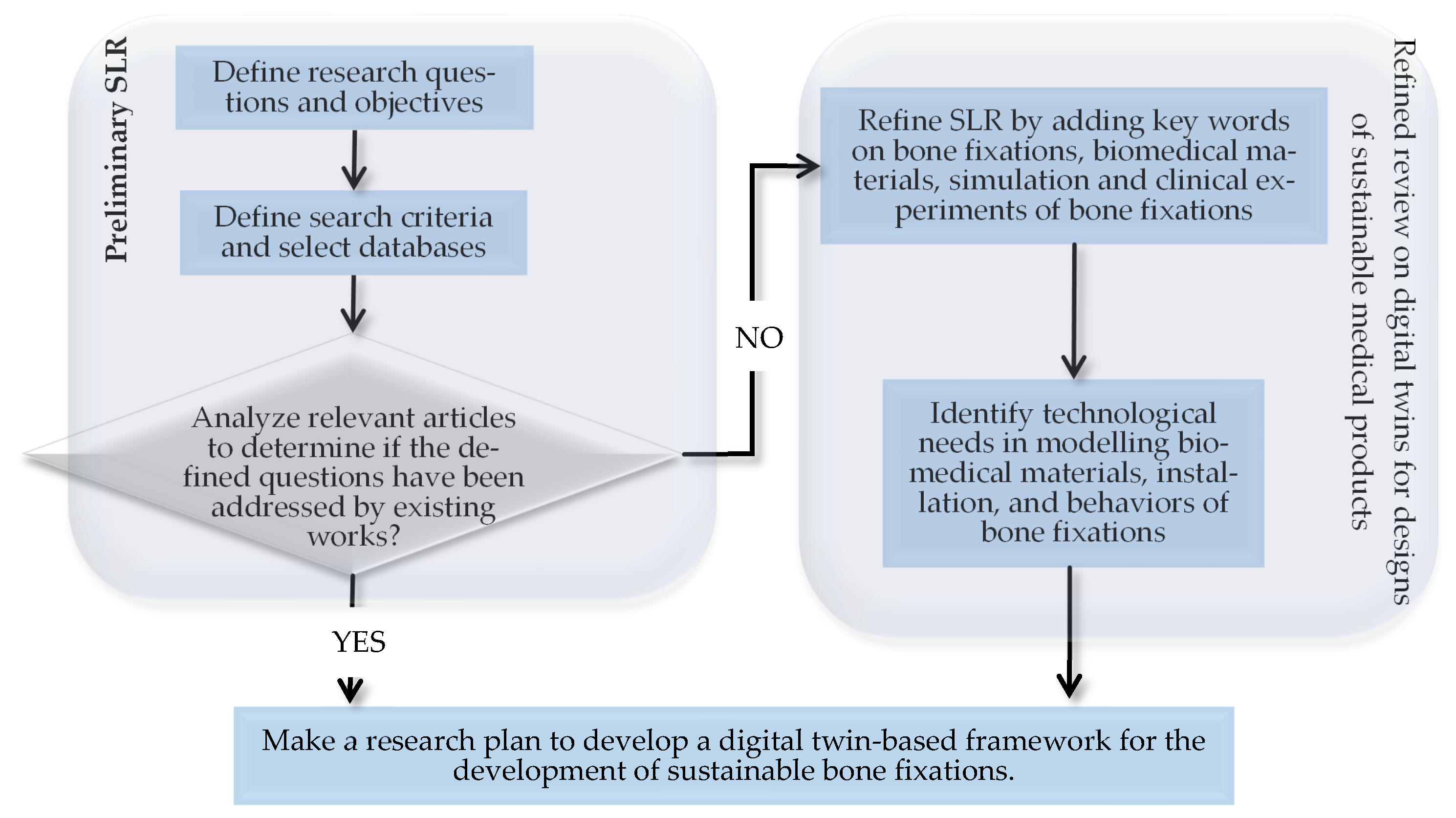
Figure 1. Preliminary and refined literature surveys on digital twins for development of sustainable bone fixations.
Designs 09 00140 g001
Figure 2. Overview of bibliographic map of 635 articles from SLR.
Designs 09 00140 g002
Figure 3. Bibliographic couplings of digital twins (DT-Is) with relevant technologies and medical applications.
Designs 09 00140 g003
Figure 4. Applications of digital twins (DT-Is) for personalized medicine and treatments.
Designs 09 00140 g004
Figure 5. Limited number of case studies on using digital twins (DT-Is) for medical product development.
Designs 09 00140 g005
Figure 6. DT-Is for drug discovery equipped with multi-scale real-time datasets [38].
Designs 09 00140 g006
Figure 7. Concept of human digital twins (DT-Is) for stroke rehabilitation by [42].
Designs 09 00140 g007
Figure 8. Dataflow of DT-I for personalized cancer care [44,45].
Designs 09 00140 g008
Figure 9. Data-centric framework by Demuth et al. [47].
Designs 09 00140 g009
Figure 10. Concept of personalized medicine by Benedictis et al. [10].
Designs 09 00140 g010
Figure 11. Concept of Digital Triad (DT-II) for sustainable product development [3].
Designs 09 00140 g011
Figure 12. FEM model of the bone and staples [75].
Designs 09 00140 g012
Figure 13. A schematic drawing of the installation of a bone staple.
Designs 09 00140 g013
Figure 14. Stress–strain curves of samples after stress-relief heat treatment.
Designs 09 00140 g014
Table 1. Materials used for bone fixation.
MaterialsModulus (GPa)AdvantagesLimitations
Stainless steel~190High strength and established usesHigh stiffness
Ti-6Al-4V~110Good biocompatibility and corrosion resistanceAl, V toxicity concerns
NiTi(Nitinol)(60, 80)Shape memory, superelastic, and fatigue-resistantNi allergenic
Ni-free β-Ti(55, 85)No Ni, low modules, and corrosion-resistantNew material and lack of tested data
Disclaimer/Publisher’s Note: The statements, opinions and data contained in all publications are solely those of the individual author(s) and contributor(s) and not of MDPI and/or the editor(s). MDPI and/or the editor(s) disclaim responsibility for any injury to people or property resulting from any ideas, methods, instructions or products referred to in the content.