
Influence of Normobaric Hypoxia on Maximal Force Production Following High-Intensity Resistance Circuit Training

 ,
,  ,
,  and
and 
Abstract
1. Introduction
2. Materials and Methods
2.1. Design
2.2. Participants
2.3. Testing Protocol
2.4. Jump Test
2.5. Push-Up Test
2.6. Strength Test
2.7. Training Program Procedure
2.8. Statistical Analysis
3. Results
4. Discussion
5. Conclusions
Author Contributions
Funding
Institutional Review Board Statement
Data Availability Statement
Conflicts of Interest
References
- Bakleh, M.Z.; Al Haj Zen, A. The Distinct Role of HIF-1α and HIF-2α in Hypoxia and Angiogenesis. Cells 2025, 14, 673. [Google Scholar] [CrossRef] [Scilit]
- Aragón-Vela, J.; Casuso, R.A. Effect of Hypoxia-Inducible Factor 1 on Vascular Endothelial Growth Factor Expression in Exercised Human Skeletal Muscle: A Systematic Review and Meta-Analysis. Am. J. Physiol.-Cell Physiol. 2025, 329, C272–C282. [Google Scholar] [CrossRef] [Scilit]
- Allsopp, G.L.; Britto, F.A.; Wright, C.R.; Deldicque, L. The Effects of Normobaric Hypoxia on the Acute Physiological Responses to Resistance Training: A Narrative Review. J. Strength Cond. Res. 2024, 38, 2001–2011. [Google Scholar] [CrossRef] [Scilit]
- Benavente, C.; Padial, P.; Scott, B.R.; Almeida, F.; Olcina, G.; Pérez-Regalado, S.; Feriche, B. Strength and Muscle Mass Development after a Resistance-Training Period at Terrestrial and Normobaric Intermittent Hypoxia. Pflug. Arch.—Eur. J. Physiol. 2024, 476, 1221–1233. [Google Scholar] [CrossRef] [Scilit]
- Wang, H.; Tuerhongjiang, M.; Zeng, Z.; Wang, Y.; Liu, J.; Liu, R. The Effects of Normobaric Hypoxic Resistance Training on Muscle Strength in Healthy Adults. Eur. J. Appl. Physiol. 2025, 125, 2087–2101. [Google Scholar] [CrossRef] [Scilit]
- Scott, B.R.; Slattery, K.M.; Sculley, D.V.; Dascombe, B.J. Hypoxia and Resistance Exercise: A Comparison of Localized and Systemic Methods. Sports Med. 2014, 44, 1037–1054. [Google Scholar] [CrossRef] [Scilit]
- Martínez-Guardado, I.; Ramos-Campo, D.J.; Olcina, G.J.; Rubio-Arias, J.A.; Chung, L.H.; Marín-Cascales, E.; Alcaraz, P.E.; Timón, R. Effects of High-Intensity Resistance Circuit-Based Training in Hypoxia on Body Composition and Strength Performance. Eur. J. Sport Sci. 2019, 19, 941–951. [Google Scholar] [CrossRef] [Scilit]
- Martínez-Guardado, I.; Sánchez-Ureña, B.; Camacho-Cardenosa, A.; Camacho-Cardenosa, M.; Olcina, G.; Timón, R. Effects of Strength Training under Hypoxic Conditions on Muscle Performance, Body Composition and Haematological Variables. Biol. Sport 2020, 37, 121–129. [Google Scholar] [CrossRef] [Scilit] [PubMed]
- Morales-Artacho, A.J.; Padial, P.; García-Ramos, A.; Pérez-Castilla, A.; Argüelles-Cienfuegos, J.; De la Fuente, B.; Feriche, B. Intermittent Resistance Training at Moderate Altitude: Effects on the Force-Velocity Relationship, Isometric Strength and Muscle Architecture. Front. Physiol. 2018, 9, 594. [Google Scholar] [CrossRef] [Scilit] [PubMed]
- Inness, M.W.; Billaut, F.; Walker, E.J.; Petersen, A.C.; Alice, J.; Aughey, R.J. Heavy Resistance Training in Hypoxia Enhances 1RM Squat Performance. Front. Physiol. 2016, 7, 502. [Google Scholar] [CrossRef] [Scilit]
- Scott, B.R.; Slattery, K.M.; Dascombe, B.J. Intermittent Hypoxic Resistance Training: Is Metabolic Stress the Key Moderator? Med. Hypotheses 2015, 84, 145–149. [Google Scholar] [CrossRef] [Scilit]
- Chycki, J.; Czuba, M.; Gołaś, A.; Zając, A.; Fidos-Czuba, O.; Młynarz, A.; Smółka, W. Neuroendocrine Responses and Body Composition Changes Following Resistance Training under Normobaric Hypoxia. J. Hum. Kinet. 2016, 53, 91–98. [Google Scholar] [CrossRef] [Scilit]
- Rong, W.; Geok, S.K.; Samsudin, S.; Zhao, Y.; Ma, H.; Zhang, X. Effects of Strength Training on Neuromuscular Adaptations in the Development of Maximal Strength: A Systematic Review and Meta-Analysis. Sci. Rep. 2025, 15, 19315. [Google Scholar] [CrossRef] [Scilit] [PubMed]
- Simpson, C.W.C.; Walter, J.; Gieseg, S.P.; Lackner, S.; Holasek, S.; Hamlin, M.J. Central and Peripheral Nervous System Activity and Muscle Oxygenation in Athletes during Repeated-Sprint Exercise in Normoxia and Normobaric Hypoxia. J. Sports Sci. 2025, 43, 2204–2216. [Google Scholar] [CrossRef] [Scilit]
- Bondi, D.; Valli, G.; Santangelo, C.; Annarumma, S.; Pietrangelo, T.; Fulle, S.; Verratti, V. Non-Invasive Motor Unit Analysis Reveals Specific Responses during Maximal Muscle Contraction under Normobaric Hypoxia. Pflug. Arch.—Eur. J. Physiol. 2025, 477, 1295–1308. [Google Scholar] [CrossRef] [Scilit] [PubMed]
- Maliszewski, K.; Feldmann, A.; McCully, K.K.; Julian, R. A Systematic Review of the Relationship between Muscle Oxygen Dynamics and Energy Rich Phosphates. Can NIRS Help? BMC Sports Sci. Med. Rehabil. 2024, 16, 25. [Google Scholar] [CrossRef] [Scilit]
- Feriche, B.; García-Ramos, A.; Morales-Artacho, A.J.; Padial, P. Resistance Training Using Different Hypoxic Training Strategies: A Basis for Hypertrophy and Muscle Power Development. Sports Med.—Open 2017, 3, 12. [Google Scholar] [CrossRef] [Scilit] [PubMed]
- Buckthorpe, M.; Erskine, R.M.; Fletcher, G.; Folland, J.P. Task-Specific Neural Adaptations to Isoinertial Resistance Training. Scand. J. Med. Sci. Sports 2015, 25, 640–649. [Google Scholar] [CrossRef] [Scilit]
- Cormie, P.; McGuigan, M.R.; Newton, R.U. Developing Maximal Neuromuscular Power: Part 1—Biological Basis of Maximal Power Production. Sports Med. 2011, 41, 17–38. [Google Scholar] [CrossRef] [Scilit]
- Álvarez-Herms, J.; Julià-Sánchez, S.; Corbi, F.; Pagès, T.; Viscor, G. Anaerobic Performance after Endurance Strength Training in Hypobaric Environment. Sci. Sports 2014, 29, 311–318. [Google Scholar] [CrossRef] [Scilit]
- Calbet, J.A.L.; Holmberg, H.-C.; Rosdahl, H.; van Hall, G.; Jensen-Urstad, M.; Saltin, B. Why Do Arms Extract Less Oxygen than Legs during Exercise? Am. J. Physiol. Regul. Integr. Comp. Physiol. 2005, 289, R1448–R1458. [Google Scholar] [CrossRef] [Scilit] [PubMed]
- Willis, S.J.; Millet, G.P.; Borrani, F. Insights for Blood Flow Restriction and Hypoxia in Leg versus Arm Submaximal Exercise. Int. J. Sports Physiol. Perform. 2020, 15, 714–719. [Google Scholar] [CrossRef] [Scilit] [PubMed]
- García-Massó, X.; Colado, J.C.; González, L.M.; Salvá, P.; Alves, J.; Tella, V.; Triplett, N.T. Myoelectric Activation and Kinetics of Different Plyometric Push-up Exercises. J. Strength Cond. Res. 2011, 25, 2040–2047. [Google Scholar] [CrossRef] [Scilit]
- Blazevich, A.J.; Gill, N.D.; Zhou, S. Intra- and Intermuscular Variation in Human Quadriceps Femoris Architecture Assessed in Vivo. J. Anat. 2006, 209, 289–310. [Google Scholar] [CrossRef] [Scilit]
- Hopkins, W.G.; Marshall, S.W.; Batterham, A.M.; Hanin, J. Progressive Statistics for Studies in Sports Medicine and Exercise Science. Med. Sci. Sports Exerc. 2009, 41, 3–12. [Google Scholar] [CrossRef] [Scilit]
- Ramos-Campo, D.J.; Scott, B.R.; Alcaraz, P.E.; Rubio-Arias, J.A. The Efficacy of Resistance Training in Hypoxia to Enhance Strength and Muscle Growth: A Systematic Review and Meta-Analysis. Eur. J. Sport Sci. 2018, 18, 92–103. [Google Scholar] [CrossRef] [Scilit]
- Wang, R.; Hoffman, J.R.; Sadres, E.; Bartolomei, S.; Muddle, T.W.; Fukuda, D.H.; Stout, J.R. Evaluating Upper-Body Strength and Power from a Single Test: The Ballistic Push-Up. J. Strength Cond. Res. 2017, 31, 1338–1345. [Google Scholar] [CrossRef] [Scilit]
- Van Den Tillaar, R.; Ball, N. Push-Ups Are Able to Predict the Bench Press 1-RM and Constitute an Alternative for Measuring Maximum Upper Body Strength Based on Load-Velocity Relationships. J. Hum. Kinet. 2020, 73, 7–18. [Google Scholar] [CrossRef] [Scilit]
- Ramos-Campo, D.J.; Martínez-Guardado, I.; Rubio-Arias, J.A.; Freitas, T.T.; Othalawa, S.; Andreu, L.; Timón, R.; Alcaraz, P.E. Muscle Architecture and Neuromuscular Changes after High-Resistance Circuit Training in Hypoxia. J. Strength Cond. Res. 2021, 35, 3035–3040. [Google Scholar] [CrossRef] [Scilit] [PubMed]
- Benavente, C.; Schoenfeld, B.J.; Padial, P.; Feriche, B. Efficacy of Resistance Training in Hypoxia on Muscle Hypertrophy and Strength Development: A Systematic Review with Meta-Analysis. Sci. Rep. 2023, 13, 3676, Erratum in Sci. Rep. 2023, 13, 15619. [Google Scholar] [CrossRef] [Scilit]
- Törpel, A.; Peter, B.; Schega, L. Effect of Resistance Training under Normobaric Hypoxia on Physical Performance, Hematological Parameters, and Body Composition in Young and Old People. Front. Physiol. 2020, 11, 335. [Google Scholar] [CrossRef] [Scilit]
- Ma, S.; Xu, Y.; Xu, S. Effects of Physical Training Programs on Healthy Athletes’ Vertical Jump Height: A Systematic Review with Meta-Analysis. J. Sports Sci. Med. 2025, 24, 236–257. [Google Scholar] [CrossRef] [Scilit]
- Sun, R.; Qu, H.; Zhang, Y.; Wang, H. The Effect of Complex Training on Strength, Counter Movement Jump and Change of Direction Skills in Female Junior Table Tennis Players. Sci. Rep. 2025, 15, 37123. [Google Scholar] [CrossRef] [Scilit] [PubMed]
- Benavente, C.; Feriche, B. The Influence of Specific Resistance Training Methodological Prescription Variables on Strength Development under Hypoxic Conditions: A Systematic Review and Meta-Analysis. J. Sports Sci. 2025, 43, 2105–2114. [Google Scholar] [CrossRef] [Scilit] [PubMed]



| Week | 1 | 2 | 3 | 4 | 5 | 6 | 7 | 8 |
|---|---|---|---|---|---|---|---|---|
| Set | 2 | 3 | 3 | 2 | 3 | 3 | 4 | 2 |
| Repetitions | 6 | 6 | 6 | 6 | 6 | 6 | 6 | 6 |
| % 6RM | 90 | 95 | 100 | 100 | 100 | 100 | 100 | 100 |
| Parameters | HG (Mean ± SD) | NG (Mean ± SD) |
|---|---|---|
| Age (years) | 24.61 ± 6.79 | 23.24 ± 5.16 |
| Height (m) | 177.42 ± 5.91 | 173.44 ± 6.21 |
| Weight (kg) | 74.86 ± 11.45 | 69.44 ± 7.35 |
| Body Mass Index | 25.90 ± 1.30 | 23.20 ± 2.49 |
| Lean Body Mass (kg) | 60.48 ± 7.87 | 56.40 ± 5.04 |
| Fat Mass (%) | 14.47 ± 5.51 | 16.28 ± 5.54 |
| Pre-Training | Post-Training | 95% CI for Difference | Group Effect | Time Effect | Group × Time | |||||||||
|---|---|---|---|---|---|---|---|---|---|---|---|---|---|---|
| Mean | SD | Mean | SD | ES | p | η2p | Mean Difference | Lower Bound | Upper Bound | |||||
| Height Jump (cm) | HG | 29.6 | 5.5 | 29.7 | 4.7 | 0.02 | 0.901 | 0.024 | 0.1 | −1.5 | 1.6 | 0.447 | 0.801 | 0.939 |
| NG | 31.2 | 6.3 | 31.3 | 5.8 | 0.03 | 0.816 | 0.1 | −1.7 | 1.4 | |||||
| Maximum Power CMJ (w) | HG | 3547.5 | 774.9 | 3497.5 | 691.8 | 0.06 | 0.517 | 0.002 | −50.0 | −206.8 | 106.8 | 0.847 | 0.824 | 0.487 |
| NG | 3461.7 | 506.2 | 3487.6 | 540.3 | 0.05 | 0.737 | 25.8 | −131.0 | 182.6 | |||||
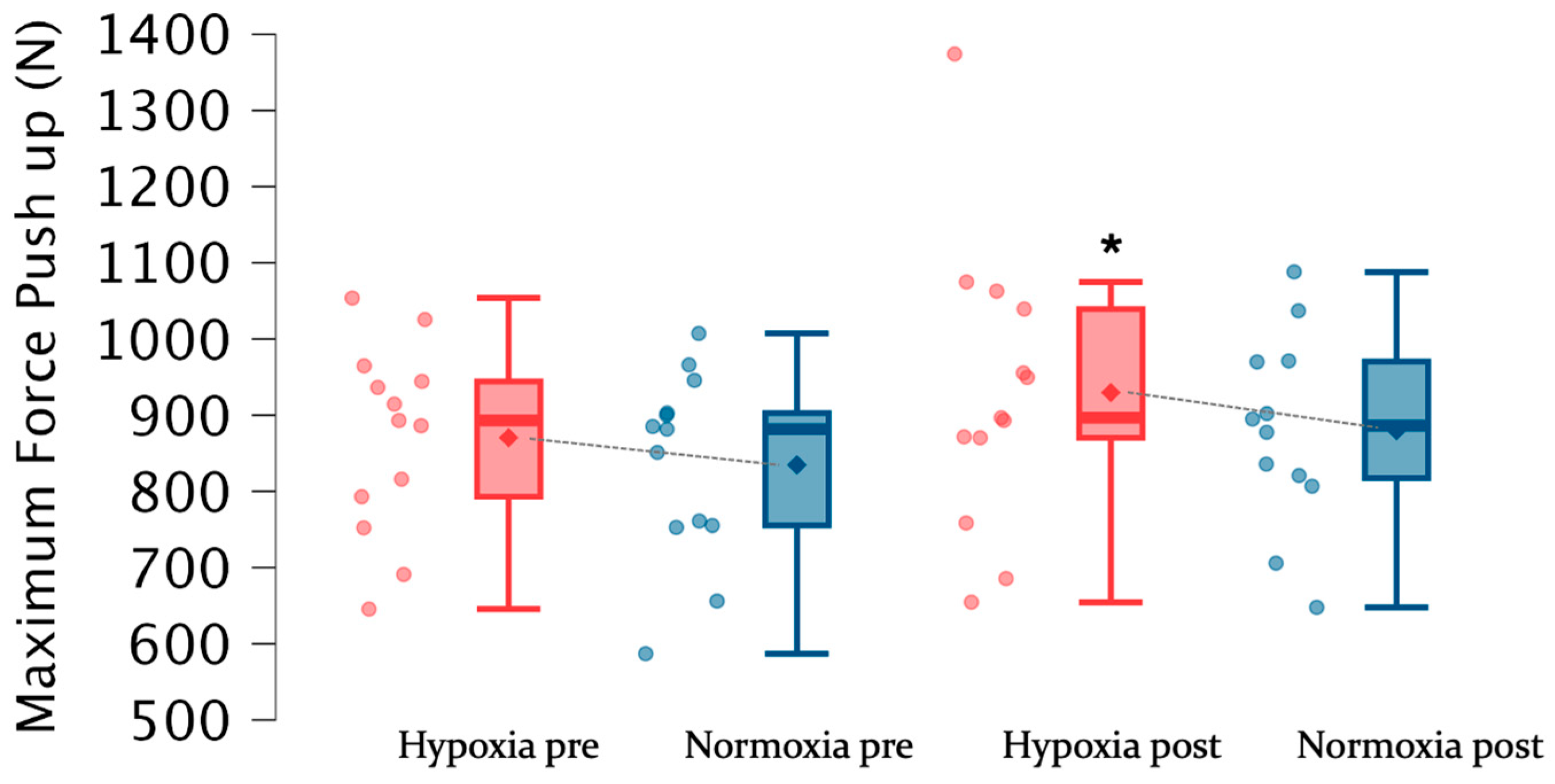
| Maximum Force Push-Up (N) | HG | 871.0 | 124.0 | 934.7 | 209.6 | 0.49 | 0.033 * | 0.023 | 63.7 | 5.5 | 121.9 | 0.457 | 0.009 | 0.713 |
| NG | 835.3 | 124.1 | 884.2 | 142.5 | 0.37 | 0.096 | 48.8 | −9.3 | 107.0 | |||||
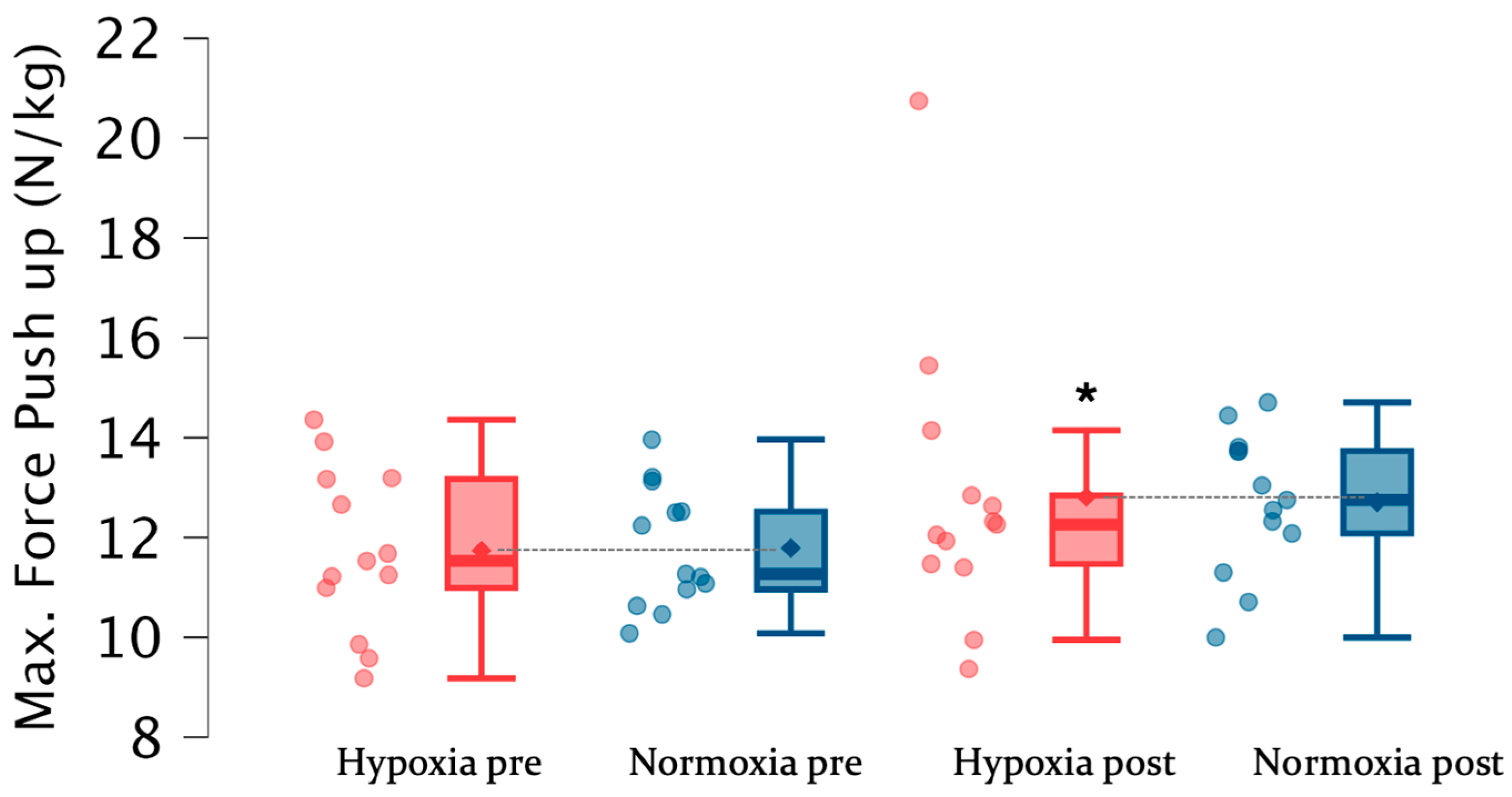
| Maximum Force Push-Up (N/kg) | HG | 11.7 | 1.7 | 12.6 | 2.9 | 0.49 | 0.034 * | 0.003 | 0.9 | 0.1 | 1.6 | 0.968 | 0.008 | 0.772 |
| NG | 11.8 | 1.2 | 12.5 | 1.4 | 0.53 | 0.079 | 0.7 | −0.1 | 1.5 | |||||
Disclaimer/Publisher’s Note: The statements, opinions and data contained in all publications are solely those of the individual author(s) and contributor(s) and not of MDPI and/or the editor(s). MDPI and/or the editor(s) disclaim responsibility for any injury to people or property resulting from any ideas, methods, instructions or products referred to in the content. |
© 2026 by the authors. Licensee MDPI, Basel, Switzerland. This article is an open access article distributed under the terms and conditions of the Creative Commons Attribution (CC BY) license.
Share and Cite
Martínez-Guardado, I.; Alonso-Aubin, D.A.; Hernández-Lougedo, J.; Ramos-Campo, D.J. Influence of Normobaric Hypoxia on Maximal Force Production Following High-Intensity Resistance Circuit Training. J. Funct. Morphol. Kinesiol. 2026, 11, 98. https://doi.org/10.3390/jfmk11010098
Martínez-Guardado I, Alonso-Aubin DA, Hernández-Lougedo J, Ramos-Campo DJ. Influence of Normobaric Hypoxia on Maximal Force Production Following High-Intensity Resistance Circuit Training. Journal of Functional Morphology and Kinesiology. 2026; 11(1):98. https://doi.org/10.3390/jfmk11010098
Chicago/Turabian StyleMartínez-Guardado, Ismael, Diego A. Alonso-Aubin, Juan Hernández-Lougedo, and Domingo J. Ramos-Campo. 2026. "Influence of Normobaric Hypoxia on Maximal Force Production Following High-Intensity Resistance Circuit Training" Journal of Functional Morphology and Kinesiology 11, no. 1: 98. https://doi.org/10.3390/jfmk11010098
APA StyleMartínez-Guardado, I., Alonso-Aubin, D. A., Hernández-Lougedo, J., & Ramos-Campo, D. J. (2026). Influence of Normobaric Hypoxia on Maximal Force Production Following High-Intensity Resistance Circuit Training. Journal of Functional Morphology and Kinesiology, 11(1), 98. https://doi.org/10.3390/jfmk11010098