


EXcellence and PERformance in Track and Field (EXPERT)—A Mixed-Longitudinal Study on Growth, Biological Maturation, Performance, and Health in Young Athletes: Rationale, Design, and Methods (Part 1)


 , ,
, ,  , , , , , , ,
  and
and
Abstract
1. Introduction
2. Materials and Methods
2.1. Design
2.2. Sample
2.2.1. Sample Size Calculation
2.2.2. Recruitment Strategy and Inclusion Criteria
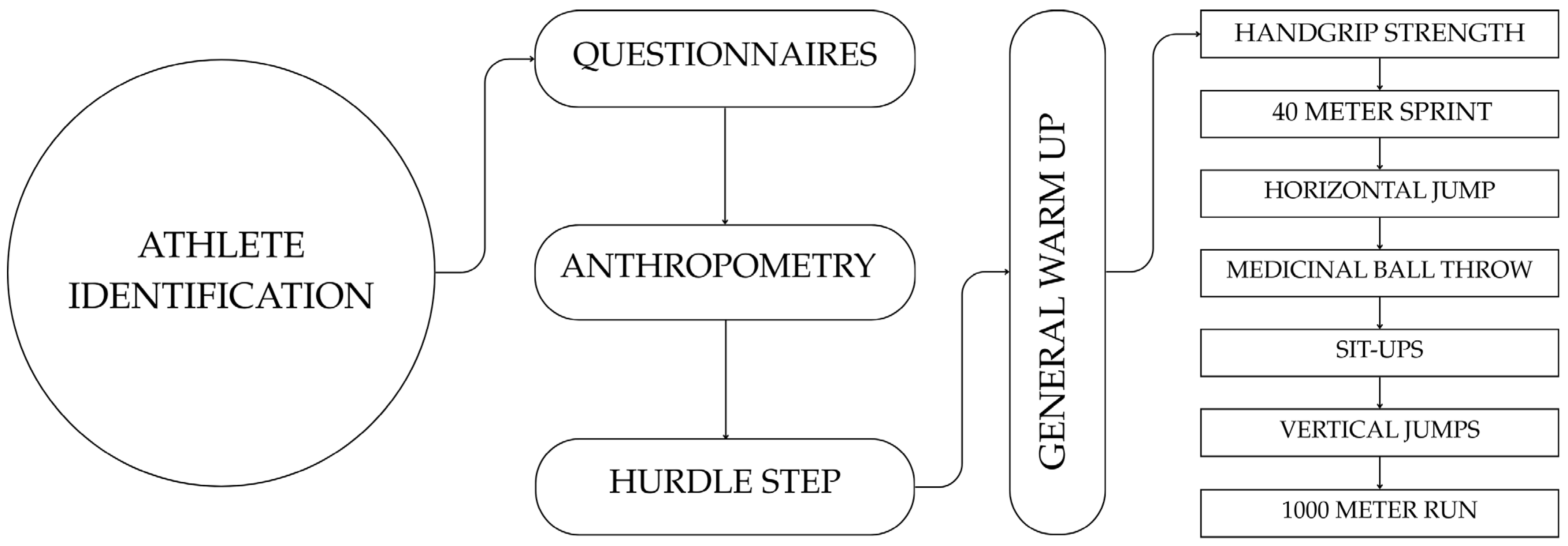
2.3. Procedures
2.4. Measurements
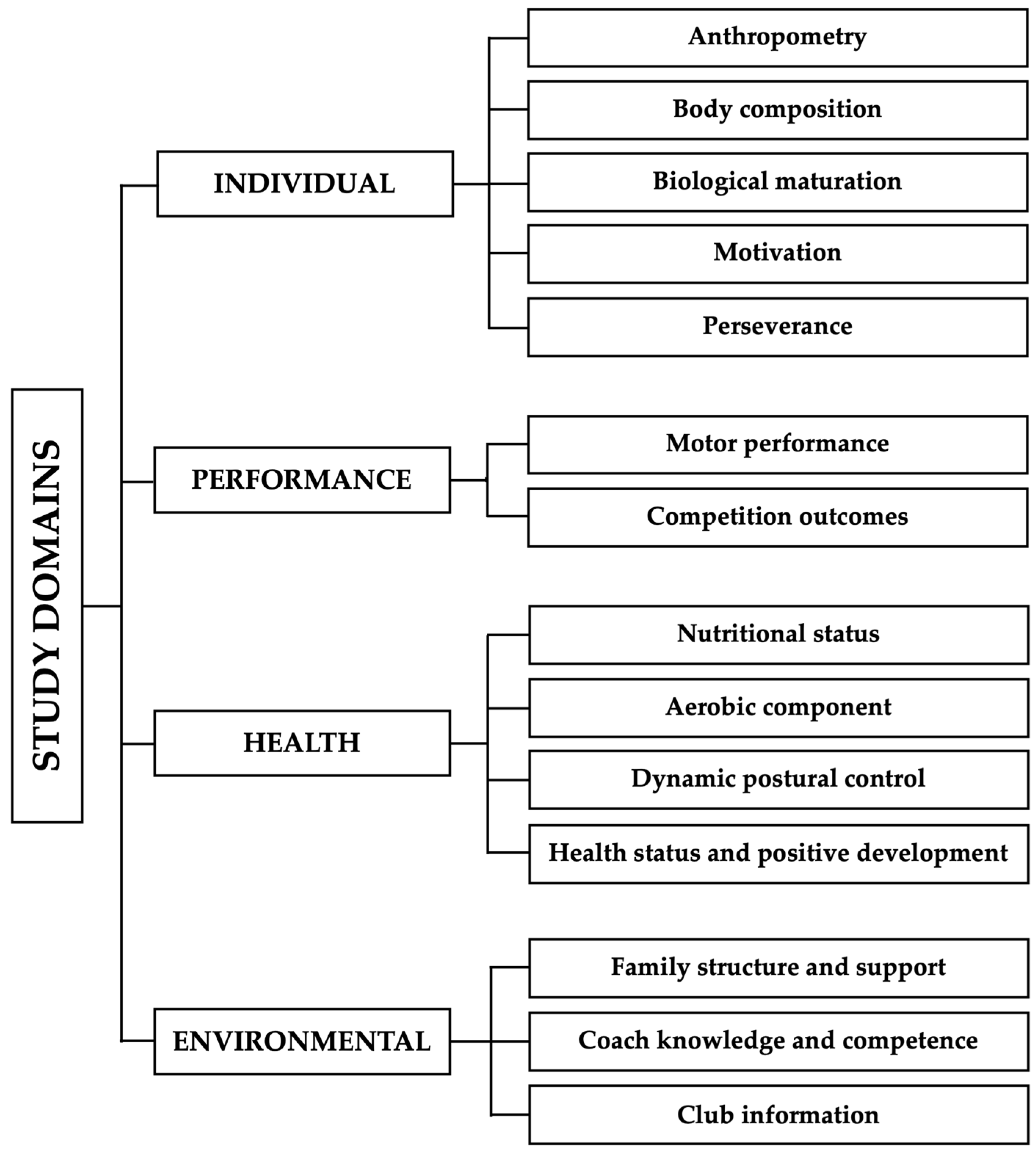
2.4.1. Individual Domain
Physical Growth—Anthropometry and Body Composition
Biological Maturation
Motivation
Perseverance
2.4.2. Performance Domain
Motor Performance
- Static strength
- Running speed
- Abdominal muscular strength
- Upper-body explosive strength
- Lower-body explosive strength
Aerobic Component
Competition Outcomes
2.4.3. Health Domain
Nutritional Status
Aerobic Component
Dynamic Postural Control
Perception of Health Status and Positive Development
- Health status
Positive Development
2.4.4. Environmental Domain
Family Structure and Support
Coach’s Knowledge and Competence
Club Information
2.5. Data Quality Control
2.6. Statistical Analysis Plan
3. Discussion
4. Conclusions
Supplementary Materials
Author Contributions
Funding
Institutional Review Board Statement
Informed Consent Statement
Data Availability Statement
Acknowledgments
Conflicts of Interest
References
- Guth, L.M.; Roth, S.M. Genetic influence on athletic performance. Curr. Opin. Pediatr. 2013, 25, 653. [Google Scholar] [CrossRef]
- Cerit, M.; Dalip, M.; Yildirim, D.S. Genetics and athletic performance. Res. Phys. Educ. Sport Health 2020, 9, 653–658. [Google Scholar] [CrossRef]
- Henriksen, K.; Stambulova, N.; Roessler, K.K. Successful talent development in track and field: Considering the role of environment. Scand. J. Med. Sci. Sports 2010, 20, 122–132. [Google Scholar] [CrossRef]
- Balyi, I.; Hamilton, A. Long-Term Athlete Development: Trainability in Children and Adolescents. Windows of Opportunity. Optimal Trainability; National Coaching Institute British Columbia & Advanced Training and Performance Ltd.: Victoria, BC, Canada, 2004. [Google Scholar]
- Lloyd, R.S.; Oliver, J.L. The youth physical development model: A new approach to long-term athletic development. Strength Cond. J. 2012, 34, 61–72. [Google Scholar] [CrossRef]
- Gulbin, J.P.; Croser, M.J.; Morley, E.J.; Weissensteiner, J.R. An integrated framework for the optimisation of sport and athlete development: A practitioner approach. J. Sports Sci. 2013, 31, 1319–1331. [Google Scholar] [CrossRef] [PubMed]
- Lloyd, R.S.; Oliver, J.L.; Faigenbaum, A.D.; Howard, R.; Croix, M.B.D.S.; Williams, C.A.; Best, T.M.; Alvar, B.A.; Micheli, L.J.; Thomas, D.P. Long-term athletic development-part 1: A pathway for all youth. J. Strength Cond. Res. 2015, 29, 1439–1450. [Google Scholar] [CrossRef] [PubMed]
- Pichardo, A.W.; Oliver, J.L.; Harrison, C.B.; Maulder, P.S.; Lloyd, R.S. Integrating models of long-term athletic development to maximize the physical development of youth. Int. J. Sports Sci. Coach. 2018, 13, 1189–1199. [Google Scholar] [CrossRef]
- Varghese, M.; Ruparell, S.; LaBella, C. Youth athlete development models: A narrative review. Sports Health 2022, 14, 20–29. [Google Scholar] [CrossRef]
- Engebretsen, L.; Steffen, K.; Bahr, R.; Broderick, C.; Dvorak, J.; Janarv, P.-M.; Johnson, A.; Leglise, M.; Mamisch, T.C.; McKay, D. The International Olympic Committee Consensus Statement on age determination in high-level young athletes. Br. J. Sports Med. 2010, 44, 476–484. [Google Scholar] [CrossRef]
- Malina, R.M.; Bouchard, C.; Bar-Or, O. Growth, Maturation, and Physical Activity, 2nd ed.; Human Kinetics: Champaign, IL, USA, 2004. [Google Scholar]
- Gabbard, C. Lifelong Motor Development; Lippincott Williams & Wilkins: Philadelphia, PA, USA, 2021. [Google Scholar]
- Gallahue, D.; Ozmun, J.; Goodway, J. Development of fundamental movement: Locomotor skills. In Understanding Motor Development: Infants, Children, Adolescents, Adults, 7th ed.; McGraw-Hill: New York, NY, USA, 2012; pp. 185–221. [Google Scholar]
- Armstrong, N.; Van Mechelen, W. Paediatric Exercise Science and Medicine; Oxford University Press: New York, NY, USA, 2008. [Google Scholar]
- Bar-Or, O. The Child and Adolescent Athlete; Blackwell Science Oxford: Oxford, UK, 1996. [Google Scholar]
- Blanksby, B.; Bloomfield, J.; Ackland, T.; Elliott, B.; Morton, A. Athletics, Growth and Development in Children; Harwood Academic Publishers: London, UK, 1994. [Google Scholar]
- Baxter-Jones, A. Training of Young Athletes Study: Physical Fitness and Growth; The Sports Council: London, UK, 1994. [Google Scholar]
- Vaeyens, R.; Malina, R.M.; Janssens, M.; Van Renterghem, B.; Bourgois, J.; Vrijens, J.; Philippaerts, R.M. A multidisciplinary selection model for youth soccer: The Ghent Youth Soccer Project. Br. J. Sports Med. 2006, 40, 928–934. [Google Scholar] [CrossRef]
- Guimarães, E.; Baxter-Jones, A.D.; Williams, A.M.; Tavares, F.; Janeira, M.A.; Maia, J. The role of growth, maturation and sporting environment on the development of performance and technical and tactical skills in youth basketball players: The INEX study. J. Sports Sci. 2021, 39, 979–991. [Google Scholar] [CrossRef]
- Abarghoueinejad, M.; Barreira, D.; Dias, C.; Guimarães, E.; Baxter-Jones, A.D.; Maia, J. Body physique, body composition, physical performance, technical and tactical skills, psychological development, and club characteristics of young male portuguese soccer players: The INEX study. Int. J. Environ. Res. Public Health 2021, 18, 3560. [Google Scholar] [CrossRef]
- Malina, R.M. Growth and Maturation of Child and Adolescent Track and Field Athletes; Centro Studi e Ricerche, Federazione Italiana di Atletica Leggera: Rome, Italy, 2006. [Google Scholar]
- Malina, R.; Sławinska, T.; Ignasiak, Z.; Rożek, K.; Kochan, K.; Domaradzki, J.; Fugiel, J. Sex differences in growth and performance of track and field athletes 11–15 years. J. Hum. Kinet. 2010, 24, 79–85. [Google Scholar] [CrossRef]
- Yanci, J.; Cámara, J.; Vizcay, J.; Young, W. Examining age and gender effects in physical performance in young athletes aged 12–16 years. Int. J. Sports Sci. Coach. 2016, 11, 538–544. [Google Scholar] [CrossRef]
- Freitas, J.V.d.; Werneck, F.Z.; Souza, R.S.d.; Castro, P.H.C.d.; Figueiredo, A.J.; Lima, J.R.P.d. Maturation, morphological, motor and technical characteristics of under 16 female track and field athletes. Rev. Bras. Cineantropom. Desempenho Hum. 2020, 22, e68128. [Google Scholar] [CrossRef]
- Zhao, Y.; Zhao, K. Anthropometric measurements, physical fitness performance and specific throwing strength in adolescent track-and-field throwers: Age, sex and sport discipline. Appl. Sci. 2023, 13, 10118. [Google Scholar] [CrossRef]
- O’Rourke, D.J.; Smith, R.E.; Smoll, F.L.; Cumming, S.P. Parent initiated motivational climate and young athletes’ intrinsic-extrinsic motivation: Cross-sectional and longitudinal relations. J. Child Adolesc. Behav. 2013, 1, 109. [Google Scholar]
- Thomas, A.; Güllich, A. Childhood practice and play as determinants of adolescent intrinsic and extrinsic motivation among elite youth athletes. Eur. J. Sport Sci. 2019, 19, 1120–1129. [Google Scholar] [CrossRef] [PubMed]
- Larkin, P.; O’Connor, D.; Williams, A.M. Does grit influence sport-specific engagement and perceptual-cognitive expertise in elite youth soccer? J. Appl. Sport Psychol. 2016, 28, 129–138. [Google Scholar] [CrossRef]
- Cushion, C.; Ford, P.R.; Williams, A.M. Coach behaviours and practice structures in youth soccer: Implications for talent development. J. Sports Sci. 2012, 30, 1631–1641. [Google Scholar] [CrossRef]
- Ford, P.R.; Yates, I.; Williams, A.M. An analysis of practice activities and instructional behaviours used by youth soccer coaches during practice: Exploring the link between science and application. J. Sports Sci. 2010, 28, 483–495. [Google Scholar] [CrossRef]
- NCD Risk Factor Collaboration (NCD-RisC). Worldwide trends in underweight and obesity from 1990 to 2022: A pooled analysis of 3663 population representative studies with 222 million children, adolescents, and adults. Lancet 2024, 403, 1027–1050. [Google Scholar] [CrossRef]
- Kerr, J.A.; Patton, G.C.; Cini, K.I.; Abate, Y.H.; Abbas, N.; Abd Al Magied, A.H.; Abd ElHafeez, S.; Abd-Elsalam, S.; Abdollahi, A.; Abdoun, M. Global, regional, and national prevalence of child and adolescent overweight and obesity, 1990–2021, with forecasts to 2050: A forecasting study for the Global Burden of Disease study 2021. Lancet 2025, 405, 785–812. [Google Scholar] [CrossRef]
- Fernandes, H.M. Physical activity levels in Portuguese adolescents: A 10-year trend analysis (2006–2016). J. Sci. Med. Sport 2018, 21, 185–189. [Google Scholar] [CrossRef]
- Guthold, R.; Stevens, G.A.; Riley, L.M.; Bull, F.C. Global trends in insufficient physical activity among adolescents: A pooled analysis of 298 population-based surveys with 1.6 million participants. Lancet Child Adolesc. Health 2020, 4, 23–35. [Google Scholar] [CrossRef]
- Nelson, M.C.; Neumark-Stzainer, D.; Hannan, P.J.; Sirard, J.R.; Story, M. Longitudinal and secular trends in physical activity and sedentary behavior during adolescence. Pediatrics 2006, 118, e1627–e1634. [Google Scholar] [CrossRef]
- Ryu, S.; Kim, H.; Kang, M.; Pedisic, Z.; Loprinzi, P.D. Secular trends in sedentary behavior among high school students in the United States, 2003 to 2015. Am. J. Health Promot. 2019, 33, 1174–1181. [Google Scholar] [CrossRef]
- Fühner, T.; Kliegl, R.; Arntz, F.; Kriemler, S.; Granacher, U. An update on secular trends in physical fitness of children and adolescents from 1972 to 2015: A systematic review. Sports Med. 2021, 51, 303–320. [Google Scholar] [CrossRef] [PubMed]
- Júdice, P.B.; Hetherington-Rauth, M.; Northstone, K.; Andersen, L.B.; Wedderkopp, N.; Ekelund, U.; Sardinha, L.B.; Collaborators, I.C.s.A.D. Changes in physical activity and sedentary patterns on cardiometabolic outcomes in the transition to adolescence: International children’s accelerometry database 2.0. J. Pediatr. 2020, 225, 166–173. e161. [Google Scholar] [CrossRef] [PubMed]
- Chu, J.; Mehrzad, R. Psychosocial factors and outcomes of obesity. In Obesity; Elsevier: Amsterdam, The Netherlands, 2020; pp. 85–97. [Google Scholar]
- Bronfenbrenner, U. The Ecology of Human Development: Experiments by Nature and Design; Harvard University Press: Cambridge, MA, USA, 1979. [Google Scholar]
- Labarthe, D.R.; Dai, S.; Day, R.S.; Fulton, J.E.; Grunbaum, J.A.; Shah, S.M.; Wen, E. Project HeartBeat! Concept, development, and design. Am. J. Prev. Med. 2009, 37, S9–S16. [Google Scholar] [CrossRef] [PubMed]
- Ross, W.D.; Marfell-Jones, R.J. Cineantropometria. In Evaluación Fisiológica del Deportista; Dougall, J.D.M., Wenger, H.A., Green, H.J., Eds.; Paidotribo: Barcelona, Spain, 1995. [Google Scholar]
- Mirwald, R.L.; Baxter-Jones, A.D.G.; Bailey, D.A.; Beunen, G.P. An assessment of maturity from anthropometric measurements. Med. Sci. Sports Exerc. 2002, 34, 689–694. [Google Scholar]
- Malina, R.M.; Rogol, A.D.; Cumming, S.P.; e Silva, M.J.C.; Figueiredo, A.J. Biological maturation of youth athletes: Assessment and implications. Br. J. Sports Med. 2015, 49, 852–859. [Google Scholar] [CrossRef]
- McAuley, E.; Wraith, S.; Duncan, T.E. Self-efficacy, perceptions of success, and intrinsic motivation for exercise 1. J. Appl. Soc. Psychol. 1991, 21, 139–155. [Google Scholar] [CrossRef]
- Fonseca, A.M.; de Paula Brito, A. Propriedades psicométricas da versão portuguesa do Intrinsic Motivation Inventory (IMIp) em contextos de actividade física e desportiva. Anál. Psicol. 2001, 19, 59–76. [Google Scholar] [CrossRef]
- Duckworth, A.L.; Quinn, P.D. Development and validation of the Short Grit Scale (GRIT–S). J. Pers. Assess. 2009, 91, 166–174. [Google Scholar] [CrossRef]
- Coutinho, P.; Bessa Pereira, C.; Gracinda Ramos, A.; Dias, C.; Mesquita, I.; Manuel Fonseca, A. Validação da Short Grit Scale através de uma análise fatorial confirmatória para uma população de jovens atletas portugueses. Rev. Port. Ciênc. Desporto 2022, 22, 13–24. [Google Scholar] [CrossRef]
- American College of Sports Medicine. ACSM’s Health-Related Physical Fitness Assessment Manual; Dwyer, G.B., Davis, S.E., Eds.; Lippincott Williams & Wilkins: Philadelphia, PA, USA, 2005. [Google Scholar]
- Yetter, M.; Moir, G.L. The acute effects of heavy back and front squats on speed during forty-meter sprint trials. J. Strength Cond. Res. 2008, 22, 159–165. [Google Scholar] [CrossRef]
- Kirdendall, D.; Gruber, J.; Johnson, R. Measurement and Evaluation for Physical Educators, 2nd ed.; Human Kinetics: Champaign, IL, USA, 1987. [Google Scholar]
- Decleve, P.; Cant, J.V.; Buck, E.D.; Doren, J.V.; Verkouille, J.; Cools, A.M. The self-assessment corner for shoulder strength: Reliability, validity, and correlations with upper extremity physical performance tests. J. Athl. Train. 2020, 55, 350–358. [Google Scholar] [CrossRef]
- Riemann, B.L.; Johnson, W.; Murphy, T.; Davies, G.J. A bilateral comparison of the underlying mechanics contributing to the seated single-arm shot-put functional performance test. J. Athl. Train. 2018, 53, 976–982. [Google Scholar] [CrossRef]
- Almuzaini, K.S.; Fleck, S.J. Modification of the standing long jump test enhances ability to predict anaerobic performance. J. Strength Cond. Res. 2008, 22, 1265–1272. [Google Scholar] [CrossRef]
- Bosco, C.; Luhtanen, P.; Komi, P.V. A simple method for measurement of mechanical power in jumping. Eur. J. Appl. Physiol. 1983, 50, 273–282. [Google Scholar] [CrossRef]
- Stratford, C.; Dos’Santos, T.; McMahon, J.J. The 10/5 repeated jumps test: Are 10 repetitions and three trials necessary? Biomechanics 2021, 1, 1–14. [Google Scholar] [CrossRef]
- Harper, D.J.; Hobbs, S.J.; Moore, J. The ten to five repeated jump test: A new test for evaluation of lower body reactive strength. In Proceedings of the BASES 2011 Annual Student Conference, Integrations and Innovations: An Interdisciplinary Approach to Sport and Exercise Science, Chester, UK, 6–8 September 2011. [Google Scholar]
- Chatzakis, P.; Zanni, E.; Paradisis, G.; Argeitaki, P.; Zacharogiannis, E. Determinants of 300 and 1000 meters running performance in young track and field athletes. J. Phys. Educ. Sports Manag. 2019, 6, 21–27. [Google Scholar] [CrossRef]
- Onis, M.d.; Onyango, A.W.; Borghi, E.; Siyam, A.; Nishida, C.; Siekmann, J. Development of a WHO growth reference for school-aged children and adolescents. Bull. World Health Organ. 2007, 85, 660–667. [Google Scholar] [CrossRef]
- McCarthy, H.; Cole, T.; Fry, T.; Jebb, S.; Prentice, A. Body fat reference curves for children. Int. J. Obes. 2006, 30, 598–602. [Google Scholar] [CrossRef]
- Cook, S.; Weitzman, M.; Auinger, P.; Nguyen, M.; Dietz, W.H. Prevalence of a metabolic syndrome phenotype in adolescents: Findings from the third National Health and Nutrition Examination Survey, 1988–1994. Arch. Pediatr. Adolesc. Med. 2003, 157, 821–827. [Google Scholar] [CrossRef] [PubMed]
- Klissouras, V. Prediction of potential performance with special reference to heredity. J. Sports Med. Phys. Fitness 1973, 13, 100–107. [Google Scholar]
- Matsudo, V.K.R. Testes em Ciências do Esporte; Editora Midiograf: São Caetano do Sul/São Paulo, Brazil, 2005. [Google Scholar]
- Cook, G.; Burton, L.; Hoogenboom, B.J.; Voight, M. Functional movement screening: The use of fundamental movements as an assessment of function-part 1. Int. J. Sports Phys. Ther. 2014, 9, 396. [Google Scholar]
- Matos, M.G.; Social, E.A. A Saúde dos Adolescentes Portugueses Após a Recessão: Relatório do Estudo Health Behaviour in School Aged Children (HBSC) em 2018. Available online: www.aventurasocial.com (accessed on 23 August 2025).
- Watson, D.L.; Newton, M.; Kim, M.-S. Recognition of values-based constructs in a summer physical activity program. Urban Rev. 2003, 35, 217–232. [Google Scholar] [CrossRef]
- Li, W.; Wright, P.M.; Rukavina, P.B.; Pickering, M. Measuring students’ perceptions of personal and social responsibility and the relationship to intrinsic motivation in urban physical education. J. Teach. Phys. Educ. 2008, 27, 167–178. [Google Scholar] [CrossRef]
- Martins, P.; Rosado, A.; Ferreira, V.; Biscaia, R. Examining the validity of the personal-social responsibility questionnaire among athletes. Motriz 2015, 21, 321–328. [Google Scholar] [CrossRef]
- Fredricks, J.A.; Eccles, J.S. Family socialization, gender, and sport motivation and involvement. J. Sport Exerc. Psychol. 2005, 27, 3–31. [Google Scholar] [CrossRef]
- Dias, C.; Fonseca, A. Avaliação da Percepção de Competência, Valor da Prática Desportiva e Incentivo e Encorajamento dos Pais de Atletas; Faculty of Sport, University of Porto: Porto, Portugal, 2009; Unpublished Manuscript. [Google Scholar]
- Feltz, D.L.; Chase, M.A.; Moritz, S.E.; Sullivan, P.J. A conceptual model of coaching efficacy: Preliminary investigation and instrument development. J. Educ. Psychol. 1999, 91, 765. [Google Scholar] [CrossRef]
- Duarte, D.; Garganta, J.; Fonseca, A.M. Adaptação transcultural e avaliação das propriedades psicométricas e estrutura factorial da versão portuguesa da Coaching Efficacy Scale (CESp). Rev. Port. Ciênc. Desporto 2012, 12, 12–31. [Google Scholar] [CrossRef]
- Chelladurai, P.; Saleh, S.D. Dimensions of leader behavior in sports: Development of a leadership scale. J. Sport Exerc. Psychol. 1980, 2, 34–45. [Google Scholar] [CrossRef]
- Cruz, J.; Chelladurai, P. Escala de Lideranca No Desporto-LSS; Universidade do Minho: Braga, Portugal, 1992. [Google Scholar]
- Beach, P.S.; Perreault, M.; Brian, A.; Collier, D.H. Motor Learning and Development; Human Kinetics: Champaign, IL, USA, 2023. [Google Scholar]
- Baxter-Jones, A.D. Physical growth and development in young athletes: Factors of influence and consequence. Kinesiol. Rev. 2019, 8, 211–219. [Google Scholar] [CrossRef]
- Hershey; USATF. Run Jump Throw. 6 Week Plan; USA Track & Field Inc.: Indianapolis, IN, USA, 2015. [Google Scholar]
- Confederação Brasileira de Atletismo. Modelo de Programa de Desenvolvimento do Atleta em Atletismo; Confederação Brasileira de Atletismo: São Paulo, Brazil, 2022. [Google Scholar]
- Blade, L. Athletics Canada Run, Jump, Throw (RJT) Program; Athletics Canada: Winnipeg, MB, Canada, 2006. [Google Scholar]
- Australian Athletics. The Fit Model. Training and Competition Guidelines for Children and Adolescents; Australian Athletics: Melbourne, Australia, 2025. [Google Scholar]
- Federação Portuguesa de Atletismo. Atletismo Infantil—Crianças Em Forma. Kids Athletics 2.0; Federação Portuguesa de Atletismo: Linda-a-Velha, Portugal, 2024. [Google Scholar]
- Rodriguez-Negro, J.; Llodio, I.; Castillo, D.; Romaratezabala, E.; Yanci, J. Changes in selected locomotor skills of young runners after one athletic season: Influence of sex and age. Int. J. Sports Sci. Coach. 2021, 16, 1152–1161. [Google Scholar] [CrossRef]
- Tønnessen, E.; Svendsen, I.S.; Olsen, I.C.; Guttormsen, A.; Haugen, T. Performance development in adolescent track and field athletes according to age, sex and sport discipline. PLoS ONE 2015, 10, e0129014. [Google Scholar] [CrossRef]
- Boccia, G.; Moisè, P.; Franceschi, A.; Trova, F.; Panero, D.; La Torre, A.; Rainoldi, A.; Schena, F.; Cardinale, M. Career performance trajectories in track and field jumping events from youth to senior success: The importance of learning and development. PLoS ONE 2017, 12, e0170744, Correction in PLoS ONE 2017, 12, e0178662.. [Google Scholar]
- Romann, M.; Javet, M.; Hernandez, J.; Heyer, L.; Trösch, S.; Cobley, S.; Born, D.-P. Longitudinal performance trajectories of young female sprint runners: A new tool to predict performance progression. Front. Sports Act. Living 2024, 6, 1491064. [Google Scholar] [CrossRef] [PubMed]

| Cohorts | Age (Years) | ♀ | ♂ | Total | |||||||||||||
|---|---|---|---|---|---|---|---|---|---|---|---|---|---|---|---|---|---|
| Cohort 1 | 10.0 | 10.5 | 11.0 | 11.5 | 12.0 | 12.5 | 40 | 40 | 80 | ||||||||
| Cohort 2 | 11.0 | 11.5 | 12.0 | 12.5 | 13.0 | 13.5 | 40 | 40 | 80 | ||||||||
| Cohort 3 | 12.0 | 12.5 | 13.0 | 13.5 | 14.0 | 14.5 | 40 | 40 | 80 | ||||||||
| Cohort 4 | 13.0 | 13.5 | 14.0 | 14.5 | 15.0 | 15.5 | 40 | 40 | 80 | ||||||||
| Cohort 5 | 14.0 | 14.5 | 15.0 | 15.5 | 16.0 | 16.5 | 40 | 40 | 80 | ||||||||
| Total | 200 | 200 | 400 | ||||||||||||||
Disclaimer/Publisher’s Note: The statements, opinions and data contained in all publications are solely those of the individual author(s) and contributor(s) and not of MDPI and/or the editor(s). MDPI and/or the editor(s) disclaim responsibility for any injury to people or property resulting from any ideas, methods, instructions or products referred to in the content. |
© 2026 by the authors. Licensee MDPI, Basel, Switzerland. This article is an open access article distributed under the terms and conditions of the Creative Commons Attribution (CC BY) license.
Share and Cite
Ribeiro, T.; Maia, J.; Conceição, F.; Baxter-Jones, A.D.G.; Guimarães, E.; Vasconcelos, O.; Dias, C.; Santos, C.; Paulo, A.; Aleixo, P.; et al. EXcellence and PERformance in Track and Field (EXPERT)—A Mixed-Longitudinal Study on Growth, Biological Maturation, Performance, and Health in Young Athletes: Rationale, Design, and Methods (Part 1). J. Funct. Morphol. Kinesiol. 2026, 11, 25. https://doi.org/10.3390/jfmk11010025
Ribeiro T, Maia J, Conceição F, Baxter-Jones ADG, Guimarães E, Vasconcelos O, Dias C, Santos C, Paulo A, Aleixo P, et al. EXcellence and PERformance in Track and Field (EXPERT)—A Mixed-Longitudinal Study on Growth, Biological Maturation, Performance, and Health in Young Athletes: Rationale, Design, and Methods (Part 1). Journal of Functional Morphology and Kinesiology. 2026; 11(1):25. https://doi.org/10.3390/jfmk11010025
Chicago/Turabian StyleRibeiro, Teresa, José Maia, Filipe Conceição, Adam D. G. Baxter-Jones, Eduardo Guimarães, Olga Vasconcelos, Cláudia Dias, Carla Santos, Ana Paulo, Pedro Aleixo, and et al. 2026. "EXcellence and PERformance in Track and Field (EXPERT)—A Mixed-Longitudinal Study on Growth, Biological Maturation, Performance, and Health in Young Athletes: Rationale, Design, and Methods (Part 1)" Journal of Functional Morphology and Kinesiology 11, no. 1: 25. https://doi.org/10.3390/jfmk11010025
APA StyleRibeiro, T., Maia, J., Conceição, F., Baxter-Jones, A. D. G., Guimarães, E., Vasconcelos, O., Dias, C., Santos, C., Paulo, A., Aleixo, P., Pinto, P., Teixeira, D., Massuça, L. M., & Pereira, S. (2026). EXcellence and PERformance in Track and Field (EXPERT)—A Mixed-Longitudinal Study on Growth, Biological Maturation, Performance, and Health in Young Athletes: Rationale, Design, and Methods (Part 1). Journal of Functional Morphology and Kinesiology, 11(1), 25. https://doi.org/10.3390/jfmk11010025

