
Factors Related to the Etiology of Hallux Abducto Valgus: A Systematic Review

 , ,
, ,  and
and
Abstract
1. Introduction
2. Materials and Methods
2.1. Protocol and Registration
2.2. Research Question
- Population (P): Individuals of any age and sex diagnosed with HAV.
- Exposure (E): Etiological factors.
- Outcome (O): Development of HAV.
- Study design: Observational studies, including cross-sectional, case–control, and cohort studies (both retrospective and prospective).
2.3. Search Strategy
2.4. Selection Criteria
2.5. Methodological Quality Assessment and Risk of Bias
3. Results
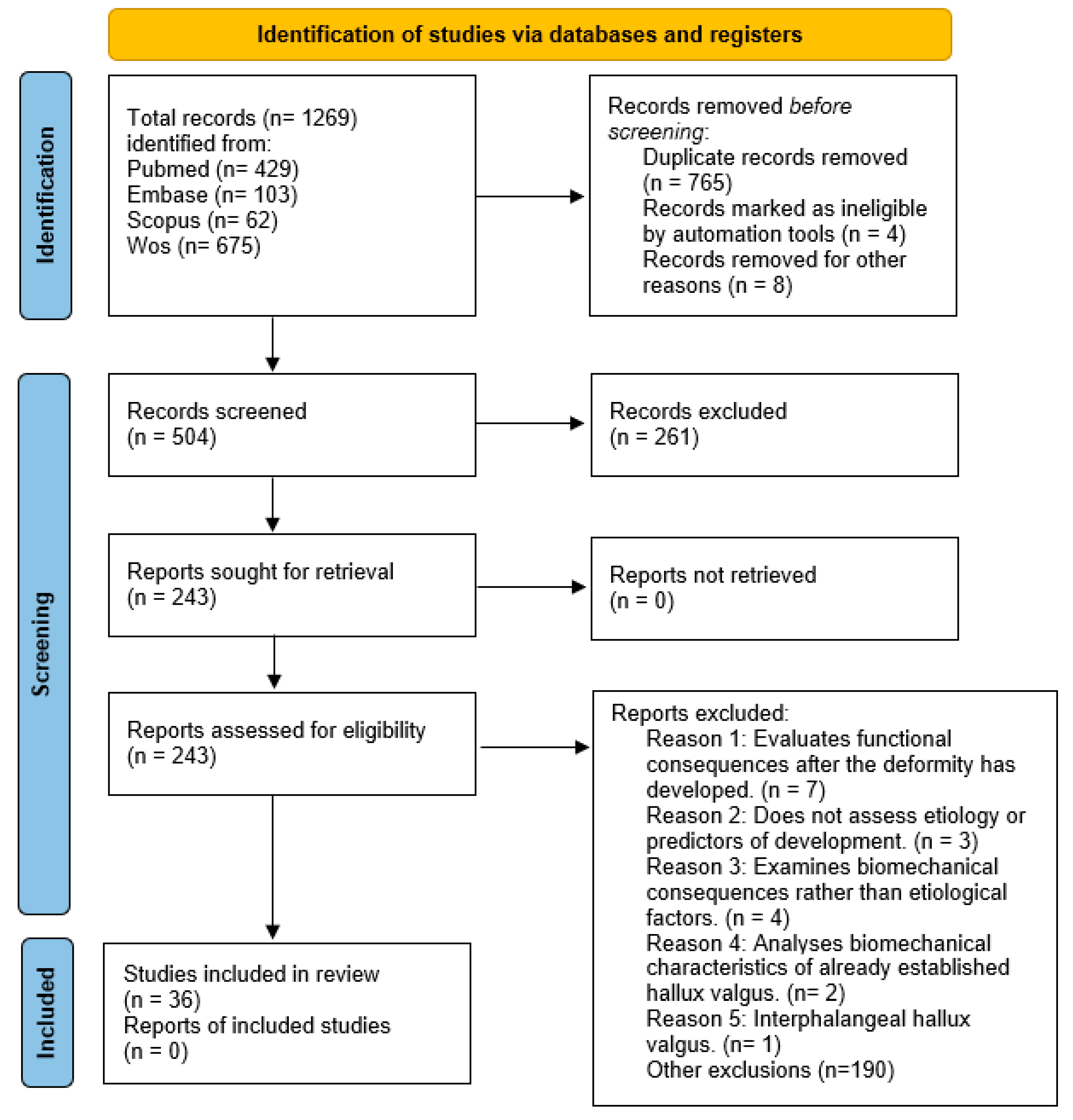
3.1. Study Selection
3.2. Study Characteristics
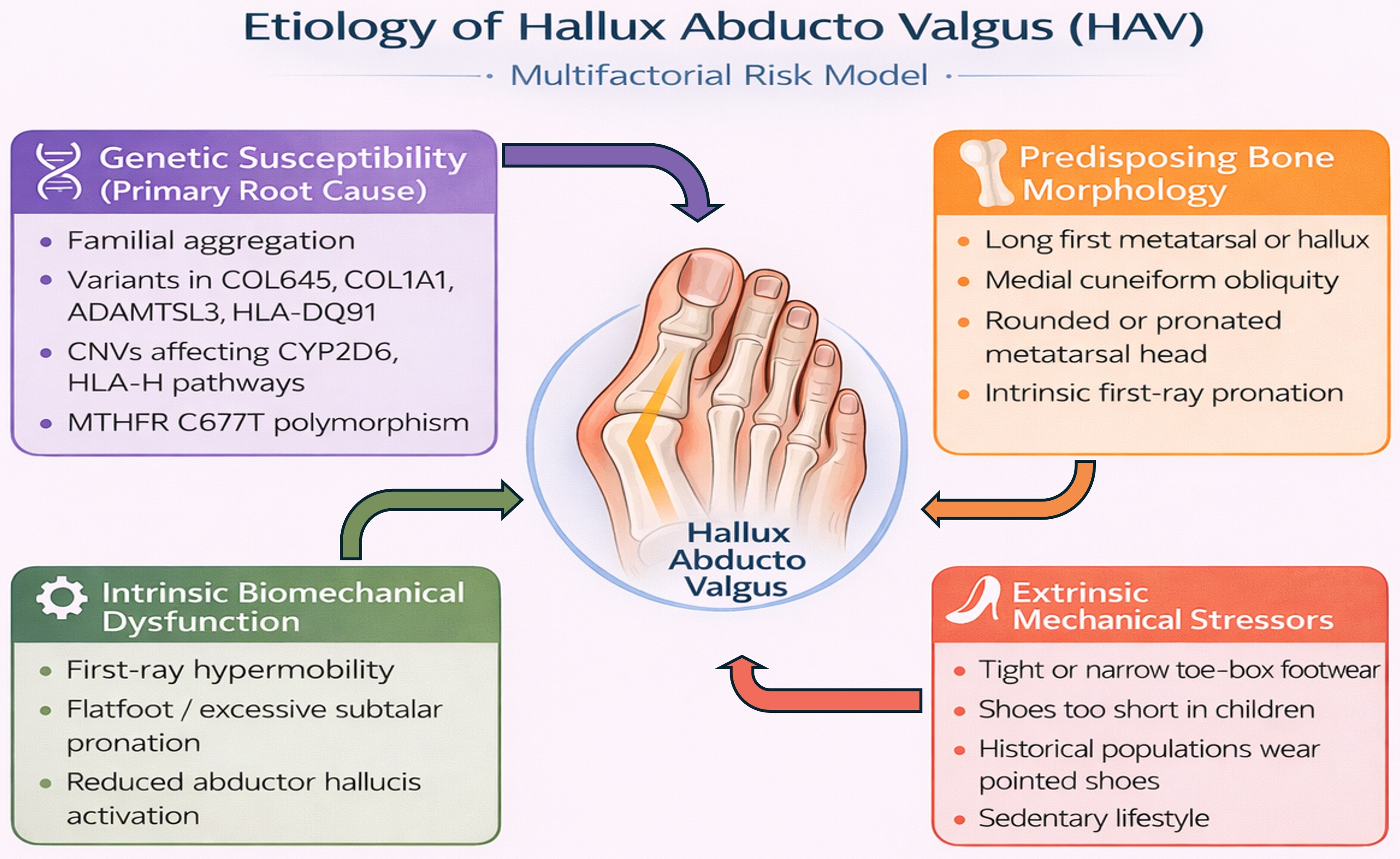
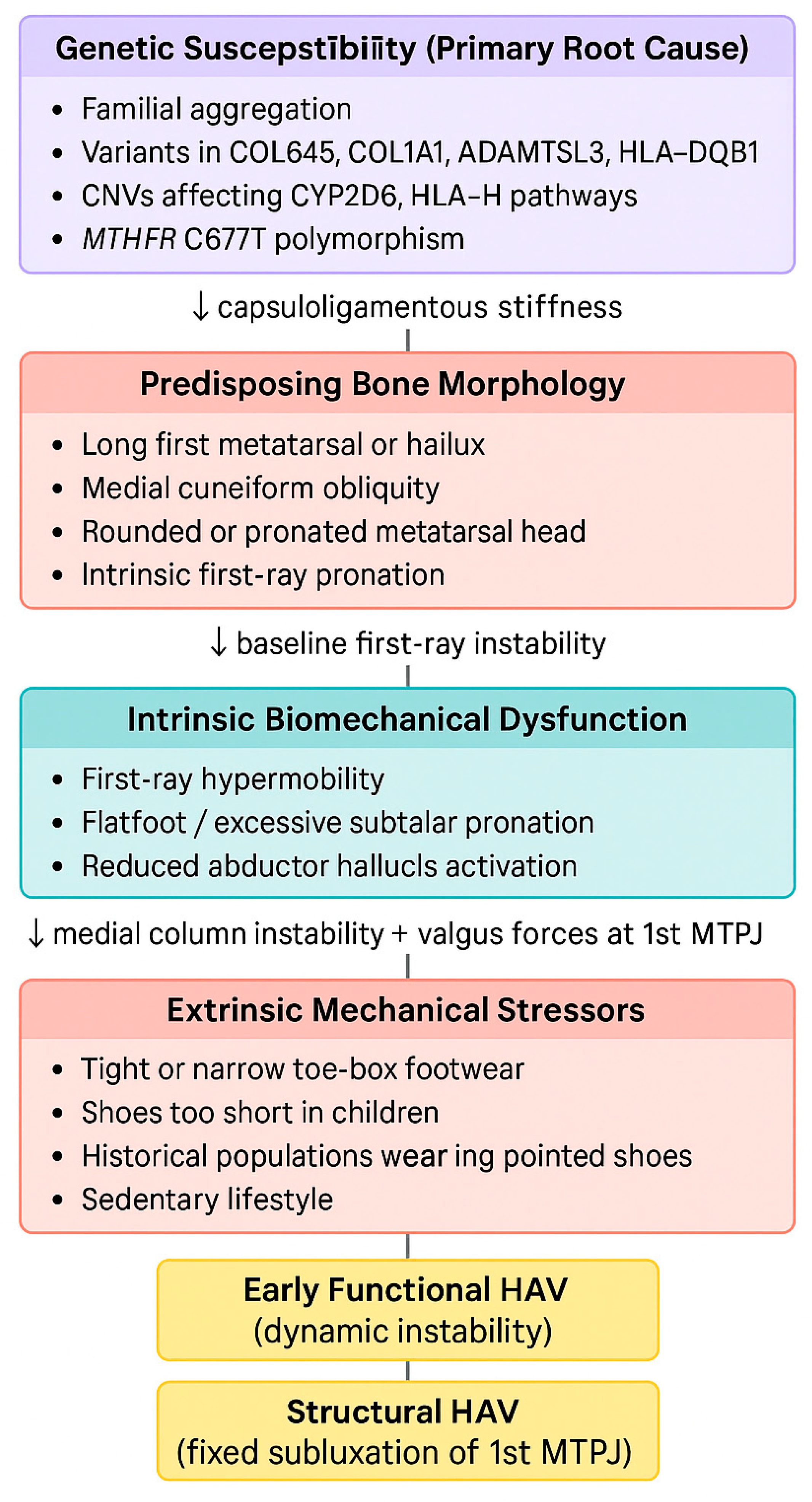
3.2.1. Genetic Factors and Family History
3.2.2. First-Ray Bone Morphology and Multiplanar Deformity
3.2.3. Intrinsic Biomechanical Factors
3.2.4. Anthropometric and Demographic Factors
3.2.5. Lower-Limb Alignment and Biomechanics
3.2.6. Extrinsic, Metabolic and Lifestyle Factors
3.3. Risk of Bias in the Included Studies
4. Discussion
4.1. Genetic Factors and Family History
4.2. Bone Morphology and the Multiplanar Component
4.3. Intrinsic Biomechanical Factors
4.4. Anthropometric and Demographic Factors
4.5. Lower-Limb Alignment and Biomechanics
4.6. Extrinsic, Metabolic, and Lifestyle Factors
4.7. Limitations
5. Conclusions
Author Contributions
Funding
Institutional Review Board Statement
Informed Consent Statement
Data Availability Statement
Conflicts of Interest
References
- Munuera-Martínez, P.V. El Primer Radio: Biomecánica y Ortopodología, 2nd ed.; Exa Editores SL: Santander, Spain, 2012; ISBN 978-84-616-0833-1. [Google Scholar]
- Giannestras, N.J. (Ed.) Hallux Valgus y Hallux Rigidus. In Trastornos del Pie; Salvat Editores SA: Barcelona, Spain, 1979. [Google Scholar]
- Nix, S.; Smith, M.; Vicenzino, B. Prevalence of Hallux Valgus in the General Population: A Systematic Review and Meta-Analysis. J. Foot Ankle Res. 2010, 3, 21. [Google Scholar] [CrossRef]
- Cai, Y.; Song, Y.; He, M.; He, W.; Zhong, X.; Wen, H.; Wei, Q. Global Prevalence and Incidence of Hallux Valgus: A Systematic Review and Meta-Analysis. J. Foot Ankle Res. 2023, 16, 63. [Google Scholar] [CrossRef]
- Glasoe, W.M.; Nuckley, D.J.; Ludewig, P.M. Hallux Valgus and the First Metatarsal Arch Segment: A Theoretical Biomechanical Perspective. Phys. Ther. 2010, 90, 110–120. [Google Scholar] [CrossRef]
- Wong, D.W.-C.; Wang, Y.; Chen, T.L.-W.; Yan, F.; Peng, Y.; Tan, Q.; Ni, M.; Leung, A.K.-L.; Zhang, M. Finite Element Analysis of Generalized Ligament Laxity on the Deterioration of Hallux Valgus Deformity (Bunion). Front. Bioeng. Biotechnol. 2020, 8, 571192. [Google Scholar] [CrossRef]
- Uchiyama, E.; Kitaoka, H.; Luo, Z.; Grande, J.; Kura, H.; An, K. Pathomechanics of Hallux Valgus: Biomechanical and Immunohistochemical Study. Foot Ankle Int. 2005, 26, 732–738. [Google Scholar] [CrossRef] [PubMed]
- Castanov, V.; Vienneau, M.; Arakawa, T.; Hassan, S.; Agur, A.; Tyczynski, D. Three-Dimensional Architecture of the Great Toe Muscles: Functional Implications in Hallux Valgus. Anatomy 2020, 14, 77–85. [Google Scholar] [CrossRef]
- Arinci Incel, N.; Genç, H.; Erdem, H.R.; Yorgancioglu, Z.R. Muscle Imbalance in Hallux Valgus: An Electromyographic Study. Am. J. Phys. Med. Rehabil. 2003, 82, 345–349. [Google Scholar] [CrossRef]
- Sánchez Gómez, R.; Benito González, S.d.; Gómez Martín, B.; Álvarez Calderón Iglesias, Ó.; Rico Teixeira, R. Maniobra de fiabilidad para el Músculo Peroneo Lateral Largo: Hipermobilidad del Primer Radio. Rev. Int. Cienc. Podol. 2009, 3, 35–44. [Google Scholar]
- Iftikhar, A.; Aslam, S.; Amjad, F.; Jabbar, S.; Alam, A. Prevalence and Factors Leading to Hallux Valgus in Adults: Leading to Hallux Valgus in Adults. Pak. Biomed. J. 2022, 224–228. [Google Scholar] [CrossRef]
- Martín-Casado, L.; Aldana-Caballero, A.; Barquín, C.; Criado-Álvarez, J.J.; Polonio-López, B.; Marcos-Tejedor, F. Foot Morphology as a Predictor of Hallux Valgus Development in Children. Sci. Rep. 2023, 13, 9351. [Google Scholar] [CrossRef]
- Perera, A.M.; Mason, L.; Stephens, M.M. The Pathogenesis of Hallux Valgus. J. Bone Jt. Surg. Am. 2011, 93, 1650–1661. [Google Scholar] [CrossRef]
- Jia, J.; Li, J.; Qu, H.; Li, M.; Zhang, S.; Hao, J.; Gao, X.; Meng, X.; Sun, Y.; Hakonarson, H.; et al. New Insights into Hallux Valgus by Whole Exome Sequencing Study. Exp. Biol. Med. 2021, 246, 1607–1616. [Google Scholar] [CrossRef]
- Manual Del JBI Para La Síntesis de La Evidencia Home. Available online: https://jira-p-us.refined.site (accessed on 19 October 2025).
- Barker, T.H.; Hasanoff, S.; Aromataris, E.; Stone, J.C.; Leonardi-Bee, J.; Sears, K.; Klugar, M.; Tufanaru, C.; Moola, S.; Liu, X.-L.; et al. The Revised JBI Critical Appraisal Tool for the Assessment of Risk of Bias for Analytical Cross-Sectional Studies. JBI Evid. Synth. 2025. [Google Scholar] [CrossRef]
- Chen, Y.; Liang, C.; Shih, H.; Tu, K.; Tang, S.; Wang, S. Correlation Between Hallux Valgus Severity and the Prevalence of Metatarsus Adductus in Hallux Valgus. J. Foot Ankle Res. 2025, 18, e70049. [Google Scholar] [CrossRef] [PubMed]
- Choi, Y.-H.; Lee, S.-W.; Ahn, J.H.; Kim, G.J.; Kang, M.H.; Kim, Y.-C. Hallux Valgus and Pes Planus: Correlation Analysis Using Deep Learning-Assisted Radiographic Angle Measurements. Foot Ankle Surg. 2025, 31, 170–176. [Google Scholar] [CrossRef]
- Liu, S.; Zheng, W.; Chen, H.; Tu, M.; Zhong, Y.; Lou, Y.; Wen, Y.; Chen, L. The Causal Relationship Between Multiple Modifiable Risk Factors and Hallux Valgus: A Two-Sample Mendelian Randomization Study. Food Sci. Nutr. 2025, 13, e70965. [Google Scholar] [CrossRef]
- Liu, Z.; Okunuki, T.; Yabiku, H.; Chen, S.; Hoshiba, T.; Maemichi, T.; Li, Y.; Kumai, T. Hallux Valgus in Preprofessional Adolescent Dancesport Athletes: Prevalence and Associated Training Factors. J. Foot Ankle Res. 2024, 17, e12043. [Google Scholar] [CrossRef]
- Nakao, H.; Imaoka, M.; Hida, M.; Imai, R.; Nakamura, M.; Matsumoto, K.; Kita, K. Determination of Individual Factors Associated with Hallux Valgus Using SVM-RFE. BMC Musculoskelet. Disord. 2023, 24, 534. [Google Scholar] [CrossRef]
- Jung, D.-Y.; Jung, S.; Gwak, G. Contributions of Age, Gender, Body Mass Index, and Normalized Arch Height to Hallux Valgus: A Decision Tree Approach. BMC Musculoskelet. Disord. 2023, 24, 278. [Google Scholar] [CrossRef] [PubMed]
- Zhou, W.; Jia, J.; Qu, H.-Q.; Ma, F.; Li, J.; Qi, X.; Meng, X.; Ding, Z.; Zheng, G.; Hakonarson, H.; et al. Identification of Copy Number Variants Contributing to Hallux Valgus. Front. Genet. 2023, 14, 1116284. [Google Scholar] [CrossRef] [PubMed]
- Bu, P.; Li, C.; Meng, X.; Ma, X.; Zhang, X.; Jiang, J.; Li, J.; Xu, Y. Radiographic study of relationship between medial cuneiform obliquity and simple hallux valgus. Zhongguo Xiu Fu Chong Jian Wai Ke Za Zhi 2022, 36, 209–214. [Google Scholar] [CrossRef]
- Dittmar, J.M.; Inskip, S.A.; Rose, A.K.; Cessford, C.; Mitchell, P.D.; O’Connell, T.C.; Robb, J.E. Health Inequality in Medieval Cambridge, 1200–1500 CE. Am. J. Biol. Anthr. 2024, 185, e24993. [Google Scholar] [CrossRef]
- Kinz, W.; Groll-Knapp, E.; Kundi, M. Hallux Valgus in Pre-School-Aged Children: The Effects of Too-Short Shoes on the Hallux Angle and the Effects of Going Barefoot on Podiatric Health. Footwear Sci. 2021, 13, 29–42. [Google Scholar] [CrossRef]
- Manceron, A.; Cazeau, C.; Hardy, A.; Piat, C.; Bauer, T.; Stiglitz, Y. Correlation between First Tarsometatarsal Joint Mobility and Hallux Valgus Severity. Int. Orthop. 2022, 46, 855–859. [Google Scholar] [CrossRef]
- González-Elena, M.L.; Castro-Mendez, A.; Cohena-Jimenez, M.; Cordoba-Fernandez, A. Relationship of the Use of Short Footwear with the Development of Hallux Valgus in a Sample of Andalusian Schoolchildren. Int. J. Environ. Res. Public Health 2021, 18, 11244. [Google Scholar] [CrossRef]
- Puszczalowska-Lizis, E.; Lizis, S.; Prusak, M.; Omorczyk, J. Impact of Length and Width of Footwear on Foot Structure of Preschool-Aged Children. PeerJ 2022, 10, e13403. [Google Scholar] [CrossRef] [PubMed]
- Nishimura, A.; Kato, K.; Fukuda, A.; Nakazora, S.; Yamada, T.; Uchida, A.; Sudo, A. Prevalence of Hallux Valgus and Risk Factors among Japanese Community Dwellers. J. Ortop. Sci. 2014, 19, 257–262. [Google Scholar] [CrossRef] [PubMed]
- Okuda, H.; Juman, S.; Ueda, A.; Miki, T.; Shima, M. Factors Related to Prevalence of Hallux Valgus in Female University Students: A Cross-Sectional Study. J. Epidemiol. 2014, 24, 200–208. [Google Scholar] [CrossRef] [PubMed]
- Klein, C.; Groll-Knapp, E.; Kundi, M. Increased Hallux Angle in Children and Its Association with Insufficient Length of Footwear: A Community Based Cross-Sectional Study. BMC Musculoskelet. Disord. 2009, 10, 159. [Google Scholar] [CrossRef]
- Coughlin, M.J.; Jones, C.P. Hallux Valgus: Demographics, Etiology, and Radiographic Assessment. Foot Ankle Int. 2007, 28, 759–777. [Google Scholar] [CrossRef]
- Piqué-Vidal, C.; Sole, M.T.; Antich, J. Hallux Valgus Inheritance: Pedigree Research in 350 Patients with Bunion Deformity. J. Foot Ankle Surg. Off. Publ. Am. Coll. Foot Ankle Surg. 2007, 46, 149–154. [Google Scholar] [CrossRef]
- Kuo, C.; Tsai, C.; Chuang, F.; Wang, Y.; Mong, M.; Yang, Y.; Shih, H.; Hsu, S.; Chang, W.; Bau, D.; et al. Impacts of Methylenetetrahydrofolate Reductase Genotypes on Hallux Valgus. In Vivo 2025, 39, 172–179. [Google Scholar] [CrossRef]
- O’Reilly, M.; Merghani, K.; McKenna, J.; Bayer, T. The Association of Gastrocnemius Tightness, Genu Valgum and Hallux Valgus: A Prospective Case-Control Study. J. Foot Ankle Surg. 2021, 60, 258–261. [Google Scholar] [CrossRef]
- Atbasi, Z.; Erdem, Y.; Kose, O.; Demiralp, B.; Ilkbahar, S.; Tekin, H.O. Relationship Between Hallux Valgus and Pes Planus: Real or Fiction? J. Foot Ankle Surg. 2020, 59, 513–517, Erratum in J. Foot Ankle Surg. 2020, 59, 873. https://doi.org/10.1053/j.jfas.2020.05.010. [Google Scholar] [CrossRef]
- Cruz, E.P.; Wagner, F.V.; Henning, C.; Sanhudo, J.A.V.; Pagnussato, F.; Galia, C.R. Does Hallux Valgus Exhibit a Deformity Inherent to the First Metatarsal Bone? J. Foot Ankle Surg. 2019, 58, 1210–1214. [Google Scholar] [CrossRef]
- Gómez Galván, M.; Constantino, J.A.; Bernáldez, M.J.; Quiles, M. Hallux Pronation in Hallux Valgus: Experimental and Radiographic Study. J. Foot Ankle Surg. 2019, 58, 886–892. [Google Scholar] [CrossRef]
- Mortka, K.; Lisiński, P.; Wiertel-Krawczuk, A. The Study of Surface Electromyography Used for the Assessment of Abductor Hallucis Muscle Activity in Patients with Hallux Valgus. Physiother. Theory Pract. 2018, 34, 846–851. [Google Scholar] [CrossRef]
- Tao, T.; Jiang, Y.; Li, W.; Li, Y.; Du, J.; Gui, J. Association of Vitamin D Receptor Gene TaqI, BsmI, FokI, and ApaI Polymorphisms and Susceptibility to Hallux Valgus in the Chinese Population. J. Foot Ankle Surg. 2018, 57, 753–758. [Google Scholar] [CrossRef]
- Kimura, T.; Kubota, M.; Taguchi, T.; Suzuki, N.; Hattori, A.; Marumo, K. Evaluation of First-Ray Mobility in Patients with Hallux Valgus Using Weight-Bearing CT and a 3-D Analysis System: A Comparison with Normal Feet. J. Bone Jt. Surg. Am. 2017, 99, 247–255. [Google Scholar] [CrossRef]
- Perez Boal, E.; de Bengoa Vallejo, R.B.; Fuentes Rodriguez, M.; Lopez Lopez, D.; Losa Iglesias, M.E. Geometry of the Proximal Phalanx of Hallux and First Metatarsal Bone to Predict Hallux Abducto Valgus: A Radiological Study. PLoS ONE 2016, 11, e0166197. [Google Scholar] [CrossRef] [PubMed]
- Menz, H.B.; Roddy, E.; Marshall, M.; Thomas, M.J.; Rathod, T.; Peat, G.M.; Croft, P.R. Epidemiology of Shoe Wearing Patterns Over Time in Older Women: Associations with Foot Pain and Hallux Valgus. J. Gerontol. A Biol. Sci. Med. Sci. 2016, 71, 1682–1687. [Google Scholar] [CrossRef]
- Steinberg, N.; Hershkovitz, I.; Peleg, S.; Dar, G.; Masharawi, Y.; Zeev, A.; Siev-Ner, I. Morphological Characteristics of the Young Scoliotic Dancer. Phys. Ther. Sport 2013, 14, 213–220. [Google Scholar] [CrossRef]
- Nery, C.; Coughlin, M.J.; Baumfeld, D.; Ballerini, F.J.; Kobata, S. Hallux Valgus in Males--Part 1: Demographics, Etiology, and Comparative Radiology. Foot Ankle Int. 2013, 34, 629–635. [Google Scholar] [CrossRef]
- Munuera, P.V.; Polo, J.; Rebollo, J. Length of the First Metatarsal and Hallux in Hallux Valgus in the Initial Stage. Int. Orthop. 2008, 32, 489–495. [Google Scholar] [CrossRef] [PubMed]
- Mancuso, J.E.; Abramow, S.P.; Landsman, M.J.; Waldman, M.; Carioscia, M. The Zero-plus First Metatarsal and Its Relationship to Bunion Deformity. J. Foot Ankle Surg. Off. Publ. Am. Coll. Foot Ankle Surg. 2003, 42, 319–326. [Google Scholar] [CrossRef] [PubMed]
- Hardy, R.H.; Clapham, J.C.R. Observations on Hallux Valgus. J. Bone Jt. Surg. Br. Vol. 1951, 33-B, 376–391. [Google Scholar] [CrossRef]
- OCEBM Levels of Evidence. Available online: https://www.cebm.ox.ac.uk/resources/levels-of-evidence/ocebm-levels-of-evidence (accessed on 19 October 2025).
- Nguyen, U.-S.D.T.; Hillstrom, H.J.; Li, W.; Dufour, A.B.; Kiel, D.P.; Procter-Gray, E.; Gagnon, M.M.; Hannan, M.T. Factors Associated with Hallux Valgus in a Population-Based Study of Older Women and Men: The MOBILIZE Boston Study. Osteoarthr. Cartil. 2010, 18, 41–46. [Google Scholar] [CrossRef] [PubMed]



| Database | Search Terms |
|---|---|
| All databases | (hallux valgus OR hallux abductovalgus) NOT (hallux limitus OR hallux rigidus OR hallux varus) AND (etiolog OR aetiology OR risk factors OR factor OR caus* OR pathogenesis OR genetics OR congenital OR famil* OR hered* OR inherit* OR hormonal OR relaxin OR shoe* OR shoewear OR footwear OR osteoarthritis OR arthritis OR rheumat* OR hipermobility OR first ray OR first metatarsal head OR peroneus longus OR intrinsic musculature OR extrinsic musculature OR biomechanics) NOT (surgery OR osteotomy OR treatment OR therap*). |
| Author | Study Type | 1 | 2 | 3 | 4 | 5 | 6 | 7 | 8 | 9 | 10 | 11 | Total |
|---|---|---|---|---|---|---|---|---|---|---|---|---|---|
| Chen et al. [17] | Cross-Sectional Studies | 1 | 0.5 | 1 | 1 | 0.5 | 0 | 1 | 1 | 6/8 | |||
| Choi et al. [18] | 1 | 1 | 1 | 1 | 0.5 | 0.5 | 1 | 1 | 7/8 | ||||
| Liu S et al. [19] | 1 | 1 | 1 | 1 | 1 | 1 | 1 | 1 | 8/8 | ||||
| Liu Z et al. [20] | 1 | 1 | 1 | 1 | 0.5 | 0.5 | 1 | 1 | 7/8 | ||||
| Nakao et al. [21] | 1 | 1 | 1 | 1 | 0.5 | 0.5 | 1 | 1 | 7/8 | ||||
| Jung et al. [22] | 1 | 1 | 1 | 1 | 0.5 | 0.5 | 1 | 1 | 7/8 | ||||
| Martín-Casado et al. [12] | 1 | 1 | 1 | 1 | 0.5 | 0.5 | 1 | 1 | 7/8 | ||||
| Zhou et al. [23] | 1 | 0.5 | 1 | 1 | 0.5 | 0 | 1 | 0.5 | 5.5/8 | ||||
| Bu et al. [24] | 1 | 1 | 1 | 1 | 0.5 | 0.5 | 1 | 1 | 7/8 | ||||
| Dittmar et al. [25] | 1 | 1 | 1 | 1 | 1 | 1 | 1 | 1 | 8/8 | ||||
| Kinz et al. [26] | 1 | 1 | 1 | 1 | 0.5 | 1 | 1 | 1 | 7/8 | ||||
| Manceron et al. [27] | 1 | 1 | 1 | 1 | 0.5 | 0.5 | 1 | 1 | 7/8 | ||||
| González-Elena et al. [28] | 1 | 1 | 1 | 1 | 0.5 | 0 | 1 | 1 | 6.5/8 | ||||
| Puszczalowska-Lizis et al. [29] | 1 | 1 | 1 | 1 | 0.5 | 0 | 1 | 1 | 6.5/8 | ||||
| Nishimura et al. [30] | 1 | 1 | 1 | 1 | 1 | 1 | 0.5 | 1 | 7.5/8 | ||||
| Okuda et al. [31] | 1 | 1 | 1 | 1 | 1 | 1 | 1 | 1 | 8/8 | ||||
| Klein et al. [32] | 1 | 1 | 1 | 1 | 0.5 | 0 | 1 | 1 | 6.5/8 | ||||
| Coughlin et al. [33] | 1 | 1 | 1 | 1 | 0.5 | 0.5 | 1 | 1 | 7/8 | ||||
| Piqué-Vidal et al. [34] | 1 | 1 | 1 | 1 | 0.5 | 1 | 1 | 1 | 7.5/8 | ||||
| Kuo et al. [35] | 1 | 1 | 1 | 1 | 1 | 1 | 1 | 1 | 0.5 | 1 | 9.5/10 | ||
| Jia et al. [14] | 1 | 1 | 1 | 0.5 | 0.5 | 0.5 | 1 | 1 | 0 | 1 | 7.5/10 | ||
| O’Reilly et al. [36] | Case–Control Studies | 0.5 | 1 | 1 | 1 | 1 | 1 | 0.5 | 0.5 | 0 | 1 | 6.5/10 | |
| Atbasi et al. [37] | 0.5 | 1 | 1 | 1 | 1 | 0.5 | 0 | 1 | 0.5 | 1 | 7.5/10 | ||
| Cruz et al. [38] | 1 | 1 | 1 | 1 | 1 | 1 | 0.5 | 0.5 | 0 | 1 | 8/10 | ||
| Gómez Galván et al. [39] | 1 | 1 | 1 | 1 | 1 | 1 | 1 | 0.5 | 0 | 1 | 8.5/10 | ||
| Mortka et al. [40] | 1 | 1 | 1 | 1 | 1 | 1 | 1 | 0.5 | 0 | 1 | 8.5/10 | ||
| Tao et al. [41] | 1 | 1 | 1 | 1 | 1 | 1 | 0.5 | 0.5 | 0 | 1 | 8/10 | ||
| Kimura et al. [42] | 1 | 1 | 1 | 1 | 1 | 1 | 1 | 1 | 0 | 1 | 9/10 | ||
| Perez Boal et al. [43] | 1 | 1 | 1 | 1 | 1 | 1 | 1 | 1 | 0 | 1 | 9/10 | ||
| Menz et al. [44] | 1 | 0.5 | 1 | 0.5 | 1 | 0 | 0 | 1 | 1 | 1 | 7/10 | ||
| Steinberg et al. [45] | 1 | 1 | 1 | 1 | 1 | 1 | 0.5 | 0.5 | 0 | 1 | 8/10 | ||
| Nery et al. [46] | 1 | 1 | 1 | 0.5 | 0 | 1 | 0 | 1 | 1 | 1 | 7.5/10 | ||
| Munuera et al. [47] | 1 | 1 | 1 | 1 | 1 | 0.5 | 0.5 | 1 | 0 | 1 | 8/10 | ||
| Arinci Incel et al. [9] | 1 | 1 | 1 | 1 | 1 | 1 | 0.5 | 0.5 | 0 | 1 | 8/10 | ||
| Mancuso et al. [48] | 0 | 0 | 1 | 1 | 1 | 0 | 0 | 1 | 0.5 | 1 | 5.5/10 | ||
| Hardy et al. [49] | 0.5 | 1 | 1 | 0.5 | 1 | 1 | 0.5 | 0 | 0 | 1 | 6.5/10 |
| Study | Checklist Tools | JBI Critical Appraisal | |
|---|---|---|---|
| Chen et al. [17] | JBI Checklist for Analytical Cross-Sectional Studies | 6/8 (75%) | Low |
| Choi et al. [18] | JBI Checklist for Analytical Cross-Sectional Studies | 7/8 (87.5%) | Low |
| Liu S et al. [19] | JBI Checklist for Analytical Cross-Sectional Studies | 8/8 (100%) | Low |
| Liu Z et al. [20] | JBI Checklist for Analytical Cross-Sectional Studies | 7/8 (87.5%) | Low |
| Nakao et al. [21] | JBI Checklist for Analytical Cross-Sectional Studies | 7/8 (87.5%) | Low |
| Jung et al. [22] | JBI Checklist for Analytical Cross-Sectional Studies | 7/8 (87.5%) | Low |
| Martín-Casado et al. [12] | JBI Checklist for Analytical Cross-Sectional Studies | 7/8 (87.5%) | Low |
| Zhou et al. [23] | JBI Checklist for Analytical Cross-Sectional Studies | 5.5/8 (68.8%) | Moderate |
| Bu et al. [24] | JBI Checklist for Analytical Cross-Sectional Studies | 7/8 (87.5%) | Low |
| Dittmar et al. [25] | JBI Checklist for Analytical Cross-Sectional Studies | 8/8 (100%) | Low |
| Kinz et al. [26] | JBI Checklist for Analytical Cross-Sectional Studies | 7/8 (87.5%) | Low |
| Manceron et al. [27] | JBI Checklist for Analytical Cross-Sectional Studies | 7/8 (87.5%) | Low |
| González-Elena et al. [28] | JBI Checklist for Analytical Cross-Sectional Studies | 6.5/8 (81.3%) | Low |
| Puszczalowska-Lizis et al. [29] | JBI Checklist for Analytical Cross-Sectional Studies | 6.5/8 (81.3%) | Low |
| Nishimura et al. [30] | JBI Checklist for Analytical Cross-Sectional Studies | 7.5/8 (87.5%) | Low |
| Okuda et al. [31] | JBI Checklist for Analytical Cross-Sectional Studies | 8/8 (100%) | Low |
| Klein et al. [32] | JBI Checklist for Analytical Cross-Sectional Studies | 6.5/8 (81.3%) | Low |
| Coughlin et al. [33] | JBI Checklist for Analytical Cross-Sectional Studies | 7/8 (87.5%) | Low |
| Piqué-Vidal et al. [34] | JBI Checklist for Analytical Cross-Sectional Studies | 7.5/8 (87.5%) | Low |
| Kuo et al. [35] | JBI Critical Appraisal Checklist for Case–Control Studies | 9.5/10 (95%) | Low |
| Jia et al. [14] | JBI Critical Appraisal Checklist for Case–Control Studies | 7.5/10 (75%) | Low |
| O’Reilly et al. [36] | JBI Critical Appraisal Checklist for Case–Control Studies | 6.5/10 (65%) | Moderate |
| Atbasi et al. [37] | JBI Critical Appraisal Checklist for Case–Control Studies | 7.5/10 (75%) | Low |
| Cruz et al. [38] | JBI Critical Appraisal Checklist for Case–Control Studies | 8/10 (80%) | Low |
| Gómez Galván et al. [39] | JBI Critical Appraisal Checklist for Case–Control Studies | 8.5/10 (85%) | Low |
| Mortka et al. [40] | JBI Critical Appraisal Checklist for Case–Control Studies | 8.5/10 (85%) | Low |
| Tao et al. [41] | JBI Critical Appraisal Checklist for Case–Control Studies | 8/10 (80%) | Low |
| Kimura et al. [42] | JBI Critical Appraisal Checklist for Case–Control Studies | 9/10 (90%) | Low |
| Perez Boal et al. [43] | JBI Critical Appraisal Checklist for Case–Control Studies | 9/10 (90%) | Low |
| Menz et al. [44] | JBI Critical Appraisal Checklist for Case–Control Studies | 7/10 (70%) | Moderate |
| Steinberg et al. [45] | JBI Critical Appraisal Checklist for Case–Control Studies | 8/10 (80%) | Low |
| Nery et al. [46] | JBI Critical Appraisal Checklist for Case–Control Studies | 7.5/10 (75%) | Low |
| Munuera et al. [47] | JBI Critical Appraisal Checklist for Case–Control Studies | 8/10 ((80%) | Low |
| Arinci Incel et al. [9] | JBI Critical Appraisal Checklist for Case–Control Studies | 8/10 (80%) | Low |
| Mancuso et al. [48] | JBI Critical Appraisal Checklist for Case–Control Studies | 5.5/10 (55%) | Moderate |
| Hardy et al. [49] | JBI Critical Appraisal Checklist for Case–Control Studies | 6.5/10 (65%) | Moderate |
| Author (Year), Study Design and Country | Level of Evidence (OCEBM) | Objective | Sample Size (N) | Participants | Risk/Etiologic Factors | Methods | Results | Conclusions |
|---|---|---|---|---|---|---|---|---|
| Chen et al. [17] (2025). Analytical cross-sectional study. China. Taiwán. | 4 | To analyze the correlation between HAV severity and the presence of metatarsus adductus. | 198 adults | F = 108 M = 90 49.6 ± 10.4 years. | HAV severity and metatarsus adductus. | Weightbearing AP radiographs (HVA, IMA, MA); PACS software; Manchester classification. | Significant correlation between HAV severity and metatarsus adductus (r = 0.42; p < 0.001). | Metatarsus adductus may act as an anatomical predisposing factor for increased HAV severity. |
| Choi et al. [18] (2025). Analytical cross-sectional study. South Korea. | 3b | To analyze the correlation between HAV and flatfoot using artificial intelligence. | 520 adults | F = 308 M = 212 51.7 ± 12.3 years. | Relationship between HVA, IMA, and calcaneal–flatfoot angles. | Convolutional neural network-assisted radiographs with automatic angle measurement. | Significant positive correlation between HAV severity and the flatfoot angle. | The coexistence of HAV and flatfoot suggests a shared biomechanical pattern. |
| Liu S. et al. [19] (2025). Analytical cross-sectional study. China. | 2b | To evaluate the causal relationship among sedentary behavior, calcium homeostasis, and HAV risk. | Aggregated GWAS data from multiple European cohorts | NA. | Sedentary behavior, serum calcium levels, bone metabolism. | Two-sample Mendelian randomization using GWAS data; two-step mediation models. | Sedentary behavior increases HAV risk (OR = 1.19); serum calcium reduces risk (OR = 0.75). | Sedentary behavior is a risk factor partially mediated by calcium metabolism. |
| Kuo et al. [35] (2025). Case–control study. Taiwán. | 3b | To investigate the association between MTHFR gene polymorphisms (rs1801133 and rs1801131) and the risk of developing HAV in a Taiwanese population. | 750 adults | F = 600 M = 150 50.7 ± 15.3 years (150 with HAV, 600 controls). | Genetic polymorphisms: MTHFR C677T (rs1801133) and MTHFR A1298C (rs1801131). | HAV diagnosis using a standardized foot diagram (>15° hallux deviation). DNA extraction from leukocytes; genotyping via PCR-RFLP; statistical analysis with adjusted ORs, chi-square tests and genetic trend analysis. | The TT genotype of MTHFR rs1801133 was associated with a 2.57-fold increased risk of HAV. The CT genotype did not increase risk. The rs1801131 polymorphism showed no association with HAV. The association did not vary by sex, age, weight, height or BMI. | The TT genotype of MTHFR rs1801133 is a genetic risk marker for HAV. |
| Liu Z. et al. [20] (2024). Analytical cross-sectional study. Japan. | 3b | To determine the prevalence of HAV and associated factors in adolescent dancers. | 275 adolescent athletes | F = 202 M = 73 14.5 ± 2.1 years. | Sex, age, weekly training time and years of practice. | Questionnaires, plantar photographs, logistic regression analysis. | Higher prevalence and severity of HAV were observed in females and in those with greater weekly training loads. | Female sex and prolonged training are key risk factors for HAV in adolescents. |
| Jung et al. [22] (2023). Analytical cross-sectional study. South Korea. | 3b | To identify the factors that contribute to HAV using a decision tree model. | 864 adults | F = 586 M = 278 54.2 ± 13.6 years. | Age, sex, BMI, arch height. | Weightbearing dorsoplantar radiographs; 3D foot scanner for arch height; demographic questionnaires. | Female sex and older age were the most influential predictors. BMI and arch height also contributed to the model. | The combination of advanced age, female sex and higher arch height increases the likelihood of HAV. |
| Martín-Casado et al. [12] (2023). Analytical cross-sectional study. Ecuador. | 3b | To evaluate morphological foot differences across BMI categories and identify HAV risk factors in children and adolescents. | 1678 children 3356 feet | F = 844 M = 834 10.54 ± 3.60 normal weight, 11.21 ± 3.64 overweight, 9.34 ± 3.20 obesity. | Age, sex, foot length, metatarsal width, heel width, arch height and BMI. | INFOOT 3D scanner; standardized marking of 13 anatomical points; HVA calculation; BMI classification. | Overweight and obese children had longer and wider feet. Age, foot length and heel width were risk factors; male sex, metatarsal width and higher arch height were protective. | Excess weight is associated with greater foot length and width. Age, foot length and heel width increase HAV risk, while a higher arch and wider forefoot reduce it. |
| Nakao et al. [21] (2023). Analytical cross-sectional study. Japan. | 3b | To identify individual factors associated with HAV and rank their importance using a machine learning model (SVM-RFE). | 864 adults 1728 feet | F = 511 M = 353 51.6 ± 21 years. | Age, sex, body weight, instep height, foot length, BMI, arch height, history of foot pain/injury, and exercise habits. | Manchester Scale; Takei Corp measurement device; Support Vector Machine–Recursive Feature Elimination with cross-validation; Student’s t, χ2, Pearson’s/Spearman’s correlations. | Age, sex and body weight were the most relevant features. HAV was more common in women and increased significantly in individuals aged 45–64. No significant correlation with body weight or arch height. | HAV is primarily associated with age and sex, being more prevalent in females and in middle-aged adults. Body weight and arch height showed limited influence. |
| Zhou et al. [23] (2023). Analytical cross-sectional study. China. | 4 | To assess the relationship between TMT joint rotation and HAV severity using weightbearing CT. | 80 adults 122 feet | F = 68 M = 12 49.3 ± 12.6 years. | TMT rotation angle, 1st metatarsal pronation, IMA and HVA. | Weightbearing CT (CurveBeam pedCAT); 3D measurements using Disior Bonelogic software; HAV severity classified by HVA values. | TMT rotation angle increased significantly with HAV severity. Moderate and severe HAV showed greater pronation and larger TMT angle. | TMT joint rotation is strongly correlated with HAV severity and may represent a contributing morphological factor. |
| Manceron et al. [27] (2022). Analytical cross-sectional study. France. | 4 | To evaluate the correlation between 1st TMT joint mobility and HAV severity. | 38 adults 50 feet | F = 33 M = 5 55.3 ± 12.1 years. | TMT mobility and radiographic deformity severity. | Weightbearing radiographs (HVA, IMA); fluoroscopic assessment of TMT mobility; statistical correlations. | Greater TMT mobility was associated with more severe deformity. | TMT hypermobility is associated with increased HAV severity and may play an etiological role. |
| Bu et al. [24] (2022). Analytical cross-sectional study. China. | 4 | To analyze the relationship between distal articular inclination of the medial cuneiform and the presence or severity of HAV on weightbearing radiographs. | 534 adults 679 feet | F = 314 M = 2020 36.0 ± 16.0 years. | HVA, IMA, MAA, MCA, DMCA, PMAA, and TMT joint morphology; age and sex. | Weightbearing AP radiographs; measurements using CAD2012 software; statistical analysis with SPSS 19.0 (t-test, Wilcoxon, χ2, multivariate linear regression). | The HAV group showed significantly higher IMA, MAA and MCA values (p < 0.05), with no differences in DMCA or TMT morphology. Regression analysis identified age, MCA and DMCA as predictors of HVA, and age, MAA, MCA and DMCA as predictors of IMA. | Medial cuneiform inclination (particularly MCA) is associated with HAV severity. DMCA remains constant and is not a reliable severity indicator; MCA may serve as a characteristic angle for assessing HAV severity. |
| Dittmar et al. [25] (2024). Analytical cross-sectional study. Germany. | 4 | To explore the relationship between forefoot alignment and HAV severity. | 502 adults | F = 292 M = 210 52.3 ± 14.2 years. | Load distribution, foot morphology, forefoot angular parameters. | 3D foot scanner and baropodometric assessment. | Increased pronation and higher intermetatarsal angles were associated with more severe HAV. | Alterations in forefoot morphology and pronation patterns contribute to HAV development and progression. |
| Kinz et al. [26] (2021). Analytical cross-sectional study. Austria. | 4 | To evaluate the relationship between inadequate shoe length and HVA in preschool children, and to analyze the effect of habitual barefoot walking. | 620 children | F = 304 M = 316. - | Insufficient shoe length (internal and external), HVA, frequency of barefoot walking. | Interior shoe-length measuring device; foot scanner with digital HVA measurement; shoe classification (adequate/too short/excessively short); regression models. | 75.5% wore shoes that were too short externally, and 84,6% wore shoes too short internally. HVA was significantly higher in children wearing excessively short shoes. Barefoot walking was associated with lower HVA values. | Insufficient shoe length is strongly associated with increased HVA in preschool children. Regular barefoot walking may act as a protective factor. |
| Jia et al. [14] (2021). Case–control study. China. | 3b | To identify rare genetic variants and de novo mutations associated with HAV using whole-exome sequencing. | 164 adults | F = 113 M = 51 46 ± 12 years (68 HAV, 96 controls). | Genes involved in collagen structure, extracellular matrix integrity and immune regulation. | Bioinformatic analysis of rare variants including functional prediction and gene-enrichment analyses (GO and KEGG). | HAV cases presented rare variants in COL6A5, COL1A1, HLA-DQB1 and ADAMTSL3, all involved in collagen synthesis, connective-tissue organization and immune modulation. | HAV may represent a musculoskeletal disorder with complex genetic architecture, potentially linked to connective-tissue fragility and immunometabolic mechanisms. |
| González-Elena et al. [28] (2021). Analytical cross-sectional study. Spain. | 3b | To evaluate the association between shoe fit and HVA in school-aged children. | 188 children | F = 90 M = 97 3 to 15 years. | Shoe length relative to foot length. | Weightbearing podoscopy; calibrated anthropometric ruler. | Significant correlations were found between higher HVA and insufficient shoe length. | Wearing shoes that are too short is associated with higher HVA in certain age groups. |
| Puszczalowska-Lizis et al. [29] (2022). Analytical cross-sectional study. Poland. | 3b | To analyze the effect of functional shoe allowance (length and width) on foot morphology in children. | 100 children | F = 50 M = 50 NA. | Functional shoe allowance (length and width). | Computerized podoscope; digital shoe measurements. | Children wearing shoes with insufficient functional allowance showed significantly higher HVA. | Poor shoe fit contributes to increased HVA in children. |
| O’Reilly et al. [36] (2021). Case–control study. Ireland. | 3b | To evaluate the association between hallux valgus, gastrocnemius tightness, and genu valgum. | 50 adults | F = 48 M = 2 43 ± 11.6 years. | Gastrocnemius tightness and genu valgum. | Silfverskiöld test; Q-angle measurement with goniometer; weightbearing radiographs for HAV staging; statistical analysis with χ2 and t-tests. | HAV was significantly associated with genu valgum and gastrocnemius tightness (p < 0.001). | Gastrocnemius shortening may contribute to HAV, particularly when combined with genu valgum. |
| Atbasi et al. [37] (2020). Case–control study. Turkey. | 3b | To investigate the relationship between hallux valgus and flatfoot in adults using radiographic assessment. | 213 adults | F = 0 M = 213 22.2 ± 2.8 years. 54 HAV, 159 controls. | HVA, IMA, talonavicular coverage angle, Meary’s angle, calcaneal pitch, lateral talocalcaneal angle. | Weightbearing AP and lateral radiographs; digital measurements using Pi-view Star v.5.0.7; t-tests and Pearson’s correlations. | HAV patients showed significantly lower calcaneal pitch and higher lateral talocalcaneal angle. HVA/IMA correlated negatively with both angles. | Flatfoot is strongly correlated with HAV, suggesting that increased pronation and reduced medial arch height contribute to HAV development. |
| Cruz et al. [38] (2019). Case–control study. Brazil. | 3b | To determine whether HAV includes intrinsic first metatarsal rotation as a structural deformity using multiplanar CT. | 91 adults | F = 69 M = 22 50.6 ± 15.8 years 146 feet (82 HAV and 64 controls). | Intrinsic 1st metatarsal rotation, DMAA, IMA, HVA, sesamoid position, round sign. | Multislice CT; multiplanar reconstruction with OsiriX MD; measurement of base-to-head rotation; mixed linear model adjusted for age and sex. | Mean 1st metatarsal rotation was 15.36° in HAV vs. 3.45° in controls. Rotation correlated with DMAA but not with HVA or IMA. | HAV involves intrinsic pronation of the 1st metatarsal as a structural deformity rather than a purely adaptive change. |
| Gómez Galván et al. [39] (2019). Case–control study. Spain. | 3b | To evaluate the relationship between hallux pronation and HAV severity and to develop a radiographic method to quantify proximal phalanx pronation. | 162 adults | F = 132 M = 30 57 ± 16 years. (132 HAV, 30 controls). | Proximal phalanx pronation, 1st metatarsal pronation, HVA, IMA, sesamoid displacement, nail–floor angle. | Weightbearing radiographs; experimental phalanx rotation model; linear regression formula; clinical nail–floor angle; Pearson’s correlations and t-tests. | HAV was significantly associated with increased proximal phalanx pronation, 1st metatarsal pronation, and higher nail–floor angle. | Proximal phalanx and metatarsal pronation are key factors in HAV severity. The nail–floor angle is a useful clinical indicator of hallux rotation. |
| Mortka et al. [40] (2018). Case–control study. Poland. | 3b | To compare abdH activity in HAV and healthy feet using surface EMG. | 86 adults | F = NR M = NR 40.2 ± 16.5 years. (44 HAV, 42 controls). | AbdH EMG activity in relation to HAV severity and joint mobility. | Surface EMG (KeyPoint System); Ag/AgCl electrodes; toe-spread-out test; MUAP amplitude and interference pattern; ANOVA, Mann–Whitney, Spearman, Pearson. | AbdH MUAP amplitude was significantly lower in HAV patients. No correlation with HAV severity, age, or ROM. | Early functional impairment of AbdH occurs in HAV, independent of angular deformity severity. |
| Tao et al. [41] (2018). Case–control study. China. | 3b | To evaluate whether VDR polymorphisms are associated with HAV susceptibility. | 428 adults | F = 369 M = 59 60.6 ± 13.8 years. 228 con HAV, 200 controls. | VDR SNPs (TaqI, BsmI, FokI, ApaI), flatfoot, TNF-α and inflammatory markers. | Multiplex SNaPshot® genotyping; χ2 and logistic regression adjusted for age and sex. | Mutant alleles TaqI (C) and BsmI (A) were associated with increased HAV risk; FokI and ApaI showed no association. | VDR TaqI and BsmI polymorphisms contribute to genetic susceptibility for HAV. |
| Kimura et al. [42] (2017). Case–control study. Japan. | 3b | To evaluate 3D mobility of the first ray in HAV vs. normal feet using WBCT. | 20 adults | F = 20 M = 0 57 ± 10.2 years (10 HAV, 10 controls). | 3D mobility of TN, CN, TMT, and MTP joints. | WBCT with custom loading device; 3D reconstruction using Analyze software and ICP algorithm. | HAV feet showed significantly greater 3D mobility in all first-ray joints (dorsiflexion, inversion, adduction). | HAV is associated with multiplanar first-ray hypermobility, not restricted to a single joint. |
| Perez Boal et al. [43] (2016). Case–control study. Spain. | 3b | To assess whether 1st metatarsal and proximal phalanx geometry predicts HAV. | 160 adults | F = 75 M = 85 49.8 ± 13.7 years. (79 HAV, 81 controls). | MT1 and PPH lengths, medial–lateral asymmetry (LDM–LDL). | Weightbearing radiographs; PACS; AutoCAD 2013; ANOVA, t-tests, ROC curves. | Proximal phalanx medial–lateral asymmetry predicted HAV with high accuracy (AUC = 0.95). | Bone morphology of MT1 and PPH is a strong anatomical predictor of HAV. |
| Menz et al. [44] (2016). Case–control study. United Kingdom. | 3b | To examine lifelong footwear characteristics and HAV in older women. | 2627 adults | F = 2627 M = 0 65.6 ± 9.9 years. | Toe-box shape, heel height, years of use. | Structured retrospective footwear questionnaire; line-drawing instrument; logistic regression. | Narrow toe-box use between ages 20–39 significantly increased HAV risk. | Early-life use of narrow shoes is associated with HAV in older age. |
| Nishimura et al. [30] (2014). Analytical cross-sectional. Japan. | 3b | To determine HAV prevalence and associated risk factors. | 1249 adults | F = 747 M = 502 58.4 ± 11.2 years. | Age, sex, BMI, footwear, joint flexibility. | Clinical exam, radiographic HVA, joint flexibility assessment. | HAV was more prevalent in women and older adults; lower BMI and reduced ankle flexibility were significant risk factors. | Aging, female sex, and joint flexibility reduction are relevant HAV risk factors. |
| Okuda et al. [31] (2014). Analytical cross-sectional. Japan. | 3b | To determine HAV prevalence and associated factors in young Japanese women. | 343 adults | F = 343 M = 0 18.7 ± 0.6 years. | Hallux pain, family history, shoe use, foot type, flatfoot, sports history, BMI, bone density. | Questionnaire; Foot Look® scanner; SAI index; calcaneal densitometry. | HAV was associated with hallux pain and family history; not with footwear or flatfoot. | In young women, HAV is mainly related to hereditary factors and hallux pain. |
| Nery et al. [46] (2013). Case–control study. Brazil. | 3b | To compare etiologic and radiographic characteristics of HAV in men vs. women. | 62 adults | F = 31 M = 31 40.4 ± 16.3 years. | Family history, footwear, MPV, flatfoot. | Clinical review; weightbearing radiographs; χ2, t-tests, Mann–Whitney, Spearman. | 68% of men had maternal family history; HAV was more severe in men. | HAV in men is largely hereditary, early-onset, and more severe. |
| Steinberg et al. [45] (2013). Case–control study. Israel. | 3b | To analyze lower-limb alignment and joint laxity in older women with HAV. | 49 adults | F = 49 M = 0 64 ± 10 years (25 HAV, 24 controls). | Q-angle, tibiofemoral angle, rearfoot angle, generalized hypermobility. | Weightbearing radiographs; goniometry; Beighton score. | HAV participants had greater hypermobility and altered lower-limb alignment. | Lower-limb malalignment and joint laxity contribute to HAV. |
| Nguyen et al. [51] (2010). Analytical cross-sectional. USA. | 3b | To identify HAV risk factors in adults ≥70 years. | 600 adults | F = 386 M = 214 77.9 ± 5.6 years. | Age, sex, BMI, foot pain, flatfoot, heel height. | Clinical exam; MatScan baropodometry; Poisson regression. | In women, HAV was associated with low BMI and past high-heel use; in men, with high BMI and flatfoot. | Etiologic mechanisms differ by sex. |
| Klein et al. [32] (2009). Analytical cross-sectional. Austria. | 3b | To evaluate the relationship between shoe length and hallux angle in preschool children. | 858 children | F = 439 M = 419 3 ± 6.5 years. | Interior shoe length. | 3D foot scanner; shoe interior measuring device. | Insufficient shoe length increased HVA. | Small shoes are associated with lateral hallux deviation. |
| Munuera et al. [47] (2008). Case–control study. Spain. | 3b | To assess whether MT1 and hallux length are associated with early HAV. | 152 adults | F = 68 M = 84 37.3 ± 10.0 years. | Relative MT1 and hallux length. | Weightbearing radiographs; standardized measurement. | HAV cases had significantly longer MT1 and hallux. | Increased longitudinal bone length predisposes to early HAV. |
| Piqué-Vidal et al. [34] (2007). Descriptive cross-sectional. Spain. | 4 | To analyze the inheritance pattern of HAV by constructing three-generation pedigrees in patients with HAV. | 350 adults | F = 328 M = 22 47.8 ± 14.8 years. | Family history, maternal/paternal lineage. | Family history questionnaire; HVA measurement; χ2, t-test, non-parametric tests. | 90% had at least one affected relative; 56% penetrance; predominantly maternal transmission. | HAV follows an autosomal-dominant pattern with incomplete penetrance. |
| Coughlin et al. [33] (2007). Descriptive cross-sectional. USA. | 4 | To analyze demographics, clinical features, and family history in surgically treated HAV. | 602 adults | F = 511 M = 91. | Family history, footwear, foot morphology. | Clinical and radiographic evaluation; descriptive analysis. | 63% had family history; more severe deformity in women and familial cases | HAV has strong hereditary influence; footwear is not a primary cause. |
| Arinci Incel et al. [9] (2003). Case–control study. Turkey. | 3b | To evaluate muscle imbalance between abductor and adductor hallucis in HAV. | 40 adults. | F = 17 M = 3 44.5 ± 12.5 years. | EMG activity of AbdH, AddH, FHB, EHL. | Surface EMG; MUAP amplitude; interference pattern. | AbdH activity was significantly decreased in HAV. | Muscle imbalance may contribute to HAV progression. |
| Mancuso et al. [48] (2003). Case–control study. USA. | 3b | To examine MT1 length, metatarsal head shape, IMA, and HAV development. | 210 adults | F = 173 M = 37 42.1 ± 15.42 years. 110 HAV, 100 controls). | MT1 length, protrusion distance, head shape. | Weightbearing radiographs; morphological classification. | HAV was associated with long MT1 and round head; MT1 length correlated with severity. | Long MT1 is a clear risk factor for HAV. |
| Hardy et al. [49] 1951). Case–control study. United Kingdom. | 3b | To identify anatomical and functional factors associated with HAV using radiographs, footprints, and biomechanical tests. | 173 adults | F = 139 M = 34 34.3 ± 14.9 years. (89 HAV, 84 controls). | HVA, IMA, metatarsal protrusion, sesamoid displacement, hallux rotation, TMT mobility, family history. | Radiographs; photographic analysis; footprint exam; goniometry; isometric strength tests. | Strong correlation between HVA and IMA; increased hallux rotation and sesamoid displacement with severity; MT1 longer and more mobile in HAV; 63% had positive family history. | HAV involves structural deformity, increased first-ray mobility, and strong hereditary influence. |
Disclaimer/Publisher’s Note: The statements, opinions and data contained in all publications are solely those of the individual author(s) and contributor(s) and not of MDPI and/or the editor(s). MDPI and/or the editor(s) disclaim responsibility for any injury to people or property resulting from any ideas, methods, instructions or products referred to in the content. |
© 2026 by the authors. Licensee MDPI, Basel, Switzerland. This article is an open access article distributed under the terms and conditions of the Creative Commons Attribution (CC BY) license.
Share and Cite
Moreno-Fresco, M.M.; Mizzi, S.; Munuera-Martínez, P.V.; Távara-Vidalón, P. Factors Related to the Etiology of Hallux Abducto Valgus: A Systematic Review. J. Funct. Morphol. Kinesiol. 2026, 11, 117. https://doi.org/10.3390/jfmk11010117
Moreno-Fresco MM, Mizzi S, Munuera-Martínez PV, Távara-Vidalón P. Factors Related to the Etiology of Hallux Abducto Valgus: A Systematic Review. Journal of Functional Morphology and Kinesiology. 2026; 11(1):117. https://doi.org/10.3390/jfmk11010117
Chicago/Turabian StyleMoreno-Fresco, Marta María, Stephen Mizzi, Pedro V. Munuera-Martínez, and Priscila Távara-Vidalón. 2026. "Factors Related to the Etiology of Hallux Abducto Valgus: A Systematic Review" Journal of Functional Morphology and Kinesiology 11, no. 1: 117. https://doi.org/10.3390/jfmk11010117
APA StyleMoreno-Fresco, M. M., Mizzi, S., Munuera-Martínez, P. V., & Távara-Vidalón, P. (2026). Factors Related to the Etiology of Hallux Abducto Valgus: A Systematic Review. Journal of Functional Morphology and Kinesiology, 11(1), 117. https://doi.org/10.3390/jfmk11010117