


Abstract
A simple explanation is given for the linear dependence of electrical resistance on temperature and the linear dependence of the magnetoresistance on the magnetic field in high-temperature superconducting cuprates, which has been mysterious for many years. It is shown that this dependence stems from the treatment of a gas of translationally invariant polarons as a system with heavy fermions for wave vectors close to nesting. The destruction of such polarons at finite temperature and an external magnetic field leads to a linear dependence of the magnetoresistance on the magnetic field and temperature. It is shown that the relationship between the slopes of the magnetoresistance curves at zero magnetic field and at zero temperature is determined by the universal ratio in fermion systems and in boson systems, where is the Boltzmann constant and is the Bohr magneton. A relation between the existence of translationally invariant polarons and the “Planck” time of their relaxation is discussed.
1. Introduction
The linear increase of the magnetoresistance of cuprates and a number of other correlated electronic systems in a wide range of magnetic fields, from the lowest to quite high ones, discovered in recent experiments [1,2,3,4,5], is one of the biggest mysteries in the physics of high-temperature superconductors (HTSC). The electrical resistance of these compounds, linear in temperature at low temperatures, which has been observed since early experiments [6,7], also remains no less of a mystery.
In strongly correlated electronic systems, this behavior of the magnetoresistance is attributed to the existence of a strange metal phase (SM) in them, in particular, a fermionic phase in [1,2], [3] and a bosonic phase in [4], [5], the appearance of which in itself is a mysterious phenomenon. It is believed that, in contrast to ordinary metals, in which at low temperatures the magnetoresistance is quadratic in temperature and magnetic field, which corresponds to their description based on quasiparticles, the description of the strange metal phase based on the idea of well-defined quasiparticles is impossible [8]. The purpose of this paper is to point out the possibility of a simple explanation of the strange behavior of magnetoresistance based on the concept of translation-invariant (TI) polarons and bipolarons used to describe HTSC [9].
2. Results
According to [9,10], TI polarons are formed in cuprates when their momentum corresponds to nesting, that is, the wave vector of the charge density wave . Due to the Kohn anomaly, their mass is very large in this case (heavy fermions), and under the Fermi surface they form a nondegenerate fermionic gas. At a temperature , where is the energy of a TI polaron (reckoned from the Fermi level), the decay of TI polarons into free electronic states becomes possible. The lifetime of such free electrons will be determined by scattering on phonons, that is , where is the phonon energy, thereby determining the linear dependence of the electrical resistance on temperature: , where n is the concentration of free electrons, and m is the mass of a free electron. In an external magnetic field H, the concentration of free electrons depends on H and, according to [11], is equal to . Hence, the magnetoresistance of the fermion system is written as:
It follows that for : , which is the well-known linear temperature law for the electrical resistance of fermionic compounds, and for is linear in a magnetic field law for their magnetoresistance. It is important to emphasize that expression (1) obtained for the magnetoresistance satisfies the Kohler rule [12]:
According to [1,2,3], the experimental dependence of the magnetoresistance of fermionic correlated systems in the case of a strong magnetic field is well approximated by the hyperbolic expression:
where and are constants satisfying the relation .
Figure 1 shows a comparison of which is the experimental dependence determined by the right side of expression (2) with the theoretical dependence determined by the right side of expression (1), for the case . It follows from Figure 1 that both the approximations are in agreement with the experimental dependance within the accuracy of the experiment [1].
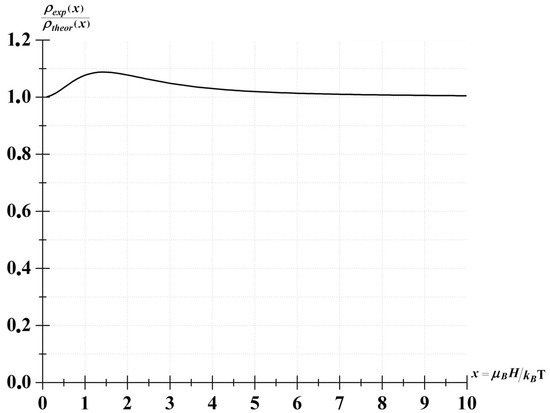
The fact that, according to [1], the linear dependence for the magnetoresistance is most clearly expressed near the optimal doping is apparently due to the fact that, under these conditions, the concentration of TI polarons reaches maximum and typically become lower in the overdoped regime [9].
We note that the presence of a strong temperature dependence of the Hall effect in fermionic compounds has little to do with the presence of TI polarons in them, since the concentration of the latter is much lower than the concentration of ordinary current carriers.
In the case of bosonic cuprates, TI bipolarons are the dominant current carriers. Each decaying TI bipolaron will now lead to the appearance of two free electrons. Accordingly, in the expression for , should be replaced by . As a result, for the magnetoresistance, instead of (1), we obtain:
According to [4], the experimental dependence of the magnetoresistance of bosonic cuprates is well approximated by the expression:
The proof of the bosonic nature of current carriers in and in [4] was based on measurements of the Little and Parks effect near the critical superconducting transition temperature , which, generally speaking, is not a strong argument in favor of the bosonic nature of current carriers at temperatures above . A stronger argument is the validity of the relations:
for fermionic systems and:
for bosonic ones which follow from (1)–(4), and are confirmed by experiments [1,4].
3. Discussion
As noted above, there is currently not a generally accepted explanation for the dependence of the magnetoresistance linear in T and H. It is worth noting that the effect under consideration is not specific for optimal doped oxides only. As was shown experimentally in [13], in such single layer cuprates as (Pb/La)-doped BiSrCuO (Bi2201) and TlBaCuO (Tl2201) the strange-metal regime extends well beyond the critical point of doping. As was shown above the TI-polaron description in this case leads to linear magnetoresistance at high H/T ratios with its magnitude much larger then predicted by conventional theory and in accordance with experiment [13] is insensitive to magnetic field orientation.
Such behavior is often observed for systems in the vicinity of their quantum critical points. In this regard, in [14] a concept of the universal “Planck” relaxation time was introduced. In the case of metallic systems, this means that the Fermi energy ceases to play the role of a scaling quantity in describing the electronic properties near the quantum critical point and, accordingly, the temperature takes on the role of a scaling energy. In the case of a TI polaron (bipolaron) gas under consideration, the characteristic frequency of fluctuations near the critical point, according to [10], tends to zero due to the Kohn anomaly, i.e., for , phase transitions can be described in terms of classical statistical mechanics, since in this case the inequality always takes place, which explains the nature of the occurrence of the “Planck” time in strongly correlated electronic systems near their quantum phase transitions. In this case, the participation of the magnetic field in the scaling relations of quantum phase transitions also becomes clear, since it plays the role of an external control parameter in them.
Funding
This research received no external funding.
Data Availability Statement
Not applicable.
Conflicts of Interest
The authors declare no conflict of interest.
References
- Hayes, I.M.; McDonald, R.D.; Breznay, N.P.; Helm, T.; Moll, P.J.W.; Wartenbe, M.; Shekhter, A.; Analytis, J.G. Scaling between magnetic field and temperature in the high-temperature superconductor BaFe2(As1-xPx)2. Nat. Phys. 2016, 12, 916–919. [Google Scholar] [CrossRef]
- Maksimovic, N.; Hayes, I.M.; Nagarajan, V.; Analytis, J.G.; Koshelev, A.E.; Singleton, J.; Lee, Y.; Schenkel, T. Magnetoresistance Scaling and the Origin of H-Linear Resistivity in BaFe2(As1-xPx)2. Phys. Rev. X 2020, 10, 041062. [Google Scholar] [CrossRef]
- Licciardello, S.; Maksimovic, N.; Ayres, J.; Buhot, J.; Čulo, M.; Bryant, B.; Kasahara, S.; Matsuda, Y.; Shibauchi, T.; Nagarajan, V.; et al. Coexistence of orbital and quantum critical magnetoresistance in FeSe1-xSx. Phys. Rev. Res. 2019, 1, 023011. [Google Scholar] [CrossRef]
- Yang, C.; Liu, H.; Liu, Y.; Wang, J.; Qiu, D.; Wang, S.; Wang, Y.; He, Q.; Li, X.; Li, P.; et al. Signatures of a strange metal in a bosonic system. Nature 2022, 601, 205–221. [Google Scholar] [CrossRef] [PubMed]
- Giraldo-Gallo, P.; Galvis, J.A.; Stegen, Z.; Modic, K.A.; Balakirev, F.F.; Betts, J.B.; Lian, X.; Moir, C.; Riggs, S.C.; Wu, J.; et al. Scale-invariant magnetoresistance in a cuprate superconductor. Science 2018, 361, 479–481. [Google Scholar] [CrossRef] [PubMed]
- Batlogg, B. Physical Properties of High-Tc Superconductors. Phys. Today 1991, 44, 44. [Google Scholar] [CrossRef]
- Iye, Y. Transport Properties of High-Tc Cuprates. In Physical Properties of High Temperature Superconductors III; Ginsberg, D.M., Ed.; World Scientific: Singapore, 1992; pp. 285–361. [Google Scholar] [CrossRef]
- Greene, R.L.; Mandal, P.R.; Poniatowski, N.R.; Sarkar, T. The Strange Metal State of the Electron-Doped Cuprates. Annu. Rev. Condens. Matter. Phys. 2020, 11, 213. [Google Scholar] [CrossRef]
- Lakhno, V.D. High-Temperature Superconductivity: Bipolaron Mechanism; De Gruyter: Berlin, Germany; Boston, MA, USA, 2022. [Google Scholar] [CrossRef]
- Lakhno, V.D. Translation-Invariant Bipolarons and Charge Density Waves in High-Temperature Superconductors. Front. Phys. 2021, 9, 662926. [Google Scholar] [CrossRef]
- Kubo, R. Statistical Mechanics. An Advanced Course with Problems and Solutions; North-Holland Publishing Company: Amsterdam, The Netherlands, 1965. [Google Scholar]
- Pippard, A.B. Magnetoresistance in Metals; Cambridge University Press: Cambridge, UK, 1989. [Google Scholar]
- Ayres, J.; Berben, M.; Čulo, M.; Hsu, Y.-T.; van Heumen, E.; Huang, Y.; Zaanen, J.; Kondo, T.; Takeuchi, T.; Cooper, J.R.; et al. Incoherent transport across the strange-metal regime of highly overdoped cuprates. Nature 2021, 595, 661–666. [Google Scholar] [CrossRef] [PubMed]
- Zaanen, J. Why the temperature is high. Nature 2004, 430, 512–513. [Google Scholar] [CrossRef] [PubMed]
Publisher’s Note: MDPI stays neutral with regard to jurisdictional claims in published maps and institutional affiliations. |
© 2022 by the author. Licensee MDPI, Basel, Switzerland. This article is an open access article distributed under the terms and conditions of the Creative Commons Attribution (CC BY) license (https://creativecommons.org/licenses/by/4.0/).