1. Introduction
If there are regions where the historical formation of the state was shaped by the environment, then Switzerland, with its Alpine peaks, is certainly one of them—at least according to the prevailing literature. Take Philip T. Hoffman, who has carefully studied the emergence of modern states in Europe and elsewhere. In his widely acclaimed 2015 book
Why Europe Conquered the World he works with an economic model of military competition driven by political factors. In this context, he must ask himself why there were so many rival states on this continent, unlike in imperial China, for example, where political authority was often centralised. Hoffman rejects the geographical answer given by Jared Diamond in his popular bestseller
Guns, Germs, and Steel. No, it is not the different shapes of the coastline (irregular versus regular) that led to this result. And no, it cannot be the mountains that increase transport costs and thwart military invasions. For although Europe has the Alps, the Pyrenees and other mountain ranges, China is in fact more mountainous, as can now be quantitatively proven (
Hoffman 2015, pp. 109–14;
Diamond 1997, pp. 413–16).
However, Hoffman does not want to completely dismiss geographical factors. After raising his objections to Diamond’s geodeterminism, he adds: ‘Not that geography was irrelevant, for it did interact with politics and military technology. Switzerland, after all, would not have remained autonomous without the Alps, and China would have been different without the steppe. The bottom line, however, is that the interaction was more complex than the arguments about mountains and coastlines assume.’ (
Hoffman 2015, p. 114). The following essay aims to examine this complexity using the example of Switzerland and its mountain regions. Hoffman takes it as a given that the country would not have remained autonomous without the Alps and that geography is therefore of some importance for the development of the state. Other authors, also well informed in comparative matters, place the Alps at the historical beginning of state development in Switzerland (
Behrisch 2025, p. 69).
Here, I would like to show that it is important to consult different types of literature for such questions. When it comes to assumptions about environmental effects, a number of generalisations have become established in large-scale research, which no longer appear certain when viewed up close and may turn out to be attributions or gross simplifications. Because mountains are such striking environmental features, they are a good example of this. The first section outlines the general discussion on the topic of mountains and states, based on selected authors. The discussion is long-standing and remains controversial to this day. The second section deals with literature on Swiss history, usually written by local authors who know the country at first hand. How do they view the influence of the Alps on the development of the small state? In the third section, I will draw on other types of studies to clarify specific factors. While economic historians, as indicated, today view mountains from the perspective of transport costs and military protection, it will become apparent that other factors may be more important.
2. The Mountains Between Geography and History
Since the emergence of scientific disciplines in the 19th century, geography and history have been in an undefined relationship. Conventions of subject-specific responsibility have developed, but in detail the separation is difficult, and the more the boundaries are emphasised, the more tempting it is to cross them at times. The first prominent ‘border violation’ came from Germany. Friedrich Ratzel (1844–1904) was initially a zoologist and travel writer before pursuing a highly successful university career as a geographer. He became famous with his two-volume
Anthropogeographie, followed in 1897 by his
Politische Geographie on state formation processes. Parts of it also appeared in an article on the Alps, which he knew personally (
Ratzel 1897,
1906). Even a brief research sketch on the subject of mountains can hardly ignore him. However, due to his close involvement in colonialism and his later use in National Socialism, his work remains a politically charged subject (
Klinke 2023).
Ratzel almost always considers the connection between mountains and states from the perspective of the mountains and illustrates it with countless fragments of information from all eras and countries around the globe. His frequent references to the Alps and Switzerland also give an impression of the discussion about our region. According to reviews, this was considered a convincing scientific style. Ratzel tended towards monism and wanted to produce a uniform description and explanation of the Earth. Important terms were ‘soil’ and ‘space’. A ‘passive soil’, for example, was a stretch of land whose population was declining and unable to defend itself. Through linguistic reversal alone, the soil thus became an actor. More than others, Ratzel worked with linguistic images: ‘The history of mountain peoples surges in the valleys like their rivers or lies as still as the mirror of an Alpine lake’ was a sentence of which he was apparently proud (
Ratzel 1906, p. 335). The mountain themes mentioned by contemporary economic historians (transport costs and difficulty of invasion) appear in Ratzel’s work under the headings ‘Inhibition of historical movement’ and ‘Protection and support’. The first guiding principle refers to an organic conception of state development based on German Darwinist models (
Klinke 2023, p. 138). When it came to the protection offered by mountains, Ratzel thought of the slowing down of military actions, which would give mountain warfare a similar character everywhere (
Ratzel 1897, p. 671).
Among his scientific opponents, the German geographer was considered a geodeterminist. Thus, for example, by the French historian Lucien Febvre (1878–1956), who published a detailed treatise on geography and history in 1922, which soon appeared in English as
Geographical Introduction to History and was reprinted almost until the 21st century. This is also related to the fact that Febvre was co-founder of the journal Annales, which later took on the character of a school. His
Introduction became a standard work of possibilism. According to this anti-deterministic concept, environmental resources are merely offerings, the selection and effective use of which is decided by human actors. Febvre saw nowhere necessities, but everywhere possibilities. Everything that affects humans ‘bears the mark of contingency’. Unlike Ratzel and many others, for example, he emphasised particular aspects of global population distribution that were difficult to explain geographically (
Febvre 1925, pp. 139–44, 236;
Müller 2003).
According to Febvre, states were never a given, but always the work of human beings. Agriculture and livestock farming, commercial activities, social cohesion, isolation and migration—these were the topics that interested Febvre in mountain societies. Political strategy and military campaigns were not among them. Instead, he was a master at deconstructing stereotypes about ‘typical mountain dwellers’. All in all, he concluded that it is not possible to speak of a homogeneous mountain society: ‘The truth is, there is no sort of mountain unity which would be always found wherever on the earth mountainous elevations exist.’ Everywhere, there were only similar opportunities or offerings, which people perceived in their own particular way, if at all. However, if studies on Europe were supplemented by studies on mountain regions on other continents, it might be possible to identify a certain number of ways in which human societies adapt to the possibilities offered by different types of mountains (
Febvre 1925, p. 200).
Later, he would have the opportunity to learn more about this. His student and successor Fernand Braudel (1902–1985) had been collecting historical materials on the Mediterranean region in the 16th century since the 1920s for a major habilitation thesis. During the Second World War, he was taken prisoner by the Germans. As an officer in the camp, he was able to consult literature from surrounding libraries and correspond with colleagues. During this enforced break, Braudel developed a three-stage concept for presenting his vast material. He divided history, in his own words, ‘into several layers’ and distinguished between ‘a geographical, a social and an individual time’. His work was developed in close contact with the geopolitical and anthropogeographical concepts of German scholarship. Unlike possibilism, this style of thinking emphasised the limits of human freedom of action and the integration of human societies into their natural environment (
Raphael 1994, pp. 113–17).
Published in 1949, the
Méditerranée was expanded and illustrated in 1966, achieving a broad impact in this form like few other historical books of the 20th century. The mountains surrounding the Mediterranean region, including the Alps, appear first in the book. The literary presentation begins with an overview of the geology, geography, climate and settlement of the mountains. This is followed by ‘civilisation’ and religion, which originated in the centres of the lowlands, and ‘freedom’, which was native to the mountains. Braudel is not particularly interested in political issues at this point, but he suggests a medieval-early modern process of state formation that originated in the lowlands and was only able to integrate the mountains to a limited extent. This was the core of their freedom or autonomy or semi-autonomy. The book presents examples from scattered historical-anthropological reports that lead from the Balkans to Syria to the Maghreb and tell of remote settlements in rugged landscapes. For Braudel, mountains belong to ‘geographical time’ and thus to a
histoire quasi immobile (
Braudel 1972,
1969, p. 11). However, in view of their resources, population and number of transit routes, he considers the Alps to be not a typical but an ‘extraordinary’ mountain range (
Mathieu 2017).
Braudel remains one of the standard references in environmental history, which has gained considerable momentum since the 1980s but does not often deal with historical state formation. Mountain geography experienced a further surge of globalisation during this period and established itself as a practical science for environmental protection and the development of mountain regions (
Mathieu 2011, pp. 5–12, 42–50). Some time ago, however, the topic of mountains and state formation emerged elsewhere in the academic system and is now being addressed in the context of economic history. I illustrate this field of research here with an article published in 2023 by four authors, two of whom work at US universities (Jesús Fernández-Villaverde, Mark Koyama) and two of whom conduct research in Asia (Youhong Lin, Tuan-Hwee Sng). The essay deals with the ‘fractured land hypothesis,’ which takes as its starting point Jared Diamond’s aforementioned assumption about the difference between Europe and China: the different coastlines and mountainous regions are said to be responsible for the polycentric and monocentric state formation at the two ends of Eurasia. Coasts and mountains are linguistically summarised here as ‘fractured land’ (
Fernández-Villaverde et al. 2023;
Diamond 1997).
The fundamental question concerns the driving forces of economic development. Why did the breakthrough to industrial modernity take place in Europe and not in China? Several economists consider the main factor to be the strength of competition in Europe, which was fuelled by inter-state competition (
Fernández-Villaverde et al. 2023, pp. 1173–79). Compared to earlier studies, the methodology has changed. The authors work with large quantitative data sets and probabilistic-mathematical explanations. They have divided the land mass of the globe into hexagonal cells with a radius of 28 km, which a person can cross in a day and which is considered a basic political unit. China has 1415 cells, while Europe west of the St. Petersburg–Trieste line has 1285. These digital units are characterised by a number of parameters: terrain (standard deviation of elevation), temperature (annual average monthly maximum and minimum) and crop productivity (hypothetical annual yields in tonnes per hectare). Some of the climate data is historical, while all other data is based on current measurements or estimates. The marked cells are then programmed for certain conflict scenarios. The simulated ‘conquests’ and ‘incorporations’ create growing state territories that tend towards unity in China and diversity in Europe. According to the authors, this is strong evidence that geography shapes state formation (
Fernández-Villaverde et al. 2023;
Koyama 2024, p. 14).
However, the argument suffers from a strong dependence on models and a considerable distance from historical evidence. The cell method essentially simulates nation-state ideas that seem unrealistic for the pre-modern era with its personal and entangled power relationships. Added to this is the fact that the contrast between the two ends of Eurasia is overstated.
1 In this case, formalisation does not seem to me to have increased consistency, because the model pursues numerous secondary arguments. What is new compared to Ratzel’s
Politische Geographie is the suggestion that mountains can provide a certain degree of protection from foreign armies due to low temperatures. In addition, protection is also provided by the terrain. Alpine states are therefore difficult to conquer. Switzerland is cited as an example. During the Second World War, the country sought to protect itself from a German invasion by means of a ‘réduit national’, i.e., by retreating important parts of its army into the high mountains (
Fernández-Villaverde et al. 2023, p. 1181). This brings us to our area of investigation.
3. The Swiss Discussion
The key question remains: Would Switzerland exist without the Alps? As the historical studies selected below show, the answer in an earlier phase was a resounding no. However, more recent literature is taking a new direction in certain respects and opens up the possibility of different answers. While the aforementioned researchers from the field of global economic history operate with satellite data and probabilistic mathematics, Swiss historians rely on comprehensive knowledge of written records and solid geographical knowledge. Their findings were less technology-driven than those of economic historians. Instead, their integration into a discourse of national self-assurance was of considerable importance.
At the turn of the 19th to the 20th century, Johannes Dierauer (1842–1920) published a five-volume
Geschichte der Schweizerischen Eidgenossenschaft (History of the Swiss Confederation), which many consider to be the beginning of a critical era in historiography. The section on the beginnings of the Confederation begins as follows: ‘Historical accounts have often emphasised how nature favoured the emergence of unique state formations in the centre of what is now Switzerland.’ Uri, Schwyz, Unterwalden—each of the three cantons on Lake Lucerne, which formed a confederation in 1291, had long been a closed little world and then became linked by Lake Lucerne to closer mutual relations (
Dierauer 1887, p. 81). Dierauer now deals in detail with political evidence of early alliances and dependencies on rulers in the Holy Roman Empire and concludes by asking why the alliances between the three cantons had such a lasting effect. He identifies the decisive reason in the position they occupied within the emerging Swiss Confederation: ‘The three countries formed not only a federative but also a territorial unit, which was immovably rooted in the mountains as a secure core’ (
Dierauer 1887, p. 267).
This pleased Friedrich Ratzel, who focused primarily on the environmental frame narrative and not on the two hundred political pages in between (
Ratzel 1906, p. 325). While Dierauer embedded Swiss history in the mountain world, the geographer gave it a deterministic twist. Swiss historiography subsequently adhered more to the embedding mode than to causal relationships. However, there were several levels of intensity. The most prominent, pointedly political version came from Karl Meyer (1885–1950). First, he took issue with a German historian who, in his pioneering work on transalpine trade and transport history, claimed that Switzerland formed a ‘pass state’ of the Gotthard. Since the difficult mountain pass was opened up for mule traffic in the early 13th century, it had been possible for the northern pass rulers to conquer the southern territories and thus expand on both sides (
Schulte 1900, vol. 1, p. 230). In view of the political dangers of pass locations, Meyer countered that it would be more accurate to say that the Swiss Confederation was created not because of, but in spite of the Gotthard. Without the will of the
Urschweizer (original Swiss) to assert themselves, history would have taken a different course (
Meyer 1919).
The small state’s will to assert itself remained a lifelong theme for Meyer. Before and during the Second World War, when Switzerland was surrounded by the Axis powers, he became an important protagonist of ‘spiritual national defence’. On the way there, his territorial reference also strengthened. In his 1926 publication
Geographische Voraussetzungen der eidgenössischen Territorialbildung (Geographical Prerequisites for the Formation of the Swiss Confederation), the author, who had risen to the rank of professor, undertook a geopolitical inspection tour of the whole of Switzerland. The introductory remark that the Swiss state was ultimately the work of a political idea seems like lip service. This is followed by almost two hundred pages of down-to-earth observations and assumptions. The structure of the Central Alps (less so the Eastern Alps) favours cooperative-particularist developments. These are reinforced by the collective livestock farming that dominates in higher, precipitation-rich areas. The Swiss Confederation essentially originated in the Gotthard region, which is why Switzerland forms a ‘circummontane state’ whose sub-regions unfortunately tend to drift apart centrifugally in the direction of their rivers (
Meyer 1926, pp. 108, 214).
The scientific focus on the Gotthard was also promoted during the war by the aforementioned ‘réduit’ defence strategy of the army leadership. When external pressure on Switzerland subsequently eased, the framework conditions changed. New research drew attention to the fact that the centrally located pass was not as important economically as had long been assumed and, significantly, did not receive a road for vehicles until 1831, later than others (
Glauser 1979). However, the burgeoning economic and social history turned its attention to other topics. In a book on the 18th century, Rudolf Braun adopted a spatial-typological classification of the Swiss mountain regions that originated in folklore studies. He omitted environmental conditions and merely suggested that they should not be regarded as historical constants. His main interest was in the commercial dynamics of the northern Alpine ‘pastoral country’, where specialised cattle breeding had become widespread since the transition to the modern era. According to Braun, this led to an increasing wealth gap and encouraged the emigration of mercenaries, for which the Swiss Confederation had been known since the late Middle Ages (
Braun 1984, pp. 59, 81). Other authors attempted to link mercenary service to cattle breeding in economic terms. They argued that it was less labour-intensive than earlier forms of farming and freed up labour. However, a review showed that this assessment is not very realistic (
Mathieu 2009, pp. 69–70).
In the 2010s, several authors published comprehensive accounts of Swiss history, three of which we include here:
Maissen (
2010),
Church and Head (
2013), and
Holenstein (
2014). They reflect the current state of research and are aimed at a broad audience, but have different readers in mind. The book by Church and Head was published in English in the Cambridge Concise Histories series and is the only one to describe the geographical conditions, as these cannot be assumed to be known to an international audience: Modern Switzerland covers 41,285 square kilometres, more than half of which lie in the Alps and their foothills. ‘Between the Alps and the Jura lie the Swiss midlands, with relatively level although by no means flat terrain, which have formed the centre of both agriculture and population throughout the last millennium. All of Switzerland’s major cities, from Geneva to St. Gallen, are located in the midlands, though several, notably Lucerne, are nestled among pre-Alpine ranges’ (
Church and Head 2013, p. 12).
Holenstein notes that the actual founding of the Swiss Confederation took place in the 15th century. The late Middle Ages were teeming with alliances, including some that were much older than the one mentioned from 1291. For a long time, no territorially definable structure could be discerned in the many networks of political actors. Several developments seemed possible. Only with time did some alliances prove to be stable, while others fell away. This confederation was consolidated after it acquired common subjects from 1415 onwards, passed corresponding resolutions at congresses (Tagsatzung) and then grew together to form a state structure that was also recognised from outside. Its geographical location made it a European transition and buffer zone in the Habsburg-French antagonism, which gave it a certain degree of protection. However, France was on the advance and after the French Revolution, it invaded and seized power. The fact that the country survived the Napoleonic era and was recognised by the European powers at the Congress of Vienna in 1815 was anything but a foregone conclusion. The mountains offered protection only insofar as no great power wanted to cede the central passes to the other (
Holenstein 2014, pp. 168–69).
Maissen’s Swiss History has been reprinted many times since its publication in 2010 and has become the most widely read account of Swiss history. Unlike its predecessors, it begins in the Swiss midlands. This is followed by medieval population growth, the founding of cities and the public peace movement. According to the author, an important moment in the development of the Swiss Confederation was the alliances that the urban centres of Zurich and Bern formed with the central mountain cantons in 1351 and 1353. With their mercenaries, they possessed military potential that the cities of the midlands could use for their expansion. However, the senior partners in this network of power and alliances were the cities, not the rural mountain areas. From the late 15th century onwards, intellectuals conceived of history in exactly the opposite way. They made a legendary, long-ago oath on the Rütli meadow by Lake Lucerne the founding act of the state and, in a prominent publication in 1548, referred to the Confederates for the first time as an ‘Alpenvolck’ (Alpine people) at home in an ‘Alpenland’ (Alpine country). This was also useful for self-definition in a wider European context (
Maissen [2010] 2025, pp. 24–29, 74–76).
The ceremonial ranking between the cantons reflected this particular hierarchy. Zurich was the presiding canton, followed by Bern and then the mountain cantons of Uri, Schwyz and Unterwalden (
Würgler 2013, p. 430). This gives us a different answer to the question of whether the country could exist without the Alps: the forces that shaped the state arose primarily from the cities of the midlands. The military support from the mountainous regions could also have been provided by nearby lowland areas. Seen in this light, the ‘roots in the mountains’ that Dierauer placed at the beginning of Swiss history were an intellectual vision or illusion, as was Meyer’s ‘circummontane state’.
However, the problem remains as to why the influential cities were located in the midlands and not in the adjacent mountainous regions. Here we must take a broader view. Research has shown that the entire Alpine space was sparsely populated with towns. This phenomenon cannot be explained without reference to the environment. One of the main reasons was the difficulty of supplying towns, as agriculture could only be intensified to a limited extent at high altitudes around the settlements.
2 This was a real handicap and leads us to two other aspects that may be relevant here.
4. Two Factors: Transportation Costs and Military Invasions
The question of whether Switzerland could exist without the Alps therefore depends on the historical genealogies attributed to this federal state. Current research tends to answer this question in the affirmative. The forces that shaped the state came mainly from the centres of the Swiss midlands. It is uncertain whether Philip T. Hoffman, with whom we began this essay, would agree with that statement. As we have seen, he rejects geographical factors as a cause of European state formation, but is willing to make an exception for Switzerland. Without mountains, the country would not have remained autonomous. He briefly addresses two classic themes of state formation: transport and war. The political integration of an area requires the transport of people, goods and information; such a system is easier and cheaper to set up in flat terrain than in mountainous areas. On the other hand, mountains protect against military invasions and hostile takeovers; armies find it difficult to operate in such environmental conditions (
Hoffman 2015, pp. 109, 114). I would like to briefly examine what research in our field says about these two factors.
The fact that transport in alpine terrain often proves to be costly is both evident and documented in numerous historical sources. However, the sources are disparate. There are descriptions of the country, accounts, estimates of agricultural transport and much more. Waterways provide a relatively systematic indication, as they offered an important and cost-effective means of transport in pre-modern times, especially for heavy goods. However, in the vicinity of the mountain source areas, rivers were unsuitable or only marginally suitable for this purpose due to low water levels and too many rapids (
Brönnimann 1997;
Bergier and Coppola 2007). Nevertheless, the formation of states seems to have paid little attention to this handicap, as political entities in the early modern period often extended beyond the Alpine ridges: Savoy-Piedmont, which became the Kingdom of Sardinia in the 18th century and whose ruling dynasty had previously been based in Chambéry on the northern side of the Alps; the Swiss Confederation, which acquired subject territories in Ticino south of the Gotthard Pass; Grisons with its Three Leagues, which did the same with Valtellina; Tyrol, which extended south of Trento in the form of Welschtirol within the Habsburg Austrian territories (see
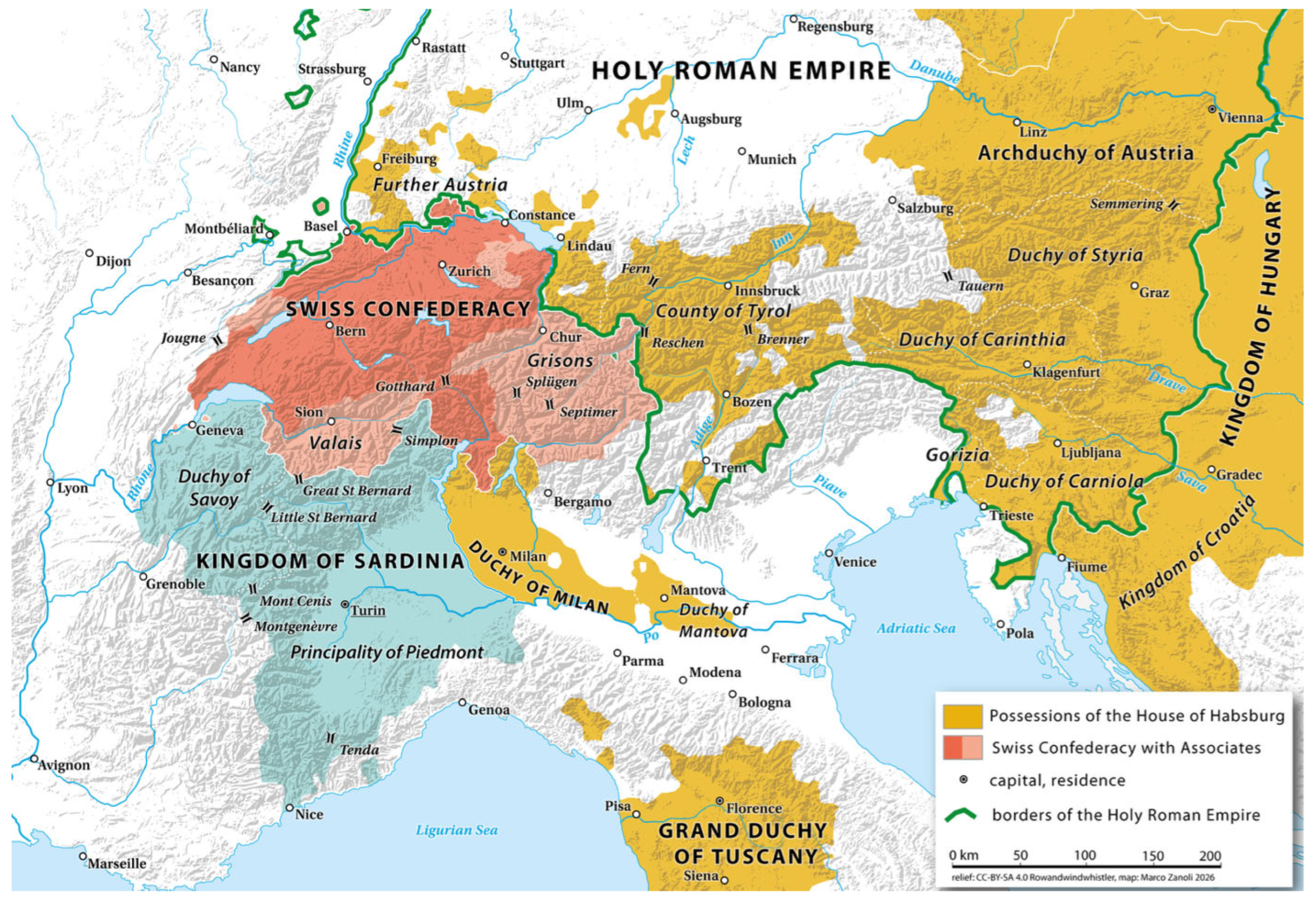
Figure 1).
Since the end of the 18th century, this cross-pass configuration has dissolved: in 1797, the Grisons lost its southern subjects to the Cisalpine Republic; in 1860, Savoy fell to France; and in 1918, Tyrol south of the Brenner Pass became part of Italy. These final territorial cessions were the result of the centralist-nationalist call for ‘natural’ borders. Only Switzerland, with its federalism, retained its transalpine character. The German geographer Albrecht Haushofer dealt intensively with this question in 1928. He was motivated by his political sympathy for ‘Old Tyrol’, but he tried to maintain the appearance of distance and to question the formation of borders on all sides.
3 In detail, he showed that the ‘natural’ mountain borders propagated by the Italian side required numerous arbitrary decisions when defining them on the ground. Haushofer had more difficulty justifying the now mostly dissolved ‘pass states’ (a term he borrowed from Ratzel and Schulte). His argument based on transport geography is the most convincing. Mountain-crossing states arose mainly along major transport routes. The growth in traffic seems to have provided an incentive for the takeover of power across passes (
Haushofer 1928, pp. 42, 55–64;
Mathieu 2018, pp. 200–5). However, this takeover of power always took place in a north–south direction and not vice versa. Anyone wishing to study this systematically should therefore take into account what the French around 1500 called
la folie d’Italie—the attraction that this country, rich in cities and traditions, exerted on rulers of various kinds in the north (
Tilly 1992, pp. 172–78;
Behrisch 2025, pp. 56–60).
The French kings’ crossings of the Alps during these Italian wars have been well researched, especially that of François I, who gathered his army in Lyon in 1515 and led it to the Duchy of Milan, where he defeated the Swiss mercenaries at Marignano. Stéphane Gal has examinded this undertaking using a wealth of source material as well as re-enactments in the field and laboratory experiments. The task was to lead around 40,000 men with 20,000 horses, cannons of all sizes, wagons and a huge crowd of auxiliaries across narrow and steep Alpine paths. The columns of horsemen and pedestrians stretched for dozens of kilometres. Since the beginning of the Italian Wars in 1494, the crown had gained considerable experience in the necessary infrastructure. This time, however, the Swiss were lying in wait on the other side of the Montgenèvre Pass. Therefore, the French ventured on a southern route over a relatively unknown pass. More than a thousand pioneers preceded the convoy and carried out extensive road improvements. The actual crossing in the high mountains took three days. During this time, the units had to be self-sufficient, as the people in the settlements had fled and there was no food anywhere (
Gal 2021). In general, the military historian notes: ‘The Alps have never been an insurmountable obstacle for armies. On the contrary, considerable forces have crossed them throughout history and in all directions’ (
Gal 2026). Starting with Hannibal’s legendary crossing of the Alps, through the German emperors in the Middle Ages, to Napoleon Bonaparte, who led an army across the Great St Bernard Pass in 1800. A famous propaganda image later depicted him on a fiery horse, suggesting that such an undertaking—although long common practice—was still considered a military exploit.
In fact, however, the Alps do not seem to have offered effective protection against invasions. A look at Swiss history supports this with other evidence. As a major mercenary market, the country was heavily involved in European wars (
Rogger and Holenstein 2024). In the early modern period, however, there were only a few important military actions that affected the Swiss Confederation and its allies on their own territory: the Swabian or Swiss War of 1499 took place along the Rhine from the Grisons to Basel, as well as around the Engadine; the Thirty Years’ War of the 1620s and 1630s spared the Swiss Confederation with few exceptions, but hit the Grisons hard; the invasions and battles in the wake of the French Revolution took place both in the Swiss midlands and in the mountain regions (
Helbling 1972/1977, vol. 1, pp. 342–45, 624–32; vol. 2, pp. 787–96, 804–7). All in all, this is not a record that could strengthen the belief in the protective function of the Alps.
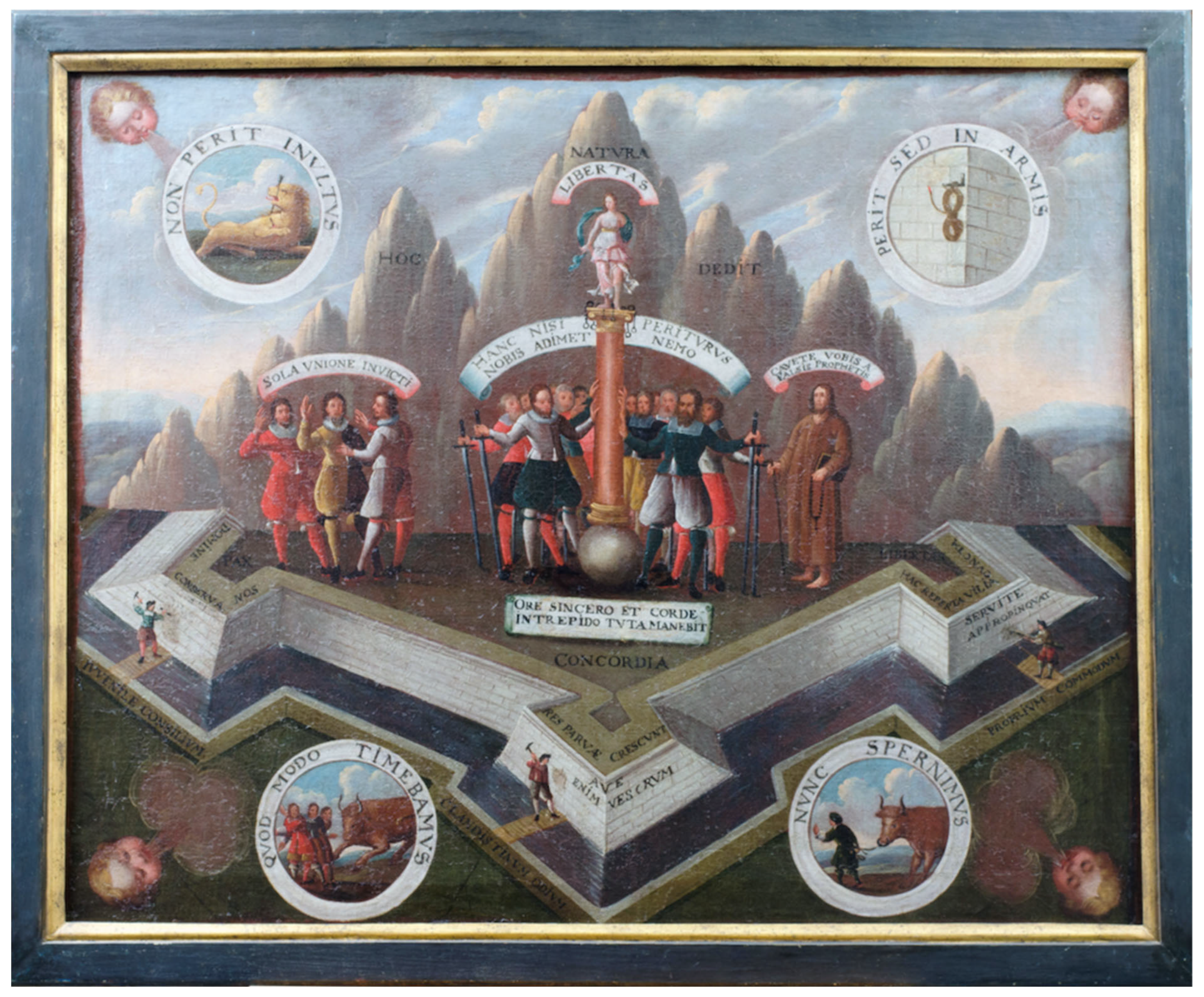
However, there is much to suggest that such a belief did exist. An anonymous oil painting, probably created in Solothurn in the 1670s, gives an idea of this (
Figure 2): in the foreground, the painting shows the city’s fortifications; on the platform, the representatives of the members of the Swiss Confederation gather around a pillar topped by the allegorical figure of Helvetia; to the right of it is Niklaus von der Flüe, the spiritual advisor to the Confederation in the 15th century; to the left we see the three confederates taking their first oath. Many elements of the painting are labelled with inscriptions, the most important of which for us is on the Alpine backdrop: NATURA HOC DEDIT—nature has given this (
Maissen 1999;
Marchal 2006, pp. 273–39, 249).
The idea that the Alps formed a repelling wall was common in pre-modern Europe. As early as the 16th century, there was also a belief that God or nature wanted to protect the Swiss Confederation in this way. The loose confederation of states adopted defensive regulations in the 17th century, but did not establish its own army until the post-Napoleonic period (
Maissen 2010;
Jaun 2017). The exact impact of these early modern imaginations is difficult to assess. However, their repeated invocation at home and abroad suggests that they were able to influence military decisions.
With the technologisation of transport and warfare in the 19th century, the military’s dependence on the environment increased significantly. Deploying a thousand pioneers at short notice to improve roads was no longer sufficient to lead large troop formations across the Alps. The construction of the railway line with its 15 km long tunnel through the Gotthard, which opened in 1882 and brought so much new attention to the pass, employed many more workers for years. Military equipment became increasingly heavy and placed high demands on infrastructure. There is much to suggest that the mountainous terrain was thus able to exert a greater protective effect than before. This was the mental and material situation when the Swiss army leadership decided in 1940 to entrench a large part of the troops in the Alpine ‘réduit national’ and to expose the midlands, with the majority of the population, to an attack by the German
Wehrmacht. A certain leverage of the Swiss was the possible destruction of the transport infrastructure through the Alps with the tunnels, which the Axis powers used for their war economy. This decision left a deep mark on the country’s identity and historiography. To this day, however, it is not clear for what reasons the German attack did not realise (
Tanner 2015, pp. 264–71;
Jaun 2017, pp. 222–37;
Maissen [2010] 2025, pp. 264–69). Easier to answer seems the question of whether the country—if it had been conquered—would have been reintegrated into the post-war order after 1945. As in the post-Napoleonic era, Switzerland might have benefited from the fact that several foreign decision-makers (rather than a single one) would have had a say in the matter.
5. Conclusions: The Significance of ‘Ground Truth’
Many historians assume that the use and thus the characteristics of mountains change with the transformation of society. Many geographers, on the other hand, often focus on environmental conditions and examine their effects, which may be indefinite in time. Between these two positions lies a field of tension in interpretation, in which the respective discipline can overshadow the view of the specific case. However, scientific research is also a pragmatic process. There are no strict rules of demarcation. As we have seen, one takes what one needs. A group of economic historians, equipped with computers, satellite data and mathematics, choose large-scale experiments. 1415 hexagonal cells with a radius of 28 km cover China, while 1285 cells cover Europe west of the St. Petersburg–Trieste line. But can terrain features, average temperatures and the productivity of today’s cereal varieties be used to generate reliable knowledge about historical state formation in the mountains?
This article is a plea for what experts in satellite-based remote sensing call ‘ground truth’. Even with good resolution, it is sometimes impossible to see exactly what is happening down below from an altitude of 650 km. Concrete clues on the ground and local witnesses who can report on actual historical events are needed. Only at this level can we answer the question that has been occupying us: Would Switzerland exist without the Alps? According to our sample from old and recent research literature, the current answer to this question tends to be yes for the pre-modern era. Since the late Middle Ages, the urban centres in the Swiss midlands have played a greater role in alliance politics than national historiography has long claimed. They would probably also have got along with allies from the lowlands, had there been any nearby. Moreover, on closer inspection, the protection of the Alps from military threats turns out to be a widespread idea rather than a proven reality.
Political integration, technological advances and commercial relationships in the modern era brought about a decisive change in the interaction between the different parts of the country. In 1803 and 1815, the large cantons of the Grisons, Ticino and Valais, which had previously been only affiliated with, or subordinate to, the Swiss Confederation, formally joined the country. Together, they account for more than a third of today’s territory and greatly expanded the mountainous region. The ‘rush to the Alps’ then ensured that the mountains became indispensable to Switzerland: as a tourist attraction, a national symbol and flagship, and certainly also an advantage for the banking sector, etc. The change can best be illustrated by the Matterhorn. The iconic mountain peak at the far end of the Mattertal valley had always been known only to the locals, because it cannot be seen from the bottom of the Valais valley. Otherwise, no one really cared about it. In 1804, it appeared for the first time in a travel guide and the accompanying panoramic drawing as ‘the thinnest and sharpest rock needle in the Alps’ (
Ebel [1793] 1804, pp. 167–68). In a later edition, it made it onto the front cover of the travel guide. Today, the Matterhorn is a globally recognised brand and also fuels highly intensive interaction between the environment and society at a national level.