Article

Landscape Change in Japan from the Perspective of Gardens and Forest Management

1
Research Faculty of Media-Communication, Hokkaido University, Sapporo 060-0816, Japan
2
Research Faculty of Agriculture, Hokkaido University, Sapporo 060-8589, Japan
*
Author to whom correspondence should be addressed.
Histories 2025, 5(4), 60; https://doi.org/10.3390/histories5040060
Submission received: 8 August 2025 / Revised: 22 October 2025 / Accepted: 30 October 2025 / Published: 28 November 2025
(This article belongs to the Section Environmental History)

Abstract

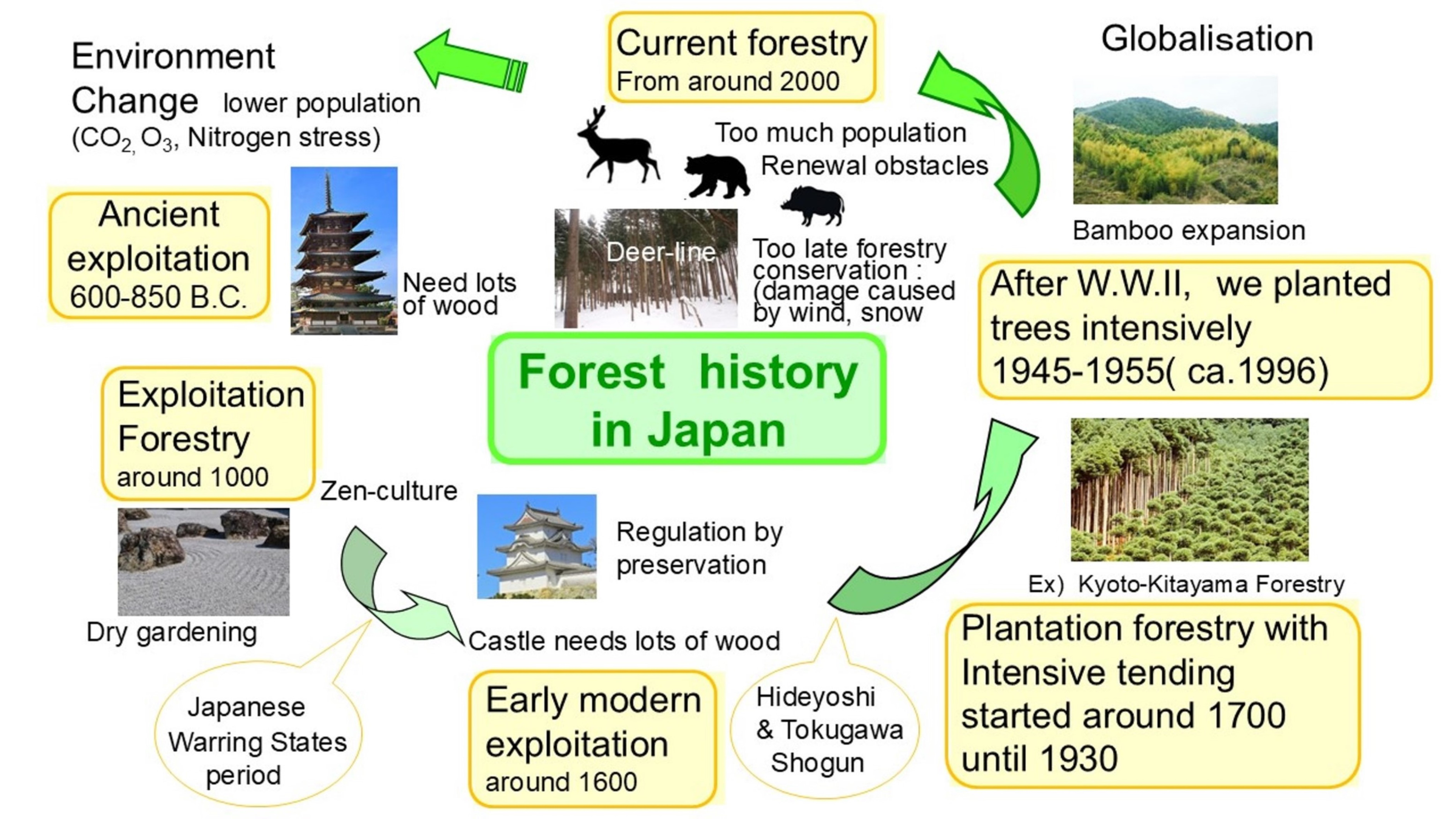
From the perspective of environmental history, which examines the interplay between socio-economic development and the natural environment, this paper discusses the evolution of Japanese landscapes. These landscapes evolved in somewhat different ways, absorbing influences from China and the West. Following the country’s opening up in the late 19th century, various forest management techniques were introduced from Europe and America. This paper examines the environmental history of the changes to the landscape that accompanied rapid Westernisation and the guidance provided by “Forest aesthetics” in forest operations—a crucial element of the landscape. Proposed by H. von Salisch, forest aesthetics is a forest management philosophy that provided guidelines for sustainability before the concept of ecosystems emerged. Although Japan is a small nation comprising elongated islands, mountains cover 67% of its land area. Its north-south orientation means that each region has unique forests and ways of life. This overview examines historical information concerning the formation of gardens and artificial forests, landscape transformations, and perceptions of forests across different eras. Using primarily secondary sources dating from around the 11th century, it demonstrates that, even in Japan, which is subject to natural disturbances under a monsoon climate, the sustainability of gardens and forests could be achieved by emulating the nature advocated for by forest aesthetics as closely as possible. This approach also considered hunting.

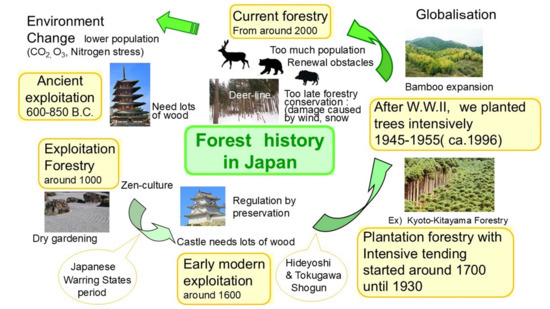
Graphical Abstract

1. Introduction

The thought patterns and religious sensibilities of the people inhabiting a place are influenced by nature (Gwiazdowicz and Janicki 2024). In this context, Japan is not the only exception. In the upper reaches of rivers, where alluvial fans form, afforestation has been carried out to mitigate damage to farmland. While such activities have transformed forest landscapes (Tatman 2007; Koike and Koike 2012), they are considered to be the result of socio-economic conditions necessitated by survival within a limited area of land. The Japanese have endeavoured to balance the utilisation of forest resources through the construction of shrines and temples, employing them as tools of governance and in the struggles between those in power. However, forests were constantly affected by disturbances such as typhoons, and it becomes clear that this played a significant role in shaping the Japanese spirit, particularly the “sense of impermanence” that intensified during the medieval period (Tatman 2007; Unno 2022). This process reveals that forests were constantly affected by disturbances such as typhoons, which played a crucial role in shaping the Japanese mindset, particularly “the concept of impermanence” as intensified during Japan’s medieval period.
Until the Warring States period in medieval Japan, timber could be sourced from the surrounding woodlands. After that, however, it became necessary to procure timber from much more distant regions. As recorded in folding-screen paintings, the mountains around Kyoto, the old capital of Japan were depicted as barren due to overuse (Ogura 1986). Architectural scholar Unno (2022) examined the history of timber use and forest management by analysing the building materials used in temples and shrines in relation to the political system. Until the Edo period, the overuse of timber led to a decline in forest area in the Kantō and Kinki regions. The Meiji Restoration in the mid-19th century marked the end of the Edo period. As science, technology, and ideas from Europe and America were adopted, the concept of landscape evolved too (K. Ono 2009; Kinda 2020), including the notion of Tüxen’s potential natural vegetation (Koike 2021).
Until the 1930s, each region had its own distinctive forest management system, resulting in corresponding landscapes. However, these systems were damaged by the subsequent large-scale utilisation of timber following the Sino-Japanese and Russo-Japanese wars (Tatman 1989). Furthermore, after the Second World War (WWII), large-scale afforestation was undertaken nationwide to rebuild the country’s forest resources. Consequently, the sustainability of these landscapes, including forests, is now in jeopardy, a situation exacerbated by the subsequent fuel revolution. To address these issues, this paper examines the concept of ‘forest aesthetics’, which was introduced to Japan from Germany in the late 19th century. It also considers the significance of lectures on this subject, which have been delivered continuously at Hokkaido University for over a century. Recently, forest aesthetics has also attracted attention in the context of ecosystem service practices (Koike et al. 2024).
The concept of forest aesthetics is rooted in the management principle that ‘the most efficient way to achieve sustainable resource use is to imitate, rather than dominate and oppose, nature’ (von Salisch 1902; Cook and Wehlau 2008). This paper argues that the validity of this operational guideline can be demonstrated by reflecting on the history of Japan’s natural environment and landscapes. After WWII in 1945, the mountains were severely degraded. Shinada (2004) observed that sudden changes to the landscape can have a profound effect on human spirituality. From this perspective, the description of landscapes such as forests and gardens is open to debate (Osumi et al. 2005). Furthermore, it is understood that human thought and activity depend on the landscapes and environments in which individuals live (Arbeitskreis Forstliche Landespflege 1991; Gwiazdowicz and Janicki 2024).
Although our work is situated within the historical context of Japanese forestry and garden ideals, we advocate the widespread adoption of forest aesthetics in Japan. This approach shows that the sustainable management of resources, including landscapes, requires forestry practices that imitate nature as closely as possible. To this end, we examine the natural environment and forest regeneration, discuss living environments and garden design, and survey the historical development of landscapes and their forest components. Finally, considering the current state of forest ecosystems and wildlife as defined by forest aesthetics, we will discuss the future direction of Japanese forest management from an environmental history perspective.

2. Materials and Methods

The primary literature consulted is as follows: (1) An overview of the history of nature and forestry in Japan (The National Land Afforestation Promotion Organization (NLAPO) 1997; Japan Forestry Investigation Committee (J-FIC 1997); Kitagawa and Matsumoto 1995; Tatman 1989; Osumi et al. 2005; Tatman 2007); (2) Forest aesthetics (von Salisch 1902; Stölb 2005; Cook and Wehlau 2008; Koike et al. 2018); and (3) Architectural history, including garden planning (Unno 2022; K. Ono 2009), and forestscape planning (Hori and Yoshida 2017).
We interpreted and analysed the materials through the following process: First, we studied Western perspectives on forest aesthetics, paying particular attention to the ideas of Cook Jr., who was responsible for the English translation of von Salisch’s work. We then analysed and compared these with Japanese perspectives: (1) approaches to capturing landscapes: the formation of natural environments, forests and scenery; (2) the meaning and lineage of garden design in Japan; (3) living environments and the ‘garden’: we interpreted comparisons with Europe and America from existing materials.

3. Results

3.1. Natural Environment

The Japanese archipelago comprises four relatively large islands and smaller surrounding islands, stretching approximately 3000 km from north to south between 45° N and 20° N in the Far East. A wide range of vegetation develops, from temperate forests to subtropical. The presence of a mountain range with peaks over 2000 m means that the continental side experiences 2–5 m of snowfall in winter, while the Pacific side is drier with frequent fires. This influence is particularly pronounced between Honshu and Hokkaido.
A typical example is the Japanese cedar (Cryptomeria japonica), which is widely distributed in the southern part of the island of Honshu, and the Japanese beech (Fagus crenata), which covers Japan’s temperate forest zone. Both of these trees exhibit genetic diversity that corresponds to the levels of snowfall (Koike et al. 1998). The landscapes formed by these tree species are highly diverse. In contrast, Hokkaido is dominated by species such as fir, spruce, elm, and birch, resulting in landscapes that resemble those of Central Europe (Koike and Koike 2012).
Around 67% of Japan’s land is covered by forest, while steep, mountainous terrain (at an elevation of 500 m or more) makes up about 25% of the country. Many people live along the alluvial fan stretching from the mountains to the sea, even though this area covers only around a quarter of the land. In terms of vegetation succession and the impact of disturbances, pollen analysis is broadly employed (Küster 2024; Ooi 2016).

3.2. Formation of the Scenery

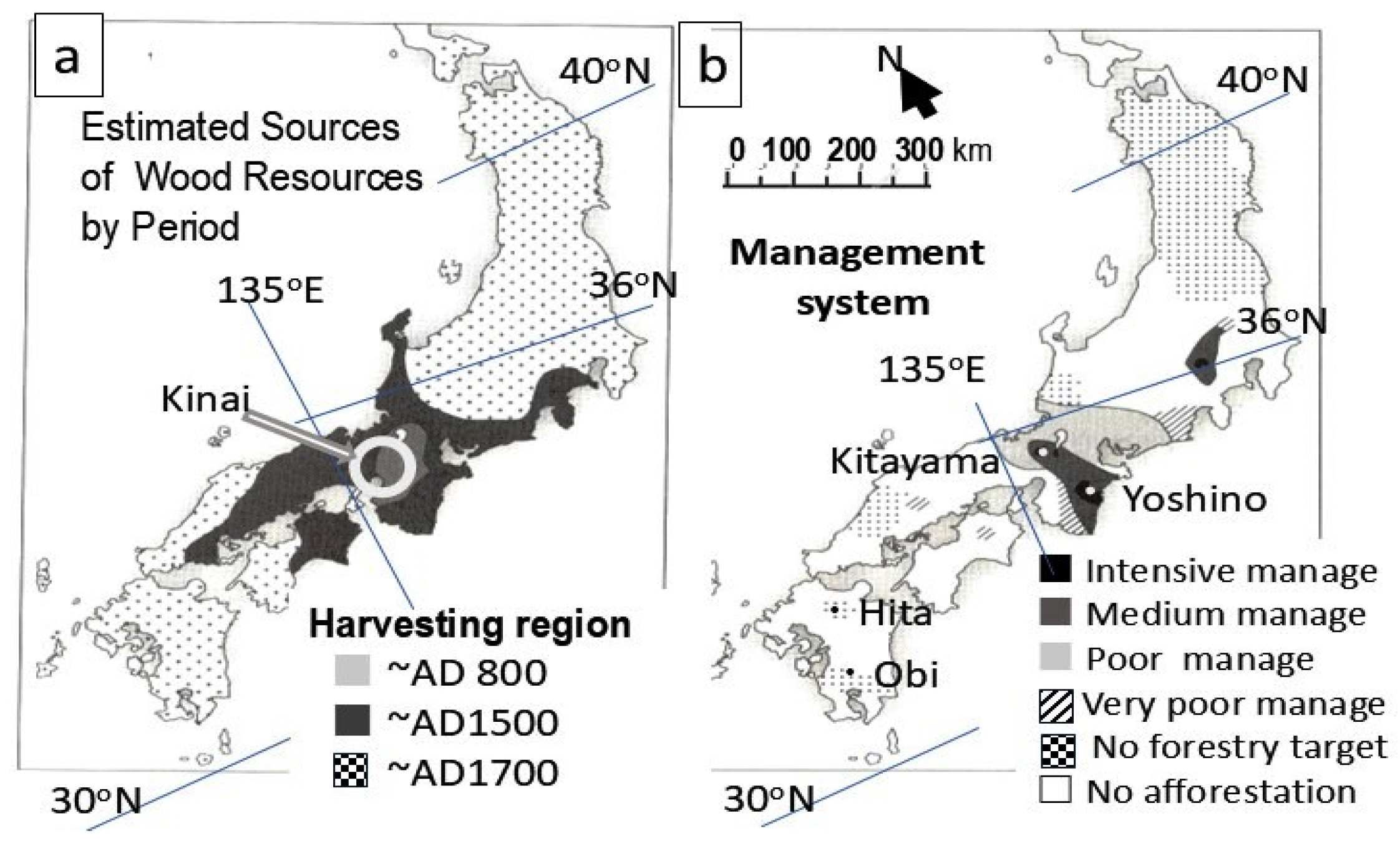
Table 1 summarises the historical periods in Japanese history alongside the relationship between garden scenery, forest canopy texture, political systems, and overseas trade. From the 9th to the 16th century, as large-diameter trees became depleted in the Kinki region, the sourcing of building materials shifted from the central mountainous areas of eastern Japan to the southwestern region, where favourable river transport was available (Figure 1a). In forestry, after timber harvesting, reforestation primarily occurred in SATOYAMA areas (Table 1; Takeuchi et al. 2003; Mizuno 2015). Consequently, the forest landscapes surrounding cities were replaced by Japanese red pine (Pinus densiflora), a species that can grow on poor soils in the absence of large trees.
This transformation is depicted in folding-screen paintings (Ogura 2017) and, from the Edo period onwards, in Ukiyo-e prints showing the 53 Stations of the Tōkaidō, as observed by Tatman (2007).
Table 1. Landscape history in Japan as affected by mainly old days of China and Western countries.
Japanese Era ClassificationTown and/or Region, Garden, LandscaperCanopy Texture of ForestPolitical Situation/Foreign Countries
Ancient Kofun period, BC 300~538; Asuka (592–710)Mainly western Japan/the Asuka (around Nara Prefecture) Horyuji-temple was built.Broad-leaved forests were dominant. Big conifers were used for construction. No record for forest plantation was found. The advanced flame of the Sui & Tang (started from 630~) dynasty of China
Nara period (710–784)Nara prefecture and its vicinity/almost no literature recorded/exploitative forestrySugi-cedar, Hinoki-cypress, and Keyaki (Zelkova sp.) were used in the literature. Not a smooth forest canopy resulted in cutout in the forest Advanced knowledge (the Feng Shui) was introduced from the Tang dynasty. Amidst social unrest, Pure Land Buddhism emerged.
Heian period (794–1185)Kyoto City (approximately 400 years) had almost no major battles, except in the Tohoku district. Sinden-zukuri (the residence of the aristocracy was built.). In the Heian period, the Shinden-zukuri style was established for nobles’ residences with gardens.A Japanese envoy to Tang Dynasty China (630~1131).
MedievalKamakura and Muromachi, 1185–1466Kamakura city (Kanagawa prefecture)/Shoin-zukuri-traditional style of Japanese residential architecture. Dry garden style created by the monk, Mr. Muso Soseki.Over-harvested near Kamakura and poor scenery/Man-made forests were found around SATOYOMA *Goryeo (Korea), Attacked by the Yuan dynasty (China)
Muromachi/the Onin-Bunmei Wars 1466–Western Japan, mainly Kyoto city and its vicinity. The “Higashi-yama” culture had been established.After the Ōnin War, the Warring States period began, and the harvesting of cedar and cypress trees intensified.Battles destroyed forests near the village and town. The concept of impermanence revived during the late Heian and Kamakura periods due to persistent social unrest and natural disasters.
Azuchi-MomoyamaThe sukiya-style architecture suited to the tea ceremony was created.Smooth canopy, such as “Yoshino” forestry. Strolling garden with a pond had started.The Shogun, Hideyoshi Toyotomi, could manage most timber in Japan. He tried to invade to the Korean region.
Early modern **early Edo 1603–1650Edo (=Tokyo/ Kanto plain region). Japanese feudal lords were constructed, finally the garden occupied about half area of Edo city. Forests near big towns were sparse or bare due to partial harvesting of timber for recovery after fires.Japanese isolationism during the Edo period (1639–1854), except for the Netherlands (Korea and the Ming dynasty of China). The population of Edo reached one million.
mid Edo 1650–1750Mountain products were used as tribute and also commercialized, supplying firewood, charcoal, timber, and other goods to cities. Cultivated land increased, and large quantities of cut grass were used as fertilizer. This cutting of grass created grassy hills. To facilitate these uses, the “communal land” system was established, and boundaries were defined. Furthermore, afforestation by the domains and the shogunate progressed.Characterized by mountain-style gardens skillfully incorporating stonework and the “naturalistic landscape” approach to garden design that realistically portrays natural scenery. Pond-stroll garden and its maturity.The “Edict on Compassion for Living Creatures” issued by the 5th shogun, Tsunayoshi, contained some excessive elements, but its emphasis on “cherishing life” did have a influence on the subsequent approach to meat consumption.
late Edo 1750–1868Forests near big cities were getting sparse in part of Japan (but rare in Hokkaido).Distinctive local landscapes with forest canopy (Table 2)Without any big battles occurring, feudal lords across the land implemented forest resource management suited to their respective domains.
Modern timesMeiji-Taisho period 1868–1912~1926(1) Emperor’s forest; (2) Ordinal people’s forests/Forest resource management for the Imperial Family aimed to create forests that emulate nature, differing from other forests. French and English type gardens were introduced, From the exploitative forestry practices of the Edo period onwards, forest management primarily modelled on German forestry was implemented to bolster the nation’s resources.Meiji Restoration & Revolution. Education and control of the populace were carried out to achieve the goals of enriching the nation, strengthening the military, and promoting industry and commerce.
Showa 1926~1945, After WWII 1945~Whole Japan/Large-scale coniferous afforestation was carried out across Japan, primarily in publicly owned forests. Particularly in Hokkaido, large-scale planting of the non-native larch species Larix gmelinii was undertaken, though many sites proved unproductive. Enlarged reforestation usually loses its distinctive canopy texture. As a result, the distinctive forest management practices traditionally carried out in each region have undermined the formation of local landscapes.After the 1960s, the “Energy Revolution” progressed, and the value of domestic lumber has been decreasing. Furthermore, changes in dietary habits, coupled with wildlife conservation management and population decline, have culminated in a disaster. We are now compelled to rebuild the very fabric of society.
to dateWhole Japan/called a “green desert” due to the aftereffects of monoculture plantation with conifers. Deer populations have surged dramatically in recent years, with bark stripping becoming increasingly prevalent, leaving planted trees in a state of near-total devastation.Without tending practices for the man-made forests, some parts of the forest canopy were destroyed by strong winds, heavy rain, and/or snow. Deer browsing along ridgelines leads to denudation, which often results in landslides during heavy rainfall.With the rapid progress of globalization, some man-made forests appear to be lacking. Some villages are missing due to underuse with low population. The administrative side failed to manage wildlife populations adequately.
* SATOYAMA means situated between pristine wilderness and mountain villages; it consists of settlements and the secondary forests surrounding them, maintained through human disturbance (Takeuchi et al. 2003). **: The division of the Edo period into three periods follows the chronology of J-FIC (1997).
Table 2. Planting and management methods in the traditional forestry area (after Koike 2021).
DensityRotationThinningRegionProducts
Lowlonggrowth regulation of individualsObiBeam, deck wood
shortvery rare, fewHita, Tenryu, Ogunipole, ordinary timber
Inter-MediatelongfewChiduhigh quality timber, barrel
longoften tendingNational forestordinal timber
HighshortfewOme, Owasepole for flatwork
many times from early stageKitayamapole for decoration, handrail
longmany times from early stageYoshinohigh quality timber, large sized trees
Gardens appear to have been constructed as early as the 7th century (K. Ono 2009). However, relatively well-documented sources from the 11th century onwards suggest that aristocratic gardens imitated the surrounding landscape. Later, the mountains beyond the garden boundaries were also used as borrowed scenery, i.e., a technique that incorporates external landscapes into the garden. In other words, the garden’s backdrop was integrated into the natural landscape (K. Ono 2009). ‘Sakutei’ implies ‘the harmony of the natural environment and living space’ (Okazaki 1970; Kondo 1973). The phrase ‘Enzan Kinsui’ means ‘incorporating mountains into the distant view and water into the near view’. This phrase was previously advocated as a design technique to visually incorporate the surrounding mountains and enrich the garden’s landscape (Kondo 1973). Japan’s view of nature is condensed within the garden, and its constituent elements are often employed metaphorically. For example, three stones may be arranged to represent the Shaka Sanzon (Buddha and his two attendants, with the central figure symbolising Buddha) (Koike et al. 2022).

3.3. Living Environments and the “Garden”: A Comparative Perspective with the West

The term ‘yuán-yě’, which refers to ancient Chinese landscaping techniques, implies ‘a place where people gather, enclosed by walls or hedges, with mounds of earth and planted trees’. Before Chinese influence, the Japanese concept of ‘niwa’ (garden) evoked an open space where people congregated. The concept of the ‘garden’, originating from the monsoon climates of Asian countries, signifies a naturally open space characterised by warmth and rainfall regardless of the season (Kondo 1973). In garden design, incorporating natural landscapes is emphasised; including the surrounding mountain scenery, for example, makes the garden appear more attractive. Wakui (2006), who oversaw the overall planning for the Aichi EXPO (International Exposition; Aichi Prefecture), also pointed out that religious views influence the fundamental principles of garden design in different countries. The genealogy of landscapes focusing on mountains and forests is outlined in Table 1. It covers key regions and cities from ancient to modern times, alongside the texture of forest canopies, political systems and overseas relations.

3.3.1. Ancient Period

During the Kofun period, influential local figures constructed burial mounds across the land, giving rise to the era’s name, ‘Kofun’ (meaning ‘burial mound’). Archaeological investigations have unearthed the remains of a garden attributed to Soga no Umako (died 626). The Nara period placed significant emphasis on Chinese ‘fengshui’ concepts (K. Ono 2009). Architecturally, Japanese gardens were constructed in a style based on models from the Tang Dynasty of China, but unique to Japan. In contrast, records of afforestation activities are almost non-existent (Figure 1).
Figure 1. Map of Japan (excluding the Ryukyu Islands and northern Hokkaido) showing forest resource acquisition and management systems. (a) Japanese timber procurement regions from ancient to early modern times; (b) regional characteristics of forest cultivation techniques up to around 1700 (late mid-Edo period) (adapted from Unno 2022) (see Table 2, especially Hita forestry region vs. Obi one). Arrow indicates the direction of north (N).
Histories 05 00060 g001
The Heian period lasted around 400 years, during which time trade with China continued even after the Japanese government stopped sending envoys there in the late 9th century. Although influenced by Chinese culture, a distinct Japanese culture emerged, characterised by Shinden-zukuri architecture, which embodied the concept of the Pure Land of Bliss. An excellent example of this can be seen in the garden of the Byōdō-in Temple in Uji City, Kyoto Prefecture (Figure 2a). In the 11th century, Japan’s oldest paper on garden design, the Sakuteiki, was written (Hida 2023; Koike and Ueda 2024). This text details techniques for incorporating natural beauty into gardens (see Appendix A).

3.3.2. Medieval Period

During the Kamakura period, the warrior class became central to politics, placing great emphasis on Zen Buddhism. Despite frequent civil strife during the Muromachi period, culture flourished in Kyoto, giving rise to the Higashiyama culture including dry landscape garden. The concept of “wabi-sabi” (Japan’s refined aesthetic sensibility) also developed during this period. Records exist of tree planting in SATOYAMA areas, excluding highlands (Okazaki 1970; Mizuno 2015). The Warring States and Azuchi-Momoyama periods began with the large-scale civil war known as the Ōnin War (Koike 2019). The sukiya-style architecture associated with the tea ceremony emerged during this time (Wakui 2006; K. Ono 2009).

3.3.3. Early Modern Period

Yoshino forestry emerged in central Honshu in the late Muromachi period (Table 1 and Table 2). Sugi cedar and hinoki cypress were primarily planted for timber production in the Kinki region (Koike and Koike 2012; Mizuno 2015).
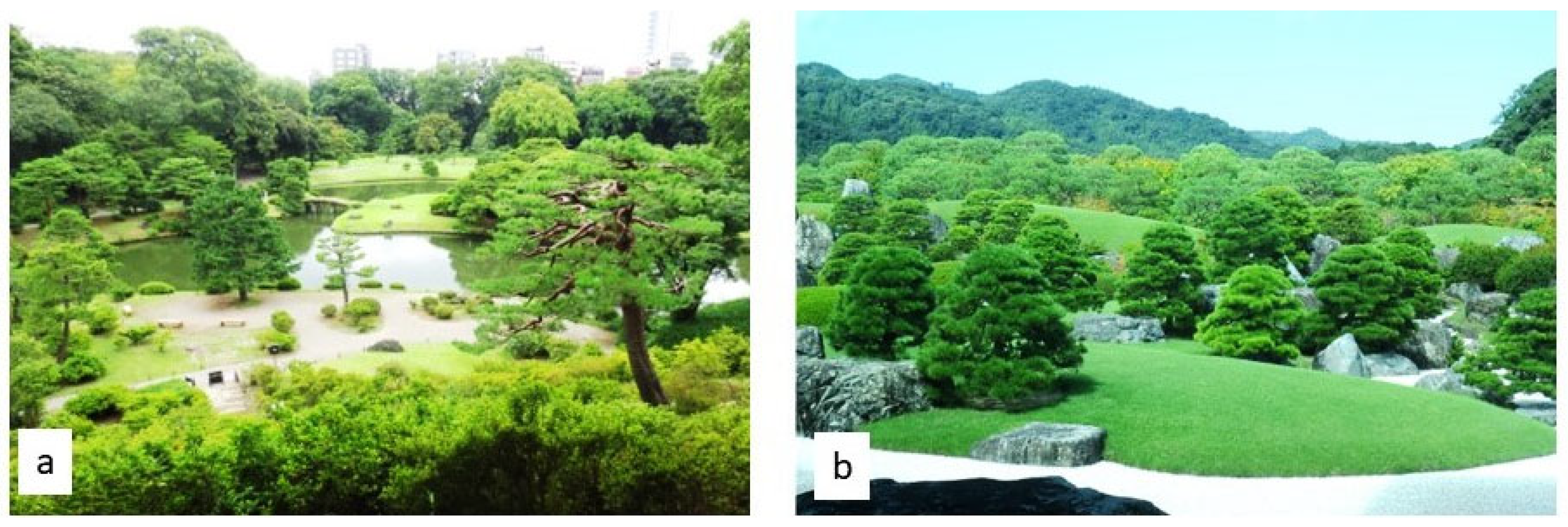
During middle Edo period, Japan experienced national isolation and the development of ‘daimyō gardens’ (Figure 3a), which incorporated ‘borrowed scenery’ (Figure 3b), depicting landscapes beyond the garden walls. From the 17th century onwards, folding-screen paintings depicted ‘bald mountains’ (hageyama) on the ridges surrounding densely populated areas such as Kamigata (Kansai) and Edo (Tokyo), where almost nothing but pine trees (Pinus densiflora) grew in ridge line (Mizuno 2015; Ogura 2017). This was the result of overexploitation of forest resources for building materials, fuel, and fertiliser (Ogura 2005). This is also corroborated by pollen analysis (Takahara 2007).
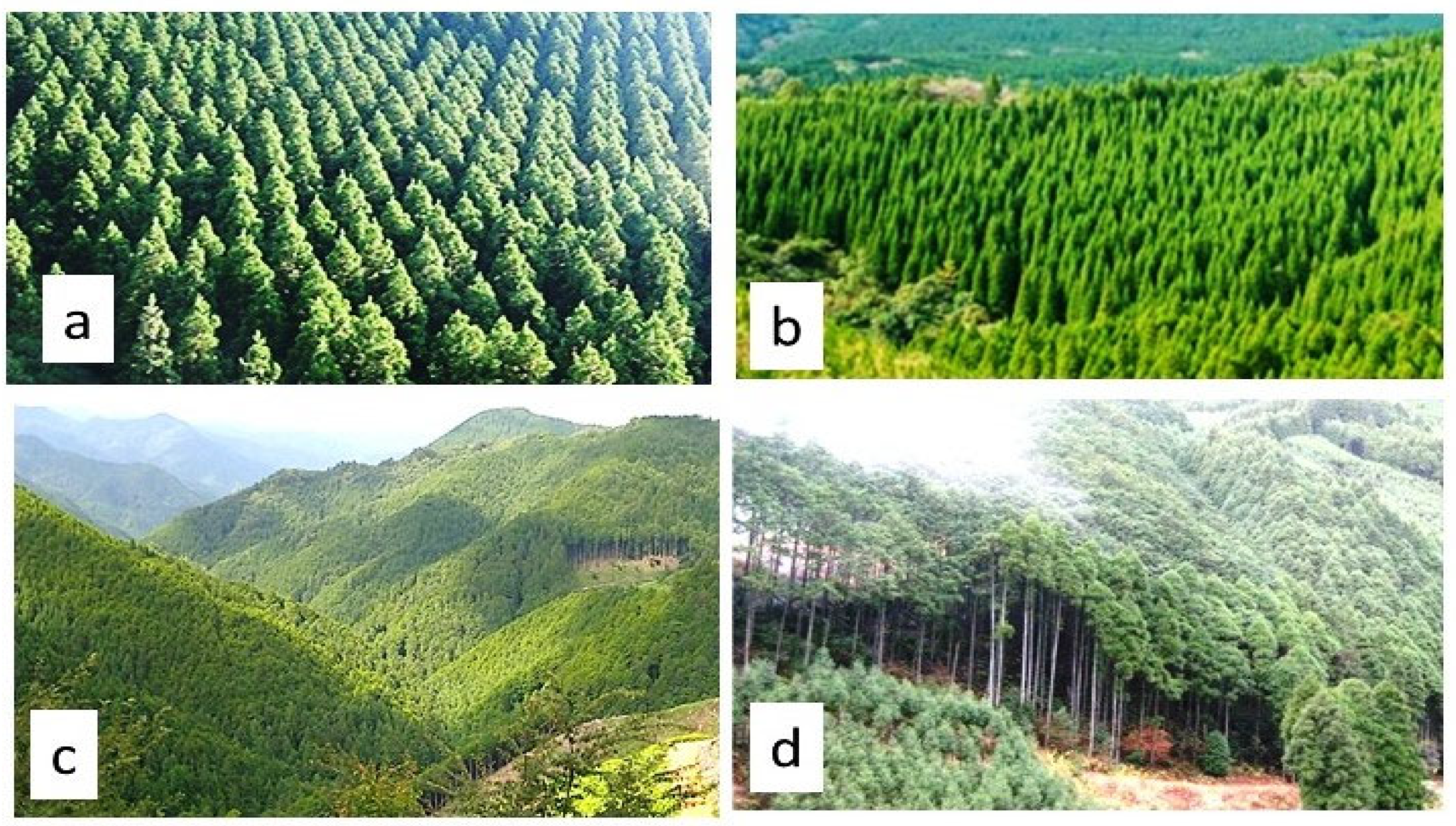
By the 18th century, vast quantities of construction materials were being procured nationwide and managed as essential resources. Examples include the ‘Kiso Five Woods’ (two types of cypress, two types of yew and umbrella pine) (see, for instance, Tatman 1989; Unno 2022). By the 1930s, forest management had been established across Honshu, from Kantō to Kyūshū, creating distinctive regional landscapes (e.g., Koike and Koike 2012). This resulted in the creation of distinctive forest landscapes (see Table 2; Figure 4).
As mentioned in the introduction to the natural environment, following the Meiji Restoration of around 1868, the concept of British-style gardens featuring large ponds and landscapes that capture the beauty of natural scenery was adopted. In garden design, distant mountain ranges are incorporated as ‘borrowed scenery’. Consequently, the management of distant mountains and forests influences garden design.
Meanwhile, the mountains depicted on 18th-century maps were largely devoid of vegetation, except for the occasional red pine (Pinus densiflora), due to the overexploitation of SATOYAMA and the suburban forests that are characteristic of hilly areas (Tatman 1989; Fujimori 2001; Takeuchi et al. 2003; Ogura 2017). During this period, the Ainu people of Hokkaido maintained a subsistence lifestyle centred on hunting (Koike et al. 2024), and Fujimori (2001).

3.3.4. Modern and Contemporary Periods

The Meiji Restoration, which began in the mid-19th century, brought an end to the Edo period of samurai rule. This was mainly due to mounting demands for the country to open up, particularly from the United States. A new political system that incorporated Western culture emerged, profoundly influencing architecture and gardens. Western styles were introduced into gardens to recreate realistic landscapes (K. Ono 2009), which differed from the symbolic gardens that emphasised metaphor and were mainstream in Japanese gardens (Koike et al. 2022). Japan lacked the natural resources essential for modernisation, so forests were a vital renewable resource before the country became increasingly dependent on fossil fuels. Great expectations were therefore placed on management techniques for forests. Guidelines for forest management from Germany, a leading nation in forestry, were primarily adopted (Okazaki 1970; Tsutsui 1995).
To restore the national strength that the Sino-Japanese and Russo-Japanese wars had depleted, an imperial rescript (the Boshin rescript) was issued in 1908 (R. Ono 2005). Even in public forests, which were predominantly mixed woodlands, the conversion of land to highly productive coniferous species was promoted (Kira 1975; Koike and Koike 2012). At that time, even in the western Kantō region, many deforested hillsides were covered in scattered young red pine (Pinus densiflora) and hemlock (Tsuga sieboldii) trees.

3.4. The Impact of the Second World War—Forests in the 20th and 21st Century

Mirei Shigemori, the landscape architect who designed the checkerboard pattern for the Hojo Garden at Tofuku-ji Temple, is considered a quintessential garden designer (Shigemori 2010). This pattern is rooted in traditional Japanese culture yet simultaneously conveys a visually rhythmic and modern impression (Mitsui 2008). Meanwhile, forests were intensively expanded for post-war reconstruction from around 1950, with planting progressing beyond the optimal zone for Sugi cedar to the subalpine zone within approximately 30 years. Consequently, the mountains became covered in green (Tatman 1989). However, while ‘green’ was restored, the forests became biologically monotonous. Consequently, forests were formed that were vulnerable to various stresses and pests, namely uniformly planted coniferous forests (Tatman 2007; Koike 2021).
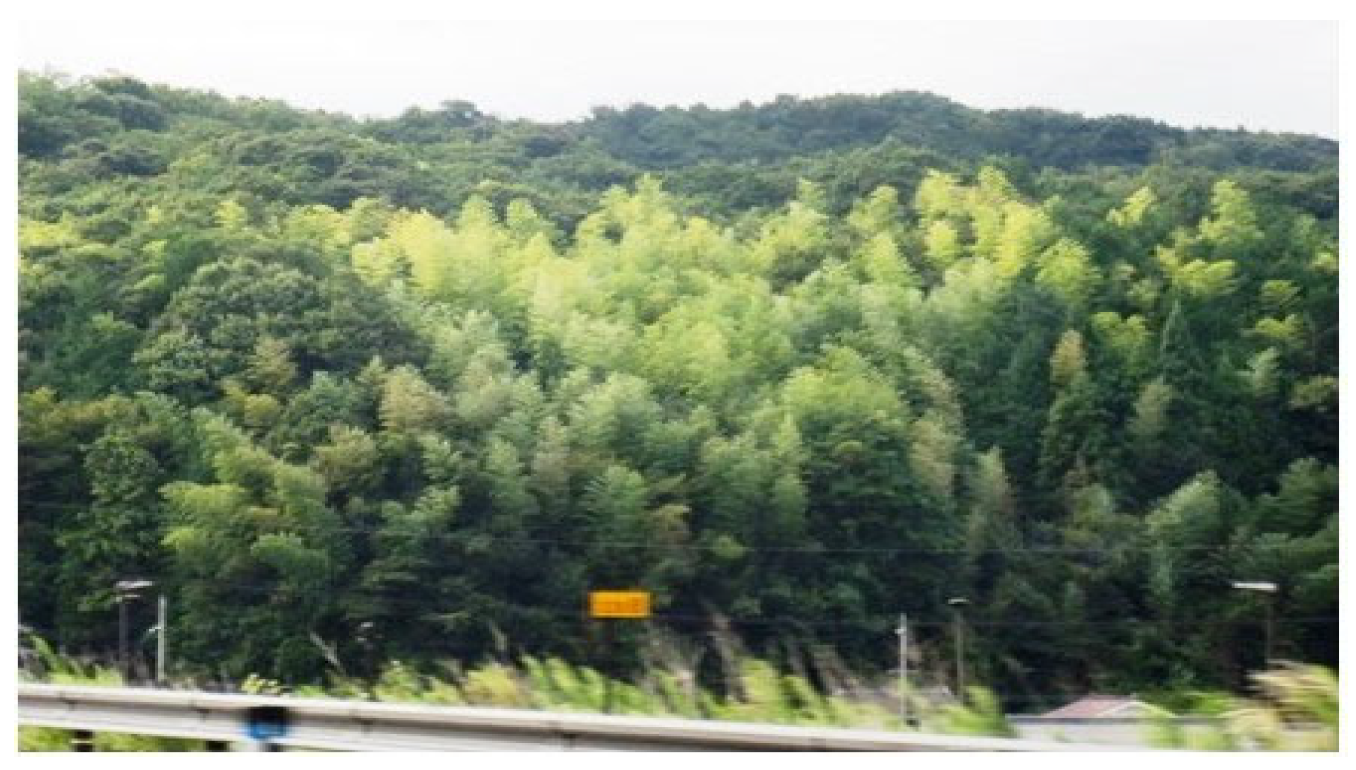
From the second half of the 20th century onwards, as globalisation progressed, fossil fuels became widespread in Japan and chemical fertilisers came into everyday use. Consequently, people no longer sought fuel or fertiliser from the mountains by raking up fallen leaves and similar methods (Koike and Koike 2012). Furthermore, depopulation became particularly pronounced in rural areas. In southern Honshu, the expansion of bamboo forests centred on Moso bamboo (Phyllostachys pubescens)—introduced during the Edo period from China—was especially noticeable, altering the landscape of western Japan (see Figure 5). Additionally, the number of traditional Japanese houses featuring a “tokonoma” alcove decreased. A tokonoma is a room for entertaining guests, decorated with hanging scrolls and flower arrangements. The raised floor indicates the elevated seating position and signifies the place of honour.
Due to the decline in bamboo usage and the rapid population decrease, SATOYAMA landscapes are collapsing, which is altering the appearance of bamboo mixed forests in the Kansai region. At one point, for example, a corner of the canopy transformed into a bamboo forest that covered the entire mountain, leading to the collapse of the tree canopy landscape. Furthermore, the widespread adoption of cross-laminated timber (CLT) has led to a decline in high-quality timber production techniques that were once standard across the region. The landscape, which is now dominated by coniferous plantations, is undergoing significant transformation. These plantations were established based on tending practices such as thinning. Consequently, in seedling-derived plantations, individual trees develop competitive advantages (Figure 3c), while those propagated by cuttings become spindly with dead branches still attached, raising concerns about mutual collapse (Figure 3a).
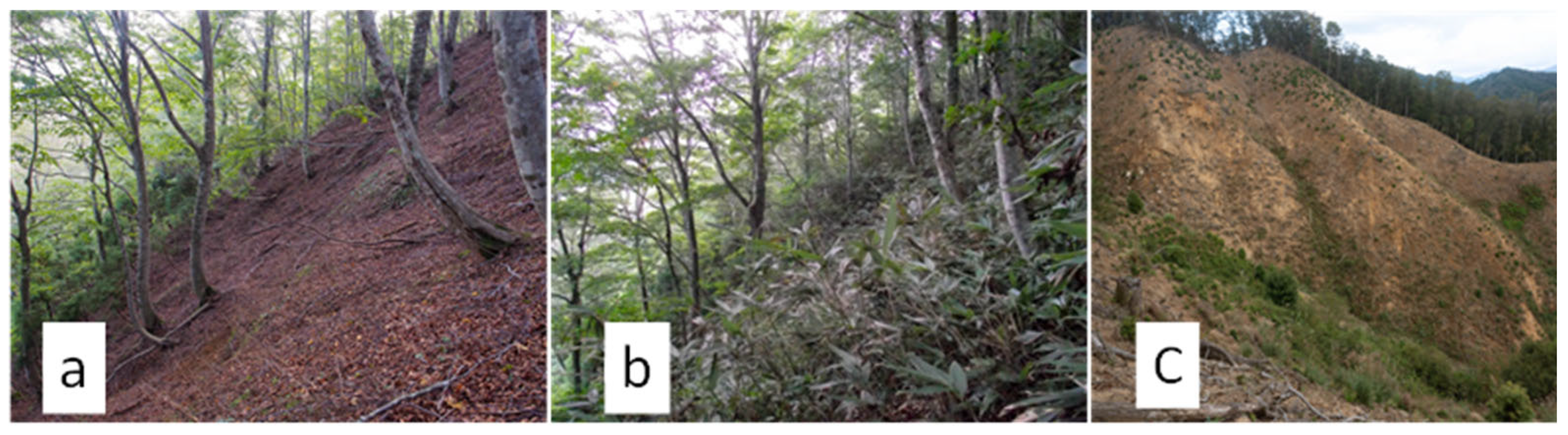
Many locations experience broken tree trunks during periods of heavy rainfall, snowfall or strong winds. More seriously, the inadequate management of the Sika deer population means that while the immediate goal of cultivating forest beauty remains, there are no young trees for regeneration (see Figure 6). This has resulted in landslides on ridges, making it more difficult to preserve production areas.

4. Discussion

4.1. Cultural Landscape

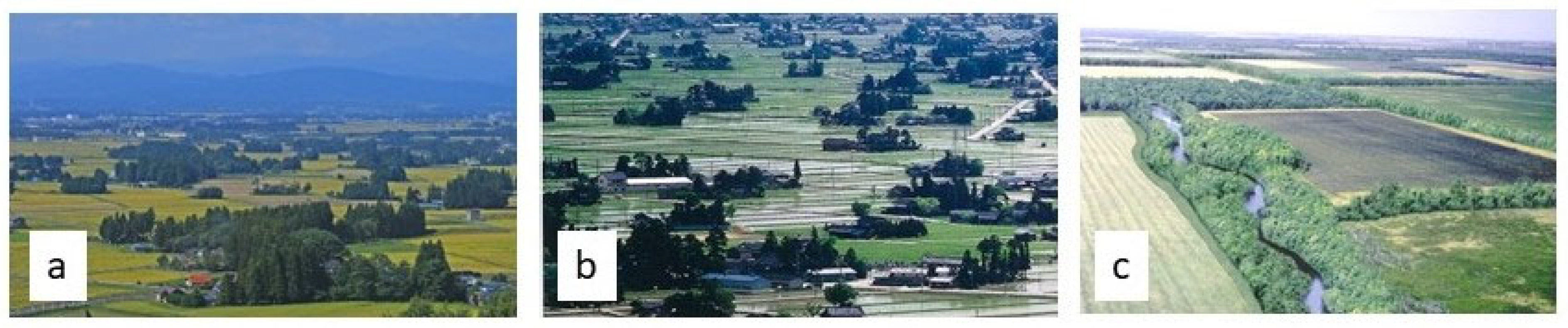
Today, the landscapes visible to humans are cultural landscapes (Daniel 2022). This suggests that almost all existing landscapes are man-made rather than natural. Therefore, nature and human activity are considered to interact. Jones (2003), a historian and geographer, summarises the work of O. Schlüter, Die analytische Geographie der Kulturlandschaft (The Analytical Geography of the Cultural Landscape): ‘Landscapes are neither purely natural nor purely cultural; the division of landscapes into natural and cultural is contradictory’. Conversely, Kinda (2020) argues that artificial landscapes, such as buildings, gardens, and modified rivers, also belong to the category of cultural landscapes. Windbreaks such as the ‘Igune’ and ‘Kainyo’ are similarly classified (Figure 7). These refer to residential forests, which are groups of trees planted around dwellings. According to landscape theory (Sauer 1925; Solot 1986), ‘nature and culture are distinct entities’. Windbreaks mitigate wind erosion and are essential agricultural infrastructure in Hokkaido’s Tokachi region, while also serving as tourist attractions (Figure 7c). Below, we examine the design process of Japanese gardens incorporating distant mountain ranges from an environmental design perspective. Kondo (1973) states that ‘distant mountains, nearby waters’ signifies ‘placing mountains in the distance and water nearby’. This concept blends Shinto teachings, which involve “revering the eight million gods, with Buddhist teachings.” Advocated as a design technique to visually incorporate the surrounding mountains, this approach enriches the garden’s landscape (Kondo 1973).

4.2. Japanese Forest Management Guidelines and Their Background

The teachings of German professor K. Gayer, who advocated ‘imitation of nature’, and those of Professor H. Mayr, mentor to Takanori Hongō and collaborator with Seiroku Honda on the design of the Meiji Shrine forest built with donated trees, were centred around ‘listening to the voice of nature’. These European teachings, along with the philosophy of ‘harmony with nature’ in landscaping and forest management, resonated with Japan’s own views on nature (Tsutsui 1995; Koike 2021; Koike and Ueda 2024).
Japan’s oldest garden design manual, i.e., the Sakutei-ki, states: “One must understand the characteristics of standing stones; one must listen to the voice of nature” (Fujimori 2001; Takei and Keane 2008; Koike et al. 2022; Hida 2023). This demonstrates a firm commitment to natural landscape principles. Below, we explore the historical background from the perspective of garden design specifically, conducting an analysis based on prior research into environmental landscaping (Kondo 1973). In garden design, emphasis is placed on incorporating natural landscapes by integrating the surrounding mountain scenery to make the garden more appealing.
The appearance of forest landscapes varies significantly depending on how the forest stands that compose them are managed (Fujimori 2001). While the scale at which the landscape is viewed is important, the texture of the canopy as a living environment also affects people’s psychology. From the Muromachi period onwards, Kyoto’s Kitayama forestry and the distinctive regional forestry zones established during the Edo period (see Table 2) produced unique timber and landscapes (see Figure 5). However, changing housing conditions due to reliance on fossil fuels, coupled with advances in timber processing methods, have reduced demand for premium timber (Koike 2021).

4.3. The Genealogy of Forest Aesthetics Transmitted from Germany to Japan

Forest aesthetics originated with Postel in Poznań (Poland) in the late 19th century. It was an aesthetic movement that aimed to enhance the functional beauty of planted forests (von Salisch 1902). H. von Salisch lovingly managed the 1000 hectares of forest (primarily Scots pine, Pinus sylvestris) that he had inherited from his grandfather (Gwiazdowicz and Wiśniewski 2011; Koike et al. 2024). Drawing on his experience of managing the forest, including hunting, he published the first edition in 1885 and the third edition in 1910. The second edition (1902) was translated to English by Cook and Wehlau (2008). The concept of forest management, which balances timber production and aesthetic value, was introduced to Japan in the early 19th century by Kawase Zentarō and Honda Seiroku, who studied at Munich, Germany (Shimizu et al. 2006; Koike 2021).
The climate and vegetation of Hokkaido differ significantly from those of Honshu and the southern islands. Niijima and Murayama (1918) wrote a book on ‘forest aesthetics’ based on conditions in northern Japan. They focused primarily on analysing the forms of coniferous and broad-leaved trees growing in mixed forests in the upper reaches of the Saru River. This area is sacred to the indigenous Ainu people of Hokkaido. The work concluded with a presentation of the concept of ‘sustainable forestry’ (Konda 1934), which was proposed by A. Möller (German: ‘Dauerwaldgedanke’, Tanaka 1996). The concept of ‘forest aesthetics’ influenced the development of recreation and the establishment of national parks, but not significantly in wildlife management (Okazaki 1970). Forest aesthetics became a significant guiding principle for forestry (Koike et al. 2011; Koike et al. 2018). In Germany, Stölb (2005), a Bavarian forest official, published ‘The Aesthetics of Natural Forests: For Nature Conservation, Forest Management and the Human Spirit. The subtitle, ‘For Nature Conservation, Forest Management, and the Human Spirit’, indicates that the focus is not solely on timber production. In reality, however, lectures on forest aesthetics are not held in Germany. In Japan, Hokkaido University (Sapporo) is the sole provider. In areas south of Honshu, lectures on forest aesthetics have been discontinued (Koike et al. 2024).
The fundamental purpose of forest aesthetics is to enhance the beauty of forests, achieved through management practices like thinning to introduce light. Consequently, the beauty of forest landscapes is significantly influenced by incident light (Koike et al. 2024). Consequently, the creation of forest beauty is thought to differ considerably from that in Germany (origin of Forest aesthetics). Despite lifestyle changes brought about by globalisation, there is once again growing interest in the principles of forest aesthetics, which aim to create resilient mixed forests that can withstand stress and realise the multifunctionality of forests.
In forest aesthetics, intensive thinning (i.e., Postel-thinning derived from the place name of its origin) was practised to promote the growth of dominant trees and encourage the development of understory trees that would provide food and shelter for wild game (von Salisch 1902; Cook and Wehlau 2008). However, this was a management method applicable only when populations were maintained at appropriate levels. Furthermore, genetic analysis studies in Hokkaido and Hyogo Prefecture, where long-term population dynamics data have been compiled, revealed that regulating deer populations is difficult without culling activities such as hunting (Iijima et al. 2023). However, it depends on local deer density (Ueno et al. 2025). Consequently, it is noted that landscape adjustment requires ecosystem management that includes regulating deer populations.

5. Conclusions

Japan modelled its political system on China’s, establishing a capital city known as Heijō-kyō. The country was also based on Buddhism, which had been transmitted from ancient China. While China was plunged into civil strife and trade declined in the 9th century, Japan’s political system achieved significant development. From the 13th century onwards, warriors (samurai) became central to politics. An extended period of tranquillity commenced in the 17th century due to seclusion, during which time cultural development progressed. The Meiji Restoration of the 19th century saw the rapid adoption of Western technology and the acceleration of Westernisation.
Japanese gardens evolved from Chinese styles around the 11th century and gradually spread in their distinctive form. With the rise in the warrior class around the 13th century, Zen spirituality appeared in Kare-sansui gained widespread popularity. While seeking eternity, a sense of impermanence became central. In the distant view (borrowed scenery), visual lines incorporating the surrounding landscape, including sacred mountains, were created. The foreground employed numerous metaphors (e.g., three stones representing Buddha) and the transformation of landscapes through forest management was practised.
While the Meiji Restoration led to the rapid adoption of Western technology and Westernisation, the Second World War accelerated the transformation of forests (e.g., Fujimori 2001). However, amidst advancing globalisation, forest management declined. Following typhoons and snow damage, clear-cutting methods were reassessed, leading to a reconsideration of the forest aesthetics advocated by H. von Salisch, who was involved in forest management. Von Salisch, the founder of “Forest Aesthetics”, believed that creating forest beauty should involve hunting for forest management. This involved promoting an intensive thinning method known as ‘Postel thinning’, named after a place in Poland. Meanwhile, in Japan, the focus was on timber production with little consideration for wildlife management. The fundamental principle of forest management is to create forests with high stress tolerance. This concept is based on the idea of ‘learning from nature’ and aims to ensure sustainability for future generations.

Author Contributions

For research articles with several authors, the following statements should be used “Conceptualization; T.K. (Tatsunori Koike), H.U. and T.K. (Takayoshi Koike).; methodology, T.K. (Tatsunori Koike) and H.U., analysis, T.K. (Tatsunori Koike), UH, T.K. (Takayoshi Koike); investigation, T.K. (Tatsunori Koike); resources, T.K. (Tatsunori Koike), H.U.; data curation, T.K. (Tatsunori Koike), T.K. (Takayoshi Koike); writing—original draft preparation, T.K. (Tatsunori Koike); writing—review and editing, T.K. (Tatsunori Koike), T.K. (Takayoshi Koike); visualization, T.K. (Tatsunori Koike); supervision, H.U.; project administration, H.U.; funding acquisition, T.K. (Tatsunori Koike). All authors have read and agreed to the published version of the manuscript.”

Funding

This work was supported in part by JSPS KAKENHI Grant No. 23K13973 (to Tatsunori Koike).

Data Availability Statement

No new data were created or analysed in this study. Data sharing is not applicable to this article.

Acknowledgments

We are grateful to Yoshihoro Natsuhara of Nagoya University for his clear explanation of the PCM (patch-corridor-matrix) model in Landscape Ecology, to Daisuke Fujiki, Ryusuke Hatano, and Junji Sano for offering photos. Finally, the authors are grateful for the anonymous reviewer’s harsh yet accurate comments.

Conflicts of Interest

The authors declare no conflict of interest.

Appendix A. The Author of Sakuteiki

The name ‘Sakutei-ki’ became widely known (Hida 2023) following its inclusion in the ‘Gunshū Ruijyu’, which was compiled by Hanawa Hoki’ichi in the mid-Edo period. Prior to this, it was known as the ‘Senzai Hisho’. Examining this oldest surviving treatise on garden design is essential for registering Japanese garden techniques as a UNESCO Intangible Cultural Heritage. The author is commonly identified as Toshitsuna Tachibana (grandson of Fujiwara no Michinaga and son of Yorimichi, founder of Byōdō-in). However, a re-examination of the author’s identity and the political, social and cultural context of the period is also necessary (Koike and Ueda 2024).

References

  1. Arbeitskreis Forstliche Landespflege. 1991. Waldlandschaftspflege: Hinweise und Empfehlungen für Gestaltung und Pflege des Waldes in der Landschaft. Landsberg: Eecomed Verlags-Gesellschaft. [Google Scholar]
  2. Cook, Walter, Jr., and Doris Wehlau. 2008. Forest Aesthetics. Durham, NC: Forest History Society. ISBN 100890300720. [Google Scholar]
  3. Daniel, Eltringham. 2022. Poetry & Commons: Postwar and Romantic Lyric in Times of Enclosure. Liverpool: Liverpool University Press, p. 67. [Google Scholar]
  4. Fujimori, Takao. 2001. Ecological and Silvicultural Strategies for Sustainable Forest Management. Amsterdam: Elsevier. ISBN 9780080551517. [Google Scholar]
  5. Gwiazdowicz, Dariusz J., and J. Wiśniewski. 2011. Estetyka lasu (Aesthetics of Forest). Gołuchów: Ośrodek Kultury Leśnej w Gołuchowie. [Google Scholar]
  6. Gwiazdowicz, Dariusz J., and Tadeusz Janicki. 2024. Human and nature: Between destruction and creation. Studia Historiae Oeconomicae 42: 1–12. [Google Scholar] [CrossRef]
  7. Hida, N. 2023. “Sakuteiki” as the origin of Japanese garden. Journal of Japanese Institute of Landscape Architecture 87: 112–15. [Google Scholar] [CrossRef]
  8. Hori, Shigeru, and Yoshio Yoshida. 2017. Forest Landscape Creation. Tokyo: Association of Forest Planning Publisher, ISBN 4889652485. [Google Scholar]
  9. Iijima, Hayato, Junco Nagata, Ayako Izuno, Kentaro Uchiyama, Nobuhiro Akashi, Daisuke Fujiki, and Takeo Kuriyama. 2023. Current sika deer adequate population size is near to reaching its historically highest level in the Japanese archipelago by release from hunting rather than climate change and top predator extinction. The Holocene 33: 718–23. [Google Scholar] [CrossRef]
  10. Japan Forestry Investigation Committee (J-FIC). 1997. Comprehensive chronology-The History of Japan’s Forests, Trees, and People. Tokyo: Japan Forestry Investigation Committee. ISBN 978-4-88965-091-4. [Google Scholar]
  11. Jones, Michael. 2003. The concept of cultural landscape: Discourse and narratives. In Landscape Interfaces; Cultural Heritage in Changing Landscapes. Edited by Hannes Palang and Gary Fry. Dordrecht: Kluwer Academic Publishers, pp. 21–51. [Google Scholar] [CrossRef]
  12. Kinda, Akihiro. 2020. History of Japan Through Landscapes. Tokyo: Iwanami-Publisher. ISBN 104004318386. [Google Scholar]
  13. Kira, Tatsuo. 1975. Primary Production of Forests. In Photosynthesis and Productivity in Different Environments. Edited by John Philip Cooper. Cambridge: Cambridge University Press, pp. 5–49. ISBN 9780521113427. [Google Scholar]
  14. Kitagawa, Hiroyuki, and Eiji Matsumoto. 1995. Climate implications of δ13C variations in a Japanese cedar (Cryptomeria japonica) during the last two millennia. Geophysical Research Letters 22: 2155–58. [Google Scholar] [CrossRef]
  15. Koike, Takayoshi. 2021. Journey to Forest Aesthetic in Quest of H. von Salisch Forest. Otsu: Kaisei-Sha Press. ISBN 10486099390X. [Google Scholar]
  16. Koike, Takayoshi, and Tatsunori Koike. 2012. Forest history in Japan with a changing environment. Studia i Materiały Ośrodka Kultury Leśnej 11: 109–30. [Google Scholar]
  17. Koike, Takayoshi, Sumie Kato, Yoshiya Shimamoto, Keiko Kitamura, Shoichi Kawano, Kumiaki Ueda, and Tetsuo Mikami. 1998. Mitochondrial DNA variation follows a geographic pattern in Japanese beech species. Botanica Acta 11: 87–91. [Google Scholar] [CrossRef]
  18. Koike, Takayoshi, Tatsunori Koike, and Hirofumi Ueda. 2022. Forest landscapes, scenery, views and metaphors. Hoppo Ringyo (Northern Forestry) 73: 179–82. [Google Scholar]
  19. Koike, Takayoshi, Yuko Shimizu, and Seigo Ito. 2011. Development and application of forest aesthetics in Japan in relation to the ideas of H. Von Salisch. Studia i Materiały Ośrodka Kultury Leśnej 10: s47–s62. [Google Scholar]
  20. Koike, Takayoshi, Yuko Shimizu, Taichi Ito, Masaki Shiba, and Seigo Ito. 2018. H. von Salisch’s Forest Aesthetics in Japanese. Otsu: Kaisei-Sha Press. ISBN 9784860999759/C3861. [Google Scholar]
  21. Koike, Tatsunori. 2019. The generals and daimyō of the early Sengoku Period (Warring States period in medieval Japan) as seen in the “Magari-no-Jin”. Nihon Rekishi (Japan History) 851: 1–18. [Google Scholar]
  22. Koike, Tatsunori, and Hirofumi Ueda. 2024. The development of “Sakuteiki” in the Edo period seen in the colophon (Oku-gaki). Journal Japanese Institute Landscape Architecture 17: 61–72. [Google Scholar] [CrossRef]
  23. Koike, Tatsunori, Takayoshi Koike, and Hirofumi Ueda. 2024. Forest Aesthetics as a basic idea for forest management from the perspectives of light quality, ecosystems, and sustainability in Japan. Studia Historiae Oeconomicae 42: 21–31. [Google Scholar] [CrossRef]
  24. Konda, Keiichi. 1934. Geschihte und Kritik der Groundfragen der Forstästetik. Research Bulletin of Hokkaido Imperials University Forests 9: 1–246. [Google Scholar]
  25. Kondo, Kimio. 1973. Environment and Landscape Theory (Kankyo-Shukei). Tokyo: Chikyu-Sha Publisher, ISBN 4804950206. [Google Scholar]
  26. Küster, Hansjörg. 2024. Different forms of civilizations and the development of woodlands: Systems of interactions. Studia Historiae Oeconomicae 42: 13–20. [Google Scholar] [CrossRef]
  27. Mitsui, Hideki. 2008. Japanese Beauty in Form: Japanese Design. Tokyo: NHK (Japan Broadcasting Corporation) Publishing. ISBN 4140911239. [Google Scholar]
  28. Mizuno, S. 2015. Establishment of Satoyama-Environment and Resources in the Middle Ages. Tokyo: Yoshikawa Kobunkan. ISBN 13 978-4642082846. [Google Scholar]
  29. Niijima, Yoshinao, and Jyozo Murayama. 1918. Forest Aesthetic. Tokyo: Seibi-do Shoten, p. B0093EI4H0. [Google Scholar]
  30. Ogura, Juiichi. 1986. The Forests around Kyoto in the Period of Rakuchurakugaizu: A Study on the Description of “Rakugaizu”. Bulletin of the National Museum of Japanese History 11: 81–105. [Google Scholar] [CrossRef]
  31. Ogura, Juiichi. 2005. Human activities and vegetation change. Japan Landscape Ecology 9: 3–11. [Google Scholar] [CrossRef]
  32. Ogura, Juiichi. 2017. The picture scroll “The Real Scenery of Higashiyama 36 Mountains” as evidence of late Edo period SATOYAMA landscapes around Kyoto. Journal Kyoto Seika University 52: 71–94. [Google Scholar]
  33. Okazaki, A. 1970. Forest Scenic Beauty and Recreation. Tokyo: Japan Forestry Investigation Committee (J-FIC), p. B000J932FM. [Google Scholar]
  34. Ono, Kenkichi. 2009. Japanese Garden. Tokyo: Iwanami Paperback, No. 1177. ISBN 4004311772. [Google Scholar]
  35. Ono, Ryohei. 2005. The meanings and the intention of adoption of the term “Keikan” by Manabu Miyoshi. Journal of The Japanese Institute of Landscape Architecture 71: 433–38. [Google Scholar] [CrossRef]
  36. Ooi, Nobuo. 2016. Vegetation history of Japan since the last glacial based on palynological data. Japanese Journal of Historical Botany 25: 1–101. [Google Scholar]
  37. Osumi, Katsuhiro, Hisashi Sugita, and Shigeto Ikeda. 2005. Ecological History of the Kitakami Mountain Landscape. Tokyo: Kokon-Shoin. ISBN 4-7722-1472-0. [Google Scholar]
  38. Sauer, Carl O. 1925. The Morphology of Landscape. In University of California Publications in Geography. Lanham: University of California Press, vol. 2, pp. 19–53. [Google Scholar]
  39. Shigemori, Chisao. 2010. Atlas of Japanese Garden. Tokyo: Natsume-Publisher. ISBN 978-4-8163-4673-6. [Google Scholar]
  40. Shimizu, Yuko, Seigo Ito, and Keizo Kawasaki. 2006. Development process from forest aesthetic to landscape management by the times before World War II. Journal of the Japanese Institute of Landscape Architecture 69: 395–400. [Google Scholar] [CrossRef]
  41. Shinada, Yutaka. 2004. Human and Green Space-Interaction Between Them. Kanagawa: Tokai University Press. [Google Scholar]
  42. Solot, Michael. 1986. Carl Sauer and Cultural Evolution. Annals of the Association of American Geographers 76: 508–20. [Google Scholar] [CrossRef]
  43. Stölb, Wilhelm. 2005. Waldästhetik—über Forstwirtschaft, Naturschutz und die Menschenseele. Kassel: Kassel Verlag. ISBN 103935638558. [Google Scholar]
  44. Takahara, Hikaru. 2007. Pollen-based reconstructions of past vegetation and climate. Low Temperature Science, Hokkaido University 65: 97–102. [Google Scholar]
  45. Takei, Jiro, and Marc P. Keane. 2008. Sakuteiki: Visions of the Japanese Garden (A Modern Translation of Japan’s Gardening). North Clarendon: Tuttle Publishing. ISBN 100804839689. [Google Scholar]
  46. Takeuchi, Kazuhiko, Robert D. Brown, Izumi Washitani, Atsushi Tsunekawa, and Makoto Yokohari, eds. 2003. SATOYAMA, the Traditional Rural Landscape of Japan. New York: Springer. ISBN 9784431000075. [Google Scholar]
  47. Tanaka, Kazuhiro. 1996. Introduction to Forest Management. Tsukuba: Japan Society of Forest Planning Press. [Google Scholar]
  48. Tatman, Conrad. 1989. The Green Archipelago: Forestry in Pre-Industrial Japan. Berkley: University of California Press. ISBN 9780520063129. [Google Scholar]
  49. Tatman, Conrad. 2007. Japan: An Environmental History (Environ History and Global Change). London: Bloomsbury Publishing. ISBN 9781786731524. [Google Scholar]
  50. The National Land Afforestation Promotion Organization (NLAPO). 1997. Chronological Table: The History of Japan’s Forests, Trees and People. Tokyo: The National Land Afforestation Promotion Organization. ISBN 978-4-88965-091-4. [Google Scholar]
  51. Tsutsui, Michio. 1995. Toward Forest Culture, Asahi Selection 529. Tokyo: Asahi publishing. ISBN 104022596295. [Google Scholar]
  52. Ueno, Mayumi, Hayato Iijima, Yoshihiro Inatomi, Saya Yamaguchi, Hino Takafumi, and Hiroyuki Uno. 2025. Spatial variation in local population dynamics of sika deer, Cervus nippon, through intensified management. The Journal of Wildlife Management 89: e70069. [Google Scholar] [CrossRef]
  53. Unno, Satoshi. 2022. Japanese History of Forests, Trees and Architecture. Tokyo: Iwanami Paperback Pocket, ed. No. 1926. ISBN 104004319269. [Google Scholar]
  54. von Salisch, Heinrick. 1902. Fosrtästhetik Auf 2, Jena, Germany. Berlin: Springer. [Google Scholar]
  55. Wakui, Masayuki. 2006. The Japanese Mind as Seen Through the Landscape. Tokyo: NHK (Japan Broadcasting Corporation) Publishing. ISBN 104149105855. [Google Scholar]
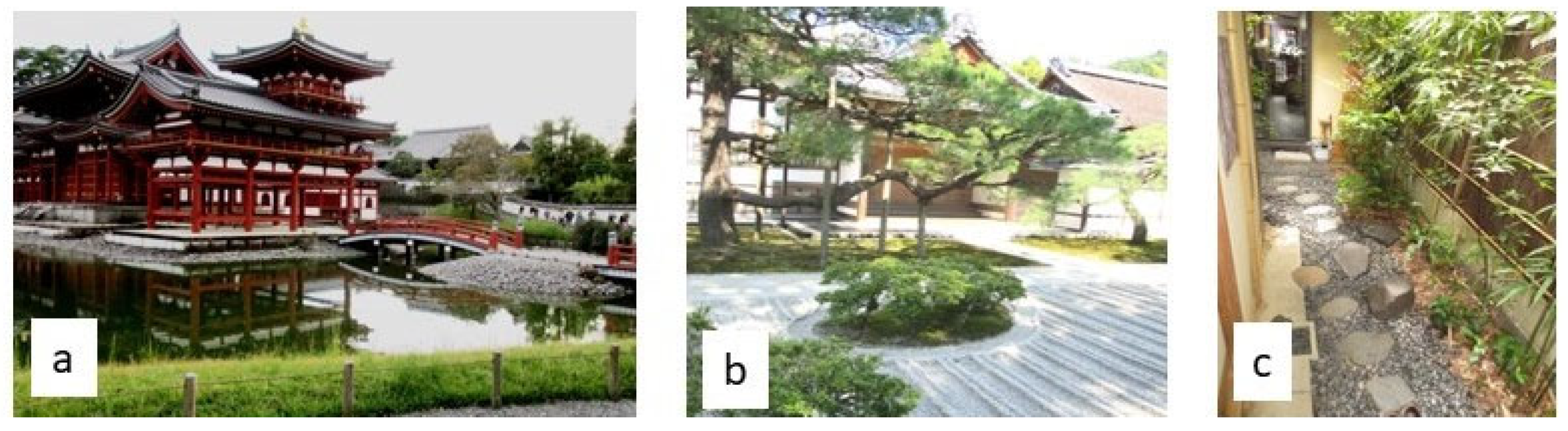
Figure 2. Historical structures remaining in Kyoto (an ancient capital of Japan) (a) Byōdō-in with its Pure Land-style garden, (b) “Karesansui” dry landscape garden at Ginkaku-ji, (c) an example of a roji (tea garden path), part of wabi-cha (Japanese tea ceremony). The garden at Higashiyama Jishō-ji (Ginkaku-ji) and the dry landscape garden at Ryoan-ji, where the arrangement of stones symbolises mountains (b). During the Azuchi-Momoyama period, Sen no Rikyū founded the wabi-cha tea ceremony, which emphasised Zen. The roji leading to the tea room developed into a tea garden featuring stone lanterns (c), a water basin, and stepping stones (K. Ono 2009; Koike and Koike 2012).
Histories 05 00060 g002
Figure 3. Examples of gardens constructed from the Edo period to the present day: (a) Strolling-type daimyō garden (Rikugien, Tokyo)—characterised by narrow paths, (b) Adachi Garden (Yasugi City, Shimane Prefecture), based on borrowed scenery—selected as Japan’s finest garden for 21 consecutive years up to 2023 by the US publication: The Journal of Japanese Gardening.
Histories 05 00060 g003
Figure 4. Typical forest management districts were completed by the Edo period. (a) Hita Forest Management District (FMD), (b) Obi FMD, (c) Yoshino FMD, (d) Kitayama FMD; see Table 2 for details.
Histories 05 00060 g004
Figure 5. Bamboo mixed forests in western Japan (courtesy of Dr. Junji Sano). The pale yellow-green area within forest stand is bamboo.
Histories 05 00060 g005
Figure 6. Conditions within forests affected by Shika deer browsing and denudation along ridgelines: A case study from Hyogo Prefecture (courtesy of Dr. Daisuke Fujiki). (a) Forest floor damaged by Sika-deer browsing (2018), (b) the same forest (a) before browsing damage became apparent (2010), (c) a ridgeline denuded by deer browsing. Unless deer-proof fencing is installed, reforestation will not succeed under current conditions.
Histories 05 00060 g006
Figure 7. Landscapes featuring groups of trees as cultural landscapes: (a) Igune (Shimane Prefecture—Western Japan), (b) Kainyo (Toyama Prefecture—Central Japan). Both residential woodlands have protected houses from strong winds and provided fuel, insulation, and protection from sand. (c) Windbreak (Tokachi region, Hokkaido). Reduces wind erosion of farmland and prevents excessive nitrogen runoff from farmland into rivers (courtesy of Dr. Ryusuke Hatano).
Histories 05 00060 g007
Disclaimer/Publisher’s Note: The statements, opinions and data contained in all publications are solely those of the individual author(s) and contributor(s) and not of MDPI and/or the editor(s). MDPI and/or the editor(s) disclaim responsibility for any injury to people or property resulting from any ideas, methods, instructions or products referred to in the content.