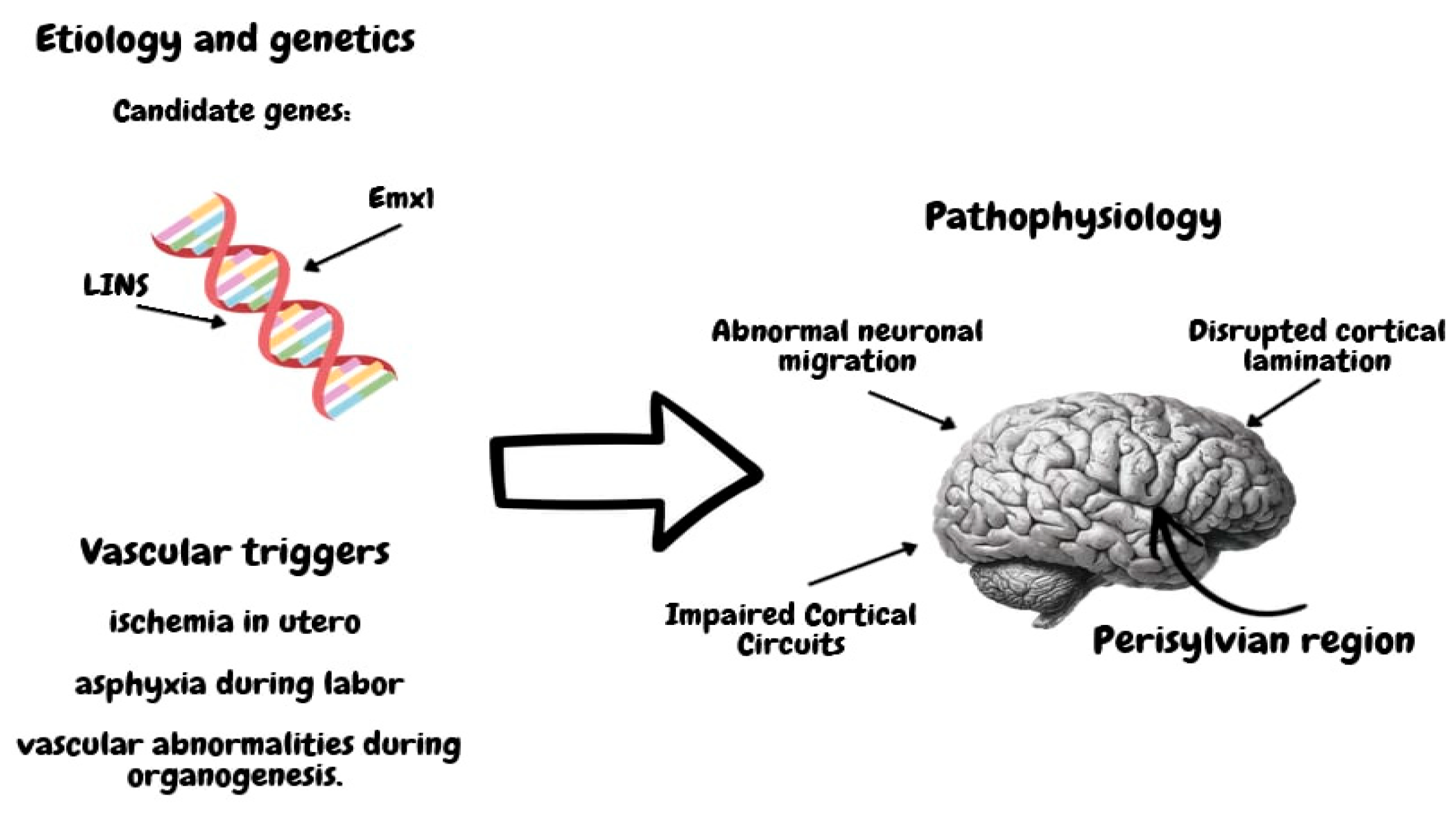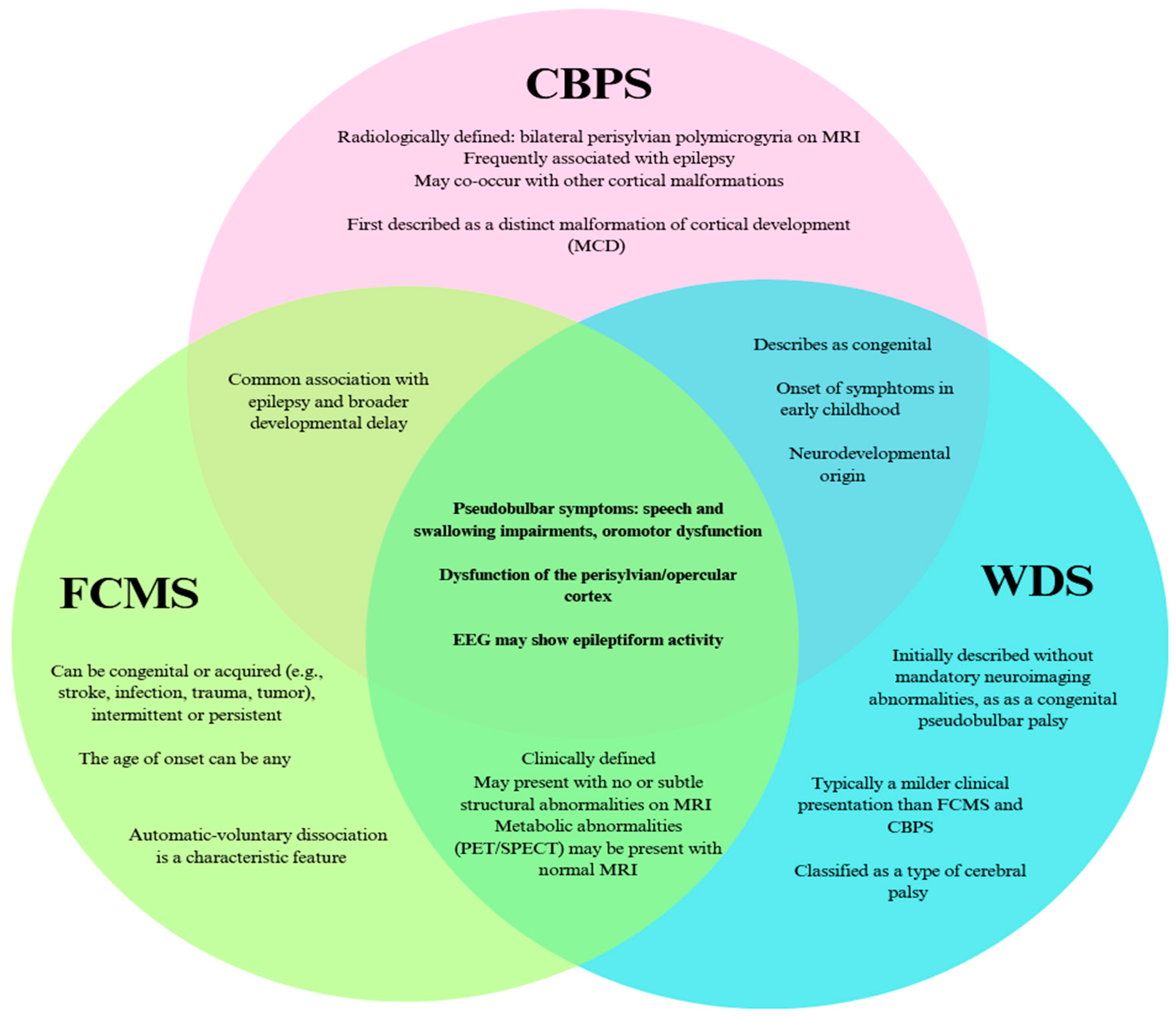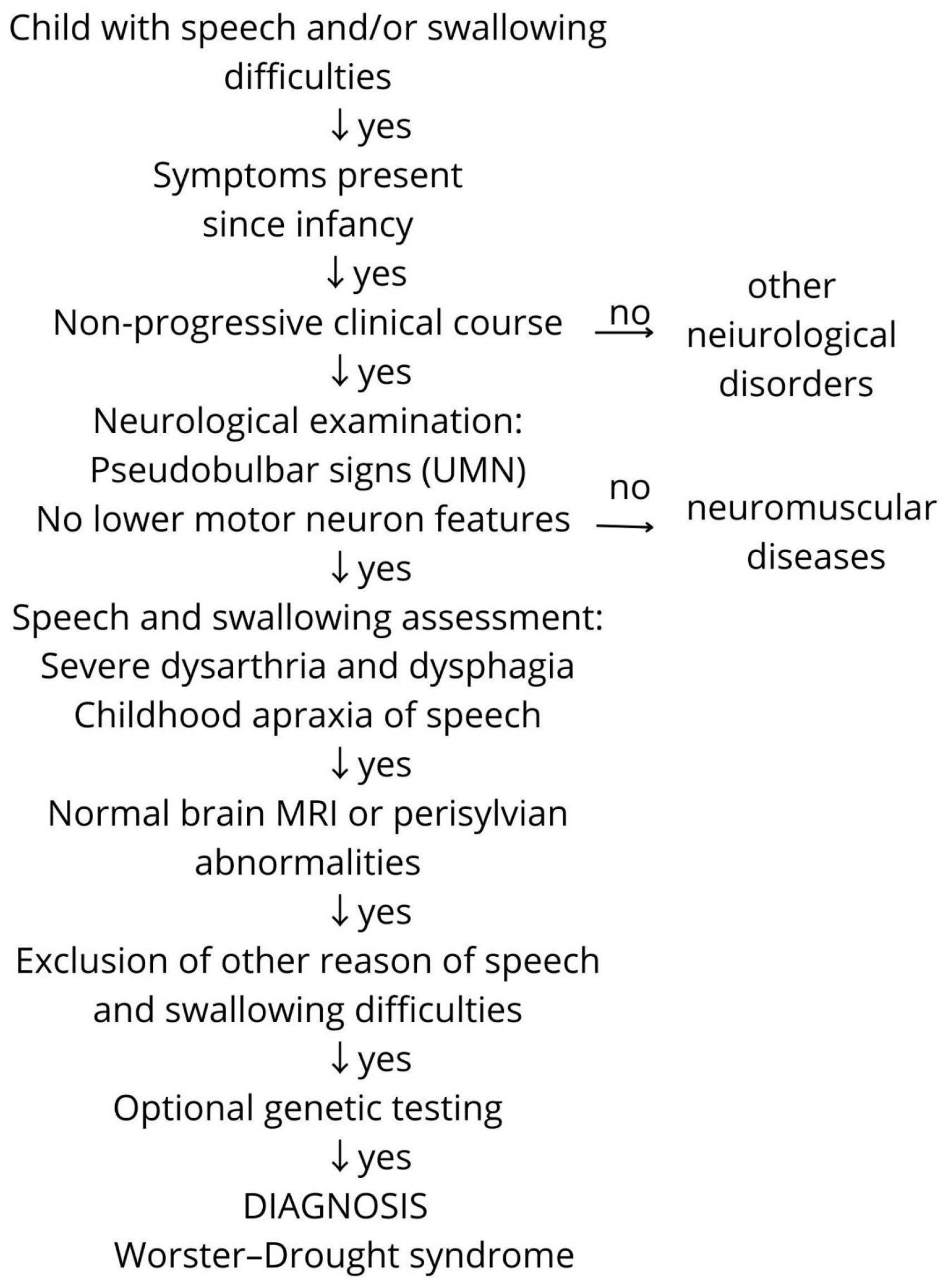

Comprehensive Review of Worster-Drought Syndrome as a Congenital Suprabulbar Paresis
 , and
, and
Abstract
1. Introduction
2. Genetics and Pathophysiology of WDS
3. Diagnosis
4. Differential Diagnosis
5. Classification Dilemma
6. Treatment
7. Discussion
8. Conclusions
Author Contributions
Funding
Data Availability Statement
Conflicts of Interest
References
- McMillan, H.J.; Holahan, A.L.; Richer, J. Worster-Drought Syndrome Associated With LINS Mutations. Child Neurol. Open 2018, 5, 2329048X18791083. [Google Scholar] [CrossRef] [PubMed]
- Worster-Drought, C. Congenital suprabulbar paresis. J. Laryngol. Otol. 1956, 70, 453–463. [Google Scholar] [CrossRef] [PubMed]
- Patton, M.A.; Baraitser, M.; Brett, E.M. A family with congenital suprabulbar paresis (Worster-Drought syndrome). Clin. Genet. 1986, 29, 147–150. [Google Scholar] [CrossRef] [PubMed]
- Worster-Drought, C. Suprabulbar Paresis. Congenital suprabulbar paresis and its differential diagnosis, with special reference to acquired suprabulbar paresis. Dev. Med. Child Neurol. Suppl. 1974, 30, 1–33. [Google Scholar] [PubMed]
- Shmueli, D.; Gross-Tsur, V. Worster-Drought syndrome—A specific cerebral palsy syndrome—Why is the diagnosis frequently overlooked? Harefuah 2007, 146, 755–758, 815. [Google Scholar] [PubMed]
- Orphanet: Worster-Drought Syndrome [Internet]. Available online: http://www.orpha.net/en/disease/detail/3465 (accessed on 22 July 2025).
- Clark, M.; Neville, B.G.R. Familial and genetic associations in Worster-Drought syndrome and perisylvian disorders. Am. J. Med. Genet. A 2008, 146A, 35–42. [Google Scholar] [CrossRef] [PubMed]
- Clark, M.; Chong, W.K.; Cox, T.; Neville, B.G.R. Congenital perisylvian dysfunction—Is it a spectrum? Dev. Med. Child Neurol. 2010, 52, 33–39. [Google Scholar] [CrossRef] [PubMed]
- Jayakumar, P.K.; Paramasivam, J.; Jayakumar, N.K.; Kumar, G.P.; Muruppel, A.M. Management of a soft tissue tumor in a child with Worster Drought syndrome using 810 nm diode laser—A case report. Laser Ther. 2015, 24, 113–117. [Google Scholar] [CrossRef] [PubMed] [PubMed Central]
- Clark, M.; Harris, R.; Jolleff, N.; Price, K.; Neville, B.G.R. Worster-Drought syndrome: Poorly recognized despite severe and persistent difficulties with feeding and speech. Dev. Med. Child Neurol. 2010, 52, 27–32. [Google Scholar] [CrossRef] [PubMed]
- Christen, H.J.; Hanefeld, F.; Kruse, E.; Imhäuser, S.; Ernst, J.P.; Finkenstaedt, M. Foix-Chavany-Marie (anterior operculum) syndrome in childhood: A reappraisal of Worster-Drought syndrome. Dev. Med. Child Neurol. 2000, 42, 122–132. [Google Scholar] [PubMed]
- Gordon, N. Worster-Drought and congenital bilateral perisylvian syndromes. Dev. Med. Child Neurol. 2002, 44, 201–204. [Google Scholar] [CrossRef] [PubMed]
- Nevo, Y.; Segev, Y.; Gelman, Y.; Rieder-Grosswasser, I.; Harel, S. Worster-Drought and congenital perisylvian syndromes-a continuum? Pediatr. Neurol. 2001, 24, 153–155. [Google Scholar] [CrossRef] [PubMed]
- Inoue, K.; Nakamura, S.; Koyano, K.; Kusaka, T. Worster-Drought syndrome with progressive symptomatic improvement in early infancy. BMJ Case Rep. 2025, 18, e263524. [Google Scholar] [CrossRef] [PubMed]
- Purkayastha, S. Worster-Drought Syndrome with Ectopic Neurohypophysis and Pituitary Hypoplasia: A Case Report. Neuroradiol. J. 2008, 21, 306–308. [Google Scholar] [CrossRef]
- Patil, A.; Gowda, V.K.; Shivappa, S.K.; Benakappa, N. Profile of Worster Drought Syndrome (WDS): Unrecognized Subtype of Cerebral Palsy—From Tertiary Care Center in South India. J. Pediatr. Neurosci. 2022, 17, 17. [Google Scholar] [CrossRef]
- Suresh, P.A.; Deepa, C. Congenital suprabulbar palsy: A distinct clinical syndrome of heterogeneous aetiology. Dev. Med. Child Neurol. 2004, 46, 617–625. [Google Scholar] [CrossRef]
- Alberto Spalice, P.I. Neuronal migration disorders: Clinical, neuroradiologic and genetics aspects. Acta Paediatr. 2009, 98, 421–433. [Google Scholar] [CrossRef]
- Epilepsy Phenome/Genome Project, Epi4K Consortium. Diverse genetic causes of polymicrogyria with epilepsy. Epilepsia 2021, 62, 973–983. [CrossRef]
- O’Leary, N.A.; Cox, E.; Holmes, J.B.; Anderson, W.R.; Falk, R.; Hem, V.; Tsuchiya, M.T.N.; Schuler, G.D.; Zhang, X.; Torcivia, J.; et al. Exploring and retrieving sequence and metadata for species across the tree of life with NCBI Datasets. Sci. Data 2024, 11, 732. [Google Scholar] [CrossRef] [PubMed]
- Clark, M.; Carr, L.; Reilly, S.; Neville, B.G. Worster-Drought syndrome, a mild tetraplegic perisylvian cerebral palsy. Review of 47 cases. Brain J. Neurol. 2000, 123, 2160–2170. [Google Scholar] [CrossRef] [PubMed]
- Voorendt, M.P.; Braun, K.P.J.; Gorter, J.W. Twee kinderen die kwijlen: Het syndroom van Worster-Drought. KIND 2009, 77, 37–42. [Google Scholar] [CrossRef]
- Neville, B. TheWorster-Drought syndrome: A severe test ofpaediatric neurodisability services? Dev. Med. Child Neurol. 1997, 39, 782–784. [Google Scholar] [CrossRef] [PubMed]
- Arbelaez, A.; Castillo, M.; Tennison, M. MRI in a patient with the Worster-Drought syndrome. Neuroradiology 2000, 42, 403–405. [Google Scholar] [CrossRef] [PubMed]
- Bulbar Palsy [Internet]. Cranial Nerve Impairments. Available online: https://www.sciencedirect.com/topics/medicine-and-dentistry/bulbar-palsy (accessed on 29 January 2026).
- Bulbar Palsy [Internet]. Hindbrain (Rhombencephalon). Available online: https://www.sciencedirect.com/topics/medicine-and-dentistry/bulbar-palsy (accessed on 29 January 2026).
- [Internet]. Sorbonne-Universite. Available online: https://hal.sorbonne-universite.fr/hal-01548998v1/document (accessed on 29 January 2026).
- Squier, W.; Jansen, A. Polymicrogyria: Pathology, fetal origins and mechanisms. Acta Neuropathol. Commun. 2014, 2, 80. [Google Scholar] [CrossRef] [PubMed] [PubMed Central]
- Moffat, J.J.; Ka, M.; Jung, E.M.; Kim, W.Y. Genes and brain malformations associated with abnormal neuron positioning. Mol. Brain 2015, 8, 72. [Google Scholar] [CrossRef]
- Poirier, K.; Saillour, Y.; Bahi-Buisson, N.; Jaglin, X.H.; Fallet-Bianco, C.; Nabbout, R.; Castelnau-Ptakhine, L.; Roubertie, A.; Attie-Bitach, T.; Desguerre, I.; et al. Mutations in the neuronal β-tubulin subunit TUBB3 result in malformation of cortical development and neuronal migration defects. Hum. Mol. Genet. 2010, 19, 4462–4473. [Google Scholar] [CrossRef]
- Singh, A.K.; Lin, H.H. The role of GPR56/ADGRG1 in health and disease. Biomed J. 2021, 44, 534–547. [Google Scholar] [CrossRef]
- Soteros, B.M.; Cong, Q.; Palmer, C.R.; Sia, G.M. Sociability and synapse subtype-specific defects in mice lacking SRPX2, a language-associated gene. PLoS ONE 2018, 13, e0199399. [Google Scholar] [CrossRef] [PubMed]
- Santini, E.; Klann, E. Genetically Dissecting Cortical Neurons Involved in Epilepsy in Angelman Syndrome. Neuron 2016, 90, 1–3. [Google Scholar] [CrossRef][Green Version]
- Johnston, M.V.; Blue, M.E.; Naidu, S. Rett Syndrome and Neuronal Development. J. Child Neurol. 2005, 20, 759–763. [Google Scholar] [CrossRef]
- Akol, I.; Gather, F.; Vogel, T. Paving Therapeutic Avenues for FOXG1 Syndrome: Untangling Genotypes and Phenotypes from a Molecular Perspective. Int. J. Mol. Sci. 2022, 23, 954. [Google Scholar] [CrossRef] [PubMed]
- Ozarkar, S.S.; Patel, R.K.R.; Vulli, T.; Smith, A.L.; Styner, M.A.; Hsu, L.M.; Lee, S.-H.; Shih, Y.-Y.I.; Hazlett, H.C.; Shen, M.D.; et al. Comparative profiling of white matter development in the human and mouse brain reveals volumetric deficits and delayed myelination in Angelman syndrome. Mol. Autism 2024, 15, 54. [Google Scholar] [CrossRef]
- Fiori, S.; Guzzetta, A.; Mitra, J.; Pannek, K.; Pasquariello, R.; Cipriani, P.; Tosetti, M.; Cioni, G.; Rose, S.; Chilosi, A. Neuroanatomical correlates of childhood apraxia of speech: A connectomic approach. NeuroImage Clin. 2016, 12, 894–901. [Google Scholar] [CrossRef]
- ICD-11 [Internet]. Available online: https://icd.who.int/en/ (accessed on 15 July 2025).
- Gropman, A.L.; Barkovich, A.J.; Vezina, L.G.; Conry, J.A.; Dubovsky, E.C.; Packer, R.J. Pediatric congenital bilateral perisylvian syndrome: Clinical and MRI features in 12 patients. Neuropediatrics 1997, 28, 198–203. [Google Scholar] [CrossRef] [PubMed]
- Szabó, N.; Hegyi, Á.; Boda, M.; Páncsics, M.; Pap, C.; Zágonyi, K.; Romhányi, É.; Túri, S.; Sztriha, L. Bilateral Operculum Syndrome in Childhood. J. Child Neurol. 2009, 24, 544–550. [Google Scholar] [CrossRef]
- Nisipeanu, P.; Rieder, I.; Blamen, S.; Korczyn, A.D. Pure congenital Foix-Chavany-Marie syndrome. Dev. Med. Child Neurol. 1997, 39, 696–698. [Google Scholar] [CrossRef] [PubMed]
- Cellerini, M.; Mascalchi, M.; Salvi, F.; Muscas, G.C.; Dal Pozzo, G. MRI of congenital Foix-Chavany-Marie syndrome. Pediatr. Radiol. 1995, 25, 316–317. [Google Scholar] [CrossRef] [PubMed]
- Kuzniecky, R.; Andermann, F.; Guerrini, R. Congenital bilateral perisylvian syndrome: Study of 31 patients. The CBPS Multicenter Collaborative Study. Lancet 1993, 341, 608–612. [Google Scholar] [CrossRef] [PubMed]
- Guerrini, R.; Dobyns, W.B. Malformations of cortical development: Clinical features and genetic causes. Lancet Neurol. 2014, 13, 710–726. [Google Scholar] [CrossRef] [PubMed]
- Baş, F.; Darendeliler, F.; Yapici, Z.Z.; Gokalp, S.; Bundak, R.; Saka, N.; Günöz, H. Worster-Drought Syndrome (Congenital Bilateral Perisylvian Syndrome) with Posterior Pituitary Ectopia, Pituitary Hypoplasia, Empty Sella and Panhypopituitarism: A Patient Report. J. Pediatr. Endocrinol. Metab. 2006, 19, 535–540. [Google Scholar] [CrossRef]
- Vasconcelos, M.G.; Fiorot, J.A.; Sarkovas, C.; Pinto, A.P.M.; Barsottini, O.G.P.; Gabbai, A.A. Intermediary form of Foix-Chavany-Marie/Worster-Drought syndromes associated to involuntary movements: Neuropsychological and phonoaudiological features. Arq. Neuropsiquiatr. 2006, 64, 322–325. [Google Scholar] [CrossRef] [PubMed]
- Queirós, F.; Duarte, G.; Correia, C.; Sérgio, J.G.; Vila-Nova, C.; Lucena, R. Síndrome de Worster-Drought: Relato de caso e distinção em relação à síndrome de Foix-Chavany-Marie. Arq. Neuropsiquiatr. 2004, 62, 906–910. [Google Scholar] [CrossRef]
- Pennington, L.; Roelant, E.; Thompson, V.; Robson, S.; Steen, N.; Miller, N. Intensive dysarthria therapy for younger children with cerebral palsy. Dev. Med. Child Neurol. 2013, 55, 464–471. [Google Scholar] [CrossRef] [PubMed]
- Margari, L.; Presicci, A.; Ventura, P.; Buttiglione, M.; Andreula, C.; Perniola, T. Congenital bilateral perisylvian syndrome with partial epilepsy. Case report with long-term follow-up. Brain Dev. 2005, 27, 53–57. [Google Scholar] [CrossRef] [PubMed]
- Aydemir, E. Immunomodulatory activity of metoclopramide HCl on murine macrophages. Naunyn Schmiedebergs Arch. Pharmacol. 2025, 398, 6781–6786. [Google Scholar] [CrossRef] [PubMed]
- Järvelä, I.; Paetau, R.; Rajendran, Y.; Acharya, A.; Bharadwaj, T.; Leal, S.M.; Lehesjoki, A.-E.; Palomäki, M.; Schrauwen, I. Heterogeneous genetic patterns in bilateral perisylvian polymicrogyria: Insights from a Finnish family cohort. Brain Commun. 2024, 6, fcae142. [Google Scholar] [CrossRef] [PubMed]
- Schumann, I.; Abou Jamra, R.; Jauss, R.T.; Karnstedt, M.; Specht, U.; Zacher, P.; Woermann, F.; Yaron, Y.; Popp, B. Overview and expansion of CEP85L-associated lissencephaly. Eur. J. Med. Genet. 2025, 77, 105042. [Google Scholar] [CrossRef] [PubMed]
- Koenig, M.; Dobyns, W.B.; Donato, N.D. Lissencephaly: Update on diagnostics and clinical management. Eur. J. Paediatr. Neurol. 2021, 35, 147–152. [Google Scholar] [CrossRef] [PubMed]
- Maranga, C.; Fernandes, T.G.; Bekman, E.; da Rocha, S.T. Angelman syndrome: A journey through the brain. FEBS J. 2020, 287, 2154–2175. [Google Scholar] [CrossRef] [PubMed]
- Vilvarajan, S.; McDonald, M.; Douglas, L.; Newham, J.; Kirkland, R.; Tzannes, G.; Tay, D.; Christodoulou, J.; Thompson, S.; Ellaway, C. Multidisciplinary Management of Rett Syndrome: Twenty Years’ Experience. Genes 2023, 14, 1607. [Google Scholar] [CrossRef] [PubMed] [PubMed Central]
- Brunetti-Pierri, N.; Paciorkowski, A.R.; Ciccone, R.; Della Mina, E.; Bonaglia, M.C.; Borgatti, R.; Schaaf, C.P.; Sutton, V.R.; Xia, Z.; Jelluma, N.; et al. Duplications of FOXG1 in 14q12 are associated with developmental epilepsy, mental retardation, and severe speech impairment. Eur. J. Hum. Genet. 2011, 19, 102–107. [Google Scholar] [CrossRef] [PubMed] [PubMed Central]
- Alduais, A.; Alfadda, H. Childhood Apraxia of Speech: A Descriptive and Prescriptive Model of Assessment and Diagnosis. Brain Sci. 2024, 14, 540. [Google Scholar] [CrossRef] [PubMed] [PubMed Central]
- Malmenholt, A.; Lohmander, A.; McAllister, A. Childhood apraxia of speech: A survey of praxis and typical speech characteristics. Logop. Phoniatr. Vocology 2017, 42, 84–92. [Google Scholar] [CrossRef] [PubMed]
- Highman, C.; Leitão, S.; Hennessey, N.; Piek, J. Prelinguistic communication development in children with childhood apraxia of speech: A retrospective analysis. Int. J. Speech Lang. Pathol. 2012, 14, 35–47. [Google Scholar] [CrossRef] [PubMed]
- Moss, A.L.; Jones, K.; Pigott, R.W. Submucous cleft palate in the differential diagnosis of feeding difficulties. Arch. Dis. Child. 1990, 65, 182–184. [Google Scholar] [CrossRef] [PubMed] [PubMed Central]



| Study and Year | Number of Patients with WDS | Main Symptoms | Epilepsy | Genetic Findings or Family History | MRI Findings | Other |
|---|---|---|---|---|---|---|
| Worster-Drought, Congenital Suprabulbar Paresis. 1956 [2] | 82 cases, out of which 32 showed the complete syndrome | Excessive drooling Dysarthria Inability to “round” lips (severe cases) Tongue immobility (severe cases) Paralysis or weakness of the soft palate (most frequent example) | No data | Seven familial examples of the disorder | No neuroimaging | The first description of congenital suprabulbar palsy described by Worster-Drought. In 26 cases, the soft palate was mainly or exclusively affected. In 10 cases, the tongue and palate were mainly affected. In 8 cases, the tongue and orbicularis oris were mainly affected. In 6 cases, the palate and orbicularis oris were mainly affected. Most of the children suffering from congenital suprabulbar paresis were of average intelligence |
| Patton et al., “A Family with Congenital Suprabulbar Paresis (Worster-Drought Syndrome)”. 1986 [3] | 4 males | Suprabulbar paresis Dribbling Poorly swallowing Limited tongue movement | Three of the four patients had epilepsy, and the fourth had an abnormal EEG | Members of three generations of one family; hypothesis of autosomal dominant inheritance with variable expression and penetrance | No neuroimaging | Transmission through unaffected males to their male—suggestion that X-linkage inheritance is unlikely One of the patients with delayed onset (compared to other relatives) after an acute illness in the second year |
| Clark et al., “Worster-Drought Syndrome, a Mild Tetraplegic Perisylvian Cerebral Palsy. Review of 47 Cases”. 2000 [20] | 47 | Bulbar problems Dribbling—86% Pyramidal signs— 91% Glue ear— 60% | 28% | 6 children with family history | 32% had abnormal neuroimaging, 14% had bilateral perisylvian polymicrogyria | Abnormal EEG—35% No speech—41% Soft, prepared diet—53% Significant medical problems in first year of life—52% Mean age of diagnosis when 6 years old Over half of the children had significant medical problems in the first year |
| Voorendt et al., “Twee kinderen die kwijlen”. 2009 [22] | Two girls, 5 and 13 years of age | Excessive drooling Dysarthria Dysphagia in the youngest girl and a mild right-sided hemiparesis in the oldest girl | - | - | Bilateral perisylvian ischemic abnormalities | - |
| Clark et al., “Congenital Perisylvian Dysfunction-Is It a Spectrum?” 2010 [8] | 70 had WDS of the total 121 (81 males, 40 females; mean age 5 years, 5 months) | Pseudobulbar palsy—100% Pyramidal signs—92% Weaning difficulties—85.7% Gastroesophageal reflux—66.7% Inappropriate drooling—91.8% | 39.3% | Family history of index condition—6% Family history of speech problems—14.5% Family history of epilepsy—14.5% | Normal perisylvian imaging | No speech— 56.6% Autistic spectrum disorder—18.2% |
| Clark et al., “Worster-Drought Syndrome”. 2010 [10] | 42 (26 males, 16 females; mean age 7 y, 10 mo) | Severe bulbar dysfunction Drooling problems during feeding—95.1% Feeding difficulties—85.7% Unintelligible speech— 60.5% | 30.8% Abnormal electroencephalography—40.6% | Familial history of WDS (4/36 families)—11.1% Speech delay (5/36 families)—13.9% Seizures (9/36 families)—25% | Perisylvian polymicrogyria- 13.5% | Neurogenic bulbar electromyography—38.5% Autism—19% ADHD—30% |
| Patil et al., “Profile of Worster Drought Syndrome (WDS)”. 2022 [16] | 83 (males 52, females 31) | Drooling—79.51% Developmental delay— 100% Expressive speech delay—100% Spasticity | 52.60% | Family history of speech delay in—2 families, 1 child- had an affected sibling with the perisylvian syndrome 4 were born of second-degree consanguinity, 9 were born of third-degree consanguinity | Perisylvian gliosis in 96.38% Bilateral perisylvian polymicrogyria— 3.61% Occipital lobe involvement— 84.33% | Birth asphyxia was present in 86.70% Mean age of diagnosis— 7.3 years |
| Domain | Features Suggestive of Worster-Drought Syndrome (WDS) |
|---|---|
| Medical history | Persistent difficulties with feeding, swallowing, speech, and saliva control since infancy; may also present with decreased IQ, learning difficulties, and diagnoses such as ADHD or autism spectrum disorder [10,21,23] |
| Neurological examination | Bilateral facial diplegia, prominent pseudobulbar signs, dysarthria, drooling, exaggerated jaw jerk reflex [2] |
| Speech and language assessment | Significant articulation impairments; difficulties with chewing and swallowing |
| Brain MRI | Often normal; in some cases, findings such as perisylvian polymicrogyria [21,24] or perisylvian gliosis [16] are observed |
| EEG | Epileptiform activity reported in approximately 30–50% of cases, especially in the presence of cortical malformations; may lead to misdiagnosis of primary epilepsy [16,21] |
| Genetic testing | Indicated for differential diagnosis in cases of unclear clinical picture; recommended particularly in atypical presentations or familial cases |
| Comorbidities | GERD present in 41% of children; may exacerbate pseudobulbar symptoms and contribute to misdiagnosis as a gastrointestinal disorder [16] Glue ear in 60% of patients [21] Neuropsychiatric problems in 41% of patients [21] |
| Group of Disorders | Specific Conditions | Similarities to WDS | Differentiating Features |
|---|---|---|---|
| Lower motor neuron (bulbar) syndromes | Congenital bulbar palsy [10] | Drooling, swallowing difficulties, dysarthria | Flaccid, atrophic tongue, absent jaw reflex, LMN lesion, Usually, evident brainstem structural changes |
| Brain malformations | Lissencephaly, various types of polymicrogyria [11,44,51] | Speech disorders (lissencephaly [52]—55%) Feeding difficulties (lissencephaly [53]—majority) Seizures (lissencephaly [52]—90%) | Extensive cortical abnormalities on MRI, more severe neurological impairments, often profound cognitive deficits |
| Neurodevelopmental syndromes with prominent speech and motor involvement | Angelman syndrome Rett syndrome FOXG1 syndrome [10] | Severe speech impairment (100%–Angelman [54]) (100%–Rett [55]) (100%–FOXG1 [56]); the initial presentation may resemble/overlap WDS | Genetic confirmation, often additional global developmental symptoms, variable clinical and imaging presentations |
| Speech disorders | Childhood apraxia of speech (CAS) [57] | Articulation difficulties (50–85% [58]), delayed speech development (100% [59]) | No muscle weakness, normal MRI |
| Structural oral cavity defects | Submucous cleft palate [10] | Drooling, feeding difficulties (48–85% [60]) | Defects visible on ENT exam or imaging, no CNS abnormalities, no neurological symptoms |
Disclaimer/Publisher’s Note: The statements, opinions and data contained in all publications are solely those of the individual author(s) and contributor(s) and not of MDPI and/or the editor(s). MDPI and/or the editor(s) disclaim responsibility for any injury to people or property resulting from any ideas, methods, instructions or products referred to in the content. |
© 2026 by the authors. Published by MDPI on behalf of the JMMS. Licensee MDPI, Basel, Switzerland. This article is an open access article distributed under the terms and conditions of the Creative Commons Attribution (CC BY) license.
Share and Cite
Dzięgiel, M.; Maciejowska, A.; Juszkiewicz, D.; Kaleta, W.; Zawadzka, M.; Mazurkiewicz-Bełdzińska, M. Comprehensive Review of Worster-Drought Syndrome as a Congenital Suprabulbar Paresis. J. Mind Med. Sci. 2026, 13, 8. https://doi.org/10.3390/jmms13020008
Dzięgiel M, Maciejowska A, Juszkiewicz D, Kaleta W, Zawadzka M, Mazurkiewicz-Bełdzińska M. Comprehensive Review of Worster-Drought Syndrome as a Congenital Suprabulbar Paresis. Journal of Mind and Medical Sciences. 2026; 13(2):8. https://doi.org/10.3390/jmms13020008
Chicago/Turabian StyleDzięgiel, Magdalena, Aleksandra Maciejowska, Dawid Juszkiewicz, Wiktor Kaleta, Marta Zawadzka, and Maria Mazurkiewicz-Bełdzińska. 2026. "Comprehensive Review of Worster-Drought Syndrome as a Congenital Suprabulbar Paresis" Journal of Mind and Medical Sciences 13, no. 2: 8. https://doi.org/10.3390/jmms13020008
APA StyleDzięgiel, M., Maciejowska, A., Juszkiewicz, D., Kaleta, W., Zawadzka, M., & Mazurkiewicz-Bełdzińska, M. (2026). Comprehensive Review of Worster-Drought Syndrome as a Congenital Suprabulbar Paresis. Journal of Mind and Medical Sciences, 13(2), 8. https://doi.org/10.3390/jmms13020008