Article

MRI Quantification of Liver Fibrosis Using Diamagnetic Susceptibility: An Ex Vivo Validation Study


1
Department of Radiology, Weill Cornell Medicine, New York, NY 10065, USA
2
Applied and Engineering Physics, Cornell University, Ithaca, NY 14853, USA
3
Meinig School of Biomedical Engineering, Cornell University, Ithaca, NY 14853, USA
4
Department of Pathology, Columbia University, New York, NY 10032, USA
5
Department of Pediatrics, Columbia University, New York, NY 10032, USA
*
Author to whom correspondence should be addressed.
This manuscript is a part of of the Ph.D. thesis by the first author, available online at: http://www.proquest.com/pqdtglobal/docview/3291606825/3174F869683E4B65PQ/1?accountid=10267&sourcetype=Dissertations%20&%20Theses (accessed on 29 January 2026).
Tomography 2026, 12(4), 46; https://doi.org/10.3390/tomography12040046

Submission received: 8 January 2026 / Revised: 10 March 2026 / Accepted: 20 March 2026 / Published: 31 March 2026
(This article belongs to the Section Abdominal Imaging)

Simple Summary

Liver fibrosis is a serious condition that can progress to cirrhosis and liver cancer, but the current standard test, liver biopsy, is invasive and risky. This study introduces a new magnetic resonance imaging method that measures tissue properties related to scar formation in the liver without surgery. Using donated liver samples, we show that this technique accurately distinguishes mild, moderate, and advanced fibrosis and performs better than several existing MRI measurements. This approach could help radiologists assess liver disease more safely, monitor treatment response, and support future studies toward noninvasive clinical diagnosis.

Abstract

Background/Objectives: Liver fibrosis, if left untreated, can lead to cirrhosis and cancer. The current standard liver biopsy for fibrosis staging is invasive and prone to risks of complication. The objective of this study was to develop a new noninvasive method to quantify fibrosis using diamagnetic susceptibility sources generated from multi-echo gradient echo (mGRE) data with both magnitude decay R2* modeling and phase QSM modeling. Methods: mGRE data of ex vivo liver explants was processed with fat–water separation and then susceptibility source separation. Negative susceptibility was used to measure diamagnetic fibrosis. In 20 formalin-fixed liver explant sections, negative susceptibility maps were compared with other MRI parameters against pathology for fibrosis staging. Results: The correlation between the negative susceptibility sources and the fibrosis stages was evaluated with Spearman coefficients. Negative susceptibility differentiated (i) no or mild fibrosis (stages F0 to F1) from moderate-to-advanced fibrosis (stages F2 to F3; p = 0.0025), (ii) stages F2 to F3 from cirrhosis (stage F4; p = 0.021), and (iii) no-to-moderate fibrosis (stages F0 to F2) from advanced fibrosis or cirrhosis (stages F3 to F4) with a sensitivity of 90%, a specificity of 90%, and a 0.88 Receiver Operating Characteristic Area Under the Curve (AUC) (p = 0.0017). Conclusions: For staging fibrosis, negative susceptibility was superior to other MRI parameters, including R2*, QSM, and PDFF. Negative susceptibility sources were positively correlated with the fibrosis stage (r = 0.60). Negative susceptibility could be valuable for MRI staging in liver fibrosis.

1. Introduction

Fibrosis is the best predictor of morbidity and mortality in chronic liver disease [1,2]. Liver biopsy, the current reference method for the diagnosis and staging of hepatic fibrosis, is invasive; cannot be used for frequent, repeated monitoring; and is limited in spatial sampling and complication risks and by interobserver variability. Consequently, alternative methods that avoid biopsy are needed for patient care and clinical research [3]. The recent FDA approval of the selective thyroid hormone receptor β agonist resmetirom as the first drug for the treatment of adults with noncirrhotic, nonalcoholic steatohepatitis (NASH, MASH, or MASLD) can be expected to increase the demand for noninvasive means to evaluate hepatic fibrosis [4,5].
Noninvasive quantitative MRI methods for the diagnosis and staging of fibrosis offer unique advantages in characterizing local intrinsic liver tissue properties. Ultrasound-based transient elastography (TE, also called ultrasonography-based transient elastography, UTE) [6] and magnetic resonance elastography (MRE) [7] quantify shear-wave propagation and show moderate diagnostic performance [8,9]. MRI with diffusion weighting (DWI) consistently shows lower apparent diffusion coefficients in fibrotic livers than in healthy controls [10]. Other MR biomarkers, such as T1 and T2 relaxometry, also appear promising for grading disease severity [11]. However, each modality has practical constraints: TE/UTE performance falls in patients with obesity due to reduced penetration and often requires additional hardware [12]. MRE requires expensive equipment and specialized expertise. T2 relaxometry suffers from high inter-study variability [13].
Quantitative susceptibility mapping (QSM) derived from complex multi-echo gradient echo (mGRE) data [14] also enables the specific quantitative study of major liver susceptibility sources, diamagnetic fibrosis and paramagnetic iron. Recently, decay rate R2* from mGRE magnitude data and QSM from mGRE phase data were combined via regression to distinguish between the different stages of fibrosis in ex vivo liver explants [15]. However, R2* and QSM can be combined via optimization to generate susceptibility source separation (R2*QSM) [16,17], including negative susceptibility mapping specific to diamagnetic fibrosis.
Here, we describe liver fibrosis quantification using negative susceptibility determined from mGRE data using susceptibility source separation [18]. Referencing it to the semiquantitative histological staging of fibrosis, we investigated the negative susceptibility and the individual parameters R2*, PDFF and QSM to differentiate between samples with no, mild or moderate fibrosis and those with advanced fibrosis or cirrhosis.

2. Materials and Methods

2.1. Liver Samples

This study was approved by the Institutional Review Board. Between January 2021 and November 2023, liver explant samples were collected by a liver pathologist. Sections of the livers of ~7 × 5 × 1.5 cm3 size and ~40 g weight were selected, preserved in formalin, and subsequently imaged with MRI.

2.2. MRI Acquisition

Liver samples preserved in formalin were placed in a cylindrical agarose mold covered with a water balloon. MRI was performed on a 3T scanner (GE Healthcare, Waukesha, WI, USA). Imaging sequence was 3D mGRE with 8 echoes, flip angle = 15, TE1 = 2.6 ms, ΔTE = 2.7 ms, TR = 24.43 ms, reconstructed voxel size = 0.88 × 0.88 × 1 mm3, bandwidth = 390 Hz/pixel, reconstructed matrix = 256 × 256 × 74 – 128.

2.3. MRI Analysis—R2, R2*, and Fat–Water Separation

MRI analysis was conducted using MATLAB (version R2023b; MathWorks, Natick, MA, USA). R2* values were derived from the magnitudes of the mGRE using the ARLO method [19]. An initial estimation of the field f was produced from the complex mGRE signals S(t) with N echoes, achieved through concurrent phase unwrapping and chemical shift elimination (SPURS) [20]. The IDEAL algorithm [21] was applied to create maps of water ( W ), fat ( F ), and field ( f ) mGRE data from a single-peak fat model:
E W , F , f = argmin W , F , f j = 1 N   S t j e R 2 * t j e i 2 π f t j W + F e i 2 π ν t j 2 2   ,
The background field was removed using the Projection onto Dipole Fields (PDF) technique [22]. The local field map was then used to produce a susceptibility map (χ) through the Morphology Enabled Dipole Inversion (MEDI) algorithm [23,24,25]. The susceptibility measurements were referenced to the mean susceptibility value of the water balloon [24]. Images representing the Proton Density Fat Fraction (PDFF) were generated from the computed fat and water images as F / ( W + F ) [26].
To exclude the background agarose gel and air, liver specimen volumes were automatically created by combining threshold-based segmentation with manual segmentation. This involved generating a liver binary mask M L using an R2* ≥ 15 s−1 threshold [15]. The mask was then manually eroded around large blood vessels, and any air bubbles were also excluded to prevent inaccuracies in fibrosis detection. Finally, the average values of all MRI parameters were calculated within the mask.

2.4. MRI Analysis—Susceptibility Source Separation

QSM χ susceptibility at a voxel was considered to be the sum of positive source χ + and negative source χ :
χ =   χ + χ ,
These positive and negative sources were assumed to contribute additively to the static dephasing rate R 2 * [18]:
R 2 *   r + χ + + r χ ,
The dephasing constants r + = r were assumed to be the same and may vary with tissues.
The positive and negative susceptibility maps were calculated by solving the optimization problem with regularization [17,18,27], which can be formulated as:
χ + * , χ * = a r g m i n χ + , χ   w 1 R 2 * r χ + + χ 2 2 + w 2 f d * χ + + χ 2 2                                                           + 2 λ 1 M E   χ + + χ 1 + λ 1 M L χ + 1 + λ 1 M L χ 1                                         + λ 2 M b   χ + χ b + ¯   2 2 + λ 2 M b   χ   χ b ¯ 2 2   ,
where f is the local field as in Equation (1), λ i are regularization parameters, is a gradient operator, M E is a binary edge mask derived from the magnitude image, M L is a binary edge mask derived from R 2 *   , M b is a binary mask of the water balloon, and χ b + ¯ and χ b ¯ are χ + and χ averaged over, respectively. w 1 and w 2 are data weighting terms. Susceptibility values violating χ + > 0 and χ < 0 were reset to zero.

2.5. Relaxometry Estimation—Learning from Histology with Leave-One-Out Cross-Validation

The dephasing constant may be calculated for the brain assuming only a positive susceptibility source in deep gray matter regions [18]. This assumption of regions with a single susceptibility source is problematic in general and particularly for the liver tissue where there is a heterogeneous mixture of diamagnetic fibrosis and paramagnetic iron and fat. In this work, we estimated the dephasing constant r such that the obtained negative susceptibility best differentiated various fibrosis groups. This was achieved by minimizing the loss of the log-likelihood for the logistic models F0–1 vs. F2–3, F2–3 vs. F4 and F0–1 vs. F4:
log L o s s = j = 1 3 i = 1 N j   y i j l o g p i j + 1 y i j l o g 1 p i j ,
Here j = 1 stands for the logistic model differentiating F0–1 vs. F2–3, j = 2 stands for the model differentiating F2–3 vs. F4, and j = 3 for F0–1 vs. F4. When a decay constant r is given, an average negative susceptibility can be solved rapidly using Equations (2) and (3). This value for each liver sample was used as the input of the logistic models to predict the labels of the sample. y i j is the label for sample i   in model j (for example, if y i j = 1 , the model only contained data with F0–1 and F2–3), and N j is the total number of samples for this model. p i j is the prediction of sample by model j given the average negative susceptibility for sample i . We examined the values for D from 50 Hz/ppm to 300 Hz/ppm with a step of 1 Hz/ppm. After obtaining the optimal value for r , we generated the final susceptibility map using Equation (4).
To avoid the “double dipping” problem and given the small dataset size, a leave-one-out cross-validation approach was employed for subject-specific models, where each liver sample was withheld while the remaining N-1 patients were used for training to get the optimal r using Equation (5). Therefore, the susceptibility in later analysis for each liver sample was based on the r value that was independently determined from other samples.
In the results, we will compare source separation with optimized decay constant r for the liver obtained using Equation (5) and with default r = 262 Hz/ppm reported in the brain source separation literature [16,17].

2.6. Histopathological Analysis

A small section of each scanned liver sample was collected for histopathological analysis for each case. Hematoxylin and eosin (H&E), Masson’s trichrome, and Prussian blue stains were performed for histology, fibrosis, and iron evaluation, respectively. Fibrosis appeared as blue fibers on liver tissue samples stained with Masson’s trichrome examined under a microscope. Iron appeared as blue microscopic granules within cells on Prussian blue staining. A liver pathologist evaluated the sections and assigned scores for fibrosis, iron, and fat using standard clinical scoring systems [28,29,30]. The fibrotic stages evaluated from the small sampled sections were consistent with the histological evaluations of the original explants from the clinical side across all cases, indicating representative sampling and reliable correlation between MRI and pathology.

2.7. Statistical Analysis

Differences in average R2*, PDFF, χ ,   | χ + | and | χ | between the subgroups F0–1 (non-fibrotic, mild fibrotic), F2–3 (medium-stage fibrotic) and F4 (cirrhotic) and between the subgroups F0–2 (non-fibrotic, mild fibrotic and significant-stage fibrotic) and F3–4 (advanced-stage fibrotic) liver samples were evaluated using Mann–Whitney U tests.
Since NASH patients with >F2 are the target population for pharmacological treatment and are most likely to benefit from antifibrotic drugs [31], the diagnostic accuracy of individual parameters for fibrosis detection between subgroups of liver samples with stages F0–2 and F3–4 was evaluated through Receiver Operating Characteristic (ROC) curve analysis. The optimal diagnostic threshold was determined using the Youden index, from which sensitivity and specificity values were calculated at this threshold.
We assessed the relationship between negative susceptibility sources and the histology-derived fibrosis stage with Spearman’s rank correlation. A Spearman coefficient close to +1 indicates a strong positive association, a value near −1 signifies a strong negative association, and one near 0 suggests no association. This rank-based test is appropriate because it only requires that each variable can be ranked.
Finally, we evaluated the ability of | χ + | to differentiate iron content among the no-iron group, grade 0–1 iron (I0–1, including samples with grade 0, grade 0–1 and grade 1 iron as shown in Table 1), and grade 2–3 iron (I2–3, including samples with grade 2, grade 2–3 and grade 3 iron) using Mann–Whitney U tests. Although the primary goal of the study is to develop a noninvasive diagnostic tool for liver fibrosis, this analysis provides additional support for the method.

3. Results

3.1. Demographics and Histopathological Characteristics

A total of 22 patient samples underwent scanning, with 20 of these being subjected to analysis. Two samples were excluded from the analysis due to the failure of water–fat separation, attributed to extremely high R2* values caused by iron overload. These excluded samples only displayed a discernible liver signal in the initial echo of mGRE images.
Table 1 summarizes the demographics and histopathological characteristics across the entire cohort and the different fibrosis groups (F0–1 vs. F2–3 vs. F4). Among the 20 samples analyzed, eight displayed liver cirrhosis (stage 4), two indicated stage 3 fibrosis, five were identified with stage 2 fibrosis, and two with stage 1 fibrosis. The other three samples did not present any signs of fibrosis, leading to a classification of five samples as either non-significant fibrosis or non-fibrotic (F0–1, combining stages 0 and 1) and seven as intermediate-stage fibrosis (F2–3, combining stages 2 and 3). Iron deposition, noted either in hepatocytes or Kupffer cells, was observed in 10 samples, with seven belonging to the F4 group, two to the F2–3 group, and one to the F0–1 group, indicating a noticeable trend towards a higher prevalence of iron deposition among the cirrhotic samples. Steatosis exceeding 5% was observed in six samples, including three from the F4 group, one from the F2–3 group, and two from the F0–1 group. Notably, four samples within the cirrhotic group exhibited minimal steatosis (less than 5%).

3.2. χ , χ + , R2*, PDFF, and QSM Measurements

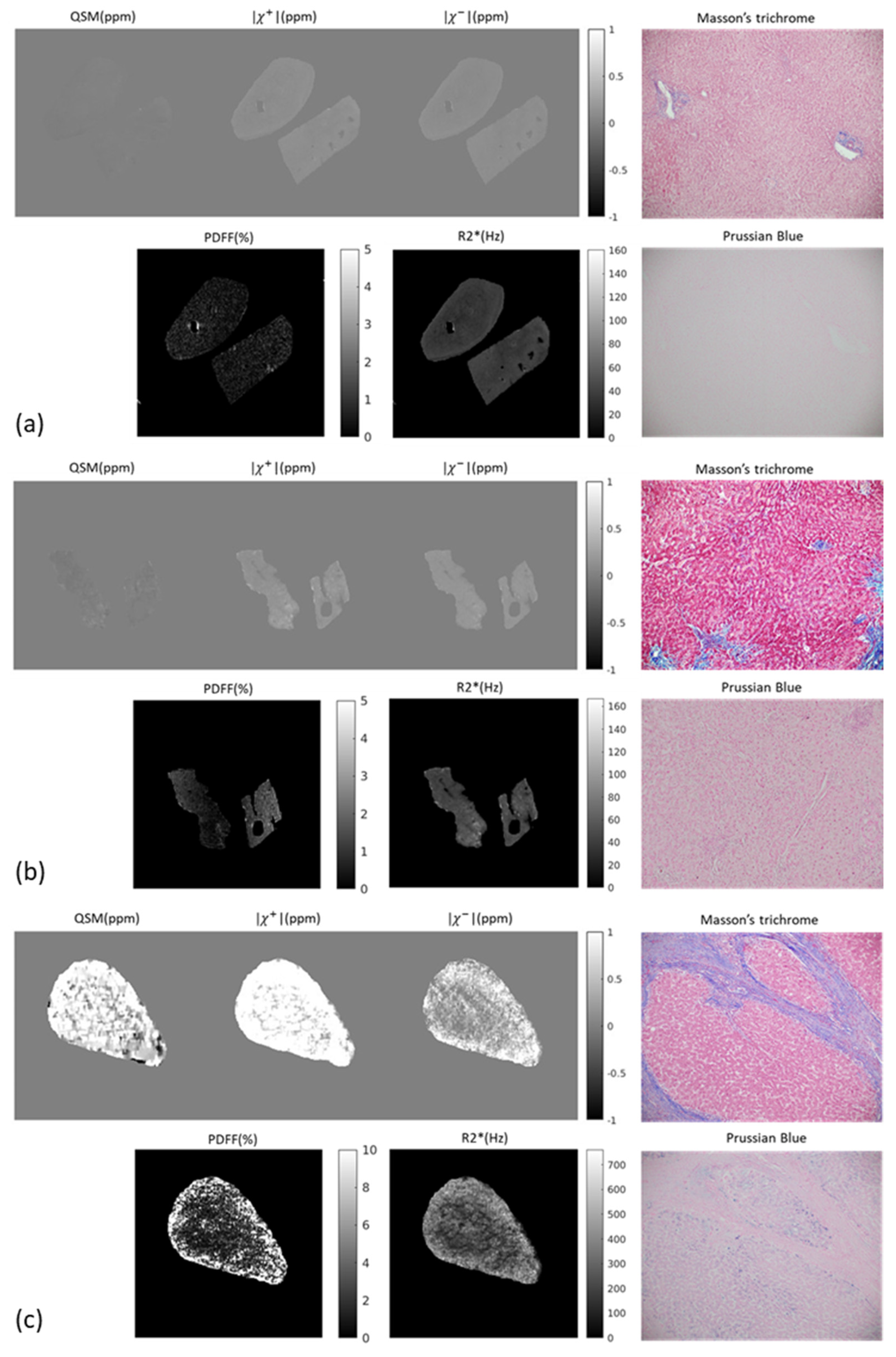
The average decay rate r value ±   SD estimated for source separation using the leave-one-out technique was 144.2 ± 3.9 Hz/ppm (min: 140, max: 156), which differed substantially from the default value of 262 Hz/ppm [16,17]. Using this average decay rate as the optimized value, example images of | χ + | , | χ | , as well as χ , R2* and PDFF maps are shown in Figure 1 along with pathologic stains.
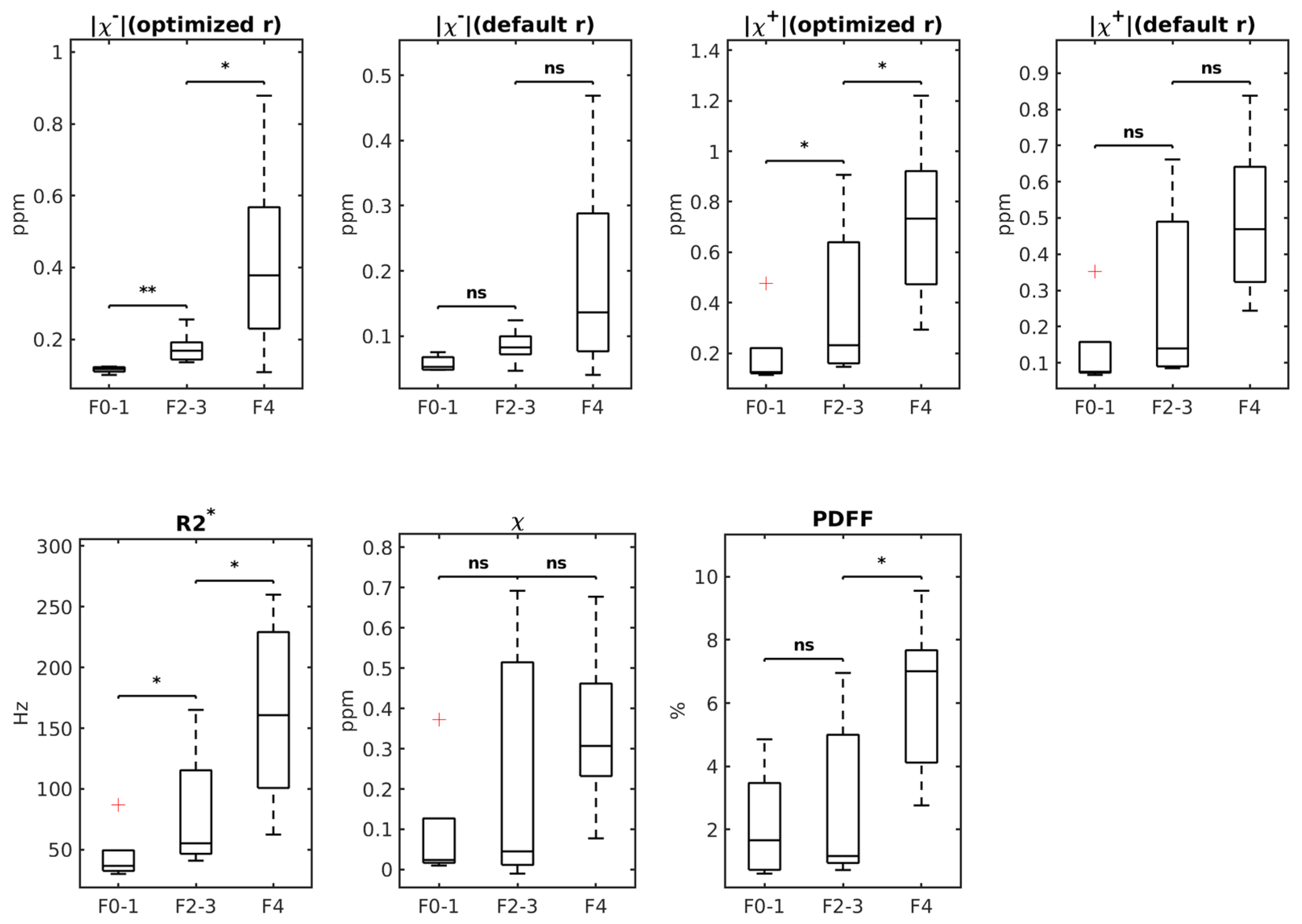
Figure 2 presents boxplots of | χ | calculated with optimized r obtained from leave-one-out cross-validation, | χ | calculated with default r , | χ + | (optimized r ), | χ + | (default r ), R2*, χ and PDFF across the subgroups of F0–1, F2–3 and F4 of liver fibrosis. When comparing both cirrhotic (F4) with medium-stage fibrosis (F2–3) and medium-stage fibrosis (F2–3) to none or mild fibrosis (F0–1), there were significant increases in | χ | with optimized r : F2–3 mean | χ | = 0.18 ± 0.04 vs. F4 mean | χ | = 0.42 ± 0.25 (p = 0.02) and F0–1 mean | χ | = 0.12 ±   0.01 vs. F2–3 mean | χ | = 0.18 ± 0.04 (p = 0.0025). However, | χ | with default r showed no significant difference in both groups.
Similarly, when comparing cirrhotic (F4) with medium-stage fibrosis (F2–3), there were significant increases in the average R2* (p = 0.021), PDFF (p = 0.014) and | χ + | with optimized r (p = 0.021) but not in | χ + | with default r (p = 0.072); when comparing medium-stage fibrosis (F2–3) to none or mild fibrosis (F0–1), there was significant increase only in R2* (p = 0.048) and | χ + | with optimized r (p = 0.048) but not in PDFF (p = 0.876) and | χ + | with default r (p = 0.11). QSM total voxel susceptibility value χ was not statistically different across the groups (p > 0.05 for both comparisons), consistent with fibrosis and iron mixing across all stages.
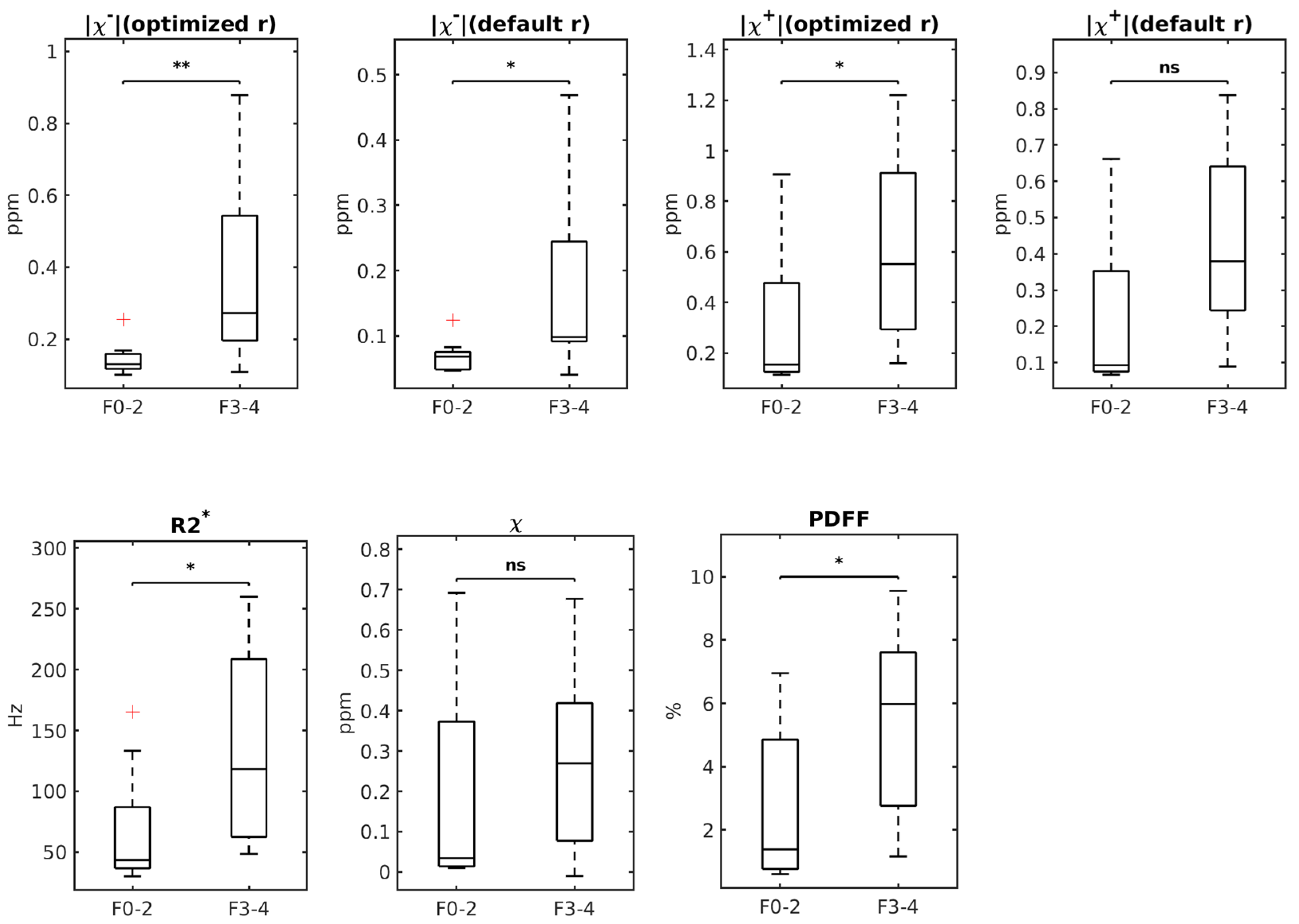
Figure 3 shows boxplots of | χ | (optimized r ), | χ | (default r ), | χ + | (optimized r ), | χ + | (default r ), R2*, χ and PDFF across the subgroups of F0–2 and F3–4 of liver fibrosis. | χ | (optimized r ), | χ | (default r ), | χ + | (optimized r ), R2* and PDFF, not | χ + | (default r ) and χ all demonstrated significant differences between these two groups, with p = 0.0046, 0.026, 0.021, 0.014, 0.026, 0.054 and 0.27, respectively.
We found that positive susceptibility sources were able to distinguish between fibrosis groups. This result is expected, because iron—the liver’s primary paramagnetic content—can promote fibrosis when present in excess.

3.3. ROC Analysis for Differentiating Two Fibrosis Subgroups

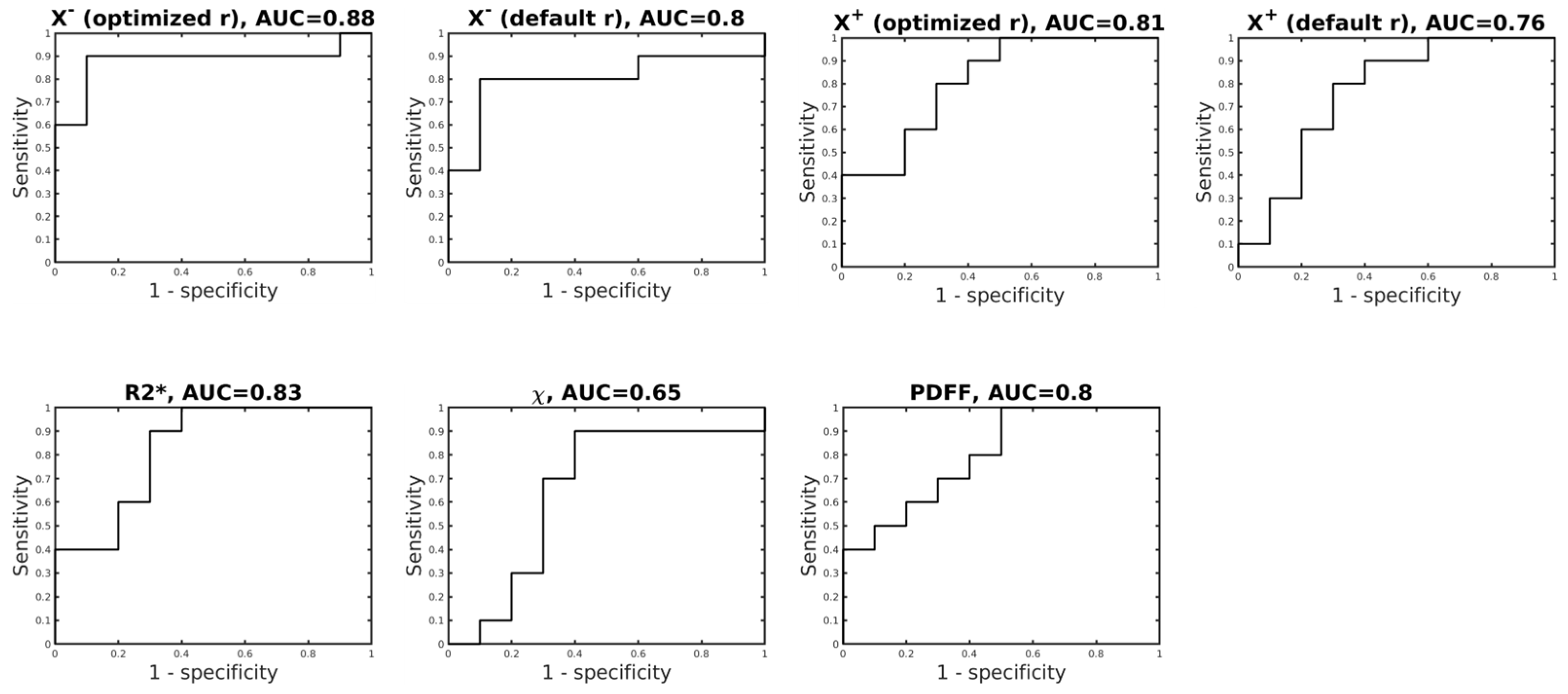
Table 2 summarizes the ROC analysis results, including Area Under the Curve (AUC) and sensitivity and specificity, are detailed in Table 2, and Figure 4 displays Receiver Operating Characteristic (ROC) curves for the differentiation of fibrosis between subgroups of liver samples with stage F0–2 (n = 10) and stage F3–4 (n = 10). χ (optimized r ) increased AUC to 0.88 (p = 0.0046), indicating a more accurate prediction than when R2* and QSM are used individually. In addition, R2*, | χ + | (optimized r ), | χ | (default r ), and PDFF achieved AUCs = 0.83, 0.81, 0.8 and 0.8 and p = 0.014, 0.021, 0.026 and 0.026, respectively, for identifying significant-stage fibrosis/cirrhosis livers. | χ + | (default r ) and magnetic susceptibility (χ) did not reach statistical significance, with AUC = 0.76 and 0.65, and p = 0.053 and 0.27, respectively.

3.4. Correlation with Histology Grades

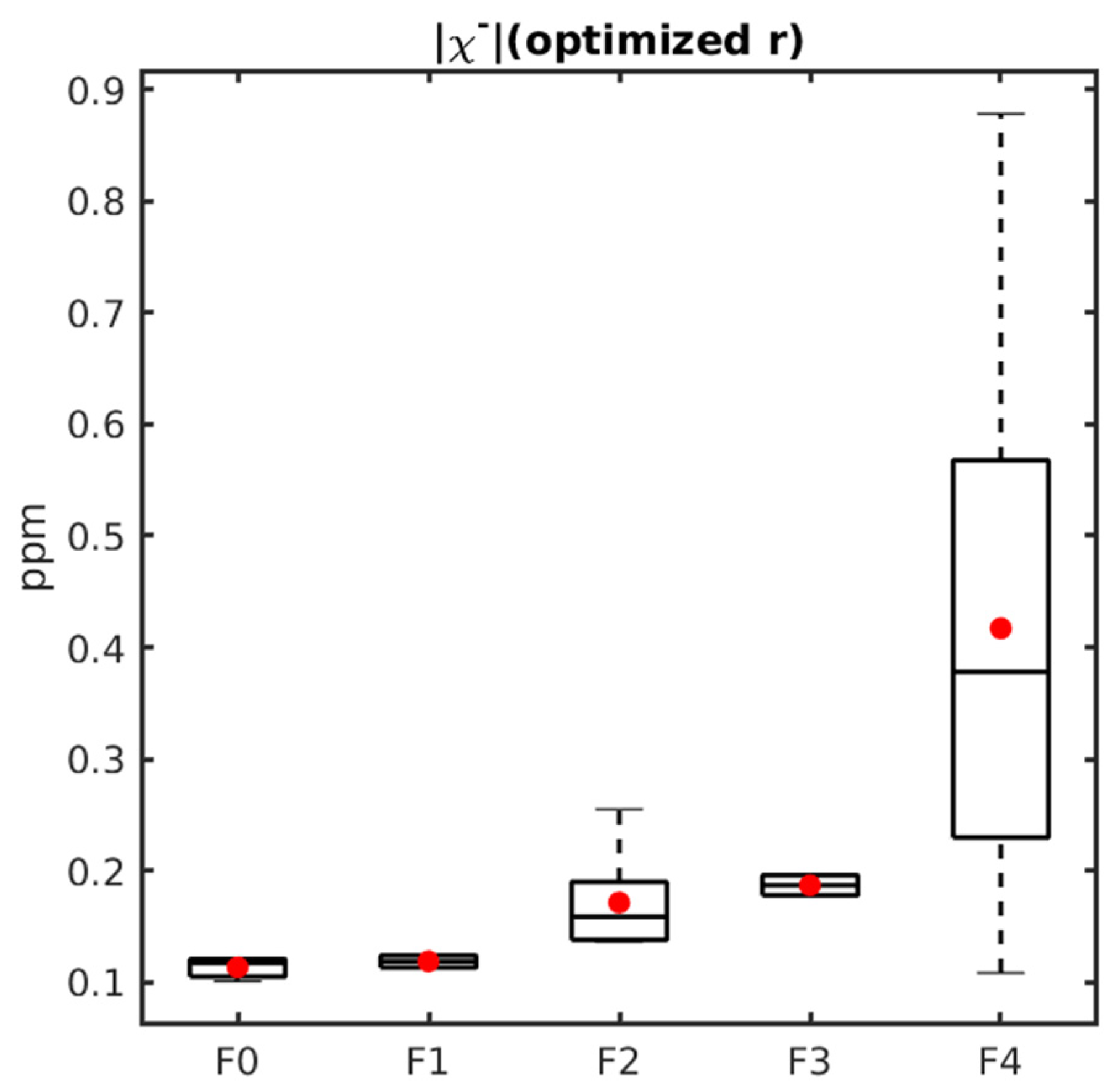
Figure 5 shows the negative susceptibility sources obtained with source separation with optimized r . The measures correlate positively with the ordinal fibrosis stage determined from histology. For the χ with optimized r , the mean ± SD absolute negative susceptibility values were 0.11 ± 0.011, 0.12 ± 0.0077, 0.17 ± 0.049, 0.19 ± 0.013, and 0.42 ± 0.25 for samples classified as F0, F1, F2, F3, and F4, respectively. The Spearman correlation coefficients are r = 0.60.

3.5. χ + Measurement for Iron

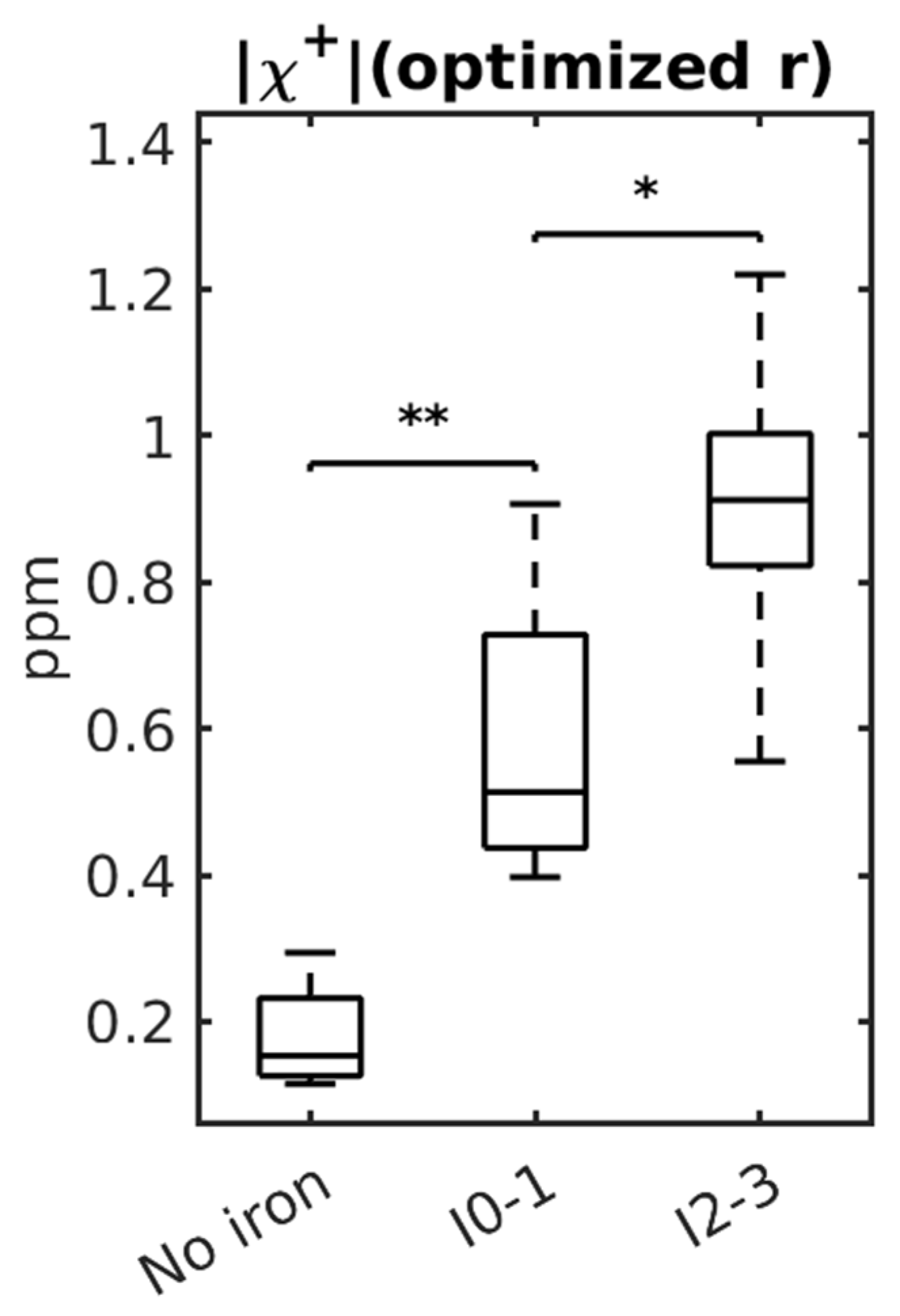
Figure 6 shows iron content differed significantly between the non-iron and I0–1 groups (p = 0.002) and between the I0–1 and I2–3 groups (p = 0.032) for χ +   with optimized r .

4. Discussion

Our results indicate that decay constant optimization for a specific tissue type is important in R2*QSM susceptibility source separation, and that diamagnetic susceptibility can serve as an accurate biomarker for assessing liver fibrosis: negative susceptibility differentiates fibrotic stages: none or mild fibrosis (F0–1), medium (F2–3), and cirrhotic (F4). Diamagnetic susceptibility is particularly useful in differentiating between livers with fibrosis F0–2 from those with >F2 as candidates for antifibrotic pharmacological treatment [31].
Liver susceptibility sources include diamagnetic fibrosis (prevalently collagen) and paramagnetic iron. In diseases such as nonalcoholic fatty liver disease (NAFLD) and steatohepatitis (NASH) (also together known as metabolic dysfunction-associated steatosis liver disease (MASLD)), fat is commonly present alongside liver fibrosis. To mitigate the impact of fat on QSM, we used water–fat separation to differentiate water and fat signals and adjust for fat content. To reduce the effect of paramagnetic sources like iron, we used susceptibility source separation to identify the diamagnetic susceptibility source for non-invasively assessing liver fibrosis using ex vivo liver explant samples. While QSM individually was not effective in identifying all groups of fibrosis stages, this study found that susceptibility source separation utilizing QSM and R2* from a single mGRE sequence is able to distinguish stage 0–1 from stage 2–3 (p = 0.0025) and stage 2–3 from cirrhotic/stage 4 (p = 0.021) in liver tissue, providing a ROC AUC of 0.88 for differentiating liver samples of stage F0–2 and advanced stage F3–4 fibrosis/cirrhosis.
Other relevant QSM methods include texture analysis using magnetic susceptibility and R2* to evaluate liver fibrosis, which has shown promising performance in differentiating fibrosis stages by quantifying spatial heterogeneity. Susceptibility tensor imaging (STI) has also been used to directly image diamagnetic susceptibility from collagen in hepatic fibrosis, suggesting a unique contrast mechanism to target fibrotic tissue components [32]. Source separation with optimized decay constant r demonstrated significantly better ability in differentiating both higher-stage fibrosis (F4 vs. F2–3 or F3–4 vs. F0–2) and lower-stage fibrosis F0–1 and F2–3 than source separation with default decay constant r .
Fibrosis is a very important concern in managing chronic liver disease (CLD), which has a molecular makeup of the fibrous scar tissue consisting of collagen types I and III, sulfated proteoglycans, and glycoproteins [33]. CLD worldwide affects 1.5 billion people, causing two million deaths each year [34,35]. The most common CLD etiologies are (i) NAFLD (or MASLD, as has been proposed [36], including nonalcoholic steatohepatitis, NASH, or metabolic dysfunction-associated steatohepatitis, MASH), (ii) viral infections (hepatitis B virus, HBV, and hepatitis C virus, HCV), and iii) alcohol-related liver disease (ALD); other etiologies include less common genetic, autoimmune, inflammatory, metabolic, infectious, and toxic disorders. In CLD, fibrosis, iron, and fat are interrelated and iron may be both a cause [37] and consequence of liver disease [38,39,40]. Fibrosis develops with excessive deposition of extracellular matrix macromolecules, predominantly collagens. The progressive formation of fibrous scars replaces normal tissue and distorts hepatic architecture. Cirrhosis develops following the formation of nodules of regenerating hepatocytes, potentially leading to portal hypertension, liver failure and hepatocellular carcinoma [41,42,43]. Noninvasive MRI is routinely used in managing patients with CLD, and liver fibrosis has been studied using R2 and R2* weighted imaging and magnetic resonance elastography (MRE). While MRE requires additional scanner hardware, R2 and R2* weighted methods have limited sensitivities; these methods may suffer from iron interference [44,45]. QSM from widely available gradient echo MRI data without any contrast injection or additional hardware is well suited for longitudinal quantitative monitoring [46]. The R2*QSM source separation-based method presented here offers a promising, widely accessible method for studying liver fibrosis.
This study has several limitations. First, only 20 samples were included in the final analysis, with an uneven distribution across fibrosis stages, which may limit statistical robustness. To validate these findings and assess their applicability in clinical environments, further studies are necessary, involving larger participant groups. Second, the source separation physical model involves substantial simplification and requires further investigation. Third, histological staging was derived from localized tissue sections, whereas MRI-derived susceptibility metrics were averaged over substantially larger specimen volumes. Given the spatial heterogeneity of fibrosis, this scale mismatch may introduce bias in the statistical analyses by underrepresenting focal fibrotic regions. Fourth, previous phantom studies demonstrate the strong nonlinear effects of fibrosis and fat interference on the R2* estimate [47] and of signal dependence on voxel size [48]. In the decay constant formulation, Equation (3) is only approximate. Therefore, residual iron effects may therefore influence the diamagnetic susceptibility estimates, especially in F4 samples, and future work should introduce more refined biophysical models that include cross terms between positive and negative susceptibility sources. Also, more accurate numerical formulation may be used to model susceptibility sources including deoxyheme iron related to hepatocyte oxygen metabolism and ferritin iron with a unique magnetization saturation property [49,50,51]. In addition, formalin fixation may cause an R2* increase [52,53], and may have affected the evaluation of susceptibility sources and other MRI parameters in our study. Results here warrant future study with fresh liver samples without formalin fixation, and the reproducibility of the results on different scanners and in vivo using the decay constant values so determined should be further studied. Additionally, although large vessels were excluded when drawing the masks, segmentation inaccuracies are still likely in regions near vessels. Finally, the decay constant r was optimized using fibrosis-stage discrimination as the objective function. While this approach improves performance within the current dataset, the optimal value of r may depend on tissue properties, voxel size, disease etiology, and acquisition conditions, and therefore may not be universally transferable. From a practical standpoint, the current optimization and reconstruction pipeline was implemented in MATLAB and involves multiple processing steps, which may limit immediate clinical deployment. Translation to routine clinical use will require streamlined, automated implementations integrated into scanner workflows or clinical image-processing platforms, as well as a validation of computational efficiency and robustness.
In future in vivo or multicenter studies, r could be calibrated using a training cohort and then fixed for independent testing, or alternatively modeled as a function of measurable imaging parameters such as field strength, voxel size, echo spacing or repetition time to improve robustness across scanners. As a result, optimal cut-off can be recalculated once the retraining is performed. Second, the proposed method against established noninvasive fibrosis assessment techniques such as magnetic resonance elastography (MRE) or diffusion-weighted imaging (DWI) can be studied on the same dataset. Finally, another direction that could be explored in the future is conducting longitudinal in vivo studies to determine whether the proposed susceptibility-based biomarkers can support disease monitoring.

5. Conclusions

In conclusion, our study shows that the diamagnetic susceptibility source obtained from mGRE data alone is a promising tool for the noninvasive diagnosis of the liver fibrosis stage, which may be used as an alternative to liver biopsy.

Author Contributions

Conceptualization, C.L.; methodology, C.L. and A.V.D.; software, C.L. and A.V.D.; validation, C.L., J.L., D.R. and J.Z.; formal analysis, C.L.; investigation, C.L., J.L., D.R. and A.K.K.d.G.; resources, C.L., J.Z., A.K.K.d.G., M.R.P. and G.M.B.; data curation, C.L., A.K.K.d.G., M.R.P. and J.Z.; writing—original draft preparation, C.L.; writing—review and editing, C.L., J.L., D.R., P.S., G.M.B. and Y.W.; visualization, C.L.; supervision, P.S., T.D.N. and Y.W.; project administration, P.S., T.D.N. and Y.W.; funding acquisition, Y.W., M.R.P. and G.M.B. All authors have read and agreed to the published version of the manuscript.

Funding

National Institutes of Health (NIH) grants R01CA181566, R01NS090464, R01DK116126 and R01NS095562.

Institutional Review Board Statement

Weill Cornell Institutional Review Board approval number 1104011660 most recently approved on 20 July 2025 and expires on 20 July 2026.

Informed Consent Statement

Not applicable.

Data Availability Statement

The data presented in this study are available on reasonable request from the corresponding author.

Acknowledgments

In memory of Gary Brittenham, who passed away on 23 December 2024. This work builds upon the foundational liver iron and fibrosis research that Gary initiated and dedicated his life to.

Conflicts of Interest

A.V.D. and Y.W. are inventors of QSM-related patents issued to Cornell University. Y.W. holds equity in Medimagemetric LLC. The remaining authors declare that they have no disclosures.

References

  1. Parola, M.; Pinzani, M. Liver fibrosis in NAFLD/NASH: From pathophysiology towards diagnostic and therapeutic strategies. Mol. Aspects Med. 2024, 95, 101231. [Google Scholar] [CrossRef]
  2. Stål, P. Liver fibrosis in non-alcoholic fatty liver disease—diagnostic challenge with prognostic significance. World J. Gastroenterol. 2015, 21, 11077–11087. [Google Scholar] [CrossRef]
  3. Fowler, K.J.; Bashir, M.R. The current status of imaging in liver fibrosis. Nat. Rev. Gastroenterol. Hepatol. 2023, 20, 628–629. [Google Scholar] [CrossRef] [PubMed]
  4. FDA. FDA Approves First Treatment for Patients with Liver Scarring Due to Fatty Liver Disease; FDA: Silver Spring, MD, USA, 2024. [Google Scholar]
  5. Harrison, S.A.; Bedossa, P.; Guy, C.D.; Schattenberg, J.M.; Loomba, R.; Taub, R.; Labriola, D.; Moussa, S.E.; Neff, G.W.; Rinella, M.E.; et al. A Phase 3, Randomized, Controlled Trial of Resmetirom in NASH with Liver Fibrosis. N. Engl. J. Med. 2024, 390, 497–509. [Google Scholar] [CrossRef] [PubMed]
  6. Yoshioka, K.; Hashimoto, S. Can non-invasive assessment of liver fibrosis replace liver biopsy? Hepatol. Res. 2012, 42, 233–240. [Google Scholar] [CrossRef]
  7. Muthupillai, R.; Lomas, D.J.; Rossman, P.J.; Greenleaf, J.F.; Manduca, A.; Ehman, R.L. Magnetic resonance elastography by direct visualization of propagating acoustic strain waves. Science 1995, 269, 1854–1857. [Google Scholar] [CrossRef]
  8. Huwart, L.; Sempoux, C.; Vicaut, E.; Salameh, N.; Annet, L.; Danse, E.; Peeters, F.; ter Beek, L.C.; Rahier, J.; Sinkus, R.; et al. Magnetic resonance elastography for the noninvasive staging of liver fibrosis. Gastroenterology 2008, 135, 32–40. [Google Scholar] [CrossRef]
  9. Yin, M.; Talwalkar, J.A.; Glaser, K.J.; Manduca, A.; Grimm, R.C.; Rossman, P.J.; Fidler, J.L.; Ehman, R.L. Assessment of hepatic fibrosis with magnetic resonance elastography. Clin. Gastroenterol. Hepatol. 2007, 5, 1207–1213 e1202. [Google Scholar] [CrossRef]
  10. Taouli, B.; Tolia, A.J.; Losada, M.; Babb, J.S.; Chan, E.S.; Bannan, M.A.; Tobias, H. Diffusion-weighted MRI for quantification of liver fibrosis: Preliminary experience. AJR Am. J. Roentgenol. 2007, 189, 799–806. [Google Scholar] [CrossRef]
  11. Heye, T.; Yang, S.R.; Bock, M.; Brost, S.; Weigand, K.; Longerich, T.; Kauczor, H.U.; Hosch, W. MR relaxometry of the liver: Significant elevation of T1 relaxation time in patients with liver cirrhosis. Eur. Radiol. 2012, 22, 1224–1232. [Google Scholar] [CrossRef]
  12. Kumagai, E.; Korenaga, K.; Korenaga, M.; Imamura, M.; Ueyama, M.; Aoki, Y.; Sugiyama, M.; Murata, K.; Masaki, N.; Kanto, T.; et al. Appropriate use of virtual touch quantification and FibroScan M and XL probes according to the skin capsular distance. J. Gastroenterol. 2016, 51, 496–505. [Google Scholar] [CrossRef] [PubMed]
  13. Lee, M.J.; Kim, M.J.; Yoon, C.S.; Han, S.J.; Park, Y.N. Evaluation of liver fibrosis with T2 relaxation time in infants with cholestasis: Comparison with normal controls. Pediatr. Radiol. 2011, 41, 350–354. [Google Scholar] [CrossRef] [PubMed]
  14. de Rochefort, L.; Liu, T.; Kressler, B.; Liu, J.; Spincemaille, P.; Lebon, V.; Wu, J.; Wang, Y. Quantitative susceptibility map reconstruction from MR phase data using bayesian regularization: Validation and application to brain imaging. Magn. Reson. Med. 2010, 63, 194–206. [Google Scholar] [CrossRef] [PubMed]
  15. Jafari, R.; Hectors, S.J.; Koehne de Gonzalez, A.K.; Spincemaille, P.; Prince, M.R.; Brittenham, G.M.; Wang, Y. Integrated quantitative susceptibility and R(2) * mapping for evaluation of liver fibrosis: An ex vivo feasibility study. NMR Biomed. 2021, 34, e4412. [Google Scholar] [CrossRef]
  16. Dimov, A.V.; Gillen, K.M.; Nguyen, T.D.; Kang, J.; Sharma, R.; Pitt, D.; Gauthier, S.A.; Wang, Y. Magnetic Susceptibility Source Separation Solely from Gradient Echo Data: Histological Validation. Tomography 2022, 8, 1544–1551. [Google Scholar] [CrossRef]
  17. Dimov, A.V.; Nguyen, T.D.; Gillen, K.M.; Marcille, M.; Spincemaille, P.; Pitt, D.; Gauthier, S.A.; Wang, Y. Susceptibility source separation from gradient echo data using magnitude decay modeling. J. Neuroimaging 2022, 32, 852–859. [Google Scholar] [CrossRef]
  18. Shin, H.G.; Lee, J.; Yun, Y.H.; Yoo, S.H.; Jang, J.; Oh, S.H.; Nam, Y.; Jung, S.; Kim, S.; Fukunaga, M.; et al. chi-separation: Magnetic susceptibility source separation toward iron and myelin mapping in the brain. Neuroimage 2021, 240, 118371. [Google Scholar] [CrossRef]
  19. Pei, M.; Nguyen, T.D.; Thimmappa, N.D.; Salustri, C.; Dong, F.; Cooper, M.A.; Li, J.; Prince, M.R.; Wang, Y. Algorithm for fast monoexponential fitting based on Auto-Regression on Linear Operations (ARLO) of data. Magn. Reson. Med. 2015, 73, 843–850. [Google Scholar] [CrossRef]
  20. Dong, J.; Liu, T.; Chen, F.; Zhou, D.; Dimov, A.; Raj, A.; Cheng, Q.; Spincemaille, P.; Wang, Y. Simultaneous phase unwrapping and removal of chemical shift (SPURS) using graph cuts: Application in quantitative susceptibility mapping. IEEE Trans. Med. Imaging 2015, 34, 531–540. [Google Scholar] [CrossRef]
  21. Reeder, S.B.; McKenzie, C.A.; Pineda, A.R.; Yu, H.; Shimakawa, A.; Brau, A.C.; Hargreaves, B.A.; Gold, G.E.; Brittain, J.H. Water-fat separation with IDEAL gradient-echo imaging. J. Magn. Reson. Imaging 2007, 25, 644–652. [Google Scholar] [CrossRef]
  22. Liu, T.; Khalidov, I.; de Rochefort, L.; Spincemaille, P.; Liu, J.; Tsiouris, A.J.; Wang, Y. A novel background field removal method for MRI using projection onto dipole fields (PDF). Nmr Biomed. 2011, 24, 1129–1136. [Google Scholar] [CrossRef] [PubMed]
  23. Liu, J.; Liu, T.; de Rochefort, L.; Ledoux, J.; Khalidov, I.; Chen, W.W.; Tsiouris, A.J.; Wisnieff, C.; Spincemaille, P.; Prince, M.R.; et al. Morphology enabled dipole inversion for quantitative susceptibility mapping using structural consistency between the magnitude image and the susceptibility map. Neuroimage 2012, 59, 2560–2568. [Google Scholar] [CrossRef] [PubMed]
  24. Liu, Z.; Spincemaille, P.; Yao, Y.; Zhang, Y.; Wang, Y. MEDI+0: Morphology enabled dipole inversion with automatic uniform cerebrospinal fluid zero reference for quantitative susceptibility mapping. Magn. Reson. Med. 2018, 79, 2795–2803. [Google Scholar] [CrossRef]
  25. Liu, Z.; Kee, Y.; Zhou, D.; Wang, Y.; Spincemaille, P. Preconditioned total field inversion (TFI) method for quantitative susceptibility mapping. Magn. Reson. Med. 2017, 78, 303–315. [Google Scholar] [CrossRef]
  26. Reeder, S.B.; Cruite, I.; Hamilton, G.; Sirlin, C.B. Quantitative Assessment of Liver Fat with Magnetic Resonance Imaging and Spectroscopy. J. Magn. Reson. Imaging 2011, 34, 729–749. [Google Scholar] [CrossRef]
  27. Kee, Y.; Liu, Z.; Zhou, L.; Dimov, A.; Cho, J.; de Rochefort, L.; Seo, J.K.; Wang, Y. Quantitative Susceptibility Mapping (QSM) Algorithms: Mathematical Rationale and Computational Implementations. IEEE Trans. Biomed. Eng. 2017, 64, 2531–2545. [Google Scholar] [CrossRef]
  28. Batts, K.P.; Ludwig, J. Chronic hepatitis. An update on terminology and reporting. Am. J. Surg. Pathol. 1995, 19, 1409–1417. [Google Scholar] [CrossRef]
  29. Puri, P.; Sanyal, A.J. Nonalcoholic fatty liver disease: Definitions, risk factors, and workup. Clin. Liver Dis. 2012, 1, 99–103. [Google Scholar] [CrossRef]
  30. Turlin, B.; Deugnier, Y. Evaluation and interpretation of iron in the liver. Semin. Diagn. Pathol. 1998, 15, 237–245. [Google Scholar]
  31. Heyens, L.J.M.; Busschots, D.; Koek, G.H.; Robaeys, G.; Francque, S. Liver Fibrosis in Non-alcoholic Fatty Liver Disease: From Liver Biopsy to Non-invasive Biomarkers in Diagnosis and Treatment. Front. Med. 2021, 8, 615978. [Google Scholar] [CrossRef]
  32. Wei, H.J.; Decker, K.; Nguyen, H.; Cao, S.; Tsai, T.Y.; Guy, C.D.; Bashir, M.; Liu, C.L. Imaging diamagnetic susceptibility of collagen in hepatic fibrosis using susceptibility tensor imaging. Magn. Reson. Med. 2020, 83, 1322–1330. [Google Scholar] [CrossRef]
  33. Friedman, S.L. Liver fibrosis -- from bench to bedside. J. Hepatol. 2003, 38, S38–S53. [Google Scholar] [CrossRef]
  34. Moon, A.M.; Singal, A.G.; Tapper, E.B. Contemporary Epidemiology of Chronic Liver Disease and Cirrhosis. Clin. Gastroenterol. Hepatol. 2020, 18, 2650–2666. [Google Scholar] [CrossRef] [PubMed]
  35. Younossi, Z.M.; Wong, G.; Anstee, Q.M.; Henry, L. The Global Burden of Liver Disease. Clin. Gastroenterol. Hepatol. 2023, 21, 1978–1991. [Google Scholar] [CrossRef] [PubMed]
  36. Rinella, M.E.; Lazarus, J.V.; Ratziu, V.; Francque, S.M.; Sanyal, A.J.; Kanwal, F.; Romero, D.; Abdelmalek, M.F.; Anstee, Q.M.; Arab, J.P.; et al. A multisociety Delphi consensus statement on new fatty liver disease nomenclature. Ann. Hepatol. 2024, 29, 101133. [Google Scholar] [CrossRef] [PubMed]
  37. Adams, P.C.; Jeffrey, G.; Ryan, J. Haemochromatosis. Lancet 2023, 401, 1811–1821. [Google Scholar] [CrossRef]
  38. Corradini, E.; Pietrangelo, A. Iron and steatohepatitis. J. Gastroenterol. Hepatol. 2012, 27, 42–46. [Google Scholar] [CrossRef]
  39. Hilton, C.; Sabaratnam, R.; Drakesmith, H.; Karpe, F. Iron, glucose and fat metabolism and obesity: An intertwined relationship. Int. J. Obes. 2023, 47, 554–563. [Google Scholar] [CrossRef]
  40. Kouroumalis, E.; Tsomidis, I.; Voumvouraki, A. Iron as a therapeutic target in chronic liver disease. World J. Gastroenterol. 2023, 29, 616–655. [Google Scholar] [CrossRef]
  41. Berumen, J.; Baglieri, J.; Kisseleva, T.; Mekeel, K. Liver fibrosis: Pathophysiology and clinical implications. WIREs Mech. Dis. 2021, 13, e1499. [Google Scholar] [CrossRef]
  42. Dhar, D.; Baglieri, J.; Kisseleva, T.; Brenner, D.A. Mechanisms of liver fibrosis and its role in liver cancer. Exp. Biol. Med. 2020, 245, 96–108. [Google Scholar] [CrossRef]
  43. Kisseleva, T.; Brenner, D. Molecular and cellular mechanisms of liver fibrosis and its regression. Nat. Rev. Gastroenterol. Hepatol. 2021, 18, 151–166. [Google Scholar] [CrossRef] [PubMed]
  44. Guglielmo, F.F.; Barr, R.G.; Yokoo, T.; Ferraioli, G.; Lee, J.T.; Dillman, J.R.; Horowitz, J.M.; Jhaveri, K.S.; Miller, F.H.; Modi, R.Y.; et al. Liver Fibrosis, Fat, and Iron Evaluation with MRI and Fibrosis and Fat Evaluation with US: A Practical Guide for Radiologists. Radiographics 2023, 43, e220181. [Google Scholar] [CrossRef]
  45. Wagner, M.; Corcuera-Solano, I.; Lo, G.; Esses, S.; Liao, J.; Besa, C.; Chen, N.; Abraham, G.; Fung, M.; Babb, J.S.; et al. Technical Failure of MR Elastography Examinations of the Liver: Experience from a Large Single-Center Study. Radiology 2017, 284, 401–412. [Google Scholar] [CrossRef]
  46. Zhang, S.; Nguyen, T.D.; Hurtado Rua, S.M.; Kaunzner, U.W.; Pandya, S.; Kovanlikaya, I.; Spincemaille, P.; Wang, Y.; Gauthier, S.A. Quantitative Susceptibility Mapping of Time-Dependent Susceptibility Changes in Multiple Sclerosis Lesions. AJNR Am. J. Neuroradiol. 2019, 40, 987–993. [Google Scholar] [CrossRef]
  47. Li, J.; Lin, H.; Liu, T.; Zhang, Z.; Prince, M.R.; Gillen, K.; Yan, X.; Song, Q.; Hua, T.; Zhao, X.; et al. Quantitative susceptibility mapping (QSM) minimizes interference from cellular pathology in R2* estimation of liver iron concentration. J. Magn. Reson. Imaging 2018, 48, 1069–1079. [Google Scholar] [CrossRef]
  48. Zhou, D.; Cho, J.; Zhang, J.; Spincemaille, P.; Wang, Y. Susceptibility underestimation in a high-susceptibility phantom: Dependence on imaging resolution, magnitude contrast, and other parameters. Magn. Reson. Med. 2017, 78, 1080–1086. [Google Scholar] [CrossRef]
  49. Dickson, J.D.; Ash, T.W.; Williams, G.B.; Sukstanskii, A.L.; Ansorge, R.E.; Yablonskiy, D.A. Quantitative phenomenological model of the BOLD contrast mechanism. J. Magn. Reson. 2011, 212, 17–25. [Google Scholar] [CrossRef]
  50. Zhang, J.; Zhou, D.; Nguyen, T.D.; Spincemaille, P.; Gupta, A.; Wang, Y. Cerebral metabolic rate of oxygen (CMRO(2)) mapping with hyperventilation challenge using quantitative susceptibility mapping (QSM). Magn. Reson. Med. 2017, 77, 1762–1773. [Google Scholar] [CrossRef]
  51. Liu, T.; Spincemaille, P.; de Rochefort, L.; Wong, R.; Prince, M.; Wang, Y. Unambiguous identification of superparamagnetic iron oxide particles through quantitative susceptibility mapping of the nonlinear response to magnetic fields. Magn. Reson. Imaging 2010, 28, 1383–1389. [Google Scholar] [CrossRef]
  52. Dusek, P.; Madai, V.I.; Huelnhagen, T.; Bahn, E.; Matej, R.; Sobesky, J.; Niendorf, T.; Acosta-Cabronero, J.; Wuerfel, J. The choice of embedding media affects image quality, tissue R(2)(*), and susceptibility behaviors in post-mortem brain MR microscopy at 7.0T. Magn. Reson. Med. 2019, 81, 2688–2701. [Google Scholar] [CrossRef]
  53. Lohr, D.; Terekhov, M.; Veit, F.; Schreiber, L.M. Longitudinal assessment of tissue properties and cardiac diffusion metrics of the ex vivo porcine heart at 7 T: Impact of continuous tissue fixation using formalin. NMR Biomed. 2020, 33, e4298. [Google Scholar] [CrossRef]
Figure 1. χ   , | χ + | / | χ | maps (with optimized r obtained from leave-one-out cross-validation), R2* and PDFF in a cross-sectional slice through a nonfibrotic liver sample (a), intermediate-stage (F2) fibrosis case (b) and a cirrhotic liver sample (c). Masson’s trichrome and Prussian blue stains are shown for each example.
Tomography 12 00046 g001
Figure 2. Boxplots of χ / χ + (with optimized r ), χ / χ + (with default r ), R2*, χ , and PDFF values in samples with stages F0–1, F2–3 and F4 respectively. The p-value range of a Mann–Whitney U test comparing the groups is displayed on top of the groups (ns: non-significant, *: 0.01 < p < 0.05, **: 0.001 < p < 0.01). The red plus signs stand for outliers in each group.
Tomography 12 00046 g002
Figure 3. Boxplots of χ / χ + (optimized r ), χ / χ + (default r ), R2*, χ , and PDFF values in samples with stages F0–2 and F3–4. The p-value range of a Mann–Whitney U test comparing the groups is displayed on top of the groups (ns: non-significant, *: 0.01 < p < 0.05, **: 0.001 < p < 0.01). The red plus signs stand for outliers in each group.
Tomography 12 00046 g003
Figure 4. ROC curves for differentiation between samples in no fibrosis or with mild fibrosis F0–2 (n = 10) vs. samples with advanced fibrosis or cirrhosis F3–4 (n = 10) for χ / χ + (optimized r ), χ (default r ), R2*, χ , and PDFF.
Tomography 12 00046 g004
Figure 5. Boxplots of negative susceptibility sources with optimized r and their correlation with histology-derived fibrosis stage. The red dot for each category represents the average negative susceptibility sources of all the samples in the category.
Tomography 12 00046 g005
Figure 6. Boxplots of χ + values with optimized r in samples with no iron, I0–1 and I2–3 iron, respectively. The p-value range of a Mann–Whitney U test comparing the groups is displayed on top of the groups (ns: non-significant, *: 0.01 < p < 0.05, **: 0.001 < p < 0.01).
Tomography 12 00046 g006
Table 1. Demographic and histopathologic characteristics of the liver samples.
All (n = 20)F0–1 (n = 5)F2–3 (n = 7)F4 (n = 8)
Age (y)45 (0–80)26 (0–80)45 (24–61)57 (49–66)
Sex
-Male13445
-Female7133
Iron deposition
-None10451
-Grade 0101 *0
-Grade 0–11010
-Grade 11102
-Grade 21001
-Grade 2–33003
-Grade 31001
Steatosis
-None9261
-Grade 0 (<5%)5104
-Grade 1 (5–33%)4112
-Grade 2 (34–66%)1100
-Grade 3 (>66%)1001
* In one sample where grade 0 iron was found in the hepatocytes, iron was observed in the Kupffer cells.
Table 2. Results of ROC analysis of MRI parameters for differentiation between liver samples with lower-stage fibrosis (F0–2, n = 10) and advanced liver fibrosis/cirrhosis (F3–4, n = 10).
ParametersAUC p-ValueCut-OffSensitivity (%)Specificity (%)
| χ | ( optimized   r ) (ppm)0.880.00460.179090
R2* (s−1)0.830.01487.029070
| χ + | (optimized   r ) (ppm)0.810.0210.398070
| χ |   ( default   r ) (ppm)0.800.0260.0749080
PDFF (%)0.800.0266.7910050
| χ + |   ( default   r ) (ppm)0.760.0530.278070
χ (ppm)0.650.270.299060
Disclaimer/Publisher’s Note: The statements, opinions and data contained in all publications are solely those of the individual author(s) and contributor(s) and not of MDPI and/or the editor(s). MDPI and/or the editor(s) disclaim responsibility for any injury to people or property resulting from any ideas, methods, instructions or products referred to in the content.