


Human-Inspired Force–Motion Imitation Learning with Dynamic Response for Adaptive Robotic Manipulation



Abstract
1. Introduction
- We propose a human-inspired imitation learning framework that jointly acquires and generalizes force–motion skills, enabling robots to perform robust, adaptive, and compliant manipulation in dynamic, contact-rich environments, thereby addressing key challenges in practical robotic applications.
- A momentum-based force observer integrated with DMPs and BLS is developed to enhance force–motion coupling, refine skill trajectories through style modulation and feature augmentation, and achieve accurate, low-latency skill reproduction.
- An adaptive RBFNN controller is introduced to dynamically tune control parameters in response to unforeseen disturbances, improving system robustness, scalability, and safe physical interaction in unstructured environments.
2. Hybrid Force-Motion Skill Learning
2.1. Sensorless Momentum-Driven Force Observers
2.2. Skill Encoding with Dynamic Movement Primitives
3. Skill Generalization & Reproduction
3.1. BLS-Based Forcing Function Modulation
3.2. Adaptive Control with RBFNN
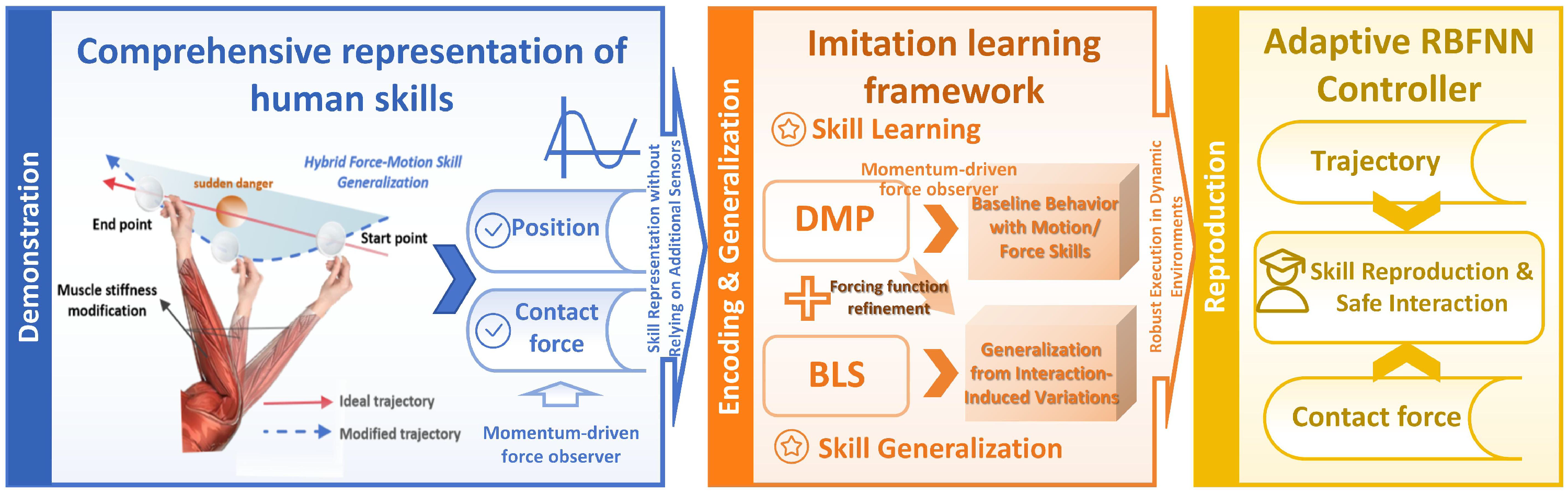
4. Overview of the Framework
5. Simulation and Physical Experiments
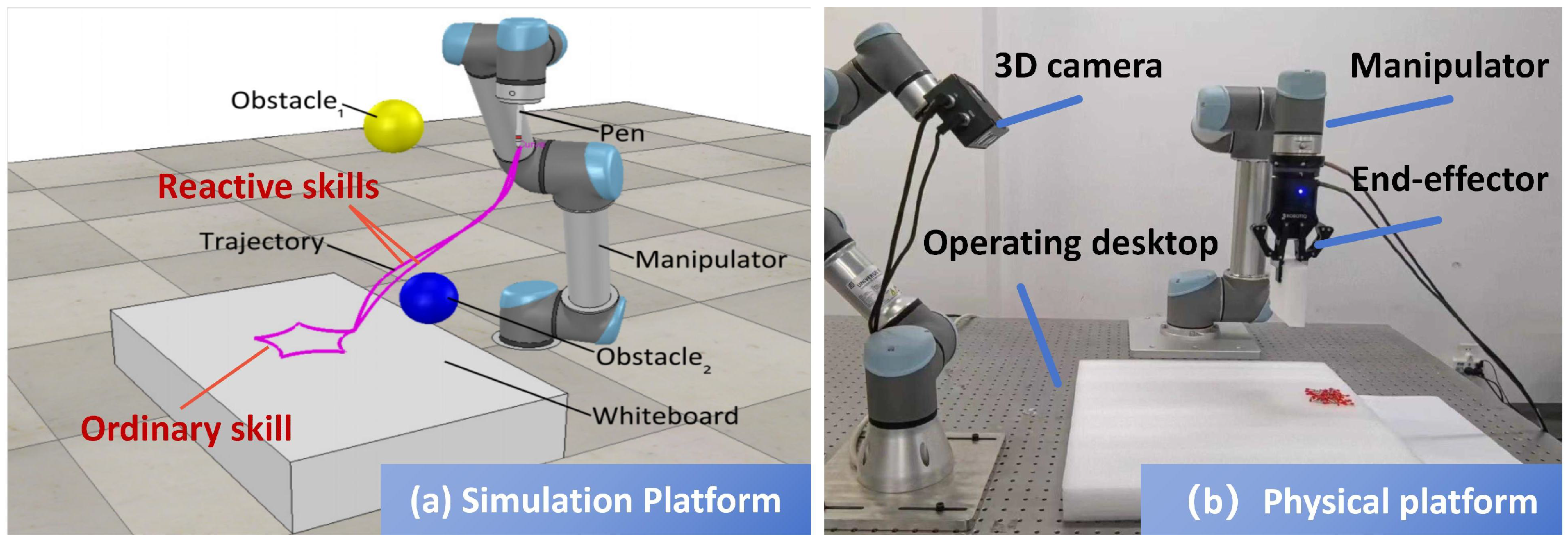
5.1. Simulation Setup
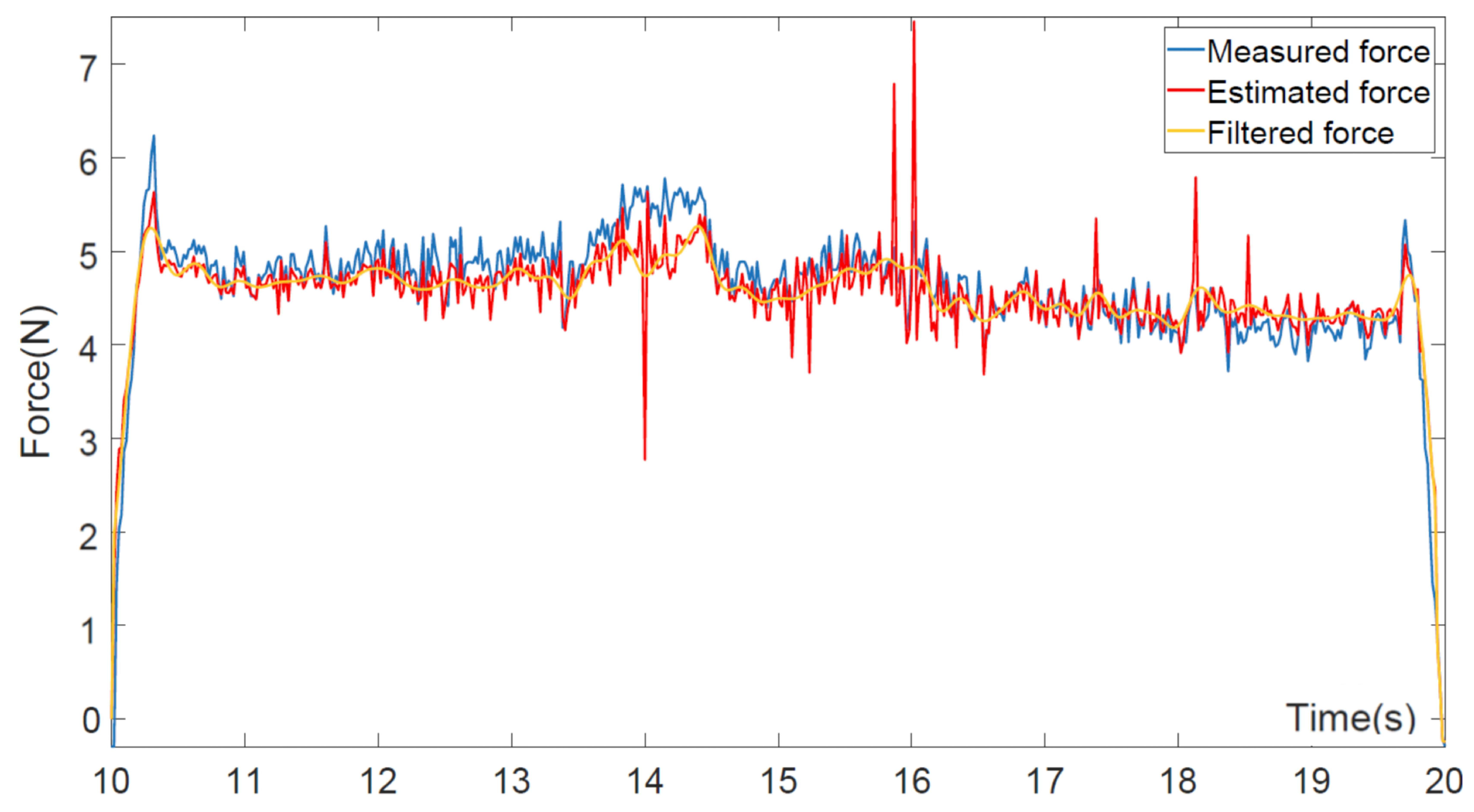
5.2. Verification of the Momentum-Driven Force Observer
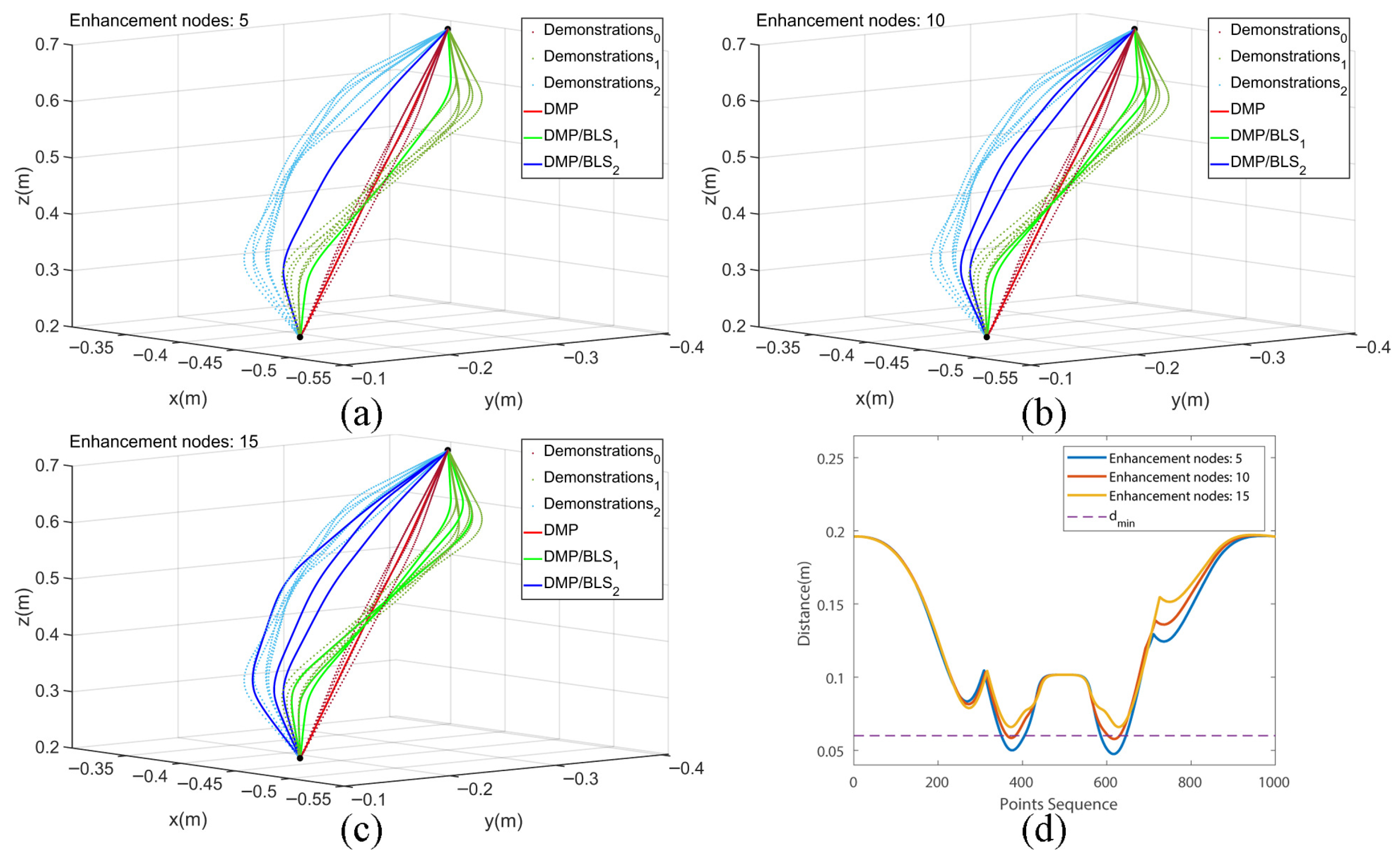
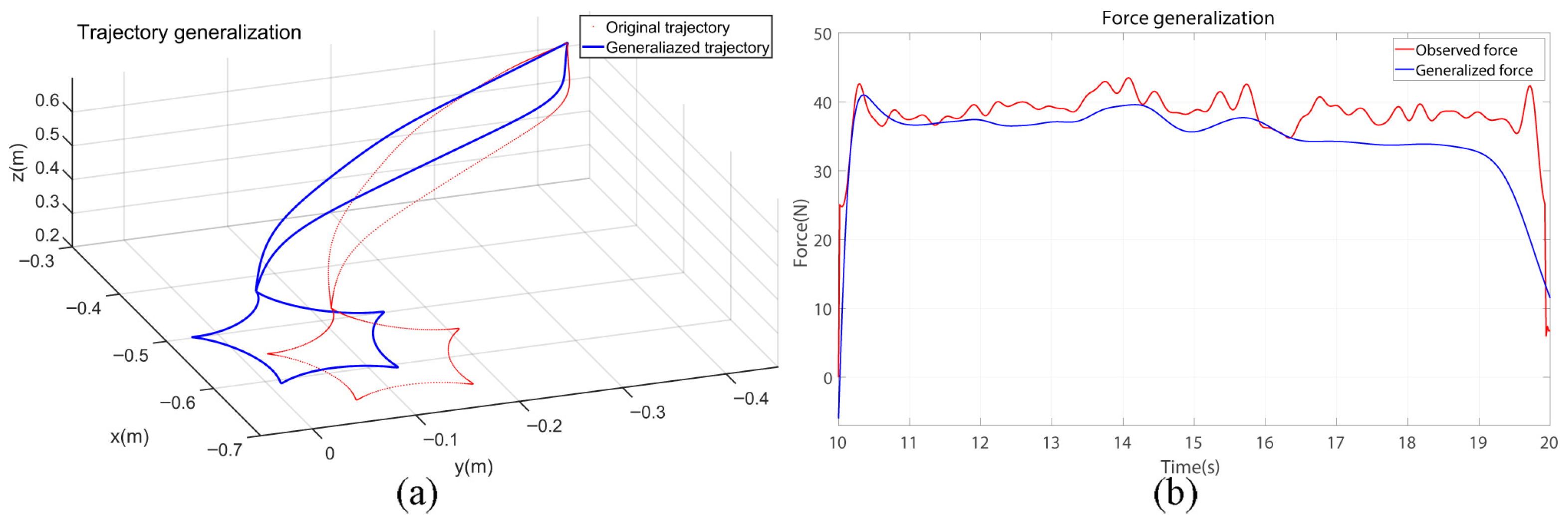
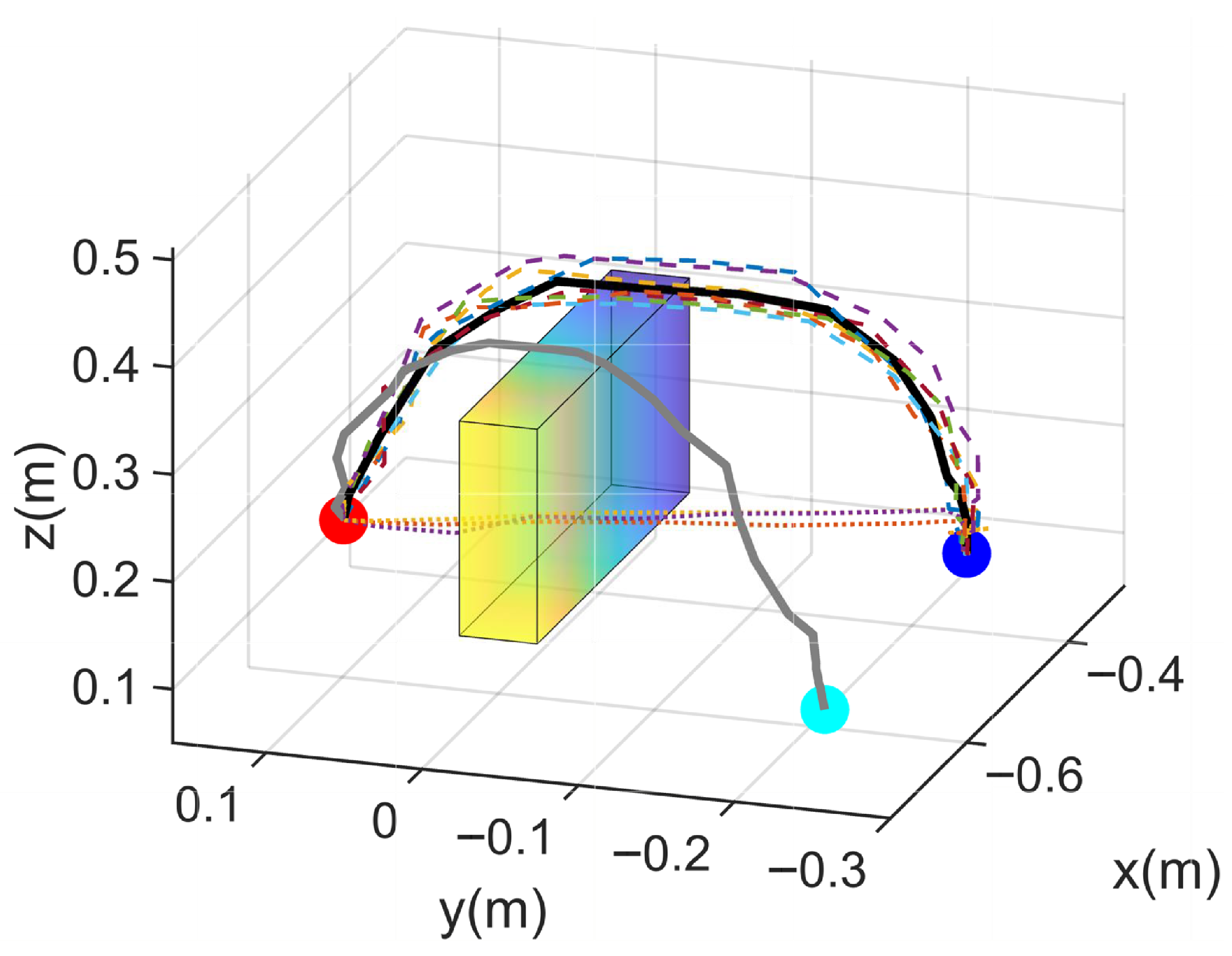
5.3. Verification of the Incremental Learning Framework
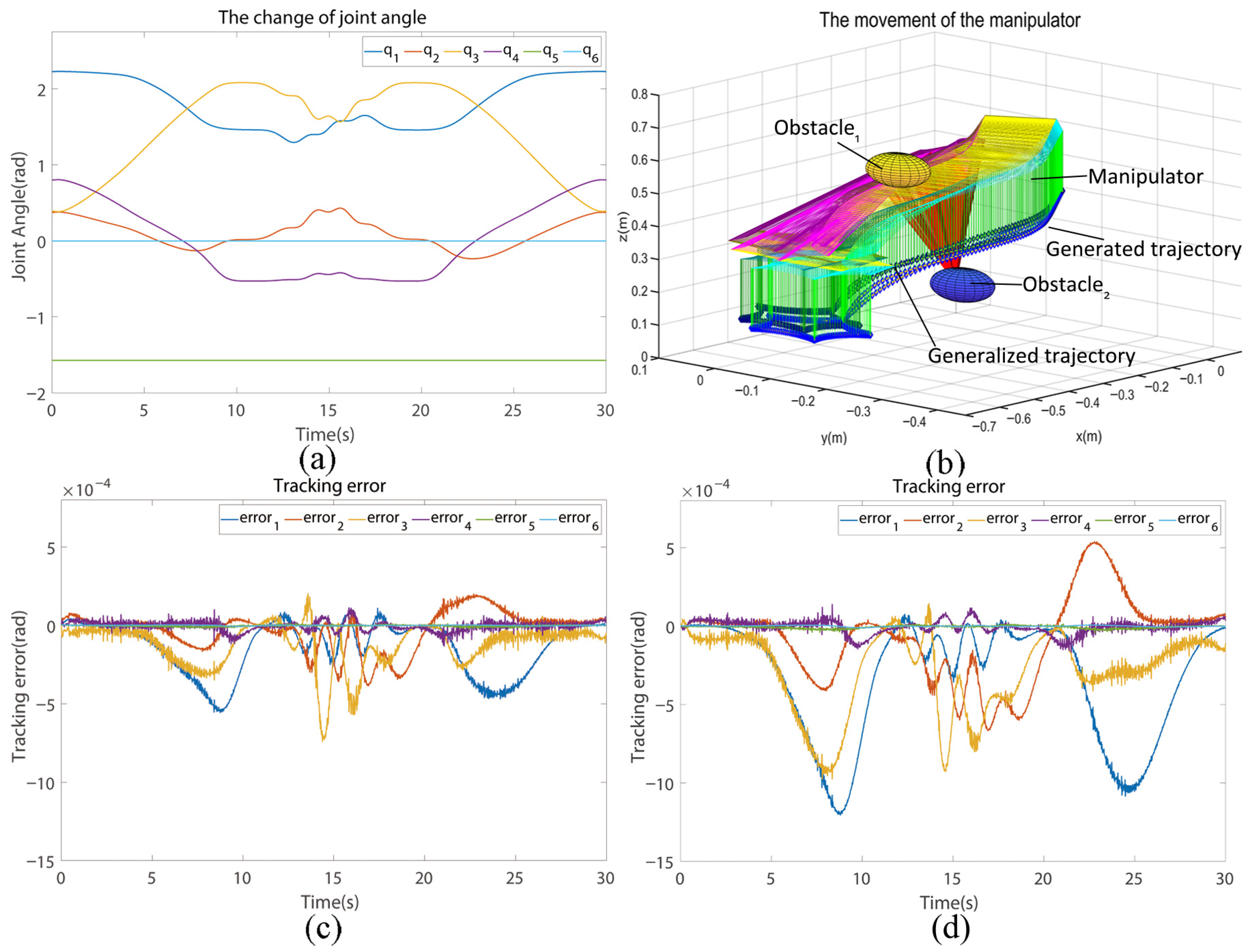
5.4. Verification of the Adaptive RBFNN Controller
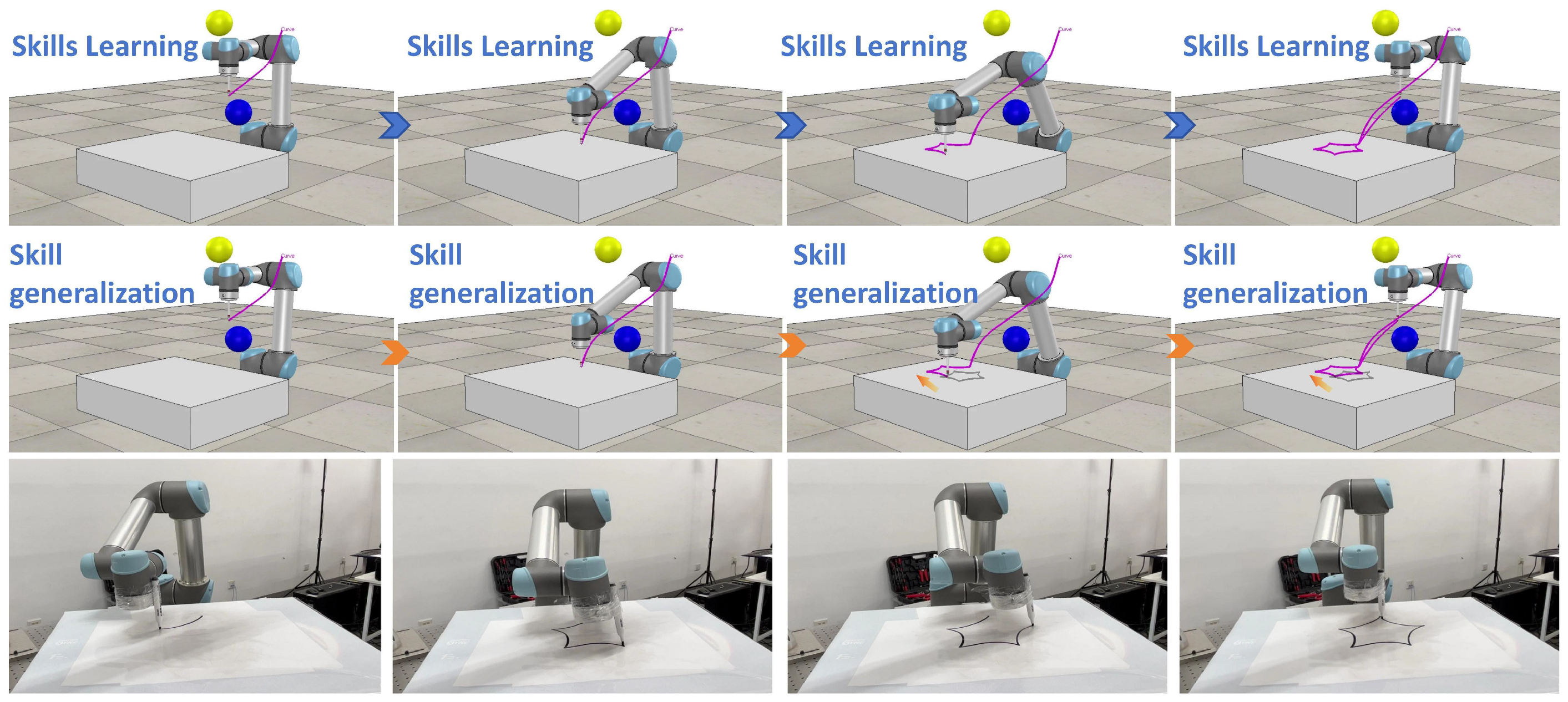
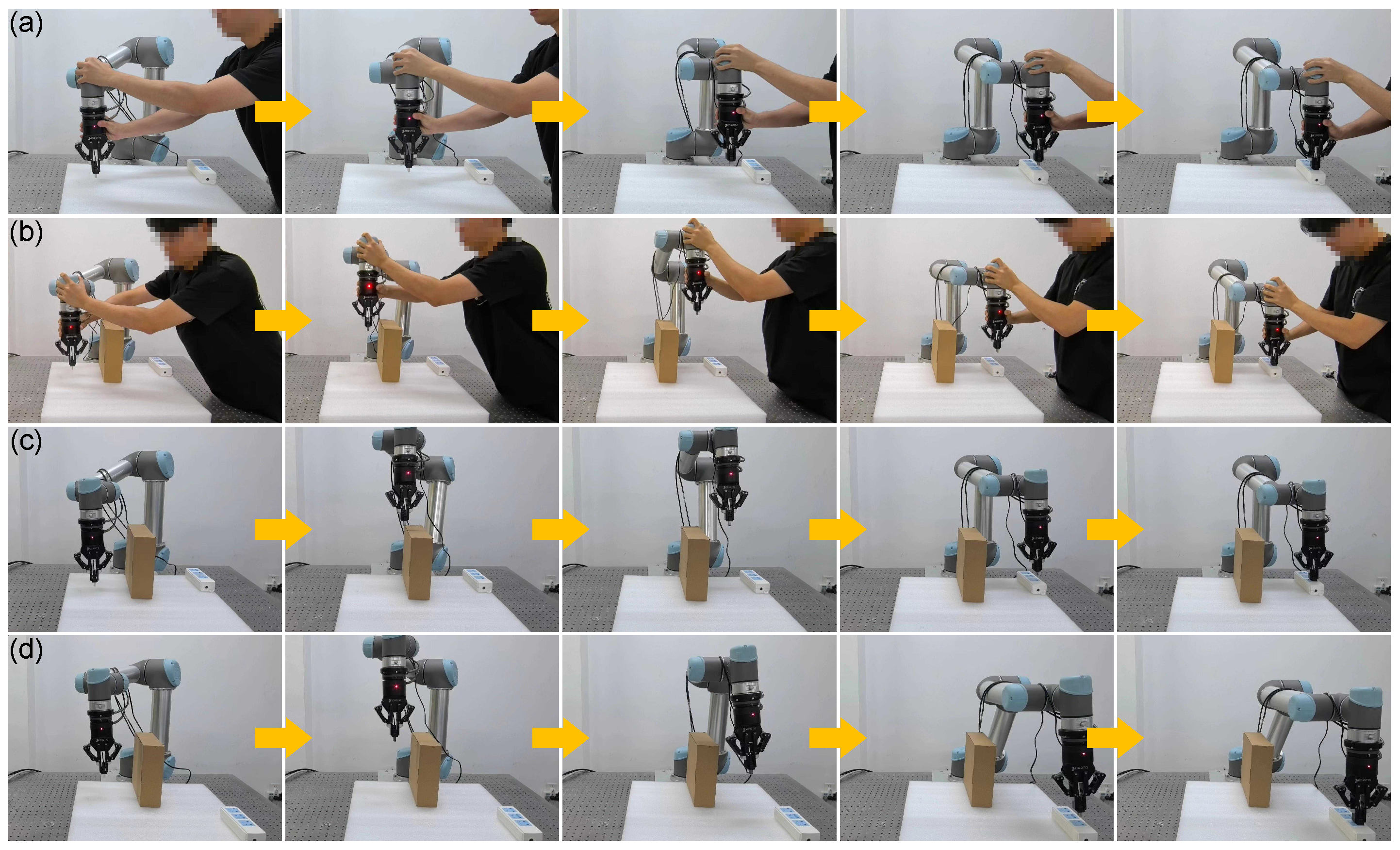
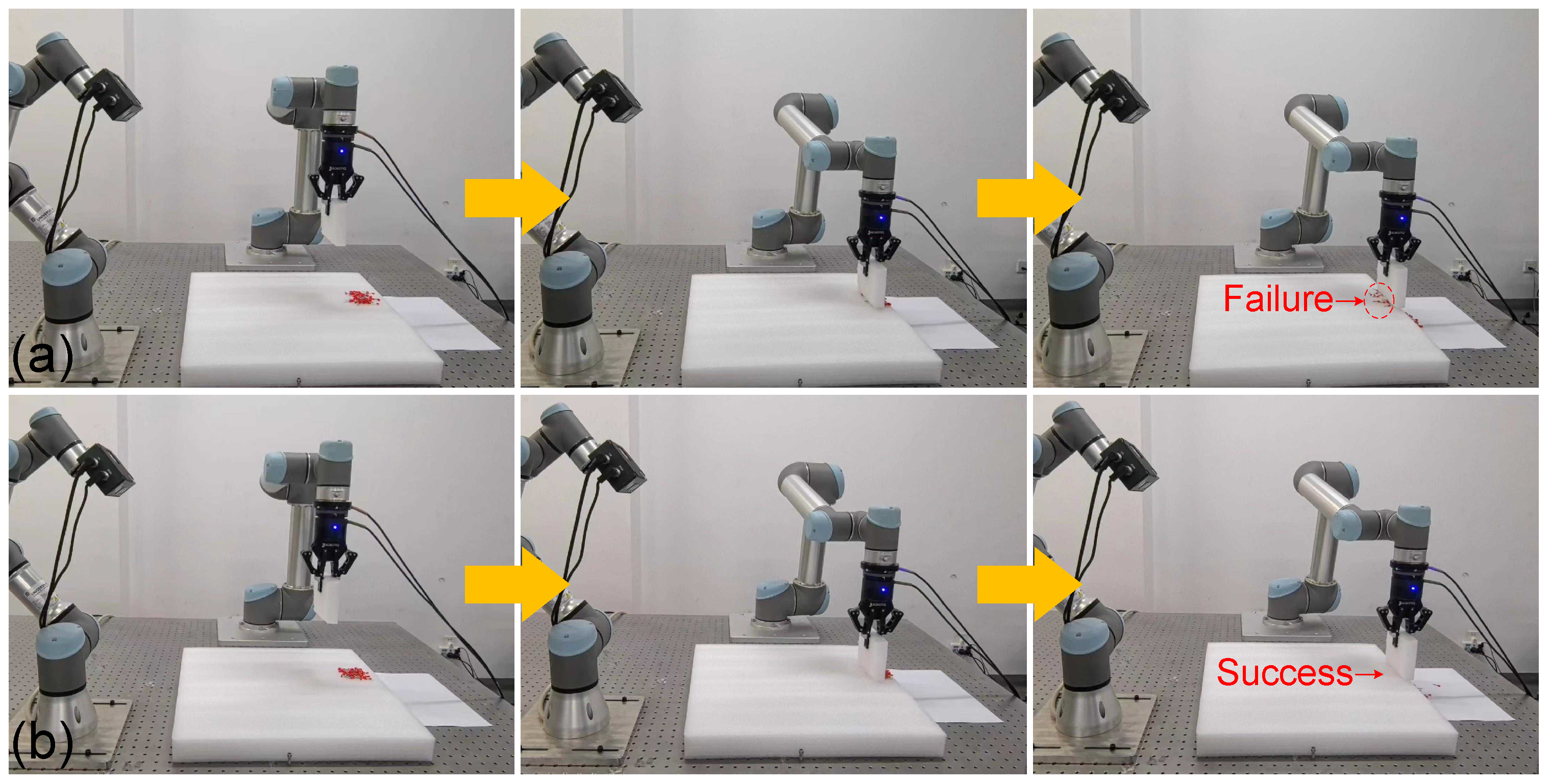
5.5. Implementation & Verification
6. Conclusions
Author Contributions
Funding
Institutional Review Board Statement
Data Availability Statement
Conflicts of Interest
References
- Liu, W.; Wang, J.; Wang, Y.; Wang, W.; Lu, C. ForceMimic: Force-centric imitation learning with force-motion capture system for contact-rich manipulation. In Proceedings of the 2025 IEEE International Conference on Robotics and Automation (ICRA), Atlanta, GA, USA, 19–23 May 2025. [Google Scholar]
- Ablett, T.; Limoyo, O.; Sigal, A.; Jilani, A.; Kelly, J.; Siddiqi, K.; Hogan, F.; Dudek, G. Multimodal and Force-Matched Imitation Learning With a See-Through Visuotactile Sensor. IEEE Trans. Robot. 2025, 41, 946–959. [Google Scholar] [CrossRef]
- Zare, M.; Kebria, P.M.; Khosravi, A.; Nahavandi, S. A survey of imitation learning: Algorithms, recent developments, and challenges. IEEE Trans. Cybern. 2024, 54, 7173–7186. [Google Scholar] [CrossRef]
- Liu, H.; Tong, Y.; Zhang, Z. Human observation-inspired universal image acquisition paradigm integrating multi-objective motion planning and control for robotics. IEEE/CAA J. Autom. Sin. 2024, 11, 2463–2475. [Google Scholar] [CrossRef]
- Ijspeert, A.J.; Nakanishi, J.; Hoffmann, H.; Pastor, P.; Schaal, S. Dynamical movement primitives: Learning attractor models for motor behaviors. Neural Comput. 2013, 25, 328–373. [Google Scholar] [CrossRef] [PubMed]
- Xue, W.; Lian, B.; Kartal, Y.; Fan, J.; Chai, T.; Lewis, F.L. Model-free inverse H-infinity control for imitation learning. IEEE Trans. Autom. Sci. Eng. 2024, 22, 5661–5672. [Google Scholar] [CrossRef]
- Liu, H.; Tong, Y.; Liu, G.; Ju, Z.; Zhang, Z. IDAGC: Adaptive Generalized Human-Robot Collaboration via Human Intent Estimation and Multimodal Policy Learning. In Proceedings of the 2025 IEEE/RSJ International Conference on Intelligent Robots and Systems (IROS), Hangzhou, China, 19–25 October 2025. [Google Scholar]
- Lu, Z.; Wang, N.; Yang, C. A dynamic movement primitives-based tool use skill learning and transfer framework for robot manipulation. IEEE Trans. Autom. Sci. Eng. 2024, 22, 1748–1763. [Google Scholar] [CrossRef]
- Lu, Z.; Wang, N.; Li, M.; Yang, C. Incremental Motor Skill Learning and Generalization From Human Dynamic Reactions Based on Dynamic Movement Primitives and Fuzzy Logic System. IEEE Trans. Fuzzy Syst. 2022, 30, 1506–1515. [Google Scholar] [CrossRef]
- Zhong, S.; Wu, W. Motion Learning and Generalization of Musculoskeletal Robot Using Gain Primitives. IEEE Trans. Autom. Sci. Eng. 2023, 21, 1580–1591. [Google Scholar] [CrossRef]
- Huang, H.H.; Zhang, T.; Yang, C.G.; Chen, C.L.P. Motor Learning and Generalization Using Broad Learning Adaptive Neural Control. IEEE Trans. Ind. Electron. 2020, 67, 8608–8617. [Google Scholar] [CrossRef]
- Pervez, A.; Lee, D. Learning task-parameterized dynamic movement primitives using mixture of GMMs. Intell. Serv. Robot. 2018, 11, 61–78. [Google Scholar] [CrossRef]
- Li, G.; Jin, Z.; Volpp, M.; Otto, F.; Lioutikov, R.; Neumann, G. ProDMP: A Unified Perspective on Dynamic and Probabilistic Movement Primitives. IEEE Robot. Autom. Lett. 2023, 8, 2325–2332. [Google Scholar] [CrossRef]
- Daab, T.; Jaquier, N.; Dreher, C.; Meixner, A.; Krebs, F.; Asfour, T. Incremental Learning of Full-Pose Via-Point Movement Primitives on Riemannian Manifolds. In Proceedings of the 2024 IEEE International Conference on Robotics and Automation (ICRA), Yokohama, Japan, 13–17 May 2024; pp. 2317–2323. [Google Scholar]
- Liu, Z.; Fang, Y. A Novel DMPs Framework for Robot Skill Generalizing With Obstacle Avoidance: Taking Volume and Orientation Into Consideration. IEEE/ASME Trans. Mechatronics 2025, 1–11. [Google Scholar] [CrossRef]
- Jiang, H.; He, J.; Duan, X. CDPMM-DMP: Conditional Dirichlet Process Mixture Model-Based Dynamic Movement Primitives. IEEE Trans. Autom. Sci. Eng. 2025, 22, 14201–14217. [Google Scholar] [CrossRef]
- Tong, Y.C.; Liu, H.T.; Zhang, Z.T. Advancements in humanoid robots: A comprehensive review and future prospects. IEEE/CAA J. Autom. Sin. 2024, 11, 301–328. [Google Scholar] [CrossRef]
- Nah, M.C.; Lachner, J.; Hogan, N. Robot control based on motor primitives: A comparison of two approaches. Int. J. Robot. Res. 2024, 43, 1959–1991. [Google Scholar] [CrossRef]
- Liu, H.; Tong, Y.; Zhang, Z. DTRT: Enhancing human intent estimation and role allocation for physical human-robot collaboration. In Proceedings of the 2025 IEEE International Conference on Robotics and Automation (ICRA), Atlanta, GA, USA, 19–23 May 2025; pp. 16312–16318. [Google Scholar] [CrossRef]
- Xia, W.; Liao, Z.; Lu, Z.; Yao, L. Bio-Signal-Guided Robot Adaptive Stiffness Learning via Human-Teleoperated Demonstrations. Biomimetics 2025, 10, 399. [Google Scholar] [CrossRef]
- Jian, X.; Song, Y.; Liu, D.; Wang, Y.; Guo, X.; Wu, B.; Zhang, N. Motion Planning and Control of Active Robot in Orthopedic Surgery by CDMP-Based Imitation Learning and Constrained Optimization. IEEE Trans. Autom. Sci. Eng. 2025, 22, 12197–12212. [Google Scholar] [CrossRef]
- Pupa, A.; Di Vittorio, F.; Secchi, C. A Novel Dynamic Motion Primitives Framework for Safe Human-Robot Collaboration. In Proceedings of the 2025 IEEE International Conference on Robotics and Automation (ICRA), Atlanta, GA, USA, 19–23 May 2025; pp. 16326–16332. [Google Scholar] [CrossRef]
- Wu, H.; Zhai, D.H.; Xia, Y. Probabilized Dynamic Movement Primitives and Model Predictive Planning for Enhanced Trajectory Imitation Learning. IEEE Trans. Ind. Electron. 2025, 72, 620–628. [Google Scholar] [CrossRef]
- Chen, Z.; Fan, K. An online trajectory guidance framework via imitation learning and interactive feedback in robot-assisted surgery. Neural Netw. 2025, 185, 107197. [Google Scholar] [CrossRef]
- Wang, W.; Zeng, C.; Zhan, H.; Yang, C. A Novel Robust Imitation Learning Framework for Complex Skills With Limited Demonstrations. IEEE Trans. Autom. Sci. Eng. 2025, 22, 3947–3959. [Google Scholar] [CrossRef]
- Liao, Z.; Tassi, F.; Gong, C.; Leonori, M.; Zhao, F.; Jiang, G.; Ajoudani, A. Simultaneously Learning of Motion, Stiffness, and Force From Human Demonstration Based on Riemannian DMP and QP Optimization. IEEE Trans. Autom. Sci. Eng. 2025, 22, 7773–7785. [Google Scholar] [CrossRef]
- Yang, C.G.; Peng, G.Z.; Cheng, L.; Na, J.; Li, Z.J. Force Sensorless Admittance Control for Teleoperation of Uncertain Robot Manipulator Using Neural Networks. IEEE Trans. Syst. Man Cybern. Syst. 2021, 51, 3282–3292. [Google Scholar] [CrossRef]
- Lyu, C.; Guo, S.; Yan, Y.; Zhang, Y.; Zhang, Y.; Yang, P.; Liu, J. Deep-Learning-Based Force Sensing Method for a Flexible Endovascular Surgery Robot. IEEE Trans. Instrum. Meas. 2024, 73, 1–10. [Google Scholar] [CrossRef]
- Heng, S.; Zang, X.; Liu, Y.; Song, C.; Chen, B.; Zhang, Y.; Zhu, Y.; Zhao, J. A Robust Disturbance Rejection Whole-Body Control Framework for Bipedal Robots Using a Momentum-Based Observer. Biomimetics 2025, 10, 189. [Google Scholar] [CrossRef]
- Prigozin, A.; Degani, A. Interacting with Obstacles Using a Bio-Inspired, Flexible, Underactuated Multilink Manipulator. Biomimetics 2024, 9, 86. [Google Scholar] [CrossRef]
- Liu, H.; Zhang, Z.; Tong, Y.; Ju, Z. Multistep Intent Estimation Guided Adaptive Passive Control for Safety-Aware Physical Human–Robot Collaboration. IEEE Trans. Cybern. 2025, 1–13. [Google Scholar] [CrossRef]
- Liu, Z.; Liu, J.; Zhang, O.; Zhao, Y.; Chen, W.; Gao, Y. Adaptive Disturbance Observer-Based Fixed-Time Tracking Control for Uncertain Robotic Systems. IEEE Trans. Ind. Electron. 2024, 71, 14823–14831. [Google Scholar] [CrossRef]
- Tong, Y.; Liu, H.; Yang, T.; Zhang, Z. A game theory perspective for multi-manipulators with unknown kinematics. IEEE Trans. Cogn. Dev. Syst. 2025, 1–18. [Google Scholar] [CrossRef]
- Yang, Y.; Li, Z.; Shi, P.; Li, G. Fuzzy-Based Control for Multiple Tasks With Human–Robot Interaction. IEEE Trans. Fuzzy Syst. 2024, 32, 5802–5814. [Google Scholar] [CrossRef]
- Liu, Q.; Li, D.; Ge, S.S.; Ji, R.; Ouyang, Z.; Tee, K.P. Adaptive bias RBF neural network control for a robotic manipulator. Neurocomputing 2021, 447, 213–223. [Google Scholar] [CrossRef]
- Li, L.J.; Chang, X.; Chao, F.; Lin, C.M.; Huỳnh, T.T.; Yang, L.; Shang, C.; Shen, Q. Self-Organizing Type-2 Fuzzy Double Loop Recurrent Neural Network for Uncertain Nonlinear System Control. IEEE Trans. Neural Netw. Learn. Syst. 2025, 36, 6451–6465. [Google Scholar] [CrossRef]
- Luo, X.; Li, Z.; Yue, W.; Li, S. A Calibrator Fuzzy Ensemble for Highly-Accurate Robot Arm Calibration. IEEE Trans. Neural Netw. Learn. Syst. 2025, 36, 2169–2181. [Google Scholar] [CrossRef]
- Xu, S.; Wu, Z. Adaptive learning control of robot manipulators via incremental hybrid neural network. Neurocomputing 2024, 568, 127045. [Google Scholar] [CrossRef]
- Liu, H.; Tong, Y.; Zhang, Z. Human-inspired adaptive optimal control framework for robot-environment interaction. IEEE Trans. Syst. Man Cybern. Syst. 2025, 55, 6085–6098. [Google Scholar] [CrossRef]
- Peng, G.; Li, T.; Guo, Y.; Liu, C.; Yang, C.; Chen, C.L.P. Force Observer-Based Motion Adaptation and Adaptive Neural Control for Robots in Contact With Unknown Environments. IEEE Trans. Cybern. 2025, 55, 2138–2150. [Google Scholar] [CrossRef]
- Xu, J.; Xu, L.; Ji, A.; Li, Y.; Cao, K. A DMP-Based Motion Generation Scheme for Robotic Mirror Therapy. IEEE-ASME Trans. Mechatronics 2023, 28, 3120–3131. [Google Scholar] [CrossRef]
- Wang, N.; Chen, C.; Di Nuovo, A. A Framework of Hybrid Force/Motion Skills Learning for Robots. IEEE Trans. Cogn. Dev. Syst. 2021, 13, 162–170. [Google Scholar] [CrossRef]
- Chen, C.L.P.; Liu, Z. Broad Learning System: An Effective and Efficient Incremental Learning System Without the Need for Deep Architecture. IEEE Trans. Neural Netw. Learn. Syst. 2018, 29, 10–24. [Google Scholar] [CrossRef]
- Kulic, D.; Ott, C.; Lee, D.H.; Ishikawa, J.; Nakamura, Y. Incremental learning of full body motion primitives and their sequencing through human motion observation. Int. J. Robot. Res. 2012, 31, 330–345. [Google Scholar] [CrossRef]
- Ge, S.S.; Wang, C. Adaptive neural control of uncertain MIMO nonlinear systems. IEEE Trans. Neural Netw. 2004, 15, 674–692. [Google Scholar] [CrossRef] [PubMed]
- He, W.; Ge, S.S.; Li, Y.; Chew, E.; Ng, Y.S. Neural Network Control of a Rehabilitation Robot by State and Output Feedback. J. Intell. Robot. Syst. 2015, 80, 15–31. [Google Scholar] [CrossRef]

Disclaimer/Publisher’s Note: The statements, opinions and data contained in all publications are solely those of the individual author(s) and contributor(s) and not of MDPI and/or the editor(s). MDPI and/or the editor(s) disclaim responsibility for any injury to people or property resulting from any ideas, methods, instructions or products referred to in the content. |
© 2025 by the authors. Licensee MDPI, Basel, Switzerland. This article is an open access article distributed under the terms and conditions of the Creative Commons Attribution (CC BY) license (https://creativecommons.org/licenses/by/4.0/).
Share and Cite
Tong, Y.; Liu, H.; Yang, T.; Zhang, Z. Human-Inspired Force–Motion Imitation Learning with Dynamic Response for Adaptive Robotic Manipulation. Biomimetics 2025, 10, 825. https://doi.org/10.3390/biomimetics10120825
Tong Y, Liu H, Yang T, Zhang Z. Human-Inspired Force–Motion Imitation Learning with Dynamic Response for Adaptive Robotic Manipulation. Biomimetics. 2025; 10(12):825. https://doi.org/10.3390/biomimetics10120825
Chicago/Turabian StyleTong, Yuchuang, Haotian Liu, Tianbo Yang, and Zhengtao Zhang. 2025. "Human-Inspired Force–Motion Imitation Learning with Dynamic Response for Adaptive Robotic Manipulation" Biomimetics 10, no. 12: 825. https://doi.org/10.3390/biomimetics10120825
APA StyleTong, Y., Liu, H., Yang, T., & Zhang, Z. (2025). Human-Inspired Force–Motion Imitation Learning with Dynamic Response for Adaptive Robotic Manipulation. Biomimetics, 10(12), 825. https://doi.org/10.3390/biomimetics10120825

