

Race, Disability and Abolition in Stephen King’s The Green Mile

 ,
,  ,
,
Abstract
1. Introduction
2. Literature Review and Theoretical Framework
2.1. The Magical Negro and Christological Sacrifice
2.2. Disability, Innocence and Juridical Vulnerability
2.3. Sound, Affect and Abolitionist Counter-Publics
3. Methodology
3.1. Research Design and Ethical Protocol
3.2. Audience Ethnography
3.3. Social Media Corpus Analysis
3.4. Parallel Corpus Translation Study
3.5. Critical Race Sound Analysis
3.6. Reflexivity and Ethics Audit
3.7. Data Integration and Trustworthiness
4. Results
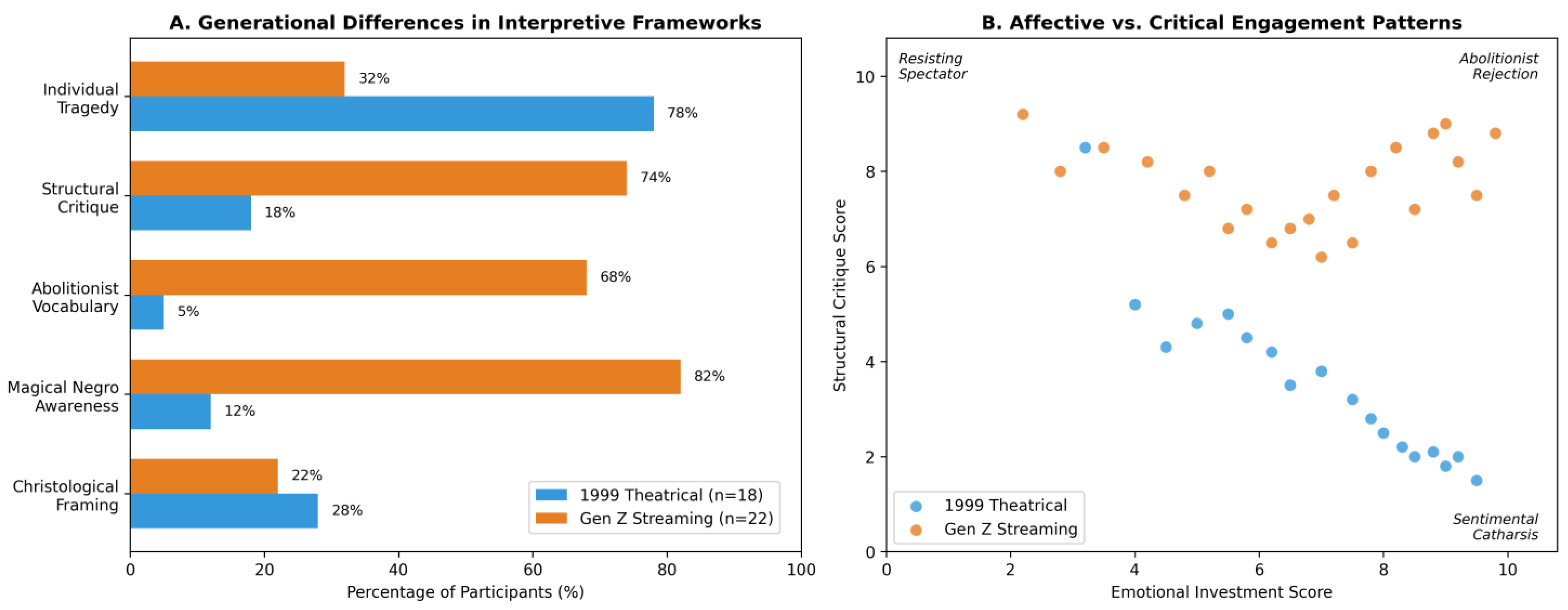
4.1. Generational Divergence in Abolitionist Literacy
4.2. Digital Corpus: Bifurcated Affect and Abolitionist Hashtag Networks
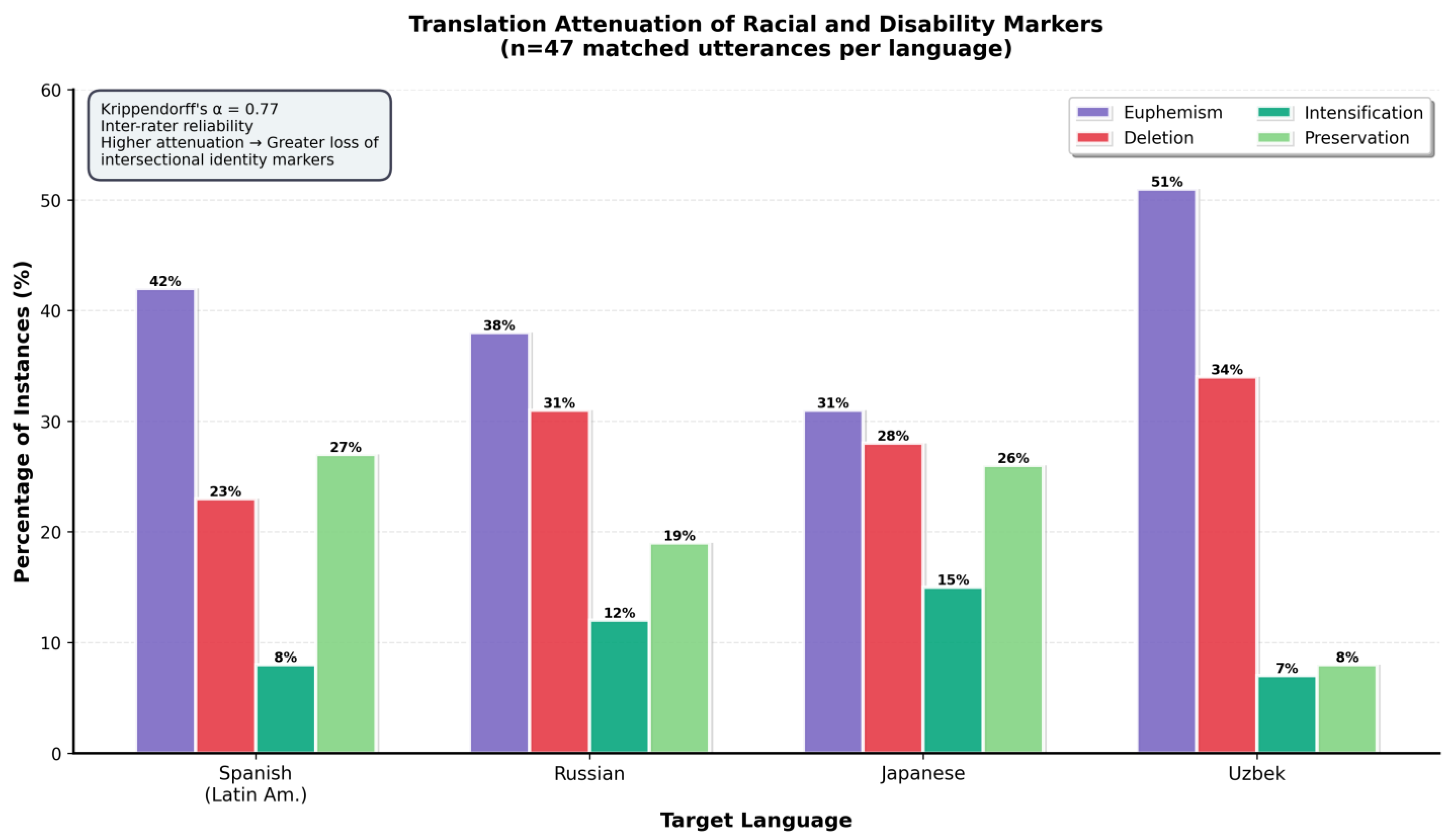
4.3. Translation Attenuation: Linguistic Deterritorialization of Intersectional Identity
4.4. Psychoacoustic Architecture: Embodied Transcendence
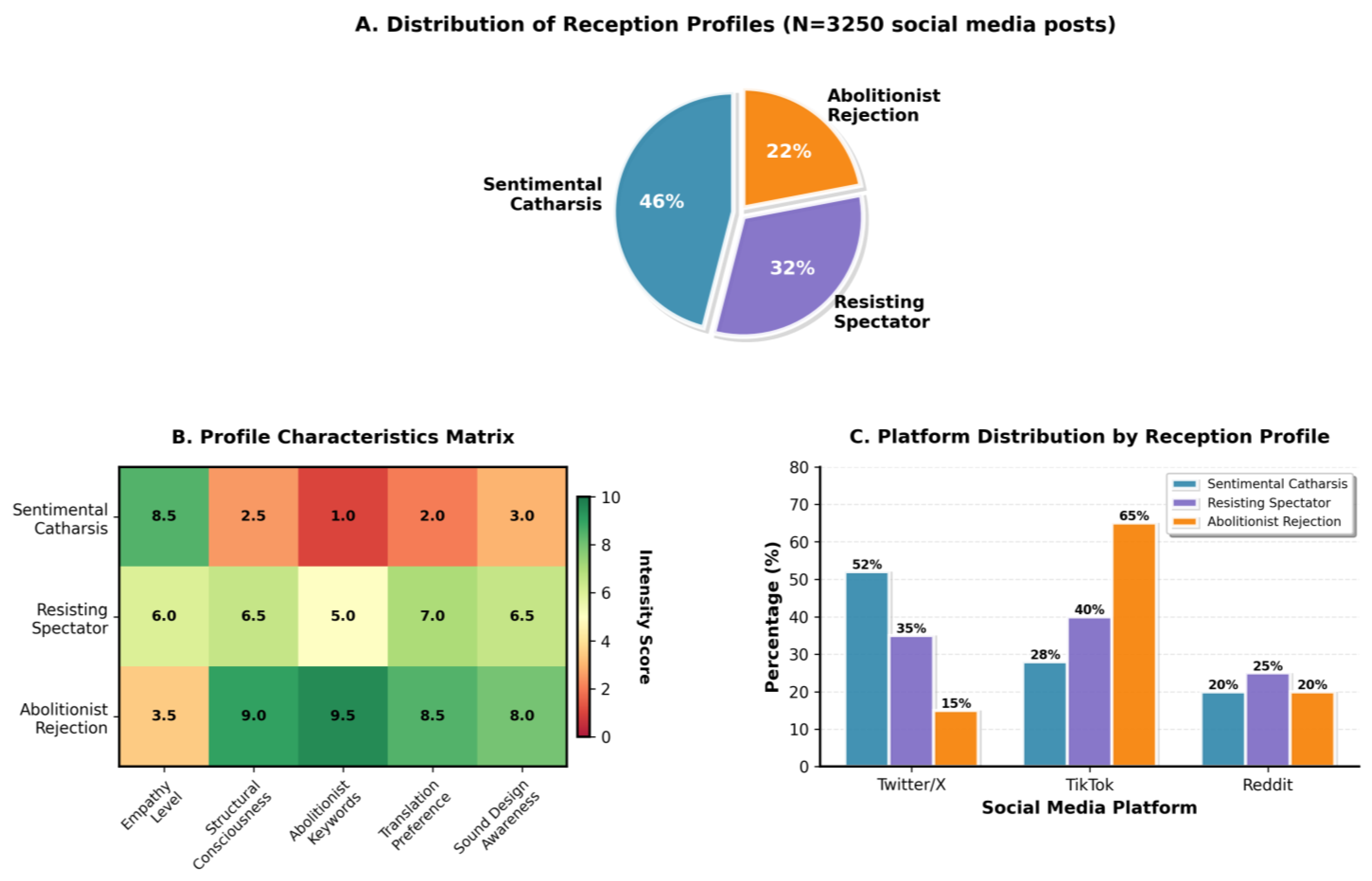
4.5. Integrated Reception Profiles: From Catharsis to Rejection
5. Discussion
5.1. Platform Paratexts and Counter-Mobilization
5.2. Sonic Manipulation and Transformative Pedagogy
5.3. Reconfiguring Affective Circuits
6. Conclusions
Author Contributions
Funding
Institutional Review Board Statement
Informed Consent Statement
Data Availability Statement
Conflicts of Interest
References
- Atika, Nellu, and Rezky Khoirina Tarihoran. 2022. An analysis of racism in the film of The Green Mile by Frank Darabont. PHILOLOGY Journal of English Language and Literature 2: 70–76. [Google Scholar] [CrossRef]
- Bacon, Helena. 2021. Roll on two: Ambiguous energies in Stephen King’s The Shining, The Green Mile and Revival. Horror Studies 12: 205–20. [Google Scholar] [CrossRef]
- Bath, Eraka P., and Stephen Bates Billick. 2001. Race and spiritualism: Facing death row—A movie review of The Green Mile. The Journal of the American Academy of Psychiatry and the Law 29: 96–99. [Google Scholar] [PubMed]
- Bărbuleţ, Gabriel-Dan. 2024. Conversational implicatures in magic realism movies—The Green Mile. Incursions Into The Imaginary 15: 138–61. [Google Scholar] [CrossRef]
- Bennett, Katherine J., and Thomas W. Satre. 2000. Movie review. The Prison Journal 80: 228–32. [Google Scholar] [CrossRef]
- Burger, Alissa. 2016. Serial Publishing and The Green Mile. In Teaching Stephen King. London: Palgrave Macmillan, pp. 121–35. [Google Scholar] [CrossRef]
- Darabont, Frank, and Stephen King. 1999. The Green Mile: Screenplay. New York: Warner Bros. [Google Scholar]
- Delcnjak, Jaka. 2018. The Passion of John Coffey: Christian Symbols and Racial Elements in The Green Mile. Master’s thesis, University of Zagreb, Zagreb, Croatia. [Google Scholar]
- Fayzulloyev, Otabek, Ulugbek Ochilov, Zaynab Kadirova, Muzaffar Rakhimov, Akmal Djumayev, and Zulfiya Abulova. 2025. Ritual, memory and identity: Postcolonial readings of Bukhara and Khorezm’s cultural continuity. Journal of Cultural Analysis and Social Change 10: 2130–46. [Google Scholar] [CrossRef]
- Findley, Mary. 2008. The prisoner, the pen and the number one fan. In The Stephen King Companion. London: Palgrave Macmillan, pp. 91–100. [Google Scholar] [CrossRef]
- Goodhead, Dokubo Melford. 2021. The resisting spectator and The Green Mile. Howard Journal of Communications 33: 45–57. [Google Scholar] [CrossRef]
- King, Stephen. 1996. The Green Mile: The Complete Serial Novel. Oxfordshire: Signet. [Google Scholar]
- Magistrale, Tony. 2003. Defining heroic codes of survival: The Dead Zone, The Shawshank Redemption, The Green Mile. In Hollywood’s Stephen King. London: Palgrave Macmillan, pp. 75–92. [Google Scholar] [CrossRef]
- Ochilov, Ulugbek. 2025a. From sacred city to managed heritage: Cultural continuity and social transformation in Bukhara, Uzbekistan. Journal of Cultural Analysis and Social Change 10: 152–67. [Google Scholar] [CrossRef]
- Ochilov, Ulugbek. 2025b. Magic at the crossroads: Moral dissonance and repair in the Wizarding World. Humanities 14: 148. [Google Scholar] [CrossRef]
- Owen, A. Susan, and Peter Ehrenhaus. 2010. Communities of memory, entanglements and claims of the past on the present: Reading race trauma through The Green Mile. Critical Studies in Media Communication 27: 131–54. [Google Scholar] [CrossRef]
- Rodríguez, Lidia, and Gabriela S. Alanís Uresti. 2015. La atenuación en el doblaje y la subtitulación de The Green Mile. Textos en Proceso 1: 97–124. [Google Scholar] [CrossRef]
- Russell, Sharon A. 2002. Revisiting Stephen King: A Critical Companion. Westport: Greenwood Press. [Google Scholar]
- Sapargalieva, A. M., and G. I. Kuldeeva. 2020. Translation of metaphors from English into Russian (based on Stephen King’s novel “The Green Mile”). Bulletin of L.N. Gumilyov Eurasian National University Philology Series 133: 103–13. [Google Scholar] [CrossRef]
- Suharto, Beni, and Phil Dewi Candraningrum. 2019. Humanism Reflected in Stephen King’s The Green Mile Novel (1996): A Sociological Approach. Undergraduate thesis, Universitas Muhammadiyah Surakarta, Surakarta, Indonesia. [Google Scholar]
- Symonová, Veronica. 2014. The Green Mile—The Comparison of the Book with Its Film Adaptation. Bachelor’s thesis, Masaryk University, Brno, Czechia. [Google Scholar]
Disclaimer/Publisher’s Note: The statements, opinions and data contained in all publications are solely those of the individual author(s) and contributor(s) and not of MDPI and/or the editor(s). MDPI and/or the editor(s) disclaim responsibility for any injury to people or property resulting from any ideas, methods, instructions or products referred to in the content. |
© 2026 by the authors. Licensee MDPI, Basel, Switzerland. This article is an open access article distributed under the terms and conditions of the Creative Commons Attribution (CC BY) license.
Share and Cite
Ochilov, U.; Ochilova, M.; Shoyimkulova, M.; Akhmadov, M.; Asadov, A.; Adambaeva, F.; Ahrorov, B.; Amonova, M.; Salimova, H.; Kakhkhorova, G. Race, Disability and Abolition in Stephen King’s The Green Mile. Genealogy 2026, 10, 2. https://doi.org/10.3390/genealogy10010002
Ochilov U, Ochilova M, Shoyimkulova M, Akhmadov M, Asadov A, Adambaeva F, Ahrorov B, Amonova M, Salimova H, Kakhkhorova G. Race, Disability and Abolition in Stephen King’s The Green Mile. Genealogy. 2026; 10(1):2. https://doi.org/10.3390/genealogy10010002
Chicago/Turabian StyleOchilov, Ulugbek, Mehriniso Ochilova, Makhzuna Shoyimkulova, Mirzobek Akhmadov, Alisher Asadov, Feruza Adambaeva, Botir Ahrorov, Munavvar Amonova, Hulkar Salimova, and Gulrukh Kakhkhorova. 2026. "Race, Disability and Abolition in Stephen King’s The Green Mile" Genealogy 10, no. 1: 2. https://doi.org/10.3390/genealogy10010002
APA StyleOchilov, U., Ochilova, M., Shoyimkulova, M., Akhmadov, M., Asadov, A., Adambaeva, F., Ahrorov, B., Amonova, M., Salimova, H., & Kakhkhorova, G. (2026). Race, Disability and Abolition in Stephen King’s The Green Mile. Genealogy, 10(1), 2. https://doi.org/10.3390/genealogy10010002

