


Risk Prevention and Safety Management in the Mount Olympus Area: Challenges and Optimal Strategies for Safe Tourism Development

 ,
,  ,
,  and
and
Abstract
1. Introduction
1.1. Research Questions and Analytical Propositions
1.1.1. Research Purpose
- To identify and categorize the main types of risks faced by visitors and professionals on Mount Olympus and to situate these risks in a comparative European mountain context.
- To analyze and evaluate existing safety management and risk prevention practices on Mount Olympus in relation to international standards and governance models.
- To assess the potential for improving current infrastructures and institutional arrangements through the selective adaptation of safety management frameworks applied in other mountain regions, such as the Alps, Pyrenees, and Carpathians.
- To examine the feasibility of transferring international best practices and technological innovations to the Greek context, taking into account local environmental, institutional, and socio-cultural constraints.
- To contribute to the development of an integrated safety management framework that combines prevention, preparedness, and education in support of sustainable mountain tourism.
1.1.2. Research Questions
- RQ1.
- What types of natural, human-induced, and organizational risks are encountered by visitors and professionals on Mount Olympus, and how do these risks compare with those documented in other European mountain regions?
- RQ2.
- How are safety management and risk prevention currently organized and implemented on Mount Olympus, and to what extent do these practices align with international standards and models?
- RQ3.
- What structural, institutional, and operational gaps can be identified in the existing safety management system on Mount Olympus?
- RQ4.
- Which elements of international safety management and risk prevention frameworks are perceived by stakeholders as transferable and relevant to the Mount Olympus context?
1.1.3. Analytical Propositions
- AP1.
- The risk profile of Mount Olympus reflects a distinctive combination of high natural hazard exposure, seasonal overcrowding, and infrastructural limitations, differentiating it from other European mountain regions.
- AP2.
- Existing safety management and risk prevention practices on Mount Olympus exhibit partial misalignment with international standards, primarily due to fragmented institutional coordination and limited systematic communication among stakeholders.
- AP3.
- The selective adaptation of international safety management components—such as permanent rescue capacity, interoperable communication systems, and real-time risk information platforms—has the potential to significantly enhance functional coordination and overall safety performance on Mount Olympus.
- AP4.
- International best practices and technological innovations can be effectively adapted to the Greek context when implementation strategies are tailored to local environmental conditions, governance structures, and social acceptability constraints.
2. Literature Review
2.1. Risk in Mountain Tourism
2.2. Core Concepts in Safety Management, Risk Prevention, and Best Practice
2.3. Mount Olympus
2.4. Cross-Cutting Themes, Gaps, and Relevance to Olympus
3. Materials and Methods
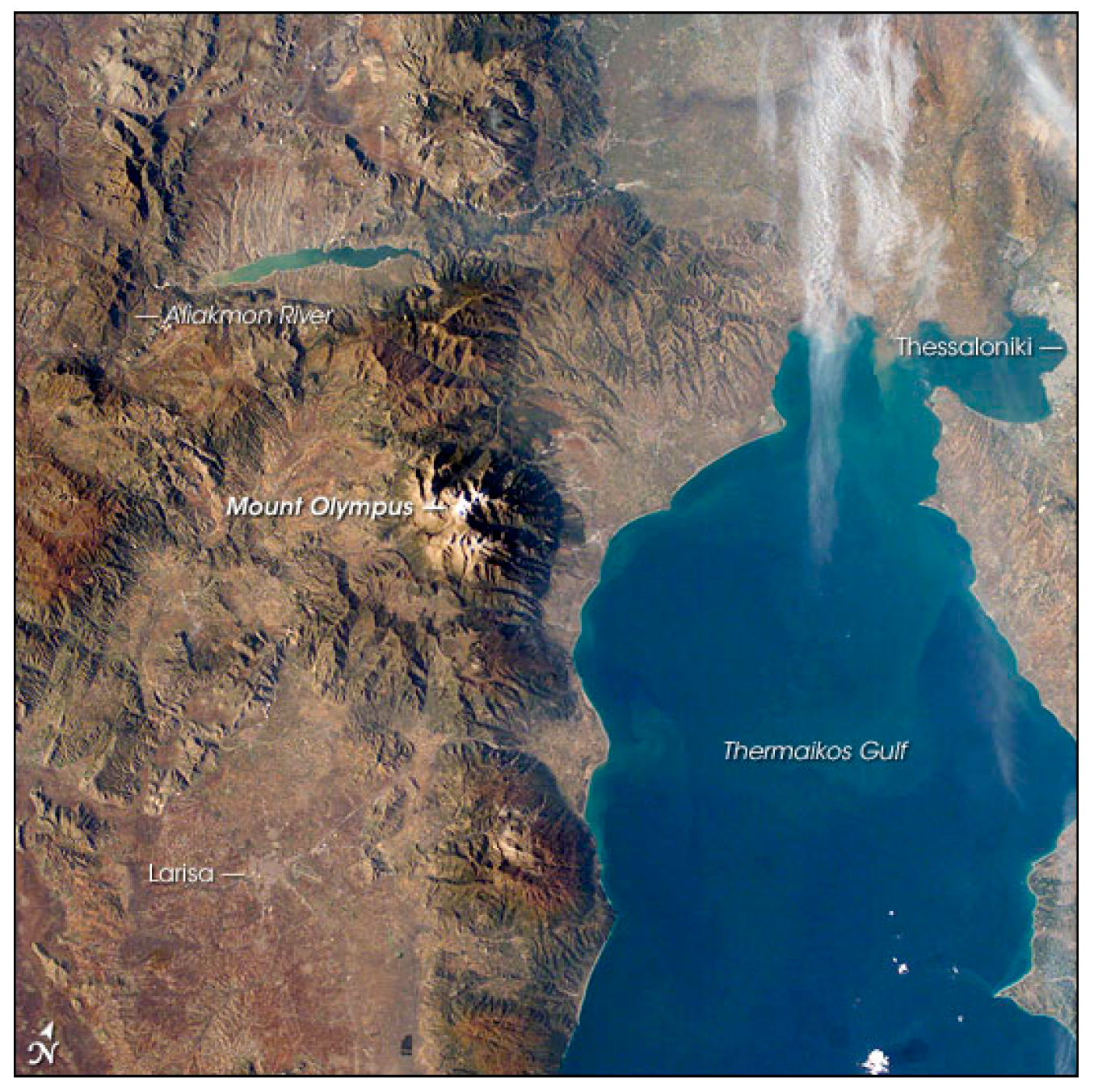
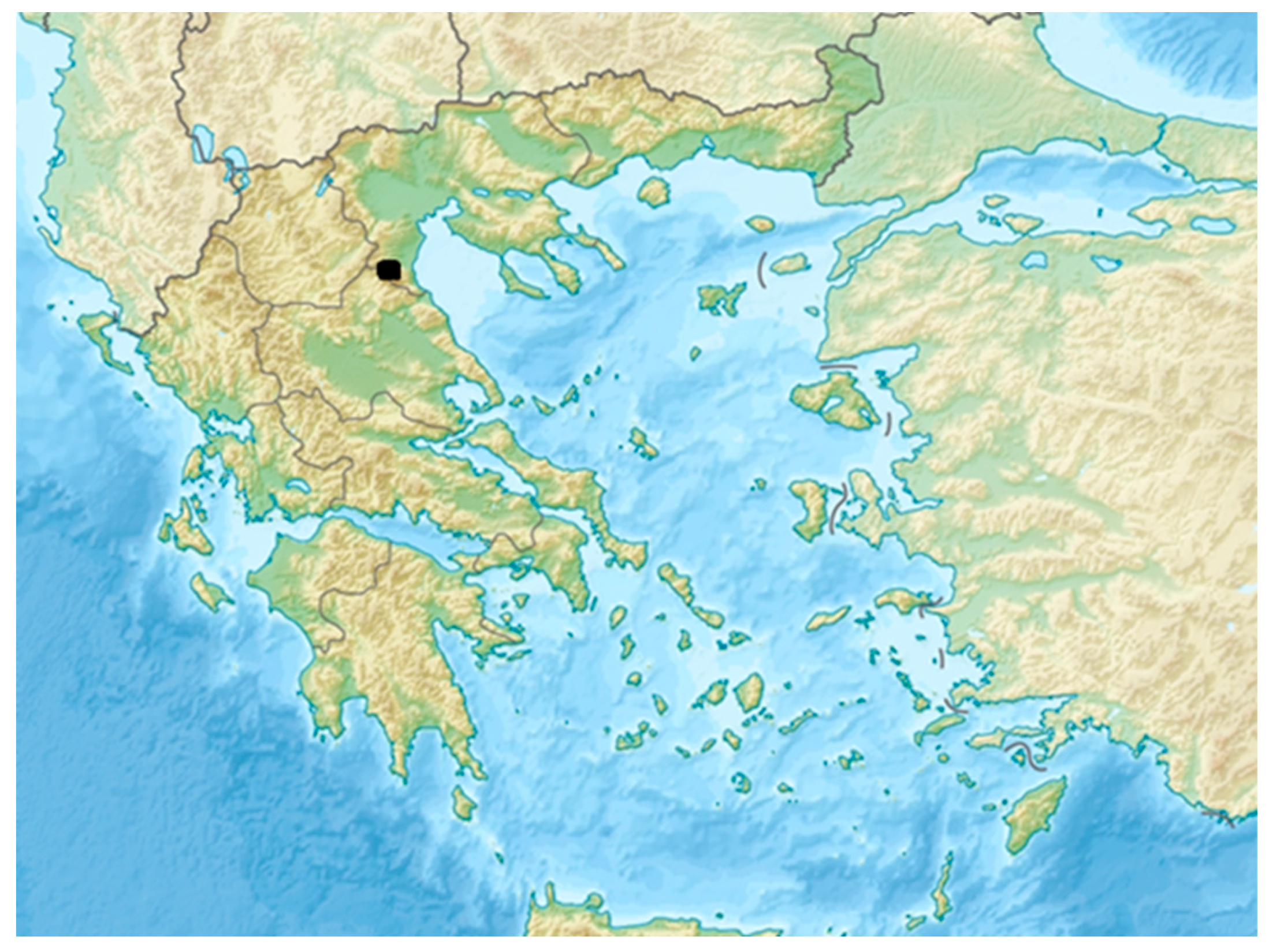
3.1. Study Area: Mount Olympus
3.2. Research Design and Analytical Logic
3.3. Systematic Literature Review
3.4. Semi-Structured Interviews
3.5. Non-Participant Observation
3.6. Data Analysis and Triangulation
4. Results
4.1. Overview
- Geomorphological Features and Natural Hazards;
- Typology of Incidents and Safety Needs;
- Infrastructure and Rescue Mechanisms;
- Cooperation and Institutional Organization;
- Technology and Innovative Tools;
- Improvement Proposals and Adaptation of Good Practices.
4.2. Thematic Analysis of Primary Data
- T1.
- Geomorphological Features and Natural Hazards
- T2.
- Typology of Incidents and Safety Needs
- T3.
- Infrastructure and Rescue Mechanisms
- T4.
- Cooperation and Institutional Organization
- T5.
- Technology and Innovative Tools
- Ground sensors for flood and landslide monitoring;
- Drones for locating missing persons in inaccessible areas;
- Web-based risk platforms providing real-time data;
- Mobile navigation applications with integrated trail maps and QR-coded signage;
- Virtual training programs for rescue personnel.
- T6.
- Improvement Proposals and Adaptation of Good Practices
5. Discussion
5.1. Interpretation of Findings in Relation to Analytical Propositions
5.2. Mount Olympus in Comparative Perspective
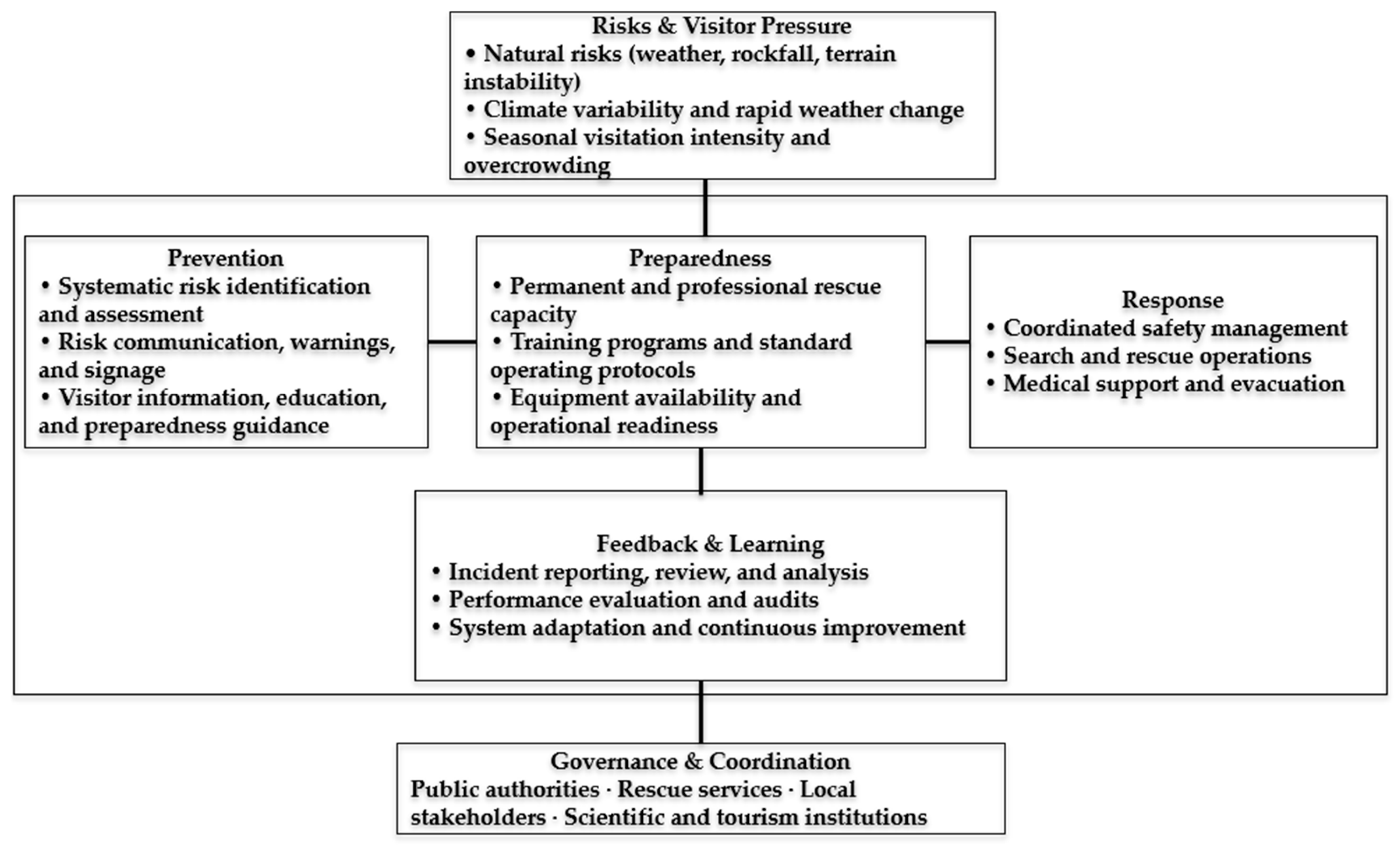
5.3. From Fragmentation to Integration: An Olympus-Specific Safety Framework
6. Conclusions
7. Implications for Policy and Management
8. Limitations and Future Research
Author Contributions
Funding
Institutional Review Board Statement
Informed Consent Statement
Data Availability Statement
Conflicts of Interest
References
- Beedie, P.; Hudson, S. Emergence of mountain-based adventure tourism. Ann. Tour. Res. 2003, 30, 625–643. [Google Scholar] [CrossRef]
- Wilks, J.; Page, S.J. (Eds.) Managing Tourist Health and Safety in the New Millennium; Elsevier Butterworth-Heinemann: Oxford, UK, 2003. [Google Scholar]
- Botetzagias, I.; Kostopoulos, G. A national park for tourists or mountaineers?: Debating Mount Olympus in inter-war Greece. J. Tour. Hist. 2025, 17, 99–116. [Google Scholar] [CrossRef]
- Apollo, M.; Wengel, Y. Mountaineering Tourism: A Critical Perspective; Routledge: Oxfordshire, UK, 2021. [Google Scholar]
- Keiler, M.; Fuchs, S. Vulnerability and exposure to geomorphic hazards: Some insights from the European Alps. In Geomorphology and Society; Springer: Tokyo, Japan, 2016; pp. 165–180. [Google Scholar] [CrossRef]
- Stieger, S.; Götz, F.M.; Wilson, C.; Volsa, S.; Rentfrow, P.J. A tale of peaks and valleys: Sinusoid relationship patterns between mountainousness and basic human values. Soc. Psychol. Personal. Sci. 2022, 13, 390–402. [Google Scholar] [CrossRef]
- Lee, H.-J.; Choi, H.C.; Jeong, C. Trails of Transformation: Balancing Sustainability, Security, and Culture in DMZ Walking Tourism. Land 2025, 14, 1204. [Google Scholar] [CrossRef]
- Keramitsoglou, K.M.; Koudoumakis, P.; Akrivopoulou, S.; Papaevaggelou, R.; Protopapas, A.L. Biodiversity as an outstanding universal value for integrated management of natural and cultural heritage. Sustainability 2023, 15, 8540. [Google Scholar] [CrossRef]
- Tacnet, J.M.; Carladous, S.; Sassus, F.; Ripert, E.; Lagleize, P.; Stephan, A.; Calmet, C.; Gil, V. Practical Risk and Resilience Assessment: A Methodology for Implementation of Mountain Risk Management and Prevention Strategy (STePRiM). 2022. Available online: https://hal.science/hal-03739844/ (accessed on 10 September 2025).
- Soule, B.; Corneloup, J. Risk management in mountain sports areas: The case of a French ski resort (Val Thorens). J. Sport Tour. 2004, 9, 141–157. [Google Scholar] [CrossRef]
- Vakrou, A.C. A Study on the Economic Valuation and Management of Recreation at Mount Olympus National Park, Greece. Doctoral Dissertation, University of Aberdeen, Aberdeen, UK, 1993. [Google Scholar]
- Della Dora, V. Mountain: Nature and Culture; Reaktion Books: London, UK, 2016. [Google Scholar]
- Morgan, N. In the Mountains: The Health and Wellbeing Benefits of Spending Time at Altitude; Hachette: London, UK, 2019. [Google Scholar]
- Körner, C. Mountain biodiversity, its causes and function: An overview. In Mountain Biodiversity; CRC Press: Boca Raton, FL, USA, 2024; pp. 3–20. [Google Scholar]
- Evola, J. Meditations on the Peaks: Mountain Climbing as Metaphor for the Spiritual Quest; Simon and Schuster: Rochester, VT, USA, 1998. [Google Scholar]
- Kostopoulou, S.; Kyritsis, I. A tourism carrying capacity indicator for protected areas. Anatolia 2006, 17, 5–24. [Google Scholar] [CrossRef]
- Harknett, J.; Whitworth, M.; Rust, D.; Krokos, M.; Kearl, M.; Tibaldi, A.; Bonali, F.L.; De Vries, B.V.W.; Antoniou, V.; Nomikou, P.; et al. The use of immersive virtual reality for teaching fieldwork skills in complex structural terrains. J. Struct. Geol. 2022, 163, 104681. [Google Scholar] [CrossRef]
- Tsianos, G.I. Human Responses to Cold and Hypoxia: Implications for Mountaineers. Doctoral Dissertation, University of Glasgow, Glasgow, UK, 2004. [Google Scholar]
- Rescue, O.M. Olympic Mountains: A Climbing Guide; The Mountaineers Books: Seattle, WA, USA, 2006. [Google Scholar]
- Deline, P.; Gardent, M.; Magnin, F.; Ravanel, L. The morphodynamics of the Mont Blanc massif in a changing cryosphere: A comprehensive review. Geogr. Ann. Ser. A Phys. Geogr. 2012, 94, 265–283. [Google Scholar] [CrossRef]
- Mourey, J.; Marcuzzi, M.; Ravanel, L.; Pallandre, F. Effects of climate change on high Alpine mountain environments: Evolution of mountaineering routes in the Mont Blanc massif (Western Alps) over half a century. Arct. Antarct. Alp. Res. 2019, 51, 176–189. [Google Scholar] [CrossRef]
- Strapazzon, G.; Reisten, O.; Argenone, F.; Zafren, K.; Zen-Ruffinen, G.; Larsen, G.L.; Soteras, I. International Commission for Mountain Emergency Medicine Consensus Guidelines for on-site management and transport of patients in canyoning incidents. Wilderness Environ. Med. 2018, 29, 252–265. [Google Scholar] [CrossRef]
- Pascual, R.; Callado, A. Mountain accidents associated with winter northern flows in the Mediterranean Pyrenees. Tethys 2010, 7, 41–55. [Google Scholar] [CrossRef]
- Nerín, M.A.; Soteras, I.; Sanz, I.; Egea, P. The “medicalization” of mountain rescue teams: A social and economic approach based on mortality evolution in the central Pyrenees. Arch. Med. Deporte 2019, 35, 393–401. [Google Scholar]
- Giménez, R.; Moreno, A.; Luetscher, M.; Ezquerro, L.; Delgado-Huertas, A.; Benito, G.; Bartolomé, M. Mitigating flood risk and environmental change in show caves: Key challenges in the management of the Las Güixas cave (Pyrenees, Spain). J. Environ. Manag. 2024, 370, 122285. [Google Scholar] [CrossRef] [PubMed]
- Fotiadis, A. The Role of Tourism in Rural Development Through a Comparative Analysis of a Greek and a Hungarian Rural Tourism Area. Doctoral Dissertation, University of Pécs, Pécs, Hungary, 2009. [Google Scholar]
- Morata, F.; Roca, D.; Cots Serra, F. A Sustainable Development Strategy for the Pyrenees-Mediterranean Euroregion: Basic Guidelines; Institut Universitari d’Estudis Europeus & Generalitat de Catalunya: Barcelona, Spain, 2007. [Google Scholar]
- Voiculescu, M. Snow avalanche hazards in the Făgăraş massif (Southern Carpathians): Romanian Carpathians—Management and perspectives. Nat. Hazards 2009, 51, 459–475. [Google Scholar] [CrossRef]
- Bednarczyk, Z. Evaluating landslide remediation methods used in the Carpathian Mountains, Poland. Environ. Eng. Geosci. 2019, 25, 272–288. [Google Scholar] [CrossRef]
- Andersson-Sköld, Y.; Bergman, R.; Johansson, M.; Persson, E.; Nyberg, L. Landslide risk management—A brief overview and example from Sweden of current situation and climate change. Int. J. Disaster Risk Reduct. 2013, 3, 44–61. [Google Scholar] [CrossRef]
- Vuorio, T. Information on Recreation and Tourism in Spatial Planning in the Swedish Mountains: Methods and need for Knowledge. Doctoral Dissertation, Blekinge Institute of Technology, Karlskrona, Sweden, 2003. [Google Scholar]
- Pietsch, U.; Knapp, J.; Kreuzer, O.; Ney, L.; Strapazzon, G.; Lischke, V.; Albrecht, R.; Phillips, P.; Rauch, S. Advanced airway management in hoist and longline operations in mountain HEMS—Considerations in austere environments: A narrative review. Scand. J. Trauma Resusc. Emerg. Med. 2018, 26, 1–8. [Google Scholar] [CrossRef]
- Mourey, J.; Lacroix, P.; Duvillard, P.A.; Marsy, G.; Marcer, M.; Malet, E.; Ravanel, L. Multi-method monitoring of rockfall activity along the classic route up Mont Blanc (4809 m a.s.l.) to encourage adaptation by mountaineers. Nat. Hazards Earth Syst. Sci. 2022, 22, 445–460. [Google Scholar] [CrossRef]
- Kaimakamis, D. Predictions for activity involvement via PERMA well-being model in mountain climbing-hiking participants on Mt. Olympus. Int. J. Recreat. Sports Sci. 2022, 6, 44–53. [Google Scholar]
- Solomou, A.D.; Martinos, K.; Skoufogianni, E.; Danalatos, N.G. Medicinal and aromatic plants diversity in Greece and their future prospects: A review. Agric. Sci. 2016, 4, 9–21. [Google Scholar] [CrossRef]
- Nogueira, B.G.D.S.; Savi, M.; Santos, J.F.L.D.; Tetto, A.F.; Paula, E.V.D.; Steiner, P.J. Social and environmental parameters for public use management in mountain ecosystems. Rev. Árvore 2023, 47, e4723. [Google Scholar] [CrossRef]
- Voiculescu, M.; Popescu, F. Management of snow avalanche risk in the ski areas of the Southern Carpathians—Romanian Carpathians: Case study: The Bâlea (Făgăraş Massif) and Sinaia (Bucegi Mountains) ski areas. In Sustainable Development in Mountain Regions: Southeastern Europe; Springer: Cham, Switzerland, 2011; pp. 103–121. [Google Scholar]
- Doytchev, B. The impact of mountaineering and climbing on the environment. Trakia J. Sci. 2021, 19, 540–545. [Google Scholar]
- Poulaki, P.; Bouzis, S.; Vasilakis, N.; Valeri, M. Hiking tourism in Greece. In Sport and Tourism; Emerald Publishing Ltd.: Leeds, UK, 2023; pp. 95–112. [Google Scholar]
- Kaimakamis, D.; Komsis, S. Prediction of involvement in activity based on the dimensions of participation in mountaineering and hiking on Mount Olympus. J. Phys. Educ. Sport 2022, 22, 2089–2097. [Google Scholar]
- Hollis, D.L. Re-Thinking Mountains: Ascents, Aesthetics, and Environment in Early Modern Europe. Doctoral Dissertation, University of St Andrews, St Andrews, UK, 2017. [Google Scholar]
- Afsharipour, M.; Maghoul, P. Towards education 4.0 in geotechnical engineering using a virtual reality/augmented reality visualization platform. Geotech. Geol. Eng. 2024, 42, 2657–2673. [Google Scholar] [CrossRef]
- Keiler, M.; Fuchs, S. Challenges for natural hazard and risk management in mountain regions of Europe. In Oxford Research Encyclopedia of Natural Hazard Science; Oxford University Press: Oxford, UK, 2018. [Google Scholar]
- Mourey, J.; Lacroix, P.; Duvillard, P.A.; Marsy, G.; Marcer, M.; Ravanel, L.; Malet, E. Rockfall and vulnerability of mountaineers on the west face of the Aiguille du Goûter (classic route up Mont Blanc, France): An interdisciplinary study. Nat. Hazards Risks Earth Syst. Sci. Discuss. 2021, 2021, 1–29. [Google Scholar]
- Havenith, H.B.; Cerfontaine, P.; Mreyen, A.S. How virtual reality can help visualise and assess geohazards. Int. J. Digit. Earth 2019, 12, 173–189. [Google Scholar] [CrossRef]
- Navas, A.; Machín, J.; Soto, J. Assessing soil erosion in a Pyrenean mountain catchment using GIS and fallout 137Cs. Agric. Ecosyst. Environ. 2005, 105, 493–506. [Google Scholar] [CrossRef]

| Participant ID | Professional Role |
|---|---|
| Participant 1 | Member of a mountaineering association |
| Participant 2 | Mountaineer |
| Participant 3 | Mountain guide |
| Participant 4 | Local government official |
| Participant 5 | Representative of an environmental organization |
| Participant 6 | Forester |
| Participant 7 | Environmental scientist |
| Participant 8 | University academic researcher |
| Participant 9 | Rescue professional |
| Participant 10 | Environmental engineering professional |
| Theme | Interviews | Observation | Literature |
|---|---|---|---|
| T1 Natural risks | √ | √ | √ |
| T2 Incident typologies | √ | √ | √ |
| T3 Rescue infrastructure | √ | √ | √ |
| T4 Institutional coordination | √ | √ | √ |
| T5 Technology | √ | - | √ |
| T6 Good practices | √ | - | √ |
| Analytical Propositions | Core Claim | Themes (T1–T6) | Data Sources |
|---|---|---|---|
| AP1 | Safety risks on Mount Olympus are shaped by a distinctive combination of natural hazards, seasonal pressure, and infrastructural constraints | T1 (Natural hazards), T2 (Incident typologies), T3 (Infrastructure) | Literature review, interviews, observation |
| AP2 | Existing safety management practices are only partially aligned with international standards due to fragmented governance | T3 (Rescue infrastructure), T4 (Institutional coordination) | Interviews, observation, literature review |
| AP3 | Selective adoption of international best practices could substantially improve safety management on Mount Olympus | T5 (Technology), T6 (Good practices) | Interviews, literature review |
| AP4 | Transferability of international practices depends on contextual, social, and institutional conditions | T4 (Coordination), T6 (Improvement proposals) | Interviews, literature review |
| Theme Code | Title | Summary Description | Representative Quote |
|---|---|---|---|
| T1 | Geomorphological Features & Natural Hazards | Natural hazards linked to topography, weather instability, and elevation; seasonal variation in risk intensity. | “The immediate dangers are natural—rockfalls, weather changes, lightning.” |
| T2 | Typology of Incidents & Safety Needs | Incident frequency and type vary by season and visitor profile; need for differentiated safety protocols. | “In summer, risks rise due to overcrowding; in winter, entire routes are inaccessible.” |
| T3 | Infrastructure & Rescue Mechanisms | Gaps in permanent rescue capacity, communication coverage, and emergency preparedness. | “No permanent rescue team and inadequate mobile coverage.” |
| T4 | Cooperation & Institutional Organization | Informal coordination; need for formal governance, shared protocols, and local involvement. | “Collaboration exists but is occasional—institutional mechanisms are needed.” |
| T5 | Technology & Innovative Tools | Adoption of sensors, real-time data, digital platforms, and virtual training to strengthen prevention. | “An information station and a real-time digital platform would make a difference.” |
| T6 | Improvement Proposals & Adaptation of Good Practices | Integration of international models, visitor education, professional rescue teams, and smart systems. | “We need a professional rescue structure similar to Air Zermatt.” |
Disclaimer/Publisher’s Note: The statements, opinions and data contained in all publications are solely those of the individual author(s) and contributor(s) and not of MDPI and/or the editor(s). MDPI and/or the editor(s) disclaim responsibility for any injury to people or property resulting from any ideas, methods, instructions or products referred to in the content. |
© 2026 by the authors. Licensee MDPI, Basel, Switzerland. This article is an open access article distributed under the terms and conditions of the Creative Commons Attribution (CC BY) license.
Share and Cite
Yfantidou, G.; Katsivelos, A.; Trigonis, I.; Kouli, O.; Kouthouris, C. Risk Prevention and Safety Management in the Mount Olympus Area: Challenges and Optimal Strategies for Safe Tourism Development. Safety 2026, 12, 19. https://doi.org/10.3390/safety12010019
Yfantidou G, Katsivelos A, Trigonis I, Kouli O, Kouthouris C. Risk Prevention and Safety Management in the Mount Olympus Area: Challenges and Optimal Strategies for Safe Tourism Development. Safety. 2026; 12(1):19. https://doi.org/10.3390/safety12010019
Chicago/Turabian StyleYfantidou, Georgia, Apostolos Katsivelos, Ioannis Trigonis, Olga Kouli, and Charilaos Kouthouris. 2026. "Risk Prevention and Safety Management in the Mount Olympus Area: Challenges and Optimal Strategies for Safe Tourism Development" Safety 12, no. 1: 19. https://doi.org/10.3390/safety12010019
APA StyleYfantidou, G., Katsivelos, A., Trigonis, I., Kouli, O., & Kouthouris, C. (2026). Risk Prevention and Safety Management in the Mount Olympus Area: Challenges and Optimal Strategies for Safe Tourism Development. Safety, 12(1), 19. https://doi.org/10.3390/safety12010019

