Review

Thermal Runaway in Lithium-Ion Batteries: A Review of Mechanisms, Prediction Approaches, and Mitigation Strategies


School of Mechanical Engineering and Automation, Northeastern University, Shenyang 110819, China
*
Author to whom correspondence should be addressed.
Batteries 2026, 12(3), 88; https://doi.org/10.3390/batteries12030088
Submission received: 24 December 2025 / Revised: 23 February 2026 / Accepted: 26 February 2026 / Published: 3 March 2026
(This article belongs to the Topic Battery Design and Management, 2nd Edition)

Abstract

Thermal runaway is one of the most critical safety challenges limiting the widespread deployment of lithium-ion batteries in electric vehicles, energy storage systems, and aerospace applications. With the continuous increase in battery energy density, the fault-to-failure transition becomes increasingly rapid, which makes early detection and effective intervention quite difficult. This review systematically summarizes the fundamental mechanisms underlying thermal runaway that drive the escalation of battery hazards. Existing thermal runaway prediction and early warning approaches are comprehensively classified into electrical, thermal, mechanical/gas, and data-driven categories. The detection principles, performance characteristics, and current limitations are critically analyzed. Furthermore, research progress in mitigation and suppression, including system-level thermal management, material-level approach, and structure modification, is discussed. This work aims to support the development of advanced early-warning technologies and to provide guidance for the design of safer next-generation lithium-ion battery systems.

1. Introduction

The accelerating deterioration of the global environment and climate has intensified the demand for the transition from fossil fuel-based energy systems to renewable energy technologies [1,2,3]. In this context, lithium-ion batteries have become a cornerstone of modern energy storage [4], serving as the dominant technology for electric vehicles and grid-scale applications owing to their high energy and power densities, long cycle life, negligible self-discharge, absence of memory effects, and low environmental impact [5,6]. However, despite the continued large-scale deployment of lithium-ion batteries, safety concerns have become increasingly critical and are widely recognized as a major barrier to further technological advancement. In particular, safety incidents related to thermal runaway have drawn substantial attention from both academia and industry.
Thermal runaway is an uncontrollable, self-accelerating reaction process in LiBs, characterized by a heat generation rate that far exceeds the heat dissipation capability, leading to a rapid temperature rise. This process is typically accompanied by the release of large quantities of gases [7], which accumulate within the confined battery enclosure and result in continuous pressure buildup. Once the internal pressure exceeds the mechanical tolerance of the battery casing, venting, rupture, or even explosion may occur. Meanwhile, thermal runaway initiates the decomposition of internal battery components, producing a range of flammable and toxic gaseous species. Battery misuse conditions that may trigger a thermal runaway are generally classified into three categories: mechanical abuse, electrical abuse, and thermal abuse. Mechanical abuse involves external mechanical forces that damage the battery structure and compromise its physical integrity, such as crushing, puncture, impact, dropping, and bending [8]. Electrical abuse arises from abnormal operating conditions in which voltage or current exceeds design limits, thereby accelerating electrochemical side reactions, including overcharge, over-discharge, high-rate charge/discharge, and external short circuits [9,10]. Thermal abuse occurs when batteries are exposed to abnormal thermal environments, causing the temperature to exceed allowable limits and directly activating exothermic side reactions. When the temperature reaches the decomposition thresholds of key battery materials, a cascade of exothermic reactions is triggered, ultimately leading to thermal runaway [11]. Importantly, these abuse modes are not independent: mechanical damage can induce internal short circuits, thereby initiating electrical and thermal abuse; heat accumulation from electrical abuse may further promote thermal abuse; and excessive temperature rise can degrade battery structures, exacerbating both mechanical and electrical failures. Such coupled interactions form a cascading pathway from initial abuse to thermal runaway [12].
Currently, the safety of LiBs has emerged as a critical bottleneck that must be addressed to enable the large-scale deployment of electric vehicles and grid-scale energy storage systems. Multiple fire incidents triggered by battery thermal runaway [13,14] have highlighted the severe consequences of such failures, underscoring that thermal runaway represents a fundamental constraint on the safe utilization of LiBs. Consequently, elucidating the triggering conditions and underlying mechanisms of thermal runaway, together with developing reliable prediction and effective suppression strategies, is essential for early risk identification and interruption of accident escalation pathways. Although substantial research efforts have been devoted to thermal runaway, several challenges remain. Existing review studies often focus on isolated aspects of thermal runaway, lacking a unified framework that integrates mechanistic insights, early-warning indicators, and mitigation strategies across different spatial and temporal scales.
To ensure the systematic and comprehensive nature of the review, we conducted a rigorous literature search using the Web of Science, Scopus, and IEEE Xplore databases. The search strategy employed a combination of keywords: “lithium-ion battery” AND “thermal runaway” AND (“mechanism” OR “prediction” OR “suppression”). The main time frame was set from 2015 to 2025 to cover the latest developments, while also including the pioneering classic literature. The inclusion criteria prioritized studies involving the mechanism of thermal runaway, multi-sensor fusion detection, data-driven early warning algorithms, as well as thermal management methods, new suppression materials, and advanced battery structures.
The remainder of this paper is organized as follows. Section 2 examines the chain reactions leading from initial failure to thermal runaway. Section 3 reviews current prediction and early-warning approaches, while Section 4 discusses available suppression and mitigation strategies. Section 5 proposes future research directions to address existing gaps, followed by the conclusions in Section 6.

2. Thermal Runaway Mechanism of Lithium-Ion Batteries

Thermal runaway (TR) can be precipitated by a multitude of anomalous conditions, generally categorized into mechanical abuse, electrical abuse, thermal abuse, and aging. While the triggering modes and corresponding mechanisms have been comprehensively elucidated in existing literature, we have synthesized the associated testing standards for these categories in Table 1. However, a comprehensive review of existing abuse methodologies reveals significant discrepancies and inconsistencies among current international testing protocols. Consequently, there is an imperative need for unified international protocols to standardize critical triggering parameters across various abuse scenarios, such as nail penetration depth and heating rates.
Notwithstanding the prevailing variations in international abuse testing protocols, the ultimate consequence of these external triggers remains consistent: the disruption of the battery’s internal thermodynamic stability. Therefore, deciphering how macroscopic external stimuli induce internal electrochemical destabilization at the microscopic level is pivotal for comprehending the fundamental nature of thermal runaway. The mechanism of TR in lithium-ion batteries involves complex thermal equilibria and chain reactions [36]. Accordingly, this section will provide a detailed elaboration on the mechanisms driving thermal runaway under abuse conditions.

2.1. Capacity Degradation

Elevated temperatures accelerate lithium-ion transport between the cathode and anode, leading to enhanced self-discharge and accelerated capacity degradation. Existing studies indicate that irreversible active lithium loss and structural degradation of electrode materials jointly drive sustained capacity fade, typically accompanied by increased interfacial impedance and overall internal resistance [37]. High temperatures also intensify electrolyte decomposition and SEI evolution, promoting inhomogeneous side reactions and interfacial layer thickening on both electrodes, which has been shown to correlate directly with capacity decay [38,39,40]. Overall, high-temperature-induced capacity degradation arises from the coupled effects of lithium loss, active material degradation, and interfacial impedance growth.

2.2. Decomposition of Solid Electrolyte Interface (SEI)

The materials inside the lithium-ion battery begin to decompose and generate heat as the temperature further increases. The first exothermic reaction is the decomposition of the SEI film, and its metastable components will decompose and release heat at 57 °C [41]. The reaction formula is introduced below:
C H 2 O C O 2 L i 2 L i 2 C O 3 + C 2 H 4 + C O 2 + 0.5 O 2
2 L i + C H 2 O C O 2 L i 2 2 L i 2 C O 3 + C 2 H 4
Decomposition reaction of the SEI membrane detects significant heat release at 80 °C and reaches a peak heat production at 100 °C [42]. As the SEI film decomposes, the available lithium at the negative electrode of the battery comes into contact with the electrolyte and regenerates an irregular and unstable new SEI film [43]. This decomposition and regeneration reaction will continue to circulate at high temperatures until the battery experiences thermal runaway [44].

2.3. Negative Electrode-Electrolyte Reaction

Oka et al. [45] reported that overcharging markedly intensifies both oxidative and reductive electrolyte decomposition, thereby inducing lithium metal reactions and additional electrode corrosion. Moreover, decomposition of the solid electrolyte interphase (SEI) exposes the negative electrode active material, which subsequently reacts with embedded lithium in the presence of the electrolyte, further accelerating interfacial degradation [46]. The chemical equation is described by
2 L i + C 3 H 4 O 3 E C L i 2 C O 3 + C 2 H 4
2 L i + C 5 H 10 O 3 D E C L i 2 C O 3 + C 2 H 4 + C 2 H 6
2 L i + C 3 H 6 O 3 D M C L i 2 C O 3 + C 2 H 6
2 L i + C 4 H 6 O 3 P C L i 2 C O 3 + C 3 H 6

2.4. Separator

Polyethylene (PE) and polypropylene (PP) are widely used as commercial battery separators, with melting points of approximately 130 °C and 170 °C, respectively [47]. Separator melting is an endothermic process that can temporarily slow down, or even reverse, the battery temperature rise [48]. However, as the temperature continues to increase, separator shrinkage may occur, leading to direct contact between the positive and negative electrodes and triggering internal short circuits. This process re-accelerates heat generation and becomes a critical heat source driving uncontrolled contact-induced heating and thermal runaway [49].

2.5. Decomposition of Positive Electrode

Cathode material chemistry plays a critical role in determining the thermal safety performance of lithium-ion batteries, thereby influencing both the likelihood and severity of thermal runaway. Doughty et al. [50] systematically compared the thermal safety characteristics of batteries employing different cathode materials.
Lithium cobalt oxide (LCO) was the earliest commercially deployed cathode material for lithium-ion batteries. However, owing to its poor thermal stability—particularly under high-temperature or overcharged conditions—it is no longer widely adopted in large-capacity power battery applications. The thermal decomposition reaction of lithium cobalt oxide can be expressed as:
L i x C o O 2 x L i C o O 2 + 1 x 3 C o 3 O 4 + 1 x 3 O 2
During the thermal decomposition of lithium cobalt oxide (LCO) cathodes, Co4+ is reduced to Co3+, accompanied by the release of oxygen and a substantial amount of heat. In comparison, Nickel–Cobalt–Manganese (NCM) cathode materials exhibit relatively lower thermal decomposition intensity than LCO. Among the transition metal species, Ni ions are more electrochemically active than Co and Mn ions and are therefore more susceptible to valence-state changes under thermal abuse conditions. As a result, the dominant reactions between NCM cathodes and the electrolyte are associated with the reduction of Ni4+ to lower valence states, such as Ni2+. Noh et al. [51] systematically investigated the influence of Ni content on the thermal stability of Li(NixCoᵧMnz)O2, with the results summarized in Table 2.
Kim et al. [52] investigated the thermal stability of LiNi1/3Mn1/3Co1/3O2 using differential scanning calorimetry (DSC) and identified three distinct exothermic peaks at approximately 325 °C, 362 °C, and 458 °C. The first two exothermic peaks were attributed to the thermal decomposition of the NCM cathode material.
Thermal decomposition of lithium manganese oxide (LMO) cathodes involves the reduction of Mn4+ accompanied by oxygen release, and the corresponding reaction equations can be expressed as follows:
4 L i M n 2 O 4 2 L i 2 M n O 3 + 2 M n 3 O 4 + O 2
3 M n 2 O 4 2 M n 3 O 4 + 2 O 2
L i M n 2 O 4 L i M n 2 O 4 y + y 2 O 2
L i M n 2 O 4 L i M n O 2 + 1 3 M n 3 O 4 + 1 3 O 2
M n 2 O 4 M n 2 O 3 + 1 2 O 2
By using high-concentration electrolytes or adding functional components to optimize the chemical environment of the electrolyte, it is an effective way to enhance the thermal stability and cycle life of LMO [53]. Finegan et al. [54] further quantified the thermal decomposition behavior of LMO, reporting a maximum heat release of up to 450 J·g−1 over a temperature range of 150–300 °C.
In contrast to the cathode materials discussed previously, LFP exhibits superior thermal stability attributed to the strong covalent P-O bonds within its olivine crystal structure. Its thermal decomposition onset temperature is significantly higher, ranging from 500 to 800 °C. Furthermore, LFP is characterized by a relatively low decomposition enthalpy, indicating minimal heat release during the reaction. Even following irreversible phase transitions at temperatures exceeding 500 °C, the robust P-O framework remains intact and prevents structural collapse [55].

2.6. Decomposition Reaction of Electrolyte

The electrolyte serves as the ionic conduction medium in lithium-ion batteries and typically consists of lithium salts dissolved in organic carbonate solvents. Thermal decomposition of the electrolyte can release substantial amounts of heat and gaseous products, thereby contributing significantly to thermal runaway [56]. The following reactions describe the complete oxidation of electrolyte components to CO2 as well as incomplete oxidation pathways leading to CO formation, where EC denotes ethylene carbonate, DEC denotes diethyl carbonate, DMC denotes dimethyl carbonate, and PC denotes propylene carbonate.
2 O 2 + C 3 H 4 O 3 ( E C ) 3 C O 2 + 2 H 2 O
6 O 2 + C 5 H 10 O 3 ( D E C ) 5 C O 2 + 5 H 2 O
3 O 2 + C 3 H 6 O 3 ( D M C ) 3 C O 2 + 3 H 2 O
4 O 2 + C 4 H 6 O 3 ( P C ) 4 C O 2 + 3 H 2 O
O 2 + C 3 H 4 O 3 ( E C ) 3 C O + 2 H 2 O
3.5 O 2 + C 5 H 10 O 3 ( D E C ) 5 C O + 5 H 2 O
1.5 O 2 + C 3 H 6 O 3 ( D M C ) 3 C O + 3 H 2 O
2 O 2 + C 4 H 6 O 3 ( P C ) 4 C O + 3 H 2 O
The decomposition mechanism is highly sensitive to the electrolyte formulation. Equations (13)–(20) depict pathways typical for standard LiPF6-carbonate systems, where LiPF6 dissociation yields Lewis acidic PF5 that catalyzes solvent decomposition [57]. In contrast, alternative salts such as LiFSI or varying solvent structures like linear versus cyclic carbonates exhibit distinct thermal stabilities and gas evolution profiles. Thus, actual decomposition products depend heavily on the specific salt–solvent–additive matrix. Based on Lewis theory, the PF5 generated by the decomposition of LiPF6 attacks the oxygen in the C-O bond, thereby accelerating the decomposition of the electrolyte. Botte et al. [58] further showed via DSC that LiPF6 undergoes an initial endothermic process prior to exothermic decomposition in EC: EMC electrolytes, whereas in EC:DEC:EMC (1:1:3), exothermic reactions initiate at around 256 °C with a total heat release of 210 J·g−1.

2.7. Decomposition Reaction of Adhesive

Polyvinylidene fluoride binders can enhance the structural integrity and thermal stability of battery electrodes at elevated temperatures, thereby improving the overall mechanical robustness of lithium-ion batteries. When the temperature exceeds 260 °C, intercalated lithium in negative electrode undergoes exothermic reactions accompanied by hydrogen gas evolution [59,60]:
C H 2 C F 2 + L i L i F + C H = C F + 0.5 H 2
C H 2 C F 2 C H = C F + H F
2 L i + R F 2 2 L i F + 0.5 R 2

2.8. Electrolyte Combustion

Upon melting and rupture of the aluminum current collector, high-temperature and high-pressure gases may be violently ejected from the battery, entraining cathode active materials and forming visible black smoke [61]. At the battery-pack level, combustion behavior is generally characterized by multiple stages, including cell swelling, ignition, stable combustion, and subsequent attenuation or extinction [62]. Meng et al. [63] investigated the combustion behavior of lithium iron phosphate (LFP) batteries using an indoor fire test platform and reported that fully charged cells (100% SOC) underwent thermal runaway at approximately 166.8 °C. This event was accompanied by the release of large quantities of flammable gases and electrolyte, leading to jet ignition above the safety valve with a peak flame temperature of 943.1 °C and a maximum heat release rate (HRR) of 12.3 kW. In addition, Hu et al. [64] demonstrated that gas generation during thermal runaway is highly dependent on abuse conditions, temperature, electrode materials, and electrolyte composition, highlighting the strong coupling between battery chemistry, operating conditions, and combustion behavior.

2.9. Kinetic Analysis

Thermal runaway progression follows Arrhenius kinetics, where reaction rates depend exponentially on temperature. It is crucial to recognize that the degradation pathways described in Section 2.2, Section 2.3, Section 2.4, Section 2.5 and Section 2.6 are not static; they are dynamically governed by these kinetic principles. As the temperature rises, the dominant reaction mechanism shifts—for instance, transitioning from mild SEI decomposition to violent electrolyte oxidation—thereby altering the specific reaction products and heat generation rates. This process is categorized into three stages based on activation energy ( E a ). Stage I is SEI decomposition with a relatively low E a   50~70 kJ mol 1 , acting as the initiating event, and Stage II involves the anode–electrolyte reaction ( E a   80~120 kJ mol 1 ) [65], driving the system into self-sustained heating. Stage III is cathode decomposition, where high-nickel NCM ( E a     150 ~ 250   kJ mol 1 ) demonstrates significantly lower stability compared to LFP [66], leading to rapid thermal destabilization.
These kinetic parameters are quantitatively derived from Accelerating Rate Calorimetry (ARC) and differential scanning calorimetry (DSC) [67,68]. By isolating heat flow peaks under adiabatic or constant-heating conditions, researchers can decouple overlapping reactions. The specific E a and pre-exponential factor A for each component is then determined through linear regression of ln ( dT / dt ) versus 1 / T , establishing characteristic kinetic profiles for different cell chemistries.
Integrating kinetic parameters into the battery management system enables predictive thermal safety. Specifically, the pre-exponential factor A and E a feed into the chemical heat generation term of electro-thermal models. By solving governing equations in real time, the BMS distinguishes irreversible decomposition heat from reversible Joule heating and extrapolates reaction trends to predict the Time-to-Thermal-Runaway (TTR) [69]. Furthermore, kinetic analysis establishes dynamic safety boundaries: if the temperature rise rate exceeds a threshold derived from the Stage II activation energy, it signals the dominance of self-accelerating reactions and triggers an early warning before catastrophic temperatures are reached [70].

3. Prediction of Thermal Runaway

3.1. Characteristic Signal-Based Method

3.1.1. Voltage Signal

During the early stage of battery failure, the terminal voltage typically remains stable or may even exhibit a slight increase, as accelerated interfacial reactions between the electrolyte and electrode materials partially compensate for voltage decline [71,72]. With continued temperature rise, intensified side reactions disrupt the electrochemical equilibrium and may induce internal short circuits, resulting in a pronounced voltage drop [73]. Based on these voltage evolution characteristics, several voltage-based early-warning methods have been proposed. Du et al. [74] developed a Gaussian smoothing filter (GSF) for voltage signal denoising, followed by a feature exponential function (FEF) to enhance subtle fault-related voltage signatures, and employed dynamic time warping (DTW) for automatic fault identification and localization. Yu et al. [75,76] proposed a thermal runaway warning approach based on battery relaxation voltage analysis to estimate short-circuit resistance, which was validated across multiple battery brands and demonstrated robustness under varying temperature and current conditions.
Voltage signals face high-frequency electromagnetic interference from motor inverters, requiring robust filtering to prevent false alarms. Additionally, voltage sensors are inherently insensitive to early micro-short circuits, necessitating fusion with other signals for timely fault detection.

3.1.2. Temperature Signal

Gulsoy et al. [77] monitored both internal and external battery temperatures using thermocouples embedded in cylindrical cells. Compared with thermocouples, fiber optic sensors offer advantages in size, flexibility, and environmental robustness, making them well-suited for battery temperature monitoring. Consequently, various fiber optic sensing technologies, such as fiber Bragg gratings (FBGs), Fabry–Perot fibers, and fluorescent fibers, have been explored for lithium-ion battery applications. Mei et al. [78] fabricated compact FBG-based sensors using femtosecond laser processing, while Li et al. [79] developed a fluorescence-based fiber optic sensor employing frequency-upconverting nanoparticles to directly measure internal battery temperature. Direct measurement of internal temperature is of critical importance for early thermal runaway warning. However, the practical deployment of implanted fiber optic sensors remains constrained by electrolyte corrosion and relatively high system cost.
Surface sensors suffer from thermal lag, failing to reflect core temperature in real-time. Optimal placement requires positioning sensors near electrode tabs or integrating them into cooling channels, though this significantly increases assembly complexity.

3.1.3. Mechanical Signal

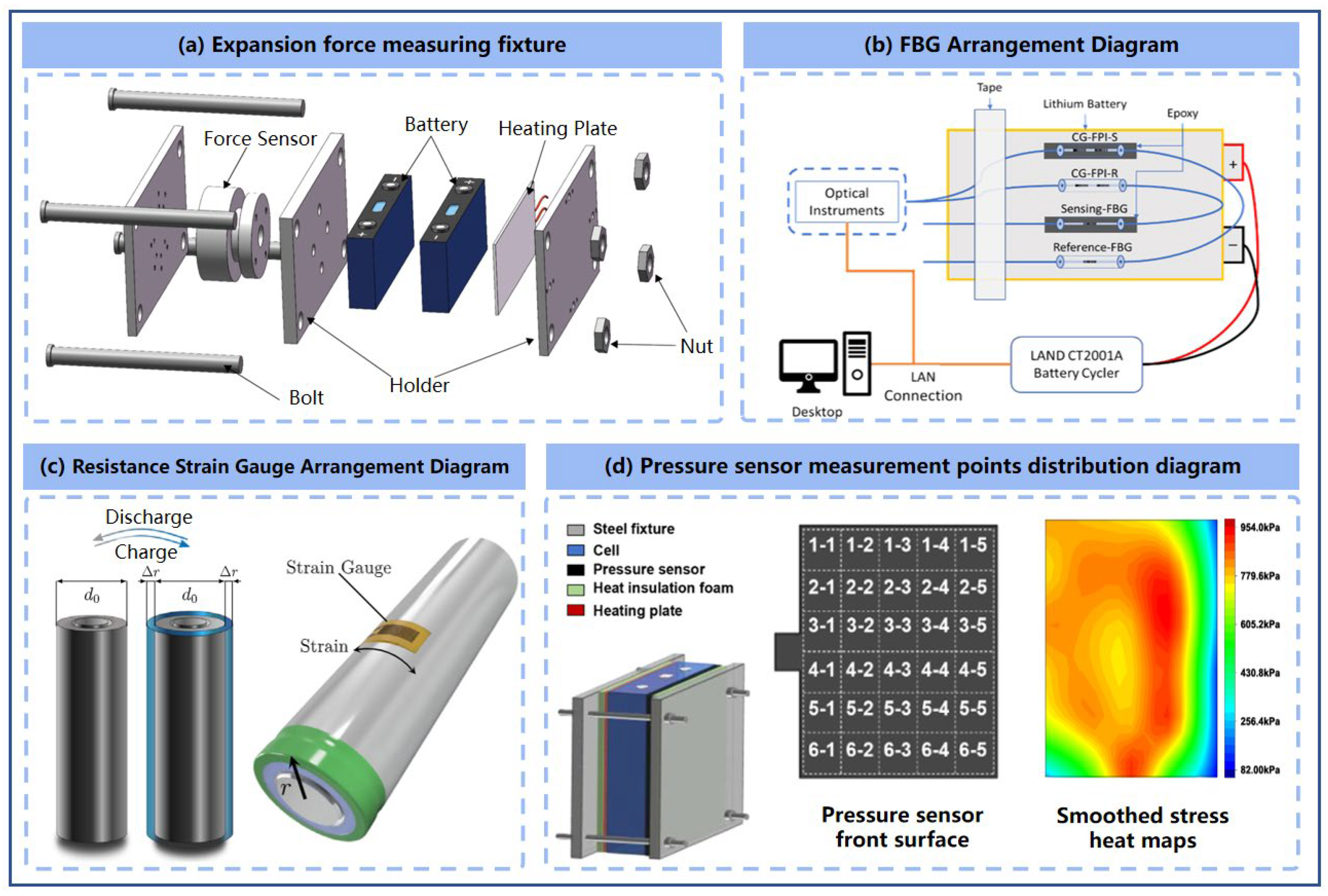
Current approaches for capturing mechanical signals in lithium-ion batteries mainly include measuring the expansion force of prismatic cells using dedicated fixtures and detecting strain via fiber gratings or resistance strain gauges [80], as illustrated in Figure 1. Sun et al. [81] demonstrated that internal pressure peaks consistently precede temperature peaks during failure evolution. Jin et al. [82] analyzed the expansion force characteristics of pouch-cell modules in the early stage of thermal runaway and showed that mechanical signals exhibit superior noise immunity. Choi et al. [83] developed a numerical model to simultaneously characterize battery lid deformation and internal pressure evolution during thermal runaway propagation. Li et al. [84] achieved accurate monitoring of internal temperature and pressure through embedded sensors, providing valuable data for early warning applications. In addition, Lin et al. [85] revealed that the superposition of expansion forces from adjacent cells is the primary cause of bimodal expansion force behavior during heat propagation in battery packs. Although mechanical sensing shows clear potential, sensor integration remains technically challenging [86]. Overall, these studies indicate that mechanical deformation is a sensitive indicator of internal battery states. Compared with temperature and voltage signals, mechanical responses typically emerge earlier; however, the exclusive use of mechanical signals for thermal runaway early warning is still limited in practice due to robustness issues and deployment constraints [87,88,89]. Integration requires pre-loaded sensors within rigid modules, which may compromise pack energy density. A major algorithmic challenge is distinguishing fault-induced irreversible expansion from the normal reversible swelling of cells during cycling.

3.1.4. Gas Signal

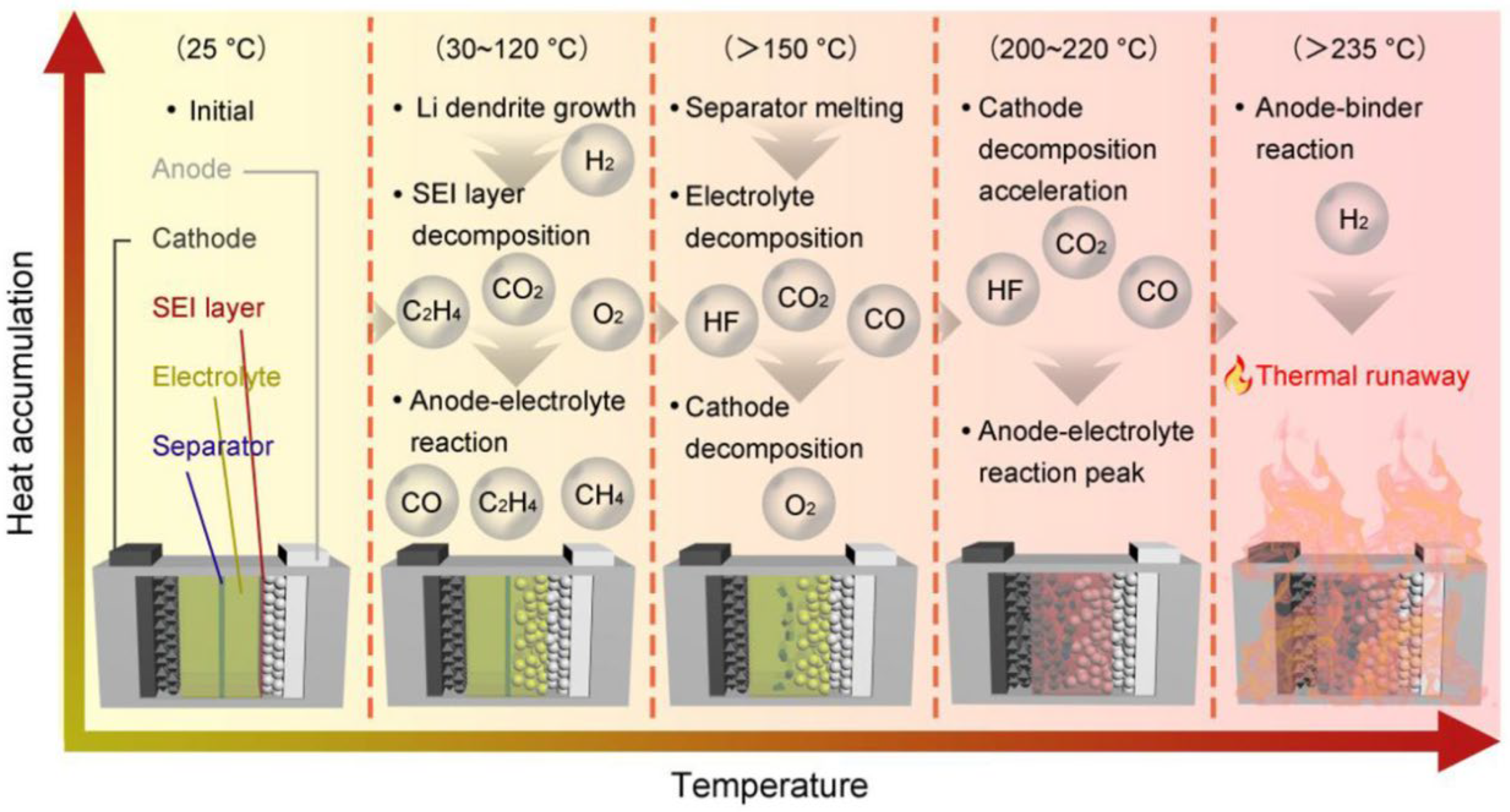
Commonly used gas sensors for LiB monitoring include semiconductor, optical, and electrochemical sensors [90]. Gas-based early-warning capability has been widely demonstrated. Yang et al. [91] reported early detection of H2 during battery overcharge, followed by CO release approximately 579 s before thermal runaway, confirming the feasibility of gas-signal-based early warning. Zhang et al. [92] proposed a multi-level warning strategy by coupling H2 and CO detection with electrical and thermal indicators. In addition to these gases, CO2 has been identified as another major component released during thermal runaway [93]. Fernandes et al. [94] further revealed a multi-stage gas release behavior in overcharged lithium iron phosphate batteries, where the initial venting was dominated by dimethyl carbonate (DMC) and ethyl methyl carbonate (EMC), followed by H2, CO2, C2H4, and CO. Furthermore, Li et al. [95] systematically summarized the evolution of gas components associated with side reactions in standard LiPF6-carbonate electrolytes across different temperature stages, as illustrated in Figure 2. The specific gas composition and onset temperatures are strongly dependent on the electrolyte chemistry. Thus, gas-based early warning thresholds must be calibrated according to the specific cell chemistry.
Monitoring gases released during battery thermal runaway provides an effective early-warning approach, as gas species and their concentration evolution serve as sensitive indicators of internal battery states [96]. Accordingly, gas sensing plays a critical role in enabling timely responses by battery management systems under hazardous conditions. Song et al. [97] analyzed gas generation characteristics under various abuse scenarios and proposed an optimized gas sensor selection strategy tailored to batteries with different material chemistries, thereby improving early-warning accuracy. Liao et al. [98] identified C2H4, CH4, and CO as characteristic gases and evaluated the corresponding warning lead times for lithium-ion battery thermal runaway. Despite these advances [90], gas-based early warning inherently relies on the accumulation of gaseous species to detectable concentration levels. In large-scale energy storage stations, gas dilution and dispersion may delay sensor response, thereby compromising early-warning effectiveness. Sensor deployment strategies and spatial configuration remain critical yet challenging issues. Gas detection is primarily limited by diffusion delay, requiring sensors to be placed in exhaust paths or near vents. Furthermore, cross-sensitivity to volatile organic compounds (VOCs) from sealing materials necessitates high-selectivity sensors.

3.1.5. Acoustic Signal

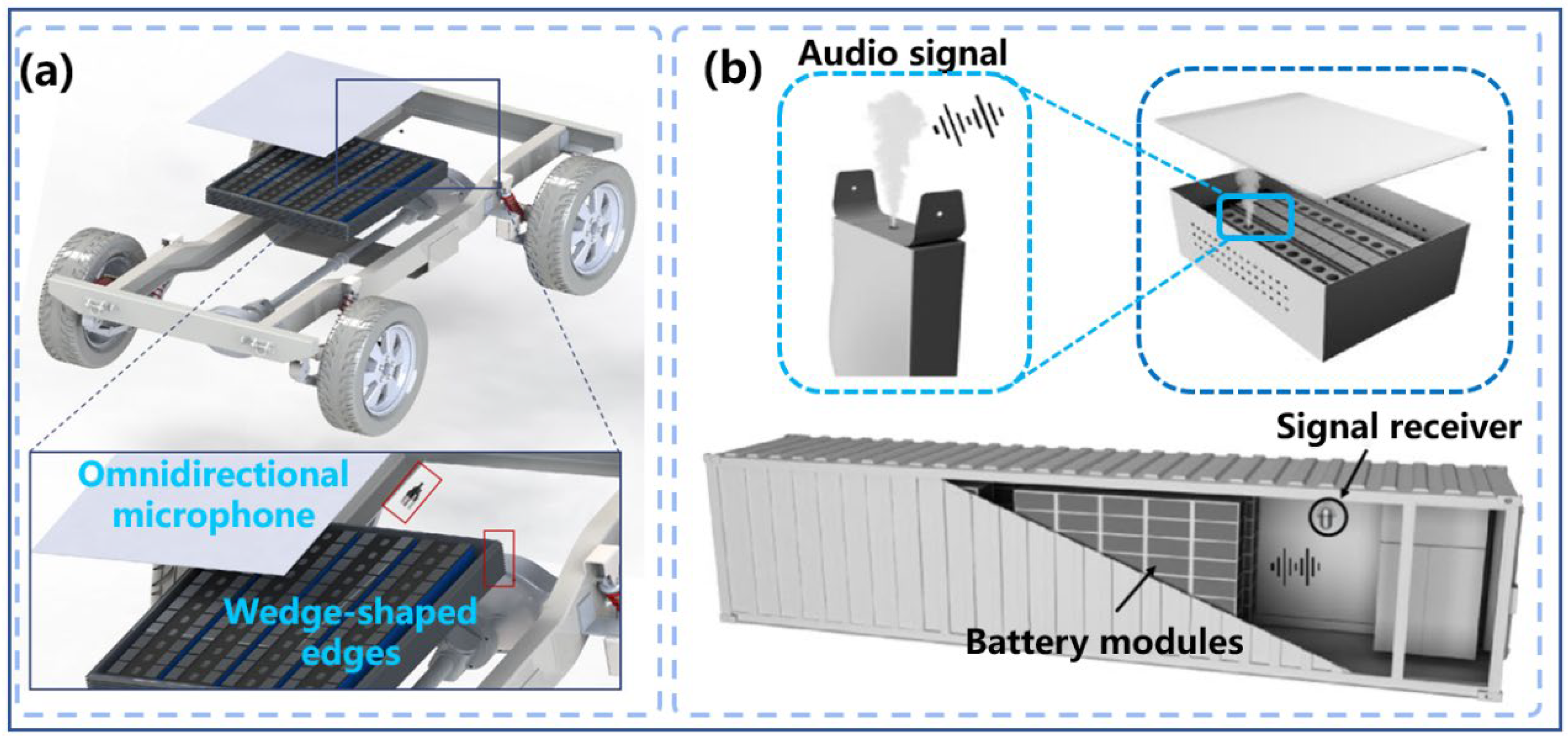
Non-contact acoustic sensors are employed to capture characteristic acoustic emissions during failure evolution, as illustrated in Figure 3. Zhu et al. [99] analyzed the acoustic signatures of prismatic battery thermal runaway using high-frequency wavelet packet energy ratio analysis. Su et al. [100] proposed a rapid and cost-effective acoustic-based warning method for megawatt-scale battery systems, achieving effective thermal runaway detection with an accuracy of 92.31%. Similarly, an acoustic early warning framework reported detection accuracies exceeding 90%, demonstrating the feasibility of sound-based approaches for timely fault identification [101].
Beyond detection, acoustic sensing has also been explored for fault localization. Lyu et al. [102] developed an acoustic-based alarm and localization method by deploying multiple sensors within an energy storage compartment to capture pressure-release sounds, achieving a maximum localization error of approximately 0.1 m. A two-stage acoustic early warning strategy was proposed to further improve detection reliability [103]. Similar with the gas detection, practical deployment of sound-based early warning remains challenging. Acoustic sensors are inherently susceptible to background noise and interference in complex operational environments, which can degrade detection accuracy. Moreover, the limited availability of real-world thermal runaway event data restricts model training, potentially constraining the robustness and generalization capability of machine learning–based approaches.
Acoustic sensors face severe background noise in EVs. Advanced spectral filtering is required, making this technology currently more viable for stationary ESS rather than dynamic automotive applications.

3.1.6. Optical Signal

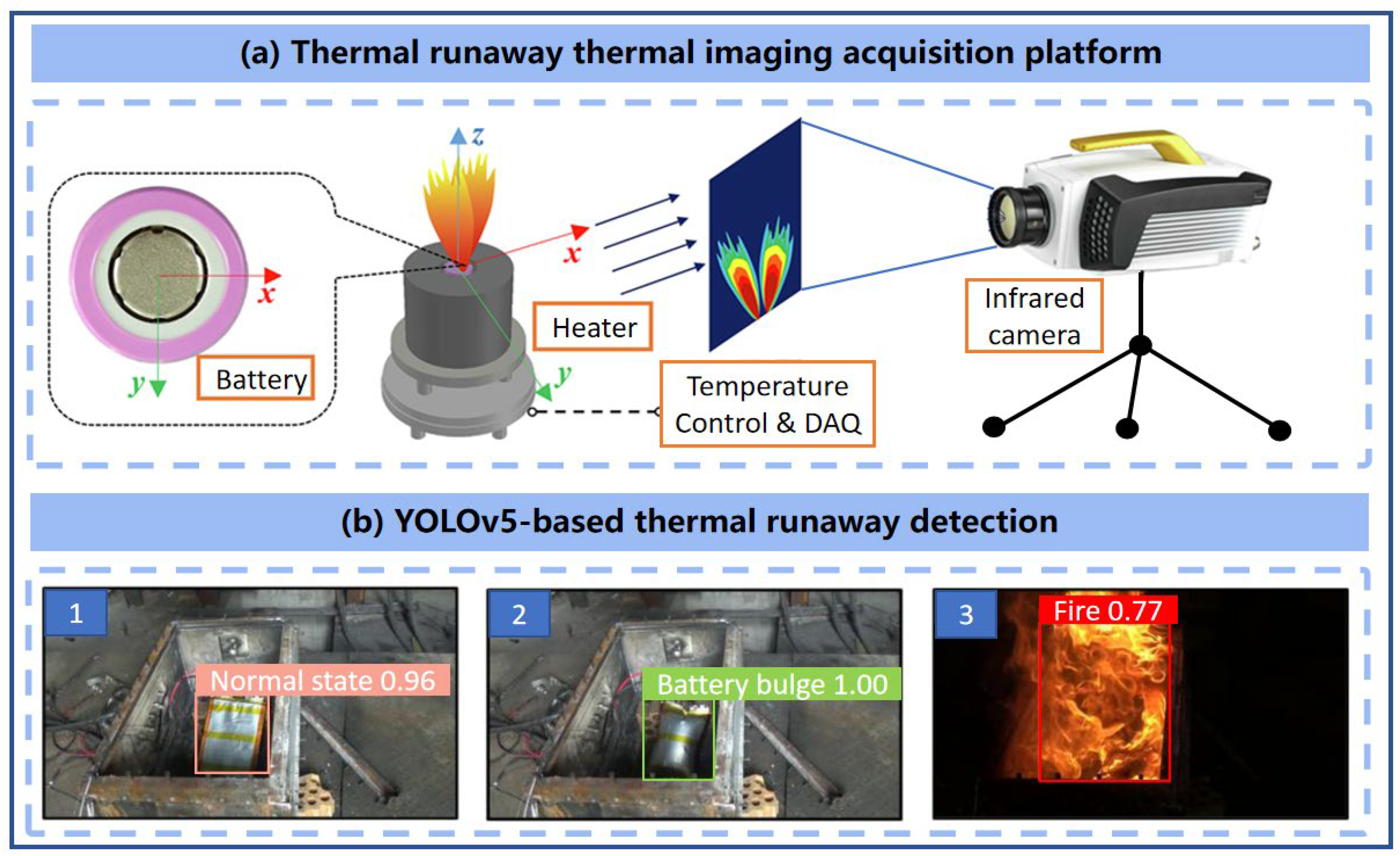
Machine vision has been applied to battery surface defect detection [104,105], and image-, video-, and thermal-imaging-based early warning has become an important direction [106]. These methods capture morphological and thermal abnormalities to enable early detection. Chen et al. [107] analyzed thermal imaging differences under varying SOC conditions, as shown in Figure 4a. Hong et al. [108] developed a YOLOv5-based algorithm that identifies normal, swollen, and thermal-runaway states with over 98% accuracy, as shown in Figure 4b. Ding et al. [109] incorporated thermal imaging into a multimodal neural network, integrating it with temperature and voltage data to achieve multi-step thermal-runaway prediction.
Optical methods are strictly limited by line-of-sight requirements. Densely packed modules obstruct internal views, rendering this method suitable primarily for open-rack storage systems or lab testing rather than enclosed EV battery packs.

3.1.7. Multidimensional Information Fusion

While Section 3.1.1, Section 3.1.2, Section 3.1.3, Section 3.1.4, Section 3.1.5 and Section 3.1.6 have extensively explored individual sensing methodologies, relying exclusively on a single signal source presents inherent risks for practical battery management systems. As systematically compared in Table 3, each detection principle possesses intrinsic limitations that can compromise safety reliability. Traditional voltage and temperature monitoring, despite their maturity and low cost, are often constrained by insensitivity to micro-shorts and significant thermal hysteresis, leading to delayed responses. Conversely, advanced methodologies such as gas analysis and mechanical expansion sensing offer superior lead times (5–15 min and 2–10 min, respectively) but are plagued by challenges like sensor breakage, integration complexity, and high costs. Similarly, acoustic and optical techniques, while enabling non-contact detection, are highly susceptible to environmental interference such as background noise and line-of-sight obstructions.
Thermal runaway is a multi-physics coupled process; thus, relying on any single feature risks false alarms or missed events under sensor faults or environmental interference [110,111]. Recent studies have established hierarchical early-warning frameworks based on multi-signal fusion, reporting high detection accuracy and enabling adaptive safety warnings through quantitative threshold design [112,113]. For instance, Feng et al. [114] integrated voltage, temperature, combustible gas, and pressure for diagnostic modeling, while Jia et al. [115] introduced a composite fiber Bragg grating parameter enabling simultaneous temperature and strain measurement. Li et al. [116] showed that mass change detection can issue warnings roughly two minutes sooner than temperature-based alerts. Xu et al. [117] constructed long-term consistency metrics for battery packs using voltage, temperature, internal resistance, and capacity, applying fuzzy AHP and entropy weighting to identify the lowest-consistency cell and thereby provide early thermal-runaway warnings.

3.2. Model-Based Methods

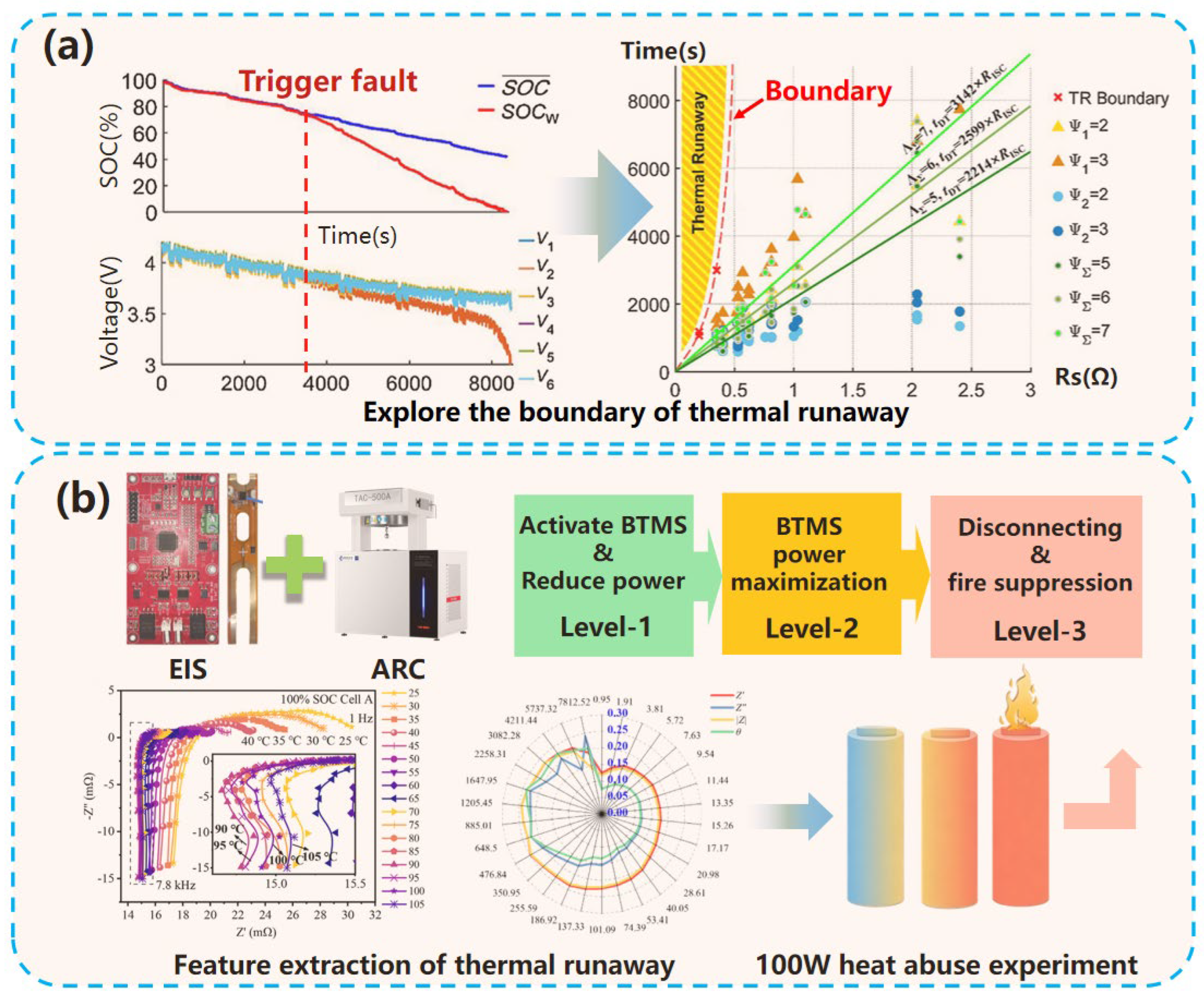
Model-based methods focus on identifying early abnormal battery states using equivalent circuit, electrochemical, and electrothermal coupling models [118]Equivalent circuit models are widely applied due to their low complexity and suitability for online estimation and fault detection [114,119], as shown in Figure 5a. Xu et al. [120] employed multiscale techniques by combining a fast PI observer with long-term SOC accumulation to enhance fault diagnosis. Recent work has also shifted from time-domain to frequency-domain analysis [121]. Electrochemical impedance spectroscopy (EIS), which captures intrinsic electrochemical changes, offers new opportunities for thermal-runaway warning, as shown in Figure 5b. Srinivasan et al. [122] showed that phase shifts at 40 Hz decrease with rising temperature due to reduced graphite–anode impedance. Spinner et al. [123] further demonstrated that the imaginary part of impedance decreases as internal temperature increases, enabling warnings before the onset of self-heating under abuse conditions.
Electrothermal coupling models based on equivalent circuits enable early anomaly detection before thermal runaway [124,125,126]. Chen et al. [127] constructed a 3D electrothermal model to simulate temperature fields under different charge/discharge rates and assess thermal propagation from a failed cell to neighboring cells. Zeng et al. [128] developed a 3D electrochemical–thermal model capturing the transition from normal charging to early overcharge, showing that irreversible heat dominates during normal operation, whereas Mn dissolution and Li deposition become primary heat sources during early overcharge, supporting a multi-stage overcharge warning strategy. Ren et al. [129] identified kinetic parameters for exothermic reactions using the Kissinger method and nonlinear fitting, establishing a prediction model that accurately forecasts critical thermal runaway temperatures. Feng et al. [130] proposed a bidirectionally coupled electrochemical–thermal failure prediction model capable of forecasting voltage drops, abnormal temperature rises, and quantifying heat contributions from internal short circuits during thermal runaway.

3.3. Data-Driven Thermal Runaway Prediction Method

3.3.1. Analysis-Based Method

To meet the power and capacity requirements of power batteries, cells are typically combined in parallel or series configurations. However, due to manufacturing inconsistencies [131] and temperature variations during operation [132], voltage inconsistencies are amplified. Consequently, analyzing battery pack voltage data streams is crucial for predicting thermal runaway in electric vehicles [133]. Wang et al. [134] proposed a voltage anomaly detection method based on modified sliding-window Shannon entropy, employing the z-score method to determine anomaly coefficient thresholds for early warning of potentially thermally runaway batteries. Similarly, Tang et al. [135] proposed a battery thermal runaway early warning strategy based on improved information entropy weighting. This approach identifies abnormal battery cells by averaging longitudinal outliers and evaluates pack consistency by integrating multidimensional operational data to reduce false positives. Its effectiveness was ultimately validated through real-vehicle thermal runaway experiments. Correlation coefficients quantify linear relationships among battery operating parameters. Li et al. [136] employed a multi-fault online diagnosis method combining non-redundant measurement topology with weighted Pearson correlation coefficients (WPCC). By weighting measurement data with varying forgetting factors, they localized distinct circuit faults. Although information analysis methods offer advantages such as simplicity, computational efficiency, and independence from complex electrochemical models, they heavily rely on large amounts of high-quality historical data and assume specific statistical distributions.

3.3.2. Machine Learning-Based Methods

With increasing data volumes and battery system complexity, machine learning has become a major direction for thermal runaway early warning. Its strengths in nonlinear modeling, automatic feature extraction, and efficient time series analysis enable effective real-time monitoring [137]. This section reviews deep learning, hybrid neural networks, time series models, few-shot and transfer learning, and physics-informed approaches.
Deep learning can automatically extract features from raw data, making it suitable for modeling the complex nonlinear evolution of thermal runaway. Ma et al. [138] combined wavelet analysis with an attention-based deep learning model to map time frequency representations for voltage and temperature joint alarms, achieving 8 to 13 min of advance prediction in practice. Building on architectural complementarity, Huang et al. [139] integrated convolutional neural networks, Transformer structures, and multilayer perceptrons to predict the remaining time before thermal runaway under high-rate conditions. Time series models naturally capture temporal dependencies in voltage and temperature signals. Zheng et al. [140] employed convolutional LSTMs with sliding windows to develop a charging protection strategy for hybrid vehicles, showing strong robustness to noise and enabling threshold design for early thermal-runaway prediction through residual analysis. However, training such models requires substantial computation and large labeled datasets, which is difficult given the scarcity of real thermal runaway incidents and increases the risk of overfitting.
Few-shot learning and transfer learning offer solutions to the scarcity of labeled thermal runaway data by enabling models to learn effectively from limited samples. Dong et al. [141] proposed an MDTL-FSL framework that transfers knowledge from multiple related source domains, selects source domains with distributions close to the target to avoid negative transfer, and uses adversarial learning and meta-learning to extract domain-invariant features and optimize decision boundaries. This method achieves early warnings across diverse battery types and conditions. Yang et al. [142] introduced a data augmentation strategy combining transfer learning with conditional GANs, where transfer learning mitigates target-domain data scarcity and GANs generate physically plausible fault samples. This approach improves recall and F1 scores under few-shot conditions, though excessive reliance on sparse samples may reduce discriminative ability on abundant normal data, and transfer learning lacks interpretability and may degrade performance when domain gaps are large.
Physics-informed approaches improve interpretability by incorporating physical equations into models. Luo et al. [143] embedded physical relationships among strain, temperature, and state of charge into the loss function, enhancing accuracy and generalization of a multi-physics state model. Residuals from this high-precision PINN enabled reliable early warnings of overcharge-induced thermal runaway. Zhang et al. [144] coupled an equivalent circuit model with a thermal model and extended a Kalman filter observer with a bidirectional LSTM to learn uncertainties, allowing the system to distinguish faults from disturbances. Although physics-informed fusion improves extrapolation and interpretability, it depends on accurate physical models.
Although the accuracy of machine learning models is high in laboratory settings, their practical application in battery management systems (BMS) still faces numerous challenges. One of the main obstacles is the domain bias caused by battery aging or differences in battery types, which requires the use of strategies such as transfer learning to maintain their performance throughout their entire lifecycle [145]. Additionally, environmental noise may mimic fault characteristics, which necessitates the use of robust algorithms with signal denoising capabilities and trained with synthetic noise [146]. Furthermore, given the severe class imbalance problem in rare thermal runaway events, evaluation metrics must prioritize F1 score over simple accuracy to ensure safety while also considering user experience [147]. Before industrial deployment, standardized tests under various operating conditions are required to verify the model’s immunity to non-fault anomalies [148].

3.3.3. Large Model-Driven Method

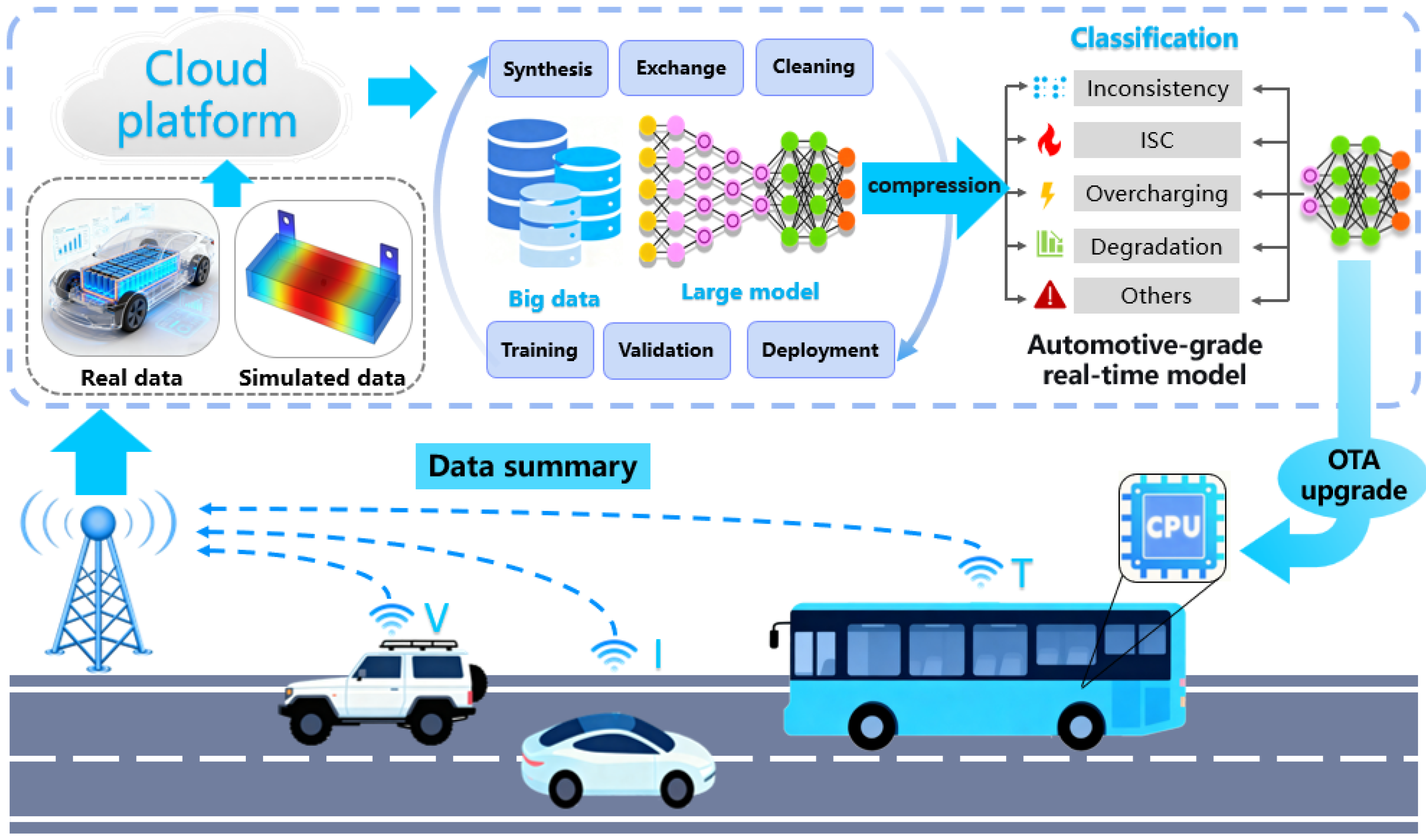
Compared with traditional threshold-based and single-sensor thermal runaway warning methods, model-driven systems built on large-scale battery models achieve a substantial advance. Notably, the scale of large models and their dataset requirements differ substantially from those of conventional machine learning models. Traditional machine learning models typically involve parameter scales below 106, whereas recent Transformer-based architectures designed for battery applications generally range from several million to tens of millions of parameters, as reported in recent studies. Correspondingly, these models often rely on larger datasets on the order of 105 to 106 training samples or long-duration electrochemical time-series data to ensure stable convergence and robust cross-condition performance. Conventional approaches cannot effectively capture early and subtle fault features under multi-factor coupling, leading to delayed detection and high false alarm rates [149,150]. In contrast, large-scale models use massive parameters to approximate complex nonlinear behavior and extract microscopic indicators of failures such as consistency degradation, internal short circuits, and overcharge from multi-source data. This enables a shift from passive threshold triggering to proactive mechanism-based inference, greatly improving both the accuracy and early-warning capability of thermal runaway prediction [151,152].
The core of this advanced system is the construction of a high-quality big data foundation. On cloud platforms, multi-source heterogeneous data from real vehicle operation and battery simulations are integrated and processed to form a large-scale dedicated battery dataset [153,154]. This dataset spans the full lifecycle from production to recycling and captures battery behavior under both typical and extreme conditions [155], providing essential support for training large models capable of understanding complex battery mechanisms. The increased architectural complexity of large models also results in higher inference latency. Reported inference times on embedded or edge computing platforms commonly range from several tens to over one hundred milliseconds, depending on model depth and input sequence length. In contrast, conventional methods such as Support Vector Machines (SVMs) and Random Forest (RF) typically achieve inference latency below 10 ms under similar deployment conditions. Consequently, while traditional machine learning models can be deployed directly on local battery management system microcontrollers, large model-driven approaches often require cloud-edge collaborative architectures to balance computational demand and deployment feasibility. This factor represents an important consideration for practical implementation.
At the large model layer, the cloud uses this high-quality dataset to drive continuous pre-trained model optimization [156]. To meet industrial needs, domain-specific fine-tuning based on general foundational models is widely adopted, enabling high-performance models for tasks such as thermal runaway warning with reduced data and computational requirements [157,158]. The trained models are then distilled into lightweight versions through quantization and pruning, making them suitable for real-time inference on vehicle-grade edge devices [159].
The system’s dynamic intelligence relies on efficient cloud–edge collaboration. At the edge, lightweight onboard models perform millisecond-level inference to provide instant detection and rapid response to thermal runaway risks. Edge devices conduct localized processing of signals including current, voltage, temperature, ambient conditions, road status, humidity, and geographic information [160]. In the cloud, continuously uploaded key summaries support large-scale model retraining and validation, enabling ongoing model evolution. Updated model capabilities are deployed across the fleet via OTA, forming a closed-loop in which data-driven model improvement enhances edge performance. This collaborative architecture integrates operational data with simulation results to enable comprehensive battery state assessment and safety early warning through big data analytics. The entire process based on the Large Model-Driven early warning system is shown in Figure 6.
Zhao et al. [161] systematically reviewed deep learning methods for lithium-ion battery health prediction under multi-physical and multi-scale conditions, organized publicly available battery datasets, and discussed key techniques including Transformer-based architectures and transfer learning. Their reported results indicate that large-scale pre-trained models can achieve approximately 5% to 15% improvements in F1 scores in cross-domain transfer tasks compared with conventional machine learning baselines. This quantitative improvement suggests enhanced robustness against variations caused by battery aging and operating condition shifts, supporting the practical advantages of large model-driven approaches in complex application scenarios.
Despite the transformative potential of large model-driven methods, their industrial deployment faces three critical hurdles that require further benchmarking. First, data scarcity remains a primary bottleneck; high-quality, labeled thermal runaway datasets are rare due to the destructive and costly nature of abuse testing. While strategies like transfer learning and few-shot learning [162,163] show promise, model robustness under rare failure modes remains to be rigorously validated. Second, computational constraints on edge BMS chips often conflict with the heavy inference requirements of large models. Although model quantization and pruning [164] can reduce complexity, deploying high-parameter models without compromising the millisecond-level response time required for safety-critical protection remains a significant challenge [165]. Third, data privacy and security concerns arise when transmitting high-fidelity battery data to cloud platforms. To address this, recent studies have proposed federated learning frameworks that allow collaborative model training without exposing raw sensitive user data [166]. Consequently, future research must establish standardized benchmarks that evaluate not only prediction accuracy but also inference latency, data privacy compliance, and robustness under data-sparse conditions.

3.4. Summary of Prediction Strategies

Section 3.1, Section 3.2 and Section 3.3 have extensively detailed the operational principles of individual detection methodologies. However, the practical selection of an early-warning strategy for battery management systems necessitates a rigorous trade-off analysis between performance metrics and implementation constraints. Signal-based methods, while currently dominating industrial applications due to their high maturity and cost-effectiveness, are often limited by the physical latency of signal propagation such as heat conduction time or sensor susceptibility to environmental noise. Model-based approaches offer a theoretical advantage by estimating internal states that are not directly measurable, yet their real-time deployment is frequently hindered by the heavy computational burden and the difficulty of accurate parameter identification over the battery lifecycle. In contrast, emerging data-driven techniques demonstrate superior capabilities in capturing complex and non-linear fault patterns while extending warning lead times significantly, although they currently grapple with challenges related to data scarcity and model interpretability.
To provide a holistic decision-making framework, Table 4 systematically synthesizes and compares these three primary prediction categories. This quantitative summary highlights the distinct differences in critical indicators including lead time, detection accuracy, industrial maturity, and deployment costs. The aim is to guide researchers and engineers in selecting the most appropriate strategies tailored to specific application scenarios ranging from cost-sensitive electric vehicles to safety-critical stationary energy storage systems.

4. Thermal Runaway Suppression Method

4.1. Thermal Management for Suppressing Early Heat Accumulation

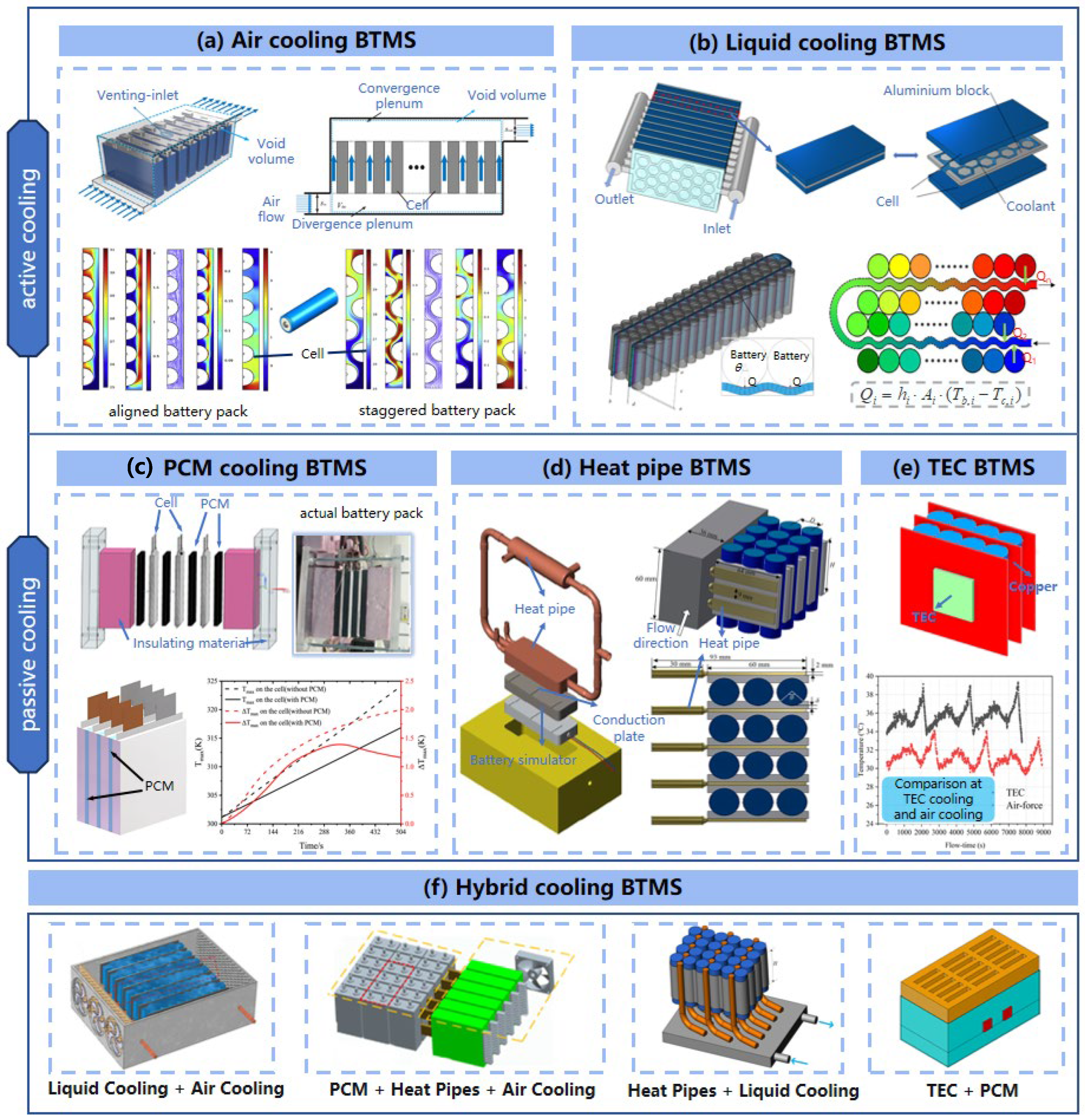
The lithium-ion battery thermal management system serves as an indispensable safeguard for ensuring battery safety, capable of effective intervention against early-stage heat generation. A variety of thermal management strategies have been developed, which can be broadly categorized into active cooling, passive cooling, and hybrid cooling, as illustrated in Figure 7.
(1)
Air cooling system
Air convection and nitrogen suppression are the main forms of air-cooling BTMS [167]. As shown in Figure 7a, Airflow can moderate pack temperature and lower gas concentration and explosion risk during thermal runaway [168], while pack arrangement and airflow design strongly influence cooling performance [169,170,171,172]. Bidirectional-flow structures further reduce peak temperature from 42.3 °C to 33.1 °C [76]. Nitrogen cooling can dilute oxygen and delay combustion [173]. Air cooling is simple and inexpensive but limited by low thermal conductivity and weak universality.
(2)
Liquid cooling system
Liquid cooling provides higher heat transfer capability via direct or indirect contact, offering better temperature uniformity [174]. As depicted in Figure 7b, Silicone oil immersion achieves both rapid cooling and oxygen isolation with pack temperature controlled within 17.5–32.8 °C [175]. Water and nanofluid coolants show modest improvements [176], while optimized flow channels and microchannel plates significantly lower maximum temperature and temperature gradients (<2–5 °C) [177,178,179,180]. Liquid cooling offers excellent uniformity but increases system weight and power consumption, reducing usable SOC [181].
(3)
Phase change material
Phase change material (PCM) can absorb large amounts of heat and offer low cost and high stability [182]. As shown in Figure 7c, Coupling PCMs with thermoelectric devices can maintain ΔT < 5 K and long cooling duration [183]. PCM coatings improve heat transfer [184], and numerical studies confirm reduced peak temperatures and gradients [185]. Composite PCMs using graphene, copper foam, or expanded graphite greatly enhance thermal conductivity and reduce battery temperature rise by 5–20 °C [186,187,188,189,190]. PCMs have strong lightweight potential and are often combined with air or liquid cooling for improved performance [191].
(4)
Heat pipe system
Heat pipes enable passive, high-conductivity heat transfer using phase-change cycling [192]. As illustrated in Figure 7d, They offer low maintenance and high efficiency in EV BTMS [193]. Experiments show heat pipes maintain pack temperatures below 50 °C and temperature differences under 5 °C at moderate heat loads [194]. CFD-validated designs reveal that structural parameters, especially conductive-element height, strongly affect thermal distribution, achieving 27.6 °C maximum and 1.1 °C gradient [195]. Heat pipes also support cooling and rapid heating (−20 °C to 0 °C in ~500 s) under extreme conditions [196]. Integration complexity and cost remain challenges.
(5)
Thermoelectric cooler system
Thermoelectric coolers (TECs) enable precise, zonal temperature control using the Peltier effect [197]. As shown in Figure 7e, Advanced control strategies such as spectral modeling and NMPC improve temperature regulation accuracy [198]. Cold plate temperature significantly affects uniformity [199], while TEC-integrated copper-plate systems outperform forced air cooling and reduce cell temperature by 4–5 °C with gradients below 3 °C [175]. However, TEC efficiency is low and energy consumption is high, so TECs are generally auxiliary components [200].
(6)
Hybrid cooling system
Hybrid systems combine air, liquid, PCM, and heat pipes to exploit complementary advantages. As summarized in Figure 7f, Liquid–air systems can maintain <33.6 °C and <5 °C gradients under 4C discharge [201]. PCM–liquid systems limit peak temperature to 39.4 °C and delay thermal-propagation during runaway [190]. Heat-pipe–liquid systems keep pack temperatures <40 °C with improved uniformity [202]. Heat-pipe–PCM split systems further lower peak temperatures by 7.6 °C compared with conventional PCM designs [203]. Hybrid cooling thus provides robust thermal control under complex duty cycles.
Figure 7. Based on thermal management system to suppress early heat accumulation. (a) Air cooling BTMS [166,167]; (b) Liquid cooling BTMS [177,186]; (c) PCM cooling BTMS [178,185]; (d) Heat pipe BTMS [192,195]; (e) TEC BTMS [197]; (f) Hybrid cooling BTMS, including liquid cooling + air cooling, PCM + heat pipes + air cooling, heat pipes + liquid cooling, and TEC + PCM [183,201,202,203].
Batteries 12 00088 g007

4.2. Material-Based Suppression of Side Reactions

Material-level optimization can effectively suppress mid-term parasitic reactions, enhance cycling life, and improve long-term stability of lithium-ion batteries.

4.2.1. Positive Electrode Improvements

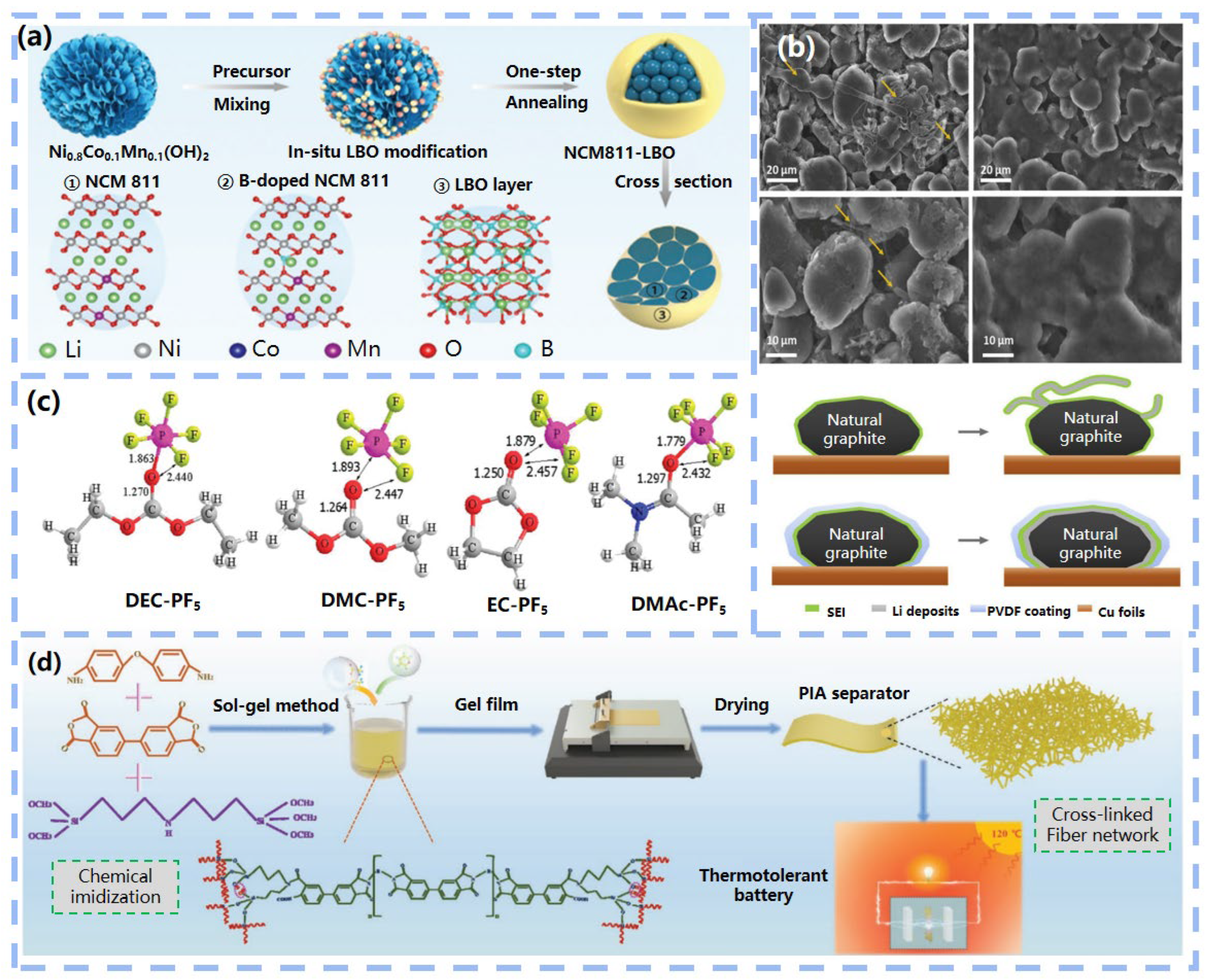
Surface coatings such as phosphates, fluorides and oxides enhance cathode thermal stability by isolating active materials from electrolytes and reducing heat generation from interfacial side reactions [204,205,206]. Synergistic bulk surface strategies, such as boron doping combined with Li2B4O7 coating for NCM811, effectively suppress oxygen release and interfacial decomposition while enhancing lithium-ion transport [207]. FePO4 coatings greatly improve overcharge resistance [206], whereas AlF3 coatings increase the thermal runaway onset temperature by nearly 20 °C. Element substitution or doping (Ni, Cu, etc.) improves lattice stability, diffusion kinetics and thermal behavior of layered and spinel cathodes [208,209,210].

4.2.2. Negative Electrode Improvements

Negative electrodes produce substantial heat once the SEI decomposes at elevated temperatures. Stabilizing the SEI through polymer or inorganic coatings helps suppress dendrite growth, improve cycling efficiency and reduce charge transfer resistance [211,212,213,214,215,216]. Mild oxidation can form dense oxide layers that enhance thermal stability and suppress exothermic reactions. Artificial SEI films based on inorganic oxides or polymers improve rate capability, high-temperature endurance and can even act as thermal shut-down barriers during overheating.

4.2.3. Electrolyte Improvements

Electrolyte flammability and high reactivity accelerate heat and gas generation during abuse. Safety enhancements include flame retardants, overcharge additives, thermally stable lithium salts, polymer or inorganic solid electrolytes, and ionic liquid or thermosensitive formulations [217,218]. Alternative salts such as lithium difluoro phosphate and imide-based lithium salts offer significantly improved thermal stability and resistance to decomposition compared with conventional LiPF6 [219,220]. Additives like DMAc improve high-temperature cycling and stabilize SEI compositions on both anode and cathode surfaces [221]. Chelated borate salts exhibit high decomposition thresholds (approximately 293 °C) [222]. Additives including EC, FEC, phosphates and fluorinated carbonates suppress SEI breakdown, reduce oxygen release and lower overall heat generation [223,224,225,226].

4.2.4. Separator Improvements

High-temperature-resistant separators reduce shrinkage and delay internal short-circuit formation. Polyimide aerogel membranes provide excellent ionic conductivity and structural stability at temperatures up to 120 °C [227]. Multilayer PP/PE/PP or PET membranes offer added thermal robustness [228,229], while ceramic and silica coatings further enhance heat resistance [230,231]. Thermoplastic polyurethane separators can react with PF5-derived species to form insulating layers under overheating, effectively isolating oxygen and improving flame retardancy [232].

4.2.5. Synergistic Effects and Full-Cell Performance

While single-component modifications are effective, the systemic safety of full cells is ultimately dictated by the intrinsic boundaries of the least stable constituent [233]. Wu et al. [234] found that the combined use of a thermally stable cathode and a functionalized electrolyte yields a safety margin superior to linear superposition. Similarly, Zhu et al. [235] leveraged the superior interfacial compatibility between composite separators and high-flash-point electrolytes, with both strategies significantly elevating the thermal runaway triggering threshold and suppressing peak heat release rates. Furthermore, advanced structural designs, such as the microencapsulation of flame retardants within separators [236], effectively resolve the trade-off between flame retardancy efficiency and kinetics. In summary, shifting from single-point breakthroughs to system-level synergy is crucial for reconciling the safety–performance trade-off in high-energy-density batteries.

4.3. Structural Strategies for Suppressing Late-Stage Deterioration

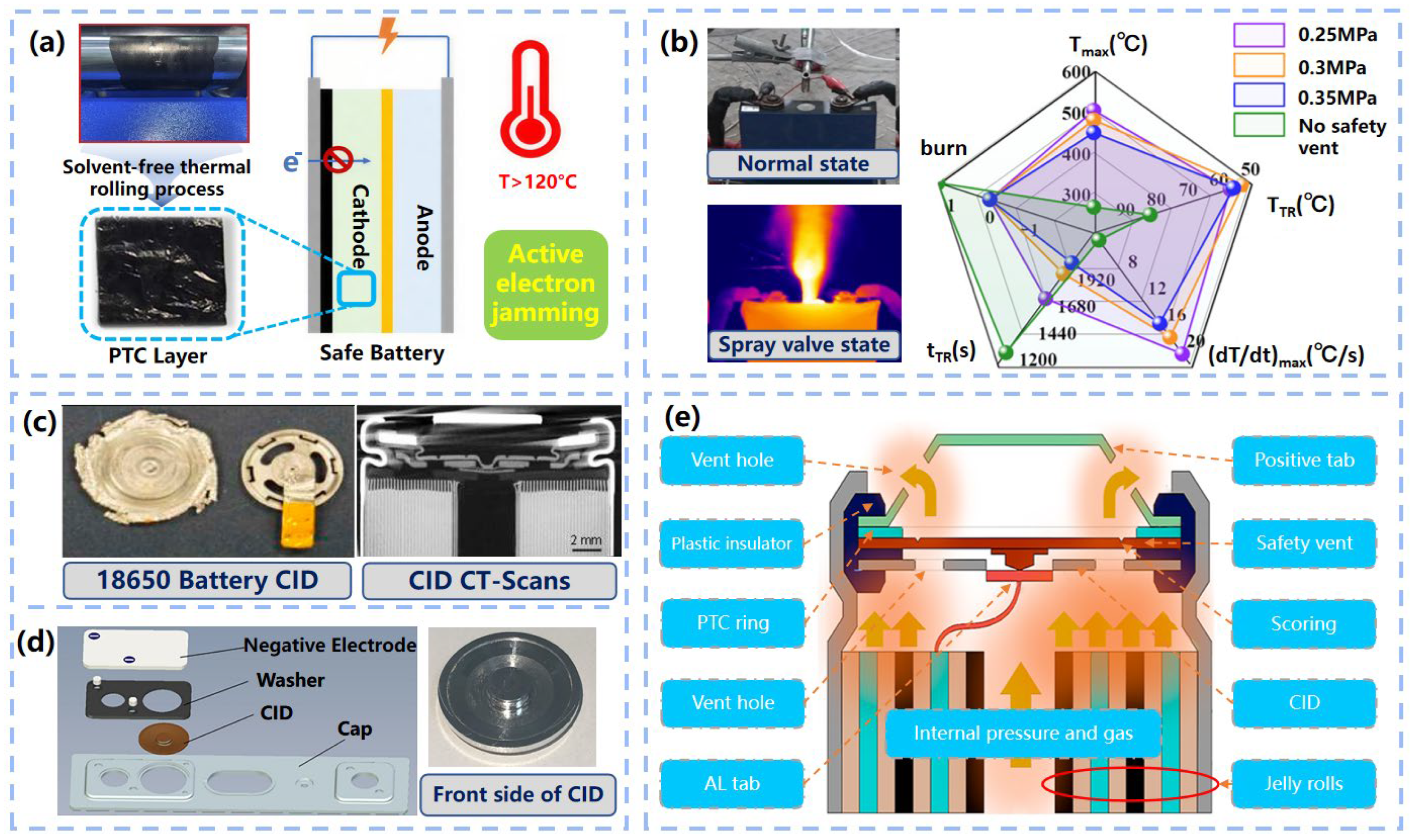
Structural protection focuses on responding to intrinsic signals such as pressure rise and resistance changes, enabling timely intervention to prevent propagation and shift battery safety from passive protection toward proactive early warning. This approach relies on advanced material design and component engineering to inhibit mid-term reaction rates and enhance intrinsic stability, as illustrated in Figure 8.

4.3.1. Positive Temperature Coefficient (PTC) Thermistor

PTC conductive polymers provide current-limiting protection through sharp resistance increases near 100 °C [237,238,239]. Heating causes polymer expansion and separation of conductive particles, switching the device to a high-resistance state that reduces current load. Lyu et al. [240] demonstrated that TPU/PE/carbon composites produce a pronounced PTC jump near 120 °C, improving LiFePO4 battery safety and maintaining cycling stability under thermal stress, as shown in Figure 9a.

4.3.2. Safety Vent

During thermal runaway, rapid heat and gas generation sharply increase internal pressure; safety vents act as designed weak points to release pressure and delay catastrophic rupture [241]. Vent-driven airflow can even power self-triggered warning devices without external energy [242]. Vent-opening pressure (Psv) strongly affects thermal runaway severity: optimized Psv (~0.35 MPa) lowers peak temperature and reduces hazard levels, whereas overly high Psv risks internal overpressure [243], as shown in Figure 9b. In cylindrical cells, safety vents typically actuate above 100 °C and at pressures higher than CID thresholds [244], while pouch cells rely on sealant fracture strength for controlled venting [245].

4.3.3. Current Interruption Device (CID)

CID disconnects the battery circuit when internal pressure or temperature reaches critical levels, preventing further reaction escalation [246,247]. Mechanical deformation such as alloy creeps may trigger premature CID activation and reduce available safety margins [248]. High-pressure CID activation in series-connected cylindrical cells can also cause voltage imbalances and arcing risks [249]. In Figure 9c,d, we have presented the different types of safety valves for batteries. Pressure-responsive CIDs rely on metal-foil rupture, whereas temperature-responsive CIDs use low-melting-point thermal fuses operating around 85–120 °C. Since CID activation is irreversible, shape-memory-alloy-based reversible designs can mitigate permanent battery damage [250].
In Figure 9e, we present the arrangement patterns of various structures within the 18650 cylindrical battery, as well as the gas guidance mechanism when abnormal gas production occurs in the battery.
Figure 9. Thermal runway suppression via battery design. (a) PTC Principle [240]; (b) Safety Vent: With vs. Without [242,243]; (c) CID in Prismatic Cells [246]; (d) CID in Cylindrical Cells [248]; (e) 18650 Battery Cross-section.
Batteries 12 00088 g009

5. Future Perspectives and Outlook

Despite significant progress in understanding thermal runaway mechanisms and developing mitigation strategies, a critical gap remains between laboratory research and industrial deployment. Future research should focus on three prioritized phases to realize intrinsically safe energy storage systems.
The immediate priority is the standardization of abuse testing and evaluation protocols. Currently, the lack of unified testing standards constitutes a major barrier, resulting in poor comparability across studies. Future protocols must establish standardized methodologies and datasets encompassing realistic failure triggers rather than extreme, idealized conditions, ensuring high inter-laboratory consistency in recording critical safety parameters.
Algorithmically, research should emphasize integrating physics-informed intelligence with cloud-edge synergy to address the generalization and interpretability challenges of data-driven methods. Electrochemical principles must be embedded into neural network loss functions to ensure the physical plausibility of predictions even under data-sparse conditions. Efforts should center on “cloud-training, edge-inference” architectures to achieve minimal false alarm rates while maintaining high recall rates for thermal runaway events. Additionally, overcoming data privacy barriers via federated learning to enable collaborative model training without exposing raw data is a key research focus.
From the battery perspective, the ultimate goal is to eliminate thermal runaway through material innovation and intrinsic safety design. Research must address interfacial impedance and dendrite growth in solid-state electrolytes to develop components that remain non-flammable even at elevated temperatures. Simultaneously, developing “self-immunizing” materials is a promising direction, such as separators that terminate ion transport prior to thermal runaway onset or current collectors that drastically increase resistance upon short-circuiting. The vision is to achieve cell-level non-propagation, ensuring that a single-cell failure never escalates into a pack-level fire.

6. Conclusions

With the rapid expansion of lithium-ion battery applications, ensuring their safety has become an urgent scientific and engineering challenge. Thermal runaway remains the most critical failure mode, and understanding its evolution—initiated when heat generation persistently exceeds heat dissipation—provides the foundation for prediction and suppression strategies. Once the internal temperature rises, coupled electrochemical, thermal, and mechanical reactions accelerate, forming a positive feedback loop that eventually triggers catastrophic failure.
This review summarizes the current progress in the mechanism, prediction and early warning, and suppression strategies for thermal runaway. Existing early-warning approaches primarily rely on external sensing or internal state estimation. Single-signal monitoring offers high specificity and fast response, yet is inherently vulnerable to noise, sensor degradation, and multi-physics coupling effects. Consequently, multi-dimensional perception and fusion-based frameworks have emerged, enabling cross-verified risk assessment and substantially improving early-warning accuracy and lead time through collaborative analysis of heterogeneous signals. State-estimation-based methods further strengthen predictive capability by inferring internal reaction states beyond what external signals alone can capture.
Further improving battery safety requires a deeper, more systematic understanding of thermal runaway evolution under diverse fault and operating conditions. Key priorities include revealing the universal and fault-specific characteristics of thermal runaway, establishing quantitative correlations between multi-physics parameters and runaway risks, and developing predictive models with higher universality, robustness, and interpretability. On the mitigation side, advances in high-efficiency thermal management, intrinsically stable materials, and intelligent structural protection will remain essential for balancing safety with high energy density and long-term durability. These research directions will collectively support the development of next-generation lithium-ion batteries with substantially improved intrinsic safety.

Funding

This work was funded by the National Natural Science Foundation of China (U23B20139) and the Fundamental Research Funds for the Central Universities (N2403013).

Data Availability Statement

Data is contained within the article.

Conflicts of Interest

The authors declare no conflict of interest.

References

  1. Tran, M.K.; Sherman, S.; Samadani, E.; Vrolyk, R.; Wong, D.; Lowery, M.; Fowler, M. Environmental and economic benefits of a battery electric vehicle powertrain with a zinc–air range extender in the transition to electric vehicles. Vehicles 2020, 2, 398–412. [Google Scholar] [CrossRef]
  2. Tran, M.K.; DaCosta, A.; Mevawalla, A.; Panchal, S.; Fowler, M. Comparative study of equivalent circuit models performance in four common lithium-ion batteries: LFP, NMC, LMO, NCA. Batteries 2021, 7, 51. [Google Scholar] [CrossRef]
  3. Tran, M.K.; Akinsanya, M.; Panchal, S.; Fraser, R.; Fowler, M. Design of a hybrid electric vehicle powertrain for performance optimization considering various powertrain components and configurations. Vehicles 2020, 3, 20–32. [Google Scholar] [CrossRef]
  4. Tran, M.K.; Cunanan, C.; Panchal, S.; Fraser, R.; Fowler, M. Investigation of individual cells replacement concept in lithium-ion battery packs with analysis on economic feasibility and pack design requirements. Processes 2021, 9, 2263. [Google Scholar] [CrossRef]
  5. Yu, Q.; Wang, C.; Li, J.; Fan, L.; Liu, S.; Xiong, R. Bridging lab to industry: Deep learning cuts testing time for lithium metal battery health models. Energy Storage Mater. 2025, 83, 104748. [Google Scholar] [CrossRef]
  6. Tran, M.K.; Mathew, M.; Janhunen, S.; Panchal, S.; Raahemifar, K.; Fraser, R.; Fowler, M. A comprehensive equivalent circuit model for lithium-ion batteries, incorporating the effects of state of health, state of charge, and temperature on model parameters. J. Energy Storage 2021, 43, 103252. [Google Scholar] [CrossRef]
  7. Ren, D.; Feng, X.; Liu, L.; Hsu, H.; Lu, L.; Wang, L.; He, X.; Ouyang, M. Investigating the relationship between internal short circuit and thermal runaway of lithium-ion batteries under thermal abuse condition. Energy Storage Mater. 2021, 34, 563–573. [Google Scholar] [CrossRef]
  8. Xie, X.; Gan, H.; Yang, G. Analysis and prediction of mechanical response of cylindrical lithium batteries under compression conditions. Eng. Res. Express 2025, 7, 045557. [Google Scholar] [CrossRef]
  9. Liu, S.; Guo, Q.; Zhang, J.; Huang, Z.; Han, D. Investigation on thermal runaway behaviors and gas generation dynamics of lithium-ion batteries induced by electrical abuse at low-pressure conditions. J. Energy Storage 2025, 125, 116855. [Google Scholar]
  10. Li, Z.; Niu, H.; Jiang, X. Simulation of electrical abuse of high-power lithium-ion batteries. Energy Procedia 2017, 142, 3468–3473. [Google Scholar] [CrossRef]
  11. Meng, D.; Wang, Y.; Wang, J.; Liu, Z.; Li, H. Investigation of thermal runaway characteristics of lithium-battery under discharging condition coupled with thermal abuse. Process Saf. Environ. Prot. 2025, 203, 107877. [Google Scholar] [CrossRef]
  12. Zhang, J.; Li, S.; Guo, Q.; Xu, C.; Huang, Z.; Han, D. Multidimensional signal evolution during nail-penetration-induced thermal runaway in lithium-ion batteries with different states of charge: An optical investigation. Energy 2025, 334, 137320. [Google Scholar] [CrossRef]
  13. Sun, P.; Bisschop, R.; Niu, H.; Huang, X. A Review of Battery Fires in Electric Vehicles. Fire Technol. 2020, 56, 1361–1410. [Google Scholar] [CrossRef]
  14. Wang, Q.; Ping, P.; Zhao, X.; Chu, G.; Sun, J.; Chen, C. Thermal runaway caused fire and explosion of lithium ion battery. J. Power Sources 2012, 208, 210–224. [Google Scholar] [CrossRef]
  15. ASTM E1981; Standard Guide for Assessing Thermal Stability of Materials by Methods of Accelerating Rate Calorimetry. ASTM International: West Conshohocken, PA, USA, 2026.
  16. Underwriters Laboratories Inc. Standard for Batteries for Use in Electric Vehicles; UL 2580, Underwriters Laboratories Inc.: Northbrook, IL, USA, 2020. [Google Scholar]
  17. Finegan, D.P.; Scheel, M.; Robinson, J.B.; Tjaden, B.; Hunt, I.; Mason, T.J.; Millichamp, J.; Di Michiel, M.; Offer, G.J.; Hinds, G.; et al. In-operando high-speed tomography of lithium-ion batteries during thermal runaway. Nat. Commun. 2015, 6, 6924. [Google Scholar] [CrossRef]
  18. SAE J2464; Electric and Hybrid Electric Vehicle Rechargeable Energy Storage System (RESS) Safety and Abuse Testing. SAE International: Warrendale, PA, USA, 2021.
  19. GB 38031; Electric Vehicles Traction Battery Safety Requirements. Standardization Administration of China: Beijing, China, 2020.
  20. Abaza, A.; Ferrari, S.; Wong, H.K.; Lyness, C.; Moore, A.; Weaving, J.; Blanco-Martin, M.; Dashwood, R.; Bhagat, R. Experimental study of internal and external short circuits of commercial automotive pouch lithium-ion cells. J. Energy Storage 2018, 16, 211–217. [Google Scholar] [CrossRef]
  21. ISO 12405; Electrically Propelled Road Vehicles—Test Specification for Lithium-Ion Traction Battery Packs and Systems. International Organization for Standardization: Geneva, Switzerland, 2018.
  22. Zhu, J.; Zhang, X.; Sahraei, E.; Wierzbicki, T. Deformation and failure mechanisms of 18650 battery cells under axial compression. J. Power Sources 2016, 336, 332–340. [Google Scholar] [CrossRef]
  23. United Nations. UN Manual of Tests and Criteria, Part III, Subsection 38.3; UN 38.3; United Nations: Geneva, Switzerland, 2025. [Google Scholar]
  24. ISO 16750; Road Vehicles—Environmental Conditions and Testing for Electrical and Electronic Equipment. International Organization for Standardization: Geneva, Switzerland, 2023.
  25. Hooper, J.M.; Marco, J.; Chouchelamane, G.H.; Lyness, C. Vibration Durability Testing of Nickel Manganese Cobalt Oxide (NMC) Lithium-Ion 18,650 Battery Cells. Energies 2016, 9, 52. [Google Scholar] [CrossRef]
  26. IEC 62133; Secondary Cells and Batteries Containing Alkaline or Other Non-Acid Electrolytes—Safety Requirements for Portable Sealed Secondary Cells. International Electrotechnical Commission: Geneva, Switzerland, 2021.
  27. Feng, X.; Ouyang, M.; Liu, X.; Lu, L.; Xia, Y.; He, X. Thermal runaway mechanism of lithium ion battery for electric vehicles: A review. Energy Storage Mater. 2018, 10, 246–267. [Google Scholar] [CrossRef]
  28. GB/T 31485; Safety Requirements and Test Methods for Traction Battery of Electric Vehicle. Standardization Administration of China: Beijing, China, 2015.
  29. Rheinfeld, A.; Sturm, J.; Noel, A.; Wilhelm, J.; Kriston, A.; Pfrang, A.; Jossen, A. Quasi-Isothermal External Short Circuit Tests Applied to Lithium-Ion Cells: Part II. Modeling and Simulation. J. Electrochem. Soc. 2019, 166, A151–A177. [Google Scholar] [CrossRef]
  30. Underwriters Laboratories Inc. Standard for Lithium Batteries; UL 1642; Underwriters Laboratories Inc.: Northbrook, IL, USA, 2020. [Google Scholar]
  31. Guo, R.; Lu, L.; Ouyang, M.; Feng, X. Mechanism of the entire overdischarge process and overdischarge-induced internal short circuit in lithium-ion batteries. Sci. Rep. 2016, 6, 30248. [Google Scholar] [CrossRef] [PubMed]
  32. Hendricks, C.; Williard, N.; Mathew, S.; Pecht, M. A failure modes, mechanisms, and effects analysis (FMMEA) of lithium-ion batteries. J. Power Sources 2015, 297, 113–120. [Google Scholar] [CrossRef]
  33. United Nations Economic Commission for Europe (UNECE). Global Technical Regulation on the Electric Vehicle Safety (EVS); GTR No. 20; United Nations Economic Commission for Europe (UNECE): Geneva, Switzerland, 2025. [Google Scholar]
  34. Coman, P.T.; Darcy, E.C.; Veje, C.T.; White, R.E. Numerical analysis of heat propagation in a battery pack using a novel technology for triggering thermal runaway. Appl. Energy 2017, 203, 189–200. [Google Scholar] [CrossRef]
  35. Feng, X.; Lu, L.; Ouyang, M.; Li, J.; He, X. A 3D thermal runaway propagation model for a large format lithium ion battery module. Energy 2016, 115, 194–208. [Google Scholar] [CrossRef]
  36. Feng, X.; Zheng, S.; Ren, D.; He, X.; Wang, L.; Cui, H.; Liu, X.; Jin, C.; Zhang, F.; Xu, C.; et al. Investigating the thermal runaway mechanisms of lithium-ion batteries based on thermal analysis database. Appl. Energy 2019, 246, 53–64. [Google Scholar] [CrossRef]
  37. Chen, F.; Yang, F.; Chu, H.; Xu, J.; Yang, K.; Akoto, J.D.; Haider, A.; Wang, X.; Yang, J.; Liu, X.; et al. Electrochemical Modeling and Degradation Analysis of Lithium-Ion Batteries in High Temperature Environments. Battery Energy 2025, 5, e70050. [Google Scholar] [CrossRef]
  38. Zhang, H.; Peng, Y.; Hu, Y.; Pan, S.; Tang, S.; Luo, Y.; Liang, Y.; Liao, Y.; Lin, Y.; Zhang, K.; et al. Quantitative Analysis of Aging and Rollover Failure Mechanisms of Lithium-Ion Batteries at Accelerated Aging Conditions. Adv. Energy Mater. 2025, 15, 2404997. [Google Scholar] [CrossRef]
  39. Feng, X.; Sun, J.; Ouyang, M.; He, X.; Lu, L.; Han, X.; Fang, M.; Peng, H. Characterization of large format lithium ion battery exposed to extremely high temperature. J. Power Sources 2014, 272, 457–467. [Google Scholar] [CrossRef]
  40. Liu, W.; Zheng, J.; Zhang, Z.; Gu, J.; Chen, Z.; Jiang, H.; Tong, Y.; Fan, X.; Li, J.; Wang, M.; et al. The capacity decay mechanism of the 100% SOC LiCoO2/graphite battery after high-temperature storage. J. Power Sources 2023, 580, 233330. [Google Scholar] [CrossRef]
  41. Ryou, M.H.; Lee, J.N.; Lee, D.J.; Kim, W.K.; Jeong, Y.K.; Choi, J.W.; Park, J.K.; Lee, Y.M. Effects of lithium salts on thermal stabilities of lithium alkyl carbonates in SEI layer. Electrochim. Acta 2012, 83, 259–263. [Google Scholar]
  42. Kim, M.; You, H.M.; Jeon, J.; Lim, J.; Han, Y.; Kim, K.; Hong, J. Thermal decomposition mechanism of lithium methyl carbonate in solid electrolyte interphase layer of lithium-ion battery. Energy Storage Mater. 2024, 70, 103517. [Google Scholar] [CrossRef]
  43. Kim, M.; Ghoniem, A.F.; Hong, J. Primary exothermic reaction pathways between solid electrolyte interphases and electrolytes during the onset of thermal runaway in lithium-ion batteries. Energy Storage Mater. 2025, 81, 104537. [Google Scholar] [CrossRef]
  44. Wu, K.; Wu, X.; Lin, Z.; Sun, H.; Wang, M.; Li, W. Identifying the calendar aging boundary and high temperature capacity fading mechanism of Li ion battery with Ni-rich cathode. J. Power Sources 2024, 589, 233736. [Google Scholar] [CrossRef]
  45. Oka, H.; Nonaka, T.; Kondo, Y.; Makimura, Y. Quantification of side reactions in lithium-ion batteries during overcharging at elevated temperatures. J. Power Sources 2023, 580, 233387. [Google Scholar] [CrossRef]
  46. Richard, M.N.; Dahn, J.R. Accelerating rate calorimetry study on the thermal stability of lithium intercalated graphite in electrolyte. I. Experimental. J. Electrochem. Soc. 1999, 146, 2068. [Google Scholar] [CrossRef]
  47. Orendorff, C.J.; Lambert, T.N.; Chavez, C.A.; Bencomo, M.; Fenton, K.R. Polyester separators for lithium-ion cells: Improving thermal stability and abuse tolerance. Adv. Energy Mater. 2013, 3, 314–320. [Google Scholar] [CrossRef]
  48. Sun, T.; Wang, L.; Ren, D.; Shi, Z.; Chen, J.; Zheng, Y.; Feng, X.; Han, X.; Lu, L.; Wang, L.; et al. Thermal Runaway Characteristics and Modeling of LiFePO4 Power Battery for Electric Vehicles. Automot. Innov. 2023, 6, 414–424. [Google Scholar] [CrossRef]
  49. He, T.; Gadkari, S.; Zhang, T.; Wang, Z.; Liu, J.; Mao, N.; Bai, J.; Cai, Q. Investigation of the internal physical and chemical changes of a cylindrical lithium-ion battery during thermal runaway. J. Clean. Prod. 2024, 434, 140548. [Google Scholar] [CrossRef]
  50. Doughty, D.H.; Roth, E.P. A general discussion of Li ion battery safety. Electrochem. Soc. Interface 2012, 21, 37. [Google Scholar] [CrossRef]
  51. Noh, H.J.; Youn, S.; Yoon, C.S.; Sun, Y.K. Comparison of the structural and electrochemical properties of layered Li [NixCoyMnz] O2 (x = 1/3, 0.5, 0.6, 0.7, 0.8 and 0.85) cathode material for lithium-ion batteries. J. Power Sources 2013, 233, 121–130. [Google Scholar] [CrossRef]
  52. Kim, H.S.; Kong, M.; Kim, K.; Kim, I.J.; Gu, H.B. Effect of carbon coating on LiNi1/3Mn1/3Co1/3O2 cathode material for lithium secondary batteries. J. Power Sources 2007, 171, 917–921. [Google Scholar] [CrossRef]
  53. Jo, M.; Park, S.H.; Lee, H. Effects of a sodium phosphate electrolyte additive on elevated temperature performance of spinel lithium manganese oxide cathodes. Materials 2021, 14, 4670. [Google Scholar] [CrossRef] [PubMed]
  54. Finegan, D.P.; Darst, J.; Walker, W.; Li, Q.; Yang, C.; Jervis, R.; Heenan, T.M.M.; Hack, J.; Thomas, J.C.; Rack, A.; et al. Modelling and experiments to identify high-risk failure scenarios for testing the safety of lithium-ion cells. J. Power Sources 2019, 417, 29–41. [Google Scholar] [CrossRef]
  55. Joachin, H.; Kaun, T.D.; Zaghib, K.; Prakash, J. Electrochemical and thermal studies of carbon-coated LiFePO4 cathode. J. Electrochem. Soc. 2009, 156, A401. [Google Scholar] [CrossRef]
  56. Sloop, S.E.; Pugh, J.K.; Wang, S.; Kerr, J.B.; Kinoshita, K. Chemical reactivity of PF5 and LiPF6 in ethylene carbonate/dimethyl carbonate solutions. Electrochem. Solid-State Lett. 2001, 4, A42. [Google Scholar] [CrossRef]
  57. Kawamura, T.; Kimura, A.; Egashira, M.; Okada, S.; Yamaki, J.I. Thermal stability of alkyl carbonate mixed-solvent electrolytes for lithium ion cells. J. Power Sources 2002, 104, 260–264. [Google Scholar] [CrossRef]
  58. Botte, G.G.; White, R.E.; Zhang, Z. Thermal stability of LiPF6–EC: EMC electrolyte for lithium ion batteries. J. Power Sources 2001, 97, 570–575. [Google Scholar] [CrossRef]
  59. Fedoryshyna, Y.; Schaeffler, S.; Soellner, J.; Gillich, E.I.; Jossen, A. Quantification of venting behavior of cylindrical lithium-ion and sodium-ion batteries during thermal runaway. J. Power Sources 2024, 615, 235064. [Google Scholar] [CrossRef]
  60. Guo, Q.; Liu, S.; Zhang, J.; Huang, Z.; Han, D. Effects of charging rates on heat and gas generation in lithium-ion battery thermal runaway triggered by high temperature coupled with overcharge. J. Power Sources 2024, 600, 234237. [Google Scholar] [CrossRef]
  61. Chen, H.; Yang, K.; Shao, J.; Liu, Y.; Zhang, M.; Wei, B.; Song, H.; Xiao, P.; Liu, T.; Wan, Y. Explosion dynamics for thermal runaway gases of 314 Ah LiFePO4 lithium-ion batteries triggered by overheating and overcharging. Process Saf. Environ. Prot. 2024, 192, 1238–1248. [Google Scholar] [CrossRef]
  62. Ping, P.; Wang, Q.; Huang, P.; Li, K.; Sun, J.; Kong, D.; Chen, C. Study of the fire behavior of high-energy lithium-ion batteries with full-scale burning test. J. Power Sources 2015, 285, 80–89. [Google Scholar] [CrossRef]
  63. Meng, X.; Yang, K.; Zhang, M.; Gao, F.; Liu, Y.; Duan, Q.; Wang, Q. Experimental study on combustion behavior and fire extinguishing of lithium iron phosphate battery. J. Energy Storage 2020, 30, 101532. [Google Scholar] [CrossRef]
  64. Hu, D.; Huang, S.; Wen, Z.; Gu, X.; Lu, J. A review on thermal runaway warning technology for lithium-ion batteries. Renew. Sustain. Energy Rev. 2024, 206, 114882. [Google Scholar] [CrossRef]
  65. Galushkin, N.E.; Yazvinskaya, N.N.; Galushkin, D.N. Causes and mechanism of thermal runaway in Lithium-ion batteries, contradictions in the generally accepted Mechanism. J. Energy Storage 2024, 86, 111372. [Google Scholar] [CrossRef]
  66. Kim, M.; Jeon, J.; Hong, J. Reaction mechanism study and modeling of thermal runaway inside a high Nickel-based lithium-ion battery through component combination Analysis. Chem. Eng. J. 2023, 471, 144434. [Google Scholar] [CrossRef]
  67. Bhatnagar, S.; Comerford, A.; Xu, Z.; Polato, D.B.; Banaeizadeh, A.; Ferraris, A. Chemical Reaction Neural Networks for fitting Accelerating Rate Calorimetry Data. J. Power Sources 2025, 628, 235834. [Google Scholar] [CrossRef]
  68. Koenig, B.C.; Zhao, P.; Deng, S. Accommodating physical reaction schemes in DSC cathode thermal stability analysis using chemical reaction neural Networks. J. Power Sources 2023, 581, 233443. [Google Scholar] [CrossRef]
  69. Zhang, X.; Chen, S.; Zhu, J.; Gao, Y. A Critical Review of Thermal Runaway Prediction and Early-Warning Methods for Lithium-Ion Batteries. Energy Mater. Adv. 2023, 4, 8. [Google Scholar] [CrossRef]
  70. Le, A.V.; Hoang, S.H.; Le, T.Q.; Pham, V.G.; Dang, T.B.; Nguyen, D.T.; Nguyen, H.H. A real-time framework for early detection and severity prediction of thermal runaway in Li-ion batteries. J. Energy Storage 2025, 135, 118310. [Google Scholar]
  71. Azuaje-Berbecí, B.J.; Ertan, H.B. A model for the prediction of thermal runaway in lithium–ion batteries. J. Energy Storage 2024, 90, 111831. [Google Scholar] [CrossRef]
  72. Feng, X.; He, X.; Ouyang, M.; Wang, L.; Lu, L.; Ren, D.; Santhanagopalan, S. A coupled electrochemical-thermal failure model for predicting the thermal runaway behavior of lithium-ion batteries. J. Electrochem. Soc. 2018, 165, A3748–A3765. [Google Scholar] [CrossRef]
  73. Chen, W.; Jiang, J.; Wen, J. Thermal runaway induced by dynamic overcharge of lithium-ion batteries under different environmental conditions. J. Therm. Anal. Calorim. 2020, 146, 855–863. [Google Scholar] [CrossRef]
  74. Du, W.; Chen, J.; Xing, Z.; Zhang, F.; Wu, M. Battery fault diagnosis and thermal runaway warning based on the Feature-Exponential-Function and Dynamic Time Warping method. J. Energy Storage 2023, 72, 108236. [Google Scholar] [CrossRef]
  75. Yu, K.; Liu, P.; Xu, B.; Li, J.; Wang, X.; Zhang, H.; Mao, L. Warning lithium-ion battery thermal runaway with 4-min relaxation voltage. Appl. Energy 2025, 377, 124466. [Google Scholar] [CrossRef]
  76. Yu, K.; Yang, X.; Cheng, Y.; Li, C. Thermal analysis and two-directional air flow thermal management for lithium-ion battery pack. J. Power Sources 2014, 270, 193–200. [Google Scholar] [CrossRef]
  77. Gulsoy, B.; Vincent, T.A.; Sansom, J.E.H.; Marco, J. In-situ temperature monitoring of a lithium-ion battery using an embedded thermocouple for smart battery applications. J. Energy Storage 2022, 54, 105260. [Google Scholar] [CrossRef]
  78. Mei, W.; Liu, Z.; Wang, C.; Wu, C.; Liu, Y.; Liu, P.; Xia, X.; Xue, X.; Han, X.; Sun, J.; et al. Operando monitoring of thermal runaway in commercial lithium-ion cells via advanced lab-on-fiber technologies. Nat. Commun. 2023, 14, 5251. [Google Scholar] [CrossRef]
  79. Li, H.; Wei, F.; Li, Y.; Yu, M.; Zhang, Y.; Liu, L.; Liu, Z. Optical fiber sensor based on upconversion nanoparticles for internal temperature monitoring of Li-ion batteries. J. Mater. Chem. C 2021, 9, 14757–14765. [Google Scholar] [CrossRef]
  80. Hu, J.; Liu, T.; Wang, X. Effect of discharge operation on thermal runaway incubation process of lithium-ion battery: An experimental study. Process Saf. Environ. Prot. 2024, 185, 25–35. [Google Scholar] [CrossRef]
  81. Sun, Y.; Chen, X.; Wang, H.; Xu, C.; Feng, X.; He, F.; Huang, L.; Li, Y.; Zhang, Y.; Deng, J. Internal pressure variation during the thermal runaway of lithium-ion batteries at different state-of-charge. Appl. Therm. Eng. 2025, 271, 126299. [Google Scholar] [CrossRef]
  82. Jin, C.; Xu, J.; Jia, Z.; Xie, Y.; Zhang, X.; Mei, X. Expansion force signal based rapid detection of early thermal runaway for pouch batteries. Energy 2024, 312, 133685. [Google Scholar] [CrossRef]
  83. Choi, Y.S.; Lee, S.H.; Hong, J.; Park, J. Experimental and Numerical Studies on the Thermomechanical Deformation of Lithium-ion Battery Pack Housing under Thermal Runaway Propagation Condition. eTransportation 2025, 25, 100431. [Google Scholar] [CrossRef]
  84. Li, Y.; Wang, L.; Song, Y.; Wang, W.; Lin, C.; He, X. Functional optical fiber sensors detecting imperceptible physical/chemical changes for smart batteries. Nano-Micro Lett. 2024, 16, 154. [Google Scholar] [CrossRef] [PubMed]
  85. Lin, C.; Mao, J.; Zhang, X.; Yan, T.; Qi, C.; Yang, J.; Feng, X. A study of expansion force propagation characteristics and early warning feasibility for the thermal diffusion process of lithium-ion battery modules. J. Energy Storage 2024, 98, 113076. [Google Scholar] [CrossRef]
  86. Ee, Y.J.; Kufian, Z.; Lim, K.S.; Tey, K.S.; Ooi, C.W.; Udos, W.; Osman, Z.; Ahmad, H. Highly sensitive vernier sensor based on chirp grating Fabry-Perot interferometer (CG-FPI) for the strain detection in lithium polymer (LiPo) batteries. Sens. Actuators A Phys. 2023, 350, 114080. [Google Scholar] [CrossRef]
  87. Li, J.; Gu, X.; Geng, H.; Zhu, Y.; Tao, X.; Shang, Y. Thermal runaway early warning for lithium-ion batteries upon strain perspective. IEEE Trans. Ind. Electron. 2025, 72, 11337–11346. [Google Scholar] [CrossRef]
  88. She, C.; Liu, C.; Li, Y.; Wang, X.; Ye, H.; Zeng, C.; Mei, W.; Wang, Q. A novel early warning method for thermal runaway of lithium-ion batteries based on mechanical stress signal. Process Saf. Environ. Prot. 2025, 201, 107626. [Google Scholar] [CrossRef]
  89. Hemmerling, J.; Fill, A.; Birke, K.P. Analysis of the age-, current-and temperature-dependent expansion of cylindrical NCM|Graphite Li-ion battery cells using strain gauges. J. Energy Storage 2024, 99, 113177. [Google Scholar] [CrossRef]
  90. Zhu, H.; Cheng, Z.; Yuan, Z.; Meng, F.; Zhao, Y. Highly Sensitive EMC Semiconductor Gas Sensor to Overcome Thermal Drift for Thermal Runaway Warning of Lithium Batteries. IEEE Trans. Instrum. Meas. 2025, 74, 1–9. [Google Scholar] [CrossRef]
  91. Yang, M.; Rong, M.; Ye, Y.; Yang, A.; Chu, J.; Yuan, H.; Wang, X. Comprehensive analysis of gas production for commercial LiFePO4 batteries during overcharge-thermal runaway. J. Energy Storage 2023, 72, 108323. [Google Scholar] [CrossRef]
  92. Zhang, Y.; Li, S.; Mao, B.; Shi, J.; Zhang, X.; Zhou, L. A multi-level early warning strategy for the LiFePO4 battery thermal runaway induced by overcharge. Appl. Energy 2023, 347, 121375. [Google Scholar] [CrossRef]
  93. Golubkov, A.W.; Fuchs, D.; Wagner, J.; Wiltsche, H.; Stangl, C.; Fauler, G.; Voitic, G.; Thaler, A.; Hacker, V. Thermal-runaway experiments on consumer Li-ion batteries with metal-oxide and olivin-type cathodes. RSC Adv. 2014, 4, 3633–3642. [Google Scholar] [CrossRef]
  94. Fernandes, Y.; Bry, A.; De Persis, S. Identification and quantification of gases emitted during abuse tests by overcharge of a commercial Li-ion battery. J. Power Sources 2018, 389, 106–119. [Google Scholar] [CrossRef]
  95. Li, P.; Wang, Z.; Feng, Y.; Liao, X.; Deng, Y.; Wei, J. Engineering semiconductor metal oxide nanostructures for chemiresistive gas sensors in early warning of battery thermal runaway. TrAC Trends Anal. Chem. 2025, 193, 118480. [Google Scholar] [CrossRef]
  96. Wang, Z.; Zhu, L.; Liu, J.; Wang, J.; Yan, W. Gas sensing technology for the detection and early warning of battery thermal runaway: A review. Energy Fuels 2022, 36, 6038–6057. [Google Scholar] [CrossRef]
  97. Song, Y.; Jiang, X.; Lyu, N.; Lu, H.; Zhang, D.; Li, H.; Jin, Y. Early warning of lithium-ion battery thermal runaway based on gas sensors. eTransportation 2025, 26, 100502. [Google Scholar] [CrossRef]
  98. Liao, Z.; Zhang, J.; Gan, Z.; Wang, Y.; Zhao, J.; Chen, T.; Zhang, G. Thermal runaway warning of lithium-ion batteries based on photoacoustic spectroscopy gas sensing technology. Int. J. Energy Res. 2022, 46, 21694–21702. [Google Scholar] [CrossRef]
  99. Zhu, Z.; Zhang, L.; Wu, H.; Chen, S.; Wei, X.; Dai, H. Wavelet packet energy proportion-based early warning for the failure of lithium-ion batteries. IEEE Trans. Transp. Electrif. 2024, 11, 2219–2229. [Google Scholar] [CrossRef]
  100. Su, T.; Lyu, N.; Zhao, Z.; Wang, H.; Jin, Y. Safety warning of lithium-ion battery energy storage station via venting acoustic signal detection for grid application. J. Energy Storage 2021, 38, 102498. [Google Scholar] [CrossRef]
  101. Tam, W.C.; Chen, J.; Fang, H.; Tang, W.; Deng, J.; Putorti, A. Development of an early-stage thermal runaway detection model for lithium-ion batteries. J. Power Sources 2025, 641, 236714. [Google Scholar] [CrossRef]
  102. Lyu, N.; Jin, Y.; Miao, S.; Xiong, R.; Xu, H.; Gao, J.; Liu, H.; Li, Y.; Han, X. Fault warning and location in battery energy storage systems via venting acoustic signal. IEEE J. Emerg. Sel. Top. Power Electron. 2021, 11, 100–108. [Google Scholar] [CrossRef]
  103. Liu, H.; Wang, Y.; Wang, T.; Gong, Y.; Shang, Y. A dual-stage thermal runaway early warning strategy for lithium-ion batteries based on multi-domain acoustic signal fusion. Energy 2025, 322, 135748. [Google Scholar] [CrossRef]
  104. Xie, Y.; Xu, X.; Liu, S.Y. Machine vision-based detection of surface defects in cylindrical battery cases. J. Energy Storage 2024, 101, 113949. [Google Scholar] [CrossRef]
  105. Dandage, H.K.; Lin, K.M.; Lin, H.H.; Chen, Y.J.; Tseng, K.S. Surface defect detection of cylindrical lithium-ion battery by multiscale image augmentation and classification. Int. J. Mod. Phys. B 2021, 35, 2140011. [Google Scholar] [CrossRef]
  106. Chen, H.; Zhang, T.; Gao, Q.; Huang, H. Thermo-electric behavior analysis and coupled model characterization of 21,700 cylindrical ternary lithium batteries affected by cyclic aging. Sustain. Energy Technol. Assess. 2024, 71, 104013. [Google Scholar] [CrossRef]
  107. Chen, S.; Wang, Z.; Liu, J. A semi-quantitative analysis of infrared characteristics of thermal runaway ejection behaviour of lithium-ion battery. J. Energy Storage 2023, 71, 108166. [Google Scholar] [CrossRef]
  108. Hong, J.; Zhang, L.; Zhang, C.; Li, M.; Liang, F.; Li, K.; Tang, A.; Chen, Y.; Huang, Z.; Ma, F. Thermal Runaway Boundary Recognition and Early Detection of Lithium Battery Based on Machine Vision Algorithm. Energy 2025, 340, 139285. [Google Scholar] [CrossRef]
  109. Ding, S.; Dong, C.; Zhao, T.; Koh, L.; Bai, X.; Luo, J. A meta-learning based multimodal neural network for multistep ahead battery thermal runaway forecasting. IEEE Trans. Ind. Inform. 2020, 17, 4503–4511. [Google Scholar] [CrossRef]
  110. Lipu, M.S.H.; Hannan, M.A.; Karim, T.F.; Hussain, A.; Saad, M.H.M.; Ayob, A.; Miah, M.S.; Mahlia, T.M.I. Intelligent algorithms and control strategies for battery management system in electric vehicles: Progress, challenges and future outlook. J. Clean. Prod. 2021, 292, 126044. [Google Scholar] [CrossRef]
  111. Tang, H.; Wu, Y.; Cai, Y.; Wang, F.; Lin, Z.; Pei, Y. Design of power lithium battery management system based on digital twin. J. Energy Storage 2022, 47, 103679. [Google Scholar] [CrossRef]
  112. Zhu, Y.; Shang, Y.; Gu, X.; Tao, X.; Li, X.; Fu, X.; Cheng, Z. Multi-level early warning of thermal runaway based on internal pressure-temperature fusion for lithium-ion batteries. Green Energy Intell. Transp. 2025, 100368. [Google Scholar] [CrossRef]
  113. Chen, L.; Li, K.; Cao, Y.C.; Feng, X.; Wu, W. Multidimensional signal fusion strategy for battery thermal runaway warning towards multiple application scenarios. Appl. Energy 2025, 377, 124512. [Google Scholar] [CrossRef]
  114. Feng, X.; Pan, Y.; He, X.; Wang, L.; Ouyang, M. Detecting the internal short circuit in large-format lithium-ion battery using model-based fault-diagnosis algorithm. J. Energy Storage 2018, 18, 26–39. [Google Scholar] [CrossRef]
  115. Jia, T.; Zhang, Y.; Ma, C.; Li, S.; Yu, H.; Liu, G. The early warning for overcharge thermal runaway of lithium-ion batteries based on a composite parameter. J. Power Sources 2023, 555, 232393. [Google Scholar] [CrossRef]
  116. Li, H.; Gao, Q.; Wang, Y. Experimental investigation of the thermal runaway propagation characteristics and thermal failure prediction parameters of six-cell Lithium-ion battery modules. Energies 2023, 16, 5172. [Google Scholar] [CrossRef]
  117. Xu, G.; Han, Q.; Chen, H.; Xia, Y.; Liu, Z.; Tian, S. Safety warning analysis for power battery packs in electric vehicles with running data. J. Energy Storage 2022, 56, 105878. [Google Scholar] [CrossRef]
  118. Nuñez Perez, F.A. Analytical–Computational Integration of Equivalent Circuit Modeling, Hybrid Optimization, and Statistical Validation for Electrochemical Impedance Spectroscopy. Electrochem 2025, 6, 35. [Google Scholar] [CrossRef]
  119. Yang, R.; Xiong, R.; Shen, W. On-board soft short circuit fault diagnosis of lithium-ion battery packs for electric vehicles using extended Kalman filter. CSEE J. Power Energy Syst. 2022, 8, 13. [Google Scholar]
  120. Xu, J.; Wang, H.; Shi, H.; Mei, X. Multi-scale short circuit resistance estimation method for series connected battery strings. Energy 2020, 202, 117647. [Google Scholar] [CrossRef]
  121. Li, Y.; Jiang, L.; Zhang, N.; Wei, Z.; Mei, W.; Duan, Q.; Sun, J.; Wang, Q. Early warning method for thermal runaway of lithium-ion batteries under thermal abuse condition based on online electrochemical impedance monitoring. J. Energy Chem. 2024, 92, 74–86. [Google Scholar] [CrossRef]
  122. Srinivasan, R.; Carkhuff, B.G.; Butler, M.H.; Baisden, A.C. Instantaneous measurement of the internal temperature in lithium-ion rechargeable cells. Electrochim. Acta 2011, 56, 6198–6204. [Google Scholar] [CrossRef]
  123. Spinner, N.S.; Love, C.T.; Rose-Pehrsson, S.L.; Tuttle, S.G. Expanding the operational limits of the single-point impedance diagnostic for internal temperature monitoring of lithium-ion batteries. Electrochim. Acta 2015, 174, 488–493. [Google Scholar] [CrossRef]
  124. Jia, T.; Zhang, Y.; Ma, C.; Yu, H.; Hu, S. The early warning for thermal runaway of lithium-ion batteries based on internal and external temperature model. J. Energy Storage 2024, 83, 110690. [Google Scholar] [CrossRef]
  125. Chen, M.; Bai, F.; Lin, S.; Song, W.; Li, Y.; Feng, Z. Performance and safety protection of internal short circuit in lithium-ion battery based on a multilayer electro-thermal coupling model. Appl. Therm. Eng. 2019, 146, 775–784. [Google Scholar] [CrossRef]
  126. Lyu, N.; Jin, Y.; Xiong, R.; Miao, S.; Gao, J. Real-time overcharge warning and early thermal runaway prediction of Li-ion battery by online impedance measurement. IEEE Trans. Ind. Electron. 2021, 69, 1929–1936. [Google Scholar] [CrossRef]
  127. Chen, M.; Sun, Q.; Li, Y.; Wu, K.; Liu, B.; Peng, P.; Wang, Q. A thermal runaway simulation on a lithium titanate battery and the battery module. Energies 2015, 8, 490–500. [Google Scholar] [CrossRef]
  128. Zeng, G.; Bai, Z.; Huang, P.; Wang, Q. Thermal safety study of Li-ion batteries under limited overcharge abuse based on coupled electrochemical-thermal model. Int. J. Energy Res. 2020, 44, 3607–3625. [Google Scholar] [CrossRef]
  129. Ren, D.; Liu, X.; Feng, X.; Lu, L.; Ouyang, M.; Li, J.; He, X. Model-based thermal runaway prediction of lithium-ion batteries from kinetics analysis of cell components. Appl. Energy 2018, 228, 633–644. [Google Scholar] [CrossRef]
  130. Feng, X.; Weng, C.; Ouyang, M.; Sun, J. Online internal short circuit detection for a large format lithium ion battery. Appl. Energy 2016, 161, 168–180. [Google Scholar] [CrossRef]
  131. Wang, S.; Wang, Y.; Xiao, J. Inconsistency assessment of lithium-ion battery pack for electric vehicles based on randomized charging segments. J. Energy Storage 2025, 137, 118692. [Google Scholar] [CrossRef]
  132. Zhang, Y.; Zhao, J.; Wang, P.; Skyllas-Kazacos, M.; Xiong, B.; Badrinarayanan, R. A comprehensive equivalent circuit model of all-vanadium redox flow battery for power system analysis. J. Power Sources 2015, 290, 14–24. [Google Scholar] [CrossRef]
  133. Sui, X.; He, S.; Meng, J.; Teodorescu, R.; Stroe, D.I. Fuzzy entropy-based state of health estimation for Li-ion batteries. IEEE J. Emerg. Sel. Top. Power Electron. 2020, 9, 5125–5137. [Google Scholar] [CrossRef]
  134. Wang, Z.; Hong, J.; Liu, P.; Zhang, L. Voltage fault diagnosis and prognosis of battery systems based on entropy and Z-score for electric vehicles. Appl. Energy 2017, 196, 289–302. [Google Scholar] [CrossRef]
  135. Tang, A.; Wu, Z.; Xu, T.; Wu, X.; Hu, Y.; Yu, Q. Week-level early warning strategy for thermal runaway risk based on real-scenario operating data of electric vehicles. eTransportation 2024, 19, 100308. [Google Scholar] [CrossRef]
  136. Li, Z.; Yang, Y.; Li, L.; Wang, D. A weighted Pearson correlation coefficient based multi-fault comprehensive diagnosis for battery circuits. J. Energy Storage 2023, 60, 106584. [Google Scholar] [CrossRef]
  137. Zhang, W.; Ouyang, N.; Yin, X.; Li, X.; Wu, W.; Huang, L. Data-driven early warning strategy for thermal runaway propagation in Lithium-ion battery modules with variable state of charge. Appl. Energy 2022, 323, 119614. [Google Scholar] [CrossRef]
  138. Ma, Z.; Huo, Q.; Wang, W.; Zhang, T. Voltage-temperature aware thermal runaway alarming framework for electric vehicles via deep learning with attention mechanism in time-frequency domain. Energy 2023, 278, 127747. [Google Scholar] [CrossRef]
  139. Huang, Y.; Wang, T.; Xu, W.; Zhao, Y.; Liao, Y.; Wang, J.; Fan, Y.; Wang, Z. Study on thermal runaway characteristics of lithium batteries under high-rate charge/discharge and development of a deep learning-based early warning model. Energy 2025, 334, 137676. [Google Scholar] [CrossRef]
  140. Zheng, X.; Gao, D.; Zhu, Z.; Yang, Q. An early warning protection method for electric vehicle charging based on the hybrid neural network model. World Electr. Veh. J. 2022, 13, 128. [Google Scholar] [CrossRef]
  141. Dong, C.; Sun, D. Multi-source domain transfer learning with small sample learning for thermal runaway diagnosis of lithium-ion battery. Appl. Energy 2024, 365, 123248. [Google Scholar] [CrossRef]
  142. Yang, Z.; Pan, Y.; Liu, W.; Meng, J.; Song, Z. Enhanced fault detection in lithium-ion battery energy storage systems via transfer learning-based conditional GAN under limited data. J. Power Sources 2025, 645, 237192. [Google Scholar] [CrossRef]
  143. Luo, H.; Cai, T.; Yuan, A.; Liu, Z. Diagnosis of Abnormal Overcharge Internal Pressure in Lithium Battery Based on Physics-Informed Neural Network’s Residual Distribution. Energy Technol. 2025, 13, 2401219. [Google Scholar] [CrossRef]
  144. Zhang, L.; Xia, B.; Zhang, F. Adaptive fault detection for lithium-ion battery combining physical model-based observer and BiLSTMNN learning approach. J. Energy Storage 2024, 91, 112067. [Google Scholar] [CrossRef]
  145. Zhang, W.; Pranav, R.S.B.; Wang, R.; Lee, C.; Zeng, J.; Cho, M.; Shim, J. Lithium-Ion Battery Life Prediction Using Deep Transfer Learning. Batteries 2024, 10, 434. [Google Scholar] [CrossRef]
  146. Taghiyarrenani, Z.; Berenji, A. Noise-Robust Representation for Fault Identification with Limited Data via Data Augmentation. PHM Soc. Eur. Conf. 2022, 7, 473–479. [Google Scholar] [CrossRef]
  147. Zhao, J.; Liu, M.; Zhang, B.; Wang, X.; Liu, D.; Wang, J.; Bai, P.; Liu, C.; Sun, Y.; Zhu, Y. Review of Lithium-Ion Battery Fault Features, Diagnosis Methods, and Diagnosis Procedures. IEEE Internet Things J. 2024, 11, 18936–18950. [Google Scholar] [CrossRef]
  148. Severson, K.A.; Attia, P.M.; Jin, N.; Perkins, N.; Jiang, B.; Yang, Z.; Chen, M.H.; Aykol, M.; Herring, P.K.; Fraggedakis, D.; et al. Data-driven prediction of battery cycle life before capacity degradation. Nat. Energy 2019, 4, 383–391. [Google Scholar] [CrossRef]
  149. Gao, D.; Du, Y.; Cheng, Y.; Yang, Q. Research on dynamic multi-level warning method for thermal runaway charging of electric vehicles. Eng. Appl. Artif. Intell. 2024, 132, 107919. [Google Scholar] [CrossRef]
  150. Wang, Q.; Wang, Z.; Zhang, L.; Liu, P.; Zhang, Z. A novel consistency evaluation method for series-connected battery systems based on real-world operation data. IEEE Trans. Transp. Electrif. 2020, 7, 437–451. [Google Scholar] [CrossRef]
  151. Chen, F.; Chen, X.; Jin, J.; Qin, Y.; Chen, Y. A data-driven early warning method for thermal runaway of energy storage batteries and its application in retired lithium batteries. Front. Energy Res. 2024, 11, 1334558. [Google Scholar] [CrossRef]
  152. Finegan, D.P.; Cooper, S.J. Battery safety: Data-driven prediction of failure. Joule 2019, 3, 2599–2601. [Google Scholar] [CrossRef]
  153. Zhao, D.; Li, H.; Zhou, F.; Zhong, Y.; Zhang, G.; Liu, Z.; Hou, J. Research progress on data-driven methods for battery states estimation of electric buses. World Electr. Veh. J. 2023, 14, 145. [Google Scholar] [CrossRef]
  154. Wang, Y.; Han, X.; Xu, X.; Pan, Y.; Dai, F.; Zou, D.; Lu, L.; Ouyang, M. A comprehensive data-driven assessment scheme for power battery of large-scale electric vehicles in cloud platform. J. Energy Storage 2023, 64, 107210. [Google Scholar] [CrossRef]
  155. Zhou, Y. Lifecycle battery carbon footprint analysis for battery sustainability with energy digitalization and artificial intelligence. Appl. Energy 2024, 371, 123665. [Google Scholar] [CrossRef]
  156. Tan, J.; Wei, Z.; Wang, R.; Zhang, C.; He, H. Data restoration and aging classification warning within cloud-edge battery management system. J. Energy Storage 2025, 118, 116186. [Google Scholar] [CrossRef]
  157. Schmidt, H.; Neumann, J. Hybrid modeling of electric vehicle battery degradation using physics-informed machine learning. Univers. Res. Rep. 2023, 10, 587–598. [Google Scholar]
  158. Chen, Q.; He, Y.; Fang, N.; Yu, G. A combined data-driven and model-based algorithm for accurate battery thermal runaway warning. Sensors 2024, 24, 4964. [Google Scholar] [CrossRef]
  159. Ye, M.; Wang, Q.; Yan, L.; Wei, M.; Lian, G.; Zhao, K.; Zhu, W. Enhanced robust capacity estimation of lithium-ion batteries with unlabeled dataset and semi-supervised machine learning. Expert Syst. Appl. 2024, 238, 121892. [Google Scholar] [CrossRef]
  160. Sarkar, P. Automotive Battery Thermal Management by Federated Learning Methodology—Real Time Thermal Runaway Detection. SAE Tech. Pap. 2025, 2025-28-0408. [Google Scholar]
  161. Zhao, J.; Han, X.; Ouyang, M.; Burke, A.F. Specialized deep neural networks for battery health prognostics: Opportunities and Challenges. J. Energy Chem. 2023, 87, 416–438. [Google Scholar] [CrossRef]
  162. Ma, L.; Tian, J.; Zhang, T.; Guo, Q.; Chung, C.Y. Privacy-preserving federated semi-supervised learning for battery life prediction amid data scarcity. J. Energy Storage 2025, 128, 117152. [Google Scholar] [CrossRef]
  163. Naseri, F.; Kazemi, Z.; Larsen, P.G.; Arefi, M.M.; Schaltz, E. Cyber-Physical Cloud Battery Management Systems: Review of Security Aspects. Batteries 2023, 9, 382. [Google Scholar] [CrossRef]
  164. Ma, B.; Yu, H.Q.; Yang, L.H.; Liu, Q.; Xie, H.C.; Chen, S.Y.; Zhang, Z.J.; Zhang, C.; Zhang, L.S.; Wang, W.T.; et al. Toward a function realization of multi-scale modeling for lithium-ion battery based on CHAIN framework. Rare Met. 2023, 42, 368–386. [Google Scholar] [CrossRef]
  165. Kim, T.Y.; Lee, S.H. Combustion and emission characteristics of wood pyrolysis oil-butanol blended fuels in a DI diesel engine. Int. J. Automot. Technol. 2015, 16, 903–912. [Google Scholar] [CrossRef]
  166. Wang, G.; Kong, D.; Ping, P.; He, X.; Lv, H.; Zhao, H.; Hong, W. Modeling venting behavior of lithium-ion batteries during thermal runaway propagation by coupling CFD and thermal resistance network. Appl. Energy 2023, 334, 120660. [Google Scholar] [CrossRef]
  167. Yang, N.; Zhang, X.; Li, G.; Hua, D. Assessment of the forced air-cooling performance for cylindrical lithium-ion battery packs: A comparative analysis between aligned and staggered cell arrangements. Appl. Therm. Eng. 2015, 80, 55–65. [Google Scholar] [CrossRef]
  168. Fan, Y.; Bao, Y.; Ling, C.; Chu, Y.; Tan, X.; Yang, S. Experimental study on the thermal management performance of air cooling for high energy density cylindrical lithium-ion batteries. Appl. Therm. Eng. 2019, 155, 96–109. [Google Scholar] [CrossRef]
  169. Shahid, S.; Agelin-Chaab, M. Development and analysis of a technique to improve air-cooling and temperature uniformity in a battery pack for cylindrical batteries. Therm. Sci. Eng. Prog. 2018, 5, 351–363. [Google Scholar] [CrossRef]
  170. Saw, L.H.; Ye, Y.; Yew, M.C.; Chong, W.T.; Yew, M.K.; Ng, T.C. Computational fluid dynamics simulation on open cell aluminium foams for Li-ion battery cooling system. Appl. Energy 2017, 204, 1489–1499. [Google Scholar] [CrossRef]
  171. Wang, T.; Tseng, K.J.; Zhao, J.; Wei, Z. Thermal investigation of lithium-ion battery module with different cell arrangement structures and forced air-cooling strategies. Appl. Energy 2014, 134, 229–238. [Google Scholar] [CrossRef]
  172. Wang, T.; Tseng, K.J.; Zhao, J. Development of efficient air-cooling strategies for lithium-ion battery module based on empirical heat source model. Appl. Therm. Eng. 2015, 90, 521–529. [Google Scholar] [CrossRef]
  173. Weng, J.; Ouyang, D.; Liu, Y.; Chen, M.; Li, Y.; Huang, X.; Wang, J. Alleviation on battery thermal runaway propagation: Effects of oxygen level and dilution gas. J. Power Sources 2021, 509, 230340. [Google Scholar] [CrossRef]
  174. Liu, J.; Li, H.; Li, W.; Shi, J.; Wang, H.; Chen, J. Thermal characteristics of power battery pack with liquid-based thermal management. Appl. Therm. Eng. 2020, 164, 114421. [Google Scholar] [CrossRef]
  175. Wu, S.; Lao, L.; Wu, L.; Liu, L.; Lin, C.; Zhang, Q. Effect analysis on integration efficiency and safety performance of a battery thermal management system based on direct contact liquid cooling. Appl. Therm. Eng. 2022, 201, 117788. [Google Scholar] [CrossRef]
  176. Jilte, R.D.; Kumar, R.; Ahmadi, M.H. Cooling performance of nanofluid submerged vs. nanofluid circulated battery thermal management systems. J. Clean. Prod. 2019, 240, 118131. [Google Scholar] [CrossRef]
  177. Zhao, D.; Lei, Z.; An, C. Research on battery thermal management system based on liquid cooling plate with honeycomb-like flow channel. Appl. Therm. Eng. 2023, 218, 119324. [Google Scholar] [CrossRef]
  178. Zhao, C.; Sousa, A.C.M.; Jiang, F. Minimization of thermal non-uniformity in lithium-ion battery pack cooled by channeled liquid flow. Int. J. Heat Mass Transf. 2019, 129, 660–670. [Google Scholar] [CrossRef]
  179. Li, Q.; Shi, H.B.; Xie, G.; Xie, Z.; Liu, H.L. Parametric study and optimization on novel fork-type mini-channel network cooling plates for a Li-ion battery module under high discharge current rates. Int. J. Energy Res. 2021, 45, 17784–17804. [Google Scholar] [CrossRef]
  180. Ren, R.; Zhao, Y.; Diao, Y.; Liang, L. Experimental study on the bottom liquid cooling thermal management system for lithium-ion battery based on multichannel flat tube. Appl. Therm. Eng. 2023, 219, 119636. [Google Scholar] [CrossRef]
  181. Akbarzadeh, M.; Kalogiannis, T.; Jaguemont, J.; Jin, L.; Behi, H.; Karimi, D.; Beheshti, H.; Van Mierlo, J.; Berecibar, M. A comparative study between air cooling and liquid cooling thermal management systems for a high-energy lithium-ion battery module. Appl. Therm. Eng. 2021, 198, 117503. [Google Scholar] [CrossRef]
  182. Liu, C.; Xu, D.; Weng, J.; Zhou, S.; Li, W.; Wan, Y.; Jiang, S.; Zhou, D.; Wang, J.; Huang, Q. Phase change materials application in battery thermal management system: A review. Materials 2020, 13, 4622. [Google Scholar] [CrossRef]
  183. Song, W.; Bai, F.; Chen, M.; Lin, S.; Feng, Z.; Li, Y. Thermal management of standby battery for outdoor base station based on the semiconductor thermoelectric device and phase change materials. Appl. Therm. Eng. 2018, 137, 203–217. [Google Scholar] [CrossRef]
  184. Javani, N.; Dincer, I.; Naterer, G.F. Numerical modeling of submodule heat transfer with phase change material for thermal management of electric vehicle battery packs. J. Therm. Sci. Eng. Appl. 2015, 7, 031005. [Google Scholar] [CrossRef]
  185. Wang, Y.; Wang, Z.; Min, H.; Li, H.; Li, Q. Performance investigation of a passive battery thermal management system applied with phase change material. J. Energy Storage 2021, 35, 102279. [Google Scholar] [CrossRef]
  186. Malik, M.; Dincer, I.; Rosen, M.; Fowler, M. Experimental investigation of a new passive thermal management system for a Li-ion battery pack using phase change composite material. Electrochim. Acta 2017, 257, 345–355. [Google Scholar] [CrossRef]
  187. Lazrak, A.; Fourmigué, J.F.; Robin, J.F. An innovative practical battery thermal management system based on phase change materials: Numerical and experimental investigations. Appl. Therm. Eng. 2018, 128, 20–32. [Google Scholar] [CrossRef]
  188. Jiang, G.; Huang, J.; Liu, M.; Cao, M. Experiment and simulation of thermal management for a tube-shell Li-ion battery pack with composite phase change material. Appl. Therm. Eng. 2017, 120, 1–9. [Google Scholar] [CrossRef]
  189. Hussain, A.; Abidi, I.H.; Tso, C.Y.; Chan, K.C.; Luo, Z.; Chao, C.Y.H. Thermal management of lithium ion batteries using graphene coated nickel foam saturated with phase change materials. Int. J. Therm. Sci. 2018, 124, 23–35. [Google Scholar] [CrossRef]
  190. Zhang, W.; Liang, Z.; Yin, X.; Ling, G. Avoiding thermal runaway propagation of lithium-ion battery modules by using hybrid phase change material and liquid cooling. Appl. Therm. Eng. 2021, 184, 116380. [Google Scholar] [CrossRef]
  191. Patil, M.S.; Seo, J.H.; Lee, M.Y. A novel dielectric fluid immersion cooling technology for Li-ion battery thermal management. Energy Convers. Manag. 2021, 229, 113715. [Google Scholar] [CrossRef]
  192. Putra, N.; Ariantara, B.; Pamungkas, R.A. Experimental investigation on performance of lithium-ion battery thermal management system using flat plate loop heat pipe for electric vehicle application. Appl. Therm. Eng. 2016, 99, 784–789. [Google Scholar] [CrossRef]
  193. Weragoda, D.M.; Tian, G.; Burkitbayev, A.; Lo, K.H.; Zhang, T. A comprehensive review on heat pipe based battery thermal management systems. Appl. Therm. Eng. 2023, 224, 120070. [Google Scholar] [CrossRef]
  194. Rao, Z.; Wang, S.; Wu, M.; Lin, Z.; Li, F. Experimental investigation on thermal management of electric vehicle battery with heat pipe. Energy Convers. Manag. 2013, 65, 92–97. [Google Scholar] [CrossRef]
  195. Wang, J.; Gan, Y.; Liang, J.; Tan, M.; Li, Y. Sensitivity analysis of factors influencing a heat pipe-based thermal management system for a battery module with cylindrical cells. Appl. Therm. Eng. 2019, 151, 475–485. [Google Scholar] [CrossRef]
  196. Wang, Q.; Jiang, B.; Xue, Q.F.; Sun, H.L.; Li, B.; Zou, H.M.; Yan, Y.Y. Experimental investigation on EV battery cooling and heating by heat pipes. Appl. Therm. Eng. 2015, 88, 54–60. [Google Scholar] [CrossRef]
  197. Zhang, Y.; Cui, H.; Fan, Y.; Zhang, J.; Zhang, J.; Chen, Z.; Luo, Y. Investigation of a Novel Lithium Battery thermal management Strategy by Using Thermoelectric Technology. Energy 2025, 333, 137247. [Google Scholar] [CrossRef]
  198. Cui, X.; Jiang, S. A novel temperature distribution modeling method for thermoelectric cooler with application to battery thermal management system. Energy 2024, 306, 132426. [Google Scholar] [CrossRef]
  199. Yu, H.; Zhu, X.; Ma, X.; Yan, H. Cooling performance analysis and sensitivity analysis of thermoelectric cooling for an 18,650 battery pack thermal management. Case Stud. Therm. Eng. 2025, 72, 106394. [Google Scholar] [CrossRef]
  200. Mahek, M.K.; Ramadan, M.; bin Dol, S.S.; Ghazal, M.; Alkhedher, M. A comprehensive review of thermoelectric cooling technologies for enhanced thermal management in lithium-ion battery systems. Heliyon 2024, 10, e40649. [Google Scholar] [CrossRef]
  201. Zhao, L.; Li, W.; Wang, G.; Cheng, W.; Chen, M. A novel thermal management system for lithium-ion battery modules combining direct liquid-cooling with forced air-cooling. Appl. Therm. Eng. 2023, 232, 120992. [Google Scholar] [CrossRef]
  202. Gan, Y.; He, L.; Liang, J.; Tan, M.; Xiong, T.; Li, Y. A numerical study on the performance of a thermal management system for a battery pack with cylindrical cells based on heat pipes. Appl. Therm. Eng. 2020, 179, 115740. [Google Scholar] [CrossRef]
  203. Zhang, W.; Qiu, J.; Yin, X.; Wang, D. A novel heat pipe assisted separation type battery thermal management system based on phase change material. Appl. Therm. Eng. 2020, 165, 114571. [Google Scholar] [CrossRef]
  204. Dai, Z.; Zhao, H.; Chen, W.; Zhang, Q.; Song, X.; He, G.; Zhao, Y.; Lu, X.; Bai, Y. In situ construction of gradient oxygen release buffer and interface cation self-accelerator stabilizing high-voltage ni-rich cathode. Adv. Funct. Mater. 2022, 32, 2206428. [Google Scholar] [CrossRef]
  205. Yang, L.; Huang, J.; Zhou, F. Thermophysical properties and applications of nano-enhanced PCMs: An update review. Energy Convers. Manag. 2020, 214, 112876. [Google Scholar] [CrossRef]
  206. Li, G.; Yang, Z.; Yang, W. Effect of FePO4 coating on electrochemical and safety performance of LiCoO2 as cathode material for Li-ion batteries. J. Power Sources 2008, 183, 741–748. [Google Scholar] [CrossRef]
  207. Ruiz, V.; Pfrang, A.; Kriston, A.; Omar, N.; Van den Bossche, P.; Boon-Brett, L. A review of international abuse testing standards and regulations for lithium ion batteries in electric and hybrid electric vehicles. Renew. Sustain. Energy Rev. 2018, 81, 1427–1452. [Google Scholar] [CrossRef]
  208. Wang, H.; Hashem, A.M.; Abdel-Ghany, A.E.; Abbas, S.M.; El-Tawil, R.S.; Li, T.; Li, X.; El-Mounayri, H.; Tovar, A.; Zhu, L.; et al. Effect of Cationic (Na+) and Anionic (F−) Co-Doping on the Structural and Electrochemical Properties of LiNi1/3Mn1/3Co1/3O2 Cathode Material for Lithium-Ion Batteries. Int. J. Mol. Sci. 2022, 23, 6755. [Google Scholar] [CrossRef]
  209. Kebede, M.A.; Kunjuzwa, N.; Jafta, C.J.; Mathe, M.K.; Ozoemena, K.I. Solution-combustion synthesized nickel-substituted spinel cathode materials (LiNixMn2-xO4; 0 ≤ x ≤ 0.2) for lithium ion battery: Enhancing energy storage, capacity retention, and lithium ion transport. Electrochim. Acta 2014, 128, 172–177. [Google Scholar] [CrossRef]
  210. Yang, L.; Ren, F.; Feng, Q.; Xu, G.; Li, X.; Li, Y.; Zhao, E.; Ma, J.; Fan, S. Effect of Cu Doping on the Structural and Electrochemical Performance of LiNi1/3Co1/3Mn1/3O2 Cathode Materials. J. Electron. Mater. 2018, 47, 3996–4002. [Google Scholar] [CrossRef]
  211. Luo, J.; Wu, C.E.; Su, L.Y.; Huang, S.S.; Fang, C.C.; Wu, Y.S.; Chou, J.; Wu, N.L. A proof-of-concept graphite anode with a lithium dendrite suppressing polymer coating. J. Power Sources 2018, 406, 63–69. [Google Scholar] [CrossRef]
  212. Wang, C.J.; Zhu, Y.L.; Gao, F.; Wang, K.K.; Zhao, P.L.; Meng, Q.F.; Wu, Q.B. Morphology, structure, and thermal stability analysis of aged lithium-ion battery materials. J. Electrochem. Soc. 2020, 167, 140550. [Google Scholar] [CrossRef]
  213. Riley, L.A.; Lee, S.H.; Gedvilias, L.; Dillon, A.C. Optimization of MoO3 nanoparticles as negative-electrode material in high-energy lithium ion batteries. J. Power Sources 2010, 195, 588–592. [Google Scholar] [CrossRef]
  214. Wu, Y.P.; Jiang, C.; Wan, C.; Holze, R. Modified natural graphite as anode material for lithium ion batteries. J. Power Sources 2002, 111, 329–334. [Google Scholar] [CrossRef]
  215. Li, F.S.; Wu, Y.S.; Chou, J.; Winter, M.; Wu, N.L. A mechanically robust and highly ion-conductive polymer-blend coating for high-power and long-life lithium-ion battery anodes. Adv. Mater. 2015, 27, 130–137. [Google Scholar] [CrossRef]
  216. Baginska, M.; Blaiszik, B.J.; Merriman, R.J.; Sottos, N.R.; Moore, J.S.; White, S.R. Autonomic shutdown of lithium-ion batteries using thermoresponsive microspheres. Adv. Energy Mater. 2012, 2, 583–590. [Google Scholar] [CrossRef]
  217. Li, Q.; Chen, J.; Fan, L.; Kong, X.; Lu, Y. Progress in electrolytes for rechargeable Li-based batteries and beyond. Green Energy Environ. 2016, 1, 18–42. [Google Scholar] [CrossRef]
  218. Tian, X.; Yi, Y.; Fang, B.; Yang, P.; Wang, T.; Liu, P.; Qu, L.; Li, M.; Zhang, S. Design strategies of safe electrolytes for preventing thermal runaway in lithium ion batteries. Chem. Mater. 2020, 32, 9821–9848. [Google Scholar] [CrossRef]
  219. Han, H.B.; Zhou, S.S.; Zhang, D.J.; Feng, S.W.; Li, L.F.; Liu, K.; Feng, W.F.; Nie, J.; Li, H.; Huang, X.J. Lithium bis (fluorosulfonyl) imide (LiFSI) as conducting salt for nonaqueous liquid electrolytes for lithium-ion batteries: Physicochemical and electrochemical properties. J. Power Sources 2011, 196, 3623–3632. [Google Scholar] [CrossRef]
  220. Eshetu, G.G.; Grugeon, S.; Gachot, G.; Mathiron, D.; Armand, M.; Laruelle, S. LiFSI vs. LiPF6 electrolytes in contact with lithiated graphite: Comparing thermal stabilities and identification of specific SEI-reinforcing additives. Electrochim. Acta 2013, 102, 133–141. [Google Scholar] [CrossRef]
  221. Xu, M.; Hao, L.; Liu, Y.; Li, W.; Xing, L.; Li, B. Experimental and theoretical investigations of dimethylacetamide (DMAc) as electrolyte stabilizing additive for lithium ion batteries. J. Phys. Chem. C 2011, 115, 6085–6094. [Google Scholar] [CrossRef]
  222. Zinigrad, E.; Larush-Asraf, L.; Salitra, G.; Sprecher, M.; Aurbach, D. On the thermal behavior of Li bis (oxalato) borate LiBOB. Thermochim. Acta 2007, 457, 64–69. [Google Scholar] [CrossRef]
  223. Xu, S.D.; Zhuang, Q.C.; Wang, J.; Xu, Y.Q.; Zhu, Y.B. New insight into vinylethylene carbonate as a film forming additive to ethylene carbonate-based electrolytes for lithium-ion batteries. Int. J. Electrochem. Sci. 2013, 8, 8058–8076. [Google Scholar] [CrossRef]
  224. Han, M.; Zheng, D.; Song, P.; Ding, Y. Theoretical study on fluoroethylene carbonate as an additive for the electrolyte of lithium ion batteries. Chem. Phys. Lett. 2021, 771, 138538. [Google Scholar] [CrossRef]
  225. Gu, Q.; Wang, M.; Liu, Y.; Deng, Y.; Wang, L.; Gao, J. Electrolyte additives for improving the high-temperature storage performance of Li-ion battery NCM523 ∥ graphite with overcharge protection. ACS Appl. Mater. Interfaces 2022, 14, 4759–4766. [Google Scholar] [CrossRef] [PubMed]
  226. Benmayza, A.; Lu, W.; Ramani, V.; Prakash, J. Electrochemical and thermal studies of LiNi0.8Co0.15Al0.015O2 under fluorinated electrolytes. Electrochim. Acta 2014, 123, 7–13. [Google Scholar] [CrossRef]
  227. Deng, Y.; Pan, Y.; Zhang, Z.; Fu, Y.; Gong, L.; Liu, C.; Yang, J.; Zhang, H.; Cheng, X. Novel thermotolerant and flexible polyimide aerogel separator achieving advanced lithium-ion batteries. Adv. Funct. Mater. 2022, 32, 2106176. [Google Scholar] [CrossRef]
  228. Huang, X. Separator technologies for lithium-ion batteries. J. Solid State Electrochem. 2011, 15, 649–662. [Google Scholar] [CrossRef]
  229. Miao, Y.E.; Zhu, G.N.; Hou, H.; Xia, Y.Y.; Liu, T. Electrospun polyimide nanofiber-based nonwoven separators for lithium-ion batteries. J. Power Sources 2013, 226, 82–86. [Google Scholar] [CrossRef]
  230. Lee, J.; Lee, C.L.; Park, K.; Kim, I.D. Synthesis of an Al2O3-coated polyimide nanofiber mat and its electrochemical characteristics as a separator for lithium ion batteries. J. Power Sources 2014, 248, 1211–1217. [Google Scholar] [CrossRef]
  231. Shin, W.K.; Kim, D.W. High performance ceramic-coated separators prepared with lithium ion-containing SiO2 particles for lithium-ion batteries. J. Power Sources 2013, 226, 54–60. [Google Scholar] [CrossRef]
  232. Han, L.; Liao, C.; Liu, Y.; Yu, H.; Zhang, S.; Zhu, Y.; Li, Z.; Li, X.; Kan, Y.; Hu, Y. Non-flammable sandwich-structured TPU gel polymer electrolyte without flame retardant addition for high performance lithium ion batteries. Energy Storage Mater. 2022, 52, 562–572. [Google Scholar] [CrossRef]
  233. Liu, K.; Liu, Y.; Lin, D.; Pei, A.; Cui, Y. Materials for lithium-ion battery safety. Sci. Adv. 2018, 4, eaas9820. [Google Scholar] [CrossRef] [PubMed]
  234. Wu, C.; Wu, Y.; Xu, X.; Ren, D.; Li, Y.; Chang, R.; Deng, T.; Feng, X.; Ouyang, M. Synergistic Dual-Salt Electrolyte for Safe and High-Voltage LiNi0.8Co0.1Mn0.1O2//Graphite Pouch Cells. ACS Appl. Mater. Interfaces 2022, 14, 10467–10477. [Google Scholar] [CrossRef]
  235. Zhu, T.; Zeng, X.; Li, J.; Liao, J.; Ma, Z.; Zuo, X.; Nan, J. High-wettability composite separator with barium sulfate nanoparticle coating and electrolyte synergistic flame retardation for high performance sodium ion Batteries. J. Energy Storage 2024, 84, 110841. [Google Scholar] [CrossRef]
  236. Liu, K.; Liu, W.; Qiu, Y.; Kong, B.; Sun, Y.; Chen, Z.; Zhuo, D.; Lin, D.; Cui, Y. Electrospun core-shell microfiber separator with thermal-triggered flame-retardant properties for lithium-ion batteries. Sci. Adv. 2017, 3, e1601978. [Google Scholar] [CrossRef] [PubMed]
  237. Kim, J.; Kang, P.H.; Nho, Y.C. Positive temperature coefficient behavior of polymer composites having a high melting temperature. J. Appl. Polym. Sci. 2004, 92, 394–401. [Google Scholar] [CrossRef]
  238. Li, H.; Wang, F.; Zhang, C.; Ji, W.; Qian, J.; Cao, Y.; Yang, H.; Ai, X. A temperature-sensitive poly (3-octylpyrrole)/carbon composite as a conductive matrix of cathodes for building safer Li-ion batteries. Energy Storage Mater. 2019, 17, 275–283. [Google Scholar] [CrossRef]
  239. Xu, B.; Kong, L.; Wen, G.; Pecht, M.G. Protection devices in commercial 18650 lithium-ion batteries. IEEE Access 2021, 9, 66687–66695. [Google Scholar] [CrossRef]
  240. Lyu, Y.; Xiang, Z.Q.; Chen, L.J.; Li, Z.S.; Wang, J.; Chen, K.; Ying, D.; Chen, B.H.; Wu, C.P. Solvent-free fabrication of TPU-reinforced PE/carbon composites for high-performance positive temperature coefficient materials in lithium-ion battery safety. RSC Adv. 2025, 15, 32071–32079. [Google Scholar] [CrossRef]
  241. Yao, X.Y.; Kong, L.; Pecht, M.G. Reliability of cylindrical li-ion battery safety vents. IEEE Access 2020, 8, 101859–101866. [Google Scholar] [CrossRef]
  242. Guo, X.; Song, Y.; Lyu, N.; Jin, Y. A novel passive wireless safety early warning technique based on transient pressurization relief energy harvesting of battery safety valves. J. Energy Storage 2025, 129, 117394. [Google Scholar] [CrossRef]
  243. Liu, C.; Liu, Y.; Cheng, Z.; Li, Y.; Liu, P.; Liu, L.; Min, Y.; Duan, Q.; Mei, W.; Wang, Q. Experimental study on the impact of safety valve venting pressure on thermal runaway in large-format lithium iron phosphate battery. Process Saf. Environ. Prot. 2025, 201, 107563. [Google Scholar] [CrossRef]
  244. Ilic, D.; Birke, P.; Holl, K.; Wöhrle, T.; Haug, P.; Birke-Salam, F. PoLiFlex™, the innovative lithium-polymer battery. J. Power Sources 2004, 129, 34–37. [Google Scholar] [CrossRef]
  245. Balakrishnan, P.G.; Ramesh, R.; Kumar, T.P. Safety mechanisms in lithium-ion batteries. J. Power Sources 2006, 155, 401–414. [Google Scholar] [CrossRef]
  246. Chombo, P.V.; Laoonual, Y. A review of safety strategies of a Li-ion battery. J. Power Sources 2020, 478, 228649. [Google Scholar] [CrossRef]
  247. Kong, L.; Li, C.; Jiang, J.; Pecht, M.G. Li-ion battery fire hazards and safety strategies. Energies 2018, 11, 2191. [Google Scholar] [CrossRef]
  248. Lin, F.; Li, J.; Hu, X.; Sun, M. Study on the failure behavior of the current interrupt device of lithium-ion battery considering the effect of creep. Int. J. Energy Res. 2020, 44, 11185–11198. [Google Scholar] [CrossRef]
  249. Haß, J.; Schieber, C.; Meilinger, F.; Kotak, Y.; Sevinc, S.; Lang, P.; Schweiger, H.G. Investigation of the Effects Caused by Current Interruption Devices of Lithium Cells at High Overvoltages. Appl. Sci. 2024, 14, 8238. [Google Scholar] [CrossRef]
  250. Xu, B.; Lee, J.; Kwon, D.; Kong, L.; Pecht, M.G. Mitigation strategies for Li-ion battery thermal runaway: A review. Renew. Sustain. Energy Rev. 2021, 150, 111437. [Google Scholar] [CrossRef]
Figure 1. Methods for acquiring mechanical signals during battery swelling. (a) Expansion force measuring fixture [85]; (b) FBG arrangement diagram [86]; (c) Resistance strain gauge arrangement diagram [87]; (d) Pressure sensor measurement points distribution diagram and smoothed stress heat maps [88].
Batteries 12 00088 g001
Figure 2. Gas composition from side reactions of PF in standard Li6-carbonate electrolytes of batteries at different temperature nodes [95].
Batteries 12 00088 g002
Figure 3. Placement methods of acoustic sensors. (a) In new energy vehicles [99]. (b) In energy storage power stations [100].
Batteries 12 00088 g003
Figure 4. Optical signals-based thermal runaway early warning. (a) Schematic of the thermal runaway thermal imaging acquisition platform for lithium-ion batteries [107]; (b) YOLOv5-based detection results: 1—normal state (0.96), 2—battery bulge (1.00), 3—fire (0.77) [108].
Batteries 12 00088 g004
Figure 5. Model-based method. (a) thermal runaway prediction based on equivalent circuit models [114]; (b) EIS-based early warning method [121].
Batteries 12 00088 g005
Figure 6. Next-generation intelligent early warning systems empowered by large models.
Batteries 12 00088 g006
Figure 8. Inhibition of mid-term reaction rate based on battery materials. (a) Schematic illustration for the preparation of NCM811-LBO [204]. (b) Under over-lithiation conditions, the PVDF coating effectively suppresses lithium dendrite growth and promotes uniform lithium deposition [211]. (c) PF5-solvent complex electrolyte geometry [221]. (d) Schematic illustration of the PIA separator [227].
Batteries 12 00088 g008
Table 1. Standardized abuse protocols and evaluation metrics.
CategoryTest MethodKey StandardsScenario and MechanismKey Refs.
Material CharacterizationARC/DSCASTM E1981 [15];
UL 2580 [16]
Adiabatic heating to decouple reaction stages and determine intrinsic T o n s e t / E a [17]
Mechanical AbuseNail PenetrationSAE J2464 [18]; GB 38031 [19]Sharp intrusion causing severe internal short circuit and rapid Joule heating[20]
Crush/IndentationISO 12405 [21]; UL 2580 [16]Mechanical stress triggers separator failure and localized ISCs.[22]
VibrationUN 38.3 [23];
ISO 16750 [24]
Road fatigue inducing tab tearing or delamination, leading to impedance rise.[25]
Electrical AbuseOverchargeUN 38.3 [23];
IEC 62133 [26]
Induces Li-plating and massive gas generation/swelling prior to thermal runaway.[27]
External ShortIEC 62133 [26];
GB 31485 [28]
High discharge current triggers rapid self-heating and separator melting.[29]
Over-
discharge
GB 31485 [28];
UL 1642 [30]
Cu dissolution forms dendrites, triggering ISC during subsequent recharge.[31]
Thermal AbuseHot Box/HeatingUL 1642 [30];
IEC 62133 [26]
Uniform overheating triggers SEI breakdown and validates thermal limits.[32]
System LevelThermal PropagationGB 38031 [19];
GTR 20 [33]
Cell-to-pack spread via heat conduction/convection; tests thermal barrier efficacy.[34,35]
Table 2. Decomposition enthalpy (ΔH) and the initial decomposition temperature (Tonset) of Li(NiₓCoᵧMnz)O2 with different compositions [51].
MaterialΔH (J.g−1)Tonset (°C)
Li0.37[Ni1/3Co1/3Mn1/3]O2512.5300
Li0.34[Ni0.5Co0.2Mn0.3]O2605.7285
Li0.30[Ni0.6Co0.2Mn0.2]O2721.4251
Li0.26[Ni0.7Co0.15Mn0.15]O2826.3230
Li0.23[Ni0.8Co0.1Mn0.1]O2904.8220
Li0.21[Ni0.85Co0.075Mn0.075]O2971.5215
Table 3. Comparative analysis of characteristic metrics and application scenarios for single-dimension sensing methodologies.
MethodologyPrincipleKey AdvantagesKey DisadvantagesTypical Lead TimeCostRecommended Application Scenario
VoltageTerminal voltage dropNo extra sensors; High maturityInsensitive to micro-shortsShort (<1 min)LowAll Scenarios
TemperatureSurface/Tab heat generationDirect indicator; SimpleThermal lag;
Surface ≠ Core
Short (<1 min)LowAll Scenarios
Gas Venting gas detectionEarliest warning capabilitySensor poisoning; Diffusion delayLong (5–15 min)MediumLarge-scale ESS; Enclosed battery rooms
MechanicalCell expansion/StrainHigh sensitivity to gasHysteresis; Hard to integrateMedium (2–10 min)HighLab Testing; High-end EVs with rigid frames
AcousticVenting sound emissionNon-contact; Fault localizationBackground noise interferenceMediumMediumStationary ESS; Closed compartments
OpticalVisual/IR imagingIntuitive locationLine-of-sight requiredVariesHighLab Testing; Open-rack storage systems
Table 4. Performance assessment and trade-off analysis of mainstream early-warning strategies.
Feature/MetricSignal-Based (Voltage, Temp, Gas)Model-Based (ECM, Electrochemical)Data-Driven (ML, Big Data)
Typical Lead TimeVariesReal-time EstimationPredictive
Detection AccuracyModerate to HighHighVery High
Industrial MaturityHighMediumLow
Deployment CostLow to HighLowHigh
Primary AdvantagesDirect measurement; High reliability; Simple implementationInternal state visibility; Mechanism-basedHandles complex non-linearities; Proactive life-cycle warning
Key LimitationsSingle-source blind spots; Thermal lag (Temp); Sensor stability issues (Gas)High computational load; Parameter identification difficultyHeavy dependence on high-quality labeled data; Poor interpretability
Disclaimer/Publisher’s Note: The statements, opinions and data contained in all publications are solely those of the individual author(s) and contributor(s) and not of MDPI and/or the editor(s). MDPI and/or the editor(s) disclaim responsibility for any injury to people or property resulting from any ideas, methods, instructions or products referred to in the content.