Article

A Grid-Forming Battery Energy System with Mode-Adaptive Virtual Inductance Control

School of Information Engineering, Zhijiang College of Zhejiang University of Technology, Shaoxing 312030, China
*
Author to whom correspondence should be addressed.
Batteries 2026, 12(3), 102; https://doi.org/10.3390/batteries12030102
Submission received: 30 January 2026 / Revised: 24 February 2026 / Accepted: 6 March 2026 / Published: 16 March 2026

Abstract

Battery Emergency Mobile Power Systems (BEMPSs) play a critical role in disaster recovery, remote electrification, and grid reinforcement, where resilient, rapidly deployable power supply is essential. However, conventional grid-forming (GFM) control strategies often rely on static parameters, limiting their adaptability during grid disturbances, weak grid conditions, and operational mode transitions. This paper proposes a novel energy-aware adaptive control strategy for GFM inverters, tailored for EMPS applications. First, a multi-mode operation framework is developed to enable seamless transitions among grid-forming, grid-following (GFL), and islanded modes, incorporating a dual-loop circulating current decoupling mechanism to suppress transient current and provide damping. Second, a dynamic virtual inductance regulation scheme is introduced, adaptively modulating output impedance based on DC link energy, PCC voltage fluctuation, and grid strength estimation. Third, an energy-aware control law ensures real-time adjustment of inverter dynamics, enhancing damping performance towards the grid disturbance. Extensive time-domain simulations validate the proposed strategy’s effectiveness under mode switching and power disturbance scenarios. Results demonstrate superior dynamic performance, reduced transient overshoot, and improved system robustness compared to conventional methods, making the proposed controller highly suitable for flexible deployment.

1. Introduction

Battery-based emergency mobile power systems (EMPSs), such as containerized microgrids and trailer-mounted energy units, have become an important solution for post-disaster power supply, temporary grid support, and standalone electrification. Their fast deployment capability and operational flexibility provide enhanced resilience; however, the extensive use of power electronic interfaces inherently reduces physical inertia and introduces challenges for frequency and voltage regulation, particularly under weak-grid or islanded conditions [1,2,3,4]. Meanwhile, contemporary grid codes at both distribution and transmission levels increasingly require inverter-based resources (IBRs) to actively contribute to system stability rather than merely follow grid references, placing higher demands on converter control strategies during non-nominal and fault scenarios [5,6,7].
In this setting, grid-forming (GFM) control has gained prominence as a key approach for establishing local voltage and frequency references and enabling decentralized power sharing using only local measurements. Typical GFM paradigms include power-synchronization control (PSC), virtual synchronous machine/generator (VSM/VSG) control, and oscillator-based methods such as VOC and dVOC. Prior comparative studies have clarified their conceptual connections, tuning philosophies, and performance trade-offs [8,9,10,11,12]. By contrast, conventional phase-locked loop (PLL)-based grid-following (GFL) control exhibits increased sensitivity to grid strength, reactive power commands, and control bandwidths, with impedance-based analyses revealing the mechanisms behind weak-grid instability phenomena and informing robustness-oriented controller design [13,14,15].
For practical EMPS deployment, GFM controllers must further accommodate current limitation, fault ride-through (FRT) requirements, unbalanced operating conditions, and system restoration or black start processes. Recent investigations have introduced saturation-aware current limiters, protection-compatible reference generation schemes, and reduced-order system models that explicitly capture the effects of current limiting during faults and re-energization events [16,17,18,19,20]. These studies collectively indicate that EMPS inverters must maintain stable and predictable behavior not only near nominal operating points but also during severe disturbances and rapid transitions among grid-forming, grid-following, and islanded modes [21,22,23,24].
In parallel, increasing attention has been paid to the role of internal energy states in shaping inverter dynamics. Several studies have explored energy state-based tuning of virtual inertia, droop gains, or damping coefficients to better coordinate DC-side energy availability with AC-side control performance. These approaches highlight that the short-term energy stored in the DC link capacitor and battery interface imposes dynamic constraints on allowable power exchange, particularly under fast load or grid disturbances. However, most existing energy-aware formulations focus on parameter adaptation within a single operating mode and do not explicitly consider the interaction between energy state-dependent tuning and multi-mode operation or transition dynamics.
For mobile or rapidly deployable battery systems, where reconnection, islanding, and weak-grid support occur frequently, the coordination between energy-aware adaptation and mode transition control becomes particularly important. This motivates the development of control strategies that integrate energy state-dependent parameter scheduling with multi-mode grid-forming operation and transient current suppression mechanisms.
It should be noted that the present work does not address long-horizon battery energy management problems such as SoC scheduling, aging-aware optimization, or economic dispatch. Instead, the focus is on converter-level dynamic regulation for emergency mobile power systems, where rapid topology changes, weak-grid reconnection, and islanding transitions impose stringent fast-timescale stability requirements. In this paper, “energy-aware” refers specifically to the use of the DC link capacitor energy state, computed from the measured DC link voltage, as an internal dynamic indicator that reflects short-term energy buffering capability. This energy state information is then embedded into the grid-forming control layer to adapt the inverter’s virtual inductance and associated damping behavior during transient events, thereby limiting current stress and improving voltage stability under disturbances. This converter-level energy-aware adaptation is fundamentally different from supervisory energy management, as it targets transient stability and protection-relevant dynamics rather than long-term energy allocation objectives.
Another active research direction concerns the parameter design of droop-based and VSG-type GFM controllers. Traditional approaches rely on fixed virtual inertia and droop coefficients selected for nominal or worst-case conditions. Under variable renewable input, fluctuating load demand, and changing grid strength, such fixed-parameter designs may lead to insufficient damping, excessive overshoot, or overly slow transient response [25,26]. To enhance adaptability, various schemes have been proposed that adjust inertia and droop parameters based on frequency or voltage deviations, feedforward signals, or optimization-based scheduling, demonstrating improved transient behavior and power-sharing performance while remaining compatible with inner-loop dynamics and protection constraints [27,28,29,30].
Virtual impedance—particularly virtual inductance—has long been employed to shape converter output characteristics and regulate power sharing in multi-converter systems. In EMPS applications characterized by frequent reconnection events and rapidly evolving operating conditions, dynamically regulated virtual inductance is especially attractive, as it allows current response shaping through control software alone and can be coordinated with outer-loop control and current-limiting mechanisms. Foundational studies on droop and virtual impedance control, together with recent experimental validations, provide quantitative guidelines for balancing stability, power quality, and interoperability among multiple converters [25,26,27,28].
Complementary to AC-side control, increasing attention has been paid to the role of the DC link energy buffer. During load transients, renewable power variations, or battery set-point changes, significant deviations in DC link capacitor energy may occur, constraining allowable AC-side control actions and interacting with current limits and protection functions. Recent works have quantified the effective virtual inertia that can be extracted from DC link capacitors at voltage control timescales, proposed energy-aware control formulations, and established explicit links between DC-side dynamics and AC-side stability and power-quality performance [29,30,31,32,33,34]. These findings motivate energy-aware GFM strategies that estimate internal energy states—potentially via observers—and adapt outer-loop parameters accordingly, enabling more aggressive control when energy margins are sufficient and more conservative behavior when energy is limited, while enforcing bounded and rate-limited parameter variations for robustness and compliance [32,33,34].
At the system level, further studies have shown that stability margins in multi-infeed networks are influenced by generalized grid strength metrics, control delays, and interaction effects among multiple converters. Modeling approaches that explicitly consider DC link timescales, along with guidelines for low-inertia operation, provide additional insights for robust parameter scheduling and limiter design [35,36,37,38,39]. Related research on three-phase damping control offers an orthogonal means to improve power quality during grid-connected operation and can complement energy-aware strategies in EMPS applications [24]. Against this background, the present work focuses on an EMPS-oriented multi-mode GFM control framework with adaptive virtual inductance coordinated by energy-aware signals, with particular emphasis on mode transitions and transient damping to ensure safe and seamless operation.
In this paper, we propose a novel GFM control strategy that addresses these limitations through three key innovations:
This paper develops a unified control framework to support seamless operation of battery-based emergency mobile power systems across grid-forming (GFM), grid-following (GFL), and islanded modes. A coordinated mode-transition structure is established, in which a dual circulating-current decoupling scheme is embedded to suppress transient current surges and ensure smooth dynamic behavior during mode switching.
Building on this framework, a dynamic virtual inductance regulation strategy is introduced. The proposed mechanism continuously adjusts the inverter’s virtual inductance in response to DC link energy variation, grid impedance characteristics, and point-of-common-coupling (PCC) voltage dynamics. By explicitly accounting for these factors, the controller enhances current injection capability and fault ride-through performance, particularly under weak-grid conditions and during grid disturbances.
Furthermore, energy-aware adaptive mechanisms are integrated into the overall control architecture, enabling the inverter to flexibly balance dynamic performance and operational robustness across a wide range of grid scenarios. Through energy state-informed parameter adaptation, the proposed strategy maintains stable operation while respecting device constraints and transient limits.
While several studies have explored energy state-based inertia or droop tuning for grid-forming converters, such methods typically operate within a single control mode and focus primarily on improving transient response under fixed grid conditions. In contrast, the present work embeds energy-aware adaptation within a unified multi-mode control architecture supporting seamless transitions between grid-forming, grid-following, and islanded operation. Furthermore, existing adaptive virtual impedance approaches mainly target stability enhancement during steady grid-connected operation. The proposed method extends these concepts by introducing a multi-factor virtual inductance regulation law jointly informed by DC link energy deviation, PCC voltage disturbance severity, and grid strength estimation, while explicitly coordinating with mode transition logic and circulating current decoupling. This integrated design is particularly oriented toward emergency mobile power systems, where frequent topology changes and uncertain grid conditions require simultaneous consideration of energy availability, mode adaptability, and transient current suppression. As a result, the proposed framework provides a system-level extension beyond conventional energy-aware or adaptive impedance methods, enabling robust and seamless operation across diverse deployment scenarios.
Although adaptive virtual impedance and energy state-based tuning methods have been investigated in recent grid-forming converter research, most existing studies treat these mechanisms within a single operating mode or under relatively stable grid conditions. In practical battery emergency mobile power systems (BEMPSs), however, the converter must operate across rapidly changing grid conditions, including grid-connected operation, weak-grid support, and islanded supply, while maintaining safe current and voltage behavior during frequent reconnection events.
In such scenarios, parameter-adaptive mechanisms cannot be designed independently of mode transition dynamics, since abrupt changes in control structure may introduce transient current surges, oscillatory power exchange, or instability. Existing energy-aware or adaptive virtual impedance approaches generally focus on improving transient response or stability in a fixed control mode, but do not explicitly address the coordination between energy state-dependent parameter scheduling, multi-mode operation, and circulating current suppression during transitions.
To address these challenges, this paper develops a unified control framework for battery emergency mobile power systems in which energy-aware adaptive virtual inductance regulation is coordinated with mode-adaptive operation and dual-loop circulating current decoupling. The proposed strategy differs from conventional adaptive approaches in that the virtual inductance is continuously adjusted using a combination of DC link energy deviation, PCC voltage disturbance severity, and grid strength estimation, while remaining compatible with seamless transitions among grid-forming, grid-following, and islanded modes. This integrated design enables consistent damping and current-limiting behavior across operating conditions and improves robustness during weak-grid disturbances and reconnection events.
The main contribution of this work therefore lies not in the isolated use of energy-aware adaptation or virtual impedance tuning, but in the coordinated multi-layer control architecture tailored for deployable mobile energy systems, where operating modes and grid conditions vary on short timescales. Simulation results demonstrate that the proposed framework achieves improved transient stability and reduced current stress compared with conventional fixed-parameter strategies under representative BEMPS operating scenarios.
Recent studies have explored adaptive grid-forming control through virtual inertia tuning, droop gain scheduling, or adaptive virtual impedance design. These methods have demonstrated improved stability and transient performance under specific operating conditions. However, most existing approaches are developed for stationary grid-connected converters and do not explicitly consider the combined challenges of rapid topology change, weak-grid reconnection, and limited short-term energy support that characterize deployable battery emergency mobile power systems.
In addition, the interaction between energy state-dependent parameter adaptation and mode transition dynamics has received limited attention. When converters frequently switch between grid-forming, grid-following, and islanded operation, uncoordinated parameter adaptation may lead to transient current surges or oscillatory behavior. The present work addresses this gap by developing a unified control structure in which adaptive virtual inductance scheduling, energy-state feedback, and circulating current suppression are jointly designed to maintain stable behavior across operating modes. This system-level coordination distinguishes the proposed approach from existing adaptive impedance or energy-aware tuning strategies.
The remainder of this paper is organized as follows. Section 2 describes the system configuration and baseline control structure for emergency mobile power applications. Section 3 presents the proposed dynamic virtual inductance regulation method aimed at improving robustness under grid disturbances. Section 4 details the multi-mode operation framework and transition logic, with particular attention to mode identification and circulating current decoupling. Section 5 validates the proposed control strategy through time-domain simulations under representative operating scenarios. Finally, Section 6 concludes the paper with a summary of the main findings and contributions (Figure 1).

2. System Overview and Control Requirements

2.1. Emergency Mobile Power System Description

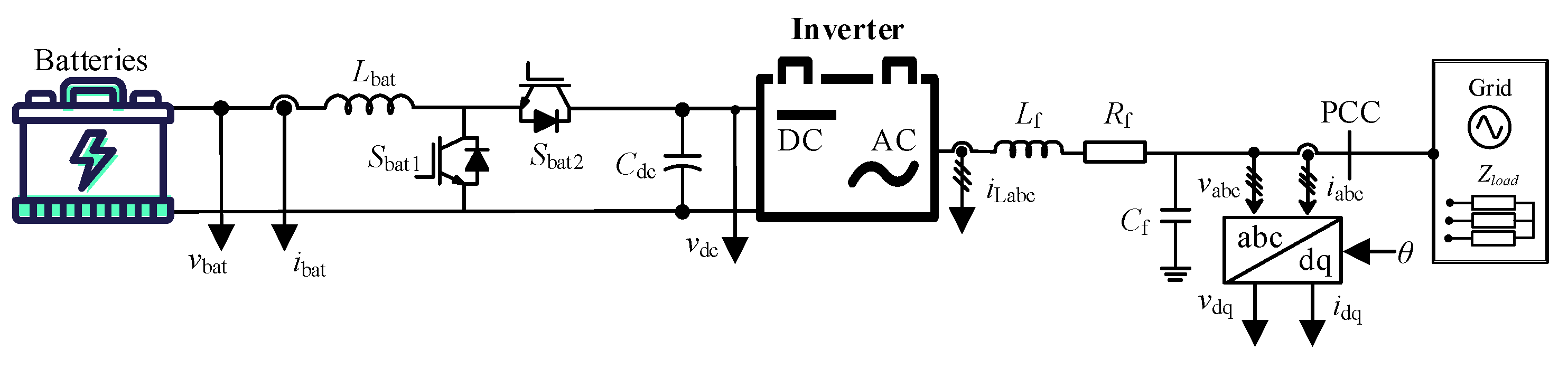
The target system considered in this study is a containerized or vehicular emergency mobile power system, typically composed of a battery energy storage system, a bidirectional DC-DC converter and a grid-forming inverter. The emergency mobile power systems are designed to operate in isolated regions, weak grids, or in rapidly changing topologies where conventional centralized generation is unavailable or unreliable.
As, shown in Figure 2, the BES system provides active power balancing and dynamic support to the DC link. It consists of a battery stack providing the voltage vbat and current ibat, via a bidirectional DC-DC converter. It allows the battery to either charge or discharge, depending on the control command and system operating conditions.
Furthermore, the inverter bridges the DC and AC sides, interfacing with the grid or local AC loads via an LCL filter. The inverter interfaces the DC link with the AC grid and operates under a GFM control scheme. It converts the DC voltage into three-phase AC currents iLabc, which are injected into an LC filter comprising an inductance Lf, and a capacitor Cf.

2.2. Typical Control Strategy of Emergency Mobile Power System

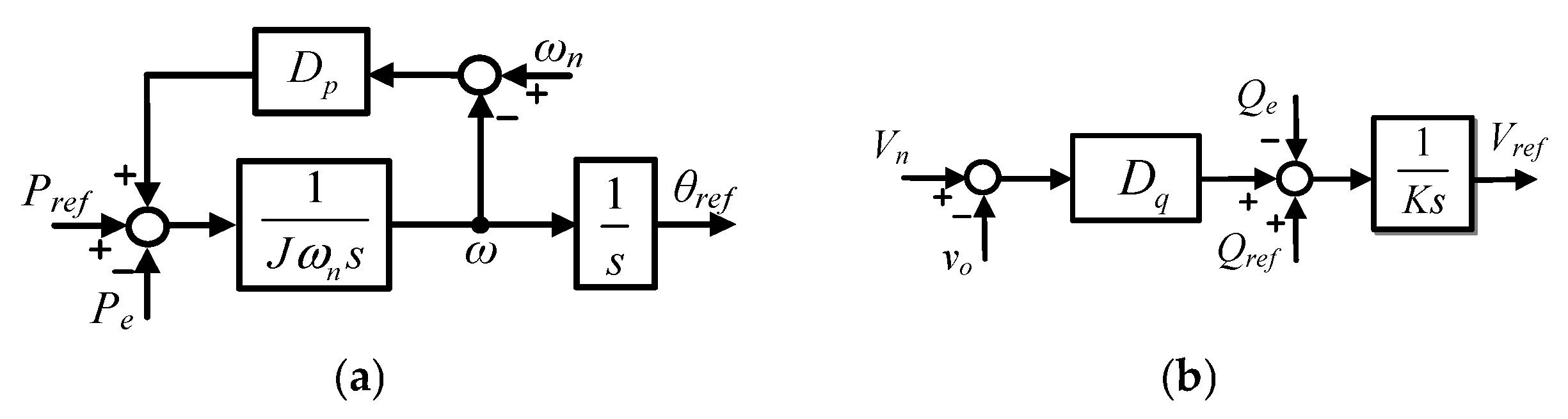
The dual control loop is used to regulate the BES system which contains inner current control loop and the outer voltage control loop. The GFM inverter is regulated by a virtual synchronous generator (VSG) control strategy, enabling it to mimic the dynamic behavior of a synchronous machine and provide inertia and damping support to the system. As presented in Figure 3, the VSG controller is composed of two parts: the active power control (APC) loop and the reactive power control (RPC) loop, which can be described as
J ω d ω d t = P r e f P e + D p ( ω ω n )
E m = 1 K s [ ( Q ref Q e ) + D q ( V n V o ) ]
Here, Pref and Pe denote the reference and actual active power, respectively, while ωn and Dp correspond to the nominal angular frequency and the active power damping coefficient. Similarly, Qref, Qe, Dq, K, Vn, and Vo represent the reference and measured reactive power, reactive power droop coefficient, virtual inertia associated with reactive dynamics, nominal voltage, and the instantaneous voltage measured at the PCC, respectively.
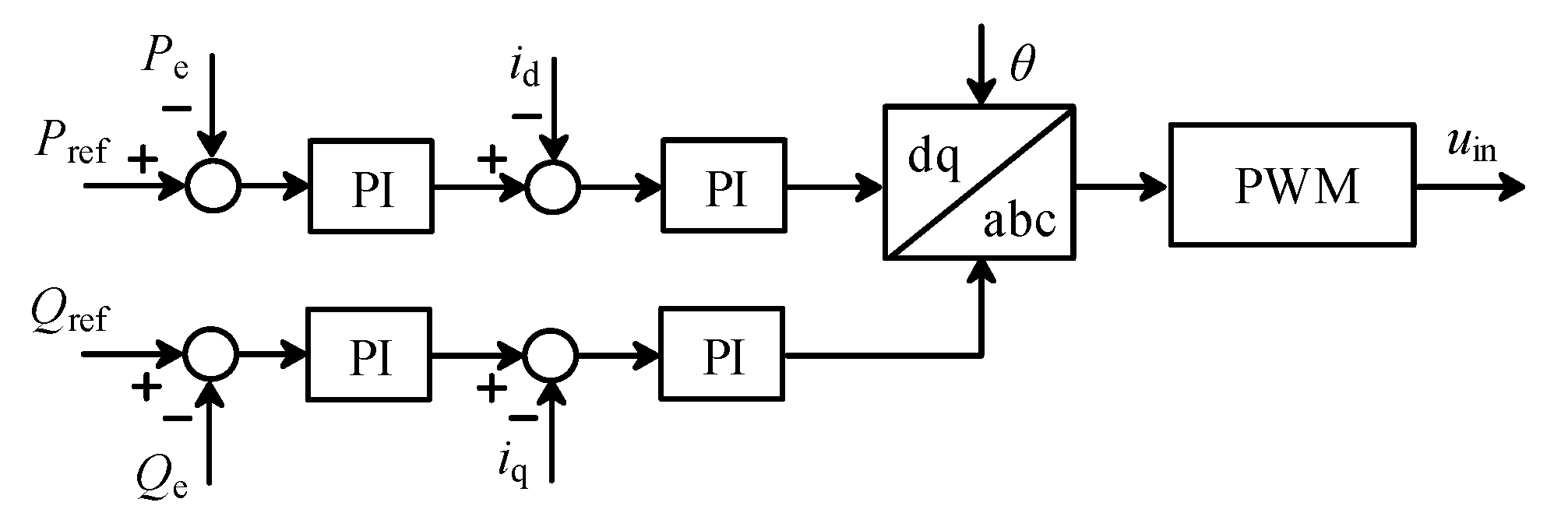
The control diagram shown in Figure 4 illustrates a typical GFL inverter control architecture, which is widely used in grid-connected systems. The inverter does not establish grid voltage or frequency but instead synchronizes to the external grid by tracking its voltage angle via a phase-locked loop (PLL), and injects active and reactive power based on external references.
The upper and lower branches represent the active and reactive power control paths, respectively. The instantaneous output active power Pe is compared with the reference Pref, and the error is regulated by a PI controller to generate a reference d-axis current id. Similarly, the reactive power Qe is tracked using another PI regulator to produce a q-axis current reference iq. These current references reflect the desired power injection targets under given system conditions.
The GFL control relies on precise synchronization with the grid and is suitable for strong grid conditions where voltage and frequency are already established by upstream sources. However, under weak grid or fault scenarios, its dependency on the PLL may lead to instability or degraded dynamic performance.
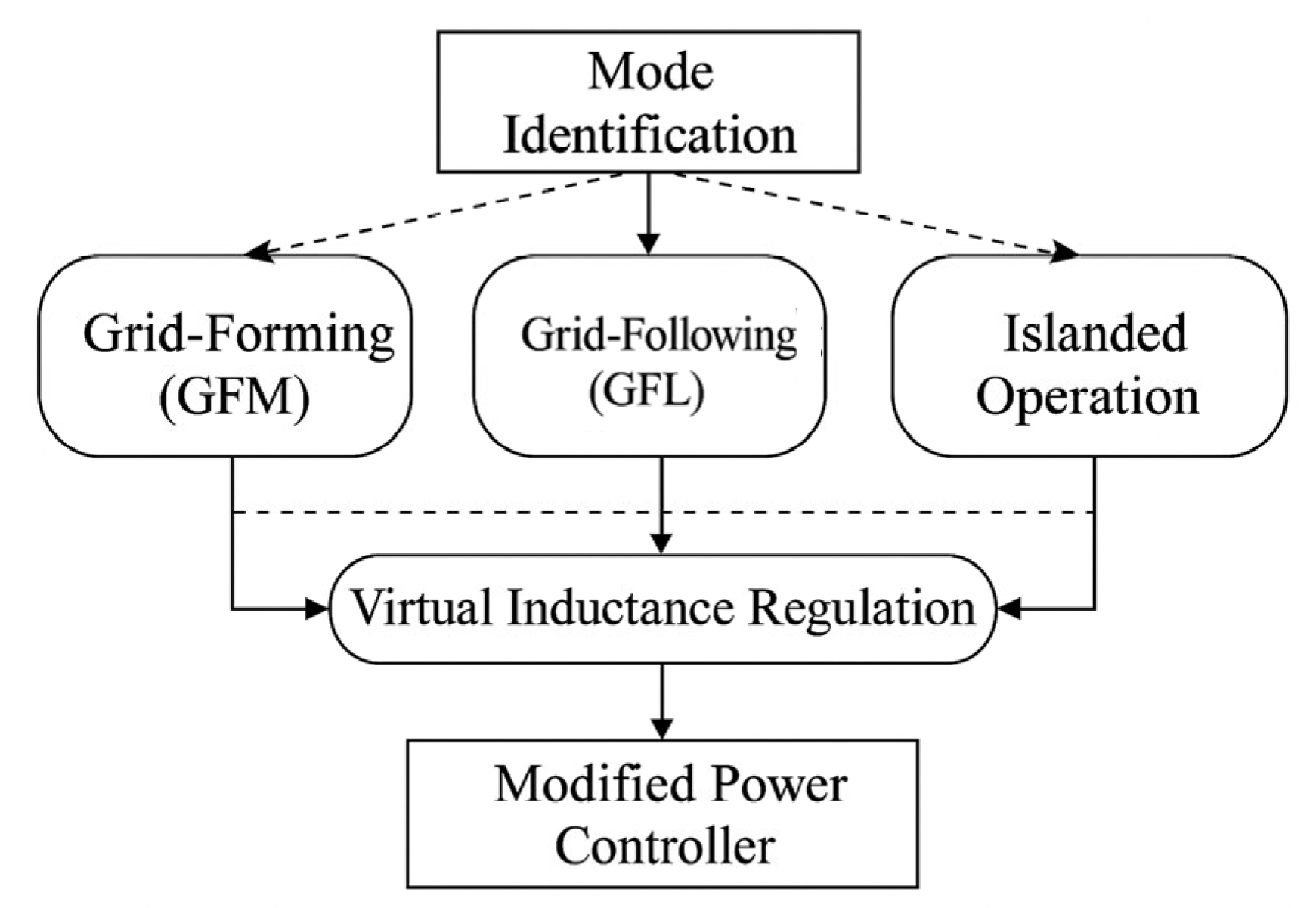
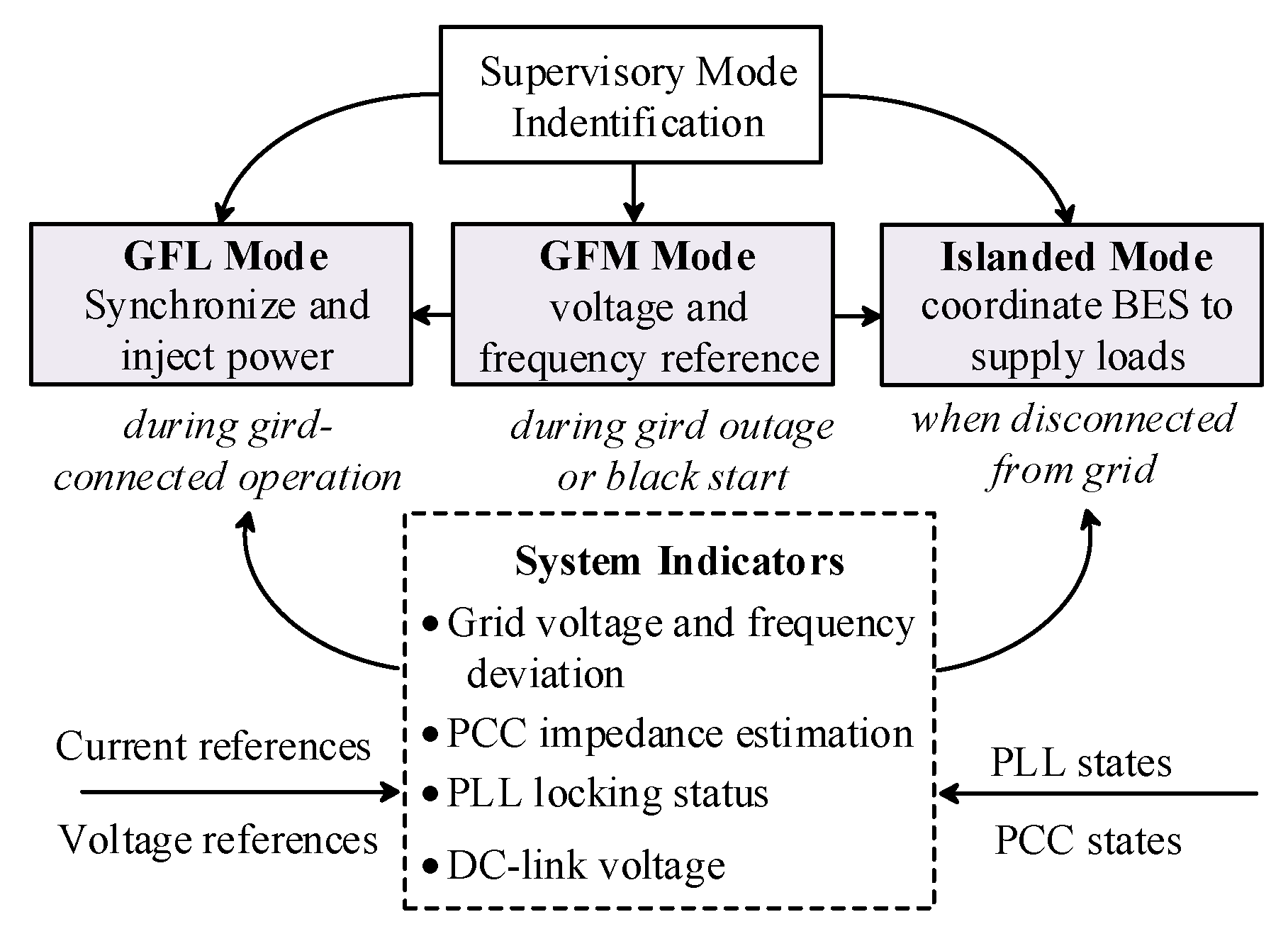
To ensure reliable and flexible operation under varying grid conditions—ranging from strong grids to complete isolation—this work proposes a hierarchical control structure for the emergency mobile power system, as shown in Figure 5. The architecture comprises three interlinked functional layers that together enable seamless adaptability and stability.
At the supervisory level, the mode switching coordinator is responsible for detecting external system changes and orchestrating smooth transitions among three key operating modes: GFM control mode, GFL control mode, and islanded mode. These transitions, often triggered by sudden grid faults or reconnections, are mitigated by a current mechanism. This logic prevents sharp transient current surges during mode switches, ensuring a smooth exchange between operational states without damaging components or tripping protections.

3. Dynamic Virtual Inductance Regulation

3.1. Motivation and Design Principle

Traditional GFM inverters rely on fixed virtual impedance to shape their output behavior, which significantly limits their adaptability in rapidly changing or fault-prone grid environments. In particular, during abnormal conditions such as grid faults, low inertia events, or black start transitions, a fixed inductance fails to deliver optimal performance across the full operating range. The inability to dynamically scale output impedance leads to degraded damping capability, and poor voltage regulation.
While the concept of incorporating energy information into converter control is broadly recognized, its role in practical grid-forming systems depends critically on how the energy state is mathematically embedded into the control dynamics and coordinated with operating mode transitions. In many existing studies, energy-aware mechanisms are implemented through inertia or droop tuning within a single operating mode, primarily aiming to improve transient response under fixed grid conditions.
In contrast, the present work employs the DC link energy deviation as a continuous state variable that directly shapes the effective output impedance through adaptive virtual inductance scheduling. The energy state therefore influences not only transient power response but also current-limiting behavior and damping characteristics during reconnection and weak-grid disturbances. More importantly, this energy-dependent adaptation is integrated into a multi-mode operational framework in which grid-forming, grid-following, and islanded modes share a unified parameter scheduling structure. As a result, the energy-aware mechanism remains active and bounded across mode transitions rather than being confined to a single control regime. This coordinated formulation enables the converter to balance dynamic performance and energy availability in rapidly changing operating conditions typical of emergency mobile power systems.
To overcome these challenges, this paper introduces a dynamic virtual inductance regulation mechanism tailored for emergency mobile power systems. The core principle is to emulate a controllable inductive impedance at the inverter output, which can be continuously modulated in real time. This virtual inductance acts as a degree of freedom that reshapes the inverter current response characteristics without physically modifying the hardware.
The design is inherently hierarchical: while the outer power control loop handles active and reactive power commands, the virtual inductance layer acts as an intermediate shaping module, offering additional control granularity. Its tuning is informed by multiple system-level indicators, notably the instantaneous capacitor energy level, PCC voltage disturbance severity, and grid impedance characteristics. By leveraging these indicators, the controller dynamically tunes the virtual inductance L vir , allowing the inverter to maintain robust, oscillation-free behavior across varying grid conditions.

3.2. Capacitor Energy-Aware Regulation Law

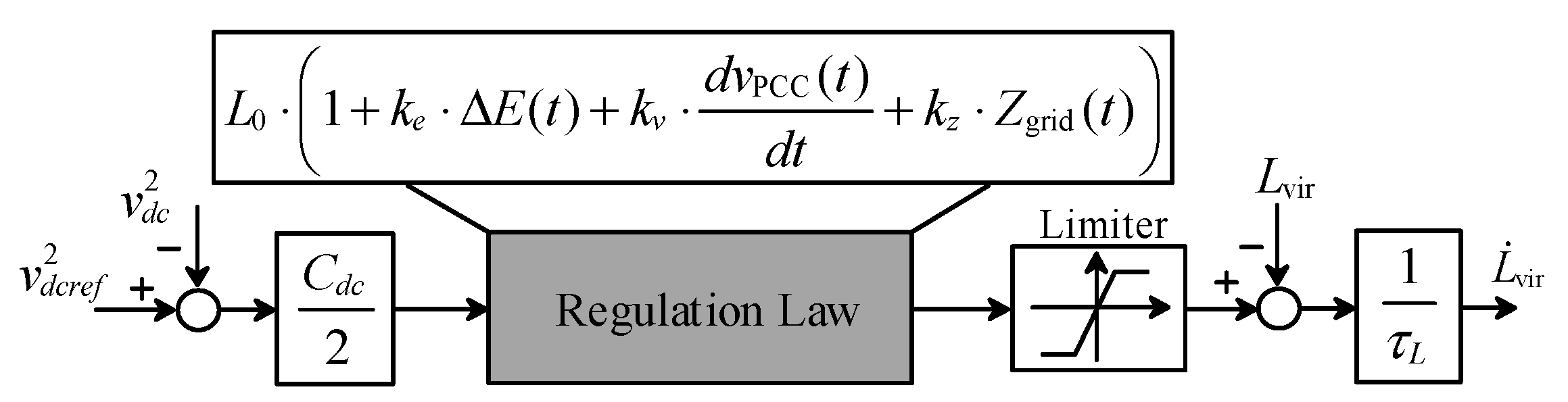
As shown in Figure 6, the DC link capacitor serves as the primary short-term energy storage element in power electronic converters. Its instantaneous energy content, which can be expressed as
E dc ( t ) = 1 2 C dc v dc 2 ( t )
where Cdc represents the capacitor of the DC link. The relative deviation can be defined as
Δ E ( t ) = E dc ( t ) E ref E ref
then the dynamic virtual inductance is calculated as:
L vir ( t ) = L 0 1 + k e Δ E ( t ) + k v d v PCC ( t ) d t + k z Z grid ( t )
where L0 is the nominal base virtual inductance; ke, kv, and kz are design coefficients; d v PCC / d t represents voltage transient severity at the point of common coupling; Z grid denotes estimated grid impedance derived from voltage–current perturbation data.
This equation integrates three critical operational features: capacitor energy-based adaptation to reflect the internal energy support ability; voltage transient awareness to enhance sensitivity to external disturbances; grid strength estimation to modulate inertia and damping according to system weakness. The regulation law ensures that during low-energy or highly disturbed scenarios, the virtual inductance is increased to suppress output current spikes, while in normal or strong-grid conditions, the inductance is reduced to allow faster dynamic response.
The grid impedance term used in the adaptive virtual inductance law represents a slowly varying grid strength indicator rather than a high-bandwidth feedback signal. In practice, this quantity can be obtained using voltage–current measurements at the PCC combined with small-signal perturbation or naturally occurring operating variations, followed by a filtered ratio or recursive estimation method. Since the proposed controller only requires a coarse indication of grid strength, the estimator operates at a bandwidth significantly lower than that of the inner current and voltage loops. To improve robustness against measurement noise and transient disturbances, the estimated impedance is processed through a low-pass filter and constrained within predefined bounds corresponding to expected grid conditions. As a result, the virtual inductance adaptation remains smooth and stable while still reflecting long-term variations in grid strength.
Since the grid strength indicator enters the adaptive virtual inductance law through a low-bandwidth scheduling channel, the proposed method does not rely on highly accurate instantaneous impedance identification. The estimated grid impedance is filtered and bounded within a predefined range corresponding to expected grid conditions. As a result, short-term estimation errors or measurement noise only produce gradual and limited variations in the virtual inductance. Because the energy- and voltage-based terms provide dominant damping support during fast transients, the controller retains stable behavior even under weak-grid conditions with imperfect impedance estimation. From a control perspective, the adaptive mechanism can be interpreted as a bounded parameter scheduling process acting on a slower timescale than the inner loops, thereby preserving the stability characteristics of the baseline grid-forming controller.

3.3. Anti-Saturation and Stability Considerations

Although dynamic regulation offers performance enhancement, it must be carefully designed to avoid inductance saturation or instability. Without constraints, excessive variation of L vir may lead to oscillatory inverter behavior in the presence of control delays, amplified current harmonics during transients, and over-conservative response under false-positive fault detection.
To mitigate these risks, the proposed method incorporates bounded regulation, ensuring that
L min L vir ( t ) L max ,
where L min and L max are empirically determined from small-signal stability analysis and hardware safety constraints.
Moreover, a first-order low-pass filter is applied to the update signal of L vir , ensuring smooth transitions and suppressing noise sensitivity:
L ˙ vir ( t ) = 1 τ L L vir , raw ( t ) L vir ( t )
where τ L is the time constant and L vir , raw is the raw output of the regulation law. Lyapunov-based stability analysis can be used offline to confirm the bounded input, bounded output stability of the full inverter system under varying L vir .
The adaptive regulation of virtual inductance (Lvir) enhances system stability by increasing the output impedance during grid disturbances. This adaptive adjustment improves damping, which can be observed as a reduction in oscillations and faster settling times. More specifically, the increase in Lvir leads to an enhanced damping effect on the system’s eigenvalues, improving the system’s ability to suppress transients and maintain stable voltage and current during disturbances. In the case of weak grid conditions or during mode transitions, this damping enhancement significantly reduces the likelihood of instability or sustained oscillations.
However, a full small-signal stability analysis of the system, including the effect of adaptive Lvir regulation on eigenvalue placement and damping, is beyond the scope of this paper and will be addressed in future work.

4. Multi-Mode Operation and Transition Strategy

4.1. Mode Identification and Transition Conditions

In emergency mobile power systems, the inverter must operate reliably across a wide range of grid conditions, including stable grid-connected operation, autonomous islanded supply, and black start scenarios. These diverse operating states necessitate differentiated control strategies and fast, seamless adaptability. To this end, a multi-mode operational framework is proposed, supporting three primary inverter modes: GFM, GFL, and islanded operation. In GFM mode, activated during grid outages or black start events, the inverter functions as a voltage source, autonomously establishing voltage and frequency references. In contrast, during grid-connected conditions, the GFL mode enables the inverter to synchronize with the main grid via a PLL and inject power based on external setpoints. When disconnected from the main grid but still supplying local loads, the inverter transitions to islanded mode, coordinating with the BESS to maintain stable voltage and frequency.
To enable smooth and reliable mode transitions, a supervisory mode identification algorithm is employed. This algorithm continuously monitors system indicators in real time and determines the appropriate operational mode. The logic incorporates several measurable electrical parameters, including grid voltage amplitude and frequency deviation, impedance estimation at the PCC, PLL locking status, and the stability of the DC link capacitor voltage. Transition conditions are governed by hysteresis-based thresholds to suppress oscillations near boundary conditions. For example, a transition from GFM to GFL is only permitted if the grid voltage remains within ±5% of the nominal level and the frequency deviation remains below 0.1 Hz for a predefined duration. Conversely, a sudden voltage collapse or loss of PLL synchronization triggers an immediate fallback to GFM mode to ensure uninterrupted power delivery.
To avoid discontinuities and abrupt dynamic shifts during mode changes, internal buffers are implemented to store and track control variables associated with each operational mode. During transitions, key variables such as current references, voltage setpoints, and PLL states are smoothly mapped between modes. Special attention is paid to droop control logic, wherein the final synchronized frequency and voltage values from the previous mode are preserved and used as initial conditions in the new mode. This continuity ensures that mode transitions occur without introducing transient power mismatches or oscillations, thereby enhancing system stability and preventing unnecessary protection trips, as shown in Figure 7.
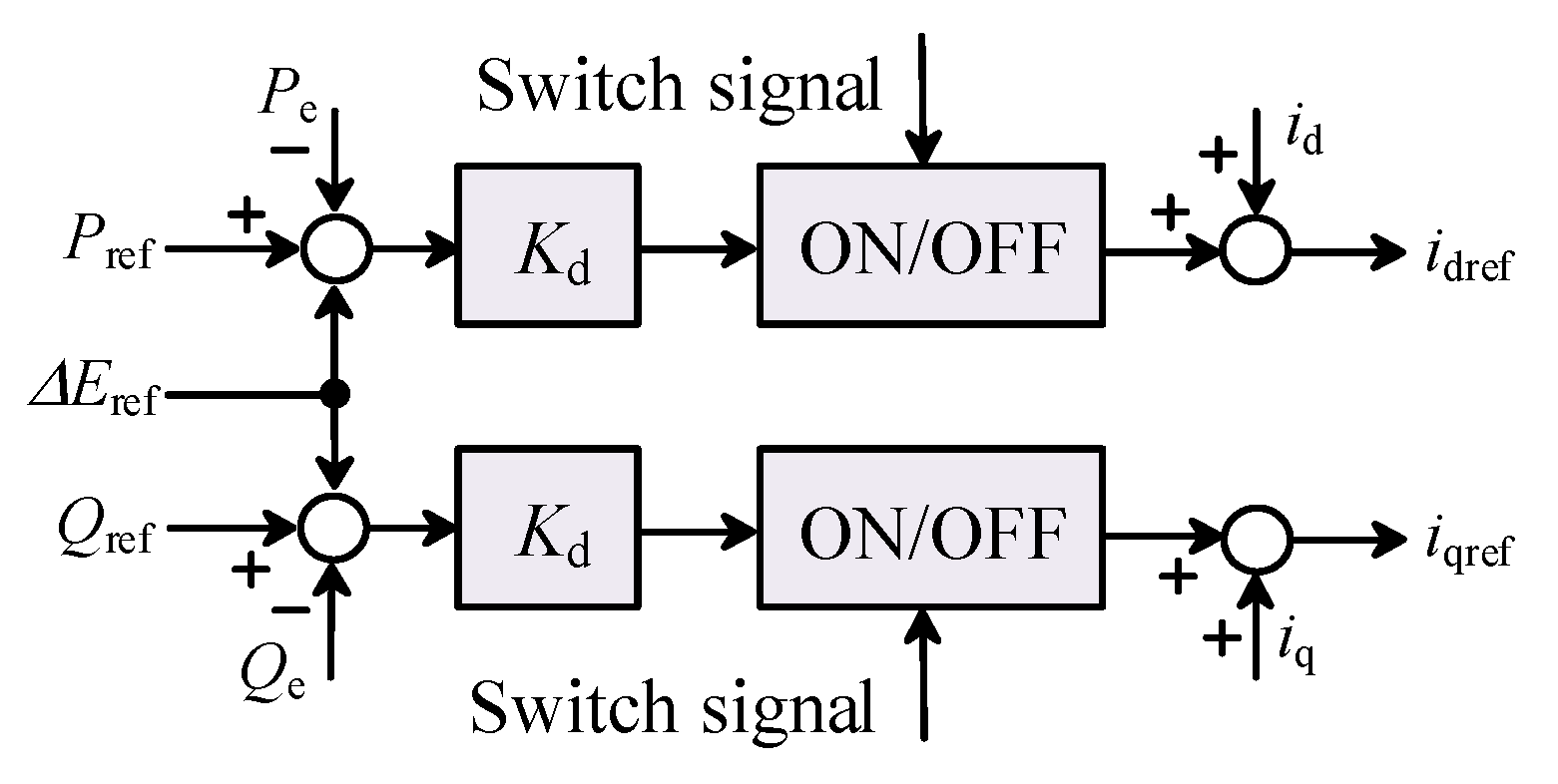
To enhance transient performance during dynamic events, a disturbance-driven switching control strategy is proposed, as illustrated in Figure 8. This control structure injects additional current components into the active and reactive current references in a controlled and adaptive manner.
In the active power channel, the deviation between the reference power Pref and the measured output Pe—optionally combined with a reference energy deviation signal Δ E ref —is scaled by a proportional gain Kd. The resulting compensation signal is then conditionally passed through an ON/OFF logic block governed by a switching signal, which is based on the previous description. When activated, the compensation current is superimposed on the d-axis current id, forming an enhanced reference idref that accelerates the system response. Similarly, in the reactive power channel, the error between the reactive power reference Qref and the measured output Qe is processed through an identical gain and logic mechanism, producing an iqref enhancement to the q-axis current.
The transition from grid-connected operation to islanded mode is triggered by a supervisory islanding detection logic based on PCC voltage and frequency deviation together with PLL synchronization status. In the present study, islanding is declared when the PCC voltage magnitude or frequency exceeds predefined thresholds, or when the PLL loses phase lock for a specified persistence interval.
The total transition duration therefore consists of two components: the islanding detection delay and the subsequent control reconfiguration time. This relationship can be expressed as
t tot = t det + t ctrl .
where represents the detection and confirmation interval determined by threshold persistence and filtering bandwidth, and denotes the time required for the controller to complete mode switching and internal state alignment.

4.2. Circulating Current Decoupling Logic

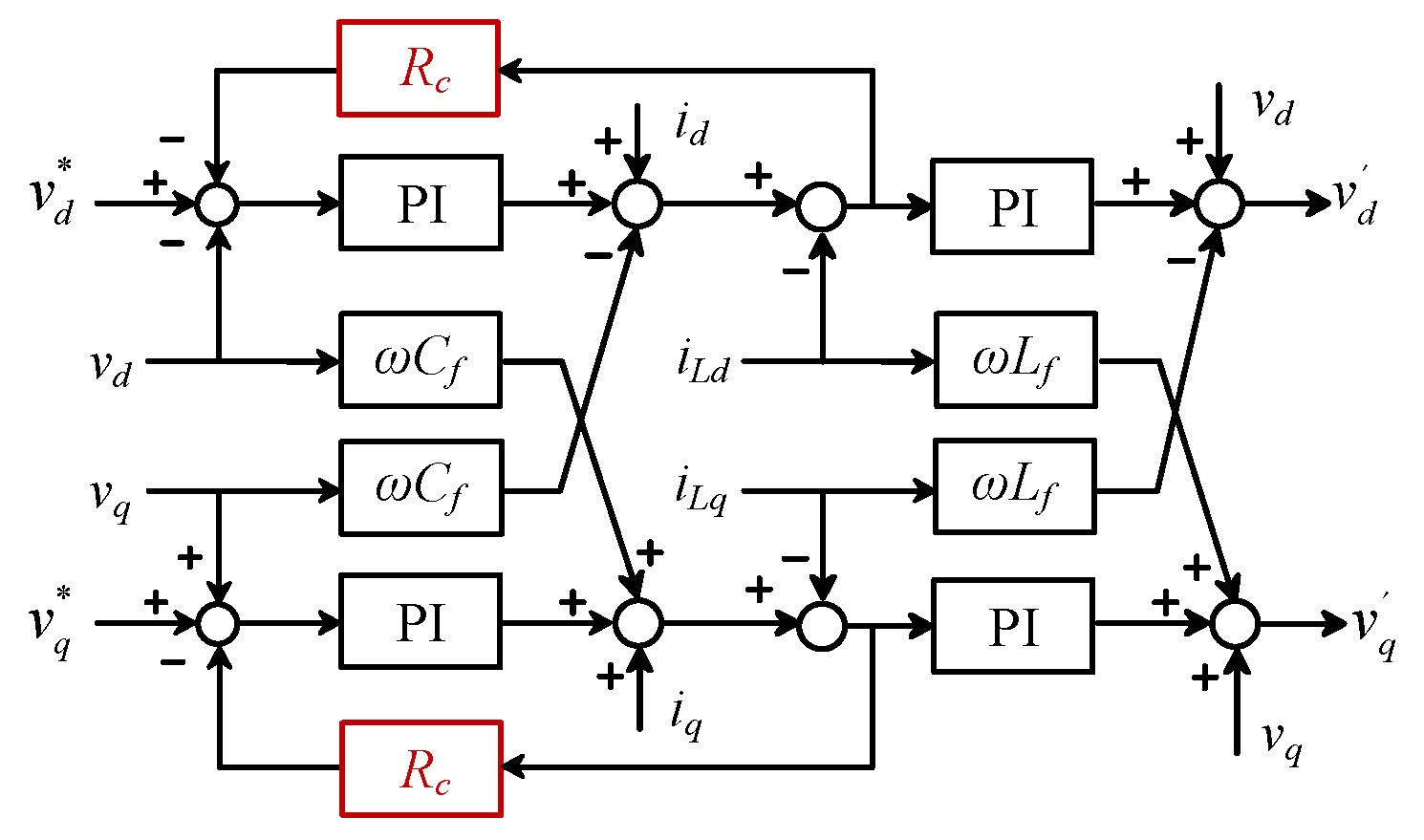
A dual-loop circulating current decoupling mechanism is proposed. A damping term proportional to the current difference is added to the voltage reference:
v d i v = v d v d R c ( i dref i L d )
where Rc is the virtual circulating current damping resistance. Complementing this, the outer loop incorporates a voltage synchronization filter designed to align voltage phase and amplitude across the initiating reconnection or mode transition.
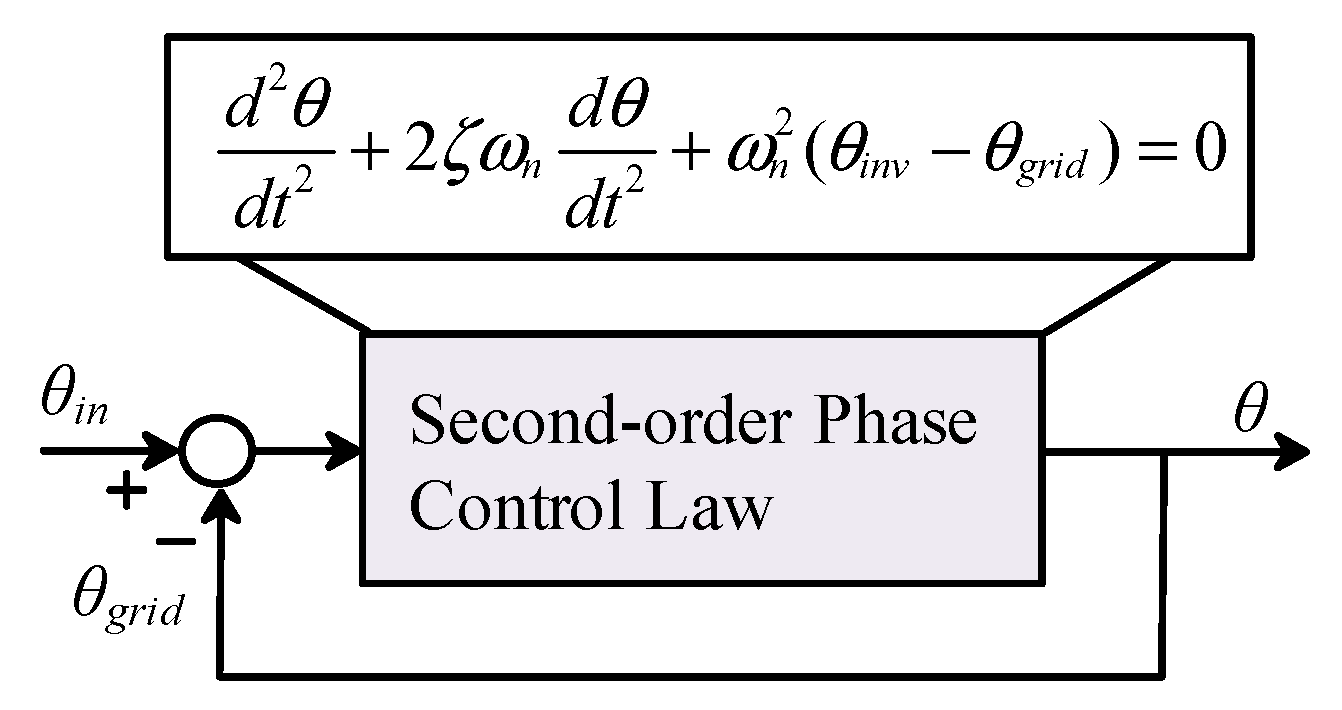
This filter adopts a second-order phase alignment structure, ensuring smooth dynamic matching of output impedances while avoiding abrupt synchronization. It can be expressed as
d 2 θ d t 2 + 2 ζ ω n d θ d t 2 + ω n 2 ( θ i n v θ g r i d ) = 0
where θinv is the output phase angle of the inverter, θgrid represents the grid phase angle acquired via the PLL, ζ is the damping coefficient that determines the convergence behavior, and ω n defines the natural frequency of the phase synchronization filter.
As shown in Figure 9, the energy-aware regulation is based on the deviation of the DC-link capacitor energy from its nominal value. The instantaneous energy is defined as E d c = 1 2 C d c V d c 2 , and the normalized deviation Δ E = ( E d c E d c , r e f ) / E d c , r e f is used as a continuous state indicator of the inverter’s short-term energy support capability. This deviation enters the adaptive virtual inductance law as a proportional correction term. As a result, a reduction in available energy leads to an increase in virtual inductance, which effectively slows current dynamics and enhances damping, preventing excessive transient power demand. Conversely, when sufficient energy margin is available, the virtual inductance is reduced, enabling faster dynamic response. The energy-based adjustment is filtered and bounded to ensure smooth parameter variation and robust operation under varying conditions, as shown in Figure 10.
This dual-loop architecture ensures that internal variables such as current references are gradually blended across control modes, circulating currents are suppressed before evolving into harmful transients, and instantaneous synchronization mismatches are effectively filtered out. This coordinated approach enhances system stability and mitigates protection-triggering events during mode switching or grid reengagement.
The inner-loop virtual damping resistance used for circulating current suppression is tuned based on a damping-oriented design principle. The coefficient is selected considering the weakest expected grid condition, ensuring sufficient attenuation of oscillatory modes caused by impedance mismatch during reconnection or mode switching. Increasing this damping term shifts the dominant oscillatory modes toward improved damping while preserving acceptable steady-state power sharing accuracy.
The outer-loop synchronization filter adopts a second-order structure whose natural frequency is selected below the inner current-loop bandwidth to avoid dynamic interaction. The damping ratio is tuned near critically damped behavior to ensure smooth phase convergence without overshoot.
Since the circulating current suppression mechanism acts on current mismatch rather than absolute power magnitude, its effectiveness remains consistent across different operating points. Moreover, robustness against grid impedance variation is enhanced by designing parameters based on worst-case weak-grid conditions, while adaptive virtual inductance regulation further reduces sensitivity to network changes.

5. Simulation Verification

To verify the effectiveness and superiority of the proposed control strategy under various transient conditions, comparative time-domain simulations in MATLAB 2023B were conducted. The conventional control scheme and the proposed method are evaluated in scenarios involving operation mode switching, and power disturbances, as shown in Table 1.
(1) Active Power Response under Mode Switching
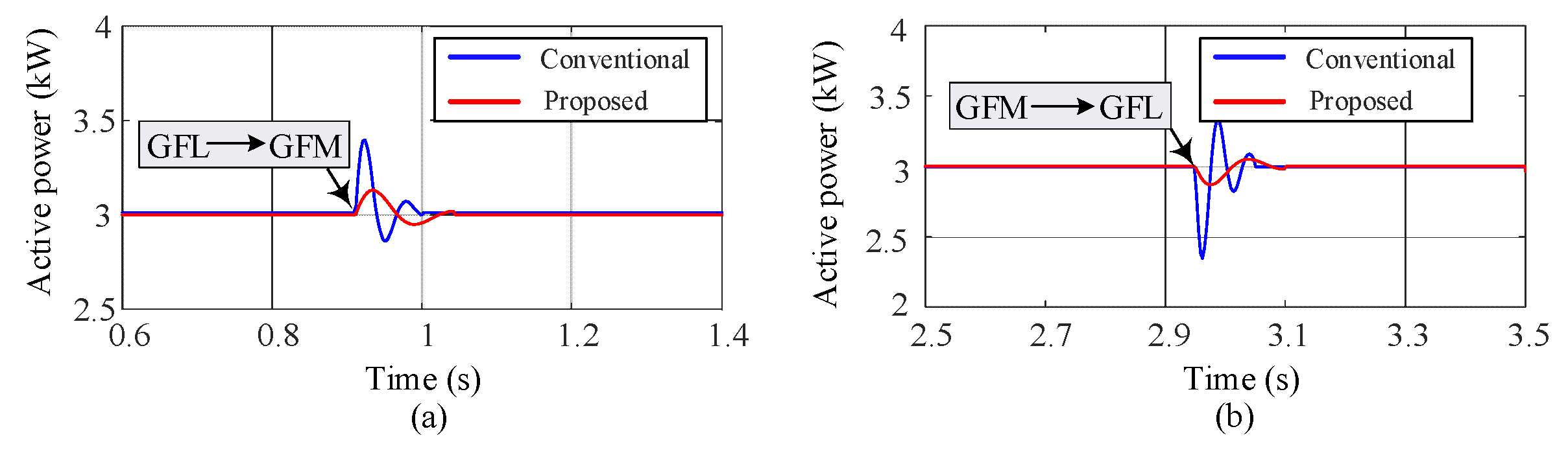
Figure 11 shows the comparison of active power during control mode transitions. In Figure 11a, the system switches from GFL control to GFM control mode. The conventional strategy exhibits evident power overshoot and oscillations, while the proposed control achieves a smooth transition with negligible dynamic deviation. In Figure 11b, during the transition from GFM to GFL, similar benefits of the proposed method are observed, indicating enhanced damping and power stability during both of mode switching.
(2) Reactive Power Response under Mode Switching
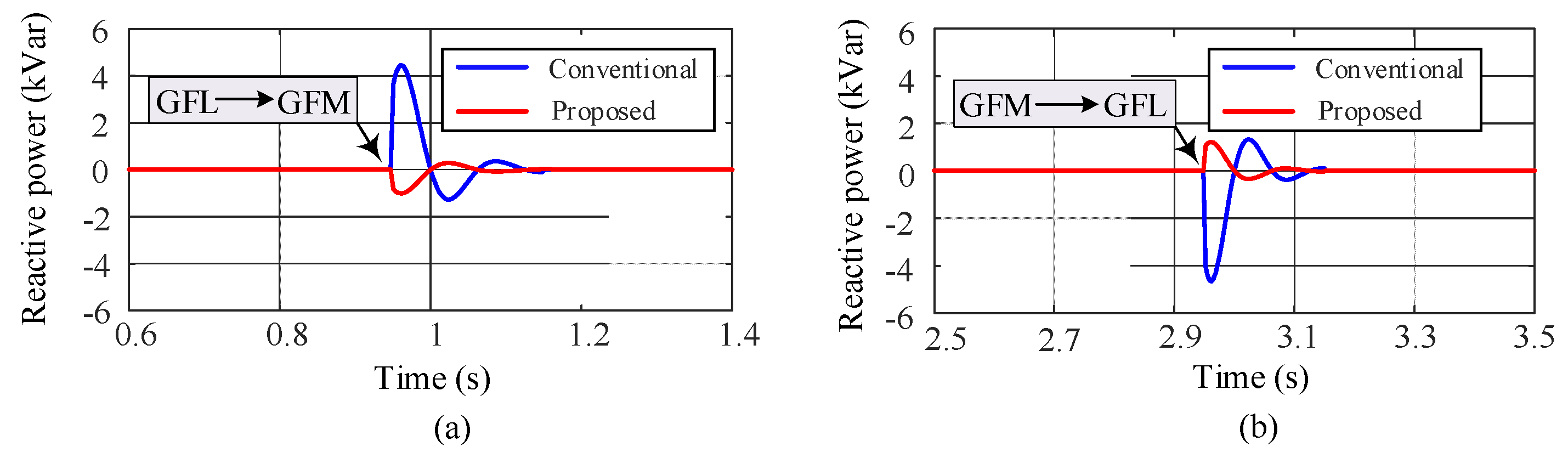
Figure 12 presents the reactive power responses during the same mode transitions. In the GFL control to GFM control case (Figure 12a), the conventional method leads to a transient reactive power surge up to 5 kVar, followed by oscillations before settling. In contrast, the proposed controller provides a seamless and disturbance-free transition. In the GFM control to GFL control case (Figure 12b), the proposed method outperforms the conventional control by eliminating the oscillatory behavior and ensuring a quick stabilization of reactive power around 0 kVar.
(3) PCC Voltage and Current during Grid-to-Island Transition
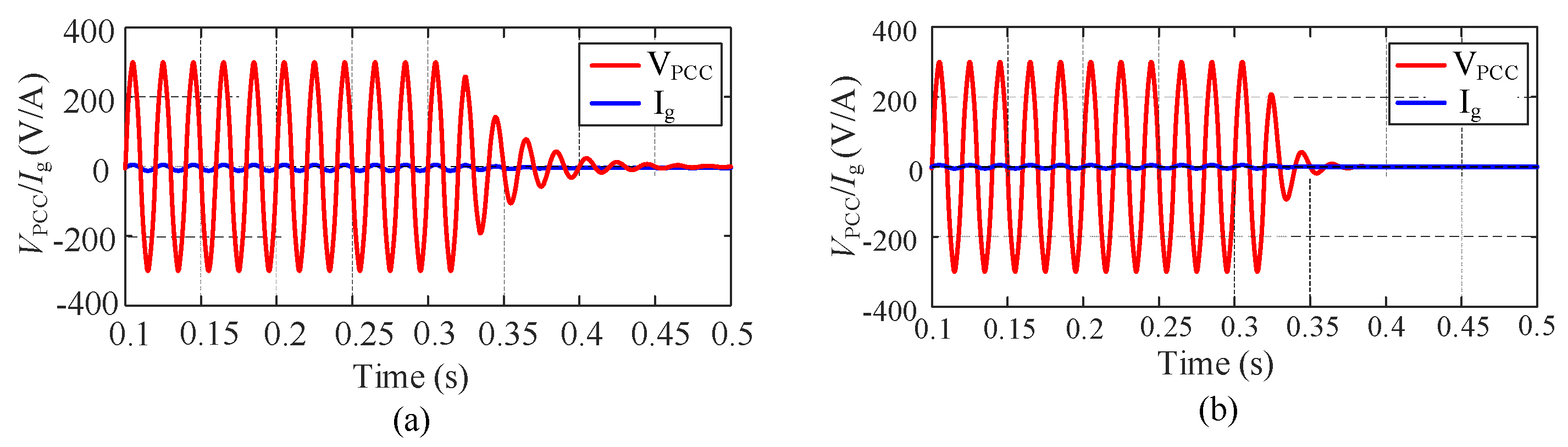
Figure 13 demonstrates the voltage and current waveforms at PCC under two cases of grid-connected to islanding transitions. Figure 13a represents a slower transition case (0.35 s stabilization), while Figure 13b shows a faster transition (0.2 s stabilization). It can be observed that the proposed control strategy enables rapid recognition of grid-to-island transition events, with significantly reduced transient oscillations in both voltage and current. The PCC voltage rapidly converges to zero following a brief oscillatory response, thereby confirming the effectiveness of the islanding detection mechanism and the seamless transition capability of the system.
To complement the waveform comparison in Figure 13, quantitative transient indicators are evaluated for the grid-to-island transition. Specifically, the PCC voltage peak deviation Δ V PCC , pk , the settling time ts (within a ±2% tolerance band), and the voltage disturbance integral index IAE V are computed over a fixed post-transition window t 0 , t 0 + T . In addition, the peak PCC current magnitude I p k P C C (and its normalized value ( I PCC , pk / I N ) is reported to quantify current stress during the transition.
While the simulations conducted in this paper validate the proposed control strategy, the feasibility of real-time implementation on hardware platforms such as Digital Signal Processors (DSPs) is an important next step. The proposed adaptive virtual inductance regulation requires modest computational resources, primarily focused on voltage/current measurements, filtering, and parameter adaptation. These tasks can be efficiently performed by DSPs commonly used in grid-connected inverter systems, making the proposed method suitable for real-time applications in mobile microgrids and emergency power systems.
Furthermore, hardware-in-the-loop (HIL) testing and experimental validation are planned as future work to assess the performance of the proposed control method in real-world conditions. These tests will involve testing the control strategy on physical inverter hardware to account for factors such as noise, latency, and hardware-related imperfections, ensuring the robustness and practicality of the approach.
The proposed control framework is formulated in a per-unit-consistent structure, enabling straightforward scalability to different power ratings. The energy-aware term is based on normalized DC link energy deviation, ensuring that parameter adaptation reflects relative energy margin rather than absolute energy magnitude. The virtual inductance parameters are referenced to the inverter base impedance, allowing proportional adjustment when the rated power changes.
For parallel operation of multiple EMPS units, the proposed adaptive virtual inductance remains compatible with conventional droop-based power sharing. The impedance-shaping effect enhances stability and mitigates circulating currents, while the low-bandwidth, bounded adaptation ensures that individual unit energy regulation does not interfere with inter-unit power sharing dynamics. Consequently, the control structure is inherently modular and suitable for scalable deployment in multi-source emergency microgrids.
Although the observed improvements in transient behavior are consistent with the intended design of the adaptive virtual inductance and circulating current suppression mechanisms, the proposed strategy differs from conventional fixed-parameter or single-mode adaptive approaches in several important aspects. First, the virtual inductance adaptation is driven by a combination of energy deviation, PCC disturbance severity, and grid-strength indicators rather than by a single tuning variable. Second, the parameter adaptation is coordinated with the multi-mode transition framework, ensuring continuity of internal control states during reconnection and islanding events. Third, the dual-loop circulating current decoupling mechanism specifically targets transient current surges that arise during mode transitions, which are not addressed in most conventional adaptive impedance designs.
The quantitative indicators provided in the revised manuscript confirm that these coordinated mechanisms lead to reduced voltage deviation, improved damping, and lower peak current stress during representative transition scenarios. These improvements are not solely attributable to parameter tuning but to the combined effect of energy-state-dependent impedance shaping and mode-adaptive coordination.


6. Conclusions

This paper has presented a multi-mode GFM with adaptive virtual inductance regulation for EMPS. The proposed framework integrates three key innovations: a multi-mode operational architecture enabling seamless transitions among GFM, GFL, and islanded modes; a dynamic virtual inductance regulation mechanism based on capacitor energy and grid indicators; and an energy-aware switching control that enhances damping during transients without compromising steady-state performance.
By leveraging real-time energy information and adaptive impedance tuning, the proposed method improves system resilience during power disturbances and mode transitions. The dual-loop current decoupling strategy improves the current response performance, while the switching controller selectively injects compensatory current to accelerate dynamic response.
Extensive simulation results verify that the proposed control achieves better performance than conventional schemes, including reduced transient overshoot, improved damping, and faster voltage/current stabilization. These features make it particularly suitable for disaster relief, mobile microgrids, and other rapidly deployable power applications where grid conditions are highly uncertain and adaptability is paramount.

Author Contributions

L.Z.: conceptualization, methodology, modeling and simulation, data analysis, visualization, writing—original draft. X.L.: supervision, validation, writing—review and editing. All authors have read and agreed to the published version of the manuscript.

Funding

This research received no external funding.

Data Availability Statement

The original contributions presented in this study are included in the article. Further inquiries can be directed to the corresponding author.

Conflicts of Interest

The authors declare no conflict of interest.

References

  1. Blaabjerg, F.; Yang, Y.; Yang, D.; Wang, X. Distributed power-generation systems and protection. Proc. IEEE 2017, 105, 1311–1331. [Google Scholar] [CrossRef]
  2. Farrokhabadi, M.; Canizares, C.A.; Simpson-Porco, J.W.; Nasr, E.; Fan, L.; Mendoza-Araya, P.A.; Tonkoski, R.; Tamrakar, U.; Hatziargyriou, N.D.; Lagos, D.; et al. Microgrid stability definitions, analysis, and examples. IEEE Trans. Power Syst. 2020, 35, 13–29. [Google Scholar] [CrossRef]
  3. Jaalam, N.; Rahim, N.A.; Bakar, A.H.A.; Tan, C.K.; Haidar, A.M.A. A comprehensive review of synchronization methods for grid-connected converters of renewable energy source. Renew. Sustain. Energy Rev. 2016, 59, 1471–1481. [Google Scholar] [CrossRef]
  4. Yin, K.; Xiao, Y.; Shen, X.; Zhu, Y.; Yang, Y. Review of Photovoltaic–Battery Energy Storage Systems for Grid-Forming Operation. Batteries 2024, 10, 288. [Google Scholar]
  5. IEEE Std 1547-2018; Standard for Interconnection and Interoperability of Distributed Energy Resources with Associated Electric Power Systems Interfaces. IEEE: New York, NY, USA, 2018.
  6. IEEE Std 2800-2022; Standard for Interconnection and Operation of Inverter-Based Resources Interconnecting with Associated Transmission Electric Power Systems. IEEE: New York, NY, USA, 2022.
  7. NERC. Reliability Guideline: BPS-Connected Inverter-Based Resource Performance; North American Electric Reliability Corporation (NERC): Atlanta, GA, USA, 2021. [Google Scholar]
  8. Zhang, L.; Harnefors, L.; Nee, H.-P. Power-synchronization control of grid-connected voltage-source converters. IEEE Trans. Power Syst. 2010, 25, 809–820. [Google Scholar] [CrossRef]
  9. Zhong, Q.-C.; Weiss, G. Synchronverters: Inverters that mimic synchronous generators. IEEE Trans. Ind. Electron. 2011, 58, 1259–1267. [Google Scholar] [CrossRef]
  10. D’Arco, S.; Suul, J.A.; Fosso, O.B. Control system tuning and stability analysis of Virtual Synchronous Machines. In Proceedings of the 2013 IEEE Energy Conversion Congress and Exposition; IEEE: New York, NY, USA, 2013; pp. 2664–2671. [Google Scholar]
  11. D’Arco, S.; Suul, J.A. Virtual synchronous machines—Classification of implementations and analysis of equivalence to droop controllers for Microgrids. In Proceedings of the 2013 IEEE Powertech Grenoble Conference, Grenoble, France, 16-20 June 2013; IEEE: New York, NY, USA, 2013; pp. 1–7. [Google Scholar]
  12. Lu, X.; Dhople, S.V.; Johnson, B.B. Benchmarking nonlinear oscillators for grid-forming power converters. IEEE Trans. Power Electron. 2022, 37, 9293–9308. [Google Scholar] [CrossRef]
  13. Huang, L.; Xin, H.; Wu, D.; Liu, B. Grid-synchronization stability analysis and loop shaping for PLL-based power converters with different reactive-power control. IEEE Trans. Smart Grid 2020, 11, 2923–2935. [Google Scholar] [CrossRef]
  14. Wen, B.; Boroyevich, D.; Burgos, R.; Mattavelli, P.; Shen, Z. Analysis of d–q small-signal impedance of grid-tied inverters. IEEE Trans. Power Electron. 2016, 31, 675–687. [Google Scholar] [CrossRef]
  15. Sun, J. Impedance-based stability criterion for grid-connected inverters. IEEE Trans. Power Electron. 2011, 26, 3075–3078. [Google Scholar] [CrossRef]
  16. Baeckeland, N.; Chatterjee, D.; Lu, M.; Johnson, B.B.; Seo, G.-S. Overcurrent limiting in grid-forming inverters: A comprehensive review and discussion. IEEE Trans. Power Electron. 2024, 39, 14493–14511. [Google Scholar] [CrossRef]
  17. Qoria, T.; Wang, X.; Kadri, R. Grid-Forming Control VSC-Based Including Current Limitation and Re-synchronization Functions to Deal with Symmetrical and Asymmetrical Faults. Electr. Power Syst. Res. 2023, 219, 109220. [Google Scholar] [CrossRef]
  18. Johnson, B.B.; Dhople, S.V.; Hamadeh, A.O.; Krein, P.T. Synchronization of Nonlinear Oscillators in an LTI Electrical Power Network. IEEE Trans. Circuits Syst. I Regul. Pap. 2014, 61, 834–844. [Google Scholar] [CrossRef]
  19. Kroposki, B. Introduction to Grid-Forming Inverters; NREL Report NREL/TP-5D00-90256; National Renewable Energy Laboratory: Golden, CO, USA, 2024. [Google Scholar]
  20. Du, W.; Nguyen, Q.H.; Wang, S.; Kim, J.; Liu, Y.; Zhu, S.; Tuffner, F.K.; Huang, Z. Positive-sequence modeling of droop-controlled grid-forming inverters for transient stability simulation of transmission systems. IEEE Trans. Power Deliv. 2024, 39, 1736–1748. [Google Scholar] [CrossRef]
  21. Seo, G.-S.; Sawant, J.; Ding, F. Black start of unbalanced microgrids: Harmonizing single- and three-phase grid-forming inverters. In 2023 IEEE Power & Energy Society General Meeting (PESGM); NREL/CP-5D00-86971; National Renewable Energy Laboratory: Golden, CO, USA, 2023. [Google Scholar]
  22. Lu, M.; Dhople, S.; Johnson, B. Benchmarking Nonlinear Oscillators for Grid-Forming Inverter Control. IEEE Trans. Power Electron. 2022, 37, 10250–10266. [Google Scholar] [CrossRef]
  23. Vasquez, J.C.; Guerrero, J.M.; Savaghebi, M.; Eloy-Garcia, J.; Teodorescu, R. Modeling, Analysis, and Design of Stationary-Reference-Frame Droop-Controlled Parallel Three-Phase Voltage Source Inverters. IEEE Trans. Ind. Electron. 2013, 60, 1271–1280. [Google Scholar] [CrossRef]
  24. Lin, Y.; Eto, J.H.; Johnson, B.B.; Flicker, J.D.; Pico, H.N.V.; Seo, G.-S.; Pierre, B.J.; Ellis, A. Research Roadmap on Grid-Forming Inverters; NREL/TP-5D00-73476; National Renewable Energy Laboratory: Golden, CO, USA, 2020. [Google Scholar]
  25. Pogaku, N.; Prodanovic, M.; Green, T.C. Modeling, analysis and testing of autonomous operation of an inverter-based microgrid. IEEE Trans. Power Electron. 2007, 22, 613–625. [Google Scholar] [CrossRef]
  26. Ling, Y.; Li, Y.; Yang, Z.; Xiang, J. A Dispatchable Droop Control Method for Distributed Generators in Islanded AC Microgrids. IEEE Trans. Ind. Electron. 2021, 68, 8356–8366. [Google Scholar] [CrossRef]
  27. Haque, M.; Wolfs, P.J.; Alahakoon, S.; Islam, A.; Nadarajah, M.; Zare, F.; Farrok, O. Three-Port Converters for Energy Conversion of PV-BES Integrated Systems—A Review. IEEE Access 2023, 11, 6551–6573. [Google Scholar] [CrossRef]
  28. Liang, W.; Liu, Y.; Shen, Y. Active Power Control Integrated with Reactive Power Compensation of Battery Energy Stored Quasi-Z Source Inverter PV Power System Operating in VSG Mode. IEEE J. Emerg. Sel. Top. Power Electron. 2023, 11, 339–350. [Google Scholar] [CrossRef]
  29. Fang, J.; Hatziargyriou, N.D.; Yang, Y.; Liu, T.; Blaabjerg, F. Distributed power-system virtual inertia implemented by grid-connected power converters. IEEE Trans. Power Electron. 2017, 32, 6931–6945. [Google Scholar] [CrossRef]
  30. Qin, H.; Kimball, J.W. Generalized Average Modeling of Dual Active Bridge DC–DC Converter. IEEE Trans. Power Electron. 2012, 27, 2078–2084. [Google Scholar]
  31. Peng, F.; Fang, J.; Yang, Y.; Liu, T.; Wang, H.; Blaabjerg, F. Maximum virtual inertia from DC-link capacitors considering system stability at voltage-control timescale. IEEE J. Emerg. Sel. Top. Circuits Syst. 2021, 11, 543–556. [Google Scholar] [CrossRef]
  32. Al-Khayyat, A.S.; Oraibi, W.A.; Hameed, M.J.; Manati, A.M. Virtual Inertia Extraction from a DC Bus Capacitor in a Three−Phase DC/AC Inverter-Based Microgrid with Seamless Synchronisation Operation Modes. Meas. Energy 2024, 4, 100024. [Google Scholar] [CrossRef]
  33. Kanaparthi, R.K.; Singh, J.P.; Ballal, M.S. A Review on Multi-Port Bidirectional Isolated and Non-Isolated DC-DC Converters for Renewable Applications. In Proceedings of the 2022 IEEE International Conference on Power Electronics, Drives and Energy Systems (PEDES), Jaipur, India, 14-17 December 2022; IEEE: New York, NY, USA, 2022; pp. 1–6. [Google Scholar]
  34. Tayyebi, A.; Groß, D.; Anta, A.; Kupzog, F.; Dörfler, F. Frequency Stability of Synchronous Machines and Grid-Forming Power Converters. arXiv 2020, arXiv:2003.04715. [Google Scholar] [CrossRef]
  35. Dong, W.; Xin, H.; Wu, D.; Huang, L. Small-signal stability analysis of multi-infeed power-electronic systems based on grid-strength assessment. IEEE Trans. Power Syst. 2019, 34, 1393–1403. [Google Scholar] [CrossRef]
  36. Tian, A.; Wu, Y.; Hu, Z.; Wang, Z.; Wu, T.; Jiang, J.; Peng, Z. Two-Stage PV Grid-Connected Control Strategy Based on Adaptive Virtual Inertia and Damping Control for DC-Link Capacitor Dynamics Self-Synchronization. J. Energy Storage 2023, 72, 108659. [Google Scholar] [CrossRef]
  37. Gurugubelli, V.; Ghosh, A.; Panda, A.K.; Behera, B.P. Fuzzy-Based Adaptive VOC Methods for Parallel Inverters. IEEE Trans. Power Electron. 2024, 39, 3956–3961. [Google Scholar] [CrossRef]
  38. Lu, M. Virtual oscillator grid-forming inverters: State of the art, modeling, and stability. IEEE Trans. Power Electron. 2022, 37, 11579–11591. [Google Scholar] [CrossRef]
  39. Bozalakov, D.; Qazi, S.H.; De Kooning, J.; Vandevelde, L. Power quality improvement by grid-connected inverters driven by the three-phase damping control strategy operated in different modes. Int. J. Electr. Power Energy Syst. 2025, 169, 110689. [Google Scholar] [CrossRef]
Figure 1. Configuration of the system.
Batteries 12 00102 g001
Figure 2. Control of the BES system.
Batteries 12 00102 g002
Figure 3. The VSG power control loop: (a) The active power control loop, and (b) The reactive power control loop.
Batteries 12 00102 g003
Figure 4. Block diagram of the grid-following (GFL) power control loop.
Batteries 12 00102 g004
Figure 5. Control structure for the emergency mobile power system.
Batteries 12 00102 g005
Figure 6. The control block diagram of the dynamic virtual inductance control law.
Batteries 12 00102 g006
Figure 7. Mode identification and transition conditions for the proposed multi-mode operation framework (GFM/GFL/islanded), including the monitored indicators (e.g., PCC voltage/frequency deviation, PLL status, and DC link voltage/energy conditions) and the hysteresis-based thresholds used to trigger mode transitions.
Batteries 12 00102 g007
Figure 8. Disturbance-driven switching control logic for auxiliary current injection during transients: generation of the d-axis and q-axis current compensation terms based on active/reactive power tracking errors (and optional energy deviation input), gain scaling, and ON/OFF activation logic to enhance damping and suppress transient overshoot.
Batteries 12 00102 g008
Figure 9. The dual-loop circulating current decoupling control block diagram.
Batteries 12 00102 g009
Figure 10. The block diagram of the second-order phase control.
Batteries 12 00102 g010
Figure 11. Comparison of active power responses under mode switching conditions with proposed control and conventional control: (a) Transition from GFL to GFM. (b) Transition from GFM to GFL.
Batteries 12 00102 g011
Figure 12. Comparison of reactive power responses under mode switching conditions with proposed control and conventional control: (a) Transition from GFL to GFM. (b) Transition from GFM to GFL.
Batteries 12 00102 g012
Figure 13. Voltage and current response at PCC during grid-connected to islanding transition: (a) Proposed method under 0.35 s transition duration. (b) Proposed method under 0.2 s transition duration.
Batteries 12 00102 g013
Table 1. Control parameters of the system referring to Figure 1.
ParameterValueParameterValue
Vdcref650 VLf4.4 mH
SN3 kVACf10 uF
Pref3 kWLg10 mH
Qref0 kWRg0.25 Ω
Cdc1000 uFDp01500
J00.4Dq015
Disclaimer/Publisher’s Note: The statements, opinions and data contained in all publications are solely those of the individual author(s) and contributor(s) and not of MDPI and/or the editor(s). MDPI and/or the editor(s) disclaim responsibility for any injury to people or property resulting from any ideas, methods, instructions or products referred to in the content.