


Abstract
Ni-rich layered LiNi0.6Co0.2Mn0.2O2 (NCM622) cathodes are the most promising candidates for high-energy lithium-ion batteries, but their performance is often limited by structural instability and capacity fading due to large primary particle sizes and surface degradation. Precise control of the primary particle size significantly impacts the performance of NCM622 cathodes and can mitigate fatigue mechanisms, but the underlying processes remain unclear. In this study, NCM622 cathodes with various primary particle sizes were synthesized by applying a controlled co-precipitation strategy by systematically controlling the ammonia feed rate and solution pH during precursor formation. Interestingly, higher ammonia feed rates promoted the formation of smaller, more ordered primary particles, whereas lower feed rates and reduced pH produced larger primary particles in spherical secondary structures. Electrochemical evaluation revealed that cathodes composed of smaller primary particles exhibited enhanced Li+ diffusion kinetics and superior electrochemical performance compared to those synthesized under lower ammonia feeding or reduced pH conditions. Moreover, the optimized NCM622 electrode demonstrated excellent rate capability and maintained a stable layered microstructure during cycling, retaining ~86% of its initial capacity. These results demonstrate that fine-tuning the ammonia feeding conditions during co-precipitation provides a simple and effective approach to control primary particle growth, thereby improving the structural integrity and electrochemical durability of NCM622 cathode materials.
1. Introduction
Lithium-ion batteries (LIBs) have emerged as one of the most efficient and widely studied energy storage technologies, playing a crucial role in integrating renewable energy and promoting sustainable, fossil-free mobility. Their high energy density, long life, and cost-effectiveness have accelerated their adoption in consumer electronics and have contributed to the rapid development of electric and hybrid vehicles for automotive applications [1,2,3,4]. Layered LiNi0.6Co0.2Mn0.2O2 (NCM622) material is one of the most balanced and effective cathode compositions for achieving high energy density, structural stability, and electrochemical efficiency in LIBs. Appropriate addition of Co and Mn to this composition plays a crucial role in stabilizing the Ni2+/Ni3+ redox reaction and alleviating excessive Li+/Ni2+ cation mixing, thereby contributing to the enhancement of capacity and structural integrity [5,6,7]. However, while high Ni content is beneficial for increased capacity, it also promotes the generation of unstable Ni4+ ions during the delithiation process. These highly oxidized Ni4+ ions readily react with the electrolyte, triggering parasitic side reactions, volume expansion, and irreversible phase transitions [8,9,10,11]. Furthermore, during repeated delithiation/lithiation cycles, the resulting mechanical strain and internal stress within the particles promote microcrack formation and progressive structural degradation [12,13,14]. Collectively, these degradation mechanisms undermine the structural integrity and long-term electrochemical stability of Ni-rich NCM622 cathodes [15,16].
Over the past two decades, extensive research has been conducted to improve the long-term cycling stability of layered cathode materials through various modification strategies, including surface coating and partial doping with low concentrations of heterogeneous transition metal (TM) ions [17,18,19,20,21,22]. These approaches typically form a protective surface layer and subtly alter surface morphology while maintaining the inherent layered crystal structure of NCM622 materials. These modifications have proven effective in suppressing undesirable side reactions during long-term cycling, stabilizing the cathode-electrolyte interface, and mitigating phase transformations to spinel or rock salt structures [23,24,25,26]. Despite these advances, serious challenges remain. Repeated delithiation and lithiation processes continuously induce mechanical stress within microspherical secondary particles composed of submicron-sized primary particles. This accumulated stress promotes crack propagation, lattice deformation, and gradual grain boundary degradation, ultimately compromising the structural integrity. This behavior accelerates electrical contact loss and capacity decay during long-term cycling, hindering the practical implementation of the layered cathodes with poor stability [27,28,29,30]. Consequently, recent research has turned to designing cathodes with reduced primary particle size that can better accommodate structural deformation, minimize anisotropic volume changes, reduce Li+/Ni2+ cation mixing, promote uniform Li+ diffusion paths, and effectively suppress microcrack formation during cycling [31,32,33,34]. Therefore, designing nanoscale primary particles within a hierarchical secondary structure has emerged as a promising and essential strategy for enhancing both the structural integrity and electrochemical durability of NCM622 cathodes.
Motivated by the benefits of reducing the primary particle size in electrochemical studies, we attempted to develop NCM622 cathode materials featuring a polycrystalline microspherical morphology composed of nano-sized primary particles. A conventional co-precipitation strategy was employed, wherein the ammonium feed rate and reaction pH were precisely regulated to control nucleation and growth kinetics during precursor formation. Fine-tuning these synthesis parameters effectively modulated the primary particle size and improved the compositional uniformity of the secondary microspheres. Notably, the sample synthesized at a higher ammonia feed rate exhibited smaller, denser, and more well-ordered primary particles, which contributed to reduced Li+/Ni2+ cation disorder, enhanced Li+ diffusion kinetics, superior rate performance, and remarkable cycling stability with higher capacity retention compared to the low-feed and low-pH counterparts. These findings confirm that regulating primary particle growth through controlled ammonia feeding provides an effective and scalable route for achieving stable layered oxide cathodes for high-performance LIBs.
2. Materials and Methods
2.1. Material Synthesis
All chemicals were purchased from Samchun Chemicals (Republic of Korea) and used as received without further purification. NCM622 cathode materials were synthesized via a conventional co-precipitation method followed by a lithiation calcination process. The synthesis began with the preparation of Ni0.6Co0.2Mn0.2(OH)2 (NCM(OH)2) precursors with a stoichiometric ratio of Ni:Co:Mn = 60:20:20. Aqueous TM sulfate solutions (2 M) were prepared using nickel(II) sulfate hexahydrate (NiSO4·6H2O, 98.5–102%), cobalt(II) sulfate heptahydrate (CoSO4·7H2O, 98%), and manganese(II) sulfate monohydrate (MnSO4·H2O, 98%) as metal sources. The mixed TM solution was aged for 24 h prior to use to ensure complete dissolution and stabilization. A 4 M sodium hydroxide (NaOH, 97%) aqueous solution and a 1.5 M ammonium hydroxide (NH4OH, 28.0–30.0% NH3) solution were employed as the precipitating and complexing agents, respectively. The co-precipitation reaction was conducted in a 4 L continuous stirred-tank reactor under a nitrogen atmosphere. Initially, 1.3 L of NH4OH solution was added to the reactor, and the pH was adjusted to 11.2–11.5 by pre-injecting NaOH solution to promote the formation of spherical particles. After a stabilization period of 30 min, the TM sulfate solution was continuously introduced into the reactor at a flow rate of 2 mL·min−1. During the reaction, the feeding conditions of NH4OH and the corresponding pH were carefully controlled. In one case, the NH4OH solution was fed at a rate of 2.6 or 2.8 or 3.0 or 3.2 mL·min−1 while maintaining a constant pH of 11 by adjusting the NaOH. In another case, the NH4OH feed rate was fixed at 3.2 mL min−1, and the NaOH addition was precisely controlled to maintain the reaction pH at 10.8 or 10.9 or 11.0 or 11.1. All reactions were carried out at 60 °C with continuous stirring at 1000 rpm to ensure homogeneous mixing and uniform particle growth. After completion, the resulting NCM(OH)2 precipitates obtained under each condition were thoroughly washed with deionized water until the filtrate reached a neutral pH (~7), followed by centrifugation and vacuum drying at 110 °C for 24 h. The samples synthesized at different NH4OH feeding rates of 3.0 and 3.2 mL·min−1 under a constant pH of 11 were labeled as NCM(OH)2–3 mL NH3 and NCM(OH)2-3.2 mL NH3, respectively, whereas the precursor obtained at a constant NH4OH feed rate of 3.2 mL·min−1 and pH 10.9 was designated as NCM(OH)2-10.9 pH. The as-prepared precursors were mixed with LiOH·H2O at a molar ratio of M:Li = 1:1.03, followed by an initial annealing at 500 °C for 5 h and subsequent calcination at 650 °C for 10 h in a tube furnace under an oxygen-rich environment to obtain the final NCM-3.2 mL NH3, NCM-3 mL NH3, NCM-10.9 pH materials.
2.2. Material Characterization
The crystal structures of the synthesized samples were analyzed using X-ray diffraction (XRD) on a Rigaku diffractometer (miniflex 600, Rigaku) equipped with Cu Kα radiation (λ = 1.5406 Å). The diffraction patterns were recorded over a 2θ range of 10–80° at a scan rate of 4° min−1. The morphological characteristics of the precursors and the calcined NCM products were examined using field-emission scanning electron microscopy (FESEM; COXEM, JEOL JSM-7610F). The surface chemical composition was analyzed by X-ray photoelectron spectroscopy (XPS, Thermo Fisher Scientific, Waltham, MA, USA, K-Alpha+).
2.3. Electrochemical Measurements
The positive electrode material was prepared by mixing the active material (NCM-3.2 mL NH3, NCM-3 mL NH3, NCM-10.9 pH) with Super P conductive carbon and polyvinylidene fluoride binder (N-methyl-2-pyrrolidone solvent) at a weight ratio of 80:10:10. The mixture was thoroughly stirred to form a homogeneous slurry, which was then uniformly coated on aluminum foil and dried in a vacuum oven at 80 °C for 24 h. The dried electrode film was pressed using a roll press to improve adhesion and uniformity, and then punched into circular disks with a diameter of 12 mm. Coin-type (CR2032) half-cells were assembled in an argon-filled glove box, maintaining oxygen and moisture content below 0.1 ppm. Lithium metal foil was used as an anode, a GF/D membrane was used as the separator, and the electrolyte consisted of 1.15 M LiPF6 dissolved in a 1:1 (v/v) mixture of ethylene carbonate and diethyl carbonate. The electrochemical performance of the coin-cells was investigated at 25 °C using WBCS3000 battery (WonATech Co., Ltd., Republic of Korea). WBCS3000 battery cycler within a potential window of 2.5 V to 4.3 V versus Li+/Li. Electrochemical impedance spectroscopy (EIS) measurements were conducted over a frequency range of 100 kHz to 1 mHz with an AC amplitude of 10 mV. Galvanostatic intermittent titration technique (GITT) measurements were performed using WonATech (WBCS3000 L, WonATech, Sunnyvale, CA, USA) and NEWARE (MIHW-200-160CH-B, NEWARE, Shenzhen, China) battery testing systems. The GITT protocol consisted of applying a current pulse of 0.1 C for 20 min, followed by a relaxation period of more than 1 h to allow the cell to reach equilibrium.
3. Results and Discussion
3.1. Structural and Morphological Characterization
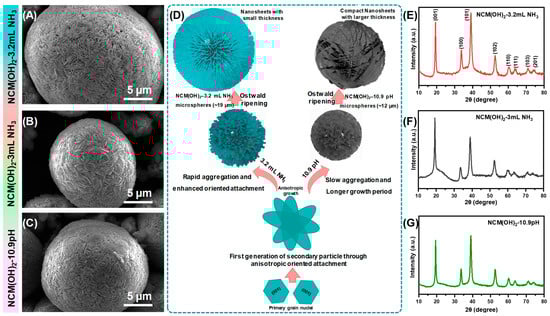
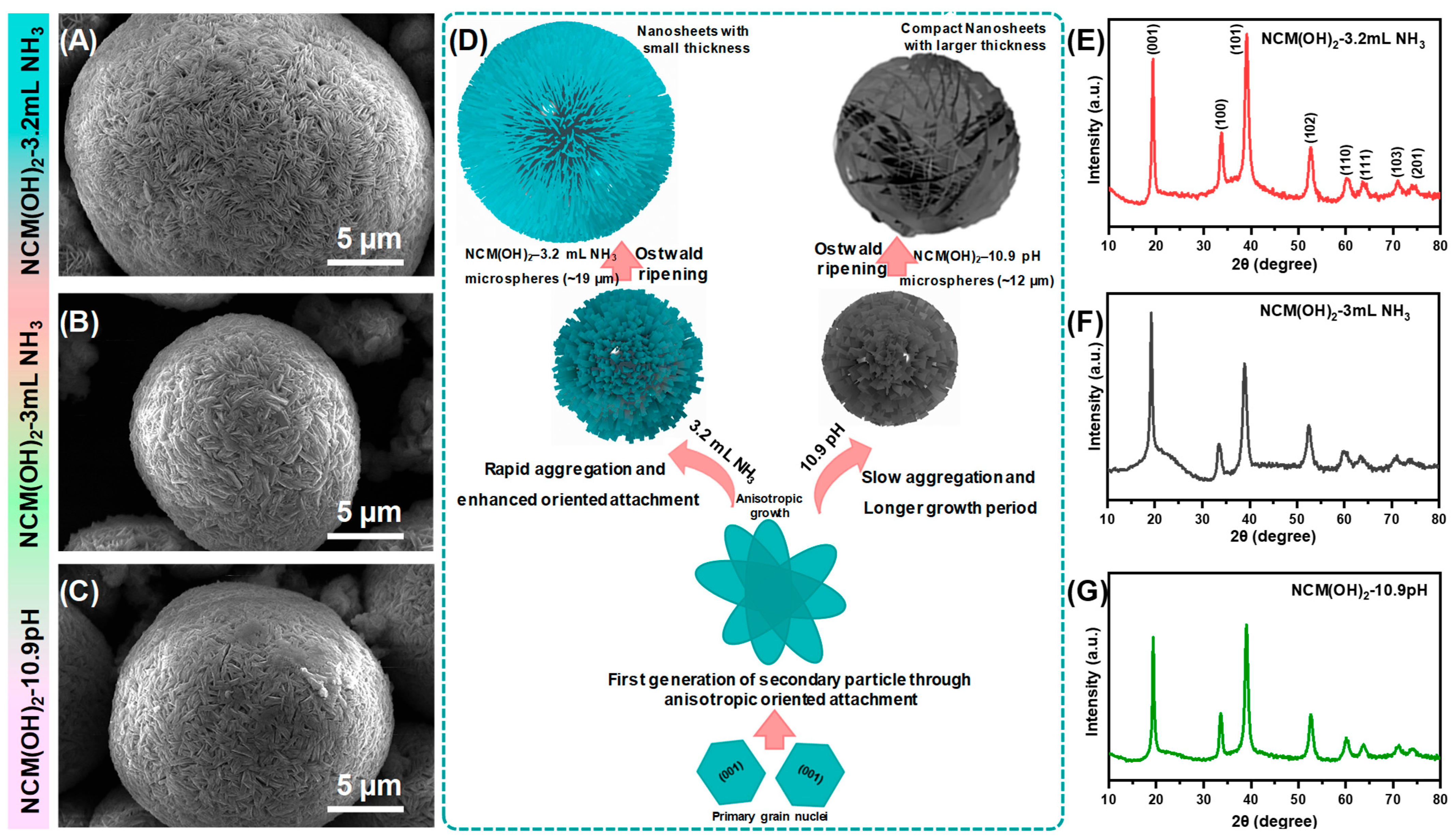
The morphological and structural characteristics of the synthesized hydroxide precursor and the corresponding oxide cathode after lithiation were investigated using FE-SEM and XRD analyses. As shown in Figure S1, all the prepared Ni0.6Co0.2Mn0.2(OH)2 precursor samples—namely NCM(OH)2-3.2 mL NH3 (Figure S1A,B), NCM(OH)2-3 mL NH3 (Figure S1D,E), and NCM(OH)2-10.9 pH (Figure S1G,H)—exhibit a predominantly spherical morphology, indicating successful co-precipitation under well-controlled conditions. The corresponding magnified FESEM images of these microspheres (Figure 1) reveal clear differences in the secondary particle sizes and internal architectures among the samples. As illustrated in Figure 1A,B,C, the secondary particles within each microsphere differ notably in size. The particle size distribution of the NCM(OH)2-3.2 mL NH3 precursor is centered around ~19 µm (Figure S1C), whereas the NCM(OH)2-3 mL NH3 and NCM(OH)2-10.9 pH samples exhibit smaller secondary particles with average diameters of approximately ~12 µm (Figure S1F,I). At higher magnification, all microspheres reveal a distinct hierarchical morphology characterized by the assembly of primary particles into closely stacked, multi-layered nanosheets with variable thickness, forming an integrated spherical framework. Such nanosheet stacking behavior is a characteristic feature of co-precipitated hydroxide precursors and plays a vital role in determining lithium diffusion pathways and mechanical integrity in the final oxide cathode [35]. The observed differences in secondary particle size and nanosheet thickness can be primarily attributed to the controlled variation of NH4OH or NH3 solution feed rate and pH adjustment using NaOH during synthesis. The co-precipitation mechanism can be described by the following reactions:
TM2+ + nNH3·H2O ↔ [TM(NH3)n]2+ + nH2O
[Ni(NH3)n]2+ + 2OH− ↔ TM(OH)2 + nNH3
Figure 1.
(A–C) Magnified FESEM images of NCM(OH)2-3.2 mL NH3, NCM(OH)2-3 mL NH3, and NCM(OH)2-10.9 pH precursors, respectively. (D) Schematic illustration of the microsphere growth process. (E–G) XRD patterns of the corresponding NCM(OH)2 precursors.
During synthesis, the TM ions initially form soluble ammine complexes with NH3, which subsequently decompose in the presence of hydroxide ions to yield TM(OH)2 precipitates. The stability of these complexes and the nucleation–growth kinetics of the hydroxide particles are highly sensitive to the NH3 feed rate and solution pH [36,37,38]. For the NCM(OH)2-3.2 mL NH3, a higher NH3 feed rate (3.2 mL min−1) at a constant pH = 11 generated a strongly basic environment with abundant ammonium ions as ligands. Although the strong basicity of the reaction medium primarily drives the development of the secondary microsphere morphology, the overall growth mechanism progresses through a sequence of coordinated steps. Initially, hexagonal nanosheets associated with the (001) plane of the layered structure emerge as primary grain nuclei. These nanosheets then undergo anisotropic oriented attachment, producing the first generation of secondary particles. At higher NH3 feed rates, the excess ammonia promotes extensive formation of TM–ammine complexes, which slows the release of free metal ions into the solution. As a result, nucleation becomes more frequent, while sustained crystal growth is suppressed, leading to the formation of many small primary crystallites. At the same time, increased NH3 concentration enhances gas bubble generation, local mixing, and mass transfer within the reactor. These conditions promote rapid aggregation and oriented attachment of numerous small nuclei, allowing secondary particles to grow larger through rapid assembly rather than through the gradual expansion of individual primary particles. Because this assembly occurs under conditions that somewhat restrict crystal growth and densification, the secondary particles naturally form relatively loose and porous internal structures. This mechanical formation reflects a series of frequent nucleation events, anisotropic growth of the secondary particles, and crystal orientation, as schematically illustrated in Figure 1D. Conversely, when the NH3 feed rate was reduced to 3.0 mL min−1 in the NCM(OH)2-3 mL NH3 sample, the lower NH3 concentration reduced the formation of metal-ammine complexes. These weakened complexes release TM ions more gradually into the reaction medium, lowering the local supersaturation and consequently suppressing both anisotropic crystal growth and the extent of Ostwald ripening. Consequently, the precursors evolved into smaller microspheres (~12 µm) composed of thicker, denser nanosheets, reflecting a growth process limited by the reduced ion supply and slow crystallization rate. Interestingly, the NCM(OH)2-10.9 pH precursor synthesized at the same NH3 feed rate (3.2 mL min−1) but at a slightly lower pH of 10.9 exhibited significantly different morphologies. At pH 10.9, the lower alkalinity reduces the availability of OH− ions and weakens the formation of stable TM-hydroxide nuclei. As a result, nucleation occurs less frequently, and fewer primary particles are generated at the early stage [38]. These primary grains therefore experience relatively longer growth periods before aggregation begins, leading to slightly larger and more compact primary structures compared to those formed at pH 11. In addition, the moderated precipitation kinetics at pH 10.9 slow down both oriented attachment and secondary-particle assembly. Because the aggregation is less vigorous and occurs with a smaller number of nuclei, the resulting secondary particles remain smaller and more densely packed, exhibiting lower internal porosity. To further elucidate this pH effect, the precursors were synthesized at pHs 10.8 and 11.1 while maintaining the NH3 feed rate at 3.2 mL min−1. At pH 10.8, limited hydroxide availability and stronger TM–NH3 complexation restricted the release of free TM ions, resulting in reduced nucleation and the formation of partially developed secondary particles with a high density of nucleation centers (Figure S2A,B). This indicates that nucleation proceeds, but growth is significantly limited by the lack of free TM ions for sustained hydroxide formation. Conversely, at a high pH of 11.1, increasing supersaturation accelerated nucleation, exceeding the growth rate of existing nuclei. The continuous formation of new nuclei throughout the solution resulted in colloidal precipitation, resulting in a more transparent blue filtrate during filtration and the production of irregularly shaped precursors smaller than ~10 µm (Figure S2C,D). This behavior reflects uncontrolled nucleation and failure of the particles to mature into uniform secondary particles. Furthermore, reducing the NH3 feed rate to 2.6–2.8 mL min−1 at a constant pH of 11 decreased the complexation efficiency and prevented the stable release of free TM ions. These conditions promoted a high nucleation rate but limited subsequent crystal growth. The resulting precursors exhibited a flower-like morphology with particle sizes less than ~10 µm (Figure S2E–H), suggesting rapid nucleation without sufficient growth to form spherical secondary particles. These observations highlight the subtle yet important interplay between NH3 supply rate and solution pH in controlling the nucleation-growth balance during the co-precipitation process. These variables are crucial factors in determining the particle size distribution, microstructural evolution, and overall morphology of the NCM(OH)2 precursor, which in turn critically influences the electrochemical performance of the final NCM cathode material. The phase purity and crystal structure of three precursors (NCM(OH)2-3.2 mL NH3, NCM(OH)2-3 mL NH3, and NCM(OH)2-10.9 pH) exhibiting well-developed spherical morphology were further verified by XRD analysis (Figure 1E–G). The diffraction patterns of NCM(OH)2-3.2 mL NH3, NCM(OH)2-3 mL NH3, and NCM(OH)2-10.9 pH showed clear peaks corresponding to the characteristic reflections of β-Ni(OH)2 (JCPDS No. 14-0117). The absence of additional diffraction peaks attributed to Co(OH)2 or Mn(OH)2 phases indicates that Co2+ and Mn2+ ions successfully substituted for Ni2+ lattice sites to form a single-phase solid solution. This confirms that the coprecipitation process effectively produced homogeneous mixed metal hydroxides that served as precursors for the subsequent lithiation calcination step, which were structurally and compositionally uniform. The morphological evolution of the NCM(OH)2 precursors after lithiation and high-temperature calcination was examined (Figure S3). All the calcined NCM samples largely preserved their original spherical secondary morphology, indicating that the microsphere framework of the hydroxide precursors remained structurally robust during the lithiation and phase transformation processes. However, significant surface modifications were observed on the primary particles constituting the microspheres. The initially well-defined, sharp-edged nanosheets present in the hydroxide precursors became compacted and shrunk after calcination. The changes are attributable to the high temperature and particle densification occurring during the oxide phase formation.
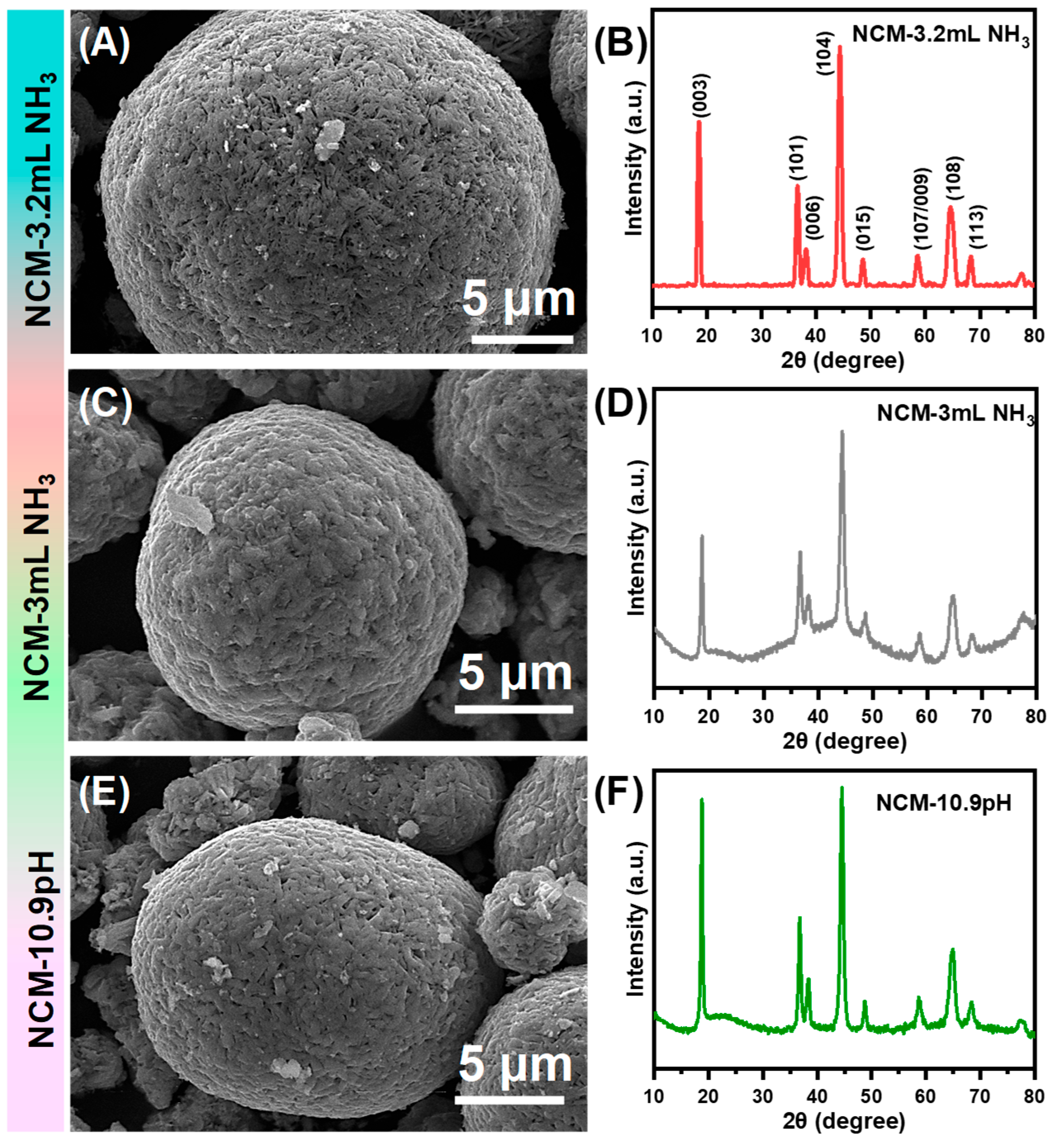
Notably, a distinct variation in the primary particle size was observed among the three samples. The NCM-3 mL NH3 (Figure 2C) and NCM-10.9 pH (Figure 2E) samples exhibited pronounced grain coarsening, with their primary particles showing strong intergrowth and partial agglomeration, leading to average widths of approximately 650 and 530 nm, respectively. In contrast, the NCM-3.2 mL NH3 sample (Figure 2A) maintained a relatively refined surface texture, where the primary crystallites were interconnected in the form of thin nanosheets with reduced width (~250 nm). This suggests that the higher NH3 feed rate during precursor synthesis contributed to the generation of more uniform and compact nanosheet substructures, which effectively resisted excessive grain growth during calcination. XRD patterns of the lithiated precursor products calcined at 650 °C for 10 h are shown in Figure 2B,D,F. All three samples exhibited distinct diffraction peaks characteristic of the layered rhombohedral α-NaFeO2 structure (space group of R3m), confirming the successful formation of an NCM oxide phase free of impurities. The absence of secondary phases indicates that the hydroxide precursor was fully lithiated into the desired layered oxide structure. A notable structural feature of the NCM material is the intensity ratio of the (003) and (104) diffraction peaks, I(003)/I(104), which serves as an indicator of cation mixing between Li+ and Ni2+ ions within the lattice. A high I(003)/I(104) ratio generally indicates a lower Li+/Ni2+ cation disorder, which leads to improved lithium ion diffusion kinetics [39,40,41]. The calculated I(003)/I(104) ratios for the NCM-3.2 mL NH3, NCM-3 mL NH3 and NCM-10.9 pH samples were 0.75, 0.49, and 0.85, respectively. Additionally, the average grain size of the samples was estimated using the Scherrer equation [42,43], and the values were 20.0 nm, 29.2 nm, and 27.5 nm for NCM-3.2 mL NH3, NCM-3 mL NH3 and NCM-10.9 pH, respectively. From the observed results, it can be concluded that the combination of relatively high I(003)/I(104) ratios and fine particle sizes in the NCM-3.2 mL NH3 and NCM-10.9 pH samples indicates enhanced crystallographic order with limited Li+/Ni2+ cation disorder. This improved structural consistency is expected to mitigate lattice distortion during lithium insertion/deintercalation, thereby enabling superior electrochemical performance compared to NCM-3 mL NH3 material.
Figure 2.
(A,C,E) Magnified FESEM images and (B,D,F) XRD patterns of NCM-3.2 mL NH3, NCM–3 mL NH3, and NCM-10.9 pH samples, respectively.
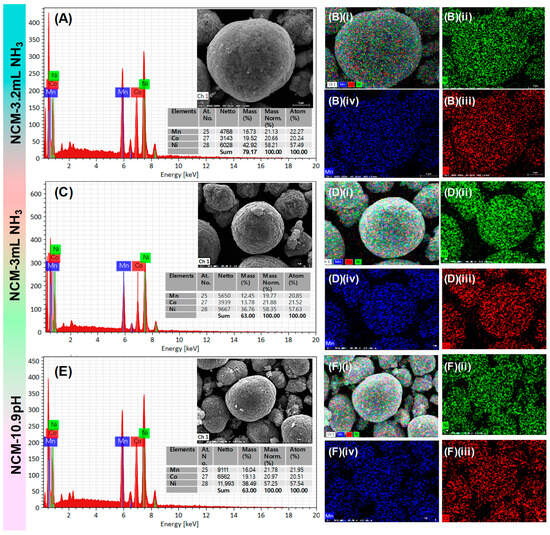
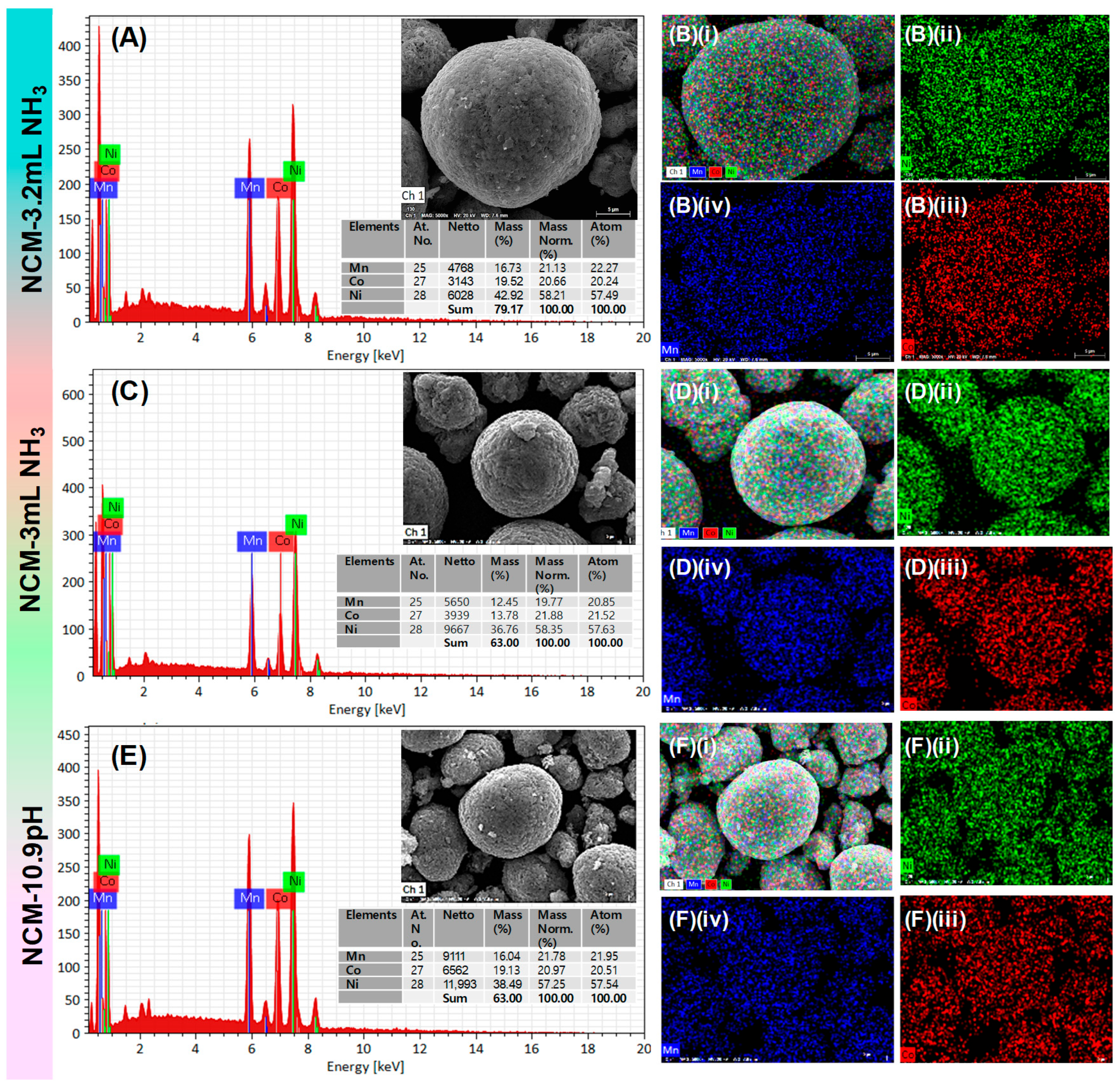
As shown in Figure 3, the elemental composition and spatial distribution of the constituent transition metals of the oxide NCM samples were investigated using energy-dispersive X-ray spectroscopy (EDS) and elemental mapping analysis. The EDS spectra of all samples (NCM-3.2 mL NH3 (Figure 3A), NCM-3 mL NH3 (Figure 3C), and NCM-10.9 pH (Figure 3E)) confirmed the presence of Ni, Co, and Mn elements without detectable impurities. The measured elemental weight percentages were almost identical to the intended stoichiometric ratio of Ni:Co:Mn = 0.6:0.2:0.2, indicating that compositional uniformity was well maintained during the synthesis and subsequent calcination processes. The corresponding elemental mapping images (Figure 3B(ii–iv),D(ii–iv),F(ii–iv)) recorded via EDS layered images of NCM-3.2 mL NH3 (Figure 3B(i)), NCM-3 mL NH3 (Figure 3D(i)), and NCM-10.9 pH (Figure 3F(i)) further demonstrate the uniform distribution of Ni, Co, and Mn throughout the microspheres. This uniform dispersion of transition metals suggests that the co-precipitation process enabled effective chemical homogeneity at the primary and secondary particle levels. Furthermore, this helps ensure a consistent local electronic environment and maintain structural transformation during lithiation and delithiation.
Figure 3.
(A,C,E) EDS spectra and (B(i–iv),D(i–iv),F(i–iv)) corresponding elemental mapping images of Ni, Co, and Mn for the NCM-3.2 mL NH3, NCM-3 mL NH3, and NCM-10.9 pH samples, respectively.
3.2. Electrochemical Performance
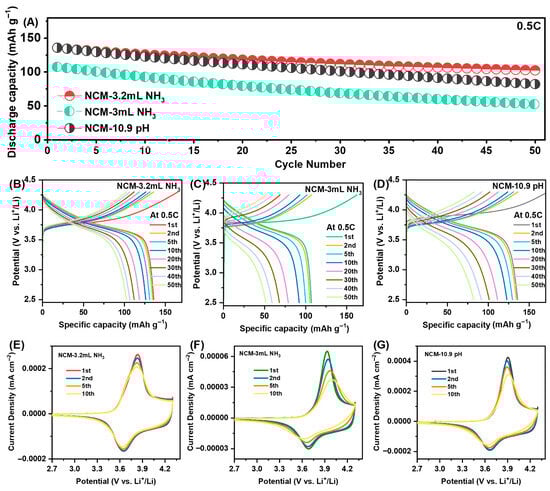
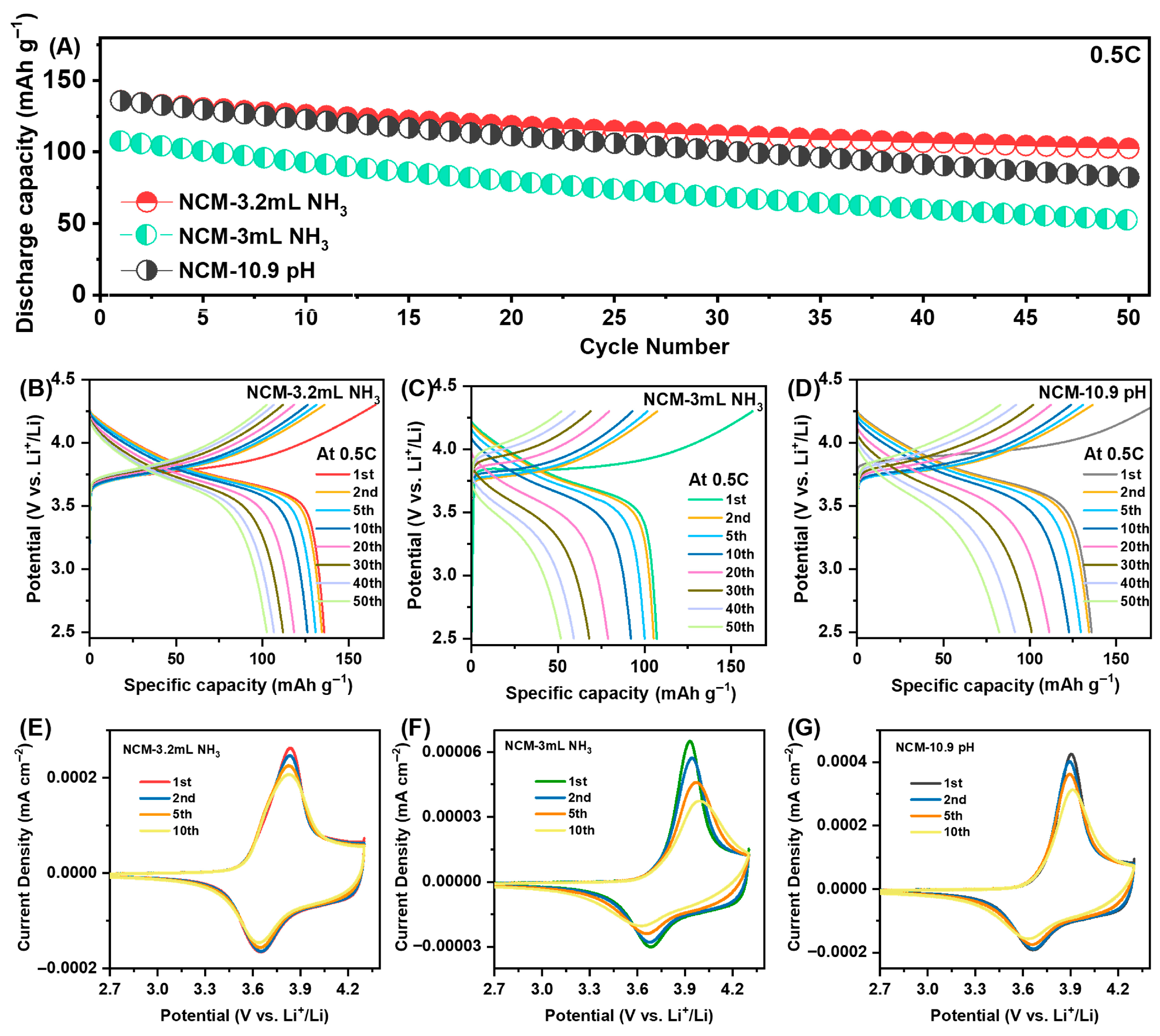
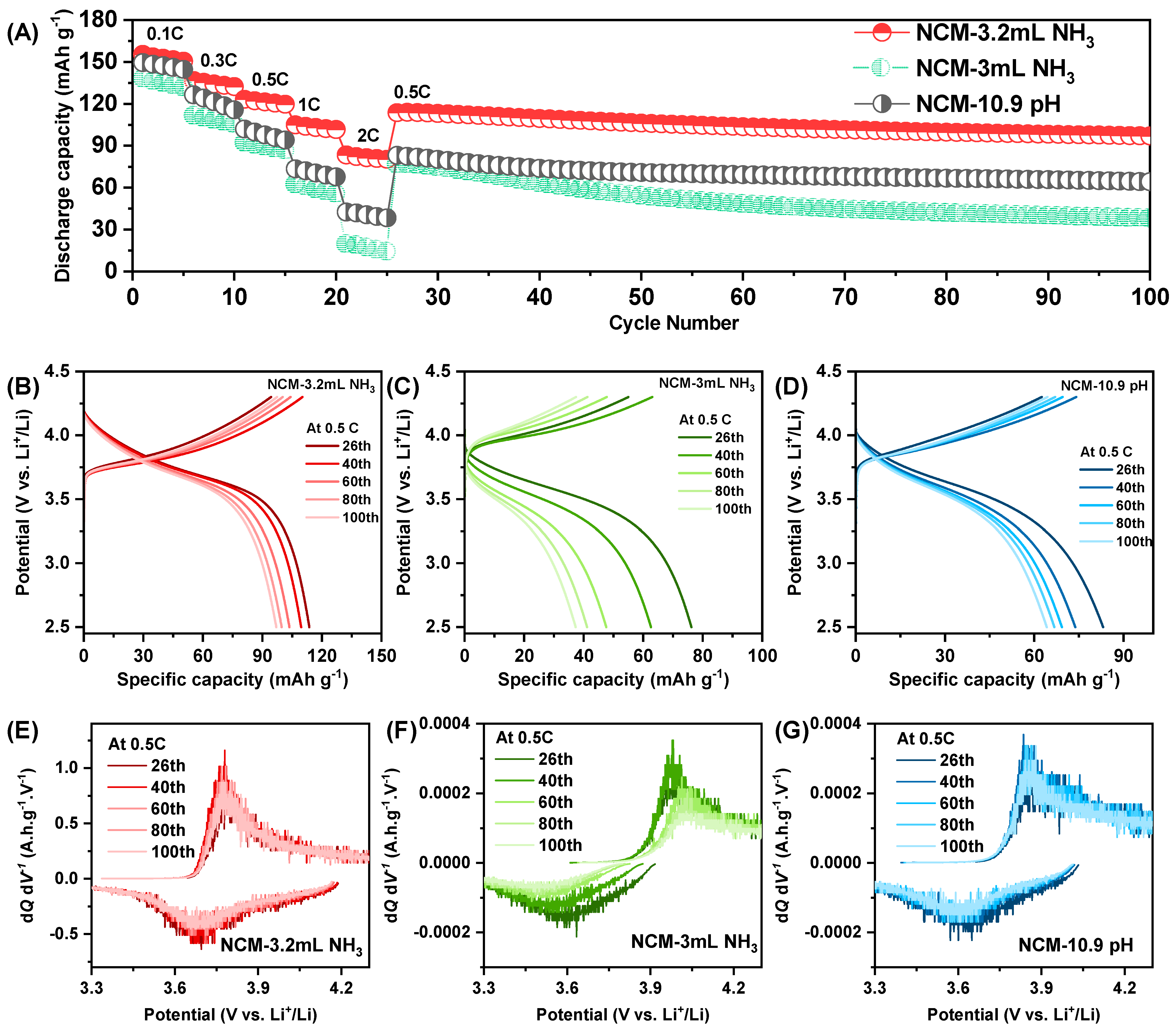
The electrochemical performance of the synthesized cathode materials was evaluated to investigate the effect of primary particle morphology on the cycling behavior. Successive galvanostatic charge–discharge cycling was performed at a rate of 0.5C within the voltage range of 2.5–4.25 V vs. Li+/Li (Figure 4A). The initial discharge capacities of the NCM-3.2 mL NH3, NCM-3 mL NH3, and NCM-10.9 pH electrodes were 142, 107, and 136 mA h g−1, respectively. During extended cycling, the NCM-3 mL NH3 and NCM-10.9 pH electrodes showed gradual capacity decay, while the NCM-3.2 mL NH3 electrode maintained relatively good performance with a slight capacity decay. After 50 cycles, the NCM-3.2 mL NH3 electrode retained ~80% of its initial capacity, outperforming the NCM-3 mL NH3 (~48%) and NCM–10.9 pH (~60%) electrodes. The excellent long-term capacity retention is more closely related to the improved mechanical integrity. The finer and more uniformly distributed primary particles of the NCM-3.2 mL NH3 electrode help suppress the formation of intergranular cracks, a common degradation mechanism in high-Ni-content layered anodes. The smaller primary particles reduce internal stress accumulation during repeated Li+ insertion/extraction, mitigate structural deformation, and limit the propagation of microcracks. Furthermore, the uniform spatial distribution of TM (Ni, Co, Mn) ions induces a homogeneous electrochemical reaction, minimizing localized deformation and delaying particle destruction [44,45]. Consequently, reduced structural deformation and suppression of side reactions contribute to higher capacity retention. The charge–discharge voltage profiles (Figure 4B–D) provide additional insight into the electrochemical stability of these electrodes. The NCM-3.2 mL NH3 electrode exhibited a smaller polarization gap and lower potential drop at high cycles, reflecting improved reaction kinetics. In contrast, the NCM-3 mL NH3 and NCM-10.9 pH electrodes exhibited larger potential drops and reduced discharge capacities at higher cycle numbers, indicating slower Li+-ion transport. Although the NCM-10.9 pH electrode exhibited relatively low Li+/Ni2+ cation mixing, its larger and denser primary particles likely hindered Li+-ion transport and promoted parasitic reactions at the electrode-electrolyte interface, resulting in faster capacity fade.
Figure 4.
(A) comparative cycling performance of NCM-3.2 mL NH3, NCM-3 mL NH3, and NCM-10.9 pH cathodes, and (B–D) the corresponding charge–discharge profiles. (E–G) the corresponding CV curves.
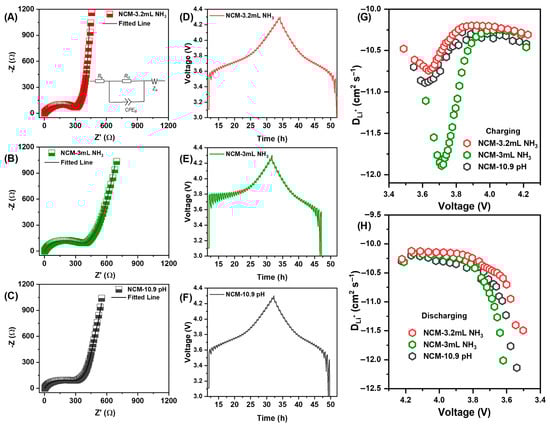
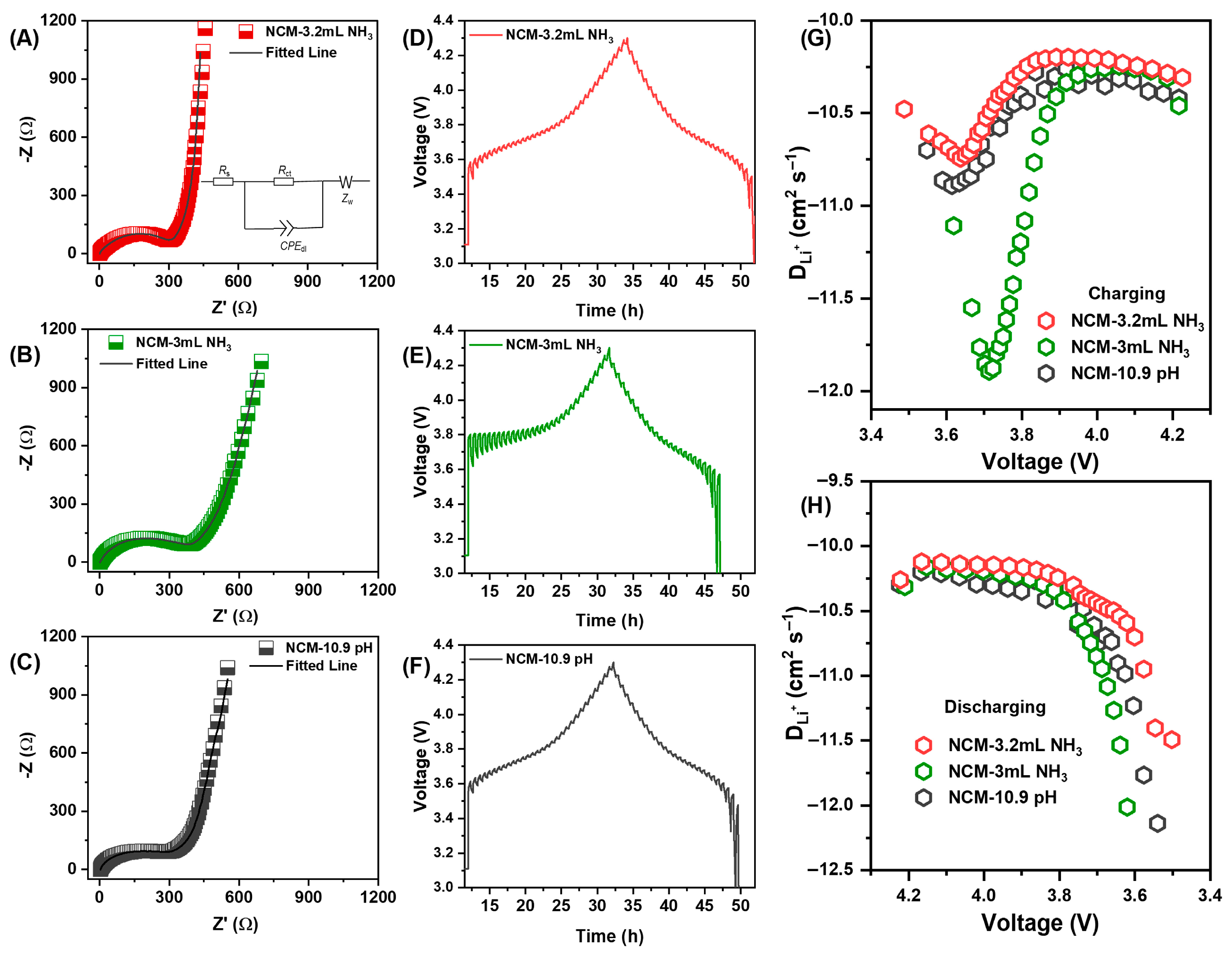
Comparative cyclic voltammetry (CV) measurements were performed for all three anodes at a scan rate of 0.1 mV s−1 over the voltage range of 2.7–4.3 V (Figure 4E–G). All samples exhibited two distinct redox peaks with smooth and symmetrical shapes, indicating excellent crystallinity. In the Ni-rich layered cathode, these anodic and cathodic peaks correspond to the reversible Li+-extraction/insertion process associated with the Ni2+/Ni4+ redox transition [46,47]. For the NCM-3.2 mL NH3 electrode (Figure 4E), the anodic and cathodic peaks in the first cycle appear at 3.83 V and 3.64 V, respectively, with a small peak gap of 0.19 V. This narrow voltage gap is characteristic of low polarization and efficient Li+ transport. After initial activation, the peak positions and separations remained virtually unchanged during the 2nd, 5th, and 10th cycles, demonstrating excellent electrochemical reversibility and stable Li+-ion diffusion pathways and kinetics. This consistency confirms that the NCM-3.2 mL NH3 cathode effectively preserves its structural integrity and maintains stable reaction kinetics throughout continuous cycling. Conversely, the NCM-3 mL NH3 and NCM-10.9 pH electrodes exhibited significantly greater peak separations, with anodic and cathodic peaks at higher potentials during the first scan, at 0.26 V and 0.24 V, respectively (Figure 4F,G). As cycling continued, these electrodes exhibited a gradual peak shift (the anodic peak shifted to higher voltages and the cathodic peak shifted to lower voltages), along with an increase in peak separation. By the 10th cycle, the peak spacing had significantly widened to 0.36 V for NCM-3 mL NH3 and 0.30 V for NCM-10.9 pH. This broadening of the peak spacing reflects increased polarization, which in turn indicates hindered Li+ diffusion and a slower reaction rate. This phenomenon suggests that the recovery of Li+ ions is incomplete or non-uniform during repeated scanning cycles, which is likely due to microstructural instability or high interfacial resistance in the electrodes. To further substantiate the kinetic advantages of the optimized cathode, EIS and GITT analyses were performed to comprehensively evaluate the interfacial charge-transfer behavior and Li+-ion transport kinetics of all electrodes. The Nyquist plots of the samples exhibit a depressed semicircle in the high- to mid-frequency region, corresponding to the charge-transfer resistance (Rct), followed by an inclined line in the low-frequency region associated with solid-state Li+ diffusion. Among the investigated samples, the NCM-3.2 mL NH3 electrode displays the smallest semicircle diameter, indicating the lowest Rct value (253 Ω) and the most favorable charge-transfer kinetics (Figure 5A). This reduced interfacial resistance is attributed to its well-developed secondary microsphere architecture composed of uniformly distributed fine primary particles, which promotes intimate particle–particle contact and a stable electrode–electrolyte interface. In addition, the steeper slope observed in the low-frequency Warburg region for the NCM-3.2 mL NH3 sample suggests enhanced Li+ diffusion kinetics, consistent with its porous secondary structure that offers shortened diffusion pathways and improved electrolyte penetration. In contrast, the NCM-3.0 mL NH3 and NCM-10.9 pH electrodes exhibit larger semicircles with higher Rct values of 340 Ω and 275 Ω, respectively, reflecting comparatively less optimized microstructures (Figure 5B,C). Consistent with the EIS results, GITT analysis reveals that the NCM-3.2 mL NH3 cathode maintains higher Li+ diffusion coefficients across the entire state-of-charge range than the other two samples. The smaller polarization during each current pulse and the faster relaxation toward equilibrium voltage indicate more efficient Li+ transport and reduced internal resistance (Figure 5D–F). Notably, the estimated Li+ diffusion coefficients in the voltage range of 3.5–4.25 V demonstrate that the NCM-3.2 mL NH3 electrode exhibits superior Li+ diffusion capability during both charging (Figure 5G) and discharging (Figure 5H) processes. These enhanced diffusion characteristics are primarily attributed to the porous secondary morphology and shortened Li+ diffusion paths afforded by the finely dispersed primary particles, facilitating rapid ion transport during lithiation and delithiation. In addition to assessing initial cycling stability, rate performance tests were conducted to further investigate the electrochemical response of the three NCM cathode materials at various current densities from 0.1C to 2C (Figure 6A).
Figure 5.
Nyquist plots of the (A) NCM-3.2 mL NH3, (B) NCM-3 mL NH3, and (C) NCM-10.9 pH cathodes. GITT voltage response profiles of the (D) NCM-3.2 mL NH3, (E) NCM-3 mL NH3, and (F) NCM-10.9 pH cathodes. Corresponding Li+ diffusion coefficients as a function of voltage during the (G) charging (H) discharging processes.
Figure 6.
(A) Comparative rate capability at various C-rates and prolonged cycling performance at 0.5 C for the 0.5C of NCM-3.2 mL NH3, NCM-3 mL NH3, and NCM-10.9 pH cathodes. (B–D) charge–discharge profiles, and (E–G) corresponding comparative dQ dV−1 profiles at various cycles for the NCM-3.2 mL NH3, NCM-3 mL NH3, and NCM-10.9 pH cathodes, respectively.
These tests provided insight into the polarization effects and Li+-ion transfer kinetics of each electrode. To ensure stable performance, each current density was maintained for five consecutive cycles, after which the rate was returned to 0.5C for post-rate recovery analysis. As shown in Figure 6A, all electrodes exhibited a gradual decrease in discharge capacity with increasing current density, which is generally attributed to enhanced polarization and kinetic limitations at high C-rates. The NCM-3.2 mL NH3 consistently provided superior capacity at all current densities, demonstrating excellent rate performance and rapid Li+ diffusion behavior. In contrast, both the NCM-3 mL NH3 and NCM-10.9 pH electrodes exhibited more pronounced capacity decay above 1C, indicating slower Li+ transport and higher internal resistance. At the highest current rate (2C), a significant difference in capacity retention was observed, with the NCM-3.2 mL NH3 electrode maintaining a significantly higher discharge capacity and returning the greater portion of its initial capacity compared to the other two electrodes. This suggests better structural resilience and reversibility during rapid charge–discharge cycling. This improved rate performance and recovery behavior can be directly associated with smaller, interconnected primary particles, which promote efficient Li+ transport and reduce polarization effects during high-rate cycling [48,49]. In particular, a noticeable potential drop (the charge–discharge plateau shift of approximately 3.5 V) and increased voltage polarization were observed for the NCM-3 mL NH3 and NCM-10.9 pH electrodes with increasing C-rate (Figure S4A–C). The differential capacity (dQ dV−1) plots (Figure S4E,F) at various C-rates further exhibited significant potential shifts with decreased anodic and cathodic redox peaks intensities, indicating higher polarization and slower Li+ insertion/deintercalation kinetics. In contrast, the NCM-3.2 mL NH3 electrode exhibited significantly smaller potential drops in its charge–discharge profiles even at high C-rates, and the shift in the redox peak position of the dQ dV−1 curve was minimal (Figure S4D). These stable electrochemical reactions confirm that the Li+ insertion and extraction processes in this material are more reversible and kinetically favorable. After 100 cycles at a 0.5 C rate, the NCM-3.2 mL NH3 electrode maintained approximately 86% of its initial discharge capacity, clearly outperforming the NCM-3 mL NH3 (46%) and NCM-10.9 pH (~76%) counterparts (Figure 6A). After high-rate cycling, the GCD curves of the NCM–3.2 mL NH3 electrode (Figure 6B) remain highly overlapped with minimal voltage polarization, indicating stable reaction kinetics and efficient Li+ extraction/insertion even during prolonged operation. The corresponding dQ dV−1 profiles (Figure 6E) also display a sharp, well-defined redox peak near ~3.8 V with negligible peak shifting or broadening up to the 100th cycle, confirming a stable redox environment and minimal impedance growth in the optimized electrode. In contrast, the NCM-3 mL NH3 (Figure 6C) and NCM-10.9 pH (Figure 6D) electrodes exhibited increasingly distorted GCD curves with increasing cycle counts, with significant voltage polarization and decreased discharge capacity. This indicates increased internal resistance and limited Li+ diffusion. This degradation is evident by the decreased intensity and increased asymmetry of the dQ dV−1 redox peak after prolonged cycling, reflecting increased resistance and partial loss of active sites (Figure 6F,G).
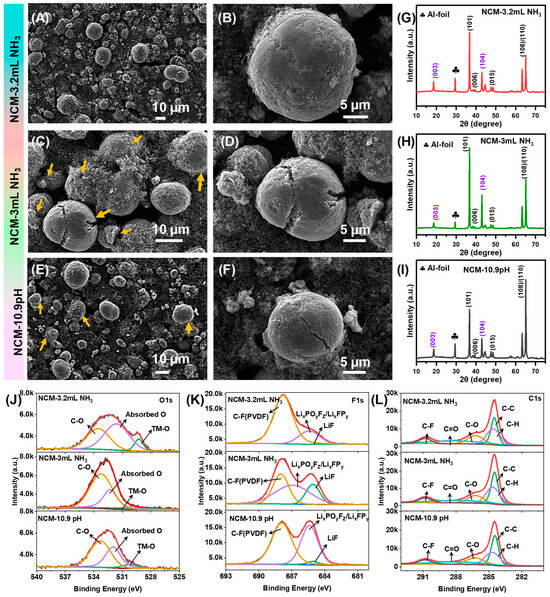
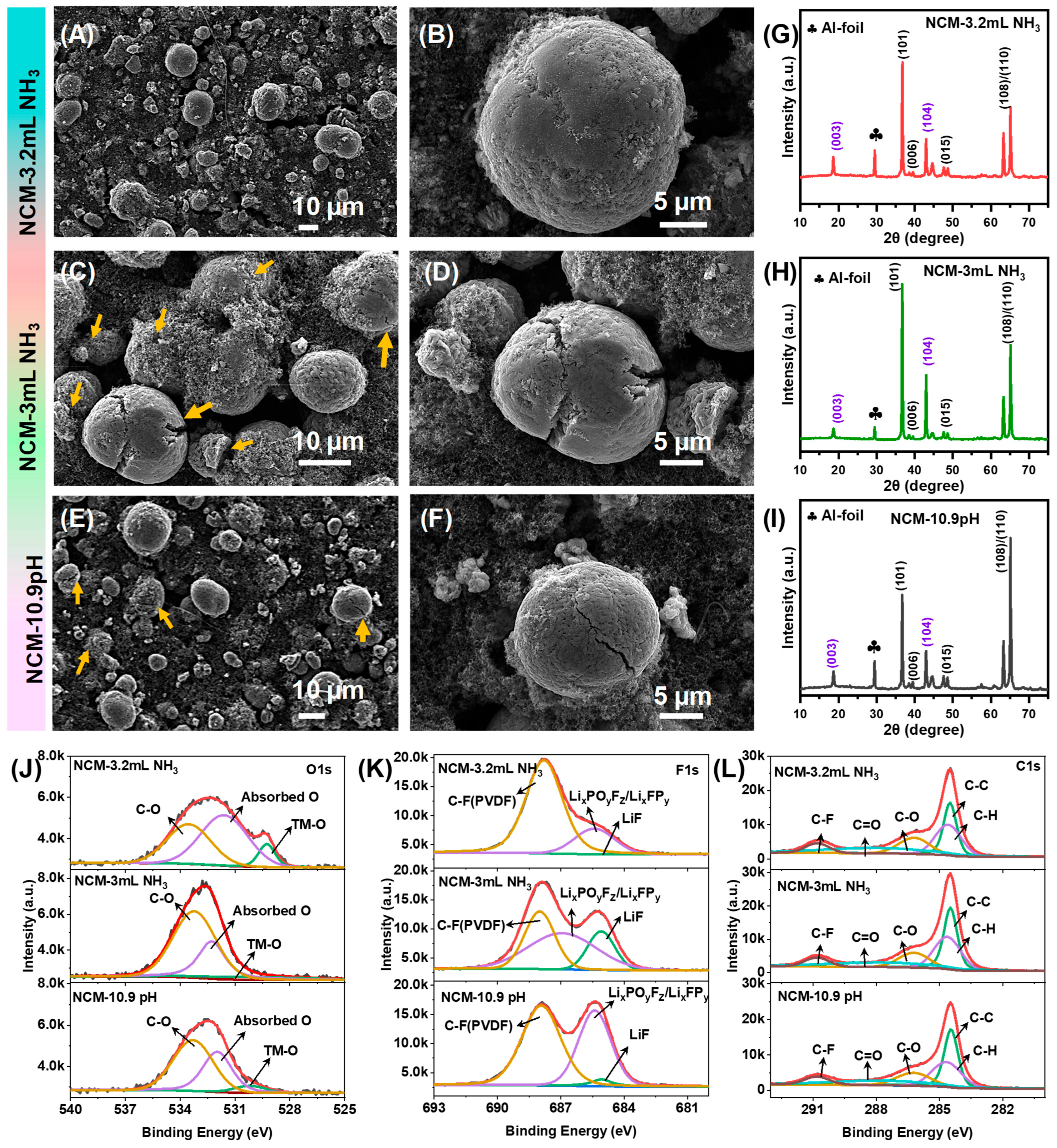
These electrochemical characteristics are further supported by the post-cycle SEM analysis results presented in Figure 7. The NCM-3.2 mL NH3electrode exhibits excellent mechanical integrity, with a well-preserved secondary particle structure and no cracks or interparticle fractures observed (Figure 7A,B). In contrast, the NCM-3 mL NH3 electrode maintains a spherical morphology but exhibits prominent microcracks within the secondary particles (Figure 7C,D). The NCM-10.9 pH sample also shows microcracking, although the extent of damage is less severe than that observed in the 3 mL NH3 sample (Figure 7E,F). These microstructural defects serve as pathways for electrolyte penetration, exacerbating parasitic surface reactions and contributing to the irreversible capacity loss observed during cycling. The sustained intensity of the dQ dV−1 redox peak, coupled with minimal potential shift and the retention of secondary particle morphology in the NCM-3.2 mL NH3 electrode after cycling, indicates effective suppression of degradation mechanisms associated with structural fatigue and phase transitions. This behavior suggests that the electrode maintains uniform Li+ diffusion channels and a stable transition metal coordination environment under repeated electrochemical cycling. To further evaluate the structural stability after cycling, ex situ XRD analysis was performed on the harvested electrodes (Figure 7G–I). All samples retained the characteristic reflections of the layered α-NaFeO2 phase, along with the Al-current-collector peak at ~30°. Nevertheless, a notable change in peak intensity indicates lattice disturbance induced during cycling. The sharper separation between the (108) and (110) reflections suggests a partial splitting of the (110) peak, which is generally associated with enhanced structural alignment in layered cathodes. As is known, the I(003)/I(104) intensity ratio, commonly used as an indicator of Li+/Ni2+ cation mixing, further highlights this difference. The NCM-3.2 mL NH3 electrode exhibits the highest ratio (0.67) after cycling, significantly exceeding the ratios of the NCM-3 mL NH3 (0.28) and NCM-10.9 pH (0.48). A higher ratio reduces cation disorder and improves Li+ diffusion paths, which is consistent with the superior electrochemical performance of the optimized electrode sample. Additionally, ex situ XPS analysis was performed on the cycled electrodes to investigate surface chemical changes after long-term cycling and their correlation with interfacial stability and Li+ transport. Figure 7J–L compare the high-resolution O 1s, F 1s, and C 1s spectra of the NCM-3.2 mL NH3, NCM-3.0 mL NH3, and NCM-10.9 pH electrodes. As shown in Figure 7J, the O 1s spectra of all electrodes can be deconvoluted into three components centered around 529, 531, and 533 eV, which correspond to C–O bonds associated with lattice oxygen (TM–O), surface-adsorbed oxygen species, and carbonate-based electrolyte decomposition products, respectively [50,51]. Notably, the C–O components attributed to the ROCO2Li/Li2CO3 species are relatively suppressed in the NCM-3.2 mL NH3 electrode, indicating reduced electrolyte decomposition and a more stabilized cathode–electrolyte interface (CEI). This suppression helps maintain smooth Li+ transport across the interface during charge–discharge processes. Furthermore, the TM–O peak intensity of the NCM-3.2 mL NH3 electrode is significantly higher than that of the NCM-10.9 pH electrode, suggesting a better preservation of the layered oxide lattice. The preserved metal–oxygen framework provides a continuous Li+ diffusion pathway within the bulk structure. In contrast, the relatively weaker TM–O signal observed in the NCM-3.0 mL NH3 electrode suggests increased surface reorganization, which may partially impede the Li+ diffusion rate. The F 1s spectrum (Figure 7K) exhibits three characteristic components: LiF, LixPOyFz/LixFPy species derived from LiPF6 decomposition, and C–F bonds in the PVDF binder [52,53]. The NCM-3.2 mL NH3 electrode exhibits significantly lower intensities of the LiF and LixPOyFz/LixFPy peaks compared to the other two electrodes, indicating suppressed interfacial reactions. Since excessive LiF accumulation is known to increase interfacial impedance and inhibit Li+ transport, the reduced formation of fluorinated species directly contributes to improved interfacial Li+ diffusion, consistent with the lower Rct and higher Li+ diffusion coefficient obtained from EIS and GITT analyses. The C 1s spectrum (Figure 7L) consists of C–C/C–H (PVDF binder), C–O, C=O, and C–F components, the latter three of which primarily originate from electrolyte decomposition and CEI formation [51,53]. While these features were observed in all electrodes after cycling, the relatively lower intensity of decomposition-related carbon species in the NCM-3.2 mL NH3 electrode suggests the formation of a thinner and more uniform CEI layer. This stable, low-resistance interface facilitates Li+ transport across the electrode-electrolyte interface during repeated lithiation and delithiation processes. Collectively, the XPS analysis results demonstrate that the optimized NH3 supply rate (3.2 mL min−1) effectively stabilizes the surface chemistry and bulk lattice structure of the NCM cathode, minimizing interfacial resistance and maintaining continuous Li+ diffusion pathways. Combined with the EIS and GITT analyses, these observations confirm that the enhanced Li+ transport rate and suppressed interfacial degradation play a crucial role in the excellent cycling stability and electrochemical performance of the NCM-3.2 mL NH3 cathode.
Figure 7.
Post-cycling characterization: FESEM images of (A,B) NCM-3.2 mL NH3, (C,D) NCM-3 mL NH3, and (E,F) NCM-10.9 pH electrodes; Post-cycling XRD patterns of (G) NCM-3.2 mL NH3, (H) NCM-3 mL NH3, and (I) NCM-10.9 pH samples; comparative high-resolution XPS spectra of (J) O 1s, (K) F 1s, and (L) C 1s regions for the cycled electrodes.
4. Conclusions
In summary, Ni-rich NCM cathode materials were synthesized via a controlled co-precipitation route by systematically adjusting the ammonia feed rate and pH to elucidate their influence on structural evolution and electrochemical performance. The optimized NCM-3.2 mL NH3 sample exhibited smaller primary particles with a more homogeneous cation distribution compared to the NCM-3 mL NH3 and NCM-10.9 pH electrodes, leading to reduced Li+/Ni2+ cation mixing and a more stable layered framework. Electrochemical testing results showed that the NCM-3.2 mL NH3 electrode exhibited excellent C-rate and cycle performance, retaining approximately 86% of its initial capacity after 100 cycles at 0.5C, which is significantly higher than other electrodes. In particular, the improved performance is due to the smaller primary particle size, which facilitates Li+-ion diffusion, reduces polarization, and effectively suppresses structural degradation during repeated cycling. Furthermore, the stable redox peak positions observed in the dQ dV−1 profile confirm the robust structural integrity and suppressed irreversible phase transition of the electrode. These improvements ensure long-term electrochemical durability by maintaining the cohesion of the secondary particles and mitigating microcrack formation. Overall, the findings demonstrate that precise control of ammonia feed rate during precursor synthesis serves as a simple yet powerful strategy to modulate primary particle growth thereby enhancing the structural stability and electrochemical performance of Ni-rich NCM622 cathodes for next-generation high-energy LIBs.
Supplementary Materials
The following supporting information can be downloaded at: https://www.mdpi.com/article/10.3390/batteries12010013/s1, Figure S1. Low-magnification FESEM images of the (A,B) NCM(OH)2–3.2 mL NH3, (C,D) NCM(OH)2–3 mL NH3, and (E,F) NCM(OH)2–10.9 pH. Panels (C), (F), and (I) show the corresponding particle size distributions. Figure S2. FESEM images of the (A,B) NCM(OH)2–10.8 pH, (C,D) NCM(OH)2–11.1 pH, and (E,F) NCM(OH)2–2.6 mL NH3, and (E,F) NCM(OH)2–2.8 mL NH3 respectively. Figure S3. Low-magnification FESEM images of the (A,B) NCM–3.2 mL NH3, (C,D) NCM–3 mL NH3, and (E,F) NCM–10.9 pH, respectively. Figure S4. (A–C) Comparative charge–discharge profiles, and (D–F) corresponding comparative dQ dV−1 profiles at various C-rates for the NCM–3.2 mL NH3, NCM–3 mL NH3, and NCM–10.9 pH cathodes, respectively.
Author Contributions
Conceptualization, K.H.S. and H.J.C.; methodology, K.H.S. and H.J.C.; validation, K.H.S., and H.J.C.; formal analysis, K.H.S.; investigation, K.H.S.; resources, J.-H.K.; data curation, H.J.C.; writing—original draft preparation, K.H.S.; writing—review and editing, K.H.S. and J.-H.K.; supervision, J.-H.K.; project administration, J.-H.K.; funding acquisition, J.-H.K. All authors have read and agreed to the published version of the manuscript.
Funding
This paper was supported by Korea Institute for Advancement of Technology (KIAT) grant funded by the Korea Government (MOTIE) (RS-2025-02073015, HRD Program for Industrial Innovation). This work was supported by KOITA grant funded by MSIT (KOITA20250002-36).
Data Availability Statement
The original contributions presented in the study are included in the article. Further inquiries can be directed to the corresponding author.
Conflicts of Interest
The authors declare no conflicts of interest.
References
- Ngoy, K.R.; Lukong, V.T.; Yoro, K.O.; Makambo, J.B.; Chukwuati, N.C.; Ibegbulam, C.; Eterigho-Ikelegbe, O.; Ukoba, K.; Jen, T.-C. Lithium-ion batteries and the future of sustainable energy: A comprehensive review. Renew. Sustain. Energy Rev. 2025, 223, 115971. [Google Scholar] [CrossRef] [Scilit]
- Hasan, M.; Haque, R.; Jahirul, M.; Rasul, M.G.; Fattah, I.; Hassan, N.; Mofijur, M. Advancing energy storage: The future trajectory of lithium-ion battery technologies. J. Energy Storage 2025, 120, 116511. [Google Scholar] [CrossRef] [Scilit]
- Wagner, A.C.; Bohn, N.; Geßwein, H.; Neumann, M.; Osenberg, M.; Hilger, A.; Manke, I.; Schmidt, V.; Binder, J.R. Hierarchical structuring of NMC111-cathode materials in lithium-ion batteries: An in-depth study on the influence of primary and secondary particle sizes on electrochemical performance. ACS Appl. Energy Mater. 2020, 3, 12565–12574. [Google Scholar] [CrossRef] [Scilit]
- Choi, H.-J.; Kim, Y.G.; Jeong, S.H.; Lee, S.J.; Jung, Y.H.; Kim, J.-H. Cu-Substituted Na3V2(PO4)3/C Composites as High-Rate, Long-Cycle Cathodes for Sodium-Ion Batteries. Batteries 2025, 11, 308. [Google Scholar] [CrossRef] [Scilit]
- Kim, N.Y.; Yim, T.; Song, J.H.; Yu, J.-S.; Lee, Z. Microstructural study on degradation mechanism of layered LiNi0.6Co0.2Mn0.2O2 cathode materials by analytical transmission electron microscopy. J. Power Sources 2016, 307, 641–648. [Google Scholar] [CrossRef] [Scilit]
- Marihot, S.D.; Cheng, Y.; Liu, H.; He, Z.; Li, Y.; Wu, Y.; Hua, W.; Xu, K. Strategic pH-Controlled Synthesis of Single-Crystal LiNi0.6Co0.2Mn0.2O2 for Maximized Structural and Electrochemical Optimization in Lithium-Ion Batteries. Mater. Today Sustain. 2025, 32, 101250. [Google Scholar]
- Aryal, S.; Durham, J.L.; Lipson, A.L.; Pupek, K.Z.; Kahvecioglu, O. Roles of Mn and Co in Ni-rich layered oxide cathodes synthesized utilizing a Taylor Vortex Reactor. Electrochim. Acta 2021, 391, 138929. [Google Scholar] [CrossRef] [Scilit]
- Cambaz, M.A.; Urban, A.; Pervez, S.A.; Geßwein, H.; Schiele, A.; Guda, A.A.; Bugaev, A.L.; Mazilkin, A.; Diemant, T.; Behm, R.J.r. Understanding the origin of higher capacity for Ni-based disordered rock-salt cathodes. Chem. Mater. 2020, 32, 3447–3461. [Google Scholar] [CrossRef] [Scilit]
- Vanaphuti, P.; Cui, Z.; Manthiram, A. Demarcating the Impact of Electrolytes on High-Nickel Cathodes and Lithium-Metal Anode. Adv. Funct. Mater. 2024, 34, 2308619. [Google Scholar] [CrossRef] [Scilit]
- Hussain, S.K.; Bang, J.H. Recent progress in Co-free, Ni-rich cathode materials for lithium-ion batteries. Bull. Korean Chem. Soc. 2024, 45, 4–15. [Google Scholar] [CrossRef] [Scilit]
- Lee, S.; Su, L.; Mesnier, A.; Cui, Z.; Manthiram, A. Cracking vs. surface reactivity in high-nickel cathodes for lithium-ion batteries. Joule 2023, 7, 2430–2444. [Google Scholar] [CrossRef] [Scilit]
- Geldasa, F.T.; Kebede, M.A.; Shura, M.W.; Hone, F.G. Identifying surface degradation, mechanical failure, and thermal instability phenomena of high energy density Ni-rich NCM cathode materials for lithium-ion batteries: A review. RSC Adv. 2022, 12, 5891–5909. [Google Scholar] [CrossRef] [Scilit]
- Kim, J.-M.; Kim, H.; Ahn, Y.-J.; Yang, Y.-H.; Sun, Y.-K. Modulating the Electrode–Electrolyte Interphases for High–Energy Lithium–Metal Batteries. Energy Storage Mater. 2025, 81, 104514. [Google Scholar] [CrossRef] [Scilit]
- Nagda, V.; Ekström, H.; Kulachenko, A. Impact of mechanical degradation in polycrystalline NMC particle on the electrochemical performance of lithium-ion batteries. J. Electrochem. Soc. 2024, 171, 060526. [Google Scholar] [CrossRef] [Scilit]
- Liu, Y.; Meng, Y.; Feng, L.; Hao, J.; Zhou, D.; Zheng, Y.; Li, B. Unveiling the Degradation Mechanisms and Addressing Sensitivity Challenges in Nickel-Rich Cathodes via Advanced Characterization. Energy Storage Mater. 2025, 81, 104530. [Google Scholar] [CrossRef] [Scilit]
- Mauger, A.; Julien, C.M. Design Principles and Engineering Strategies for Stabilizing Ni-Rich Layered Oxides in Lithium-Ion Batteries. Batteries 2025, 11, 254. [Google Scholar] [CrossRef] [Scilit]
- Rambukwella, I.; Ponnuru, H.; Yan, C. The role of dopants in mitigating the chemo-mechanical degradation of Ni-rich cathode: A critical review. EcoEnergy 2025, 3, 321–353. [Google Scholar] [CrossRef] [Scilit]
- Yao, L.; Liang, F.; Jin, J.; Chowdari, B.V.; Yang, J.; Wen, Z. Improved electrochemical property of Ni-rich LiNi0.6Co0.2Mn0.2O2 cathode via in-situ ZrO2 coating for high energy density lithium ion batteries. Chem. Eng. J. 2020, 389, 124403. [Google Scholar] [CrossRef] [Scilit]
- Kim, A.-Y.; Strauss, F.; Bartsch, T.; Teo, J.H.; Janek, J.; Brezesinski, T. Effect of surface carbonates on the cyclability of LiNbO3-coated NCM622 in all-solid-state batteries with lithium thiophosphate electrolytes. Sci. Rep. 2021, 11, 5367. [Google Scholar] [CrossRef] [Scilit]
- Wullich, R.N.; Lelotte, B.; Pelé, V.; Jordy, C.; Gubler, L.; El Kazzi, M. Optimized LiNbO3 Sol-Gel Coatings for NCM622 in Sulfide-Based All-Solid-State Batteries: Insights into Synthesis, Uniformity, and Electrochemical Performance. Electrochim. Acta 2025, 536, 146750. [Google Scholar] [CrossRef] [Scilit]
- Sun, H.H.; Kim, U.-H.; Park, J.-H.; Park, S.-W.; Seo, D.-H.; Heller, A.; Mullins, C.B.; Yoon, C.S.; Sun, Y.-K. Transition metal-doped Ni-rich layered cathode materials for durable Li-ion batteries. Nat. Commun. 2021, 12, 6552. [Google Scholar] [CrossRef] [Scilit] [PubMed]
- Venkatachalam, P.; Balakrishnan, G.; Pai, R.K.; Dange, Y.D.; Duru, K.K.; Sangaraju, S.; Maram, P.S.; Kalluri, S. High performance crack-free single crystalline NCM-622 via Mg-doping as a high voltage cathode for lithium-ion batteries. J. Power Sources 2025, 657, 238155. [Google Scholar] [CrossRef] [Scilit]
- Qu, X.; Huang, H.; Wan, T.; Hu, L.; Yu, Z.; Liu, Y.; Dou, A.; Zhou, Y.; Su, M.; Peng, X. An integrated surface coating strategy to enhance the electrochemical performance of nickel-rich layered cathodes. Nano Energy 2022, 91, 106665. [Google Scholar] [CrossRef] [Scilit]
- Fu, D.; Zhang, X.; Zhou, Y.; Yang, K.; Fan, J.; Li, L.; Fu, C. Regulating the Evolution Pathway of the Cathode Electrolyte Interphase to Stabilize Li-Rich Cathode Materials. ACS Sustain. Chem. Eng. 2025, 13, 3311–3320. [Google Scholar] [CrossRef] [Scilit]
- Xi, X.; Fan, Y.; Liu, Y.; Chen, Z.; Zou, J.; Zhu, S. Enhanced cyclic stability of NCM-622 cathode by Ti3+ doped TiO2 coating. J. Alloys Compd. 2021, 872, 159664. [Google Scholar] [CrossRef] [Scilit]
- Pham, H.Q.; Mirolo, M.; Tarik, M.; El Kazzi, M.; Trabesinger, S. Multifunctional electrolyte additive for improved interfacial stability in Ni-rich layered oxide full-cells. Energy Storage Mater. 2020, 33, 216–229. [Google Scholar] [CrossRef] [Scilit]
- Liao, C.; Li, F.; Liu, J. Challenges and modification strategies of Ni-rich cathode materials operating at high-voltage. Nanomaterials 2022, 12, 1888. [Google Scholar] [CrossRef] [Scilit] [PubMed]
- Chen, Z.; Guo, F.; Zhang, Y. Micron-sized monodisperse particle LiNi0.6Co0.2Mn0.2O2 derived by oxalate solvothermal process combined with calcination as cathode material for lithium-ion batteries. Materials 2021, 14, 2576. [Google Scholar] [CrossRef] [Scilit]
- Oswald, S.; Bock, M.; Gasteiger, H.A. Elucidating the Implications of Morphology on Fundamental Characteristics of Nickel-Rich NCMs: Cracking, Gassing, Rate Capability, and Thermal Stability of Poly-and Single-Crystalline NCM622. J. Electrochem. Soc. 2022, 169, 050501. [Google Scholar] [CrossRef] [Scilit]
- Ryu, H.-H.; Namkoong, B.; Kim, J.-H.; Belharouak, I.; Yoon, C.S.; Sun, Y.-K. Capacity fading mechanisms in Ni-rich single-crystal NCM cathodes. ACS Energy Lett. 2021, 6, 2726–2734. [Google Scholar] [CrossRef] [Scilit]
- Meng, Z.; Ma, X.; Azhari, L.; Hou, J.; Wang, Y. Morphology controlled performance of ternary layered oxide cathodes. Commun. Mater. 2023, 4, 90. [Google Scholar] [CrossRef] [Scilit]
- Yang, G.; Huang, L.; Song, J.; Liu, S.; Cong, G.; Zhang, X.; Huang, Y.; An, Q.; Gao, X.; Geng, L. Impact of lithium diffusion paths on electrochemical behavior of LiNi0.6Co0.2Mn0.2O2 cathode for lithium-ion batteries. Electrochim. Acta 2023, 465, 142990. [Google Scholar] [CrossRef] [Scilit]
- Gao, Y.; Wang, X.; Geng, J.; Liang, F.; Chen, M.; Zou, Z. Research progress on the failure mechanisms and modifications of Ni-rich ternary layered oxide cathode materials for lithium-ion batteries. J. Electron. Mater. 2023, 52, 72–95. [Google Scholar] [CrossRef] [Scilit]
- Ding, H.; Wang, X.; Wang, J.; Zhang, H.; Liu, G.; Yu, W.; Dong, X.; Wang, J. Morphology-controllable synthesis and excellent electrochemical performance of Ni-rich layered NCM622 as cathode materials for lithium-ion batteries via glycerin-assisted solvothermal method. J. Power Sources 2023, 553, 232307. [Google Scholar] [CrossRef] [Scilit]
- Han, Y.; Zheng, C.; Liu, Z.; Chen, P.; Liu, S.; Li, G.; Gao, X.P. Ultra-High Nickel Oxides as Cathode Materials for High-Energy Lithium-Ion Batteries. Energy Environ. Mater. 2013, e70160. [Google Scholar] [CrossRef] [Scilit]
- Wang, J.; Batara, B.; Xu, K.; Zhang, K.; Hua, W.; Peng, Y.; Liu, W.; Putri, A.H.I.; Xu, Y.; Sun, X. Co-Precipitation of Ni-Rich Me(OH)2 Precursors for High Performance LiNixMnyCo1-x-yO2 Cathodes: A Review. Energy Environ. Mater. 2025, 8, e70078. [Google Scholar] [CrossRef] [Scilit]
- Hu, K.-H.; He, Y.-Y.; Zhu, C.-Q.; Zhou, K.; Chen, Q.; Yang, Z.-M.; Wan, B.-R.; Yang, E.-Q.; Zhang, T.-T.; Qin, Y.-D. Insight into the evolution of precursor and electrochemical performance of Ni-rich cathode modulated by ammonia during hydroxide precipitation. J. Alloys Compd. 2019, 803, 538–545. [Google Scholar] [CrossRef] [Scilit]
- Nam, K.-M.; Kim, H.-J.; Kang, D.-H.; Kim, Y.-S.; Song, S.-W. Ammonia-free coprecipitation synthesis of a Ni–Co–Mn hydroxide precursor for high-performance battery cathode materials. Green Chem. 2015, 17, 1127–1135. [Google Scholar] [CrossRef] [Scilit]
- Lee, S.-H.; Lee, S.; Jin, B.-S.; Kim, H.-S. Optimized electrochemical performance of Ni rich LiNi0.91Co0.06Mn0.03O2 cathodes for high-energy lithium ion batteries. Sci. Rep. 2019, 9, 8901. [Google Scholar] [CrossRef] [Scilit] [PubMed]
- Jiang, M.; Danilov, D.L.; Eichel, R.A.; Notten, P.H. A review of degradation mechanisms and recent achievements for Ni-rich cathode-based Li-ion batteries. Adv. Energy Mater. 2021, 11, 2103005. [Google Scholar] [CrossRef] [Scilit]
- Susai, F.A.; Bano, A.; Maiti, S.; Grinblat, J.; Chakraborty, A.; Sclar, H.; Kravchuk, T.; Kondrakov, A.; Tkachev, M.; Talianker, M. Stabilizing Ni-rich high energy cathodes for advanced lithium-ion batteries: The case of LiNi0.9Co0.1O2. J. Mater. Chem. A 2023, 11, 12958–12972. [Google Scholar] [CrossRef] [Scilit]
- Zybert, M.; Ronduda, H.; Szczęsna, A.; Trzeciak, T.; Ostrowski, A.; Żero, E.; Wieczorek, W.; Raróg-Pilecka, W.; Marcinek, M. Different strategies of introduction of lithium ions into nickel-manganese-cobalt carbonate resulting in LiNi0.6Co0.2Mn0.2O2 (NMC622) cathode material for Li-ion batteries. Solid State Ion. 2020, 348, 115273. [Google Scholar] [CrossRef] [Scilit]
- Kang, H.E.; Park, T.M.; Song, S.G.; Yoon, Y.S.; Lee, S.J. Optimization of LiNiCoMnO2 Cathode Material Synthesis Using Polyvinyl Alcohol Solution Method for Improved Lithium-Ion Batteries. Nanomaterials 2024, 14, 1096. [Google Scholar] [CrossRef] [Scilit]
- Lee, S.Y.; Park, G.S.; Jung, C.; Ko, D.S.; Park, S.Y.; Kim, H.G.; Hong, S.H.; Zhu, Y.; Kim, M. Revisiting primary particles in layered lithium transition-metal oxides and their impact on structural degradation. Adv. Sci. 2019, 6, 1800843. [Google Scholar] [CrossRef] [Scilit]
- Sun, W.; Lin, G.; Zhang, X.; Jin, H.; Zhu, M.; Li, Y. The Modification of Ncm Cathode Material Prepared by Hydrothermal Method Under Pulsed High Magnetic Field. Research Square, 2024; Preprint (v1). [CrossRef] [Scilit]
- Singh, J.P.; Devnani, H.; Sharma, A.; Lim, W.C.; Dhyani, A.; Chae, K.H.; Lee, S. Challenges and opportunities using Ni-rich layered oxide cathodes in Li-ion rechargeable batteries: The case of nickel cobalt manganese oxides. Energy Adv. 2024, 3, 1869–1893. [Google Scholar] [CrossRef] [Scilit]
- Zhang, R.; Zheng, Y.; Yao, Z.; Vanaphuti, P.; Ma, X.; Bong, S.; Chen, M.; Liu, Y.; Cheng, F.; Yang, Z. Systematic study of Al impurity for NCM622 cathode materials. ACS Sustain. Chem. Eng. 2020, 8, 9875–9884. [Google Scholar] [CrossRef] [Scilit]
- Han, D.; Zhang, J.; Yang, M.; Xie, K.; Peng, J.; Dolotko, O.; Huang, C.; Wu, Y.; Shao, L.; Hua, W. Enhancing the long-term cycling stability of Ni-rich cathodes via regulating the length/width ratio of primary particle. Energy Mater. 2024, 4, 400001. [Google Scholar] [CrossRef] [Scilit]
- Anansuksawat, N.; Sangsanit, T.; Prempluem, S.; Homlamai, K.; Tejangkura, W.; Sawangphruk, M. How uniform particle size of NMC90 boosts lithium ion mobility for faster charging and discharging in a cylindrical lithium ion battery cell. Chem. Sci. 2024, 15, 2026–2036. [Google Scholar] [CrossRef] [Scilit]
- Nisar, U.; Bansmann, J.; Hebel, M.; Reichel, B.; Mancini, M.; Wohlfahrt-Mehrens, M.; Hölzle, M.; Axmann, P. Borate modified Co-free LiNi0.5Mn1.5O4 cathode material: A pathway to superior interface and cycling stability in LNMO/graphite full-cells. Chem. Eng. J. 2024, 493, 152416. [Google Scholar] [CrossRef] [Scilit]
- Deng, X.; Zhang, R.; Zhou, K.; Gao, Z.; He, W.; Zhang, L.; Han, C.; Kang, F.; Li, B. A comparative investigation of single crystal and polycrystalline Ni-Rich NCMs as cathodes for lithium-ion batteries. Energy Environ. Mater. 2023, 6, e12331. [Google Scholar] [CrossRef] [Scilit]
- Zhou, D.; Gao, G.; Yang, Z.; Guo, W.; Lin, L.; Zhang, Y.; Zhang, C.; Li, S.; Liu, Y.; Sa, B. A low-cost inorganic oxide as dual-functional electrolyte additive towards long cycling Li-rich Mn-based cathode materials. Energy Mater. 2025, 5, 500033. [Google Scholar] [CrossRef] [Scilit]
- Shi, Z.; Gu, Q.; Yun, L.; Wei, Z.; Hu, D.; Qiu, B.; Chen, G.Z.; Liu, Z. A composite surface configuration towards improving cycling stability of Li-rich layered oxide materials. J. Mater. Chem. A 2021, 9, 24426–24437. [Google Scholar] [CrossRef] [Scilit]

Disclaimer/Publisher’s Note: The statements, opinions and data contained in all publications are solely those of the individual author(s) and contributor(s) and not of MDPI and/or the editor(s). MDPI and/or the editor(s) disclaim responsibility for any injury to people or property resulting from any ideas, methods, instructions or products referred to in the content. |
© 2025 by the authors. Licensee MDPI, Basel, Switzerland. This article is an open access article distributed under the terms and conditions of the Creative Commons Attribution (CC BY) license.