


Abstract
Oenanthe javanica (LY) and Oenanthe linearis (SQ), collectively known as water dropwort, are popular aquatic vegetables in China. Their blanching cultivation produces tender, etiolated tissues with reduced lignin content and improved sensory qualities. To clarify the effects of shading cultivation on lignin synthesis and accumulation in these two cultivars, this study investigated their shading responses in terms of morphological traits, physiological indices, enzyme activities, cellular structure, and lignin synthesis-related gene expression levels. The results showed significant differences between the two cultivars during the 24-day shading treatment. Compared with ‘SQ’, ‘LY’ exhibited upright growth and marked elongation of new petioles, while old petioles were significantly decreased. The entire plant turned light yellow or white, conferring commercial value typical of blanched water dropwort. During the initial 0–16 d of shading, lignin content was higher in ‘SQ’; however, by day 24, it was 92.26 mg·g−1 lower in ‘SQ’ than in ‘LY’. In terms of enzyme activity, shading generally decreased the activities of PAL, CAD, and C4H, while increasing 4CL activity. Notably, shading reduced POD activity in ‘SQ’ but increased it in ‘LY’. Histological observation revealed that shading led to a gradual loosening of xylem cell arrangement in water dropwort; furthermore, the number and size of xylem cells in ‘LY’ were significantly larger than those in ‘SQ’. At the molecular level, shading significantly downregulated the expression of OlPAL, Ol4CL, OlCCR, OlCCoAOMT, and OlCAD1 in ‘SQ’, a trend that correlated with the observed decrease in lignin content and thus appears to be a primary cause of altered lignin accumulation. In ‘LY’, the expression level of OjPAL2 decreased, showing a positive correlation with both PAL enzyme activity and lignin content, suggesting it acts as a key regulator of lignin synthesis under these conditions. In conclusion, compared with ‘SQ’, ‘LY’ exhibits a higher degree of lignification but possesses stronger resistance to shading stress, making it more suitable for producing high-quality etiolated water dropwort.
1. Introduction
Water dropwort, a perennial aquatic herb belonging to the genus Oenanthe in the family Umbelliferae, includes species such as Oenanthe javanica and Oenanthe linearis. It is rich in various bioactive compounds, including vitamins, proteins, dietary fiber, and flavonoids [1,2,3,4]. As a vegetable with dual medicinal and culinary uses, it exhibits significant pharmacological effects, such as blood pressure reduction, anti-inflammatory activity, antioxidant properties, and antiviral effects [5,6,7,8,9]. The light conditions in the growth environment significantly influence the physiological metabolism and accumulation of secondary metabolites in the plant [9].
Lignin, an essential component of dietary fiber, constitutes one of the primary components of the plant cell wall, playing a pivotal role in plant mechanical support, water transport, and resistance to both biotic and abiotic stresses [10,11]. Moreover, in vegetable crops, changes in lignin content significantly impact quality attributes such as texture, mouthfeel, and postharvest shelf-life. Excessive lignification stiffens cell walls, increasing fiber content and reducing edibility [12]. This phenomenon has been documented in various crops, including granulated grapefruit juice sacs [13], as well as lignified peas [14], bamboo shoots [15], and loquats [16]. Lignin biosynthesis is a complex process governed by a cascade of enzymatic reactions and corresponding gene regulatory networks [17]. In plants, this process is primarily completed via the phenylpropanoid pathway. Key enzymes involved include phenylalanine ammonia-lyase (PAL), cinnamate-4-hydroxylase (C4H), 4-coumarate-CoA ligase (4CL), caffeoyl-CoA O-methyltransferase (CCoAOMT), cinnamoyl-CoA reductase (CCR), cinnamyl alcohol dehydrogenase (CAD), laccase (LAC), and peroxidase (POD) [18,19]. The expression levels of the genes encoding these enzymes directly regulate lignin synthesis and accumulation.
Shading treatment is a common blanching cultivation technique and is widely applied in the production of high-value vegetables such as Chinese chive (jiuhuang) [20], asparagus [21], celery [22], and garlic sprouts [23], where it improves texture, reduces fiber content, and enhances marketability. This technique inhibits chlorophyll synthesis and photosynthetic activity, leading to the production of tender, pale-colored, and flavorful plant organs, which are often preferred for culinary purposes. By altering light intensity and quality, shading influences plant photosynthesis and secondary metabolism, thereby modulating the activity of enzymes and the expression of genes related to lignin synthesis [24]. Previous studies have demonstrated that shading reduces lignin content and downregulates lignin-related gene expression in various crops, including asparagus [21] and celery [22]. In vegetable production, shading is a common practice to improve texture, reduce fiber content, and enhance marketability. Although the blanching cultivation of water dropwort has a long history in China, the impact of shading on lignin biosynthesis and its associated gene expression in this species remains largely unexplored.
Despite the widespread application of blanching cultivation in vegetable production, the regulatory mechanisms underlying lignin biosynthesis under shading conditions in water dropwort remain largely unexplored. To date, no comprehensive study has integrated morphological, physiological, enzymatic, histological, and gene expression analyses to investigate lignin metabolism in response to shading in this species.
In this study, we provide the first integrated investigation of lignin metabolism in two water dropwort cultivars (O. javanica of ‘SQ’ and O. linearis of ‘LY’) under shading. Therefore, this study aimed to characterize the morphological and physiological responses of two water dropwort cultivars to shading treatment; determine the activities of key lignin biosynthesis enzymes (PAL, C4H, 4CL, CAD, and POD); examine lignin distribution in petiole tissues using histological staining; and analyze the expression patterns of lignin-related genes. The results provide new insights into the regulatory mechanisms of lignin biosynthesis under shading stress and offer a theoretical foundation for selecting suitable Oenanthe cultivars for blanching cultivation.
2. Materials and Methods
2.1. Plant Materials and Handling
This study employed two water dropwort cultivars, ‘SQ’ (O. linearis, Guizhou water dropwort) and ‘LY’ (O. javanica, Liyang water dropwort), as experimental materials to investigate the impact of blanching cultivation on lignin biosynthesis. In October 2024, water dropwort seedlings were cultivated in the vegetable seedling greenhouse at the Institute of Horticulture, Guizhou Academy of Agricultural Sciences (26.51° N, 106.67° E). Stem cuttings were transplanted into 1.5-gallon pots filled with a 2:1 (v/v) mixture of organic soil and perlite. After 45 days (d) of growth, opaque black PVC sleeves were used to implement a shading treatment, while a parallel set of plants was maintained under natural light as a conventional control. The plants were cultivated under a shading treatment with a shading rate exceeding 95%. The environmental conditions inside the sleeves were controlled as follows: temperature at 15–25 °C and relative humidity at 80–90%. The treatments comprised dark exposure for 0, 8, 16, and 24 d, respectively, with corresponding conventional control groups. Each treatment, including the control, consisted of nine pots. These pots were divided into three groups of three, with each group serving as one biological replicate. Thus, three biological replicates were established per treatment and control. Petioles from both dark-treated and control plants of ‘SQ’ and ‘LY’ were harvested, flash-frozen in liquid nitrogen, and stored at −80 °C for subsequent RNA extraction, enzyme activity assays, and drying to constant weight. Additionally, petioles were fixed in 70% FAA (1:1:18 formalin: glacial acetic acid: 70% ethanol) at 4 °C for paraffin embedding and fluorescence microscopy.
2.2. Appearance Observation of Water Dropwort
Morphological changes in water dropwort petioles were recorded daily during the shading treatment (0, 8, 16, and 24 d). The color changes of the petioles were documented through observation and photography. Plant height and petiole length were also measured.
2.3. Determination of Lignin Content and Assay of Related Enzyme Activities
Lignin content in water dropwort samples was quantified using the Solarbio lignin assay kit (BC4205, Beijing Solarbio Science & Technology Co., Ltd., Beijing, China) in conjunction with UV–visible spectrophotometry. Lignin extraction and quantification were performed using a commercial assay kit according to the manufacturer’s instructions. Total lignin content was determined using the acetyl bromide method. The extraction principle is based on solubility characteristics of lignin in specific solvents: through heating and agitation, lignin is released from plant cell walls and subsequently precipitated with a suitable agent. Upon acetylation, the phenolic hydroxyl groups of lignin exhibit a characteristic absorption peak at 280 nm, with the absorbance value being positively correlated with lignin concentration. Consequently, the absorbance of the reaction mixture was measured at 280 nm using a T-UV1810S spectrophotometer (Shanghai Yoke Instruments Meters Co., Ltd., Shanghai, China). Glacial acetic acid (Sinopharm Chemical Reagent Co., Ltd., Shanghai, China) was used as a blank control and lignin content was calculated using the extinction coefficient method according to the formula provided by the manufacturer. Three biological replicates were analyzed for each sample.
2.4. Assay of Related Enzyme Activities
The activities of enzymes involved in lignin biosynthesis—phenylalanine ammonia-lyase (PAL, EC 4.3.1.24), cinnamate-4-hydroxylase (C4H, EC 1.14.14.91), 4-coumarate-CoA ligase (4CL, EC 6.2.1.12), cinnamyl alcohol dehydrogenase (CAD, EC 1.1.1.195), and peroxidase (POD, EC 1.11.1.7)—were measured using commercial assay kits (Beijing Solarbio Science & Technology Co., Ltd., Beijing, China) according to the manufacturer’s instructions.
For enzyme extraction, approximately 0.1 g of fresh water dropwort petioles was ground to a fine powder in liquid nitrogen using a pre-chilled mortar and pestle. The powder was homogenized in 1 mL of the respective ice-cold extraction buffer provided in each kit, following the recommended protocols. The homogenates were centrifuged at 8000–10,000× g for 10 min at 4 °C, and the resulting supernatants were collected as crude enzyme extracts and kept on ice until analysis.
PAL activity was assayed at 290 nm following incubation at 30 °C for 30 min. C4H activity was measured at 340 nm after incubation at 30 °C for 30 min. For 4CL, the reaction mixture was incubated at 37 °C for 60 min, and the absorbance was recorded at 333 nm. CAD activity was determined at 340 nm after incubation at 25 °C for 5 min. POD activity was measured at 470 nm after incubation at 25 °C for 1 min. All absorbance measurements were performed using a UV-Vis spectrophotometer (for PAL, C4H, 4CL, and CAD) or a visible spectrophotometer (for POD) with 1 mL quartz or glass cuvettes (1 cm path length). For each assay, a blank control was prepared by replacing the enzyme extract with distilled water or extraction buffer as specified in the protocols.
One unit of PAL, C4H, and POD activity was defined as the amount of enzyme that caused an increase of 0.01 in absorbance per minute under the assay conditions. One unit of 4CL activity was defined as the amount of enzyme that catalyzed the formation of 1 nmol of product per hour. One unit of CAD activity was defined as the amount of enzyme that catalyzed the oxidation of 1 nmol of substrate per minute. Enzyme activities were calculated using the formulas provided by the manufacturer. All measurements were performed with three biological replicates, each with three technical replicates.
2.5. Preparation of Paraffin-Embedded Tissue Sections and Histochemical Staining
A Safranin O and Fast Green staining (Wuhan Servicebio Technology Co., Ltd., Wuhan, China) protocol was employed on transverse sections of water dropwort petioles. Safranin O, a basic dye, interacts with lignin and cellulose in plant cell walls, producing vivid contrast. It specifically stains lignified, suberized, and cutinized tissues in vascular plants a distinctive red. Fast Green, an acidic dye, preferentially stains cellulose cell walls of parenchyma tissues, rendering them green and thereby enhancing the clarity of cellular structures.
Paraffin embedding was performed following standard histological procedures. Petiole samples were fixed in FAA solution for 24–48 h. For dehydration and clearing, the tissues were sequentially transferred through 70% and 80% ethanol for 1–2 h each, followed by two changes of 95% ethanol and absolute ethanol (100%) for 1 h each to prevent tissue shrinkage. The samples were then cleared with xylene to replace the ethanol. For infiltration and embedding, the dehydrated tissues were infiltrated with paraffin wax to fill intercellular spaces. After infiltration, the samples were placed in embedding molds, and the orientation of the tissue plane was carefully adjusted before paraffin solidification. Finally, the embedded specimens were sectioned into 4 µm thick slices using a rotary microtome.
For histochemical staining, the sections were deparaffinized and rehydrated. Briefly, sections were immersed in xylene (Sinopharm Chemical Reagent Co., Ltd., Shanghai, China) to remove paraffin, then passed through absolute ethanol (Sinopharm Chemical Reagent Co., Ltd., Shanghai, China), followed by 75% ethanol, and finally rinsed with tap water. The rehydrated sections were stained with Safranin O solution for 2 min, then briefly rinsed with 50%, 70%, and 80% ethanol for decolorization. Subsequently, the sections were counterstained with Fast Green for 6–20 s, immediately followed by three successive washes in absolute ethanol for 5 s, 10 s, and 20 s, respectively. After clearing in xylene, the sections were mounted with neutral gum and observed under a bright-field microscope. Lignified cell walls appeared red, while cellulose walls were green.
For histological observation, paraffin sections (4 µm thick) were deparaffinized in xylene for 20 min and rehydrated through a graded ethanol series (absolute ethanol twice, 5 min each; 75% ethanol, 5 min) to distilled water. The sections were then stained with Safranin O for 2 min, briefly rinsed, and differentiated in 50%, 70%, and 80% ethanol for 3–8 s each. Counterstaining was performed with Fast Green for 6–20 s, followed by rapid dehydration in absolute ethanol for 5, 10, and 20 s. After clearing in xylene for 5 min, the sections were mounted with neutral resin (Sinopharm Chemical Reagent Co., Ltd., Shanghai, China). Observations and image capture were conducted using an upright optical microscope (Wuhan Servicebio Technology Co., Ltd., Wuhan, China) equipped with an imaging system, with lignified cell walls appearing red.
2.6. RNA Extraction and qRT-PCR Analysis
The expression levels of lignin biosynthesis-related genes in water dropwort were quantified using quantitative real-time PCR (qRT-PCR). Total RNA was extracted from water dropwort petioles using the Huayueyang Quick Plant RNA Extraction Kit (Beijing Huayueyang Biotechnology Co., Ltd., Beijing, China) according to the manufacturer’s protocol. RNA integrity was assessed by 2% agarose gel electrophoresis, and RNA purity and concentration were determined by measuring the absorbance ratio at OD260/280 using a Nanodrop 2000 spectrophotometer (Implen GmbH, München, Germany). First-strand complementary DNA (cDNA) was synthesized from 1 µg of total RNA with the HiScript III RT SuperMix for qPCR (+gDNA wiper) kit (Vazyme Biotech Co., Ltd., Nanjing, China), and stored at −20 °C until further use for quantitative real-time PCR (qRT-PCR) analysis.
Based on the lignin biosynthetic pathway, 12 genes involved in lignin biosynthesis were identified from the water dropwort genome database published by Liu et al. [25], including PAL1, PAL2, 4CL, CCR, CCoAOMT1, CCoAOMT2, CCoAOMT3, CCoAOMT4, CAD1, CAD2, PER, and LAC (Supplementary Materials). TIP41 was used as the internal reference gene [26,27]. Gene-specific primers were designed using Premier 6.0 software (Table 1). Quantitative real-time PCR (qRT-PCR) was performed on a Bio-Rad CFX96 Real-Time PCR Detection System (Bio-Rad, Hercules, CA, USA) using the Premix Ex Taq kit (TaKaRa, Dalian, China). Each 20 μL reaction mixture contained 10 μL of 2× SYBR Premix Ex Taq, 0.4 μL of each primer (10 μM), 2 μL of cDNA template, and 7.2 μL of DEPC-treated water. The thermal cycling conditions were as follows: initial denaturation at 95 °C for 30 s, followed by 40 cycles of 95 °C for 5 s and 60 °C for 30 s. All qRT-PCR assays were performed with three biological replicates and three technical replicates. Relative gene expression levels were calculated using the 2−ΔΔCt method.
Table 1.
Primer sequences used in qRT-PCR analysis.
2.7. Statistical Analysis
Statistical analysis was carried out using IBM SPSS Statistics (version 26.0). Multiple comparisons among all treatment combinations (2 cultivars × 2 treatments × 4 time points) as individual groups were conducted using one-way analysis of variance (ANOVA), with statistical significance set at p < 0.05. Before conducting one-way ANOVA, the data were first tested for normality and homogeneity of variances. The results confirmed that the data met the assumptions of normal distribution and homogeneity of variances. Subsequently, Duncan’s multiple range test was employed for post hoc multiple comparisons. To elucidate the strength and direction of the linear relationships among different factors, a Pearson correlation analysis was conducted. Graph generation was performed using Origin (version OriginPro 2021b) and the online tool ChiPlot (https://www.chiplot.online/, accessed on 1 February 2026), and Adobe Illustrator 2022 (version 26.0) was utilized for figure composition and design.
3. Results
3.1. Effects of Shading Treatment on Morphological Characteristics of Water Dropwort
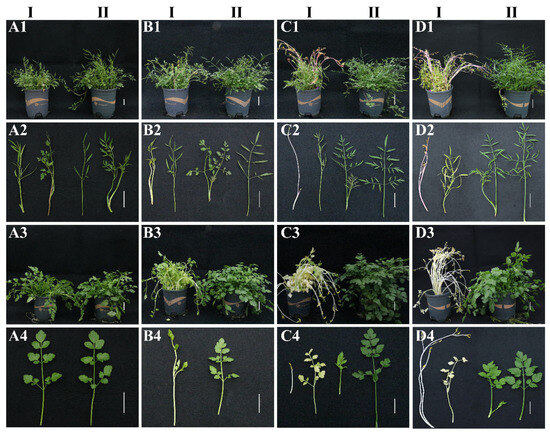
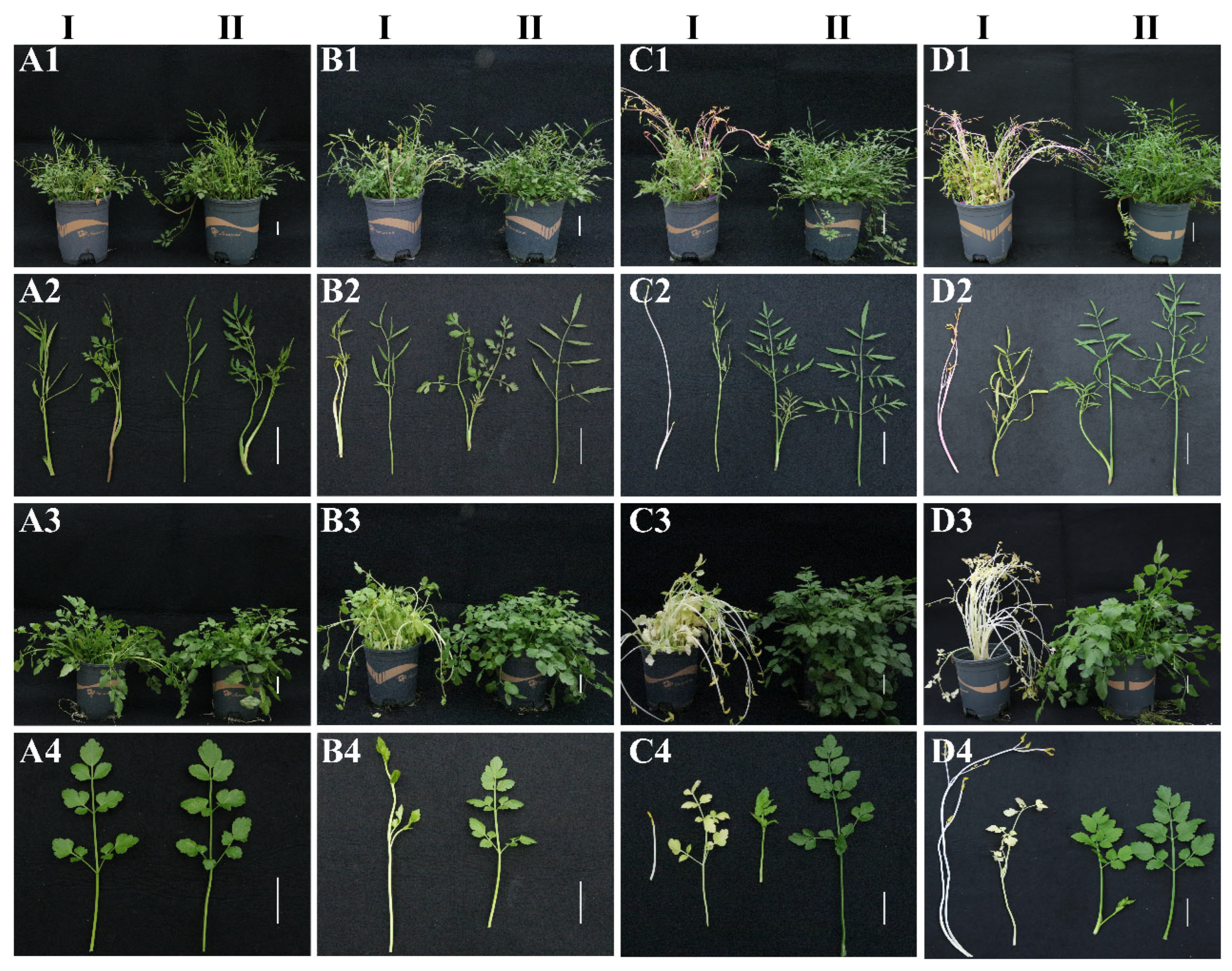
Morphological changes in the petioles of both cultivars, ‘SQ’ (O. linearis, Guizhou water dropwort) and ‘LY’ (O. javanica, Liyang water dropwort), were observed at different stages of the shading treatment, with distinct differences noted between the two cultivars (Figure 1).
Figure 1.
Morphological changes in water dropwort petioles during the treatment period. (I): Shading treatment, (II): control treatment. (A1,A2): ‘SQ’ after 0 d, (B1,B2): ‘SQ’ after 8 d, (C1,C2): ‘SQ’ after 16 d, (D1,D2): ‘SQ’ after 24 d, (A3,A4): ‘LY’ after 0 d, (B3,B4): ‘LY’ after 8 d, (C3,C4): ‘LY’ after 16 d, (D3,D4): ‘LY’ after 24 d. Scale bars = 5 cm. ‘SQ’ represents Guizhou water dropwort (O. linearis), and ‘LY’ represents Liyang water dropwort (O. javanica).
Prior to shading (0 d), both cultivars showed similar morphological characteristics. The plant height of ‘SQ’ and ‘LY’ was 25.6 ± 0.7 cm and 20.1 ± 1.3 cm, respectively, with petiole numbers of 35.0 ± 2.0 and 28.7 ± 2.1 per plant. Both cultivars exhibited robust growth and a deep-green coloration (Figure 1(A1–A4)).
After 8 d of shading, ‘SQ’ developed new petioles with pale-yellow and light-pink tones. Plant height increased slightly to 27.0 ± 1.1 cm, while petiole number remained relatively stable at 32.3 ± 2.1. In contrast, ‘LY’ maintained an overall light-green appearance with accelerated growth and even lighter coloration of new petioles. Plant height increased to 25.7 ± 0.7 cm, and petiole number increased to 29.3 ± 2.5 (Figure 1(B1–B4)).
After 16 d of shading, the new petioles of ‘SQ’ turned red, exhibiting pronounced elongation and leaf curling. Plant height increased to 28.6 ± 1.6 cm, while petiole number decreased slightly to 31.3 ± 2.1. Conversely, ‘LY’ showed significantly elongated, white, and pendulous new petioles, while older petioles turned distinctly yellow. Plant height increased to 24.7 ± 1.1 cm, and petiole number increased to 30.3 ± 3.5 (Figure 1(C1–C4)).
After 24 d of shading, the new petioles of ‘SQ’ remained markedly elongated with a light-pink hue, and older petioles yellowed, yet the plant retained structural support. Plant height was recorded at 28.0 ± 1.4 cm, with petiole number at 37.3 ± 3.1. In contrast, the new petioles of ‘LY’ grew erect with significant elongation, older petioles were markedly reduced, and the overall plant displayed a pale-yellow and white coloration. Plant height reached 31.9 ± 1.6 cm, and petiole number increased to 30.7 ± 2.1 (Figure 1(D1–D4)).
Overall, ‘LY’ showed more pronounced etiolation and elongation of new petioles under prolonged shading, with greater increases in plant height and petiole number, while ‘SQ’ displayed greater red pigmentation and structural stability with relatively stable plant height and moderate changes in petiole number.
3.2. Lignin Content Variation Under Shading Stress
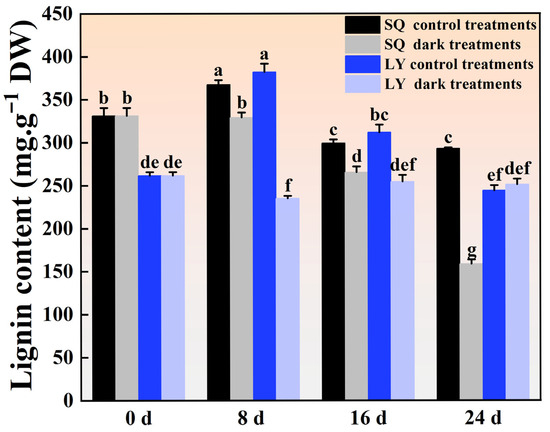
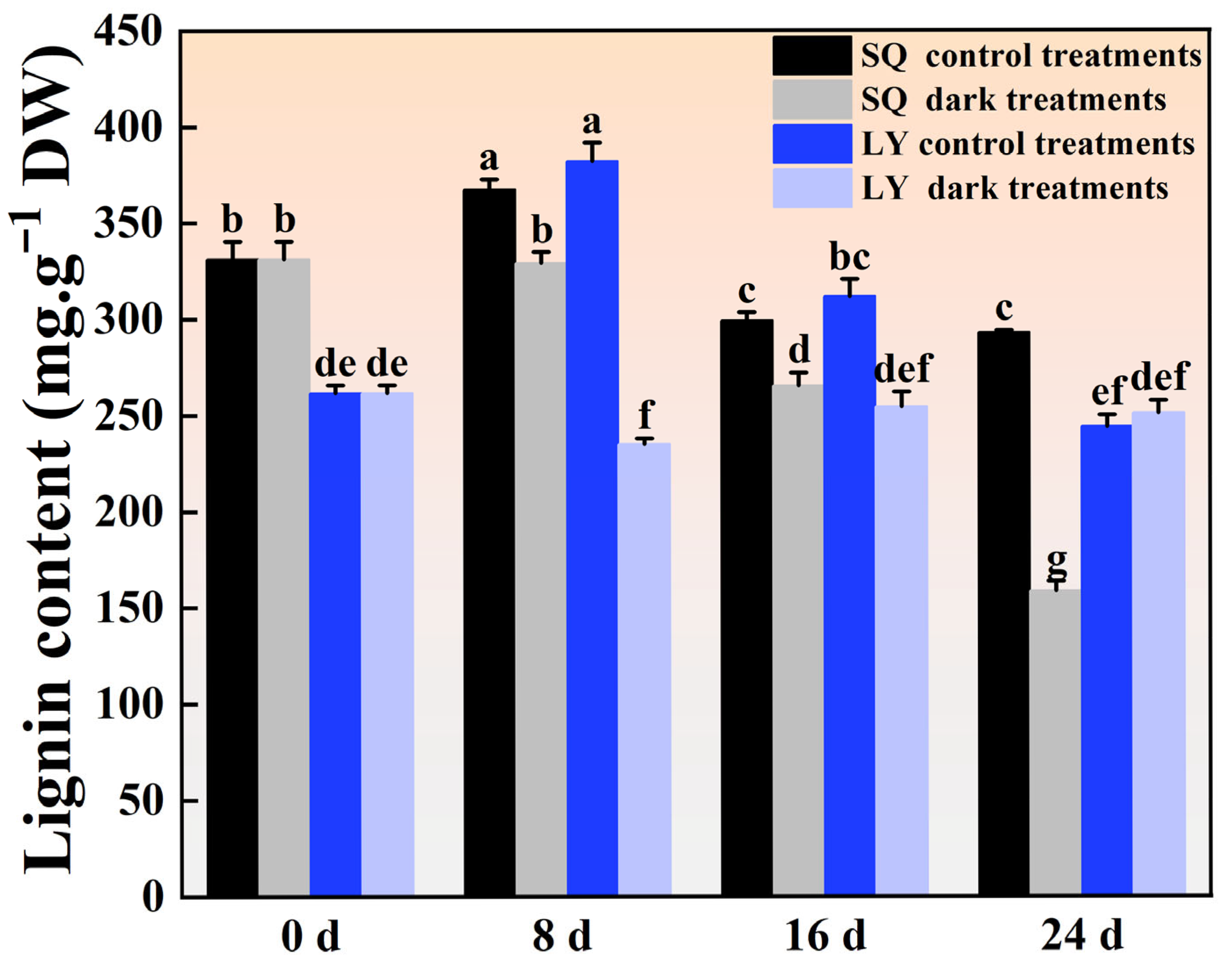
The lignin content of both cultivars was significantly influenced by shading treatment and treatment duration (Figure 2). Under control conditions, lignin content in both ‘SQ’ and ‘LY’ increased significantly during the initial phase, peaked at 8 d, and then gradually declined. Under shading treatment, the lignin content of ‘SQ’ showed a slight initial decrease, followed by a significant reduction, reaching its lowest level at 24 d. In contrast, ‘LY’ exhibited a non-significant decrease at 8 d, followed by a slight increase thereafter, with the minimum value observed at 8 d. Compared with the control, the greatest reduction in lignin content for ‘SQ’ occurred at 24 d, while for ‘LY’, the largest decrease was observed at 8 d. Specifically, under shading, the lignin content of ‘SQ’ was significantly reduced by 10.46% to 45.79% between 8 and 24 d, whereas that of ‘LY’ decreased by 38.46% to 18.38% by 8 and 16 d.
Figure 2.
Lignin content in water dropwort under different treatments. Data are presented as mean ± standard error (SE). Different lowercase letters indicate significant differences at p < 0.05. ‘SQ’ represents Guizhou water dropwort (O. linearis), and ‘LY’ represents Liyang water dropwort (O. javanica).
3.3. Alterations in Lignin-Related Enzyme Activities of Water Dropwort
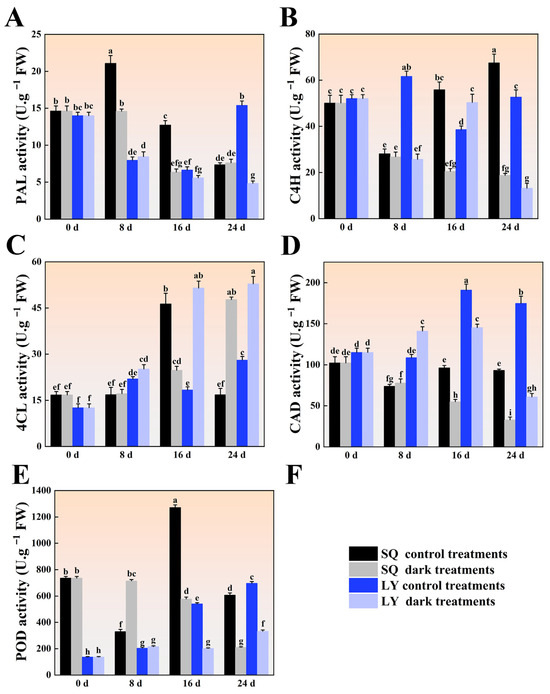
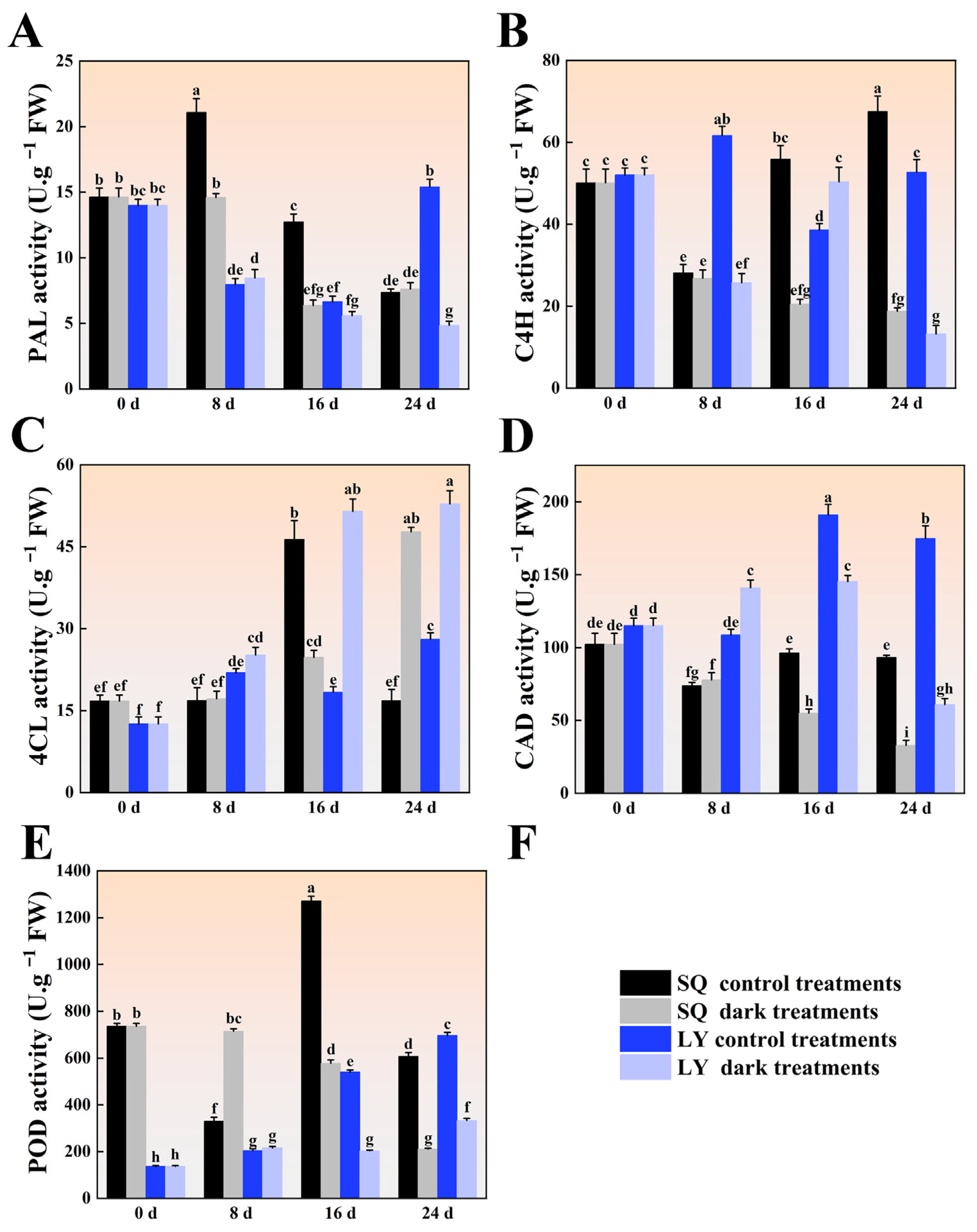
The activities of key lignin biosynthesis enzymes—PAL, C4H, 4CL, CAD, and POD—were measured at different time points during the shading treatment to evaluate the effects of shading on lignin metabolism (Figure 3).
Figure 3.
Lignin-related enzyme activities in water dropwort during the treatment period. (A) The PAL enzyme activity of water dropwort; (B) The C4H enzyme activity of water dropwort; (C) The 4CL enzyme activity of water dropwort; (D) The CAD enzyme activity of water dropwort; (E) The POD enzyme activity of water dropwort; (F) Legends. Data are presented as mean ± standard error (SE). Different lowercase letters indicate significant differences among treatments (p < 0.05). ‘SQ’ represents Guizhou water dropwort (O. linearis), and ‘LY’ represents Liyang water dropwort (O. javanica).
Phenylalanine ammonia-lyase (PAL) catalyzes the first committed step of lignin biosynthesis. Under control conditions, PAL activity in ‘SQ’ increased significantly from 0 to 8 d, followed by a marked decline from 8 to 24 d. Under shading, PAL activity in ‘SQ’ remained relatively stable from 0 to 8 d, then decreased sharply from 8 to 16 d. In ‘LY’, PAL activity under control conditions exhibited a decrease–stabilization–increase pattern, while under shading it showed a continuous decline, with significant changes observed between 0 and 16 d. The greatest differences in PAL activity between control and treatment groups were observed at 16 for ‘SQ’ and at 24 d for ‘LY’, where control values were 2–3 times higher than those under shading. Initially, PAL activity was similar between the two cultivars. In the control group, their temporal trends diverged, whereas under shading, both showed a gradual decline over time, with ‘LY’ exhibiting a more pronounced reduction (Figure 3A).
Cinnamate 4-hydroxylase (C4H) is a cytochrome P450 monooxygenase that catalyzes the conversion of trans-cinnamic acid to p-coumaric acid. Compared with the control, C4H activity in ‘SQ’ under shading gradually decreased. In contrast, ‘LY’ showed opposite trends between control and shading treatments. Initially, C4H activity was’ slightly higher in SQ’ than in ‘LY’. At 8 d of treatment, minimal changes were observed in ‘SQ’ under both conditions, whereas C4H activity in control ‘LY’ was more than twice that of the shaded group. At 24 d, C4H activity in the shaded groups of ‘SQ’ and ‘LY’ decreased by nearly 50 U·g−1 and 40 U·g−1, respectively, but remained slightly higher in ‘SQ’ than in ‘LY’ (Figure 3B).
In higher plants, 4-coumarate: CoA ligase (4CL) activates hydroxycinnamic acids for lignin biosynthesis. Silencing the Os4CL3 gene in rice significantly reduces lignin content, compromises plant growth, and reduces spikelet fertility [28]. In this study, 4CL activity in control ‘SQ’ showed an initial increase followed by a decline, while all other treatment groups exhibited a gradual increase. Overall, 4CL activity was higher under shading than in controls, with more pronounced temporal changes. Initially, 4CL activity was slightly higher in ‘SQ’ than in ‘LY’; however, from 8 to 24 d, ‘SQ’ showed lower activity than ‘LY’. At 24 d, the largest differences between treatments were observed, with differences of 30 U·g−1 and 25 U·g−1 for ‘SQ’ and ‘LY’, respectively (Figure 3C).
Cinnamyl alcohol dehydrogenase (CAD) is an NADPH-dependent enzyme involved in monolignol biosynthesis [29]. CAD activity in water dropwort showed a general trend of initial decline followed by an increase. Under shading, CAD activity in ‘SQ’ gradually decreased, while in ‘LY’ it gradually increased. Compared with controls, CAD activity under shading showed minimal differences from 0 to 8 d, but larger differences from 16 to 24 d. During the 16–24 d period, CAD activity in ‘LY’ was nearly twice that in ‘SQ’, with more pronounced changes in ‘LY’ (Figure 3D).
Peroxidase (POD) catalyzes the final polymerization of lignin monomers such as coniferyl and sinapyl alcohols [30]. Under control conditions, POD activity in ‘SQ’ showed a decline–increase–decline pattern, while under shading it gradually decreased. In contrast, POD activity in ‘LY’ gradually increased throughout the treatment period. From 0 to 16 d, POD activity was higher in ‘SQ than in ‘LY’; however, at 24 d, ‘SQ’ showed lower activity than ‘LY’ (Figure 3E).
3.4. Analysis of Safranin O and Fast Green Staining on Paraffin Sections of Water Dropwort Petioles
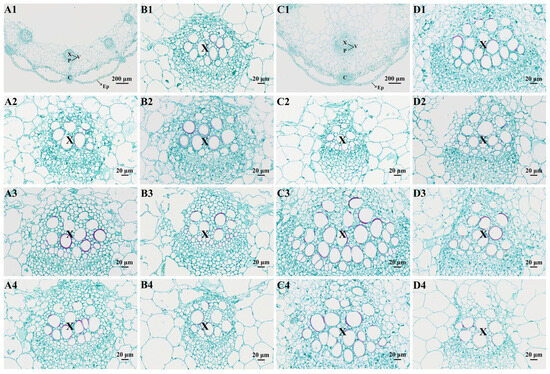
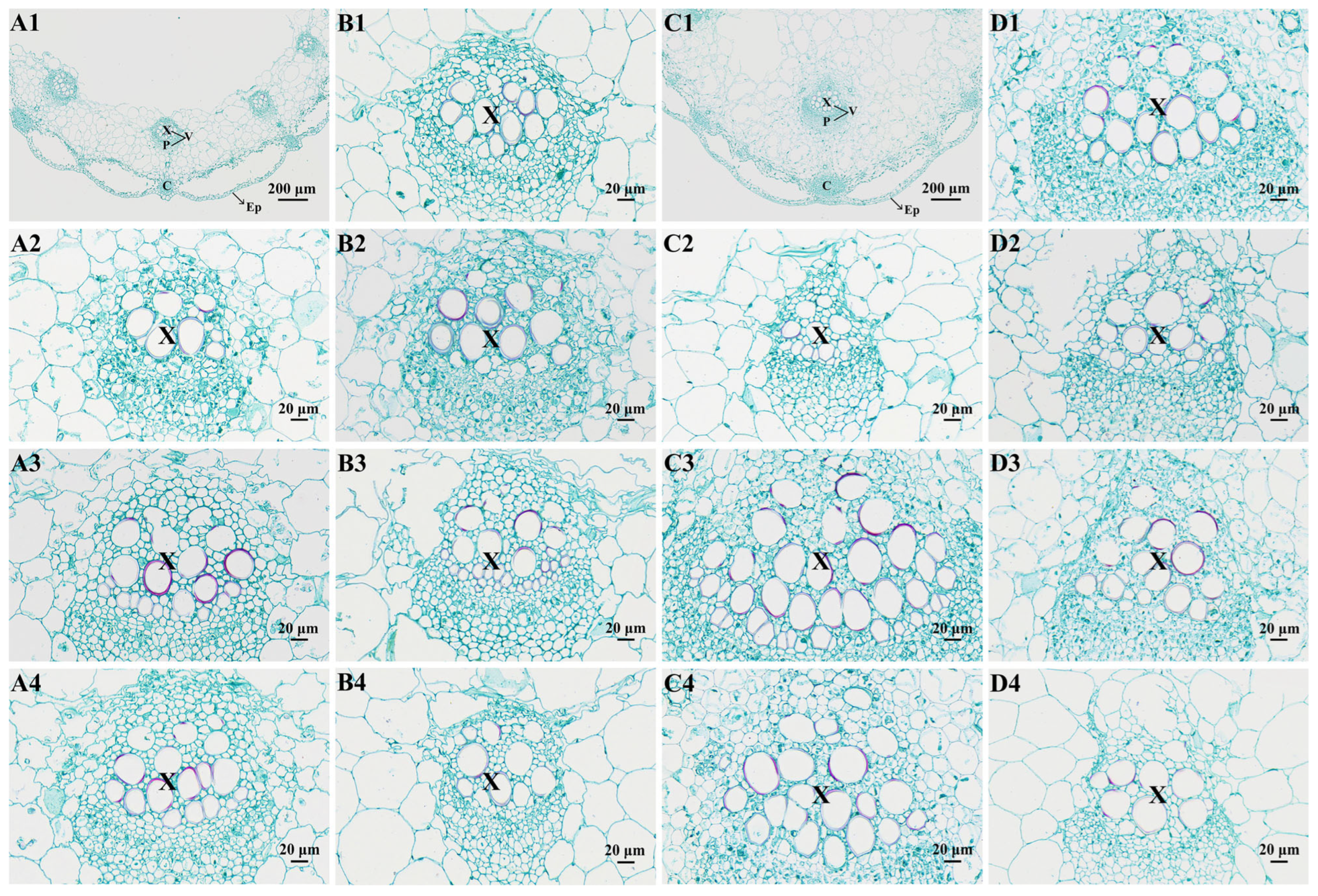
Safranin O selectively stains lignified tissues red, with staining intensity positively correlated with lignin content. This allows for clear microscopic observation of lignin distribution in plant cell walls. Temporal changes in xylem cells and lignin deposition were observed in both control and shading treatment groups (Figure 4).
Figure 4.
Xylem cell structure in water dropwort petioles under control and shading treatments. (A,C): Control treatment, (B,D): shading treatment. (A,B): ‘SQ’ represents Guizhou water dropwort (O. linearis), (C,D): ‘LY’ represents Liyang water dropwort (O. javanica); (A1–D1): 0 d, (A2–D2): 8 d, (A3–D3): 16 d, (A4–D4): 24 d. The figure labels include the vascular bundle (V), epidermis (Ep), phloem (P), collenchyma (C) and xylem (X).
Throughout the treatment period, the control group exhibited markedly higher xylem cell density and lignin accumulation than the shading group. Moreover, ‘LY’ consistently displayed more numerous and larger xylem cells compared to ‘SQ’. From 0 to 16 d, both xylem cell number and lignin content progressively increased in all samples. These changes were more pronounced in the control group, where arrangement became denser and cell wall coloration deepened from light-purple to purplish-red. At 24 d, lignin content in the control group showed a slight decline, whereas the shading group experienced a significant reduction, falling below initial levels. Throughout the treatment, xylem cell arrangement became increasingly dispersed under shading; in the control group, such dispersion was only observed at 24 d. These dispersion patterns were more evident in ‘LY’. These results indicate that shading treatment duration significantly influences lignin distribution, with ‘LY’ exhibiting more pronounced changes than ‘SQ’.
3.5. Analysis of Lignin-Related Gene Expression in Water Dropwort Petioles
Twelve genes involved in lignin biosynthesis (PAL1, PAL2, 4CL, CCR, CCoAOMT1, CCoAOMT2, CCoAOMT3, CCoAOMT4, CAD1, CAD2, PER, and LAC) were identified from the water dropwort genome database [25].
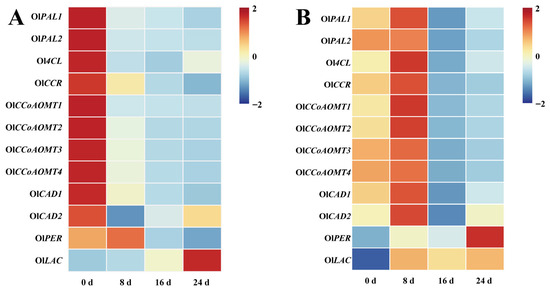
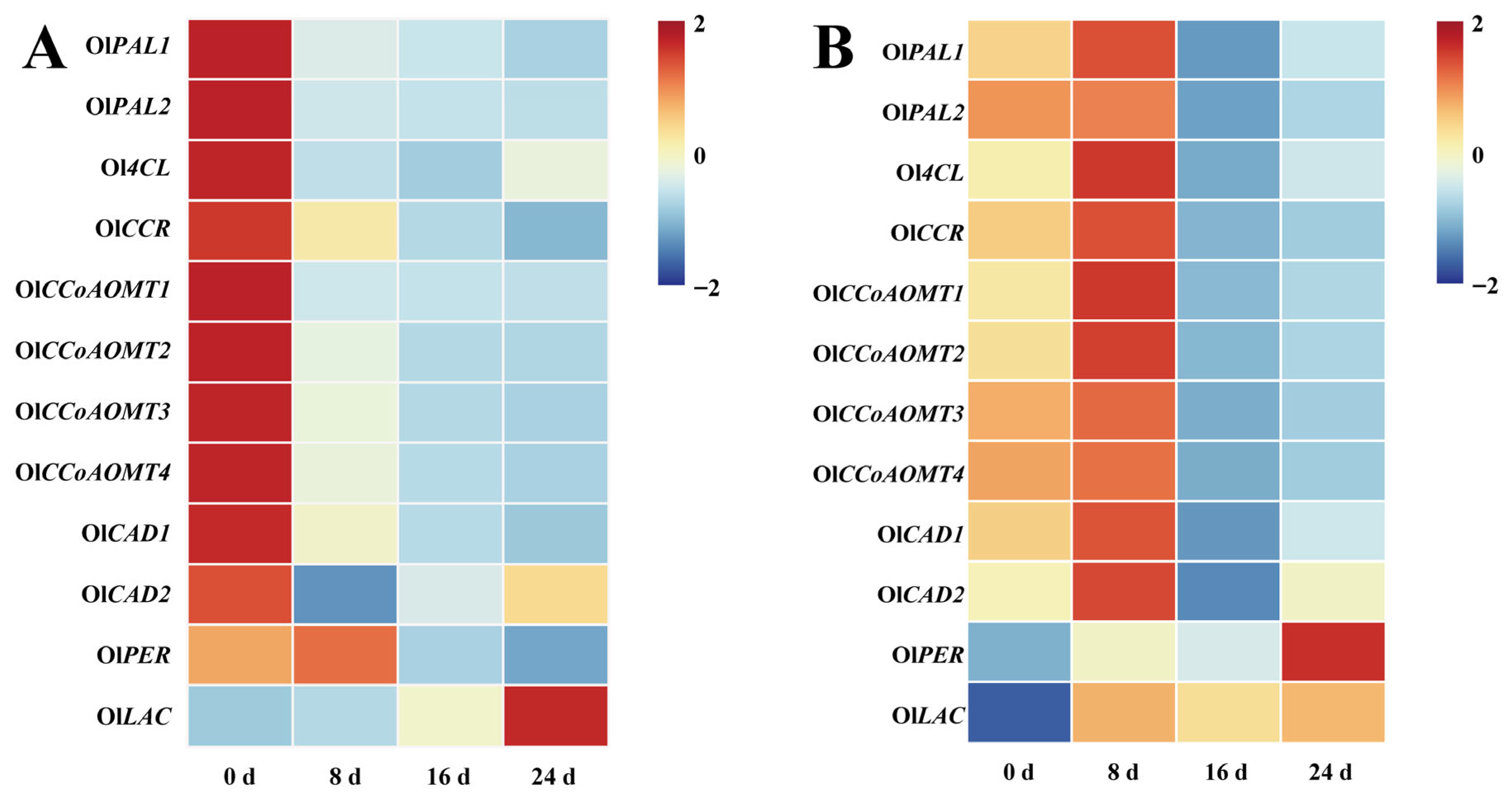
In the control group of ‘SQ’, the expression of OlCCoAOMT1 and OlCAD2 initially decreased and then increased, while OlLAC showed an initial increase followed by a decrease. OlPER expression remained elevated throughout the early treatment period, exhibiting a gradual upward trend. In contrast, the other eight lignin biosynthesis genes displayed peak expression at the early stage of treatment, followed by a gradual decline (Figure 5A). In the shading treatment group of ‘SQ’, the expression of lignin biosynthesis genes generally followed a slight increase–decrease–increase pattern (Figure 5B). From 0 to 8 d, OlPER and OlLAC showed the most significant upregulation, reaching 15-fold of their initial levels. At 16 d, these two genes exhibited the smallest decline, still maintaining over 10-fold of their initial levels; other genes showed a marked decrease, with the maximum reduction exceeding 20-fold compared to the early stage. By 24 d, the expression of OlCCR and OlPER stabilized and increased, while other genes were significantly upregulated. The expression levels of OlPER and OlLAC remained over 15-fold higher than the initial stage, whereas other genes fell below their initial levels. Relative to controls, the shading treatment group showed significant differences in the expression patterns of lignin biosynthesis genes, with OlPER and OlLAC being significantly upregulated (Figure 5).
Figure 5.
Relative expression levels of lignin-related genes in ‘SQ’ under control and shading treatments. (A): Control treatment; (B): shading treatment. ‘SQ’ represents Guizhou water dropwort (O. linearis).
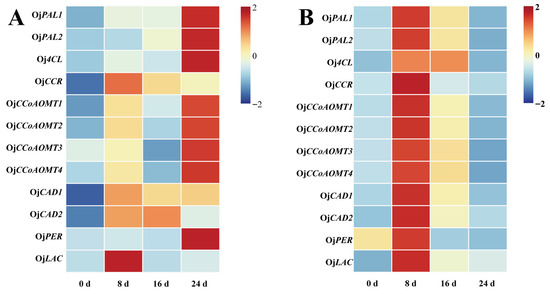
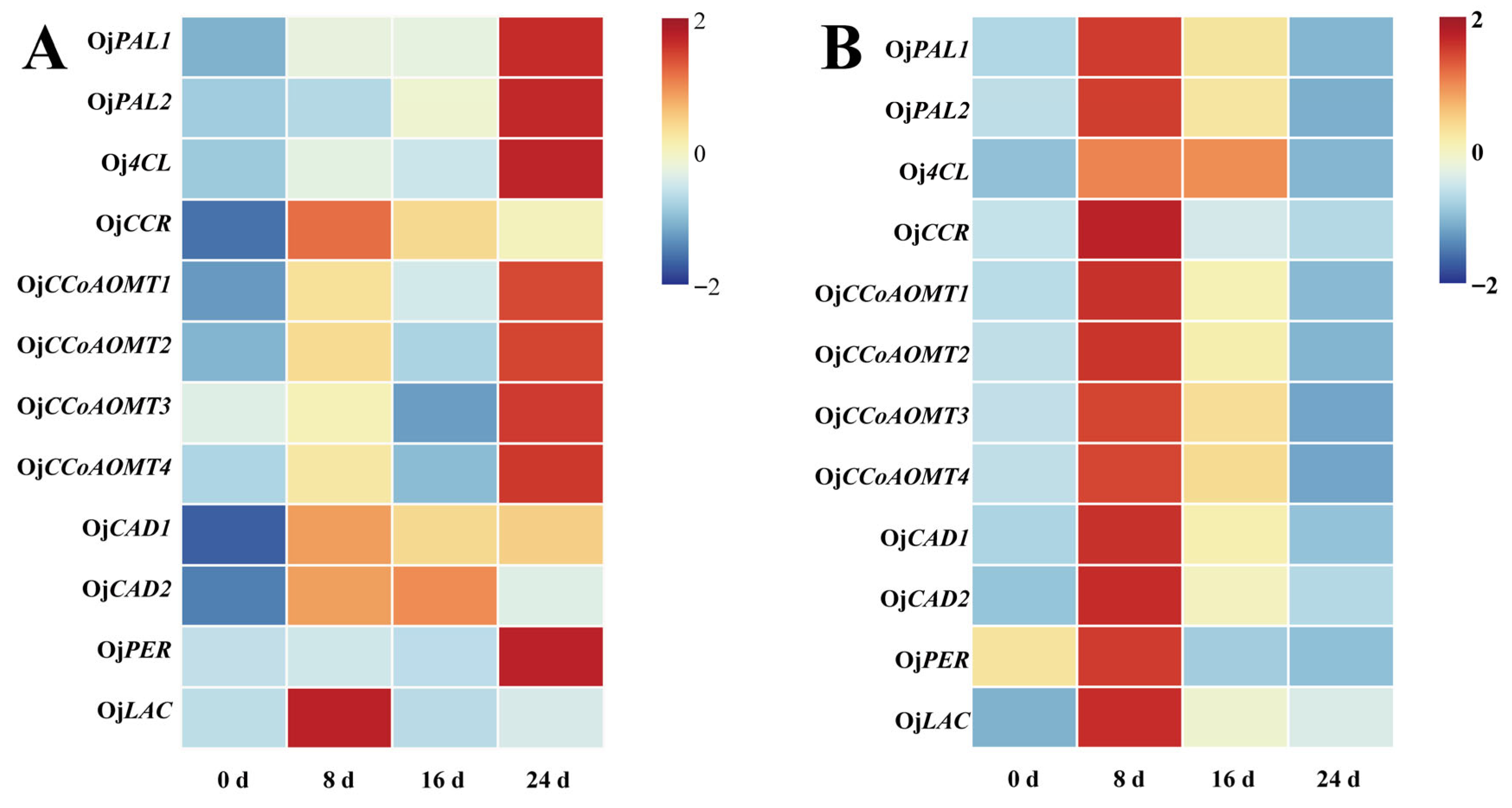
In the control group of ‘LY’, the expression of lignin biosynthesis genes initially increased from 0 to 8 d, followed by a decline from 8 to 24 d (Figure 6A). In the shading treatment group, OjPAL2 expression continuously increased, while OjCAD2 and OjCCR expression initially increased and then decreased (Figure 6B). Other genes followed an increase–decrease–increase pattern, with OjPER and OjLAC exhibiting the most pronounced changes in decline and increase, respectively. Compared with controls, except for OjCAD2 and OjCCR, most lignin biosynthesis genes in the shading treatment group showed significant expression changes, with notable downregulation of OjPAL1, Oj4CL, OjCCR, and OjLAC (Figure 6).
Figure 6.
Relative expression levels of lignin-related genes in ‘LY’ under control and shading treatments. (A): Control treatment; (B): shading treatment. ‘LY’ represents Liyang water dropwort (O. javanica).
Shading treatment significantly affected the expression of lignin biosynthesis genes, with a more pronounced promotion effect observed in ‘LY’ for most genes. Under shading, ‘SQ’ exhibited certain adaptability in genes such as OlCAD2 and OlPER, whereas ‘LY’ showed a more evident response. These results suggest that different water dropwort cultivars respond distinctly to shading treatment, potentially due to differences in genetic background and physiological characteristics.
3.6. Correlation Analysis
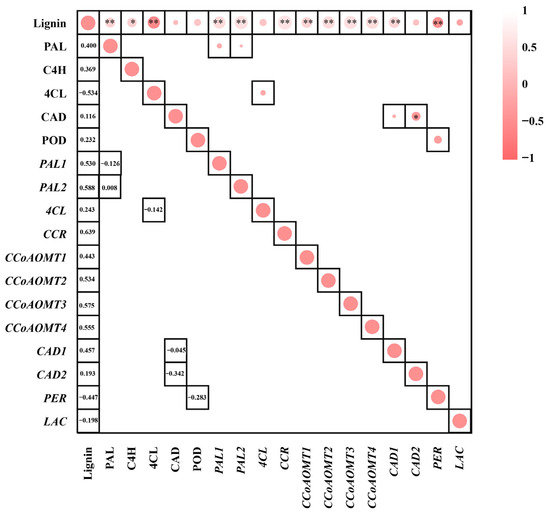
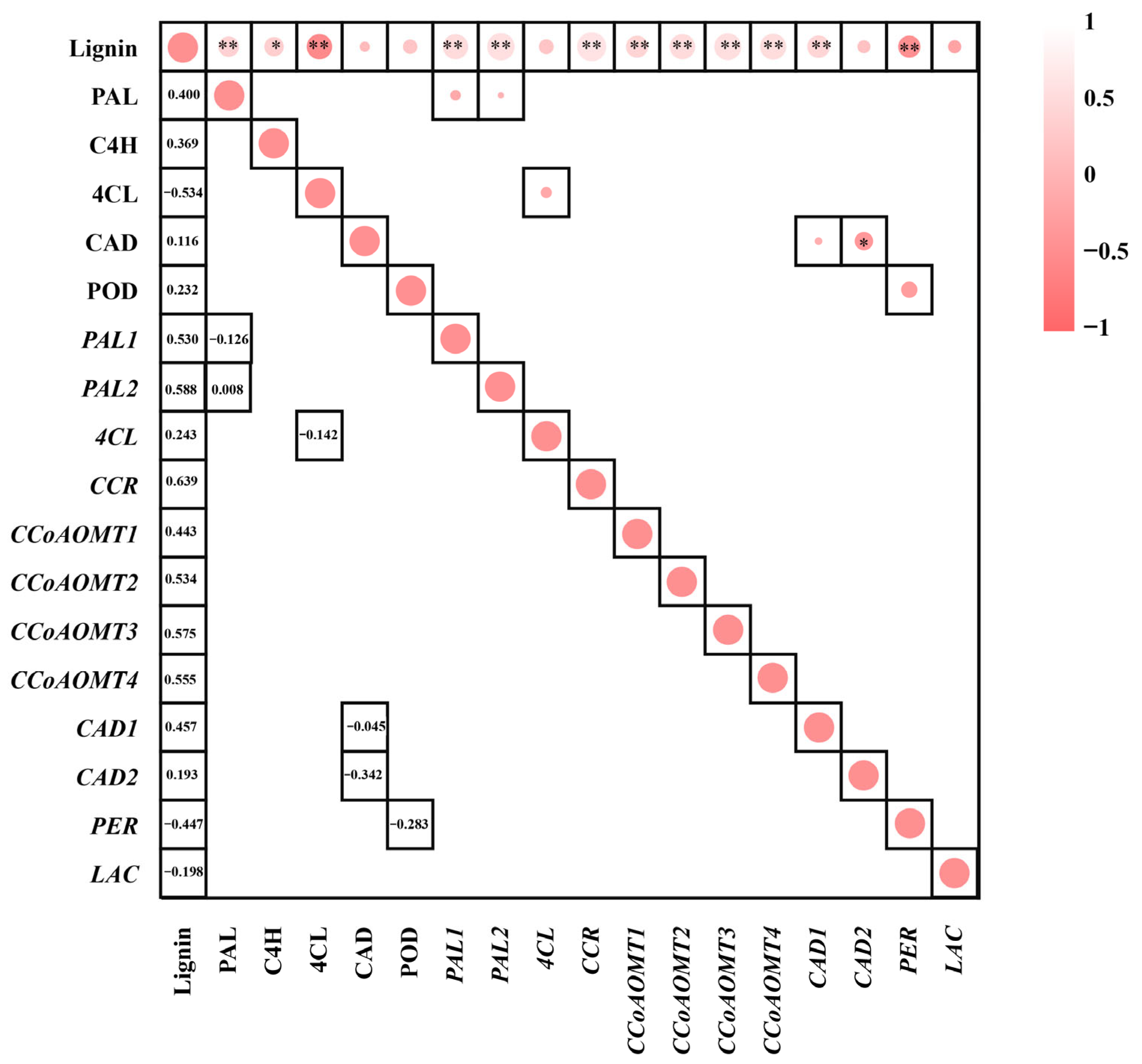
Correlation analysis was performed to assess the relationships between lignin content, enzyme activities, and gene expression levels in water dropwort (Figure 7).
Figure 7.
Correlation analysis of lignin content with enzyme activities and gene expression levels, and between enzyme activities and gene expression. Numbers represent correlation coefficients. Asterisks indicate statistical significance: * p < 0.05, ** p < 0.01.
Lignin content showed significant positive correlations with PAL (r = 0.400, p < 0.05) and C4H (r = 0.369, p < 0.05) activities. Additionally, lignin content was significantly positively correlated with the expression levels of PAL1 (r = 0.530), PAL2 (r = 0.588), CCR (r = 0.639), CCoAOMT1 (r = 0.443), CCoAOMT2 (r = 0.534), CCoAOMT3 (r = 0.575), CCoAOMT4 (r = 0.555), and CAD1 (r = 0.457) (p < 0.05 for all). In contrast, lignin content was significantly negatively correlated with 4CL activity and PER expression (−0.534, −0.447). Further analysis of the relationships between enzyme activities and their corresponding gene expression levels revealed that PAL activity showed a non-significant negative correlation with PAL1 (r = −0.126) and a non-significant positive correlation with PAL2 (r = 0.008). 4CL activity was non-significantly negatively correlated with 4CL expression (r = −0.142). CAD activity exhibited a significant negative correlation with CAD1 (r = −0.342, p < 0.05), while POD activity showed a non-significant negative correlation with PER (r = −0.283).
4. Discussion
Light intensity and quality significantly affect the quality of horticultural crops, particularly the accumulation of functional metabolites. Shading has been shown to alter the phenotype of tea plants, reducing non-structural carbohydrates such as starch and sugars, increasing leaf surface temperature by several degrees, and consequently affecting stomatal transpiration [31]. Gang et al. [32] reported that under shading conditions, blackcurrant fruit maturation is delayed, fruit hardness increases, and ascorbic acid (AsA) content significantly decreases. In the present study, prolonged shading induced marked etiolation, leaf curling, and yellowing of petioles in water dropwort. These morphological changes are consistent with previous observations in celery, where that shading leads to yellowing, reduced stem thickness, and increased plant height [22], as well as in rice, where shading induced etiolation and reduced lodging resistance [33].
Shading has been shown to reduce the content of S lignin monomers in wheat while increasing the content and proportion of H monomers, thereby compromising straw fracture strength [34]. This indicates that shading alters the distribution ratio of lignin monomers (S, G, H), affecting stem lignin composition and lodging resistance. In the present study, shading significantly reduced lignin content in water dropwort between 8 and 16 d, consistent with findings in maize [35], tea [36], asparagus [21], and rice [33], where low-light conditions downregulate lignin-related genes and enzyme activities, leading to reduced lignin content accumulation. Notably, under shading, lignin content in ‘SQ’ decreased significantly after 8 d, while changes in ‘LY’ were less pronounced. Microscopic observation of paraffin sections revealed a gradual reduction in xylem cell number and lighter cell wall coloration under shading. These changes were more evident in ‘SQ’ than in ‘LY’, suggesting that ‘LY’ may possess greater resistance to shading-induced lignification reduction.
PAL is a key enzyme catalyzing the first committed step of lignin biosynthesis. C4H, 4CL, and CAD are also crucial enzymes in this pathway. Inhibition of these enzymes has been shown to reduce lignin content and alter subunit composition [37,38,39]. Peroxidase (POD) plays a vital role in the final stage of lignin polymerization by scavenging reactive oxygen species (ROS), thereby enhancing plant resistance [40]. In this study, PAL activity gradually decreased under shading in both cultivars, while 4CL activity increased. However, ‘SQ’ and ‘LY’ exhibited distinct patterns in C4H, CAD, and POD activities. In ‘SQ’, these enzyme activities gradually decreased under shading, correlating with reduced lignin content. In contrast, ‘LY’ showed increased C4H activity at 16 d, elevated CAD activity at 8 d, and a gradual increase in POD activity throughout the treatment. These results suggest that the maintenance of C4H, CAD, and POD activities in ‘LY’ contributes to its relatively stable lignin content and enhanced resistance to shading stress.
Prior to treatment, PAL, C4H, 4CL, and CAD activities were similar between cultivars, but POD activity was significantly higher in ‘SQ’ than in ‘LY’. Under shading, C4H, 4CL, and CAD activities in ‘LY’ exceeded those in ‘SQ’, while POD activity decreased in ‘SQ’ but increased in ‘LY’. The reduction in PAL, C4H, CAD, and POD activities in ‘SQ’ likely hindered lignin biosynthesis, whereas elevated 4CL activity may have accelerated lignin degradation, ultimately reducing lignin content. Conversely, the increased C4H, CAD, and POD activities in ‘LY’ delayed lignin degradation, stabilizing lignin content. These findings are consistent with studies in longan, where reduced activities of PAL, C4H, 4CL, CAD, and POD were associated with lower lignin levels, increased disease susceptibility, pulp degradation, and pericarp browning [41]. Similarly, in pears, tomatoes, and peaches, reduced activities of these enzymes hindered lignin synthesis, leading to disease development [42,43,44].
Lignin gene expression levels interact with its content, forming a complex regulatory network [45,46]. Gene expression analysis revealed that lignin biosynthesis-related genes were differentially regulated by shading. Notably, at 8 d and 24 d, expression levels of OlPAL1, OlPAL2, Ol4CL, OlCCoAOMT, and OlPER in ‘SQ’, and Oj4CL, OjCCR, OjCCoAOMT1, OjPER, and OjLAC in ‘LY’ differed by up to tenfold between control and shading treatments. In ‘SQ’, the expression of OlPAL, Ol4CL, OlCCR, OlCCoAOMT, and OlCAD1 initially stabilized and then significantly decreased, consistent with the trend of lignin content, suggesting these genes play a positive regulatory role in lignin synthesis. In ‘LY’, OjPAL2 expression decreased from 8 to 24 d, positively correlating with PAL activity and lignin content, while other genes showed a negative correlation with lignin content. Several factors may explain these observations: (1) multiple CCR genes exist in higher plants, with only one or two involved in lignin biosynthesis, such as AtCCR1 being the sole CCR gene involved in lignin biosynthesis in Arabidopsis thaliana [47,48,49]; (2) shading may activate flavonoid synthesis pathways, competing for common precursors with lignin synthesis; and (3) reduced photosynthesis under shading may limit carbon source availability for lignin synthesis [28]. Therefore, the significant suppression of OjPAL2 expression in ‘LY’ under continuous shading may represent a key regulatory mechanism for lignin synthesis and accumulation in this cultivar.
This study provides novel mechanistic insights into lignin biosynthesis regulation in water dropwort under shading conditions. Unlike previous studies in other crops that primarily focused on single aspects, such as enzyme activity or gene expression, our integrated approach revealed cultivar-specific regulatory strategies. In ‘SQ’, shading suppressed lignin biosynthesis by downregulating key enzyme activities (PAL, C4H, CAD, POD) and the expression of multiple lignin-related genes (OlPAL, Ol4CL, OlCCR, OlCCoAOMT, OlCAD1), leading to reduced lignification. In contrast, ‘LY’ exhibited greater resilience to shading, maintaining relatively stable lignin content through increased activities of C4H, CAD, and POD, along with the upregulation of most lignin-related genes. Notably, OjPAL2 emerged as a potential key regulator in ‘LY’, showing a positive correlation with PAL activity and lignin content. These findings advance the current understanding of lignin regulation beyond the general patterns reported in other crops by revealing species- and cultivar-specific adaptive mechanisms under shading stress. The identification of OjPAL2 as a candidate gene for lignin regulation provides a new target for future functional studies and breeding programs aimed at improving water dropwort quality under blanching cultivation.
Several limitations of this study should be acknowledged. First, our histological observations were primarily qualitative; future studies could incorporate quantitative anatomical measurements, such as cell wall thickness, xylem area, and xylem cell counts, to provide stronger evidence for changes in lignification and tissue structure. Second, the molecular mechanisms underlying the differential expression of lignin-related genes, particularly the role of OjPAL2 as a potential key regulator in ‘LY’, warrant further investigation through functional analyses such as gene overexpression or silencing. Finally, field-based trials under varying environmental conditions would help validate the practical applicability of our findings for blanching cultivation.
5. Conclusions
This study demonstrates that prolonged shading treatment induces marked etiolation, leaf curling, and petiole yellowing in water dropwort. Extended shading leads to a progressive reduction in xylem cell number within the petioles, accompanied by a gradual darkening and paling of cell wall coloration, indicating a continuous decline in lignification. This is associated with reduced activities of PAL, C4H, CAD and POD enzymes, as well as suppressed expression of genes, including OlPAL2, Ol4CL, OlCCR, OlCCoAOMT, and OlCAD1. Collectively, these changes hinder lignin biosynthesis in ‘SQ’, resulting in thinner cell walls and diminished mechanical strength. In contrast, ‘LY’ exhibits greater resilience to shading stress. Under shading, lignin content in ‘LY’ remains relatively stable, maintaining a higher degree of lignification. The activities of C4H, CAD, and POD enzymes tend to increase, and most lignin-related genes are upregulated. Notably, OjPAL2 may serve as a key regulatory factor for lignin synthesis and accumulation in ‘LY’. These findings deepen our understanding of lignin metabolism in water dropwort and provide a theoretical basis for selecting suitable Oenanthe cultivars for blanching cultivation. In particular, ‘LY’ (O. javanica) demonstrates greater resilience to shading stress and is therefore more suitable for producing high-quality etiolated water dropwort.
Supplementary Materials
The following supporting information can be downloaded at https://www.mdpi.com/article/10.3390/horticulturae12040477/s1, File S1: Nucleotide sequences of PAL1 from water dropwort. File S2: Nucleotide sequences of PAL2 from water dropwort. File S3: Nucleotide sequences of 4CL from water dropwort. File S4: Nucleotide sequences of CCR from water dropwort. File S5: Nucleotide sequences of CCoAOMT1 from water dropwort. File S6: Nucleotide sequences of CCoAOMT2 from water dropwort. File S7: Nucleotide sequences of CCoAOMT3 from water dropwort. File S8: Nucleotide sequences of CCoAOMT4 from water dropwort. File S9: Nucleotide sequences of CAD1 from water dropwort. File S10: Nucleotide sequences of CAD2 from water dropwort. File S11: Nucleotide sequences of POD from water dropwort. File S12: Nucleotide sequences of LAC from water dropwort.
Author Contributions
Conceptualization, S.-H.Z. and G.-F.T.; methodology, S.-H.Z. and X.-L.Z.; software, S.-H.Z. and G.-F.T.; validation, S.-H.Z., X.-L.Z., J.Y., A.-S.X., Q.Q. and G.-F.T.; formal analysis, X.-L.Z. and Q.L.; writing—original draft preparation, S.-H.Z.; writing—review and editing, S.-H.Z., X.-L.Z. and G.-F.T.; visualization, S.-H.Z.; supervision, G.-F.T.; project administration, S.-H.Z., X.-L.Z., A.-S.X., C.-Y.C. and G.-F.T. All authors have read and agreed to the published version of the manuscript.
Funding
This research was funded by the Guizhou Academy of Agricultural Sciences (Qian Nongkeyuan Youth Science and Technology Fund No. [2026] 21; Qiannongke Doctoral Fund No. [2024]03); Project of Guizhou Provincial Department of Science and Technology (Qiankehe Foundation-MS [2025] 311; Qiankehe Service Enterprise [2024] 003-1; Qiankehe Service Enterprise [2024]003-2); Guizhou Mountain Agriculture Key Core Technology Research Project (GZNYGJHX-2023013); and Guizhou Province Plateau Characteristic Vegetable Industry Technology System (GZGYTSCCYJSTX-03).
Data Availability Statement
The original contributions presented in this study are included in the article/Supplementary Material. Further inquiries can be directed to the corresponding author.
Conflicts of Interest
Author Cong-Yin Cheng was employed by the company Huaqin Technology (Shenzhen) Co., Ltd. The remaining authors declare that the research was conducted in the absence of any commercial or financial relationships that could be construed as a potential conflict of interest.
Abbreviations
The following abbreviations are used in this manuscript:
| PAL | Phenylalanine ammonia-lyase |
| C4H | Cinnamate-4-hydroxylase |
| 4CL | 4-coumarate-CoA ligase |
| CCoAOMT | Caffeoyl-CoA O-methyltransferase |
| CCR | Cinnamoyl-CoA reductase |
| CAD | Cinnamyl alcohol dehydrogenase |
| LAC | Laccase |
| POD | Peroxidase |
References
- Park, J.H.; Cho, J.H.; Kim, I.H.; Ahn, J.H.; Lee, J.C.; Chen, B.H.; Shin, B.N.; Tae, H.J.; Yoo, K.Y.; Hong, S.; et al. Oenanthe javanica extract protects against experimentally induced ischemic neuronal damage via its antioxidant effects. Chin. Med. J. 2015, 128, 2932–2937. [Google Scholar] [CrossRef] [Scilit] [PubMed]
- Feng, K.; Kan, X.Y.; Li, R.; Yan, Y.J.; Zhao, S.P.; Wu, P.; Li, L.J. Integrative Analysis of Long- and Short-Read Transcriptomes Identify the Regulation of Terpenoids Biosynthesis Under Shading Cultivation in Oenanthe javanica. Front Genet. 2022, 13, e813216. [Google Scholar] [CrossRef] [Scilit]
- Feng, K.; Xu, Z.S.; Que, F.; Liu, J.X.; Wang, F.; Xiong, A.S. An R2R3-MYB transcription factor, OjMYB1, functions in anthocyanin biosynthesis in Oenanthe javanica. Planta 2018, 247, 301–315. [Google Scholar] [CrossRef] [Scilit]
- Feng, K.; Hou, X.L.; Xing, G.M.; Liu, J.X.; Duan, A.Q.; Xu, Z.S.; Li, M.Y.; Zhuang, J.; Xiong, A.S. Advances in AP2/ERF super-family transcription factors in plant. Crit. Rev. Biotechnol. 2020, 40, 750–776. [Google Scholar] [CrossRef] [Scilit]
- Ahn, H.; Lee, G.S. Isorhamnetin and hyperoside derived from water dropwort inhibits inflammasome activation. Phytomedicine 2017, 24, 77–86. [Google Scholar] [CrossRef] [Scilit]
- Her, Y.; Shin, B.N.; Lee, Y.L.; Park, J.H.; Kim, D.W.; Kim, K.S.; Kim, H.; Song, M.; Kim, J.D.; Won, M.H.; et al. Oenanthe javanica extract protects mouse skin from UVB radiation via attenuating collagen disruption and inflammation. Int. J. Mol. Sci. 2019, 20, 1435. [Google Scholar] [CrossRef] [Scilit]
- Lu, C.L.; Li, X.F. A Review of Oenanthe javanica (Blume) DC. as traditional medicinal plant and its therapeutic potential. Evid. Based Complement. Alternat. Med. 2019, 2019, e6495819. [Google Scholar] [CrossRef] [Scilit] [PubMed]
- Han, Y.Q.; Huang, Z.M.; Yang, X.B.; Liu, H.Z.; Wu, G.X. In vivo and in vitro anti-hepatitis B virus activity of total phenolics from Oenanthe javanica. J. Ethnopharmacol. 2008, 118, 148–153. [Google Scholar] [CrossRef] [Scilit]
- Feng, K.; Kan, X.Y.; Liu, Q.; Yan, Y.J.; Sun, N.; Yang, Z.Y.; Zhao, S.P.; Wu, P.; Li, L.J. Metabolomics analysis reveals metabolites and metabolic pathways involved in the growth and quality of water dropwort [Oenanthe javanica (Blume) DC.] under nutrient solution culture. Plants 2023, 12, 1459. [Google Scholar] [CrossRef] [Scilit] [PubMed]
- Peter, G.; Neale, D. Molecular basis for the evolution of xylem lignification. Curr. Opin. Plant Biol. 2004, 7, 737–742. [Google Scholar] [CrossRef] [Scilit]
- Zhu, N.; Zhao, C.; Wei, Y.; Sun, C.; Wu, D.; Chen, K. Biosynthetic labeling with 3-O-propargylcaffeyl alcohol reveals in vivo cell-specific patterned lignification in loquat fruits during development and postharvest storage. Hortic. Res. 2021, 8, e61. [Google Scholar] [CrossRef] [Scilit] [PubMed]
- Mélida, H.; Largo-Gosens, A.; Novo-Uzal, E.; Santiago, R.; Pomar, F.; García, P.; García-Angulo, P.; Acebes, J.L.; Álvarez, J.; Encina, A. Ectopic lignification in primary cellulose-deficient cell walls of maize cell suspension cultures. J. Integr. Plant Biol. 2015, 57, 357–372. [Google Scholar] [CrossRef] [Scilit]
- Liu, L.; Chen, Y.; Wu, W.; Chen, Q.; Tian, Z.; Huang, J.; Ren, H.; Zhang, J.; Du, X.; Zhuang, M.; et al. A multilevel investigation to reveal the regulatory mechanism of lignin accumulation in juice sac granulation of pomelo. BMC Plant Biol. 2024, 24, e390. [Google Scholar] [CrossRef] [Scilit]
- Li, X.; Wang, J.; Qu, Y.; Li, Y.; Humaira, Y.; Muhammad, S.; Pu, H.; Yu, L.; Li, H. Comparison of storage and lignin accumulation characteristics between two types of snow pea. PLoS ONE 2022, 17, e0268776. [Google Scholar] [CrossRef] [Scilit]
- Li, Z.; Xu, X.; Yang, K.; Zhu, C.; Liu, Y.; Gao, Z. Multifaceted analyses reveal carbohydrate metabolism mainly affecting the quality of postharvest bamboo shoots. Front. Plant Sci. 2022, 13, e1021161. [Google Scholar] [CrossRef] [Scilit]
- Li, X.; Zang, C.; Ge, H.; Zhang, J.; Grierson, D.; Yin, X.; Chen, K. Involvement of PAL, C4H, and 4CL in chilling injury-induced flesh lignification of loquat fruit. Hort. Sci. 2017, 52, 127–131. [Google Scholar] [CrossRef] [Scilit]
- Ma, Q.H. Lignin Biosynthesis and Its Diversified Roles in Disease Resistance. Genes 2024, 15, 295. [Google Scholar] [CrossRef] [Scilit]
- Wang, Y.; Chantreau, M.; Sibout, R.; Hawkins, S. Plant cell wall lignification and monolignol metabolism. Front. Plant Sci. 2013, 4, e220. [Google Scholar] [CrossRef] [Scilit]
- Chen, X.M.; Mou, Z.L.; Zhao, Y.T.; Su, X.G.; Han, Y.C.; Chen, H.J.; Wei, W.; Shan, W.; Kuang, J.F.; Lu, W.J.; et al. Modified atmosphere packaging maintains stem quality of Chinese flowering cabbage by restraining postharvest lignification and ROS accumulation. Food Chem. X 2024, 24, e102006. [Google Scholar] [CrossRef] [Scilit] [PubMed]
- Li, N.; Xie, L.; Hu, M.; Tong, J.; Wang, B.; Ji, Y.; Chen, J.; Liang, H.; Liu, W.; Liu, M.; et al. Effects of blanching cultivation on the chemical composition and nutritional quality of Chinese chive. Food Chem. 2025, 464, e141824. [Google Scholar] [CrossRef] [Scilit] [PubMed]
- Ma, J.; Li, X.; He, M.; Li, Y.; Lu, W.; Li, M.; Sun, B.; Zheng, Y. A Joint transcriptomic and metabolomic analysis reveals the regulation of shading on lignin biosynthesis in Asparagus. Int. J. Mol. Sci. 2023, 24, 1539. [Google Scholar] [CrossRef] [Scilit]
- Zhu, S.; Zhong, X.; Zhang, X.; Xiong, A.; Luo, Q.; Wang, K.; Li, M.; Tan, G. Effects of dark treatment on lignin and cellulose synthesis in celery. Agronomy 2024, 14, 896. [Google Scholar] [CrossRef] [Scilit]
- Sun, X.; Zhu, S.; Li, N.; Cheng, Y.; Zhao, J.; Qiao, X.; Lu, L.; Liu, S.; Wang, Y.; Liu, C.; et al. Chromosome-level genome assembly of garlic (Allium sativum) provides insights into genome evolution and allicin biosynthesis. Mol. Plant 2020, 13, 1328–1339. [Google Scholar] [CrossRef] [Scilit]
- Mottiar, Y.; Vanholme, R.; Boerjan, W.; Ralph, J.; Mansfield, S.D. Designer lignins: Harnessing the plasticity of lignification. Curr. Opin. Biotechnol. 2016, 37, 190–200. [Google Scholar] [CrossRef] [Scilit]
- Liu, J.X.; Liu, H.; Tao, J.P.; Tan, G.F.; Dai, Y.; Yang, L.L.; Feng, K.; Wang, H.; Li, T.; Liu, Y.H.; et al. High-quality genome sequence reveals a young polyploidization and provides insights into cellulose and lignin biosynthesis in water dropwort (Oenanthe sinensis). Ind. Crop. Prod. 2023, 193, 116203. [Google Scholar] [CrossRef] [Scilit]
- Jiang, Q.; Wang, F.; Li, M.Y.; Ma, J.; Tan, G.F.; Xiong, A.S. Selection of suitable reference genes for qPCR normalization under abiotic stress in Oenanthe javanica (BI.) DC. PLoS ONE 2014, 9, e92262. [Google Scholar]
- Jiang, Q.; Xu, Z.S.; Wang, F.; Li, M.Y.; Ma, J.; Xiong, A.S. Effects of abiotic stresses on the expression of Lhcb1 gene and photosynthesis of Oenanthe javanica and Apium graveolens. Biol. Plant. 2014, 58, 256–264. [Google Scholar] [CrossRef] [Scilit]
- Wu, L.; Zhang, W.; Ding, Y.; Zhang, J.; Cambula, E.D.; Weng, F.; Liu, Z.; Ding, C.; Tang, S.; Chen, L.; et al. Shading contributes to the reduction of stem mechanical strength by decreasing cell wall synthesis in Japonica rice (Oryza sativa L.). Front. Plant Sci. 2017, 8, e881. [Google Scholar] [CrossRef] [Scilit] [PubMed]
- Li, H.; Zhang, S.; Zhao, Y.; Zhao, X.; Xie, W.; Guo, Y.; Wang, Y.; Li, K.; Guo, J.; Zhu, Q.H.; et al. Identification and characterization of cinnamyl alcohol dehydrogenase encoding genes involved in lignin biosynthesis and resistance to Verticillium dahliae in upland cotton (Gossypium hirsutum L.). Front. Plant Sci. 2022, 13, e840397. [Google Scholar] [CrossRef] [Scilit] [PubMed]
- Yang, T.; Zhang, P.; Pan, J.; Amanullah, S.; Luan, F.; Han, W.; Liu, H.; Wang, X. Genome-wide analysis of the peroxidase gene family and verification of lignin synthesis-related genes in watermelon. Int. J. Mol. Sci. 2022, 23, 642. [Google Scholar] [CrossRef] [Scilit]
- Yamashita, H.; Tanaka, Y.; Umetsu, K.; Morita, S.; Ono, Y.; Suzuki, T.; Takemoto, T.; Morita, A.; Ikka, T. Phenotypic markers reflecting the status of overstressed tea plants subjected to repeated shade cultivation. Front. Plant Sci. 2020, 11, e556476. [Google Scholar] [CrossRef] [Scilit]
- Gang, H.; Zhang, D.; Sun, X.; Huo, J.; Qin, D. Influences of shading on ascorbic acid biosynthesis of blackcurrant (Ribes nigrum L.). Forests 2022, 13, 1127. [Google Scholar] [CrossRef] [Scilit]
- Liu, H.; Yang, C.; Li, L. Shade-induced stem elongation in rice seedlings: Implication of tissue-specific phytohormone regulation. J. Integr. Plant Biol. 2016, 58, 614–617. [Google Scholar] [CrossRef] [Scilit]
- Luo, Y.; Chang, Y.; Li, C.; Wang, Y.; Cui, H.; Jin, M.; Wang, Z.; Li, Y. Shading decreases lodging resistance of wheat under different planting densities by altering lignin monomer composition of stems. Front. Plant Sci. 2022, 13, e1056193. [Google Scholar] [CrossRef] [Scilit]
- Liu, S.; Liu, Y.; Liu, S.; Ma, Y.; Dai, M.; Liu, J.; Liu, C. Effects of shade stress on the synthesis of cellulose and lignin in maize nodal roots. J. Agron. Crop Sci. 2025, 211, e70015. [Google Scholar]
- Teng, R.M.; Wang, Y.X.; Li, H.; Lin, S.J.; Liu, H.; Zhuang, J. Effects of shading on lignin biosynthesis in the leaf of tea plant (Camellia sinensis (L.) O. Kuntze). Mol. Genet. Genom. 2021, 296, 165–177. [Google Scholar] [CrossRef] [Scilit]
- Sewalt, V.; Ni, W.; Blount, J.W.; Jung, H.G.; Masoud, S.A.; Howles, P.A.; Lamb, C.; Dixon, R.A. Reduced lignin content and altered lignin composition in transgenic tobacco down-regulated in expression of L-phenylalanine ammonia-lyase or cinnamate 4-hydroxylase. Plant Physiol. 1997, 115, 41–50. [Google Scholar] [CrossRef] [Scilit] [PubMed]
- Feduraev, P.; Riabova, A.; Skrypnik, L.; Pungin, A.; Tokupova, E.; Maslennikov, P.; Chupakhina, G. Assessment of the role of PAL in lignin accumulation in wheat (Tríticum aestívum L.) at the early stage of ontogenesis. Int. J. Mol. Sci. 2021, 22, 9848. [Google Scholar] [CrossRef] [Scilit]
- Qi, K.; Song, X.; Yuan, Y.; Bao, J.; Gong, X.; Huang, X.; Khanizadeh, S.; Zhang, S.; Tao, S. CAD genes: Genome-wide identification, evolution, and their contribution to lignin biosynthesis in pear (Pyrus bretschneideri). Plants 2021, 10, 1444. [Google Scholar] [CrossRef] [Scilit] [PubMed]
- Yang, X.; Zhang, W.; Lv, H.; Gao, Y.; Kang, Y.; Wu, Y.; Wang, F.; Zhang, W.; Liang, H. Lignin synthesis pathway in response to Rhizoctonia solani Kühn infection in potato (Solanum tuberosum L.). Chem. Biol. Technol. Agric. 2024, 11, e135. [Google Scholar] [CrossRef] [Scilit]
- Lin, Y.; Lin, Y.; Zhang, H.; Lin, M.; Chen, L.; Li, H.; Lin, H. Hydrogen peroxide induced changes in the levels of disease-resistant substances and activities of disease-resistant enzymes in relation to the storability of longan fruit. Food Chem. 2023, 20, e100923.1. [Google Scholar] [CrossRef] [Scilit]
- Sun, T.; Ouyang, H.; Sun, P.; Zhang, W.; Wang, Y.; Cheng, S.; Chen, G. Postharvest UV-C irradiation inhibits blackhead disease by inducing disease resistance and reducing mycotoxin production in ‘Korla’ fragrant pear (Pyrus sinkiangensis). Int. J. Food Microbiol. 2022, 362, e109485. [Google Scholar] [CrossRef] [Scilit]
- Zheng, Y.; Sheng, J.; Zhao, R.; Zhang, J.; Lv, S.; Liu, L.; Shen, L. Preharvest L-arginine treatment induced postharvest disease resistance to Botrysis cinerea in tomato fruits. J. Agric. Food Chem. 2011, 59, 6543–6549. [Google Scholar] [CrossRef] [Scilit]
- Wang, J.; Cao, S.; Wang, L.; Wang, X.; Jin, P.; Zheng, Y. Effect of β-Aminobutyric acid on disease resistance against rhizopus rot in harvested peaches. Front. Microbiol. 2018, 9, e1505. [Google Scholar] [CrossRef] [Scilit]
- Tamaoki, D.; Karahara, I.; Nishiuchi, T.; Wakasugi, T.; Yamada, K.; Kamisaka, S. Involvement of auxin dynamics in hypergravity-induced promotion of lignin-related gene expression in Arabidopsis inflorescence stems. J. Exp. Bot. 2011, 62, 5463–5469. [Google Scholar] [CrossRef] [Scilit]
- Shad, M.A.; Li, X.; Rao, M.J.; Luo, Z.; Li, X.; Ali, A.; Wang, L. Exploring lignin biosynthesis genes in rice: Evolution, function, and expression. Int. J. Mol. Sci. 2024, 25, 10001. [Google Scholar] [CrossRef] [Scilit]
- Li, J.; Fan, F.; Wang, L.; Zhan, Q.; Wu, P.; Du, J.; Yang, X.; Liu, Y. Cloning and expression analysis of cinnamoyl-CoA reductase (CCR) genes in sorghum. PeerJ 2016, 4, e2005. [Google Scholar] [CrossRef] [Scilit]
- Barakat, A.; Yassin, N.B.; Park, J.S.; Choi, A.; Herr, J.; Carlson, J.E. Comparative and phylogenomic analyses of cinnamoyl-CoA reductase and cinnamoyl-CoA-reductase-like gene family in land plants. Plant Sci. 2011, 181, 249–257. [Google Scholar] [CrossRef] [Scilit]
- Mir Derikvand, M.; Sierra, J.B.; Ruel, K.; Pollet, B.; Do, C.T.; Thévenin, J.; Buffard, D.; Jouanin, L.; Lapierre, C. Redirection of the phenylpropanoid pathway to feruloyl malate in Arabidopsis mutants deficient for cinnamoyl-CoA reductase 1. Planta 2008, 227, 943–956. [Google Scholar] [CrossRef] [Scilit]

Disclaimer/Publisher’s Note: The statements, opinions and data contained in all publications are solely those of the individual author(s) and contributor(s) and not of MDPI and/or the editor(s). MDPI and/or the editor(s) disclaim responsibility for any injury to people or property resulting from any ideas, methods, instructions or products referred to in the content. |
© 2026 by the authors. Licensee MDPI, Basel, Switzerland. This article is an open access article distributed under the terms and conditions of the Creative Commons Attribution (CC BY) license.