Article

Gibberellin Promotes Sugar Accumulation in Longan Fruit via Upregulation of the Plasma Membrane Sugar Transporter DlSWEET3a

1
College of Horticulture, Institute of Genetics and Breeding in Horticultural Plants, Fujian Agriculture and Forestry University, Fuzhou 350002, China
2
Key Laboratory of Ministry of Education for Genetics, Breeding and Multiple Utilization of Crops, Fujian Agriculture and Forestry University, Fuzhou 350002, China
*
Authors to whom correspondence should be addressed.
These authors contributed equally to this work.
Horticulturae 2026, 12(1), 96; https://doi.org/10.3390/horticulturae12010096
Submission received: 11 November 2025 / Revised: 7 January 2026 / Accepted: 14 January 2026 / Published: 16 January 2026
(This article belongs to the Special Issue Advances in Genetics and Improvement of Tropical Fruits)

Abstract

Exogenous gibberellin (GA3) significantly improves sugar accumulation in longan (Dimocarpus longan) fruit, yet its molecular mechanism remains unclear. This study demonstrates that 50 mg/L GA3 optimally enhances sucrose, glucose, fructose, total sugar, and sweetness in longan. Transcriptomic analysis revealed 1345 differentially expressed genes (DEGs), including the sugar transporter gene DlSWEET3a, which was upregulated by GA3. Subcellular localization confirmed DlSWEET3a resides on the plasma membrane. Functional assays in yeast demonstrated its ability to transport glucose, fructose, mannose, and galactose. Critically, transient overexpression of DlSWEET3a in longan fruit and stable overexpression in tobacco leaves significantly increased soluble sugar content. These results establish that GA3 promotes sugar accumulation in longan fruit partly through the upregulation of the plasma membrane hexose transporter DlSWEET3a, providing a mechanistic insight into gibberellin-mediated fruit quality improvement.

1. Introduction

Gibberellins (GAs), a class of important plant hormones, play a crucial regulatory role in plant growth and development [1]. To date, over 130 structurally distinct GA analogs have been identified in plants, fungi, and bacteria. Among these, only GA1, GA2, GA3, and GA4 exhibit the strongest biological activity, governing multiple plant developmental processes such as seed germination, stem elongation, flower induction, and the development of floral organs and fruits [2,3]. Due to their long-lasting effects, high efficiency, good stability, and safety, GAs have been widely used in recent years to improve the yield and quality of horticultural crops. In grapes, GA3 treatment increases fruit weight and longitudinal and transverse diameters, promotes color change, enhances firmness, reduces titratable acid content, and increases the solid–acid ratio [4]. In watermelons, exogenous GA3 application enhances the accumulation of fructose and glucose [5]. In persimmons, exogenous gibberellins delay fruit maturation [6].
In plants, sugars not only act as primary energy sources and carbon skeletons but also play pivotal roles in growth and development, signal transduction, stress responses, and fruit quality formation [7,8,9,10,11,12]. Soluble sugars, the main contributors to fruit sweetness, primarily consist of three monosaccharides and disaccharides: fructose (Fru), sucrose (Suc), and glucose (Glu). In terms of sweetness intensity, fructose is the sweetest, with a relative sweetness 1.73 times that of sucrose and 2.34 times that of glucose [13]. During the late stage of fruit development, as maturity advances, polysaccharides such as starch are gradually degraded and converted into soluble sugars via enzymatic hydrolysis. This conversion directly affects the taste properties and commercial quality of fruits [14]. The quantity and composition of sugars in fruits are determined by the processes of synthesis, metabolism, and transport [15]. To date, three major classes of sugar transporters have been identified in plants: monosaccharide transporters (MSTs), sucrose transporters (SUTs/SUCs), and sugars will eventually be exported transporters (SWEETs) [16].
SWEET proteins are a class of membrane-associated proteins responsible for sugar transport, primarily expressed on plant cell membranes and organelle membranes [17]. As a key component of the apoplastic transport mechanism, the SWEET transporter family has enabled the comprehensive elucidation of the molecular basis underlying this sugar loading pathway [18]. Phylogenetic analyses have classified SWEET proteins into four subfamilies (clades I–IV), which are involved in multiple physiological processes in higher plants, including environmental adaptation, senescence, reproductive development, and host–pathogen interactions [19]. In Arabidopsis thaliana, AtSWEET4/5/7/8/10/12/15 have been identified as pathogen-responsive genes; AtSWEET9 participates in sugar transport during nectar secretion; AtSWEET11 and AtSWEET12, through synergistic interaction with the sucrose transporter AtSUT1, regulate phloem loading of photosynthates; and AtSWEET16/17 form a unique regulatory module involved in maintaining vacuolar fructose metabolic homeostasis [20,21,22,23,24,25]. Additionally, SWEET family members play critical roles in sugar accumulation in various fruits. For example, the hexose transporter ClSWEET3 in watermelon shows the highest expression in parenchyma (storage) cells during fruit development and is involved in hexose uptake from the apoplast [26]. In peach, PpSWEET9a and PpSWEET14 function as sucrose efflux proteins, forming a heterooligomer that synergistically directs sucrose allocation from source leaves to fruits [27]. In apple, MdSWEET9b specifically transports sucrose, with calli overexpressing MdSWEET9b showing significantly increased total sugar content, while knockdown of MdSWEET9b has the opposite effect [28].
Longan (Dimocarpus longan Lour.) is an evergreen fruit tree belonging to the Sapindaceae family, closely related to litchi (Litchi chinensis Sonn.). Originating in southern China and Southeast Asia, it has a cultivation history of over 2000 years and is now widely distributed in tropical and subtropical regions, including China, Thailand, Vietnam, and Malaysia. In China, significant commercial cultivation occurs in the provinces of Guangdong, Guangxi, Fujian, and Taiwan [29]. Additionally, longan is a well-known medicinal and edible plant with high medicinal value. Nutritionally, longan arils are rich in bioactive compounds, including polysaccharides, phenolic acids, flavonoids (such as quercetin and kaempferol), and vitamins (e.g., vitamin C, thiamine, and riboflavin), as well as essential minerals like potassium, magnesium, and iron. These components contribute to its various biological activities, such as antioxidant, anti-inflammatory, and immunomodulatory properties, as documented in numerous phytochemical and pharmacological studies [30,31].
Sugar content is recognized as a key determinant of longan fruit quality. In recent years, research on soluble sugar accumulation in longan fruits has primarily focused on the characteristics of soluble sugars in longan germplasm [32], the expression patterns of genes involved in sugar metabolism and transport [33,34], and the effects of exogenous treatments on sugar levels during storage [35]. We previously identified 72 sugar transporters (5 SUCs, 47 MSTs, and 20 SWEETs) in the ‘Honghezi’ longan genome, and qRT-PCR analysis indicated that several members are potentially involved in regulating sugar accumulation in longan fruits [36,37]. However, the regulatory mechanisms by which sugar transporters mediate sugar accumulation in longan remain largely unclear. GAs, as an important growth regulator, are known to promote fruit development and sugar accumulation [4,5,6]. However, the molecular mechanisms through which GA precisely regulates sugar metabolic networks by modulating specific sugar transporters in characteristic fruit crops such as longan remain unclear. Elucidating this mechanism holds significant theoretical value for understanding the physiological pathways by which GA improves fruit quality.
In this study, we investigated the effect of preharvest GA3 treatment on sugar accumulation in longan fruits. Transcriptomic analysis revealed that the expression level of DlSWEET3a was upregulated following exogenous GA3 treatment. Subcellular localization via transient transformation in longan callus confirmed that the DlSWEET3a protein is localized to the cell membrane. Yeast-based transport activity assays demonstrated that DlSWEET3a can transport glucose, fructose, mannose, and galactose. Furthermore, transient overexpression in longan fruits and stable transformation in tobacco significantly enhanced sugar accumulation. Collectively, these findings lay a foundation for understanding the role of gibberellin in regulating fruit quality and provide insights for in-depth research on the SWEET gene in longan.

2. Materials and Methods

2.1. Plant Materials and Treatment Method

The ‘Lidongben’ longan variety used in this study was harvested from Yongguang Farm in Fuzhou City, Fujian Province. Three high-yielding trees (one tree was set as one biological replicate) under standard cultivation conditions were selected for GA3 treatment at 90, 105, and 120 days after flowering (DAF). GA3 (Sinopharm Chemical Reagent, Shanghai, China) was dissolved in ethanol and adjusted to the desired concentrations (10, 20, 50, 100, 150, and 200 mg/L) with water. For each treatment, three evenly distributed and vigorous fruit clusters were selected, and sprayed with 100 mL of solution per cluster, with a water spray as the control. Fruits of uniform size and free from visible defects were harvested at the mature stage (135 DAF), with ten fruits from each tree considered as one biological replicate, with three biological replicates per sample. The pericarp and pulp were separated, and the pulp was immediately frozen in liquid nitrogen and stored in a −80 °C ultra-low-temperature freezer for subsequent experimental analysis.

2.2. Determination of Sugar Content

The composition and content of soluble sugars in longan aril (pulp) were measured by Ultra Performance Liquid Chromatography (UPLC) (Waters ACQUITY, Milford, MA, USA). Briefly, 0.1 g of frozen longan aril samples were weighed into powder, dissolved in 2.0 mL ultrapure water, and placed in a water-bath ultrasonic oscillator for 40 min to ensure complete dissolution. After centrifugation at 6000 rpm for 10 min, 1 mL supernatant was collected and then filtered through a 0.22 μm water-based syringe filter. The chromatographic column was ACQUITY UPLC BEH Amide column (2.1 mm × 100 mm, 1.7 μm). The mobile phase consisted of acetonitrile and 0.2% ammonia water with the flow rate 0.3 mL per minute, and the column temperature 35 °C. For the ELSD detector, the temperature was set at 80 °C. The sugar content was calculated using mg/g fresh weight (FW). The sweetness index was calculated using the evaluation system [38], with specific criteria: taking the sweetness coefficient of sucrose as 1.00 as the reference, the sweetness coefficients of fructose and glucose were set as 1.75 and 0.70, respectively. The final calculation formula for the sweetness index was as follows: (sucrose content × 1.00) + (fructose content × 1.75) + (glucose content × 0.70).
The soluble sugar content in transgenic tobacco leaves were measured using the Plant Soluble Sugar Content Test Kit (Comin, Suzhou, China) according to the manufacturer’s instructions.

2.3. Transcriptomic Sequencing

Total RNA was extracted using the RNAprep Pure Polysaccharide/Polyphenol Plant Total RNA Extraction Kit (TIANGEN, Beijing, China). The RNA quality was assessed by NanoDrop 2000 spectrophotometer (Thermo, Waltham, MA, USA), and Agilent 2100 bioanalyzer (Agilent, Santa Clara, CA, USA). Qualified RNA samples were reverse-transcribed to synthesize cDNA, followed by end repair, 3′ end adenylation, sequencing adapter ligation, fragment size selection with AM Pure XP magnetic beads, and PCR amplification. Library construction was performed using Illumina’s NEBNext Ultra™ RNA Library Prep Kit (NEB, Ipswich, MA, USA) according to the manufacturer’s instructions. Finally, PE150 paired-end sequencing was conducted on an Illumina NovaSeq 6000 platform (Illumina, San Diego, CA, USA), with raw data output ≥ 10 G per sample and Q30 ≥ 90%. Raw sequencing data were preprocessed to remove adapter sequences, poly-N reads, and low-quality reads. The resulting high-quality reads were then aligned to the ‘Honghezi’ longan genome [38] using HISAT2 with default parameters [39]. The differentially expressed genes (DEGs) analysis was performed using the DEseq2 R package (version 1.30.1), with an absolute log2 (fold change) ≥ 1 and false discovery rate ≤ 0.05. The GO (Gene Ontology) and KEGG (Kyoto Encyclopedia of Genes and Genomes) functional enrichment analyses were conducted on BMKCloud (www.biocloud.net). The sequencing data have been deposited in the China National Gene Bank Database (https://db.cngb.org/) under accession number CNP0008439.

2.4. Quantitative Real-Time Polymerase Chain Reaction (Qrt-Pcr)

The cDNA of different longan organs, plant hormones, and stress responses were obtained from our previous study [33,34,36,37]. The qRT-PCR verification was performed on a fluorescence quantitative PCR instrument (Jena) using TB Green Premix Ex Taq II (Takara, Dalian, China). Longan Actin was selected as the reference gene, and the relative gene expression level was calculated using the 2−∆∆Ct method [40]. The primers sequences are listed in Table S1.

2.5. Subcellular Localization Analysis of DlSWEET3a

The coding sequence of DlSWEET3a was amplified from ‘Lidongben’ and the sequence was inserted into the Stu I (Takara, Dalian, China) site of the pH7LIC5.0-ccdBrc-N-eGFP vector to generate the 35S: DlSWEET3a-eGFP construct. The recombinant plasmid was then transformed into Agrobacterium tumefaciens strain GV3101 (Weidi Biotechnology, Shanghai, China) by the freeze-thawing method, and positive clones were screened and expanded. When the OD600 of the bacterial culture reached 0.6–1.0, cells were harvested by centrifugation and resuspended in infiltration buffer to an OD600 of 0.8. After dark incubation for 2 h, the suspension was introduced into the longan protoplasts through the PEG-mediated transformation method according to the previously reported method [41]. Transformed protoplasts were evenly plated in a 6-well cell culture plate and incubated at 25 °C in the dark for 12 h. Following expression, protoplasts were collected, and subcellular localization was observed using a laser confocal microscope.

2.6. Sugar Transport Activity Detection of DlSWEET3a Protein

The pDR196 yeast expression vector was double-digested with restriction enzymes Pst I (Takara, Dalian, China) and Spe I (Takara, Dalian, China), followed by ligation with the full-length CDS of DlSWEET3a. Positive clones were selected, expanded, and recombinant plasmids were extracted. The recombinant plasmids were then transformed into the Saccharomyces cerevisiae strain EBYVW4000 using standard PEG protocol [42]. Treatment groups included 2% fructose, 2% sucrose, 2% glucose, 2% mannose, 2% galactose, and a special combination group using a mixed carbon source of 1% maltose and 0.2% 2-deoxyglucose. Single colonies were picked from SD (-ura) solid selection medium, inoculated into 10 mL of liquid SD (-ura) medium, and cultured at 28 °C and 200 rpm until OD600 reached 1.0. One milliliter of the yeast culture was transferred to a 1.5 mL EP tube, centrifuged to discard the supernatant, and the bacteria were resuspended in sterile water to adjust the OD600 to 1.0. Using this OD600 = 1.0 bacterial solution as the stock, serial dilutions were prepared to achieve OD600 values of 0.1, 0.01, and 0.001. Five microliters of each of the four bacterial solutions with different OD600 values were spotted onto media containing different sugar substrates to observe and record the growth of bacterial solutions at different concentrations.

2.7. Transient Transformation of DlSWEET3a in Longan Fruits

The full-length CDS of DlSWEET3a was amplified and ligated into the pSAK277 vector. Positive clones were screened and expanded, followed by extraction of recombinant plasmids and transformation into Agrobacterium tumefaciens (GV3101). After selecting positive clones, the bacteria were cultured until the OD600 reached 0.8–1.0, then harvested by centrifugation and resuspended in prepared buffer (150 µM Acetosyringone, 10 mM 2-Morpholinoethanesulfonic acid, 10 mM MgCl2) to an OD600 of 0.8. The resuspended bacterial solution was incubated in the dark on a shaker at room temperature at 180 rpm for 2 h, and then injected into fresh longan fruits with intact branches using a sterile syringe. Post-injection, the fruits were subjected to 2 days of dark culture followed by 2 days of light culture. Injected areas of longan fruits were sampled, snap-frozen in liquid nitrogen, and stored at −80 °C. Each treatment included 5 biological replicates, with each replicate containing at least 3 fruits.

2.8. Stable Transformation of DlSWEET3a Gene in Tobacco

The stable overexpression in tobacco was conducted as described previously [43]. Briefly, under aseptic conditions, tobacco leaves with vigorous growth were selected and cut into squares of 1 cm × 1 cm, which were pre-cultured on MS medium for 3 days. Agrobacterium culture was expanded until OD600 reached 0.6, then resuspended in 1/2 MS buffer to an OD600 of 0.6 and statically incubated for 2 h. The pre-cultured leaf disks were immersed in the resuspended bacterial solution for 10 min, excess bacteria were blotted off with filter paper, and the disks were dark-cultured at room temperature for 3 days. After 30 days, the induced calli were transferred to fresh selection medium for subculture. Tobacco buds were excised and transferred to rooting medium for root development. When tobacco plants formed robust roots and reached a height of approximately 10 cm, the culture bottle caps were gradually opened for seedling acclimatization. After one week, plants were transplanted into a soil matrix and cultivated in a greenhouse until flowering and fruiting, with seeds collected for next-generation sowing.

2.9. Data Statistics

All data were analyzed using IBM SPSS Statistics 25.0, and significant differences were defined as p < 0.05 (*), p < 0.01 (**), and p < 0.001 (***). Changes in soluble sugar content were visualized using GraphPad Prism 8 software.

3. Results

3.1. Effects of Exogenous Ga3 Treatment on Sugar Content in Longan Fruits

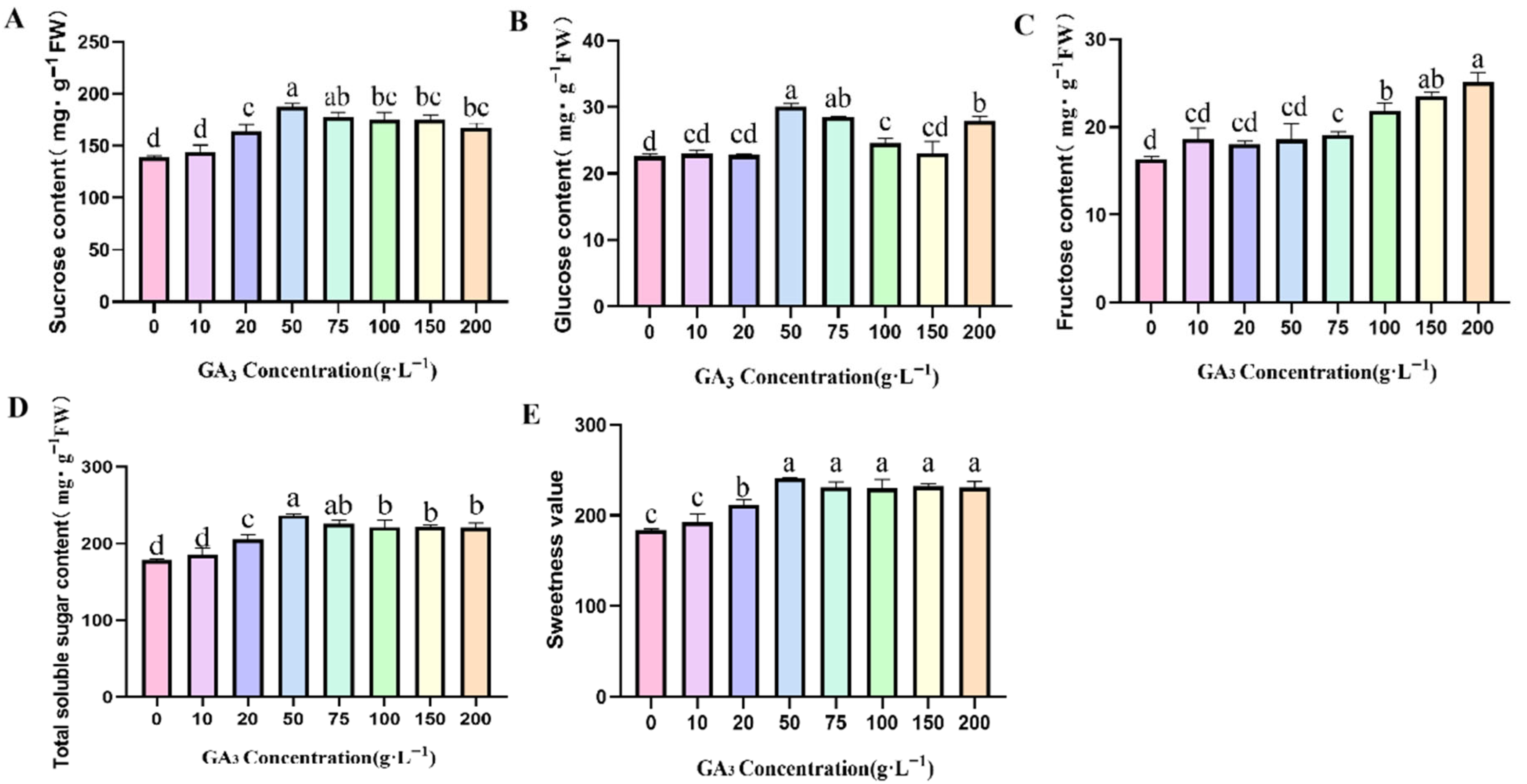
To verify the effects of exogenous GA3 on sugar accumulation in longan fruits, ultra-performance liquid chromatography (UPLC) was employed to quantify sucrose, fructose, and glucose in each treatment group. The results showed that sucrose and glucose contents followed the same trend, peaking at the 50 mg/L GA3 concentration, whereas fructose continued to increase. Total sugar content exhibited a typical trend of first increasing and then decreasing, while the sweetness value increased overall and plateaued at 50 mg/L, with no further elevation at higher GA3 concentrations (Figure 1). Specifically, the 50 mg/L GA3 treatment maximized the contents of sucrose, glucose, and total sugars, as well as the sweetness value. This phenomenon may be attributed to GA3 promoting sugar accumulation at concentrations below 50 mg/L but inhibiting it above this threshold. Based on these findings, longan fruits treated with 50 mg/L GA3 were selected as the optimal experimental material for subsequent RNA-Seq analysis.

3.2. Mining Candidate Genes Related to Sugar Accumulation Through Transcriptome

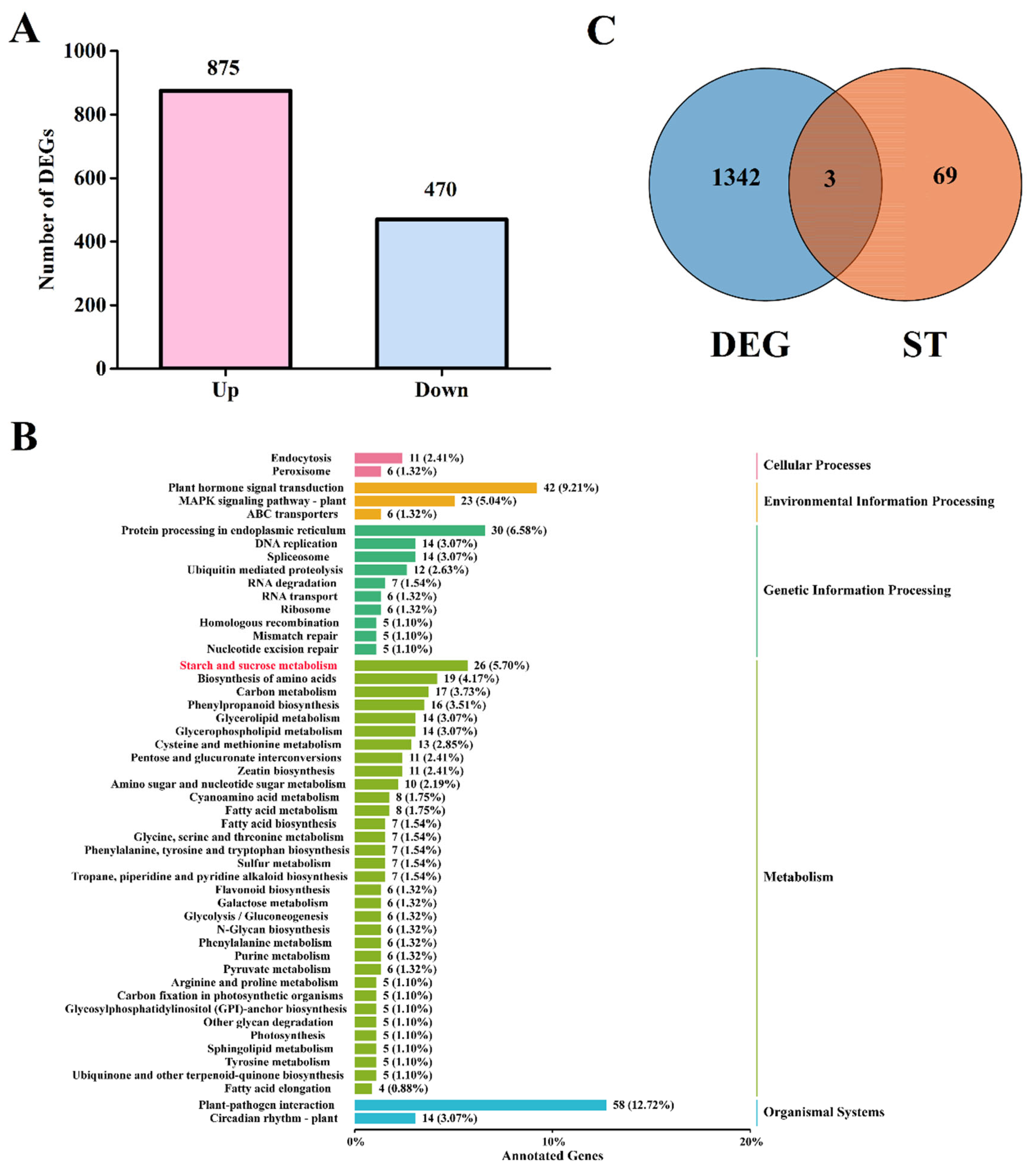
To identify the key factors mediating the effects of exogenous GA3 treatment on sugar accumulation in longan fruits, RNA sequencing (RNA-Seq) was performed on samples treated with 50 mg/L GA3 and control samples. The analysis generated 39.54 GB of clean data, with a minimum of 5.35 GB per sample, and the Q30 base percentage was at least 95.57% (Table S2). Novel gene discovery identified 4143 new genes, of which 1410 were functionally annotated (Table S3). A total of 1345 differentially expressed genes (DEGs) were detected, including 875 upregulated and 470 downregulated genes (Figure 2A). GO annotation classified these DEGs into 30 functional groups: 17 in biological processes, 3 in cellular components, and 10 in molecular functions. Within biological processes, DEGs were primarily involved in cellular processes, metabolic processes, biological regulation, response to stimuli, and localization. For cellular components, DEGs were enriched in cell structures, intracellular components, and protein-containing complexes. In terms of molecular functions, enrichment was observed in binding, catalytic activity, transporter activity, and transcription regulator activity (Figure S1). KEGG pathway analysis revealed significant enrichment of DEGs in multiple metabolic pathways, specifically 42 DEGs in plant hormone signal transduction, 26 in starch and sucrose metabolism (Table S4), 11 in pentose and glucuronate interconversions, 6 in galactose metabolism, 6 in glycolysis/gluconeogenesis, and 5 in photosynthesis (Figure 2B).
Given the critical role of sugar transporters in fruit sugar accumulation, we focused on differentially expressed sugar transporter genes. Venn analysis revealed that three sugar transporter genes—DlSWEET3a (Dlo_001364.1), DlSTP16 (Dlo_011195.1), and DlSFP9 (Dlo_000038.1)—exhibited different expression levels between the GA3 treatment and control groups (Figure 2C). To validate the RNA-Seq data, 10 candidate genes were selected for qRT-PCR analysis. The results showed a significant positive correlation between the relative expression levels measured by qRT-PCR and the FPKM values from the transcriptome data, confirming the reproducibility and reliability of the RNA-Seq results (Figure S2).

3.3. Expression Pattern Analysis of DlSWEET3a in Longan

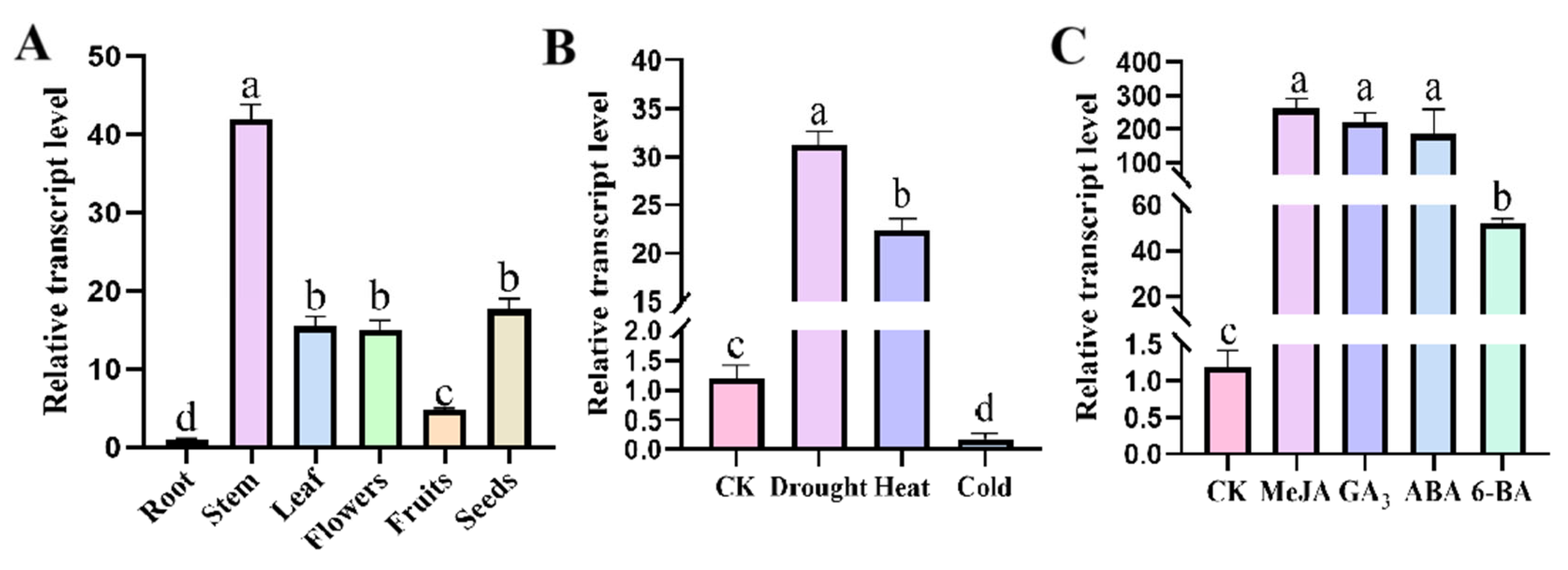
To determine the expression pattern of DlSWEET3a in longan tissues, qRT-PCR was conducted using samples from six organs: root, stem, leaf, flower, fruit, and seed. The results showed that DlSWEET3a exhibited its highest expression level in the stem, followed by seed, leaf, flower, fruit, and root (Figure 3A). Under abiotic stresses, DlSWEET3a expression was significantly upregulated under drought and heat stress, but downregulated under cold stress (Figure 3B). Additionally, DlSWEET3a expression was significantly upregulated following exogenous treatment with MeJA, GA3, ABA, and 6-BA (Figure 3C).

3.4. Subcellular Localization of DlSWEET3a

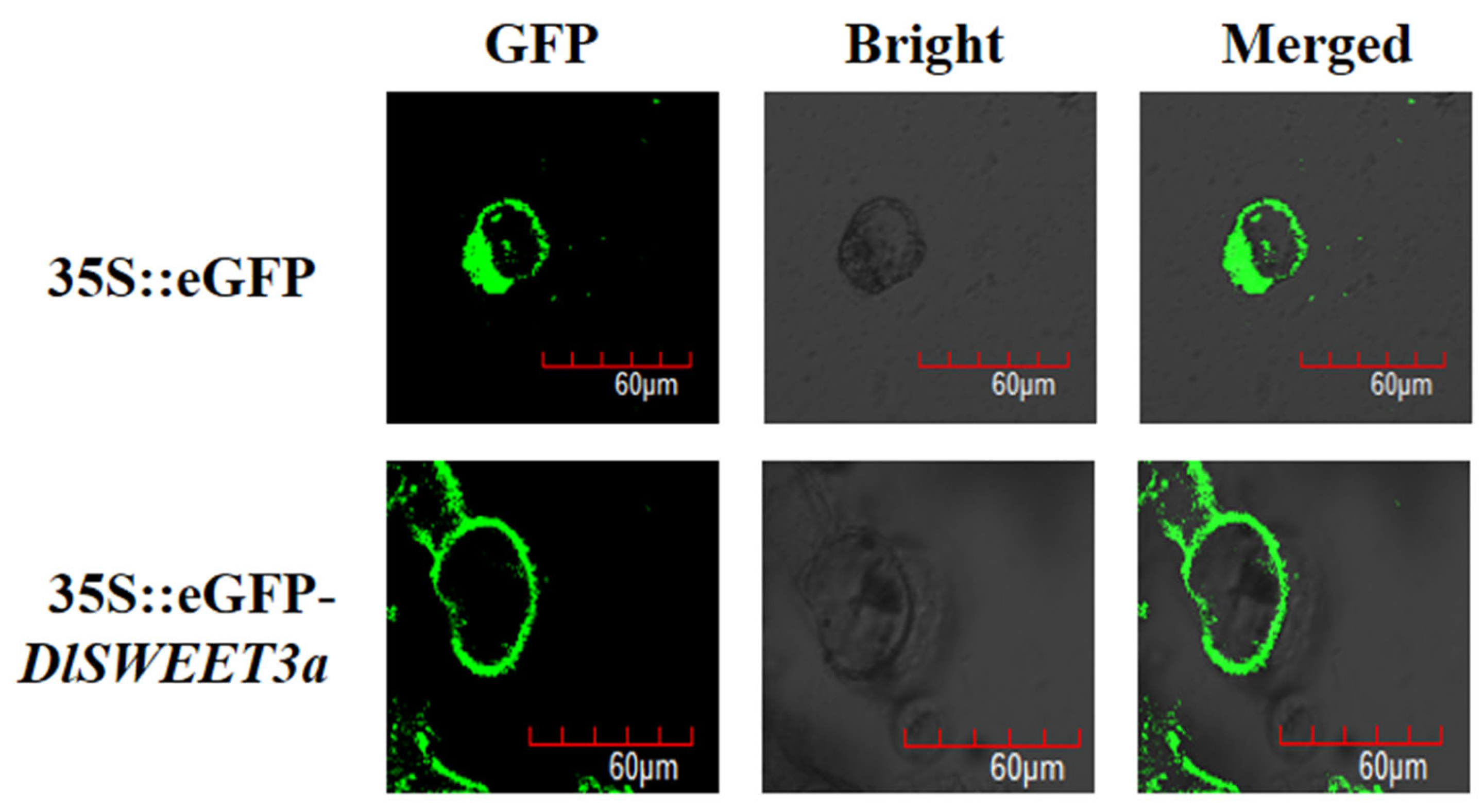
To determine the subcellular localization of DlSWEET3a, Agrobacterium strains harboring either 35S::eGFP (control) or 35S::DlSWEET3a-eGFP fusion constructs were infiltrated into longan protoplasts. Laser confocal microscopy revealed that control cells exhibited 35S::eGFP fluorescence in both the plasma membrane and the nucleus, whereas 35S::DlSWEET3a-eGFP fluorescence was strictly confined to the plasma membrane (Figure 4). The result confirmed that DlSWEET3a localizes to the plasma membrane.

3.5. DlSWEET3a Transports Glucose, Fructose, Mannose, and Galactose

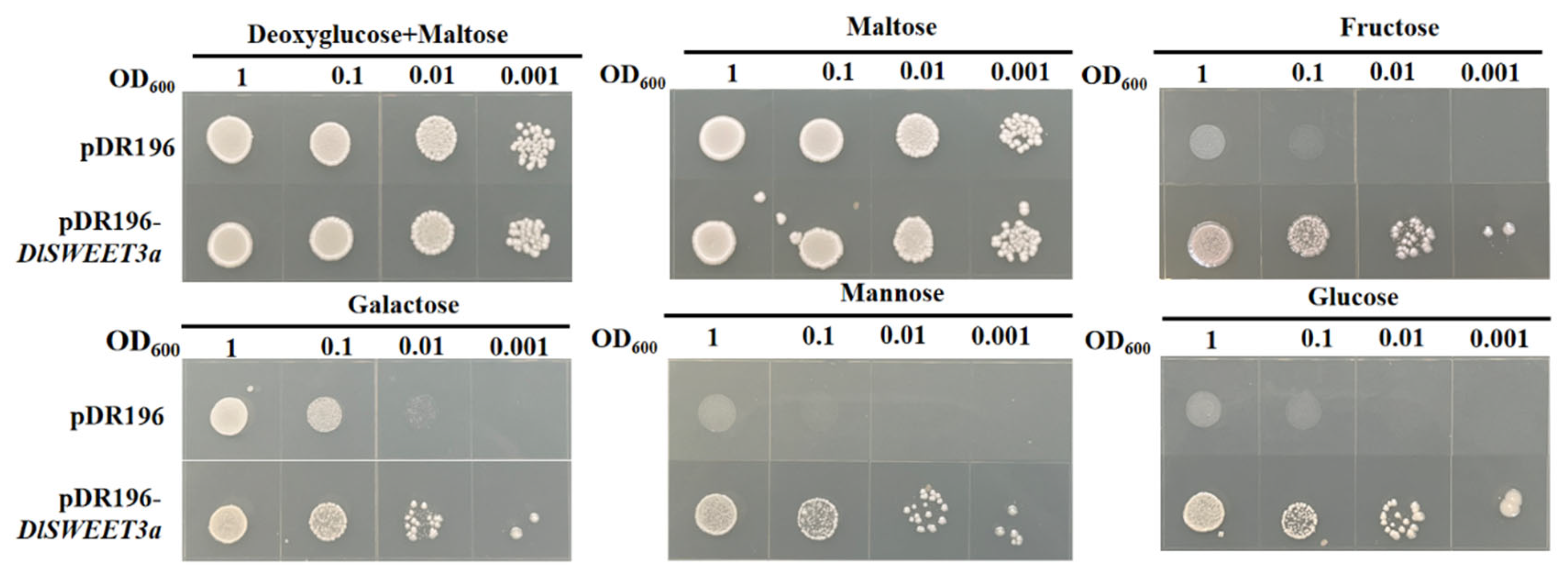
To investigate the substrate specificity of the DlSWEET3a protein, a yeast heterologous expression system was employed. The yeast strain EBY.VW4000 expressing DlSWEET3a exhibited growth on media containing glucose, fructose, mannose, maltose, or galactose as the sole carbon source, but failed to grow on deoxyglucose—indicating specificity for natural monosaccharides (Figure 5). Collectively, these results demonstrate that DlSWEET3a functions as a plasma membrane-localized transporter for glucose, fructose, mannose, and galactose.

3.6. Stable Overexpression of DlSWEET3a Enhances Sugar Content in Tobacco

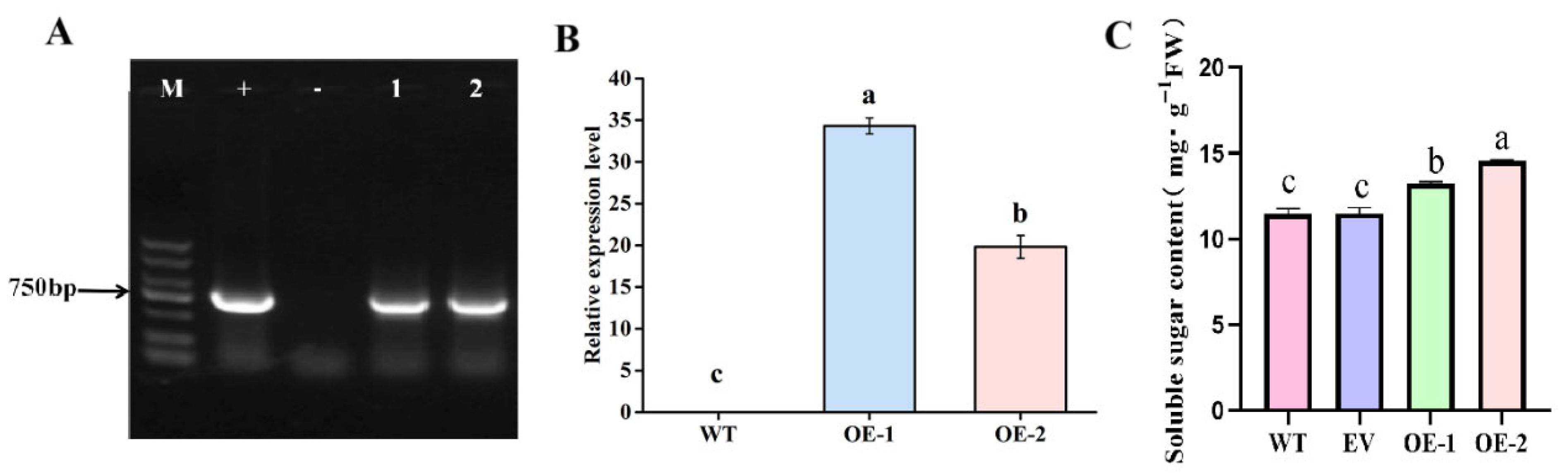
To explore the biological function of DlSWEET3a in regulating sugar accumulation, we overexpressed DlSWEET3a in tobacco and obtained two independent transgenic lines (OE-1 and OE-2) (Figure 6A). The expression level of DlSWEET3a in the OE lines was significantly higher than that in wild-type (WT) plants (Figure 6B). Furthermore, the soluble sugar content in the transgenic leaves was also markedly increased, indicating that the overexpression of DlSWEET3a promotes sugar accumulation across plant species (Figure 6C). These findings underscore the conserved role of DlSWEET3a in enhancing sugar transport and accumulation.

3.7. Transient Overexpression of DlSWEET3a Enhances Sugar Accumulation in Longan Fruits

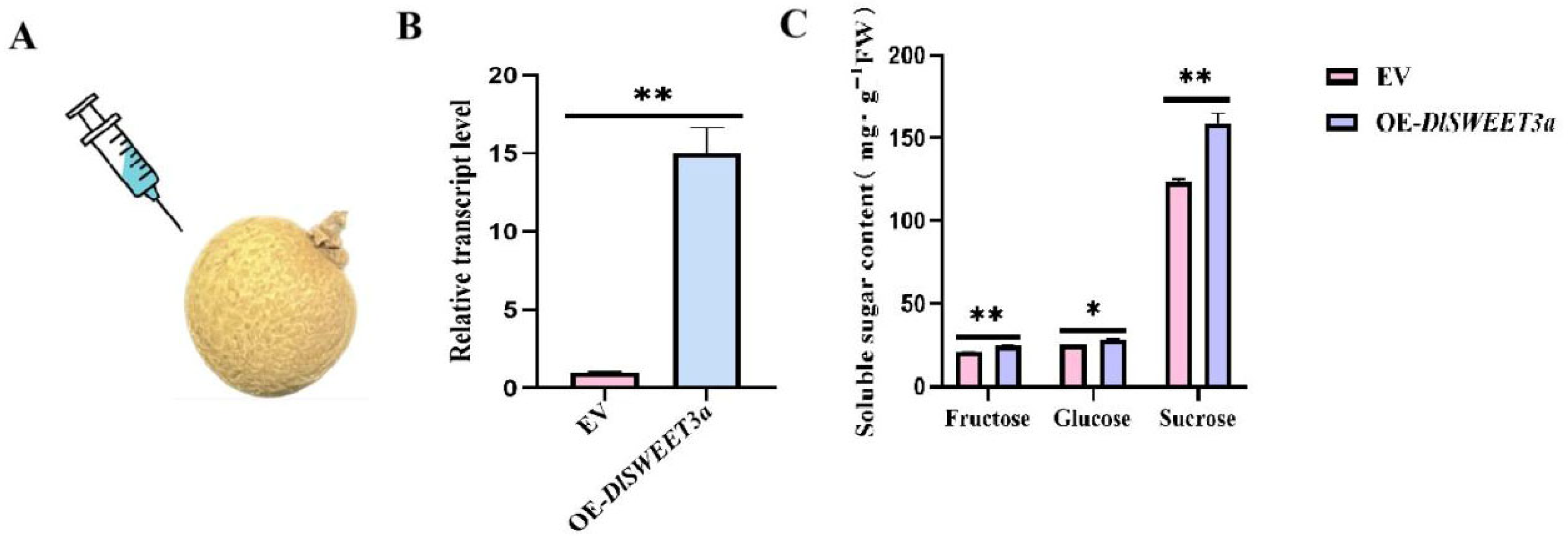
To characterize the function of DlSWEET3a in longan fruits, transient overexpression of DlSWEET3a was performed via Agrobacterium tumefaciens-mediated infiltration, with the empty pSAK277 vector used as a control (Figure 7A). Higher expression levels of DlSWEET3a were detected in the overexpressing fruits (Figure 7B). UPLC analysis revealed that the contents of fructose, glucose, and sucrose were significantly higher in DlSWEET3a-overexpressing fruits compared to the empty vector controls (Figure 7C), indicating that DlSWEET3a positively regulates sugar accumulation in longan fruits.

4. Discussion

4.1. Exogenous Gibberellin Spraying Regulates Sugar Contents of Longan Fruit

The formation of fruit quality is a complex and tightly regulated process involving the accumulation of aroma and flavor compounds, color changes, and textural modifications. As ubiquitous trace bioactive substances with vital physiological functions in plants, plant hormones regulate fruit growth and development by inducing changes in physiological and biochemical metabolism through signal transduction and crosstalk [44]. Soluble sugar content is not only a crucial indicator of fruit flavor but also a primary criterion for evaluating fruit quality [33]. During fruit ripening, there exist complex signaling pathways modulated by hormone balance and sugar signals.
As an important class of plant hormones, gibberellins play a significant role in improving fruit quality. For example, GA3 has been shown to significantly affect soluble sugar contents in grapes and plums [45,46]. In this study, exogenous GA3 treatment exerted a significant influence on the sugar content of longan fruits, with effects varying across different concentrations. Specifically, low concentrations of GA3 (e.g., 10 mg/L and 20 mg/L) weakly promoted sugar accumulation. As the GA3 concentration increased (e.g., 50 mg/L, 75 mg/L, and 100 mg/L), the contents of soluble sugars (such as sucrose, glucose, and fructose) in the fruits increased significantly. However, when the GA3 concentration was further elevated (e.g., 150 mg/L and 200 mg/L), the promoting effect on sugar accumulation tended to plateau. A similar phenomenon has been reported in oranges [47], which may be attributed to high concentrations of GA3 inhibiting the activity of certain key enzymes involved in sugar metabolism or inducing metabolic imbalances in the fruits.

4.2. Ga3 Facilitated the Decomposition of Sugars by Increasing Crucial Genes Involved in Sugar Metabolism and Transport

In recent years, the increasing maturity and cost-effectiveness of RNA-Seq technology have facilitated its widespread application in fruit tree functional genomics, including gene function annotation, spatiotemporal expression profiling, and molecular marker development [48]. In longan, existing transcriptomic studies have primarily focused on stress responses [48], fruit quality formation [34], flowering regulation [49], and somatic embryogenesis [50]. However, research on the molecular mechanisms underlying the GA3-mediated regulation of fruit sugar metabolism remains limited. Gibberellins can modulate fruit sugar accumulation by regulating the expression of sugar metabolism-related genes. For example, gibberellin treatment on pear fruit stalks significantly upregulates sucrose phosphate synthase (SPS) while downregulating sucrose synthase (SS), thereby increasing soluble sugar content in pears [51].
In this study, six RNA-Seq libraries were constructed to screen for differentially expressed genes (DEGs) following GA3 treatment. A total of 1345 DEGs were identified, including 26 genes involved in starch and sucrose metabolism. These included two encoding SPS, one encoding SS, and one encoding fructokinase (FRK). SPS is a key enzyme in sucrose biosynthesis; we previously identified a DlSPS gene via comparative transcriptomics, and transient expression assays demonstrated its critical role in longan sucrose accumulation [34]. SS, which catalyzes reversible reactions between sucrose and UDP-glucose, plays a pivotal role in plant carbon allocation and primarily functions in sucrose decomposition in plants [52,53]. The overexpression of PtSS3 alters fructose, glucose, and sucrose levels in Populus tomentosa [54]. FRK not only phosphorylates fructose but also acts as a sugar sensor and signaling molecule to regulate plant metabolism and development [55]; the overexpression of pear PbFRK1 in tomato enhances hexokinase activity and reduces sugar content [56].
Furthermore, sugar transporters are critical for fruit sugar accumulation, and gibberellins can influence their expression to modulate plant growth. In tomato, GA regulates sucrose allocation via the PROCERA–JACKDAW–Sucrose Transporter 1 module [57]. Here, we identified three differentially expressed sugar transporter genes (DlSWEET3a, DlSTP16, and DlSFP9). Collectively, these findings suggest that gibberellins may promote sugar accumulation in longan fruits by regulating the expression of genes involved in sugar metabolism and transport.

4.3. DlSWEET3a Contributes to Sugar Accumulation in Longan Fruits

Numerous studies have demonstrated that SWEET genes play a crucial role in maintaining plant osmotic balance by regulating sugar homeostasis, thereby enhancing plant survival under various stresses, including salt [58], cold [37], low nitrogen [59], and drought [60]. In Arabidopsis, AtSWEET11 and AtSWEET12 enhance cold tolerance by promoting sugar allocation [25]. Similarly, the overexpression of DlSWEET1 in transgenic Arabidopsis improved cold tolerance [37]. In this study, both drought and high-temperature stresses significantly upregulated the expression of DlSWEET3a. However, further research is needed to verify its precise role in longan stress resistance.
The subcellular localization of SWEET family proteins exhibits remarkable diversity, which is closely associated with their multifaceted biological functions. Plasma membrane-localized SWEET proteins primarily facilitate transmembrane sugar transport and participate in pathogen interactions, as exemplified by VvSWEET15 in grape [61] and SlSWEET12c in tomato [62]. In contrast, tonoplast-localized SWEETs, such as DsSWEET17 in Dianthus spiculifolius [63], play critical roles in regulating sugar storage and stress responses. Consistent with previous studies [64,65], our results showed that DlSWEET3a localizes to the plasma membrane, suggesting its potential involvement in extracellular sugar efflux or pathogen defense.
Different SWEET subfamilies exhibit selectivity for monosaccharides or disaccharides. According to our previous study, DlSWEET3a belongs to Clade I [37], which preferentially transports hexoses. Transport activity assays confirmed that DlSWEET3a can transport glucose, fructose, mannose, and galactose (Figure 5). The composition and content of soluble sugars are key factors determining fruit quality, while sugar transporters play a crucial role in their accumulation [66]. For example, the transient overexpression of CitSWEET6 in citrus fruits increased fructose level [67]. The overexpression of MdSWEET9b in apple calli promoted total sugar contents [28], while the overexpression of ZjSWEET2.2 in jujube enhanced leaf photosynthate content [68]. Similarly, our study demonstrated that the overexpression of DlSWEET3a significantly increased soluble sugar content in both transgenic tobacco and longan fruits. Although the transformed fruit exhibited a dramatically higher expression level than the EV control, the corresponding increase in sugar content was considerably less pronounced. The similar phenomenon has also been observed in other studies, such as grape [61] and peach [69]. Fruit sugar content represents a highly regulated and integrative phenotype. The plant’s metabolic network is equipped with feedback mechanisms that maintain homeostasis by buffering against drastic fluctuations in solute concentrations. Although the overexpression of DlSWEET3a likely enhances the potential for sugar uptake into cells or specific compartments, the net accumulation of sugars may be constrained by downstream, non-transport-related bottlenecks, such as rates of metabolic conversion or the capacity for vacuolar storage. Collectively, these findings indicate that DlSWEET3a positively regulates sugar accumulation in longan fruits. While the transient overexpression of DlSWEET3a in this study provides compelling evidence for its role in promoting sugar accumulation, future research employing stable transgenic approaches or silencing techniques (e.g., RNAi, CRISPR/Cas9) will be crucial to confirm the loss-of-function phenotype and further solidify the causal relationship.

5. Conclusions

In this study, exogenous GA3 spraying at different concentrations significantly increased sucrose, glucose, fructose, total sugar contents, and sweetness in longan fruits, with 50 mg/L GA3 demonstrating the most pronounced effect. Transcriptome analysis of control and GA3-treated fruits identified 1345 DEGs, including one SWEET gene DlSWEET3a. Subcellular localization analysis confirmed that DlSWEET3a protein localizes to the plasma membrane, functioning as a transporter for fructose, glucose, galactose, and mannose. Both transient overexpression in longan fruits and stable overexpression in tobacco leaves significantly promoted sugar accumulation, providing direct evidence of DlSWEET3a’s critical role in enhancing sugar accumulation.

Supplementary Materials

The following supporting information can be downloaded at https://www.mdpi.com/article/10.3390/horticulturae12010096/s1. Table S1: The primers used in this study; Table S2: Summary statistics of RNA-Seq results; Table S3: Statistics of new gene function annotation; Table S4: Annotation of 26 unigenes related to starch and sucrose metabolism; Figure S1: GO classification map of DEGs; Figure S2: The qRT-PCR validation of 10 genes expression levels in the transcriptome.

Author Contributions

T.F. and L.Z. conceived and designed the study. T.X., Y.B., J.X., K.L., and S.Y. performed the experiments and analyzed the data. T.X. and Y.B. wrote the manuscript draft. T.F. and L.Z. revised the manuscript. All authors have read and agreed to the published version of the manuscript.

Funding

This work was supported by grants from the National Natural Science Foundation of China (32102343), special fund for scientific and technological innovation of Fujian Agricultural and Forestry University Applied Basic Research (KFB25074A), and the funds for the connotation development of disciplines of Fujian Agricultural and Forestry University (102-725025010).

Data Availability Statement

The original contributions presented in this study are included in the article/Supplementary Material. Further inquiries can be directed to the corresponding author.

Conflicts of Interest

The authors declare no conflicts of interest.

References

  1. Li, J.; Li, C.Y. Advances in plant hormone research over 70 years since the founding of the People’s Republic of China. Sci. China Life Sci. 2019, 49, 1227–1281. [Google Scholar]
  2. Gao, X.H.; Fu, X.D. Research progress on gibberellin signal transduction and its regulation of plant growth and development. Biotechnol. Bull. 2018, 34, 7–19. [Google Scholar]
  3. Silverstone, A.L.; Sun, T. Gibberellins and the green revolution. Trends Plant Sci. 2000, 5, 1–2. [Google Scholar] [CrossRef] [PubMed]
  4. Zhou, Y.Z.; Cheng, Y.X.; Zhong, R.; Tang, J.; Pervaiz, T.; Zhou, S.H.; Liu, J.B.; Wang, B.; Jia, H.F. Brassinolide and gibberellin promote grape fruit development and quality. Sci. Hortic. 2024, 338, 113619. [Google Scholar] [CrossRef]
  5. Wang, Y.; Xian, K.; Liu, H. Effect of exogenous hormones on sugar accumulation in fruit of grafted watermelon. North. Hortic. 2007, 10, 27–29. [Google Scholar]
  6. Wu, W.; Sun, N.J.; Xu, Y.; Chen, Y.T.; Liu, X.F.; Shi, L.Y.; Chen, W.; Zhu, Q.G.; Gong, B.C.; Yin, X.R.; et al. Exogenous gibberellin delays maturation in persimmon fruit through transcriptional activators and repressors. Plant Physiol. 2023, 193, 840–854. [Google Scholar] [CrossRef]
  7. Zhang, B.; Li, Y.N.; Wu, B.H.; Yuan, Y.Y.; Zhao, Z.Y. Plasma membrane-localized transporter MdSWEET12 is involved in sucrose unloading in apple fruit. J. Agric. Food Chem. 2022, 70, 15517–15530. [Google Scholar] [CrossRef]
  8. Mishra, B.S.; Singh, M.; Aggrawal, P.; Laxmi, A. Glucose and auxin signaling interaction in controlling Arabidopsis thaliana seedlings root growth and development. PLoS ONE 2009, 4, e4502. [Google Scholar] [CrossRef]
  9. Cho, Y.H.; Yoo, S.D. Signaling role of fructose mediated by FINS1/FBP in Arabidopsis thaliana. PLoS Genet. 2011, 7, e1001263. [Google Scholar] [CrossRef]
  10. Li, P.; Wind, J.J.; Shi, X.; Zhang, H.; Hanson, J.; Smeekens, S.C.; Teng, S. Fructose sensitivity is suppressed in Arabidopsis by the transcription factor ANAC089 lacking the membrane bound domain. Proc. Natl. Acad. Sci. USA 2011, 108, 3436–3441. [Google Scholar] [CrossRef]
  11. Evoland, A.L.; Jackson, D.P. Sugars, signalling and plant development. J. Exp. Bot. 2011, 63, 3367–3377. [Google Scholar] [CrossRef] [PubMed]
  12. Lemoine, R.; Lacamera, S.; Atanassova, R. Source-to-sink transport of sugar and regulation by environmental factors. Front. Plant Sci. 2013, 4, 272. [Google Scholar] [CrossRef] [PubMed]
  13. Pangborn, R. Relative taste intensities of selected sugars and organic acids. J. Food Sci. 2006, 28, 726–733. [Google Scholar] [CrossRef]
  14. Atkinson, R.G.; Gunaseelan, K.; Wang, M.Y.; Luo, L.; Wang, T.; Norling, C.L.; Johnston, S.L.; Maddumage, R.; Schröder, R.; Schaffer, R.J. Dissecting the role of climacteric ethylene in kiwifruit (Actinidia chinensis) ripening using 1-aminocyclopropane-1-carboxylic acid oxidase knockdown line. J. Exp. Bot. 2011, 62, 3821–3835. [Google Scholar] [CrossRef]
  15. Ruan, Y.L.; Jin, Y.; Yang, Y.J.; Li, G.J.; Boyer, J.S. Sugar input, metabolism, and signaling mediated by invertase: Roles in development, yield potential, and response to drought and heat. Mol. Plant 2010, 3, 942–955. [Google Scholar] [CrossRef]
  16. Doidy, J.; Grace, E.; Kühn, C.; Simon-Plas, F.; Casieri, L.; Wipf, D. Sugar transporters in plants and in their interactions with fungi. Trends Plant Sci. 2012, 17, 413–422. [Google Scholar] [CrossRef]
  17. Xue, X.; Wang, J.; Shukla, D.; Cheung, L.S.; Chen, L.Q. When SWEETs turn tweens: Updates and perspectives. Annu. Rev. Plant Biol. 2022, 73, 379–403. [Google Scholar] [CrossRef]
  18. Braun, D.M.; Wang, L.; Ruan, Y.L. Understanding and manipulating sucrose phloem loading, unloading, metabolism, and signalling to enhance crop yield and food security. J. Exp. Bot. 2013, 65, 1713–1735. [Google Scholar] [CrossRef]
  19. Jeena, G.S.; Kumar, S.; Shukla, R.K. Structure, evolution and diverse physiological roles of SWEET sugar transporters in plants. Plant Mol. Biol. 2019, 100, 351–365. [Google Scholar] [CrossRef]
  20. Chen, L.Q.; Hou, B.H.; Lalonde, S. Sugar transporters for intercellular exchange and nutrition of pathogens. Nature 2010, 468, 527–532. [Google Scholar] [CrossRef]
  21. Chen, L.Q.; Qu, X.Q.; Hou, B.H. Sucrose efflux mediated by SWEET proteins as a key step for phloem transport. Science 2012, 335, 207–211. [Google Scholar] [CrossRef] [PubMed]
  22. Chardon, F.; Bedu, M.; Calenge, F.; Klemens, P.A.W.; Spinner, L.; Clement, G.; Chietera, G.; Léran, S.; Ferrand, M.; Lacombe, B.; et al. Leaf fructose content is controlled by the vacuolar transporter SWEET17 in Arabidopsis. Curr. Biol. 2013, 23, 697–702. [Google Scholar] [CrossRef] [PubMed]
  23. Guo, W.J.; Nagy, R.; Chen, H.Y.; Pfrunder, S.; Yu, Y.C.; Santelia, D.; Frommer, W.B.; Martinoia, E. SWEET17, a facilitative transporter, mediates fructose transport across the tonoplast of Arabidopsis roots and leaves. Plant Physiol. 2014, 164, 777–789. [Google Scholar] [CrossRef] [PubMed]
  24. Lin, I.W.; Sosso, D.; Chen, L.Q.; Gase, K.; Kim, S.G.; Kessler, D.; Klinkenberg, P.M.; Gorder, M.K.; Hou, B.H.; Qu, X.Q.; et al. Nectar secretion requires sucrose phosphate synthases and the sugar transporter SWEET9. Nature 2014, 508, 546–549. [Google Scholar] [CrossRef]
  25. Le Hir, R.; Spinner, L.; Klemens, P.A.W.; Chakraborti, D.; de Marco, F.; Vilaine, F.; Wolff, N.; Lemoine, R.; Porcheron, B.; Géry, C.; et al. Disruption of the sugar transporters AtSWEET11 and AtSWEET12 affects vascular development and freezing tolerance in Arabidopsis. Mol. Plant 2015, 8, 1687–1690. [Google Scholar] [CrossRef]
  26. Ren, Y.; Li, M.Y.; Guo, S.G.; Sun, H.H.; Zhao, J.Y.; Zhang, J.; Liu, G.M.; He, H.J.; Tian, S.W.; Yu, Y.T.; et al. Evolutionary gain of oligosaccharide hydrolysis and sugar transport enhanced carbohydrate partitioning in SWEET watermelon fruits. Plant Cell 2021, 33, 1554–1573. [Google Scholar] [CrossRef]
  27. Luo, M.; Jia, M.; Pan, L.; Chen, W.; Zhou, K.; Xi, W. Sugar transporters PpSWEET9a and PpSWEET14 synergistically mediate peach sucrose allocation from source leaves to fruit. Commun. Biol. 2024, 7, 1068. [Google Scholar] [CrossRef]
  28. Zhang, S.; Wang, H.; Wang, T.; Zhang, J.; Liu, W.; Fang, H.; Zhang, Z.; Peng, F.; Chen, X.; Wang, N. Abscisic acid and regulation of the sugar transporter gene MdSWEET9b promote apple sugar accumulation. Plant Physiol. 2023, 192, 2081–2101. [Google Scholar] [CrossRef]
  29. Yi, D.; Zhang, H.; Lai, B.; Liu, L.; Pan, X.; Ma, Z.; Wang, Y.; Xie, J.; Shi, S.; Wei, Y. Integrative analysis of the coloring mechanism of red longan pericarp through metabolome and transcriptome analyses. J. Agric. Food Chem. 2021, 69, 1806–1815. [Google Scholar] [CrossRef]
  30. Yue, X.; Chen, Z.J.; Zhang, J.M.; Huang, C.; Zhao, S.Y.; Li, X.B.; Qu, Y.; Zhang, C. Extraction, purification, structural features and biological activities of longan fruit pulp (Longyan) polysaccharides: A review. Front. Nutr. 2022, 9, 914679. [Google Scholar] [CrossRef]
  31. Lai, T.T.; Shuai, L.; Han, D.M.; Lai, Z.Y.; Du, X.X.; Guo, X.M.; Hu, W.S.; Wu, Z.X.; Luo, T. Comparative metabolomics reveals differences in primary and secondary metabolites between ‘Shixia’ and ‘Chuliang’ longan (Dimocarpus longan Lour.) pulp. Food Sci. Nutr. 2021, 9, 5785–5799. [Google Scholar] [CrossRef]
  32. Chen, X.P.; Deng, C.J.; Hu, W.S.; Jiang, J.M.; Jiang, F.; Xu, Q.Z.; Zheng, S.Q. Analysis of fruit sugar components and content characteristics in longan germplasm resources. J. Fruit Sci. 2015, 32, 420–426. [Google Scholar]
  33. Fang, T.; Li, Y.; Xie, T.; Xian, H.M.; Bao, Y.Y.; Zeng, L. The bHLH transcription factor DlbHLH68 positively regulates DlSPS1 expression to promote sucrose biosynthesis in longan. Int. J. Biol. Macromol. 2025, 296, 139594. [Google Scholar] [CrossRef] [PubMed]
  34. Li, Y.; Ren, R.; Pan, R.Y.; Bao, Y.Y.; Xie, T.; Zeng, L.; Fang, T. Comparative transcriptome analysis identifies candidate genes related to sucrose accumulation in longan (Dimocarpus longan Lour.) pulp. Front. Plant Sci. 2024, 15, 1379750. [Google Scholar] [CrossRef] [PubMed]
  35. Liu, J.; Lin, Y.; Lin, H.; Lin, M.; Fan, Z. Impacts of exogenous ROS scavenger ascorbic acid on the storability and quality attributes of fresh longan fruit. Food Chem. X 2021, 12, 100167. [Google Scholar] [CrossRef]
  36. Fang, T.; Peng, Y.; Rao, Y.; Li, S.; Zeng, L. Genome-wide identification and expression analysis of sugar transporter (ST) gene family in longan (Dimocarpus longan L.). Plants 2020, 9, 342. [Google Scholar] [CrossRef]
  37. Fang, T.; Rao, Y.; Wang, M.; Li, Y.; Liu, Y.; Xiong, P.; Zeng, L. Characterization of the sweet gene family in longan (Dimocarpus longan) and the role of DlSWEET1 in cold tolerance. Int. J. Mol. Sci. 2022, 23, 8914. [Google Scholar] [CrossRef]
  38. Lin, Y.; Min, J.; Lai, R.; Wu, Z.; Chen, Y.; Yu, L.; Cheng, C.; Jin, Y.; Tian, Q.; Liu, Q.; et al. Genome-wide sequencing of longan (Dimocarpus longan Lour.) provides insights into molecular basis of its polyphenol-rich characteristics. Gigascience 2017, 6, 1–14. [Google Scholar] [CrossRef]
  39. Kim, D.; Langmead, B.; Salzberg, S. HISAT: A fast spliced aligner with low memory requirements. Nat. Methods 2015, 12, 357–360. [Google Scholar] [CrossRef]
  40. Livak, K.J.; Schmittgen, T.D. Analysis of relative gene expression data using real-time quantitative PCR and the 2−∆∆CT method. Methods 2001, 25, 402–408. [Google Scholar] [CrossRef]
  41. Zhang, X.L.; Peng, R.; Tian, X.B.; Guo, Y.Q.; Li, X.Y.; Liu, X.L.; Xie, Y.; Li, M.Z.; Xia, H.; Liang, D. Establishment of protoplasts isolation and transient transformation system for kiwifruit. Sci. Hortic. 2024, 329, 113034. [Google Scholar] [CrossRef]
  42. Wang, P.; Wei, P.; Niu, F.; Liu, X.; Zhang, H.; Lyu, M.; Yuan, Y.; Wu, B. Cloning and functional assessments of floral-expressed SWEET transporter genes from Jasminum sambac. Int. J. Mol. Sci. 2019, 20, 4001. [Google Scholar] [CrossRef] [PubMed]
  43. Sparkes, I.; Runions, J.; Kearns, A.; Hawes, C. Rapid, transient expression of fluorescent fusion proteins in tobacco plants and generation of stably transformed plants. Nat. Protoc. 2006, 1, 2019–2025. [Google Scholar] [CrossRef] [PubMed]
  44. Vanstraelen, M.; Benková, E. Hormonal interactions in the regulation of plant development. Annu. Rev. Cell Dev. Biol. 2012, 28, 463–487. [Google Scholar] [CrossRef]
  45. Perez, F.J.; Gomez, M. Possible role of soluble invertase in the gibberellic acid berry-sizing effect in Sultana grape. J. Plant Growth Regul. 2000, 30, 111–116. [Google Scholar] [CrossRef]
  46. Song, Q.; Nie, X.; Chen, H. Effects of abscisic acid and gibberellin on sugar accumulation in ‘Fengtang’ Plum (Prunus salicina Lindl). Hortic. Sci. 2024, 51, 314–326. [Google Scholar] [CrossRef]
  47. Wang, Y.B.; Xian, K.M.; Zhang, Y.H.; Liu, H.Y. Research progress on the application of GA. North. Hortic. 2007, 6, 74–75. [Google Scholar]
  48. Tian, Q.; Xie, X.; Lai, R.; Cheng, C.; Zhang, Z.; Chen, Y.; XuHan, X.; Lin, Y.; Lai, Z. Functional and transcriptome analysis reveal specific roles of Dimocarpus longan DlRan3A and DlRan3B in root hair development, reproductive growth, and stress tolerance. Plants 2024, 13, 480. [Google Scholar] [CrossRef]
  49. Jue, D.; Sang, X.; Liu, L.; Shu, B.; Wang, Y.; Liu, C.; Wang, Y.; Xie, J.; Shi, S. Comprehensive analysis of the longan transcriptome reveals distinct regulatory programs during the floral transition. BMC Genom. 2019, 20, 126. [Google Scholar] [CrossRef]
  50. Chen, Y.; Xu, X.; Liu, Z.; Zhang, Z.; XuHan, X.; Lin, Y.; Lai, Z. Global scale transcriptome analysis reveals differentially expressed genes involve in early somatic embryogenesis in Dimocarpus longan Lour. BMC Genom. 2020, 21, 4. [Google Scholar] [CrossRef]
  51. Li, J.; Yang, Q.; Yu, X.; Wang, L.; Wang, S.; Xu, W.; Zhang, C. Influence of gibberellins on sugar metabolism and related gene expression in fruit of pear (Pyrus pyrifolia). J. SJTU-A S 2015, 3, 21–28+35. [Google Scholar]
  52. Stein, O.; Granot, D. An overview of sucrose synthases in plants. Front. Plant Sci. 2019, 10, 95. [Google Scholar] [CrossRef]
  53. Schmölzer, K.; Gutmann, A.; Diricks, M.; Desmet, T.; Nidetzky, B. Sucrose synthase: A unique glycosyltransferase for biocatalytic glycosylation process development. Biotechnol. Adv. 2016, 34, 88–111. [Google Scholar] [CrossRef] [PubMed]
  54. Li, J.; Gao, K.; Lei, B.; Zhou, J.; Guo, T.; An, X. Altered sucrose metabolism and plant growth in transgenic Populus tomentosa with altered sucrose synthase PtSS3. Transgenic Res. 2020, 29, 125–134. [Google Scholar] [CrossRef] [PubMed]
  55. Stein, O.; Granot, D. Plant fructokinases: Evolutionary, developmental, and metabolic aspects in sink tissues. Front. Plant Sci. 2018, 9, 339. [Google Scholar] [CrossRef] [PubMed]
  56. Zhao, B.Y.; Yi, X.R.; Liu, S.T.; Qi, K.J.; Zhang, S.L.; Wu, X. The PbFRK1 gene from pear fruit affects sugar accumulation. Sci. Hortic. 2024, 323, 112536. [Google Scholar] [CrossRef]
  57. Liang, Y.; Zhao, J.; Yang, R.; Bai, J.; Hu, W.; Gu, L.; Lian, Z.; Huo, H.; Guo, J.; Gong, H. PROCERA interacts with JACKDAW in gibberellin-enhanced source–sink sucrose partitioning in tomato. Plant Physiol. 2025, 197, kiaf024. [Google Scholar] [CrossRef]
  58. Wang, Y.; Wu, F.; Zou, R.; Xu, M.; Shan, H.; Cheng, B.; Li, X. The maize sugar transporters ZmSWEET15a and ZmSWEET15b positively regulate salt tolerance in plants. Plant Physiol. Biochem. 2024, 213, 108845. [Google Scholar] [CrossRef]
  59. Klemens, P.A.; Patzke, K.; Deitmer, J.; Spinner, L.; Le Hir, R.; Bellini, C.; Bedu, M.; Chardon, F.; Krapp, A.; Neuhaus, H.E. Overexpression of the vacuolar sugar carrier AtSWEET16 modifies germination, growth, and stress tolerance in Arabidopsis. Plant Physiol. 2013, 163, 1338–1352. [Google Scholar] [CrossRef]
  60. Chen, Q.; Hu, T.; Li, X.; Song, C.P.; Zhu, J.K.; Chen, L.; Zhao, Y. Phosphorylation of SWEET sucrose transporters regulates plant root:shoot ratio under drought. Nat. Plants 2022, 8, 68–77. [Google Scholar] [CrossRef]
  61. Lu, L.; Delrot, S.; Fan, P.; Zhang, Z.; Wu, D.; Dong, F.; García-Caparros, P.; Li, S.; Dai, Z.; Liang, Z. The transcription factors ERF105 and NAC72 regulate expression of a sugar transporter gene and hexose accumulation in grape. Plant Cell 2025, 37, koae326. [Google Scholar] [CrossRef] [PubMed]
  62. Liu, H.; Zhang, J.Q.; Zhang, R.R.; Chen, C.; Tao, J.P.; Xiong, J.S.; Xiong, A.S. SlMYB1R1-SlSWEET12c module synergistically promotes sugar accumulation in tomato fruits. Plant J. 2025, 121, e70062. [Google Scholar] [CrossRef] [PubMed]
  63. Aimin, Z.; Hongping, M.; Shuang, F.; Gong, S.; Wang, J. DsSWEET17, a Tonoplast-Localized Sugar Transporter from Dianthus spiculifolius, Affects Sugar Metabolism and Confers Multiple Stress Tolerance in Arabidopsis. Int. J. Mol. Sci. 2018, 19, 1564. [Google Scholar]
  64. Zhang, X.; Feng, C.; Wang, M.; Li, T.; Liu, X.; Jiang, J. Plasma membranelocalized SlSWEET7a and SlSWEET14 regulate sugar transport and storage in tomato fruits. Hortic. Res. 2021, 8, 186. [Google Scholar] [CrossRef]
  65. Zhang, Q.; Chen, C.; Guo, R.; Zhu, X.; Tao, X.; He, M.; Li, Z.; Shen, L.; Li, Q.; Ren, D.; et al. Plasma membrane-localized hexose transporter OsSWEET1b, affects sugar metabolism and leaf senescence. Plant Cell Rep. 2024, 43, 29. [Google Scholar] [CrossRef]
  66. Wei, X.Y.; Liu, F.L.; Chen, C.; Ma, F.W.; Li, M.J. The Malus domestica sugar transporter gene family: Identifications based on genome and expression profiling related to the accumulation of fruit sugars. Front. Plant Sci. 2014, 5, 569. [Google Scholar] [CrossRef]
  67. Fang, H.; Shi, Y.; Liu, S.; Jin, R.; Sun, J.; Grierson, D.; Li, S.; Chen, K. The transcription factor CitZAT5 modifies sugar accumulation and hexose proportion in citrus fruit. Plant Physiol. 2023, 192, 1858–1876. [Google Scholar] [CrossRef]
  68. Geng, Y.Q.; Wu, M.J.; Zhang, C.M. Sugar transporter ZjSWEET2.2 mediates sugar loading in leaves of Ziziphus jujuba Mill. Front. Plant Sci. 2020, 11, 1081. [Google Scholar] [CrossRef]
  69. Mollah, M.D.A.; Zhang, X.; Zhao, L.; Jiang, X.H.; Ogutu, C.O.; Peng, Q.; Belal, M.A.A.; Yang, Q.R.; Cai, Y.M.; Nishawy, E.; et al. Two vacuolar invertase inhibitors PpINHa and PpINH3 display opposite effects on fruit sugar accumulation in peach. Front. Plant Sci. 2022, 13, 1033805. [Google Scholar] [CrossRef]
Figure 1. Effects of exogenous GA3 treatment on longan fruits. The effects of three spray applications of different concentrations of exogenous GA3 on sucrose (A), glucose (B), fructose (C), total sugar content (D), and sweetness value (E) of longan fruits. Different alphabetical letters indicate statistical significance at p < 0.05 (one-way ANOVA with Tukey’s test).
Horticulturae 12 00096 g001
Figure 2. Analysis and validation of transcriptome data. (A) Number of DEGs between GA3 and control. (B) KEGG classification map of DEGs. (C) Venn diagram of DEGs related to sugar transporters.
Horticulturae 12 00096 g002
Figure 3. Expression pattern analysis of DlSWEET3a gene. (A) Expression levels of DlSWEET3a in various tissues of longan. (B) The expression levels of the DlSWEET3a gene under abiotic stress. (C) The expression levels of the DlSWEET3a gene after the application of plant hormones. Different alphabetical letters indicate statistical significance at p < 0.05 (one-way ANOVA with Tukey’s test).
Horticulturae 12 00096 g003
Figure 4. Subcellular Localization of DlSWEET3a protein in longan protoplasts.
Horticulturae 12 00096 g004
Figure 5. Sugar transport activity analysis of DlSWEET3a protein. Complementary growth assay of yeast EBY.VW4000 mutants: Yeast transformants expressing empty vector (negative control) and DlSWEET3a were inoculated on media containing 2% maltose (positive control), 2% mannose, 2% glucose, and 2% fructose for culture.
Horticulturae 12 00096 g005
Figure 6. Stable transformation of DlSWEET3a in tobacco. (A) DNA identification of DlSWEET3a gene in transgenic tobacco. M: DL2000 Marker; +: Positive control; -: Negative control; 1–2: OE-1 and OE-2. (B) The expression level of DlSWEET3a in transgenic tobacco. The relative gene expression level was calculated using the 2−∆Ct method. (C) Determination of sugar content in leaves of transgenic tobacco. Different alphabetical letters indicate statistical significance at p < 0.05 (one-way ANOVA with Tukey’s test).
Horticulturae 12 00096 g006
Figure 7. Transient transformation of DlSWEET3a in longan fruits. (A) Schematic animation of transient transformation in longan fruits. (B) Measurement of sugar content in longan fruits by UPLC. (C) The expression level of DlSWEET3a gene in transiently transformed longan fruits. Values presented as mean ± standard error (SE) (n = 3). Asterisks indicate significant differences (* p ≤ 0.05, ** p ≤ 0.01).
Horticulturae 12 00096 g007
Disclaimer/Publisher’s Note: The statements, opinions and data contained in all publications are solely those of the individual author(s) and contributor(s) and not of MDPI and/or the editor(s). MDPI and/or the editor(s) disclaim responsibility for any injury to people or property resulting from any ideas, methods, instructions or products referred to in the content.