1. Introduction
Walnut (
Juglans regia L.), as an important economic tree species, produces fruits rich in various phenolic compounds. These substances possess the potential to scavenge reactive oxygen species (ROS) and prevent cancers, cardiovascular diseases and diabetes [
1,
2,
3,
4]. Tannin, a crucial polyphenolic compound, plays a key role in plant defense mechanisms against biotic and abiotic stresses [
5]. This astringency becomes a major source of the puckering taste in fruits, vegetables, and their beverage products [
6,
7]. Importantly, astringency significantly reduces consumers’ purchase intention, making it a key limiting factor in product sales [
8]. Plant tannins are mainly divided into two categories: hydrolyzable tannins and condensed tannins. Hydrolyzable tannins can be further classified into gallotannins and ellagitannins: the former yield gallic acid upon hydrolysis, while the latter produce ellagic acid through the action of tannase [
9]. Condensed tannins, also known as proanthocyanidins, are polymers formed from flavan-3-ols or flavan-3,4-diols and are widely distributed in various organs and tissues of plants [
10,
11].
In plants, the synthesis and storage of tannins are largely compartmentalized within specialized tannin cells. Tannin cells (TC) are commonly found in higher plant tissues and exhibit complex morphological structures, demonstrating diversity in surface characteristics, browning degree, shape, texture of inclusions, and plasmolysis behavior [
12]. During plant tissue development, the size, morphology, and tannin content of tannin cells undergo continuous dynamic changes. As the central site of tannin metabolism, in-depth research on their morphological structure and distribution patterns is crucial for elucidating the accumulation mechanisms of tannins in fruits and for quality regulation [
13,
14,
15]. Current studies on tannin cells in horticultural plants have predominantly focused on persimmon fruit [
16,
17], while systematic research on the dynamic morphological changes in tannin cells in walnut inner seed coats remains relatively limited.
Tannin degradation is a key process in fruit deastringency, primarily achieved through enzymatic and non-enzymatic pathways. In enzymatic degradation, tannase, a class of acyl hydrolases, specifically catalyzes the hydrolysis of ester bonds in tannins and gallic acid esters, releasing gallic acid and glucose, thereby effectively reducing the content of tannins and other phenolic compounds [
18]. Currently, the enzymatic properties and structures of microbial-derived tannases have been systematically studied [
19,
20,
21], while significant progress has also been made in the isolation and functional research of plant-derived tannases. Niehaus and Gross purified an esterase from oak leaves capable of hydrolyzing galloyl glucose, with properties similar to fungal tannase [
22]. Dai et al. [
23] first isolated the tannase CsTA from tea plants, which can catalyze the hydrolysis of EGCG and simple β-penta-O-galloyl-D-glucose (PGG) into EGC, gallic acid (GA), and intermediate products. Belur et al. [
24] also found that crude enzyme extracts from the fruits of Terminalia chebula and sumac leaves exhibit typical tannase activity. As an important enzyme preparation in the food industry, tannase has been widely used to improve the quality of various products. This enzyme plays a significant role in the processing of fruit wine and coffee soft drinks [
25,
26,
27]. In the juice industry, it can be applied for deastringency treatment of products such as persimmons and pomegranates; in beer brewing, it hydrolyzes polyphenols to reduce chill haze in refrigerated beer [
28,
29]. In tea beverage processing, it breaks down tea polyphenols responsible for turbidity and astringency, thereby enhancing clarity and taste [
30,
31,
32].
Previous studies have shown that tannin content directly affects the sensory quality and nutritional value of walnut kernels [
33]. Elucidating the structural characteristics of tannin cells in walnut inner seed coats and the accumulation patterns of specific tannins is of significant importance for both quality regulation of walnuts and the high-value utilization of tannin resources. While the enzymatic hydrolysis of tannins by tannases is a well-recognized process, molecular and functional studies on tannase (
TA) genes within the Juglandaceae family are limited. Recent work in pecan (
Carya illinoinensis) has identified putative
TA genes [
21], yet the specific
TA genes in walnut (
Juglans regia L.), their expression patterns in relation to tannin accumulation, and the biochemical properties of their encoded enzymes (JrTAs) remain systematically uncharacterized. We hypothesized that the expression of walnut
JrTAs genes is developmentally regulated and negatively correlated with tannin content, and that JrTA enzymes efficiently hydrolyze the key astringent compounds in walnut. Therefore, this study aims to isolate and purify walnut tannase JrTAs and thoroughly explore their hydrolytic efficacy on specific tannins. By identifying
JrTAs genes and characterizing their function, this study pinpoints key targets and establishes a functional principle for reducing walnut astringency enzymatically, providing a foundation for future development of quality improvement strategies and novel applications of walnut tannases.
2. Materials and Methods
2.1. Plant Materials
Fruits of the ‘Nonghe 1’ walnut cultivar, grown at the Horticultural Experiment Station of Shanxi Agricultural University, served as the experimental material. In spring 2023, three trees of comparable age and consistent growth vigor were selected as experimental units and biological replicates (n = 3). Sampling was conducted across three developmental stages: stone hardening period (50 and 70 days after flowering, DAF), the oil conversion stage (90 and 110 DAF), and the maturation stage (130 DAF), totaling five time points. At each sampling event, 20 healthy, disease-free fruits were harvested from multiple spatial orientations around each tree. This intra-tree composite sampling strategy was employed to ensure representative sampling of individual trees at defined developmental stages. Following ice-cold transportation to the laboratory, the inner seed coat was carefully excised. Sample processing was performed independently for each tree: a portion of the collected tissue was fixed for histological observation of tannin cells, while the remainder was immediately flash-frozen in liquid nitrogen and stored at −80 °C for subsequent analysis of phenolic compounds and gene cloning studies. Commercial green tea was obtained from Guizhou Fenggang County Xianrenling Zinc-Selenium Organic Tea Co., Ltd. (Zunyi, China). All experiments were performed with three independent biological replicates, and each measurement was conducted in triplicate.
2.2. Morphology of Tannin Cells in Walnut Inner Seed Coats
The walnut inner seed coats were fixed in FAA fixative (100% ethanol:distilled water:glacial acetic acid:formaldehyde = 9:9:1:1) for over 24 h. After fixation, the paraffin sectioning method described by He [
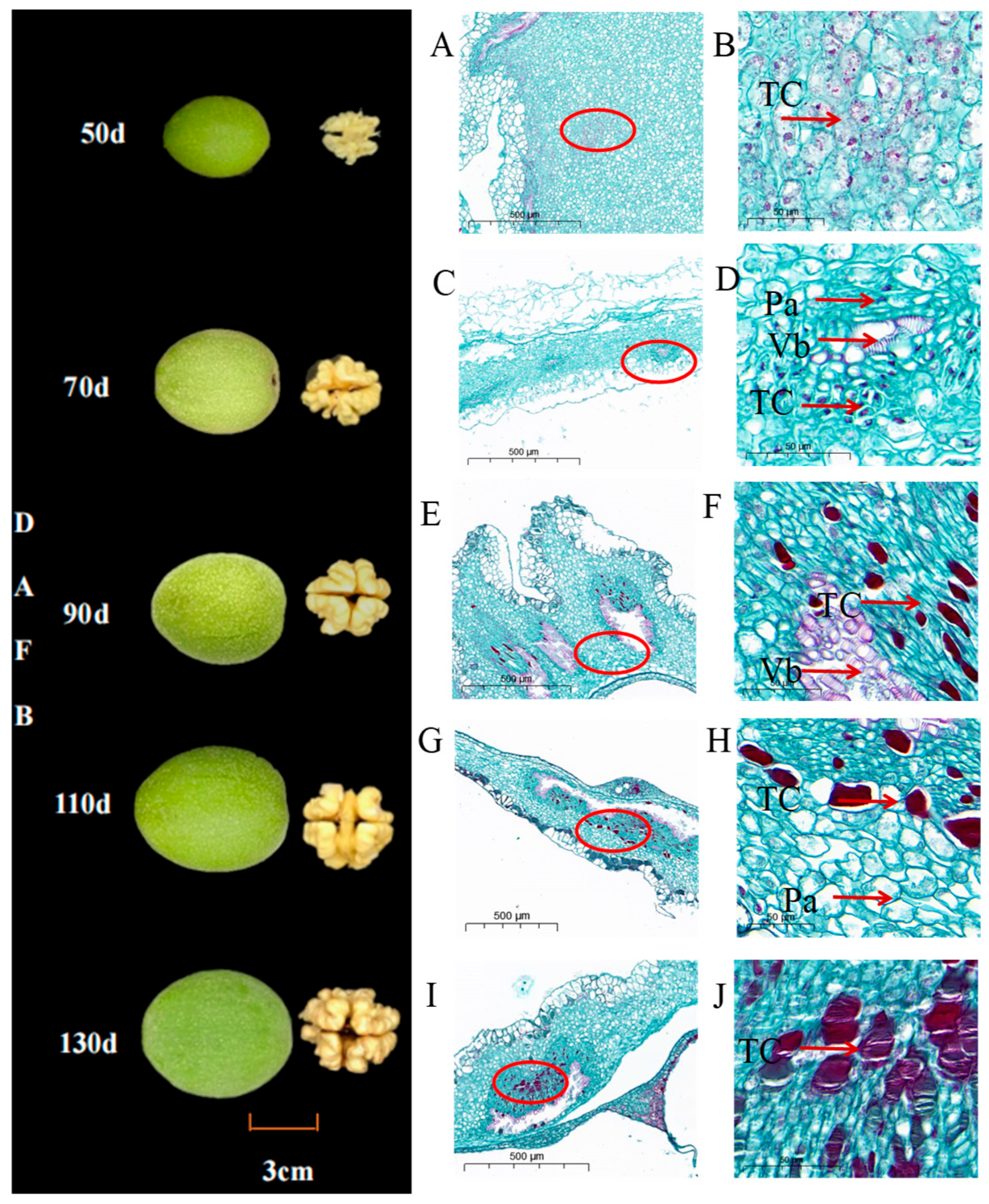
34] was followed with modifications. To accommodate the tissue characteristics of the walnut inner seed coat, the durations for each step of dehydration and clearing were adjusted to 30 min and 45 min, respectively. During the final clearing step, an equal volume of paraffin wax was added and the mixture was left to stand overnight. This was followed by wax infiltration using pure paraffin wax, which lasted 2-3 days and involved 3-4 changes in pure wax. After embedding, continuous sections of 8 μm thickness were obtained using a rotary microtome (Leica RM2016, Leica Biosystems, Nussloch, Germany). The ribbons were floated on a 40 °C water bath, mounted on glass slides, and dried overnight at 40 °C The sections were then deparaffinized, rehydrated, and stained with Safranin O and Fast Green using a standard protocol. After staining, the overall tissue architecture can be observed, and based on the affinity of Safranin O for polyphenolic compounds, cells accumulating such compounds are highlighted in red. Finally, the stained slides were observed and digitally scanned using a PANNORAMIC SCAN (3DHISTECH, Budapest, Hungary) fully automated slide scanner for image acquisition and analysis.
2.3. Quantification of Phenolic Compounds
Sample processing and the determination of total phenol (TP), total tannin (TA), and total flavonoid (TF) contents were performed according to the method described by Liu [
33]. The analysis of condensed tannins (CT) was based on the method of Lai [
35] with slight modifications. The absorbance of the reaction solution was measured at a wavelength of 500 nm, and the content was calculated based on a standard curve of proanthocyanidins. The flavonoid compounds (including C, EC, GC, EGC, CG, EGCG, etc.) and phenolic acids (including GA, VA, SA, EA, CA, etc.) in the walnut inner seed coats were determined using High-Performance Liquid Chromatography (HPLC). The specific chromatographic conditions and operational procedures followed the report by Liu [
33]. Chromatographic conditions: Separation was performed on a Hypersil GOLD C18 column (250 mm × 4.6 mm, 5 μm) maintained at 25 °C. The mobile phases consisted of (A) a solution containing 0.5% (
v/
v) acetic acid, (B) acetonitrile, and (C) methanol. The flow rate was set at 0.8 mL/min with an injection volume of 10 μL. Detection was carried out at 280 nm. The elution gradient was programmed as follows: 0–3 min, 88% A, 4% B, 8% C; 3–10 min, 85% A, 5% B, 10% C; 10–25 min, 70% A, 10% B, 20% C; 25–30 min, 72% A, 8% B, 20% C; 30–33 min, 88% A, 4% B, 8% C; 33–35 min, maintained at 88% A, 4% B, 8% C. The total run time was 40 min. The standard curves for each monomeric compound are detailed in
Appendix A Table A1.
2.4. Cloning and Expression of JrTAs Genes
The CDS sequences of the
JrTAs genes were retrieved from the NCBI database. Gene-specific cloning primers were designed using Primer Premier 5 software (
Appendix A Table A2). Total RNA was extracted from the inner seed coats of walnut fruits using the CTAB method [
36]. First-strand cDNA was synthesized using the HiScript II 1st Strand cDNA Synthesis Kit (+gDNA wiper) (Vazyme Biotech Co., Ltd., Nanjing, China). The PCR amplification protocol was set as follows: 95 °C for 3 min; 35 cycles of (95 °C for 15 s, 60 °C for 15 s, 72 °C for 1 min). The PCR products, verified by gel electrophoresis, were gel-extracted and ligated into the pMD19-T vector. The resulting constructs were transformed into E. coli DH5α competent cells, followed by screening for positive clones. The successfully constructed plasmids, pMD19-T-
JrTA1 and pMD19-T-
JrTA2, were sent for sequencing to Sangon Biotech (Zhengzhou) Co., Ltd. (Shanghai, China). The PCR products, verified by gel electrophoresis, were subsequently purified, cloned, and sequenced. Based on the obtained amino acid sequences, their fundamental physicochemical properties were predicted using the Expasy online database. Subcellular localization was predicted via Wolf PSORT II (
https://wolfpsort.hgc.jp/ (accessed on 20 May 2025)) and Softberry (
http://www.softberry.com/berry.phtml?topic=promoter (accessed on 20 May 2025)). Multiple sequence alignment and phylogenetic analysis were performed using DNAMAN 8.0 and MEGA 11.0 software, respectively. The promoter sequences of the
JrTAs genes were analyzed using the PlantCARE (
http://bioinformatics.psb.ugent.be/webtools/plantcare/html/ (accessed on 29 May 2025)).
The expression analysis of the
JrTAs gene was performed using quantitative real-time PCR (qRT-PCR), with the
JrActin gene serving as the internal reference. The corresponding primers are listed in
Appendix A Table A2. The experiment utilized the SYBR Green Pro Taq HS Premixed qPCR Kit III (with low Rox) (Vazyme Biotech Co., Ltd., Nanjing, China), and the reaction setup and thermal cycling conditions were configured according to the manufacturer’s instructions. Each 20 μL reaction mixture contained 10 μL of 2× SYBR Premix, 0.4 μL of each forward and reverse primer (10 μM), 2 μL of cDNA template (equivalent to 100 ng total RNA), and 7.2 μL of nuclease-free water. The thermal cycling protocol was as follows: initial denaturation at 95 °C for 30 s, followed by 40 cycles of 95 °C for 5 s and 60 °C for 30 s. A melt curve stage (65 °C to 95 °C, increasing by 0.5 °C every 5 s) was included to confirm amplification specificity. The relative expression levels of the gene were calculated using the 2
−ΔΔCT method.
2.5. Subcellular Localization
The pMD19-T-
JrTA1 and pMD19-T-
JrTA2 constructs, which did not contain stop codons, were separately ligated into the 35S:GFP vector using the KpnI and XbaI restriction sites to generate 35S:GFP-
JrTA1 and 35S:GFP-
JrTA2. The primers used for constructing these subcellular localization vectors are listed in
Table A2. The recombinant plasmids were each transformed into Agrobacterium tumefaciens strain GV3101 via the freeze–thaw method. Positive single colonies were cultured in LB medium until the OD
600 reached approximately 0.8. The bacterial cells were collected by centrifugation and resuspended in an equal volume of infiltration buffer (10 mM MES, 10 mM MgCl
2, and 200 μM acetosyringone). The bacterial suspensions were injected into the abaxial side of mature tobacco leaves, with leaves transformed with the 35S: GFP empty vector serving as the control. After two days of incubation, GFP fluorescence signals were observed and captured using a Leica TCS-SP8 confocal laser scanning microscope (Leica Microsystems, Wetzlar, Germany).
2.6. Molecular Docking
The tertiary structure of the JrTAs protein was predicted using AlphaFold (
https://alphafold.ebi.ac.uk/ (accessed on 24 October 2025)). The three-dimensional structures of the ligand compounds intended for docking were downloaded from PubChem (
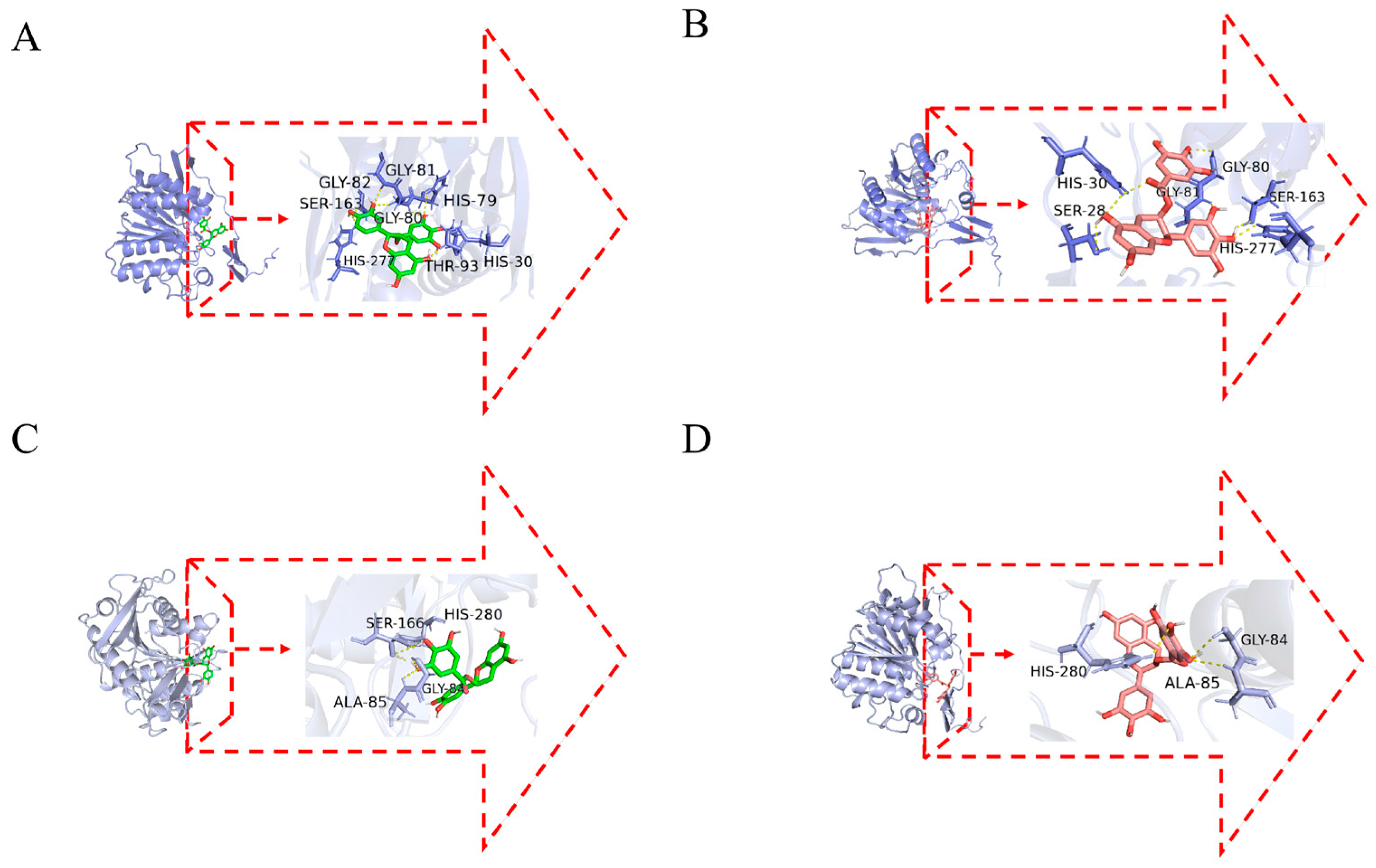
https://pubchem.ncbi.nlm.nih.gov/ (accessed on 24 October 2025)). Molecular docking was subsequently performed using AutoDock Vina (version 1.1.2), with the JrTAs protein serving as the receptor and various types of catechin molecules as the ligands.
The detailed steps are as follows:
- (1)
Receptor and Ligand Preparation
Receptor and ligand structures were prepared using AutoDockTools (AutoDock, Berlin, Germany). For the receptor, polar hydrogens were added and Gasteiger charges were assigned. For the ligand, hydrogens were added, charges were computed, and rotatable bonds were defined.
- (2)
Active Site Prediction and Docking Box Setup
The predicted active site of the receptor was identified using the PrankWeb server (
https://prankweb.cz/ (accessed on 24 October 2025)), which was used to define the docking box. The final docking search space was set as a grid box centered at coordinates (center x: 8.06, centery: 5.48, center z: −6.85) with dimensions of 22.5 A × 22.5 A × 22.5 A, ensuring complete coverage of the catalytic cavity.
- (3)
Setting Vina Input Parameters
The docking parameters were configured with the number of modes set to 15.
- (4)
Running AutoDock Vina and Output Generation
AutoDock Vina was executed to perform comprehensive conformational sampling. The docking results were exported after generating 15 binding poses.
- (5)
Visualization of Docking Results
The resulting docking poses and binding sites were visualized and analyzed using PyMOL (Version 3.11).
2.7. Isolation and Purification of JrTAs Recombinant Protein
The pMD19-T-
JrTA1 and pMD19-T-
JrTA2 constructs were ligated into the pGEX-6P-1 vector to generate pGEX-6P-1-
JrTA1 and pGEX-6P-1-
JrTA2, respectively, using the BamH I and Sac I restriction sites. The primers used for constructing these prokaryotic expression vectors are listed in
Table A2. The verified recombinant expression plasmid was transformed into
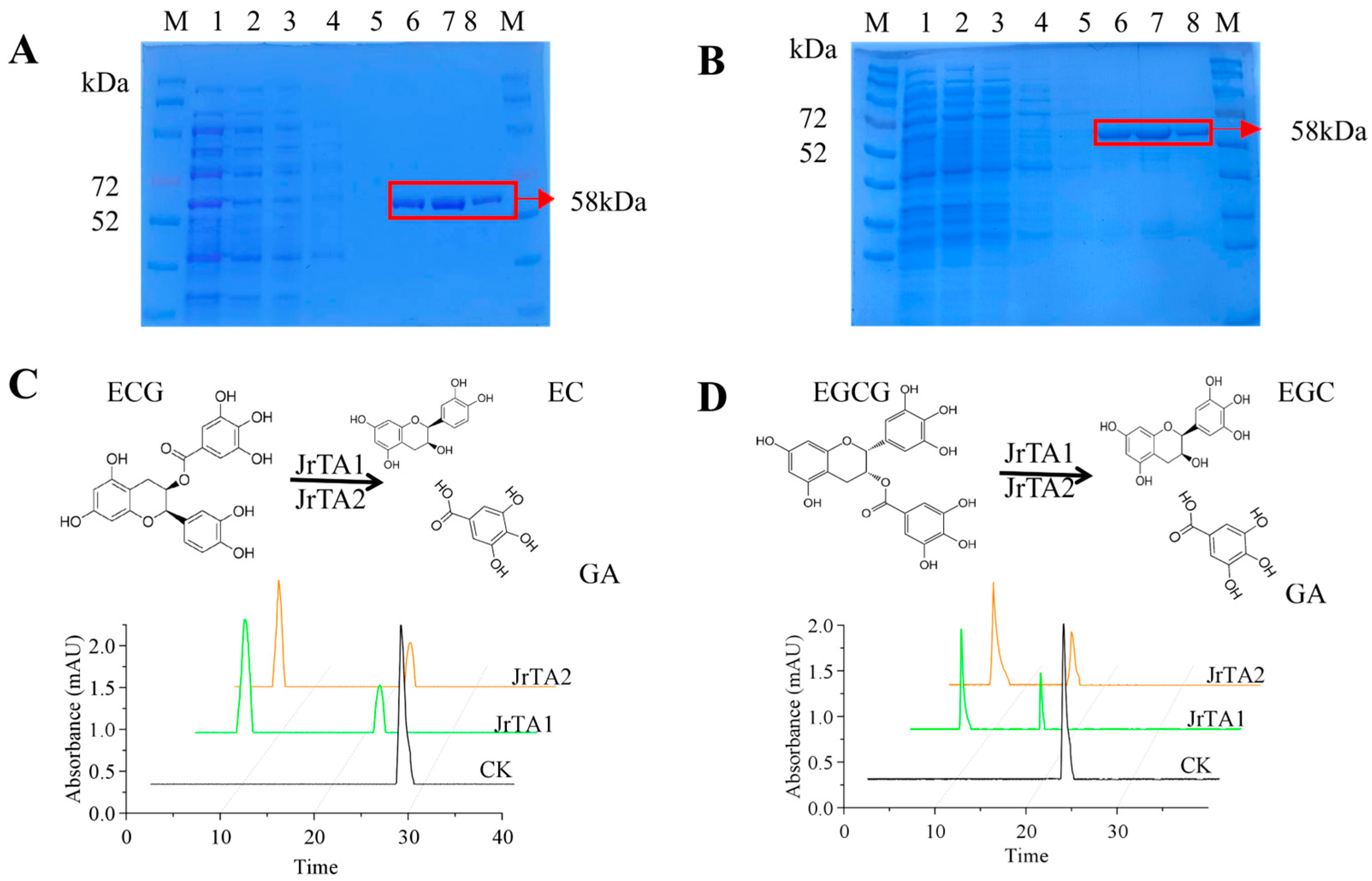
Escherichia coli BL21 (DE3) Rosetta cells and plated on LB solid medium containing ampicillin, followed by an overnight culture at 37 °C. Single colonies were inoculated into 50 mL of LB liquid medium with the corresponding antibiotic and cultured with shaking at 37 °C until the OD600 was 0.6. IPTG was then added to a final concentration of 1 mmol/L, and induction was carried out at 37 °C and 220 rpm for 4 h. Bacterial cells were collected, disrupted by ultrasonication, and centrifuged at 12,000 rpm for 10 min at 4 °C. The supernatant and precipitate were separately collected. Protein expression was analyzed by 10% SDS-PAGE and Coomassie Brilliant Blue staining. Protein purification was performed according to the instructions of the GST-tagged protein purification kit (GST Tag Protein Purification Kit, Beyotime Biotechnology, Shanghai, China).
2.8. In Vitro Enzyme Activity Assay of Recombinant Protein
The in vitro enzyme activity assay was performed following the method described by Dai [
23]. Standard solutions of EGCG, ECG, EGC, EC, and GA were prepared. In a total reaction volume of 500 μL, 10 μL of purified protein, 1 μL of 0.1 M/L ascorbic acid, and 10 μL of 1 g/L EGCG (as substrate) were added. The remaining volume was supplemented with 10 mM/L phosphate buffer (pH = 7.4). The reaction was carried out at 35 °C for 15 min and terminated by adding an equal volume of pure methanol. In the control experiment, heat-inactivated protein was added while keeping all other components and conditions unchanged. The mixture was centrifuged at 12,000 rpm, and the supernatant was used for HPLC analysis.
2.9. Determination of Enzymatic Properties of JrTAs Recombinant Enzyme
To enable the efficient and comparative analysis of biochemical properties (optimal pH, temperature, and effects of various reagents), enzyme activity was measured using a colorimetric rhodanine assay with propyl gallate as the model substrate, which quantifies the release of gallic acid from the hydrolysable galloyl ester bond. Enzyme activity was measured according to the method described in reference [
37] with slight modifications. A mixture of 50 μL of enzyme solution and 450 μL of propyl gallate was reacted at 35 °C for 10 min, followed by sequential addition of 300 μL of 100 mmol/L methanol rhodanine (to terminate the reaction) and 200 μL of 1 mol/L KOH (for color development). After color development for 5 min, the absorbance was measured at 520 nm. One unit of enzyme activity (U) was defined as the amount of enzyme required to produce 1 μmol of gallic acid per minute.
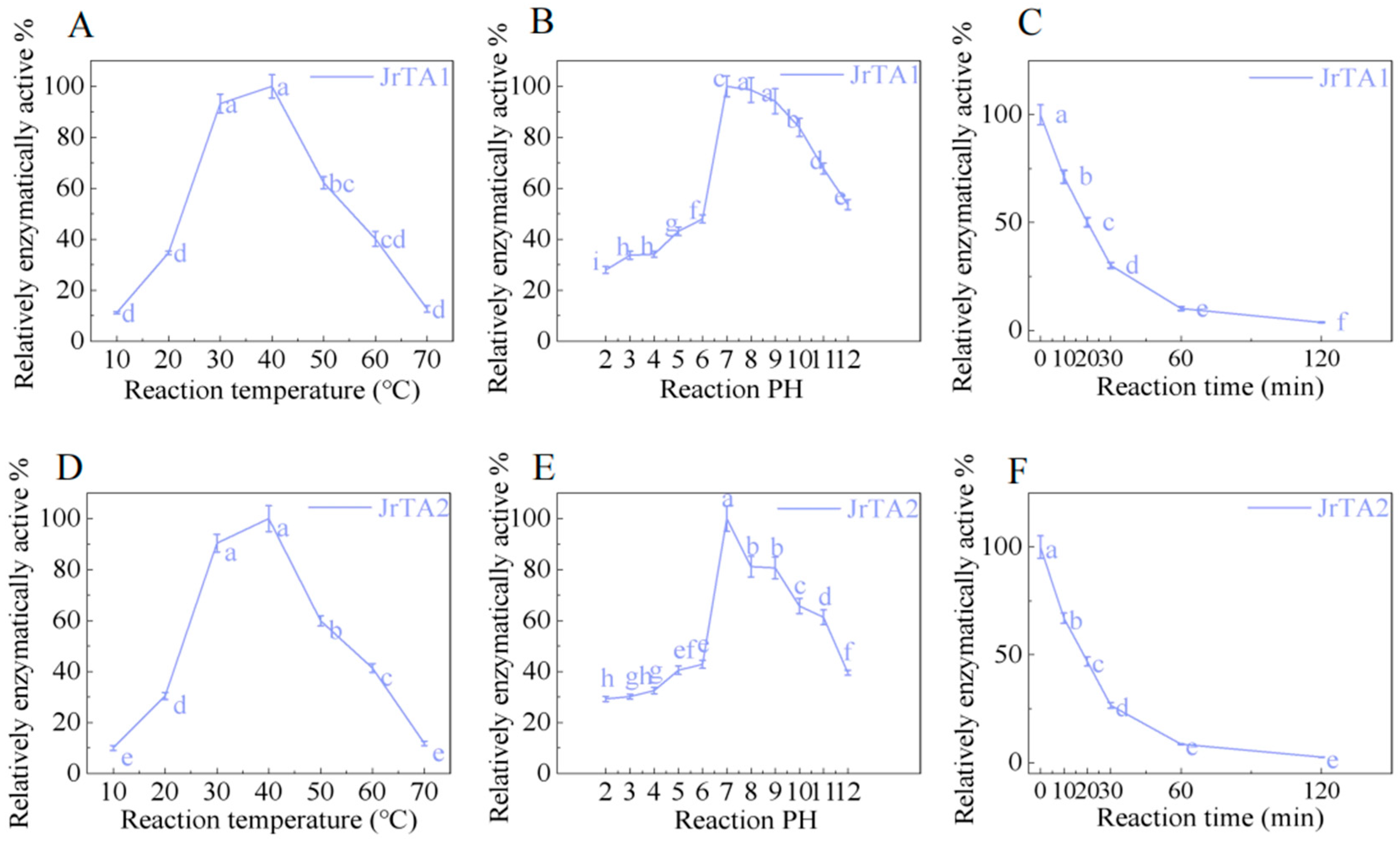
The optimal temperature, optimal pH, reaction time, and chemical reagent tolerance of the recombinant enzyme were determined based on reference [
37] with slight modifications. Enzyme activity was measured after adding different reagents to the standard reaction system: the final concentrations of metal ions, SDS, and EDTA were 1 and 10 mmol/L; the volume fractions of Tween 80, CH
4N
2O, CH
3OH, C
2H
5OH, C
3H
8O
3, C
3H
8O and C
3H
6O were 1% and 10%. The enzyme activity without any added reagents was used as the control (100%), and the relative enzyme activity was calculated.
2.10. Effect of Exogenous JrTAs Enzymes on Green Tea Infusion
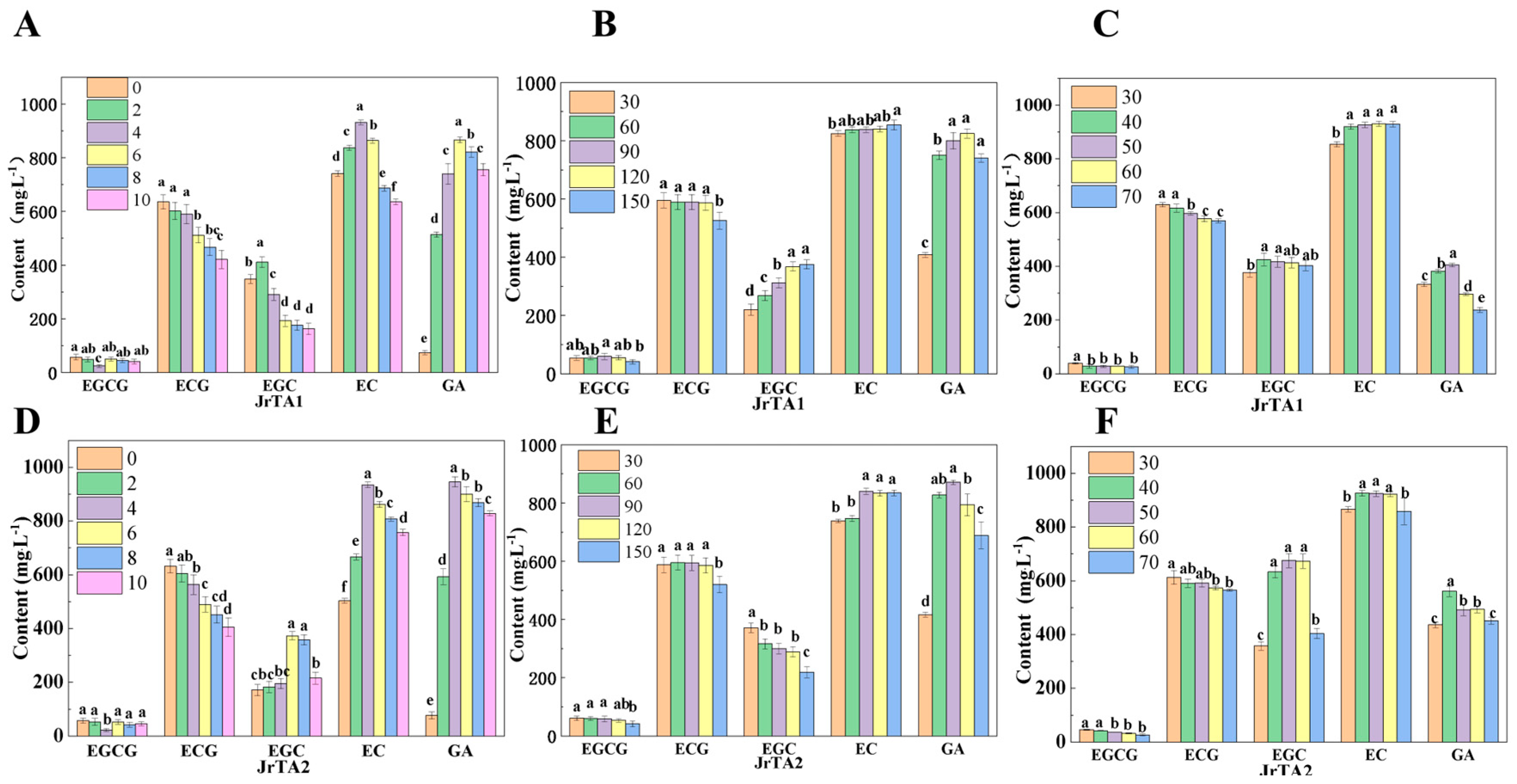
To investigate the effect of exogenous JrTAs enzymes on green tea infusion, the supernatant obtained from a tea-to-water ratio of 1:50 after extraction in an 85 °C water bath for 30 min was used as the enzyme reaction substrate for the following tests: (1) Protein dosage: Add 0, 2, 4, 6, 8, and 10 µg of protein to the substrate, and react at 35 °C for 30 min. (2) Reaction time: Collect samples after reaction times of 30, 60, 90, 120, and 150 min, respectively. (3) Reaction temperature: React the substrate at 30, 40, 50, 60, and 70 for 30 min, respectively. All reactions were terminated by heat inactivation at 95 °C, followed by quantitative analysis of catechin compounds.
2.11. Genetic Transformation in Arabidopsis thaliana
The pMD19-T-
JrTA1 and pMD19-T-
JrTA2 constructs were ligated into the pRI101 vector to generate the recombinant plasmids pRI101-
JrTA1 and pRI101-
JrTA2, respectively, using the Xba I and Nde I restriction sites. The primers used for constructing these plant overexpression vectors are listed in
Table A2. The recombinant plasmids were transformed into Agrobacterium tumefaciens strain GV3101.
Arabidopsis thaliana was transformed using the floral dip method [
23]. Mature T0 seeds were harvested and screened on 1/2 MS medium containing 400 μmol/L kanamycin. Surviving seedlings were transferred to potting mix for further growth. Genomic DNA was extracted from T1 Arabidopsis leaves and subjected to PCR verification. Plants showing specific amplification of the
JrTA1 (912 bp) or
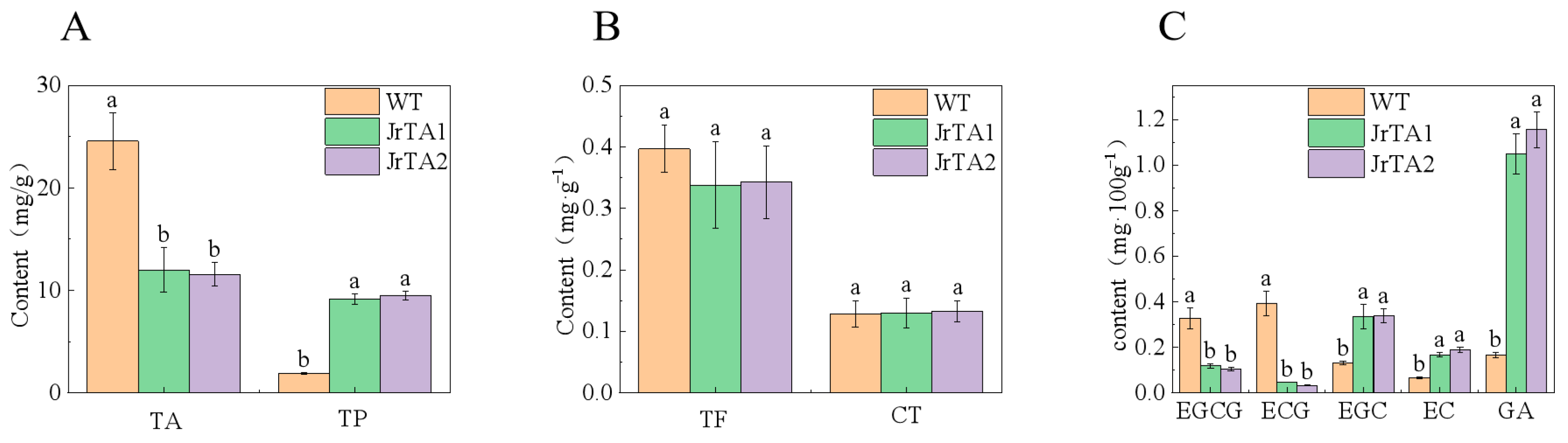
JrTA2 (921 bp) gene fragments were identified as positive transgenic lines. The T1 transgenic Arabidopsis plants were successively cultured to the T3 generation. Differences in phenolic compound content between the transgenic and wild-type Arabidopsis leaves were then analyzed, following the same methodology described in
Section 2.3.
2.12. Data Processing
Data statistics and recording were performed using Microsoft Excel 2019. Significance difference analysis and correlation analysis were conducted using SPSS 21.0 software. Use Origin 2021 for drawing.
4. Discussion
Bitterness and astringency are key factors affecting the sensory quality of plant-based foods. Existing studies have confirmed a significant correlation between phenolic compound content and the intensity of bitterness and astringency [
1,
2,
3]. In green tea, esterified catechins (such as ECG and EGCG) have been identified as the primary bitter and astringent components [
32,
38]. In walnut inner seed coats, tannins, chlorogenic acid, EC, GC, EGCG, and caffeine collectively form the basis of their bitter and astringent substances, with significant varietal differences in the content of individual phenolics [
33]. Li et al. [
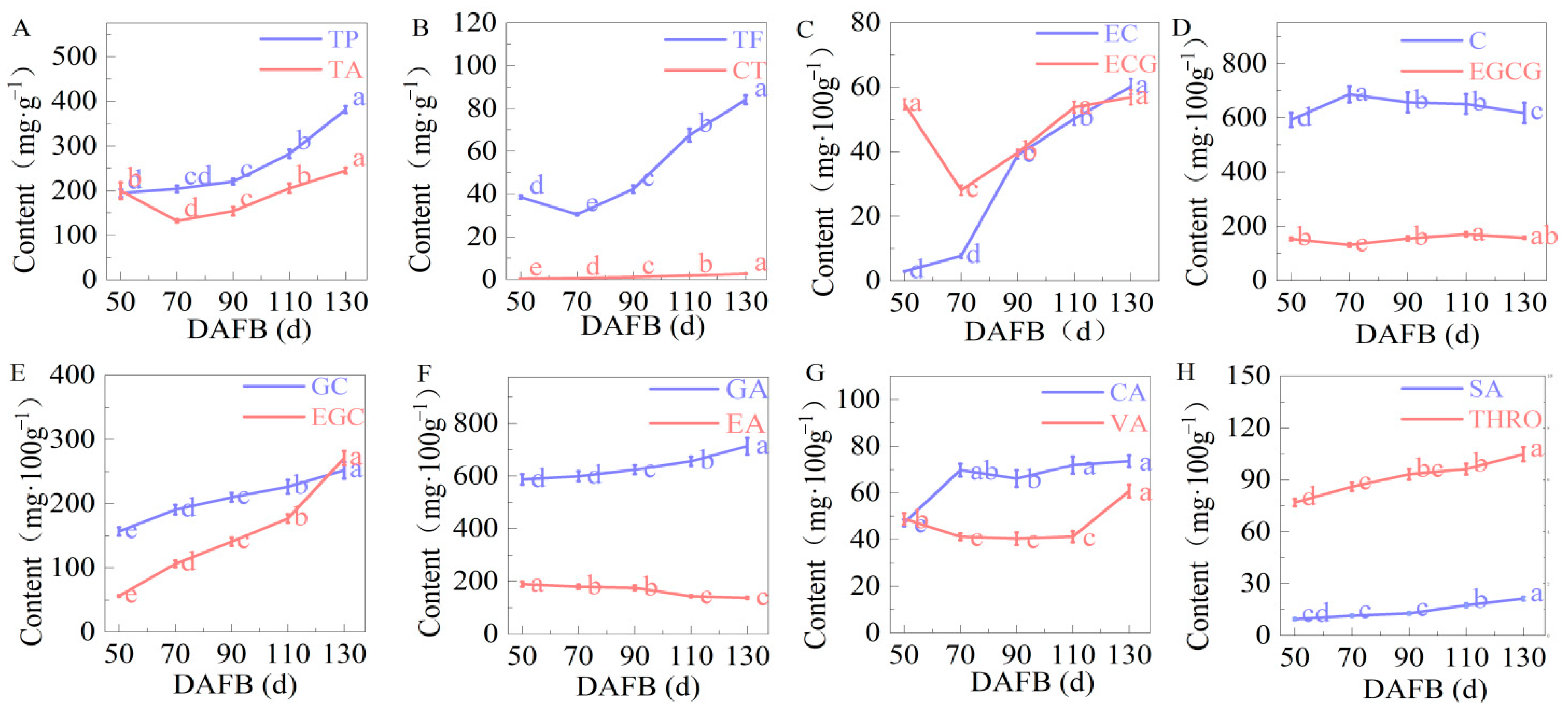
39] reported that during the development of Juglans sigillata ‘Qianhe 7’ inner seed coats, total phenols and total flavonoids generally increased, with continuous accumulation of rutin, syringic acid, and gallic acid, while catechin, chlorogenic acid, and ferulic acid exhibited a dynamic trend of “initial increase, followed by a decrease, and then a subsequent increase”. In this study, the composition of astringent substances in the inner seed coats of ‘Nonghe 1’ walnuts showed both similarities and differences with the aforementioned research. The continuous increase in total phenols, syringic acid (SA), and gallic acid (GA) aligns with the findings of Li et al. [
39]. However, total flavonoids and chlorogenic acid showed an initial decrease followed by an increase, while catechin (C) exhibited an initial increase followed by a decrease, differing from the patterns observed in ‘Qianhe 7’. This discrepancy may stem from varietal characteristics and cultivation environment differences. Additionally, Jin et al. [
40] reported that tannin content in ‘Xinwen 179’ continuously increased to a peak during development and then stabilized, whereas in this study, the tannin content of ‘Nonghe 1’ showed an “initial decrease followed by an increase” trend, which is generally consistent with the overall pattern of change.
Tannins are key astringency components in walnut inner seed coats, primarily synthesized and stored within tannin cells [
12]. This study utilized ‘Nonghe 1’ as experimental material to systematically observe the morphological structure of tannin cells and the distribution of tannin substances in its inner seed coats. The results showed that the total tannin content in the inner seed coat and the distribution trend of tannins within tannin cells were consistent, both exhibiting a dynamic change in “initial decrease followed by an increase.” Safranin O-Fast Green staining results indicated that during the early developmental stage, tannin cells were few in number and small in size, with sparse tannin distribution. By the maturation stage, the number of tannin cells increased, their structure became more developed, and tannin accumulation in epidermal cells accelerated, leading to an overall rise in content. This trend is largely consistent with the observations reported by Cui et al. [
41] in ‘Wen 185’ walnuts. The distribution characteristics of tannin cells lay the foundation for further elucidating the intrinsic relationship between tannin cells and tannin substances in walnut inner seed coats.
Tannins are the primary source of astringency in walnut inner seed coats. Clarifying their degradation mechanisms is essential for improving the taste of walnut kernels. Tannin degradation pathways mainly include enzymatic reactions (e.g., involving tannase and pectinase) and non-enzymatic treatments (e.g., CO
2 and ethanol vapor) [
42,
43]. Tannase can specifically hydrolyze the ester bonds of tannins and related gallic acid esters, significantly reducing phenolic compound content [
11]. Therefore, investigating the enzymatic properties and functions of walnut tannase is crucial for elucidating its metabolic mechanisms and promoting its applications. Dai et al. [
23] first isolated tannase CsTA from tea plants, demonstrating its ability to catalyze the hydrolysis of EGCG and simple galloyl glucose (PGG) into EGC, gallic acid (GA), and intermediate products. This study successfully cloned the walnut tannase genes
JrTA1 and
JrTA2 and obtained purified recombinant proteins through prokaryotic expression. In vitro enzyme activity analysis confirmed that both can specifically hydrolyze esterified catechins such as ECG and EGCG, consistent with the findings of Dai et al. [
23]. Furthermore, in transgenic
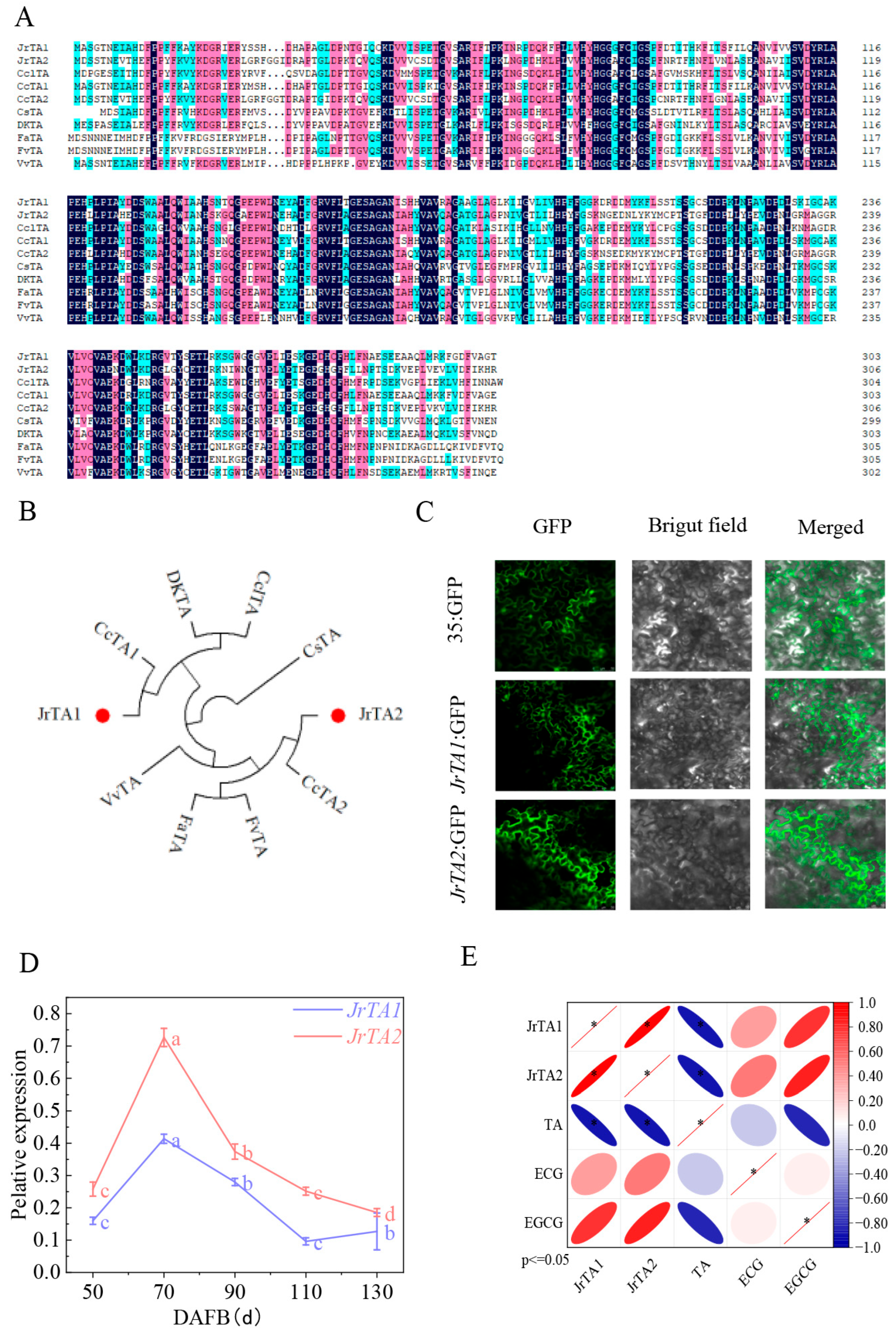
Arabidopsis, the contents of EGCG and ECG decreased, while the levels of EGC, EC, and GA increased, further validating that JrTA1 and JrTA2 specifically hydrolyze ester bonds in tannins and esterified catechins. This study found that the expression levels of
JrTA1 and
JrTA2 were significantly negatively correlated with the total tannin content in the inner seed coat. Promoter sequence analysis revealed that both genes contain gibberellin-responsive elements (P-boxes). Research by Zhang et al. [
44] showed a highly significant positive correlation (
p < 0.01) between tannin content in persimmon roots and GA
3. It is therefore speculated that
JrTA1 and
JrTA2 are likely regulated by gibberellin signaling and represent key candidate genes linking gibberellin signals to tannin biosynthesis in walnut, though the specific molecular regulatory mechanism remains to be elucidated.
Studying the enzymatic characteristics of walnut tannase can provide a theoretical basis for the subsequent development and application of recombinant enzymes. Existing reports indicate that the optimal reaction conditions for tannases from different sources vary: the tea plant-derived tannase rCsTanA has an optimum at 40 °C and pH 7.0 [
37], while the tannase from
Galactobacillus timonensis exhibits the highest activity at 50 °C and pH 6.0 [
45]. In this study, JrTA1 and JrTA2 reached peak enzyme activity under conditions of 40 °C and pH 7.0 after 20 min of reaction, which is consistent with the results for rCsTanA. The differences observed compared to the microbial-derived enzyme may stem from variations in enzyme protein structure and purification methods. Metal ions also significantly influenced the activity of both enzymes. In this study, JrTA1 and JrTA2 exhibited peak activity at 40 °C and pH 7.0, aligning closely with rCsTanA and suggesting conserved catalytic mechanisms among plant tannases. This contrasts with the microbial enzyme, highlighting how source-dependent structural differences dictate functional properties. Importantly, the confirmed hydrolysis of key walnut tannins (ECG, EGCG) under mild, food-compatible conditions (neutral pH, moderate temperature) directly addresses the applied gap compared to microbial preparations. It demonstrates that JrTAs are inherently tailored to their native substrate suite and operate optimally within a range suitable for food processing, thereby minimizing the need for harsh conditions that could compromise product quality. The differential effects of these metal ions may stem from their unique chemical properties and interactions with enzymes. Low concentrations of Ca
2+ showed a notable activating effect on both JrTA1 and JrTA2, aligning with the findings reported by Alka et al. [
46]. Mg
2+ enhanced the enzymatic activity of JrTA1, while Fe
3+, Mn
2+, Al
3+, and Zn
2+ inhibited both enzymes. Notably, Fe
3+ exerted the strongest inhibitory effect on JrTA1, whereas Al
3+ was the most potent inhibitor of JrTA2. These results are largely consistent with the findings reported by Chen et al. [
47].
Previous studies have demonstrated that tannase can effectively alleviate astringency caused by tannins through catalyzing the degradation of esterified catechins in green tea infusion, thereby improving its taste profile [
47]. To further investigate the function of walnut tannase JrTAs, this study applied them as exogenous enzymes in a green tea infusion system. The results showed a significant decrease in the content of esterified catechins (EGCG and ECG) in the tea infusion, while the content of their degradation products (EC, EGC, and GA) increased markedly. These findings are largely consistent with the conclusions of Chen et al. [
47] regarding the tea-derived tannase CsTA, indicating that walnut tannase JrTAs possess catalytic functions similar to those of CsTA. Therefore, JrTAs hold potential for application in green tea beverage production to improve taste quality.
In conclusion, this study integrates molecular, biochemical, and cellular evidence to propose a coherent model for tannin degradation in walnut: developmental signals upregulate the expression of JrTAs genes; the synthesized enzymes hydrolyze key esterified catechins (ECG, EGCG) within the tannin cells of the seed coat, thereby actively regulating the pool of astringency precursors during kernel maturation. This model positions JrTA enzymes as key players linking primary metabolism and sensory quality. Future work should focus on functional validation in walnut via the establishment of a genetic transformation system using walnut callus; structural analysis to elucidate the molecular basis for substrate specificity and ion effects—which should include site-directed mutagenesis of the predicted key substrate-binding residues (e.g., those identified around the galloyl moiety) to experimentally validate their roles and explore active-site engineering; and sensory evaluation to comprehensively assess the effectiveness of JrTAs in reducing astringency, ultimately enabling the development of walnuts with optimized flavor profiles.