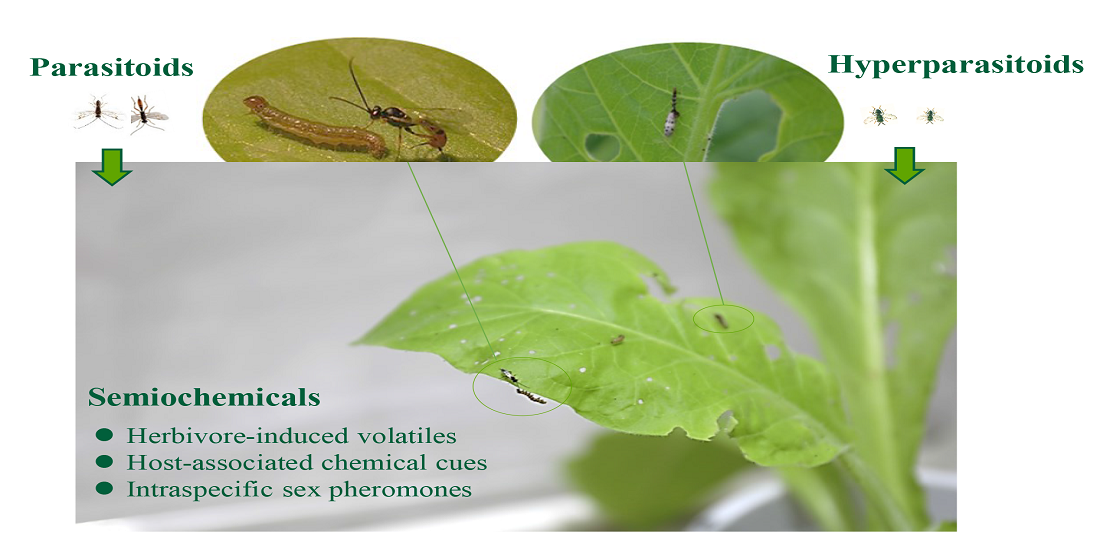
Semiochemicals Used by Insect Parasitoids and Hyperparasitoids in Complex Chemical Environments and Their Application in Insect Pest Management



Abstract
1. Introduction
2. Semiochemicals for Food Location and Mate Finding
3. Semiochemicals for Host Foraging
3.1. HIPVS
3.2. Host-Associated Chemical Cues
4. Semiochemicals Used by Hyperparasitoids
5. Chemosensory Mechanisms of Parasitoids
5.1. Olfactory Mechanisms
5.2. Gustatory Mechanisms
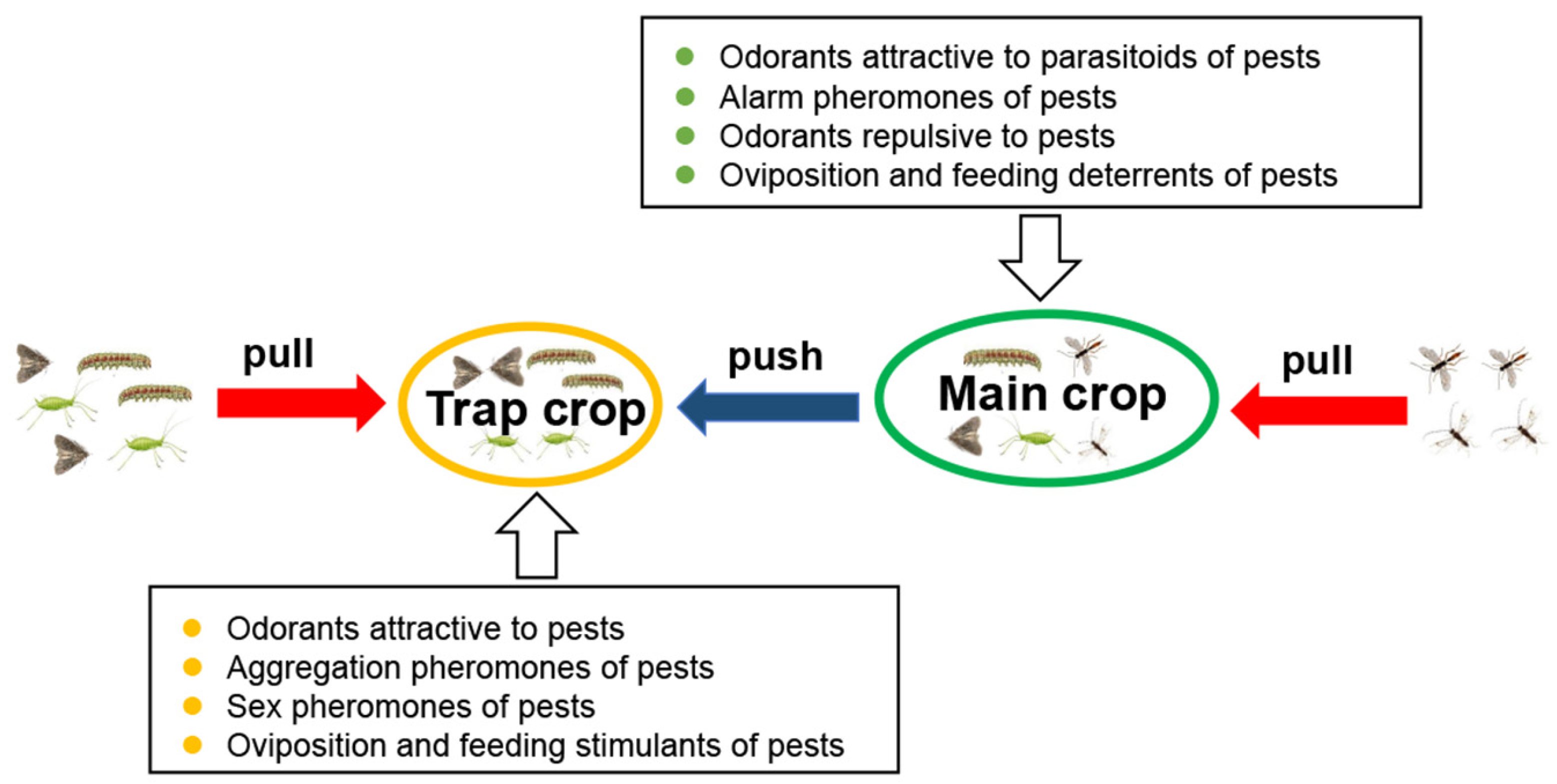
6. Application of Semiochemicals in Pest Management
7. Future Perspectives
Author Contributions
Funding
Data Availability Statement
Conflicts of Interest
References
- Zhong, G.H.; Cui, G.F.; Yi, X.; Sun, R.R.; Zhang, J.J. Insecticide cytotoxicology in China: Current status and challenges. Pestic. Biochem. Physiol. 2016, 132, 3–12. [Google Scholar] [CrossRef] [PubMed]
- Sobhy, I.S.; Erb, M.; Lou, Y.; Turlings, T.C.J. The prospect of applying chemical elicitors and plant strengtheners to enhance the biological control of crop pests. Philos. Trans. R. Soc. Lond. B Biol. Sci. 2014, 369, 20120283. [Google Scholar] [CrossRef] [PubMed]
- Wajnberg, E.; Desouhant, E. Editorial overview: Behavioral ecology: Behavioral ecology of insects: Current research and potential applications. Curr. Opin. Insect Sci. 2018, 27, 8–11. [Google Scholar] [CrossRef] [PubMed]
- You, L.S.; Lei, R.H.; Jiang, J.X.; Bo, L.Y.; Xiao, Z.S. Bionomic of Campoletis chlorideae (Hymenoptera: Ichneumonidae) as a parasitoid of the cotton bollworm Helicoverpa armigera (Lepidoptera: Noctuidae). Entomol. Sin. 2002, 9, 29–37. [Google Scholar]
- Poelman, E.H.; Cusumano, A.; de Boer, J.G. The ecology of hyperparasitoids. Annu. Rev. Entomol. 2022, 67, 143−161. [Google Scholar] [CrossRef]
- Aartsma, Y.; Bianchi, F.J.J.A.; van der Werf, W.; Poelman, E.H.; Dicke, M. Herbivore-induced plant volatiles and tritrophic interactions across spatial scales. New Phytol. 2017, 216, 1054–1063. [Google Scholar] [CrossRef]
- Turlings, T.C.J.; Erb, M. Tritrophic interactions mediated by herbivore induced plant volatiles: Mechanisms ecological relevance and application potential. Annu. Rev. Entomol. 2018, 63, 433−452. [Google Scholar] [CrossRef]
- Guo, H.; Wang, C.Z. The ethological significance and olfactory detection of herbivore-induced plant volatiles in interactions of plants herbivorous insects and parasitoids. Arthropod-Plant Interact. 2019, 13, 161–179. [Google Scholar] [CrossRef]
- Ali, M.Y.; Naseem, T.; Holopainen, J.K.; Liu, T.; Zhang, J.; Zhang, F. Tritrophic interactions among arthropod natural enemies’ herbivores and plants considering volatile blends at different scale levels. Cells 2023, 12, 251. [Google Scholar] [CrossRef]
- Steiner, S.; Ruther, J. Mechanism and behavioral context of male sex pheromone release in Nasonia vitripennis. J. Chem. Ecol. 2009, 35, 416−421. [Google Scholar] [CrossRef]
- Ruther, J.; Steiner, S.; Garbe, L.-A. 4-Methylquinazoline is a minor component of the male sex pheromone in Nasonia vitripennis. J. Chem. Ecol. 2008, 34, 99–102. [Google Scholar] [CrossRef] [PubMed]
- Niehuis, O.; Buellesbach, J.; Gibson, J.D.; Pothmann, D.; Hanner, C.; Mutti, N.S.; Judson, A.K.; Gadau, J.; Ruther, J.; Schmitt, T. Behavioral and genetic analyses of Nasonia shed light on the evolution of sex pheromones. Nature 2013, 494, 345–348. [Google Scholar] [CrossRef] [PubMed]
- Tamiru, A.; Bruce, T.J.; Woodcock, C.M.; Caulfield, J.C.; Midega, C.A.; Ogol, C.K.; Mayon, P.; Birkett, M.A.; Pickett, J.A.; Khan, Z.R. Maize landraces recruit egg and larval parasitoids in response to egg deposition by an herbivore. Ecol. Lett. 2011, 14, 1075–1083. [Google Scholar] [CrossRef]
- Pickett, J.A.; Khan, Z.R. Plant volatile-mediated signaling and its application in agriculture: Successes and challenges. New Phytol. 2016, 212, 856–870. [Google Scholar] [CrossRef] [PubMed]
- Khan, Z.; Midega, C.A.; Hooper, A.; Pickett, J. Push-Pull: Chemical ecology-based integrated pest management technology. J. Chem. Ecol. 2016, 42, 689−697. [Google Scholar] [CrossRef]
- Aartsma, Y.; Cusumano, A.; Fernández de Bobadilla, M.; Rusman, Q.; Vosteen, I.; Poelman, E.H. Understanding insect foraging in complex habitats by comparing trophic levels: Insights from specialist host-parasitoid-hyperparasitoid systems. Curr. Opin. Insect Sci. 2019, 32, 54−60. [Google Scholar] [CrossRef]
- Guo, H.; Wang, C.Z. Harnessing semiochemicals for parasitoid-based biological control: From laboratory identification to field applications. Crop Health 2025, 3, 21. [Google Scholar] [CrossRef]
- Hansson, B.S.; Stensmyr, M.C. Evolution of insect olfaction. Neuron 2011, 72, 698–711. [Google Scholar] [CrossRef]
- Leal, W.S. Odorant reception in insects: Roles of receptors, binding proteins, and degrading enzymes. Annu. Rev. Entomol. 2013, 58, 373−391. [Google Scholar] [CrossRef]
- Wäckers, F.L. Assessing the suitability of flowering herbs as parasitoid food sources: Flower attractiveness and nectar accessibility. Biol. Control 2004, 29, 307–314. [Google Scholar] [CrossRef]
- Jacob, H.S.; Evans, E.W. Influence of food deprivation on foraging decisions of the parasitoid Bathyplectes curculionis (Hymenoptera: Ichneumonidae). Ann. Entomol. Soc. Am. 2001, 94, 605–611. [Google Scholar] [CrossRef]
- Knudsen, J.T.; Tollsten, L.; Bergström, L.G. Floral scents—A checklist of volatile compounds isolated by head-space techniques. Phytochem. 1993, 33, 253–280. [Google Scholar] [CrossRef]
- Borg Karlson, A.K.; Unelius, C.R.; Valterova, I.; Nilsson, L.A. Floral fragrance chemistry in the early flowering shrub Daphne mezereum. Phytochemistry 1995, 41, 1477–1483. [Google Scholar] [CrossRef]
- Du, Y.; Poppy, G.M.; Powell, W.; Pickett, J.A.; Wadhams, L.J.; Woodcock, C.M. Identification of semiochemicals released during aphid feeding that attract parasitoid Aphidius ervi. J. Chem. Ecol. 1998, 24, 1355–1368. [Google Scholar] [CrossRef]
- Yan, Z.G.; Wang, C.Z. Identification of Mythimna separata-induced maize volatile synomones that attract the parasitoid Campoletis chlorideae. J. Appl. Entomol. 2006, 130, 213–219. [Google Scholar] [CrossRef]
- Salerno, G.; Iacovone, A.; Carlin, S.; Frati, F.; Conti, E.; Anfora, G. Identification of sex pheromone components in Trissolcus brochymenae females. J. Insect Physiol. 2012, 58, 1635–1642. [Google Scholar] [CrossRef]
- Ruther, J. Novel insights into pheromone-mediated communication in parasitic hymenopterans. In Chemical Ecology of Insect Parasitoids; Wajnberg, E., Colazza, S., Eds.; John Wiley & Sons: New York, NY, USA, 2013; pp. 112–144. [Google Scholar]
- Guo, H.; Huang, L.Q.; Wang, C.Z. Infochemicals used by parasitoids to find mates and hosts and their application in pest control. Chin. J. Appl. Entomol. 2023, 60, 375−388. [Google Scholar]
- Fauvergue, X.; Lo, G.A.; Lo, P.M. Virgins in the wild: Mating status affects the behavior of a parasitoid foraging in the field. Oecologia 2008, 156, 913–920. [Google Scholar] [CrossRef]
- Kant, R.; Minor, M.; Trewick, S. Mating or ovipositing? A crucial decision in the life history of the cabbage aphid parasitoid Diaeretiella rapae (M’Intosh). Ecol. Entomol. 2012, 37, 169–174. [Google Scholar] [CrossRef]
- Steiner, S.; Ruther, J. How important is sex for females of a haplodiploid species under local mate competition? Behav. Ecol. 2009, 20, 570–574. [Google Scholar] [CrossRef]
- Kugimiya, S.; Shimoda, T.; Wajnberg, E.; Uefune, M.; Takabayashi, J. Host-searching responses to herbivory-associated chemical information and patch use depend on mating status of female solitary parasitoid wasps. Ecol. Entomol. 2010, 35, 279–286. [Google Scholar] [CrossRef]
- Auguste, A.; Fauvergue, X. Intimate rendezvous in a tritrophic context? Nothing but the girls for male Lysiphlebus testaceipes. Ethology 2015, 121, 236–244. [Google Scholar] [CrossRef]
- Delury, N.C.; Gries, G.; Gries, R.; Judd, G.J.R.; Brown, J.J. Sex pheromone of Ascogaster quadridentata, a parasitoid of Cydia pomonella. J. Chem. Ecol. 1999, 25, 2229–2245. [Google Scholar] [CrossRef]
- Cônsoli, F.L.; Williams, H.J.; Vinson, S.B.; Matthews, R.W.; Cooperband, M.F. Trans-bergamotenes-male pheromone of the ectoparasitoid Melittobia digitata. J. Chem. Ecol. 2002, 28, 1675–1689. [Google Scholar] [CrossRef]
- Ruther, J.; Döring, M.; Steiner, S. Cuticular hydrocarbons as contact sex pheromone in the parasitoid Dibrachys cavus. Entomol. Exp. Appl. 2011, 140, 59–68. [Google Scholar] [CrossRef]
- Guo, H.; Mo, B.T.; Li, G.C.; Li, Z.L.; Huang, L.Q.; Sun, Y.L.; Dong, J.F.; Smith, D.P.; Wang, C.Z. Sex pheromone communication in an insect parasitoid Campoletis chlorideae Uchida. Proc. Natl. Acad. Sci. USA 2022, 119, e2215442119. [Google Scholar] [CrossRef]
- Burke, G.R.; Sharanowski, B.J. Parasitoid wasps. Curr. Biol. 2024, 10, R483−R488. [Google Scholar] [CrossRef]
- De Moraes, C.M.; Lewis, W.J.; Pare, P.W.; Alborn, H.T.; Tumlinson, J.H. Herbivore-infested plants selectively attract parasitoids. Nature 1998, 393, 570−573. [Google Scholar] [CrossRef]
- Dicke, M. Behavioural and community ecology of plants that cry for help. Plant Cell Environ. 2009, 32, 654−665. [Google Scholar] [CrossRef]
- Loughrin, J.H.; Manukian, A.; Heath, R.R.; Turlings, T.C.J.; Tumlinson, J.H. Diuenal cycle of emission of induced volatile terpenoids herbivore-injured cotton plants. Proc. Natl. Acad. Sci. USA 1994, 91, 11836−11840. [Google Scholar] [CrossRef]
- Turlings, T.C.J.; Loughrin, J.H.; McCall, P.J.; Röse, U.S.; Lewis, W.J.; Tumlinson, J.H. How caterpillar damaged plants protect themselves by attracting parasitic wasps. Proc. Natl. Acad. Sci. USA 1995, 92, 4169–4174. [Google Scholar] [CrossRef] [PubMed]
- Röse, U.S.R.; Tumlinson, J.H. Volatiles released from cotton plants in response to Helicoverpa zea feeding damage on cotton flower buds. Planta 2004, 218, 824–832. [Google Scholar] [CrossRef] [PubMed]
- Yan, Z.G.; Wang, C.Z. Similar attractiveness of maize volatiles induced by Helicoverpa armigera and Pseudaletia separata to the generalist parasitoid Campoletis chlorideae. Entomol. Exp. Appl. 2006, 118, 87–96. [Google Scholar] [CrossRef]
- Sun, J.G.; Huang, L.Q.; Wang, C.Z. Electrophysiological and behavioral responses of Helicoverpa assulta (Lepidoptera: Noctuidae) to tobacco volatiles. Arthropod-Plant Interact. 2012, 6, 375–384. [Google Scholar] [CrossRef]
- Turlings, T.C.J.; Tumlinson, J.H.; Heath, R.R.; Proveaux, A.T.; Doolittle, R.E. Isolation and identification of allelochemicals that attract the larval parasitoid Cotesia marginiventris (Cresson) to the microhabitat of one of its hosts. J. Chem. Ecol. 1991, 17, 2235−2251. [Google Scholar] [CrossRef]
- Wu, H.; Li, R.T.; Dong, J.F.; Jiang, N.J.; Huang, L.Q.; Wang, C.Z. An odorant receptor and glomerulus responding to farnesene in Helicoverpa assulta (Lepidoptera: Noctuidae). Insect Biochem. Mol. Biol. 2019, 115, 103106. [Google Scholar] [CrossRef]
- Loughrin, J.H.; Manukian, A.; Heath, R.R.; Tumlinson, J.H. Volatiles emitted by different cotton varieties damaged by feeding beet armyworm larvae. J. Chem. Ecol. 1995, 21, 1217−1227. [Google Scholar] [CrossRef]
- Arimura, G.; Matsui, K.; Takabayashi, J. Chemical and molecular ecology of herbivore-induced plant volatiles: Proximate factors and their ultimate functions. Plant Cell Physiol. 2009, 50, 911–923. [Google Scholar] [CrossRef]
- Marmolejo, L.O.; Thompson, M.N.; Helms, A.M. Defense suppression through interplant communication depends on the attacking herbivore species. J. Chem. Ecol. 2021, 47, 1049–1061. [Google Scholar] [CrossRef]
- Dudareva, N.; Pichersky, E.; Gershenzon, J. Biochemistry of plant volatiles. Plant Physiol. 2004, 135, 1893–1902. [Google Scholar] [CrossRef]
- Holopainen, J.K.; Gershenzon, J. Multiple stress factors and the emission of plant VOCs. Trends Plant Sci. 2010, 15, 176–184. [Google Scholar] [CrossRef]
- ul Hassan, M.N.; Zainal, Z.; Ismail, I. Green leaf volatiles: Biosynthesis biological functions and their applications in biotechnology. Plant Biotechnol. J. 2015, 13, 727–739. [Google Scholar] [CrossRef]
- Maffei, M.E.; Gertsch, J.; Appendino, G. Plant volatiles: Production function and pharmacology. Nat. Prod. Rep. 2011, 28, 1359–1380. [Google Scholar] [CrossRef] [PubMed]
- Clavijo McCormick, A.; Gershenzon, J.; Unsicker, S.B. Little peaks with big effects: Establishing the role of minor plant volatiles in plant-insect interactions. Plant Cell Environ. 2014, 37, 1836–1844. [Google Scholar] [CrossRef] [PubMed]
- Zhou, S.; Jander, G. Molecular ecology of plant volatiles in interactions with insect herbivores. J. Exp. Bot. 2022, 73, 449–462. [Google Scholar] [CrossRef] [PubMed]
- Sun, Y.L.; Dong, J.F.; Huang, L.Q.; Wang, C.Z. The cotton bollworm endoparasitoid Campoletis chlorideae is attracted by cis-jasmone or cis-3-hexenyl acetate but not by their mixtures. Arthropod-Plant Interact. 2020, 14, 169–179. [Google Scholar] [CrossRef]
- Gouinguené, S.; Pickett, J.A.; Wadhams, L.J.; Birkett, M.A.; Turlings, T.C.J. Antennal electrophysiological responses of three parasitic wasps to caterpillar-induced volatiles from maize (Zea mays mays) cotton (Gossypium herbaceum) and cowpea (Vigna unguiculata). J. Chem. Ecol. 2005, 31, 1023–1038. [Google Scholar] [CrossRef]
- Pope, T.W.; Kissen, R.; Grant, M.; Pickett, J.A.; Rossiter, J.T.; Powell, G. Comparative innate responses of the aphid parasitoid Diaeretiella rapae to alkenyl glucosinolate derived isothiocyanates nitriles and epithionitriles. J. Chem. Ecol. 2008, 34, 1302–1310. [Google Scholar] [CrossRef]
- Blande, J.D.; Pickett, J.A.; Poppy, G.M. A comparison of semiochemically mediated interactions involving specialist and generalist Brassica-feeding aphids and the braconid parasitoid Diaeretiella rapae. J. Chem. Ecol. 2007, 33, 767–779. [Google Scholar] [CrossRef]
- Beyaert, I.; Wäschke, N.; Scholz, A.; Varama, M.; Reinecke, A.; Hilker, M. Relevance of resource-indicating key volatiles and habitat odour for insect orientation. Anim. Behav. 2010, 79, 1077–1086. [Google Scholar] [CrossRef]
- Shiojiri, K.; Ozawa, R.; Kugimiya, S.; Uefune, M.; van Wijk, M.; Sabelis, M.W. Herbivore-specific density-dependent induction of plant volatiles: Honest or ‘cry wolf’ signals? PLoS ONE 2010, 5, e12161. [Google Scholar] [CrossRef] [PubMed]
- Plouvier, W.N.; Wajnberg, E. Improving the efficiency of augmentative biological control with arthropod natural enemies: A modeling approach. Biol. Control 2018, 125, 121−130. [Google Scholar] [CrossRef]
- van Oudenhove, L.; Mailleret, L.; Fauvergue, X. Infochemical use and dietary specialization in parasitoids: A meta-analysis. Ecol. Evol. 2017, 7, 4804−4811. [Google Scholar] [CrossRef] [PubMed]
- Miller, D.R.; Borden, J.H. β-Phellandrene: Kairomone for pine engraver Ips pini (Say) (Coleoptera: Scolytidae). J. Chem. Ecol. 1990, 16, 2519−2531. [Google Scholar] [CrossRef]
- Fatouros, N.E.; Dicke, M.; Mumm, R.; Meiners, T.; Hilker, M. Foraging behavior of egg parasitoids exploiting chemical information. Behav. Ecol. 2008, 19, 677–689. [Google Scholar] [CrossRef]
- Colazza, S.; Rosi, M.C.; Clemente, A. Response of egg parasitoid Telenomus busseolae to sex pheromone of Sesamia nonagrioides. J. Chem. Ecol. 1997, 23, 2437−2444. [Google Scholar] [CrossRef]
- Noldus, L.P.J.J. Semiochemicals foraging behaviour and quality of entomophagous insects for biological control. J. Appl. Entomol. 1989, 108, 425−451. [Google Scholar] [CrossRef]
- Prokopy, R.J.; Webster, R.P. Oviposition-deterring pheromone of Rhagoletis pomonella: A kairomone for its parasitoid Opius lectus. J. Chem. Ecol. 1978, 4, 481−494. [Google Scholar] [CrossRef]
- Agelopoulos, N.G.; Dicke, M.; Posthumus, M.A. Role of volatile infochemicals emitted by feces of larvae in host-searching behavior of parasitoid Cotesia rubecula (Hymenoptera: Braconidae): A behavioral and chemical study. J. Chem. Ecol. 1995, 21, 1789−1811. [Google Scholar] [CrossRef]
- Colazza, S.; Aquila, G.; De Pasquale, C.; Peri, E.; Millar, J.G. The egg parasitoid Trissolcus basalis uses n-nonadecane a cuticular hydrocarbon from its stink bug host Nezara viridula to discriminate between female and male hosts. J. Chem. Ecol. 2007, 33, 1405–1420. [Google Scholar] [CrossRef]
- Lo Giudice, D.; Riedel, M.; Rostás, M.; Peri, E.; Colazza, S. Host sex discrimination by an egg parasitoid on brassica leaves. J. Chem. Ecol. 2011, 37, 622–628. [Google Scholar] [CrossRef] [PubMed]
- Iacovone, A.; French, A.S.; Tellier, F.; Cusumano, A.; Clément, G.; Gaertner, C.; Conti, E.; Salerno, G.; Marion-Poll, F. The role of contact chemoreception in the host location process of an egg parasitoid. J. Insect Physiol. 2016, 91−92, 63−75. [Google Scholar] [CrossRef] [PubMed]
- Bénédet, F.; Bigot, Y.; Renault, S.; Pouzat, J.; Thibout, E. Polypeptides of Acrolepiopsis assectella cocoon (Lepidoptera: Yponomeutoidea): An external host-acceptance kairomone for the parasitoid Diadromus pulchellus (Hymenoptera: Ichneumonidae). J. Insect Physiol. 1999, 45, 375–384. [Google Scholar] [CrossRef] [PubMed]
- Ma, R.Z.; Swedenborg, P.D.; Jones, R.L. Host-seeking behavior of Eriborus terebrans (Hymenoptera: Ichneumonidae) toward the European corn borer and the role of chemical stimuli. Ann. Entomol. Soc. Am. 1992, 85, 72–79. [Google Scholar] [CrossRef]
- Heath, R.R.; Ferkovich, S.M.; Greany, P.D.; Eller, F.J.; Dueben, B.D.; Tilden, R.L. Progress in the isolation and characterization of a host hemolymph ovipositional kairomone for the endoparasitoid Microplitis croceipes. Arch. Insect Biochem. Physiol. 1990, 13, 255–265. [Google Scholar] [CrossRef]
- Rutledge, C.E. A survey of identified kairomones and synomones used by insect parasitoids to locate and accept their hosts. Chemoecology 1996, 7, 121–131. [Google Scholar] [CrossRef]
- Metzger, M.; Fischbein, D.; Auguste, A.; Fauvergue, X.; Bernstein, C.; Desouhant, E. Synergy in information use for mate finding: Demonstration in a parasitoid wasp. Anim. Behav. 2010, 79, 1307–1315. [Google Scholar] [CrossRef]
- Reddy, G.V.; Holopainen, J.K.; Guerrero, A. Olfactory responses of Plutella xylostella natural enemies to host pheromone larval frass and green leaf cabbage volatiles. J. Chem. Ecol. 2002, 28, 131−143. [Google Scholar] [CrossRef]
- Steiner, S.; Steidle, J.L.M.; Ruther, J. Host-associated kairomones used for habitat orientation in the parasitoid Lariophagus distinguendus (Hymenoptera: Pteromalidae). J. Stored Prod. Res. 2007, 43, 587–593. [Google Scholar] [CrossRef]
- Mattiacci, L.; Vinson, S.B.; Williams, H.J. A long-range attractant kairomone for egg parasitoid Trissolcus basalis, isolated from defensive secretion of its host, Nezara viridula. J. Chem. Ecol. 1993, 19, 1167–1181. [Google Scholar] [CrossRef]
- Buitenhuis, R.; Vet, L.E.M.; Boivin, G.; Brodeur, J. Foraging behaviour at the fourth trophic level: A comparative study of host location in aphid hyperparasitoids. Entomol. Exp. Appl. 2005, 114, 107–117. [Google Scholar] [CrossRef]
- Zhu, Y.L.; Yang, F.; Yao, Z.W.; Wu, Y.K.; Liu, B.; Lu, Y.H. A molecular detection approach for a cotton aphid-parasitoid complex in northern China. Sci. Rep. 2019, 9, 15836. [Google Scholar] [CrossRef] [PubMed]
- Poelman, E.H.; Bruinsma, M.; Zhu, F.; Weldegergis, B.T.; Boursault, A.E.; Jongema, Y.; van Loon, J.J.; Vet, L.E.; Harvey, J.A.; Dicke, M. Hyperparasitoids use herbivore-induced plant volatiles to locate their parasitoid. PLoS Biol. 2012, 10, e1001435. [Google Scholar] [CrossRef] [PubMed]
- Poelman, E.H.; Harvey, J.A.; van Loon, J.J.A.; Vet, L.E.M.; Dicke, M. Variation in herbivore-induced plant volatiles corresponds with spatial heterogeneity in the level of parasitoid competition and parasitoid exposure to hyperparasitism. Funct. Ecol. 2013, 27, 1107–1116. [Google Scholar] [CrossRef]
- Zhu, F.; Cusumano, A.; Bloem, J.; Weldegergis, B.T.; Villela, A.; Fatouros, N.E.; van Loon, J.J.; Dicke, M.; Harvey, J.A.; Vogel, H.; et al. Symbiotic polydnavirus and venom reveal parasitoid to its hyperparasitoids. Proc. Natl. Acad. Sci. USA 2018, 115, 5205–5210. [Google Scholar] [CrossRef]
- Buitenhuis, R.; McNeil, J.; Boivin, G.; Brodeur, J. The role of honeydew in host searching of aphid hyperparasitoids. J. Chem. Ecol. 2004, 30, 273−285. [Google Scholar] [CrossRef]
- Grasswitz, T.R. Contact kairomones mediating the foraging behavior of the aphid hyperparasitoid Alloxysta victrix (Westwood) (Hymenoptera: Charipidae). J. Insect Behav. 1998, 11, 539–548. [Google Scholar] [CrossRef]
- Schworer, U.; Völkl, W.; Hoffmann, K.H. Foraging for mates in the hyperparasitic wasp Dendrocerus carpenteri: Impact of unfavourable weather conditions and parasitoid age. Oecologia 1999, 119, 73–80. [Google Scholar] [CrossRef]
- Micha, S.G.; Stammel, J.; Höller, C. 6-Methyl-5-heptene-2-one, a putative sex and spacing pheromone of the aphid hyperparasitoid Alloxysta victrix (Hymenoptera: Alloxystidae). Eur. J. Entomol. 1993, 90, 439–442. [Google Scholar]
- Kaplan, I. Attracting carnivorous arthropods with plant volatiles: The future of biocontrol or playing with fire? Biol. Control 2012, 60, 77–89. [Google Scholar] [CrossRef]
- Tougeron, K.; Tena, A. Hyperparasitoids as new targets in biological control in a global change context. Biol. Control 2018, 130, 164–167. [Google Scholar] [CrossRef]
- Cusumano, A.; Harvey, J.A.; Bourne, M.E.; Poelman, E.H.; de Boer, J.G. Exploiting chemical ecology to manage hyperparasitoids in biological control of arthropod pests. Pest Manag. Sci. 2020, 76, 432–443. [Google Scholar] [CrossRef] [PubMed]
- Poelman, E.H.; Kos, M. Complexity of plant volatile-mediated interactions beyond the third trophic level. In Deciphering Chemical Language of Plant Communication; Blande, J.D., Glinwood, R., Eds.; Springer: Berlin/Heidelberg, Germany, 2016; pp. 211–225. [Google Scholar]
- Budenberg, W. Honeydew as a contact kairomone for aphid parasitoids. Entomol. Exp. Appl. 1990, 55, 139−148. [Google Scholar] [CrossRef]
- Völkl, W.; Sullivan, D.J. Foraging behaviour, host plant and host location in the aphid hyperparasitoid Euneura augarus. Entomol. Exp. Appl. 2000, 97, 47–56. [Google Scholar] [CrossRef]
- Zhu, F.; Weldegergis, B.T.; Lhie, B.; Harvey, J.A.; Dicke, M.; Poelman, E.H. Body odors of parasitized caterpillars give away the presence of parasitoid larvae to their primary hyperparasitoid enemies. J. Chem. Ecol. 2014, 40, 986–995. [Google Scholar] [CrossRef]
- Vieira, F.G.; Forêt, S.; He, X.; Rozas, J.; Field, L.M.; Zhou, J.J. Unique features of odorant-binding proteins of the parasitoid wasp Nasonia vitripennis revealed by genome annotation and comparative analyses. PLoS ONE 2012, 7, e43034. [Google Scholar] [CrossRef]
- Nishimura, O.; Brillada, C.; Yazawa, S.; Maffei, M.E.; Arimura, G. Transcriptome pyrosequencing of the parasitoid wasp Cotesia vestalis: Genes involved in the antennal odorant-sensory system. PLoS ONE 2012, 7, e50664. [Google Scholar] [CrossRef]
- Wang, J.; Li, D.Z.; Min, S.F.; Mi, F.; Zhou, S.S.; Wang, M.Q. Analysis of chemosensory gene families in the beetle Monochamus alternatus and its parasitoid Dastarcus helophoroides. Comp. Biochem. Physiol. Part D Genom. Proteom. 2014, 11, 1–8. [Google Scholar] [CrossRef]
- Wang, S.N.; Peng, Y.; Lu, Z.Y.; Dhiloo, K.H.; Gu, S.H.; Li, R.J. Identification and expression analysis of putative chemosensory receptor genes in Microplitis mediator by antennal transcriptome screening. Int. J. Biol. Sci. 2015, 11, 737–751. [Google Scholar] [CrossRef]
- Wang, S.N.; Shan, S.; Liu, J.T.; Li, R.J.; Lu, Z.Y.; Dhiloo, K.H.; Khashaveh, A.; Zhang, Y.J. Characterization of antennal chemosensilla and associated odorant binding as well as chemosensory proteins in the parasitoid wasp Microplitis mediator (Hymenoptera: Braconidae). Sci. Rep. 2018, 8, 7649. [Google Scholar] [CrossRef]
- Farias, L.R.; Schimmelpfeng, P.H.; Togawa, R.C.; Costa, M.M.; Grynberg, P.; Martins, N.F.; Borges, M.; Blassioli-Moraes, M.C.; Laumann, R.A.; Bao, S.N.; et al. Transcriptome-based identification of highly similar odorant-binding proteins among neotropical stink bugs and their egg parasitoid. PLoS ONE 2015, 10, e0132286. [Google Scholar] [CrossRef]
- Li, K.; Yang, X.; Xu, G.; Cao, Y.; Lu, B.; Peng, Z. Identification of putative odorant binding protein genes in Asecodes hispinarum, a parasitoid of coconut leaf beetle (Brontispa longissima) by antennal RNA-Seq analysis. Biochem. Biophys. Res. Commun. 2015, 467, 514–520. [Google Scholar] [CrossRef] [PubMed]
- Sheng, S.; Liao, C.W.; Zheng, Y.; Zhou, Y.; Xu, Y.; Song, W.M.; He, P.; Zhang, J.; Wu, F.A. Candidate chemosensory genes identified in the endoparasitoid Meteorus pulchricornis (Hymenoptera: Braconidae) by antennal transcriptome analysis. Comp. Biochem. Physiol. Part D Genom. Proteom. 2017, 22, 20–31. [Google Scholar] [CrossRef] [PubMed]
- Liu, J.B.; Wu, H.; Yi, J.Q.; Song, Z.W.; Li, D.S.; Zhang, G.R. Transcriptome characterization and gene expression analysis related to chemoreception in Trichogramma chilonis, an egg parasitoid. Gene 2018, 678, 288–301. [Google Scholar] [CrossRef] [PubMed]
- Zhang, S.; Chen, L.Z.; Gu, S.H.; Cui, J.J.; Gao, X.W.; Zhang, Y.J.; Guo, Y.Y. Binding characterization of recombinant odorant-binding proteins from the parasitic Wasp Microplitis mediator (Hymenoptera: Braconidae). J. Chem. Ecol. 2011, 37, 189–194. [Google Scholar] [CrossRef]
- Robertson, H.M.; Gadau, J.; Wanner, K.W. The insect chemoreceptor superfamily of the parasitoid jewel wasp Nasonia vitripennis. Insect Mol. Biol. 2010, 19, 121−136. [Google Scholar] [CrossRef]
- Zhang, Y.; Zheng, Y.; Li, D.; Fan, Y. Transcriptomics and identification of the chemoreceptor superfamily of the pupal parasitoid of the oriental fruit fly Spalangia endius Walker (Hymenoptera: Pteromalidae). PLoS ONE 2014, 9, e87800. [Google Scholar] [CrossRef]
- Wang, S.N.; Shan, S.; Zheng, Y.; Peng, Y.; Lu, Z.Y.; Yang, Y.Q.; Li, R.J.; Zhang, Y.J.; Guo, Y.Y. Gene structure and expression characteristic of a novel odorant receptor gene cluster in the parasitoid wasp Microplitis mediator (Hymenoptera: Braconidae). Insect Mol. Biol. 2017, 26, 420–431. [Google Scholar] [CrossRef]
- Sun, Y.L.; Dong, J.F.; Ning, C.; Ding, P.P.; Huang, L.Q.; Sun, J.G.; Wang, C.Z. An odorant receptor mediates the attractiveness of cis-jasmone to Campoletis chlorideae, the endoparasitoid of Helicoverpa armigera. Insect Mol. Biol. 2019, 12, 23−34. [Google Scholar] [CrossRef]
- Wang, Y.; Chen, Q.; Guo, J.; Li, J.; Wang, J.; Wen, M.; Zhao, H.; Ren, B. Molecular basis of peripheral olfactory sensing during oviposition in the behavior of the parasitic wasp Anastatus japonicus. Insect Biochem. Mol. Biol. 2017, 89, 58–70. [Google Scholar] [CrossRef]
- Zhang, Q.; Chen, J.; Wang, Y.; Lu, Y.; Dong, Z.; Shi, W.; Pang, L.; Ren, S.; Chen, X.; Huang, J. The odorant receptor co-receptor gene contributes to mating and host-searching behaviors in parasitoid wasps. Pest Manag. Sci. 2023, 79, 454−463. [Google Scholar] [CrossRef]
- Rogers, M.E.; Sun, M.; Lerner, M.R.; Vogt, R.G. SNMP-1, a novel membrane protein of olfactory neurons of the silk moth Antheraea polyphemus with homology to the CD36 family of membrane proteins. J. Biol. Chem. 1997, 272, 14792–14799. [Google Scholar] [CrossRef] [PubMed]
- Shan, S.; Wang, S.; Song, X.; Khashaveh, A.; Lu, Z.; Dhiloo, K.H.; Li, R.; Gao, X.; Zhang, Y. Molecular characterization and expression of sensory neuron membrane proteins in the parasitoid Microplitis mediator (Hymenoptera: Braconidae). Insect Sci. 2020, 27, 425−439. [Google Scholar] [CrossRef] [PubMed]
- Benton, R.; Vannice, K.S.; Gomez-Diaz, C.; Vosshall, L.B. Variant ionotropic glutamate receptors as chemosensory receptors in Drosophila. Cell 2009, 136, 149–162. [Google Scholar] [CrossRef] [PubMed]
- Wang, S.-N.; Peng, Y.; Lu, Z.-Y.; Dhiloo, K.H.; Zheng, Y.; Shan, S.; Li, R.-J.; Zhang, Y.-J.; Guo, Y.-Y. Cloning and expression profile of ionotropic receptors in the parasitoid wasp Microplitis mediator (Hymenoptera: Braconidae). J. Insect Physiol. 2016, 90, 27−35. [Google Scholar] [CrossRef]
- van Baaren, J.; Boivin, G.; Bourdais, D.; Roux, O. Antennal sensilla of hymenopteran parasitic wasps: Variations linked to host exploitation behavior. In Modern Research and Educational Topics in Microscopy; Vilas, A.M., Alvarez, J.D., Eds.; Elsevier: Amsterdam, The Netherlands, 2007; pp. 345–352. [Google Scholar]
- Colazza, S.; Peri, E.; Salerno, G.; Conti, E. Host searching by egg parasitoids: Exploitation of host chemical cues. In Egg Parasitoids in Agroecosystems with Emphasis on Trichogramma; Cônsoli, F.L., Parra, J.R.P., Zucchi, R.A., Eds.; Springer: London, UK, 2010; pp. 97–147. [Google Scholar]
- Borges, M.; Colazza, S.; Ramirez-Lucas, P.; Chauhan, K.R.; Moraes, M.C.B.; Aldrich, J.R. Kairomonal effect of walking traces from Euschistus heros (Heteroptera: Pentatomidae) on two strains of Telenomus podisi (Hymenoptera: Scelionidae). Physiol. Entomol. 2003, 28, 49–355. [Google Scholar] [CrossRef]
- Conti, E.; Salerno, G.; Bin, F.; Williams, H.J.; Vinson, S.B. Chemical cues from Murgantia histrionica eliciting host location and recognition in the egg parasitoid Trissolcus brochymenae. J. Chem. Ecol. 2003, 29, 115–130. [Google Scholar] [CrossRef]
- Salerno, G.; Conti, E.; Peri, E.; Colazza, S.; Bin, F. Kairomone involvement in the host specificity of the egg parasitoid Trissolcus basalis (Hymenoptera: Scelionidae). Eur. J. Entomol. 2006, 103, 311–318. [Google Scholar] [CrossRef]
- Iacovone, A.; Salerno, G.; French, A.S.; Conti, E.; Marion-Poll, F. Antennal gustatory perception and behavioral responses in Trissolcus brochymenae females. J. Insect Physiol. 2015, 78, 15–25. [Google Scholar] [CrossRef]
- Clyne, P.J.; Warr, C.G.; Freeman, M.R.; Lessing, D.; Kim, J.H.; Carlson, J.R. A novel family of divergent seven-transmembrane proteins: Candidate odorant receptors in Drosophila. Neuron 1999, 22, 327−338. [Google Scholar] [CrossRef]
- Ruschioni, S.; van Loon, J.J.A.; Smid, H.M.; van Lenteren, J.C. Insects can count: Sensory basis of host discrimination in parasitoid wasps revealed. PLoS ONE 2015, 10, e0138045. [Google Scholar] [CrossRef] [PubMed]
- Lee, J.C. Effect of methyl salicylate-based lures on beneficial and pest arthropods in strawberry. Environ. Entomol. 2010, 39, 653–660. [Google Scholar] [CrossRef] [PubMed]
- Rodriguez-Saona, C.; Kaplan, I.; Braasch, J.; Chinnasamy, D.; Williams, L. Field responses of predaceous arthropods to methyl salicylate: A meta-analysis and case study in cranberries. Biol. Control 2011, 59, 294–303. [Google Scholar] [CrossRef]
- Zhang, P.; Xu, C.; Zhang, J.; Lu, Y.; Wei, J.; Liu, Y.; David, A.; Boland, W.; Turlings, T.C.J. Phloem-feeding whiteflies can fool their host plants but not their parasitoids. Funct. Ecol. 2013, 27, 1304–1312. [Google Scholar] [CrossRef]
- Lou, Y.G.; Baldwin, I.T. Manduca sexta recognition and resistance among allopolyploid Nicotiana host plants. Proc. Natl. Acad. Sci. USA 2003, 100, 14581−14586. [Google Scholar] [CrossRef]
- Thaler, J.S. Jasmonate-inducible plant defences cause increased parasitism of herbivores. Nature 1999, 399, 686–688. [Google Scholar] [CrossRef]
- Lou, Y.G.; Du, M.H.; Turlings, T.C.; Cheng, J.A.; Shan, W.F. Exogenous application of jasmonic acid induces volatile emissions in rice and enhances parasitism of Nilaparvata lugens eggs by the parasitoid Anagrus nilaparvatae. J. Chem. Ecol. 2005, 31, 1985−2002. [Google Scholar] [CrossRef]
- McCall, P.J.; Turlings, T.C.J.; Loughrin, J.; Proveaux, A.T.; Tumlinson, J.H. Herbivore-induced volatile emissions from cotton (Gossypium hirsutum L.) seedlings. J. Chem. Ecol. 1994, 20, 3039–3050. [Google Scholar] [CrossRef]
- Röse, U.S.R.; Manukian, A.; Heath, R.R.; Tumlinson, J.H. Volatile semiochemicals released from undamaged cotton leaves (A systemic response of living plants to caterpillar damage). Plant Physiol. 1996, 111, 487–495. [Google Scholar] [CrossRef]
- Kappers, I.F.; Aharoni, A.; van Herpen, T.W.; Luckerhoff, L.L.; Dicke, M.; Bouwmeester, H.J. Genetic engineering of terpenoid metabolism attracts bodyguards to Arabidopsis. Science 2005, 309, 2070–2072. [Google Scholar] [CrossRef]
- D’Alessandro, M.; Brunner, V.; von Mérey, G.; Turlings, T.C.J. Strong attraction of the parasitoid Cotesia marginiventris towards minor volatile compounds of maize. J. Chem. Ecol. 2009, 35, 999. [Google Scholar] [CrossRef][Green Version]
- Yu, H.L.; Zhang, Y.J.; Wyckhuys, K.A.G.; Wu, K.M.; Gao, X.W.; Wu, K.M. Electrophysiological and behavioral Responses of Microplitis mediator (Hymenoptera: Braconidae) to caterpillar-induced volatiles from cotton. Environ. Entomol. 2010, 39, 600–609. [Google Scholar] [CrossRef]
- Clavijo McCormick, A.; Unsicker, S.B.; Gershenzon, J. The specificity of herbivore-induced plant volatiles in attracting herbivore enemies. Trends Plant Sci. 2012, 17, 303−310. [Google Scholar] [CrossRef] [PubMed]
- Williams, L., 3rd; Rodriguez-Saona, C.; Castle, S.C.; Zhu, S. EAG active herbivore-induced plant volatiles modify behavioral responses and host attack by an egg parasitoid. J. Chem. Ecol. 2008, 34, 1190–1201. [Google Scholar] [CrossRef] [PubMed]
- James, D.G. Synthetic herbivore-induced plant volatiles as field attractants for beneficial insects. Environ. Entomol. 2003, 32, 977–982. [Google Scholar] [CrossRef]
- James, D.G.; Grasswitz, T.R. Synthetic herbivore-induced plant volatiles increase field captures of parasitic wasps. BioControl 2005, 50, 871–880. [Google Scholar] [CrossRef]
- Uefune, M.; Choh, Y.; Abe, J.; Shiojiri, K.; Sano, K.; Takabayashi, J. Application of synthetic herbivore-induced plant volatiles causes increased parasitism of herbivores in the field. J. Appl. Entomol. 2012, 136, 561–567. [Google Scholar] [CrossRef]
- Bruce, T.J.A.; Pickett, J.A.; Smart, L.E. cis-Jasmone switches on plant defence against insects. Pestic. Outlook 2003, 3, 96−98. [Google Scholar] [CrossRef]
- Bruce, T.J.A.; Martin, J.L.; Pickett, J.A.; Pye, B.J.; Smart, L.E.; Wadhams, L.J. cis-Jasmone treatment induces resistance in wheat plants against the grain aphid Sitobion avenae (Fabricius) (Homoptera: Aphididae). Pest Manag. Sci. 2003, 59, 1031−1036. [Google Scholar] [CrossRef]
- Pickett, J.A.; Birkett, M.A.; Bruce, T.J.; Chamberlain, K.; Gordon-Weeks, R.; Matthes, M.C.; Napier, J.A.; Smart, L.E.; Woodcock, C.M. Developments in aspects of ecological phytochemistry: The role of cis-jasmone in inducible defence systems in plants. Phytochemistry 2007, 68, 2937–2945. [Google Scholar] [CrossRef]
- Bruce, T.J.A.; Matthes, M.C.; Chamberlain, K.; Woodcock, C.M.; Mohib, A.; Webster, B.; Smart, L.E.; Birkett, M.A.; Pickett, J.A.; Napier, J.A. cis-Jasmone induces Arabidopsis genes that affect the chemical ecology of multitrophic interactions with aphids and their parasitoids. Proc. Natl. Acad. Sci. USA 2008, 105, 4553–4558. [Google Scholar] [CrossRef] [PubMed]
- Moraes, M.C.B.; Laumann, R.A.; Pareja, M.; Sereno, F.T.P.S.; Michereff, M.F.F.; Birkett, M.A.; Pickett, J.A.; Borges, M. Attraction of the stink bug egg parasitoid Telenomus podisi to defence signals from soybean activated by treatment with cis-jasmone. Entomol. Exp. Appl. 2009, 131, 178–188. [Google Scholar] [CrossRef]
- Dewhirst, S.Y.; A Birkett, M.; Loza-Reyes, E.; Martin, J.L.; Pye, B.J.; E Smart, L.; Hardie, J.; A Pickett, J. Activation of defence in sweet pepper, Capsicum annum, by cis-jasmone, and its impact on aphid and aphid parasitoid behavior. Pest Manag. Sci. 2012, 68, 1419–1429. [Google Scholar] [CrossRef] [PubMed]
- Oluwafemi, S.; Dewhirst, S.Y.; Veyrat, N.; Powers, S.; Bruce, T.J.A.; Caulfield, J.C.; Pickett, J.A.; Birkett, M.A. Priming of production in maize of volatile organic defence compounds by the natural plant activator cis-Jasmone. PLoS ONE 2013, 8, e62299. [Google Scholar] [CrossRef]
- Disi, J.O.; Zebelo, S.; Ngumbi, E.; Fadamiro, H.Y. cis-Jasmone primes defense pathways in tomato via emission of volatile organic compounds and regulation of genes with consequences for Spodoptera exigua oviposition. Arthropod-Plant Interact. 2017, 11, 591–602. [Google Scholar] [CrossRef]
- Sobhy, I.S.; Woodcock, C.M.; Powers, S.J.; Caulfiled, J.C.; Pickett, J.A.; Birkett, M.A. cis-Jasmone elicits aphid-induced stress signaling in potatoes. J. Chem. Ecol. 2017, 43, 39–52. [Google Scholar] [CrossRef]
- Schnee, C.; Kollner, T.G.; Held, M.; Turlings, T.C.J.; Gershenzon, J.; Degenhardt, J. The products of a single maize sesquiterpene synthase form a volatile defense signal that attracts natural enemies of maize herbivores. Proc. Natl. Acad. Sci. USA 2006, 103, 1129–1134. [Google Scholar] [CrossRef]
- Foster, S.P.; Denholm, I.; Thompson, R.; Poppy, G.M.; Powell, W. Reduced response of insecticide-resistant aphids and attraction of parasitoids to aphid alarm pheromone; a potential fitness trade-off. Bull. Entomol. Res. 2005, 95, 37–46. [Google Scholar] [CrossRef]
- Verheggen, F.J.; Arnaud, L.; Bartram, S.; Gohy, M.; Haubruge, E. Aphid and plant volatiles induce oviposition in an aphidophagous hoverfly. J. Chem. Ecol. 2008, 34, 301–307. [Google Scholar] [CrossRef]
- Stephen, F.M.; Browne, L.E. Application of Eliminade™ parasitoid food to boles and crowns of pines (Pinaceae) infested with Dendroctonus frontalis (Coleoptera: Scolytidae). Can. Ent. 2000, 132, 983−985. [Google Scholar] [CrossRef]
- Hardie, J.; Nottingham, S.F.; Powell, W.; Wadhams, L.J. Synthetic aphid sex pheromone lures female parasitoids. Entomol. Exp. Appl. 1991, 61, 97–99. [Google Scholar] [CrossRef]
- Franco, J.C.; da Silva, E.B.; Fortuna, T.; Cortegano, E.; Branco, M.; Suma, P.; La Torre, I.; Russo, A.; Elyahu, M.; Protasov, A.; et al. Vine mealybug sex pheromone increases citrus mealybug parasitism by Anagyrus sp. near pseudococci (Girault). Biol. Control 2011, 58, 230–238. [Google Scholar] [CrossRef]
- Lim, U.T.; Mainali, B.P. Effect of aggregation pheromone trap of Riptortus pedestris (Hemiptera: Alydidae) on the distribution and composition of its egg parasitoids. J. Econ. Entomol. 2013, 106, 1973–1978. [Google Scholar] [CrossRef] [PubMed]
- Teshiba, M.; Sugie, H.; Tsutsumi, T.; Tabata, J. A new approach for mealybug management: Recruiting an indigenous, but ‘non-natural’ enemy for biological control using an attractant. Entomol. Exp. Appl. 2012, 142, 211–215. [Google Scholar] [CrossRef]
- Teshiba, M.; Tabata, J. Suppression of population growth of the Japanese mealybug, Planococcus kraunhiae (Hemiptera: Pseudococcidae), by using an attractant for indigenous parasitoids in persimmon orchards. Appl. Entomol. Zool. 2017, 52, 153–158. [Google Scholar] [CrossRef]
- Völkl, W.; Hübner, G.; Dettner, K. Interactions between Alloxysta brevis (Hymenoptera, Cynipoidea, Alloxystidae) and honeydew-collecting ants: How an aphid-hyperparasitoid overcomes ant aggression by chemical defense. J. Chem. Ecol. 1994, 20, 2901–2915. [Google Scholar] [CrossRef]
- Höller, C.; Micha, S.G.; Schulz, S.; Francke, W.; Pickett, J.A. Enemy-induced dispersal in a parasitic wasp. Experientia 1994, 50, 182–185. [Google Scholar] [CrossRef]
- Lewis, W.J.; Martin, W.R. Semiochemicals for use with parasitoids: Status and future. J. Chem. Ecol. 1990, 16, 3067–3089. [Google Scholar] [CrossRef]
- Meinwald, J.; Eisner, T. Chemical ecology in retrospect and prospect. Proc. Natl. Acad. Sci. USA 2008, 105, 4539–4540. [Google Scholar] [CrossRef]
- Jiang, Y.; Xiu, C.; Pan, H.; Liu, X. Recruitment of Hippodamia variegata by active volatiles from Glycyrrhiza uralensis and Alhagi sparsifolia plants infested with Aphis atrata. Pest Manag. Sci. 2024, 80, 355−365. [Google Scholar] [CrossRef]
- Osman, I.; Wang, Z.; Li, H.; Li, E.; Feng, H.; Yin, J.; Liang, G.; Liu, Z.; Ning, D.; Li, K.; et al. Attraction of Telenomus remus to egg volatiles of Spodoptera litura and oviposition-induced plant volatiles from tobacco (Nicotiana tabacum). Ecol. Evol. 2025, 15, e72012. [Google Scholar] [CrossRef] [PubMed]
- Pinto-Zevallos, D.M.; Blande, J.D. Challenges of climate change and air pollution for volatile-mediated plant–parasitoid signalling. Curr. Opin. Insect Sci. 2024, 66, 101290. [Google Scholar] [CrossRef] [PubMed]
- Wang, C.Z.; MO, B.T.; Zhang, J.Z. Semiochemicals for pest control in the age of synthetic biology. Emerg. Sci. Technol. 2025, 4, 1–12. [Google Scholar] [CrossRef]
- Fleischer, J.; Pregitzer, P.; Breer, H.; Krieger, J. Access to the odor world: Olfactory receptors and their role for signal transduction in insects. Cell. Mol. Life. Sci. 2018, 75, 485–508. [Google Scholar] [CrossRef]
- Zhang, J.; Raza, S.A.K.; Wei, Z.; Keesey, I.W.; Parker, A.L.; Feistel, F.; Chen, J.; Cassau, S.; Fandino, R.A.; Grosse-Wilde, E.; et al. Competing beetles attract egg laying in a hawkmoth. Curr. Biol. 2022, 32, 861−869.e8. [Google Scholar] [CrossRef]
- Andersson, M.N.; Biswas, T.; Yuvaraj, J.K. Highly Expressed odorant receptor orthologs detect the aggregation pheromone lineatin in Trypodendron Ambrosia Beetles. Mol. Ecol. 2025, 34, e70064. [Google Scholar] [CrossRef]
- Chang, H.; Unni, A.P.; Tom, M.T.; Cao, Q.; Liu, Y.; Wang, G.; Llorca, L.C.; Brase, S.; Bucks, S.; Weniger, K.; et al. Odorant detection in a locust exhibits unusually low redundancy. Curr. Biol. 2023, 33, 5427–5438.e5. [Google Scholar] [CrossRef]
- Sun, H.; Bu, L.A.; Su, S.C.; Guo, D.; Gao, C.F.; Wu, S.F. Knockout of the odorant receptor co-receptor, orco, impairs feeding, mating and egg-laying behavior in the fall armyworm Spodoptera frugiperda. Insect Biochem. Mol. Biol. 2023, 152, 103889. [Google Scholar] [CrossRef]


| Semiochemical Sources | Hyperparasitoid Species * | Effects | Components | References |
|---|---|---|---|---|
| HIPVs | ||||
| HIPVs emitted by cabbage plants damaged by parasitized caterpillars | Lysibia nana | Attraction | DMNT | [84] |
| HIPVs induced by parasitized caterpillars | Pteromalus semotus | Attraction | NA | [85] |
| Host-associated chemicals | ||||
| Contact cues from the parasitized aphids | Dendrocerus carpenteri Asaphes suspensus Syrphophagus aphidivorus Alloxysta victrix | Attraction | NA | [82] |
| Body chemicals of the parasitized caterpillars | Baryscapus galactopus | Attraction | 2,3-butanedione | [86] |
| Aphid honeydew (no difference between healthy and parasitized aphids) | Dendrocerus carpenteri Asaphes suspensus Syrphophagus aphidivorus Alloxysta victrix | Antennal drumming behaviors | NA | [87] |
| Cuticular hydrocarbons of the caterpillars | Alloxysta victrix | Attraction | NA | [88] |
| Intraspecific pheromones | ||||
| Intraspecific females | Dendrocerus carpenteri | Mate finding | NA | [89] |
| Intraspecific (both males and females) | Alloxysta victrix | Mate finding | 6-Methyl-5-hepten-2-one | [90] |
| Semiochemical | Parasitoid * | Source | Effect | Reference |
|---|---|---|---|---|
| Pheromones | ||||
| (4R,5R)-5-Hydroxy-4-decanolide, (4R,5S)-5-hydroxy-4-decanolide, and 4-methylquinazoline | Nasonia vitripennis | Intraspecific males | Mate finding | [10,11] |
| (Z,Z)-9,12-Octadecadienal | Ascogaster quadridentata | Intraspecific females | Mate finding | [34] |
| (E)-Bergamotene | Melittobia digitata | Intraspecific males | Mate finding | [35] |
| 3-Methylalkane | Dibrachys cavus | Intraspecific females | Mate finding | [36] |
| Tetradecanal 2-heptadecanone | Campoletis chlorideae | Intraspecific female pheromone blend | Mate finding | [37] |
| HIPVs | ||||
| (3E)-4,8-Dimethyl-1,3,7-nonatriene (DMNT) | Cotesia sesamiae | Single compound | Attraction | [13] |
| (E)-β-Ocimene Linalool Farnesene (Z)-Jasmone | Aphidius ervi | Single compound | Attraction | [24] |
| Linalool (Z)-Jasmone Farnesene (Z)-3-Hexenyl acetate | Campoletis chlorideae | Single compound | Attraction | [25,44,57,111] |
| 3-Butenyl isothiocyanate 3-Isothiocyanatoprop-1-ene | Diaeretiella rapae | Single compound | Attraction | [30,59,60] |
| (Z)-3-Hexenyl acetate | Trichogramma chilonis Cotesia plutellae | Single compound | Attraction | [79,119] |
| (E)-α-Farnesene (+)-Aromadendrene (Z)-3-Hexenol | Anastatus japonicus | Single compound | Attraction | [112] |
| 2-Ethyl-1-hexanol | Anastatus japonicus | Single compound | Repulsion | [112] |
| 3,7-Dimethyl-1,3, 6-octatriene | Microplitis mediator | Single compound | Attraction | [136] |
| (Z)-3-Hexenal, (E)-2-hexenal, (Z)-3-hexenol, (Z)-3-hexenyl acetate, linalool, DMNT, indole, (E)-bergamotene, (E)-β-farnesene, (E)-nerolidol, and (3E,7E)-4,8,12-trimethyl-1,3,7,11-tridecatetraene (TMTT) | Cotesia marginiventris | Blend | Attraction | [46] |
| β-Phellandrene, (E)-β-ocimene, (Z)-β-ocimene, (E)-β-caryophyllene, and α-humulene | Closterocerus ruforum | Blend | Attraction | [61] |
| Heptanal, α-pinene, sabinene, and (Z)-3-hexenyl acetate | Cotesia vestalis | Blend | Attraction | [99] |
| (E)-2-Hexenyl (E)-2- hexenaoate, (E)-2-hexenyl (Z)-3-hexenoate, and tetradecyl isobutyrate | Ooencyrtus nezarae Gryon japonicum | Blend | Attraction | [157] |
| Host-associated chemicals | ||||
| (Z)-11-Hexadecenyl acetate, (Z)-11-hexadecenol, (Z)-11-hexadecenal, and dodecyl acetate | Telenomus busseolae | Host sex pheromone blend | Attraction | [67] |
| Blend chemicals NA | Cotesia rubecula | Host larval feces | Attraction | [70] |
| n-Nonadecane | Trissolcus basalis | Host cuticles | Discrimination female hosts from male hosts | [71] |
| Polypeptides | Diadromus pulchellus | Host cocoon | Host searching behavior | [74] |
| Proteins, amino acids, triglycerides, and salts | Eriborus terebrans | Host larval feces and cuticles | Probing–oviposition behavior | [75] |
| Allyl isothiocyanate | Cotesia plutellae | Host larval feces | Attraction | [79] |
| (Z)-11-Hexadecenal, (Z)-11-hexadecenyl acetate, and (Z)-11-hexadecenol | Cotesia plutellae | Host sex pheromone blend | Attraction | [79] |
| Amino acids, sugars, and glucosinolates. | Trissolcus brochymenae | Host cuticles | Host searching behavior | [121,123] |
| (4aS,7S,7aR)-(+)-nepetalactone, (1R,4aS,7S,7aR)-(-)-nepetalactol | Praon abjectum P. dorsal P. volucre | Host sex pheromone blend | Attraction | [155] |
| (S)-(+)-lavandulyl senecioate | Anagyrus sp. | Host sex pheromone | Attraction | [156] |
Disclaimer/Publisher’s Note: The statements, opinions and data contained in all publications are solely those of the individual author(s) and contributor(s) and not of MDPI and/or the editor(s). MDPI and/or the editor(s) disclaim responsibility for any injury to people or property resulting from any ideas, methods, instructions or products referred to in the content. |
© 2025 by the authors. Licensee MDPI, Basel, Switzerland. This article is an open access article distributed under the terms and conditions of the Creative Commons Attribution (CC BY) license.
Share and Cite
Sun, Y.; Tian, C.; Xu, P.; Dong, J.; Wang, S. Semiochemicals Used by Insect Parasitoids and Hyperparasitoids in Complex Chemical Environments and Their Application in Insect Pest Management. Horticulturae 2026, 12, 2. https://doi.org/10.3390/horticulturae12010002
Sun Y, Tian C, Xu P, Dong J, Wang S. Semiochemicals Used by Insect Parasitoids and Hyperparasitoids in Complex Chemical Environments and Their Application in Insect Pest Management. Horticulturae. 2026; 12(1):2. https://doi.org/10.3390/horticulturae12010002
Chicago/Turabian StyleSun, Yalan, Caihong Tian, Pengjun Xu, Junfeng Dong, and Shaoli Wang. 2026. "Semiochemicals Used by Insect Parasitoids and Hyperparasitoids in Complex Chemical Environments and Their Application in Insect Pest Management" Horticulturae 12, no. 1: 2. https://doi.org/10.3390/horticulturae12010002
APA StyleSun, Y., Tian, C., Xu, P., Dong, J., & Wang, S. (2026). Semiochemicals Used by Insect Parasitoids and Hyperparasitoids in Complex Chemical Environments and Their Application in Insect Pest Management. Horticulturae, 12(1), 2. https://doi.org/10.3390/horticulturae12010002