Article

Overexpression of the SlPti4 Transcription Factor in Transgenic Tobacco Plants Confers Tolerance to Saline, Osmotic, and Drought Stress


by
Maria Guadalupe Castillo-Texta
1,†,
Tania Belén Álvarez-Gómez
1,†,
Mario Ramírez-Yáñez
2,
José Augusto Ramírez-Trujillo
1,* and
Ramón Suárez-Rodríguez
1,*
1
Laboratorio de Fisiología Molecular de Plantas, Centro de Investigación en Biotecnología, Universidad Autónoma del Estado de Morelos, Av. Universidad No. 1001, Col Chamilpa, Cuernavaca 62209, Morelos, Mexico
2
Programa de Genómica Funcional de Eucariontes, Centro de Ciencias Genómicas, Universidad Nacional Autónoma de México, Av. Universidad No. 1001, Col Chamilpa, Cuernavaca 62210, Morelos, Mexico
*
Authors to whom correspondence should be addressed.
These authors contributed equally to this work.
Horticulturae 2026, 12(1), 114; https://doi.org/10.3390/horticulturae12010114
Submission received: 9 December 2025 / Revised: 14 January 2026 / Accepted: 16 January 2026 / Published: 20 January 2026

Abstract

The APETALA2/Ethylene Response Factor (AP2/ERF) family of transcription factors (TF) is characterized by their participation in various biological processes related to growth, development, and response to stress. ERFs are ideal candidates for crop improvement because they regulate defense genes like JERF1, JERF3, LeERF2, NtERF5, and Tsil which confer tolerance to drought, salinity, osmotic stress, and pathogen attack, respectively. The ERF subfamily includes the TF Pti4, whose activity is regulated by different signaling pathways, thus providing tolerance response to multiple factors such as drought, salinity, cold, and pathogen attack in tomato. In this work we evaluated the effect of overexpression of TF SlPti4 from Solanum lycopersicum in transgenic tobacco plants when subjected to saline, osmotic, and drought stress. Our results from this study demonstrated that transgenic lines overexpressing Pti4 tolerate abiotic stress during germination and in plants. The transgenic lines showed improvements in photoinhibition, electron transport rate, chlorophyll content, and biomass, as well as a reduction in malondialdehyde content.

1. Introduction

Plants are sessile organisms exposed to stressful conditions that affect their growth, development, and adaptability [1,2,3,4]. For this reason, plants have developed a high plasticity in their metabolic, morphological, physiological, and genetic expression patterns to generate timely responses that tolerate biotic and abiotic stress, thus ensuring they remain in a state where they are not drastically harmed [5,6]. These responses are coordinated by numerous molecules and signaling pathways that converge at specific points to promote a defense response in plants [1,2,3,4,7]. The signaling pathways activate or repress transcription factors (TFs), regulatory proteins that modulate the defense response by binding to the promoter regions of target genes that activate defense under stress conditions and during biological processes [8]. The APETALA2/Ethylene Response Factor (AP2/ERF) TF family has stood out because they regulate defense responses, plant growth, and development [8,9,10]. The AP2/ERF family is one of the largest and most conserved gene families in plants, involved in biological processes such as growth, development, as well as in response to biotic and abiotic stress [8,10,11,12]. This family is characterized by the presence of one or more AP2 domains comprising around 60 amino acids, which interact with regulatory elements known as GCC box (AGCCGCC) and/or DRE/CRT (dehydration responsive element/cytosine repeat elements, RCCGCC), which are found in the promoter regions of target genes [8,10,11,12]. The AP2/ERF family has been extensively studied in plants, including tomato, Arabidopsis, tobacco, chili, and rice, where its expression plays a role in biological processes and in providing a defense response under stress conditions by regulating genes related to pathogenesis (PR) that bind to GCC boxes [8,10,13]. The AP2/ERF family is divided into five subfamilies due to the presence of the AP2 domain, which is essential for transcription, repression activity, protein–protein interactions, and cellular localization. The subfamilies are AP2, RAV, Soloist, DREB, and ERF (ethylene-responsive factor). The latter two present an AP2 domain, which confers tolerance to biotic and abiotic stress, as well as plant development, where a deregulation of their gene expression could cause pleiotropic effects. This domain presents two highly conserved amino acids essential for the recognition of the DNA-binding sequence. In the DREB subfamily, the amino acids are valine in position 14 and glutamic acid in position 19. In contrast, in the ERF subfamily, it is alanine and aspartic acid, respectively. These variations imply functional divergence between the subfamilies [8,10,12,13].
TFs from the ERF subfamily are ideal candidates for crop improvement due to their involvement in biological processes such as flowering, seed development, fruit formation and maturation, germination, senescence, primary and secondary metabolism, and their roles in biotic and abiotic stress responses. ERFs can be activated by various signaling pathways coordinated by different molecules such as phytohormones, for example, abscisic acid (ABA), salicylic acid (SA), jasmonic acid (JA), and/or ethylene (ET) [8,10,12,14,15,16]. It has been reported that heterologous overexpression of ERFs in transgenic plants promotes tolerance to different stress conditions. For example, the JERF1 and JERF3 genes from Solanum lycopersicum overexpressed in rice improve tolerance to osmotic stress and drought. Tobacco TF TERF1, when overexpressed in tomato, promotes drought tolerance and ABA sensitivity during development. Overexpression of SlERF1 in tomato shows greater tolerance to salt stress during plant development, a higher relative water content, lower malondialdehyde content, and reduced electrolyte leakage [8,10,17]. Similarly, under biotic stress conditions, the overexpression of OsEREBP1 in rice promotes tolerance to infection by Xanthomonas oryzae pv. oryzae and drought stress. ERF1 and ERF2 are known to induce the expression of genes such as b-CHI and PDF1 in Arabidopsis, contributing to increased resistance to Fusarium oxysporum infection [18,19]. Another example is the tomato Pti4 protein that regulates the expression of genes such as PDF1.2, activated by the ET pathway, while the genes related to pathogenesis, PR2, PR3, PR4, and GST1, are regulated by the SA pathway. This gene induction promotes tolerance in Arabidopsis against biotrophic pathogens such as Erysiphe and Pseudomonas [16,20]. Heterologous overexpression of various tomato genes has been widely studied due to its potential for crop improvement. Within the ERF subfamily is Pti4 for which there are few works about its overexpression in plants.
The Pti protein activates pathogenesis genes related to PR by signaling hormones such as SA, ET, and JA. The Pti proteins (Pti4, Pti5, and Pti6) have been isolated from tomato plants, where they were evaluated under different conditions; particularly, Pti5 is not induced in treatments with ET and SA, nor in abiotic stress conditions, but it is induced during pathogen and insect attacks. However, it is known that Pti4 can be induced in treatments with ET, SA, JA, and under both biotic and abiotic stress conditions [11,16,21]. Tomato Pti4, Pti5, and Pti6 have been expressed in tobacco, tomato, and Arabidopsis, demonstrating their ability to activate PR proteins. The Pti4 protein has been documented to localize to the nucleus and cytoplasm, thereby potentiating its phosphorylation and, consequently, the activation of target genes related to stress tolerance [20]. The regulatory model for Pti4/AtERF has been reported to be involved in SA and ET/JA hormone signaling pathways, as well as in pathogen attack. The increase in ET leads to the activation of Pti4; however, when constitutive expression occurs, an external stimulus is unnecessary because Pti4 is already available for Pto kinase to phosphorylate and promote its binding to the promoter regions of target genes. This phosphorylation is independent of the ET or JA signaling pathway, as shown by the activation of PDF1.2, which is not affected in ein2 mutants (ET sensitive) and jart1 mutants (JA sensitive). The binding specificity of TFs to GCC boxes will depend on the nucleotides flanking the Pti4/5/6 gene sequences, because they are all different, resulting in different gene expressions [20]. Pti4 can regulate various genes depending on the signaling pathway involved. In the presence of ET/JA, Pti4 is highly phosphorylated and induces the expression of genes such as PDF1.2, whereas in the presence of SA, Pti4 induces the expression of PR1 and genes related to the SA pathway, leading to repression of PDF1.2 and a decrease in Pti4 phosphorylation. Low levels of SA cannot inhibit Pto, which is why both phosphorylated and non-phosphorylated Pti4 can be found, generating an antagonistic interaction between the SA and ET/JA signaling pathways [20]. Several models have been proposed for the regulation of the Pti4 gene expression. These models suggest that Pti4 can bind directly to the GCC box to activate the expression of defense-related genes, such as PDF 1.2 and PR3, or interacts with other boxes such as DREB, ABRE, and CTR (Proven models). Other putative models suggest that Pti4 can bind to the GCC box of a TF, which functions as a modulator in the expression or repression of other defense genes, or that it may be involved in the regulation of genes lacking the known cis element or containing a GCC box but not linked to Pti4. These promoter sites could be linked to TF whose expression is altered by Pti4 or indirectly regulated by other TFs. Another scenario is that other cis elements may be interacting with Pti4 to activate defense genes, or that the binding of another TF to a cis element can promote the binding of Pti4 to the GCC box [22]. The objective of this work was to evaluate the overexpression of the transcription factor Pti4 from Solanum lycopersicum cv. Ailsa Craig (SlPti4) in transgenic Nicotiana tabacum L. cv. Petit Havana plant and assess its response to abiotic stress conditions such as salinity, osmotic, and drought.

2. Materials and Methods

2.1. Nicotiana tabacum L. cv. Petit Havana SR1 In Vitro Germination

The N. tabacum L. cv. Petit Havana SR1 seeds were acquired from Lehle Seeds (Round Rock, TX, USA). The seeds of N. tabacum were disinfected with 1 mL of 70% ethanol, centrifuged at 16,873 rcf in an Eppendorf 5418 centrifuge (Leipzig, Germany) for 1 min, decanted, and rinsed with 1 mL of sterile distilled water (dH2O), stirred for 1 min, and decanted. A solution of 10% commercial bleach (Cloralex®, containing 6.15% sodium hypochlorite, Mexico City, Mexico) and 0.2% Tween 20 was added, stirred for 6 min, and decanted. Subsequently, six washes were performed with 1 mL of sterile dH2O, stirring for 1 min each time, followed by decanting and resuspension in 1 mL of sterile dH2O. The seeds were placed in Petri dishes containing Murashige and Skoog (MS) [23] culture medium supplemented with 30 g/L of sucrose and 0.8% agar. Plants were grown in a growth chamber at 16 h light/16 h dark photoperiod at 22 °C for two weeks. Subsequently, the plants were placed individually in magenta boxes containing MS culture medium for an additional two weeks to support their growth and development.

2.2. Construction of Transformation Vectors

From the coding sequence of the Pti4 transcription factor (U89255) deposited in the NCBI GeneBank database [24], specific oligonucleotides flanked by BamHI-KpnI restriction sites were designed to allow the amplification of the Pti4 gene by PCR from genomic DNA in a Corbett Research Palm-Cycler CG1-96 96-Well Gradient Thermal Cycler/HP Pocket PC (Mortlake, NSW, Australia). The PCR conditions for the Pti4 gene are: one cycle of initial denaturation at 95 °C for 3 min; 35 cycles at 95 °C for 45 s, annealing at 65 °C for 45 s, extension at 72 °C for 1 min, and a final extension cycle at 72 °C for 5 min. The oligonucleotides used to amplify the Pti4 gene were F: 5′GCTCTAGAATGGATCAACAGTTACCACCG3′ and R: 5′GGGGTACCTAAATGACCAATAGTTGATGG3′. The PCR amplification products were purified using the QiagenII Qiaquick PCR purification kit (Hilden, North Rhine-Westphalia, Germany), ligated into the pJET1.2/blunt cloning vector (CloneJET™ PCR Cloning Kit, Thermo Fisher Scientific, Waltham, MA, USA), and mobilized into Escherichia coli DH5α. Plasmid DNA was extracted, and a restriction analysis was performed using XbaI-KpnI enzymes to release the fragment of interest. The product was purified using Qiagen® Kit and sent to the sequencing unit of IBT-UNAM (Cuernavaca, Morelos, Mexico). Once the sequence obtained was confirmed by a phylogenetic analysis using the Neighbor-Joining method (with Pti4 sequence from Solanum lycopersicum and Arabidopsis as references). The gene was mobilized into the transformation vector p2x35S-Nos (Figure 1), which is driven by a double constitutive 35S promoter [25] and includes an AMV transcriptional enhancer. The plasmid was then mobilized by electroporation (1800V-5s) into Agrobacterium tumefaciens LBA4404 strain. Subsequently, the transformation was confirmed by digesting the 2x35S-Pti4 plasmid construct with the EcoR1 restriction enzymes. This step enabled the selection of the correct clone for the genetic transformation of tobacco plants.
We must mention that the Pti4 gene sequence in WT tobacco plants is not found in the genome.

2.3. Genetic Transformation of N. tabacum L. cv. Petit Havana Mediated by Agrobacterium tumefaciens LBA4404

Four-week-old tobacco plants were used for genetic transformation. The explants were subjected to an organogenesis process, and transgenic lines were selected based on their resistance to Kanamycin (Km), due to the presence of the neomycin phosphotransferase II (NPTII) gene, a selection marker included in the transformation vector. Leaf discs of 7 mm were excised and immersed in a solution containing A. tumefaciens strain LBA4404 at an Optical Density (OD600nm) of 0.2 for 30 min. A. tumefaciens was cultured overnight in 50 mL of Luria Bertani (LB) culture medium supplemented with the selection antibiotics Km 50 mg/L and rifampicin (Rif) 25 mg/L. The bacterial culture was centrifuged at 1055 rcf for 10 min at 4 °C, the supernatant was discarded, and the pellet was resuspended in liquid MS culture medium [23]. The tobacco explants were blotted on sterile filter paper to eliminate excess liquid and placed with the abaxial side down in Petri dishes with MS culture medium supplemented with the phytohormones: naphthaleneacetic acid (NAA) 0.1 mg/L and 6-benzylaminopurine (BAP) 1 mg/L, which promote cell proliferation, growth, and shoot development. The explants were incubated under in vitro conditions with a photoperiod of 16 h light/8 h dark at 22 °C for 48 h. After co-cultivation, the explants were washed with liquid MS culture medium, blotted on filter paper to remove excess liquid, and placed with the abaxial side down on Petri dishes containing MS culture medium added with NAA, BAP, and Km (100 mg/L). The inclusion of Km enabled the selection of transformed shoots (green plants) and non-transformed (yellow plants) as conferred by the NPTII selection gene. Carbenicillin (Cb) 200 mg/L was added to the culture medium to eliminate the residual A. tumefaciens growth. The explants were incubated until the shoots developed. One shoot from each callus was selected and transferred to magenta boxes with MS + Km (100 mg/L) culture medium to promote the differentiation of roots, stems, and leaves. 4-week-old regenerated plants that tested positive for NPTII and Pti4 gene amplification were transferred to pots with sterile substrate for acclimatization in the growth chamber and moved to the greenhouse for seed production and segregation analysis of the transgenic lines.

2.4. Molecular Analysis of Transgenic Tobacco Lines

Genomic DNA was extracted from tobacco plants using the CTAB (cetyltrimethylammonium bromide) method [26]. 200 mg of fresh wild-type (WT) and Pti4 transgenic tobacco leaves were macerated in 500 μL of CTAB buffer and incubated for 15 min at 55 °C. The mixture was centrifuged at 14,540 rcf for 5 min, and the supernatant was transferred to a new tube. Next, 250 μL of chloroform–isoamyl alcohol (24:1) was added, mixed by inversion, and centrifuged for 1 min. The aqueous phase was transferred to a fresh tube, and 50 μL of 7.5 M ammonium acetate and 500 μL of cold absolute ethanol were added. The mixture was inverted gently to precipitate the DNA and centrifuged at 14,540 rcf for 5 min. The DNA pellet was washed with 500 μL of cold 70% ethanol, centrifuged for 1 min (this step was repeated twice), dried for 10 min at 55 °C, and finally resuspended in 25 mg/L TE-RNAse buffer and incubated at 65 °C for 15 min. The genomic DNA was quantified a Nanodrop 2000, and its integrity was assessed by electrophoresis on a 1% agarose gel.
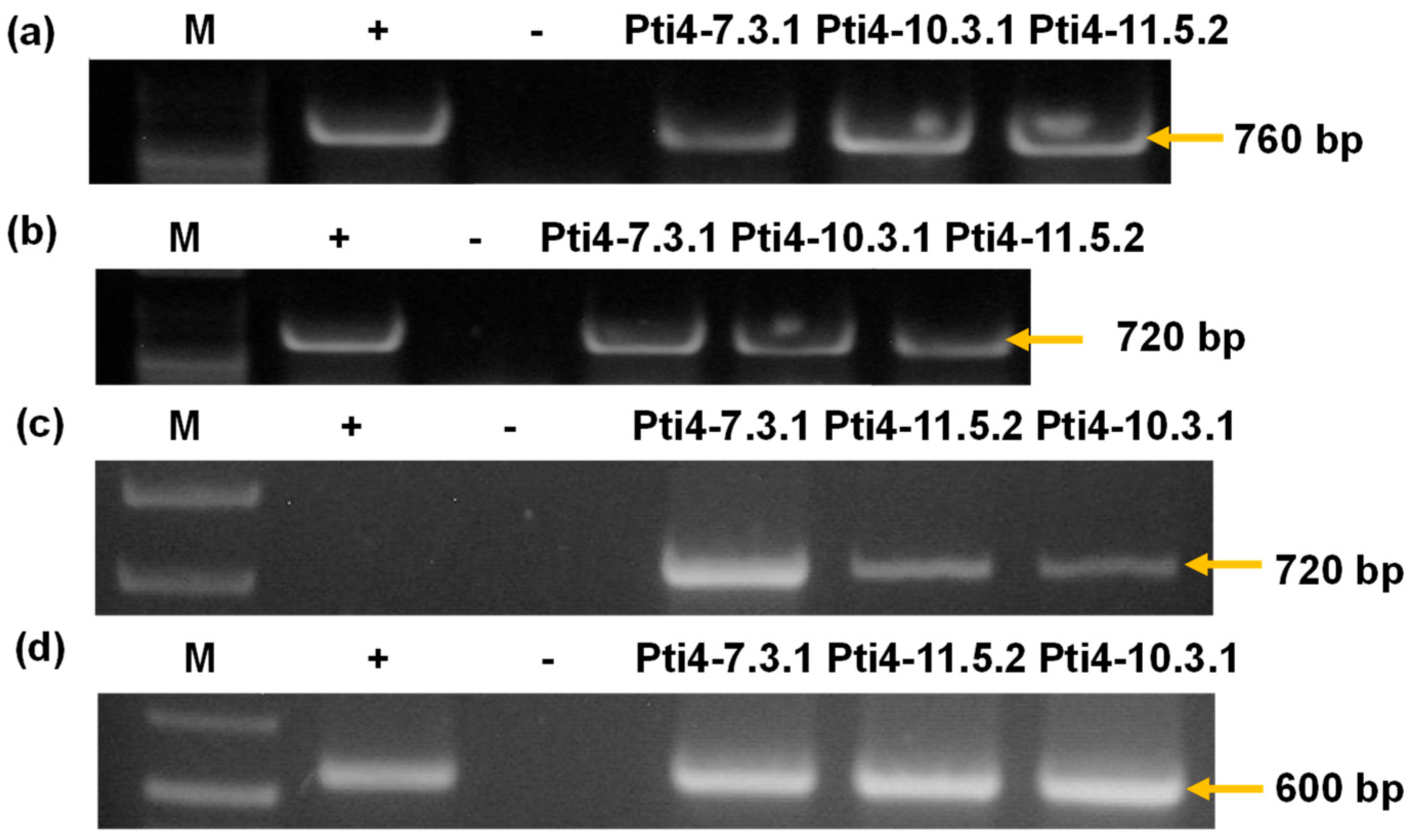
To verify the presence of transgenes, PCR amplification of the NPTII and Pti4 genes was performed. The PCR conditions for the NPTII gene are: one cycle at 94 °C for 5 min; 35 cycles at 94 °C for 45 s, 57 °C for 45 s, 72 °C for 1 min, and 1 cycle of 72 °C for 1 min [27]. The PCR conditions for the Pti4 gene were described above. The oligonucleotides used to amplify the NPTII were F: 5′GAACAAGATGGATTGCACGC3′ and R: 5′GAAGAACTCGTCAAGAAGGC3′, and those of the Pti4 gene were those mentioned above. The PCR products were analyzed by electrophoresis on a 1% agarose gel; the expected fragment sizes were 760 bp for the NPTII and 720 bp for the Pti4. Plants that tested positive for both NPTII and Pti4 genes amplification were transferred to pots for growth and development in the greenhouse.

2.5. Regeneration of the Transgenic Lines and Generation of a Homozygous Line of N. tabacum L. cv. Petit Havana

The plants were grown to maturity to obtain seeds. Subsequently, 100 seeds per Petri dish were germinated on MS + Km 100 mg/L culture medium. After 15 days, the lines that exhibited a Mendelian segregation ratio of 3:1 of green and yellow plants were selected. 10 green individuals were selected per Petri dish (T1 generation), the molecular analysis was performed, and these were grown to maturity plants to produce the next generation of seeds (T2 generation). The T2 seeds were germinated on MS + Km culture medium, and lines with 100% green plants were selected, and the presence of the transgene was verified. Adult plants were taken to produce seeds for the T3 generation, and the presence of NPTII and Pti4 was confirmed. The plants were grown to increase the seed stock. The confirmed homozygous transgenic lines were used for the experiments of this work [28].

2.6. Semiquantitative Expression Analysis (RT-PCR) of the Pti4 Transgene

Total RNA was extracted using TRIZOL reagent according to the manufacturer’s protocol (Thermo Fisher Scientific, Waltham, MA, USA). RNA integrity was checked on a 2% agarose gel, and quantification was performed using a Nanodrop 2000 spectrophotometer (Thermo Fisher Scientific, Waltham, MA, USA). cDNA was synthesized following the instructions of the RT-PCR kit (Thermo Fisher Scientific, Waltham, MA, USA) with an oligo dT-18 primer and 2 μg of DNase-treated total RNA. The PCR conditions for the Pti4 gene were described previously; only the annealing and extension stage was modified to 28 cycles to perform the RT-PCR. As an amplification control, the actin gene (ACT) was used; the RT-PCR conditions were one cycle at 94 °C for 3 min; 28 cycles at 94 °C for 30 s, annealing 55 °C for 30 s, extension at 72 °C for 30 s, and a cycle of 72 °C for 10 min, the oligonucleotides were NtACT-Fwd 5′AAGGTTACGCCCTTCCTCAT3′ and NtACT-Rev 5′CATCTGTTGGAAGGTGCTGA3′.

2.7. Tolerance Analysis Under Abiotic Stress Conditions (Salinity and Drought)

2.7.1. Evaluation of Stress Tolerance During Tobacco Seed Germination

Tobacco seeds from each transgenic and WT line were disinfected as described previously 100 seeds were placed in each Petri dish with agar-water culture medium for the control trials (stress-free). Two treatments were used: one of saline stress and the other of osmotic stress. For salt stress assays, sodium chloride (NaCl) was added at concentrations of 100 and 150 mM. For drought-stress assays (osmotic stress), sorbitol was used at concentrations of 200 and 300 mM. Each assay was evaluated for 20 d under controlled in vitro culture conditions with a 16 h light/16 h dark photoperiod at 22 °C. The parameters evaluated included the average daily germination (ADM), the maximum germination value (VM), the germination percentage based on radicle emergence (PG), and the value of germination vigor or germination speed (VG). Each experiment was performed in triplicate [29,30].
ADM = germination percentage per day between day
MV = final germination percentage divided by the number of days
PG = seeds germinated (SG) among seeds sown (SS) per 100 = SG/SS × 100
VG = VM × GDM

2.7.2. Effect of Stress Tolerance in Tobacco Plants

For the experiment, two-week-old tobacco plants from each transgenic and WT line were used and grown under greenhouse conditions with regular irrigation every three days. To evaluate the salt stress experiment, the plants were watered with a NaCl solution at a concentration of 250 mM for two weeks, followed by a recovery phase lasting another two weeks. To evaluate the drought stress experiment, the plants were kept without irrigation for 15 days until the substrate reached a moisture percentage below 5%, after which the recovery phase began, during which they were irrigated for an additional two weeks.

2.7.3. Stress Indicator Parameters

During the abiotic stress assays, the following physiological parameters were measured to evaluate the damage in tobacco plants under stress conditions with 250 mM NaCl and drought stress. The parameters included photosynthetic efficiency, chlorophyll and malondialdehyde content, and biomass in fresh weight and dry weight.

2.7.4. Determination of Photoinhibition and the Electron Transport Index in Tobacco Plants

Photoinhibition and the electron transport index was determined in four-week-old plants under control and salt stress conditions, during the first and second weeks of treatment. Measurements were conducted using an OS-30p chlorophyll fluorometer (Opti-Sciences, Inc., Hudson, NH, USA). Fluorescence was induced by excitation with a 640 nm red light pulse for 2 s. Prior to measurement, a light-exclusion clip was placed on the leaves of the plants for two hours, which allowed adaptation to darkness, thereby reducing chloroplast activity [31].
During the evaluation of the photosynthetic efficiency of photosystem II (PSII), the first period of fluorescence, known as maximum absorbed fluorescence under light conditions (Fm), will be determined and compared with the variable fluorescence (Fv). This Fm/Fv ratio indicates the maximum primary photochemical efficiency of the leaves. This parameter is one of the most studied due to its close relationship with the damage caused by water stress [31].
Fo is the minimum fluorescence and is determined when all the reaction centers are open. Fm is the maximum fluorescence when all the centers are closed. The difference between Fo and Fm is the variable fluorescence (Fv).
Fv/Fm = (Fm − Fo)/Fm

2.7.5. Quantification of Chlorophyll (Chl) Content in Tobacco Plants

To quantify the Chl content, 7 mm leaf discs were collected and macerated with 1 mL of 100% methanol. They were then centrifuged at 1743 rcf for 15 min, and the samples were kept in the dark at 4 °C. For the blank sample, 1 mL of 100% methanol was used. The supernatant from the samples was transferred to a 1 mL quartz cell to measure absorbance at two wavelengths, 665.2 and 652 nm. The following formulas were used to quantify chlorophyll a, b, a+b, and the result was expressed in mg/L [32,33].
Chla = 16.29 × OD665.2 − 8.54 × OD652
Chlb = 30.66 × OD652 − 13.58 × OD665.2
Chla+b = 22.12 × OD652 − 2.71 × OD665.2

2.7.6. Quantification of Malondialdehyde (MDA) Content in Tobacco Plants

To quantify MDA content, a colorimetric assay was used with the thiobarbituric acid (TBA) reagent [34]. For the determination, 100 mg of leaf tissue was macerated with 1 mL of the TCA-TBA-HCl reagent and incubated for 30 min at 90 °C. Samples were then cooled on ice and centrifuged at 12,400 rcf for 5 min. Subsequently, the supernatant was transferred to a 1 mL cell, and the absorbance was measured at 535 and 600 nm using a spectrophotometer. One mL of the TCA-TBA-HCl reagent was used as a blank sample. The MDA content was calculated using the following equation, and the results were expressed in nmoles MDA/g fresh weight (FW) [29,35,36].
CMDA: [(A535 − A600)1 mmol/1.56 × 105 mL] × (106 nmol/1 mmol) × 1 mL/0.1 g)

2.7.7. Determination of Biomass in Tobacco Plants

The six-week-old tobacco plants were removed from the saline stress, and the control treatments were removed from their pots. The total fresh weight (FW) was measured, as well as the FW of each plant tissue, considering the FW of the aerial parts (FWAP) and the FW of the root parts (FWRP). The plants were then dried in an oven at 80 °C for 48 h to measure the dry weight (DW). The results were expressed in grams (g) [37,38].

2.7.8. Statistical Analysis

All experiments were performed at least three times independently unless indicated. The data were processed using analysis of variance (ANOVA) followed by a post hoc Tukey’s multiple range test for means comparison. An alpha value (α) of 0.05 was used to determine statistical significance. The probability value (Pr > F) was used to evaluate the significance of the model’s F value with a significance threshold set at 0.05 and 0.01, which are generally used in research. The SAS program (Statistical Analysis Software 9.0) was used for statistical analysis.

3. Results

3.1. Generation of Homozygous Transgenic Tobacco Lines

The results of the genetic transformation process with the vector of interest p2x35S-Pti4, a regeneration rate of 27% and a transformation efficiency of 66.66%. A total of 27 independently regenerated lines were obtained, each of which was a transgenic tobacco line derived from the genetic transformation event and was molecularly analyzed to confirm the insertion of the selection gene NPTII and the gene of interest Pti4. Finally, 18 lines were confirmed as successfully genetically transformed.

3.2. Molecular Analysis and Regeneration of Homozygous Transgenic Tobacco Lines

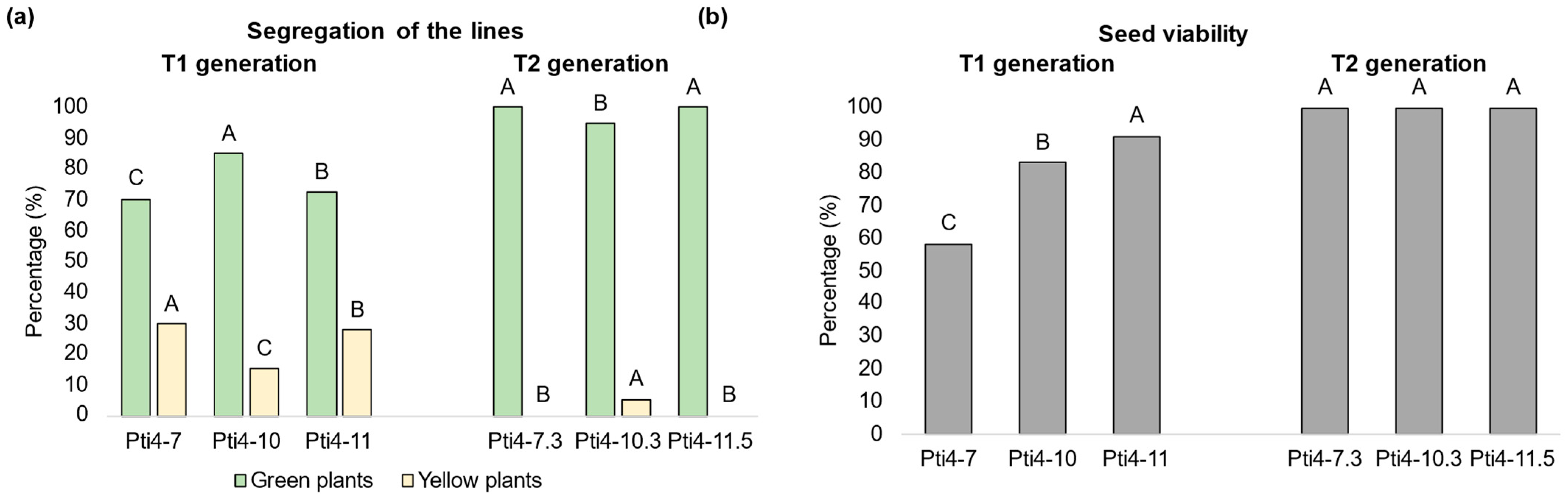
The regenerated transgenic lines were verified through PCR amplification of the selection gene NPTII and the Pti4 gene. Of the 27 regenerated lines, only 18 independent lines were confirmed as transgenic plants; these lines were designated as Pti4 (1–18). Among these 18 lines, 55.55% of the lines were viable for the segregation (Pti4-2/7/8/9/10/11/12/14/17, and 18), 27.78% of the lines (Pti4-1/3/5/6, and 16) did not show seed generation, and 16.67% of the lines did not germinate in the culture medium (Pti4-4/13, and 15). Segregation and evaluation of seed viability were carried out on the ten viable lines, according to the percentage of green plants. The lines Pti4-7/10 and 11 (T1 generation) were selected (Figure 2), which obtained 70.11, 84.90, and 72.22% of green plants, respectively (F = ∞, Pr > F ≤ 0.0001; Figure 2a). According to the percentage of seed viability, the lines Pti4-7/10, and 11 obtained 58.16, 83.33, and 91.25% of viability, respectively (F = ∞, Pr > F ≤ 0.0001; Figure 2b).
For the T2 generation, five plants of each of the Pti4-7/10 and 11 transgenic lines were individualized to obtain seeds. 100% of the fifteen lines obtained generated seeds, and all germinated; the germination rate ranged from 68 to 100%. Finally, we selected the lines Pti4-7.3, Pti4-10.3, and Pti4-11.5 (T2 generation), according to the percentage of green plants. The lines Pti4-7.3/10.3 and 11.5, which obtained 100, 94.73, and 100% of green plants, respectively (F = ∞, Pr > F ≤ 0.0001; Figure 2a). According to the percentage of seed viability, the lines selected obtained 100% of viability (F = ∞, Pr > F ≤ 0.0001; Figure 2b). For the T3 generation, seven plants of each of the Pti4-7.3/10.3 and 11.5 transgenic lines were individualized to obtain seeds. 100% of the twenty-one lines obtained generated seeds, and all germinated. The lines that had 100% green plants and those that had the insertion of the NPTII (Figure 3a) and the Pti4 gene were selected (Figure 3b). The lines that did not amplify the aforementioned genes were discarded, and finally, the lines Pti4-7.3.1, Pti4-10.3.1, and Pti4-11.5.2 (T3 generation) were selected, which corresponded to the homozygous transgenic lines that were used for all experiments.

3.3. Semiquantitative Expression Analysis of the Gene of Interest Pti4

The expression level of the Pti4 gene was determined through semiquantitative RT-PCR on the homozygous tobacco lines Pti4-7.3.1, Pti4-10.3.1, and Pti4-11.5.2. The Pti4-7.3.1 line presented the highest relative expression compared to the Pti4-11.5.2 and Pti4-10.3.1 lines, which showed similar expression levels, indicated by the band intensity on the electrophoresis gel (Figure 3c). These findings suggest that the Pti4-7.3.1 line presents a high expression, and the Pti4-11.5.2 and Pti4-10.3.1 lines represent medium expression levels. It is worth mentioning that the Pti4 gene is absent from the genome of WT tobacco plants, which explains the lack of amplification in the WT control. Likewise, Figure 3d shows the expression levels of the reference gene, actin (ACT), where both transgenic lines and the WT have similar expression levels.

3.4. Effect of Tolerance to Abiotic Stress on Tobacco Seeds

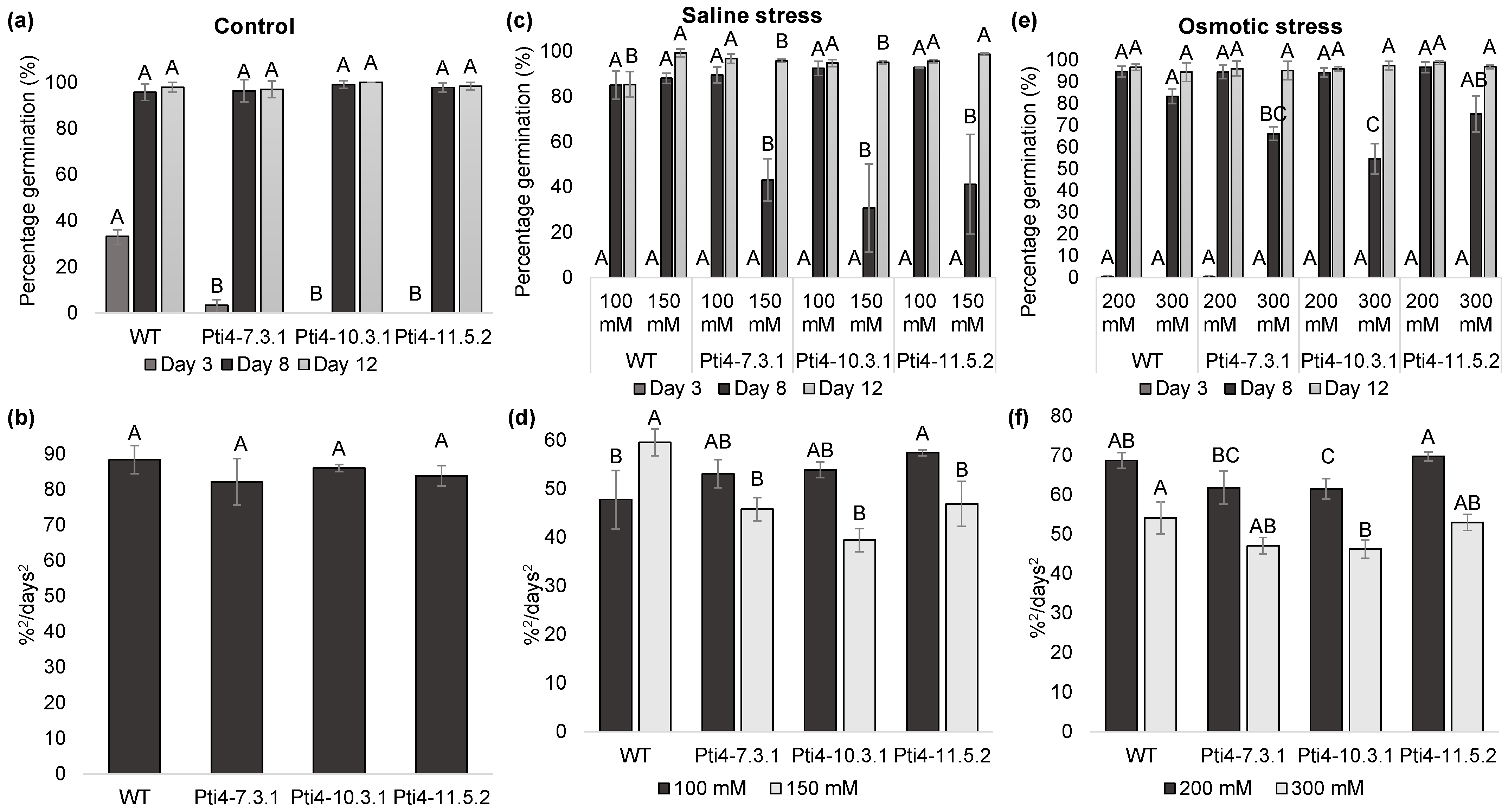
Germination is the first stage of plant establishment. Due to its importance, the tolerance to abiotic stress conditions at this stage was evaluated over a period of 20 days. The result shown in Figure 4 is the germination percentage and the germination speed data for days 3, 8, and 12 of evaluation. Figure 4a shows the control conditions (without stress), the WT and Pti4-7.3.1 lines began germinating on day 3, obtaining 33.14 and 3.32% germination, respectively. While the transgenic lines Pti4-10.3.1 and Pti4-11.5.2, germination began on day 4. Statistical analyses indicated significant differences on day 3 between the WT line and the transgenic lines (F = 228.32, Pr > F ≤ 0.0001; Figure 4a). By day 8, WT and transgenic lines showed germination rates between 95.58 and 99%, with no significant differences observed (F = 0.65, Pr > F = 0.6068; Figure 4a). By day 12, the WT and Pti4-7.3.1 lines achieved a germination percentage of 97.98 and 96.98%, respectively, while the transgenic lines Pti4-10.3.1 and Pti4-11.5.2 reached germination percentages of 100 and 98.33%, respectively. However, no significant differences were observed (F = 0.94, Pr > F = 0.4641; Figure 4a). In relation to the germination value under control conditions (Figure 4b), the germination value rates ranged from 82.09 to 88.31%2/days2 for the WT and transgenic lines; however, no significant differences were obtained (F = 1.31, Pr > F = 0.3354).
Figure 4c shows the salt-stress conditions (100 mM NaCl), both the transgenic and WT lines began to germinate on day 4, indicating a delay in germination for the WT and Pti4-7.3.1 lines compared to the control condition (Figure 4a). By day 8, germination rates ranged from 84.96 to 92.85% for the WT and transgenic lines; however, no significant differences were observed (F = 2.59, Pr > F = 0.1252; Figure 4c). By day 12, a higher germination percentage was obtained for the lines Pti4-7.3.1, Pti4-10.3.1, and Pti4-11.5.2, which presented 96.70, 94.71, and 95.56% germination, respectively, while the WT line reached the lowest percentage of germination with 85.28%, obtaining significant differences (F = 8.36, Pr > F = 0.0076; Figure 4c). Regarding the germination value shown in Figure 4d, significant differences were obtained between the WT and transgenic lines (F = 4.00, Pr > F = 0.0518), obtaining 47.73, 53.07, 53.86, and 57.37%2/days2 for the WT, Pti4-7.3.1, Pti4-10.3.1, and Pti4-11.5.2 lines, respectively. In this salt-stress experiment, we can highlight that the three transgenic lines exhibit greater tolerance to 100 mM NaCl compared to the WT line.
When the NaCl concentration was increased to 150 mM (Figure 4c), a further delay in germination occurred in all evaluated lines, as all lines began germinating only on day 5. On day 8, notable significant differences are observed between the WT and the transgenic lines (F = 8.15, Pr > F = 0.0082), with the latter showing an evident delay compared to the WT line (88.01%). The transgenic lines Pti4-7.3.1, Pti4-10.3.1, and Pti4-11.5.2 obtained 43.12, 30.77, and 41.11% germination, respectively (Figure 4c). For day 12, the germination percentage of the transgenic lines Pti4-7.3.1 and Pti4-10.3.1 showed the lowest germination percentages, at 95.75 and 95.14%, respectively. While the Pti4-11.5.2 line reached 98.67%, and the WT line reached 99.20%, with significant differences (F = 11.83, Pr > F = 0.0026; Figure 4c). The germination speed for the 150 mM NaCl treatment showed significant differences (F = 21.09, Pr > F = 0.0004; Figure 4d). The transgenic lines Pti4-7.3.1, Pti4-10.3.1, and Pti4-11.5.2 achieved germination rates of 45.75, 39.37, and 46.85%2/days2. In contrast, the WT line exhibited a higher rate of 59.51%2/days2.
Under osmotic stress conditions with 200 mM sorbitol (Figure 4e), the WT and Pti4-7.3.1 lines began germination on day 3, obtaining 0.32%, respectively, while Pti4-10.3.1 and Pti4-11.5.2 started on day 4 (F = 0.67, Pr > F = 0.595). By day 8, the germination percentages ranged between 94.31 and 96.68% for the evaluated lines, where no significant differences were shown (F = 0.55, Pr > F = 0.6593; Figure 4e). By day 12, the germination percentages ranged from 96.13 to 98.98% for the evaluated lines, where again no significant differences were observed (F = 1.45, Pr > F = 0.3001; Figure 4e). Concerning the germination speed shown in Figure 4f, the Pti4-11.5.2 line had the highest value with 69.69%2/days2 while the Pti4-10.3.1 line had the lowest value with 61.52%2/days2 (F = 7.87, Pr > F = 0.0090).
When the sorbitol concentration was increased to 300 mM, a delay in germination is observed starting on day 5. By day 8, the WT and Pti4-11.5.2 lines presented the highest germination percentage with 83.32 and 75.18%, respectively, while the lines Pti4-7.3.1 and Pti4-10.3.1 had a lower germination percentage, 66.18 and 54.60% respectively. Showing a notable significant difference (F = 13.28, Pr > F = 0.0018; Figure 4e). On subsequent days (up to day 12), germination was not further affected, and therefore there were no statistically significant differences (F = 0.60, Pr > F = 0.6354), reaching a germination percentage of between 94.44 and 97.48% for the evaluated lines (Figure 4e). Regarding germination speed (Figure 4f), significant differences were observed (F = 6.32, Pr > F = 0.0167) between line Pti4-10.3, which again had the lowest germination value (46.20%2/days2) and the other lines evaluated. In the osmotic stress experiments, the Pti4-10.3.1 line presented lower tolerance to both sorbitol concentrations.
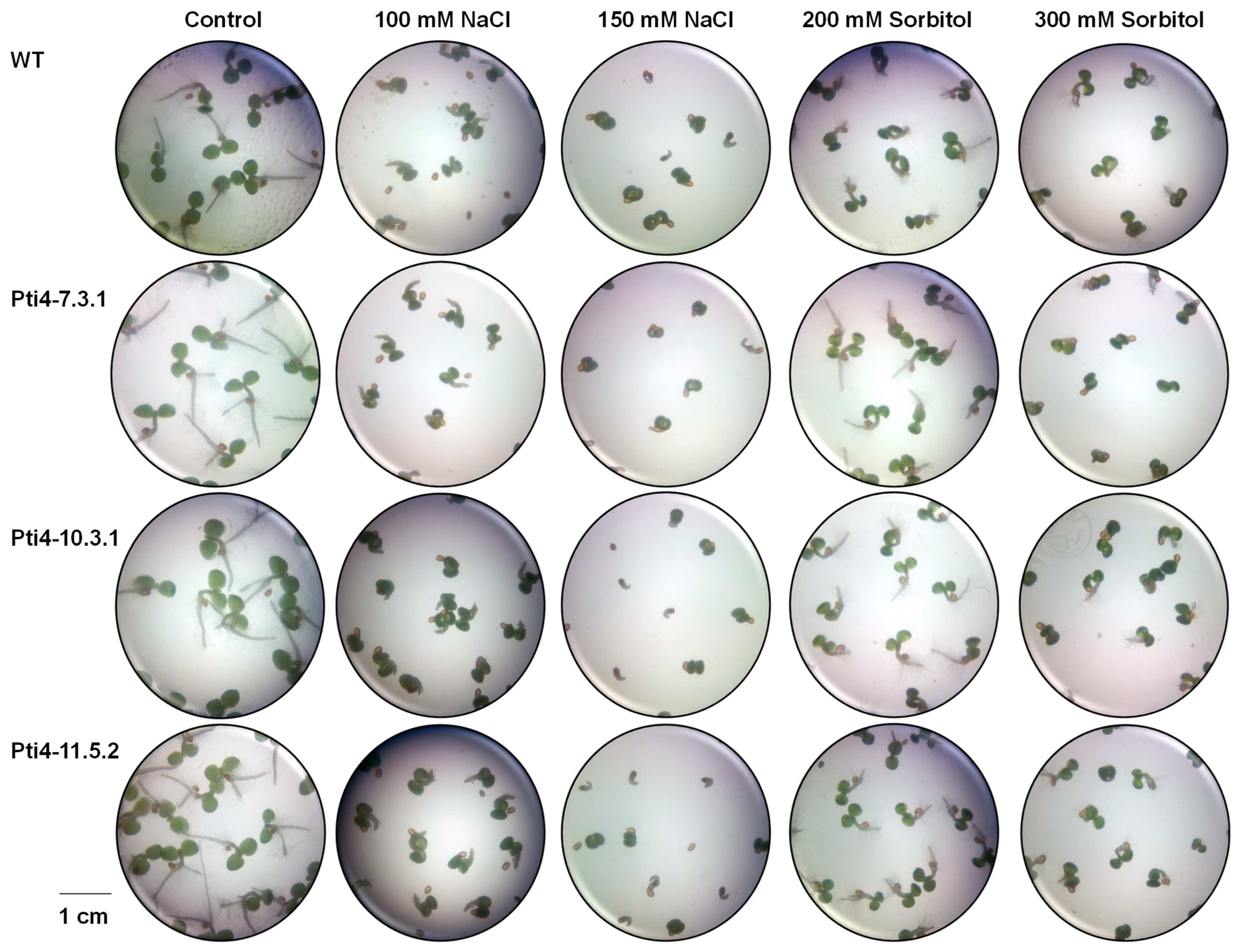
Seedlings phenotype Figure 5 shows microscopic images at day 20 under control, saline, and osmotic stress conditions for the evaluated lines. Supplementary Table S1 displays the macroscopic pictures of the seedlings’ phenotype at day 15. In both Figures, the effect of salinity on the development of the leaf, root, and root hair is observed, as well as the chlorosis induced by salt stress. Likewise, the effect of osmotic stress is evident, with a reduction in leaf and root size and an increase in root hair.

3.5. Effect of Tolerance to Abiotic Stress in Tobacco Plants

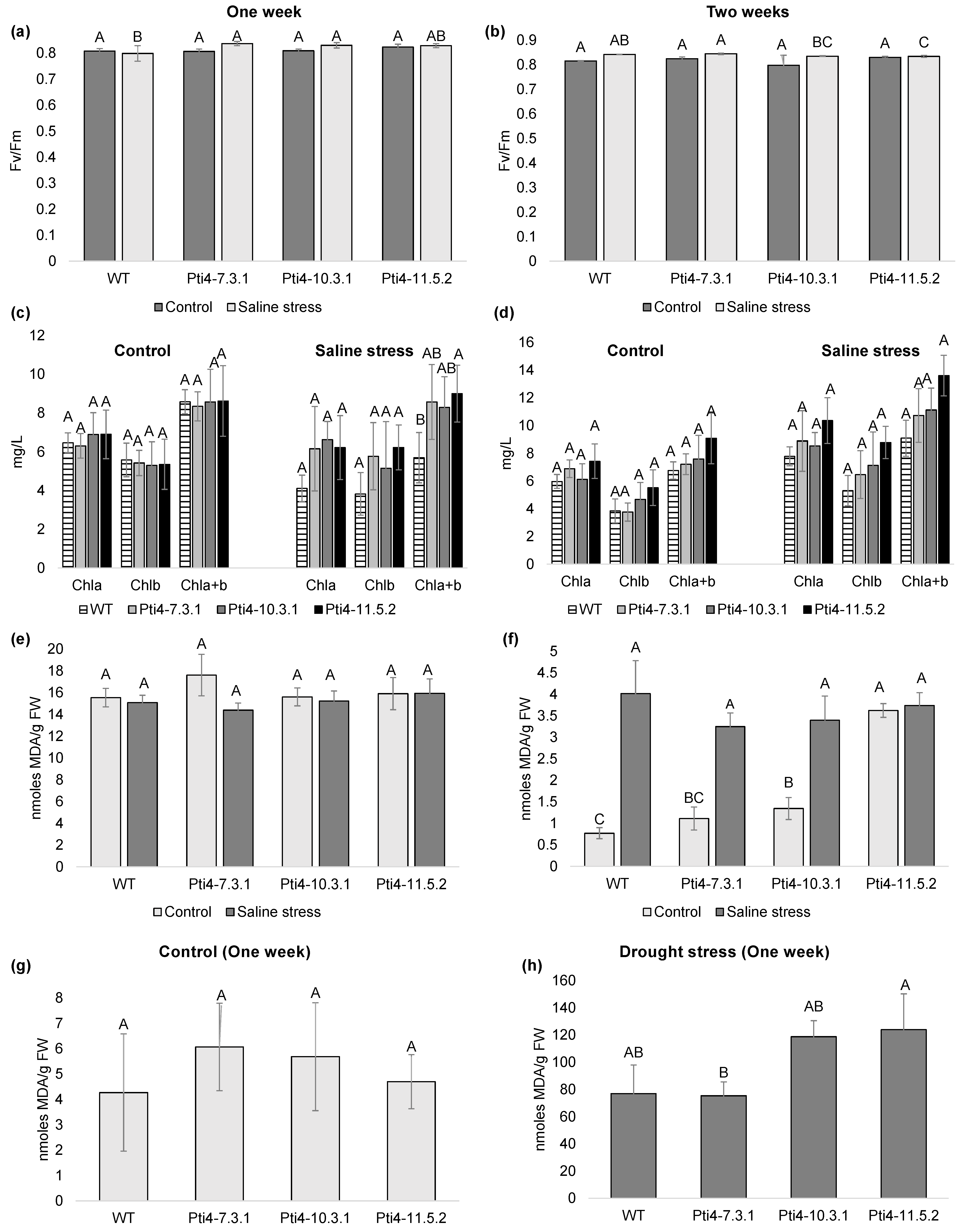
Parameters indicative of stress (Figure 6) were measured during the first and second weeks of treatment. The parameters recorded included photoinhibition and the electron transport index (Fm/Fv), chlorophyll content (Chl a, b, and a+b), and malondialdehyde content (MDA). Under drought stress conditions, only MDA content was measured during the first week of treatment due to insufficient or absent plant tissue due to the stress condition. These stress indicators provide insights into whether photosynthetic processes, oxidative damage, and plant development are significantly affected.
For photoinhibition and the electron transport index, the values obtained during the first week under control conditions were not significant (F = 3.35, Pr > F = 0.0456), with a range between 0.8062 and 0.8228 Fv/Fm for the evaluated lines (Figure 6a). Under salt stress conditions, during the first week, the transgenic lines presented better photosynthetic efficiency than the WT line (0.7984 Fv/Fm), while Fv/Fm values of 0.8362, 0.8298, and 0.8286 for the lines Pti4-7.3.1, Pti4-10.3.1, and Pti4-11.5.2, respectively. This showed a notable statistical difference (F = 4.99, Pr > F = 0.0124; Figure 6a). During the second week under control conditions, Fv/Fm values showed no significant difference (F = 1.43, Pr > F = 0.303), with values ranging from 0.797 to 0.83 for the evaluated lines (Figure 6b). Under salt stress conditions during the second week, Fv/Fm values of 0.8415, 0.8436, 0.8343, and 0.8336 were obtained for the WT, Pti4-7.3.1, Pti4-10.3.1, and Pti4-11.5.2 lines, respectively. The Pti4-7.3.1 line was the one with the best photosynthetic efficiency, while the Pti4-11.5.2 line showed the lowest photosynthetic efficiency (Figure 6b) (F = 10.85, Pr > F = 0.0034).
For the quantification of the chlorophyll (Chl) content, Chla, Chlb, and Chla+b were measured during the first week under control conditions (Figure 6c) where no significant differences were found, the Chla content 6.46, 6.30, 6.89, and 6.89 mg/L was obtained (Chla F = 0.52, Pr > F = 0.6735), for Chlb content 5.58, 5.42, 5.30, and 5.35 mg/L was obtained (Chlb F = 0.07, Pr > F = 0.9750), and for Chla+b content was 8.57, 8.34, 8.56, and 8.61 mg/L for the WT, Pti4-7.3.1, Pti4-10.3.1, and Pti4-11.5.2 lines, respectively (Chla+b F = 0.04, Pr > F = 0.9882). Under salt stress conditions during the first week (Figure 6c), no significant differences were observed for Chla (F = 2.89, Pr > F = 0.0679) and Chlb contents (F = 1.92, Pr > F = 0.1663). The results obtained for Chla were 4.11, 6.15, 6.62, and 6.21 mg/L, and were 3.82, 5.77, 5.14, and 6.22 mg/L for Chlb. While significant differences were observed for Chla+b content (F = 4.40, Pr > F = 0.0194), which was 5.69, 8.56, 8.27, and 8.99 mg/L for the WT, Pti4-7.3.1, Pti4-10.3.1, and Pti4-11.5.2 lines, respectively. The Pti4-11.5.2 line presented the highest Chla+b content, while the WT line obtained the lowest content.
During the second week in control conditions (Figure 6d) no significant differences were found between the Chl content. For Chla content was 5.97, 6.88, 6.13, and 7.43 mg/L (F = 1.14, Pr > F = 0.3614), for Chlb, 3.84, 3.76, 4.67, and 5.52 mg/L were obtained (F = 1.93, Pr > F = 0.1660), and for Chla+b content was 6.76, 7.21, 7.59, and 9.06 mg/L for the WT, Pti4-7.3.1, Pti4-10.3.1, and Pti4-11.5.2 lines, respectively (F = 2.36, Pr > F = 0.1102). And in the second week under the salt stress condition (Figure 6d), no significant differences were found either. For Chla 7.78, 8.88, 8.54, and 10.35 mg/L were obtained (F = 1.25, Pr > F = 3242), for Chlb 5.30, 6.46, 7.13, and 8.78 mg/L were obtained (F = 1.45, Pr > F = 0.2655), and for Chla+b 9.07, 10.72, 11.11, and 13.59 mg/L for the WT, Pti4-7.3.1, Pti4-10.3.1, and Pti4-11.5.2 lines, respectively (F = 2.10, Pr > F = 0.1401).
For the quantification of MDA content, during the first week under control conditions (Figure 6e), the MDA content was 15.53, 17.61, 15.61, and 15.91 nmol MDA/g FW for the WT, Pti4-7.3.1, Pti4-10.3.1, and Pti4-11.5.2 lines, respectively. However, no statistical differences were found (F = 2.66, Pr > F = 0.0831). During the first week under salt stress conditions (Figure 6e), the MDA content was 15.08, 14.39, 15.23, and 15.93 nmol MDA/g FW for the WT, Pti4-7.3.1, Pti4-10.3.1, and Pti4-11.5.2 lines, respectively. Again, no significant differences were found (F = 2.30, Pr > F = 0.1165).
In the second week under control conditions (Figure 6f), notable statistical differences were observed in the MDA content (F = 112.37, Pr > F ≤ 0.0001) of the transgenic lines compared to the WT line was obtained 0.76 nmol MDA/g FW, while for the lines Pti4-7.3.1 and Pti4-10.3.1 was 1.11 and 1.34 nmol MDA/g FW, respectively, being the lines with the lowest MDA content. At the same time, the Pti4-11.5.2 line presented the highest content of MDA, 3.62 nmol MDA/g FW. Under salt stress conditions during the second week (Figure 6f), there were no significant differences (F = 1.32, Pr > F = 0.3333) between the MDA content was 4.01, 3.24, 3.39, and 3.73 nmol MDA/g FW for the WT, Pti4-7.3.1, Pti4-10.3.1, and Pti4-11.5.2 lines, respectively.
By comparing the lipid peroxidation level of the Pti4-11.5.2 line under control conditions (15.91 nmol MDA/g FW) and salt stress (15.93 nmol MDA/g FW) during the first week (Figure 6e) and in control conditions (3.62 nmol MDA/g FW) and salt stress conditions (3.73 nmol MDA/g FW) during the second week (Figure 6f), it was observed that the lipid peroxidation levels remained constant in this transgenic line. In contrast, the other lines during the second week under salt stress conditions (Figure 6f) presented an increase in MDA content compared to the control condition. For the WT line, there is an increase of 5.27 times, 2.91 times for the Pti4-7.3.1 line, and for the Pti4-10.3.1, it increases 2.52 times.
In quantifying MDA content for tobacco plants subjected to drought stress, measurements were only taken during the first week. Under control conditions (Figure 6g), no significant differences were observed in MDA content (F = 0.60, Pr > F = 0.6329), which was 4.27, 6.06, 5.68, and 4.70 nmol MDA/g DW for the WT, Pti4-7.3.1, Pti4-10.3.1, and Pti4-11.5.2 lines, respectively. Under drought stress conditions (Figure 6h), a high MDA content was observed in all evaluated lines (F = 5.99, Pr > F = 0.0193), with the Pti4-11.5.2 line exhibiting the highest MDA content with 123.93 nmol MDA/g DW, while the Pti4-7.3.1 line showed the lowest MDA content with 75.30 nmol MDA/g DW. The WT and Pti4-10.3.1 lines had MDA content of 76.96 and 118.77 nmol MDA/g DW, respectively.
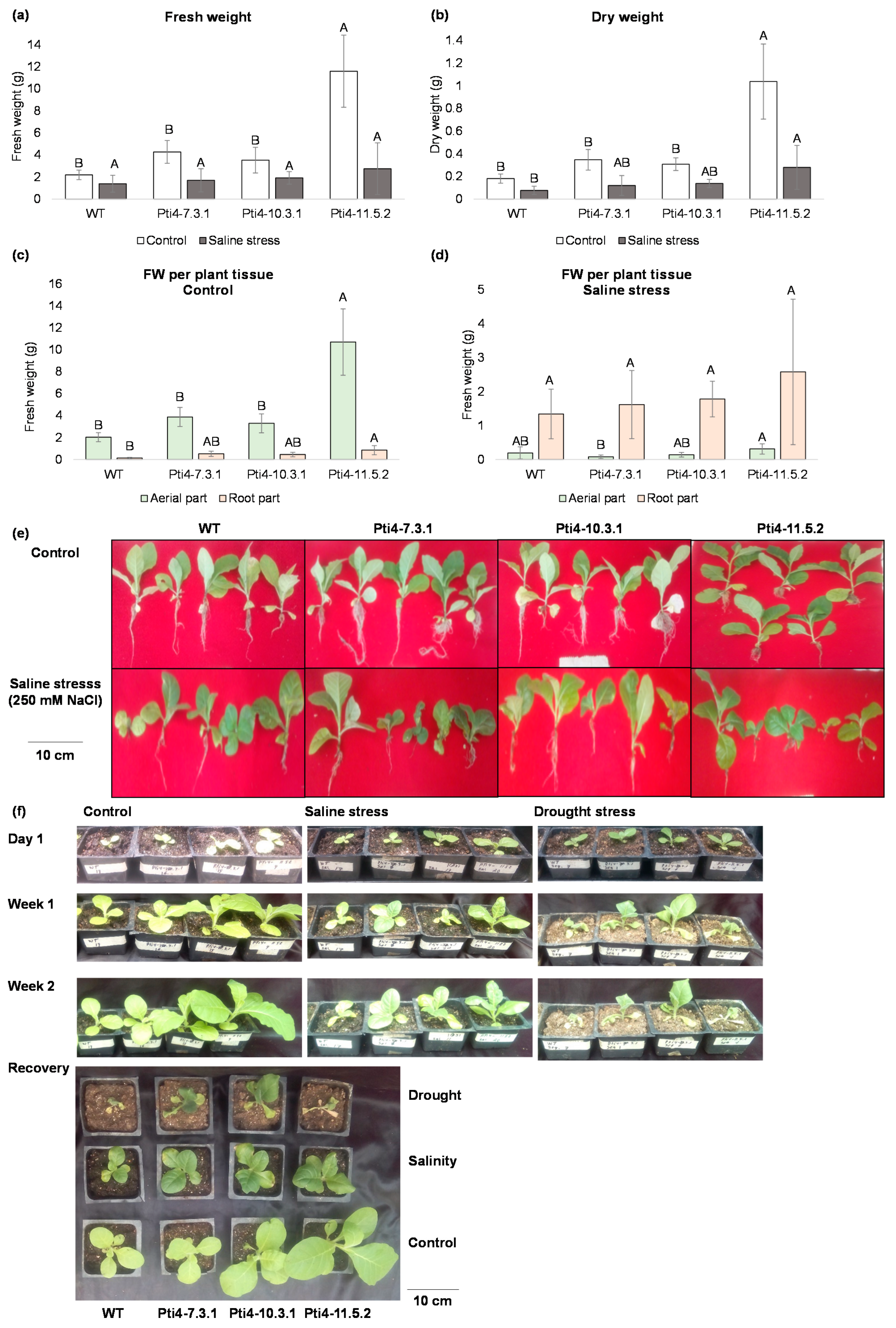
Figure 7 presents the vegetative parameters evaluated in tobacco plants subjected to control, saline stress, and drought stress conditions. To determine the biomass, total fresh weight (FW), the FW of the aerial part (FWAP), the FW of the root part (FWRP), and dry weight (DW) of the tobacco plants were measured. Under control conditions, the transgenic lines FW was greater than that of the WT line (Figure 7a), showing a notable statistical difference (F = 26.82, Pr > F ≤ 0.0001). The Pti4-11.5.2 line presented the highest FW (11.59 g), followed by the Pti4-7.3.1 line (4.28 g) and Pti4-10.3.1 (3.53 g), while the WT line had the lowest FW with 2.19 g. A similar behavior was observed about the FWAP and FWRP (Figure 7c). The Pti4-11.5.2 line again presented the highest FWAP and FWRP with 10.71 g and 0.85 g, respectively, followed by the Pti4-7.3.1 line with a FWAP of 3.88 g and a FWRP of 0.52 g, and the Pti4-10.3.1 line with a FWAP of 3.30 g and a FWRP of 0.45 g, while the WT line again presented the lowest FWAP and FWRP with 2.04 g and 0.14 g, respectively (F = 27.98, Pr > F ≤ 0.0001; F = 6.24, Pr > F = 0.0052). Under salt stress conditions (Figure 7a), no significant differences in FW were detected (F = 0.91, Pr > F = 0.4560). FW values were 1.39, 1.70, 1.92, and 2.76 g for the WT, Pti4-7.3.1, Pti4-10.3.1, and Pti4-11.5.2 lines, respectively. For the FWAP under saline stress conditions (Figure 7d), the Pti4-11.5.2 line had the highest weight with 0.31 g, followed by the WT line with 0.19 g, Pti4-10.3.1 with 0.14 g, and the Pti4-7.3.1 line, which had the lowest FWAP with 0.08 g (F = 3.08, Pr > F = 0.0574). For FWRP under saline stress conditions (Figure 7d), no significant differences were observed between the lines (F = 0.88, Pr > F = 0.4707), with weights of 1.34, 1.61, 1.78, and 2.58 g for the WT, Pti4-7.3.1, Pti4-10.3.1, and Pti4-11.5.2 lines, respectively.
In the determination of biomass in DW under control conditions (Figure 7b), the transgenic lines again showed greater biomass than the WT line (F = 24.22, Pr > F ≤ 0.0001). The Pti4-11.5.2 line presented the highest DW with 1.03 g, followed by the Pti4-7.3.1 and Pti4-10.3.1, which had DW values of 0.34 and 0.30 g, respectively. The WT line obtained 0.18 g. For DW under salt stress conditions (Figure 7b), the transgenic lines again obtained better DW (F = 3.24, Pr > F = 0.0500). The Pti4-11.5.2 line presented the highest DW with 0.28 g, followed by the Pti4-10.3.1 and Pti4-7.3.1 lines that obtained a DW of 0.13 and 0.12 g, respectively, while the WT line obtained the lowest DW with 0.07 g. The phenotype of the transgenic lines compared to the WT line in control conditions and salt stress with 250 mM NaCl is shown in Figure 7e, and Figure 7f shows the phenotype of the plants under control conditions, salt stress, and drought stress during day 1, the first and second week of treatment, as well as in their recovery process.

4. Discussion

AP2/ERF TFs constitute one of the largest and most conserved gene families in plants, where they perform many functions in cellular and biological processes and in response to stress. These TFs can be activated by multiple signaling pathways, including phytohormones such as ABA, SA, JA, and ET to regulate the activation or repression of genes that will confer tolerance to abiotic or biotic stress [10,11,12,15,20,39,40,41]. The tomato TF Pti4 has been reported in several model systems, including tobacco, rice, chili, Arabidopsis, and tomato. Its activation under stress conditions due to drought, salinity, cold, pathogen attack, and exogenous hormones treatment modulates and activates the gene expression that confers tolerance [11,16,20,21,22,42]. For this reason, the tomato Pti4 gene was selected in the present study to evaluate its overexpression in transgenic tobacco plants. It is worth mentioning that in the work of Álvarez-Gómez [41] (personal communication), an attempt to generate transgenic tomato lines overexpressing the Pti4 gene was unsuccessful, which is why a heterologous system, such as the tobacco model plant, was sought to be used. One possible explanation for the inability to obtain Pti4 overexpressing tomato lines is that it could be that this gene is highly regulated in tomato, and changes in its gene expression could interfere with the development of seedlings during genetic transformation due to its participation in cellular development, particularly during callus formation [42]. It has been reported that constitutive overexpression of Pti4 in transgenic A. thaliana plants under the 35S promoter leads to pleiotropic effects [11]. These effects cause an ET-sensitive phenotype, causing morphological abnormalities like etiolation of seedlings, inhibited hypocotyl elongation, reduced leaf size, radial swelling of the hypocotyl, and exaggerated curvature in the apical hook [11]. The cauliflower mosaic virus 35S promoter acts as a strong constitutive promoter in transgenic organisms; however, it could generate negative effects in plants due to recombination and the presence of tissue-specific regulatory sites [43,44]. Wu et al. [11] reported similar results when performing constitutive expression of Pti4, Pti5, and Pti6. Six independent Pti4 lines were obtained, five of which had an ET-sensitive phenotype, characterized by a smaller phenotype, darker color, etiolated phenotype, and inhibited hypocotyl elongation. In contrast, the Pti5 and Pti6 lines were phenotypically like the WT plant. For this reason, the effect of overexpressing SlPti4 in transgenic tobacco plants was evaluated. Regarding the genetic transformation of tobacco, three independent homozygous transgenic lines overexpressing Pti4 were obtained and were regulated by a constitutive double 35S promoter (Figure 1 and Figure 3a,b). The transgenic lines Pti4-7.3.1, Pti4-10.3.1, and Pti4-11.5.2 did not present any pleiotropic effect at any of the growth stages where they had viable seeds, as well as growth and development like that of the WT tobacco line (Supplementary Figure S2). However, during the segregation of the homozygous lines, some of the plants did not generate seeds (Pti4-1/3/5/6 and 16). Others did not generate viable seeds upon germination (Pti4-4/13 and 15), which could be secondary effects of the genetic transformation because we do not know the site where the gene was inserted. It should be noted that a sequence like the Pti4 gene has not been found in the genome of the WT tobacco plant.
The semiquantitative expression level analysis of the Pti4 gene in the transgenic tobacco lines showed that the Pti4-7.3.1 line presents a higher relative expression compared to the Pti4-10.3.1 and Pti4-11.5.2 lines, which display similar expression levels (Figure 3c). The expression level of Pti4 may correlate with the stress tolerance in the transgenic lines, as each line exhibited distinct behavior under stress. This work evaluated the tolerance to abiotic stress in the three transgenic lines during both the germination stage and in four-week-old plants. Germination is one of the most critical and important stages in plant development and establishment because different environmental factors influence it [1,3,4,40,45,46]. According to our results, under salt stress conditions with 100 mM NaCl, all three transgenic lines showed a higher germination percentage compared to the WT tobacco line (Figure 4c). This increased salinity tolerance was also reflected in their germination rate (Figure 4d). When a higher concentration is tested (150 mM NaCl), the transgenic lines Pti4-7.3.1 and Pti4-10.3.1 show the lowest germination percentage, whereas the Pti4-11.5.2 line exhibited the highest percentage, indicating greater tolerance compared to the lines mentioned above and the WT line (Figure 4c). Seedlings’ phenotype on day 20 (Figure 5) showed that at the concentration of 150 mM of NaCl, seedlings exhibited reduced leaf and root development, including a decrease in root hairs and leaf chlorosis. This could be due to stomatal closure and possible photosynthetic damage to the plants.
During salinity stress, it has been reported that germination percentage is reduced due to increased respiration rate, elevated ABA production, and concentration. Salinity tolerance changes during plant ontogeny; susceptibility depends on the type and intensity of stress, species, and developmental stage. High salt concentrations in soil limit root absorption and assimilation of nutrients, ions, and water, leading to deficiencies in plant growth and development, as well as ionic imbalance and toxicity that generates oxidative and saline stress [1,3,4,40,45,46,47]. The germination in plants such as tomato, spinach, melon, lettuce, cucumber, beet, and broccoli is reduced at a concentration of 150 mM NaCl, limiting biomass, percentage, and speed of germination, and the production of ACC (1-aminocarboxylic acid), and consequently ET [45]. Yao et al. [36] overexpressed the poplar ERF76 gene in tobacco plants, which can be induced by saline stress, ABA, and polyethylene glycol (PEG). These transgenic lines were evaluated under salt stress conditions, resulting in greater tolerance under continuous irrigation with 150 and 250 mM NaCl, and better germination than the wild line.
In relation to the treatment with sorbitol at a concentration of 200 and 300 mM, no significant differences were observed in the germination percentage on day 12 (Figure 4e). However, germination speed showed a similar trend to that of salt stress; the Pti4-11.5.2 line presented the highest germination speed compared to the other lines evaluated (Figure 4f). Figure 5 shows how seedlings subjected to osmotic stress have reduced size and have significantly fewer root hairs compared to seedlings under control conditions. It has been reported that sugars such as glucose, trehalose, and mannose affect seed germination. Dekkers et al. [48] reported that glucose application to A. thaliana seeds, during osmotic stress, delayed germination; however, through the induction of the GA and ET signaling pathways, germination could be reactivated [48]. Overexpression of the repressor ERF3b in tomato induces germination and germination rate under conditions of salt stress (35 mM NaCl), osmotic stress (70 mM sorbitol), and oxidative stress compared to the WT tomato line, while the ERF5 (activator) line showed tolerance to 1.0 µM methyl viologen. This tolerance could be due to the increased proline and ascorbate peroxidase (APx5) activity resulting from P5CS overexpression, which is involved in proline synthesis under stress conditions [41].
The tolerance to abiotic stress was also determined in two-week-old plants subjected to irrigation with 250 mM NaCl and drought stress. Salt and water stress impair plant growth and development, causing a harmful effect on essential processes such as germination, premature senescence, water potential reduction, assimilation of nutrients, water decrease, accumulation of harmful metabolites, alteration in transpiration and respiration rates, photochemical efficiency, RuBisCO, and photosynthesis decrease. Consequently, photosynthetic productivity declines and the photosynthetic apparatus atrophies, causing photoinhibition [1,3,4,31,40,49]. For this reason, the degree of photoinhibition and the electron transport rate of the plants were evaluated to estimate the stress caused by solar radiation, salinity, and dehydration. This technique estimates the damage to photosynthetic pigments, their organization, and electron transfer to photosystem II (PSII), thereby indicating overall PSII integrity [31,49]. During the first and second weeks under salt stress conditions, the three transgenic lines exhibited higher photosynthetic efficiency than the WT line, with a range of 0.82 to 0.84 Fv/Fm (Figure 6a,b). It has been reported that the optimal Fv/Fm ratios in non-photoinhibited leaves range from 0.80 to 0.83, serving as a reference for intrinsic PSII photosynthetic efficiency [49]. Water stress strongly alters photosynthesis by reducing plant survival and tolerance. Photosynthetic efficiency under drought stress could not be determined due to tissue loss generated by susceptibility to chronic photoinhibition, which drastically reduced photosynthesis activity. In plant stomatal closure, limited CO2 availability, unable to dissipate energy and heat, generating an increase in temperature, and compromised plant growth and development [31,49].
Plant growth is regulated by physiological, biochemical, and molecular processes in which photosynthesis plays a crucial role. Light energy captured during photosynthesis is converted into chemical energy used in metabolic processes; however, stress conditions obstruct photosynthesis, altering metabolites and enzymes responsible for stomatal regulation, organelle structure, as well as the concentration of photosynthetic pigments such as Chla, Chlb, and Chla+b. In particular, Chla served as a determinant of photosynthetic behavior [49]. During the first week under salinity stress, significant differences in total chlorophyll (Chla+b) content were observed, particularly the three transgenic lines obtained the highest chlorophyll content, indicating greater salinity tolerance and consequently a reduced Chl degradation. This may be related to an efficient ROS removal system and accumulation of compatible solutes such as proline or trehalose [50,51]. In contrast, the WT line presented the lowest Chl level, indicating higher sensitivity to the stress condition (Figure 6c). Similar results were reported in tomato plants overexpressing ERF3b and ERF5, watered with 250 mM NaCl, where the transgenic lines showed higher Chla, Chlb, and Chla+b contents in the second week [41]. During salt stress, Chl is degraded due to an increase in Na+ levels, thus reducing the photosynthetic pigments Chla and Chlb. In sunflower callus and plants, during Chla degradation, Chlb can convert to Chla, helping replenish this pigment quickly and effectively. During salt stress, the synthesis of Chl precursors like glutamate and 5-aminolaevulinic acid decreases. However, Chl degradation does not occur. This mechanism will depend on each species; in salinity-tolerant plants, it is known that there are increased Chl levels, while sensitive plants show Chl reduction [49,52]. Salt stress affects photosynthetic pigments and thylakoid membranes, thereby reducing photosynthesis. Studies on chlorophyllase and peroxidase indicate that Chl reduction may result from accelerated decomposition rather than slowed biosynthesis, and it has been reported that Chlb is reduced more than in Chla [52].
Another effect caused by salt and drought stress is oxidative stress, which disrupts ionic equilibrium as a result of the generation and accumulation of ROS; some examples are superoxide radicals, hydrogen peroxide (H2O2), hydroxyl and alkoxy radicals, as well as MDA. MDA is a secondary product of enzymatic decomposition or oxygenation, leading to oxidative lipid degradation; its accumulation increases the H2O2 production. One of the strategies that plants use to eliminate ROS is to synthesize antioxidant enzymes such as peroxidase (POD), superoxide dismutase (SOD), catalases, glutathione reductases, and ascorbic peroxidase, among others, to prevent oxidative damage [34,36,41,50,51]. During the second week under salt stress, the transgenic lines showed a decrease in MDA content compared to the first week, though the differences were not statistically significant (Figure 6e,f). In the evaluation of MDA content under drought stress, the Pti4-7.3.1 line had the lowest MDA content and exhibited the most tolerance to oxidative stress compared to the other lines evaluated (Figure 6h). Similar results were observed in tomato plants overexpressing ERF3b and ERF5, under salt stress and drought stress displayed lower MDA content compared to the WT line. The authors mention that ERF5 and ERF3b induce the expression of the P5CS and APx genes, which are involved in proline synthesis and ascorbate peroxidase activity that have been reported to facilitate ROS scavenging and reduce lipid peroxidation; furthermore, these lines exhibited tolerance to paraquat (100 µM) treatment, when the plants recovered within a week of exposure to the herbicide [41]. Transgenic tobacco plants that overexpress the ERF76 gene exhibit low levels of MDA compared to the wild type, demonstrating greater tolerance due to the accumulation of antioxidant enzymes, including POD, and SOD, and the amino acid proline [36].
Finally, the biomass of plants was also determined because under stress conditions, the growth and development of the plants are strongly affected. We observed that under both control and saline stress conditions, the transgenic lines presented higher biomass. Particularly, the Pti4-11.5.2 line was the one that obtained the greatest biomass in FW and DW, as well as the highest leaf area and root weight (Figure 7a–d). Yao et al. [36] reported that the plants overexpressing the ERF76 gene presented greater size in leaf and root area, an advantage in biomass under saline conditions under irrigation of 150 mM NaCl. A widely studied strategy in plants to tolerate salt and drought stress is the synthesis and accumulation of compatible osmolytes such as amino acids (proline, glutamic acid), quaternary ammonium compounds (glycine betaine), polyols (glycerol, inositol, mannitol, sorbitol), and sugars (trehalose and sucrose) that help in water stress [53,54,55].

5. Conclusions

Overexpression of the Pti4 gene driven by the constitutive double promoter 35S in tobacco plants does not affect their regeneration, unlike in tomato plants. Overexpression of the Pti4 gene improved tolerance to abiotic stress by regulating the activation or repression of genes that help resist stress caused by salinity and drought.
Differences in stress tolerance among the transgenic lines were attributable to different expression levels of the Pti4 gene. Overexpression of Pti4 in the three transgenic lines improved germination and germination rate under salt stress conditions, enhanced physiological processes such as photosynthetic efficiency and total Chl content, and reduced MDA content during the second week of salt stress. Under drought stress conditions, the Pti4-7.3.1 line exhibited the lowest MDA content, making it the most tolerant line to oxidative stress. Regarding biomass, all three transgenic lines had the highest biomass in FW and DW. The Pti4-11.5.2 line showed the greatest biomass in both leaf and root areas, and the best phenotype under control, salt stress, and drought stress conditions. Our results suggest that SlPti4 may be a potential candidate for agricultural crop improvement due to its effective response time to abiotic stress.

Supplementary Materials

The following supporting information can be downloaded at: https://www.mdpi.com/article/10.3390/horticulturae12010114/s1, Figure S1: Phenotype of tobacco seedlings under control, salt stress, and osmotic stress conditions on day 15; Figure S2: Phenotype of plants transformed with the 2x35s-Pti4 vector of interest; Table S1: Photoinhibition and electron transport index in tobacco plants evaluated.

Author Contributions

Conceptualization, M.G.C.-T., T.B.Á.-G. and R.S.-R.; methodology, M.G.C.-T., T.B.Á.-G. and R.S.-R.; validation, M.G.C.-T. and R.S.-R.; formal analysis, M.G.C.-T. and R.S.-R.; investigation, M.G.C.-T., T.B.Á.-G. and R.S.-R.; resources, M.G.C.-T., T.B.Á.-G., M.R.-Y., J.A.R.-T. and R.S.-R.; data curation, M.G.C.-T., T.B.Á.-G. and R.S.-R.; writing—original draft, M.G.C.-T., T.B.Á.-G., J.A.R.-T. and R.S.-R.; writing—review and editing, M.G.C.-T., T.B.Á.-G., J.A.R.-T. and R.S.-R.; visualization, M.G.C.-T., T.B.Á.-G., J.A.R.-T. and R.S.-R.; supervision, M.G.C.-T., T.B.Á.-G., J.A.R.-T. and R.S.-R.; project administration, M.G.C.-T., T.B.Á.-G., J.A.R.-T. and R.S.-R.; funding acquisition, M.R.-Y., J.A.R.-T. and R.S.-R. All authors have read and agreed to the published version of the manuscript.

Funding

We are grateful for an internal scholarship from the Secretaría de Ciencia, Humanidades, Tecnología e Innovación (SECIHTI) to M.G.C.-T. (CVU: 919853; support number: 803022).

Data Availability Statement

The original contributions presented in this study are included in the article/Supplementary Material. Further inquiries can be directed to the corresponding authors.

Acknowledgments

We thank the Centro de Investigación en Biotecnología (CEIB) of the Universidad Autónoma del Estado de Morelos and the Laboratorio de Fisiología Molecular de Plantas (LFMP) for the space they provided to carry out the postgraduate studies.

Conflicts of Interest

The authors declare no conflicts of interest.

Abbreviations

The following abbreviations are used in this manuscript:
TFTranscription factors
AP2/ERFAPETALA2/Ethylene Response Factor
PRGenes related to pathogenesis
ERFEthylene-responsive factor
ABAAbscisic acid
SASalicylic acid
JAJasmonic acid
ETEthylene
MDAMalondialdehyde
ADMAverage daily germination
VMMaximum germination value
PGGermination percentage based on radicle emergence
VGValue of germination vigor or germination speed
FmFluorescence under light conditions
FvVariable fluorescence
ChlChlorophyll

References

  1. Madhava, R.K.V.; Raghavendra, A.S.; Janardhan Reddy, K. (Eds.) Physiology and Molecular Biology of Stress Tolerance in Plants; Springer: Berlin/Heidelberg, Germany, 2006; pp. 1–14. [Google Scholar] [CrossRef]
  2. Huang, G.T.; Ma, S.L.; Bai, L.P.; Zhang, L.; Ma, H.; Jia, P.; Liu, J.; Zhong, M.; Guo, Z.F. Signal transduction during cold, salt, and drought stresses in plants. Mol. Biol. Rep. 2012, 39, 969–987. [Google Scholar] [CrossRef]
  3. Verma, S.; Nizam, S.; Verma, P.K. Biotic and abiotic stress signaling in plants. In Stress Signaling in Plants: Genomics and Proteomics Perspective; Sarwat, M., Ahmad, A., Abdin, M.Z., Eds.; Springer: New York, NY, USA, 2013; Volume 1, pp. 25–49. [Google Scholar] [CrossRef]
  4. Redondo-Gómez, S. Abiotic and biotic stress tolerance in plants. In Molecular Stress Physiology of Plants; Ranjan, G.R., Bandhu, D.A., Eds.; Springer: Delhi, India, 2013. [Google Scholar] [CrossRef]
  5. Montoliu, V.A. Respuesta Fisiológica de Cítricos Sometidos a Condiciones de Estrés Biótico y Abiótico. Aspectos Comunes y Específicos. Ph.D. Thesis, Universitat Jaume I de Castellón, Escuela Superior de Tecnología y Ciencias Experimentales, Castellón de la Plana, Spain, 2010. [Google Scholar]
  6. Moreno-Reséndez, A.; Carda-Mendoza, V.; Reyes-Carrillo, J.L.; Vásquez-Arroyo, J.; Cano-Ríos, P. Rizobacterias promotoras del crecimiento vegetal: Una alternativa de biofertilización para la agricultura sustentable. Rev. Colomb. Biotecnol. 2018, 20, 68–83. [Google Scholar] [CrossRef]
  7. Esquivel-Cote, R.; Gavilanes-Ruiz, M.; Cruz-Ortega, R.; Huante, P. Importancia agrobiotenológica de la enzima ACC desaminasa en rizobacterias, una revisión. Rev. Filotec. Mex. 2013, 36, 251–258. [Google Scholar]
  8. Xu, Z.S.; Chen, M.; Li, L.C.; Ma, Y.Z. Functions and application of the AP2/ERF transcription factor family in crop improvement. J. Integr. Plant Biol. 2011, 53, 570–585. [Google Scholar] [CrossRef]
  9. García-Morales, S.; Gómez-Merino, F.C.; Trejo-Téllez, L.I.; Herrera-Cabrera, É.B. Factores de transcripción involucrados en respuestas moleculares de las plantas al estrés osmótico. Rev. Filotec. Mex. 2013, 36, 105–115. [Google Scholar] [CrossRef]
  10. Rehman, S.; Mahmood, T. Functional role of DREB and ERF transcription factors: Regulating stress-responsive network in plants. Acta Physiol. Plant. 2015, 37, 178. [Google Scholar] [CrossRef]
  11. Wu, K.; Tian, L.; Hollingworth, J.; Brown, D.C.W.; Miki, B. Functional Analysis of Tomato Pti4 in Arabidopsis. Plant Physiol. 2002, 128, 30–37. [Google Scholar] [CrossRef]
  12. Gu, C.; Guo, Z.H.; Hao, P.P.; Wang, G.M.; Jin, Z.M.; Zhang, S.L. Multiple regulatory roles of AP2/ERF transcription factor in angiosperm. Bot. Stud. 2017, 58, 6. [Google Scholar] [CrossRef]
  13. Pirrello, J.; Prasad, B.N.; Zhang, W.; Chen, K.; Mila, I.; Zouine, M.; Latché, A.; Bouzayen, M. Functional analysis and binding affinity of tomato ethylene response factors provide insight on the molecular bases of plant differential responses to ethylene. BMC Plant Biol. 2012, 12, 190. [Google Scholar] [CrossRef]
  14. Yang, Z.; Tian, L.; Latoszek-Green, M.; Brown, D.; Wu, K. Arabidopsis ERF4 is a transcriptional repressor capable of modulating ethylene and abscisic acid responses. Plant Mol. Biol. 2005, 58, 585–596. [Google Scholar] [CrossRef]
  15. Pirrello, J.; Jaimes-Miranda, F.; Sanchez-Ballesta, M.T.; Tournier, B.; Khalil-Ahmad, Q.; Regar, F.; Latché, A.; Pech, J.C.; Bouzayen, M. Sl-ERF2, a tomato ethylene response factor involved in ethylene response and seed germination. Plant Cell Physiol. 2016, 54, 1195–1205. [Google Scholar] [CrossRef]
  16. Wang, Y.; Feng, G.; Zhang, Z.; Liu, Y.; Ma, Y.; Wang, Y.; Ma, F.; Zhou, Y.; Gross, R.; Xu, H.; et al. Overexpression of Pti4, Pti5, and Pti6 in tomato promote plant defense and fruit ripening. Plant Sci. 2021, 302, 110702. [Google Scholar] [CrossRef]
  17. Lu, C.W.; Shao, Y.; Li, L.; Chen, A.J.; Xu, W.Q.; Wu, K.J.; Lou, Y.B.; Zhu, B.Z. Overexpression of SlERF1 tomato gene encoding an ERF-type transcription activator enhancer salt tolerance. Russ. J. Plant Physiol. 2011, 58, 118–125. [Google Scholar] [CrossRef]
  18. Jisha, V.; Dampanaboina, L.; Vadassery, J.; Mithöfer, A.; Kappara, S.; Ramanan, R. Overexpression of an AP2/ERF type transcription factor OsEREBP1 confers biotic and abiotic stress tolerance in rice. PLoS ONE 2015, 10, e0127831. [Google Scholar] [CrossRef]
  19. Berrocal-Lobo, M.; Molina, A. Ethylene response factor 1 mediates Arabidopsis resistance to the soilborne fungus Fusarium oxysporum. Mol. Platt-Microbe Interact. 2004, 17, 763–770. [Google Scholar] [CrossRef] [PubMed]
  20. Gu, Y.Q.; Yang, C.; Wildermuth, M.C.; Chakravarthy, S.; Loh, Y.T.; Yang, C.; He, X.; Han, Y.; Martin, G.B. Tomato Transcription Factors Pti4, Pti5, and Pti6 Activate Defense Responses When Expressed in Arabidopsis. Plant Cell 2002, 14, 817–831. [Google Scholar] [CrossRef]
  21. Thara, V.K.; Tang, X.; Gu, Y.Q.; Martin, G.B.; Zhou, J.M. Pseudomonas syringae pv tomato induces the expression of tomato EREBP-like genes Pti4 and Pti45 independent of ethylene, salicylate and jasmonate. Plant J. 1999, 20, 475–483. [Google Scholar] [CrossRef] [PubMed]
  22. Chakravarthy, S.; Tuori, R.P.; D’Ascenzo, M.D.; Fobert, P.R.; Després, C.; Martin, G.B. The tomato transcription factor Pti4 regulates defense-related gene expression via GCC box and non-GCC box cis elements. Plant Cell 2013, 15, 3033–3050. [Google Scholar] [CrossRef]
  23. Murashige, T.; Skoog, F. A revised medium for rapid growth and bio assays with tobacco tissue cultures. Physiol. Plant. 1962, 15, 473–497. [Google Scholar] [CrossRef]
  24. Zhou, J.; Tang, X.; Martin, G.B. The Pto kinase conferring resistance to tomato bacterial speck disease interacts with proteins that bind a cis-element of pathogenesis-related genes. EMBO J. 1997, 16, 3207–3218. [Google Scholar] [CrossRef]
  25. Kay, R.; Chan, A.; Daly, M.; McPherson, J. Duplication of CaMV 35S promoter sequences creates a strong enhancer for plant genes. Science 1987, 236, 1299–1302. [Google Scholar] [CrossRef] [PubMed]
  26. Allen, G.C.; Flores-Vergara, M.A.; Krasnyanski, S.; Kumar, S.; Thompson, W.F. A modified protocol for rapid DNA isolation from plant tissues using cetyltrimethylammonium bromide. Nat. Protoc. 2006, 1, 2320–2325. [Google Scholar] [CrossRef]
  27. Blake, N.K.; Ditterline, R.L.; Stout, R.G. Polymerase chain reaction used for monitoring multiple gene integration in Agrobacterium mediated transformation. Crop Sci. 1991, 31, 1686–1688. [Google Scholar] [CrossRef]
  28. Passricha, N.; Saifi, S.; Khatodia, S.; Tuteja, N. Assessing zygosity in progeny of transgenic plants: Current methods and perspectives. J. Biol. Methods 2016, 3, e46. [Google Scholar] [CrossRef]
  29. Pérez, M.M.B. Uso de un Nuevo vector de transformación para incrementar la acumulación de trehalosa en Nicotiana tabacum. Bachelor’s Thesis, Facultad de Ciencias Biológicas, Universidad Autónoma del Estado de Morelos, Cuernavaca, Mexico, 2016. [Google Scholar]
  30. Castillo-Texta, M.G.; Ramírez-Trujillo, J.A.; Dantán-González, E.; Ramírez-Yáñez, M.; Suárez-Rodríguez, R. Endophytic Bacteria from the Desiccation-Tolerant Plant Selaginella lepidophylla and Their Potential as Plant Growth-Promoting Microorganisms. Microorganisms 2024, 12, 2654. [Google Scholar] [CrossRef]
  31. Cerrillo, R.; Maldonado, R.; Ariza, D. Fluorescencia de la clorofila en cinco procedencias de Pinus halepenesis mil y su respuesta a estrés hídrico. Cuad. Soc. Esp. Cie. For. 2004, 17, 69–74. [Google Scholar]
  32. Lichtenthaler, H.K.; Wellburn, A.A. Determination of total carotenoids and chlorophyll a and b of leaf extracts in different solvents. Biochem. Soc. Trans. 1983, 603, 591–592. [Google Scholar] [CrossRef]
  33. Lichtenthaler, H.K.; Rinderle, U. The role of chlorophyll fluorescence in the detection of stress conditions in plants. Crit. Rev. Anal. Chem. 1988, 19, S29–S85. [Google Scholar] [CrossRef]
  34. Janero, D.R. Malondialdehyde and thiobarbituric acid-reactivity as diagnostic indices of lipid peroxidation and peroxidative tissue injury. Free Radic. Biol. Med. 1990, 9, 515–540. [Google Scholar] [CrossRef] [PubMed]
  35. Buegue, J.A.; Aust, S.D. Microsomal lipid peroxidation. Methods Enzymol. 1978, 2, 302–310. [Google Scholar] [CrossRef]
  36. Yoa, W.; Wang, L.; Zhou, B.; Wang, S.; Li, R.; Jiang, T. Over-expression of poplar transcription factor ERF76 gene confers salt tolerance in transgenic tobacco. J. Plant Physiol. 2016, 198, 23–31. [Google Scholar] [CrossRef] [PubMed]
  37. Bray, A.E.; Bailey, S.J.; Weretilnyk, E. Responses to abiotic stresses. In Biochemistry and Molecular Biology of Plants, 2nd ed.; Buchanan, B., Gruissem, W., Jones, R.L., Eds.; John Wiley & Sons: Pondicherry, India, 2000; pp. 1158–1202. [Google Scholar]
  38. De la Rosa, R.; Acuña, R.; Acurio, K.; Castillo, A.; Cepeda, C.; Chavarry, C.; Correa, M.; de la Cruz, L.; García, M.; Huamaní, M.; et al. Respuestas fisiológicas de Hibiscos rosa-sinensis L. (Malvácea) en el cerro “El Agustino”, Lima, Perú. Biologist 2011, 9, 1–8. [Google Scholar]
  39. Basurto, S.M.; Núñez, B.A.; Pérez, L.R.R.; Hernández, R.O.A. Fisiología del estrés ambiental en plantas. Synthesis 2008, 48, 1–5. [Google Scholar]
  40. Shao, H.-B.; Chu, L.Y.; Jaleei, C.A.; Zhao, C.X. Wáter-deficit stress-induced anatomical changes in higher plants. Comptes Rendus Biol. 2008, 333, 215–225. [Google Scholar] [CrossRef]
  41. Álvarez-Gómez, T.B.; Ramírez-Trujillo, J.A.; Ramírez-Yáñez, M.; Suárez-Rodríguez, R. Overexpression of SlERF3b and SlERF5 in transgenic tomato alters fruit size, number of seeds and promotes early flowering, tolerance to abiotic stress and resistance to Botrytis cinerea infection. Ann. Appl. Biol. 2021, 179, 382–394. [Google Scholar] [CrossRef]
  42. Gu, Y.Q.; Yang, C.; Thara, V.K.; Zhou, J.; Martin, G.B. Pti4 is induced by ethylene and salicylic acid, and its product is phosphorylated by the Pto kinase. Plant Cell 2000, 12, 771–785. [Google Scholar] [CrossRef] [PubMed]
  43. Benfey, P.N.; Ren, L.; Chua, N.H. Tissue-specific expression from CaMV 35S enhancer subdomains in early stages of plant development. EMBO J. 1990, 9, 1677–1684. [Google Scholar] [CrossRef]
  44. Hull, R.; Covey, S.N.; Dale, P. Genetically modified plants and the 35S promoter: Assessing the risks and enhancing the debate. Microb. Ecol. Health Dis. 2000, 12, 1–5. [Google Scholar] [CrossRef][Green Version]
  45. Zapata, P.J.; Serrano, M.; Pretel, M.T.; Amorós, A.; Botella, M.Á. Polyamines and ethylene changes during germination of different plant species under salinity. Plant Sci. 2004, 167, 781–788. [Google Scholar] [CrossRef]
  46. Llanes, A.; Andrade, A.; Masciarelli, O.; Alemano, S.; Luna, V. Drought and salinity alter endogenous hormonal profiles at the seed germination phase. Seed Sci. Res. 2016, 26, 1–13. [Google Scholar] [CrossRef]
  47. Escaso, S.F.; Martínez, G.J.L.; Planelló, C.M. Hormonas vegetales: Desarrollo y respuesta de las plantas con flor al ambiente. In Fundamentos Básicos de Fisiología Vegetal y Animal; Martín, M.R., Martín, E., Eds.; Pearson Educación, S.A.: Madrid, Spain, 2010; pp. 57–77. [Google Scholar]
  48. Dekkers, B.J.W.; Schuurmans, J.A.M.J.; Smeekens, S.C.M. Glucose delays seed germination in Arabidopsis thaliana. Planta 2004, 218, 579–588. [Google Scholar] [CrossRef] [PubMed]
  49. Cabrera, H.M. Respuestas ecofisiológicas de plantas en ecosistemas de zonas con clima mediterráneo y ambientes de alta montaña. Rev. Chil. Hist. Nat. 2002, 75, 625–637. [Google Scholar] [CrossRef]
  50. Albacete, A.; Ghanem, M.E.; Martínez-Andújar, C.; Acosta, M.; Sánchez-Bravo, J.; Martínez, V.; Lutts, S.; Dodd, I.C.; Pérez-Alfocea, F. Hormonal changes in relation to biomass partitioning and shoot growth impairment in salinized tomato (Solanum lycopersicum L.) plants. J. Exp. Bot. 2008, 59, 4119–4131. [Google Scholar] [CrossRef]
  51. Shanker, A.K.; Maheswari, M.; Yadav, S.K.; Desai, S.; Bhanu, D.; Attal, N.B.; Venkateswarlu, B. Drought stress response in crops. Funct. Integr. Genom. 2014, 14, 11–22. [Google Scholar] [CrossRef] [PubMed]
  52. Ashraf, M.; Harris, P.J.C. Photosynthesis under stressful environments: An overview. Photosynthetica 2013, 51, 163–190. [Google Scholar] [CrossRef]
  53. Valpuesta, V.; Berteli, F.; Pérez-Prat, E.; Corrales, E.; Narasimham, M.; Botella, M.; Bressan, R.; Pliego, F.; Hasegawa, P. Cambios metabólicos y de expresión génica en plantas superiores en respuesta al estrés salino. AgriScientia 1992, 9, 55–63. [Google Scholar] [CrossRef]
  54. Suárez, R.R.; Raya, P.J.C.; Iturriaga, G. La trehalosa: Un azúcar osmoprotector con capacidad de señalización. Cienc. Tecnol. Agropecu. 2015, 13, 1–13. [Google Scholar]
  55. Elbein, A.D.; Pan, Y.T.; Pastuszak, I.; Carroll, D. New insights on trehalose: A multifunctional molecule. Glycobiology 2003, 13, 17–27. [Google Scholar] [CrossRef] [PubMed]

Figure 1. Construction of the p2x35S-Pti4 transformation vector. LB, left border; NPTII, selection gene encoding neomycin phosphotransferase II; 2x35S, constitutive double promoter; AMV, transcriptional enhancer; Pti4, gene of interest; NOSt, transcriptional terminator; RB, right border.
Horticulturae 12 00114 g001
Figure 2. Segregation and seed viability of transgenic tobacco lines. (a) Segregation analysis of the T1 and T2 generations. Comparisons were made among transgenic lines within each generation (T1 and T2) separately, considering the number of green and yellow plants. (b) Seed viability percentage of transgenic lines in T1 and T2 generations. Comparisons were made among transgenic lines within each generation (T1 and T2) separately. Bars represent the mean value. Statistically significant differences compared to the control were determined using a completely randomized ANOVA (Pr > F ≤ 0.0001), followed by Tukey’s test (α = 0.05); means with the same letter are not significantly different, and error bars indicate the standard deviation of three repetitions.
Horticulturae 12 00114 g002
Figure 3. Molecular analysis of the genes NPTII, Pti4, and ACT from the homozygous transgenic lines Pti4-7.3.1, Pti4-10.3.1, and Pti4-11.5.2. (a) Confirmation by PCR amplification of the NPTII gene. (b) Confirmation by PCR amplification of the Pti4 gene. From left to right in both images, the molecular weight marker 1Kb (M), positive control (+, plasmid p2x35s-Pti4), negative control (-), and the independent lines transformed with the vector of interest (Pti4-7.3.1, Pti4-10.3.1, and Pti4-11.5.2) are shown. (c) Semiquantitative expression analysis of the Pti4 gene by RT-PCR amplification of the homozygous transgenic lines. (d) Semiquantitative expression analysis of the ACT gene by RT-PCR amplification of the homozygous transgenic lines. From left to right in both images, the molecular weight marker 1Kb (M), WT tobacco (+, does not present the Pti4 gene and therefore there is no amplification), negative control (-, sterile water), and the transgenic lines (Pti4-7.3.1, Pti4-10.3.1, and Pti4-11.5.2).
Horticulturae 12 00114 g003
Figure 4. Seed germination test under control conditions, salt stress, and osmotic stress of the transgenic lines compared to the WT line. (a) Germination percentage in control conditions. Statistical comparisons were made between the transgenic lines and the WT line for each day of evaluation (days 3, 8, and 12), under the control condition. (b) Germination speed under control conditions. Statistical comparisons were made between the transgenic lines and the WT line under the control condition. (c) Germination percentage under salt stress conditions with 100 and 150 mM NaCl. Statistical comparisons were made between the transgenic lines and the WT line for each day of evaluation (days 3, 8, and 12), under saline stress (100 and 150 mM NaCl). (d) Germination of seeds under salt stress conditions with 100 and 150 mM NaCl. Statistical comparisons were made between the transgenic lines and the WT line under saline stress. (e) Germination percentage under osmotic stress conditions with 200 and 300 mM sorbitol. Statistical comparisons were made between the transgenic lines and the WT line for each day of evaluation (days 3, 8, and 12), under osmotic stress (200 and 300 mM sorbitol). (f) Germination speed under osmotic stress conditions with 200 and 300 mM sorbitol. Statistical comparisons were made between the transgenic lines and the WT line under osmotic stress. The bars represent the mean value. Statistically significant differences compared to the control were determined using a completely randomized ANOVA (Pr > F ≤ 0.0001), followed by Tukey’s test (α = 0.05); means with the same letter are not significantly different, and error bars indicate the standard deviation of three repetitions with 100 seeds each Petri dish.
Horticulturae 12 00114 g004
Figure 5. Tobacco phenotype seedlings under control conditions, salt stress (100 mM and 150 mM NaCl), and osmotic stress (200 mM and 300 mM sorbitol) on day 20. Photographs taken with a Nikon SMZ1500 stereomicroscope are shown. From top to bottom, WT tobacco plants are shown, followed by the transgenic tobacco lines Pti4-7.3.1, Pti4-10.3.1, and Pti4-11.5.2 under control (no stress), salt stress (100 and 150 mM NaCl), and osmotic stress (200 and 300 mM sorbitol).
Horticulturae 12 00114 g005
Figure 6. Stress indicators were evaluated in the transgenic lines under control conditions, salt stress with 250 mM NaCl, and drought stress. (a) Photoinhibition and the electron transport index under control and salt stress conditions during the first week. (b) Photoinhibition and the electron transport index under control and salt stress conditions during the second week. Statistical comparisons were made between the transgenic lines and the WT line during the evaluation of photoinhibition and the electron transport index, under control and saline stress conditions, during the first and second week. (c) Chlorophyll content under control and salt stress conditions during the first week. (d) Chlorophyll content under control and salt stress conditions during the second week. Statistical comparisons were made between the transgenic lines and the WT for the content of Chla, Chlb, and Chla+b, analyzed independently under control and saline stress conditions, during the first and second week of evaluation. (e) MDA content under control and salt stress conditions during the first week. (f) MDA content under control and salt stress conditions during the second week. Statistical comparisons were made between the transgenic lines and the WT line for MDA content under control and saline stress conditions, during the first and second week of evaluation. (g) MDA content under control conditions during the first week. Statistical comparisons were made between the transgenic lines and the WT line for MDA content under control conditions during the first week of evaluation. (h) MDA content under drought stress conditions in the first week. Statistical comparisons were made between the transgenic lines and the WT line for MDA content under drought stress conditions during the first week of evaluation. Statistically significant differences compared to the control were determined with a completely randomized ANOVA (Pr > F ≤ 0.0001), followed by Tukey’s test (α = 0.05); means with the same letter are not significantly different, and error bars indicate the standard deviation of three replicas with five repetitions each.
Horticulturae 12 00114 g006
Figure 7. Vegetative parameters were evaluated in the transgenic lines under control conditions, salt stress with 250 mM NaCl, and drought stress. (a) Biomass in fresh-weight under control and salt stress conditions. Statistical comparisons were made between the transgenic lines and the WT line in biomass expressed as fresh weight, under control and saline stress conditions. (b) Biomass in dry weight under control and salt stress conditions. Statistical comparisons were made between the transgenic lines and the WT line in biomass expressed as dry weight, under control and saline stress conditions. (c) Fresh weight per plant tissue under control conditions. Statistical comparisons were made between the transgenic lines and the WT line considering the fresh weight of the aerial and root parts, under control conditions. (d) Fresh weight per plant tissue under salt stress conditions. Statistical comparisons were made between the transgenic lines and the WT line considering the fresh weight of the aerial and root parts, under saline stress conditions. (e) Phenotype of tobacco plants under control and salt stress conditions with 250 mM NaCl. (f) Phenotype of tobacco plants under control, salt stress, and drought stress conditions on day 1, during the first and second weeks, and recovery. Statistically significant differences compared to the control were determined with a completely randomized ANOVA (Pr > F ≤ 0.0001), followed by Tukey’s test (α = 0.05); means with the same letter are not significantly different, and error bars indicate the standard deviation of three replicas with five repetitions each.
Horticulturae 12 00114 g007
Disclaimer/Publisher’s Note: The statements, opinions and data contained in all publications are solely those of the individual author(s) and contributor(s) and not of MDPI and/or the editor(s). MDPI and/or the editor(s) disclaim responsibility for any injury to people or property resulting from any ideas, methods, instructions or products referred to in the content.